5/24/11

Valzhyna Mort - Visceral, wistful, bittersweet, and dark: everything is from shit; the thing is that there is good shit and bad shit

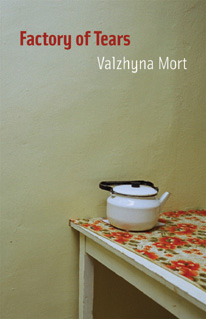
Valzhyna Mort, Factory of Tears, Trans. by author, Elizabeth Oehlkers Wright and Franz Wright, Copper Canyon Press; Bilingual edition, 2008.


"Celebrated in Europe for her dynamic performances, Mort, a 26-year-old Belarusian poet, is a fireball, and her American debut collection, nothing short of phenomenal.
This bilingual publication, cotranslated by the husband-and-wife team of Elizabeth Oehlkers Wright and Pulitzer Prize-winning poet Franz Wright, features 36 works, including the blistering prose piece White Trash, Polish Immigrants, and Belarusian II Mort's vision is visceral, wistful, bittersweet, and dark. In Music of Locusts, the narrator laments, "Everything belongs to me but hope" while "the whole colorful universe/ appears like the deep/ hole in the sink" in Hospital Mort takes an unflinching look at a violent world, referencing homeless dogs, dead men, terrorist attacks in Chechnya, stinging memories, bloody bodies, and forced silence. Personal, political, and passionate, Mort's poetry will surely sustain many reading audiences." - Miriam Tuliao

"In her first American publication, poet Valzhyna Mort contends with the joys and sorrows that comprise the heartache of self discovery. Factory of Tears juxtaposes youthful coming-of-age against the struggles of a nation's emergent vitality... Self identification, national independence, and the bounty of metaphor and language take us to an edge where everything is wild."

"The 26-year-old Belarusian Mort has made a big splash in Europe. With help from the popular, Pulitzer-winning Franz Wright, this thin, uneven, but decidedly exciting bilingual first U.S. edition shows how Mort's energies work. Some poems last just a few lines; others stretch out across pages of fast-moving prose, and the best bring into disturbing collision the difficult circumstances of Eastern Europe (crowds, relative poverty, bad weather) and the recent results of globalization (suicide bombers, teen culture, game shows with telephonic life lines). Mort says of her compatriots in Belarusian I, we gorged on dirt thinking it was bread and calls our future/ a gymnast on a thin thread of the horizon. Later poems reflect her move to the U.S. (she now resides in Virginia), and contemplate those who have made the same move before: of Polish Immigrants, she asks, how do they break away from the land/ where even stones take root. At her best, Mort shows a ragged power Americans might not otherwise know: she writes in a crackling prose poem, I protest against everything: low-quality goods in supermarkets, pigs in the subway, and those who protest against pigs in the subway... this is the only way to survive." - Publishers Weekly

"Everything is from shit. Absolutely everything," Mort writes in her début American publication. "The thing is that there is good shit and bad shit." It’s a difficult point to dispute in this argumentative collection. Mort, a young Belarusian poet living in America, strives to be an envoy for her native country, writing with almost alarming vociferousness about the struggle to establish a clear identity for Belarus and its language. (All but one of the poems appear alongside their Belarusian originals.) The poems are driven by a tension between cynicism and patriotism: Belarus, for Mort, is a difficult obsession. Approaching Minsk, her birthplace, at dusk, she writes, "This is how brutally, / this is how tight / heart climbs out of the mouth / and strains eyesight." - The New Yorker

"Mort's style—tough and terse almost to the point of aphorism—recalls the great Polish poets Czeslaw Milosz and Wislawa Szymborska." — LA Times

“A risen star of the international poetry world,” declares the Irish Times, about Belarusian poet Valzhyna Mort, who is famed throughout Europe—and now the US—for her vibrant reading performances. Mort, born in Minsk, Belarus (former Soviet Union), in 1981, made her American debut in 2008 with a poetry collection Factory of Tears (Copper Canyon Press), co-translated by the husband-and-wife team of Elizabeth Oehlkers Wright and Pultizer Prize-winning poet Franz Wright. Her second book is Collected Body (Copper Canyon Press, 2011).
There is an urgency and vitality to her poems; the narrative moves within universal themes—lust, loneliness, the strangeness of god, and familial love—while many poems question what language is and challenge the authority that delegates who has the right to speak and how. The New Yorker writes, “Mort strives to be an envoy for her native country, writing with almost alarming vociferousness about the struggle to establish a clear identity for Belarus and its language.” Library Journal described Mort's vision as ”visceral, wistful, bittersweet, and dark,“ and Midwest Book Review calls Factory of Tears ”a one-of-a-kind work of passion and insight.“
Valzhyna writes in Belarusian at a time when efforts are being made to reestablish the traditional language, after governmental attempts to absorb it into the Russian language have been relinquished. She reads her poems aloud in both Belarusian and English. About her reading performance, The Irish Times wrote, “[T]he searing work of Valzhyna Mort, marvelously different in form and in delivery... dazzled all who were fortunate to hear her translations, and to be battered by the moods of the Belarus language which she is passionately battling to save from obscurity.”
Mort received The Bess Hokin Prize for her poems in the December 2009 issue of Poetry Magazine, the Crystal of Vilenica award in Slovenia in 2005, and the Burda Poetry Prize in Germany in 2008. She has been a resident poet at Literarisches Colloquium in Berlin, Germany, and has received a fellowshiip at Gaude Polonia, Warsaw, Poland. She is a recipient of a 2009 Lannan Literary Fellowship. Her English translations of Eastern-European poets can be discovered in the anthology, New European Poets (Graywolf Press, 2008). Factory of Tears has been translated into Swedish and German.
Mort has the distinction of being the youngest person to ever be on the cover of Poets & Writers magazine. She lives and teaches in Baltimore, Maryland.
About COLLECTED BODY (2011)
Collected Body is Mort's first collection composed in English. Whether writing about sex, relatives, violence, or fish markets as opera, Mort insists on vibrant, dark truths. "Death hands you every new day like a golden coin," she writes, then warns that as the bribe grows "it gets harder to turn down."
About FACTORY OF TEARS (2008)
Factory of Tears is the American debut of Valzhyna Mort—and the first bilingual Belarusian-English poetry book ever published in the US. Set in a land haunted by the specter of a post-Soviet Eastern Europe, and marked by the violence of the recent past, intense moments of joy leaven the darkness. “Grandmother”—as person and idea—is a recurring presence in poems, and startlingly fresh images—desire as the approaching bus that immediately pulls away or pain as the embrace of a very strong god “with an unshaven cheek that scratches when he kisses you”—occupy and haunt the mind. The music of lines and litanies of phrases mesmerize the reader, then sudden discord reminds us that Mort's world is not entirely harmonious. “I'm a recipient of workers' comp from the heroic Factory of Tears”, she writes in the final stanza. “I have calluses on my eyes...And I'm Happy with what I have.” Engaged, voracious, and memorable, Factory of Tears is a remarkable American debut of a rising international poetry star. The translation was in collaboration between Mort, Pulitzer Prize-winning poet Franz Wright, and Elizabeth Oehlkers Wright." - Alison Granucci

"Even more than its neighbors, Belarus remains chained to its past. Landlocked by Russia and the Baltic states, the country was decimated in the 1940s by the Nazis; over the next two decades, it was absorbed into the Soviet Union, its language and culture suppressed. The majority of postwar poets exported from the former Eastern bloc have been Polish (Herbert, Milosz, Szymborska), and Belarus, still crouching in Moscow’s long shadow, has yet to produce a bard of international stature. So when the press release for Valzhyna Mort’s Factory of Tears declares it “the first- ever Belarusian/English book of poems published in the United States,” the statement comes tinged with urgency.
Unlike her cultural forebears, Mort, born in 1981, does not seem keen to exhume her country’s past. She is similarly ambivalent about its future: “Belarusian I” ends with the cryptic lines “and there on the horizon the gymnast of our future / was leaping through the fiery hoop / of the sun,” suggestive of both courage and reckless self-obliteration. Likewise, the title poem concludes with a series of declarations—“I have compound fractures on my cheeks. / I receive my wages with the product I manufacture. / And I’m happy with what I have”—that hover between bitter sarcasm and weary sincerity. This is not to say that Mort argues against the pro-Western spirit of the many political movements, like the Ukraine’s Orange Revolution, that have spread like wildfire throughout Eastern Europe. It’s just that her focus is trained elsewhere.
On sex, for instance. Often (too often, perhaps), Factory of Tears taps the vein that was first opened by Anne Sexton and Sylvia Plath and that, over the past forty years, has been drained almost dry. If Mort aims to shock, one can only assume that Belarusian audiences are scandalized by lines like “Lust is sitting inside me like a cherry pit” and “Who will pinch the ass of love.” Americans have heard it all before. The otherwise elegant translation occasionally dips too eagerly into slang, as if hinting that not all Belarusians are the dreary pensioners that we (admittedly) tend to picture them as.
What’s most compelling about these poems—especially the multipage “White Trash,” whose lines seem written for performance rather than reading—is that they are political, but obliquely, almost sneakily so. “Your glance in certain circumstances can replace tear gas” serves, for instance, as an apt metaphor for Mort’s continual obstruction of the political with the personal. This strategy, if not always well executed, ultimately succeeds. It suggests that the author has captured a perspective that many Americans may have simply overlooked: that of a European generation for which the United States is not a blazing torch of democracy but a bizarre admixture of puritanism, militarism, and sex—a collective export the author approaches with skepticism rather than adulation." - Matthew Ladd

"When asked why she chose Belarusian as the language for Factory of Tears Valzhyna Mort said she always wanted to be a musician and was able to achieve a certain musicality through the Belarusian language that she couldn’t achieve with the Russian Language. Mort, born in Minsk, Belarus, in 1981, made her American debut in 2008 with a poetry collection Factory of Tears –the only book of poetry to be written in Belarusian with side-by-side English translation—And the musicality translates to English through Mort’s chorus-like lyrics, alternating rhythms and short percussive line breaks. But why does she choose Belarusian, when the language is not expected to survive the next generation?
Belarusian is an Eastern Slavonic language with about 7.5 million speakers in Belarus. In “Bellarussian I” Mort establishes that she is part of a history of Belarusians who have fought in difficult circumstance to keep their language alive.
and our tongues were removed we started talking with our eyes
when our eyes were poked out we talked with our hands
when our hands were cut off we conversed with our toes
when we were shot in the legs we nodded our heads for yes
and shook our heads for no and when they ate our heads alive
we crawled back into the bellies of our sleeping mothers
as if into bomb shelters
to be born again

She continues this theme throughout Factory of Tears and culminates with “Belarusian II” where she refers to the fact that part of the vulnerability of the Belarusian language is that no one can agree on a spelling system for the language.
“Belarusian II”

Your language is so small
That it can’t even speak yet

Letting another’s language suck your own milk?!
A bluish language lying on the windowsill—
Is it a language or last year’s hoarfrost?
For Mort, choosing to write in Belarusian is a form of political activism. By physically connecting Belarusian to the English language, Mort has taken action towards keeping Belarusian alive and as she says in “Juveniles” “…no one is going to deny us the city we grew up in.”
Mort was 14 years old when Belarusian lost it’s status as the exclusive language of Belarus. There’s a childlike fearlessness and vulnerability preserved in Factory of Tears which seems to urgently fight against the system that is depriving the survival of the language. Many of the images used in Factory of Tears belong to a child. And almost all her poems use a crayon-like palette of simple primary colors to reinforce imagery. In “Juveniles’ she writes from the perspective of a child “…painting our faces like Easter eggs,” often repeating “ because we are children.”
In “For A.B.” for she writes – Our skin so thin/That veins blued through it/Like lines in school notebooks.” In “White Trash” She writes - “Who is building his joy like a snowman, a dumpling….who is pinching the ass of love.” In one poem Mort uses a multiple choice test to show the thought process of a child trying to logically understand terrorism.
Mort uses “we” and “our” throughout her poems, talking for her generation. In that sense Factory of Tears gives voice to her generation with an urgency. Very early in the book Mort identifies her generation with the fragility and vulnerability of the Belarusian Language– “we discovered we ourselves were the language.”
Mort says that she was so close to her grandmother that it was almost as if her grandmother wrote Factory of Tears. In this sense Factory of Tears is about the survival of Mort’s grandmother and how they saw the world together. In “Grandmother,” she writes “…Put me in your lap,/tell me the stories about the world that is standing on tortoises. Your/hands feel like a tortoise’s shell. Let me hide my head in them.”
Factory of Tears is a document of survival. Survival of Belarusian language, survival of Mort’s Grandmother, survival of Mort’s generation and survival of Mort’s childhood. Mort achieves her music with modern poetics and strong images drawing from a generation’s nostalgia and frustration, childhood references and a grandmother’s insight. The technical musicality of her poems furthers her cause to brand Factory of Tears and Belarusian on its reader." - J. Hope Stein

"Factory of Tears, originally written in Valzhyna Mort's native Belarusian, appears with the translation alongside the original work. According to the book jacket, it is the author's intent "to reestablish the traditional language of her homeland." The country’s official language has been divided between Russian and Belarusian since 1995. Belarus, situated between Lithuania and the Ukraine, is a country with a history of fighting for independence.
Mort's work reflects a poetics of survival in "Belarusian I":
even our mothers have no idea how we were born
how we parted their legs and crawled out into the world
the way you crawl from the ruins after a bombing
and later:
we crawled back into the bellies of our sleeping mothers
as if into bomb shelters
to be born again
Other works present the implications of youth and aging in the context of change and sameness; others, in boredom, loneliness, frustration and disgust with life. Still others, like "White Trash," strive to be epic in a Whitmanesque sense, but the effect is more that of a pointless rant. "White Trash" is interspersed with stanzas about Chechnya that seem out of place in the midst of such lines as "Who is ready to take luck by the throat, and make it sit on the potty whispering into its ear: 'Finally you're mine, pain in the ass'?"
"Fall in Tampa" provides a mediocre evocation of seasonal metaphor while poems with titles like "Cry Me a River" come off as cliché and unimpacting. Mort uses abstract language without the abstractions themselves. An example of this is in "You see your life as something borrowed," where Mort writes, "It's not your life that teaches you—it's you who gives your life a lesson. To be yourself. To give yourself to the end." Lines like these abstract a grounded sense of reality, and are philosophical without providing concrete examples.
"Belarusian I," along with "Factory of Tears" are two of the most effective poems in the collection. Mort's strongest attribute as a poet may be her ability to synthesize life in political upheaval with a poetics of continuity." - Cynthia Reeser

"That is the title of a collection by Valzhyna Mort. What a wonderful title. A poet’s work, poems’ work, life, one’s homeland… The last poem in the book has the same title, and starts –
And once again according to the annual report
the highest productivity results were achieved
by the Factory of Tears.
It ends –
I’m a recipient of workers’ comp[ensation] from the heroic
Factory of Tears.
I have calluses on my eyes.
I have compound fractures on my cheeks.
I receive my wages with the product I manufacture.
And I’m happy with what I have.
Great to see the language of Soviet era central planning put to such absurd use. And to be made to wonder about the Factory of Tears that is poetry.
The last line takes us back to the smiling workers of socialist realism. If the poem had been written by someone from any other former Iron Curtain country, we might suspect ironic Ostalgie. But Valzhyna Mort is from Belarus which is a dictatorship, very repressive; see the BBC, today. See also the Belarusian Telegraph Agency, if you want to enter the strange land the Factory came from – note that in the menu of news topics, President comes first, before Politics, Economy etc. It’s hard to imagine that Mort is popular with the Belarusian authorities, though her first poems were published there.
Valzhyna Mort now lives in the US. Factory of Tears has Belarusian and English in parallel text, the translation done by the author and Elizabeth and Franz Wright. An excellent idea – if only there were more such poetry books. Someone who has a Slav language and Cyrillic script can follow the original, which makes a huge difference to the reading experience. (I was reading it yesterday sitting on the train, and became aware that a young man with a check shirt was standing there, staring intently at my book.. he then turned abruptly and walked off. Had he thought it was Russian and then realised it wasn’t?)
However, this may also be a disadvantage. Mort said in an interview: “For me this is something that I would like to escape, this label of being a Belarusian poet because I truly don’t know what is Belarusian about my poetry and when I come to a reading, I feel people have some kind of expectation that I will not be able to fulfil unless I wear a national costume!”
I confess I find it hard to get away from the Belarusianness: the Belarusian text, the book’s title; even the novelty value, the costume. In the poem quoted above, the Factory of Tears has ‘adopted a new economically advantageous / technology of recycling the wastes of the past - / memories mostly’, and the theme of memory, some of it very Belarusian, runs through the book. It is a first full collection, published in 2008; her next book will be written in English. Maybe the interview comment, from 2010, is more about her recent work.
Anyway, one of the book’s strengths is the poet’s ability to draw on the unusual material provided by her country of birth. The opening poem, ‘Belarusian I’, begins
Even our mothers have no idea how we were born
how we parted their legs and crawled out into the world
the way you crawl from the ruins after a bombing…
and later
completely free only in public toilets
where for a little change nobody cared what we were doing
we fought the summer heat the winter snow
when we discovered we ourselves were the language
and our tongues were removed we started talking with our eyes
…..
…and when they ate our heads alive
we crawled back into the bellies of our sleeping mothers
as if into bomb shelters
to be born again

and there on the horizon the gymnast of our future
was leaping through the fiery hoop
of the sun
That’s the end of the poem (read it here, plus a video interview), which she says is a response to criticism she and her contemporaries received for writing in Belarusian rather than their first language, Russian. It shows another of the book’s strengths, the vigorous imagery which drives so many of the poems. She often starts with something simple – a tiger, a train, snow – but the way she uses the images is very striking. The short poem ‘Fall in Tampa’ ends
..summer is standing stock-still
like a white heron in green water
‘for Rafal Wojaczek’ has death as a fly:
getting into your eyes
mouth
ear
like a filthy fly
death is circling
interfering
with seeing
eating…
A grandmother, to whom the book is dedicated and whom I understand as symbolic / folkloric as well as very real and loved, appears in the poems; this one’s called ‘Grandmother’.
she swallows the sun-speckles of pills
and calls the internet the telephone to america

her heart has turned into a rose the only thing you can do
is smell it
pressing yourself to her chest
By now it will be clear that she writes in free verse, without much punctuation, and that the line breaks mostly go with the sense. The translators have done a good job of being faithful to this without losing the energy.
The poems that don’t work so well lack the thematic force that otherwise welds different metaphors together within one poem. A long prose poem, ‘White Trash’, in the middle of the book has some great bits which could be more effective on their own, each as a short prose poem.
I suppose it’s a cliché that the first post-war generation of East European poets wrote politically, and the post-Fall of Berlin Wall generation turned towards individual experience. Though Mort belongs to the younger end of the latter group (and writes poems about sex and growing up) it seems to me her poems contain elements of both, and her surreal metaphors certainly recall some of the former, such as Różewicz and Holub. Her perspective can be both very personal and broad at once, as in ‘for A.B.’:
it’s so hard to believe
that once we were even younger
than now
that our skin was so thin
that veins blued through it
like lines in school notebooks
that the world was a homeless dog
that played with us after class
and we were thinking of taking it home
but somebody else took it first
gave it a name
and trained it stranger
against us
Mort has said she is old-fashioned in that she believes in ‘inspiration’. Audios of her reading in Belarusian sound great – she’s been described as a ‘fireball’ and ‘electrifying’. The best poems come across on the page with the force and originality of something inspired. Wherever she’s going, I hope she doesn’t abandon the national costume completely, to be lost in the great American crowd." - Fiona Moore


Selected Writings

ZHENYA

1.
… Zhenya moves as if her left side were heavier than her right. She leans like an old village fence, almost kissing the ground, and a shred of green cloth, scudded by the wind around the grazing, has finally caught hold of one of the boards and hangs on it—and it is Zhenya’s jacket. Enveloped by the damp October soil, under unending drizzle, the fence is rotting. Leisurely, Zhenya rots at a forty-five degree angle, her putrid insides wrapped carefully into her skin. Unable to tear my eyes off Zhenya, as she limps away, stops to thoroughly read the university announcements, smokes leaning against the corner of the International Affairs building, I imagine God’s invisible hand that carries the white paper wrap around the
city, unable to find a proper trash bin.


PREFACE

on a bare tree—
a red beast,
so still, it has become the tree.
now it's the tree that prowls over the beast,
a cautious beast itself.

a stone thrown at its breast

is so fast—the stone has become the beast.
now it's the beast that throws itself like a stone,
blood like a dog-rose tree on a windy day,
and the moon is trying on your face
for the annual masquerade of the dead.

death decides to wait to hear more.
so death mews:
first—your story, then—me.

—from Collected Body


BELARUSIAN I

even our mothers have no idea how we were born
how we parted their legs and crawled out into the world
the way you crawl from the ruins after a bombing
we couldn't tell which of us was a girl or a boy
we gorged on dirt thinking it was bread
and our future
a gymnast on a thin thread of the horizon
was performing there
at the highest pitch
bitch

we grew up in a country where
first your door is stroked with chalk
then at dark a chariot arrives
and no one sees you any more
but riding in those cars were neither
armed men nor
a wanderer with a scythe
this is how love loved to visit us
and snatch us veiled

completely free only in public toilets
where for a little change nobody cared what we were doing
we fought the summer heat the winter snow
when we discovered we ourselves were the language
and our tongues were removed we started talking with
our eyes
when our eyes were poked out we talked with our hands
when our hands were cut off we conversed with our toes
when we were shot in the legs we nodded our head for yes
and shook our heads for no and when they ate our heads
alive
we crawled back into the bellies of our sleeping mothers
as if into bomb shelters
to be born again

and there on the horizon the gymnast of our future
was leaping through the fiery hoop
of the sun


A Poem About White Apples

white apples, first apples of summer,
with skin as delicate as a baby’s,
crispy like white winter snow.
your smell won’t let me sleep,
this is how dead men
haunt their murderers’ dreams.
white apples,
this is how every july the earth
gets heavier under your weight.

and here only garbage smells like garbage…
and here only tears taste like salt...

we were picking them
like shells in green ocean gardens,
having just turned away from mothers’ breasts
we were learning
to get to the core of everything with our teeth.

so why are our teeth like cotton wool now...

white apples,
in black waters, the fishermen,
nursed by you, are drowning.


Untitled

for A.B.

it’s so hard to believe
that once we were even younger
than now
that our skin was so thin
that veins blued through it
like lines in school notebooks
that the world was a homeless dog
that played with us after classes
and we were thinking of taking it home
but somebody else took it first
gave it a name
and trained it “stranger”
against us

and this is why we wake up late at night
and light up the candles of our tv sets
and in their warm flame we recognize
faces and cities
and courageous in the morning
we dethrone omelets from frying pans...

but our dog grew up on another’s leash
our mothers suddenly stopped sleeping with men
and looking at them today
it’s so easy to believe in the immaculate conception

and now imagine:
somewhere there are towns
with white stone houses
scattered along the ocean shore
like the eggs of gigantic water birds
and every house carries a legend of a captain
and every legend starts with
“young and handsome...”


Grandmother

my grandmother
doesn't know pain
she believes that
famine is nutrition
poverty is wealth
thirst is water

her body like a grapevine winding around a walking stick
her hair bees' wings
she swallows the sun-speckles of pills
and calls the internet the telephone to america

her heart has turned into a rose the only thing you can do
is smell it
pressing yourself to her chest
there's nothing else you can do with it
only a rose

her arms like stork's legs
red sticks
and i am on my knees
howling like a wolf
at the white moon of your skull
grandmother
i'm telling you it's not pain
just the embrace of a very strong god
one with an unshaven cheek that scratches when he kisses you


Factory of Tears

And once again according to the annual report
the highest productivity results were achieved
by the Factory of Tears.

While the Department of Transportation was breaking heels
while the Department of Heart Affairs
was beating hysterically
the Factory of Tears was working night shifts
setting new records even on holidays.

While the Food Refinery Station
was trying to digest another catastrophe
the Factory of Tears adopted a new economically advantageous
technology of recycling the wastes of past —
memories mostly.

The pictures of the employees of the year
were placed on the Wall of Tears.

I’m a recipient of workers comp from the heroic Factory of Tears.
I have calluses on my eyes.
I have compound fractures on my cheeks.
I receive my wages with the product I manufacture.
And I’m happy with what I have.

5/17/11

Lonely Christopher worries at the wounds made by family and at the odd cancers quickened by desire


Lonely Christopher, The Mechanics of Homosexual Intercourse, Akashic Books, 2011.


"TWO BOYS LIE ON A BED, ONE OF THEM IS ALREADY DEAD; they listen to Glenn Gould playing Bach and talk about suicide and love. A lonely narrator mourns the end of a relationship and the disappearance of a mysterious object as a frustrated artist jumps out of a moving car on his birthday and runs for the last streetlamp in the universe. Awkward parents and angsty teens negotiate a dark suburban landscape, searching for something they can't name, spelling out balletic sentences of failure and shame. Helicopters menace the night sky, a horse is murdered in a kitchen, victims go missing in swamps of ambiguity, and everybody waits for what the construction of a new road into town will bring: the end of the world or something worse.
The Mechanics of Homosexual Intercourse, a radical map of shortcomings in our daily experiences in the form of a debut story collection, presents thematically related windows into serious emotional trouble and monstrous love. Lonely Christopher combines a striking emotional grammar, reminiscent of Gertrude Stein's Three Lives, with an unyielding imagination in the lovely/ugly architecture of his stories."

"For all their postmodernist touches, the nine stories in poet Christopher's provocative and refreshing debut collection offer coherent plots and accessible prose, starting with the long title tale, about the efforts of a guy named Dumb to forget his dead boyfriend, Right, as he embarks on a new relationship with a person called Orange. In "Game Belly," which charts the night moves of club kids, characters are identified not by name but by brief tags like "the kid with long hair." "White Dog" finds menace in a woman's not so mundane trip to the supermarket. The supershort "Milk" plops a horse into a kitchen. With a lot of alternative fiction, one gets the feeling that the writer's rejection of traditional forms isn't earned; not so with this author, who's also a librettist and playwright. More Russell Banks than Donald Barthelme, Christopher could write solid, naturalistic stories if he chose, and he almost does." - Publishers Weekly

"Praise seems superfluous for a book as accomplished, cohesive, and devastating as Lonely Christopher's debut collection, so consider these words admiration instead, and admonishment: if you still think fiction counts for anything, then you should buy this bookĘright now." - Dale Peck

"Lonely Christopher, as his name suggests, knows despair as only a hobo or a clown can. This knowledge animates his fiction and provides each story with a humor that belies the terrible things that happen to his men, women, children, and animals. His formal experimentation will reward readers who have been craving a Huysmans sort of Nick Drake sort of Andy Kaufman killer writer. These readers will, like all good boys and girls, go to bed happy at last." - Kevin Killian

"Damn straight I judge books by their covers, and I judged the hell out of Lonely Christopher’s The Mechanics of Homosexual Intercourse: The cheeky nom de plume, drily academic title and bloodied prepubescent doll-boy had me anticipating some unholy union of Tao Lin’s preciousness, Ben Marcus’ experimental airlessness and Dennis Cooper’s deadpan depravity. To be clear, I would not have enjoyed such a mélange. But when I rallied to actually read the book, I found sharp and shimmering constructions inside, stories that sparked like burning bugs. What I found was a vicious debut collection by a young writer not on the verge of great things, but a young writer already doing great things.
Guided by the black light of Kafka’s “The Judgement,” perhaps literature’s supreme domestic nightmare, Lonely Christopher worries at the wounds made by family and at the odd cancers quickened by desire.
The strongest (and longest) story here, “Nobody Understands Thorny When,” is also the most superficially traditional. Darting back and forth on the mine-ridden timeline between a boy’s abduction and eventual return home, Lonely Christopher uses a rather familiar story arc to upset notions of tragedy and redemption. What emerges is an unsettling and haunting study of what it means to love people who love to hurt us, to hurt people who hurt with love for us.
Things do get structurally strange, as in “That Which,” an Oulipo-esque experiment consisting only of one-syllable words, and the narratives do flirt with outlandishness—“Milk” concerns a horse trapped between a fridge and a microwave—but the limpidity of Lonely Christopher’s language and his startlingly keen eye for common (but no less damaging) emotional cracks keeps the stories moored to a world that is recognizably ours. “White Dog,” the final story in The Mechanics of Sexual Intercourse, introduces us to a woman who has just woken up in a grocery store’s parking lot. She does not know how she got there, but she decides to shop, because although the nature of her arrival might be a mystery, the fact of that grocery store and its stocked shelves is not.
Lonely Christopher is, in his subtle way, describing his own work, a push-pull of sense and transcendence that commands us to keep moving, keep searching for ways to understand why we are this way." - Chris Stamm

"There’s this theory that activist and writer Eve Ensler and I talk about from time to time about people who are living in the world who are alive and people who are living in the world who are dead.
Call it a way of looking at human beings that explains death not only as something that stops life in one motion but also describes what people are doing when the engine of wonder sputters and leaves someone stranded and soulless: alive but hollow and strange. We all know people from both sides of the theory: dead people, living people.
Lonely Christopher’s first book of short stories is called The Mechanics of Homosexual Intercourse (Akashic) and everything about it—from its title, subject matter, syntax, even to the author’s photograph (a dark and barely decipherable image of a man squeezed into an open closet with his head inside a cage)—feels like a document delivered from a community of people who are living but who are… dead.
Not only are characters in these stories haunted by their own, (mostly), missteps, but they are fixed in their wrongness and are drawn as static, self-interested, inarticulate creations lacking real passion for anybody or any thing.
They are living blocks of wood who, more often than not, have mistaken addiction, violence and hanging around, as life. Here’s a scene from the first story in the book, “That Which”:
Dumb sat anxiously in the tub, Morton, having lowered the cover, sat on the toilet, and Lucy stood in the doorway of her bathroom holding a beer. “What then?” asked Morton. “Then he said, ‘I don’t usually drink vodka,’ and I told him he told me that when he was puking in the wastebasket before he passed out,” said Lucy. “uh, yeah,” Dumb agreed. “And described how you felt for me, please,” said Morton. “Nothing, I guess,” Said Dumb. “Everything really hurt, and maybe there was only room for some thoughts about what a bad idea it was to have drunk that much.
This strange and completely other book (an imprint of Akashic Books called Little House on the Bowery, curated by Lambda Literary Award winner Dennis Cooper) is made up of stories quixotically drawn around people like the ones above and other kinds of them that we all know but sort of wished we didn’t or, perhaps more importantly, never have really looked at closely enough to see if there was any light inside.
A great upheaval of the lost are here: outside the outside—beyond merely being marginal: sorry, negative and weirdly enough (?) gay most of the time. They all have names that practically declassify them as being human: Burning, Victim and Ash and you’ve already met Dumb.
The stories have strange titles, too: “Nobody Understands Thorny When,” “Game Belly,” and the title story: “The Mechanics of Homosexual Intercourse,” which is about two boys—one them who happens to be dead—both “listening” to Glenn Gould playing Bach, among other things.
The story really has nothing (or is it everything?) to do with sex or love or Glenn Gould. It reads—as every story reads—as a chance encounter, a haphazard arrangement of language with some people and places thrown in and after a while the complete avoidance of complexity or lyric beauty in subject matter or in language really begins to wear one down.
There’s no real morality or understanding of life as these stories have their curtains fall—all unseemly parts of an arbitrary sum: skewed syntax, an expanse of desert where once some flowers were.
And, of course, they can be surreal.
The story, “Milk” begins: “The horse was in the kitchen.”
It ends with this:
‘That horse was nothing but a pain in the neck,’ my mother said at supper. My father winced and ejaculated an overstated sigh. We ate meatloaf and broccoli and drank tall glasses of milk. The television, carted in from the living room, played the evening news a low volume following our required prayer. The stable thereafter was a shed. Father brought a new riding lawn mower he kept in there. The name of the horse was Black Beauty even though it was brown.
Much of the writing in the other stories has the same musicality and sense that sentences are independent statements of thinking related or not related to a strict story sense. Sometimes this works beautifully and one is sort of transported into this bizarre world of saying something and anonymity and at other times it all feels pretentious and meandering.
And there’s this overriding, somewhat annoying contrivance that generates every story which has to do with the metaphorical placing of people in the dark wood and having them not find the way out.
Because so many of Christopher’s stories are populated by characters who don’t have names one would associate with human beings, we’re back in that place of living with dead people.
The worlds that Lonely Christopher makes in this, his debut collection, are all cages, at a time of the world when we really need more stories about people who are shamelessly free—helping people be alive, not letting them be dead." - Michael Klein

"In 2003, the novelist Dennis Cooper launched his Little House on the Bowery series in connection with Akashic Books. Releasing around two books a year, this line of fiction books focuses mainly on younger North American writers who, according to an introduction for the series written by Dennis himself, "believe that fiction can be as entertaining, challenging, revelatory, and, in a word, important as any other medium. I hope Little House on the Bowery will be a reliable source for readers who want literature to be an adventure on the levels of content and style. I also want it to be an oasis for people who have come to see contemporary literature as a spotty, conservative medium." Over the years Little House on the Bowery has released a number of innovative and captivating books, including 2007's short fiction anthology Userlands (confession: a story of mine appeared in this book so naturally I'm biased) and, more recently, Mark Gluth's sublime novella The Late Work of Margaret Kroftis. Early this year they released their two newest titles, a reissue of Matthew Stokoe's cult transgressive novel Cows and Lonely Christopher's The Mechanics of Homosexual Intercourse, a collection of nine short stories that I have just recently completed reading and will now briefly review.
This is certainly a most curious collection, and I'm having trouble classifying it. Many of the stories (which end on ambigious notes) feature characters with unusual names, such as Dumb, Vowel Shift, Burning Church, Normal Chapter, and Timmy Victim. And the writing style is very unusual. For example, the first story, "That Which," is narrated by a boy who suffered from a debilitating head injury and is thus written in a very disjointed manner. Equally bizarre is the subject matter: the fourth story, "Milk" (which is also the shortest story in the collection at a mere 4 pages) revolves around the murder of a horse in a kitchen. The better stories, in my opinion, are the longer ones that focus more on characterization, such as "Burning Church," (which deals with a week in the life of a school teacher named Burning Church), and "Game Belly," an atmospheric piece which takes place in an empty city late at night and which revolves around a number of vacuous characters going about their nocturnal activity (though I wonder what exactly a "game belly" is). By far the best story is "Nobody Understands Thorny When," which at 34 pages is the longest story of the book. It's about the relationship between an odd boy (named Thorny When) and his kidnapper (Normal Chapter), and their most strange love affair, and how Thorny's life changes when he's "saved" from his captor after four years.
Not all of the stories worked for me though. I had no idea what "The Pokemon Movie" was supposed to be about (perhaps because I'm not all that familiar with the Pokemon phenomenon in general), though if I had to hazard a guess I'd say it's about the loss of childhood innocence. And the last story, "White Dog," which is about a seven foot tall lesbian who wanders in a dream-like daze through a supermarket, goes on for way too long, with many tedious and rambling paragraphs (the narrator spends 4 pages debating whether to buy mascara or not).
For the most part, however, I found the stories to be well-written, entertaining and humorous. I can only wonder what Christopher's influences are... some of the stories have a sort of David Lynch vibe ("Burning Church" even features a hallway light that flickers constantly). He certainly has an impressive vocabulary: some words that really stood out were "videlicet," "pulchritude," and "contrastively." One thing is certain: it will be interesting to see in what direction he takes his fiction next.
Finally, like many of the other books released by Little House on the Bowery, this one also features a typically awesome cover by Joel Westendorf." - James Champagne

"I went to creative writing school as an undergrad with this guy who would later adopt the pseudonym “Lonely Christopher.” He wrote these stories that basically no one knew what to do with—they were full of weird grammar jokes, sudden shifts of scene, and a kind of dream-logic that was sometimes funny if you figured it out, and sometimes deeply disturbing. He rewrote Stephen King’s The Shining as a 100-page-long sometimes-abstract language program, started a novel that combined Dracula with the gay club scene, and drank way too much Ballantine Ale. Basically, he was the guy about whom everyone said, “Holy shit, that weird dude has some actual talent.”
Now he’s got a real book coming out, called The Mechanics of Homosexual Intercourse, on Dennis Cooper’s publishing imprint, Little House on the Bowery, and is getting a bunch of rave reviews from people like Dale Peck, which is not bad for a 23-year-old who still drinks way too much Ballantine. His book release reading/party is tonight at Bluestockings Books, and after that he’s going on a big book tour that includes a reading with performance artist Genesis P-Orridge. I swallowed my jealousy the other night and went over to his place, bought him a 40, and talked about how it feels to be all semi-famous and shit.
You went to school for writing and you produced a book of short fiction—that’s pretty much what every writing student, in their ideal world, pictures themselves doing, right?
- I suppose so. When I was writing and thinking that I was eventually going to write publishable stories, in a way that was working against the attitude of writing school. It was sort of designed as a bit of a fuckaround, and a lot of the students were idiots, you exempt.
Thanks for that. Why is it such a fuckaround?
- Maybe it’s just an accident, I don’t know. We studied under some really good teachers, like Joshua Furst, who used to teach at Pratt. He had a pretty defensible teaching model, which was he was going to take his students seriously, and whatever they were writing he was going to help them figure out logically how to develop that into something that worked.
I think writing school is very beneficial so long as you know what you’re doing and you have enough focus as a student, but you do have to cut through some of the bullshit. A few professors, when I was learning how to write fiction, believed in my work and spent the time to help me develop as a writer, what I was dealing with a lot was—you know, I wasn’t writing the kind of work they knew how to critique or that they even enjoyed and they said, “This is just too weird and not, ever, ever going to get published.” And it’s really easy to tell someone their work isn’t going to be published, because 99.9 percent of the time you’re going to be correct. Another thing about where we went was they didn’t actually teach us how to behave in a publishing industry environment, like that’s so unfeasible they don’t even get around to talking about it.
Well, there was that one class where they told us that we would never get published.
-
I didn’t go to that class. I went once, and there was an agent there who lectured us in a very condescending way about the publishing industry, gleefully, it seemed, crushing our souls. What she told us was that no one was going to respect our integrity as writers and if we wanted a book we would have to write a popular nonfiction book, and then people would start talking to you about your novel.
But you did get your fiction published, thanks to Dennis Cooper, right?
- His interest in my work has obviously been life-changing. All of a sudden I had the interest of a relatively well-known established fiction writer who I had a lot of respect for. I mean, you wouldn’t be sitting here asking me these questions if that turn of events hadn’t occurred. So I’m really thankful for Dennis’s support, and I’m happy that this book is out, because otherwise it would be sitting in a drawer and no one would be talking about it. It’s been a startling experience having a conversation about my work occur in a room where I’m not sitting. That’s definitely new to me.
How do you feel about that kind of low-level fame?
- I don’t know. My reaction vacillates between out-of-control pride and complete existential despair.
I mean, I don’t think there’s any special or inherent quality in myself that makes me any better than anyone else who has to make those kinds of decisions, and I’ve been poorly managing my life so far and I just happened to hook up with a really small but big enough publisher in Brooklyn, so I have a book now.
Well, in fairness, you’re one of the hardest-working writers I know.
- It’s not to say that what I’ve been pursuing doesn’t take a lot of work and sacrifice. I mean, I’ve been living a pretty indigent, despairing, bohemian lifestyle. I’m sort of embarrassed for myself the way I’ve been living. I don’t know if this is something I picked up in school, but this tendency to be self-delusional and think what I’m doing is important enough to not have to figure out how to live in a very expensive city and try to make it work. Which it really hasn’t been. I mean, I have a book, but the rest of my life is going completely to shit.
I realize that we might lack a certain perspective and people might find it foolish that we’re talking so gravely about our circumstances when we’re so young, but I don’t feel particularly young.
That’s fucking depressing.
- I mean, I know I’m living like a child, but—
Like a drunk child.
- Like a very drunk child." - Interview by Harry Cheadle

5/10/11

Voynich Manuscript - The world's most mysterious: the language of plants where the search for meaning is the meaning?

The Voynich Manuscript [a.k.a. Beinecke MS 408] download it

"when i was younger, roaming the forests of Oregon hungrily wanting to eat every plant that crossed my path, but also fearful of the unknown, i always wondered how humans first found out what plants were edible or not—whether neanderthal tribes had guinea pigs that were the first to try things. & then once they discovered what plants were edible, how this information was documented so others would know what not to eat & how to prepare the things you could eat. i'm sure these are natural thoughts to have. you could almost argue that this was the initial driving force for the invention of language—for the communication of information relevant to survival. in this day & age most people take both language & our acquired knowledge of food for granted. they are things baked into our DNA, or if not, it's readily accessible on the internet.
i've managed to resist all the Michael Pollan hype thus far, but the other day j was watching one of his Ted Talks & it caught my attention, where he postulates that agriculture was developed by plants to propagate their genes. «what if human consciousness isn't the end-all and be-all of Darwinism?» he asks. «What if we are all just pawns in corn's clever strategy game to rule the Earth?»
it's not a novel idea [which he admits]. Terrence McKenna saying: «Animals are something invented by plants to move seeds around» is the first i remember hearing this idea articulated in so many words, the first time it stuck [& struck home] for me anyway, perhaps because it puts into language a sneaking suspicion i've always had, at least on some subconscious level. this is the role of language, a tool to reveal in words what we already suspect, like a darkroom solution that develops invisible-inked code etched in the vestigial recesses of our brains. with this in mind, i switch from food to my other favorite topic: books. & the mother of all book objects, the so-called Voynich Manuscript.
Written in Central Europe at the end of the 15th or during the 16th century, the origin, language, and date of the Voynich Manuscript—named after the Polish-American antiquarian bookseller, Wilfrid M. Voynich, who acquired it in 1912—are still being debated as vigorously as its puzzling drawings and undeciphered text. Described as a magical or scientific text, nearly every page contains botanical, figurative, and scientific drawings of a provincial but lively character, drawn in ink with vibrant washes in various shades of green, brown, yellow, blue, and red.
This is how Yale University Beinecke Rare Book and Manuscript Library describes the so-called «Voynich Manuscript», which it houses on its shelves as Beinecke MS 408 [a name i prefer to The Voynich Manuscript as Voynich was merely the self-proclaimed discoverer who tried to exploit it for his own fame & monetary gain]. it has also been called «the world's most mysterious manuscript». when I visited Beinecke last year, i made a half-ass attempt to view MS 408 for myself but alas fat chance for a hack like me with no academic credentials. no matter, they've graciously allowed you to view it online, which is probably better than having someone with white gloves flip pages for you & watch you while you read—further reconfirming my belief that in this day & age there are fewer & fewer reasons to leave home [Rome, just north of Villa Mondragone, which which was home to Beinecke MS 408 for hundreds of years, before Voynich got his grubby hands on it & named it after himself].
Gerry Kennedy & Rob Churchill's book on the subject [The Voynich Manuscript: The Mysterious Code That Has Defied Interpretation for Centuries] gives a good overview & insight into the book for anyone interested. the history of Beinecke MS 408 is as mysterious & veiled as the book itself. i won't bother to go into the hisory & all the various theories & attempts to decode it, except to give my 5 cents here. i could state 5 theories giving rise to Beinecke MS 408: that it's a hoax, that it was a private journal of doodles, that it contains coded secrets, that it's asemic babble—the written equivalent of speaking in tongues—or that it's simply a work of art, but in my mind no substantiated truth about Beinecke MS 408 would change what it intrinsically is, which is a work of art, book object as performance art, an object that has acquired the history of all eyes & hands that have beheld it & made theories about it, tried to decode it, read into it. it's a bit like Piero Manzoni's «Artist's Shit»—the discovery that it was not shit but plaster did nothing to diminish the brilliance [or auction value]. it was the idea behind it, an idea put into a object that was put forth into the world to make people think [even if duped] & acquired the meaning of the sum of all the thinking into it's physical manifestation.
who knows what the original intention of the author was & who cares. rumors abound as to authorship: Francis Bacon, Leonardo Da Vinci, Voynich, John Dee [my gut feeling if i had to pick one]—but what's interesting to me is not who wrote it, but why his or her name is not on it, whether this was intentional or not. maybe they just didn't think to, maybe it was intended to be private, or maybe they deliberately chose not to, or maybe they did, but it was erased. the front & back cover of Beinecke MS 408 is completely blank:
i can't imagine a braver & more brilliant cover for a book, intentional or not. not only does it lack an author but it lacks a title! no indication when you open to the first page either, it just jumps right into the heart of the matter. but then again, there are missing & re-ordered pages, so who's to say. there's no denying that the book is botanical in nature though—when i say it jumps right into it, the first page, & the next 112 after that are encyclopedic looking pages of different plant species.

there are a few lapses, sections with mandala-like astrological charts & then the famous series of nude nymphs in hot-tubs, but it eventually circles back to botany with a hundred or so more pages of pharmaceutical/plant drawings/babel. if it were just for these illustrated pages, you might think the text is placeholder gibberish, FPO, put in for appearance, perhaps even writ in after the fact, but there are also dozens of pages of just text.
there's no denying there was an intent to communicate with this text & statistical analysis has shown the entropy of the language is similar to known languages. Kennedy & Churchill [& plenty of others] go into this & all the various failed attempts at interpretation/translation. but the thing is, how would we know if it ever was decoded? what sort of message are we expecting?

in one convoluted multi-step cipher-decoding scheme, the text on the above page (78R) is translated as follows:
Well humidified, it ramifies; afterward it is broken down smaller; afterwards, at a distance, into the fore bladder it comes. Then veselled, it is awhile-after ruminated; well humidified it is clothed with veinlets. Thence after-a-bit they move down below; tiny teats they provide in the out-pimpling of the veinlets. They are impermiated; are thrown down below; they are ruminated; they are ferminised with tiny teats. It is operated so that it happens that they are fully vested with feminity.regardless of what Kennedy & Churchill [& James Martin Feely, the lawyer from Rochester responsible for this particular decryption] think, it makes perfect sense to me! but they dismiss it, saying the results were «unintelligible» & «unreadable». but perhaps this was the original author's intent, a form of stream-of-conscious poetry. & perhaps s/he feared persecution for writing such crazy shit & that's why it was encoded. any misunderstanding comes at the reader's end. even if Beinecke MS 408 was deciphered with certainty, nobody would believe it.
one of the leading studies of Beinecke MS 408 was written by Mary D'Imperio [who works for the U.S. National Security Agency of all places]. she had this to say about another attempt [by Leonell Strong] at decoding the manuscript:
The reader may arrive at his own conclusions from the following sample: 'When skuge of tun'e-bag rip, seo uogon kum sli of se mosure-issue ped-stans sku-bent, stokked kimbo-elbow crawknot.'
again, in my mind, genius! regardless of whether it was the intended meaning or not. but then D'Imperio says «To my mind, at least, this seems a highly unlikely thing for any writer of any age to have said, whether in cipher or not.» maybe some OULIPO poets should be «deciphering» the Beinecke MS 408 instead of government agents worried about whether the document contains secrets that could threaten national security. [for anyone interested in Mary D'Imperio's in-depth take on it [written in 1978] it's posted online here—your tax dollars paid for it, may as well read it!]
after delving into the convoluted history & quack attempts at interpretation, Kennedy & Churchill come to a somewhat sensible conclusion, driven by intuition, taking a holistic look at the manuscript rather than deciphering bits & pieces, respecting the book object for what it is. though they lean more skeptically on the hoax side than i do, though i guess it depends on the meaning of «hoax»—& whether it was intended as a hoax, or whether it has been turned into a hoax by the legions of entrepeneurial geeks who have tried to decode & capitalize on it, claim it as their own. i'd agree with Kennedy & Churchill when they say: «The overriding sense is that the creator of the manuscript had a purpose other than to create something of "beauty", and was driven by a desire to convey meaning.» & also when they say, after arriving at the conclusion that you can draw no conclusions:
The conflicting opinions of the many Voynich scholars arise not just because of the strange and inexplicable nature of the manuscript itself, but also due to the diverse and conflicting personalities who have applied their particular intellectual skills to the conundrum. In Hamlet's instructions to the Players, Shakespeare provided us with the defining purpose of their art, namely: 'to hold as t'were a mirror up to nature.' The 'art' of the Voynich manuscript is to hold a mirror up to each and every investigator, in which he or she often sees, instead of the truth underpinning the manuscript, a reflection of their own preconceptions and beliefs.then they go on to compare Beinecke MS 408 with Schrödingers Cat, in that it lives in a state of indeterminacy. «With its true meaning still unknown, and with its seemingly unique ability to provide corroborating evidence for almost all of the various hypotheses that have ever been suggested, at a fundamental level the Voynich manuscript fits all the theories that have ever been put forward about it, and at the same time, none of them.» i would go one step further & say to live in a state of indeterminacy is/was it's intent—to «decipher» it would be to kill the cat. & again, even if we did have a reputable interpretation, nobody would accept it, because in the end people believe what they want to believe.
in the Kennedy & Churchill book, they also implore Beinecke Library to allow the book to be carbon-14 dated & in fact, this past February it was, by the same University of Arizona lab that dated the Shroud of Turin [& also the cranium they determined did not belong to Francesco Petrarca [despite being attached to his body in his tomb]] with the result that, with 95% certainty, the vellum on which it was written dates back to between 1404 & 1438, which is 100 years or so earlier than previously suspected [thus Beinecke needs to update their description as Wikipedia already has]. so if it was Francis Bacon [b. 1561] or John Dee [b. 1521] they would've had to author it on 100+ year old paper, which is not inconceivable, but even more far-fetched. unfortunately carbon-dating the ink is near impossible. but again, does it matter? they conclusively dated the Shroud of Turin to 1260—1390 A.D. but that doesn't stop the Vatican from still saying that Jesus was buried in it. they can believe what they want to believe, just as any interpretation of Beinecke MS 408 is valid. this is the beauty of it.
in the end, the search for meaning becomes the meaning. getting back to the thought that seeded this post, of humans being invented by plants to spread their seeds, i declare that Beinecke MS 408 is a sort of transcription of the genetic code of the plants it illustrates, real or not. i can speculate that a nameless author channeled the information from these plants, either by deep introspection, or perhaps even by ingesting them & writing under their influence, & no one can prove otherwise. the «language» Beinecke MS 408 is written in cannot be deciphered because it is not a cipher to begin with—it IS the information—a direct reflection of how the information exists in a chemical or molecular or biological form.
musing on Beinecke MS 408 got me to thinking more about language & plants. as an undergraduate studying math at UC Santa Cruz i was somewhat obsessed with plant morphology. coincidentally, in the video in the last post, Terrence McKenna said he first learned of Beinecke MS 408 from Ralph Abraham, who was my first choice as senior thesis advisor at UCSC, but alas, he was on sabbatical or not taking on any more students, i forget. i vaguely remember the so-called Voynich manuscript talked about in hushed tones amongst the computational math geeks, but in those days [late 80s] the internet wasn't that connected so i don't remember actually seeing images/text from it. plus i wasn't that interested in breaking code, which seemed to be the brunt of the interest in the so-called Voynich manuscript.
...i wrote my senior thesis on Phyllotaxis, or the whorling patterns that plants exhibit as they spew out leaves along their stems...it's no secret that the Fibonacci sequence crops up everywhere in plants—if you count the number of petals on a flower, 9 out of 10 times there'll be 5, 8, 13 or 21 petals, but few & far in between will you get non-Fibonacci numbers. & i'm sure everyone's heard that if you count the spirals in a pine cone or aloe or artichoke you get Fibonacci numbers, etc... but i wanted to know why. & strangely when i discovered why it was in some obscure journal [Tony Van Ravenstein «Optimal Spacing of Points on a Circle» Fibonacci Quarterly, Vol 27 no. 1, 18-24 (1989)], wherein he proves that the so-called golden ratio allows for optimal spacing of points along a circle. & since the golden ratio is an approximation to the ratio between successive Fibonacci numbers, having plants that put out leaves using this spiraling arrangement of successive Fibonacci numbers [in opposing direction], leads to optimal spacing of leaves along the stalk of the plant, minimizing overlap of leaves & thus allowing for maximum sunlight & photosynthesis. while this is all in my rear view mirror now & i've shifted gears to language & art, these ideas seem to still inevitably creep in to my work.
not only does the overall structure of Ark Codex hinge on Fibonacci numbers [144 pages divided into 5 folios, each of successive Fibonacci numbers] but this idea of phyllotaxis & bifurcation keeps creeping in probably in more ways than i even know.
i'm not gonna get into the nitty gritty here, of why plants express Fibonacci numbers in phyllotaxis, there's a mathematical proof in the above linked-to Van Ravenstein paper. like Beinecke MS 408, i don't think most people care about the real meaning behind it, but are more fascinated by the mystery & strangeness of it all—almost as if knowing the truth kills the intrigue. & discovering a reason or a wizard behind the curtain perhaps gives less of a reason to believe in «god» or magic or whatever unseen mysterious forces people want to believe in. readers will project their own beliefs. when i look at Beinecke it looks like genetic plant code to me & i see lots of 89s & 8s & 2s [Fibonacci numbers].
Tony van Ravenstein gave a proof for the reason plants express successive Fibonacci numbers in spiralings, but it still doesn't explain how plants discovered it, or how they implement it. sure it's a simple bi-product of natural selection, the optimization of leaves around a stem to maximize sunlight, but i'm not talking about this underlying reasoning so much as the mathematical & lingual interpretation—the realization in a language for human understanding [this was all that was «discovered» after all]. it's nothing plants need to know. & cycling back to the beginning of the last post—that the purpose of human existence is to fulfill the will of plants—perhaps we are only here to put this into language for the plants. to document it for prosperity's sake. we are possessed by plants to spread their seeds, whether it be agricultural [as Michael Pollan [ironic his name sounds like pollen] tells us], or in the case of the unknown author of Beinecke MS 408, to document the genes/memes of plants into some coded language knowing full well that some day it will get filed away in the Yale University Beinecke Rare Book and Manuscript Library. humans are driven by the pursuit of authorship, publish or perish, but who's driving this ship? plants. they are true authors in this case [Beinecke MS 408], we are merely ghost writers.
these [& pretty much everything i post on 5cense] are things i think about as i work on the Ark Codex. seeing some cool art in Indonesia once i inquired as to the artists & the gallery owners shrugged their shoulders—maybe one person worked on it some, then a few others, it didn't matter. they felt no need to put their names on paintings & this struck me. & when i got some drawings on our recent trip to India it was the same story. of course you could argue that a lack of an «artist» demotes the art to being that of a «craft». but the art is in the eye of the beholder & the only thing being beheld is the art object, so the only «artist» there is once the object is created, is on the receiving end. in the case of science, it's the discovery that matters, not who «discovered» it [or put into language fit for human understanding]. in the case of a book, the published object is all that matters. the information conveyed is at the heart of it. the art is in the presentation, the display. we are merely disposable beings whose biology was driven by the needs of this information to propagate in an artful form. contemporary music is ahead of the other arts in this regard, in the recent trend to have «projects», a person, or people that get together to make an album or a song & then perhaps regroup into something else, so what becomes important is the project, not the people behind it. & regardless, both are façades, scaffolding that crumbles away when finished. at the end of the day all that's left is the song. artists die, but the songs remain the same.
the influence of Beinecke MS 408 on Luigi Serafini's codex is obvious [not that i've read anywhere that Serafini states Beinecke MS 408 as an influence... i'm not even sure he outwardly explains at all what influenced him or what his codex means, nor should he].
some people have speculated that Beinecke MS 408 is simply a recipe book written in code—a botanical/pharmaceutical knowledge-base of what's edible & how to use & prepare [medicinally or culinarily] the plant. makes sense to me, but then again the Finnegan's Wakean translation makes perfect sense to me too. yesterday i went to Macaresse to hijack j's language lesson & then have lunch with some of her seed-hunting cohorts, including the so-called «Rocket Man». supposedly before the 1990s, rocket, or arugula, was only picked in the wild & not many people outside of Italy knew of it's existence. thanks to the efforts of the Rocket Man & others a wide assortment of tasty & nutritious plants are available for us to eat. here's the Rocket Man imitating a Turkmenistanian mountain goat:
something the Rocket Man said that stuck with me is that in all these efforts to preserve seeds, not a lot of effort is being made to gather the information on how to actually grow & prepare these plants. when j was in St. Petersburg a few weeks ago she was hanging out with some of the supporting «seed-hunters» in this documentary. while most of these seed-hunters have the biodioversified presence of mind to consider the entire ecosystems, to think holistically beyond just the seeds, i'm not so sure about the intentions of the main bloke who made this documentary: Dr. Ken Street, the self-made Indiana Jones of the seed-hunters, the type that pillages exotic & remote communities at all costs to save seeds from extinction, «green gold» as he calls them. but what's the point of «saving» all these seeds if you aren't working with the farmers & food workers that work with & live off these plants? the «custodians of knowledge» as the Rocket Man calls them. agriculture is more than just seeds—its the whole culture revolving around them, botanical & human, from «farm to fork» as the saying goes.
it's a bit reminiscent of Beinecke MS 408—in similar Indiana Jones-fashion, Wilfrid M. Voynich «saved» this manuscript from extinction. but without the knowledge around the found manuscript, without even someone that can read it, it's just an artifact. which in the art world is something, but in the food world, an envelope of archived seeds in a seed bank by itself is meaningless. you can't eat genes. part of me is fascinated by & immensely respects the efforts of those that are trying to save extinct languages. but at the same time, if there is no culture left around these languages, is it a language? if there is one person left in the world speaking a language, what's the point? or if there are zero people left but we have a dictionary & all the rules of that language, but no one left to read it, then what is it? what needs to be preserved is the culture around language, the literature. language is useless without literature & literature is useless without language. & both are useless without conscious beings. you can store all these seeds up in the Svalbard «doomsday seed vault» but who cares if we're all dead. who cares if we have all these seeds & don't know what to do with them. just as with dying languages, there's elders in remote places around the world, or even here in Italy, that have knowledge of growing & cooking crops that will die with them when they die. you could make the argument with both languages & plant species that if they aren't useful in this ever-changing modern world, if they can't keep up with the Joneses [in the corn-belt of Indiana], then what's the point of preserving them? sadly, people will be more apt to survive if they learn the dominant language for commerce in whatever region they live & same goes with food crops. what can you do, except put your own 2, 3 or 5 cents on the internet to one day become extinct..." - Derek White
Wikipedia article
Voynich page
more Voynich
William F. Friedman’s Transcription of the Voynich Manuscript


     4065941 1006074.jpg
     3465843 1006075.jpg
     4466609 1006076.jpg
     4392729 1006077.jpg
     4048039 1006078.jpg
     4527693 1006079.jpg
     4106898 1006080.jpg
     4316683 1006081.jpg
     4455333 1006082.jpg
     4545920 1006083.jpg
     4601811 1006084.jpg
     4433998 1006085.jpg
     4469368 1006086.jpg
     4292984 1006087.jpg
     4163607 1006088.jpg
     4134604 1006089.jpg
     4547113 1006090.jpg
     4128417 1006091.jpg
     4743833 1006092.jpg
     4362063 1006093.jpg
     4631282 1006094.jpg
     4300740 1006095.jpg
     4438545 1006096.jpg
     4609528 1006097.jpg
     4427952 1006098.jpg
     4788561 1006099.jpg
     4951872 1006100.jpg
     4299843 1006101.jpg
     3988177 1006102.jpg
     4537020 1006103.jpg
     4066685 1006104.jpg
     4658790 1006105.jpg
     4227350 1006106.jpg
     4274296 1006107.jpg
     3859211 1006108.jpg
     4430656 1006109.jpg
     3953215 1006110.jpg
     4510919 1006111.jpg
     4257554 1006112.jpg
     4449194 1006113.jpg
     4145496 1006114.jpg
     4782466 1006115.jpg
     4307274 1006116.jpg
     4384484 1006117.jpg
     4307167 1006118.jpg
     4406512 1006119.jpg
     3909506 1006120.jpg
     4630385 1006121.jpg
     4047924 1006122.jpg
     4673696 1006123.jpg
     4408624 1006124.jpg
     4516465 1006125.jpg
     4173653 1006126.jpg
     4793829 1006127.jpg
     4561186 1006128.jpg
     4524241 1006129.jpg
     4248679 1006130.jpg
     4878721 1006131.jpg
     4643762 1006132.jpg
     4582855 1006133.jpg
     4258740 1006134.jpg
     4731263 1006135.jpg
     4611215 1006136.jpg
     4540246 1006137.jpg
     4496619 1006138.jpg
     4675530 1006139.jpg
     4790130 1006140.jpg
     4579784 1006141.jpg
     4476850 1006142.jpg
     4718148 1006143.jpg
     4302626 1006144.jpg
     4719559 1006145.jpg
     4544145 1006146.jpg
     4326123 1006147.jpg
     4625691 1006148.jpg
     4512945 1006149.jpg
     4256860 1006150.jpg
     4796000 1006151.jpg
     4360193 1006152.jpg
     4708096 1006153.jpg
     4358248 1006154.jpg
     4629071 1006155.jpg
     4350223 1006156.jpg
     4542000 1006157.jpg
     4788998 1006158.jpg
     4442281 1006159.jpg
     4548295 1006160.jpg
     4466713 1006161.jpg
     4360234 1006162.jpg
     4891810 1006163.jpg
     4484282 1006164.jpg
     4905460 1006165.jpg
     4460473 1006166.jpg
     4484575 1006167.jpg
     4587003 1006168.jpg
     4558604 1006169.jpg
     4472437 1006170.jpg
     5006802 1006171.jpg
     4616327 1006172.jpg
     4705674 1006173.jpg
     4627335 1006174.jpg
     4484360 1006175.jpg
     4483953 1006176.jpg
     4827988 1006177.jpg
     4680858 1006178.jpg
     4696427 1006179.jpg
     3045486 1006180.jpg
     4926183 1006181.jpg
     4560055 1006182.jpg
     4653402 1006183.jpg
     4494886 1006184.jpg
     4602290 1006185.jpg
     4740268 1006186.jpg
     4629857 1006187.jpg
     4493851 1006188.jpg
     4451572 1006189.jpg
     4304815 1006190.jpg
     4982929 1006191.jpg
     4558725 1006192.jpg
     5181790 1006193.jpg
     7499517 1006194.jpg
     8476998 1006195.jpg
    13863780 1006196.jpg
    11754370 1006197.jpg
     4362818 1006198.jpg
    13903260 1006199.jpg
     6616307 1006200.jpg
     4560245 1006201.jpg
     4674310 1006202.jpg
     7678808 1006203.jpg
     9585827 1006204.jpg
     4940289 1006205.jpg
     4510148 1006206.jpg
     4656029 1006207.jpg
     4674843 1006208.jpg
     4489738 1006209.jpg
     4683929 1006210.jpg
     4542959 1006211.jpg
     4704920 1006212.jpg
     4574287 1006213.jpg
     4597201 1006214.jpg
     4605027 1006215.jpg
     4661200 1006216.jpg
     4394665 1006217.jpg
     4631930 1006218.jpg
     4788358 1006219.jpg
     4663714 1006220.jpg
     4332208 1006221.jpg
     4439223 1006222.jpg
     4638636 1006223.jpg
     4746676 1006224.jpg
     4817890 1006225.jpg
     4580180 1006226.jpg
     4825714 1006227.jpg
     4505281 1006228.jpg
    12336400 1006229.jpg
     7542762 1006230.jpg
    23790195 1006231.jpg
     4335063 1006232.jpg
    14144140 1006233.jpg
     6642000 1006234.jpg
    11368195 1006235.jpg
     4362122 1006236.jpg
     4368810 1006237.jpg
     4346760 1006238.jpg
     4408427 1006239.jpg
     4250335 1006240.jpg
    12097009 1006241.jpg
     4413365 1006242.jpg
     4539270 1006243.jpg
     4316789 1006244.jpg
     4578910 1006245.jpg
     4254287 1006246.jpg
     4778710 1006247.jpg
     4283516 1006248.jpg
    13279290 1006249.jpg
     4556250 1006250.jpg
    13875056 1006251.jpg
     5049514 1006252.jpg
     4363256 1006253.jpg
     4425920 1006254.jpg
     4559168 1006255.jpg
     4667559 1006256.jpg
     4285329 1006257.jpg
     4506459 1006258.jpg
     4024539 1006259.jpg
     4437204 1006260.jpg
     4039168 1006261.jpg
     4148630 1006262.jpg
     4419593 1006263.jpg
     4556340 1006264.jpg
     4396951 1006265.jpg
     4385088 1006266.jpg
     4506296 1006267.jpg
     4277595 1006268.jpg
     3833663 1006269.jpg
     3960286 1006270.jpg
     4231075 1006271.jpg
     4047823 1006272.jpg
     4310652 1006273.jpg
     3899742 1006274.jpg
     4132524 1006275.jpg
     3999819 1006276.jpg
     3783202 1006277.jpg
     6752226 1006278.jpg
     3956990 1006279.jpg
     4131912 1037112.jpg
     3336975 1037113.jpg
     4745271 1043429.jpg
     1409082 11868207.jpg
     1416672 11868208.jpg
     2079734 11868209.jpg
     1283843 11868210.jpg
  1074918322 Voynich-New-Object_ID-JPEG.zip