 Adalbert Stifter, Indian Summer, Trans. by Wendell Frye, Peter Lang Pub. 1999.[1857.]
This is one of Stifter’s great epic works, a most sensitive account of
the formative years in the life of Heinrich, a student of natural
sciences, born into a bourgeois environment, but influenced and gently
guided by a nobleman, the old Baron von Risach. It is in fact the
baron’s own reminiscences which give the book its title. Comparable in
some ways to Gottfried Keller’s
Der grüne Heinrich this novel, nevertheless, reflects Stifter’s own moral values, his ethical thinking and his deep reverence for nature.
Adalbert Stifter is the towering giant of Austrian literature, who helped shape the modern literature of his country. He has written both in the long and the short form, producing very long novels, shorter novellas and short stories alike. In 1857 he published Der Nachsommer, translated by Wendell Frye as Indian Summer, which is his best known and most celebrated work. It is an exemplar
Bildungsroman (some even claim, the only perfect
Bildungsroman), a meditation upon art, life and love. However, In German-language literary criticism this book as been an object of hot debate. Famous writers like Friedrich Nietzsche, Arno Schmidt, Friedrich Hebbel, Ludwig Harig have raised their voices in praise or derision ever since the book’s publication. Today it’s generally regarded as one of the most important (if not the most important) novels in Austrian literature, it’s taught in schools, at university; a monument of German-language literature. There is no sex, nor violence in this book, it’s not written in a difficult or abrasive style. So how has this book become so contested? What is it that provokes people to passionately comment upon it?
Many people, especially Arno Schmidt, who, in two of his entertaining and brilliant radio essays, completely destroyed Stifter’s two major novels, Der Nachsommer and the historical novel Witiko, criticize Stifter as being complacent and earth-shatteringly boring. Its fans, like Harig, point out how warm and immersible the book is. I daresay, if you share the novels complacent attitude towards the world and connect to its young, questing protagonist Heinrich, you may enjoy it. Personally, I found the book extraordinarily boring, easily one of the most boring “good” books I’ve ever read. This does not mean, however, that I do not recommend the Nachsommer. Without a doubt, this is a very rich book, dense with detail, thought and reference; I even maintain that much that is boring in the novel is actually intentional or at least functional. With less boredom the book would certainly be more fun to read but would it be as good a book? I would not vouch for this. The boredom is derived both from the overflowing wealth of described objects as well as from the deliberate writing that processes any information in careful order, piece by piece.
The fact that this huge (in my edition 791 pp) book contains only a thin plot and spends the rest of its time rambling, doesn’t help either. The protagonist, Heinrich, son of a merchant, has educated himself for the better part of his adolescence (one thinks of Faust’s lament
“Habe nun, ach! Philosophie, / Juristerei und Medizin, / Und leider auch Theologie! / Durchaus studiert, mit heißem Bemühn. / Da steh ich nun, ich armer Tor! / Und bin so klug als wie zuvor.“) and decides, at the onset of the book, to delve into geology, for which endeavor he takes it upon himself to wander around his country, looking at nature and observing it until he comes to a house that belongs to a well-off noble called Freiherr von Risach. All this is stretched over a good many pages; in contrast to some boring books which start to sag after a few dozen interesting pages, Stifter elevates boredom to an art form. There is nothing interesting to
turn boring, the very second page had me yawning. It’s because Stifter develops everything carefully, and if an action contains seven steps you can be sure he’ll show us each one of them. Of course, he jumps ahead and sums things up now and then, but when he slows down and lets us take a look, he pulls no punches, boredom-wise.
Here’s an example: when he comes to von Risach’s house, he knocks and asks to be let in because he thinks it will rain soon. Von Risach disagrees. The following discussion extends over several pages, incredibly redundant, and frighteningly dull. At times they appear to discuss the reasoning for their different estimation of the probability of rain, at other times they talk about the area, telling each other what wood is near what river. There is no disagreement there, they are basically finishing each others’ sentences, but it drags on and on and on, so when they decide to step inside to let the weather decide the winner of the rain debate, the reader breathes a sigh of relief. This kind of discussion comes up all the time and I was exasperated. At first I found all this very artificial, very tiresome, but actually, it’s a dull kind of realism. Reading this dialogue aloud, one finds that, minus the elevated language, everyday discussions, small talk, especially, really are this repetitive, this dull and irritating. People do tell each other things that they both know and they do discuss completely useless facts in minute detail, just to be the one who’s right.
At the same time, all this ‘unfiltered realism’ really is artificial: it’s utterly constructed, arranged to form a larger pattern. The sequence of events and the details are all significant, as when Stifter, on the second page, describes bookshelves in his home, and how his father sometimes opens them and how he sometimes takes out a book and puts it in again. The
how of this description is far more important that
what it describes. The slowness of his father’s actions, the care with which he looks at a book and with which he returns it to is rightful place on the shelf is what’s important, and Stifter needs every word he uses to impress these things on the reader. Stifter knows what he wants, in the same chapter he describes it as “stern exactitude” (“strenge Genauigkeit”). Order. It’s about order, about the system of things. Not in an abstract way, though. It’s the small details of life, the interactions of the individual elements where we see order, or where Stifter shows us its existence; not only that, he also shows us how it should be. “Every thing and every human being, [Heinrich's father] used to say, can be only one thing, that one thing, however, it needs to be completely.” (“Jedes Ding und jeder Mensch, pflegte er zu sagen, könne nur eins sein, dieses aber muß er ganz sein.” (crappy translations are my own)). And how is it determined what that one thing is? By function. Your identity is that one which best fits the order.
This point is elaborated upon as Heinrich steps into von Risach’s house and strikes up a friendship with him. He doesn’t ask for his host’s name and von Risach does not volunteer to tell him. So he refers to his house as the rose house, because on the walls of the house, roses grow plentiful. They indicate an important fact: Von Risach has a ‘green thumb’. As we are about to find out, in excruciating detail, he has a large garden, which is rich and full of healthy, beautiful plants and trees. There are various pests about in the country, birds, vermin and others, which are harmful to gardens and crops everywhere, as Heinrich witnessed on his peregrinations. Astonished, he inquires about the secret of the garden and von Risach explains to him (in far too many pages) that the garden is constructed in a way that restores perfect balance. He grew plants that would attract birds that specialize in eating the vermin that is so common and harmful; he attracts bees to crowd out other insects and so on. There is another long and dire conversation that reveals this order that von Risach created in his back yard. He explains that he utilizes each plant and animal in the best possible way, the only way that would create this completely functional balance in the garden. Everything needs to be used in the best way possible, which, as Heinrich’s father’s sentence and other passages in the book suggest, applies to human beings as well. This is what some would call complacent. Stifter has no interest in stirring the pot, in allowing his realism to depict social unrest or anything that could incite it. No, Der Nachsommer tells us that things are fine as they are, or they would be if people would behave as they should.
So, yes, the book is very dull and very complacent, but it’s also really well constructed. Actually, it provides a complete image of the ideology its pushing and all its pictures and analogies are so apt, so like examples for a philophical thesis, rigorously arranged, that, at times, I wondered whether somewhere in his work a counterpart novel, an antithesis, existed. All the details fit. The garden, for instance, and the application of its model structure to the human sphere. Von Risach didn’t impose a
natural order, the garden functions perfectly
for humans. Had he left the garden alone for a year and it would likely be balanced all on its own, but it would
look disorderly. See, when Stifter talks about an order, he doesn’t necessarily mean biological order. It’s a cultural order, an aesthetic order (this is one of many echoes of Stifter that resonate through Bernhard’s work, in this case Frost) The plants do not profit from looking pretty and growing in rows, it’s the human eye that finds this pleasing. In the analogy, it’s both God’s order that we should not disturb and a more abstract human order, relevant and applicable to the real world. Women, for example. As Stifter tells us in a throwaway phrase,women can be educated, but only if it does not come at the expense of the only education that matters to them: how to be a wife. The book does not contain any poor people but their place, it’s implied several times, is to be poor; that’s just how things work. The proper order of things is Nachsommer‘s major concern.
Reading Der Nachsommer, one slowly grows accustomed to its rhythms, one starts following the unspectacular winding paths of its narrative with a certain kind of joy. Also, there’s a love story in the book, which becomes more prominent as the book progresses. As a true
Bildungsroman, the novel charters Heinrich’s entering society as a full, mature member; ideally, this also means he should be married, or at least have love affairs. As the love affair picks up speed and von Risach steps up his lessons to Heinrich, we witness a man being shoehorned into society, learning his trade, picking up a wife, growing up (there’s a whole Bildungsroman discussion, about the Turmgesellschaft in Goethe’s Wilhelm Meister and similar things, attached here). Stifter is an extraordinary writer, his writing is always elegant, as I said, always controlled, and it creates a feeling of intense warmth, if you lean back and let the book string you along. But you, or I, anyway, never stop being vaguely bored; additionally, you can’t help but notice how cold,
au fond, this book really is. There are several degrees of power, nature (and women) very low on the ladder, human beings, especially men, somewhat higher, art and craft (there’s a huge section dealing with these two terms and their differences alone) somewhere in between. But at the top, there’s no-one.
Stifter asks us to abdicate responsibility, compassion and commitment to a structure, or possibly to God, because the structure has the last word. If everything works as it should, everything is fine. It’s this book’s mantra and it’s repeated time and again. This is annoying, and, ultimately, deeply unsettling and unpleasant. I’ve said it before and repeat it: Der Nachsommer is both a very good and a very bad book. On account of the intense boredom I suffered, I cannot possibly recommend it, despite the excellency of the writing, thinking and composition involved. If you are interested in modern Austrian literature at all, moreover, you cannot pass this book by. It’s importance and stature is enough to warrant reading it, if one has the time. It is a rich book, frequently beautiful and meditative, written by an aesthete and a master of his craft. And it’s boring, annoying and complacent. It’s your choice. Hey, I’ve read it. Would I read it again? Not sure. And Stifter’s writing is instrumental here. I have not seen Frye’s translation, I have no idea if it delivers as it should.
-
shigekuni.wordpress.com/2009/06/19/ask-the-bees-adalbert-stifters-der-nachsommer/
For very long stretches of his prose Stifter is an unbearable chatterbox, he has an incompetent and, which is most despicable, a slovenly style and he is moreover, in actual fact, the most boring and mendacious author in the whole of German literature. (Thomas Bernhard, Old Masters, 1985, tr. Ewald Osers, p. 35)
So there is one view, admittedly that of a fictional character, of Adalbert Stifter. It contains some truth. His first novel,
Indian Summer (
Der Nachsommer, 1857), is dull, mannered, distant, completely devoid of humor, virtually devoid of story, and free of characters who might be described as naturalistic.
For example, dull:
“Once I took the trouble of measuring the area of this hill as far as it is planted in grain so I could make a prediction about the average amount that would be harvested in one year. I based my calculations on our previous harvests as well as those of our neighbors. I couldn’t believe the figures; I wouldn’t have even dreamed that they were so large. If you are interested, I’ll show you this study which is kept in our house.” (45)
The novel could be even more dull, I suppose – Stifter could spend several pages describing that study of grain yield; thankfully, it is never mentioned again, although the characters do spend a great deal of time looking at drawings of buildings and furniture.
Humorless:
We finally learned from each other, spending many joyous and loving hours with the zither. (208)
Sorry, that is actually an example of humor, assuming you find the word “zither” as inherently humorous as I do. The narrator spends a fair amount of time playing the zither and commissioning beautiful hand-crafted zithers. This is the voice, by the way, of the main character and narrator of the novel. Hundreds of pages, much like that.
Mannered:
“Thank you, Mother,” her son replied, “you are so kind, Mother dear; I already know what it is and shall do exactly as Foster Father decides.”
“That will be good,” she answered. (142)
Everyone talks in this way. They have to, because a defining feature of the novel is that there is no drama or even
conflict of any sort. Everyone says the words they ought to say and takes the actions they ought to take. In a pattern typical with Stifter, for example in his novellas
Limestone (1848) and
Brigitta (1844), the events in the present of the story are a sort of ideal resolution of a conflict from the past, a conflict the existence of which is only revealed at the end of the story.
Imagine how this works when the text of the novel is eight times longer than the novellas. The tension is almost unbearable. When will something
happen? Something
has to happen, doesn’t it? Or was Stifter writing some kind of expectation-crushing 19th century avant garde anti-novel?
He was not, but it took me a long time to understand what he was doing. As my understanding grew, so did my enthusiasm for this quiet, odd novel.
Indian Summer turns out to be a – what is a good metaphor – Austrian culture, perhaps. That grump in the Bernhard novel also calls Stifter “an author I myself had always so enormously revered that it became more like artistic addiction,” at least before he finally read him “accurately and radically.” (34)
That sets a good example for me. I am going to write about Stifter and
Indian Summer until I run out of things to say.
All quotations are from the 1985 Wendell Frye translation, which I still, after 470 dense pages, can hardly believe exists. -
wutheringexpectations.blogspot.com/2013/02/the-most-boring-and-mendacious-author.html
Adalbert Stifter, Brigitta, with Abdias, Limestone & the Forest Path. Trans. by Helen Watanabe-O'Kelly, Angel Books, 1990.
Richly evocative and brushed with mystery... a wonderful new
translation.--
Publishers Weekly
A writer who portrayed the
development of people, how they overcome antagonistic forces of family
and nature and very often have to pay a great price until a certain
serenity in life can be achieved, if at all... Edited very carefully... a
pleasure to read. -
Choice
A chance to sample the works of a writer
whom Thomas Mann once described as `one of the most remarkable,
profound, secretly bold and strangely exciting story-tellers in world
literature'. The selection itself is on the whole excellent. -
TLS
The new translation...will make the text accessible to those Women's
Studies courses that discuss portrayals of gender. -
New German
Studies
“Here for example the beautiful silver mirror of a river swells, a boy falls in, the water ripples sweetly around his locks, he sinks - and after a short while the silver mirror swells as before.”
―
Adalbert Stifter
“How great inexperience and innocence is. On the authority of their parents they go to a place where they could meet their death; for the Zirder in flood is very dangerous and, given the ignorance of the children, can be incalculably dangerous. But they know nothing of death. Even if they speak its name, they do not know its essence and their aspiring life has no feeling for annihilation. If they were on the brink of death themselves, they would not know it and they would die before they found it out.” ―
Adalbert Stifter
Adalbert Stifter, The Bachelors. Trans. by David Bryer, Pushkin Press, 2008.
read it at Google Books
Leaving the home of his foster mother to begin his working life, young
Victor stops to visit his uncle, who long ago sealed himself away from
the world, on a island in a lake, high in the Austrian alps. The old
man, who has never known love, lives barricaded in a former monastery,
surrounded by an atmosphere of death and decay. Portraying the friction
between these two characters with keen psychological insight, Stifter's
masterful bildungsroman explores conflicting attitudes to life and their
existential effects: stillness and movement, light and dark, openness
and withdrawal.
It was with high anticipation that I opened this book expecting the
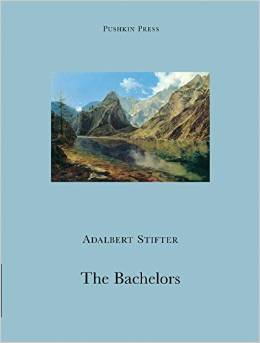
action to transport me to my favourite place in Germany . Well, it doesn’t and that may be the reason why Pushkin Press has changed the book cover from that on the left to this on the right.
The new cover more apt as the place is unidentifiable, a generic setting in the Austrian alpine landscape as per Stifter’s novella. He may use place names but they are entirely fictional.
Not that it detracts one jot from the vivid landscape word portraits. I am a mountain person (as opposed to a beach person) and so, it would seem, is Stifter. Here just one description of the frequently described “
beautiful” mountains.
The woods had opened out, the lake lay at the young man’s feet and all the mountains he had seen from the plain and Attmaning were now ranged so peacefully, clearly and closely around the water that he imagined he could reach out and touch them – their rock faces, though, their ravines and crevices, were not grey but wreathed in a delightful blue, and the trees on them were like little sticks, or not to be seen at all on others, these latter ones stretching up heavenwards with perfectly smooth sides.
Contrasted against the majesty and permanence of the mountains is the the paltriness and impermanence of man. The Bachelors of the title, an adolescent on the cusp of life and his uncle, an old man, embittered and withdrawn. It is a novella about time, how it separates the generations, how they struggle to communicate, to appreciate each other and how easy it is to waste the few opportunities that come our way.
Life is immeasurably long while you are still young. You always think there is so much ahead of you and that you’ve only gone a short way. And so you postpone things, put this and that to one side to be taken up later. But when you do want to take it up it’s too late and you realise you’re old. That’s why life seems a vast expanse when viewed from the beginning but scarcely a stone’s throw when at the end you look over your shoulder.
The story can be summarised as a coming-of-age. I’m not going to detail plot elements because the main threads are detailed
here within an illuminating article about Stifter in the framework of German literature as a whole. An article which became a bit of a lecture for this reader, if truth be told.
Stifter may be a curriculum read in Germany but this was my first tasting. While I enjoyed the landscape and the themes, I did not enjoy the pace of the action. The central section in which the young man and his uncle learn to tolerate each other seemed interminable, particularly as one of the two protagonists refuses to speak to the other. That section sandwiched between beginning and end sections that seemed so twee, verging almost on the sentimental.
Having read Roger Devlin’s article in full, that last paragraph possibly says more about me as a reader than it does of Stifter the writer. I obviously don’t get him because
a) I have poor 21st century reading habits. I do need the page turning element and to quote Devlin
“To many readers today, the very definition of a good story is a “page turner,” a book that one “can’t put down.” To appreciate Stifter, on the other hand, one must above all learn to slow down. The reader who becomes impatient for him to get to the point is probably missing his point.”
b) I need to learn to reread. To quote Devlin again
“Many of Stifter’s stories improve on rereading, because the significance that is gradually revealed casts back light on earlier episodes, and especially on those which the impatient modern reader will be most likely to dismiss as “boring.”
That’s me told then. I’ll accept the criticism but the idea of re-reading
The Bachelors isn’t my next move. I’ll probably visit
Brigitta – I’ve seen good reviews on other blogs. And now I know what to expect, I may appreciate my second outing with Stifter a little more. -
lizzysiddal.wordpress.com/2008/10/09/the-bachelors-adalbert-stifter/
 Adalbert Stifter, Rock Crystal. Trans. by Elizabeth Mayer and Marianne Moore, NYRB Classics, 2008.
read it at Google Books
download
Adalbert Stifter, Rock Crystal. Trans. by Elizabeth Mayer and Marianne Moore, NYRB Classics, 2008.
read it at Google Books
download
Seemingly the simplest of stories—a passing anecdote of village life—
Rock Crystal opens up into a tale of almost unendurable suspense. This
jewel-like novella by the writer that Thomas Mann praised as "one of the
most extraordinary, the most enigmatic, the most secretly daring and
the most strangely gripping narrators in world literature" is among the
most unusual, moving, and memorable of Christmas stories. Two
children—Conrad and his little sister, Sanna—set out from their village
high up in the Alps to visit their grandparents in the neighboring
valley. It is the day before Christmas but the weather is mild, though
of course night falls early in December and the children are warned not
to linger. The grandparents welcome the children with presents and pack
them off with kisses. Then snow begins to fall, ever more thickly and
steadily. Undaunted, the children press on, only to take a wrong turn.
The snow rises higher and higher, time passes: it is deep night when the
sky clears and Conrad and Sanna discover themselves out on a glacier,
terrifying and beautiful, the heart of the void. Adalbert Stifter's rapt
and enigmatic tale, beautifully translated by Elizabeth Mayer and
Marianne Moore, explores what can be found between Christmas Eve and
Christmas Day—or on any night of the year.
Seemingly the simplest of stories—a passing anecdote of village life—
Rock Crystal opens up into a tale of almost unendurable suspense. This jewel-like novella by the writer that Thomas Mann praised as “one of the most extraordinary, the most enigmatic, the most secretly daring and the most strangely gripping narrators in world literature” is among the most unusual, moving, and memorable of Christmas stories.
Two children—Conrad and his little sister, Sanna—set out from their village high up in the Alps to visit their grandparents in the neighboring valley. It is the day before Christmas but the weather is mild, though of course night falls early in December and the children are warned not to linger. The grandparents welcome the children with presents and pack them off with kisses. Then snow begins to fall, ever more thickly and steadily. Undaunted, the children press on, only to take a wrong turn. The snow rises higher and higher, time passes: it is deep night when the sky clears and Conrad and Sanna discover themselves out on a glacier, terrifying and beautiful, the heart of the void.
Adalbert Stifter’s rapt and enigmatic tale, beautifully translated by Elizabeth Mayer and Marianne Moore, explores what can be found between Christmas Eve and Christmas Day—or on any night of the year.
“…a quiet and beautiful parable about the relation of people to places, of man to nature”…Beyond its leisurely beginning lies a painstakingly polished and fashioned gem, an ageless, mystical folktale whose return deserves a 12 month celebration.—
The New York Times
The work of Adalbert Stifter, who was one of the very few great novelists in German literature, can be compared to no other writer of the nineteenth century in pure happiness, wisdom, and beauty…Stifter became the greatest landscape-painter in literature…someone who possesses the magic wand to transform all visible things into words and all visible movements—into sentences.—
Hannah Arendt
Whereas romances are rarely fearsome, even when teeming with dragons, tales quite often are. The fear that must underlie even our most cordial relation with the elements has an established place in them. I think of
Rock Crystal…it tells of two children, brother and sister, lost in a mountain snowstorm at Christmas-time while returning from a custom-honored three-hour walk to their grandmother’s house down the valley. The quite ordinary and familiar two-horned alp traversed by the shoemaker’s children is a mountain more magic than any of Thomas Mann’s imagining.
—
Mary McCarthy
Two children, Conrad and Sanna, walk from their village in the Alps to visit their grandparents the day before Christmas. On their journey home, they take a wrong turn and are feared lost in a snowstorm. Lyrical and descriptive, this brief tale by Austrian writer, poet, and painter Stifter…will do well where literary fiction is appreciated.—
Library Journal
Stifter’s rapturous and enigmatic tale of village life begins with a small anecdote—one Christmas eve, a brother and sister lose their way amid snowdrifts while crossing the Alps—and opens onto vast questions of faith and destiny. “[Stifter was] one of the most strangely gripping narrators in world literature.”—
Thomas Mann
Long, long ago — maybe some time in the 17th century — and far, far away — but almost certainly somewhere in the Alps — two valleys lay next to each other, ringed by high mountains and linked by a sole, lonely path. One unusually warm Christmas Eve two children set out on the path from the northward valley, through pine forest and over the pass, to visit their grandmother in the valley to the south.
Conrad and little Sanna set out early, arrive in time for lunch, and are kissed and showered with gifts by their adoring grandmother. But she insists that they start for home early. The temperature is dropping. Ice is forming on the puddles in the road. As Conrad and Sanna climb the path back toward home, a snowfall begins. It's a snowfall the villagers later call once in a century: "unprecedented unwearying" and "voracious." The children climb and climb, but their path never descends as it should; they never find their familiar landmarks.
So begins the all-but-forgotten Austrian writer Adalbert Stifter's 1845 novella
Rock Crystal, every re-reading of which is, for me, exactly like the first time I read it: in a single sitting, with my heart in my mouth and my breath as frozen in my lungs as the mammoth glacier in the heart of which Conrad and Sanna soon find themselves.
Writing about
Rock Crystal on the occasion of its superlative English translation by Elizabeth Mayer and Marianne Moore — yes,
that Marianne Moore — no less than W.H. Auden noted that "to bring off, as Stifter does, a story of this kind, with its breathtaking risks of appalling banalities, is a great feat. What might so easily have been a tear-jerking melodrama becomes in his hands a quiet and beautiful parable about the relation of people to places, of man to nature."
Auden is particularly right to say "quiet": For all the excruciating detail with which Stifter impresses upon us the plight of the children, the true power of
Rock Crystal arises not from catastrophe's noisy consummation, but catastrophe's quiet avoidance: from the series of small miracles by which the children survive.
Although the action takes place on Christmas Eve, or what Stifter's villagers call Holy Eve, and although the Christ-child and his kindness to children are duly mentioned, what really interests Stifter, and us, in this story is not divinity but humanity at its humblest and most resilient: the attentiveness of a big brother, who makes a little roof out of the shawl that his sister is wearing, to keep the snow off her face; or the loyalty of a sister, who maintains her brother's courage simply by how much she trusts him.
Stifter's own life failed to avoid catastrophe: He died by his own hand, at the age of 63. How much more grateful that makes me for this ageless and electrifying book, which, for all the ways in which it feels like a fairy tale, never fails to restore my faith in real-life human beings. With apologies to Auden, I do cry every time that I read it, but my tears don't feel appalling or banal. They feel celebratory. -
Susan Choi
Adalbert Stifter’s unusual Christmas story,
Rock Crystal, comes freighted with expectation. Republished earlier this year in a beautiful new edition by NYRB Classics, it was named by Gabriel Josipovici as one of his
top ten novellas, alongside pretty heady companions such as
The Death of Ivan Ilyich, Bartleby the Scrivener, and
Metamorphosis. It has been praised already by blogs as diverse as
Booklit and
Vertigo, and Stifter influenced writers as renowned as Kafka and Sebald. So what is there for me to add?
Rock Crystal was published in German as
Bergkristall – an altogether crunchier, wintrier title – in 1845, and translated into English a century later by Elizabeth Mayer and the poet Marianne Moore.
Stifter begins the story as a meditation on and celebration of the Christian myth and the Christmas festival, with “the church rising from the heart of the village” and on Christmas morning “the Christ-child … returning home after visiting children everywhere and bringing to each, a wondrous gift,” bringing too an end to “the cheerless expanse of desolate night.” And “after this, the long winter departs; spring comes, then lingering summer.”
The parallels this has for the rest of the book will become clear, but the way Stifter brings us there is ingenious and delightful. The narrative begins in widescreen, with a cultural tradition, then selects a mountainous landscape, draws down to a pair of neighbouring villages, and finally closes in on its handful of characters. The villages are Millsdorf and Gschaid, and the shoemaker of Gschaid wins the heart of the daughter of the dyer from Millsdorf. But the villages, though indistinguishable, maintain a certain rivalry:
so it came about that after the beautiful daughter of the dyer of Millsdorf married the shoemaker of Gschaid she was still regarded by the people of Gschaid as a stranger.
“That’s the way it was,” Stifter tells us, “and no use talking about it.” Similarly, when the couple have children, “like their mother who had always been treated as a stranger in Gschaid, the children became strangers too; and were hardly Gschaid children, but belonged half to Millsdorf.”
The children is what it comes down to, Conrad and Sanna, and their journey from their grandmother’s home in Millsdorf back home to Gschaid; but it is winter, Christmas Eve, and the sun is just a “dull reddish ball” low in the sky. What comes next is not entirely surprising, and eventually
on every side was nothing but a blinding whiteness, white everywhere that nonetheless drew its ever narrowing circle about them, paling beyond into fog that came down in waves, devouring and shrouding everything till there was nothing but the voracious snow.
W.H. Auden in the introduction (actually his 1945 review of the book from the
New York Time Book Review) speaks of the story’s “breathtaking risks of appalling banalities”, and it’s easy to see what he means. On one reading, this is a charming but straightforward folk tale; but nonetheless it seems more wide-ranging and stranger than that, in its structure, cultural grounding, and the scene when the children find themselves in a magical, sinister cavern of ice, “bluer than anything on earth, a blue deeper and finer than the vault of heaven itself.” It has warmth in the midst of the coldest setting, like a glowing fire on a frosty Christmas morning. -
John Self
As I read Aldalbert Stifter’s 1845 Christmas story
Rock Crystal, which was published in 1999 as a petite volume by London’s Pushkin Press, it was easy to see why W.G. Sebald admired this nineteenth-century writer so much.
Rock Crystal contains the bits and pieces required to construct a morality piece, but in the end Nature shoves everything aside with all of the rudeness of an avalanche.
South of the village you see a snowy mountain with dazzling horn-shaped peaks.
A shoemaker from one village successfully woos the daughter of a wealthy dyer from a village on the other side of the mountain. But more than a mountain separates the two villages. The dyer’s daughter has broken tradition by crossing over to the other village, and her father responds by withholding most of the dowry. Within a few years, the shoemaker and his wife have two young children who regularly trek across the mountain to spend a few hours with their grandparents before returning home.
Mothers may love their children and tenderly long for them when they are absent, but a grandmother’s love for her grandchildren amounts almost to a morbid craving.
One year on the day before Christmas, after a dry and warm autumn, the two children cross over the mountain for a holiday meal with the grandparents. They are dutifully warned about the dangers of winter storms by their father before the depart and they receive the same ominous warning from the grandparents as they set out on the return trip. Naturally, halfway home, a furious snowstorm suddenly begins.
But on every side there was nothing but a blinding whiteness, white everywhere that none the less drew its ever narrow circle about them, paling beyond into fog that came down in waves, devouring and shrouding everything till there was nothing but the voracious snow.
The two children are soon hopelessly lost in an environment that becomes less and less real and more and more dangerous.
As far as the eye could reach there was only ice. Pointed masses and irregular clumps thrusting up from the fearsome snow-encrusted ice. Instead of a barricade that could be surmounted, with snow beyond, as they had expected, yet other walls of ice rose from the buttress, cracked and fissured, with innumerable meandering blue veins, and beyond these walls, others like them; and beyond, others, until the falling snow blurred the distance in its veil of gray.
At night they take shelter beneath to massive boulders and struggle to stay awake and alive. The blinding storm abates and reveals its opposite – the infinite universe of the sky.
The arch of heaven was an even blue, so dark it was almost black, spangled with stars blazing in countless array, and through their midst a broad luminous band was woven, pale as milk…
The following day the two children are found, rescue parties from both villages having set out in a symbolic breaking with the past. Stifter makes token mention of the improved relations between the villages, but the last word, as it were, goes to the mountain.
The children, however, can never forget the mountain, and earnestly fix their gaze upon it when in the garden, when as in times past the sun is out bright and warm, the lime tree diffuses its fragrance, the bees are humming, and the mountain looks down upon them as serene and blue as the sky above.
The sublime beauty and terror of snow, ice, alpine heights, and northern extremes is a thread that runs through Sebald’s book-length poem
After Nature. In the first section, devoted to the sixteenth-century German painter Matthias Grünewald, we see “the ice age, the glaringly white / towering of the summits…” in the background of Grünewald’s
Temptation of Saint Anthony. At the end of this section, Sebald imagines Grünewald staring at the landscape, mourning the death of his teen-aged son.
The forest recedes, truly,
so far that one cannot tell
where it once lay, and the ice-house
opens, and rime, on to the field, traces
a colourless image of the Earth.
So, when the optic nerve
tears, in the still space of the air
all turns as white as
the snow on the Alps.
In the second section of
After Nature, Sebald writes of the voyage of exploration of Vitus Bering, who pursued the “vast tracts of whiteness” of the Arctic Ocean between Siberia and Alaska.
All was a grayness, without direction,
with no above or below, nature
in a process of dissolution, in a state
of pure dementia.
And in the final, autobiographical section, Sebald recounts how, at the hour he was born, a freak mountain storm killed four canopy bearers who were helping with the blessing of the fields on Ascension Day.
…Many
terrible midnights
of doubt have I passed
since that time, but now peace
returns to the dust and I read
of the eighteenth century how a
verdant land is submerged
in the blue shadows of the Jurassus
and in the end only the age-old
ice on the Alps retains a faint
afterglow…
For more reading along these lines, try Mary Shelley’s
Frankenstein (1818), possibly the ultimate novel of the Alps and the Arctic, and Peter Davidson’s wide-ranging study
The Idea of North (London: Reaktion Books, 2005). The cover illustration for
Rock Crystal, by the way, is from a painting by the British artist Jason Martin. -
sebald.wordpress.com/2008/05/26/the-voracious-snow/
Last year, Stanford University Press published a selection of Hannah Arendt's essays on the arts under the title "Reflections on Literature and Culture." One of the pieces in the volume was Arendt's review of a 1945 translation of the novella "Rock Crystal," by the 19th-century Austrian writer Adalbert Stifter. To Arendt, Stifter (1805-68) was "one of the very few great novelists in German literature," whose work stood out for its "pure happiness, wisdom, and beauty." Above all, Arendt stressed the power of Stifter's natural descriptions: He was "the greatest landscape painter in literature ... someone who possesses the magic wand to transform all visible things into words."
In casting Stifter as a writer of lucid serenity, a maker of natural idylls, Arendt was following a long critical tradition. One standard history of German literature describes him as "a poetic soul" with "a serious, sane view of life," who remained "untouched by the political currents of his age." It all sounds a bit dull and worthy, and perhaps helps to explain why Stifter remains almost unknown to English readers, despite his high rank in German literature. As even Arendt acknowledged, "nothing in our time or in the non-German literary tradition ... meets this work half-way. Our sense of homelessness in society and of alienation in nature ... are constantly contradicted by Stifter."
But now "Rock Crystal" (NYRB Classics, 76 pages, $12.95) has been reissued, in the very translation by Elizabeth Mayer and Marianne Moore that Arendt was writing about; and, surprisingly, it is not at all the kind of "innocent" work she leads us to expect. Nor did W.H. Auden really capture the moving strangeness of the tale in his introduction, reprinted in this new edition, where he, too, writes of Stifter's love for "order, childhood, and the limpid serenity of the classical style."
All of these elements are present in "Rock Crystal," it is true, and on one level it can appear as timeless and simple as a folktale. Yet Thomas Mann came closer to the true experience of reading "Rock Crystal" when he praised Stifter as "one of the most extraordinary, the most enigmatic, the most secretly daring and the most strangely gripping narrators in world literature." In "Rock Crystal," as in a Mann story, plot and description are never "innocent," no matter how lovingly they are elaborated. Rather, as the novella unfolds, succinctly but without hurry, it evolves into a parable of frightening depth. It is no more than 25,000 words, if that, but in this short space Stifter transports the reader to the heart of the world's mystery, before returning him to a comfortable dailiness that henceforth cannot help but feel haunted.
This arc of the reader's journey, ascent followed by descent, follows that of the young children whose adventure Stifter narrates in "Rock Crystal." (The novella was published in 1853 as part of a collection called "Colored Stones," along with companion pieces titled "Granite," "Tourmaline," etc.) Conrad and his sister Susanna live in the small Alpine village of Gschaid, which is so isolated as to "constitute a separate world." Stifter conjures the villagers' lives in a few sure strokes. On the one hand, Gschaid is a place of safety and mutual support, where "All mourn when anyone dies; all know the name of the new-born ... they help one another, and if anything unusual happens, come flocking together." Yet if the hamlet is sustained by its traditions, it is also frozen by them: "If a stone is dislodged from a wall, that very stone is put back; the new houses are built like the old ones."
Hand in hand with this conservatism goes a strong mistrust of outsiders, whose effects can be seen in Conrad and Susanna's own family. Their father is a native of Gschaid, but their mother comes from Millsdorf, a bigger and richer town one valley over; and while Millsdorf is just a few hours' walk away, the people of Gschaid regard it as absolutely foreign. "Months, sometimes a year, may pass before anyone from Gschaid crosses into the valley beyond to visit the great market-town, Millsdorf." As a result, the children's mother is still regarded as a kind of alien in Gschaid, and Conrad and Susanna themselves are not fully accepted by the villagers.
It is this divided heritage that leads to the disaster at the heart of the tale. The children are in the habit of crossing the mountain pass to visit their mother's parents in the next valley; they have been doing it for so long that they are allowed to make the journey alone. As the story opens, it is the day before Christmas, and Conrad and Susanna are paying a holiday visit to Millsdorf. Stifter describes their route so clearly, thanks to the verbal "magic wand" Arendt wrote about, that the reader could practically draw a map of it: the footbridge, the meadows, the forest, the red post marking the spot where a local man once died.
When they start back home that afternoon, however, these landmarks are soon obliterated by a steady snowfall. Because he has painted the scene so clearly, Stifter allows the reader to share the children's anxiety as they lose their bearings. No matter which way they turn, they seem to keep going upward, away from the valley and toward the glacier peak that soars above it. Conrad keeps reassuring his young sister, in a way that grows almost unbearably poignant as the reader realizes how lost the children really are. Finally they emerge, on Christmas Eve, in an altogether unearthly landscape, which Stifter evokes with eerie vividness:Ice — nothing but ice. There were great slabs lying, covered with snow but on the edges glassy green ice showed; there were mounds of what looked like pushed-up foam, the sides dull but with inward glimmers as if crystals and splinters of precious stones had been jumbled together; there were, besides, great rounded bosses engulfed in snow ... Some were eroded into cavities through which an arm, a head, a body, or a great cartload of hay could pass.That "cartload of hay" is a perfect example of Stifter's free indirect narration — it is just the image that the children themselves, steeped in country things, would use. So, too, when the children are forced to spend the night on the mountaintop, little Susanna imagines that the lights that appear in the sky are heralds of the Christ child, as expected on Christmas Eve. Yet Stifter allows the reader to see the gulf between her trustingly pious metaphor and the uncanny cosmic reality:Something now began to happen, as they watched. While they sat thus, a faint light bloomed amid the stars, describing upon the heavens a delicate arc. The faint green luminescence traveled slowly downward. But the arc grew brighter and brighter until the stars paled away a shudder of light, invading other parts of the firmament — taking on an emerald tinge — vibrated and flooded the stellar spaces. Then from the highest point of the arc sheaves radiated like points of a crown, all aglow.These are the "stellar spaces" that terrified Pascal, with their intimation of eternal emptiness. What, then, is the meaning of this "crown"? Is it in fact a signal from the King of Heaven, sent down to keep the children from falling asleep — which would, as they themselves know, mean their deaths? Or is it a purely natural phenomenon, as Stifter also suggests — perhaps "the electricity in the atmosphere had become so charged by the tremendous snowfall that it flashed forth"?
This celestial apparition, in its teasing doubleness, holds the key to "Rock Crystal." In its light, the simple story takes on the dimensions of a parable. The children who do not quite belong in the valley they were born to; their accidental journey from the ordinary to the infinite; the danger and beauty of such an ascent; the vast difference between what they find on the mountaintop and the cosy rituals of Christmas going on down below — all these elements take their places in Stifter's design. What starts out as a folktale turns into a religious and existential riddle. No wonder Mann paid homage to "Rock Crystal" in a pivotal scene in "The Magic Mountain," in which Hans Castorp gets lost in a blizzard and experiences a fleeting understanding of man's destiny.
What happens to Conrad and Susanna, whether they come back alive from the crystal world, forms the only narrative suspense in the tale, and while that suspense is not essential to Stifter's effect, the reader may want to skip Auden's introduction, which gives the ending away, until the second reading. For "Rock Crystal" is one of those still but deep books that deserves to be read again, and again.
Adalbert Stifter (1805–1868), the son of a provincial linen weaver and flax merchant, was born in the rural Bohemian market town of Oberplan, then part of the Austrian Empire but today in the Czech Republic. When Stifter was still a child, his father was crushed under an overturned cart; the family was left poor, but Stifter’s grandfather sent him to school at the the Benedictine Monastery of Kremsmunters and he proved a brilliant student. Stifter attended the University of Vienna, where he studied law but failed to obtain a degree. Instead he supported himself as a much sought-after tutor to the children of the high Viennese aristocracy while also acquiring a small reputation as a landscape painter. For a number of years Stifter eagerly courted the daughter of a rich businessman, but his lack of worldly position turned her family against him, and in 1835 he married Amelia Mohaupt, a milliner. In 1840, he published his first story, the success of which started him on a career as a writer, and in 1850, after working as an editor on two newspapers, he was appointed supervisor of elementary schools for Upper Austria. Stifter’s works include numerous stories and novellas, as well as
Witiko, a historical novel, and
Indian Summer, considered one of the finest examples of the German bildungsroman. Stifter’s mental and physical health deteriorated in his final years. In 1868, suffering from cirrhosis of the liver, he committed suicide. -
Adam Kirsch
Adalbert Stifter suffered from anxiety and depression his entire life. Like so many writers, he depended on the approval of others and despaired over the public indifference to his novels. Obviously, his own character was one that could not overcome this perception regarding his own inadequacies. He took this public refusal of his life’s work so personally that his last act on earth was to unfortunately cut his own throat.
This is a fiction, but all of us bring something of ourselves to the reading of any text, that is, unless we are dumb to the ways of the heart and our own human impulses. What matters to many of us at specific and certain times, for others matters to none. Within the law, I myself am naturally a hardened, cold-blooded murderer. Like a farmer tending to his flock and crops I do what must be done to extricate and eradicate in order to protect the better interest of all I am charged with safekeeping. It helps a human to be hard when it entails a violence unbecoming of a man so closely attuned to nature. Death is simply a matter-of-fact and nothing one needs to dwell on. But when children are involved this sometimes frozen heart of mine thaws to a degree baffling to the ears of those who know me and who hear me babbling in my pleading cries for mercy. And I, who have never been a lover of young children, even my own, rise to their defense and protection like no other. It puzzles even myself this manner in which my overwhelming and compassionate emotions seem to exflunct my long-hardened stance. My posture severely bends in the doubling over of my agony, and I wish the present experience had never occurred or would quickly end.
Much has been praised about this fine little book Rock Crystal. In addition, there have been others who cannot bear the seeming pretense of this labeled prim and human-caring spectacle. I understand this latter position better than my own. But what is important I think to note is how, through our many years, we all do change. Everything looks different from an altered or, it is hoped, an evolved point of view. Our tastes in food, music, and literature are good examples of this, not to mention our specific needs for sex and meaningful relationships. If one lives long enough the important lesson learned is that all of life changes all of the time. It is true that everything is in flux in this world ruled by utter chaos.
What seemed to me at first to be a very brief encounter when taking a peek at the total ninety-six page count actually resulted in more than seven days of reading time. My sessions were only good for a very few pages at each seating. So descriptive were the geographies and social sciences that I struggled at times to absorb them all. It was almost too much. Early on I was asking the author for the point of his story. But it did not take me long to realize in fact that Adalbert Stifter was very good at this craft of writing. I committed to continue in my struggle, and to march on through his text to see what I might see. Unlike a few critical others, the name Adalbert Stifter interests me to no small degree. I have wanted for some time now to read his work just because of that remarkable and mysterious name. I believe in the threat of danger involved in just viewing the face of the name’s own landscape on this page that claims the name of Adalbert Stifter.
Crazy as it sounds, I suspect in some ways this novella may be misconstrued again as a type of Christian tale because it more than once invoked its name. I think it instead makes a statement relatively more inclusive to all humanity and the brilliantly glorious and fantastical wonders of our world. For me, a literary vehicle coursing through the streaming blood that comes from the violent death of one Adalbert Stifter, a gruesome murder bloodied by his own hand, this tale bravely mounts itself in its own way indifferently onto his fiction. And is as well proof of his own denial of a god’s commandment stating thou shan’t kill. Literally, this book was an amazing effort he made in making me see, and for that world of his I entered and that person I am who in this case allowed himself to be written upon, I am quite grateful. - M Sarki
My literary hero, Adalbert Stifter, was introduced to me by a professor of German studies during my sophomore year at Binghamton University. At the time, I lived alone in a studio apartment on the west side of Binghamton, a small city in upstate New York crippled by its loss of the computer and defense industries. The low standard of living and high crime rate, palpable even in the city’s nicer parts, are all the more jarring for the beautiful view of the Catskill Mountains that graces the area. At the end of the school year, the cold lifts, the rains stop, and the weather turns mild. The air, normally raw and wet, is balmy, and thick with the smell of pine.
In an e-mail, I expressed particular curiosity about the desiccated natural landscapes in Thomas Bernhard’s novels, and my professor suggested that I read Adalbert Stifter, an Austrian author who, despite the endorsements of Thomas Mann and W.G. Sebald, is remembered as a hokey sentimentalist, interested mostly in mountains and flowers.. The stories, novellas, and novels for which Stifter is known were written at the height of the Biedermeier period, a time of bourgeois reaction after the catastrophic, continent-wide destruction unleashed by the Napoleonic Wars. Beidermeier culture was fond of middle-class comfort, of painted plates, copper prints, simple furniture, and little knickknacks. Rather than challenge the political repression of post-Metternich Europe and take stock of the hopes for equality and immediacy in human relations shattered by the failed revolutions of 1848–49, the German-speaking world of Stifter’s time withdrew into the home, the family, and from there, into a world of fantasy.
Desperate for my professor’s guidance and approval, I found Stifter’s novella collection
Bunte Steine (
Many-Colored Stones) in the deathly quiet German-language stacks of Bartle Library.