1/25/16

Serge Brussolo - lucid dreamers called mediums dive into their dreams to retrieve ectoplasms—sticky blobs with curiously soothing properties that are the only form of art in the world. The more elaborate the dream, the better the ectoplasm

25279790
Serge Brussolo, The Deep Sea Diver's Syndrome, Trans. by Edward Gauvin,  Melville House, 2016. 
excerpt


An undisputed French master of the fantastic—as prolific as Stephen King; as original as Philip K. Dick—now in English for the first time
In
The Deep Sea Diver’s Syndrome, lucid dreamers called mediums dive into their dreams to retrieve ectoplasms—sticky blobs with curiously soothing properties that are the only form of art in the world. The more elaborate the dream, the better the ectoplasm.
David Sarella is a medium whose dream identity is a professional thief. With his beautiful accomplice Nadia, he breaks into jewelry stores and museums, lifts precious diamonds, and when he wakes, the loot turns into ectoplasms to be sold and displayed.
Only the dives require an extraordinary amount of physical effort, and as David ages, they become more difficult. His dream world—or is it the real world?—grows unstable. Any dive could be his last, forever tearing him away from Nadia and their high-octane, Bond-like adventures.
David decides to go down one final time, in the deepest, most extravagant dive ever attempted. But midway through, he begins to lose control, and the figures in the massive painting he’s trying to steal suddenly come to life . . . and start shooting.


“Brussolo is a singular and essential voice…with a striking imagination, sense of strangeness, and masterful feel for the surreal… he plunges readers into the weird and macabre, leaving only a blazing vision lingering on their retinas . . . a French J.G. Ballard, impeccably distilled stylized nightmares.” Le Monde


By night, David Sarella is a burglar at the bottom of the sea. He’s a lucid dreamer whose dreams are always threatening to slip from his control. Each time, he dreams a new cityscape that only his concentration maintains in a bubble of breathable air. When his nerves or belief waver, the sky starts to cave in from water pressure. Fish appear among the chimneys, and in the jewelry store he’s just snuck into, objects start to float. The diamonds look like pebbles on the ocean floor. He wipes his palms, pops a focus pill. His lover Nadia is waiting outside in a long black sedan subtly turning sharklike. Insinuations, little irrealities… and the whole scene starts to lose its density, its grip. But David’s got the goods. As they make their getaway, cops hot on their tail, he closes his eyes, feels himself rising through the waters… and wakes up.
An air of noir black as squid ink suffuses Serge Brussolo’s most celebrated novel, The Deep Sea Diver’s Syndrome. Though it opens with a heist tense and hardboiled as French crime classics of the 50s, it has the sorrowful fatalism of a French New Wave love letter to, say, David Goodis. By day, David is what they call a “medium”: that is, a producer of dream-ectoplasms. Whatever object he steals in his dream he coughs up, on waking, as a shimmering piece of dream-blob (trailing blood and sputum). His assigned nurse Marianne is there to collect and clean it, but also to maintain him with bedpans and IVs while he sleeps. A single bureaucracy employs them both: one that manages the production, curation, and sale of these ectoplasmic objets d’art.
David can go under for days at a time. The deeper the dream, the bigger the prize; the more gripping and convincing the fantasy, the grander and more compelling the ectoplasm produced. And yet it’s also Marianne’s job to maintain David’s sanity: to remind him of the real world waiting for him when he wakes, to remind him that whatever face he puts on the loot (jewels, paintings, sculpture) is supplied by his subconscious.
In the world of Brussolo’s novel, ectoplasms have supplanted all other art forms. They have curiously soothing properties and come in all shapes and sizes. Some sit on sills and mantels, and others on pedestals in museums; one even adorns a public square, a celebrated monument whose aura is so strong it helped stop a war. That one was created by an old friend of David’s, Soler Mahus. Sometimes David visits him in the hospital. Soler is now a shell of a man, but once, in his dreams, he was a big game hunter. Now insane, he lives in his memories of dreams more real to him than life ever was. The lives of mediums are physically taxing and spiritually draining. Most mediums only have a short productive lifespan before they burn out. David himself is torn between an addiction to his dreams—where he’s a suave thief with an exciting life—and the possibility that, as his health fails, every next dream could be his last. And then there’s the pressure to produce. David’s last few ectoplasms have been puny and disappointing. Once mediums cough the ectoplasms up, they’re torn from their creators’ hands: subjected to a battery of clinical tests and auctioned at market or else disposed of with hazmat precautions (just in case). David’s last few have been so far below snuff that they haven’t survived the incubator during testing. Both fears—of death, and of inadequacy—pollute his dreams, sapping his ability and daring there.
This premise summary brutally simplifies a book whose unmatched originality lies in its feverish proliferation of detail. Word by word, phrase by phrase, Brussolo’s world seeps in through your pores, gets under your skin, and starts crawling around. His prose is always panic-attack frantic. The sense of reality’s slippage, as one reads, is utterly enveloping. If a mark of speculative fiction is the reification of what “literary” fiction is traditionally content to leave as metaphor, then Brussolo is speculation mainlined. His imagination, always on overdrive, is far more hit than miss. Serendipities of language fuel his imagery, propel his plots. His compositional method is constant associational riffing—a stray simile becomes reality, a figure of speech a solid object, an image a sudden obstacle. His unstoppable flow of ideas has sent other novels of his spinning out of control, but what could better capture a fever dream than his obsessive style? The tone can veer from grotesque to comic, unsettling to wacky and back in under a paragraph. What could better suit a fundamentally unstable world?
The free rein that Brussolo gives his fancy also complicates, rococos the architecture of his overarching themes, keeps them from being too controlling or pat. For The Deep Sea Diver’s Syndrome clearly has large themes on its mind: the relationship between artist and society, and more specifically, how pulp publishing wrings writers out and hangs them up to dry. All Brussolo’s mediums are described as somehow childish, incompletely matured, fundamentally unequipped for adult life and clinging to specifically genre fantasies. The worlds of their dreams are a veritable history of escapist literature in France.
But Brussolo also seems to ask: where does the imagination come from? Even when we can trace the source of its images, what is the root of the creative drive? David is plagued not only by whether Nadia and his dreamworld are real, but what happens to them when he’s awake, what will happen to them when he dies. Which world is really real—the one of our fulfillment, or the one of our frustration, and can we truly choose to be in one or the other? If so, at what cost? Brussolo’s puzzle-box construction has all the breakneck pace, mind games, and set pieces of Inception, plus dreams that actually feel like dreams.
In this column so far, I’ve erred mostly on the “literary” side of things, focused on writers anointed by publication from major houses: Gallimard, Grasset, Laffont, Albin Michel. Serge Brussolo is a writer firmly on the “genre” side of the divide, having made his mark in Denoël’s Présence du futur imprint (one of France’s two most influential SF imprints, along with Fleuve noir’s Anticipation). As we now know, market categories are largely artificial.
Brussolo first burst onto the scene with “Funnyway” (a very French dystopia of endless bicycling in polluted trenches) which won the Grand Prix de la science-fiction française at Utopiales in 1979. His early years were devoted to a genre-bending mixture of SF and fantasy, fueled by an intensely personal vision. Since then, he’s dabbled in almost every genre, from thriller to horror, police procedural to historical novel (both medieval and WWII), and most recently, YA. Admittedly, he’s massively overproduced, to the tune of several novels a year, and his reputation has suffered as a result, his work half-baked when not ripping himself off. But he remains a force unto himself in French letters. Few other contemporary French writers can match his rabid imagination and the shocking cruelty of his worldview, or the surging, neurotic prose with which he brings it to life. Since its publication in 1992, The Deep Sea Diver’s Syndrome has deservedly become a classic. Times have changed: Gallimard’s own Folio SF imprint recently reprinted it with other select titles from Brussolo’s backlist, bowing to a genius at once genre and sui generis. -


The Deep Sea Diver's Syndrome imagines a world and reality that's veered off slightly from our own -- and, beneath it, another, much stranger not-quite-reality. This is a world where art no longer serves any purpose and the idea of admiring and valuing: "Paint applied to a piece of canvas with a stick topped by animal hair" has been dismissed (as has the great artistic output of all times, as Brussolo amusingly describes the emptying and repurposing of what had been art-museums). Instead, humanity has harnessed -- and built quite an elaborate bureaucracy and infrastructure around -- what amounts to the exploitation of the dreams of a select few.
       Well, not exactly dreams, and not really harnessing -- they're transformed, into baubles and objects and grand masses:
It's not a dream, it's an ectoplasmic product a sleeping medium has materialized from an oneiric image haunting his brain. The dream allowed you to create this object by stimulating your imagination -- that's all.
       'That's all' -- but, of course, that's a rather fanciful notion, and credit to Brussolo for introducing and presenting it so well in the course of his story.
       The novel centers on David Sarella, a medium who is able to 'materialize ectoplasms'. Essentially, he falls asleep and enters into a dream(world), and recovers objects from there which, when he surfaces (wakes) are, in a different form and shape, material objects. Sort of, anyway: oneiric objects, with physical qualities (including a troubling stickiness when they've outlived their usefulness). These have properties that are highly valued, able to affect humans in the vicinity -- hence their replacing art. From just a general good feeling to actual physical well-being -- the strongest objects can ward off even disease -- or just providing the ability to give a good night's sleep, they are understandably much in demand.
       Harvesting is strictly licensed and controlled (though there is a black market), and it's a physically demanding procedure, too, with the medium not conscious for days and thus needing to be hydrated and provided nutrition by an outside helper ("it was suicidal to dive without medical assistance"). David works with Marianne, the licensed caretaker who watches over his 'dives' -- his journeys into dream-land. But David's trips are taking a physical toll on him. It's affecting his work, too: the objects he's retrieving lately haven't been up to snuff.
       The novel opens with David in the middle of a dive, in an alternate world -- a deep sea, where he's on a jewel heist (the diamonds the things of value he retrieves and bring to the surface, even if there the resulting oneiric object takes on a very different form). Things aren't going smoothly, his imagination -- shaping everything around him, after all -- messing with him. When he surfaces, Marianne makes clear that it's time for him to take a break -- but the lure of the deep, of this alternate reality, is too great for him to resist.
       Brussolo immerses us in the alternate-dream-world before he offers any explanation for it, and then neatly fills in the blanks. Surprisingly much of the novel is exposition -- explaining how things work and what they are -- and yet that doesn't bog down the story, as he balances well between showing and telling. Though quite simple in its conception, the idea is also beautifully realized: Brussolo offers a fantasy world where everything is possible, yet grounds it sufficiently in reality, and around David's situation and condition that it functions wholly convincingly. A lot of it is in the details -- and part of it is that even with all the exposition Brussolo doesn't overwhelm with detail, either (as is (too) common in much similar science fiction/fantasy).
       The use of (sea-)diving imagery to describe the (dream-)'diving' process is very well done, and Brussolo's rich (verging on over-rich) writing gets the most out of this. Vivid and evocative, Brussolo pulls readers into these worlds with him. In particular, he brings to life David's struggles -- with and against himself, and with the lure of the deep and what he finds there -- with tremendously gripping power.
       The stylized writing verges on the overindulgent, yet Brussolo (and his fine translator Gauvin) pitch it just right, and even outside the dream-world it works when he writes, for example:
It was easier for him to confront the outside world in the half-light of dawn, when the ink of night, barely faded, still stained the streets and sky.
       In less than 200 pages, The Deep Sea Diver's Syndrome also offers a remarkably full story, creating two fascinating worlds -- the real one, right down to its bureaucracy for handling the oneiric objects (and manhandling them, in the case of their disposal, something they haven't entirely come to grips with), as well as the one in the depths of David's imagination -- and following David as he struggles between them. Finally, Brussolo brings all this together in a beautful conclusion -- an obvious resolution, perhaps, but hard to pull off well, and Brussolo easily does.
       The Deep Sea Diver's Syndrome is a very impressive flight of fantasy. - M.A.Orthofer


"It was hard — terrible, sometimes — but that's life, real life! Know what I'm saying?"
There's something both handy and unfortunate about a classic novel brought into a new market after a major motion picture with the same general concept. "It's like Inception" is the quickest, cleanest way to describe the heist sensibility and ectoplasm dives in The Deep Sea Diver's Syndrome without getting into the vaguely hallucinatory specifics. But that description barely scratches the surface of Serge Brussolo's 1992 novel, which makes an art out of its nightmares.
In Brussolo's slightly fractured future, David is a medium — someone whose lucid dreams can produce an amorphous ectoplasm that soothes and even heals its beholders. It's changed the art world: What use is a painting when an ectoplasm can banish your wrinkles and your nightmares? The toniest neighborhoods burst into being near public art installations; museums become mausoleums. It's enough like art that the work of dreaming ruins the dreamers; it's enough pap for the masses that every million-dollar-auction winner has a dime novel inspiration behind it. David is a small-timer whose productions are more suited to middle-class mantles than bold public statements. Those are the work of Soler Mahus, a used-up medium whose mind is reduced to the racist Great White Hunter ramblings of his self-aggrandizing subconscious; a portrait of the artist as a young megalomaniac.
There is, technically, a plot — one last heist in the dream world, the big score that will let David rest — but Brussolo (translated from the French by Edward Gauvin) is happy to linger under a cloud of dread, picking apart the wretched, self-pitying threads of David's restless life in a world in which his littleness is horrifyingly measurable. Syndrome is also a novel of ideas that's much less concerned with the ideas than it is the minute ways things stay with us; unimportant details fester and eat their own tails.
Brussolo seamlessly maintains both that air of dread and a quality of the lugubrious unreal that's only fitting in a novel that's so ambivalent about reality: Dialogue swings from pulp fiction to soliloquy, and dissatisfaction leaves a taste in the mouth until David can't eat. Even awake, he's just as likely to suffer from hallucinations that rise up like bilge water without warning; the lives of those who don't dream have all the blitheness of a dream that's just about to turn into a nightmare.
That sense of omnipresent decomposition — which affects David as much as it does the museums and incinerators and bakeries of the world — can lead to some beats that are no less sour for being intentional. Though it's no surprise that a man as self-obsessed as David objectifies those around him until they could walk out of a painting in two dimensions, the way he flattens the women in his life — his mother, his lover, his caretaker, his muse — until he can find some reason to quietly despise them becomes almost familiar. That doesn't mean it gets easier to swallow.
But Brussolo is careful to keep us from falling so deeply into David that we ever truly sympathize; we understand how he got set so adrift, while we furtively look for the shore to save ourselves. Though questions of art, society, reality, and identity are everywhere, a world as unstable as that in The Deep Sea Diver's Syndrome keeps us from reaching for any easy answers; visually rich and deliciously unsettling, it's a science-fiction fever dream that will leave you in no hurry to wake up.
- Genevieve Valentine


SERGE BRUSSOLO is the author of nearly two hundred books in every possible genre—dark fantasy, horror, historical fiction, young adult fiction, thrillers, and literary fiction. His books are consistently bestsellers, have won every major French science-fiction prize, are considered modern classics, and have been made into films.
1/21/16

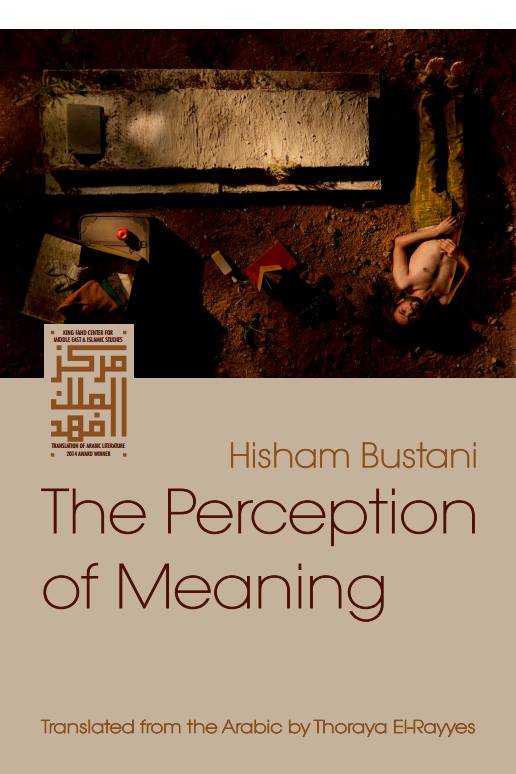
Hisham Bustani - A dazzling exemplar of contemporary experimental Arabic literature, collection of seventy-eight pieces of flash fiction presents an intense and powerful vision of today’s world seen through the eyes of an alienated and sardonic author.

Slikovni rezultat za Hisham Bustani, The Perception of Meaning
Hisham Bustani, The Perception of Meaning, Trans. by Thoraya El-Rayyes, Syracuse, 2015.

stories: Nightmares of the City
History Will Not Be Made On This Couch
Stardust

This award-winning collection of seventy-eight pieces of flash fiction presents an intense and powerful vision of today's world seen through the eyes of an alienated and sardonic author. The Perception of Meaning reads like an alternative history to our world--a collage of small nightmares brought to life by a canon of unlikely historical figures, including Mark Zuckerberg, the lead singer of Megadeth, Stanley Kubrick, the Korean activist Lee Kyoung Hae, and the Mayan poet Humberto Akabal, among others. A dazzling exemplar of contemporary experimental Arabic literature, The Perception of Meaning deftly captures a historical moment in which Arab societies are increasingly questioning the status quo and rebelling against it. Bustani's stories speak powerfully to the present and look to the future with a wary eye.


"Whose voice is strong enough to examine the heartbreaking mysteries of our times with such wry, unflinching power? Try Hisham Bustani. When he drops his brave bucket into the ‘deep, deep well’ of human doings, expect something excruciatingly perceptive and astonishing to rise. These are not lullabies."—Naomi Shihab Nye, author of 19 Varieties of Gazelle: Poems of the Middle East

"One of the most influential members of a new generation of Jordanian writers, Bustani is a progressive novelist who experiments with both form and content in his work."—The Culture Trip


Hisham Bustani’s third collection of fiction, The Perception of Meaning, translated by Thoraya El-Rayyes, is like a house of mirrors at a carnival, reflecting the distortion, absurdity, and maladies of a modern world that worships technology and destroys nature. The book was the co-winner of the prestigious King Fahd Center for Middle East Studies Translation of Arabic Literature Award for 2014 at the University of Arkansas. Bustani’s work is experimental, literary fiction with a razor edge, slicing the tops off of familiar myths, tales, legends, and then, transforming them into visceral, grotesque fables. Hisham Bustani, known in the Arab world for his contemporary, “surreal” view, draws widely upon film, history, politics and literature for  inspiration in his flash fiction. Thoraya El-Rayyes, the translator and a writer herself, has translated an intellectually ambitious book, which balances on the tightrope between a philosophical text and linguistic play, into fluid, lyrical English.
It is no accident that Bustani opens his book with a section entitled “Apocalypse Now,” a reference to Francis Ford Coppola’s film, itself a reinterpretation of Joseph Conrad’s Heart of Darkness. In Bustani’s meta-fictional Apocalypse Now” there are “no knights here, and the castles are ruins with broken windows.” The new heart of darkness is not Vietnam but our self-reflexive reality, controlled by technology: the internet, the phone, Facebook, and television. We consume others’ images of pain, suffering, violence, revolution: our journey through life is packaged and artificial. Most do not seek awareness or the inner path, like the Sufi poet, Al-Hallaj, whose epigraph opens the book.  Even love, sex, beauty are commodified by expectations created by companies: nothing is personal and individual. This serves another prominent theme of the book: how man believes he can tame and control nature, but ultimately destroys and annihilates it, just as he does his fellow man. The book is divided into twelve sections and plays with form, shape, genre, and language: riddles, aphorisms, fable, fairy tale, legend, myth, real news, poetry, Facebook posts, and Youtube images.
Bustani’s short fictions often contain the disturbing shards from the news, full of reports of violence, atrocity, and injustice. For example, why did an ordinary peasant at the World Trade Organization summit in Mexico City in 2003 commit suicide? Lee Kyoung Hae, the simple Korean farmer, was lost in a world that has become controlled by “global markets,” forces bigger than himself that would ruin his livelihood. He acted briefly in an extreme protest and then flared out:  “The peasant, whose petrol-soaked clothes caught a spark, dissolved immediately into the soil in a flare of celebration. Part of him became flowers, part of him became migrating birds.”
Violence recoils upon itself since the murderer will be haunted by his crimes; the ghosts will follow him down the streets: “He swats them away but they do not go.” Only when he is himself killed will he then “wake up and join their protest.”
Bustani finds the irony in existing narratives—for example in the German director Herzog’s film, Fitzcarraldo, about a man who loved opera so much he hauled a ship over a mountain in Peru. In Bustani’s version, Fitzcarraldo is not a noble aficionado of opera, but a white colonial who destroyed the trees and exploited the indigenous people:
The White God taught them his intoxicating miracles, so they carried the floating phonograph to where trees patiently await their killer. They were slaughtered by slanted lines across their trunks that meet in the Center, then their blood was gathered to be sent to the Old World and return as radiant junk. As for the opera, it still warbles out of the speakers of bomber airplanes and the tears of trees.
Elsewhere, Bustani retells “Laila and the Wolf,” or “Little Red Riding Hood,” as a sadomasochistic tale. The wolf, not Laila, comes to visit grandma while the hunter is filming grandma having sex through the window with his mobile phone, and then we view the story again as porn images on Youtube. He seems to suggest that the modern story is simply the voyeurism of sex and violence, offered to us from the media. But then we learn that none of what we imagined was true:  “Laila hadn’t been going to visit the grandmother that day; she’d had a date with a client. The wolf hadn’t been hungry that day. The grandmother hadn’t been ill. The hunter hadn’t been…” In fact, the story had been thrown away by the child into the trash.
Not only are the old tales obsolete, but people are still destroyed by them. In “Mockery of the Narcissus of the Universe,” a booklouse is made over by plastic surgeons into a “moderately attractive woman.” She found the crown of a princess and placed it on her head, even though there were dead bodies on the road. She would do anything to be a princess, just as women will still do anything to look like “princesses” in our world. The doctor, “her magnificent maker,” chortles as he watches her “silicon balls” jumping up and down. They eventually break and numb her brain, such that it is.
In Bustani’s worlds, the language and symbols of the internet and Facebook have become so casual and promiscuous that they no longer signify real emotion: “How will I know if Like is a passing courtesy, genuine admiration, flirtation, or a hint at something to come?” In History Will Not Be Made on This Couch,” the narrator watches the Egyptian revolution from his television, while others were acting: “Inside the television, streets are flooding with colorful drops of people, stones and barricades.” The narrator feels increasingly alienated by his own passivity and comments wryly: “The television is on fire and history isn’t being made on this couch.”
The final section is entitled “Salvation.” There are many questions without answers: “And when the answer didn’t come, he broke the mirror with a clenched fist and walked along the path covered in glass shards, looking for another that holds the answer.” I am reminded again of the Indian poet Tagore’s epigraph at the beginning of the book: “I close my eyes…and see.” Maybe Bustani is implying that the only real salvation is the imagination. Slavishly watching reality, or what is manufactured as reality through the internet, media, television, Facebook, Twitter, will make us paranoid, angry, bitter; it will drive us crazy.
The book has found the right home at Syracuse University Press. Bustani’s imaginative journey is also reflected in the careful, deliberate presentation of the bilingual edition. Instead of the more conventional structure of a bilingual reader, which separates one language from another, each story in Arabic is followed by the English translation. The book will especially appeal to the sophisticated reader of modern literature. As for the bilingual reader of both languages, he/she will have the thought-provoking experience of entering the portal twice. - Gretchen McCullough


The Perception of Meaning is a collection of a variety of work, ranging from the most succinct 'flash fiction' to somewhat more elaborate stories. Little here is in any way conventional, with much of the writing verging on the -- if not outright -- epigrammatic; almost of all of it is of and in the moment, almost all of it intentionally jarring, in language and image.
       Some of the best and, perhaps surprisingly, fullest pieces are the one-liners:
At the moment he opened his mouth to scream, the silence killed him. 
       Many of the pieces resemble prose-poems -- or indeed poems, outright -- with much of the arrangement and display of the words and sentences a significant aspect, from the choppy presentations of longer pieces to a final literal fade-out in the closing piece, the words: "You discover that this whiteness is endless" then reinforced by a literal fade-out into whiteness of the word 'endless'. One of the more elaborate stories, 'Laila and the Wolf', integrates what are presented as drawn YouTube-stills, in a nicely twisted Little Red Riding Hood-variation, the cartoon-middle not just a gimmick but entirely appropriate in the story that keeps shocking, down to its revealing explanatory final section -- nicely shifting perspective on what came before.
       Bustani's is a wired, social-networked world, all interconnected and shared, with everything on display:
     The entire world is having sex in a giant bedroom full of wires.

     The entire world is peeping into that room and masturbating.
 
       The extremes of old and new, tradition and the opportunities of the new, constantly clash here -- and are occasionally spelled out, as when Bustani writes:
     Everything dissolves into digital language: 0 1, 0 1, and bodies evaporate to become shapes on a screen.
       So also:
     "This is the era of the novel," said Gaber 'Asfur but the illustrious writers of the screen were content with a single line in the status bar. This is their magnum opus.
       ('Asfur was famously Egypt's Minister of Culture for just over a week (before resigning) during the Arab Spring; he would later (after this book was published) take up the post again, this time for almost a year, in 2014-15.)
       Among the interesting experiments is 'Short Dialogues with Humberto Ak'abal', in which Bustani integrates bits of K'iche' Maya poet Ak'abal's poetry into the story. It is yet another example of the global connections here -- which also extends to references ranging from Dave Mustaine -- of Megadeth -- to the Bhopal disaster.
       Bustani is immersed in the contemporary -- the technological contemporary, especially -- but also remains highly critical throughout -- signaled already early on when he amusingly observes:
     Apes do not wage wars.
     Apes do not invent instruments of torture.
     Apes do not puncture the ozone with fossil fuels.
     "Humans are descended from apes ?"
     Who says apes would approve ?

       The Perception of Meaning is a dense, sharp collection; often jarring, consistently intriguing. Some here is very hit and miss, but it all moves Internet-fast, always immediately moving on to then ext thing.
       The short bursts and pieces -- and Bustani's concision of expression -- lend themselves to the bilingual presentation here, and it's always good to have the original there for comparison (largely more theoretical than actual, for most readers -- but give the importance of the 'look' of the text and its presentation it's useful to compare to the mirrored Arabic originals, even for those unable to read it).
       Offering a glimpse of a very different kind of writing than found in 'traditional' modern Arabic fiction The Perception of Meaning is a very welcome, and worthwhile, volume. - M.A.Orthofer


No one’s ever really gone on the Internet. “With all this technology, absence has become a lie,” writes Hisham Bustani in The Perception of Meaning. Absent presence—that paradox of electronic communication—slowly emerges as a central motif in this enigmatic and yet wonderfully immersive novel. It is a motif recapitulated, indeed, in this paradoxical reading experience of immediacy and indefinite deferral, ready assimilability and indifferent resistance; in short, a reading experience the agonizing speaker(s) of this fractured indictment of modernity knows well. Indeed, this meditation on the nature of perception opens with two apparent invitations to the abnegation of ordinary, easy perceiving—Bustani calls them “entrypoints”—in the words of Sufi mystic Al-Husayn bin Mansur al-Hallaj, executed in the tenth century on accusations of heresy, (“He who has vision forsakes hearsay, and he who knows the envisioned forsakes vision”) and Rabindranath Tagore (“I close my eyes . . . and see”), shared national poet of India and Bangladesh. Technologically-enabled remote viewing—a kind of vision that is as easily suspended, when convenient, as attained—and its attendant phenomenon of apparent presence in absence is unequivocally sinister here. It comes in the form of news broadcasts that report the ongoing effects of the United States’ absent presence the world over as a result of its imperialist adventures; it also comes in the angst-inducing lure of online friend-stalking.
This incongruity of scale—the trivial backlit by the momentous or vice versa, hashtag-first-world-problems in the third world—is a favorite rhetorical gambit for Bustani throughout the novel. Descriptions of familiar, routine small pleasures and stresses bump against catastrophe that is, in its enormity, beyond absorbing. Published by Syracuse University in a bilingual edition that includes both the original Arabic (Bustani is Jordanian) and an award-winning 2014 English translation by Thoraya El-Rayyes on facing pages, The Perception of Meaning juxtaposes, like overlapping Internet browser windows, the suffering of the social media adept/addict with the headline-ripped violence of war, environmental destruction, and cynical corporate profiteering therefrom. If you’ve ever had Facebook and CNN.com open at once on your screen, you know the feeling. Spectacles of human carelessness at large and at small abound.
The writing—broken into short imagistic prose-poem-like units that run from a single sentence to a few pages, a format that recalls Calvino or Borges—is a jarring combination of poetic abstraction and exuberant, limpid surrealism cut with up-to-date witticisms that tend to ring flat and reductive. Sometimes such deflating quips feel cheap. It is possible that this cheapness is the point, though these moments seem more like participation in than commentary on the nihilism the novel generally purports to critique. Here’s the novel’s take on “the handsome whale, Tilikum,” Sea World’s fallen star and chief exploitee, who features in the mix of pop culture, violence, and pop-culture-mediated violence in the fittingly-named first section “Apocalypse Now”:
They stole him from his ocean and crammed him into a fish tank.
And when he drowned his trainer in protest,
he was at once transformed into material for news broadcasts.
Chewed between newscasters’ teeth and swallowed,
to provide their daily allowance
of Omega-3.
The smirking conclusion to this grand account of persecution feels like a punch line, a dark joke made in a status update. The human denial of animal otherness, animal wildness, slips into the popular obsession with proper eating, as one television segment gives way to another. The tone and velocity of the novel recall the provocations and spectacles of Futurism. It lacks Futurism’s actual infatuation with modernity and excoriates humans for the destruction we bring obliviously down upon ourselves and the world, but an element of grim satisfaction still surfaces in depictions of it. The aesthetic sense is inverse, yet the affective result is the same.
Nihilistic joy in human solipsism resurfaces elsewhere, as in the novel’s version of the 2010 Icelandic volcano eruption that grounded European flights and, as one of sparse notes included by the author points out, “[cost] airlines billions of dollars in losses.” Reimagined in Bustani’s seductive surrealist style, which seems to infuse being into everything it touches, the volcano “opened its mouth and screamed,” at which “the business class passengers,” scornfully figured here as children “enraged to have their colored lollipops snatched away,” meet “in the top floor of a skyscraper” and resolve to plug the volcano with a “gigantic stopper,” only to uncork celebratory champagne that transforms into lava “700–1200 degrees Celsius.” The Dantean contrapasso dissolves the passengers beyond recovery: “In billions of years, other beings—smarter than we are—will not find their fossils.” Vital and absurd, the tale feels not unlike Vladimir Mayakovsky’s Soviet-era propagandistic but subversively surrealist drama Mystery-Bouffe, a somewhat prescient-feeling romp of melting ice caps and visits to hell that pits allegorized characters against one another in a battle of classes, natural forces, and technological agents, silly and also grave. No triumph of the proletariat emerges here, however, even as the “business class” are burned out of existence.
There is something satisfying about this utter expungement of the human from the Earthly record. Certainly, we deserve it; a subsequent episode in the same chapter features a man heedlessly feeding paper, figured as the mutilated corpse of a woman, into a photocopier: “The tree’s foot this time. Her head. Her hips. Her trunk . . . Months ago, she was magnificent, spreading green in the air, seducing the birds. Today, her body parts lay dismembered/pulverized/bleached in the trash can.” Speaking for the screaming volcano and the murdered tree, the narrating voice of “Apocalypse Now” seems to place itself somewhere slightly outside the human as well; it knows human devastation in all its intimacies and intricacies and it sets out to present the case against the accused. At times though, this presentation is glib, self-satisfied, without any clear sense of the narrator’s own implication in the proceedings, whatever that may be. Less vivid articulations of the case strive for haiku-like pith but feel a little tired, and a little lazy: “Behold the flowers sprawled out over the fields: / white, red, yellow, lavender. / How naïve, / they do not know the concrete is coming.” “‘Humans are descended from apes?’ / Who says the apes would approve?” Cute, but I’ll need you to bewail the state of humanity with a few more citations.
In fact, the prose of this opening section is richest and most original when it deals with humanity in greater specificity. “Apocalypse Now”—which includes a swatch of dialogue from its Coppola namesake—seems to speak directly, uncompromisingly to Western readers, engaging the legacy of Western colonialism and Western culture on terms that verge on pedagogical. To be sure, most of Bustani’s literary allusions are drawn from the Arab world and are often creative additions to or commentaries on existing literature, as if he is joining in on a communal project. Describing a curiously hybrid “balcony/scandal” that yearns for escape from its wall, Bustani invokes Palestinian poet Murid Barghouti, who once wrote a balcony with dreams of flight: “She whispered to Murid once upon a drunkenness: if only I could fly.” Much of the novel, however, feels as though it is written for Westerners. The novel seems to address Western readers, from the American pop cultural references to the particular bent of the notes; one more indication of the continuing legacy of Western-centrism, from one point of view, though it is certainly not pandering, and engages explicitly not just with culture but with race as well. “The White God cruises across the river of bare-assed savages with opera music,” begins an excursus of intellectual favorite Werner Herzog’s film Fitzcarraldo. The accompanying note is less explanatory than polemic:
Fitzcarraldo was not an opera lover, he was a rubber baron with an army of 5,000 men who carved out for himself a piece of land in South America the size of Belgium. But the German director Werner Herzog did not see a story in that! The baron dismantled a ship and transported it over a mountain, and the Europeans built an opera house in the Amazon. Now that’s a story! Thus, the lying white movie with a mongrel plot came to be.
The anger and sarcasm feel searingly personal; those who insist that Western incivility (that is to say, atrocity, frequently parenthetical in Western discourse) be discussed civilly will undoubtedly find this challenging, and dismiss it on the grounds that it is angry. That is a risk Bustani takes, invigoratingly, over and over again.
The real heart’s blood of the novel gets pumping, however, in its last third’s brooding, tormented reflections on technological engridment. “History Will Not Be Made on This Couch”—a chapter I at first expected to be about something else, and maybe there’s a low bar for what counts as couch history for me—evokes the surreal experience of monitoring the 2011 Egyptian revolution, televised, a stream of text messages that variously seem to report from the frontlines on the events (“‘The thugs. They r killing us.’”) and hint at the recipient’s snug domesticity (“‘I wish I was with u to hold u tight and tell u I have the world in my arms.’”) The experience of this modern news viewer, impotently watching, is one of guilt and spatial disjunction: “The television is on fire, and history isn’t being made on this couch. / The television is on fire, and the remote control doesn’t change history. / The television is on fire, and I am here, in front of it.” That sense of disconnect is perhaps the overwhelming affect—or lack thereof—that attends media consumption, although a contrarian must point out the role of technology, particularly social media, in the Arab Spring. The chapter begins with a dedication “To the revolutionaries of Egypt who left their couches and burnt their televisions,” but is meaningful contemporary political action only to be found at the barricades?
This overtly political meditation, however, is given fairly little space in comparison to interludes that probe further into the inner life of the multimedia consumer. History may not be made on this couch, but there are plenty of paranoid personal counterhistories and fantasies fashioned on it in the novel’s eighth and ninth chapters that run parallel to “History Will Not Be Made . . .” in their consideration of the meaning of life online. Bustani’s most lyrical and poignant writing comes here—coupled, however, to a troublesome persona determined to bring suit against his fellows even as he reveals his own implication in all of his grievances. This jealously Facebooking malcontent and his low self-awareness are both deeply funny and will be, for at least some Facebook users, excruciatingly familiar, though to exactly what degree his furious expostulations are satirical is unclear. Throughout, the narrator strikes postures of moralistic isolation that seem keenly felt, likening social media use to sexual promiscuity in a way that evidences a somewhat fogeyish attitude to both. “Today, I’m the only one left holding up his trousers, walking shyly through the Nudist Market,” he grouses. “The entire world is having sex in a giant bedroom full of wires. / The entire world is peeping into that room and masturbating.” Is that so terrible, if that’s what you’re into?
Still, it is difficult to imagine that a chapter entitled, marvelously, “This Deluge of Emotion is Going to Make Me Vomit” is not at least a little self-ironizing. Like any paranoid lover, the speaker is sincere in his wretchedness, but not insensible of its absurdity. “Everything dissolves into digital language, 0 1, 0 1, and bodies evaporate to become shapes on a screen,” but the virtuality of this world does not make its slights and victories any less visceral. The jealousy is of so histrionic a timbre that it’s difficult not to read it as comic: “What is left for me when my darling has shared with all the inhabitants of the earth? What is left for me when my darling is available to chat with anyone at any time?” All the same, these sententious lamentations stir to life on the page because they bear out a truth many find unpoetic: real life happens on the Internet, as much as anywhere else, and the endless series of exercises in compromised dignity that is human existence is more varied than ever. The constant possibility of social interaction means that in any moment lack of interaction becomes interaction in itself, and under these new rules, technologically-mediated interaction is more unparseable than ever. “How will I know if Like is a passing courtesy, genuine admiration, flirtation, or a hint at something to come?” the speaker demands. One hardly has the heart to point out that it might also be an unconscious phone-scrolling tap.
Against cyber-sociality, Bustani pits a realm of sensuality and imagination that he gives up for lost. The older sensorium is not just receptive but creative, accustomed to absences and able to conjure the absent beloved accordingly; there is more than stimulation in this life of the senses. Longing is tenderer and not so hectic here, and though no less painful, less destructive:
I take you out of my head:
I leave my nails on your buttocks
I leave my fingers on your nipples
I leave my teeth on your neck
I leave my tongue on the lobe of your ear
I leave my foot inside your mouth
I leave my lips on the curve of your breast
and suddenly:
I search but do not find you,
and that bed that spoke beneath our bodies
has become a coffin,
and the colored sheets, a shroud.
There is no one there, no one.
You have left, leaving your perfume suspended in the hallway,
and some hairs on the pillow,
wearing parts of my body as a necklace on yours.
***
That is how the writer put his lover to paper, then faded.
Absence is by no means agreeable, but it opens a space for art; when absence is a lie, the narrator tells us, then “imagination is a lie.” The real void comes in the absence of absence, when “Sight collides with tall buildings and the lights of big screens, smell is muddled by the odor of exhaust fumes and canned perfumes, touch has evaporated with the rough feel of selfishness, taste has melted in artificial flavoring, smell has been pierced by the clanging of wheels turning and turning without end,” and our senses have taken leave of us: “the five senses held a meeting and decided to commit mass suicide, and this is why Man runs, every day, in a world that is vacant.”
Such earnest nostalgia for an earlier time—an earlier way of loving, writing, feeling—is a little suspect. A pastoral fantasy seems to be operating in the denunciation of current sensory life; exhaust fumes and canned perfumes are smells as surely as the—apparently not canned?—perfume that the speaker’s love leaves in his hallway. Do we really no longer remember departed lovers like this, no longer look for traces of them on our own bodies, even if we also get on Facebook to drop them a Like? The essential complaint of Bustani’s Facebook cuckold is that of a lover—and writer—of any age: “How will I know if the kisses at the end of every sentence she sends to whomever leaves a line of nonsense on her wall are different from the kisses she gives me? . . . How will I know if my kisses are really kisses and not a long line of the letter x?” How have we ever known? Lingering words that may not mean what we thought they meant, melodramatic emoting over mundane pleasantries, simultaneous high stakes and practiced carelessness: was love ever conducted differently?
Bustani’s argument is that we no longer have the possibility of distance that “sharpens the senses,” though he also seems to acknowledge in one moment that, aesthetic ideals notwithstanding, lovers will incorrigibly ache for presence: “(He wrote to her after she was gone) / The most beautiful woman is the one at a distance . . . except you. / Your beauty that spilled over the bar is still fixed to my lips . . . (He wrote to her after she was gone) / I envy that place, because it encloses you like the palm of a hand. And as for your breathing, there it goes wasted on stairways instead of in my bed . . . When he couldn’t handle it any longer, he crammed himself into the telephone wires and appeared in her dreams.” The italicized line is that of contemporary Libyan novelist Ibrahim al Koni; the bereft lover’s citation both acknowledges and challenges the human tendency to valorize what is out of reach. Ultimately, he’ll take a sinister modern network over separation. For the space of the abrupt ending, the imaginative and the technological magically coincide; telephone wires carry sentiment and sensuality, and lyrical love-lettering becomes electronic. - Nell Pach


Author Hisham Bustani and Translator Thoraya El-Rayyes on Translating, Together
‘Perception of Meaning’: At the Boundary of Arabic Poetry and Apocalypse (interview)
Interview by Safia Moore
Interview by Syracuse UP
Renegade Writers: A Dialog with Hisham Bustani, Naomi Shihab Nye, Thoraya El-Rayyes
Requiem for the Aral Sea (poem)
Writing Is Not Terrorism, Mr. President (essay)
A Bicultural Love of the Written Word: John Barton in Conversation with Thoraya El-Rayyes


Hisham Bustani is a Jordanian writer and activist, and the author of four collections of short fiction. Renowned for his contemporary themes, style, and language, he has been described by al-Ra’i as "bringing a new wave of surrealism to [Arabic] literary culture, which missed the surrealist revolution of the last century." Bustani’ s work has been translated into four languages with English-language translations appearing in prestigious journals across the US, UK, and Canada, including World Literature Today, The Common, and The Literary Review. His third short-story collection, The Perception of Meaning, won the 2014 University of Arkansas Arabic Translation Award.

1/19/16

Jan Ramjerdi - a book whose innovative treatment of story, typography, and author/character relationship are used in the service of the unspeakable - in this case, the unspeakability of rape


Jan Ramjerdi, RE.LA.VIR, Fiction Collective 2, 2000.
read it at Google Books


RE.LA.VIR renders rape through the narrative filter of an online hypertext program. Juxtaposing savvy technical language and graphic scenes of sexual violence, the novel creates an alternative techno fictive space for representing lived experience.
The pages of RE.LA.VIR are the scrolling text of a computer screen, as transitory and erasable as the body of the raped woman. RE.LA.VIR reenvisions her, offering the female speaker a wider range of voices and positions to act from than is allowed in traditional rape narrative.


A no-prisoners, technofictive onslaught against literary convention and human sensibility. With all the delicacy of a snuff film, Ramjerdi's excessively experimental debut uses hypertextual interactivity and the device of a scrolling computer screen to produce an oppressive story of a generic rape victim. I do not know the woman I am until I am raped. This mantra, repeated endlessly either in fragments or whole, sums up what story there is here. Ostensibly a virtual-reality program specializing in custom-fitted rape narratives, Ramjerdis hypernovel incorporates commands, queries, and deconstructed words and meanings, along with multiple violent, threatening voices, delivered chat-room style, which serve as a kind of postmodern Greek chorus. But the main event, the images corresponding to the rape variations, have a uniform, sickeningly graphic quality: an ER doctor examines a victim, describing her thorough sexual mutilation for the record while a cameraman records the visual evidence; a woman is sodomized to death on the beach with a log, then brutalized postmortem and dismembered; others see action courtesy of a flute, an exhaust pipe, a gun barrel, etc. From time to time meditative, lyrical moments intervene, usually deathlike in their imagery (a city street in falling snow, a red leaf falling, etc.). And in the end is a woman's Paradisecomplete with bondage. Certainly such experiments in storytelling have to be undertaken, but when the level of sensation weighs in in excess of the level of sense, it's just as certain that they all dont need to be published. - Kirkus Reviews           


"Jan Ramjerdi works in a nexus that connects, among other things, Gertrude Stein, hyper text, and the rhetoric of contemporary feminisms-all informed by her extraordinary passion for fiction experimentation and the expression of women's experiences. An absolutely incandescent and revelatory performance that goes beyond the transgressive and into a world where startling forms and intense feelings are in perfect union. -- Eugene Garber

"Jan Ramjerdi's RE.LA. VIR is a book whose innovative treatment of story, typography, and author/character relationship are used in the service of the unspeakable-in this case, the unspeakability of rape." -- Larry McCaffery

"RE.LA.VIR is a fierce, gorgeous, even astonishing work that uses the languages of new technology and post-narrative fiction to create a novel so in league with the poetics of sexual preoccupation, and so physically luscious and advanced, it makes even the best of Acker, Guyotat, and Burroughs seem like Balzac." -- Dennis Cooper


Within the hallowed halls of the experimental fiction juggernaut, there are very few writers who can pull off truly postmodern blendings of genre and form, of process and product, and do it gracefully. Indeed, the almost obsessive need to appear innovative and compelling often takes precedence over actually doing something innovative and compelling. It’s Courtney Love Syndrome, literary style, and while it often garners a certain amount of press and notoriety, it rarely succeeds artistically. Jan Ramjerdi is clearly a welcome exception to this rule, and RE>LA>VIR is as stunning as it is disturbing, a bold nightmare that meticulously dots every I and crosses every T.
RE>LA>VIR is about rape. It’s about violent violations of the female body. But it’s filtered through the computer screen, filled with enough techno-jargon to please even the most hard-core of computer geeks while never letting go of the book’s repeated and harrowing claim: “I do not know the woman I am until I am raped.” Pages move swiftly from first-person narratives, both of the raped woman and the rapist, into computerized instructions, hypertext programming, and, significantly, the frequent reminder, “TO STOP: Press ESC Key.” RE>LA>VIR moves far beyond Kate Bornstein and Caitlin Sullivan’s 1996 attempt to blend computer communication patterns with traditional narrative structures in Nearly Roadkill, for example, partially because much of RE>LA>VIR is closer to poetry than it is prose narrative. Ramjerdi’s words are deliberate, calculated, and richly pulled from the most horrific of crimes, and her gift at stringing them together in inventive and deeply troubling patterns is considerable.
This is, really, only as it should be; a text about rape should be disturbing, and it makes perfect sense that the form should mirror the content. Ramjerdi has created chaotic pages (both visually and ideologically) that reinforce the narrative of sexual violence, and that insist on a constant and almost debilitating anxiety. Perhaps it is because I am only one slippery and threatening step away from total computer-illiteracy, but my one complaint of this book is that I periodically found myself distracted from the narrative, trying to reason through what my own strategy would be if I ever saw these complicated and foreign computer symbols dotting the screen of my own computer the way they dot the pages of this book. But if the reader can temporarily hold off her own anxiety about the messenger, the message itself is frighteningly intense and unfortunately tangible. I had chills for hours.
Ramjerdi makes one other move in RE>LA>VIR that begs comment: she makes some of her rapists women. Within a discourse that constantly assumes that the rape victim is a woman and the perpetrator is a man (many states actually define rape in their criminal codes as some kind of forced sex by a man against a woman, thereby precluding the possibility of a male victim or a female attacker), this is a bold and refreshing move that speaks volumes to Ramjerdi’s literary and intellectual stamina. By including passages such as “Basically I rape her up the ass with the barrel of my gun, handle shoved up my cunt so I can come too. Again and again and again and again,” Ramjerdi allows the reader to visualize all the horrific potential of her subject, and opens up a discourse that is sometimes necessarily, but all too summarily, closed to more infrequent possibility.
Filled with gorgeously terrifying accounts of rapes and sexual mutilations, predatory sexual violence, and multi-gendered torture, RE>LA>VIR is not for the faint of heart. What it is is a stunning contribution to the ever-shallow pool of experimental fiction that not only has something to say but goes about saying it with breathtaking and refreshing creativity. And Jan Ramjerdi, who makes her fiction debut with RE>LA>VIR, possesses a talent and insight that the Courtney Loves of the world can only imagine. While the computerized form of the book may be a bit intimidating to technophobes like me, it’s certainly worth a slow, careful read. And it is certainly among the very best in contemporary experimental fiction. - Susan Glen

RE.LA.VIR, as you might suspect from its title, mimics computer technology and new media: Its pages, which comprise a rape narrative, look like data and hypertext unscrolling on a computer screen.
I've been working at appreciating Re.La.Vir since it was published last year by FC2, a press devoted to innovative fiction, with terrific work on its list (Cris Mazza's Is It Sexual Harassment Yet?) alongside other works that have the self-indulgent residue of college workshops all over them (Mark Amerika's Sexual Blood). But while Re.La.Vir's form may be exciting for some folks in the twisted, defiant little world some of us call experimental writing, and while it raises some good issues amid its pages of feverishly scrolling computer lexicon, the value of its experiment mostly escapes me. Written by a Cal State-Northridge English professor, the book (whose title comes from its patterns of wordplay) is reminiscent, for me, of looking at the artist Sue Coe's work, but its pitch is even more uncomfortable. The rape/torture incident and its aftermath, from the woman's point of view, contains some of the strongest, most difficult lines I've read, and the narrative's presentation in fragmented, fractured pieces makes its intensity even greater. With the horrific, unflinching tones of someone writing from the absolute bottom of hell, Ramjerdi builds the book's first segment upon insomnia-producing phrases from the speaker's memory of a rape, such as "Die, you little red cunt," and "No one can hear you, make all the noise you want, bitch," and also a sentence that's repeated and reworked into a plethora of nightmarish anagrams and spelling fragments: "I don't know the woman I am until I am raped." That said, these pages are difficult to wend through because of their computer-mimicking form; and the reader would get the gist in half the book's length. Since the rape material sounds traumatized and genuine, it must be read with discomfort and horror and cannot be dismissed. So, like many books about illness or catastrophe, the subject matter here automatically ensures the reader's sympathy, and this makes a negative critique look mean-spirited. Like a slick tarp, Re.La.Vir and its savage subject matter work to repel criticism like sour rainwater. One has to ask, however, when faced with Re.La.Vir's experimental typography, "Why this form? How does it work to abet the subject matter?" You might read the author's choice as a suggestion that human experience is at odds with technology's purported aloof, nonhuman qualities, or that a woman's rape is like the new technology's sudden domination of the globe--but that would be a gross over-reading. It's more likely that Ramjerdi feels that the language of terminals is ably suited to express human woe, or that rapid-fire computer talk is similar to thoughts in a traumatized psyche. She may also be suggesting, as has theorist Donna Haraway, that women now are in an especially interesting, ripe position to merge with technology. Still, none of these ideas is made clear enough in Re.La.Vir to justify the book as a readable or feasible narrative. Instead, like works by Kenneth Goldsmith, who's written books in which each sentence in a chapter might have a preordained number of syllables, Re.La.Vir works as a book to think about: a disturbing art object, even if its ideas fall short. Ramjerdi's fragmenting language, meant to mimic the explosion of trauma, is not that innovative; some readers might like the expulsion of words rendering the narrator's experience, though to me they ring with cliché: "The woman was NARRaped," "ALT.REAL::REAL.E.PISTOL::." At moments, it's true, the pretend computer-screen form renders this text eerily airless, and the book's speaker is as ghostly a nonentity as real-life rape victims are made, resulting in some worthwhile textual moments. And yes, technology has changed our minds and purportedly our bodies, blah blah. But Ramjerdi's language play (e.g., "No. No. [Novel not to die," etc.) at last suggests that she sees language as essential and definitive rather than a tool we've invented--the final sour realization in an ambitious but not very engaging experiment. - Stacey Levine


Excerpt 1:
The woman is arriving by train. She is here to replace you. Ten women are arriving by train. They are here to replace you. They arrive one by one at the wrought iron gate. They are deposited at the station by some intermittent engine that like the snowplow experiences engine difficulty. It starts. It stops. It starts. It stops. It is an erratic progression through an unfamiliar landscape which appears sometimes lunar in its desolation, sometimes cracked pavement abandoned long enough ago that weeds have had time to grow foot high between the cracks, sometimes wind-born dust or snow blows up in funnel-shaped clouds obscuring the traveler's view of her passage so that it is hard to say if it is one long passage or one long steady climate in a jar. The storms are of indeterminate length, even the progress of the sun is obscured so that night is indistinguishable from day, and the traveler who has been etching her face on the window for some sign of human habitation, a station, a house, a fence post, a cat, sees in the window only her own lines in a piece of glass, visible writing suggesting nothing, thinks it is during these times that what she is here to replace exists at some station, but she missed it.

1/16/16

Barry Webster - Told in a lush baroque prose, this intense, extravagant magic-realist novel combines elements of fairy tales, horror movies, and romances to create a comic, hallucinatory celebration of excess and sensuality.

13592252
Barry Webster, The Lava in My Bones, Arsenal Pulp Press, 2012.

A frustrated geologist studying global warming becomes obsessed with eating rocks after embarking on his first same-sex relationship in Europe. Back home, his young sister is a high-school girl who suddenly starts to ooze honey through her pores, an affliction that attracts hordes of bees as well as her male classmates but ultimately turns her into a social pariah. Meanwhile, their obsessive Pentecostal mother repeatedly calls on the Holy Spirit to rid her family of demons. The siblings are reunited on a ship bound for Europe where they hope to start a new life, but are unaware that their disguised mother is also on board and plotting to win back their souls, with the help of the Virgin Mary.
Told in a lush baroque prose, this intense, extravagant magic-realist novel combines elements of fairy tales, horror movies, and romances to create a comic, hallucinatory celebration of excess and sensuality.

"The Lava in My Bones is, quite simply, a fabulous book ... “Magical,” “compelling,” “electric,” complex, troubling, and contradictory, The Lava in My Bones is a book that I will read repeatedly throughout my life, illuminating crap times and hard knocks with the seismically wild, deeply relevant and earnest irreverence of it all." —Lambda Literary

Compulsive, energetic, surreal, and wildly imaginative, Barry Webster's The Lava in My Bones links human emotions and a cascade of natural events. In this unusual tale, sexual identity is wrenched from family and social dysfunction, and a bold canvas of metaphor invigorates the characters' quest to love and be loved in return. These are relationship truths, embedded in family dynamics: Webster's take on desire is like no other.  Marilyn Bowering

Canadian author Barry Webster's whimsical, perversely playful fiction has garnered numerous accolades; indeed, his 2005 collection, The Sound of All Flesh, took home the ReLit Award for best Canadian short story collection. With The Lava in My Bones, Webster brings his talents in the shorter medium to bear on the medium of the novel. As a debut novel, The Lava in My Bones is witty and mature, and painstakingly intertextual, in its nearly seamless segues from teen angst to social commentary, from the use (and, most times, the overuse) of magical realism to a universal tale of the search for love and self-acceptance. However, where The Sound of All Flesh succeeded in its brevity and the far wider scope for which a story collection allows, The Lava in My Bones reads too redundantly like a short story stretched far beyond its logical narrative constraints, a series of vignettes tied together loosely by the themes of family, social ostracism, and the motherly ties that bind -- not to mention the oedipal ties that strangle when they can no longer mold according to social and cultural expectations.
The Lava in My Bones begins with Sam Masonty -- a geological expert on climate change "who'd gotten a BA, MSc, and PhD in eight years" -- barred from reentering Zurich and imprisoned in his native Ontario, where he commences not only his first relationship with another man, Franz, but his curious habit of eating rocks ("If you love something, you put it in your mouth"). Sam vacillates back and forth between recalling Canada's vast natural expansiveness to his lover who knows only the monotonous tedium of life in his own country, "Switzerland, the most land-locked country in the world." Webster's skill here is in presenting a relationship between two men that plays into self-parodies of queer life while also eschewing them: although Sam and Franz enact a doomed love affair, one that comments on queer subculture insofar as it emphasizes taut bodies and designer clothing, the body is less the focus than are the ways in which desire can be viewed as something intimate and yet something dangerous.
Webster foregrounds this theme of desire in a prologue that situates Sam's inchoate queer identity in terms of the grandiose and fantastic world of fairy tales; in these tales, Sam encounters "lovers who bit off each other's organs and when they opened their mouths, birds flew out," all the while recognizing that "these tales were telling the very story of his life." The magical realism found in these tales makes its way into the main narrative: during the height of Sam and Franz's relationship, snow falls in Zurich despite the fact that it is summer; Sam's academic work on climate change ("Rocks bear the imprint of the weight of our bodies... rocks record the details of someone's life") becomes personal when Franz first swallows a rock and then tempts his lover to appease his own wish to be closer to the core of the earth; and Sam's malevolent, religious mother appears at the foot of the bed he shares with Franz, casting judgment and externalizing Sam's own conflict about his sexual identity.
These fantastical elements carry over into the subsequent vignettes, episodes that are sieved through Sam's main narrative as we return to him for grounding. (It is no wonder that as each thread in The Lava in My Bones is titled after the four elements, Sam's element is that of the earth.) As Webster extends his terrain to introduce the reader to Sam's family, the reliance on magical realism becomes more of a crutch than a quirky trope that would allow the novel to flow more smoothly and inventively. We are introduced to Sam's sister, Sue, who begins to ooze honey from her pores; Sam's maritime father who is obsessed with mermaids; and Sam's hyper-religious mother who enlists the help of the Virgin Mary to save the souls of her far-from-normal children. Although the mother's vigilance is one of the most absurd flights of fancy in the novel, it does, all the same, emphasize an intertextual debt to literary and cultural sources; to be sure, in spite of his unique voice in characterizing a mother who feels she has not done enough to steer her children in this world, one is often reminded of the omniscient, phallic mother figure in Guy Maddin's film Brand Upon the Brain!
Franz later admits in his own vignette: "In truth, I did not want you, Sam. I wanted the space that surrounded you... The German language is so damned sexy; just hearing it gives me a hard-on; no wonder you wanted me, Sam." This clumsy juxtaposition of Webster's major themes here is made all the more so by this point in the novel; the introduction of first-person narratives grants us more subjectivity for tangential characters than the reader receives in Sam's more major and profound sections. In fact, the narrative distancing results in further displacing the main character along divisive lines that belie Webster's overt attempt to dismantle them: time and space, language and confusion, love and shame, and reality and fantasy are dichotomies that are less blurred by the cacophony of voices and the overwrought structure of The Lava in My Bones than they are fixated and made more resoundingly separate.
Webster certainly has a way with words, and this is largely what carries the reader through his debut novel. Less focused than his short fiction, The Lava in My Bones still explores similar themes of longing, the search for love, and the desire for self-acceptance; at the same time, due to the novel's excessive length and its chorus of voices -- many of which seem to be dead-end paths on a road already labyrinthine in terms of structure -- one comes away feeling as though language is the primary focus, especially how language can render magical the otherwise marginalized existence of the sexually and socially outcast. Webster's uniting thematic here is definitely praiseworthy in its message of tolerance, but it is one that is often lost among eaten rocks, mermaid infatuations, oozing honey, and the many fairy tales and films that overpopulate his novel.
- K. Thomas Kahn

Barry Webster is also no stranger to experimentation. His first collection, The Sound of All Flesh, containing an award-winning story that debuted in EVENT, established his reputation as a writer unafraid to push his ideas to the extreme—and to crack us up doing so. Webster has now leapt into long-form fiction with The Lava in My Bones, a lush, baroque and brave investigation of human sexuality and sexual identity, which draws on surrealist fiction as well as fairy tale to create a world in which metaphor becomes literal and characters live out their inner lives through physical hyperbole, like heroic clowns.
Webster begins by introducing us to Sam, a Canadian geologist imprisoned for his imaginative excesses, who arrives in Switzerland to deliver a paper at a climate-change conference only to fall in love with Franz, a handsome, wealthy artist, who is so moved by his attraction to Sam that he eats the rock Sam holds. Thus begins Sam’s intense encounter with Franz, whose rock-eating leads to renewed painterly inspiration and ultimately to his temporary rejection of Sam, who meanwhile has begun to hear the fire at the centre of the Earth.
Sam is not the only character for whom nature becomes personal. His sister, Sue, bullied and socially excluded back in the small town of Cartwright, Newfoundland, where the siblings grew up, begins to exude honey from her pores, a secretion that increases with puberty and becomes life-threatening when her boyfriend almost dies sampling its delights.
What follows is a wild, shape-shifting narrative in which Sue becomes locked in a protective, honey-proof dress, and Sam escapes from a psychiatric hospital in Toronto and runs back to Newfoundland while simultaneously transforming into a wolf, after which the two siblings, accompanied unknowingly by their mother, end up on a cruise across the Atlantic, chased by swarms of bees. In other words, if you plan to read this novel (which you should), make sure your mental seatbelt is on because Webster sure takes some crazy swerves.
He is also funny. His humour is earthy and ribald, ranging from the siblings’ cross-dressed, yet religiously devout, mother racing around the cruise ship wielding samples of the Virgin Mary’s urine, to Sam’s deliberate goading of prurient psychiatrists: ‘The rocks remind me of bosoms…. Yes. Great, big lactating tits.’ The Lava in My Bones is a compelling read, propelled by virtuosic writing and surreal insight. While Virgo foregrounds soul, Webster foregrounds the body, specifically human sexuality and its connection to the vagaries of the natural world: ‘Sam felt the expansiveness of his own desires…a wonderful wilderness he could get lost in and explore for the rest of his life.’ For Webster’s utopia is one in which disguises, genders and costumes can be switched at will and endless combinations of desire are possible, such that the alacrity with which characters change species, switch genders and orientations resembles a pansexual vaudeville act, albeit one that is moving as well as entertaining.
The novel’s energy does flag in places: Webster’s aesthetic of literalness and excess works best in small, intense chunks, and over the long haul risks squandering its power through repetition and a lack of nuance. The Mr. Potato Head analogy, for example, comes around once too often, repeatedly assaulting the reader with the author’s theme of gender as performance.
Nevertheless, this is fiction that engages the mind, libido and funny bone, and with slightly less telegraphing of its intentions could leave even more room for the heart also to kick in. What touched me most about The Lava in My Boneswas the hope these characters discover through their trials, and their faith in the honesty of the body and desire: ‘As his arms and legs flail in the fast-moving currents, he is confident that his body will save him, for it is matter, part of a universe that endures.’ As, we hope, is the human imagination, mysterious and fabulously weird. - Cathy Stonehouse
The best magic realism aims to satirize some element of societal trauma or injustice. Think Bulgakov parodying the excesses of Stalinism in The Master and Margarita, or Márquez dissecting Latin American fatalism in One Hundred Years of Solitude. If we extend the tradition to Barry Webster’s new novel, then the target here is clearly the degradation of the Earth itself. Indeed, it may very well be the first of its kind, at least in Canada: an ecological magic-realist novel.
The Lava in My Bones is divided into elemental sections (rock, air, ice, water, etc.) and narrated from various perspectives. Sam, a somewhat indolent Canadian geologist, travels to Switzerland to attend an academic conference. While there, he meets a priapic young swinger named Franz who awakens in him a nascent homosexuality. The two begin a tryst and engage in lovemaking that gives the phrase “Did the Earth move for you?” a whole new meaning.
Meanwhile, back in Sam’s home of Labrador, his kid sister, Sue, becomes the target of bullies when she begins to perspire honey instead of sweat. Finding no solace in her religious-zealot mother, she longs to reconnect with her brother. The two finally reunite, but not before Sam gets dumped by Franz, travels to a warped version of Toronto, is institutionalized, escapes, and flees back to Labrador. Sam and Sue travel to Europe by boat to confront Franz, but their journey is complicated by their mother, who stows away on board and doggedly tries to thwart their plans.
This novel is a joyous fairytale about familial dysfunction and our connection to Mother Earth. Webster writes hallucinatory prose with zany gusto. The Lava in My Bones does have a message – something about the fires inside our bodies being connected to the fires inside the Earth – but part of the fun is untangling that moral from the images of collapsing continents, swarms of attacking bees, and oodles of gay sex.
This is an exuberantly written novel. We need more like it in this country. - Mark Sampson

The hero of The Lava in My Bones is a geologist obsessed with digging beneath the surface of things, which makes it particularly apt that the novel can be read on several different levels. Buried almost completely out of sight are the bones of a domestic drama about an unhappy Labrador family. Mother is stuck in a loveless marriage to an emotionally remote fisherman and so finds herself turning to religion in order to cope. Her son, Sam (the geologist), gets into a relationship with Franz, a Swiss playboy, while attending an academic conference. It’s an odd same-sex attachment between representatives of “the two most unromantic countries in the world,” and indeed Franz quickly gets sick of the affair and buys Sam a one-way ticket back to Canada. Sam doesn’t respond well to being dumped and finds himself in a mental institution upon his return. Finally, there is Sue, Sam’s younger sister, a pudgy girl who gets bullied in high school while enduring her own uncomfortable sexual awakening.
When you describe what the novel is “about” in that sort of language, the language of realistic fiction, it doesn’t sound very appealing. This is not, however, a realistic novel but one that draws on the tradition of magic realism, finding fantastic objective correlatives for shattering personal experiences and disturbed states of mind. Characters in this world change gender as easily as flicking a light switch, while Sue sweats a kind of honey that attracts bees, Sam turns into a werewolf able to cover forests with his ejaculations and their mother manages to exorcise a good chunk of the Atlantic Ocean with a sprinkle of the virgin Mary’s urine.
With all this emphasis on liquid discharge, it’s small wonder Sam comes to feel that “bodily fluids are the most wonderful thing in the world … the oil that lubricates the Earth’s engine.”
Along with these fairy tales of flesh, the book is also ridden with pantheistic gusts of nature poetry. Sam and Franz even hook up over a shared predilection for eating stones, and are transformed into physical embodiments of their native lands.
This is fantasy as allegory and psychodrama, and the exaggerated effects really do help, because beneath the layers of lush language and mythic pyrotechnics is a rather annoying love story. Of course all lovers are annoying, but Sam and Franz represent truly epic levels of self-absorption. Thus Franz to Sam: “Of the six billion people in the world, you were the one who could most profoundly appreciate the masterpiece of my body.” And there’s more where that came from.
Not surprisingly, Sam considers Franz to be a narcissist, a condition Franz curiously seeks to outgrow by locking himself in a room and avoiding all human contact. But Sam’s use of the narcissist label is also a case of the pot calling out the kettle. Indeed, Sam is so full of himself he even has epiphanies that reveal the previously obscure (to him) reason “why other people exist.” Other people don’t really matter very much to Sam. Shortly after rejoicing in his belatedly discovered gayness he discovers that Franz has pulled a gender switcheroo and become Veronika. But it makes no difference. What Sam is disturbed at is the thought of settling into a boring life of married domesticity (like those “other people”), and he has to be reassured by his partner that other people really aren’t so bad: “Everybody is us.”
It says a lot that both characters are stricken to amazement at this recognition of their having something in common with the rest of humanity.
The most upsetting expression of Sam’s solipsism, however, is seen in his treatment of his mother. The wicked witch in this fairy tale, she is nevertheless disposed of in a particularly jarring way, both condescending and vicious, that makes Sam out to be almost psychopathically self-centred. And yet it seems impossible that this is how Webster wants us to view him, especially given the happily-ever-after ending. The result is a truly disturbing, if unintended, moral disjuncture.
But then morality and myth have always made odd bedfellows, and The Lava in My Bones lays itself open to many interpretations. Cultural theorists will see in it an essay on the artificial boundaries of gender identity, and Freudians should have a field day tracking the associations of homosexuality with oral fixation (“If you love something, you put it in your mouth”), penis obsession, narcissism and hatred of the mother. Or you can choose to read it as a pure entertainment that isn’t serious about anything.
But I wouldn’t want to go that far. We usually think of magic realism as being a liberating force in fiction, allowing authors to leave the laws of physics and traditional rules of narrative behind. In digging down to the myths and archetypes of simpler forms of storytelling, however, writers can also find their picks ringing against a bedrock of unconscious and immovable elements that are not always reassuring or attractive. This is what makes even the most basic fairy tales so ambiguous and often scary. Webster has written a vast, exuberant and optimistic epic about the ebbs and flows of the lava-like oils that lubricate the world’s engine, emphasizing the transformative power of love. But the dark side of desire is here too, and it has the feel of something a lot less mutable. - Alex Good


2402495
Barry Webster, The Sound of All Flesh, Porcupine's Quill, 2005

Warning: The following stories contain nudity, violence, pianos, amazingly radiant verbalising, venomous weather, and funny clanking noises in the tiled washrooms of the nation. Viewer discretion is advised.'
- Mark Anthony Jarman

`Both highly erotic and anti-pornographic, humanizing investing souls in objectified bodies.' - N A Hayes 

`Barry Webster is a classically trained pianist. Parents of budding prodigies beware: If Webster's story collection reflects his experience, you'd do better to put your money on tap dancing. His story ``The Royal Conservatory Statement and Fugue for Eight Voices'' opens with a piano teacher gazing from her studio window at ``dangling icicles, dead squirrels, and tress reft by lightning.'' The hard chill, the little frozen corpses, the shattered trees preface an aria of beauties and horrors. In a fearless, magnificent run-on sentence, we encounter gold-buckled shoes, slit throats, tulips, scorpions and fresh hearts ``whose blood drips in straight lines down the wallpaper and coagulates in little puddles below the electric sockets.'' Enter the ice-pick-wielding mezzo-sopranos.'(Jim Bartley Globe and Mail)

`Imagine a world threatened by clowns, enriched by music, and teetering on the edge of change, and you have a taste of the rich offering in this strong debut collection.' - Laurie Elmquist 

`Barry Webster's stories constitute a magical glass window through which we see more clearly into the human story than with ordinary prose. Webster's fiction neither magnifies nor distorts, but its clarity of vision permits a reader to see the longing for a better life that underlies ordinary existence -- that wish his characters (and ourselves) have for a happier past, a more caring and just present, a beneficent future. By unflinchingly revealing the gritty and the glorious, these tales bring into sharp focus previously opaque dimensions to how people function amid restrictive social constructs and a damaged natural world that we inherit and must transform or at least cope with.' - Tom Wayman

Montreal author Barry Webster is a classically trained musician, a pianist to be precise, and in his writing, that fact couldn’t be made more clear. The Sound of All Flesh, his first published compendium of short fiction, is ruled by rhythm, breathing imagery in and out like the dependable lungs of an accordion.
Generally, Webster’s prose is poetic and impressionistic, at once astutely precise in its terminology and amiably amphibological in its impact. The main thrust through his narratives is the visualizations he conjures; phrases like "we sink to the floor to suck the dirt from carpet fronds" resonate with a power that carries readers effortlessly through the more functional sentences until the next enveloping image a few lines down. Though published in book form for the first time here, Webster’s words have been printed in a variety of Canadian journals, including Matrix, Dalhousie Review and Fiddlehead; he has been short-listed for a National Magazine Award and the CBC-Quebec Prize.
The accomplished collection starts off with a challenge, the most obtuse and formally ritualized piece of the 12. The Royal Conservatory at once makes homage and denigrates that most prestigious of musical institutions, composed like a musical partition-in-the-making: founding elements are listed at the beginning, to then integrate into harmony at the end. The piece’s parts are rich and laden with a very particular humour that laces its way through the book, but to grasp it as a consumable piece of prose requires a certain effort.
Subsequent stories confirm Webster’s great ability at simply, less self-consciously, telling tales. My favourite could possibly be Laughing Forever, the story of a poor boy who promised himself he would never laugh, lest he expose himself to the demonic will of the world’s clowns. The horror in the story attains mythic proportions: "Monstrous, blood-webbed eyes, mauve pupils that stab and impale, the oblate nose obscenely moist, wound-red, emitting a deafening HONK when touched, the mouth lipless as a skeleton’s, beige teeth flat as tombstones, the gaps between which fingers can be caught, shredded or severed, and no hair on top of his head but, on the sides, heaps of poisonous, pink mould, his trumpet-mouthed ears full of hook-headed fuzz brittle as the hair on tarantula-legs." Yikes! Bozo will never look the same.
The pieces range from very straightforward (the travelogues Believing in Paris and Capturing Varanasi) to playful, extraordinary and surreal (A Piano Shudders, The Innocence of Water, Circles). In the balance rests the sense of a lifetime of words and notes melting into one another on the page. - Isa Tousignant