12/20/16

Jason DeBoer's experimental fictions were created by disintegrating and then reintegrating Shakespeare's language into new narratives of warfare and desire. The result is an ultra-vivid hypertext, a warped yet faithful concordance of astounding poetic power

Image result for Jason DeBoer, Annihilation Songs: Three Shakespeare Reintegrations,


Jason DeBoer, Annihilation Songs: Three Shakespeare Reintegrations, Stalking Horse Press, 2016.


Killing the Dogs of Kathmandu, by Jason DeBoer
The Execution Of The Sun


With Annihilation Songs: Three Shakespeare Reintegrations, writer and award-winning filmmaker Jason DeBoer presents radical anagrammatic takes on The Tempest, The Two Gentlemen of Verona, and Hamlet. Using only the words contained within each original drama, DeBoer's experimental fictions were created by disintegrating and then reintegrating Shakespeare's language into new narratives of warfare and desire. The result is an ultra-vivid hypertext, a warped yet faithful concordance of astounding poetic power, with theoretical roots in the earth of Bataille, Nietzsche, and Sade.


"An unprecedented supernova of narrative, DeBoer's work transforms Shakespeare's well-worn lexicon, taking it though a skillfully woven and compelling wormhole. Inverting a vocabulary deeply seared into the collective unconscious, DeBoer's innovative text transports the reader to a glistening event horizon of satisfying new puzzles, mysteries, and timeless preoccupations. A resounding triumph of structure and language, form, and voice." --Quintan Ana Wikswo


These gripping tales are preceded by an introduction by Tosh Berman, and Killing the Dogs of Kathmandu, DeBoer's psychedelic account of the origin of his technique in Nepal, and the history of the reintegrations.


Much has been made of Shakespeare’s contribution to the English language in the decades since his plays were first performed, but Jason DeBoer’s Annihilation Songs: Three Shakespeare Reintegrations takes a different approach. Rather than simply praising The Bard, DeBoer has broken down Shakespeare’s work to its raw elements, its words, and recombined them to form new stories using only the words within each play. Though every word within the reintegrations has its origins in one of Shakespeare’s plays, not every word from each play appears in the new stories.
DeBoer taught in SFUAD’s Creative Writing and Literature department back in 2015; now, it is through CWL chairman James Reich’s independent publishing house, Stalking Horse Press, that Annihilation Songs has been published, a whimsical coincidence that arose out of Reich’s interest in DeBoer’s work rather than any personal connection. The first reintegration, “Here Swims a Most Majestic Vision,” was born in 1996 while DeBoer suffered through mefloquine-induced insomnia in Kathmandu, Nepal. This story was a very physical two-year long process, in which DeBoer chopped up his despised copy of The Tempest using a khukuri knife. For his later stories, DeBoer graduated to using an online lexicon to choose his words.
The sentence structure within these three reintegrations bears mentioning. Phrases like “the immortal moon, still skyish as a pale morning apparition”; “Nero, that imperial changeling, ruled with cool assurance of a distant star”; and “she loved to molest a dollar, just as he lived to stroke leather black as pitch” feel like a resurrection of language. DeBoer feels that the link to Shakespeare gave him a “Get Out of Minimalism Free” Card, allowing him to “write in a much more florid style than would normally be recommended in this day and age.” While DeBoer gave careful consideration to individual word arrangement, he says he “wanted to let Shakespeare conform to [his] voice and interests, not vice versa.” Even the degree to which the individual word placement was rearranged varies from piece to piece. In “Here Swims a Most Majestic Vision,” DeBoer left more phrases intact, as seen in the story’s title, but he ultimately felt that readers became too focused on the Easter Egg hunt of Shakespearean phrases. For subsequent reintegrations such as “The Execution of the Sun” and “Puzzles of War,” based on Two Gentlemen in Verona and Hamlet, the composition was more seamless, words themselves recombined to create new words; Shakespeare would be proud.
DeBoer is currently writing his fourth reintegration, “A Fallow Heart,” based on The Merry Wives of Windsor, which differs thematically from the first three. The stories within Annihilation Songs feature characters who react against these unconquerable forces like death, religion, the sun, love, and patriarchy; they “probe the impossible.” Miranda battles her abusive husband, Caliban seeks to transcend death, Cornelius comes up against the war-machine that surrounds him, and Valentine attempts to kill the sun, which allows Christianity to maintain what DeBoer refers to as arbitrary dominance.” Within “A Fallow Heart,” the two brothers at the story’s center protect themselves from the real world as opposed to fighting it, staying at home all day and pretending they are English knights.
In the years since the first reintegration came to life, DeBoer’s stories have been published in eight different countries and many online journals. “I probably overdid it on reprinting the stories,” DeBoer admits, “but they were so time-consuming to write that I wanted to give them the most exposure possible.” The first reintegration took two years to compose, and now with children, he has found the fourth integration to be even more difficult. These days, he leans more toward writing novels and screenplays, making Annihilation Songs a throwback to his shorter form work.


In addition to composing these reintegrations, DeBoer founded Trembling Sun Films and his work has been featured in magazines such as The Iowa Review, Quarterly West, and Exquisite Corpse. His 2015 film Dead River won the New Mexico Film Award at the 2016 Albuquerque Film Festival and is set to play at 1 pm, Dec. 10, at SFUAD’s Screen as part of the Santa Fe Film Festival. DeBoer celebrated Annihilation Songs’ publication on Dec. 7 at Santa Fe Spirits Bar, standing beneath a ceiling dripping with red glittering snowflakes and gold baubles. A crowded room of people gathered on chairs and bar stools to listen as he read “Puzzles of War.” In response to an audience question about what Shakespeare means to him, DeBoer admitted he best enjoyed Shakespeare through the interpretive lens of cinema. He commented on the themes, voices, and tones of the original Shakespearean plays, and how readers would bring their own knowledge to Annihilation Songs. “Shakespeare is so well-known that his work is metatextual for readers,” he says of the layers of meaning. “Perhaps he can no longer be experienced any other way; his work is so pervasive.” -


In 2010 I was asked to teach a community college Kerouac class in his hometown of Lowell, Massachusetts. I didn’t have much knowledge of his work, but my punk rock background, I guess, made me the adjunct most qualified to teach his stuff. So I dove in, reading his novels one by one over a few months. While I’m not crazy about the guy, his writing, or the imitators he spawned, I became fascinated with presentation: all of his novels were intended to be read as one long narrative. But they weren’t written in the intended order– kinda like Star Wars, or William Vollmann’s “Seven Dreams” series — nor were they published in sequence. In other words, three distinct chronologies exist in Kerouac’s written work: intent, publication and authorship. Modern readers don’t follow the intended path and are none the wiser.
It was during this class that I became reacquainted with the work of William Burroughs. My initial Bill phase came on the cusp of college, when I was trying to fly a tarp of identity using bands, authors and directors to stake down the corners. Naked Lunch was a cool movie to like, so I chased down the book, as well as several others which I tried without much success to navigate. I had a pat response when asked about the man: “He invented the cut-up method, so I give him credit — but that doesn’t mean I have to read the stuff.”
But during one of my Kerouac prep sessions I had several books open and a football game playing on the television and two fantasy teams on my laptop while I texted a friend about Belichick’s failed fourth-and-two. Burroughs made more sense to me after that.
I’ve never been a theory guy, but the rearrangement of elements in both Burroughs and Kerouac at least resembles neutral monism, which says that everything is essentially made of the same stuff, even if it can be arranged in a certain physical way (like cut-up) or mental way (like the multiple orders of Kerouac).
Enter Jason DeBoer, a polymath director/writer whose new book, Annihilation Songs, takes the common trope of reimagining a crucial volume and turns it on its head by forging three new stories from Hamlet, the Tempest and Two Gentlemen of Verona, using only text from each source play.
I know, I know — it sounds precious, precocious, especially when taking into consideration some of the buzzwords DeBoer mentions in his author’s note: reintegration, restructure. Exercises in form can be engaging; they can also be tedious and fun-sucking. And I’ve never been crazy for Shakespeare. In college, it took me three tries to pass a course about the Bard and his work — I could get the gist of plays by watching them on VHS, but was never enraptured by the language like his ardent admirers.
But like the aforementioned Kerouac and Burroughs examples, there’s much more to consider than I initially thought. As unlikely as it sounds, there’s all the beauty and brutality, here reimagined for us to once again turn over in hand — even as it’s simultaneously the same stuff. Such is the power of the language therein.
Take the first of the three, “Puzzles of War,” which draws on the text of Hamlet. An army private named Cornelius is enlisted to dig mass graves following the battle of Normandy. On the brink of losing his sanity as “(t)he Norman sun made the dead bloat and split open…. like fat puppets with their strings cut” he kills his commanding officer, and absconds to a chapel wherein he finds a woman desperate to keep the memory of her deceased husband alive using any necessary means. All the while, the private reads a book on Nero and the fall of Rome.
The Nero text-in-a-text comments on Cornelius’s plight and brings to mind Tales of the Black Freighter, the comic-in-a-comic which comments on the main action in Alan Moore and Steve Gibbons’ Watchmen. The mood of Freighter is decidedly grim, what with its apocalyptic color scheme and with a cadre of sharks devouring a raft made of human corpses. DeBoer’s reimagination of Hamlet is similarly grim, both in its main and metatextual components — and the latter offers a wink. DeBoer knows how the concept of rearrangement sounds to skeptics. But he goes on.
The power of “Puzzles of War” comes from the same well of language — the same stuff — from which Shakespeare drew. As a modern reader, it’s easy to get tripped up by Shakespeare’s words and rhythms. Throughout DeBoer’s three reimaginations, I was struck by both the beauty and the modernity of his assembled verbiage. My conception of Shakespeare — like many readers, I suspect — has some roots in difficulty because of the age of the plays, and because, as the old chestnut goes, the stuff was meant to be seen, not read (once again, I’m reminded of checking out VHS copies from the college library to try to make head or tail). To say that there are surprises in Shakespeare after all this time and thought seems impossible, but DeBoer’s reordering of the prose draws attention not to the structure of the plays, or the characters therein, their plots, but to the language itself. And this is done in such a way that throughout I was not only dazzled by the way in which DeBoer pieced found fragments together, but the connotation of words, which had changed over time.
Witness this sample from “Here Swims A Most Majestic Vision,” which draws from the text of The Tempest:
“Often, she thought it was no rift between them, but a coil of closeness, and irreparable discord in which the hurt was tended between them as some fertile indulgence.”
Certainly the tortured psyche of Caliban in the source material carries some of the same twisted weight which DeBoer imbues here. But using words chosen five hundred years ago, Shakespeare, via DeBoer, discusses relationship dysfunction with modern nuance. Certainly we can look critically at characterizations in Shakespeare plays and apply our modern ideas to them; DeBoer reimagines different ideas that share a similar resonance — and he does so by using the same language. To me, this tonal similarity is the most fascinating thing about DeBoer’s successful experiment: that the feelings contained in these stories are just as strong and true as those in their sources, no matter the arrangement or lens.
I understand if thisall sounds a little Pierre Menard. I was skeptical at first, too. But these aren’t just rote experiments — they ring out. Annihiliation Songs is transcends the ‘exercise’ tag in its readability and craft while yielding reflection long after its covers are closed. - Michael T. Fournier


A PRODIGY SWOONS
Eschatology and Orgasm


Jason DeBoer is the founder of Trembling Sun Films. His feature film Dead River has garnered critical acclaim and awards in Europe and the United States. His writing has been featured in The Iowa Review, Quarterly West, The Barcelona Review, Stand, Exquisite Corpse, The Absinthe Review, and other publications.

Visions of Discovery: New Light on Physics, Cosmology, and Consciousness - World-leading researchers, including Nobel Laureates and rising young stars, examine some of the most important and fundamental questions at the forefronts of modern science, philosophy, and theology, taking into account recent discoveries from a range of fields


Visions of Discovery: New Light on Physics, Cosmology, and Consciousness, Cambridge University Press, 2010.
read it at Google Books


World-leading researchers, including Nobel Laureates and rising young stars, examine some of the most important and fundamental questions at the forefronts of modern science, philosophy, and theology, taking into account recent discoveries from a range of fields. This fascinating book is ideal for anyone seeking answers to deep questions about the universe and human life. The remarkable career of Charles H. Townes, inventor of the maser and laser for which he shared the 1964 Nobel Prize in Physics, has spanned seven decades. His interests have ranged from the origin of the Universe to the structure of molecules, always focusing on the nature of human life. Honoring his work, this book explores the most basic questions of science, philosophy, and the nature of existence: How did the Universe begin? Why do the fundamental constants of nature have the values they do? What is human consciousness, and do we have free will?


"This unparalleled book is a must-read by any scientist interested in acquiring the most recent knowledge in optics, quantum mechanics, astrophysics or the delicate issues of consciousness, free will and ultimate reality." - Daniela Dragoman

Marvin Cohen - We cooked our meals by rubbing our bodies together while holding the raw meat and vegetables. It was amazingly effective. Animal heat, as yet unexploited, contains unlimited possibilities as a source of energy. We thought of selling ourselves to the government: But that would be prostitution


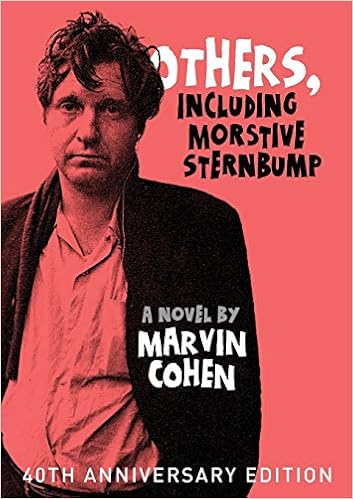
Amazon.com: Others, Including Morstive Sternbump (9780692788486): Cohen,  Marvin, Schober, Rick: Books
Marvin Cohen, Others, Including Morstive Sternbump: 40th Anniversary Edition, Tough Poets Press, 2016.


www.marvincohen.net/


This new paperback edition of Others, Including Morstive Sternbump has been completely reformatted and contains the full text of the original version published in 1976. In addition, it includes the transcript of the 23-minute December 24, 1976 Reader's Almanac interview with Marvin Cohen conducted by Walter James Miller courtesy of New York Public Radio (WNYC 93.9 FM), as well as a new brief introduction by the author.


"[Like] something out of the brain of a poetic trash compactor fed on ten years' accumulation of The New York Review of Books and As the World Turns. Cohen is bewitched by the novelty of the novel. He uses plot and language not to tell a story, but to discover and utilize all the lavish possibilities and pleasures these provide. This book is a writer's lark, yet also a benign ramble through the Disneyland of a literary man's literature." - Soho Weekly News

"[Cohen] has put his sophisticated hand into the wiring of the language and twisted it impishly. ... The reward for your attention is that you hear a new voice and a new kind of surreal music." - The New York Times Book Review
Marvin Cohen, now 85, was one of the most innovative voices in American literature during the 1960s and 1970s. He authored 9 books, two of them published by New Directions, and his short fiction and essays appeared in more than 80 publications including The New Yorker, The New York Times, The Village Voice, The Nation, Harper's Bazaar, Vogue, Fiction, The Hudson Review, Quarterly Review of Literature, Transatlantic Review, and New Directions annuals. Staged readings of his 1980 play, The Don Juan and the Non-Don Juan, featured such actors as Richard Dreyfuss, Keith Carradine, Jill Eikenberry, and Wallace Shawn.
During Cohen's heyday, his writing was praised for its originality, sincerity, and humor. Here's what the New York Times Book Review had to say about his 1967 debut, The Self-Devoted Friend
"It is rare these days -- perhaps, any days -- to come across a work that not only reveals a striking, fresh talent, but stands outside current literary preoccupations. What Mr. Cohen has is his own: a joy in language, and an eye, at once innocent and shrewd, for the paradoxes inherent in the human condition. He puts both language and people through their paces, stands them on their heads, and hugs them to his heart in what amounts as a tour de force of serio-comedy, a sort of superb clowning in which pathos and absurdity intertwine as they do in a Charlie Chaplin film."


Amazon.com: How to Outthink a Wall: An Anthology (9789811101182): Cohen,  Marvin: Books

Marvin Cohen, How to Outthink a Wall: An Anthology, Verbivoracious Press, 2016.


Who is Marvin Cohen? Brooklyn-born New Yorker Marvin Cohen published numerous surreal and whimsical fictions in books and magazines from 1967 to 1982. This anthology showcases the two modes of Cohen’s writing: short ‘dialogues’ operating in the manner of an Ionesco or Beckett script by inverting language with an eschatological hopelessness while revelling, rather than despairing, in life’s absurdity, and longer stories displaying Cohen’s unique style and knack for shaping language in novel ways: his repetitions, random exclamations, and bestowing on abstract nouns abstract qualities. Cohen has an ear for the music of the absurd on a par with Donald Barthelme, mixing the flip whimsy, astute and wry observation, and verbal heft, with a fondness for paradoxes and intellectual riddles. His incessant probing of the weird crevices of existence makes reading Cohen a perpetual pleasure. This anthology collects Cohen’s four volumes of short fiction.


“His stories are bursting with inventiveness, and have a way of posing awkward questions—this, when most of the world’s story writers are content with dry observation, or mere character assassination.” — The Times Literary Supplement


This newly-released anthology collects the following volumes of Cohen’s short fiction: The Monday Rhetoric of the Love Club and Other Parables, Fables at Life’s Expense, The Inconvenience of Living, How the Snake Emerged from the Bamboo Pole but Man Emerged from Both, and Aesthetics in Life and Art. It also includes approximately 40 pages of new work.


++++++++++


“It is rare these days — perhaps, any days — to come across a work that not only reveals a striking, fresh talent, but stands outside current literary preoccupations. What Mr. Cohen has is his own: a joy in language, and an eye, at once innocent and shrewd, for the paradoxes inherent in the human condition. He puts both language and people through their paces, stands them on their heads, and hugs them to his heart in what amounts as a tour de force of serio-comedy, a sort of superb clowning in which pathos and absurdity intertwine as they do in a Charlie Chaplin film.” — Alice S. Morris


“Cohen surrealistically juxtaposes ideas, seeks irrational and fantastic links, but for the high purposes of verbal comedy and linguistic entertainment.” — The New Statesman


“Marvin Cohen’s wacky humor has something of Thurber, something of Steinberg, Buster Keaton, the surrealists, the pataphysicians. The Self-Devoted Friend is a book that should be read immediately by all who gladly recognize themselves to be half crazy.” — Thomas Merton


“Such discontinuous fictions as Finnegans Wake or Naked Lunch or Marvin Cohen’s The Self-Devoted Friend would store more suitably than nineteenth-century novels.”  — Richard Kostelanetz


Marvin Cohen - Dialogues


Marvin Cohen - Monday Rhetoric of the Love Club


“Marvin Cohen is a virtual original. He is at his best in his dialogues, excellent theater of the absurd — zany, witty, progressing by disrupting and revealing pun to open up new areas of insight. There is an exuberance about his work which shows in his delight of words: many phrases are sheer delight. Cohen is also a satirist of thrust, touching upon many matters — sex, love, religion — but some of his most moving pieces deal with loneliness. Even here, however, his vitality and vigor encompass the emptiness of his subject and enable us to see the human situation in context. He is never dwarfed by his material, nor does he sentimentalize it. His touch illuminates and moves on. Perhaps this book will create for him the following he deserves.” — Library Journal


“His stories are bursting with inventiveness, and have a way of posing awkward questions — this, when most of the world’s story writers are content with dry observations, or mere character assassination.” — The Times Literary Supplement


“Cohen thinks all our lives shade very close to surrealism and, set down, his observations are often wildly funny. Add his wonderful facility with words and you have one of the most delightful books of the season.” — Newsday


Marvin Cohen - Baseball the Beautiful


“For his first non-fiction book, [Cohen] chose his lifelong love. Baseball the Beautiful is unlike any book on baseball that you have ever read. He compares baseball to life, death, time, space. Frequent references are made to Tolstoy, Aristotle, Moliere, Greek tragedy. It is beautifully written, but perhaps in a manner that only another writer will admire and envy.” — Verne Boutner


“Cohen’s essays on the sport never become trapped in sentimentality or overblown analysis — as pleasing as a perfect game with two out in the ninth.” — Penthouse


“Cohen approaches baseball as the artist does a great work of art — it contains, for him, the metaphysical, the holy, the myth, that which lives beyond us, love. Seeing baseball as the supreme art, we are drawn into the book, and close to whatever art we are involved in, close to life.” — Rochelle Ratner


“Probably the most sympathetic book ever written about the game.” — Vic Ziegel


Marvin Cohen - Fables at Life's Expense


“The narrator in Cohen’s typical fable purposely locks himself into a logic that must lead to frustration and failure. Instead of despairing, however, he then revels in the irony of the situation and finds consolation in the triumph of art (the fable) over life. He reaches rare and dizzying heights of metaphorical perfection in describing paradoxical emotional states. For serious collections of contemporary experimental fiction.” — Library Journal


“Verbal and situational fun. Attractive comic fantasia. Cohen writes in a style that pulses with energy.” — Publishers Weekly


Marvin Cohen - Others, Including Morstive Sternbump
“[Like] something out of the brain of a poetic trash compactor fed on ten years’ accumulation of The New York Review of Books and As the World Turns. Cohen is bewitched by the novelty of the novel. He uses plot and language not to tell a story, but to discover and utilize all the lavish possibilities and pleasures these provide. This book is a writer’s lark, yet also a benign ramble through the Disneyland of a literary man’s literature.” — Ron Whyte


“[Cohen] has put his sophisticated hand into the wiring of the language and twisted it impishly. ... The reward for your attention is that you hear a new voice and a new kind of surreal music.”
Raymond Sokolov


“An appeal that lingers beyond the final page. ... A brilliantly interpretive mind.” — Houston Chronicle


Marvin Cohen - Inconvenience of Living


“With sage and quiet humor Cohen whittles at the ludicrous dimensions of human folly and cuts us to the quick with his fables, parables, dialogues, and other delightful departures from the conventions of fiction It’s always a pleasure to come across Cohen in a magazine piece; here, too, he again proves to be an antidote to the inconvenience of living.”  — Publishers Weekly
Marvin Cohen - How the Snake Emerged


Facebook


The Don Juan and the Non-Don Juan (1980)


Based on two unpublished episodic novels by Marvin Cohen, (Women, and Tom Gervasi and Inside the World: As Al Lehman), The Don Juan and the Non-Don Juan was was first performed at the New York Shakespeare Festival as part of the Poets at the Public Series. Staged readings featured Richard Dreyfuss, Keith Carradine, Mimi Kennedy, Wallace Shawn, and Jill Eikenberry, with a full production in London.
        “Two different separate men who never even heard of each other are alternately displayed as having to do in comparative parallel contrast of ways with, in various forms, women. One of the men is the latest in the line of the Don Juans, from the lengthy literary tradition as depicted by Byron, Shaw, Moliere, and Mozart/Da Ponte. The other man would also like to be a Don Juan: his attempts on that score demonstrate that he’s not.
        “Among the hordes of women encountered by these unmutual men are an office secretary who gets one of them fired; a nunhood-renouncing nun; a monthly duo named May and June; a rich gangster’s smitten wife; a flowery trio named Iris, Rose, & Lila; women at parties; women at dinners; women in bed; women in the rain.
        “Plenty of conflicts abound. To settle one of them, God puts in a majesterial appearance.
        “At the end of this theater presentation, there’s no loss of conclusions that an audience member may (or for that matter may not) arrive at. Among the theatrical approaches to the Don Juan legend or the failure thereof, the comic gets treatment. Other devices help out, just in case.”  — Marvin Cohen


Necessary Ends involves two couples who tangle in a philosophical farce about love, language, sex, time, and death. A collaboration with the director James Milton, it was privately auditioned to producer Joseph Papp, with Wallace Shawn, Andre Gregory, Angela Pietropinto, and Gretchen Van Riper in the four roles.
“The term ‘character’ was coined with Marvin Cohen in mind. A gentle observer of the unpredictable and slightly absurd, Marvin has a fondness for mankind that is unmistakably his own. Sometimes I think of him as a comedian-chronicler standing at the center, his head turned slightly toward your line of speaking to accomodate his hearing aid. Necessary Ends is the sum of these parts, as Marvin positions and repositions people within relationships, that ever-aimed ear to the pun and odd bits of conversation, as though he’s walking slowly through a cocktail party. The strength of his writing stems from his baroque sense of humor and his ability to see both the world and himself as wonderfully delightful miscreaants.” — Joseph Papp


When Marvin Cohen was offered space for this website biography, he confessed: “I’ve risen from a lower class background to a lower class foreground.”
Described as a poet, humorist, surrealist, essayist, etc., he has published nine books. His play The Don Juan and the Non-Don Juan has been acted in by Richard Dreyfuss, Keith Carradine, and Wallace Shawn, plus actors in England, and translated for German TV. His shorter writings — stories, parables, allegories, essays — have appeared in more than 80 publications, including anthologies from New Directions and other major publishers, plus The New York Times, The Village Voice, The Nation, Harper’s Bazaar, and Vogue. He’s given loads of readings in New York and London, often assisted by dialogue partners who acted like actors and sometimes even were.
Despite very little college education, he taught creative writing at the New School, the City College of New York, C.W. Post of Long Island University, and Adelphi. He was never imitated by years of students, much to their credit.
Born in Brooklyn in 1931 during the recession, Cohen took art classes at Cooper Union, but oils and canvas cost too much and writing cost very little. Reduced to 35% hearing from infantile disease, he lived in a cold-water flat starting at $31 a month in Manhattan’s Lower East Side. He notoriously crashed a lot of parties and receptions for extra food, drink, and free socializing not to mention flirting (harmless, of course). His odd jobs included messengering, mink farming, children’s camp counselor, market research, post office temp, proofreader, ineffectual gardener, and merchant seaman on oil tanker to Cuba; but he was fired virtually more frequently than hired, if at all possible.
His first published piece appeared in The Beat Scene (Corinth Books, 1960) along with Jack Kerouac, Allen Ginsberg, and Gregory Corso:
Prose Poem
        I woke up feeling too good to be true. That was my first mistake.
        I yawned, and with powerful ease of breath blew the ceiling away from my bedroom, until the lady upstairs fell on me with violent curiosity of desire.
        I married her the next day to facilitate our growing friendship. It was a marriage of convenience, since she was intolerably wealthy and I was sufficiently poor.
        She made me move upstairs. We cooked our meals by rubbing our bodies together while holding the raw meat and vegetables. It was amazingly effective. Animal heat, as yet unexploited, contains unlimited possibilities as a source of energy. We thought of selling ourselves to the government: But that would be prostitution.
        This story ends, though, sadly: We loved each other to extinction. Even our graves are invisible.
Cohen lives in New York City with his wife, a retired paperback editor. He enjoys good health and still plays softball regularly, but now is courteously run for starting at home plate, but he plays and makes errors all by himself at first base, mainly in Central Park, in all seasons on Sundays. He identifies himself as a Yankee fan in his book Baseball the Beautiful, title-changed by the publisher from the original Baseball as Metaphysics for commercial feasibility and to bring in the lumbering lowbrow audience.
With the exception of The Monday Rhetoric of the Love Club and Other Parables, (New Directions), Cohen languishes out of print. However, a resurgence of popularity may be imminent, as Boston-area independent publisher Tough Poets Press is currently working on a 40th anniversary edition of Others, Including Morstive Sternbump, a novel if you call it that. Plans are also underway for Cohen’s resurgence at Verbivoracious Press in Glasgow and Singapore for an omnibus of his earlier work compiled laboriously to benefit the subject of this website, which heralds Cohen’s entry into the electronic world as an experiment in modernity.
“My work has been influenced by such personal factors as my rather isolated Brooklyn childhood, my semi-deafness from the age of three; my interests in Major League baseball, art, and music; early abortive love life, poverty, the cosmos of New York City, travelings and tattered abundance of jobs, and idlenesses. However, my work hardly ever touches literally on events, being rather surrealistically abstract.”  - www.marvincohen.net/

12/19/16

Design Fiction identifies the current fascination with fiction across art, design, and architecture. Practitioners and theorists explore this strategy by pushing the debate into both speculative and real-fictitious terrains


EP Vol. 2 . Design Fiction, Alex Coles, Ed., Sternberg Press, 2016.


Contributions by Paola Antonelli, The Atlas Group (1989–2004), Alex Coles, Anthony Dunne, James Dyer, Umberto Eco, Experimental Jetset, Vilém Flusser, Verina Gfader, Huib Haye van der Werf, Will Holder, Sophie Krier, Carrie Lambert-Beatty, Lucas Maassen, Valle Medina, Philippe Morel, Rick Poynor, Fiona Raby, Benjamin Reynolds, Hiroko Shiratori, Bruce Sterling
After the first EP volume on the activities of the early Italian avant-garde, the second volume in the series identifies the current fascination with fiction across art, design, and architecture. Practitioners and theorists explore this strategy by pushing the debate into both speculative and real-fictitious terrains. Newly commissioned interviews, artist projects, and essays shed light on topics such as parafiction and algorithmic ambiguity. Included in the volume is one of the final interviews to be published with novelist and semiotician Umberto Eco; a conversation with Bruce Sterling, in which the science-fiction author responds to designers who reference his writings; and design theorist Vilém Flusser’s 1966 essay “On Fiction,” in its first English translation.   

The EP series fluidly moves between art, design, and architecture, and introduces the notion of the “extended play” into publishing, with thematically edited pocket books as median between popular magazines (“single play”) and academic journals (“long play”).
 
Design by Experimental Jetset


December 2016, English


Chris Dankland - A very loose narrative holds the pieces together as these are individuals who have checked out of reality going for the absurd the margins of society freely embracing it


Chris Dankland, Weed Monks, Gumroad. 2016.


“Weed Monks” reveals Chris Dankland to be the red-eyed man of the dank lands. Chris Dankland is the one that Madvillain referred to their award-winning hit “America’s Most Blunted”. Throughout the collection “Weed Monks” reveals itself to be quite compassionate for its lowly individuals seeking salvation. Many of these monks opt for the silent “All Quiet On the Western Blunt” sort of life, refusing to speak yet possessing a great many followers.
Humor ties the stories together. A very loose narrative holds the pieces together as these are individuals who have checked out of reality going for the absurd the margins of society freely embracing it. Chris Dankland gives these outcasts religious attributes as they devote themselves to a lifestyle most assume is exclusively for leisure. Nothing in the many stories reveals a sense of leisure. These weed monks ponder the giant questions in life while removing temptation from their lives. As a result they live relatively sparse lives, living on the beach, driving golf carts, forgetting how to go to the bathroom.
Various insight is given into the mysterious tradition of the weed monks. Chris Dankland does not speak of the original weed monk, the one who began it all. Such a focus would make the collection lose its sort of weird charm. A righteous sense leads these individuals as they sing to themselves and others. Plenty more completely disappear never to come out again. Some try for deep enlightened thought only to come up completely short. Sober people have the same outcome so ultimately it is about perspective more than anything.
The history of the weed monk comes into view. Lost traditions come into play of people devoting themselves to it. A few try to come up with ways to avoid speaking with simple hand gestures, losing them in the passage of time and forgetfulness. Others still wonder what loneliness means, and whether or not it is a more honest way of living. Belief systems are worked upon to try and figure out what purpose the afterlife might have, all of which are the questions that involve one hand clapping.
Even Chris Dankland makes a cameo. Adhering to the role of scribe he tries to write down the wisdom that he witnesses across the many weed monks of his world. Not all of the ideas are fully elaborated upon but rather serve as example of how many tangents can grow without flowering.
Really funny, really bizarre, and strangely sweet “Weed Monks” is devoted to the weird ones in the world, the ones who fell through the cracks and choose to live there.  - beachsloth.tumblr.com/post/138967103935/weed-monks-by-chris-dankland


Szilvia Molnar - a dark tale about love, betrayal, dreaming, sex, airports, and office tension


Szilvia Molnar, Soft Split, Future Tense, 2016.
zilmolnar.tumblr.com/


Soft Split is a dark tale about love, betrayal, dreaming, sex, airports, and office tension. Szilvia Molnar is a fearless fictional deviant.

“With its red parrots, illicit sexual encounters, and a former lover named Blondie, Szilvia Molnar’s Soft Split is a welcome contribution to the library of dreams, wet and not.”Sjón

“If Georges Bataille had found a feral child and left her with Miranda July and Emmanuel Carrère to raise, the little girl may have grown up to sound exactly like Szilvia Molnar, whose Soft Split has the mannered depravity and whimsical uber-feminist pervdom we’ve come to expect from these giants of the genre.”Jerry Stahl


“In 30 pages I have counted 8 orgasms and I wasn’t ashamed of any of them, there are probably more, the text is too good to concentrate on counting orgasms… Soft Split is loud & cheeky, relentlessly emotional, without a will to sentimentalize, what a generous bluntness in words & contex, what a vulnerable I in every circumstance.“ —Saša Stanišić


“Filthy, gorgeous, funny, strange—a dark little journey through someone else’s dream.”—Jonathan Lee


A Conversation with Szilvia Molnar on 'Soft Split' & Psychosexual Dreams


WRITINGS


Professor Past and Professor Present, THE CHAPESS ZINE #7 (UK), April 2015 [poems]
Escenarios alternativos para amantes* {Alternative Scenarios For Lovers}, The Buenos Aires Review, April 2015 [short story] 
Professor2, Two Serious Ladies, November 2014 [poem]
Have at it, Electric Cereal, September 2014 [poem]
Alternative Scenarios For Lovers, Little Brother #4 (Canada), June 2014 [short story] 
*translated by Miguel Muñoz 
**translated by Ursel Allenstein
PRESS
The alt-lit names to look out for in 2016” in Dazed Digital by Lucy K Shaw
Interview in PDXX Collective by Tabitha Blankenbiller
Interview in Luna Luna Magazine by Meredith Alling
Interview in The Rejectionist by Sarah McCarry
Interview in The Believer Logger by Shane Jones


Szilvia Molnar’s prose and poetry have been published in Two Serious Ladies, Electric Cereal, Little Brother, and The Buenos Aires Review, among others. Her artwork has been published by Girls Get Busy, Flavorwire, Jezebel and Icon – El Pais. Born in Budapest and raised in Sweden, Szilvia now lives in Brooklyn, New York.


Mário de Andrade - a landmark precursor of Latin American magical realism. Dramatizing aspects of Brazil in transition (multiracial, Indian versus European, rural versus urban life), Macunaima undergoes sometimes hilarious, sometimes grotesque transformations until his final annihilation and apotheosis as the Great Bear constellation in the heavens


Mário de Andrade, Macunaíma, Trans. by E. A. Goodland, Random House, 1984 [1928]

Announcing a major literary event: here is the first translation into English of a landmark precursor of Latin American magical realism, which has informed the work of contemporary writers from Garcia Marquez to Salman Rushdie. Macunaima, first published in Portuguese in 1928, and one of the masterworks of Brazilian literature, is a comic folkloric rhapsody (call it a novel if you really want) about the adventures of a popular hero whose fate is intended to define the national character of Brazil.

"Inventive, blessedly unsentimental," as Kirkus Reviews has it, and incorporating and interpreting the rich exotic myths and legends of Brazil, Macunaima traces the hero's quest for a magic charm, a gift from the gods, that he lost by transgressing the mores of his culture. Born in the heart of the darkness of the jungle, Macunaima is a complex of contradictory traits (he is, of course, "a hero without a character"), and can at will magically change his age, his race, his geographic location, to suit his purposes and overcome obstacles. Dramatizing aspects of Brazil in transition (multiracial, Indian versus European, rural versus urban life), Macunaima undergoes sometimes hilarious, sometimes grotesque transformations until his final annihilation and apotheosis as the Great Bear constellation in the heavens.


"Sly, ribald and opulent in a hardheaded, buoyant way, the book is a classic (.....) A hallucinative poet suckled on Apollinaire and Laforgue, de Andrade takes in everything, ancient and modern, African and Italian, and creates from it a chirping icon, cosmic and undusty. (...) What an amazing supple text it is, woven together from songs, curses, obscenities, tall tales, erudite letters and primitive improvisation. It is almost beside the point to note that the book's content is just as varied as its manner" - Paul West, The Nation


"E.A.Goodland's translation brings the language across with descriptive passages of considerable eloquence. However, he cannot make Mário de Andrade's folk speak in English as they should. (...) Nonetheless, I am almost ready to forgive anything from Mr.Goodland, who has obviously taken pains to bring such a nutty and happily unserious exercise into English." - Alexander Coleman, The New York Times Book Review


"(A) hilarious folkloric novel (.....) The language, exuberant and vulgar, lifts off the page, creating a huge, richly textured slice of Brazilian life, oozing with rapturous malevolence and peopled by blackguards, victims, paramours and assiduous ticks and ants." - Sunday Times


"Ostensibly, the book follows its roguish titular hero as he travels from his homeland in the northern Amazon to 1920s São Paulo and back, in quest of a talisman which has fallen into the hands of a giant. But digressions are the sunshine, and the book’s principal pleasure lies in Andrade’s meanderings through Brazilian myth and legend. Macunaíma’s adventures often read like a series of short folkloric vignettes. (...) Dodson’s translation captures all the playfulness of the Portuguese text. The Brazilian colloquialisms are transposed to a fizzy American vernacular, but flora and fauna maintain their original names, inviting a surrender to the story’s strange, defamiliarising atmosphere." - Pablo Scheffer, The Telegraph


"(O)ne of the most original novels in Latin American literature, and the work that established the terms of debate for the forging of a distinctive Brazilian aesthetic of modernity. (...) Katrina Dodson’s translation, employing a colloquial American diction with palpable African American and Deep South overtones, gives Macunaíma a consistent, credible voice in English. She inhabits and breathes life into the novel as though she were a revenant from the Brazilian jungle of a century ago. Her afterword is the most complete short account of Andrade’s achievement available in English; her notes on each chapter’s word choices, the result of five years’ research, exceed in their insights even Portuguese-language critical editions such as that co-ordinated by Telê Porto Ancona Lopez, published by Unesco in 1988. (...) It is not only Brazil’s complexity that Mário de Andrade captures, but that of the Americas as a whole, and to some extent that of the entire modern world." - Stephen Henighan, Times Literary Supplement


‘Katrina Dobson’s translation, employing a colloquial American diction with palpable African American and Deep South overtones, gives Macunaíma a consistent, credible voice in English. She inhabits and breathes life into the novel as though she were a revenant from the Brazilian jungle of a century ago…It is not only Brazil’s complexity that Mário de Andrade captures, but that of the Americas as a whole, and to some extent that of the entire modern world.’— Stephen Henighan, Time Literary Supplement


‘Macunaíma is a self-consciously nation-founding novel that reads like a thick broth of painful historical truth, quoted myth, and irreducible pleasures. Rarely is so much pleasure given and pain revealed by overlapping languages.’— Arto Lindsay


‘An explosion of language… The obvious comparison for English speakers would be Ulysses, as an encyclopedia of styles, of language forms.’— Fredric Jameson


‘He’s an anti-hero hero, questioning and contradictory. Macunaíma is an emblem of the marvelous, metamorphosed into the errant question mark of his one-legged constellation. An anti-normative hero who points to a future, eventually more open, world.’— Haroldo de Campos


‘Mário wrote our Odyssey and, with a swing of his native club, created our classical hero and the national poetic idiom for the next fifty years.’— Oswald de Andrade


‘A deliberately provocative text, slangy, comical, antiliterary, assuming all the apparent contradictions of the struggle against European seriousness in its various forms.‘— Pascale Casanova


‘Macunaíma is a miracle. There’s nothing like it in all of literature. Katrina Dodson is a hero.’— Mario Bellatin, author of Beauty Salon


‘We are so fortunate that Mário de Andrade’s rollicking Macunaíma is finally reappearing in English in Katrina Dodson’s dazzling translation.’— John Keene, author of Counternarratives


‘Dodson, a PEN Award–winning translator of Clarice Lispector, breathes new life into this spirited modernist classic from Brazillian writer de Andrade…Electrifying and perplexing, this cornerstone of Brazilian literature shouldn’t be missed.’— Publishers Weekly, starred review


Macunaíma opens with the birth of its titular hero, described not as 'the hero with no character' of the subtitle but rather:

In the depths of the virgin-forest was born Macunaíma, hero of our people.

As to his hero's 'lack of character', Andrade explains, in the second preface he wrote to the novel, it is: "Lack of character in the double sense of an individual with no moral character and with no set characteristics" -- and he certainly shows these throughout the story.

Macunaíma is often referred to simply as 'the hero' in the rest of the story as well, though he mostly seems out for his own pleasure and fun. If, ultimately, a man of action, at least in the sense of a great deal happening around and to him, he is only reluctantly so -- as is made clear by his oft-repeated catchphrase (or, indeed, motto): "Ah ! just so lazy ! ...".

Macunaíma is also no ordinary man, but, in this novel filled with the fantastical, a shapeshifter: already as a young child he transforms into a full-grown adult "ardent prince", so he can have his way with his brother Jiguê's "gal". He comes to play around with her more, too:

Macunaíma stayed home alone with Jiguê's gal. Then he turned into the quenquém ant and bit Iriqui to cuddle with her. But the girl hurled the quenquém far away. So then Macunaíma turned into an urucum tree. The lovely Iriqui laughed, gathered its seeds and dolled herself up painting her face and distinctive parts. She was ever so lovely. And Macunaíma was so delighted he turned back into a person and shacked up with Jiguê's gal.

Macunaíma also takes up with the beautiful "Ci, Mother of the Forest", a warrior-queen with a: "body ravaged by vice and painted with jenipapo". When they part -- Ci ascending "a vine up to the sky", where she becomes Beta Centauri -- she gives him "a famous muiraquitã amulet". Macunaíma loses this tempetá, and to the extent that Macunaíma has a plot it can be called a quest tale, as he tries to retrieve it, leading him also to the big city -- São Paulo.

Macunaíma is a quick-fire tale, a tour through the jungle-depths and cultures -- indigenous and colonial -- of Brazil, covering both the natural (and the supernatural ...) world as well as urban modernity. As Andrade writes in his second preface to the novel: "Legend, history, tradition, psychology, science, national objectivity, the participation of adapted foreign elements all pass through it".

Macunaíma's experiences and adventures -- and there are very many of them -- often mirror or are variations on local tales and myths, especially of the Tupi. (In prefatory notes he prepared for the novel but never published Andrade goes so far as to suggest: "In the end, this book is no more than an anthology of Brazilian folklore".) There's also a constant engagement with colonial history -- with, for example, one chapter entirely in the form of a 'Letter to the Icamiabas' which, as translator Katrina Dodson explains in her endnotes, is clearly: "a parody of the founding document of Brazilian history -- scribe Pero Vaz de Caminha's 1500 letter to Portugal's King Manuel I recounting the "discovery" of Brazil".

Central to the novel is this idea of being 'without character' -- neither with moral character nor with 'set characteristics'. As Andrade explains in his first preface, he came to such a depiction because he finds that the Brazilian, in general, has no character:

He's just like a twenty-year-old kid: we might observe general tendencies more or less, but it's still not time to affirm anything whatsoever. I believe, optimistically, that it is from this lack of psychological character that we derive our lack of moral character. Hence our none-too-clever chicanery (the elasticity of our honor), the lack of appreciation for true culture, our improvisation, the lack of an ethnic sensibility in families. And, above all, an (improvised) existence living by our wits (?), while in the meantime a wildly imaginative delusion -- following the lead of Columbus as its figurehead -- searches this land with eloquent eyes for an El Dorado that can't possibly exist, amid cleaning rags and climates that are good and bad in equal measure, colossal hardships that can only be weathered with the frankness of accepting reality. It's ugly.

Macunaíma, and especially its hero, reflect this view very well, in Andrade's very creative portrayal.

Language -- or languages -- are also central to the novel, beginning with Andrade noting, at one point, that: "Macunaíma made the most of waiting around by honing his proficiency in the two languages of the land, spoken Brazilian and written Portuguese". Macunaíma is also full of indigenous term -- especially of flora and fauna, which often play a major role in the story -- and there is a great deal of dialect as well. The foreign enters too, if often playfully twisted -- not just Latin but, in Dodson's translation:

"Tell me something, do you speak Igpay Latin ?"

"Never heard of it !"

"Well the, my foe: Ogay eatay itshay !"

With all its language- and word-play, the book is clearly a great challenge to translate. Dodson's Afterword addresses this in some detail, including the interesting explanation of part of her approach:

One major challenge was figuring out how to convey Macunaíma's peculiar effect on Brazilian readers, for whom the novel feels alternately close to home and impenetrably foreign. My solution for approximating this correspondence was to make the translation seem irrevocably Brazilian and American at the same time. Just as Andrade "deregionalized" Brazil, I collapsed North and South America, displacing what we in the United States insist is the America. Macunaíma needs an American English translation because the novel is so deeply American.

With many of the terms -- especially the flora and fauna -- also left untranslated, as well as many references and allusions, Macunaíma does require annotation, and Dodson chooses to present it in the form of; "endnotes as chapter summaries with key terms in bold". These work reasonably well -- including the separate section at the end of many of the chapter-summaries focused specifically on the mentions of "Selected flora, fauna, and food" -- with Dodson arguing:

This format allows for the heady pleasure of reading the novel straight through, letting the music of unfamiliar words disorient you as Andrade intended, without the constant interruption of numbered footnotes droning like a swarm of mosquitoes.

Fair enough, though I must say I would have much preferred on-site footnotes, page after page, given just how much there is on each that is unfamiliar.

Fast-paced, raucous, and often raw, Macunaíma is also full of the beautifully surreal ("Then he turned Jiguê into a telephone machine, called up the giant and cursed his mother"). It's a whirlpool ride of a read, with its mix of Brazilian folklore, myths, and history, practically leaving one breathless. John Keene's Introduction, Dodson's Afterword, and Andrade's own prefaces help give a fairly good sense of all that Andrade tries and manages to do here, but it's still a lot to chew on and swallow.

Multifarious, and with a very dubious hero, Macunaíma is certainly a text of considerable interest -- and good, if often very strange fun, a fascinating take on national epic.- M.A.Orthofer

https://www.complete-review.com/reviews/brazil/andrade_macunaima.htm


Dodson, a PEN Award–winning translator of Clarice Lispector, breathes new life into this spirited modernist classic from Brazillian writer de Andrade (1893–1945), whose other translated works include Hallucinated City. A frequent refrain—“Ants aplenty and nobody’s healthy, so go the ills of Brazil!”—captures only a hint of the 1928 novel’s frenetic energy and satirizing humor. Over the course of hundreds of years, Macunaíma, a young man with ever-changing characteristics, travels with his brothers Jigue and Maanape from their homeland in the wild north of Brazil to the heart of São Paulo and back. Their mission is to retrieve a magical amulet, muiraquitã, from cannibal giant Venceslau Pietro Pietra. Along the way, de Andrade incorporates Indigenous Tupi and Pemon folklore, a West African Candomble religious ritual that allows people to communicate with deities, formal correspondence, popular vernacular, and continent-spanning botany. Macunaíma derives from an Indigenous Carib and Arawak shape-shifting trickster god, and de Andrade uses him as a blank canvas to explore Brazil’s mass of contradictions; he is at various times Black, white, and Indigenous; wild and urbane; comically officious and boorishly crude, and morally inconsistent. In other words, according to de Andrade, “quintessentially Brazilian.” Electrifying and perplexing, this cornerstone of Brazilian literature shouldn’t be missed. - Publishers Weekly


The novel follows a young man, Macunaíma, "a hero without a character," born in the Brazilian jungle and possessing strange and remarkable abilities (Mostly Shapeshifting), as he travels to São Paulo and back again. The protagonist is often considered a representation of the Brazilian personality. The novel employs a composite structure using elements of what would later be called magic realism and a number of dialects of both interior Brazil and São Paulo. It is based on Andrade's research in language, culture, folklore, and music of the indigenous peoples in Brazil.
Macunaíma was an attempt on the part of Andrade to write a novel which represented pan-Brazilian cultura and language.[citation needed]. The author desired to write Macunaíma in the spoken language of Brazil. Macunaíma's catch phrase "Ai, que preguiça!" is a pun in both Tupi language and Portuguese as "Ai" is a Tupi word for sloth and "preguiça" is Portuguese for sloth. This is an example of Andrade using a fused language to write this text, which begins with a simple description "In the depths of the virgin jungle was born Macunaíma, hero of our people. He was jet black and son of the fear of the night".
Considered a "rhapsody" by Andrade himself, Macunaíma is a melding of the cultures of Brazil. Most of the folk lore contained within the text is taken directly from native stories; Lucia Sá has shown that Andrade's novel draws heavily on the narratives of the Pemon people that were collected and recorded by Theodor Koch-Grünberg.[1]
In the tale, Macunaíma travels from his home tribe in the jungle to São Paulo and back again, with chase scenes that go all over the country of in between, in order to retrieve an amulet which he lost. The amulet had been given to him by his lover, Ci before she ascended into the sky to become a star. He encounters all sorts of folk legends and orixas along the way. The interactions which Macunaíma had with most of these characters was imagined by Andrade, though the essence of the folk lore remains true. - wikipedia


A beautiful Brazilian modernist novel in an incredibly well-achieved translation into English. This books exudes fantasy, colours, smells (and ants), without ever losing the sense of being part of a universal cultural history. The perfect antidote to the essentialism of magical realism. - Fernando Sdrigotti


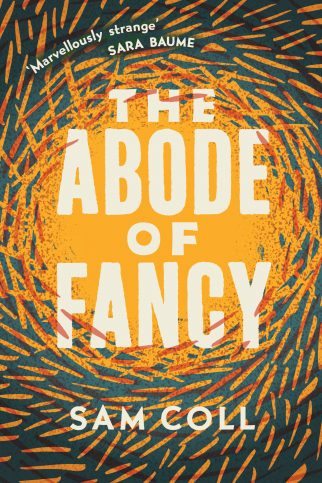
Sam Coll - a thoroughly Irish take on the big parodic postmodern novel in the vein of Thomas Pynchon’s 'Mason and Dixon', but it is is far darker, far more uncanny, and far more savage than the picture that word paints


Lilliput-TheAbodeofFancy-Cover.indd
Sam Coll, The Abode of Fancy, The Lilliput Press, 2016.
extract
interview
interview 2


'We Irish are a shallow people, albeit perversely fair perhaps, as cruel to others as to ourselves, treasuring the unconsummated and the failed, making shallow friendships founded on fatuous fun that runs so cold in the bitter end, backbiting and bitching and kicking our enemies when they are down, snide wiseguys who refuse to acknowledge the depths, emotional retards embarrassed by awkward topics away from which we shy, making nothing but a mess of our feelings, those horrid truths we would prefer to edit than be undone, to find the latent fun embedded in the torment, and make lukewarm comedies from the hash of our life's little disasters.'
Heartbreaking and hilarious, The Abode of Fancy fuses reality and fantasy in an extraordinary narrative. This astonishing mosaic of characters and images, of memories and prophecies, propels the reader into a world that reaches far beyond the printed page. In modern-day Dublin, Simeon, a melancholy student, is tormented by unrequited love, jealousy and loneliness. He seeks solace in the company of his father's friends, a disparate group of world-weary alcoholics, and through them glimpses a grim picture of his own probable future life. A parallel tale follows mythical man-god The Mad Monk on his return to Ireland, seeking out the ghost of his long dead brother. As these two worlds intertwine, the author delivers a powerful meditation on the impossibility of love and the consolations of friendship. The Abode of Fancy is a wildly imaginative addition to the enduring legacy of Irish comic literature, in the spirit of Jonathan Swift, James Stephens and Flann O'Brien. Cosmic and intimate, sentimental and acerbic, harebrained and profound, it is a masterpiece of invention.


'This is everything I'd want in a novel. It's Count Curly Wee adrift in Nighttown. It's Wanderly Wagon hijacked by Laurence Sterne. It's Sinead de Valera with a bang on the head.'- Gavin Corbett


A work of cantankerous and bloody-minded genius, bursting at the seams. I utterly loved it.'- Jon McGregor'


A great Rabelaisian feast of comic ingenuity.'- Paraic O'Donnell


Wildly funny ...a huge, mad gem.'- Donal Ryan


Sam Coll’s The Abode of Fancy, written when he was a 20-year-old undergraduate at Trinity College, is a 500-page contemporary picaresque which will blow your mind. - Andrew Gallix


I started reading Sam Coll’s phone-book sized debut novel The Abode of Fancy yesterday after being bowled over by the musicality of his prose at the launch. I’m 90 pages in and I am staggered by Coll’s talent. By the prose most of all… it’s so audacious, a high ornate style that can look questionable on the page, but it always and I mean always sounds right in the ear, for Coll, like James Joyce, seems blessed with a perfect ear. As with Joyce, and I’m thinking of the Sirens chapter in Ulysses here, you can sometimes deduce in the sentences how musicality has determined Coll’s choices about things like verb/adverb order, the positioning of clauses, redundancies and such-like, and the sense is of an artifice - in Veronica’s Forrest-Thompson’s formulation - where meaning has been shaded (slightly but somewhat) by being sound’s servant.
The book, so far, is one of the most inventive things I’ve ever read. It’s a thoroughly Irish take on the big parodic postmodern novel in the vein of Thomas Pynchon’s Mason and Dixon. The book is going to be talked about a lot, and I imagine we’ll hear the word ‘whimsical’ bandied about, but The Abode of Fancy is far darker, far more uncanny, and far more savage than the picture that word paints. A scene where a bull skeleton is reanimated by the Pooka gave me the type of goose-bump lunar shivers Robert Graves would associate with the White Goddess herself, death-in-life.
I’ve 440 pages to go, but I’m calling this now: The Abode of Fancy is a work of greatness.
Coll is only 27 years old. He’s some buck. - darragh's tumblr


“What do such large, loose, baggy monsters, with their queer elements of the accidental and the arbitrary, artistically mean?” With his Russian contemporaries in mind, Henry James asked this question in an essay about the lengthy novels of the 19th century. While Sam Coll’s debut opus doesn’t quite rival the wordcounts of Dostoevsky and Tolstoy, at nearly 500 pages it is a sizeable commitment for readers approaching the work of a new novelist.
From Dublin and educated at Trinity, Coll may already be familiar to some from his short fiction, notably his rewriting of James Joyce’s Grace for the Dubliners 100 anthology published by Tramp Press last year. Its editor Thomas Morris wrote that “a piece of prose lives and dies in its sentences, and in Sam’s work the sentences positively pulsate: they are lovingly detailed, crammed with adverbs, and probably wouldn’t go down too well in a creative writing workshop.”
The same can be said of The Abode of Fancy, a hugely impressive linguistic feat that for the most part pulls off with brio a high register of grandiose diction that is both self-conscious and self-assured. Repetition, exaggeration, rhyme and deliberate embellishment – not the clueless overegging of those maligned creative writing students – are just some of the techniques used to create a buoyancy that is vital in a book of this length.
Although there are plenty of “queer elements” and many more queer episodes, there is little accidental or arbitrary about the book. Complex narratives require their authors to think seriously about form. The Abode of Fancy’s structure shows a striking amount of thought, from its framing device to the multiple strains of metanarrative that comprise the whole. Coll skilfully meshes fantasy with reality, whimsy with despair, prose with doggerel, while managing to bring his vast cast of characters together in the end.
A picaresque narrative centres on Simeon Jerome Collins, a disenchanted Trinity student who eloquently depicts his loneliness and unrequited love for various heartless women. Simeon, whose initials align him to the author, is “a hopeless romantic who always had to be in love, yet whose bitter and cynical cast of narrow mind forever daunted and soured the fleeting purity of his feelings, ultimately rendering them false”. Spurned by the callous and gratingly believable Saruko, Simeon finds solace in the friends of his father, a group of world-weary alcoholics.
There is the aging lothario Harry Carson, “the barfly, the ligger who always knew when the next reception would be held”; Albert Potter, the repressed homosexual genius who “these days had not even the luxury of oblivion”; weatherman Arsene O’Colla, who missed out on true love when his “anorexic bulimic” jilted him for no apparent reason.
A second fantastical narrative weaves into the lives of the group, often throwing up answers. The mythical god-man Mad Monk has returned to Ireland in search of his dead brother. Along with his henchmen, the Puck and Pooka, he either helps or wreaks havoc for those he encounters. Among the adventures are a grotesquely funny sex scene with a cow (“who calls him Sah”), burgeoning romance with a banshee, the reunion and subsequent destruction of two star-crossed hares, a mysterious death in Yeats country, a donkey named Balthazar and the Promethean creation of the hideous CLUNGE MONKEY.
And that’s just for starters. In a move that recalls the postmodern writing of Flann O’Brien, Coll treats his story as a piece of literary history with a framework that offers a fictional explanation of how the narratives have come to be. A prologue sees Mr Martin Graves sitting down in the house of his friend Eugene Collins – Simeon’s father and a link to many of the characters – at a dining table strewn with documents and paraphernalia.
A rundown of the items summarises the entire novel and includes: Life of Watt, a comic book of 994 pages co-authored by the Mad Monk; a packet of condoms belonging to Simeon’s rival; the bones of Peadar Lamb’s bull; an edition of A Midsummer Night’s Dream “as signed by Robin Goodfellow, the Puck himself”; a prescription to stop the swelling of a foreskin; a self-portrait of a young Albert Potter; The Mad Monk’s Doggerel Epic, which will later be written for his lady love, Banshee Maggie Devlin.
Along with this montage of narratives, other postmodern elements include shifts in time and setting, multiple names for the same character, black humour, satire and a novel that draws attention to its own artifice, what Simeon’s frenemy Konrad calls “this whimsical shit . . . we really have to drop this dreadful gentlemanliness that marks our encounters”. A knowing use of cliff-hangers at the end of chapters and a Muriel Spark-like penchant for describing the deaths of characters almost as soon as we meet them also add vibrancy.
With so much going on, it is inevitable that the book flags at points. Lengthy intros before characters are revealed at the start of chapters test patience. Simeon’s later rants appear more authorial that his earlier elocutions. The Mad Monk’s doggerel may bewilder as many readers as it enthrals. Back stories sometimes feel repetitive, particularly on the subjects of unrequited love and awful mothers. Some tired imagery creeps in – the spire as an addict’s needle, that question about why one never sees baby pigeons.
But these are anomalies in a book where linguistic flair is to the fore. From the “beady rosary chain of hostile eyes” that a mother notes of her children, to a character named Fritzl who is “the sweetest of them all”, Coll pushes himself to the limit.
A meditation on the Irish mentality in a later chapter shows his skill and sums up many of the characters: “For we Irish are a shallow people, albeit perversely fair perhaps, as cruel to others as to ourselves, treasuring the unconsummated and the failed, making shallow friendships founded on fatuous fun that runs so cold in the bitter end, backbiting and bitching and kicking our enemies when they are down, snide wise guys who refuse to acknowledge the depths, emotional retards embarrassed by awkward topics away from which we shy, making nothing but a mess of our feelings, those horrid truths we would prefer to edit than be undone, to find the latent fun embedded in the torment.”
There is light, however, in the fact that “we make lukewarm comedies from the hash of our life’s little disasters”. It is an apt description of Coll’s novel as a whole, a book that goes out of its way to show the reader that it is recorded as opposed to invented, when in fact it is likely the most outrageous invention of a debut Irish author this year. - Sarah Gilmartin


It all begins jauntily enough. An elderly singer, Martin Graves, attends the home of his friend Eugene Collins, who is later revealed to be the father of protagonist Simeon Jerome Collins, a lonely and disillusioned Trinity College Dublin student. This prologue turns out to be an elaborate framing device - on the dining table, Graves finds a collection of assembled objects, the inventory of which offers a summary of the entire novel.
Billed as a novel, The Abode of Fancy is structured more like a themed short story collection. The overarching narrative follows Simeon's college escapades and his dalliances with a series of women who don't return his affections, as well as his friendships with a loosely associated group of ageing alcoholics pondering the question of what it means to be a man of worth. Running parallel is the tale of the Mad Monk, a mythical character returned to Ireland in search of his dead brother Elijah.
The story is set in the present day, but bears the hallmarks of a much more old-fashioned style of writing. It's as if Coll has tried to write an early 20th-century novel and been forced to wedge in elements of 21st-century life, preferring to pretend modern conveniences don't exist and revel in the romanticised past. These moments can feel clumsy and misplaced, as Coll's Joycean aspirations clash uneasily with scenes of blunderous texting.
Coll manages to bring the vast cast of characters together in a tender finale, but the journey there can feel like a bit of an endurance test for the average intelligent reader. Characters are abandoned and reappear hundreds of pages later, leaving readers perplexed and hankering for a glossary.
There's no debating that, at close to 500 pages, this is a sizeable volume, and rather demanding for readers tackling the work of a first-time author. Even more challenging are the excerpts of lengthy poetic verse from the Mad Monk's "doggerel epic".
The novel is often marvellously inventive. Written while Coll was studying at TCD, it offers vivid descriptions of life on and off that storied campus, and evokes the most inflated, pretentious and verbose of students as the young characters wrestle with unrequited love, fickle friends and copious adverbs.
Coll's use of language is startling, as he plays with and parodies classic prose and contemporary slang, filling the text with comic digressions, pointed absurdities and hyper-stylised linguistic hijinks. It threatens to slip out of hand, as the modifiers pile up and you're left reeling by a character who "jocosely rejoined adroitly". The imagination of the early tales seems to have run out by the time we meet the "Clunge Monkey", a Promethean creature defined by his insatiable libido, and the sort of lazy, immature joke you'd expect from a 12-year-old schoolboy.
At other times, the novel can feel undisciplined and self-indulgent, as if the author is luxuriating in his own cleverness at the expense of the reader, which gives the novel an air of 'The Big Bloated Book of Me-me-me'. The 'me', in this case, is loudly, boisterously male, recalling the romantic ideal of the heavy-drinking, rarely-washing literary hero with a brilliant creative mind and mountains of existential angst. All of the characters Coll deems worthy of more than one dimension are male, from the volatile poet Tadgh O'Meara to the ailing weatherman Arsene O'Colla to the debauched gentleman Harry Carson.
Perhaps the flatness of the women characters is intentional, but there is little to celebrate here between the naïve wife tricked by her husband into an open marriage, the whining and shrill student, the dopey, oversexed hare and the servile banshee. None of these women can hold the male characters', or the author's, attention for long, acting merely as passing fancies.
Instead, Coll offers a catalogue of dribbling drunkards manoeuvring their lumpy buttocks on bar stools as they philosophise and muse on their own bowel movements. There are, it seems, more varieties of human excrement than women characters in Coll's book, as he showcases an almost impressively thorough (if frequently unsettling) level of detail and potency in descriptions of all bodily functions - and malfunctions.
The Abode of Fancy boasts a range of rancid smells far more vast than any human is likely to encounter in daily life, the likes of which do not bear repeating, for fear they might put you off your brunch. Suffice to say, at times the book may leave you gagging.
Readers may glean little from this work, save bewilderment and a sense of mild disgust. It's likely to alienate as many as it ensnares. - Meadhbh McGrath


Sam Coll was born in 1989, in Dublin, Ireland. He graduated in English and Art History from Trinity College Dublin in 2011 and later obtained a Masters degree in Anglo-Irish literature, writing his dissertation on Samuel Beckett and sentimentality. He has performed at the Edinburgh Fringe Festival and co-founded the Spoonlight Theatre Group, performing in their productions of Finnegans Wake and Heartbreak House, and can be found on YouTube doing spoken word performance.