8/25/17

Déborah Danowski & Eduardo Viveiros de Castro - offer a bold overview and interpretation of these current discourses on the end of the world, reading them as thought experiments on the decline of the West's anthropological adventure; that is, as attempts at inventing a mythology that is adequate to the present


Déborah Danowski and Eduardo Viveiros de Castro,  The Ends of the World, Polity, 2016.
excerpt


The end of the world is a seemingly interminable topic; at least, of course, until it happens. Environmental catastrophe and planetary apocalypse are subjects of enduring fascination and, as ethnographic studies show, human cultures have approached them in very different ways. Indeed, in the face of the growing perception of the dire effects of global warming, some of these visions have been given a new lease on life. Information and analyses concerning the human causes and the catastrophic consequences of the planetary crisis have been accumulating at an ever-increasing rate, mobilising popular opinion as well as academic reflection. In this book, philosopher Deborah Danowski and anthropologist Eduardo Viveiros de Castro offer a bold overview and interpretation of these current discourses on the end of the world, reading them as thought experiments on the decline of the West's anthropological adventure; that is, as attempts, though not necessarily intentional ones, at inventing a mythology that is adequate to the present. This work has important implications for the future development of ecological practices and it will appeal to a broad audience interested in contemporary anthropology, philosophy, and environmentalism.


In their powerful essay on the climate crisis that humans face today, Danowski and Viveiros de Castro propose nothing short of a radically new and pluralist philosophical anthropology that is bound to reinvigorate humanist and post-humanist debates on anthropogenic global warming. A brilliant tour de force. -  Dipesh Chakrabarty

 This is a passionate, profoundly intelligent book. The ends of time are not the Anthropocene; that is a boundary, not a destiny. What comes next cannot be allowed to be the barbarism of the techno moderns. In this book, recomposition tracks along the Möbius strip of still imaginable, still liveable thought, mythology, and world-making practices indigenous to terrans. Actual indigenous peoples, who have refused to end in end time after end time, can perhaps teach the needed subsistence of the future. - Donna Haraway


Manuel Correa responds to Déborah Danowski & Eduardo Viveiros de Castro, “Is There Any World to Come?”

8/24/17

Ute Holl - We've all had the experience of watching a film and feeling like we've been in a trance. This book takes that experience seriously, explaining cinema as a cultural technique of trance, one that unconsciously transforms our perceptions

Image result for Ute Holl, Cinema, Trance and Cybernetics
Ute Holl, Cinema, Trance and Cybernetics, Amsterdam University Press, 2017.


We've all had the experience of watching a film and feeling like we've been in a trance. This book takes that experience seriously, explaining cinema as a cultural technique of trance, one that unconsciously transforms our perceptions. Ute Holl moves from anthropological and experimental cinema through nineteenth-century psychological laboratories, which she shows developed techniques for testing, measuring, and classifying the mind that can be seen as a prehistory of cinema, one that allows us to see the links among cinema, anthropology, psychology, and cybernetics.


Ute Holl had worked as filmmaker and commissioning editor in Hamburg, Germany, before writing her dissertation on cinematic perception, anthropological filmmaking and cybernetics as critical epistemology, a book published as Kino, Trance und Kybernetik, Berlin 2002. An English translation was published by Amsterdam University Press (Cinema, Trance and Cybernetics, 2017). She has then written on music, electro-acoustics and politics (Moses-Komplex, Zürich 2014) and held commissioned professorships in Weimar and Cologne. Since 2009 Ute Holl is professor for Media Aesthetics at the University of Basel. Focus of research: History of perception in the 19th and 20th century; Science and technology studies of audiovisual media; media history of acoustics and electro-acoustics as well as radio theory; experimental and ethnographic cinema. 
Links

8/21/17

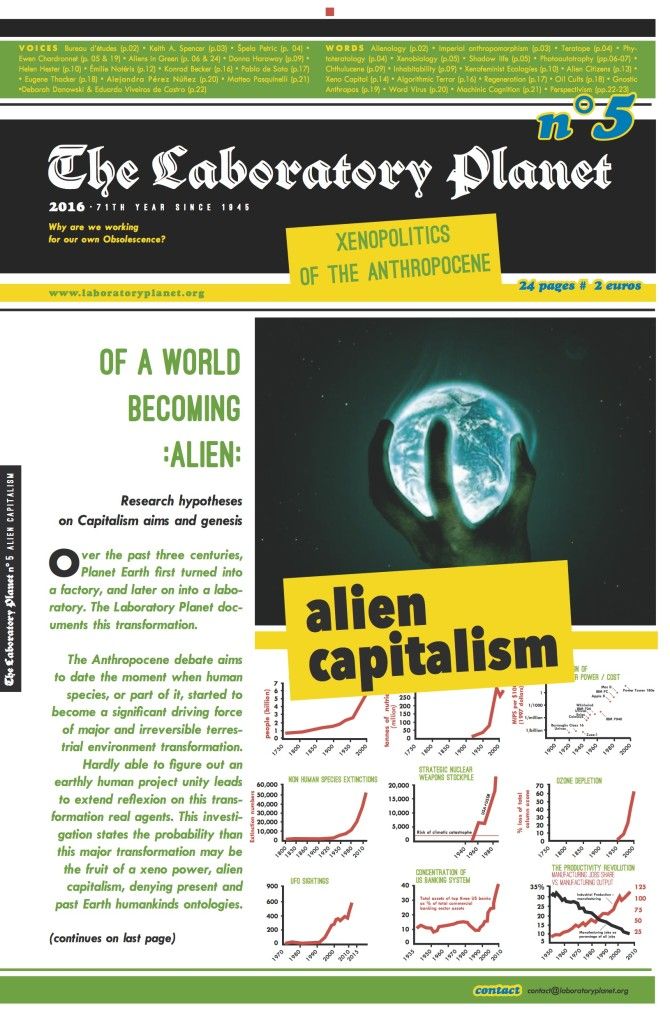
The Laboratory Planet - Alien Capitalism: Xenopolitics of the Anthropocene


The Laboratory Planet
https://laboratoryplanet.org/en/


The newspaper “The Laboratory Planet” was created in 2007 at the initiative of Ewen Chardronnet and the group of artists Bureau d’études who assumed overall editorial responsibility since.
Publication dependent on funding opportunities, four issues have been published between 2008 and 2011, with mixed prints 5,000 copies in French and 5,000 in English.
The Issue 5 : “Alien Capitalism: Xenopolitics of the Anthropocene” was published on February 4, 2016, for Transmediale in Berlin. It was co-produced by PING (Nantes), Jeu de Paume (Paris) and the crowdfunders of Goteo platform.
Download Issue 5
The dissemination was carried out by support networks or at activist or cultural events or interventions in academic contexts.
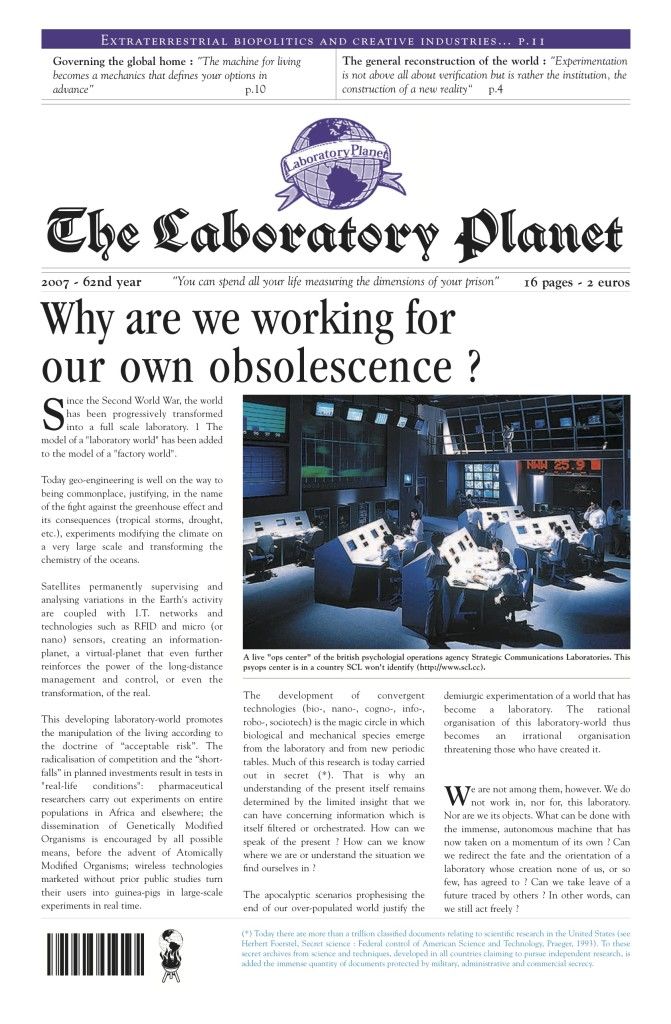
“Since World War, the planet is gradually transformed into a scale 1 laboratory. The old model of “world factory” has given way to the model of the “world laboratory”.
Objects of this laboratory, can we also be the subjects? Can we reclaim this huge machine that became autonomous and is now developing according to its own dynamic? Can we redirect the fate and direction of this laboratory?”

Issue 5 : Of a World Becoming Alien

The Anthropocene debate aims to define the moment when human species, or part of it, started to become a significant driving force of major and irreversible transformation of the terrestrial environment. As we can hardly manage to form an united human project on earth, we might as well consider that the real actors of this transformation may not be humans, which leads us to wonder who the trouble makers might be. We will consider that this major transformation is due to alien agents, leaving the perceptions one might have of this term as open as possible.
Laboratory planet or captured planet, put to work, denatured, rebuilt by aliens? From who or what capitalism is then the name? What is this unconscious colonial enterprise? Basically, we may not know yet…
This is from this non-knowing that we have decided to open an exploratory research around the alien capitalism. Not yet marked research, tangled, complex, the journal will aim to provide beacons, lights, fragments of analysis.
• The First hypothesis speculates about a capitalism which sets its sights on devastating the Earth with the prospect of its future desertion, which would be the symptom for the « alien ». The alien here, would be the one who leave his terrestrial origins to become other, to give themselves other bodies, other futures, finding, perhaps, other origins that the salience of their cradle would have hidden. They would come into being from a powerful action for the sake of the cosmic destiny of humanity in progress, they would strive to redefine or even free themselves from the earthbound co-evolution of humans and non-humans, leave Earth behind for outer space. Humans here are « aliens » as they break away from the devastated planet and maintain an utopian outlook.
In contrast, a non-alien would be operating a tragic re-rooting, a return to earth, disconnecting himself from the epic story of the escapist alien agenda.
• The Second hypothesis refers to Planet earth’s own alien roots. Earth, far from belonging to itself, has participated in a cosmic economy, which by the falling of asteroids loaded the planet with gold, water, precious metals, viruses,… active elements of its evolution and transformation, fertilising it and so that organic resources emerge. Earth would then be a place of socialisation and acclimatisation, a becoming-earthling of alien entities and components. In this way, Earth could appear as a pirate spot where treasures are gathered by the accumulation of accidents, positioning terrestrial society as a community of shipwrecked sailors, building – either voluntary or involuntary – the future of their island.
• The Third hypothesis questions a triple privilege : the privilege of humans over another species – terrestrial or not – (speciesism), the privilege of Earth over other cosmic environments (earth-centrism), the privilege of living organisms over other carbon-free living organisms (biocentrism). From these questions, a post-humanism comes into form, a becoming-alien of humans based on a plurality of intelligent agents, having moral criteria freed from the limits of the humanistic canon or even from terrestrial and biocentric canons. This post-humanism would stimulate the development of new forms of community ethics, new functional assemblies, and the experimentation of new processes of being which, as non-humans, could be defined as alien.
• The Forth hypothesis turns alien capitalism into a meta-discourse, a field of abstraction looming over what is real, with a strong effect of authority. Inventories of ressources in the abstract places of laboratories (the stock market is a sort of laboratory), setting out their respective roles in the same grand system, this meta-discource tells of the planet that has become capital; put to work, that is to say rendered foreign even to itself, managed like an innovative enterprise. Supported by simulations, technocratic narratives, convincing reconstructions of events, this discursive machine is rooted by the appliances of capturing and projecting spaces that orientate our actions, focus our desires, control bodies, legitimise regulations, drive industrial mutations, scientifically govern or subvert mass cognition.
Who is who’s alien ? …a political question
Let’s speculate about passports being made and issued to alien entities. Would they only be issued by the little green men that Men in Black are taking care of? Wouldn’t they also be useful to the « unidentified migrants » and sans-papiers who spread over Europe just like UFO’s? The field of questions opened by the notion of alien also opens the question of the limits of political institutions, and what Hannah Arendt called non-humans; having no status, and therefore no rights. Gathered together at the border, from now are economical migrants, political refugees, climate refugees, cosmic refugees, interstellar castaways and inter-dimensional survivors.

Issue 1 • Why are we working to our own obsolescence? (2008)
Texts by Observatoire de l’évolution, Ange Valderas, Michel Tibon-Cornillot, Alioune Diop, Sophie Gosselin &David Guignebert, Konrad Becker, Ewen Chardronnet, Xavier Inizan, Bureau d’études
Une-laboplanet1
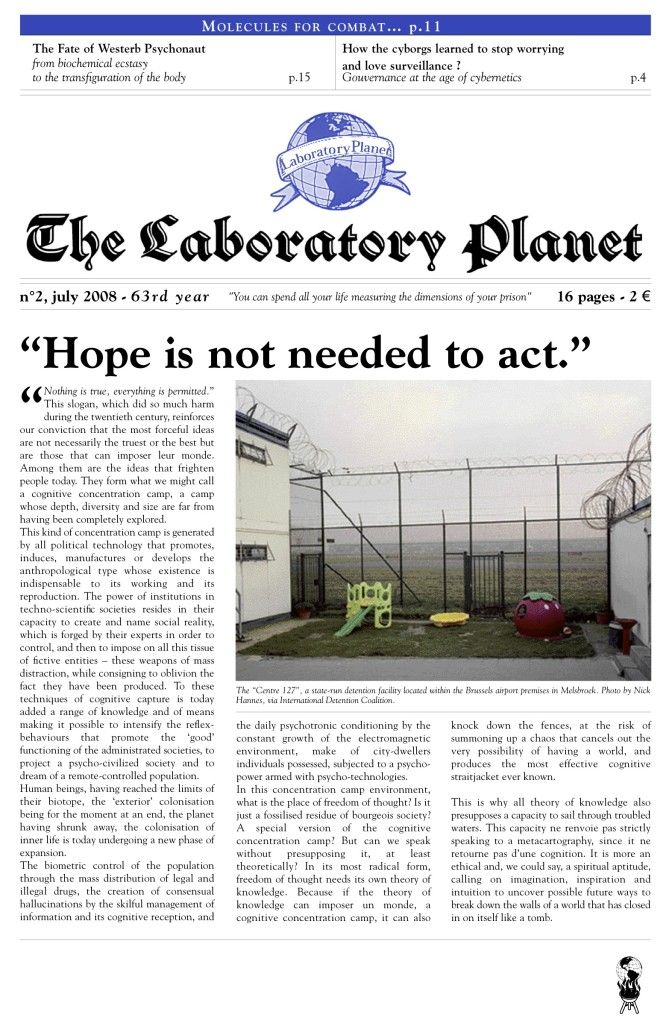
Issue 2 • Hope is not needed to act (2008)
Texts by Bureau d’études, Brian Holmes, Konrad Becker, Nicolas Bonnet, Yves Edel and Lionel Sayag, Michel Tibon-Cornillot, Grégoire Charbey, Ewen Chardronnet
LaboPlanet2-EN
Issue 3 • The laboratory planet or the terminal phase of nihilism (2009)
Texts by Bureau d’études, William Engdhal, Michel Tibon-Cornillot, Ewen Chardronnet, Jean segont I, Jean- François Tabardin
Laboplanet3-front
Issue 4 • The conquest of Earth by the computers (2011)
Texts by Jean-Baptiste Labrune, James Becht, Célia Izoard, Chris Chesher, Bureau d’études, Konrad Becker, Ewen Chardronnet
(no english version)

Issue 5 • Alien Capitalism : xenopolitics of the anthropocene (2016)
Texts by Bureau d’études, Keith A. Spencer, Spela Petric, Ewen Chardronnet, Aliens in Green, Donna Haraway, Helen Hester, Émilie Notéris, Konrad Becker, Pablo de Soto, Eugene Thacker, Alejandra Pérez Núñez, Matteo Pasquinelli, Deborah Danowski & Eduardo Viveiros de Castro
UNE-LaboratoryPlanet5-en
 

8/19/17

Judson Hamilton - celebration of the oddball, those who defy the normal way of doing things. Employing a gentle form of surrealism throughout these weird, warped stories, the characters emerge fully-formed, lovable, and flawed

Placeholder image
Judson Hamilton, Gross in Feather, Loud in Voice, Dostoyevsky Wannabe, 2017.


The incantations of tattoos, a child raised in a shopping mall, whale hearts and the whisperings of graffiti - the stories of Judson Hamilton show us both the trials and travails of modern life and the hope that maybe, just maybe, something more lies beneath the surface.


Gross In Feather, Loud In Voice is a brand new short story collection by Judson Hamilton, a Wroclaw-based writer with three chapbooks and a novella already under his belt. Some of the stories in this collection have previously been published in impressive literary journals from across the world, which suits the huge range of geographic settings of the pieces. This is a global work, and Hamilton is clearly a global writer, his stories as comfortable set in the Southern USA, in Central Europe, in the Far East and many other places in between. The collection evokes very much a whole world, but perhaps not the world in which we live…
///
A few days ago I saw – and laughed at – a right-wing review of a TV show that included this laughably small-minded comment in relation to magical realism:
if anything can happen, who bloody cares?
I was reminded of this comment when reading Hamilton’s book, because the writer here proves the ridiculousness of that statement. For in Hamilton’s stories we are as likely to witness the unbelievable as we are to see the mundane, and amongst stories of violence and loss and rejection and despair, we also get magic and transformation and the truly strange (I’m hesitant to use the word “surreal”). Always the reader cares, because although what happens is impossible to predict, all Hamilton’s human characters respond with understandable emotion.
Gross In Feather, Loud In Voice opens with a story where a character attends a party at his ex-con brother’s house, and finds the heart of a whale in the back garden served as a gastronomic treat. This is, in some ways, a fair introduction to the collection; we see very human stories with edges of the unbelievable. Sometimes we read of things that we ourselves could experience, but often the reader slips out of the understandable and into the bizarre.
As a collection it can – at times – be disorienting. The worlds established in these works are often very, very, different. In ‘Bones and such’, for example (the longest story in the collection), the reader witnesses a world panicking as the moon’s gravity begins sucking the bones of the dead into the sky, until this force constructs a giant human figure on the moon that points at a specific point, back on Earth, which holds clues that allow scientists to develop artificial life, a life that will eventually take over the planet. This takes only 20 pages, but is a hugely complex and evocative story: Hamilton is able to transport a reader – within a single narrative – rapidly from idea to idea, turning and twisting in unexpected but never unbelievable (within context) ways. However, as every story is utterly different, this collection does have the risk of overwhelming a reader if read too quickly – there is so much going on that these stories deserve attention as individual pieces, rather than as part of a larger whole.
Of particular note are:
  • ‘Skull’ – a man with a brain tumour goes on a last holiday with his wife and wanders deep into what may or may not be hallucinations;
  • ‘#9’ –  a single father struggling with his temper and his finances becomes a bare knuckle boxer then goes on a violent rampage;
  • ‘b.p.s.l.’ – a successful estate agent descends into drug addiction and his marriage breaks down. He holds onto a single picture that he and his ex-wife bought at a flea market when young and in love;
  • ‘The Menagerie’ – a newly single man begins making animal masks as part of his therapy (this one seems to have a [vaguely] happy ending);
  • ‘The send off’ – this – the final piece in the collection – is a rather beautiful piece about a man losing his father.
As you can see from this list, there are themes and personalities that reoccur – lots of these stories are about men experiencing – or about to be experiencing – loss. I think to criticise this, though, would miss the point of the collection: Gross In Feather, Loud In Voice shows a reader a huge variety of ways in which people (well, men) can experience pain and/or unhappiness, both within this reality and outside of it. The virtuosic leaps into imaginative, swiftly-created, worlds are grounded in human and relatable emotion. Thanataphobia, addiction, grief, loneliness, regret: this is an emotive text that regularly makes a reader uncomfortable and upset. Hamilton’s writing is not an easy read, and by that I don’t mean his prose is impenetrable, but that his texts discuss unhappiness in an often very bleak – though kinda distinctly male – way.
Unhappiness and loss, though, have long been considered central to literature, as Andrej Nikolaidis and Eley Williams discuss in a recent episode of Triumph of the Now TV:

Judson Hamilton’s short story collection throws a reader about, both in terms of place, in terms of reality and in terms of emotion. It’s a collection of ambitious works that regularly leave a reader deeply affected, and always explore a unique idea in an interesting way. Hamilton’s work is well worth a look, however it is very much an exploration of male emotion and male experience, so do bear that in mind.
Gross In Feather, Loud In Voice is a male text, but that doesn’t mean it isn’t engaging, emotive and full of unexpected imagery. Give it a go. - scottmanleyhadley

“Gross in Feather, Loud in Voice” displays Judson Hamilton’s celebration of the oddball, those who defy the normal way of doing things. Employing a gentle form of surrealism throughout these weird, warped stories, the characters emerge fully-formed, lovable, and flawed. A dry wit permeates every piece, whether it is a musing about the downsides of genetic modification or simply a car ride out to see a giant whale heart. The random, the extraordinary, these help to drive the stories forward for the characters are ones that care, even if that caring is skewed, a bit off-kilter, and perhaps not the most obvious.
Relationships form the crux of the stories. Many of them deal with the bonds formed in a family. There are the strange ones, the black sheep of any gathering. With these people Judson Hamilton shows the love they have for one another, whether is it for their children, their parents, their grandparents, etc. Nothing breaks these bonds, not even a raging violence that consumes an entire Diner out in the middle of nowhere. Even incarnation cannot stop these caring and compassion for others, which also conveniently follows the sea of violence.
Indeed, while there is no overarching story that weaves all these characters together, there are themes. People defiant against normal ways of being, of needing to do things “their way” whatever that way may lead. Strong, powerful personalities grace the pages, even the ones which go into explicit detail of trying to start an empire from complete scratch. Fo those who try to escape the world, to go Hikikomori, they too are drawn to try and come out of their shell, after so many days spent in the lonesome.
Habits, daily rituals reveal to be coping strategies. Abnormal behavior, no matter how strange, becomes normalized through the vast networks of people connected who previously had never been connected before. The distance between people does not thwart a thing, for no matter what they are found wherever they have found some comfort. Strangeness too has a way of lending itself to vast groups of people, for they record it on Facebook, milling about, hoping that their questions will one day become answered. Philosophical musings abound throughout the collection, wondering about death about life and the meaning of how to make sense of a world whose disorientation is its main attribute.
Judson Hamilton’s “Gross in Feather, Loud in Voice” feel soothing as the infinite intricate detail, the endless expanse of geography, simply washes over the reader leaving them happily dazed.

///
Judson Hamilton, Celebrity Slumbers, Cervena Barva Press
Judson Hamilton, The Sugar Numbers, Black Scat Press

Judson Hamilton, No Rainbow, Greying Ghost Press
Judson Hamilton, Black Box, Greying Ghost Press


three poems
poems
Sunday
St. Paul


Skull (story)


12 or 20 questions with Judson Hamilton
twitter


8/17/17

Rodrigo Hasbún - the story of the eccentric, fascinating Ertl clan, headed by the egocentric and extraordinary Hans, once the cameraman for the Nazi propagandist Leni Riefenstahl


Rodrigo Hasbún, Affections, Trans. by Sophie Hughes, Pushkin Press, 2016.


excerpt


'He is not a good writer, thank goodness. He is a great one' - Jonathan Safran Foer


A gripping novel about an unusual family's breakdown, set in 1950s-60s South America
Loosely based on real events, Affections tells the story of the eccentric, fascinating Ertl family, headed by the egocentric and extraordinary Hans, once Leni Riefenstahl's famous cameraman and Rommel's 'personal photographer'. Having fled Germany shortly after the country's defeat in the war, the family now lives in Bolivia. However, shortly after their arrival Hans - an enthusiastic adventurer and mountaineer - decides to embark on an expedition in search of Paitití, a legendary Inca city. The failure of their outlandish quest into the depths of the Amazon rainforest proves fateful, initiating the end of a family whose subsequent voyage of discovery ends up eroding everything which once held it together.
Against the backdrop of the both optimistic and violent 1950s and 1960s, Affections traces the Ertls' inevitable breakdown through the various erratic trajectories of each family member - from Hans and his constant engagement in colossal projects, to his daughter Monika, heir to his adventurous spirit, who joins the Bolivian Marxist guerrillas and becomes known as 'Che Guevara's avenger' - and the story of a woman in search of herself, the story of the heartrending relationship between a father and a daughter, the story of a family adrift.


'Hasbún's writing has a strange power. He likes to reach into the darkest places. Reading him is like... a journey to the brink of an abyss' - El País


“Dark, deep, disturbing. No concessions, no sweeteners: here everything hurts. Through this ably crafted family saga, Hasbún manages to explore the permanent conflicts and contradictions of a whole nation.” —Andrés Neuman


"In Affections, a family elegy is woven into an epitaph for the radical politics of South America and the result is an act of literary hypnosis you won't soon forget."  —Adam Haslett


"Concise yet wild, haunting yet exuberantly full of life, Rodrigo Hasbún's Affections achieves all sorts of artful, intoxicating contradictions. What a gloriously unpredictable book." —Idra Novey


“A dark, stunning novel, Affections is charged by a brilliant kaleidoscope of perspectives, the voices of exiles, a post-war German family in Bolivia. Hasbún has spun a tale of displacement, of political turmoil, in which the characters’ motives are as complicated as the Bolivian jungle they explore. It’s a fascinating book." —Lynne Tillman


"It's hard to decide which character is more fascinating in Hasbún's masterful blend of history and fiction about a German family living in La Paz in the decades after the war. As the quick-paced narrative covers from the search for a lost city in the Amazon to the brutal guerrillas in the Bolivian jungle, the inner lives of each family member build up to enormous emotional payoff. This is sharp storytelling, both in the political and intimate fronts." —Daniel Galera


Affections is a masterpiece, its spare mosaic narrative mesmerizes and brilliantly explodes in the reader's imagination like slow fireworks that will never fade. With its Chekovian emotional intimacy, the razor sharp and tragic political insight of a Coetzee or Bolaño, the seamless enchantment of a Dinesen tale, this novel feels timeless.” —Francisco Goldman


"This is a finely atmospheric book...It’s a work of sympathetic imagination, written with cool economy, elegance and understanding. It’s a reconstruction of real lives, real historical events, but Hasbún’s achievement is to make it perfectly fictional, which is to say truer than fact. I read it straight through first, with no idea of its historical truth, no knowledge of Hans Ertl beyond the name, no memory of the woman who in Hamburg assassinated the Bolivian diplomat who had been the policeman who ordered the hands of the dead Che Guevara be cut off. Learning of this made the second reading interesting in a different way, but didn’t enrich it. The truth of fiction of this quality is that it reminds you how much of life that really matters goes on in the mind and heart." The Scotsman (UK)


Los afectos is a miracle of writing: Rodrigo Hasbún can concentrate two continents, fifty years of history and the collapse of a family in just one hundred pages. He works with extreme delicacy on the Erlts’ biography by creating a literary version of them which is wonderful for its consistency and clarity.” —Giorgio Fontana


“With a direct, unvarnished style, harsh in some way, but with a great sense of rhythm, the author hooks the reader until the very ending of the novel, which is unexpected as much as suspended." —Marco Ostoni


“Hasbún never tricks the readers, but he surprises them, and displays his heroes with a sort of warm coldness which plays with our curiosity and lets us freely imagine what’s left unsaid.” —Goffredo Fofi


Hans Ertl was the director of photography for Leni Riefenstahl’s film Olympia. Though never a member of the Nazi Party, he also worked as the official photographer for Marshal Rommel and the Afrika Korps. After the war he was blacklisted in Germany and in 1950 he emigrated with his wife and three daughters to South America, first to Chile and then Bolivia. There he made documentary films, one about the search for a lost Inca city, and then bought a farm where he would live until he died in his nineties. The oldest daughter, Monika, was his favourite, working with him on his documentaries. She married another German exile, a dull businessman. Oppressed by the poverty and social inequalities of Bolivia, she founded an orphanage and was then drawn into radical politics. Adoring and hero-worshipping Che Guevara, she became a guerrilla fighter or terrorist and later his avenger. Her commitment separated her from the father she had loved. She was killed in an ambush by the security forces. The two other sisters led more normal lives, Heidi returning to Germany where she became a successful businesswoman, the youngest,Trixi, remaining unhappily in Bolivia. This is tremendous material for a novel, dramatic and full of moral complexity. No wonder the young Bolivian novelist Rodrigo Hasbún was attracted to it. What is remarkable, however, is what he has made of it. The easy option, which someone less talented and original might have taken, would have been to write a political thriller. All the material is here in waiting for such a book that, well done, would have sold in airports worldwide. Nazi background, exotic locations, Che Guevara, police brutality, a beautiful and idealistic assassin; altogether a rich stew. Maybe somebody will still write that novel, heavily weighted with research, and it will be a big success.Hasbún’s success is of a different order. He has written a spare narrative, little more than a novella in length, in short, impressionistic chapters, spoken through the voices of Monika (addressing herself as “you”), the other daughters, the brother-in-law who loved her too late and lost her, and an unidentified narrative voice. Everything in the drama is here counterpointed with the ordinariness of life in a land where you don’t feel at home and yet seek to belong. The title indicates where his interest lies. Affections is the theme, affections not strong enough to hold a family together. The father is presented as a “phantom”; you’re always aware of him and he is always slipping out of sight. Monika is a mystery. What turns a beautiful, intelligent girl, so close to her father, into an activist, terrorist and assassin? Events and the reflections they give rise to are presented to us, now in memory, now in a shifting present. But things get “distorted and lost in memory.” “It’s not true,” Trixi thinks, “that memory is a safe place.” “We end up,” she says, ”turning away from the people we love the most.” She does so painfully and reluctantly. The middle sister, Heidi, does so determinedly. But actions have consequences for other people. You get blamed for what you aren’t yourself responsible for. Trixi comes to the sad conclusion that “knowing how to be alone was my one great achievement in life”. Or perhaps that’s not so sad, but a sort of success. Hasbún is a writer who invites you to look at the other side of the coin. This is a finely atmospheric book, admirably translated from the Spanish by Sophie Hughes. It’s a work of sympathetic imagination, written with cool economy, elegance and understanding. It’s a reconstruction of real lives, real historical events, but Hasbún’s achievement is to make it perfectly fictional, which is to say truer than fact. I read it straight through first, with no idea of its historical truth, no knowledge of Hans Ertl beyond the name, no memory of the woman who in Hamburg assassinated the Bolivian diplomat who had been the policeman who ordered the hands of the dead Che Guevara be cut off. Learning of this made the second reading interesting in a different way, but didn’t enrich it. The truth of fiction of this quality is that it reminds you how much of life that really matters goes on in the mind and heart. - Allan Massie


The Ertl family produced two infamous members whose lives are fictionalized in Hasbún’s moody and spare novel. Hans Ertl was a famous Nazi cinematographer exiled to Bolivia after World War II, where he became obsessed with finding the Lost City of Paititi. His eldest daughter, Monika, who accompanied him on an expedition to find the mythological land, married into a wealthy family before becoming radicalized, joining the Marxist revolutionary movement, and becoming a guerilla fighter. All of this is known as fact, but through his measured and oddly ethereal writing (reminiscent somewhat of Paulo Coelho), Hasbún creates a sort of double exposure of the Ertl family’s slow demise over the upheaval roiling through South America. The impact of Hans’s restlessness on his family—his three daughters and their mother—frames the narrative, which unfolds through multiple points of view. Somehow, it is Trixi, the sister who stayed behind with her mother while the rest of the family sought Paititi, whose staid narrative provides the most powerful moments: from her unhappy, cancerous mother deliberately introducing her to cigarettes at age 12, to the devastating paragraph in which Monika corrects Trixi’s naive belief that her older sister’s lover died accidentally: “They kicked his spine until it snapped.” This is an inventive, powerful novel.  - Publishers Weekly

A German family heads to Bolivia after World War II, sparking decades of internal strife amid political revolution.
Hasbún's brisk, sensitive U.S. debut is a fictionalized story of the Ertl clan, which emigrated to escape the ruins and political embarrassments of Nazism. (Patriarch Hans worked as an assistant to propagandist Leni Riefenstahl.) But Hans’ dream of exploring a new land absent politics slowly erodes. Central to that shift is his daughter Monika, who, after a failed marriage, joins Che Guevara’s revolutionaries; “she felt that she had at last found her place in the world.” Her decision, and the violence that follows it, creates a blast radius around the rest of the family, especially her sisters, Trixi and Heidi. But though Hasbún’s narrative is rooted in politics, its key strengths are his remarkable command of time and characterization. The novel is short but gallops across a half-century’s worth of transformations in Bolivia, and sections narrated by individual characters are marked by a surprising depth of emotional detail given the story’s brevity. Reinhard, the brother of Monika’s husband, can’t reconcile “the intriguing Monika from the early days with the impossible Monika later on.” Heidi describes the disoriented family as like “soldiers searching for a war, or interplanetary beings,” while Trixi laments the “doses of horror” that Monika’s radicalization created; Monika herself hardens over time, becoming someone with “no emotion, no memory.” More detail about each of these characters would be welcome; the book feels at times like an epic historical saga that’s been cut down to size by an especially aggressive editor. But in stripping down the story to its barest essence, Hasbún has intensified the effects of each individual scene; the volumes' worth of drama contained in the family’s life emerge by suggestion and implication.
A one-sitting tale of fragmented relationships with a broad scope, delivered with grace and power.  - Kirkus Reviews
       
Rodrigo Hasbún’s Affections (translated by Sophie Hughes, review copy courtesy of Pushkin Press) begins in the Bolivian capital of La Paz in 1955.  Hans Ertl, a German film-maker and explorer who brought his whole family across the ocean a few years earlier, has just arrived home after another extended absence in the mountains.  His presence is to prove short-lived, though, as he heads off again in search of a legendary lost city, taking his elder daughters, Monika and Heidi, with him, leaving his long-suffering wife Aurelia at home with the youngest daughter, Trixi.
Affections is not your average family drama, though.  The first half of the book slowly sets the scene, only for the story to take off in the second part.  You see, Bolivia in the 1960s and 70s was a rather turbulent place, and it turns out that Monika is to find herself in the thick of the political and social turmoil.  As the family drifts apart, so does the country, leaving chasms that will prove almost impossible to bridge once the dust has settled.
Hasbún’s novel is relatively short, but it’s very effective and a pleasure to read.  While Affections is based on real people, the writer has used them as the basis for his tale, reimagining their relationships around certain infamous real-life events.  Ertl and his family did emigrate to Bolivia in the 1950s (as a Wikipedia search will confirm), and despite initial adjustment issues, they became part of a German diaspora, a fortunate elite in a poor country.
Our first view of the story is as a description of three very different sisters, gradually growing apart.  The middle sister, Heidi, is homely and cheerful, her crush on Rudi, her father’s assistant, setting the course for her later life (and eventual disillusionment).  Her younger sister Trixi is close to her mother, and having arrived in Bolivia at a young age, she makes a life for herself in La Paz, even if she does seem to drift through a languid, goalless existence.
However, from the very beginning, it’s clear that our attention will mainly be focused on the eldest sister, Monika:
Yes, she’s the only one who matters now, the misunderstood child, the chaotic, rebellious teenager, the woman who went on to lose all perspective and no longer knew where to stop and ended up hurting herself and others.//Yes, if you pressed me I would say this is the definition of her that sticks: the woman who went on to cause so much hurt.
p.41 (Pushkin Press, 2016)
Larger than life, fierce and independent, Monika is close to her father but able to stand up to him, and her inherited sense of adventure eventually develops into an attachment to a cause.  Yet this description of a woman who brings chaos wherever she goes is very close to the truth.
This was a time of revolutions and uprisings in Latin-America, and while the Castros and Guevara changed society elsewhere, Bolivia is also affected.  Reinhard, Monika’s brother-in-law, senses that a change is on its way:
Reinhard is critical of the Revolutionary Nationalist Movement and its methods.  He says it’s not enough to give land to the Indians, and less meaningful still to let them vote (“Vote for whom?” he asks, when your husband challenges him, “Vote for which of the little white men exploiting them?”).  He tells us it’s brewing, that those of us present should hold onto our hats and our wallets, should be trembling in our boots.  You’ve never heard anyone speak like this before, his words unsettle you. (p.65)
Monika is infected by his beliefs, eventually becoming more heavily involved with the leftist struggle (far more involved than Reinhard himself) than she could ever have thought.
While the second half of Affections is set in a time of turmoil, the text largely avoids the actual fighting and atrocities.  Instead, Hasbún focuses on the spaces between the murders and the thoughts of the people involved.  He uses a variety of narrators and narratorial styles (something translator Sophie Hughes will have been very used to from her work on Laia Jufresa’s similarly structured Umami), with Reinhard’s repetitive monologues (//Yes…) particularly distinct.  The obvious stand-out among the characters is Monika, not only because she appears throughout the other characters’ sections, but also because her strand is written in the second person, distancing the reader from the main focus of the novel.  In a way, the other characters appear to be in orbit around her (even if she’s the one constantly on the move).
Looking back at what I’ve written, I suspect that I haven’t really explained the book as well as I might have, but that’s partly owing to the nature of Hasbún’s novel.  A lot remains unsaid, and it’s up to the reader to decide what to take from the story.  The writing is excellent, calm and measured, yet compelling, whether it concerns descriptions of rainforest adventures, nights of passion or the tense wait for battle.  As we circle around to end the novel with Hans, who has been absent for much of the book, we are forced to reflect on the events of the years separating it from the start.  Affections, then, is a work which can be read in several ways – but it’s certainly one which can be read many times too. - tonysreadinglist.wordpress.com/2016/09/06/affections-by-rodrigo-hasbun-review/


Hans Ertl, Nazi cinematographer and photographer, made his home in Bolivia where he died in 2000. Piero Pomponi / Getty Images.


Hans Ertl was a German cinematographer who made his name working with Leni Riefenstahl on the propaganda films she made for Hitler in the 1930s. Olympia (1938), for example, their documentary about the 1936 Berlin Olympic Games, once famous for showcasing then-groundbreaking cinematic technique, is now infamous for its glorification of Aryan athletic supremacy.
Such was Ertl’s reputation with the Nazi elite, when war broke out in 1939 he was conscripted into the military as a war correspondent, famously earning the title of “Rommel’s photographer” for his documentation of the field marshal’s North Africa campaign.
After the war, with the country and the party he’d spent his career lionising now defeated, Ertl was banned from working in Germany. Along with many of his contemporaries, he fled to South America to begin a new life. He and his family – his wife, and their three daughters: Monika, Heidi and Trixi – arrived in La Paz in 1952.
He shot two final documentaries in Bolivia in the 1950s before his career was brought to an abrupt end in 1961 when mid-filming a new project, he lost his footage in an accident.
Retiring to an isolated farm, he stepped back from the limelight only for his eldest daughter Monika to take centre stage instead. In 1969 she joined the guerrillas fighting in Che Guevara’s National Liberation Army of Bolivia, soon becoming the most wanted woman in Latin America after she assassinated Toto Quintanilla, the man supposedly responsible for cutting off Guevara’s hands after his execution. She was hunted down and killed in 1973.
Faced with such riches to mine, a less daring writer would surely produce a doorstop of a family saga. Rodrigo Hasbún, however, boldly strips his narrative right back, and, in a writerly intrepidness that matches the adventurous spirit of both Ertl and Monika, constructs a haunting account of the family’s Bolivian years, the key to which is an elegant sparseness.
Rather than retelling the facts of their extraordinary public history, Hasbún is concerned with an intimate examination of the slow collapse of the family as experienced from within: a sister who became a “mystery”, a father who was always a “phantom”.
The story of which he pieces together through vignette-like chapters: a series of episodic moments spanning a period of more than 20 years and narrated from multiple perspectives.
Slight, mercurial and more than a little strange, Affections is like a rare bird of paradise; the kind of creature one imagines Ertl and his companions encountering during the expedition deep into the Amazon jungle with which Hasbún begins the story.
Filming the first of his two Bolivian-set documentaries, Ertl sets out in search of the lost legendary Inca city of Paitití (the Lost City of Gold); Monika and Heidi accompanying him, along with the man Heidi will eventually marry, and the woman who will become Ertl’s lover.
Wearing strange “green rainforest suits,” they push through the thick fog tracing the footsteps of the Conquistadores of yore: “We looked like lost skydivers. We looked like soldiers searching for a war, interplanetary beings.”
It’s an experience that is formative for each and everyone involved – even little Trixi, who is left at home with her mother – a journey into the interior, both physically and psychologically, that lays the groundwork for so much of what’s to come.
Beautifully translated by Sophie Hughes, Affections is a richly atmospheric and evocative portrait of fractured familial bonds that takes the reader into the darkness where the protagonists dwell.
“It’s not true that our memory is a safe place,” thinks the adult Trixi. “In there, too, things get distorted and lost.
In there, too, we end up turning away from the people we love the most.” - Lucy Scholes


If you thought your teenaged years were a struggle to work out the world, and yourself, consider that of Heidi Ertl. Or either of her sisters – this book serves as a sort of tribute to these three real-life women, and the lives that came out of their very disjointed youth, forced to be rarefied from the norm by their family uprooting. Father Hans was one of Leni Riefenstahl's key cameramen, and a Nazi military photographer, before taking the whole family into post-war exile in Bolivia. Their mother would have followed him to the ends of the earth – as in part would their daughters, the older two of which start the book by joining him on an expedition to discover a lost Incan city. Heidi finds young, instant love on the trek – but sees the dark side of such emotions, too. Older sister Monika, who might well be manic depressive, finds something else, while the baby of the family stays at home with a maudlin mother. So much here could be the hook on which to hang a full novel, but if anything it's the reaction of them all to this unusual formative journey that inspires this book.
And it has to be said that while it's not a full novel – nobody would struggle to read this in two hours – it's just as rich as you'd want. Part of that must come down to the different narrative voices used. We just get used to seeing Heidi's point of view of the expedition, when we jump to her kid sister and her Christmas back at home. The oldest girl joins in too, in an unusual second person voice. A man crops up, with a weird paragraph formatting and with everything starting with a Yes,… as if he's responding to a questioner or rehearsing to himself the giving of a statement. Plain narration from outside the sisterhood and their larger family is thin on the ground.
But nothing reads thinly about this book. Rodrigo Hasbun has been receiving accolades at home in Bolivia and elsewhere, and this proves why. It's taut, it's a little strange – certainly it took me to a much different place than to where I was expecting from the opening chapters – but it says a lot. There's a richness here you would appreciate and, to repeat, expect much more readily from a larger, denser read. If you have an understanding of Latin American politics and history, well – you've got the icing on the cake. I got an eye-opener to a family I'd never heard about, and one which certainly held my interest despite the lack of relevance the Bolivian audience would definitely find. But that's not to say this reads as a faction about these women's lives, however remarkable – the author's note points out this does not intend to be a faithful portrait, rather a novelisation of the events and characters. Those events and characters, and the way the book addresses the theme of the after-effects of displacement, are certainly worth sharing a little time with. - John Lloyd


Interview with Rodrigo Hasbún - The White Review

Serafinski - an excellent example of taking anarcho-nihilism seriously, as a call to action that has nothing to do with the expectation that we will succeed at making the world better

Image result for serafinski anarcho-nihilism
Serafinski, Blessed is the Flame: An Introduction to Concentration Camp Resistance and Anarcho-Nihilism                   
read it here


This book, with a name from a poem by a partisan fighter, takes two things that would not necessarily seem to go together, but that, on second thought, are made for each other. An introduction to anarcho-nihilism becomes tales of resistance in the Nazi concentration camps, almost all of which failed (in the sense that the resisters died), and for which there was never much hope that they could do anything but fail, which are then analyzed in light of anarcho-nihilism. This book is an excellent example of taking anarcho-nihilism seriously, as a call to action that has nothing to do with the expectation that we will succeed at making the world better. For those who are confused about anarcho-nihilism, and also for those who use the word nihilism as a trendy way to talk about the same actions that leftists have been doing for decades, this text will be an especially helpful road sign.


“What does it take to resist in absolutely futile and overwhelming situations? Inside of the Nazi concentration camps, places ruthlessly designed to eradicate all possibilities for resistance, inmates organized, sabotaged, and reflexively fought back against their oppressors. Within each of these stories we can find a simmering spirit of anarcho-nihilism, a tendency that challenges us to translate our feelings of hopelessness into wild and joyous forms of attack.”

Domício Coutinho comically explores Nova Eboracense, Brazilian New York, with its dazzling mix of priests, brothers, nuns, students, church workers, parishioners, city luminaries, and a dog named Duke who wants to become a priest


Domício Coutinho, Duke, the Dog Priest, Trans. by Clifford E. Landers, Green Integer, 2009

excerpt


From the very beginning pages of Duke, the Dog Priest the reader is thrown into a debate underlying the absurdity of Brazilian author Domício Coutinho's premise: for his novel fabulously purports to be the tale of a dog who desired to become a priest -- or a least to learn Latin. Most American readers -- readers who have encountered few twentieth-century native examples of this genre within the confines of "serious fiction" outside of works such as John Hawkes' Sweet William and The Frog, Tom La Farge's The Crimson Bears, and a handful of other works -- may quietly put down this book, send for their children, or read on in the hopes of encountering a lightweight fantasy. Americans have no great literary tradition of animal characters as do the Japanese, for example, with books such as I Am a Cat, or the Brazilians, well acquainted with their early classic -- to which this work makes reference -- Quincas Borba, Machado de Assis's story of a philosopher dog.

Let the reader be warned: this tale, narrated by Amarante, a Brazilian and former sacristan ("he prepares the altar, lights candles, assists at mass, teaches prayers, aids virgins, widows and abandoned wives. He also secretly tests the virtues and character of the wine") living in New York (Nova Eboracense), will challenge the most sophisticated of readers in its dazzling mix of priests, brothers, nuns, students, church workers, parishioners, city luminaries and, yes, a dog named Duke and the marvelous tales of their interrelationships. If Duke, the Dog Priest were to have a single theme at its center -- and fortunately Brazilian writer Coutinho presents an almost perversely diverse and multifaceted world wrapped around dozens of thematic possibilities -- it would be that even the smallest of actions affects nearly everyone. And, in that sense, each small tale within this encyclopedic work of stories within stories is as important as the next in its inevitable interconnectedness.

Originally published in Portuguese in 1998, this translation reveals a contemporary masterwork of fiction.


About Domício Coutinho: Born in João Pessoa, Brazil in 1931, Coutinho emigrated to the United States in 1959, eventually earning a Master’s and Ph.D. in Comparative Literature from the City University of New York (CUNY) in addition to his bachelor’s degree in Aristotelian Thomistic theology from the Gregorian University of Rome. In 1986, Coutinho, with his wife and two sons, began a business in real estate appropriation and management of properties. In 1999, Coutinho founded The Brazilian Writers Association of New York (UBENY). In 2002, he was admitted as Commander into the Order of Rio Branco, a Brazilian Institution honoring those who have distinguished themselves in cultural and patriotic achievements. In 2004, Coutinho founded the Brazilian Endowment for the Arts (BEA), a non-profit organization dedicated to preserving and promoting the Brazilian Arts, Literature, and Cultural Traditions for the Brazilian/American and Latin American Communities. That same year, he created The Machado de Assis Medal of Merit to honor those who distinguish themselves in Brazilian Cultural Traditions. In 2006, Coutinho founded The Brazilian Library of New York, which houses 7,000 titles, with an auditorium for events, conferences, literary gatherings, films, and dramatic performances. The library has been visited by prominent representatives from government, diplomacy, and academia.

Aside from an untranslated poetry collection titled Salomônica (1975) and an untranslated novel titled Incríveis Revelações de uma Minhoca (2000), Coutinho published a novel in 1998 titled Duke, the Dog Priest, which was translated from the Portuguese by Clifford E. Landers and brought out by Green Integer in 2009.

I interviewed Domício Coutinho here.

The sacred, the mysterious, fables, mythology—all contained the same thing, their history, their magic. […] The Jews had invented the Bible; the Greeks, classical mythology; the Scandinavians, the saga of the Valkyries; the Arabs, the Thousand and One Nights. The Spanish have the image of El Cid implanted in their minds. The Portuguese even today ask what the world would be like in the Fifth Empire. The human mind is a wondrous factory for all myths.”

At first Duke, the Dog Priest gives the impression of being the Cien años de soledad of New York, yet its scope is not as expansive even if it maintains high ambitions throughout its nearly 500 pages. Another hint at its more contained scope is the title, which doesn’t have the lapidary quality of Gabo’s masterpiece nor fellow Portuguese writer João Ubaldo Ribeiro’s An Invincible Memory. Rather than encompassing the whole of the Big Apple, Coutinho focuses mostly on the members of a Catholic parish, turning New York into its dead-language counterpart, Nova Eboracense. However, his novel is no apologia. Instead, it often adopts a satirical and irreverent tone that would have many of the faithful foaming, “Blasphemy!” Coutinho not only acknowledges that natural and species-perpetuating phenomenon known as lust, something religion villainizes and oppresses, but he explores it at length, including lust in the loins of the anointed, for it’s one of the book’s major themes. The lesson could be summed up as follows: celibacy is against our animal nature, if not religion in its entirety.

Occasionally, the prose will personify abstract concepts, adding an almost Aesopian zest to the storytelling, an extra layer beyond the usual satire and irreverence, as when “deformity grew and took possession of [a faithful’s] soul. One day, reason packed its bags and departed, and he was left alone looking through the hole in the door.” Closer to that Greek fabulist is the personification of germs who “invaded [a priest’s] body like savage vandals, with every weapon in their mischief-making arsenal, and the coughing and sneezing, the mucus, the fever, the cold tremors and night sweats made the sack of Rome look like child’s play.” Coutinho takes it further by explaining how germs were given “carte blanche” within bodies as a fulfilling purpose from God. A final example is the flowers that the orphically gorgeous florist Dorothy handles: “Her flowers made love, fought, separated, became widows, committed suicide. She would play with them, directing gentle jokes at them or risqué, insolent words, sighing over a love that melted away. […] it wasn’t the woman who was being entranced by the flowers, but rather the flowers that couldn’t resister her spell….

Early on in the novel, the manuscript that the narrator is writing comes under the critical scrutiny of the titular canine who explains what to cut and add so that it’s elevated beyond “a collection of things that make no sense either here or in the next world.” Despite being bothered by the critique, the narrator had already become fond of the dog, wanting to “ask his approval for a vast work that included everything.” While this novel is a bit shy of an Everything book, it still manages to include a generous number of asides, digressions, and stories-within-stories, such as the brief tale of the romantic ass who had a voice like Figaro and was crazy about plums, or a longer section in which Father Thomas demonstrates his famous aptitude in the “art of expelling demons” where we also become privy to a bit of politics as they pertain to the Federal Republic of Hell.

Like many of the greatest Latin American novels, Coutinho maintains a mostly avian perspective of the people until we get an extended series of chapters that deal in depth with the story of Brother Alphonse who has a spiritual and well-nigh mental breakdown after his dog Duke does the dirty deed with a bitch. He initially thinks it’s his fault for tying Duke up on the street as he ran an errand but later admits to being aroused by the scene, replacing in his mind the female dog with a female human, the male dog with himself…bestial blasphemy! However guano crazy things get, Coutinho balances it out with sincerity for the characters and their feelings, especially those fueled by a misplaced passion. Unfortunately, it gets worse and worse for Brother Alphonse, although after various troubles, there is something of a happy ending for someone, just not him. Here’s a taste of the sacrilegious rigmarole: “‘Ex-prostitute, ex-nun raped and pregnant marries the brother of the priest who killed himself over her,’ read the sensationalist newspapers in the Village.”

Through repressively perverted priests and naughty nuns, among other characters, Coutinho portrays the war within, instinct versus what we know or think we know is better. Brother Alphonse is not the only one to spiral. The parish dishwasher Boris eventually has a meltdown and is admitted into an asylum, reduced to acting like a dog on an invisible leash, later dying in his daughter’s arms. His last words before he fell into madness are a moral for the novel, something so simple that it can be learned without the mythology of religion: “The secret of everything, daughter, is to follow your better instincts; to put into practice what the voices of good there inside tell us.”

Speaking of acting like a dog, our titular character is not always front and center but he’s omnipresent, as it were. In many ways, Duke, who ‘joins’ the parish after being dropped off at the door of the church, is the manifestation, or canifestation, if you will, of our animal nature, particularly those choked by the clerical collar. I couldn’t help but remember a Jewish substitute teacher I had for a single class in middle school who asked with specious profundity regarding a student’s story about a noteworthy dog, “What’s dog spelled backward?” She seemed to be emphasizing the holiness within this household pet but the reverse could be just as true, the animality within the Creator, what with his Old Testament temperament, a wolf in lamb’s clothing.

Rather than understanding the religion of man, and I do mean specifically man, Duke worships the Great Master, the God of the masters, the Great Dog, as well as the Virgin Bitch, Mother of all dogs, part of the pack rather than the flock, as it were, although he’s often as intrigued by the behaviors of the parishioners as he is frustrated by their incompetence. On page 289, we get a brief canine creation story that opens with the following: “In the beginning was the Dog.”

After the tragedy of his human master, Duke wanders the nighttime streets and encounters an old mangy friend of his named Poor Devil, his counterpart in the sense that Duke had been domesticated while Poor Devil is wild and homeless. And like God and his wayward Lord of Light, Duke pities Poor Devil, powerless to do anything of consequence for him except mourn his unexpected death, for no one else will (“The garbage truck picked him up. It was horrible to hear the splintering of his bones.”). Before that, they both have a run-in with the canine mafia, Duke suspected of being a “spy from the West Side, with that dumb face of his….”

At the end of Duke’s eventful life, he doesn’t die but rather rises into the sky, a vertical motion that brings to mind Márquez’s Remedios the Beauty in 100 Years of Solitude who rises to heaven, the Methuselan matriarch Úrsula leaving “the sheets to the mercy of the light as she watched Remedios the Beauty waving good-bye in the midst of the flapping sheets that rose up with her, abandoning with her the environment of beetles and dahlias and passing through the air with her as four o’clock in the afternoon came to an end, and they were lost forever with her in the upper atmosphere where not even the highest-flying birds of memory could reach her.” And let’s not forget the protagonist of Joyce’s Ulysses at the end of the “Cyclops” episode: “And they beheld Him even Him, ben Bloom Elijah, amid clouds of angels ascend to the glory of the brightness at an angle of fortyfive degrees over Donohoe’s in Little Green Street like a shot off a shovel.” But Coutinho goes farther than that, literally:

Duke was swept into the air by that tremendous whirlwind, spinning, spinning, his paws raised, his expression proud. Many people saw it, and went dashing through the streets with [Lourdes] in the hope of finding him fallen to earth somewhere. Futile. […] An astronomer at Mount Palomar had detected a brilliant object moving at the speed of light in the direction of Sirius in the constellation of Canis Major, the Great Dog.

Translated from the Portuguese by Clifford E. Landers and published by Green Integer in 2009 [the original came out in 1998], this novel is for anyone who loves passionate storytelling in the Latin American style but with some twists, such as its American, albeit ecclesiastical, locale. If you’re still on the fence, then maybe the legendary translator Gregory Rabassa can sway you. Coutinho’s son showed me a letter that Rabassa wrote to his pater in 2004, which features a blurb for the novel that reads as follows: “Here to take his place alongside such outstanding characters of Brazilian fiction as the late Brás Cubas, Dona Flor, Riobaldo, G. H., and Caetana is Duke, the dog-priest or priest-dog, presented […] in this novel located somewhere between the work of Lima Barreto and Jonathan Swift. We are thankful for this rollicking romp.” - George Salis

https://thecollidescope.com/2022/07/31/duke-the-dog-priest-by-domicio-coutinho/


Domício Coutinho, Incredible Revelations of an Earthworm. Trans. by Clifford E. Landers. Tough Poets Press, 2024 


Incredible Revelations of an Earthworm is a Voltairean dive into the timeless stories of creation, from the beginning duality of dark and light to the beliefs and politics of animalkind. Worms and donkeys, sharks and Edenic humans, step right up one and all for a zoological romp with no shortage of irreverence and introspection.


For more information about the author, check out "Ave Canis: A Rare Interview with Domício Coutinho" on The Collidescope.


8/16/17

Kazufumi Shiraishi - Each and every one of us is something like a cancer cell.

Image result for kazufumi shiraishi, the part of me that isn’t broken inside,
Kazufumi Shiraishi, The Part of Me That Isn’t Broken Inside, Trans. by Raj Mahtani, Dalkey Archive Press, 2017.


Naoto Matsubara works in a Tokyo publishing house, though the work doesn’t particularly interest him. What does interest him, we soon discover, is the purpose of life. Naoto ponders the powers of love, attachment, and mutual care by examining closely his own friends and lovers, searching out how exactly his connection to them confers meaning on his life. Along the way, Naoto also draws on the thought of many writers and philosophers, including Tolstoy, Fromm, and Mishima.


The title of this novel, The Part of Me That Isn’t Broken Inside, certainly suggests a seriously damaged narrator, yet Naoto Matsubara comes across as fairly confident -- sure of himself, and not much prone to wobbly vacillating (though he does drink to considerable excess rather regularly). While his actions are often impulsive, there's a sureness to the way he barrels ahead. It's a combination that works well in this narrative, which is basically a year-in-the-life story of the narrator, more or less bookended by his twenty-ninth and thirtieth birthdays, a slow-boil novel that holds back on its explanation of what broke Naoto and shifts from seemingly almost aimlessly meandering to being more sharply, darkly focused in building up to its conclusions.
       Naoto has a good job, working for a major publisher. He's now in the editorial department, and though he says he doesn't really care much which part of the business he's involved in, he seems fairly dedicated to and serious about his work. Still, his reason for applying for the job after university was only that the company reportedly offered the highest salaries (ah, Japan ...). He has a half-sister that he sends money to, because she's looking after their terminally ill mother; he's not at all close to his mother and avoids visiting her -- and his father abandoned the family when he was an infant.
       When the novel opens he's celebrating his birthday with a trip with his girlfriend, Eriko. The relationship seems to be going well -- so of course as soon as he's back in Tokyo, "I decided it would be better to stop seeing Eriko for a while", the first indication that he maybe has some issues with closeness and being involved with someone. As it turns out, he's involved with several women, including Teruko Onishi, a married woman with whom he has a purely sexual relationship (and who slips him money, to help support his mother's care), and bar owner Tomomi, a single mother who has a young son, Takuya. Naoto has few real friends, but two people -- also damaged, in their own ways -- do occasionally spend time at his apartment, often sleeping over: Honoka, a student whom he tutored when she was a teenager, and Raita. Naoto has a truly open-door policy -- he doesn't lock his apartment door when he's not there (or when he's there alone).
       The Part of Me That Isn’t Broken Inside presents and circles around these relationships, and Naoto's interactions with these different people, slowly filling in more background or revealing more about them. The situations shift over the course of the year. Eriko gets closer to Naoto, even as he makes clear his discomfort:
I've never actually lived in a house where I've felt comfortable enough to invite friends.
       (Honoka and Raita are in a different category, and Naoto's open-door policy for them is his way of providing a sense of support they can't find elsewhere, a not-quite-last resort that they can always turn to.)
       Naoto's relationship with Tomomi is tested, too, as he moodily swings between considerable sacrifice and abandoning her. And Naoto's mother passes away -- something that obviously affects him, but which he only casually mentions to Eriko in the most awkward circumstances. He's not a sharer -- "You've never spoken so much about yourself", Eriko observes -- but then given his grim childhood and how it still weighs on him -- including some understandable issues with his mother, who was never really a mother figure -- it's not surprising.
       There are other relationships and deaths as well, and Naoto even moves to a new apartment, an attempt at a larger relocation that's doomed until he deals with all his issues and demons.
       Eriko diagnoses:
You're a person with a hole in his heart. It's afflicted, and it can never find fulfillment. You may have tenderhearted feelings, but your mind is whimsical and cold, although not so cols as to drive a person into a corner.
       And she also finds:
you're always trying to find radically unique answers regarding things about this world -- answers that are all your own. You hesitate to engage in everyman's joy, in everyman's contentment, or even in everyman's sorrow. Instead you're always complaining that there should be a brand new kind of happiness out there waiting just for you, or a sorrow that only you can suffer.
       Naoto is a man of strong opinions, and he's built up a protective shell around himself of his philosophy. His hurt is deep, and his only hold is certainty about a few things -- including:
the question I continue to think about every day.
     Why is it that I don't commit suicide ?
       The Part of Me That Isn’t Broken Inside is, in fact a deeply and overtly philosophical novel -- but Shiraishi strikes an excellent balance between his narrator's existentialist theorizing and the supporting activity in the book. It helps that the others don't indulge Naoto too much -- Eriko complains: "There you go again with your weird nonsense. You're so full of it", and Honoka teases him: "Actually you're quite clueless about a lot of things, aren't you ! Such a shame". Better yet, Shiraishi's carefully layered narrative ultimately reveals a foundation supporting both philosophy and character fully -- impressively done. As importantly, he doesn't force a simple, rounded-off happy-end conclusion to the story.
       With a late, secondary twist, focused on one of the other characters, an act of violence ending in a death, Shiraishi arguably reaches too far, but in its (relatively, given its proportions) limited effect on Naoto it doesn't undo what else he's built up. But it has the feel of Shiraishi trying too hard, in a novel that otherwise works very well on its smaller, everyday scale.
       When Naoto finally opens up about his mother, and an important substitute figure in his life, his character comes into focus, Shiraishi artfully building up to those points with a narrative that until then seemed much looser and vaguer, Naoto seeming to act out yet actually flailing. His treatment of those in his life -- especially Eriko -- can seem harsh and occasionally cruel, and Eriko seems almost too understanding, but it does fit with the character and his history - and the way he sees the world in his philosophy. Details such as his inability to forget anything, in particular, impress -- and are worked well into a variety of aspects of the novel.
       The Part of Me That Isn’t Broken Inside is exceptionally well done, a novel that seems to meander almost aimlessly along with its self-indulgent narrator yet is a tight and profound exploration of human hurt and intimate relationships. An impressive work. - M.A.Orthofer


Kazufumi Shiraishi, Me Against the World, Translated by Raj Mahtani, Dalkey Archive Press, 2016. 


A jaded journalist inherits an abandoned manuscript penned by an old acquaintance who has recently passed away. The writing―a collection of ruminations on the nature of existence by a fifty-three-year old businessman who, as far as the journalist remembers, was a kind and gentle soul―is nothing short of shocking. In it, this apparent everyman―whom we know only as Mr. K―writes that he has a son, daughter, and wife, but has no love for them. He claims that humans are like cancer cells, destroying Mother Earth with their unrestrained propagation. He looks at our mortal destiny with an unflinching honesty and turns to psychic mediums for clues to the afterlife, wondering what immortality―if it were possible―would mean for our spiritual well-being. Me Against the World takes the reader down the rabbit hole of the raging mind of this man, who only rejects the world in order to save it from itself.


I have a son and daughter, and a wife, but I have no love for them. Humankind is a cancer; people are cancer cells. We have abandoned Mother Earth and are destroying it with our unrestrained propagation.
This is the nihilistic opening line of a manuscript by a 53-year-old family man, which can be taken as the voice of the author. Where do we come from? And where are we headed? These are the questions he goes on to examine. More than the former, though, it is the latter he is concerned with?in other words, the question of death. Our awareness of where we come from is problematic, given that all we have to go on are hazy memories of infancy. But we have many examples we can turn to when it comes to where we are headed. One of them might be possession by the dead, and psychic mediums may provide insight into such occasions. Ultimately, though, death is something we cannot escape. No one is immortal.
But even if we could attain immortality, it would be at the expense of a spiritual life. All our exclusive relationships?parent-child, brother-sister, friends, lovers?along with our virtuous feelings of love and succor, and even our very sense of individual identity, would become unnecessary. Eventually we would probably end up yearning for death rather than trying to avoid it.
In other words, ours is an existence in which we must die. There are numerous people who preach (whether in a religious, spiritual, or simply humanistic context) that love is the only way of escaping the fear of death, that love is something absolute that transcends death, but it is these people we should beware of. The "true love" that the author is at pains to convey is fellow-feeling and compassion. Such a love is powerless against death, which is why it is so universal and all-encompassing. It is only once you stop praying for the happiness of the special people in your life, he declares, that you can set your sights on neutralizing evils such as poverty, violence, war, discrimination, persecution, and fanaticism. - www.booksfromjapan.jp/publications/item/1142-me-against-the-world


When my grandparents were not dead, I would go alone to see them, usually for lunch. Not often because I lived far away, but when I visited my parents I liked the midday, midweek drive to my grandparents’ Orange County subdivision while the world was at work. Having only the three of us felt novel partly because we had no recourse to the set roles and scripts that otherwise constitute family drama. We could speak freely. My grandfather could speak freely. For example, the time he looked intently at me over an egg salad sandwich: “They say you can make a difference, that everything is filled with meaning. They are lying. Life means nothing.” Hearing that, it was like relief. The pronouncement was surprising, even for him. He was more or less known for being a curmudgeon, partly why we got along so well. Also, we both liked poetry and egg salad sandwiches, both of which go largely underappreciated in my family.
Kazufumi Shiraishi’s misanthropic Me Against the World begins there, in the subdivision, at the condo’s beige kitchen table, or wherever you associate the most predictable interactions with the most predictable people in your life. The character Mr. K (Mr. Kazufumi? Mr. Kashyap? Does it matter?) whose journal we are supposedly reading, after a staid life filled with un-objectionably fulfilling his obligations, then begins to articulate something other.
You see I don’t love my children, nor do I love my wife.
Their existence is meaningless to me.
An existential thrill sets in, one I don’t remember feeling since, say, The Stranger or Nausea, both guiding lights during my late teens. The book then proceeds with a homespun philosophical interrogation of/tirade against death and the idea of it for about a hundred pages. The philosopher will say, that’s it? What can you get done in a hundred pages chasing after such a perennial? The fiction reader: Do I have to wade through all one hundred? I’ll say it outright. You can get a lot done and you should wade through all of them.
There is real pleasure in the way Mr. K makes his way through his line of reasoning, in the shape of his thoughts. The explanatory tropes he uses and the weirdly curated thought exercises and facts culled from popular media, funneled through the curious divagations of his thinking, these give depth to the character and energy to the prose. We get paranormal reality TV and Enola Gay. We get the “enormous drawing paper measuring ten meters in height and twenty meters in width” on which the self is but an ink stain. Even though not longer after the drawing paper gets scrapped — actually “We are like the paper patterns tailors use.” Or how, in another extended metaphor, those who advocate for “a great force for good” are merely God’s spies on the battlefield, no different from any spies deployed by any imperial power.
And if we are to follow his train of thought, where does Mr. K lead us? While not particularly rigorous in approach (that is not the point) nor particularly new in scope, there are little gems that feel fresh, excavated by the process. Cancer is suicidal, we learn. Ghosts are only capable of uninteresting platitudes. That by “carrying out mutual destruction . . . we are made to perceive and appreciate the true pleasures of life.” Not the least of these surprises is the volta towards the end. The reader having been drawn through the wringer of a peculiar kind of negative theology, arrives at a stance of equanimity and compassion, but a skeptic’s stance, one highly specific and personal.
“I saw myself in Camus’ The Stranger,” quotes translator Raj Mahtani from an interview with Kazufumi in his postscript. The little novel was apparently an early and magnetic influence during the author’s charmingly literary childhood cloistered on account of chronic respiratory issues. No surprise given the clear if superficial congruencies between Existentialism and certain strains of Japanese lit. For a certain set, what’s better? You get moral permission to inhabit the voice of a first-person asshole poised to wipe the bourgeois smirk off the reader’s face by way of the unvarnished truth, the really real. Even if that voice must be a male’s and of a certain privilege.
But this is not that exactly. Kazufumi is working against the backdrop of another terrible global political morass, equally all-consuming and equally likely to debilitate with apathy, but with a different texture. The current toxic media environment and rainbow hues of terror alerts are pervasive and pernicious in ways unlike the specter of out and out world wars. Second, the method is hybrid. While Mr. K is more or less doing atheistic philosophy, he doesn’t give up on the Buddhism of contemporary Japanese culture in which he is steeped. Lastly, he let’s himself get somewhere. There might be some shortcutting, but that doesn’t entirely undermine the moment of arrival.
In the introduction, the fictional journalist responsible for getting Mr. K’s notes published justifies his decision: “I thought it would be a good idea to personally hand over this collection of notes to those around twenty years old.” And it’s true; of the multiple ways to take this work, it’s hard to shake the reading in which there’s an unwritten subtitle, something like Letters to a Young Curmudgeon. The younger me would have been enthralled. He would not have noticed so much the spots where the terrain felt well trod or where the path skirted solipsistic onanism. But there’s more than enough thrill in the premise and delight in the execution to find you the whole way through. You walk away with a hard won sliver of compassion for Mr. K and continued gratitude to Dalkey for making acclaimed contemporary voices like Kazufumi available to a broader audience before they’re totally dead. - Nabil Kashyap


“Is this book a novel trying to do philosophy or is it philosophy masquerading as a novel?” This was the question I found myself asking over and over again as I made my way through Kazufumi Shiraishi’s Me Against the World. Right from the opening page, Shiraishi’s work seems to deliberately confuse genres. “The Publisher’s Forward” is actually a fictional introduction to “K,” the recently deceased salaryman whose philosophical musings make up the bulk of Me Against the World’s one hundred or so pages.
This foreword gives the impression that Shiraishi has literary ambitions for the book we are going to read. A book based on the words of a man who is already dead seems to be a reference to Kokoro, a novel by Japanese literary giant Natsume Soseki, whose face once graced the surface of the one thousand yen note. The final section of Kokoro takes the form of a suicide note from an older man, known only as Sensei, to our younger narrator. And if this similarity wasn’t enough for the reader, Shiraishi heavy-handedly hammers it home by having his deceased character, “K,” bear the same name as Sensei’s rival in love. Yet despite its literary pretensions and perhaps a preoccupation with death, Me Against the World bears very little resemblance to Soseki’s masterpiece.
First and foremost, Kokoro is a novel with a plot. It follows a series of characters through various parts of their lives. And while it certainly raises philosophical questions through doing so, I would never really call it a work of philosophy. Me Against the World on the other hand is a book without a plot. Beyond the “Publisher’s Forward” which briefly details the events of K’s life, nothing really happens. K is the only character who is ever named (well, except for his cat Hachi). And the only events that K describes to us are a series of hypothetical situations which he uses to illustrate his philosophical viewpoint, including a particularly graphic one involving a father taking his revenge on the man who raped and murdered his daughter.
And while there is nothing wrong with mixing genres, these hypothetical situations and a series of powerful metaphors—which Raj Mahtani does a good job of translating, such as one that compares humanity to uncontrollably multiplying cancer cells—still don’t constitute a story. Instead they are being used by K to espouse his philosophical argument. And the philosophy of Me Against the World leaves something to be desired.
K’s ramblings often lack a certain degree of philosophical rigor, and I found myself constantly disagreeing with his claims. Early on in the book he talks about the existence of the soul. He says that it would be ridiculous to doubt the existence of the soul, but that even if we do it shouldn’t change anything. Elsewhere, much of K’s discussion revolves around the idea of death: What does it mean to die? What happens to us after death? What would happen if people lived forever? Yet his discussions about death are all based on the assumption that we have a soul. K never addresses the counter-argument, in this case whether or not we even have a soul, and this failure to anticipate an objection is not the mark of a strong argument.
These moments in the book infuriated me. This was no Socratic dialogue; K had no interlocutor to push back against his often totally left-field claims. Furthermore, in the foreword our editor has already asked us for forgiveness over the often shocking things that K has chosen to write about. This feels like a weak excuse to allow the author to get away with bad arguments by saying, “Well, it’s not really me saying this.” Shiraishi uses the form of the novel to allow him to get away with some rather weak philosophizing, with K as his mouthpiece.
Yet, as it turns out this isn’t an entirely fair characterization of what Me Against the World is doing. By the end of the book I began to see how it was more like a novel than I had given it credit for. The book didn’t suddenly shift into meaningful plot but Part II of K’s writing served as a sort of climax to the work. There is a sudden shift in topic, moving from a discussion about death to one that is focused on love. Without revealing too much the move helps bring together some of the more absurd things that K has written. I’m still not sure whether to call Me Against the World a novel or a work of philosophy, but  I would recommend it to someone who is willing persevere through its frustrations.
-


Kazufumi Shiraishi’s Me Against the World is, according to its subtitle, a novel, but would be more accurately described as a work of philosophy with a fictional framing device. The “publisher’s foreword” fictionalizes the main text by presenting it as the work of a Mr. K, an old friend of the “publisher.” Their friendship was not what one would describe as intimate, but it was marked by deeply meaningful exchanges through correspondence and in person. Over the course of this lifelong friendship, the two meet at least once a year until Mr. K dies suddenly of a heart attack at fifty-three and entrusts a manuscript he was working to his friend, in whom he had never confided about his writing.
After the publisher has piqued the reader’s curiosity by sharing his compulsion to have this manuscript published and by seeking to soften or justify the manuscript’s abrasiveness, the foreword ends and we are plunged into the main text, a rabid stream of consciousness reminiscent of Journey to the End of the Night, full of contempt for humans and anger at having to live among them. Mr. K asserts at one point that human beings are to the planet what cancer is to human beings–an endlessly multiplying, malignant organism:
Each and every one of us is something like a cancer cell. While cancer cells can metastasize anywhere and are able to adapt and grow in any environment, there really isn’t a single thing that can be considered significant in their existence or in their nature to carry out unlimited proliferation.
This likening of human beings to cancer is the first of many analogies Mr. K uses to describe the human condition. To anyone who’s read epistemological philosophy (willingly or unwillingly), reliance on analogies recalls the work of thinkers who firmly believe in the universe’s explainability. But it soon becomes clear that—as the “foreword” preemptively pointed out—many of these analogies are faulty, either because they compare two things that are not analogous or because the analogy is used to support a conclusion that does not follow from it. What appear to be analogies are really more like free associations, just as what appears to be reasoning is more like a string of loosely connected musings assembled in such a way that it looks like a work of philosophical argumentation as long as you skim over what the words are saying. This, and the way Mr. K criticizes anything and everything humans do to make their lives a little bit bearable, makes for tough reading and the occasional eye roll.
Mr K. has little patience for widespread beliefs and for the ways that people reassure themselves or organize their lives. Of physics and scientist alike he says: 
In effect, what they’re doing is picking up random stones littered on the ground, then coloring them and showing them off before us as if they were something precious and rare. They commercialize “death”—which is in fact the most ordinary and commonplace phenomenon you can find in the world—by decorating it in various ways . . . I believe the psychic medium resembles the career scientist very much. Of course, priests of existing and new religions are also similar in this regard.
Mr. K’s mistrust of rationality, of the scientists who he believes deify it, and of religion and superstition—as well as his passionate and oracular voice—bring to mind Nietzsche, specifically The Gay Science. Like Nietzsche, Mr. K pinpoints the foolishness of the beliefs we hold on to as balm (or opium, Marx might say) for our creeping awareness of our pointless existences and our inevitable deaths. But even to a reader who agrees with this vision of the world, the narrator is at his most abrasive in these passages, particularly where he criticizes care for one’s family and friends as a feel-good farce. In emulating Nietzsche, Mr. K sometimes veers into the tone of those who have read Nietzsche hastily and without depth and want to provoke and to seem superior by proclaiming the majority of humanity weak and stupid.
Just as irritating are the meditations on revenge, justice, and responsibility that make up the midsection of this slim but slow-moving book. We are introduced to extreme and off-putting scenarios—rapes, murders, accidental deaths—and called upon to imagine what kind of punishment is appropriate. If someone kills a child, would the father of that child be justified in killing the murderer? Or would justice or revenge be better served by killing the murderer’s family so that he might experience the same grief that he inflicted? If your girlfriend dies in an accident on her way to meet you, to what extent did your actions cause her death? And so on. Given the casual, detached tone of these passages, their point might be to drive home the horror of the human condition, that the world is so disgustingly cruel that horrible acts of violence do not warrant dramatics or outrage because they’re commonplace enough to merit nothing more than a shrug.
But Me Against the World hinges on explaining a much smaller-scale, less visible tragedy: “Dying has never been our true suffering. All of our sufferings, in fact, have been born . . . from having to live in this mutable world.” Just as happiness is only perfect in anticipation, death is most fearsome when we’re alive and constantly aware of it, every change in the world a reminder of the passage of time. What we fear about death, Mr. K contends, is forever losing consciousness, our relationship with our incomprehensible self:
When physical death is imminent, what is horrifying to you above all else is not the prospect of parting from your beloved wife or your young children. It’s the prospect of parting from yourself.
Eventually, the combative tone subsides, as though the narrator has accepted death and now just wants to reason through its implications. It becomes clear that what he seeks to do is to defy the indignity and inevitability of death by writing toward some discovery, some purpose for his life. It’s rare for a philosophical work to have character development, but this progression seems to qualify: Mr. K, for all of his off-putting or unfounded judgments, for all his bitterness and misanthropy, is shown to be one of us. He has spent his life hoping, if not quite effectually, to accomplish something exceptional that might justify his existence. He has cast aside the consolations and reassurances of science and religion and other beliefs, and he has also tried the give up on finding meaning, and yet peace of mind still evades him.
But some kind of clarity and resolution does come at last. Unlike some of Nietzsche’s corny imitators, the narrator ends up proving, in the end, that he had a reason for hacking away at religion, superstition, family, and every other value widely embraced as solution to the problem of death. The narrator’s conclusion, and his recommendation to all of humankind, is to cast off affection for individuals in our lives in favor of developing real compassion for all members of the human race—a change that will, for Mr. K, lead us to a more just world. In a shift of mood and tone reminiscent of Albert Camus’s The Stranger, the last pages suddenly turn from clipped pessimism to lyricism and evoke a sense of hope and vindication. Mr. K comes to the Camusian conclusion that although we must die without ever knowing why we exist on this earth:
Real love is a small encouragement for all of us who must die. Which is why every kind of human being, every kind of living thing, deserves to be loved equally. You could be a good person or a bad person, but your inevitable fate of death will remain unchanged. The true nature of love is in fact an infinite sadness for every presence, every being that must die. The true character of love is in fact a never-ending flow of sympathy for us beings who remain in the dark about why we were ever born, what we love for, and what we die for. Love can never overthrow death. But that’s why love can come close to us . . . Just by bringing to life the compassion within you, you can neutralize the abominable, diabolical program that has been built into the world—the program running the algorithms of poverty, violence, war, discrimination, persecution, fanaticism, and other true sins.
Even upon finishing the book, this reader remained at a loss as to how Mr. K arrived at his conclusion of universal love through his series of convoluted and often unpleasant digressions. But when one thinks about it for a while, one realizes that these kinds of thoughts about the human condition, or anything else, are never linear—and they don’t even have to be logical or consistent to lead us to an epiphany that is greater than the sum of the thoughts that preceded it. Still, it is a strange and maybe even triumphant accomplishment to start from utter misanthropy and disgust at the world—hurling insults at it, showing it the truth of its own ugliness—and end with a stunning display of hope. - Emily Lever


Me Against the World begins with a (fictional) 'Publisher's Foreword', a fifty-year-old writer describing the origins of the text that makes up the bulk of the novel. This writer met the author of the text, a Mr.K, quarter of a century or so earlier, and they had remained friends -- albeit of the long-distance sort, meeting: "only about once a year, if we met at all" but staying in touch through correspondence, with the writer always sending his work to Mr.K, who would respond with comments. At the age of fifty-three, Mr.K passed away, and recently, a few years later, his widow passed on to the writer a manuscript of: "Mr.K's private musings, which is the book you hold".
       This Foreword gives a brief overview of Mr.K's life, as perceived at some distance by the writer -- useful insofar as Mr.K.'s two-part text is a sort of 'I-novel', and gives only a limited, inside perspective in Mr.K's own voice. The writer also notes that he felt compelled to publish Mr.K's work -- "I passionately believed that" -- and does so without revising it, despite the fact that:
I couldn't but help find various details objectionable and have also spotted a considerable number of inconsistencies from the outset. 
       Similarly, even though he finds: "the title is slightly too provocative for comfort" he left that too unchanged.
       The writer also claims: "I've decided to refrain from expressing my personal opinions here", but over the mere seven pages of the Foreword does, in fact, express quite a lot, directly and indirectly. He both makes some excuses for Mr.K and states, emphatically:
But let me just say that every young person should read Mr.K's writings. I would very much like that.
       Meanwhile, he acknowledges that:
I have also been suffering from a sudden attack of depression again after ten-odd years, and at present I find myself incapable of holding my pen for long
       It's no stretch to imagine that Mr.K's text, and what he expresses there -- all that material the writer believes young folk might benefit from ... -- weighs heavily on the writer ..... Because heavy it indeed is .....
       The Foreword feels like the most 'fictional' part of the novel, the closest to offering story. Mr.K's text does offer a few stories too, but even these tend to be thought-experiments more than an attempt to recount from life or imagination. So the Foreword is central to the novel, shaping it, and the reading of the rest of it -- including by the writer subtly undermining aspects of Mr.K's text and arguments.
       The two-part text itself then reads more like an essay -- or, indeed, philosophical text -- than anything else. It is a personal argument -- its opening entirely personal, for example: "I am married with one son and one daughter" -- but more concerned with theory. Mr.K offers his life-vision -- but that is one that insists our day-to-day lives are of essentially no significance, and that we focus on entirely the wrong matters, and are missing the point.
       As already hinted at in the Foreword, Mr.K quickly gets to one of his points: "I don't love my children, nor do I love my wife". In fact, he pretty much has no feelings for or interest in pretty much anyone -- an attitude he thinks is easy to explain:
The reason I am unable to sustain any interest not only in other people, including my family, but also in myself is because I myself -- the very person who should be the subject of my interest -- will eventually expire.
       Oh, yes, Mr.K's 'Me Against the World' is a study of existential despair, taken to its obvious extremes. It's all about death -- inevitable death, which really throws a spanner in the works. Since we know death is coming ... well, there's no point to anything, right ? Yes, for Mr.K that's the crux of the matter -- all matters. Conversely -- so Mr. K --: "If we can realize immortality every problem in this world will surely be resolved".
       Yes, there's more than a touch of the Houellebecqian to his philosophy too:
     Strictly speaking, sex to humans is a means for realizing pleasure. And that's the very reason why human sexual intercourse has ended up becoming so infinitely disgusting. I can conclusively say in fact that it has become the height of depravity itself, having lost its essential point -- which is reproduction.
       There's some appeal to these extreme positions -- and a character beneath, revealing himself and his lonely struggles of 'Me Against the World' -- and even the basic idea (we're going to die so what else could possibly be the point ?) and some of the consequences he draws from it are intriguing. But it's so poorly argued as philosophy, and there's so little intellectual rigor. If it's convenient to his arguments, then a TV demonstration by a 'psychic' isn't questioned in the least: "As far as you can tell from watching the program, it's impossible to doubt his ESP". The bar for 'impossible' has to be higher than that -- and it isn't here, as Mr.K throws around with absolutes and certainty without bothering with any sort of foundations or explanations (much less proofs).
       Of course, the lack of foundations allow for another reading, too -- that Mr.K offers not a world-view but a desperate and despairing lament for his own personal failure, that when he speaks in generalities and universals what he is in fact bemoaning is his own inability to connect and feel:
     I believe we are simply not endowed with the faculty to accept from the heart, to deeply appreciate, a peaceful, quiet and beautiful world.
       Are Mr.K's writings -- which we know he struggled over for a decade -- simply a flailing reaction to rhe modern condition, to the intense personal isolation Mr.K experienced and which he was unable to free himself from ?
       As such the novel would indeed be more 'a novel' -- but there's not quite enough along those lines for it to be a success as such either. (Additionally, the many poorly- and mis-argued claims frustrate the exercise, regardless of its nature.)
       Me Against the World is, conceptually, an interesting work of fiction -- but the reliance on Mr.K's text, and the weaknesses of that text (specifically, a truly shocking lack of intellectual rigor -- this is stuff that wouldn't pass in a beginner's philosophy seminar) make for a relatively frustrating read. There's appeal to the outlandishness of Mr.K's philosophy -- but their proponent can't do them justice here. - M.A.Orthofer


August honors the dead in Japan, so it’s fitting that Kazufumi Shiraishi’s raw discourse on mortality makes its English debut this month. Originally published in 2008, “Me Against the World” breaks from Shiraishi’s fictional works, offering the author’s undiluted musings on life. As told The Japan Times in a recent interview: “I had tried to include the ideas of this work in all of my previous novels, but I was at a point where I wanted to thoroughly sort out my thoughts and record them in one book, so I wrote the whole thing in one go. It took about a week, like writing an extended memo to myself.”
Using his background in fiction, Shiraishi created a loose narrative form. In a constructed “Publisher’s Forward,” a fictional journalist provides a brief explanation of a Mr. K and their friendship to introduce the manuscript he has inherited after Mr. K’s sudden death. The rest of the book is the manuscript itself, a series of entwining, metaphorical reflections on the biggest questions in life. For Shiraishi, these questions have preoccupied him since childhood. As he explains: “Why are we here? What is the reason for us to be on this earth? It’s no joking matter. This is something I’ve been thinking about from the time I was young. As a child, I really wanted to know.”

As an adult, Shiraishi’s unblunted examination spins into heady, addictive mind candy. The English translation, by Raj Mahtani, captures Shiraishi’s contemplations with profound simplicity. The brilliance of “Me Against the World” is found in its contradictions, its pragmatic nihilism somehow morphing into compassionate biocentrism, its metaphorical imaginings mired in a reality that lays bare the ironic absurdity of existence.
The opening of the “manuscript” jars in its harsh appraisal of love and humanity, drawing the reader into a seeming rabbit hole of negativity. As Mr. K soon explains: “Humans too lead meaningless lives, having no reason to be born. What’s more, humans have broken away from Earth — their life-support system, their mother — and are destroying her as they please before indiscriminately propagating themselves. To Earth, humans are without a doubt nothing more than cancer cells.”
Discussing everything from psychic beliefs to religion; romantic love to reincarnation; and comparing human life to an oscillating thread, an ink spot, a “paper pattern tailors use,” the spiraling, philosophical meanderings gradually converge on a simple pinpoint of truth: Compassion is the only answer in the face of such epic farce.
Catching up with the author, it comes as no surprise that the young Mr. K, as in Kazufumi, the son of acclaimed novelist Ichiro Shiraishi, read voraciously and questioned incessantly as a child. Tolstoy, Dostoevsky, Gide, Sartre, Camus — as a teen and young adult, Shiraishi looked toward the intellectuals of Western literature for answers. For a long time, however, he never considered following in his late father’s footsteps.
“I never dreamed I would become a writer. To be a writer, you have to come up with something only you can write. It took me a long time to find this,” he says. “I wasn’t convinced I could write something only I could write.”
First finding work as a journalist and editor, Shiraishi was encouraged to write by the efforts of his twin brother, Fumio, also a published novelist. Nearly 20 years since his 2000 debut novel “A Ray of Light,” Shiraishi has enjoyed both commercial and critical success. Awarded the Naoki prize for “To an Incomparable Other” in 2009, (he and his father are the only father-son pair to have each won the prize), he also won the Yamamoto Shugoro Prize in the same year for “Remove this Arrow from Deep in my Heart.” “The Part of Me That Isn’t Broken Inside,” published in 2002, became a national best-seller and is upcoming in translation from Dalkey Archive Press.
Shiraishi calls “Me Against the World” “a fitting debut” to Western readers, grappling as it does with the existential questions more commonly addressed in classic Western literature.
“Japanese tend to be more concerned if a person’s life or death is beautiful, or aesthetically pleasing,” he points out. “People in the West seriously debate philosophical issues like the meaning of life and death.”
For Shiraishi, a discussion on death naturally begins with love: “If you trace its origins all the way back, like going upstream a river, you find that the root of love, it’s fundamental cause, is death. And that’s what I wanted to say in this novel.
“In other words, if there is no death, there is no love. Human beings perish, without fail, within a brief passage of time, far briefer than, say, a tree. Human existence involves consciousness, which fades away along with the body, before we disappear, in the end. And love is something that compensates for this ephemerality.
“If we don’t die, there is no love, no nothing; no family, no marriage, nada. In other words, if you think about what’s truly everlasting — well, everyone thinks that love is eternal, but what’s truly everlasting as an absolute truth. What forms the foundation of love — it’s our mortality, isn’t it? The act of dying itself?
And that’s what I wanted to say. That’s also why Mr. K, when he thinks about love, is left with no choice but to think about death.” - 


To an Incomparable Other                                                         
A man and a woman, both from well-to-do families, respectively figure in this pair of novellas about love. The title work centers on Akio, the third son of a distinguished family whose great-grandfather was a successful entrepreneur. Whereas his father and both his older brothers are talented academics, Akio was a mediocre student and now at 27 makes his living as a sales rep for a sports manufacturer. Akio’s wife Nazuna is a beautiful younger woman he married two years ago against his family’s wishes after meeting her at the cabaret where she worked. One day Nazuna suddenly leaves him to go back to her hostessing; as she confesses, she is carrying on an affair with a childhood friend, although the man, too, is married with a family of his own. Akio’s plaints find a sympathetic ear in his boss Michiko, and little by little he becomes attracted to this self-proclaimed “homely” woman six years his senior. Although he briefly goes back to Nazuna, he divorces her when he is transferred to China. Upon his return he marries Michiko, whom he nurses through relapsed lung cancer and eventual death.
The second tale, Kakegae no nai hito e (To an Irreplaceable Other), reverses the premise: this time the role of protagonist falls to a privileged woman whose father is the president of a power-line company and mother the head of a hospital pediatrics ward. Although engaged to an elite company colleague her own age, the woman finds herself enthralled by the sexual expertise of a former boss in his forties. Through both scenarios the author calls on us to reexamine our own life choices. - www.booksfromjapan.jp/publications/item/442-to-an-incomparable-other


A Ray of Light
At the young age of 38, Kōsuke Hashida is chosen to head the personnel department of a company that belongs to one of Japan’s largest conglomerates. A rising star on the corporate fast track, he is engaged to be married to 28-year-old Rui Fujiyama, daughter of an oil company president and niece of his own company’s head, Ōgigaya. One day Hashida comes to the aid of a junior-college student, Kaori Nakahira, when the owner of the bar she works at is giving her a hard time. As their friendship grows he is soon giving her advice on finding a job, offering emotional support, and helping her out in a variety of other ways. Having been abused by her mother and older brother as a child Kaori is mentally fragile, and she remains terrified of her brother, who continues to try to approach her.
Hashida’s smooth-sailing career encounters choppier waters as he gets drawn into a power struggle within the company. An exposé appears in the newspaper about political shenanigans orchestrated by Ōgigaya to curry favor in connection with oil field development in Indonesia. As Hashida conducts his own investigation of the matter it comes to light that some 200 million yen in political funds have gone missing, and there are calls for the president’s ouster. Although Ōgigaya is indeed guilty of embezzling the money, he manages to save his own skin by shifting the blame to his loyal aide Suruga; he resigns as president to become chairman of the board. Having been thrown under the bus by his boss, Suruga commits suicide in despair, and Hashida is so disillusioned with Ōgigaya that he quits the company.
The now jobless Hashida tries to break off his engagement with Rui, but her love is strong, and she refuses to let him go: they begin a new life together. While Hashida and Rui are away on a trip, Kaori is attacked by the brother who has been stalking her, and a blow to the head leaves her in a vegetative state. Although Hashida has always been concerned about Kaori’s safety, he regrets that he has been out of touch with her while things developed with Rui. When he rushes to the hospital to see her, her fiancé Yanagihara reveals that the person Kaori really loves is Hashida. Yanagihara gives Hashida a letter addressed to him from Kaori in which she states her determination to stand on her own two feet, without Hashida’s help. Realizing for the first time what is really important to him, Hashida breaks up with Rui; vowing to remain at Kaori’s side until she recovers consciousness, he decides to file marriage papers.
The story of ill-fated love between hero and heroine shines like a single fleeting ray of light amidst the dark realities of corporate culture in this strong debut work by an author who has subsequently gone on to win the Naoki Prize. - www.booksfromjapan.jp/publications/item/2957-a-ray-of-light


The Lightless Sea                                                           
A man at a crossroads in his life reflects on his past and the choices he has made while desperately seeking a ray of hope for the future.
For the last ten years, 50-year-old Shūichirō Takanashi has been president of Tokumoto Industries, a mid-sized wholesaler of building materials with upwards of 500 employees. Avowing frugality as his credo, he is proud to have successfully steered the company through difficult economic times by reining in expenditures, but now he finds it difficult to maintain his former sense of purpose and drive. With no blood relations left and having lost his wife and son to divorce, he is completely alone in the world. The story recounts events spanning a little over a year before he yields the post of president to a successor and retires.
Takanashi’s predecessor, Michiyo Tokumoto, is constantly on his mind. Tokumoto Industries was founded by her husband Kyōsuke. In 1976, when Takanashi was 11, a company car in which Tokumoto Kyōsuke was riding hit Takanashi’s little sister Atsuko in a traffic accident, and the girl was left with a permanent limp. Two years before this, their father had run off with a young employee of the coffee shop he operated, and their mother died five years later from stomach cancer. The orphans were subsequently supported by Tokumoto Industries, and when Takanashi graduated from high school, he went to work for the company. This was four years after Kyōsuke Tokumoto died and his wife Michiyo had taken over as president at the young age of 39.
Not long after Takanashi begins working at the company, Michiyo initiates a sexual relationship with him, which they carry on secretly for twelve years. Three years after they end their relationship, Takanashi marries Junko Tokumoto, Michiyo’s daughter with Kyōsuke, at Michiyo’s behest. Junko soon bears a son, but it is the child of a man she was seeing before she got married. Takanashi and Junko divorce, but Michiyo taps him to be her successor as president of the company as she herself becomes chairman of the board. Meanwhile, Takanashi’s sister Atsuko disappears while snorkeling in Bali and is confirmed dead at the age of 24, and a private investigator he hires reports back that his father died at the age of 60.
Along the way, the various difficulties faced by supporting characters with whom Takanashi is close?Hanae, who sells urns that purify water from a street stand, and her grandmother Kinue; Mr. and Mrs. Horikoshi, whose son was sentenced to life in prison for murder?deliver a variety of jolts to Takanashi. He makes it through these trials, as well as a takeover attempt led by Tokumoto Industries’ main bank and his own effective removal from office, but as he then lays the groundwork to reopen the old coffee shop his mother had operated, he attempts to take his own life. The result of the attempt is left unknown. - www.booksfromjapan.jp/publications/item/3637-the-lightless-sea