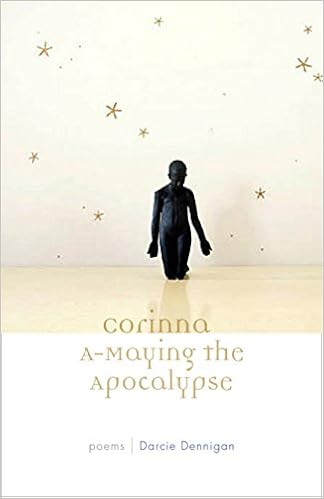
 Darcie Dennigan, Canarium Books, 2016.
This book contains a play about a woman who dies twice, a treatise on why there are no female absurdists, and several unfortunate references to goldfish. In fact, the book was almost called "The Fish" in the way that Gogol's story is called "The Nose," except that unlike the olfactory organ of the Gogol story, neither the woman nor the fish has yet developed a life of her own, and it is perhaps beyond the powers of the author to indicate whether this is a happy or sad undevelopment. Much of the text is simply unattributed lines from Pina Bausch, Virginia Woolf, Daniil Kharms, Albert Camus, Clarice Lispector, and others.
Lists, images, musical fragments, letters, charts, a play, quotes—Dennigan (Madame X) packs her dense, intelligent third collection with all manner of communication. A poem doesn't have to be a poem in this book, in which writing bites at the edges of reality both formally and thematically. For instance, Dennigan's stage directions can operate as eerie, dreamlike demands: "I was to go off to the edge of the lawn again, lightly, like a silk handkerchief." Others are more specific, as in "(move)" or "YOU CAN SKIP THIS WHOLE THING," the latter of which feels both self-conscious and knowing, a nod toward the absurdism being explored. As was notable in her previous collection, Dennigan is obsessed with the absurdity of the human body, particularly fertility and pregnancy: "So the fetus did try to come out early./ I was able to stuff her back in and help her regain fetus status, but not before she made a few requests." Dennigan's poetry resists categorization, demanding that the reader try not to reconcile the paradoxes she presents. Instead, Dennigan asks that readers accept the book's logical and emotional traps, the long mazes that conclude without relief: "Marry and you will regret it; do not marry and you will also regret it. That is how the expert's report ended." -
Publishers Weekly
 Darcie Dennigan, Madame X, Canarium Books, 2012.
All wide awake in a state of delirium, Darcie Dennigan's MADAME X stands at the intersection of the surreal and the historical, an ill communication of the anxieties and ecstasies of the 21st century.
In Dennigan’s poem “Matriarchy,” the mysterious Madame X makes an appearance, asking the bewildering question, “Why Have There Been No Great Male Pietàs?” Many of the poems in Dennigan’s collection are dense, lengthy monologues broken up only by breath-like ellipses and strange circumstances. In addition to themes of gender and religion, there are also questions of religion and sex. In “Catholic Reunion,” Dennigan writes, “Mary and Cervantes on the mattress —/It is not a word for humor girls –/ It means death, little death.” But through “little death” comes little Jesus, who asks, “What came first, the stream or the yearning?” In “The Half-Life,” birth brings death. A nurse at a hospice home that has survived a nuclear holocaust describes the devastation of a stillborn baby among their ranks: “Helen said How beautifully easy to break... I said... firmly... Helen it is already broken... But she... she had meant... me....” Dennigan’s quirky language and light touch work to counteract the weightiness of these themes. Her bizarre poems about dreams and her lovely poem entitled “The Ninth Annual Meeting of the Fraternal Disorder of Historic Linguists or The Error of My Maze” tangle language and clash meanings to create new understandings and misunderstandings. The poems are surprising and evocative, “to put it wildly.” - Publishers Weekly
It’s hard to make the ellipsis work in poetry. Elizabeth Bishop’s “At the Fishhouses” is a particularly successful example (though there are only two ellipses in that poem), harnessing the taut precision of the imagery to the poem’s metaphysical reverie, and the immense vastness of the “clear gray icy water” to the specific objects immersed in it (a seal) or which flank it, as scenery (the “dignified tall firs”). But this poem is an exception: spoken or written ellipses more often seem to indicate rambling or indecision: childlike locution, even.
Such were my thoughts on the ellipses in poetry before picking up
Madame X, a collection of poems predominantly structured in long prose paragraphs whose incomplete clausal phrases are connected by ellipses. The initial effect was jarring— spit it out, poet!—but that perception soon shifted to formal considerations of how the ellipsis was functioning (rejection of closure in an internal monologue gone haywire?). By the time I reached the poem “The Ninth Annual Meeting of the Fraternal Disorder of Historic Linguistics, or, The Error of my Maze,” my benefit of the doubt reading was confirmed: the lexical burst that characterize this book lead the reader to a climatic ending that dramatizes one of the text’s most dazzling hooks: interpretative validity, both the dream and impossibility thereof. “I keep hoping you will interrupt me,” the speaker (eulogizing a wallflower) declares in the collection’s final poem. Perhaps this is also part of the strategy—desire for the reader’s involvement—being deployed? Either way, the thrills of
Madame X are had at the cost of the speaker’s limited patience with the poem-as-spectacle: “Friends, I cannot entertain you eternally.”
A passage from an elliptical poem (“The Existentialist”):
. . . Last night I dreamt . . . maybe this is a sign too . . . I dreamt . . . a terrible swift God . . . was in my driveway . . . I kept telling him to go away . . . I kept saying Okay okay yes you’re God . . . but only because you’re in the style of one . . I don’t know why I said that . . . in the dream . . . he didn’t have a God face . . . but he had the clothes . . . (actual ellipses here denoting skipped lines) . . . And then what is . . . What . . . Who is . . . Who is riding . . . whom . . .
The patron poet of
Madame X (who appears only once, in “The Matriarchy”) is Sappho; the speaker isolates Sapphic “clauses” (e.g. “Garlands of celery”) to shore up the speaker’s search, articulated in “Some Antics” thus: “There is a vast unwritten clause—that I race and pound to—that I/ palpitate to—/ My belief in that vast unwritten clause brought it into being.”
This begs the question: does the speaker see her elliptical narratives (interrupted not by an other but by competing thoughts or passing observations) as being that “vast unwritten clause” or does that vast unwritten clause represent an extra-textual (as-yet-unheard) speech act or song? If the former, we learn of the beginning of this love-affair with language, as broken into “complete” syntactic units (independent clauses, or sentences) and pieces torn therefrom with the line “My first utterance was a sentence …”
The gravitas of
Madame X is tempered by a slipstream of ideas, memories, literary ghosts (Cervantes, Celine), as well as the persistent figure of a baby who returns the poems again and again not to a domestic realm, but a Stevensian “reality,” (à la “Tea at the Palaz of Hoon”): “Everything is the baby, the bedroom is the end of the world,// but when the baby is calm you cannot know its mind, and you/ must/ hold in your arms a strange thing.”
Shapeshifting between the voices (and occupations) of a predatory bird, an aesthete, a male Pietà, a suicidal baker whose secret ingredient is flowers, a mother, and a sacristy worker with a penchant for drinking baptismal water and eating communion bread—while the desires shot through this collection include the sublime as approached corporeally—“the part of me that really responds to majesty are my hips”—these poems are also footnotes to actual life. As if incapable of not being “honest” (the poet promises us this gift throughout), the poems that reference the life of the poet spur this hyper-kinetic collection on as much as they ground it.
From “The Job Interview”:
#1 I am not an idealist!
#2 I’ll work anywhere and hard . . .
#3 What I’m really good at is loving this world well.
I just don’t know who—
who I’m supposed to be or how to make enough money.
Madame X pilots the idea that the line between reality and dream is not so much collapsible as it is meant to be collapsed. The result is poems that are carefully measured yet fully embodied, necessary, yet ebullient, weighed down by material concerns yet toward the glory of the poem:
Three empty glasses and Laura finally says, Skin & bones.
What? my new husband says.
I whip at him, Shush! We are starving the language.
The anatomy of truth, I say to her. Yes, yes, okay!
- Virginia Konchan
http://therumpus.net/2012/06/madame-x-by-darcie-dennigan/
Darcie Dennigan’s poems are all over the place, or rather, all over the page. In just flipping through Madame X, one might be daunted by the flurry of form, the constant ebb and flow of lines from page-long blocks of text divided only by ellipses, or mid-length lines surrounded by white space. Dennigan is not using form all willy-nilly, though. It’s clear she’s taken care to select each poem’s shape and punctuation in order to further the work that the words do on their own. Page-length hallucinatory narratives become incantatory, hypnotic, always moving. End-stopped short lines, as in “We Humans” (“My boyfriend believes aliens built the pyramids. He is very smart.”) become a welcome calm among the chaos.
This is not a collection to choked down, and a reader would be doing herself a disservice to do so. Each time I read this book, I was compelled to devour it differently, grouping poems in a way I’d not previously, or starting from an entirely different place. There’s a lot going on here, and it’s no exaggeration to say that Madame X deserves both the time and attention it takes to sit and engage with these poems.
The book is divided into six sections that are not named, but rather denoted with a dividing page marked with a large black “X.” It begins with what became my favorite poem of the entire batch, “The Youngest Living Thing in L.A.” which is given its own section entirely. The poem’s speaker has an unnervingly declarative voice, a voice which makes an appearance throughout the entirety of the book. This speaker, is able to make the quotidian sound eerie, the eerie gorgeous. “City whose sky was white jet streaks. / Whose houses were apparitions of asbestos flakes. / Whose homeless sipped wind from tins.”
Dennigan’s worlds feel sometimes entirely fictional, yet wholly engaging. The are enigmatic without being obtuse. In “The Shooter” she is faced with a feast of only kiwi. In lines that trail into each other, she describes the one note smorgasbord that intellectually we know never happened, but secretly hope once did, as she repeats “kiwi” until we barely understand the word, and it sounds suddenly foreign. “In The Bakery” is especially beautiful, and follows a year of frantic baking with flowers that seems to mimic a descent into madness cut short. “I drank a vat of rosewater and put my wrists through the slicer.” Dennigan’s voice can be so matter of fact that we forget she can surprise us with a quiet, controlled line like “I love how in the cold, my breath flowers before me.” These moments are a lovely slap in the face.
I don’t always know what’s happening in these poems, but I don’t mind. Dennigan has earned permission to stun us with oddness then appease us with the straightforward. Whether the narratives are real or imagined, whether the speaker is Dennigan herself, doesn’t matter. What matters is that each poem had a way of enveloping me slowly, the way vines might grow in the night. By the end of the collection, I was rapt and bound. -
Anna Claire Hodge http://southeastreview.org/review-madame-x-darcie-denniga/
“She was my mother and she was also, in the dream, a large bird.”
Darcie Dennigan’s
Madame X has poems that are simultaneously swirling and staid, manic and composed. Navigating the life of the aesthete in the 21st-century, her shifting speaker shrieks with the grace of a saint but evinces honesty throughout, exploring subjects like semantics, fertility, sexuality, and childbirth. This speaker, concerned with the prospect of “starving the language” while cooking up a luxurious duck heart dinner, tries to reconcile the strangeness of the world with preconceived ideas that no longer hold true (as the dinner guests chime in, “That’s not the way it goes … anymore”). The longer prose poems attempt to jell the linguistic and tangible—often visually, with heavy ellipses—and create an exciting liminal space in which the poems flourish. It is from this fresh perspective, though, that Dennigan’s speaker also articulates a concern typical to young artists: “I just don’t know who— / who I’m supposed to be or how to make enough money.”
In this landscape, making money isn’t what matters most (even if this necessitates a reluctant resignation from a job at the local sacristy). What’s important here is the ability of language to extricate humans from their fleshy encasements, to tell “the tiniest shard of a story’s eggshell”. In “Out in the Ether,” Dennigan describes two angels enjoying “interpenetration”—a term that, perhaps, is an apt contrast to human penetration. For in this angelic scenario, we are assured that this is “purely, purely a spiritual thing. So as many positions / as they tried, as much licking, they made no babies, no diseases—just hymns.” The entering into one another, in the act of interpenetration, yields nothing tangible (no flesh), nothing microbial (no illness)—simply song. The act gives birth to something pure and ethereal, something unlike “a monster, with boobs and mouth and fingers.” The song of the poet, though, can create a marriage of these two seemingly disparate facets: “Oh angels, if I were Milton typing this, I would find you a way to have sex / that lets you be real, nipple-biting people—and also of one soul and holy and glorious”.
Such is the power of language, of song. At times, the text veers into a tone of sagacious aphorism (even quoting a range of authors, from Herman Melville to Alfred Jarry to André Gide), but maintains a deference to the power of the articulated word. A prime example is seen in “The Shooter”, where we learn (as a superstitious grandmother might say), “When asked, if you say, ‘I do not dance,’ the next day an infant is born without feet.” The communion of ethereal spirits, then, can result in beautiful song, but a person’s refusal to dance will force a newborn to lose limbs. Here, language is the primary method for a human to see that “my breath flowers before me.”
But, as seen in “The Job Interview,” language can’t be the only way to ward off eventual death and decomposition; indeed, sometimes, “clouds are nothing to rub against, are nothing but emptiness.” Equally important are simple joys, heartbreak, amazement—basic feelings that preclude the tangible. In this poem, the speaker irons white church vestments in “the stupid beautiful light through the stained glass,” its beauty still resonant despite the light’s prism through a physical lens. She nears climax (stating “the part of me that really responds to majesty are my hips”), but quickly apologizes (to whom?): “I’m so sorry, / so sorry to have a body. // But how else.” Clearly, here, body is integral (though not exclusive) to experiencing the spectrum of existence—and presupposed to be riddled with imperfections.
For even if the water supply has been tainted by “some kind of chemical … poison … or just the sun,” the species continues to propagate with their physical bodies, leading to “true optimism” for the world at large: “The triplets were gurgling … They were so hearty … They would, when they learned to walk, stand very straight … they would invent it all anew”. Forced into impermanent bodies that will eventually decay, these triplets have the chance to shape a world that they live in. Like these triplets, Dennigan invites us to work at “loving this world well,” for there can be beauty in even the most horrific scenarios, “In the dark of our apartment [where] we feel the planetness of our planet” or in unnerving interpersonal situations (or, “encounters,” as described in “The End is Near”). Through the shaping of language, we can manipulate “the loneliness of babies and the loneliness of / the last gas station attendant in bad weather” into something redemptive:
When you sleep in bed with a new baby in your arms—that kind of loneliness.
Everything is the baby, the bedroom is the end of the world,
but when the baby is calm you cannot know its mind, and you must
hold in your arms a strange thing.
Note the force of her tone, here: this action is unavoidable. You go on because you have to.
The inhabitants of Dennigan’s collection are commonly stripped of choice. Take, for example, the residents of a hospice care center in “The Half-Life”, who are saved from nuclear holocaust by the structure’s inexpensive building materials: “the residents were really … roused … The news … the adrenaline … their lives … for months … might be extended.” These ellipses disrupt an otherwise straightforward narrative. Here the text conveys the machinations of the mind at work, and its breathless attempt to cling to bits of language amidst peril. The speaker eventually (and succinctly, sans ellipses) alludes to the patients’ mental self-actualization: “It was great to see their minds off their bodies.” In this quarantined existence, where we can surely assume the residents will pass away, we learn that the speaker cannot even destroy herself—she attempts to poison herself by ingesting mercury thermometers, but in the end, she concedes, “I continue to exist among them.” Perhaps the speaker desires death amidst such circumstances, but this desire works like all other forms of want: once explored, it’s no longer as desirable. Or, perhaps articulating such desire is enough, as echoed in “Some Antics”—a string of adjectives and verbs suffices:
I want to go where people say the sea is green.
Is the sea green there?
No. But their language has no word for blue.
Would you have loved me there?
Maybe. If they had a different verb. - Kevin Walter http://coldfrontmag.com/reviews/madame-x/
Many of the poems in Darcie Dennigan’s brash, flexible, strongly voiced second book,
Madame X (Canarium Books, 2012), take the form of hearty chunks of ellipsis-ridden prose. Dennigan uses the prose poem to rethink the ellipsis and the ellipsis to rethink the prose poem. Her ellipses can carry any number of meanings, and it is fascinating to discern the ways in which those meanings come to light on these poems’ narrative surface. Besides using ellipses as a kind of de facto line break, Dennigan uses ellipses to denote a change in speaker or, in the opening of the poem “The Other Forest,” the same speaker addressing a different audience: ‘
To insects—sensual lust … was how I began my talk.’ Dennigan’s ellipsis can mean that a word has been elided or interrupted, as in the wonderful poem “The Existentialist,” where the speaker wonders “Okay why does the Columbiney kid have his hand in his breast pock …?” Elsewhere ellipses stand in place of other punctuation marks like periods or commas. They can connote elements of tone like a voice drifting off, pausing, or stuttering, like the speaker’s halting “Why had I … I hadn’t meant … !” in “The Speechmaker.” In poems like “The Shooter” and “The Drought,” which have a strained or particularly complex relationship to reality, the clots of ellipses come to feel particularly restricting, tense, or anxiety inducing; they create a sense of space that after some repetition feels screechingly artificial, desperately limiting.
The italicized quotation that starts “The Other Forest” comes from
The Brothers Karamazov, but the sense of its having come from
elsewhere is what feels most relevant to
Madame X. Most of the poems here include repurposed and re- or mis-contextualized material from other (usually literary) sources. Each of the prose poems begins with an unattributed literary quotation, set off only by an ellipsis. Dennigan could have made these opening quotations into epigraphs, or attributed them in footnotes or endnotes; as it is, their tones and intentions bleed into those of her speakers. “The Contaminants” begins, “
Because Nazi venom had seeped into our very thoughts, every true thought was a victory … Speaking of seepage… Something had gotten into the water … some kind of chemical… poison… or just the sun…” Here the seriousness of the opening phrases (from Sartre) contrast with the speaker’s comic, physical “Speaking of seepage.” But Dennigan ratchets back up the stakes of the poem immediately by introducing the suggestion of “poison” in the water. And even if it is “just the sun,” the sinister suggestions of “Nazi venom” and poison weave against those lighter notes and images. In many of these poems, there is a sense of false joy—often connoted by an ellipses and an exclamation point—or, like here, a sense of tonal dissonance that feels deeply unsettling. Even, as in “Whale,” when it is clear the poem is a description of dreams and thus we are prepared for an unsteady relationship to reality, Dennigan finds new ways to shake us, gently and unexpectedly unpeeling reality.
Unlike other recent books in which poets explore the possibilities of a specific form—for example, Karen Volkman’s sound-driven sonnets in
Nomina, Sabrina Orah Mark’s dark prose poems in
The Babies and
Tsim Tsum, or Dennigan’s press-mate Anthony Madrid’s ghazals in
I Am Your Slave Now Do What I Say—Dennigan in
Madame X takes some notable departures from her chosen form. That decision allows Dennigan to effect a wider variety of tones, sounds, and types of speaker—many of these poems are several pages long. In the poem “Out of the Ether,” Dennigan plays with two voices, one cynical, resisting transport, the other high lyric. The masterful “Some Antics” builds on its aphoristic stanzas, mounting toward a gorgeously rich conclusion that feels both spare and lush, hopeful and bereft. The poem also includes a moment that helped me read the books’ many ellipses:
I prefer and so on to etcetera.
The latter goes by too quickly to convey sub specie aeternitatis with accuracy.
And fails to suggest hope of an end. If you trip over and so on you’ll get soon.
Perhaps Dennigan’s ellipsis can be read as an “
and so on”: a wrapping-up that is also an upcoming, and end becoming a beginning.
Another theme of this wonderful book is naming and re-naming. In its first poem, “The Youngest Living Thing in L.A.” the speaker’s baby is christened again and again; a fountain becomes a mountain, then turns back into a mountain. With her shifting (and shifty) tones and settings, Dennigan undermines her poems’ internal sense of reality. The giant X that demarcates each section break reads to me like an error messages or like when the TV screen suddenly fills with static—another new shock to the system.
In “The Job Interview,” Dennigan writes in the bold tradition of great American dramatic monologuists like Richard Howard, Frank Bidart, and Robert Frost. Like those poets, Dennigan has an excellent ear for the cadences and subtexts of contemporary speech, which she conveys through the earnest tale of a flawed sacristy worker. Confessing to having used incense as deodorant, she says, “The smell of the incense made me feel as if I were leading a solemn procession. It also made me feel sort of sexy?” In the midst of these moments of real humor, Dennigan achieves beauty:
I’m so sorry,
so sorry to have a body.
But how else.
I don’t have heaven.
I don’t have clouds even.
One of the great strengths of this fresh, inventive book is its ranging creativity, the philosophy, history, and geography across which Dennigan creates believable or convincingly
unbelievable selves, and, the ways in which—as, with, and through those selves—she speaks. -
Lucy Biederman
www.thirdcoastmagazine.com/recommended/madamex/
We lie in every word.
Did I say word? Oh dear. I meant mode.
We lie in every mode.
Darcie Dennigan, “The Ninth Annual Meeting of the Fraternal Disorder of Historic Linguists or The Error of My Maze”
Darcie Dennigan announces in
Madame X, her second collection of poetry, that we have been
“wis-hearing” syllables “since the Tower of Babel’s ceiling fan stirred
M and
W into topsiturvitude.” In “Some Antics” we find the speaker “at Macy’s searching for an honest clause.” We are told: “When the honest word eludes, try to substitute.” Finally, at the end of the book, Dennigan acknowledges her readers: “If anything emerges from this book’s mistakes, it is thanks to [their] generous readings.”
Mistakes run rampant through
Madame X. As large-scale disasters they are droughts and hurricanes, nuclear holocaust and water contamination. But mistakes also arise as verbal collisions, as a misunderstanding or misspeaking. Dennigan favors dramatic monologues in a prose style that is rich with ellipses to signal interruptions, erasures, verbal tics or a trailing off. The ellipses allow the prose poems to escape their box bodies (yes, these are prose poems with line breaks) by separating words with lapses or pauses, often highlighting language’s slipperiness. In “The Atoll” Dennigan describes the native Atlanteans, driven out of their island homes by the negative effects of fisson testing: “We escorted them … to a very nice … resort-like … laboratory”…“They were nodding and bowing … maybe politeness … maybe vomiting.”
These poems inhabit a site that is almost recognizable. An abandoned Los Angeles. A dreamscape with vivid flourishes. A sense of normalcy, for instance, in the surreal preparation of a fancy dinner – thirty duck hearts – against the backdrop of a simultaneous hurricane, blizzard, and 4
th of July. The recipe keeps changing, depending upon who hears about it, always with some new ingredient to add, some preparation method to tweak. “That’s not the way it goes … anymore,” the chorus of dinner guests reprimands. “Each heart should be served raw … and drowning … in a sacred diamond-flavored fountain” is an impossibility in a poem entitled “The Drought”, where the riverbed is dry.
Symbolism, for these characters, is often undermined. The hostess in “The Drought,” frustrated by her guests’ servitude to ritual, finally blurts out: “But these guests! … Honestly … They were just … They were as hungry as I was.” Divorced from symbol, objects become purely functional again. Baptismal water and communion wafers are consumed for sustenance. St. Augustine’s book flips open to a revelatory passage, not through mysticism, but since “the freaking book probably always falls open to that page because … who’s always reading it … creasing it … who owns that book in the first place.” As Dennigan puts it bluntly, “Even if I believed
the Word became flesh, well –/ I’d probably just want to have sex with it.” Dennigan’s poems often return to the body, the desires and perceived failings her speakers constantly try to transcend. “This is me typing – Darcie. I am a human. / At least, when I am not a monster, with boobs, and mouth and fingers.”
“Some say the world will end in fire, / Some say in ice” famously wrote Robert Frost. “I whispered
precipice” Dennigan answers, “[…] because
precipice contains
ice (practically twice).” If the end is near, as Dennigan proposes, at least the language is hearty. The crux of the book seems to hinge on our ability to dismantle words to make meaning, to misspeak to create new understandings. True loneliness, Dennigan says, is a place distanced from the disaster zone or, as above, removed from verbal topsiturtivitude. “When the baby is calm you cannot know its mind, and you must / hold in your arms a strange thing.” -
Pia Aliperti http://www.thethepoetry.com/2012/05/the-petal-of-my-tongue-keeps-slipping-darcie-dennigans-madame-x/
Darcie Dennigan’s Madame X conjures a post-apocalyptic vision whose darkness is always imbued with play and benign strangeness. The speakers in these poems seem genuinely (and, somehow, amusingly) undecided on the question of their own humanity—yet humanity seems to be at the very center of Dennigan’s work: these poems ruminate on human identity and the centrality of art, even as they wander the strange landscapes of the imagination, the holy, the comic, the tragic. Take, for example, “The Job Interview”:
“At one point, I also did some work as a skydiver.
It was a strange summer because I was pretty young and had just gotten my period.
Not to be gross, but I basically bled all summer. And that was mostly fine.
It was beautiful weather and I, you know, wore dark pants, took loads of baths.
But there was one cloudy day, and they sent us up anyway.
I thought—if the crotch of my pants rubs against a cloud, I’ll leave red streaks.
And I did fall through a cloudbank and even kind of tried to do a split mid-cloud.
But clouds are nothing to rub against, are nothing but emptiness.
…
I’m so sorry,
so sorry to have a body.
But how else.”
The poems carry the weight of contradiction: they are living, bleeding, oddly-shaped bodies tumbling through space—apologetic for their thrown-ness but somersaulting nevertheless, uncertain of the reason for their freakishness, yet completely certain of their presence. This “sorry/not sorry” disposition creates tremendous energy in poems that fuse the sacred and profane, life and death, innocence and sex, waking and dream life, all while maintaining their comic levity and stunning beauty.
Dennigan’s “sorry/not sorry” oscillation is not limited to the narrative elements of the poems but is enacted formally in rather overt ways. Many of the poems share a form: a highly experimental prose poem with intermittent ellipses. This curious structure ostensibly aspires toward formlessness, as the words tumble in compact units and breaths, bursts of unnerved lyric that seek to undermine their own authority. The result is a compelling occupation of a liminal space more akin to linguistic vapor than the more stable forms we’re used to seeing in American verse—they float about the page in odd patterns, drifting on whims and asides, wafts of strange speech.
And yet, despite these gestures towards formal indeterminacy, Dennigan’s poems are so deeply certain of their uncertainty that, eventually, forward momentum becomes unavoidable. We begin to see that what first appears as reluctant weight shifting between nervous feet is in fact a kind of dance: an entirely new and strangely beautiful step.
“They … thanked us … patted our / lab jackets … Then they turned away from us … They turned back / to the children … in the sand … building castles … and alphabets /… and … grand frigates … with sand yes … but also with pieces of / … They were building pillars of … bone … they built a frieze … / with an image of the sun … it was a sun the size of a heart … a heart / the size of the fist of a kid …” (from “The Atoll”)
To further counterbalance the weightlessness of the form, Dennigan roots these poems in conventions more characteristic of prose: character, dialogue and narrative. And the narrative arc of the collection can be viewed as one of the strangest bildungsromans ever.
We see the speaker as a young adult contemplating the various paths art has to offer:
“I went / on … Wanted the summa cum laude next to my name in the art / school graduation program … I asked the school how to … They / presented three honors tracks … suicide … jail … madness … / Madness was graded on a curve … madness being … relative … / The other two … strictly by the book .. Okay I said … Jail sounds / good …” (from “The Corpus”)
We see the speaker as a young wife and mother:
“We were frozen in the yard of a dollhouse. The yard was turf instead of grass. I was the wife doll in a lounge chair. The husband figure had a rake in his hands. The kids were also dolls and there were bubbles around their dolls heads and they were posed as if trying to pop them. Then the yard suddenly exploded and in my doll head I thought, Run.”
(“Whale”)
We see the speaker as a male Pietá defending the maternal identity of men:
“As if a chorus of female opinion / were a prerequisite to knowing my … It just happens that some / of the most exciting … I mean … the long line of great Pietá advancements in the 20th … I mean … the Virgin laughing over / Christ’s body … the Virgin mourning Christ as a miscarriage … / the bitch Virgin holding Christ between her teeth by the nape / of his neck … the Virgin who left to find herself … so many / variations on the pierced milk ducts Virgin … women … all women … This is not to deny my own … my own work … has / … greatness …”
(“The Matriarchy”)
The world into which the speaker grows is absurdly cruel, so it only makes sense that the speaker’s development would itself be absurd.
The collection’s title, Madame X, places it in the tradition of the famously controversial Portrait of Madame X (later renamed simply Madame X) by American painter John Singer Sargent. Like Sargent’s portrait (and the countless productions on both stage and screen since) Dennigan’s collection is engaged in the problem of feminine agency in a bleakly patriarchal world. The women in this collection are often seen in positions of cartoonishly-exaggerated, corporeal suffering:
“I closed the doors (every season is too full of longing!) and
rechristened myself Flora.
I drank a vat of rose water and put both my wrists through the
slicer.
And then I began to bleed—a white powder.
Flour.
And then you came in.
I would have known you even if you were not wearing in your
buttonhole a carnation.
The bakery is closed, I said tersely.
I was bleeding profusely.
I loved you even before you said
Nothing breaks more slowly, more silently, than bread.”
(“In the Bakery”)
The artist suffers to create art. The woman suffers in a world that hates women. The woman artist, then, if she wants to create, suffers a unique violence: a brutalization of the female form that renders the “feminine” the result of sustained violence both figurative and literal. So we see blood-streaked clouds and arteries spewing flour—we find the speaker with scars in her throat from blowing divine light.
Madame X is a fearless collection: formally adventurous, thematically compelling, and unflinching in its aesthetic risks. Its combination of strange apocalypticism and comic levity is reminiscent of Matthia Svlaina’s wonderfully odd Destruction Myth (Cleveland State 2009), and its meditation on female agency in a cartoonishly-violent, patriarchal milieu suggests Dennigan’s place among the best poets of the Gurlesque.
Notable poems: The Job Interview; Out of the Ether; In the Bakery; The Center of Worthwhile Things; The Matriarchy - Bradley Harrison http://www.thethepoetry.com/2014/11/infoxicated-corner-bradley-harrison-reviews-darcie-dennigans-madame-x/
The poems in Darcie Dennigan’s Madame X play out their eerie dramas in the liminal space between dream and reality, utopia and dystopia. In “The Youngest Living Thing in L.A.,” which opens this collection, Dennigan’s speaker clutches a silent baby in a silent city: “I said to the baby, We will stand here until there is snow on the mountain. / I may have meant to say fountain. / We peered all day into the strange fountain.” Her poems’ long lines stretch across the page, but it’s only in this first poem and a handful of others that Dennigan allows her line to end in the finality of a period. The majority of these poems extend down the page in dense blocks of prose. As these first-person narrations raggedly unfurl, their speakers begin a thought, correct themselves, then drift into silence, their short phrases separated by ellipses: “It was all going to work out,” she writes in “The Contaminants,“ “ … proud … optimistic … my triplets … The number three has magical residue … Was that my idea … ? or did I overhear … ” And, with the thought left unfinished, the stanza ends.
This “true optimism” that the speaker in “The Contaminants” attempts to maintain sneaks into every corner of this collection full of women making impossible decisions in more impossible situations. Against these masterfully overdrawn backdrops, her characters speak and behave in small, human ways. In “The Contaminants,” we’re presented with dying landscape, populated by militiamen and “bunker neighbors” who are horrified by a woman bringing life—that is, triplets—into the world. “The triplets were gurgling … They were so hearty … They would, when they learned to walk, stand very straight … they would invent it all anew … ”
Children, especially infants, flutter through these poems like ghosts: they’re often dead or dying, wished into existence, impossibly conceived, made of stone. When the hospice attendant in “The Half-Life” is confronted with a nuclear holocaust that only her residents and coworkers survive, she cradles the world’s last stillborn baby in her arms: “It was Helen’s turn to hold the … Helen had ALS and I had to help … I was crouching down … the infant half in my arms and half in Helen’s … Helen said How beautifully easy to break … I said … firmly … Helen it is already broken … But she … she had meant … me … ” With the help of her hospice patients, the speaker attempts to kill herself but finds she cannot. “Filled a clean bedpan with beads of liquid mercury and ate … bibelot after bibelot … But … I continue to exist among them … ” No one can successfully create life, in this world; no one can successfully end it.
These poems, however, aren’t at all humorless: they’re often as mercilessly funny as they are sad. “When two angels enjoy interpenetration, when there is a frantic fluttering then / falling back of wings, it’s purely, purely a spiritual thing,” begins “Out of the Ether,” which ends with an angel performing oral sex on a lightsaber. But, like life, humor creeps into the more high-minded corners, too: “I myself am a Pieta … who happens to be … male … and I … well, it’s a daunting task … ” Little comes easy to the narrators of these poems, but Dennigan’s speakers dig their heels in hard as the nuclear bombs drop. - Brittany Cavallaro https://dept.english.wisc.edu/devilslake/reviews/2012_dennigan.html
On Sunday night I finished reading Darcie Dennigan’s Madame X. I put it down on the nightstand, which is shaped like a ladder but isn’t a ladder, around 10pm. Many of Madame X’s pages were dog-eared, by me, which is a strange thing to be, as a page. Also, not all dogs’ ears are floppy or folded down in variably sized triangles. If you’ve docked your dog’s ears, I’d say that in addition to being an ass, you might have a dog whose ears look like a page folded down. So, if you’re looking for the thing itself, you might not find it in these pages, but if you’re wondering about displacements and/or misplacements and doppelgangers and boomerangs, then I say go for it. I mean, really, this book knows something about a disfigured signified.
My favorite poem in the book is “In the Aviary,” which is all about birds, but not. I like this poem mainly because people hate birds in poems these days, but do not presumably hate the things—sky, cage, tree—that hold birds. I find this to be perplexing. Anyway, in the poem’s first couplet, all Ophelia-like (crazy, but not), the speaker tries to get to a nunnery but she ends up in an aviary. Here’s what Dennigan has to say about language via the aviary: “I called and called and took / all my songs outside their parentheses,” a direction she takes with language throughout the book. Take words out of their original contexts, boxes, expectations, and see what happens!
And, in her discussion of salvation and/or how to be salvaged by the aviary (deliverance versus rescue), Dennigan writes to/of a nightingale:
Gingerly, I held the beak closed
I cupped the air around his throat
I’ll be gentle, nightingale, if you’ll let me dismantle
the words I’ve misheard
Salvation was not the Latin greeting
hey, you’ve come back for me
nor did nightingale signal a dark, strong storm
…except in me, in the aviary.
Oh lord, isn’t language slipperary. Look at the rhyme and echo in these lines, both slant and otherwise. The long o’s of closed and throat. Gentle/nightingale/dismantle, words/misheard, Salvation/Latin, and then connecting the last two couplets, me/me/aviary. In essence, language heard and misheard is really a product of the listener herself. Whether a word falls on deaf or listening or mis-hearing ears is not the responsibility of the speaker, in this case a nightingale whose beak is being held shut. Dear Dennigan, your recursiveness makes me pensive and tentative and regurgitative! At the end of the poem, the speaker eats all of the round, blue robin’s eggs, swallows language whole, and hopes that the birds will sing better songs for their sadness. Don’t we all. Sing better songs. For our sadness.
…
I woke up on Monday morning at around 3am thinking this: That’s it! It’s the end of the word ____. I hastened to write a poem in the middle of the night about the end of that word, but not before I acknowledged to myself that, despite there being other books on my ladder-nightstand, it was Dennigan’s second book, named for a mystery woman, that took hold of my imagination, sunk into my psyche deeply enough to wake me up with a poem of my own. What good art should do. Though my poem might also be Dennigan’s. Let’s make that clear from the get-go. All language stems from other language, a notion that Dennigan explores throughout the book as she begins many of the poems therein with quotes from elsewhere, a trope that allows her to create the most inventive of narratives.
But back to the lady, Madame X, who is less mentioned in the book than evoked, who appears in “The Matriarchy,” at a Vatican party to ask a male Pietà to contemplate his usefulness. Madame + X being the archetype of woman. X, of course, marks the spot. X is the signature of an illiterate person. X negates an answer. X is the sign of a hug (or is it a kiss?). There’s John Singer Sargent’s Madame X, a painting that was never actually anonymous despite its name, a painting that the subject’s own mother asked Sargent to remove from an exhibition because her daughter’s image showed so much…what? Then there’s the 1908 Bisson play and a litany of movies based on it, which involve a woman who marries “up,” is left alone a lot (oh fear!), a lover (friend?) who dies mysteriously, blackmail and banishment, etc. etc. I think we get the picture: Woman. Anonymity. Sexuality. Birth-and-Death. Now I’m extrapolating.
…
I woke on Monday at the normal time, and I was thinking about all the dreams I must have forgotten. Like the one about the transgendered clown. Like the one about the sea turtles munching on seaweed. Think of all the things the brain does to us while we sleep. Dennigan uses dream and dream logic in Madame X as both a symbol for creative space-making and as a way to mis/re-interpret events. In “Whale” she writes, “In the years before we’d bought a house I had dreamt of a house and had loved dreaming of a house and then we had a house and I missed my dreams,” she writes, but really the whole poem is a dream: the real estate agent who has swallowed whale sperm or the homeless man who doubles as the speaker’s husband or the speaker trying to read Jung and pretending to read Kierkegaard. We never actually read in dreams. Dreams are a lot like ellipses, actually. They take a series of images, events, language moments and make you connect them through interpretation.
Ellipses are placeholders of things left out, things unsaid. Throughout Madame X, the in-betweens are just as important as the shapes on the page. Especially because this is a book of radio signals. I swear to god, what Dennigan did was make an aluminum foil helmet for herself and fashion a lightning rod and sit on top of her house—I’d like to imagine for these purposes that Dennigan lives in three places at once: the edge of some body of water (fountain, shoreline), atop a skyscraper in a lean-to, and ethereally in the airwaves. So, she tuned into some frequencies, and what she got were all these different voices, sometimes detailing the apocalypse (which Dennigan is kind of obsessed with, thank god), sometimes bringing babies into the world as maybe obvious but ardently weird metaphors, always with strange vocations and provocations.
But ellipses. So, things unsaid and radio frequencies. Can you hear the static of stations being flicked atop an abandoned building the night the moon melts into the sea? Get this. Ellipses, which is a sign and signifier of the omission of superficial words, comes from the Greek elleipsis via the Latin elleipein. Now, the root of the word ellipse, a regular oval shape, comes via French from the Latin word, ellipses. How confusing! Which is exactly Dennigan’s point. The points of ellipsis are both empty and full at the same time (as is language, as is language!).
…
On Tuesday, around noon, my neck is killing me. Whiplash of the senses. If we exchanged “n” for “d,” my deck would be killing me, a play Dennigan makes throughout Madame X, particularly in “The Ninth Annual Meeting of the Fraternal Disorder of History Linguists Or Error of My Maze,” in which “ceiling fans stirred M and W into topsiturvitude” so that a woman’s body becomes the land of whelk and honey versus its biblical milk-and-honey alternative.
And if my deck were killing me, I’d probably tear it out and build a new one with shining planks of hardwood that I’d stain red. It’s almost as though Dennigan builds poems the same way: out of mis-hearings. In “High and Bright and Fine and Ice,” we witness a speaker who blurts words seemingly solely for their sounds: “I whispered precipice / the word for the no-more-boyfriend feeling // because precipice contains ice (practically twice) / because I wanted teetering—” Thing is, in the midst of diagramming/dissecting words to find out whatever’s inside them, the speaker is inevitably arriving at the word’s meaning via action: teetering. All this tinkering with language creates a vibrational force that might just send us over the edge. The speaker names her child Cecily because it sounds like iced lily. Oh, the obsession with ice, the speaker’s need for the world to end in…is it fire or is it ice?
…
Wednesday. To be transgressive on a weekday is to drink the holy water at the sacristy, to screw with language in a way that makes it simultaneously unrecognizable and totally familiar, it’s the end of the world and the beginning of a new one—the apocalypse coupled with birth, eggs, and babies all around, a nuclear holocaust. Dennigan’s treat! Here it is, all wrapped up in a pink bow, in “Some Antics,”
For child, substitute held. My held.
For she was, and she was and she was.
Are you hearing hell in there? I am not. There is a degree of
viseness that is quite agreeable.
My held.
Call it, during the fetus stage, to hold.
Tenses become manifestations of states of being. To be pregnant, to give birth, to hold a child is to speak the language of being humanoid, a word that reminds us of ovoid, and I think of bellies and eaten eggs, and so on in a circle.
…
Monday again. Midday. Midwinter sun. A review takes a book out of its own context and puts it into the reviewer’s. For instance, my midwinter sun in Florida, is it the same as yours? There’s way more to this book than language play. Really, I’ve said nothing about the book at all, which is fine I guess because you should just read it. A good book evokes and provokes its reader. A good book makes you a little crazy, tells you something you don’t already know, creates in its reader a desire to grow. Madame X is one of the most inventive I’ve read since Dennigan’s first book, Corrina A-Maying the Apocalypse (2008). Aside from constructing a philosophy of the arbitrariness of language, Madame X is playful, serious, intimate, image-driven, narratively bombastic, and sonically wow. “Outside the aviary, isn’t it always bird winter?” Dennigan asks of the dangerous world outside her creation, but inside, it’s whatever we imagine it to be. - Alexis Orgera http://www.drunkenboat.com/db17/madame-x.html
What are the ethics surrounding the use of stolen language to create one’s own art, especially when that language goes misinterpreted? What happens when we confuse the voices of others with our own? Darcie Dennigan’s Madame X, a book with an obsessive use of quotations as springboards into its dream-like, satirical narratives, demands that we ask these questions. Some quotes are easily recognizable, while others are obviously the poet’s own inventions. Yet the fact that none are given citation blurs the distinction between the poet’s own creative impulses and outside influence. Which begs the question: does the distinction matter?
Reading through Madame X is not unlike flipping through television channels, as many of the absurd backdrops of these dramatic monologues evoke typical movie premises or recent public traumas: survivors of a nuclear holocaust electing a couple among them to procreate, or a mother driving out of a storm-flooded city with her newborn baby. Dennigan injects a dark humor into each scenario, but what makes these poems transcend satire is their capacity to shift between absurdity and emotional intelligence. In the latter poem, for instance, the fleeing mother and a gas attendant share a random moment of intimacy in the midst of the storm: “We were surrounded by dark cars rocking and bobbing / on the waters, and we, the gas attendant and I, were so close and lonely. / When you sleep in bed with a new baby in your arms, that kind of loneliness.” The tension between humor and introspection abides over the course of the book.
Much of that humor hinges on miscommunication. At the beginning of “Strawberry,” the speaker mistakes her waiter’s offer of a plat du jour for a plat, “which was what we called a neighborhood laid out all the same.” The speaker then thanks “the city planner who stood before my dinner table with his little model of trees and roofs and roadways arranged on his clean white disk and as he set down the plat I looked for the Callaghan manse.” The poem doesn’t just play with the misunderstanding, but is built upon it, using it as the basis for the speaker’s leap into memory: “I thought to ask the waiter, But what is this? And he said, Straw—and I said Straw! We used to have a goat, the only goat on the plat, and he slept on straw and sometimes when I was upset and didn’t know it yet I would chew on a strand of his straw and it would taste like my memory in January of the smell of grass.” It’s the sudden interiority of the recollection that is impressive. A slight mishearing results in a memory embedded within a memory. What this and other such instances emphasize is the creative possibility inherent in misinterpretation. But it also points to the role of stolen or overheard language in Dennigan’s process: the voices of others fuel and eventually blur with her own imagination.
To investigate further Dennigan’s use of stolen language, it’s worth looking closely at a poem grounded in a quotation. “The Existentialist,” one of the book’s many elliptical prose poems, places the speaker in a scenario most of us have experienced in some form or another:
A horse, a horse, my kingdom for a _______ . . . For a what . . . ? . . . I forgot . . . I’m the only one on the bus . . . Now boarding: two Columbine-ish kids with duffles . . . In three miles we’ll be at the bridge . . . The kids look relaxed . . . but . . . Calculate the risk . . . Risk of two long-haired trenchcoat kids blowing up this bus on the bridge . . . equals . . . no is less than . . . the risk of twenty short-haired men . . . in khakis . . . blowing up a . . . a . . . transport . . . or more than the risk of . . . one man . . . in baseball cap . . . blowing up only . . . himself . . . Or not that . . . That’s stupid . . . If I die on this bus . . . well then . . . I chose it . . . Like last night in the library . . . I was talking to my friend . . . loudly . . . about the Augustine story . . . Augustine going into the garden . . . hearing the child . . . crying . . . I forget what . . . Maybe crying Now . . . ! or . . . Check the book . . . ! I don’t . . . but he checks the book blindly . . . puts his finger on a . . . at random . . . at random he thinks . . . ! and lo and . . . his revelation . . . No more sex . . . Only God . . . Augustine thinks it a . . . miracle . . . but . . .
Beginning a poem with a quote, real or invented, is a staple of Madame X. This one is of course from Shakespeare’s King Richard III, and the use of it to anchor the poem is brilliant. Said by Richard after falling off his horse in the middle of battle, the quote depicts how panic alters value, i.e., a horse can be traded for a kingdom so long as it will save one’s life. The speaker, however foolishly, imagines herself in a similarly life-threatening situation. Note how the ellipses create the discursiveness of an inner dialogue, though they also make readers participatory to that dialogue as we naturally fill in the gaps. Furthermore, by creating a stop-and-go music, the ellipsis also let various rhythms and rhymes enter the poem. Read the last passage aloud and listen to how sing-songy it becomes, the rhymes punctuating the speaker’s excitement or attending her realizations:
One mile to the bridge . . . My kingdom . . . My kingdom for . . . a horse . . . Of course . . . My kingdom for a horse . . . Ha that’s . . . Last night I dreamt . . . maybe this is a sign too . . . I dreamt . . . a terrible swift God . . . was in my driveway . . . I kept telling him to go away . . . I kept saying Okay okay yes you’re God . . . but only because you’re in the style of one . . . I don’t know why I said that . . . in the dream . . . he didn’t have a God face . . . but he had the clothes ... the Godly robes . . . He was blocking my driveway . . . This morning I chose . . . to ride the bus . . . And . . . to . . . not get off . . . The boots of these kids . . . These kids who maybe have guns . . . bombs . . . Are the kids’ boots supposed to be the horses’ hooves . . . ? And then what is . . . What . . . Who is . . . Who is riding . . . whom . . .
The interconnectivity of their parts is what makes these poems both hilarious and intelligent. In the speaker’s retelling, Augustine’s forfeit of sex is laughable, and reminds us of our own willingness to forfeit the pleasures to which we are entitled if it creates an illusion of safety. And there is a haunting link between the robes of the god in the driveway and the trenchcoats of the Columbine shooters. Thus the poems in Madame X are suggestive rather than accusatory, calling for the reader to draw out the ethical dimension from the associations.
The result of incorporating the language of others into her own creative process is twofold for Dennigan. On one hand, the creative possibilities seem endless. On the other hand, the distinction between public and private language blurs. Madame X is rife with instances of a speaker’s inability to distinguish between her own and someone else’s words. In “The Contaminants,” the speaker has triplets in a war-tattered setting with slim resources to go around, asking herself, “But was that true optimism . . . or residue . . . leftover . . . from . . . the commercials on pessimism.” And when she announces that a true thought was a victory, the problem is that she nonetheless employs the vocabulary of the enemy: “Victory was not the right word . . . it sounded like war.” This points to a conundrum beyond language: How to distinguish between inherent desires and the results of cultural conditioning.
Madame X enacts that very dilemma, and Dennigan’s formal decisions include not just others’ but our own voices. Full of pauses and elisions, the poems force us to fill in the gaps and, essentially, take part in their completion. The paradox of Madame X is that, while its speakers struggle to differentiate between their own thoughts and external language, the poems themselves seem dependent upon that language and thrive on its misinterpretation. As the speaker says to us in the book’s final poem, “I keep hoping you will interrupt me.” - Ben Rutherfurd http://www.thevolta.org/fridayfeature-madamex.html
Darcie Dennigan’s poetry can horrify, shock, gross you out, turn you off—her poems are full of spilt bodily fluids, new corpses, nuclear accidents, human beings stuffed with nonfood items or having dangerously or sacrilegiously kinky sex or being taken apart. And yet these shocks come with a twist: most of the poems, and all the best ones, connect their grisly surprises not so much to death and dismemberment as to conception, fertility, and childbirth. In “Bethany Home Hospice,” for example, “the nuclear holocaust happened yesterday” but the employees—surrounded by the dying elderly—try, and fail, to make a baby anyway. “The Youngest Living Thing in L.A.” turns out to be “my baby, whom I held like a heavy statuette”; the poem implies that most of Los Angeles has been leveled, depopulated by vague catastrophe, which may or may not have killed the baby, too: “he never ever cried.” In other poems, what looks like juice or ink or paint turns out to be fresh blood, as from menstruation: the outrageous speaker in “The Job Interview,” who also confesses to drinking from baptismal fonts, remembers how she took on “some work as a skydiver” when “I was pretty young and had just gotten my period… I thought—if the crotch of my pants rubs against a cloud, I’ll leave red streaks.” Her fertility may disconcert us, but it is powerful enough to stain the clouds. - Stephen Burt https://www.believermag.com/issues/201210/?read=review_dennigan
It was a geologic instant.
Fine-bone plates moved under the Pawtuxet
& up sprang West Warwick. In an instant
the houses were up & the shutters open.
Then the paint was peeling all over town.
Then the instant passed with a shudder
& all the houses fell down.
The lilacs die. The lilies of the valley. April & May blow up & away.
"We are ready to live as before,"
says the last bald priest to the last white-May-dress girl,
who touches her chalked hopscotch sidewalk
& beneath her palm detects an earthquake
& in a gutter puddle sees her skull
& on her tongue catches a white blossom,
the last one. With her chalk she bawls
"The spring days are going to the graveyard."
The pet goat eats poison oak. The puppy bites the bitty lamb. All the kitty's whiskers fall away.
The little Lamb girl straddles a Chrysler Plymouth,
queen of the car parade, with a kitty
in her arm crook & a hand to the crowd.
She calls out, "I can see the end from here"
& tosses all West Warwick some Tootsie Rolls.
The Chrysler driver blows his horn.
Where have all the May-dress girls gone?
—To the classroom, for learning Latin & blushing
over Queen Dido's open, bebassing mouth.
The dust turns to tar. The rain to chalk. Undertakers cart snow angels away.
My hearse slides by a girl astride a puddle
wearing her mom's wedding gown. A downpour
smacks Arctic, Natick, the Greenwich Inn.
All the front door keys to all the places
I have ever lived drip from the dogwood tree
& chime in the wind. The girl in the gown
sinks. The puddle turns to a pond. West Warwick,
my West Warwick, drowns. Drowns world,
my clapboard castle & the moonface I was living in.
-Darcie Dennigan