6/12/18

Jacek Dehnel - Based on the life of the author’s grandmother, intertwining detailed historical research with enthralling family accounts, Lala’s story stretches from Kiev in 1875 to modern-day Poland

Image result for Jacek Dehnel, Lala,
Jacek Dehnel, Lala, Trans. by Antonia Lloyd-Jones, Oneworld Publications, 2018.


Lala has lived a dazzling life, filled with love, betrayals, acts of courage and some of the most extraordinary events of the twentieth century. There is nothing she likes better than to tell stories of her fascinating past – of her grandfather, the legendary owner of the first car in Ukraine; of her aristocratic mother; and not least of herself. Her most avid listener is her grandson, Jacek, to whom she is extremely close. As she grows older and becomes increasingly confused, her tales become more repetitive and Jacek often finds himself filling in the gaps.
Based on the life of the author’s grandmother, intertwining detailed historical research with enthralling family accounts, Lala’s story stretches from Kiev in 1875 to modern-day Poland, spanning the First and Second World Wars, the German occupation, the revolution and the republic. This moving family saga paints a fascinating picture of life in twentieth-century Europe and is a celebration of a beautiful relationship between grandmother and grandson.


Lyrical passages, some endearingly eccentric characters, a flyby through twentieth-century history, and a convincing voice for Lala.' - Booklist


A masterfully constructed novel...mature and highly entertaining.' * Polityka


Lala is unique - no author displays such maturity of style, knowledge of form and literary erudition at the age of twenty, because nobody is ever as well-read or intellectual at that age. Dehnel - who wrote this book aged twenty to twenty-two - is the exception that proves the rule.' - Gazeta Wyborcza


First-time novelist Dehnel uses his grandmother’s life and reminiscences as a springboard for a sweep through Poland’s turbulent 20th century, mingled with musings on the nature of storytelling.
Though she was born in 1919, Lala’s stories begin with the childhoods of her grandparents, Polish aristocrats who inhabited a “mythical land…beyond an impenetrable wall, in the bizarre world that we agree to call the past.” The author himself is a character here, appearing first as a 14-year-old who, toward the end of the 20th century, delights in writing down and relating to friends his Granny’s tales of the way of life ended by World War I. Both Lala and her mother have complicated love lives involving multiple marriages and children not necessarily the offspring of their husbands at the time, but Granny also branches off into chronicles of the peasant brigands and thieving servants who made the family’s home turf in Lisów “the greatest bandit village on earth.” Jacek is fascinated by it all, but readers may be more restless. It’s difficult to keep track of everyone wandering in and out of Granny’s fragmented recollections, particularly during the grim World War II years, when surprisingly decent Germans, roving partisans, and then triumphant Soviets come and go in droves. What gives the novel gathering force, as Granny’s memory fails and her body deteriorates, is Jacek’s keening meditation on the transience of earthly things. Observing the garden of his family home, so lush in his childhood, he grieves: “Because I knew that with…the hacking down of every tree, with the inevitable death of each peony or rosebush that the rampant weeds had choked, came the irrevocable erasure of a primeval codex, the obliteration of ancient formulae and epic poems.” His book—this book—is his tribute to that vanished world and the grandmother who brought it to life for him.
Best for extremely patient readers, who will be rewarded with some exceptionally beautiful passages in the final 100 pages, poignantly alive with loss and love. - Kirkus Reviews


If a novel is especially immersive, if the voice of its narrator is sufficiently consistent and evocative, the world it describes may come to life in picturesque color. I say picturesque, rather than vivid, because a novel’s dominant colors may not be entirely lifelike; they may be closer to the rich oils of Rembrandt or the downy pastels of Degas. Such colors suggest life but also remind us of art’s mediating presence. Jacek Dehnel’s lush debut novel, Lala, for instance, is awash in the sepia tones of old photographs, a few of which punctuate the text. Like an old family album, assembled by an eccentric relative with an artistic bent, Dehnel’s work is drawn from life and enriched with intent, with a kind of aesthetic cohesion that bare facts lack.
Cohesion, of course, does not mean dull chronological neatness. The material of the novel is the story – or rather the stories – of the author’s grandmother, Helena Bieniecki, the titular “Lala” (“doll” in Polish), who is succumbing to dementia. Tender and droll, rueful and rousing, these stories trace one Polish family’s journey from the 1860s to the present day against the backdrop of national uprisings, falling empires, world wars, invasions, and dictatorships. But owing to the beautifully flawed operations, to the inherent failings and embellishments of memory – which are in fact the true subject of this book – “Granny’s narrative twists and coils like a pea plant, putting out endless unexpected shoots that grab hold.” Grab hold they do, both of our sensitive guide and, thanks to his skillful retelling, of us.
Indeed, the prehensile magic of Lala lies in the art of retelling. On the second page, when our narrator visits the ruins of his family’s estate in Lisów in south-central Poland, he tells us he knows “where the desk had been, off which my ninety-year-old great-great-grandmother Wanda had shooed the German officer.” That cryptic shoot remerges on page 178, when Wanda, whom we have already come to know and admire, steps forth in full splendor to confront the rude occupier from the Third Reich, swishing her cane in the air and presenting “papers from the Archduke Ferdinand stating that [her] property is exempt from all requisition.” The officer laughed it off, we’re told, but “he stood to attention before Grandmama, and to the day he and his soldiers left, he always bowed to her with great respect.”
Is the story true? Regardless, it offers a wise and beautiful lesson in resistance, in sticking to one’s principles under duress, in demanding respect. And as Dehnel reminds us, “The repetition of wise and beautiful things is wise and beautiful in itself, and is the same sort of virtuous act as feeding the hungry, caring for animals, watering plants or donating to charity.” It may be surprising to learn that this insight, which one might expect to hear from a ninety-year-old great-great-grandmother, belongs to a man in his early twenties. Dehnel was only twenty-six when Lala was published in Poland, and only twenty-two when he had finished writing it, but he has never really been a man of his age, in any sense. In his life, his prose, and his exquisite poems, some of which were “pre-dated” by a century on first publication, Dehnel has carefully cultivated an anachronistic style, or set of styles, bringing the traditions of the past to bear on the present.
He is also a masterful translator of Anglophone poetry and, I suspect, a bit of an Anglophile. There is certainly something English about the genteel characters of Lala, a certain plucky, ironic resilience. Here is Granny herself, explaining the pure luck that enabled her to keep the house going under German occupation:
Aha. Well, we still had a bit of land, so we planted potatoes. The peasants wondered how on earth I did it, because one summer I planted them too late, and on top, so they shouldn’t have done well at any price (the peasants said they’d be the size of peas and dry as a bone); but all summer it bucketed down, so while everyone else’s potatoes rotted, mine grew beautifully. The next year I planted the other way around, on soggy ground and too early, so once again the peasants tapped at their foreheads, saying it would all rot. And guess what? It was a blazing hot summer, everyone else’s potatoes dried out, but mine grew into whoppers. “Those as ‘ave been to school ‘ave been to school,” one of them said.
Our narrator, more given to magniloquence, would surely ascribe this to “the goddess Fortuna,” who “flapped her gilded wings, whirled her spoked wheel, flew down from clouds of whipped cream and set a star of propitious fortune on my grandmother’s brow.”
Dehnel too has been graced by propitious fortune: in Antonia Lloyd-Jones he has found a translator uniquely attuned to the styles and moods of his prose. For all its Polish specificity, the novel reads as if it were born in English. As we reach the end, with Granny “going back to [her] infancy,” Dehnel’s narrative takes on greater poignancy. He chronicles her decline with delicate but unabashed realism, as well as great humor, and Lloyd-Jones captures these qualities perfectly:
“This spray of flowers has collapsed,” I say, “the silver and pink ones. The sticks supporting them have snapped. We’ll have to tie them up or they’ll fall over.”
“I need tying up too. I’ve collapsed too.”
“Oh, that’s a bit harder to fix.”
And yet the young author isn’t entirely helpless in the face of Lala’s collapse. What he has managed to collect and bind in the novel that bears her name will live on, like an eternal spray of forget-me-nots. - Boris Dralyuk
http://quarterlyconversation.com/lala-by-jacek-dehnel


When he walks in the street or enters a Jerusalem hotel, everyone turns to stare at him. He is wearing a brown velvet jacket, a floral shirt, a broad necktie, a black vest, and striped black-and-white trousers tucked into black leather boots. He is carrying an antique walking stick capped by a silver animal head. He might have stepped out of a fin de siecle photograph of European aristocrats - albeit without the homburg, which he left behind in Warsaw. From an antique gold chain dangling from a pocket hangs a large jewel; part of the chain is connected to a shell-shaped box that contains antidepressants or small change, another part to a watch.
"Lala" is also the story of the Polish aristocracy and intelligentsia, of china and highly polished manners - all of which are disappearing. Dehnel is a master of the Polish language, with its different registers and subtleties, and the excellent Hebrew translation by Boris Gerus preserves, with irony and amusement, Polish's melody. Fascinated by his grandmother's life story and enthralled by her colorful personality, the author conducts conversations with her and transcribes them almost verbatim.
The plot is founded on Lala's memories, and she lures him to the place where it all began. As the story progresses, her memory and Dehnel's maturation undergo opposite processes: The old woman's memory grows hazy and fades, while the narrator, the little boy, grows from being a passive listener into a man who, at a certain stage, takes command of Lala and her memory and finally adopts a properly detached adult point of view.
Granny Lala was born in Kielce in 1919. Her first husband, Julek Rogozinski, was a translator of French literature. Her second husband, Zygmunt Karpinski, Dehnel's grandfather, was a forester. Dehnel's paternal grandfather was an officer in the Polish navy, captured by the Germans in World War II and incarcerated in a prisoner-of-war camp; his father, Jacek II, was born in Gdynia, a port city on the Baltic Sea. Dehnel: "In the 1960s, my grandfather was transferred to Gdansk, which is close to Gdynia, and in the 1970s my parents met and married and thus I was born."
He and his brother, two years his junior, grew up in Gdansk, the city of Lech Walesa. His father works in computers and his mother is a painter. As a boy, Dehnel spent a great deal of time with his grandmother, Lala, who lived nearby. From a young age it was clear to him that he, too, would be a painter.
"Mother painted in gouache and tempera, and I also painted a great deal during these years, but because I was asthmatic I could not paint with oils," he explains. "I studied at the academy of art, but could not take part in the oil-painting workshops. All I could do was learn the theory and draw or paint in aquarelle. Talent? Well, I had some sort of talent, but it's the same with writing. Talent is one thing and hard work is something else."
He also began to write poetry at a young age: "That happened by itself. I was a smart-aleck kid. We had an open house and I was always present when my parents entertained. I read a lot, and in comparison with most 10 year-olds, I had a very coherent, broad worldview. According to our house code, it was clear that every person must express himself artistically. One did not have to be a piano virtuoso but, for the sake of personal development, one had to do something: play the guitar, paint in aquarelles, scribble in the margins of notebooks - the main thing was to be creative.
At the age of 18, Dehnel entered the University of Warsaw's humanities program. He still believed he would earn a living largely from painting and that writing would be only a hobby.
"I painted large works in the style of the French Symbolists, the way people painted in the fin de siecle period," he recalls. "I showed works in exhibitions and I still have paintings at home which I find difficult to part with."
At 19 Dehnel started to send poems to literary competitions, winning prizes. His name began to stir interest in literary circles as the next hot thing in poetry. His first poetry book was published in 2004 and earned him the Koscielski Foundation Literary Award - Poland's second most important literary prize. "That helped," he says. "Things began to get easier." He has published several books of poetry and his poems have been translated into French, Basque, Gaelic, Lithuanian, Slovakian, Slovenian and English.
Dehnel started to work on "Lala" at the age of 20, but after completing the novel did not try to contact a publisher.
His new book, to be published this fall, pursues the theme of romantic nostalgia and includes a collection of old photographs Dehnel collected or bought in flea markets, juxtaposed with literary texts that uncover the secrets underneath the graphic images.
Why does someone so young revel in past history instead of looking toward the future?
"I think it is the role of parents and grandparents to make sure young people know the world did not begin yesterday, but has been around for a few years. I am aware that this soil on which we are walking is covered by a thin layer of dust we created, but beneath it are a great many other layers that were created by earlier generations. It is my feeling that every word I use, and all the things around us, were here long before us and will remain long after we are gone."
All the women in "Lala" are strong and independent, the men far less so. Dehnel always thought this was the case in his family only, until he says he discovered that these traits are typical of all women.
"It is also typical of Poland," he notes. "Men fought in the wars and took part in the rebellions, and women stayed behind and looked after the house, the children, even entire estates. So it happened that a woman, who formerly was weak and pale and spent her time playing a grand piano, suddenly was compelled to deal with large property holdings and to see to the livelihood of the family and the workers."
Lala's family had two such estates in the Kielce area. Over time they fell into disrepair, just like the aristocracy and the intelligentsia.
"If the national character of the Poles can be summed up in a word, it is poetry," Dehnel says. "Every Pole is a potential poet." In addition to being a full-time writer and poet, he works in television as an editor and hosts a weekly cultural program.
"That made it possible for me to buy an apartment, for which I am still paying," he says, "because to make a living from literature alone is a bit difficult."
Why the cane?
"For the pose - and for the asthma. It gives me confidence in the street. At first I walked with an umbrella and now with a cane. I have a collection of antique canes. But maybe it is really more because of the facon. One of the advantages of homosexual relations is that one can exchange clothes with one's boyfriend. Yes, I have had a boyfriend for five years now, and my impression is that this will not change soon."
Dehnel's family responded to that news with mixed feelings - his mother far better than his father, who perhaps understood that in Poland's intolerant climate, the prospects for a Jacek IV are not great.
Dehnel did not come out of the closet publicly, but is also not secretive about his identity. He believes that the more exposure the subject gets, the more naturally the phenomenon will be accepted in Poland.
"I never made a fuss about it. I went out with boys freely and openly," he explains. "The formative experience was the first time I saw the film 'The Neverending Story.' I must have been about eight. I took a great liking to the boy and felt that something odd was happening to me. That was my first awareness of my sexual difference. I had my first boyfriend at age 17, but my parents suspected nothing until I told them.
"Parents," he continues, "have a rare ability not to see things and to ignore even telltale signs. It was immediately clear in the broader sense as well; even before I began to become famous, I wrote love poems in the masculine case. But I never went public and did not turn it into a circus, as people sometimes do when they confess in tabloids."
Most gays and lesbians in Poland lead a secret life, Dehnel adds: "I can count on the fingers of one hand the number of famous people who have come out publicly, and this has implications for society as a whole."
His partner, Piotr, is 26 and is working on a Ph.D. in history. They bought their apartment together.
A number of Jews entered Dehnel's large family through marriage in earlier generations, but left no legacy to speak of.
When the Nazis built concentration and death camps on Polish soil, the Poles knew they would be next in line, Dehnel says: "Today, when I walk around Warsaw, I cannot forget what happened in those streets - the poverty, the ghetto, the executions, the Umschlagplatz [where Warsaw Jews were collected for transport to death camps]. It is terrible. For me, the Jewish fate and the Polish fate are intertwined."
Did your grandmother also tell you about the pogrom perpetrated by Poles against Jews in Kielce after the war?
"During the war, Grandma was no longer in Kielce, but in Warsaw. But yes, she knew many Jews, friends and acquaintances, and felt terrible about what happened."
Lala died a year ago. "During her last years she was quite cut off from things," her grandson says. "She stopped talking and responding. She just sat in an armchair or lay in bed, and communication with her was generally limited. Sometimes, though, she would snap out of it and throw herself into life tempestuously.
"One day a friend came to visit me. He felt ill and lay down on the sofa to listen to an opera by Puccini - 'Tosca.' By then, my grandmother no longer remembered anything and could not tell the difference between a violin and an orchestra. But some portal was suddenly opened for her: She said, 'He is now going to be executed and I do not think that will help your stomach ache.' Or one day she asked my mother and me, 'Tell me, darlings, do you remember or is it just my imagination that I had a torrid, erotic life?'"- Aviva Lori


This is the mysterious nature of storytelling: the same start can also mean different endings, and different starts can lead to the same finale. It's all subordinate to the greater narrative, which starts somewhere in Kiev. This beautiful book is exactly that, the mysterious art of storytelling. The wayward meanderings of memory, of tangents and digressions, of side notes and elaborations, but above all that of affection; for both the story and the storyteller. What makes us who we are if not our culture and heritage and in this book our narrator re-lives and re-tells the story of his heritage told to him by his grandmother.
To describe the plot of this book is difficult; it's like trying to hold water, and that is the wonder of this book. The story is really a great string of memories; of Jacek Dehnel's own memories of his grandmother and his memories of the stories she told of a great cast of characters, family members, neighbours, even Madzia-who-brings-the-milk. These stories of memories pick up and drop off, fly off at tangents, both our narrators and his grandmothers, so as a reader it is hard to hold a specific sense of who, where and when. Instead, the reader is left with a glorious sense of impressions, a sense of who people are rather than what people did. Added to that, the memories are told by Dehnel with a great sense of humour and affection for both the stories he is telling and for his elderly grandmother Lala. This book won the Paszport Polityki Award and it is not hard to see why.
I particularly loved the photos scattered through the book, they range from 1900 to 1995 but are all in black and white, which adds a uniformity and dignity to them, especially as Lala ages. It adds a sense of depth to the memories shared when the protagonist of the current story is regarding you as you read. This book is less like reading a novel but rather looking through a friend's photo album as they reminisce about their life and events. It rather adds to the tone of the book that the photos are increasingly scarce around the times of the greatest upheavals, the Revolution and the two World Wars; there is the added sense of survival being more important and of things forever lost.
The book as a whole is wonderful; all events are told with the sense of humour that the human character uses to get through difficult times. Lala's father escaped the Russian Revolution, Lala and her family lived through both World Wars, and Dehnel recounts the nightmares they suffer because of it, but we see a sense of the strength of Lala's spirit in the tales she tells. For me, though, the real beauty of this book comes towards the end as Lala gets older and older and starts to fade. Her memories fade, events become muddled and she suffers from senile obsession but her strength of character continues and Dehnel, without sugar coating events, continues to pay tribute to her strength of character as they try to deal with her loss of health and the family rally round to make the most of her before she dies. Dehnel's honest representation of the end of an era is so moving, it is not sentimental or morbid but rather it is the plain re-telling of the final months and days of a woman who has been at the centre of his world.
This is an unusual book, more biography than novel, but it never stops for a second. It is funny, and charming, and sad all at once. It is more than a story of his grandmother but one of history and heritage and love, every moment of the book is about the love Lala felt for her family and Dehnel's love for Lala. It is a glorious snapshot of a time long gone and a life well lived and every moment of it is wonderful. - Ruth Wilson
http://www.thebookbag.co.uk/reviews/index.php?title=Lala_by_Jacek_Dehnel_and_Antonia_Lloyd-Jones_(translator)


Image result for Jacek Dehnel, Aperture,
Jacek Dehnel, Aperture, Trans. by Karen Kovacik, Zephyr Press, 2018.
excerpt


The poet brings his fascination with formal poetry to 21st century subjects ― internet culture, science, postmodern architecture ― even as he also explores intimacy, gay love, and emotionally-charged objects in this bilingual (Polish/English) collection. Dehnel’s range of style and diction includes poems based on the classic Polish thirteen-syllable line and intricate rhyming stanzas, to prose poems and freer lyrics. “My restlessness… is one of my strongest traits―that insatiability for places, books, paintings, people,” he says.


Jacek Dehnel’s first full collection in English spans the past 15 years and includes work from four of his Polish collections. His translator, Karen Kovacik, has chosen to order the collection according to theme or feeling rather than chronology, so the English-language reader is better able to explore the resonances and enduring preoccupations of this elegant, lyrical poet.
This approach pays off: Aperture offers a generous selection that gives a good sense of the arc of Dehnel’s important and underrepresented work.
Each of Dehnel’s poems is annotated with a date and a place name, much like  an artist’s sketch; and, indeed, the more we read of Dehnel’s work, the more we understand that a quick brush and “razor-sharp glance” are at the heart of his poetic mission. He’s a watcher, a flâneur. Fittingly, “Aperture”, the title poem of this collection, seems very directly to refer to the artistic act of observation. In it the lyrical subject is kneeling on the ice, looking through an ice-hole, studying another “species”:
“Clearing, pond, ice-hole – concentric rings:
the hole glazed with wafer-thin, fresh ice.
Here, you observe. Here, on your knees,
eye to the icy pane, observe and believe …”
(from “Aperture”)
Dehnel excels in the detail of life: the lacquered surface, the hairdryers on their hooks, the smell of charcoal and varnished floors in the empty school in summer. This detail furnishes and fleshes out the picture; it also serves, like the medieval symbols of vanitas, to remind us of the transience of our own lives. Transience, and the melancholy that accompanies it, are key notes in a number of the poems: the gorgeous “Pheasant”, (written on a passing train) contrasts the bird’s immortal insouciance with the man’s namelessness: “That’s why I write: he came / to the railway, his name: pheasant. Me, I have no name.” From the same collection, the long poem “Fig. 370. Hunchback due to tuberculosis of the spine” is an extended meditation on the life of a young hunchback who features in a pre-war medical photograph. His grotesque deformity is record- ed with the same loving attention as his frailty (“that solitary hand, / suspended free before / him in the morning light”) and the poem muses on his eventual fate as a dosser, a beggar, in some imperial Eastern European city.
This elegy in soft sepia tones focuses on masculine sensuality even in deformity, and its loving gaze rescues this unfortunate cripple from objectification as a medical specimen, a sufferer and a pauper. We learn perhaps only at the end of the poem that the man is naked. He dresses behind a screen and bids the doctor goodbye. In the poem his dignity   is restored by the poet: he is a man, with a man’s frailty.
The poems are translated with the same loving gaze: Kovacik has entered so successfully into the world of the poet that much of this work honestly seems poetry of a very high order in English. She writes in her introduction of the classicism of Dehnel’s work, his interest in syllabic and rhyming verse. It is to her great credit that she manages unobtrusive and yet careful rhyme, patterning and the far more natural (to English ears) iamb to convey Dehnel’s love of poetic order to underpin the proliferation of detail. - Sasha Dugdale
Image result for Jacek Dehnel, Saturn,
Jacek Dehnel, Saturn, Trans. by Antonia Lloyd-Jones, Dedalus 2014.


Saturn is a fictionalised version of the personal life of the great Spanish Painter Goya. The story is narrated by Goya, his son Javier and his grandson Mariano. The deeply flawed relationship between the three generations produce an atmosphere of psychological tension.The story is built around the theory that Goya's horrific series of Black Paintings were in fact the work of his son Javier, and were Javier's way of expressing his feelings about his father. Each of the paintings features as an illustration within the book.


Jacek Dehnel has written a fictionalised account of the last years of the lives of Goya, Javier and Javier’s son Mariano, working on the basis that Javier did indeed paint the Black Paintings, and it makes for a fascinating read. The book interweaves first person diary-style accounts from each of the three men; the embittered Francisco, the other-worldly and confused Javier and the scheming Mariano. As the book progresses a very credible story builds up which includes Javier beginning to paint the first few of these 14 paintings.
The relationship between the three men is deeply flawed. Francisco seems to have taken a dislike to his son from the start. Javier did not want to paint with his father and he reacted badly to Francisco’s outbursts of anger and his erratic lifestyle. Francisco writes of his son,
" He drew like a woman. For he grew more and more like a woman altogether . . . he just crept about the house with his nose eternally in a book, pale and unhealthy . . . he always sat on a mule or a horse like a sack, nor would he go to the bullfight – he avoided me, hid in corners.'
Francisco on the other hand was a riotous, philandering, boastful man who saw every woman as a potential conquest, even trying to seduce Javier’s young wife soon after Javier brought her to live in the family home. When the book opens, Francisco has achieved considerable success and the family is wealthy, living in some style. The house is full of expensive art materials, many of them toxic, and as we read the alternating voices of the Francisco and Javier we gain an impression of an artistic chaos which does nobody any good, but which provides fertile ground for a sort of tortured creativity which goes some way to explaining the choice of the themes of the Black Paintings.
The book includes black and white reproductions of the fourteen paintings with a brief “ekphrasis” of each one (I had to look up ekphrasis – apparently it is a graphic, often dramatic description of a work of art). These are done rather well. - The Common Reader Blog


I am not sure I would have liked Goya very much as he is portrayed here. He was given to outbursts of rage both against his family and the world in general, and was constantly unfaithful to his long-suffering wife. He never thought his son would amount to much and regularly criticised and put him down. In examining their relationship, the author builds up an atmosphere of psychological tension.
The author himself (who is Polish), apart from being a writer, is also a painter, and his intimate knowledge of the visual arts is very apparent. One very telling insight is that Goya could paint faultlessly such things as gold braid, sashes, faces, breasts under muslin and the neck of a plucked guinea fowl, but every horse he painted was “like an oversized dog”.
Credit must be given to Antonia Lloyd-Jones, who is a full-time translator of Polish literature and who has produced effortless and fluent prose from what I sense is a challenging original text. - Historical Novel Review


This unusual novel tells the life story of a great artist, but is at the opposite extreme to the typical vie romancée. Its polyphonic construction is as precise as the art of a watchmaker, while at the same time it feels as if the whole story emerged in a single breath, and was written with passion, or even fury. -
Tygodnik Powszechny


The main body of the story is told in the form of monologues by Goya and Javier, each giving something of themselves, the expectations they had of each other and the failures. Later still the role of Goya is taken over by his grandson Mariano, arguing with his father about the fate of the house in which Javier has painted murals on the wall, compositions so grotesque as to call into question his sanity. And thus, with three generations of the family given a voice, the title is explained – the mythological Saturn, who as the Greek Cronus overthrew his father Uranus and was in turn overthrown by his son Zeus.
The end result is a fascinating book, one in which the story is filtered through three distinct personalities, with the reader left to decide how much to rely on each. We have the great artist Goya, willing to do anything to survive, feeling that he has done his best for his son but disappointed at the latter’s failure to succeed as an artist in the same mould as himself. Contrarily Javier thinks that his father has let him down, that he has been abandoned and his efforts disregarded, and he consoles himself by mocking the commercialism and pragmatism of his father. Then again we have Mariano, an arriviste to the bone, looking at everything in terms of its monetary value and how it will help him to progress in society. The interplay between the three is engaging, touching on such themes as art versus commerce, principles versus pragmatism, and as a side issue there is a gripping account of aspects of the Peninsular War, with the compromises of Goya mirrored in those made with Napoleon by his nation.
As far as identifying the artist of the Black Paintings goes, Dehnel presents no real evidence, but then again I doubt that this was his intention. His book does however work splendidly as a study of the artistic sensibility and the rivalries that exist within families, and the burden of being the child of a famous father. - Peter Tennant in Black Static


Jacek Dehnel (born 1980 in Gdansk) is well established as a poet, and has won several awards. As well as translating many great poets from English into Polish, he has published four volumes of his own poetry, which has also appeared in several leading Polish periodicals and been translated into several European languages. He is also a painter, and presents an arts programme on mainstream Polish television. Lala is his first novel. He lives in Warsaw.
6/6/18

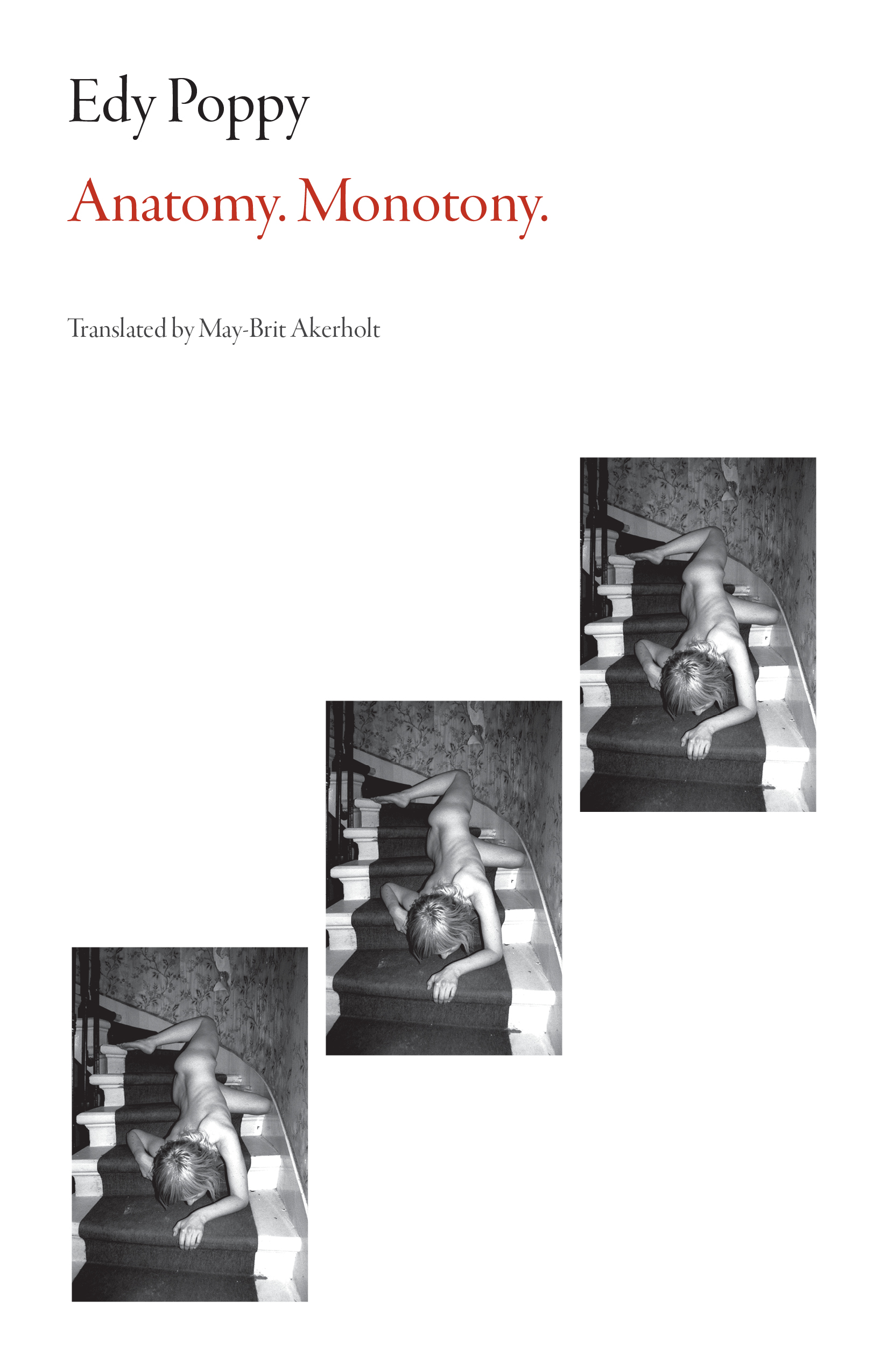
Edy Poppy - What is fidelity? Part autofiction, part literary, cinematic, and musical dance of allusions, and part chronicle of the mute body’s aches and pains and lusts and needs, the novel deftly hits its notes, high and low, to create a symphonic work of tragicomedy

Image result for Edy Poppy, Anatomy. Monotony,
Edy Poppy, Anatomy. Monotony, Trans. by May-Brit Akerholt, Dalkey Archive Press, 2018.


What is fidelity? In Anatomy. Monotony., Edy Poppy examines this question with an intimacy and ruthlessness worthy of Marguerite Duras. Vår, a young woman from a small Norwegian town, and Lou, a Frenchman from Nîmes, maintain an open marriage. But their polyamorous experiment is freighted with jealousies. Their life in London is broken into by one fascinating stranger after another, until eventually they decide to move away, back to Vår’s rural hometown—a decision that will change the nature of their relationship forever. Anatomy. Monotony. is a novel about sex, love, and the creation of literature in no uncertain terms.


Born in 1975, Edy Poppy is a Norwegian author and former model. In addition to her work in the theatre and as a writer of short stories, poems, and essays, her debut novel Anatomi. Monotoni won the Gylendal Prize in 2005.


“Edy Poppy’s Anatomy, Monotony is a devilish hybrid. Part autofiction, part literary, cinematic, and musical dance of allusions, and part chronicle of the mute body’s aches and pains and lusts and needs, the novel deftly hits its notes, high and low, to create a symphonic work of tragicomedy.”– Siri Hustvedt


Anatomy. Monotony. is narrated by Vår, a Norwegian woman married to Frenchman Lou; they live together in London. Vår earns some money as an art model -- "I'm a popular nude model" -- but she is also exposing herself and putting herself on display in another way: she is trying to write an autobiographical book -- this book. Passages of the work-in-progress -- also titled: Anatomy. Monotony. -- are interspersed in the more direct first-person account that makes up most of Anatomy. Monotony., with the perspective (third, rather than first- person) and the names changed -- the Vår-figure called Ragnhild Moe (which is, in fact, the pseudonymous Edy Poppy's real name), her husband Cyril (which is Poppy/Moe's (ex-)husband's real name)).
       Early on, she's still struggling somewhat with the writing, unsure about how seriously to take it, but finding it a valuable outlet:
I'm lucky to have my art, my scribbling, so I have somewhere to put my feelings.
       Eventually, it takes on greater importance -- and when, in the last parts of the book, Vår and Lou move from London to her small hometown of Bø, she devotes herself completely to the writing. Throughout, the main issue she wrestles with is:
I wonder how I can change this very personal story into literature.
       The personal story involves the very open relationship she and her husband have. While in London, Lou is also involved with the (legal-but-still-)teen Sidney, while she is involved with men like The Lover and then a cellist, the American.
       The American eventually challenges her, suggesting:
     All that counts is Lou and you, isn't it ? The rest of us are just test rabbits, something you can write about ...
       She denies it, but doesn't sound convincing. Her motivation might be different -- possibly even sincere, on some level --, but she -- and her husband -- certainly come across as toying around with others in exploring just what their own relationship means and can withstand. Vår tells herself: "It is important to test one's limits, how far one can go" -- and she and Lou go pretty far. But it's obviously not the easiest balancing act, and part of the process is her trying to figure out just exactly what she needs and wants, something she continues to struggle with:
I have to separate sex from love. I want my husband to be the one to get both. I believe I don't need to love anyone else, that he can take care of that side, that as well as the intellectual. Because the only thing he needs help to is the erotic, orgies, men who take me from all sides and are sexually almost bestial. I think I should be satisfied with that, because I get more than most women. Of freedom.
       But freedom -- no limits -- can also be illusory. Lou's relationship with Sidney does bother her, and the other men in her life do get in the way of her relationship with him. They both want to see it as a sort of game, and Lou tries to convince himself, and her, that: "this time it will be different, I'll be stronger", but when she goes to Amsterdam to spend some time with the cellist, the strains show pretty clearly.
       The problem with the characters of Vår and Lou is, of course, that they come across as almost entirely vacuous, empty vessels seeking fulfillment -- and looking for guidance in all the wrong places:
     Lou insists that we still have much to learn, both of us, when it comes to crossing boundaries, bending them. He asks if I know the author Pauline Réage ?
       Of course the sheltered Norwegian girl doesn't, and even if she gamely immerses herself in Lou's authors -- "Réage, Bataille, Apollinaire, Breton, Aragon ..." -- both are emotionally incapable of doing much with these literary abstractions. And, honestly, even Vår's sleeping around is pretty tame -- not to mention Lou not being able to be any more adventurous than taking advantage of a wide-eyed teen.
       Vår has grand visions -- and it's telling that by the end she expresses them even more in literary terms (i.e. removed from the real), describing how she'd like her alter-ego fictional self (i.e. herself) to be:
I'm thinking about women in literature and wondering whom I like best. I love Lila in Lila Said, Catherine in The Garden of Eden, Hermine in Steppenwolf, and Velma in Velma Variations. That is the kind of woman I want Ragnhild to be: playful, different, amoral ... A woman Hamsun would like to dislike, I think, or Thomas Bernhard ... one of history's many ingenious male chauvinists. I want Ragnhild to be a woman who ridicules all men who are hostile to women.
       [Lila Said is surely Chimo's Lila dit ça, published in English as Lila Says.]
       Turning to writing, and trying to (re)define herself on the page, seems a slightly healthier way of going about it, as the testing of their relationship by involving others so intimately seems to have been a challenge which they weren't really equipped to handle, literarily or in real life. (It's hardly surprising to find that Poppy dedicates the book to her husband -- noting parenthetically there also: "He is now my ex-husband" ..... (Though, in fact, they seem to have maintained a relationship, even collaborating on his own debut novel.))
       Vår pondered: "I wonder how I can change this very personal story into literature", and this is certainly one way to try -- but Anatomy. Monotony. doesn't really go far enough, in any respect. While descriptive, it isn't raw -- the brutal honesty that might, perhaps, be revealing --, and the self-reflection remains fairly shallow. Occasionally, Vår seems to be on the verge of some insight, but fails to make the connections: she makes the claim: "The only way to get a feeling for a place is to experience it alone, I think, find one's own way, one's own tempo, one's on good and bad habits", but fails completely to project that go-it-alone approach to her inter-personal relationships.
       Presumably, Vår and Lou's (open-)marriage concept is meant to shock in its pseudo-daring, but it doesn't really seem very daring at all; rather Vår and Lou seem to be struggling desperately with coming to terms to with any sort of emotion and human connection, with each other or others. Not they don't have honest, deep feelings -- but they seem entirely dazed by them: when Vår says, early on: "I'm lucky to have my art, my scribbling, so I have somewhere to put my feelings" she's oblivious to what she's saying -- that the life she's leading doesn't allow her feelings expression anywhere else but in her 'scribblings'.
       It doesn't help the novel, as literary work, that the sex isn't very sexy, and the writing -- not helped by the translation -- ... struggles. Some of the simple descriptions show a writer trying way too hard:
I run through the city, my legs like the second hand on a watch, I don't stop until I'm home.
       Legs moving "like the second hand on a watch" ? Two legs, moving like a single second hand -- that, anchored in place at one end, ticks in a circular motion ?
       And some sentences beggar belief:
     With you, an orgasm is like a momentous upchuck of the finest food and drink.
       (Rather too lackadaisical editing also does the book no favors: see just some of the sentences quoted above, e.g.: "He asks if I know the author Pauline Réage ?" is not a proper sentence in English.)
       Anatomy. Monotony. comes across as a heartfelt attempt by a young woman to process, through writing, her juggling of unfulfilling yet passionate relationships -- trying, just a bit too hard, to be 'literary' and daring, and not quite equipped for the task at hand. The book is ultimately way too personal, tending towards too much idealized wishful projection -- a lover telling Vår: "You are violently, incredibly beautiful, and extremely tender" -- as Vår/Poppy/Moe can't achieve anywhere near the necessary distance from herself and her acts. - M.A.Orthofer
http://www.complete-review.com/reviews/norge/poppye.htm


Hernan Diaz - a weird anti-western western. A singular and haunting novel, an epic journey into the wilderness of nineteenth-century America and into the depths of solitude. In its majestic evocation of landscapes it bears a resemblance to Blood Meridian


Hernan Diaz, In the Distance, Coffee House Press, 2017.
excerpt


A young Swedish immigrant finds himself penniless and alone in California. The boy travels east in search of his brother, moving on foot against the great current of emigrants pushing west. Driven back again and again, he meets naturalists, criminals, religious fanatics, swindlers, Indians, and lawmen, and his exploits turn him into a legend. Díaz defies the conventions of historical fiction and genre, offering a probing look at the stereotypes that populate our past and a portrait of radical foreignness.


“Hernan Diaz's In The Distance is exquisite: assured, moving, and masterful, as profound and precise an evocation of loneliness as any book I've ever read.”—Lauren Groff


In the Distance is a singular and haunting novel, an epic journey into the wilderness of nineteenth-century America and into the depths of solitude. In its majestic evocation of landscapes it bears a resemblance to Blood Meridian, but in the meditative precision of its language and the moral compass that spins at its heart, Díaz’s novel is a creature all its own, and it’s one of the very few works of fiction that transport you, emotionally and imaginatively, to an utterly new place. It’s a breathtaking trip.” —Paul La Farge


“If I could hand you this book I would. Read this. Hernán Díaz’s In the Distance is a portrait of this country as both a dreamscape and a living nightmare. With echoes of John Williams’s Butcher’s Crossing, Andrey Platonov’s Soul, and Richard Hughes’s A High Wind in Jamaica, this is fiction at its finest—propulsive, unsettling, wildly ambitious, and an unforgettable journey that we will certainly return to in the years to come.” —Paul Yoon, author of The Mountain


In the Distance by Hernán Díaz sends a shotgun blast through standard received notions of the Old West and who was causing trouble in it. Håkan and his adventures, which are truly extraordinary, not to mention beautifully written, had me from the novel’s first striking chapter to the last.” —Laird Hunt


“On its surface, In the Distance is a haunting and unique tale of survival—with all the thrilling frustrations of such. Deeper still, it is a story about the devastation wrought by the American Dream—the West as it happened to many, in spite of all they’d hoped.” —Colin Winnette


“Great stories are driven by desire. Håkan Söderström, the remarkable protagonist of Hernán Díaz’s In the Distance, sets off on an unremitting quest to find his brother. As he journeys against the grain of the frontier, Håkan confronts lust, love, honor, greed, and confounding betrayal. He also crafts a solitude that becomes, in Díaz’s skilled hands, as American as the landscape. In prose that is as bold as the western sky, Díaz has written an unforgettable tale of soulfulness and survival.” —Alyson Hagy


“While In the Distance can be read as a revisionist western—and totally enjoyed and chewed on as such—what makes Díaz’s book truly exceptional is how far beyond a simple genre it goes. A beautiful, thoughtful, and often heartbreaking exploration of lonesomeness, the simple confusion of just living, and the magnificent need for human connection.” —Justin Souther


Social theories of space have been vastly underrepresented throughout the evolution of critical discourse. From the Enlightenment to Marx, through to Foucault, most philosophers and critics have been primarily concerned with time and history, the sequential order of events and the effects of the timeline on human development. In his landmark 1989 work, Postmodern Geographies: The Reassertion of Space in Critical Social Theory, Edward Soja sets out the arguments for how and why the consideration of space might provide the answers to some of the dogged questions about humanity. Building on the developing field of Geography, and citing the work of his contemporaries (David Harvey, Doreen Massey, even Foucault, et al.), Soja suggests that the evolution of societies might be understood through examining the consumption and production of space, and the ways this shapes human behavior and social structure. In art, this discourse has been percolating for the past few decades, influencing stories and renderings that display the ways space affects us. Hernan Diaz’s recent novel, In The Distance, does that and more, exploring the traumatic effects of the exploitation of space.
In Diaz’s debut, a brilliant and fresh take on the old-school western, a young Swedish immigrant named Håkan is separated from his brother, Linus, en route to America. Håkan lands in San Francisco knowing only that he must get to New York to find Linus, but his journey becomes a series of increasingly dangerous episodes. He becomes a sexual hostage of a saloon owner with “black, gleaming, toothless gums, streaked with bulging veins of pus”; is roped into a kooky naturalist’s search in a dried-out seabed for a jellyfishlike proto-organism that supposedly created mankind; and is forced to kill marauders in self-defense. This latter episode leads to word spreading around the western territory that Håkan is an outlaw legend who literally keeps growing and growing in size, and, indeed, he becomes a giant by the book’s end. Diaz cleverly updates an old-fashioned yarn, and his novel is rife with exquisite moments: Håkan has moving relationships with a horse named Pingo and another traveler named Asa, there’s a drug-induced sequence in which Håkan looks at his own brain, and Håkan’s very limited grasp of English heightens the suspense of his tense encounters. The book contains some of the finest landscape writing around, so potent because it reflects Håkan’s solitude: “Nothing interrupted the mineral silence of the desert. In its complete stillness, the world seemed solid, as if made of one single dry block.” - Publishers Weekly


Violent, often surrealistic Wild West yarn, Cormac McCarthy by way of Gabriel García Márquez.
Håkan Söderström is a force of nature, a wild giant whose name, in the frontier America in which he has landed, is rendered as the Hawk. On the docks back in Gothenburg he was separated from his brother, Linus, and he has sworn to find him in a land so big he can scarcely comprehend it. The Hawk lands in California and ventures eastward only to find himself in all kinds of odd company—crooks, con men, prophets, and the rare honest man—and a tide of history that keeps pushing him back to the west. Along the way, his exploits, literary scholar Diaz (Hispanic Institute/Columbia Univ.; Borges, Between History and Eternity, 2012) writes, are so numerous that he has become a legend in a frontier full of them; for one thing, says an awe-struck traveler, “He was offered his own territory by the Union, like a state, with his own laws and all. Just to keep him away.” The Hawk protests that most of what has been said about him is untrue—but not all of it. As Diaz, who delights in playful language, lists, and stream-of-consciousness prose, reconstructs his adventures, he evokes the multicultural nature of westward expansion, in which immigrants did the bulk of the hard labor and suffered the gravest dangers. One fine set piece is a version of the Mountain Meadows Massacre, in which religious fanatics dressed as Indians attack a pioneer party—save that in Diaz’s version, Håkan tears his way across the enemy force with a righteous fury befitting an avenging angel. “He knew he had killed and maimed several men,” Diaz writes, memorably, “but what remained most vividly in his mind was the feeling of sorrow and senselessness that came with each act: those worth defending were already dead, and each of his killings made his own struggle for self-preservation less justifiable.”
Not for the faint of heart, perhaps, but an ambitious and thoroughly realized work of revisionist historical fiction. - Kirkus Reviews


Hernan Diaz’s In the Distance is more than just an atypical Western: it’s also an atypical ‘New Western,’ charting out fresh territory even among those postmodern novels that appropriate the conventions of the classic Western for subversive purposes. It follows the misadventures of a young, wayward, and largely speechless Swedish emigrant who finds himself accidentally traversing the harsh landscape of nineteenth century America. With its choice of protagonist, the novel casts aside the stoic, steadfast settlers whose presence usually defines the Western and replaces them with a confused, often clumsy adolescent incapable of settling anywhere. Then, not content to simply humanize one of the faceless beggars among the “wretched refuse” of the Old World’s “teeming shore,” In the Distance makes playthings of the narrative trajectory and language that are typically found in both the Western and the New Western. Much as its protagonist takes a childlike view of the unfamiliar world he lands in, and much as he relies on trial and error to figure out how it works, the novel itself finds a sort of innocent wonder in mixing and matching the key elements of its two genres.
Sent abroad by his father to escape a life of rural poverty, Håkan Söderström is a naive young boy dispatched to find his fortune in the place he knows only as “Nujårk.” Traveling in the company of his elder brother, Linus, he boards a ship in Gothenburg with a plan to cross the Atlantic. While changing vessels in England, however, the two brothers lose one another. Håkan promptly climbs aboard another ship bound for the Americas, convinced that Linus will reach New York first and await his arrival there, but instead of docking in the United States he is swept past Buenos Aires, five thousand miles off course, and then, after rounding Cape Horn, he ends up abandoned and alone in California. From San Francisco, still determined to reunite with Linus, Håkan sets out on a haphazard journey to the east coast on foot.
So much for a Western novel about purposeful pioneers intent on settling in the West. So much, too, for a Western whose hero either domesticates a frontier territory or is domesticated by it. Håkan’s wanderings see him embroiled in not just one of the mythic ventures of the American West, but outlandishly, implausibly, in an abundance of them — in a gold prospecting outfit and a small-town racket, in an eccentric naturalist’s scientific expedition, in a wagon train journey to the northwest, in conflicts with Indians and religious zealots, in a shootout and a flight from the authorities, in a standoff with a self-aggrandizing sheriff, and in more besides.
Yet despite applying the kitchen sink approach to a Western narrative, In the Distance never feels overstuffed or capricious, never reduces Håkan’s journey to a satire or a tragicomic picaresque. It achieves this feat largely because its prose is so tightly controlled, so grounded in its young protagonist’s perspective, and so respectful of the demands imposed on it by its guiding conceit. Prior to the novel’s release, Diaz spelled out this conceit in an interview with the Paris Review. “[O]ne of the most fascinating formal problems in literature is point of view,” he said,
because taken to its ultimate limit, I think it’s also an ethical problem, since it’s related to power. How much about your characters do you know? How far into situations or people can you see? … I [stick] with Håkan’s point of view in a very drastic way, in that regard. If he doesn’t understand, neither do we.
This is no exaggeration. Håkan Söderström is an immigrant to America with almost zero command of English. To him the language is “a mudslide of running, slushy sounds” and “some particularly gelatinous vowels.” Simple sentences strike him like this: “Frawder thur prueless rare shur per thurst. Mirtler freckling thow. No shemling keal rearand for fear under shall an frick.” Moreover, Håkan is a child with virtually no concept of adult behavior, interests, and motivations. He doesn’t grasp the fundamentals of sexual attraction, commercial exchanges, assumed authority, the exercise of power, or the forces that encourage people to manipulate and exploit others. He looks older than his years — he is preternaturally tall and bulky, effectively a giant — but with his habitual silence amidst the hubbub of a foreign tongue, and his bafflement in a world governed by greed and guile, he comes across as the Michael K. of the wild frontier. He is a lumbering yet meek behemoth, abandoned to the elements yet capable of survival, and absolutely single-minded in his dogged pursuit of a distant desire.
Crucially, though, Diaz doesn’t go for the easy option of allowing an omniscient narrator to explain what’s happening around Håkan, or what’s going on inside his head, whenever the boy is mystified or alienated by events. Nor does he resort to first-person prose that allows Håkan to spell out his confusions, his emotions, his desires and his hopes. Instead, Diaz tries his hand at some aesthetic alchemy. Literary naturalism requires readers to infer the thoughts and feelings of a character from a more or less objective description of their behavior. Free indirect style conveys a character’s impressions of the surrounding world by channelling them into largely depersonalized, third-person prose. Diaz amalgamates these two technical devices, applying free indirect style to a character who has to read his own world the same way we read naturalistic literature — one who can only observe incomprehensible things and guess at their apparent meanings, their seeming causes, and their potential names.
At its best, the effect of this alchemy is both engrossing and disorienting, offering partial access to the thoughts of a person who watches strangers go about their business as if they belong to another species. “After a while,” Håkan observes of the gold prospector James Brennan,
he stopped, spat on the rock, and rubbed it with his fingertips. Suddenly pale, panting and stumbling stiffly like a flightless bird, he went to his children, dragged them to the hillside, and seemed to explain to them what he had just found. With eyes shut, he pointed first to the sky, then to the ground, and finally to his heart, on which he tapped while repeating the same phrase over and over.
In other instances, alien sights for which Håkan has no terms of reference are described almost entirely in impressionistic prose. As he ventures into the Midwest, for instance, Håkan comes across a beast apparently “made out of two different bodies ineptly put together,” with a head “so massive [that] it seemed to have been dreamed onto the rest of the body,” “as if nature had changed its mind halfway through it.” Call it by its name and the buffalo loses the majesty these words confer upon it. Convey it through the eyes of a child who’s never seen it before, a child who also lacks the capacity to describe it, and by virtue of the language alone, rather than the imagination, the buffalo becomes a creature every bit as magical as something plucked from a fantasy novel. And even when the passage of time allows Håkan to pick up some rudimentary English, Diaz sustains his torque on the language by confronting Håkan with sights that shatter his syntax. Alone in the desert somewhere, the boy comes across a mutilated corpse. This is as much as he is able to articulate: “Corrupting, there, forsaken, becoming, already, nothing.”
It wouldn’t be quite right to say that Diaz takes the novel’s conceit to wildly experimental extremes or applies it with the rigor of an Oulipian constraint. There’s an ease and looseness to In the Distance that makes it easy to be immersed in the story of Håkan Söderström and to not have to attend too closely to Diaz’s technical tricks. But the novel is shot through with breathtaking imagery and moments of real profundity — an unforgettable incident on a salt lake, a gut-wrenching sequence in a desert cañon, a tense climax in a subterranean enclave — and all of these derive their power from Diaz’s meticulous approach to his protagonist’s point-of-view. If the raw action of In the Distance would make it a compelling Western in any event, it is finally a novel of larger, more sweeping ambitions which it realizes through the sheer force of its style. - Daniel Davis Wood
http://necessaryfiction.com/reviews/InTheDistancebyHernanDiaz

Håkan Söderström, the hulking hero of Hernán Diaz’s novel, “In the Distance,” makes a stupendous entrance, ascending onto the first page through a star-shaped void on a featureless plain of white sea ice. Longhaired, white-bearded, gnarled and naked, he pulls himself onto the floe and walks on bow legs to an icebound schooner, carrying a rifle and ax. We are somewhere, nowhere, in the frozen north.
Nowhere is also the place “In the Distance,” Mr. Diaz’s first novel, seems to have erupted from. He had no agent when he answered an open call for manuscripts by the nonprofit Coffee House Press in Minneapolis, which published the novel last October. In April Mr. Diaz was named a finalist for the Pulitzer Prize and the PEN/Faulkner Award for Fiction, causing book reviewers around the country to say, who?
Mr. Diaz is a scholar at Columbia University who grew up in Argentina and Sweden, studied in London and New York and lives in Brooklyn. His book is about an immigrant Swede of unusual size journeying in America’s desert frontier between the Gold Rush and the Civil War.
Though many of its elements are familiar to the point of being worn out — saloons and wagon trains, Indians and gold prospectors — the novel is not. Mr. Diaz’s long study of North American literature, much of it steeped in the 19th century, allowed him to expertly plunder an antique genre for parts. The rebuilt mechanism is his own design, and it moves in unexpected directions: west to east, around in circles, down into the earth, and north to Alaska.
Which makes “In the Distance” an uncanny achievement: an original western.
“He’s standing on the shoulders of a lot of giants,” said Chris Fischbach, publisher of Coffee House Press and Mr. Diaz’s editor. “It’s a modernist book in that he’s absorbing all these fragments and using those to create a new world, and a new piece of art.”
In a recent interview in a sunny Brooklyn Heights apartment that Mr. Diaz shares with his wife, Anne, a filmmaker, and their daughter, Elsa, 7, he talked about the bafflement that led him to Håkan.
He was mystified, he said, by the absence of western novelists in the American canon. Who, besides Zane Grey and Louis L’Amour and a forgotten brotherhood of pulp novelists? Who, besides Larry McMurtry and Cormac McCarthy? And if those contemporaries write “anti-westerns,” where are the westerns they are writing against?
“They’re writing against John Ford, I suppose,” Mr. Diaz said.
“It’s weird,” he said. Weird that the western novel was so underachieving, given how tightly the genre embraces America’s most potent myths about itself. Westerns, he said, glamorize “the worst aspects of the imperial drive of the United States” — brutality against nature, genocidal racism, “the whole macho thing, the place of women, the frivolous violence, it goes on.”
Mr. Diaz, it should be clear, is a western writer who hates guns. He said it sickened him to think that telling Håkan’s story would require imagining and describing acts of murderous violence. “I came very close to not writing the book,” he said. “But I knew something really bad had to happen to him to make the plot plausible.”
Håkan is a backwoods boy from Sweden who leaves home with his older brother, Linus, for the American metropolis they call Nujårk. But he loses Linus on a wharf in Portsmouth, England, boards the wrong ship and ends up in San Francisco. He resolves to reunite with his brother by trudging across the continent, shoes against the current of westward migration and continental conquest.
He knows no English, and for a time the reader is almost as disoriented as Håkan is. Stray words float by in a river of frontier gibberish: “Frawder thur prueless rare shur per thurst. Mirtler freckling thow.” But Håkan learns fast. He meets people: a mystery woman in a corset with amber hair and black-red lips, like a hooker with a heart of coal. A demented gold miner. An obsessive naturalist who wades in alkaline pools for imagined proto-organisms. Homesteaders, marauding Civil War veterans and a sinister sheriff.
Håkan starves and thirsts. He survives and grows, in sorrowful wisdom and, inexplicably, to colossal size. And though he murders and maims and becomes a notorious outlaw, he is disgusted, and ultimately shattered, by his violence.
The reader, absorbed, has urgent questions. Will the misdirected Håkan ford the Mississippi and pass Huck Finn lighting out the other way? Will he find Linus in the sooty hubbub of Walt Whitman’s Brooklyn or the immigrant maelstrom of Five Points? How does he end up in Alaska?
More immediately, how do you pronounce Håkan?
Make a fish mouth and glide over the vowels: “Hu-oh-aahk-kan.” To Mr. Diaz, it sounds like a Long Islander saying “Hawk can,” which is pretty close for someone whose roots are from nowhere near Massapequa.
He was born in Buenos Aires in 1973. His mother was a psychoanalyst; his father a filmmaker who became involved in Trotskyist politics, which put the family in danger after Argentina’s military coup, when Hernán was 2. They fled to Stockholm. Moving there and then back to Argentina as a boy gave Mr. Diaz double doses of immigrant dislocation; the emotional aftereffect of isolation and bullying seem to echo in his story of lonely Håkan.
Unlike his reticent, hulking hero, Mr. Diaz has a slight build and a wide smile and an expression that gains intensity as he listens and weighs his words, which he delivers with rapid precision. He is associate director of the Hispanic Institute at Columbia, where he edits the journal Revista Hispánica Moderna, or RHM. His last book was a study of Jorge Luis Borges, the Argentine essayist and poet: “Borges, Between History and Eternity.”
Among the ideas Mr. Diaz challenges with “In the Distance” is the one that writing convincingly about a place requires going there at some point.
He didn’t. No rental car and GPS for him: “There was something that to me felt corrupt and dishonest about having an air-conditioned experience of the protagonist’s ordeals,” he said. “I defend the idea of reading over researching, which has this whole protocol that I don’t think applies to literature, which has its own relationship to truth.”
Instead he read widely and deeply and wrote the book in Brooklyn and Manhattan. He knew he was working within an old tradition. Many early westerns were written by men for whom “Go West” meant crossing the Rhine. They include Karl May, the German scribbler of sauerbraten westerns, and Franz Kafka (“Amerika”). Arthur Conan Doyle set part of “A Study in Scarlet” in Mormon Utah.
Mr. Diaz considered the risks of historical howlers (Kafka imagined the Statue of Liberty holding a sword) and found them tolerable. What he concocted is strange and transporting, a story that approaches but never enters the realm of magical realism. Håkan is one humongous Swede, but not a biblical giant. On a big-enough horse to match his proportions, he can plod down Main Street without causing panic.
Some characters stray toward anachronism, like the opulent winemaker, a sort of Finnish Francis Ford Coppola, who lives on a groomed estate out of Architectural Digest, or Asa, the good guy in a bad gang who loves to cook. Asa is a frontier foodie, adding sweet sap and blossoms to his dishes. He shares with Håkan a few ambiguously tender scenes of manly attachment, and his recipe for quail stew.
Weird. But give Mr. Diaz this: It’s a weirdness to which a reader willingly submits, because of the vigorous beauty of his words and his ability to keep Håkan’s bizarre adventures somewhere within sight of possibility. So when you get to a sentence like this — “Håkan tried to milk the lion” — it passes without a second thought.
An affecting oddness is the great virtue of “In the Distance,” along with its wrenching evocations of its main character’s loneliness and grief. And its ability to create lustrous mindscapes from wide-open spaces, from voids that are never empty.
“It all could plausibly happen,” Mr. Fischbach said. “It probably wouldn’t.” - Lawrence Downes


In the Distance is a historical novel which takes place during the uniquely American period defined by the doctrine of Manifest Destiny. Set in the plains, deserts, mountains and canyon regions of the western United States, Diaz portrays the vastness of the landscape, while shaping the mania it can cause. Håkan, the solitary main character, is a Swedish immigrant who immediately finds himself lost after landing in San Francisco as a young adult. With the money earned from the sale of a horse he had been lucky enough to procure for free, his poor tenant father had secured passage on a ship to New York for his sons, Håkan and Linus, who “had never even seen a picture of a city.” The boys are sent to America to find a better life and earn their fortunes in the proverbial land of opportunity.
Hernan Diaz was born in Argentina but grew up in Sweden after moving there as a young child. When his family decided to move back to Buenos Aires, he felt a certain foreignness that compelled him to move to London and finally to New York City where he has lived for almost twenty years. Currently he is the managing editor of RHM, a distinguished international periodical for academic research in Spanish, and an associate director of the Hispanic Institute at Columbia University. Diaz’s background played a large role in his writing of In the Distance. In an interview with the Paris Review he says, “The experience of foreignness has determined my entire life. I wanted to re-create that feeling…I tried to make genre and even language itself feel foreign.” Diaz accomplishes this with various tricks, such as silencing his protagonist for a long section of the narrative until he learns his first few words of English.
It doesn’t take long for Håkan to experience his first trauma away from home. The two brothers board a ship from Gothenburg to Portsmouth, where they are set to transfer to another ship destined for New York. On their journey, “they spoke no English, so the name of the city they were headed for was an abstract talisman to them.” Håkan and Linus are thrust into a newly globalised world when they land in Portsmouth. They find a milieu of multi-culturalism. With stylistic flair, Diaz paints this scene with a wonderful list:
…merchants, incense, tattoos, wagons, fiddlers, steeples, sailors, sledgehammers, flags, steam, beggars, turbans, goats, mandolin, cranes, jugglers, baskets, sailmakers, billboards, harlots, smokestacks, whistles, organ, weavers, hookahs, peddlers, peppers, puppets, fistfighst, cripples, feathers, conjuror, monkeys, soldiers…
The list goes on, effectively echoing the chaos of a major 19th century European port. It is here that Håkan loses Linus. Amidst the hubbub the two brothers become separated, and in a panic, without knowing the language, Håkan hurries onto a ship he thinks is set for New York hoping he’ll find Linus there. But as the ship sets sail, his brother is nowhere to be found. As the vessel makes its way into the Atlantic, Håkan  becomes feverish with despair. The Brennans, an Irish family on board, find him and care for him. After some time Håkan is able to communicate, learning the details of their journey:
…through signs and with the aid of a small piece of lead with which Eileen [Brennan] drew a rough map of the world, Håkan understood that they were an eternity away from New York–and getting farther from it every instant. He saw they were sailing to the end of the world, to get around Cape Horn, and then head up north. That was the first time he heard the word ‘California.’
In Postmodern Geographies Soja argues, “this emerging postmodern critical human geography must continue to be built upon a radical deconstruction, a deeper exploration of those critical silences in the texts, narratives and intellectual landscapes of the past, an attempt to reinscribe and resituate the meaning and significance of space in history.” Here, Soja is laying the foundation for a Marxist Geography within social theory, and in doing so, he creates the opportunity for literary scholars to develop a spatial reading. With this project in mind, one cannot ignore the ways in which Diaz constructs In the Distance that make such a reading possible. Throughout the novel Håkan barely speaks and so embodies the “critical silence,” allowing the reader to read the composition and influence of the landscape as it takes control of the narrative.
In the novel’s prologue, set in the present, we are initially presented with the image of a mature and very different Håkan, seen emerging from a swimming hole in the frozen sea. Diaz brilliantly introduces his protagonist as one who literally issues forth from the bleak landscape of a frozen wasteland, “only then did his colossal proportions, which the blank vastness had concealed, become apparent…he was as large as he could possibly be while still remaining human.” He is a chiseled, bearded, giant man who instills fear and respect in the men who meet him. Following his polar bear swim, Håkan makes his way back to the ice-bound schooner of which he is a passenger. Some wary fellow passengers have heard the legend of The Hawk, a name given to him due to the poor understanding of his name by English speakers. At the urging of a brave few, a crowd gathers around him to hear his story while the ship waits for the warming days to break up the ice. From there the narrative turns back in time to the point when Håkan and Linus leave Sweden.
What creates the legend of the Hawk? How does Håkan transform from lost boy aboard a ship to California to fearsome legend? As the novel progresses he falls into the paths of many people, and through each encounter he learns something new. His life is dominated by the aspirations of those undertaking the rugged quest of settling the western United States. In many ways Håkan symbolizes a vessel carrying the imperial burden of new territory. Work defines him. Once they land in San Francisco, his first assignment is to haul the belongings of the Brennans. He believes that as long as he heads eastward he will find his way to New York, where ultimately he might find his brother. Håkan finds hope in his ability to move across the unknown distance.

James Brennan, however, is bent on gold. He has uprooted his family from their native Ireland in order to strike it rich in the goldfields of the territories. As the small family, which now includes Håkan, moves east, their prospects of success seem as unlikely as finding a needle in a haystack. Until one fateful day when Håkan loses grip of the wheelbarrow which holds all their belongings, and it falls down a steep descent, “tumbling and flipping on itself, and finally turning somersaults and pirouetting with surprising grace until it smashed against a boulder, shattering beyond repair.” The family is forced to camp for the night. An outraged Brennan mindlessly goes to pan a small stream nearby while Eileen pitches camp and Håkan nurses his blistered and bleeding hands. Then, “when the pan came out, he stared at it, transfixed, as if he were looking into a mirror without recognizing the face that was supposed to be his.” James Brennan has struck gold.
Time and time again, Håkan suffers trauma while others find fortune in the “blank vastness” of a territory slowly being claimed. After his experience with the Brennans, he is kidnapped and held hostage as a sex slave by a powerful land-owning woman. Then he meets and joins an evolutionary biologist intent on finding the missing link in the expansive, and deadly, salt flats. Time passes and Håkan finds himself accompanying a small wagon train, serving as the head of security until they are overrun by bandits. Thrown into a violent rage, Håkan slays the entire murderous band of attackers. It is in this event that legend of the Hawk is born. The trauma of the attack sends him into a lonely saga of avoiding humanity, trapped in the endless landscape that seems to contain him no matter how long he travels. After being alone for years he re-enters society only to find that he is a wanted man, wrongly accused of murdering the families of the wagon train he had saved.
Håkan is like the wheelbarrow he once pushed, endlessly “tumbling and flipping” and “shattering beyond repair.” However, he is often able to discover something new and worthy, some effort which keeps him alive. Along the way he encounters wonders of science and medicine, and uses those skills to help himself and others. He fine-tunes his ability to hunt and live off the land. He learns the joys of gastronomy using the herbs, plants and fowl of the wilderness from someone who becomes very dear to him, only to see that person brutally murdered. Håkan is the trauma wanderer, suffering the psychosis-inducing terror of empire-building. Everywhere he goes seems to be a site of profit-extraction. For instance, not far from the remote location where James Brennan first finds gold, there exists the small outpost of Clangdon. It is here, in a typical Western setting of lawlessness, that Håkan is held hostage. Eventually he is able to escape and flee to other distant parts of the territories. Years later, he revisits the small town, only to find it a bustling urban environment. Håkan’s story is not the typical immigration story, nor does he fit into the traditional protagonist role of the American Western novel. Diaz shows us a man exploited and tortured by the processes of capitalist enterprises in the spatial ordering of the American landscape.
Using the Borges story The Aleph to frame his discussion about Los Angeles, Soja compares the most expansive urban environment of the contemporary American west to the unexplainable location described in the classic short story:
 …we still know too little about the descriptive grammar and syntax of human geographies, the phonemes and epistemes of spatial interpretation. We are constrained by language much more than we know, as Borges so knowingly admits: what we can see in Los Angeles and in the spatiality of social life is stubbornly simultaneous…the task of comprehensive, holistic regional description may therefore be impossible…there is hope nonetheless.
Soja’s hopefulness might spring from the feeling that great literature can give us a glimpse of the unexplainable. When we think about the American West, we must think about it spatially. We must  remember not only the timeline of events: When was this battle won or lost? Who purchased this land? Where did those people go? Instead we should focus on the atmosphere of space created under the efforts of claiming dominion: How did the site of battle determine its outcome? What gives land its value? Where might people flourish? This simple readjustment of inquiry invites a deeper reading into the consequences of social progress and development.
Diaz dispels the old myth of the West. In his novel, we see that even a giant white man can be taken advantage of amidst the setting of an emerging empire. Håkan interacts with very few Indigenous people throughout the novel, which might come as a surprise, but is fitting since those voices have been destroyed from the narrative of American progress. Håkan himself rarely speaks. Not due to the language barrier, because he picks up English easily. He actively avoids interacting with others after suffering the trauma caused by the actions of those he meets, affecting his navigation through an environment made hostile by human behavior. While the landscape and terrain itself proves uninviting and dangerous, it is the company of others that proves to be the most lethal. From the moment he sets foot in the New World, Håkan is used as a tool, exploited by various people and their enterprises. Labour shapes him. Even during his periods of isolation, he can’t resist mindlessly putting himself to work, almost as a way to ignore and suppress his emotions. And this work takes on an especially disturbing quality when he begins tunneling into the earth to escape the outside world.
In this novel, Diaz deftly creates the postmodern landscape, one filled with sites of profit-extraction and knowledge-digging. The main character experiences the mania of empire-building and is traumatized over and over again until he almost breaks. Like Borges, Diaz is unafraid to use formal tricks to express this. Towards the end of the novel, a certain passage is repeated several times to showcase the tedium of Håkan’s labors:
…Seasons went by and returned, and Håkan’s occupations never changed. A roof could leak less. Traps had to be set. A gutter overflowed. Tiles had slid out of place. An abandoned ditch had to be filled. The coat had to be mended. A trench had fallen into disrepair. Firewood had to be gathered. An extension to an old passageway was necessary. Drinking water was needed. A new tool had to be made. Some meat had to be jerked before it spoiled. Cobblestones had come loose. A leather flue was too decayed. More glue had to be boiled down. Before one of these tasks had been completed, the next one demanded his attention, so that at all times he was engaged in one of these chores, which, together, over time, formed a circle, or, rather, some sort of pattern that, though invisible to him, repeated itself, he was sure, at regular intervals…he did not even eat at regular hours. In fact, his diet had been reduced to the absolute, life-sustaining minimum.
This passage,which recurs three times within several pages, also exhibits some of the haunting, halting prose that Diaz uses to evoke the monotony and tortured emotionality of his protagonist. Håkan symbolizes the repetitive mechanics of a machine, a man divorced from any sense of fellow-feeling for humanity. He exists in survival mode.
In The Aleph, the narrator, who is identified as Borges himself, lists some mythical examples of mirrors throughout the history of literature, and determines that the Aleph he experienced in the Buenos Aires cellar is a false one, describing what he saw as an example of one of those “mere optical instruments.” With In the Distance, Diaz presents us with one of those optical instruments through which the reader might see a totalizing view of the settling of the American West. It is a dark and haunting landscape. Diaz wonderfully distills the sweeping clichés of the era and region into the heart and soul of a single man, showing the violence and chaos of the imperialist age. Håkan’s emotionality is mirrored by the social production of space. As much as it was true in the nineteenth century, it’s still true today. Human behavior can be defined not by the moment in time, but its point in space. By engaging spatial literacy, spatial readings of works can be explored. It is unwise to ignore the environment which contains us. We might experience the quest and thirst for understanding, but we must recall those visions of oases in the distance. - Gabriel Boudali  http://www.3ammagazine.com/3am/spatiality-emotionality-hernan-diazs-novel-distance/


"In the Distance did something new, subverting the Western genre and, in so doing, raising important questions about cultural attitudes made evident by assumptions we make about art, particularly toward guns and immigrants. It’s also just a great story."The Paris Review Staff’s Favorite Books of 2017


"Hernan Diaz's strange, absorbing novel "In the Distance" . . . upends the romance and mythology of America's Western experience and rugged individualism. . . . Diaz's take on the immigrant's experience strikes me as a modern story. It resonated most strongly when my mind went to the millions of people on the move around the world today."The Star Tribune


“Stitched through with humor, this often-unpredictable novel will keep readers running along with every step of Håkan’s odd escapades.” —Booklist


"[In the Distance] is the story of a young Swedish emigrant to the United States, some time in the middle of the 19th century, which begins as a vividly observed and emotionally nuanced Western, and evolves into a kind of epic of loneliness, as our protagonist wanders farther and farther into the desolate landscapes of the West, and comes dizzyingly close to a psychic point of no return. It's a hero's journey, or possibly a monster's journey—the ending recalls the austere beauty of the last scenes of Frankenstein—and one of the great pleasures of Diaz's singular book is to observe the complicated ways in which the hero and the monster coexist."BOMB, “Fall Books Preview”


"Be on the lookout for Hernan Diaz’s short story in our pages next year. Until then, thank goodness we have In the Distance (Coffee House), his first novel—a sensitively written, often harrowing odyssey through the desert—which will have made ten more year-end lists since breakfast."The Kenyon Review, "Holiday Reading Recommendations"


“[In the Distance] is an episodic picaresque adventure, but the transitions are so smooth—and the prose is as unbroken as the horizon—that the past fades away like a dream. It’s as if Herman Melville had navigated the American West, instead of the ocean.”—The Nation


"Debut author Hernan Diaz depicts a bonafide Western character, an original born in the spirit of expansion and innovation and formed by “the business of being that took up all his time.” Jorge Luis Borges’ influence on Diaz is palpable in his pithy prose; lists convey the sparsity of Håkan’s surroundings and the emptiness that feeds him again and again on his circular path. Diaz is bound to join ranks with Borges on the literary scene with this mythical personality, still at large in our consciousness long after we’ve put down the book."—BookPage


"While set in the American West, this is no conventional Western, as it turns the genre's stereotypes upside down, taking place on a frontier as much mythic as real with a main character traveling east. In this world, American individualism becomes the isolation that is its shadow and the dream of freedom devolves into anarchic violence. And while Håkan longs for community, he finds himself a stranger everywhere. VERDICT: Resonant historical fiction with a contemporary feel."Library Journal, starred review


"A powerful and singular novel . . . in which Hernan Diaz succeeds in the most difficult thing—creating a character that lingers in your mind. . . . The book, indeed, is anomalous, a meteorite in American literature."Il Giornale (Italy)


"Stunning . . . The writing style is free of sentimental conclusions and emotional directives, yet Håkan is a perpetually engaging and sympathetic character, so expressively drawn that bouts of loneliness, heartache, and shame vibrate off the page. . . . The American wilderness is Håkan’s only constant companion, and descriptions of salt flats, canyons, and prairies shimmer with an almost hallucinatory power. Fine writing, diverse and well-imagined exploits, and Håkan himself keep the pace flowing, and mounting tension over just how it will all end makes for long reading sessions. As gritty, unromanticized tales of the American West go, In the Distance ranks with classics like Thomas Berger’s Little Big Man and Larry McMurtry’s Lonesome Dove."—Foreword Reviews, starred review


"Díaz’s great gift lies in reconfiguring the possible, the expected, the taken-for-granted into something extraordinary."Paste


"A gritty, dreamy anti-Western Western. This book’s unflinching exposure of our foundational American myths about individualism and violence is so well-executed that it feels nothing short of subversive. Surreal, cerebral, and affecting beyond what I thought possible."LitHub


"A  a truly haunting narrative. . . . A gorgeous journey, a profound homage to America’s natural beauty. Dip into Hernan Diaz’s In the Distance slowly, read a little bit at a time, enjoy the pure beauty of Hawk’s journey, his sense of being in America’s mythic past."—Counterpunch


“Hernan Diaz’s In the Distance will haunt me forever, a narrative that continues to astound me, and I think a near perfect portrayal of aloneness and solitude and deep longing.” —The Millions
"Perhaps most striking is Díaz’s ability to describe the known as unknown, the all too familiar when it is yet unfamiliar. The nature of his protagonist, Håkan Söderström, a lost and wandering Swedish immigrant in the rough, largely uninhabited American territory, allows Diaz to write of what it is like to encounter the foreign or forgotten, such that the reader has a similarly enlightening experience, encountering it anew." The Paris Review, "Staff Picks"


"The musical prose of Hernan Diaz’s debut novel In the Distance is as rich and surprising as the quest that the novel’s protagonist, Håkan Söderström, embarks on through the volatile American West. . . . Though it successfully mines many elements of a classic western novel, In the Distance is far more than a western. The meticulous care with which Diaz has clearly crafted each sentence proves he is a highly versatile author, one who is virtually limitless in scope. . . . Ultimately, it is a combination of nuanced characters like Håkan and finely-tuned, lyrical prose that enables Diaz to wildly succeed here in humanizing an often mythologized time in history.—The Arkansas International


"This is the perfect marriage of adventure and literary fiction. The sprawling narrative covers an entire lifetime of traveling and growing, and it always stays fresh and exciting."PANK: "Best Books of 2017"


"For someone not afraid to read a difficult but extremely rewarding literary work"The Feminist Press: "The Best Books of 2017"


"Diaz performs masterstrokes of aesthetic, thematic, and narrative superimposition throughout the novel. In the Distance is distinguished by inversions of traditional history, which color the novel’s terribly gorgeous landscape of 19th century west of the Mississippi. . . . The breadth and deployment of Diaz’s argot is simply astounding. His sentences are crisp, speckled with terms esoteric to an era yet idiomatically clear in their function. And more than any historical reimagining, Håkan’s desperate, often desultory journey blurs the line between purpose and nihilism, hope and despair, swirling together the variegation of human agency and circumstance until we find ourselves staring at the ineffable being that has become of Håkan, a life so saturated with learning, love, and loss that we have no choice but to accept his final measure."Atticus Review


"[Díaz's] debut novel has a wonderfully old-fashioned feel. It sprawls across early America through the story of a Swedish immigrant who transforms from penniless young man to living legend."—BookPage, "First Fiction: The 15 Most Exciting Debuts of the Fall"


"The opening line (and, really, the opening chapter) is worth double or triple whatever money you spend on this novel. It’s that good."—Writer's Bone


"The prose is surreal and wondrous, especially in its evocation of a landscape that exists more in allegory than historical fact."Tor.com


"An infectious story of one man’s quest for solitude and understanding, In the Distance is a noteworthy, original debut."The Gazette


"A surprising anti-Western Western interrogating the archetype of rugged anti-hero, and the way we tell stories about America. Diaz constructs a piercing and highly original depiction of our history's weird resonances."MPR News


"Diaz wonderfully distills the sweeping clichés of the era and region into the heart and soul of a single man, showing the violence and chaos of the imperialist age."—Gabriel Boudali, 3:AM Magazine


"A tremendous debut novel and an epic American story. . . . Just a flat out great book." —Brazos Bookstore, "Buyer’s Corner: Upcoming Fall Favorites!"


“The western as American myth is no new thing, but rarely has it been done so well. A picaresque, a bildungsroman, a parable, and a survivor tale all in one, Hernan Diaz’s story of Håkan, a Swedish immigrant forced to fend for himself in the American West, has an epic feel that belies the slender book’s page count. This is the kind of non-whitewashed American mythology that nurses a kernel of truth: Are we not all immigrants to a world we hoped would be better, encountering on life’s journey few friends and more foes, all of whom influence our understanding of the world and leave lasting impressions even after the memory of their faces fade?” —Christopher Phipps, East Bay Booksellers


"Through the story of Håkan, a Swedish immigrant to the United States in the mid 1800s, Diaz meditates on the nature of impersonal landscape, explores a life of isolation, and tours through some of the characters that carved the identity of the American West. This is a strange and brilliant version of historical fiction, twisting the genre into something unique. For fans of Cormac McCarthy and  Eleanor Catton's Booker Prize winning novel The Luminaries." —Porter Square Books: Staff Picks


"Part coming-of-age tale, part survivalist story, you have never read a western frontier novel like this. Truly one of the best books of the year."—Third Place Books: Staff Picks


"The best novel I have read in 2017. Why? Because it is replete with qualities that seem increasingly scarce in contemporary culture; namely nuance, subtlety, and reflection. A young Swedish immigrant arrives penniless in antebellum America, his sole purpose to reunite with his brother. From this simple setup, Diaz creates a deep evocation of foreignness, adding a welcome complication to the Western genre. Exploring myth and shame, the episodic journey upends stereotypes while maintaining a gripping narrative. Written in beautifully tactile prose, In The Distance is a startling debut novel. I look forward to reading it again." —Elliott Bay Book Company