8/28/18

Jan Brandt - The more he tries to prove his innocence, the more fierce the accusations, until his only option is open war against the village and its inhabitants.


Jan Brandt, Against the World, Trans. by Katy Derbyshire,  Seagull Books, 2016.
an excerpt


On its publication in German, Against the World was hailed as an immediate classic. “One of the most spectacular debuts of recent decades,” said Kulturspiegel, while Der Spiegel went even farther: “Against the World is the book of books.” Now English-language readers will get their first chance to see what German readers have already learned: this is a big, ambitious, over-the-top masterpiece.
Set in the East Friesia region of Germany in the mid-1970s, Against the World tells the story of Daniel Kuper, the nominal heir to a drugstore dynasty, and his struggle to free himself from the petty suspicions and violence of small-town life. A delicate, secretive boy with too much imagination and too few opportunities, he becomes the target of outrage and fear when strange phenomena convulse the town: snowfall in summer, inexplicable corn circles, a boy dead under the wheels of a train, swastikas crudely daubed on walls. Fingers point, and they single out Kuper. The more he tries to prove his innocence, the more fierce the accusations, until his only option is open war against the village and its inhabitants.
An unforgettable debut, Against the World is an epic account of growing up an outsider, and the pain, violence, and betrayal that accompany exclusion.


As experimental literature becomes more mainstream and as literature as a whole becomes democratized to the point of allowing instant, often digital, traversal of stories from one end of the earth to another, it seems harder and harder to find books that are truly unique in terms of structure. Harder still is finding such a book that uses its unique structure in a way that isn’t gimmicky or distracting. With this in mind, Jan Brandt’s debut novel Against the World is a particular joy, as its style, billed by the author himself as manischen realismus, or “manic realism,” feels incredibly fresh while staying completely readable.
At first glance, Brandt’s manic style appears overwhelming. To leaf through the book is like having too many windows open on a computer screen, with an abundance of visually and tonally different items competing for attention. Brandt’s audacious choices include varying fonts, the occasional image, passages in Latin, letters with scribbled handwriting in the margins, multiple narrators, pages containing only one word and other pages consisting only of the same word repeated over and over again, a large chunk where the pages are split horizontally with two different accounts told above and below the line and other quirks.
However, when taken as a whole, this manic realist style accomplishes two important tasks. First, it makes an 882-page novel of literary prose readable and consistently interesting for multiple parts of the brain. And second, it feels completely current. Though the story begins in a corner of Germany in the 1970s and proceeds from that point forward, this is a truly 21st century novel—one that is aware that readers’ brains are overwhelmed by information, images, politics, theories, spiritual crises, globalization and dozens of other competing stimuli. Brandt’s manic telling mimics that while contrasting it against long, literary sections that include beautiful references to the German landscapes, the intricacies of small-town life and heavy doses of ‘70s/‘80s/‘90s nostalgia.
Against the World feels incredibly fresh, which is a particular accomplishment when considering that Brandt still pays homage to those who influenced him. David Foster Wallace’s presence is felt both in the style of prose and in reference, and the book itself looks to be building upon other pieces of ergodic literature like Mark Z. Danielewski’s House of Leaves. Ergodic literature, a term coined by Norwegian scholar Espen Aarseth for literature in which “a nontrivial effort is required for the reader to traverse the text,” is a field where many pieces are derivative of classics of the form like the aforementioned House of Leaves and Nick Bantock’s classic Griffin and Sabine series. Against the World certainly sits among those works, yet it doesn’t attempt to copy them.
Style aside, it must also be noted that the readability of the English version has a lot to do with the excellent translation by Katy Derbyshire, who brings Brandt’s world to English without sacrificing the German idiosyncrasies that make his story so interesting. This is a particular feat when considering that this is an 882-page book featuring multiple points of view, yet Derbyshire’s translation is consistently marvelous.
Though Against the World is outstanding in many ways, it still has a few flaws. For instance, even with Brandt’s manic delivery the book does slow down for long portions, which serve to beautifully and complexly evoke small-town country life but also deprive the reader of the delicious structural weirdness of other sections. And through a combination of perspective and description, the main character, Daniel, often feels distant from the reader, too mysterious and occasionally less interesting than the other characters.
It feels important for big, bold books like Against the World to be written and published. Though this book doesn’t break any molds when it comes to race or gender, the literary world is still very traditional in terms of style and inclusivity, and the publishing of more unique works will only open doors for underrepresented voices and styles, particularly a beautifully told one like Against the World. Jan Brandt’s admirable debut is great reading for any occasion: complex and hearty while remaining swiftly readable thanks to a great story and a pitch-perfect translation. - Mike McClelland
https://spectrumculture.com/2016/10/19/world-jan-brandt/


When he was a student at Harvard, the poet Robert Lowell sought out Robert Frost and began to read to him an epic poem he had written about the Crusades.  Frost interrupted the fledgling poet and said "it goes on a bit, doesn't it?" and then proceeded to read out loud the opening stanza of Keats' Hyperion, teaching young Lowell a valuable lesson in concision.
If only Jan Brandt had been taught a similar lesson from a mentor or at least an editor.  His debut novel Gegen die Welt "goes on a bit" for over 910 pages. The book was recently released in English as Against the World, translated by my blogger acquaintance Katy Derbyshire (Katy, how did you have the stamina?). With his bloated novel Jan Brandt is seeking give the reader as sense of  totality of a fictitious provincial town - Jericho in Ostfriesland.  He might have learned something from Theodor Fontane, who could invoke an entire world in just a few pages of dialogue.
Jericho is located in what we in the US call "fly-over" country -  a forgotten region that is never a destination.  Brandt's Jericho is literally a "fly-over" town: fighter jets are constantly buzzing the town as they patrol the near-by East German border (the novel takes place in the 1980's shortly before 'Die Wende').  On the other side of the border is Jerichow - a town much like its West German counterpart but in a more advanced stated of decline.  Jericho has seen better days. Businesses struggle to stay afloat.  Young people, if they are lucky, leave to study in distant cities, never to return.  Those left behind turn to drugs, alcohol, heavy metal rock and - in a few cases - suicide.  Even nature conspires against Jericho; it begins snowing in September, and later heavy fog envelopes the town for months on end.  The central figure in the novel is Daniel Kupers, a typical teenage boy who gets caught up in very untypical goings-on in Jericho, and soon gets blamed - mostly unjustly - for everything that goes wrong.
What's frustrating is that Gegen die Welt contains several excellent sections and strands that could be crafted into terrific novellas or novels.  I especially liked the character Bernhard "Hard" Kupers, Daniel's father, a funny and energetic small businessman who does whatever it takes - including arson - keep his drug store afloat, even as he indulges in gambling and adulterous affairs. The dialogue between Hard and his wife "Biggi" is pure comedy.  The strongest piece of writing is the story of the locomotive driver who suffers from Post Traumatic Stress Syndrome after two young people throw themselves in front of his train.  His story goes on for over 150 pages - the bottom half the page, while the top half continues the saga of Daniel Kupers.
Jan Brandt has many such "techniques" for tormenting his readers, and I confess I put the book down for weeks at a time. But, to the author's credit, I did decide to finish Gegen die Welt, and, reading the last third of the novel, I realized Brandt's true achievement.  Gegen die Welt was published in 2011, three years before Pegida  or AfD (Alternative for Germany), yet Brandt predicted the wave of right-wing populism that today is washing over the provinces.  The citizens of Jericho are no different from those in Sachsen or Mecklenburg-Vorpommern. They see their world threatened by globalization, big box stores, automation, immigration - and are attracted to any rhetoric that promises to "make Germany great again."  The best scene in Gegen die Welt is when Johann Rosing - the local real estate and construction baron running for mayor (a "mini-Trump") - mesmerizes the people of Jericho with his speech at a campaign rally:
"Das Schlimmste aber ist die Vernichtung des Vertrauens in unser Volk, die Beseitigung aller Hoffnungen und aller Zuversicht. Wie können wir diesem Schicksal entgetehn? Der Grundgedanke der Hochfinanz besteht darin, dass es nur ein Glück gibt: Das Diesseits. Dieses Glück hängt von der Lebensmöglichkeit ab, die der einzelne Mensch sich an materiellen Gütern verschafft. [...] Das wahre Glück hängt aber vom Grund und Boden ab, von der Mutter Erde, und von den Menschen, von der Qualität der Menschen. Jedes Volk kann nur dann glücklich werdem. wenn es sein  eigenes Leben lebt. wenn es die Güter bekommt, die es selbst zu erzeugen fähig ist... Nur auf das, was man selbst erreicht hat, aus eigener Kraft und Anstrengung, kann man stoltz sein."
Sounds very much like a stump speech by Björn Höcke, and in fact Daniel Kupers later finds that much of the speech was lifted verbatim from Mein Kampf.  Daniel's father Hard is a die-hard FDP voter, but I'm sure that today Hard and all his neighbors would be casting their ballots for the AfD.  It is to Jan Brandt's credit that he does not just depict these folks as caricatures,  but as humans with genuine hopes and fears. - David Vickrey
http://www.dialoginternational.com/dialog_international/2016/12/review-jan-brandts-gegen-die-welt.html


Jan Brandt, born in Leer (East Frisia) in 1974, studied History and Literary Studies in Cologne, London and Berlin, and attended the German School for Journalism in Munich. His novel Gegen die Welt, 2011 (Against the World, 2016) was shortlisted for the German Book Prize and won the Nicolas Born Début Prize. His most recent publication was the autofictional text Tod in Turin (2015, ‘Death in Turin’).

Karolina Zapal - One of the most riveting, beautiful collections on immigration, meeting head-on the challenges of exploring the acceptance of difference, taking language and customs beyond borders and living with the cost of both in this world

Image result for Karolina Zapal, Polalka,


Karolina Zapal, Polalka, Spuyten Duyvil, 2018.
karolinazapal.com/
an excerpt


Polalka brilliantly weaves the thread of experience and language together to create a new American flag, one made out of the torn fabric of immigrant dreams, American dislocations, lotteries, and language. With daring and wry wit, Karolina Zapal delivers a timely missive packed with an illuminating punch. - Brenda Coultas


When I first encountered Karolina Zapal's Polalka, I found some convenience in reading the text's arrangements, erasures, and estrangements as only performance--of the immigrant's crisis of assimilation, loss, and fear. I was wrong. This is, more importantly, also a text of pleasure, a site for "the possibility of a dialectics of desire, of an unpredictability of bliss," as Roland Barthes said. Karolina writes like an outsider who has won the lottery and ravaged the game. Polalka plays, pleases, and flirts. It is un-writing written "off-tune by off-breed who tells its holes." - J'Lyn Chapman


One of the most riveting, beautiful collections on immigration, meeting head-on the challenges of exploring the acceptance of difference, taking language and customs beyond borders and living with the cost of both in this world. Karolina Zapal's innovations with language and the page keep this text resonating in us, calling us to read it again, be with her journey again. One of my favorite new books, and I am certain it will be one of yours as well! - CAConrad


Poetry

“To Be Local,” “Customs,” & “Kraj” – Flock Issue 20 (2018)
“Darling” – The Dependent Issue #1: Intimacy (2018)
“Edging” – The Manhattanville Review (2017)
“Office: Parts 1 & 2” – Witness Vol. XXX.1 (2017) * Nominated for a Pushcart Prize XLIII
“Crossroads” – SWP Guerilla Lit Mag (2017) (collaboration with Ryan Mihaly)
“Living Room: Parts 1 & 2” – Bone Bouquet Issue 8.1 (2017)
“To the Lady Who Left the Note” – Indicia Volume 1.2 (2017)
“Język (sections II & III)” – Bombay Gin 43 (2017)
“A Love Letter to Zygmunt Hertz” – SWP Guerilla Lit Mag (2016)

Essays

“Devil in White” – Sinkhole (2018) (runner up, Pop Culture Essay Contest)
“Ki$$ the President” – Foglifter Volume 2 Issue 1 (2017)
“Mała Means Little Feminine” – winner of John L. Rainey Prize, University of Illinois Urbana-Champaign (2015)

Translations

“Sky Writing” – 3:AM Magazine (forthcoming) (collaboration with Ryan Mihaly)

Book Reviews

Emiy Abendroth, ]Exclosures[ – Galatea Resurrects (2016)
Cody-Rose Clevidence, Beast Feast – Galatea Resurrects (2016)
Anselm Hollo, SevenSomething on Paper (2016)
Dao Strom, We Were Meant to Be a Gentle PeopleSomething on Paper (2016)
J’Lyn Chapman, BeastlifeSomething on Paper (2016)

Others

Round Table: Text and ImageSomething on Paper (2017)
Co-editor of SWP Folio for Bombay Gin 44 (with Ryan Mihaly)
Interview with Julie Carr – Something on Paper (2016)


Karolina Zapal is an itinerant poet, essayist, and translator. Her work has appeared in The Manhattanville Review, Bone Bouquet, Foglifter, Witness, Bombay Gin, and others. She served as the Anselm Hollo Fellow at Naropa University from 2015-2017. She's an editor with The Birds We Piled Loosely Press and an appointed Bridge Guard in Štúrovo, Slovakia. Born in Poland and raised in the United States, she wonders about lost cities and impenetrable borders. This is her first book. Her website is karolinazapal.com.

8/17/18

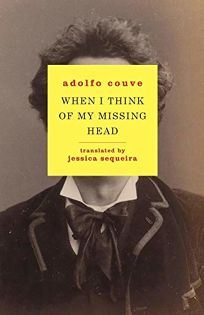
Adolfo Couve - Camondo, a painter, wakes up one morning in his studio with his head missing, it having been yanked from his body the night before. The cloudy jumps from one scene to another in decadent descriptive language are exhilarating, and it is never entirely clear what is really happening and what is fantasy

Image result for adolfo couve when i think
Adolfo Couve, When I Think of My Missing Head, Trans. by Jessica Sequeira, Snuggly Books, 2018.


Camondo, a painter, wakes up one morning in his studio with his head missing, it having been yanked from his body the night before by Marieta, a model. This is a punishment from the gods, who have already taken away his artistic talent. Now, mysteriously resurrected but not quite intact, Camondo wanders about a seaside town wearing a Franciscan habit stolen from church in an attempt to disguise himself.
Published posthumously, When I Think of My Missing Head, by the Chilean painter and novelist Adolfo Couve, here translated for the first time into English by Jessica Sequeira, is a phantasmagorical literary experiment, an existential puzzle with pieces that fit together by secret logic. With tones that are gothic and surrealist, symbolist and magical, this is a highly original work of terror and fantasia.


This posthumous final work by Couve (1940–1998), a Chilean author and painter, is both perfectly readable and totally incomprehensible. Its subtitle is “The Second Comedy,” and it follows La comedia del arte (1995), which shares with this book the principal character of the painter Camondo. Camondo has lost his head—his literal, physical head, which has been turned into wax by the Olympian deities and removed from his shoulders by an angry former model. Few other facts can be ascertained from the narrative, which, while consistently using plain, simple language, jumps from time to time, place to place, and person to person with no obvious pattern. Several conflicting accounts are given of whether and how Camondo gets back his head, and no attempt is ever made to explain how he can live, see, and communicate without its presence. This isn’t magical realism, but an insistent anti-narrative: it takes effort and skill to maintain this sort of clarity at the sentence level without producing some kind of comprehensible overall schema. As a fiercely experimental piece of literature, this will interest fans of Kathy Acker or William S. Burroughs, but conventional enjoyment is almost entirely absent. - Publishers Weekly


The phenomenological condition of headlessness — that is, the absence of a head — has a curiously rich history in Western literature and philosophy. Political theorists from Saint Paul to Thomas Hobbes to Carl Schmitt have taken on the question from a social perspective; interested in the idea of human society as an organic body with a sovereign as head, they have argued that any organization without this head will descend into chaos, and that no matter what claims on behalf of the viability of a headless state might be made by French anarcho-socialists like Fourier, Saint-Simon and Proudhon, and later English corporatists like Barker, Laski, and Cole, society is unworkable should the head be removed. The failures of a ‘headless society’ have been painted in the most vivid of colors.
But what about the individual body without a head? What is the imaginary landscape of the headless person? There is the idea of beheading, the removal of the head as punishment, as exemplified by the guillotine — a clean and clinical manner of separating a body in two resulting in death, a scientifically-designed approach less cruel at least than older methods of terminating a life such as stretching out a body to breaking point with the help of two horses galloping in opposite directions. In addition to the famous decapitations of the French Revolution, from Marie Antoinette to Madame du Barry, there is the beheading of John the Baptist, the result of Herod giving Salome what she desired, immortalized by Gustave Moreau in the intense jeweled tones of his 1876 painting ‘Salome and the Apparition of the Baptist’s Head’; in this image the head retains a sort of life, staring with sorrow and accusation at the woman who ordered it to be severed from the body.
The head has traditionally been thought to contain the mind, the consciousness, such that its removal suggests removal of thought, logical cognition and organized deliberation. Descriptions from the ‘outside’, however, decadent as they may be, do not represent the lived experience of being without a head. Where are the descriptions of headlessness from within, from the perspective of someone missing this part of the body? There is, of course, a paradox in this — how can one think and describe if one is headless? — but where some see impossibility, others see opportunity.
With his final book, the Chilean writer Adolfo Couve takes on precisely this philosophical question. His work incorporates and personalizes the concerns voiced by centuries of Western tradition, centered around the importance of the head which contains the brain as center of consciousness. When I Think of My Missing Head, Couve’s final novel, reflects the questions that preoccupied him at the end of his life. It contains a contradiction from its very title, of course — what does it mean to think without a head? — but from this paradox emerges the fragmentary, oneiric abundance of Couve’s vision, which inquires into what it means to exist as a headless person without coherent rational thought.
A reader who plunges into this book without warning will find herself adrift in a chimerical world without obvious grips. Since Couve narrates in a non-linear style, representing a jumpy and fractured form of thinking, this short novel requires more attention than a traditional book of its size might. Couve is often described by Chilean critics as a writer with a classical style; he himself proclaimed allegiance to a realist French tradition that includes Balzac, Stendhal, Flaubert, Maupassant, Merimée, Michelet and Rénan. That might be somewhat true in his earlier books, even if a UK or US reader still finds these quite ‘experimental’ compared with typical novels from their countries; in When I Think of My Missing Head, however, the structure is anything but straightforward. Some critics have suggested reading this novella as a sort of puzzle book, in which the reader can fit the various fragments together. The metaphor is useful, but only partially — if this is a puzzle, there are gaps and overlaps by the pieces, and such rational logic does not fit the more poetic atmosphere of the book.
All this said, When I Think of My Missing Head is quite clear at the levels of sentence and paragraph. Couve operates in terms of clear anecdotes. It is only when the reader stops and asks how a page connects to the material from a few pages before that the head-scratching begins, as it were. Anecdote follows anecdote but what joins the parts is more theme than plot — the constant of headlessness. An ironic and playful tone throughout lightens up the somewhat grim material; the first and third sections are also recounted in first person, which gives a picaresque quality to the different adventures as they move through spiritual, oneiric and realistic realms.
Taking a step back, the book does have a structure that can be summarized as well. Three parts comprise it: ‘Cuando pienso en mi falta de cabeza’ [When I Think of My Missing Head], ‘Cuarteto menor’ [Minor Quartet] and ‘Por el camino de Santiago’ [The Road to Santiago]. In the first part, the ‘narrator’ is the painter Camondo, a double for Couve himself. Camondo wakes up in his studio literally missing a head, since the night before his model Marieta has yanked it from his body. This is understood to be yet another punishment from the gods, who have taken away his artistic talent. Now, mysteriously resurrected but not quite intact, Camondo wanders about his seaside town, reacting to the discovery of his condition, seeking some kind of normality by wrapping himself in a cloak stolen from church to create the illusion of a head and railing against the gods who have permitted this to happen.
As an outsider, Camondo now experiences life in town with a sense of disoriented strangeness. This leads him to memories of travel with his grandmother. He remembers seeing a disconcertingly headless statue in Florence, which makes him say that: ‘What my grandmother did not know is that I found myself in Florence the night of 17 November 1494’. Here he describes a carnivalesque scene — pure imagination, a dream, or what?— which in turn segues into recollections of bohemian life in Santiago when he and his friends would hold parties involving desecrations of the church. Here, perhaps, lies one explanation for the gods’ wrath.
Couve thinks in similes not metaphors; memories, visions and bohemian reenactments are to him not performances of reality but reality itself. The cloudy jumps from one scene to another in decadent descriptive language are exhilarating, and it is never entirely clear what is really happening and what is fantasy.
Did Camondo really die? Was his ‘wax head’ really plucked off his body? Or does he simply feel this way? Perhaps it is the reasoning mind that separates ‘reality’ from other states, while in the headless mode existence and fantasy co-exist in a cauldron of potentiality. The idea of ‘losing one’s head’ is both metaphorical and literal; just as in Catholic transubstantiation an abstraction becomes reality, the host becoming the flesh of Jesus, here the abstract loss of rationality of ‘losing one’s head’ is represented as a physical loss, a powerful image — one remembers that Couve is a painter. All this is mirrored on a formal level in the book as the plot itself ‘goes to pieces’.
In ‘Minor Quartet’, the second section, we move away from Camondo to a series of other characters. The ‘quartet’ consists of four stories with two parts each, for a total of eight fragments. ‘Bad Head’ tells the story of the madness of model Marieta, ‘Losing one’s head’ the adultery of the clown Tony Bombillín, ‘Head of a girl’ the anguish of an old woman who lives off the memories of her painter father, and ‘Breaking one’s head’ the preparations of a cook to garnish a pig discovered in a waterwheel. These fragments link to one another as well as to the Camondo sections, in more or less obvious ways; each anecdote also possesses such a wealth of detail that it can be read as a story in its own right.
In the third section, ‘The Road to Santiago’, we return to Camondo, on his way to Cuncumén before he goes back to Santiago. The tone in these sections is more allegorical. Camondo meets a collector of antiques and curiosities who has discovered his wax head; inexplicably the dealer turns into a sort of devil who pursues him with empty eye sockets, a putrid green mouth and ugly hands facing backward; at last Camondo ends up in a church where he discovers his head displayed as the head of Saint Tarcisius. From here we move into a section from the perspective of the mentor of Tarcisius, portrayed as a coward who watches as the saint is martyred by circus folk but does nothing. (The circus, here as elsewhere, is seen to be not a docile place of fun and games, but rather a locus of desire and danger.)
The following section is a dream in which Camondo meets a beautiful young woman who desperately wants him to paint her portrait, removing her clothes and begging him again and again, which Camondo refuses out of a pact not to paint anymore. The last section finds him at the house of the young woman’s father, a millionaire in town; Camondo stealthily breaks into a party but is found out and humiliated. The book ends with a deus ex machina, a benevolent divine presence this time, in the form of the Consul General of Chile in New York. This diplomat knew Camondo when he was a great artist and defends him before all; he then has his chauffeur drive him back to Santiago in a limousine, and the book ends in a peaceful drift into sleep. In these final sections, the loss of a head prompts examinations of horror, longing, humiliation, displacement and relief, which reach an existential intensity that one can only speculate were felt by Couve himself.
When I Think of My Missing Head is a macabre work with dusky tones—Couve killed himself in 1998 in his house in Cartagena facing the sea—but it is also a work full of parody, above all about a career in painting. While the book is a stand-alone work, it can also be read productively in relationship with Couve’s earlier novel The Comedy of Art, which not only features Couve’s doppelgänger Camondo as narrator and the same secondary characters that appear in the ‘Minor quartet’ section of When I Think of My Missing Head, but takes on a similar plot of vengeful gods in a small seaside town. This in itself has a tragicomic effect—the great themes of religion, philosophy and art are all put to service in the life of a tired painter in a tired town.
As Ignacio Valente points out, The Comedy of Art marked a turning point in Couve’s work from realism toward ‘a freer and looser way of narrating that gives way to the grotesque, the phantasmagorical, the mortuary and almost postmortuary, the spectral on the very edges of hell… without losing those plausible and almost picaresque dimensions’. The loose style continues in When I Think of My Missing Head, which possesses a ‘poetic prose’ that for Rosa María Verdejo expresses a ‘troubling and painful search, saturated by the will to preserve certain life experiences through symbols and the imagination, as a game in which past and present combine in multiple spaces’. José Alberto de la Fuente makes the point more bluntly, writing that the ‘lack of a head’ is ‘a way to conjure up madness and death, to displace desperation and suicide into another temporality’.
Regardless of the effects of Couve’s own mood on this work, it is possible and illuminating to read the novella on terms beyond the author’s life. Other critics have commented on the work’s treatment of the grotesque; Adriana Valdés, who wrote the prologue to the first edition, notes that in When I Think of My Missing Head the grotesque appears to be engaged in a duel with the sublime. Felipe Toro notes that the fragments read like naturalezas muertas, ‘objects in repose (small everyday treasures) exposed to the gaze of the reader’. He also makes the connection between Camondo’s wax head yanked from him without pain and the ‘enchanted head’ presented to Don Quixote in Cervantes’ famous work.
Couve’s influences, as well as those he has influenced, are another area of interest. Leonidas Morales has associated Couve with the Chilean writer José Donoso, who works with similar thematics of closed spaces, big houses, elderly characters and decaying landscapes which serve as allegory. The relationship between Couve’s artistic work and his literature is also a fertile field. In 2002, Couve’s student Claudia Campaña, now a successful professor of art history, assembled a catalogue of his paintings with adjacent commentary, presented at the Santiago Museum of Fine Arts; this included several pieces by the author that had not previously appeared. Campaña has since written other texts on the author’s paintings connecting them to his novels.
When I Think of My Missing Head is a complex headless footnote, a fascinating coda to Couve’s life. It is capable of containing numerous readings from the personal to the mythological. As a translator, I have attempted to capture its quality of precision and multiplicity, in which no sentence reigns sovereign, but every sentence is a daub of paint that further enriches and illuminates a work, a life and a tradition. - Jessica Sequeira
https://minorliteratures.com/2018/03/21/on-headlessness/

8/14/18

Theresa Smith - 'L' reads like one woman’s desperate deconstruction of the world around her—tearing away assumptions, preferring a cosmic vantage point—all in order to better understand the very desperation that has inspired her deconstruction


Theresa Smith, L, Expat Press, 2018.


An archaeological conclave stumbles on a possible skeleton key to unlocking space and time. The Biblical crucifixion is gleefully reimagined as a carnival of mistaken identities and archetypes. A nodal literary figure is resurrected and interrogated on the salacious subtext of his novel as canonical concordance is thrown into carnal upheaval. A chance encounter on public transit becomes a fulcrum of entropic derangement. A species of arcade-style games conceal a vicious intent. The mysteries of a fictional planet are explored. Faith, science, and all manner of human constructs and earthly intuition are tested by Theresa Smith’s otherworldly imagination. The human condition is laid bare through inversion and surgical inquiry. Curiosity is the engine that drives Theresa Smith, the quintessential voice in science fiction you can’t afford to sleep on, and the thrum of her electric heart the compass. Tune in to her signature madcap, boundary-defying innovations in these ten stories with illustrations.


Interview with Theresa Smith


Language is a living record of all sorts of events, if one knows the necessary formulas to parse the dead facts from its shifting dynamism.
Theresa Smith’s writing reminds me that everything I see, everything I experience, everything I love is made up of small subatomic particles spinning and twirling, creating the illusion of a cohesive, ordered existence. Smith is a young writer who has obviously immersed herself and her fiction in the literature of philosophy and the hard sciences. Her slim debut collection of mind-bending stories reminds the reader how precarious the myth of ontological comfort is. I say the collection is full of stories, but I use the word story with some reservation. Though her fictions carry distinct narratives, they feel more akin to philosophies or creative theological treatises. Her writing is deeply Borgesian in its compression, its playfulness, and its insistence on folding itself into literary labyrinths. The opening story, ‘Who Among Us Has Not Stepped Through This Door’, can be read as an introduction to the work as a whole. It traps the reader in a simulation which has the aim of making us “perfectly, quiveringly aware that there is effectively no relationship between experience and its apparent causes or effects.”
 L contains ten stories split into two sections (a structure which also mirrors Borges Ficciones). The longest story is twenty pages, and half of the stories fall under ten pages. Even with such economy they demand concentration and slow, deliberate reading. In the vein of postmodern metafiction—like that of  Donald Barthelme and Robert Coover—Smith drapes her sentences in layers of interpretations. Take, for instance, the opening from ‘Barabbas’:
Barabbas is late. I had a feeling about Barabbas. I have to admit I was seduced by his resume: Herodic palace guard, Oriental astrologer and, here’s the kicker, a speaking role as Pharisee 2 in Matthew 19:7. But here we are, the masses are screaming, the Son of God’s in shackles, Pontius Pilate has to leave at 6:30—and no Barabbas.
We are left groping about even as the story surges forward. Is it a contemporary story of a man named Barabbas? Is it a retelling of the Biblical account? Are we watching actors on a stage? Have those actors been swallowed by the text? In four sentences the perceived subject goes through circuitous changes until it returns, essentially, to its starting point. This is indicative of all of Smith’s stories: they lift us into a vortex of comic and absurd ponderings, carry us around the world, and return us to the exact place we first apprehended. They leave the impression that nothing has happened and everything has happened. The reader is simultaneously unaffected and ultimately transformed.
L is concerned with these sorts of paradoxes. For very short stories, their premises are large and audacious. Each story is sprawling, suggesting countless meta-stories to be explored and considered at the reader’s discretion. This is where her compression and restraint shine. For many young writers it would be too large a temptation to take the offhanded mention of the of new creation myth and stretch the narrative thread to its furthest length. But throughout the collection, Smith shows the maturity of a more seasoned writer, willing to allow many compelling narrative details to remain shrouded in suggestion. Many of these “pocket fictions” are speculative and theoretical and maintain more power in the absence of fully realized explanations. That being said, there are plenty of instances where Smith follows certain speculative strains to more realized ends. The collection includes a story told from the perspective of a tetrahedron; it takes the Biblical crucifixion and reimagines it, and uses mathematics to explore the construct of identity. Smith writes with unmatched assuredness when employing heavy science, metaphysics, and speculative theology. Complex theories are never rendered in a cheap, exploitative manner—their complexities are carried into the fiction.
The role of science in Smith’s stories is distinct, and rendered in a way that cannot merely be assigned a label like speculative or science fiction. In her stories there is a cooperative interplay between narrative and science. In places, she allows the theories to speak for themselves—the science essentially becoming narrative. In other instances, the narrative is structured in graphs and charts, calculated in such a way as to become a science. The border between these seeming disparate disciplines is stretched and blurred as Smith uses whatever tools are available to interpret the world. In an interview with Expat Press, she explained it this way:
I want to be able, eventually, to create a fictional world without necessarily making anything up. I like to create by taking the structure of a concept – say, catastrophe theory in math – and grafting it underneath another concept, like the speech mechanism of a non-human creature, or the way someone’s facial expression changes while they’re telling a joke.
L’s propensity to deal in subject matter that is difficult to parse is not limited to science and hard mathematics. The collection is repeatedly concerned with religion and theology. Smith’s approach to religion finds a way of skirting the all-to-easy pitfalls of naiveté and cynicism. Her stories thread these by approaching religion with extreme interest and no commitments. By rejecting any sort of orthodoxy or dogmatism, she is able to pull from Christian tradition, Biblical literature, and speculative theological thought in a way that employs religion as yet another narrative tool. The plethora of religious themes also lends her writing an intuitive moral center. The subverted Christian vocabulary and imagery adds a weightiness to her stories.
Smith’s sentences are precise, well-orchestrated attacks. The language, although it is lyrical, is filled with a violent energy, an ambiguous insistence. In the same way that the content of her stories contrasts high theory and philosophy with lower subject matter (i.e. video games, planet exploration, relational disputes), she effectively juxtaposes meandering lyrical considerations with tight punchy prose. Take, as an example, her description of a crystal breaking through the pavement in ‘The Third Timekeeper.’ The story eventually reveals the crystal to be one of three timekeeping gods:
The crystal seems to possess just this sort of blind and monadic, dispersed but nonetheless fine-fingered intelligence. An explanation that explains itself, explaining nothing. He observes the singular twitching of its points and edges and duly imagines it capable of probing and perhaps even comprehending the captive language of silence; the intricate network of pauses, falterings and ellipses harbored within the spoken word. It yawns.
For all its lofty aims, there is something at the centre of this collection that is far more fundamental. L reads like one woman’s desperate deconstruction of the world around her—tearing away assumptions, preferring a cosmic vantage point—all in order to better understand the very desperation that has inspired her deconstruction. Smith explores a broad scope of worlds and possibilities in L because sometimes it is necessary to imagine a new universe in order to gain any perspective on the one you find yourself trapped in.
L is not an easy read, and it offers no apologies for its difficulty. Readers should anticipate spending more time on each story than the page count would suggest. This is a book for those who love the interplay of hard science and speculative fiction. It’s a book for admirers of Borges or Philip K. Dick. This is a book for anyone who has ever picked up a piece of philosophy, read until you ceased to understand, and then continued, undaunted, into the muddled and transcendent complexities of unbridled thought. Those who approach literature as a place to arrive at answers will leave L unsatisfied and with a great many more disturbing questions. The collection is aimed at undermining the world’s assurances and reimagining its horrors. Theresa Smith is a smart, sharp writer and her debut is impressive in its excesses and its restraint.
Get this book, read it, and reconsider everything. - Stephen Mortland
https://www.3ammagazine.com/3am/the-view-from-the-cosmos/


The Object of this Story – Theresa Smith

8/13/18

János Pilinszky - A landscape like the bed of a wrinkled pit, with glowing scars, a darkness which dazzles. Dusk thickens. I stand numb with brightness blinded by the sun. This summer will not leave me

2341884
János Pilinszky, The Desert of Love: Selected Poems, Trans. by Ted Hughes and János Csokits, Anvil Press Poetry; Revised & enlarged ed., 1989.


János Pilinszky (1921-1981) was a unique and compelling voice among the generation of European poets whose work bore first-hand witness to the horrors of war. The distinction of his poetry, as Ted Hughes argues, is both spiritual and artistic: `the desolation of [his] vision is equalled by its radiance'. The depth and power of Pilinszky's poetry are forcefully recreated in these memorable versions by János Csokits and Ted Hughes.
`The Desert of Love' is a revised edition of their earlier selection of his magnetic, intense and haunting poems. The added memoir by Pilinszky's close friend and associate Ágnes Nemes Nagy gives a major living Hungarian poet's view of his achievement.


The Desert of Love

A bridge, and a hot concrete road -
the day is emptying its pockets,
laying out, one by one, all its possessions.
You are quite alone in the catatonic twilight.

A landscape like the bed of a wrinkled pit,
with glowing scars, a darkness which dazzles.
Dusk thickens. I stand numb with brightness
blinded by the sun. This summer will not leave me.

Summer. And the flashing heat.
The chickens stand, like burning cherubs,
in the boarded-up, splintered cages.
I know their wings do not even tremble.

Do you still remember? First there was the wind.
And then the earth. Then the cage.
Flames, dung. And now and again
a few wing-flutters, a few empty reflexes.

And thirst. I asked for water.
Even today I hear that feverish gulping,
and helplessly, like a stone, bear
and quench the mirages.

Years are passing. And years. And hope
is like a tin-cup toppled into the straw.


The silence of the heavens will be set apart
and forever apart
the broken-down fields of the finished world,
and apart
the silence of dog-kennels.
In the air a fleeing host of birds.
And we shall see the rising sun
dumb as a demented eye-pupil
and calm as a watching beast.


The French Prisoner                                                      

Harbach 1944                                                        


On the Wall of a KZ Lager                                                        


Van Gogh's Prayer


One of the greatest Hungarian poets of the 20th Century was the Catholic, János Pilinszky. Fortunately for us, some of his poems have been translated by Ted Hughes and János Csokits and published in a collection entitled The Desert of Love.
Pilinszky's life and work was largely shaped by his experiences at the end of World War II when, having been drafted into the Hungarian army, he experienced some of the horrors of the Nazi death camps. His early poetry, in particular, draws upon those shattering experiences and so it is perhaps no surprise that the silence of God is often more apparent in them than faith, hope or love. Nonetheless, Pilinszky was never a nihilist, as even terribly bleak poems like 'Fish in the Net' reveal
A fair amount of Pilinszky's poetry is available on the web, including the haunting 'Fable' which is worth revealing line by line to maximise its potential to shock, 'The French Prisoner', which is available in at least two different translations, and 'Introitus'. However, there are also other poems, such as 'The Passion', 'Enough', and 'Exhortation' which are less readily available but which are well worth seeking out.
The Desert of Love has an excellent and highly sympathetic introduction by Ted Hughes. The only major omission is any direct reference to the horrendous political situation in Hungary during the late '40s and '50s. And yet poems like 'Introitus' can really only be understood in their political context. This is where books like George Paloczi-Horvath's The Undefeated come into their own. Paloczi-Horvath gives an extremely well-written and powerful account of those terrible years and helps us to understand why Pilinszky fell silent for so long after the success of his first collection.
Introducing Hungarian poetry into the classroom might seem a tall order but, as John Clegg of Durham University has shown, Pilinszky's poems are not only valuable in their own right but can also shed light on Ted Hughes's work. Pilinszky's poetry could also be studied alongside that of his fellow Central European and classroom favourite, Miroslav Holub, but essentially his poetry needs no excuse. It is powerful stuff and deserves to be more widely known.

János Pilinszky (1921 – 1981) served with the Hungarian army in WWII. Harmadnapon (On the Third Day, 1959) established him as a courageous witness to the horrors of mid-twentieth century Europe. Two selections of his work have appeared in English: Selected Poems, translated by Ted Hughes and János Csokits (Carcanet, 1976) — which was later expanded into The Desert of Love (Anvil, 1989)— and Crater, translated by Peter Jay (Anvil, 1978).

Aura Xilonen - It’s a crazy read. The language is wild, there are no chapters and the narrative is fragmented. Sometimes, in italics, there are flashbacks to Liborio’s childhood in Mexico and his swim across the Rio Grande into the US. In the ‘present’ Liborio lives a perilous existence threatened by street gangs, immigration cops, imminent starvation and worms


Image result for Aura Xilonen, The Gringo Champion,
Aura Xilonen, The Gringo Champion, Trans. by Andrea Rosenberg,  Europa Editions; Reprint edition, 2017.        


Read an excerpt here at Words without Borders


The award-winning debut novel by young Mexican author Aura Xilonen, The Gringo Champion is a thrillingly inventive story about crossing borders that the Los Angeles Review of Books called "one of the must-read books of 2017."


Liborio has to leave Mexico, a land that has taught him little more than a keen instinct for survival. He crosses the Rio Bravo, like so many others, to reach "the promised land." And in a barrio like any other, in some gringo city, this illegal immigrant tells his story.
As Liborio narrates his memories we discover a childhood scarred by malnutrition and abandonment, an adolescence lived with a sense of having nothing to lose. In his new home, he finds a job at a bookstore. He falls in love with a woman so intensely that his fantasies of her verge on obsession. And, finally, he finds himself on a path that just might save him: he becomes a boxer.
This is a migrant's story of deracination, loneliness, fear, and finally, love told in a sparkling, innovative prose. It's Million Dollar Baby meets The Brief Wondrous Life of Oscar Wao, and a story of migration and hope that is as topical as it is timeless.


Highbrow lowbrow; sweet spot, too. El Sur said in a review that Xilonen brilliantly transforms the vulgar into art and in cultured diction, with which I heartily concur––though I’m personally less concerned with elitism in language than with finding the beautiful in the ugly and speaking truth to power (shazam!). A migration story for the current moment, large, intense, honest, and somehow still hopeful. - M. Bartley Seigel


Punches, profanity and streams of offbeat argot fly from the first page of this idiosyncratic debut novel about a Mexican immigrant living on the edge of survival in an unnamed American city. Maybe 17 and “skinny as a shoelace,” Liborio has suffered enough hardship for several lifetimes, including a near-fatal border crossing, a brutal cotton-picking job and a raid by a band of “migrant-hunting gringos.” When the novel opens, he’s working in a bookstore for a boss with a penchant for vulgar verbal abuse and is madly in love with the girl next door.
Xilonen, a novelist and filmmaker from Mexico, was 19 when she wrote the book, and the prose, with all its madcap neologisms, has a youthful wildness, rather like Liborio when his blood’s running hot in a street fight. And it’s his talent for dishing out and taking beatings that ultimately offers him salvation, and a little bit of fame, via the boxing ring.
The novel’s language can be distracting (“passiflorally” speaking, but not in a “wlobalicidal” way) and the profanity wearing, but this book won’t be shelved among the “dull novels” frequently excoriated by Liborio, who is reading his way through the bookstore and has strong opinions about literature — opinions that one suspects hew closely to those of his creator. Those dull books “were fettered by the superficial task of effectuating sentence after sentence, soulless, lifeless, simply tossing out pretty words right and left. That’s how I imagined writers thread their novels together, wormy, airless, disemvoweled.” - Alison McCulloch

Those familiar with Campeon gabacho in Aura Xilonen's original Spanish note its baroque style: Liborio, the teenage street-fighter narrator who at the novel's beginning works in a Spanish-language bookshop, eats a dictionary to understand poetry and spits out his words most often to cuss. Andrea Rosenberg's translation should be praised for rising to the challenge of invention: The Gringo Champion is, too, a Jabberwocky creation of slang, nonce and portmanteaux – meaning derived from words' mouthfeel as much as anything else. The scrappy vernacular is to match Liborio's story: an undocumented immigrant fleeing violence and abuse in Mexico, his short life thus far has been a series of beatings and scrapes, his time in the United States navigated between xenophobia and exploitation, hunted by immigration officers. Translated two years after its original publication in Mexico, The Gringo Champion arrives when it is urgently needed, its central question – whether Liborio can find stability amid circumstances that force him into perpetual fight or flight – of pressing political concern. -


IN A TIME WHEN the US president got elected in part by the success of his claim that Mexicans are criminals and rapists, the long-running tradition of Mexico-bashing and stereotyping has acquired a new political urgency. Even though Mexico is the United States’s neighbor to the south, the source of its largest immigrant community, one of its top trade partners, the home of nearly two million US citizens, and a place with profound historical, intellectual, economic and political ties to the United States, Americans of all stripes — including its intellectual elite — possess an astonishing level of ignorance regarding the country. A significant contributing factor regarding this ignorance is the near total unavailability of cultural products from Mexico. As someone who teaches about Mexico in an elite institution of higher education, I can tell you stories about the insurmountable difficulties to find Mexican-created history books, literature, and cinema available in English translation. It is true that, in academia, I have the privilege to belong to a wonderful community of specialists in Mexican culture, literature, and history, but even these specialists’ works have a hard time reaching a readership outside our own circle. The xenophobic bashing of Mexico and Mexicans by the current US administration — including threats of mass deportation and military invasion, labels like “bad hombres,” and Mexico demonized as a country that cheats the United States in trade relations — has amounted to a longstanding ignorance that is no longer acceptable, either politically or ethically. The absence of Mexico’s perspective in the United States is not just a matter of run-of-the-mill American provincialism, but truly a political question when racist hate speech toward Mexico is allowed to exist without any significant counterpoint.
Literature is no exception to this trend. In the already dismal world of literary translation in the United States, Mexico has been historically nonexistent. Many classical works of Mexican literature are either out of print since the 1970s (the seminal novels of Rosario Castellanos and Elena Garro), untranslated (pretty much any poet after Octavio Paz), or published in English two or three decades after their original publications (the works of Sergio Pitol and Fernando del Paso). There are various reasons behind this phenomenon. One is mere disinterest: elite cultural consumers are generally interested in reading and watching a high percentage of American cultural products peppered with the world-literary author du jour (some people have even responded to my reproach claiming that they read Roberto Bolaño, who is Chilean). Another reason is a pervasive form of cultural supremacy. Global South writers in general are expected to provide northern readers with experiences of cultural authenticity or difference, and the fact is that most Mexican writers are cosmopolitan and steadfastly refuse to participate in the exoticist role that the world literary system seeks to attribute to them. Yet another reason is cultural conflation: many publishers and readers do not understand that, while related in genealogy and in political solidarity, Mexican literature is not the same as Chicano or Mexican-American literature. Indeed, one thing to reproach my fellow Mexicans for is their equally astonishing and unacceptable ignorance of our brothers and sisters in the Mexican-American community and the dismal circulation of Chicano literature in Mexico. Nevertheless, on the United States’s side, since a lot of Mexican-American literature is written in English, it is quite easy for publishers to simply not attempt translation of works written in Spanish. They feel that the market niche is satisfied with the works of Anglophone writers.
Because of all of these reasons, the publication of Aura Xilonen’s The Gringo Champion in Europa Editions should be praised and celebrated, as it is one of very few books from Mexico that has been able to break the symbolic wall of disinterest and cultural supremacy that keeps Mexican writers out of American mainstream literary publication. In recent years, many key works by contemporary Mexican writers have reached American shores thanks to the heroic efforts of translators like Lisa Dillman, George Henson, and Christina MacSweeney, as well as presses like Deep Vellum, And Other Stories, and Coffee House. American readers can begin to access timely works like Yuri Herrera’s Signs Preceding the End of the World, one of the best novels out there about crossing the border, as well as classics like Sergio Pitol’s The Art of Flight, a collection of cosmopolitan memoir-essays that many consider the most significant work of Mexican literature from the 1990s. Indeed, there are some grains of salt to this phenomenon. Many books are released in the limited circulation afforded to independent presses. It is also true that many works (like Valeria Luiselli’s celebrated fiction or Álvaro Enrigue’s Sudden Death) are worthwhile literary products, and their translations are important events, but they belong to Mexican literature’s tendency to resist political imperatives in fiction.
The Gringo Champion is a remarkable cultural object not only because it was published by a mainstream literary press (the same one that has become ubiquitous in bookstores thanks to the success of their translations of Elena Ferrante), but also because it happens to be a novel about a lower-class Mexican immigrant published at a time when stories of immigration have acquired new political urgency. Originally titled Campeón gabacho (“gabacho” is a slang word used as a derogatory term for the French during their invasion of Mexico in the 1860s, which then evolved to be used by Northern Mexicans and Chicanos as a derogatory term for white Americans), the novel tells the story of Liborio, an impoverished Mexican migrant with a harrowing childhood, who begins his ventures in the United States working in a bookstore. Eventually, Liborio becomes a successful boxer as he pursues the love of a reluctant woman. Yet the most notable feature of the book is not its plot, which could be regarded as a somewhat predictable story, but its literary form. Aura Xilonen possesses one of the most original and plastic literary voices from Mexican literature I have read. She writes in a mixture of vernacular words from different Mexican regions and Chicano Spanglish, peppered with words and expressions from popular genres of literatures from the 16th and 17th century.
Her Mexican publisher describes Xilonen’s style as “ingleñol,” as a sort of Mexican inversion of Spanglish, but in my view the term does not do justice to Xilonen’s uncanny talent for linguistic hybridity. I think that the best way to describe her language is through the term “neobaroque.” The book more properly belongs to a tradition of writing about marginalized subjects in Spanish-language fiction that appeals to baroque mixtures of learned and vernacular prose in order to account for the subjectivity of subalternized subjects. The origins of this tradition are in Spanish Golden Age picaresque narratives like Lazarillo de Tormes, but it also has a very strong lineage in Mexican literature of the last few decades. Variations of this literary operation can be found in genres such as the urban chronicle (where Carlos Monsiváis created a genre of his own through his baroque linguistic engagement with everyday life, media, and high culture), in landmark books representing sexual marginalization (like Luis Zapata’s novel El vampiro de la Colonia Roma, translated as Adonis García, which is narrated as tape recordings of the testimonial of a gay male prostitute from Mexico City) and the various social subjectivities of Mexico’s northern states (including the aforementioned book by Yuri Herrera or Daniel Sada’s magnificent oeuvre, the most complex works linguistically speaking in contemporary Mexican fiction). In Spanish, Campeón gabacho (I keep the Mexican title to distinguish it from its translation) is a very worthy entry in this tradition, and Liborio’s fictionalized speech escapes the sort of ethnographic artificiality that plagues social fiction precisely by opting for the joyful, self-deprecating, and highly textured style of the Latin-American neobaroque.
The story of the novel’s publication and of Aura Xilonen are remarkable in themselves. The novel was the winner of the first “Premio Mauricio Achar,” organized by Librerías Gandhi, Mexico’s largest chain of bookstores, and Literatura Random House, the literary arm of Mexico’s Penguin Random House subsidiary. The novel was submitted with a pseudonym (“Cleopatra”) and was chosen among 392 submissions. According to an editor at Random House, Maria Fernanda Álvarez, from whom I heard this story, the jury assumed that the writer was in his late 30s and early 40s, due to the quality of the prose, and was likely male,  on the basis of the marks of identity in the book. When they opened the envelope with the author’s identification, they found out that the author was a 19-year-old woman, whose main aspiration is to become a filmmaker. In various interviews and public events, Xilonen has said that she wrote the novel, beginning at age 16, inspired by stories from her grandfather — who was a boxer, a photographer, and an immigrant — and by some books and films meaningful to her. The book received significant press coverage, but was snubbed by professional literary criticism, probably due to the stigma of the award’s commercial nature vis-à-vis Mexico’s elitist literary world, as well as Xilonen’s lack of the literary cultural capital necessary to attain reviews in magazines and supplements. This lack of critical attention is a mistake. The novel surely has some marks of Xilonen’s youth — a naïf account of love within a plot that could use more economy and tension — but its linguistic inventiveness, its joyful storytelling, the beauty of its characters, and its empathy to the experience of economic marginalization and migration make it, in my view, one of the most significant and worthwhile novels of 21st-century Mexican literature. The book is not written to satisfy the demands of the literary world, but rather to tell a story of great personal meaning and to do so with the enthusiasm and verbal prowess of a truly talented writer. Xilonen has a more inventive and original literary style than many writers three or four decades her senior, and I think that, if she decides to pursue literary writing further, she could become one of the key writers of Latin-American literature. The fact that this book does not accommodate the prejudices of Mexican literary critics (many of whom use words like “transparent” and “pure” as positive qualifiers) is, in my view, positive. Campeón gabacho is the kind of bold, unapologetic, and emotive work one rarely sees in Mexican fiction. It chooses to engage with its present and its history in a direct and politically relevant way. There are only a handful of authors in Mexican literature about whom this could be said. I would highlight the aforementioned narrative of Yuri Herrera; Antonio Ortuño’s bold La fila india, a timely novel about the killing of Central-American migrants yet to find English translation; María Rivera’s forceful poem “Los muertos”; Cristina Rivera Garza’s essays on necropolitics and writing; and Heriberto Yépez’s forceful and controversial post-poetry and critical essays as some of the other instances of Mexican writers seeking to engage the present. The fact that a lot of these writings are unavailable to American readers speaks volumes about the absence of the Mexican literary voice as a counter to current anti-Mexican rhetoric.
One should always be wary of the machinations of corporate publishers in pushing their authors onto the worldwide stage, and certainly one should also resist the role that these publishers have in creating what we now call “world literature.” Yet, in the case of Campeón gabacho, Random House’s institutional power is allowing for a truly remarkable work of fiction to become available in various languages. At the time of this writing, besides the English translation, the French translation has appeared and I believe editions in Italian and Dutch are forthcoming. One cannot begin to imagine the enormous difficulty of translating a prose like Xilonen’s, full of wordplay, idiomatic expressions, and anachronisms, with an almost musical verbal flow that relies on the Spanish language’s natural syllabic metrics. Andrea Rosenberg’s translation is notably intrepid. Some of the idiomatic plasticity of the original is lost — even in the title they had to opt for “gringo” which does not have the same connotations as “gabacho” — but generally speaking Rosenberg successfully conveys the strength of the original prose. Just to give an example, the novel’s first phrase in Spanish reads as follows: “Y entonces se me ocurre, mientras los camejanes persiguen a la chivata hermosa para bulearla y chiflarle cosas sucias, que yo puedo alcanzar otra vida al putearme a todos esos foquin meridianos.” Rosenberg renders it: “And then it hits me, as the scruffs trail the gorgeous chickadee, hooting at her and talking dirty, that I can get myself another life by beating these pinches australs up.” There are many fortunate choices here that illustrate Rosenberg’s talent as a translator. “Cameján” is a rare anachronistic term referring to lower-class boy that would be difficult to gather as a Spanish speaker, and the expression “scruff” communicates the unkempt nature of the characters. Rosenberg resists translating the Anglicism “bulear” into the common word “bullying,” from which the Spanish slang term is derived, to keep from betraying the informality of the word. She opts for “hooting” instead, which does not have the strong overtones the word “bullying” carries in English. And instead of translating the Anglicism “foquin” into its English direct equivalent, “fucking,” Rosenberg uses “pinche,” the common Spanish expression one would use in this context. The result of Rosenberg’s titanic efforts is that The Gringo Champion carries into English nearly all of the grace, beauty, and force of Campeón gabacho, and Xilonen’s remarkable style is offered a fair rendering in English that should allow Anglophone readers an opportunity to appreciate its brilliance and strength. The centrality of language in the novel is expressed in the book’s epigraph, attributed to Liborio, the protagonist: “Words, like ideas, are barbaric men’s inventions.” One could hardly encapsulate in a better expression the ethos that underlies Xilonen’s powerful novel.
I could speak more about the formal wonders of both Xilonen and her translator, but the final point to be made is that the arrival of The Gringo Champion to the United States in the early days of the Trump presidency is both timely and political. Xilonen dedicates her novel “[t]o all the world’s migrants, which, if we go back to our origins, is all of us.” The novel can be read as a meaningful attempt to imagine the lived experience of the Mexican migrant to the United States. Behind Xilonen’s baroque sense of humor, Liborio’s story is profoundly tragic. The novel captures the enormous violence of the migrant experience (Liborio is consistently beaten and his body is routinely subject to physical violence inflicted by the police, by boxers, and by others); the perils of racialization (American characters frequently point to Liborio’s purported “ugliness” and his love story is in part marked by the characterization of working-class Mexican bodies as undesirable); and the struggle for class mobility with the imagined possibility of the American dream for subjects barred from first-world privilege. This is the story of a Mexican immigrant who could easily be branded as a criminal and a rapist by the voices of white supremacy. In its verbal richness, its humanity, its loving empathy, and its unapologetic depiction of the everyday violence to which migrants are subject, The Gringo Champion is probably one of the most significant novels in translation published in the United States in recent years. Aura Xilonen is an emergent Mexican voice with many things to tell Americans about their neighbors to the south, and with an uncanny talent to narrate the story of her migrant heritage. Few works, I think, are a better response to anti-Mexican sentiments from a Mexican perspective. It is, as such, one of the must-read novels of 2017 and the exciting debut of a young woman who will, I hope, become one of the leading artists of her generation. - Ignacio M. Sánchez Prado
https://lareviewofbooks.org/article/neobaroque-immigrant-aura-xilonens-campeon-gabacho-gringo-champion/


As the President of the United States employs the phrase, “illegal immigrant” to invoke fear, criminality and imply the crumbling of a once great America, Aura Xilonen’s debut novel The Gringo Champion is a fierce—if unintentional—rejoinder to the increasingly ugly narrative surrounding undocumented workers. Xilonen’s novel follows Liborio, a young man who, after a childhood of abuse, decides to leave Mexico for the United States. He crosses the Rio Grande and stumbles through the desert, a traumatic crossing story that Xilonen tells intermittently as flashbacks, as memories prompted by Liborio’s attempts to build a new life in an unnamed border town. Liborio finds work a bookstore where he reads novels and learns English, giving the book its literary feel, but the violence of his childhood follows him, ironically leading him to boxing, where he’ll eventually find success and love.
The Gringo Champion’s plot isn’t what makes this novel compelling; rather, it’s Xilonen’s empathetic character development combined with a deeply original voice. The story, told from Liborio’s perspective, is narrated in a mix of vernacular language and Spanglish. Xilonen has a particular knack for expressionist language; silence is “shredded,” a ransacked bookstore is a “bedlam of books,” and pedestrians are like “befuddled telephone poles.” Rather than the sun simply setting, it lowers “its angles and is heading out, as it does every day bouncing orange among cirrus clouds.” Xilonen’s imagery is always offset by the violence that, for the first half of the book, frames Liborio’s life. After such a poetic description of the sunset, Liborio is pulled back to reality, and asks, “What’s wrong with this goddamn world?”
The Gringo Champion is quite an accomplishment, particularly for a debut novel. But Xilonen’s work is even more astounding considering that she wrote the novel at 19 years old. The Los Angeles Review of Books notes that it was the winner of a contest held by “Librerías Gandhi, Mexico’s largest chain of bookstores, and Literatura Random House, the literary arm of Mexico’s Penguin Random House subsidiary.” It was chosen from 392 entries and the judges were surprised to learn that the book was written by a woman. LARB reports that “the jury assumed that the writer was in his late 30s and early 40s, due to the quality of the prose, and was likely male, on the basis of the marks of identity in the book.”
Regardless of the circumstances of its publication or Xilonen’s age, The Gringo Champion is a compelling novel, rich with description and empathetic in its depiction of a migrant worker. Europa Editions, Xilonen’s American publisher, has translated and published some of the most compelling novels in the last few years (including Elena Ferrante’s work) and The Gringo Champion is a perfect fit for the publishing house. Like Ferrante, Xilonen’s novel is unflinching and occupies a clearly political point of view without being a political book. - Stassa Edwards
— Jezbel


‘Yes, they’ve left me stratospherically muddled: my headlights are burned out, racooned, straticated like a panda. Black and blue. Turkeyfied. Back in my hometown they say I’ve got peeperitis — like the green-eyed monster. I can barely see where my peepers are reaching out their claws to touch things. My ears are asymmetrically buzzing, endecibelled by my ass-whuppative encounter with the addos.’
The novel is skilfully translated from Spanish by Andrea Rosenburg. The words that she and young Mexican author, Aura Xilonen, pour out of the mouth of the narrator, Liborio, are an energetic torrent! Reading it is exhausting but addictive. The words are versions of actual words, and in reading them the brain is engaged in an interpretative workout.
Liborio’s language comes from a series of foul-mouthed ‘carers’ and ‘employers’ from whom he receives scant food and no wages. Whilst slaving in a bookstore he teaches himself to read, starting with The Golden Age of Spanish Poetry. By the time the action begins he has read ‘Virgil and Dante, Catullus and Bécquer, Boccaccio and Balzac, Homer and Tolstoy, Cervantes and Dickens, Austen and Borges, Pylorus and Aesop.’ His idiolect ranges from high culture to the lowest but lacks the normal register that most of us use to communicate.
It’s a crazy read. The language is wild, there are no chapters and the narrative is fragmented. Sometimes, in italics, there are flashbacks to Liborio’s childhood in Mexico and his swim across the Rio Grande into the US. In the ‘present’ Liborio lives a perilous existence threatened by street gangs, immigration cops, imminent starvation and worms.
In a way, it’s exactly the sort of novel that I do not like. I particularly hate reading about violence. In the early pages, Liborio, 17, gets beaten up at least once a day. If he’s not being physically assaulted he’s being chased or cursed. It’s horrible. ‘They raise their crushing clubs and give me a few tastes, one after another, on my back, shoulders, and braincase. One precise blow on the back of the scullery knocks me out.’ But then it segues into another type of tale that I would not choose: the unlikely and soppily sentimental sort of Rocky Balboa rags-to-riches boxing story.
I hate boxing too. This is because it requires people to hit other people in the head, sending the brain in its fluid slapping into the inside of the skull. Result? Serious lesions. ‘The scruff leaps at me in a rage — I can smell his tense, jumbled musculature, scented with incendiary, malodorous, murderous perspirations — but before he can tear me to shreds, I see him coming at me and just like that, palindromed, I leap to one side and bring my fist down on his right temple.’
To top all this organised, and disorganised, violence there is romance. Boy meets girl, things go wrong, can they be overcome? ‘Without saying anything, just like that, out of the blue, I plant a kiss on her sleepy lips. Like that, swift, adolescent. Taking her face in my hands.’
The Gringo Champion is probably aimed at the young adult market, although I am not sure how many teenagers have the necessary vocabulary. Their parents, furthermore, might not like them to have access to so many swearwords; the language is extremely coarse, as well as poetic.
In spite of these caveats it is a charming book, centred on a charismatic, if unreliable, narrator. - Josephine Fenton
https://www.irishexaminer.com/lifestyle/artsfilmtv/book-review-the-gringo-champion-by-aura-xilonen-455918.html

A Language In Constant Rebellion: Talking with Aura Xilonen
— The Rumpus


An award-winning Mexican novel honors the American dream
— The Dallas Morning News


Aura Xilonen on making the journey across the border, her own time as an undocumented immigrant and her debut novel.