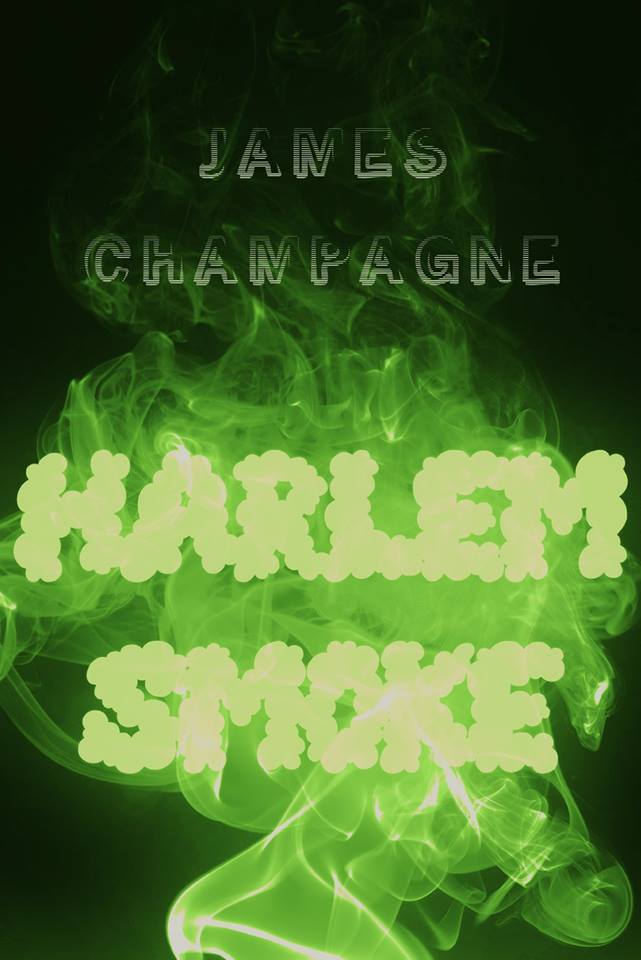
 James Champagne, Harlem Smoke, Snuggly Books, 2019.
A gay, black antinatalist, Isaac Grimalkin isn't your typical H.P. Lovecraft fan. Back in 1996 Isaac was the sole member of the Dunwich Posse, an experimental Lovecraftian horrorcore hip-hop act that released
Harlem Smoke, a groundbreaking album chronicling the gruesome exploits of its titular monster. But when his album began to inspire real-life copycat crimes, Isaac abandoned his musical career at the height of his fame.
Flash-forward to 2015. Once again living in the city of Providence, Rhode Island, Isaac, now 38, has reinvented himself as a Pickman-esque painter of the morbid and the macabre. He wishes to forget his past; but his life gradually takes a hellish descent when an interview with a music magazine resurrects public interest in the Dunwich Posse. Meanwhile, local women are being murdered in a variety of grotesque scenarios that seem directly inspired by the lyrics of Isaac's old, cursed album. As police suspicion mounts, Isaac begins investigating his family's sinister history, in search of answers for just who (or what) the elusive Harlem Smoke actually is: an interior quest that could lead to his own annihilation.
Set in a social realist modern-day Providence where paradoxical dimensions of cosmic horror are only a stone's throw away,
Harlem Smoke is a creative re-imagining of the artistic potentialities of the Lovecraftian novel.
Hello, my name is James Champagne, though most of you on here most likely also know me by my handle of Sypha. Thanks to the kindness of our benefactor Dennis, I’m here today to tell you a bit about
Harlem Smoke, which has recently been published by Snuggly Books and which serves as my second professional novel (the first being
Confusion, which I self-published through iUniverse way back in 2006… some of you old-timers on here may even remember that one).
Harlem Smoke is, at heart, a Lovecraftian horror novel, a psychological chiller (I use the word “chiller” rather than “thriller” because the book moves at a somewhat glacial pace and, well, it doesn’t have many thrills). But even that’s kind of a facetious description because, in my opinion, the book can be interpreted in many different ways. It could be seen as a Jungian treatise on the subject of Man grappling with his Shadow-side… or as a perverted parody of the Christian Passion Play… or as a metafictional postmodern hypersigil designed to create change in conformity with Will, a magic(k)al spell in textual form designed to rid me of my obsession with writing horror… or as a Marxist commentary on class struggle (okay, I’m just kidding about that last one). Really, one of my hopes is that the book could function as an eldritch Rorschach test, where every reader interprets the narrative in a different way… a triumph of Art over Logic, to quote words of praise directed towards The Manic Street Preachers’ album
The Holy Bible… you know how so many books or movies or TV shows are classified by the media today as the “Book/Movie/TV show we need right now,” as if Art were nothing more than some kind of fucking Chicken Soup for the Soul? Well,
Harlem Smoke is most assuredly not such a book, in fact it is a book that no one really needs right now… and yet, paradoxically, it exists. But then again, no one ever accused the world of making sense!
My reference in the title of today’s article of
Harlem Smoke being “the last Lovecraft novel” is somewhat tongue-in-cheek: what I really mean by that is that it’s my last Lovecraft novel, though it’s also a reference to how, when William Gaddis was writing
The Recognitions, he thought of it as being the last Christian novel. And because I saw
Harlem Smoke as being my one and only horror novel, I tried to turn it into a sort of repository of horror, stuffing it with as many of the tropes of the genre as I could: haunted houses, nightmares, serial killers, demonic possession, black magic, séances gone wrong, body horror, weird cults, sinister grimoires, eldritch alien monsters from outside time and space, you name it.
Hellfire, when I proposed the idea for this Day to Dennis I told him I’d be more terse than usual and already the damn intro has gone on longer than I intended. Ah well… as the Scorpion said to the Frog, “Blame me not…”
Before I move on I suppose I should briefly mention what the book’s about, so here’s the blurb from the back cover:
“A gay, black antinatalist, Isaac Grimalkin isn’t your typical H.P. Lovecraft fan. Back in 1996 Isaac was the sole member of the Dunwich Posse, an experimental Lovecraftian horrorcore hip-hop act that released
Harlem Smoke, a groundbreaking album chronicling the gruesome exploits of its titular monster. But when his album began to inspire real-life copycat crimes, Isaac abandoned his musical career at the height of his fame.
Flash-forward to 2015. Once again living in the city of Providence, Rhode Island, Isaac, now 38, has reinvented himself as a Pickman-esque painter of the morbid and the macabre. He wishes to forget his past; but his life gradually takes a hellish descent when an interview with a music magazine resurrects public interest in the Dunwich Posse. Meanwhile, local women are being murdered in a variety of grotesque scenarios that seem directly inspired by the lyrics of Isaac’s old, cursed album. As police suspicion mounts, Isaac begins investigating his family’s sinister history, in search of answers for just who (or what) the elusive Harlem Smoke actually is: an interior quest that could lead to his own annihilation.
Set in a social realist modern-day Providence where paradoxical dimensions of cosmic horror are only a stone’s throw away, Harlem Smoke is a creative re-imagining of the artistic potentialities of the Lovecraftian novel.”
Some Words on the Creation of Harlem Smoke
Like almost every book I’ve written,
Harlem Smoke had a convoluted and torturous evolution. Initially it began as a simple short story idea: Around the summer/fall of 2014 I had begun listening to a lot of horrorcore hip-hop bands from the 1990’s and had become fascinated by those groups and their utilization of horror iconography. On November 8th of 2014 I posted the following status update on Facebook: “I wonder if anyone has ever done a weird fiction/Lovecraftian story revolving around the horrorcore hip-hop scene. I think the idea of a hip-hop group appropriating Lovecraftian imagery and making it their own has a kind of perverse appeal.” I used the word “perverse” there because of course Lovecraft was a notorious racist, and I began to go through Lovecraft’s stories and pondering what kind of characters in them that a hip-hop group might be drawn to. Naturally I began to focus on Lovecraft’s black characters, which didn’t take long as you can almost count them on one hand. I quickly thought of “Herbert West: Reanimator,” a
Frankenstein parody written by H.P. Lovecraft between October 1921 to June 1922 (and serialized by the amateur publication
Home Brew in 1922). That story featured an African-American boxer named Buck Robinson (nickname: “The Harlem Smoke”) who gets killed in a fight with a white boxer. Herbert West, a mad scientist/necromancer, takes Buck’s corpse and reanimates it, but it comes back to life as a grotesque monster that ravages a Polish community, eventually devouring a little white girl before West is forced to put him down. I could see the appeal such a character might have for a hip-hop artist: a black monster created by white society that ends up turning on its wicked masters. But it was the two words “Harlem Smoke” that really caught my eye… I realized it was the perfect title for the story.
I quickly threw together a plot: it would revolve around an older black man living in Detroit, a former rapper (MC Buck Robinson) who reformed and became a pastor (as many of these former hip-hop artists are prone to do). The big idea was that in his hip-hop days he had done an album named Harlem Smoke, one that revolved around a monster murdering people in a number of cruelly inventive ways. But when people start emulating the lyrics and the album begins inspiring copycat crimes (and thus gets a cursed reputation, like Esham’s Boomin’
Words from Hell album), the character would quit the music industry, clean up his act, get married, and begin preaching the good word. But then, years later, people would start to be murdered again, and the main character would be forced to face the possibility that maybe his misbegotten creation had actually become a flesh and blood monster, thus forcing him to deal with his past. I did begin writing this story, but didn’t get very far… the main character (and the setting) didn’t interest me, and I also came to the conclusion that
Harlem Smoke was too good a title to waste on a short story… that maybe I should save it for a novel. Not making any serious headway on the story, I decided to resort to my usual course of action (which is to say, the path of least resistance: I quit it), and set it aside. Yet still, in the shadows of my mind, it remained on the backburner…
Around the same time that I was developing the idea for the short story I was also struggling with coming up with an idea for a novel that would be set in Providence, Rhode Island. Though I’ve lived not far from the city of Providence my entire life, and had been there numerous times prior to 2014, it was only in 2013 where I began going to the city on my own and exploring it. Initially I began going to Providence in 2013 to hang out with someone I had befriended online, but even after our friendship died out in early 2014 I continued visiting the city and the more I explored it, the more I realized that it would make a great setting for a novel. In truth, I had already written a novel set in Providence, way back in 1998, when, during my senior year of high school, at the age of 17, I had handwritten out a book named Arthouse, a slice-of-life novel about a suicidal artist whose life turns around when she discovers she’s a lesbian. That book had also been set in Providence, but because I hadn’t explored the city in great depth at that time in my life, to me it didn’t feel like a Providence novel. But my problem in 2014 was, I just couldn’t think of a narrative that would work well in the city. In any event, at some point in 2015 I had a brainstorm: why not set
Harlem Smoke in Providence and have it serve as my Providence novel? It only made sense to set a Lovecraftian novel in Providence, that most Lovecraftian of cities (after all, it is where Lovecraft lived for most of his life, and much of his work is set there). Really, this “killing two birds with one stone” approach seems so natural an idea now that it depresses me that it took me so long to realize it…
And yet still, I didn’t totally commit to the project and kind of hemmed and hawed about it for awhile. But then in late May 2015 I was approached by a German publisher who asked if I would be interested in doing a six issue comic book mini-series for them. After kicking around a few ideas, I thought maybe
Harlem Smoke might work as a comic book. On June 11, 2015, I wrote out a 5 page pitch for the project, detailing the main storyline, listing what would happen in each issue, providing a list of characters (many of whom would undergo name changes in the final product), things like that. And though it was all very vague (as I still didn’t even have an ending at that point), it did help me to finally nail some ideas down for the story. But the more I thought about it, the more I realized that
Harlem Smoke wouldn’t work as a comic book, that it simply had to be a novel. So I bowed out of the project (something I regret doing now; with my love of comic books I really should have just pitched them another idea).
In July 2015 I purchased one of those generic college rule composition notebooks, intending it to serve as my main notebook for Harlem Smoke (I even wrote the words
Harlem Smoke Notes on the front cover… though of course, in my scatterbrained and unorganized way, I also used this notebook for other things unrelated to the project). The first thing I began filling its pages with, oddly enough, were notes taken from a bunch of old Poppy Z. Brite interviews I was reading at that time, mainly dealing with how she went about writing her first novel
Lost Souls. That same month, I also created a Word file document for the book. But it would not be until August 14th of 2015 that I actually began writing the book, in this case the Prologue, which I finished two days later. In my notebook I began keeping a “milestones” list. Figuring that the book would be 300 pages, and how that meant that with every 30 pages finished I’d be 10% closer to completion, every time I finished 30 pages I would make a note of the date and mark down what day of the project that I had reached it (for example, I reached page 150, the 50% done mark, on November 25th, 2015, Day 103 of the project). In this way was I able to chart the book’s progress. -
James Champagne
read more here (Dennis Cooper blog)
 James Champagne, Grimoire. Mauve Zone Recordings, 2009.
"If all books are gateways to other realities, then Grimoire is a portal into a realm of the most profound darkness, a twilight world of black flowers thriving under the monstrous shadows cast forth across time by the writers and poets of the 19th century French Decadence, the art of the Surrealists, and the weird fictions of H.P. Lovecraft and his acolytes. Each of the eleven stories, or Neo-Goth Narratives, which make up this collection presents the reader with a worldview of cosmic nihilism, a morbid atmosphere haunted by the revenants of the fin de sicle practitioners of black magic. Those who lose themselves in these sunless and Satanic vistas will learn arcane words of power, experience forbidden knowledge, and encounter fantastic and grotesque alien beings whose forms and powers we are unable to comprehend, whose very presence can drive one to insanity. Grimoire is no mere book: it is a 90,000 word scream from the Abyss of non-existence, a descent into Hell itself, a dream journal of God's nightmares. Let the Danse Macabre begin!"

James Champagne's Autopsy of an Eldritch City: Ten Tales of Strange & Unproductive Thinking. Rebel Satori Press, 2015.
The city has long since faded away: all that lingers is its nightmares, in the form of these ten testimonials from the damned, tales of strange and unproductive thinking. Will you open these pages and conduct an autopsy of your own on this dead city? But be warned: the scalpel that dissects the shadows is also the scalpel that cuts both ways.
“Every city casts a shadow, some longer than others. And the city of Thundermist, Rhode Island casts one of the longest shadows of all. With a population of 40,000 people, it might not seem like the most populated place on earth, but every citizen there has a story to tell, some more sinister than others. Look past the city’s pious Catholic façade and you shall see dead children floating face down in its sewers, witches corrupting susceptible minds with blasphemous books, and demons capering on the frescos of its haunted churches. It is a city where even the most innocent of objects- a quilt, a video game, a snow globe, a notebook- can act as a key that unlocks the doors to Doom, Delirium, and Death. The city has long since faded away: all that lingers is its nightmares, in the form of these ten testimonials from the damned, tales of strange and unproductive thinking. Will you open these pages and conduct an autopsy of your own on this dead city? But be warned: the scalpel that dissects the shadows is also the scalpel that cuts both ways.”
“We stood at the edge of Lovecraft’s tomb in Providence, I and the author James Champagne, on a misty November morning, sun battling with frost. Almost without thinking we sank to our haunches, squatting at the foot of the grave; from nowhere a strange heat came to flicker at our underparts, to toast them, to inflame them. “Do you feel that, James?” “Yes, like a hand caressing me.” Hold on a minute here, I thought, my mind racing in excitement. It was almost as if the hands of Lovecraft himself were trying to wrestle us into the grave with him, down into hell, by the balls if need be. In panic I dropped his hand as the images of Lovecraft’s and Champagne’s haunted fictions began to cloud my mind in madness. Autopsy for an Eldritch City shows once again why James Champagne is one of the most inventive, soulful writers of horror and the fantastic working today. And he can be wicked funny too. Watch at twilight as his wit takes you down the leafy path to damnation.” - Kevin Killian
“James Champagne's AUTOPSY OF AN ELDRITCH CITY is vitally strange fiction. Glimpse TRUE DETECTIVE writ large (you paying attention Mr. Ligotti?) - then you get a little notion. Champagne's work is perverse, elegant, and creepy; I wish I could write this well!” - Scott Bradley
Autopsy of an Eldritch City: Ten Tales of Strange & Unproductive Thinking is my second collection of short stories, a follow-up to my first collection Grimoire (2012). Like Grimoire, this new one is published by Rebel Satori Press. Initially, I had intended Grimoire to be my last word in the realm of Lovecraftian weird fiction, but events conspired against that stratagem. I finished writing Grimoire in December of 2009. Yet in 2010 I wrote a new horror story, and by the autumn months of 2011 I had a total of 4 new stories, which prompted me to conceive the idea of doing a second collection. The project stalled in 2012 (mainly because it was around then that I began to type out Metatron’s Arch, my long fantasy novel). But then in 2013 I befriended a young man whose interest in Grimoire (and weird fiction in general) got me inspired to getting back to work on the project. Even though my friendship with the person in question eventually faded away to nothing, I can’t deny that my conversations with him influenced the book in a number of ways (for example, he got me interested in the work of Nick Land). In this fit of inspiration, I wrote 5 more stories in 2013, then one final one for the collection in 2014.
That same year (2013), I realized that what the project lacked was some kind of framing device, a central gimmick. Thinking back to a book I had read and enjoyed in 2011 (Backwoods, by Natty Soltesz), I thought that maybe the collection could achieve some sort of unity if all of the stories were situated in the same setting: in this case, the New England city of Thundermist, Rhode Island, which is a somewhat fictionalized version of my own hometown of Woonsocket, Rhode Island… the word “Woonsocket” being a Native American word that, when translated into English, means “Thundermist” (a brief fun fact: Lovecraft mentions Woonsocket in his story “The Horror at Red Hook”). Another influence in this regard was Bret Easton Ellis’ The Informers, which has long been one of my favorite short story collections. I liked how almost all of the stories in The Informers were set in the Los Angeles area, and how characters that played a minor part in one story would become the main character/narrator in another. So I began to rewrite some of the stories I had previously written (as it were, a few had been set in Thundermist already, so those didn’t need much rewriting) to bring them in line with this new scheme. In the end, all of the collection’s ten stories take place in Thundermist, with one exception. I liked the idea of deliberately shattering the symmetry I had created by putting in a false note on purpose, a perverse act of self-sabotage, and what the hell, The Informers has a few stories not set in Los Angeles anyway.
This collection differs from Grimoire in two ways: for starters, while like Grimoire the stories here are all interconnected (and all told chronologically out-of-order), whereas the stories in Grimoire all combined to tell one giant narrative that led to a big climax, there is no such narrative thread that links the stories in Autopsy. As a result, the collection has, I feel, a more jagged, fragmented tone: one visual inspiration I had was that of a shattered Le Corbusier lamp (in much the same manner that Kanye West’s album Yeezus was inspired by a Le Corbusier lamp). These stories don’t really add up to anything: however, I feel that, individually, if you separated them from the whole, they’d hold up better as stories, whereas if any of the Grimoire stories were separated from their whole, they maybe wouldn’t hold up as well. The other big difference between the two is that this new collection is fully illustrated, whereas Grimoire had no illustrations at all aside from its cover (more on that later).
Working titles for my second collection included The Revolting Science of God, Strange and Unproductive Thinking, Sabaziorum, and Opus Contra Naturam. On July 26th, 2013, I selected Strange and Unproductive Thinking as the title. Later on that year, on October 31st, I came up with the title Autopsy of an Eldritch City. The title is partly inspired by a chapter name from Thomas Ligotti’s philosophy book The Conspiracy Against the Human Race (the chapter in question being entitled “Autopsy on a Puppet”), and also inspired by the title of Alain Robbe-Grillet’s novel Topology of a Phantom City: I didn’t like that book but thought it was a great title. The use of the word “Eldritch” is, of course, a nod to H.P. Lovecraft, who often employed it in his own tales. Finally, because I like subtitles and still liked the phrase “Strange and Unproductive Thinking” (which is actually the name of a David Lynch song), I decided my new book would have a subtitle as well, and that is how it became Autopsy of an Eldritch City: Ten Tales of Strange & Unproductive Thinking.
The first public announcement of this book (outside of this blog and my own Onyx Glossary blog) was in the author description of myself that appears in the back of the Mighty in Sorrow anthology I appeared in back in May 2014. I mentioned how Autopsy of an Eldritch City was “forthcoming,” which I suppose was kind of a cocky move on my part, seeing I didn’t even have a publisher lined up for it yet… but in my bones I just knew that it would get published at some point, and I wanted to drum up some early publicity. As it was, Rebel Satori got back to me about it not long after that.
From “The Cursed Quilts”
“I’ve always found attending quilt shows to be a somewhat unsettling experience. It’s not because of the Raison d’etre of such shows: after all, how scary can a quilt be? And it’s also not related to the people such shows tend to attract; generally speaking, harmless-looking middle-aged to older women, the kind of people who read ‘cozy’ mystery novels about cats who solve crimes or who surround themselves with cats in general (or sometimes both). No, what I find unsettling is the looks I get when I myself attend quilt shows. In my experience, I’ve found that you often won’t find a lot of men at such events, aside from the husbands of those women whose work is on display, or, more pertinently, the sons of those women. Therefore, when I go to such shows I feel as if I stick out like the proverbial sore pollex, and I always get embarrassed when the other women would refer to my brothers and me as “Susan’s boys” (Susan being the name of our mother). There are even times where I’ve wondered if it would be less embarrassing were I to go to such shows in drag, to try to blend in with the other women, as it were, and thus escape notice. But seeing as my body is fairly hairy, I don’t believe that such a deception would be all that effective.”
From “Tir-Na-Nog”
“Like many odd children, Halloween was always my favorite holiday. It was to my great fortune, then, that I grew up in the city of Thundermist, Rhode Island: while this city was of a particularly Christian bent, that didn’t stop its citizens from going all-out and getting in touch with their inner pagan as far as Halloween was concerned (and as G.K. Chesterton once observed in his book Orthodoxy, “We are all revenants; all living Christians are dead pagans walking about”). My obsession with Halloween was something that perplexed my parents, but I can’t see why this should have been the case; after all, I was hardly a stereotypical little girl, and while my peers were all playing with Barbie dolls I instead took it upon myself to fashion a miniature eidolon from concrete and rebar, said eidolon resembling, in retrospect, a condensed version of SCP-173. I suppose I was a somewhat precocious child: I was probably the only girl on my block who named her pet cat Dharma. And yes, it was a black cat. My youth was a time of loneliness and isolation, and I didn’t have all that much in the way of friends, aside from a local boy named Frederick (it probably didn’t help matters that I wasn’t the most attractive girl, bearing a strong resemblance to poor Clara, the little tot who’s wasting away in Edward Gorey’s The Gashlycrumb Tinies, though I have freckles and she doesn’t). I’ve always wondered if this had to do with my family’s cultural heritage: in a city made up mostly of French-Canadian immigrants, a girl with a name like Alice O’Nan kind of drew notice to herself, as Thundermist has never boasted a large population of Irish-Americans. At times it felt as if the only thing I had in common with all the people around me was my Catholic faith and my love for Halloween.”
From “Iridophobia”
“For as long as I can remember, I’ve had a fear of the sky.” I paused, took a sip from the glass of water that Dr. Roxy had been thoughtful enough to leave on the small wooden end table to the side of my chair, and then continued on with my story. “I have this very distinct memory from childhood where I was hanging out at Vernon Park one day and staring up at this domed hill, and on top of this domed hill there was this one lone tree, and because it was late fall all of the leaves had fallen off this tree, leaving its branches bare. From where I stood, at the bottom of the hill, the tree looked completely black, and juxtaposed as it was with the cloudless blue sky behind it, it seemed almost as if the tree were a crack in the sky itself, and for a brief few seconds the tree/crack seemed to begin to grow before my eyes, and I panicked, visualizing in my mind’s eye the sky itself cracking open and shattering to pieces all around me like big shards of blue glass. The sky as a giant blue Easter egg being smashed against the rim of a frying pan, the rim in this case being the Earth’s horizon. What can I say? As a child, I had quite an imagination. But it wasn’t just the sky itself that scared me. It was also things that came from the sky. One raindrop could have been the precursor to a Biblical flood that would never end. Then there were tornadoes, which scared me witless, even though I’ve yet to ever see one in my life. I often had nightmares of tornadoes, as a child. In these dreams I would often see storm clouds gathering in the sky like the black ships of the Antichrist’s armies and watch in horror as the bottom tips of maturing tornadoes descended from these storm clouds like enormous cobras unsheathing their fangs. Lightning was an electric crack that seemed to shatter the mirror of the sky, and thunder unsettled me. There was this one bad storm I suffered through when I was a child, I may have been maybe 9 or perhaps even 10 at the time, where I was home alone with my father and we were both in the living room of our house, he on his favorite rocker and me on the family sofa, and I guess to try to take my mind off the storm my father was telling jokes, or just making comments that were supposed to be amusing in general. One of these comments (or perhaps observations would be a better word) was that thunder was nothing more than God farting in Heaven. But that comment had the opposite of its intended effect on me: instead of making me laugh, it shocked and even horrified me. It seemed blasphemous to me that he would say such a thing, even though I knew he wasn’t being serious. I looked at my father with a glum face and asked him, in a nervous voice, ‘Dad, will you go to Hell for saying something like that?’ Many years later, during a period of my life in which I found myself studying the Qabalah, I came across a book by William G. Gray entitled Qabalistic Concepts: Living The Tree, that had first been published in 1984. There was this one chapter in the book, chapter 20 I think it was, that was titled ‘Esoteric Excretion,’ in which the author pondered the idea of Man serving as the Microcosm that was made in the likeness of God (and the Macrocosm), and wondered how, if Man has a digestive and excretory system, then does God as well? Or, as the author puts it, ‘does deity produce dung?’ He examined the Qabalistic Tree of Life and came to the conclusion that the Sephira Daath, otherwise known as ‘The Abyss,’ served as a sort of mouth, then conceptualized a second Abyss, in between Yesod and Malkuth at the bottom of the Tree, that served as the anus of God. It’s quite an interesting chapter, really, and reading it one can see how it was a clear influence on Grant Morrison’s The Filth comic book. At the start of the chapter, he wrote how, in the old days, there was a reason why hanging was the preferred method of dealing with criminals. It was believed that when the soul left the body at death, it did so via either the mouth or the nostrils. But when one was strangled, the soul would be unable to escape the corpse using those routes, and would instead be forced to escape via the anus, or the ‘dung gate’ as it was called. It’s common knowledge that when one is hanged one often ejaculates, but explosive defecation is also quite common in such situations. By forcing the soul to flee from the body side-by-side with shit, they believed they were condemning it to an ill-starred afterlife. Anyway, reading all this reminded me of my father’s observation about the farts of God years ago, and got me looking into the topic of intestinal exorcism. One day while I was paying a visit to the Thundermist Rescue Mission I happened to bump into a friend of mine, Padre Pendragon. We got to talking, one thing led to another, and he eventually got around to lending me a book called Glory of the Confessors by Gregory of Tours. In this book he writes about this bishop from the 5th century named Martin of Tours who was known for his ability to exorcise demons from people who had been possessed. At one part of the book Gregory mentions how one of the afflicted men that Martin exorcised ended up expelling the demon from his body in a ‘blast of air from his bowels.’ So I got to researching the topic a bit more and I found out how in the Middle Ages it was believed that flatulence was seen as a way of casting demons out from one’s body. The idea of demons being expelled by flatulence isn’t unique to Western Christianity, however. For example, Ethiopians also believe that when one farts demons escape from the body. And there’s also a certain mysterious voodoo cult in Haiti that worships Ti-Moufette, the lwa of bad smells. The priesthood of this cult conducts rituals in which they try to emit as many bad smells as they possibly can: I’m sure you can imagine what that entails.”
From “The Snow Globes of Patient O.T.”
“Searchers after horror haunt strange, far places.” So begins “The Picture in the House,” a short story written by H.P. Lovecraft on December 12, 1920. It was a statement that had resonated with Daphne Broadmoor ever since she first came across it many years ago, while flipping through the 1985 corrected sixth printing of Arkham House’s publication of Lovecraft’s The Dunwich Horrors and Others, a book that she had stumbled across on her father’s bookcase when she was a child, a book with a green dust jacket featuring a Raymond Bayless illustration of Cthulhu emerging from his sunken tomb at R’lyeh. Throughout her twenty-five years of existence, Daphne had known a fair number of people who were fixated on buildings possessing an eidolic glamour: one friend of hers had been obsessed with an old chemical factory situated in the city of Los Diablos (an obsession which had led him to insanity), while another of her friends, Timothy Childermass, adored a local church known for its beautiful (and supposedly haunted) frescoes. As it was, there was one such place she herself was utterly fascinated with, which, though it was not far from her, was certainly strange: Saddleworth Clinic, a hospital for the mentally insane.”
From “The Yellow Notebook”
“Hell is other people!” So wrote Jean-Paul Sartre in his 1944 play No Exit. Little could he have known at the time that this anguished ejaculation of existentialism would become the unofficial credo of the modern day retail employee. Like the chorus of some pretentious yet nonetheless catchy Parisian pop song, the phrase “Hell is other people!” had a habit of repeating itself in my head over and over again during my shifts at Covers, which was the name of the bookstore where I worked full time as a bookseller. It was certainly echoing in my head on the date of October 11, 2012, the evening on which I first laid eyes on the Yellow Notebook. Oh! That infernal Yellow Notebook! If only I had called in sick that day, I could have spared myself from the present misery I now find myself enmeshed in. But, alas, I get ahead of myself.”
From “The Fire Sermon” (note: because this story is one long paragraph, I’ve only excerpted its first page)
“The deliquescent prenatal memories of swimming onetailed through your father’s groinal cathedral, Pre-Ovum, back when Mother used to spend an hour in the bedroom of her parent’s house, listening to “What in the World” off David Bowie’s Low over and over again while putting on her Clockwork Orange-inspired make-up before hitting the local disco, where one September night in 1979 she met your Father (you were conceived when your parents first had sex in the restroom of said disco, while Blondie’s “Heart of Glass” played over the sound system in the background). Father, a physicist who was utterly discredited years later when he wrote that article defending Hanns Horbiger’s World Ice Theory (Welteislehre), stating his fanatical belief, in no uncertain terms, in the doctrine of Eternal Ice and Glacial Cosmogony. Your mother was an archaeoastronomer and a member of ISAAC (The International Society for Archaeoastronomy and Astronomy in Culture). The year that you realized that most other little boys didn’t have tails and scaly skin and forked tongues and extremely flexible spines. The times when your peers would chase you around the schoolyard, throwing stones at your frail body and calling you “Son of Godzilla” (and oh, how you cried when you got home, in the privacy of your own bedroom, yet at the same time you also took a secret masochistic pride in being called Godzilla’s son because Godzilla’s son, Minilla, was the Godzilla character with whom you most identified). The same jeering peers who only grudgingly accepted you as one of them the year you developed those warts on your right hand (on the webbing in between your thumb and index finger, an area known as the thenar space), and you would chase the screaming girls around the schoolyard, trying to touch them with your warty hands, while the boys whom you both hated and at the same time wanted to impress laughed and cheered: misogyny creates strange bedfellows (years later you would partially redeem yourself by selecting Chun-Li as your preferred Super Street Fighter II character of choice, a partial feminist statement, though a subconscious one). Playing on the beach one overcast August afternoon, digging a large hole in the sand and pretending that it was the hoof print of an enormous horse, the kind of thing one would expect to see featured in a Surrealist painting from the 1930’s, or perhaps the final work of Alan Kirschner.”
From “Dyad”
“In the Yamanashi Prefecture of Japan, there is situated, at the northwest base of Mt. Fuji, a forest known as Aokigahara, which is Japanese for “Sea of Trees.” Spread out over 14 square miles and being home to over 200 icy caverns, over the years this notorious forest has acquired a large measure of infamy on account of the fact that not only is it a popular site for suicides (the second most popular site in the world, with the first being the Golden Gate Bridge in San Francisco), but also due to legends which state that the forest is haunted by angry spirits known as the Yūrei. During the famine years of the 19th century, poor Japanese families would sometimes take their elderly relatives or even their very young and infirm children out into the depths of Aokigahara and abandon them there, an act known as Ubasute, and perhaps it is the spirits of those who were left behind to die in such a cruel way that now haunt the forest.”
From “The Aphotic Zone”
“Good evening, my friend. Please, step a little closer to me; I can’t hear you over the noise of the crowd and this music. I quite like this song, actually: “Underneath,” by Adam Lambert. I find the lyrics, especially those that may be found in the chorus, to be quite touching. Yes, you presume correctly: I am indeed the artist known as Professor Noe. I take it this isn’t your first time visiting the Melanoid Art Gallery? Ah, I was correct in my assumptions, then. Quite a turnout tonight, wouldn’t you say? I’m not quite sure if I understand all the hullabaloo, though: this art is all a bit too minimalist and abstract for my liking. Nothing depresses me more than seeing our lovely organic forms reduced to mere geometrical shapes, and to be honest I’m somewhat appalled by the Cubistic hereticism on display this evening. Did you see that print campaign that the Berlin Philharmonic Orchestra released a few months ago, in which they took macro photographs of the interiors of violins, flutes, cellos, and pipe organs, so that the insides of these instruments, which we normally never see, took on the appearance of vast, extremely spacious rooms? I thought that the violin photographs, in particular, were stunning: their interiors resembled large wooden chambers, with the f-holes in the ceiling acting almost like skylights. Such art is more to my liking. But there are too many people here for me to talk to you comfortably. Come, let us speak in this less occupied side gallery, where it is quieter and darker, and our only audience will be the shadows, who, even more so than priests, can be trusted to conceal a secret.”
From “The Demons in the Fresco”
“Of the many gifts that Timothy Childermass had received on his sixth birthday, his favorite one had been a kaleidoscope that had been a present from his father. This kaleidoscope, which his father had purchased at a local church bazaar for the grand total of $7.59, was encased in a cardboard tube whose outer surface was decorated with artwork of a Christian nature, mainly depicting scenes of martyrdom. These scenes included reproductions of Guido Reni’s 1616 painting of Saint Sebastian being shot with arrows (this being a work of art that had not only inspired Oscar Wilde but had also led Kochan, the narrator of Yukio Mishima’s 1948 novel Confessions of a Mask, to experience his first sexual ejaculation), Caravaggio’s 1616 painting Crucifixion of St. Peter (which portrayed St. Peter being crucified upside-down on an inverted, or Petrine cross), Jean-Leon Gerome’s 19th century work The Christian Martyr’s Last Prayer (which displayed an Imperial Rome scene in which a small band of imprisoned Christians huddle together in prayer in the center of the Circus Maximus, with lions and tigers slowly approaching them for the kill), and, finally, Rembrandt’s 1625 painting The Stoning of St. Stephen, which depicted the Protomartyr being stoned to death by a mob of infuriated Jews following his trial before the Sanhedrin (this scene being taken from the New Testament’s “Acts of the Apostles”). It seemed a very odd and somewhat morbid way in which to decorate a child’s toy, but years later Timothy had done some research on the kaleidoscope and found out that it had been manufactured by a Waco, Texas-based company (named Mt. Carmel Curiosities) that specialized in the creation of Christian themed children’s toys. Apparently, the illustrations on the front were to remind the child about the sacrifices that Christians are often demanded to make, while the beautiful colors within the tube symbolized the beauty of the human soul, something that can’t be seen on our outer forms.”
From “Ritual Quest”
“Sometimes one can form a surface impression of someone else through the briefest of glances. And most people who saw Alex Vauung for the first time usually came to the kneejerk conclusion, based on his appearance, that he just had to have strange hobbies, like collecting air sickness bags or watching propaganda videos put out by the Heaven’s Gate UFO doomsday cult: he was the sort of man that made one think, “Now there’s an unusual looking chap. He must be a campanologist, or perhaps a man who knows how to best apply Yuggothian Matrices to the To-Gai Null Spaces.” Alex Vauung was indeed an unusual looking individual, a 19-year-old man whose brown hair was done up in an exaggerated bouffant similar to the style sported by Jack Nance in the film Eraserhead, and his clothes were all vintage, threadbare-looking, ill-fitting suits from Victorian times, though the Matrix-style sunglasses he always had on when out and about did give him a sort of cyberpunk vibe. And he did indeed have a strange hobby, in that he was a collector of peculiar and obscure video and computer games. Not necessarily rare games, however: after all, he was a borderline destitute student, and often couldn’t afford such luxuries. His favorite type of peculiar or obscure games were generally the ones that fell within the survival horror genre, especially games that mined a Lovecraftian vein and that tended to include some type of sanity meter in their gameplay mechanics: to name just a few, there was Eternal Darkness: Sanity’s Requiem, Call of Cthulhu: Dark Corners of the Earth, and Amnesia: The Dark Descent. But even those games, cult as they were, had achieved some mainstream success, however small; still, Alex had managed to add games to his collection that were far less well known, and he usually found such games at equally obscure and unexpected places (such as Kirkbride’s Curios in downtown Thundermist, where he had once managed to not only nab a copy of an old, fairly obscure Commodore 64 game entitled The Silence of the LAMs, but also the legendary Red version of Godzilla: Monster of Monsters).”
James Champagne’s previous works include the novel
Confusion (self-published, 2006) and two Weird Fiction short story collections, 2012’s
Grimoire: A Compendium of Neo-Goth Narratives and 2015’s
Autopsy of an Eldritch City: Ten Tales of Strange & Unproductive Thinking (both published by Rebel Satori Press). His work has also appeared in the anthologies
Userlands: New Fiction Writers From the Blogging Underground, Mighty in Sorrow: a Tribute to Current 93 & David Tibet, Marked To Die: A Tribute to Mark Samuels and Drowning in
Beauty: the Neo-Decadent Anthology. He was born in 1980 and lives in Rhode Island. He has never washed dishes professionally.
Hello, my name is James Champagne, though most of you on here most likely also know me by my handle of Sypha. Thanks to the kindness of our benefactor Dennis, I’m here today to tell you a bit about
Harlem Smoke, which has recently been published by Snuggly Books and which serves as my second professional novel (the first being
Confusion, which I self-published through iUniverse way back in 2006… some of you old-timers on here may even remember that one).
Harlem Smoke is, at heart, a Lovecraftian horror novel, a psychological chiller (I use the word “chiller” rather than “thriller” because the book moves at a somewhat glacial pace and, well, it doesn’t have many thrills). But even that’s kind of a facetious description because, in my opinion, the book can be interpreted in many different ways. It could be seen as a Jungian treatise on the subject of Man grappling with his Shadow-side… or as a perverted parody of the Christian Passion Play… or as a metafictional postmodern hypersigil designed to create change in conformity with Will, a magic(k)al spell in textual form designed to rid me of my obsession with writing horror… or as a Marxist commentary on class struggle (okay, I’m just kidding about that last one). Really, one of my hopes is that the book could function as an eldritch Rorschach test, where every reader interprets the narrative in a different way… a triumph of Art over Logic, to quote words of praise directed towards The Manic Street Preachers’ album
The Holy Bible… you know how so many books or movies or TV shows are classified by the media today as the “Book/Movie/TV show we need right now,” as if Art were nothing more than some kind of fucking Chicken Soup for the Soul? Well,
Harlem Smoke is most assuredly not such a book, in fact it is a book that no one really needs right now… and yet, paradoxically, it exists. But then again, no one ever accused the world of making sense!
My reference in the title of today’s article of
Harlem Smoke being “the last Lovecraft novel” is somewhat tongue-in-cheek: what I really mean by that is that it’s my last Lovecraft novel, though it’s also a reference to how, when William Gaddis was writing
The Recognitions, he thought of it as being the last Christian novel. And because I saw
Harlem Smoke as being my one and only horror novel, I tried to turn it into a sort of repository of horror, stuffing it with as many of the tropes of the genre as I could: haunted houses, nightmares, serial killers, demonic possession, black magic, séances gone wrong, body horror, weird cults, sinister grimoires, eldritch alien monsters from outside time and space, you name it.
Hellfire, when I proposed the idea for this Day to Dennis I told him I’d be more terse than usual and already the damn intro has gone on longer than I intended. Ah well… as the Scorpion said to the Frog, “Blame me not…”
Before I move on I suppose I should briefly mention what the book’s about, so here’s the blurb from the back cover:
“A gay, black antinatalist, Isaac Grimalkin isn’t your typical H.P. Lovecraft fan. Back in 1996 Isaac was the sole member of the Dunwich Posse, an experimental Lovecraftian horrorcore hip-hop act that released
Harlem Smoke, a groundbreaking album chronicling the gruesome exploits of its titular monster. But when his album began to inspire real-life copycat crimes, Isaac abandoned his musical career at the height of his fame.
Flash-forward to 2015. Once again living in the city of Providence, Rhode Island, Isaac, now 38, has reinvented himself as a Pickman-esque painter of the morbid and the macabre. He wishes to forget his past; but his life gradually takes a hellish descent when an interview with a music magazine resurrects public interest in the Dunwich Posse. Meanwhile, local women are being murdered in a variety of grotesque scenarios that seem directly inspired by the lyrics of Isaac’s old, cursed album. As police suspicion mounts, Isaac begins investigating his family’s sinister history, in search of answers for just who (or what) the elusive Harlem Smoke actually is: an interior quest that could lead to his own annihilation.
Set in a social realist modern-day Providence where paradoxical dimensions of cosmic horror are only a stone’s throw away, Harlem Smoke is a creative re-imagining of the artistic potentialities of the Lovecraftian novel.”
Like almost every book I’ve written,
Harlem Smoke had a convoluted and torturous evolution. Initially it began as a simple short story idea: Around the summer/fall of 2014 I had begun listening to a lot of horrorcore hip-hop bands from the 1990’s and had become fascinated by those groups and their utilization of horror iconography. On November 8th of 2014 I posted the following status update on Facebook: “I wonder if anyone has ever done a weird fiction/Lovecraftian story revolving around the horrorcore hip-hop scene. I think the idea of a hip-hop group appropriating Lovecraftian imagery and making it their own has a kind of perverse appeal.” I used the word “perverse” there because of course Lovecraft was a notorious racist, and I began to go through Lovecraft’s stories and pondering what kind of characters in them that a hip-hop group might be drawn to. Naturally I began to focus on Lovecraft’s black characters, which didn’t take long as you can almost count them on one hand. I quickly thought of “Herbert West: Reanimator,” a
Frankenstein parody written by H.P. Lovecraft between October 1921 to June 1922 (and serialized by the amateur publication
Home Brew in 1922). That story featured an African-American boxer named Buck Robinson (nickname: “The Harlem Smoke”) who gets killed in a fight with a white boxer. Herbert West, a mad scientist/necromancer, takes Buck’s corpse and reanimates it, but it comes back to life as a grotesque monster that ravages a Polish community, eventually devouring a little white girl before West is forced to put him down. I could see the appeal such a character might have for a hip-hop artist: a black monster created by white society that ends up turning on its wicked masters. But it was the two words “Harlem Smoke” that really caught my eye… I realized it was the perfect title for the story.
I quickly threw together a plot: it would revolve around an older black man living in Detroit, a former rapper (MC Buck Robinson) who reformed and became a pastor (as many of these former hip-hop artists are prone to do). The big idea was that in his hip-hop days he had done an album named Harlem Smoke, one that revolved around a monster murdering people in a number of cruelly inventive ways. But when people start emulating the lyrics and the album begins inspiring copycat crimes (and thus gets a cursed reputation, like Esham’s Boomin’
Words from Hell album), the character would quit the music industry, clean up his act, get married, and begin preaching the good word. But then, years later, people would start to be murdered again, and the main character would be forced to face the possibility that maybe his misbegotten creation had actually become a flesh and blood monster, thus forcing him to deal with his past. I did begin writing this story, but didn’t get very far… the main character (and the setting) didn’t interest me, and I also came to the conclusion that
Harlem Smoke was too good a title to waste on a short story… that maybe I should save it for a novel. Not making any serious headway on the story, I decided to resort to my usual course of action (which is to say, the path of least resistance: I quit it), and set it aside. Yet still, in the shadows of my mind, it remained on the backburner…
Around the same time that I was developing the idea for the short story I was also struggling with coming up with an idea for a novel that would be set in Providence, Rhode Island. Though I’ve lived not far from the city of Providence my entire life, and had been there numerous times prior to 2014, it was only in 2013 where I began going to the city on my own and exploring it. Initially I began going to Providence in 2013 to hang out with someone I had befriended online, but even after our friendship died out in early 2014 I continued visiting the city and the more I explored it, the more I realized that it would make a great setting for a novel. In truth, I had already written a novel set in Providence, way back in 1998, when, during my senior year of high school, at the age of 17, I had handwritten out a book named Arthouse, a slice-of-life novel about a suicidal artist whose life turns around when she discovers she’s a lesbian. That book had also been set in Providence, but because I hadn’t explored the city in great depth at that time in my life, to me it didn’t feel like a Providence novel. But my problem in 2014 was, I just couldn’t think of a narrative that would work well in the city. In any event, at some point in 2015 I had a brainstorm: why not set
Harlem Smoke in Providence and have it serve as my Providence novel? It only made sense to set a Lovecraftian novel in Providence, that most Lovecraftian of cities (after all, it is where Lovecraft lived for most of his life, and much of his work is set there). Really, this “killing two birds with one stone” approach seems so natural an idea now that it depresses me that it took me so long to realize it…
And yet still, I didn’t totally commit to the project and kind of hemmed and hawed about it for awhile. But then in late May 2015 I was approached by a German publisher who asked if I would be interested in doing a six issue comic book mini-series for them. After kicking around a few ideas, I thought maybe
Harlem Smoke might work as a comic book. On June 11, 2015, I wrote out a 5 page pitch for the project, detailing the main storyline, listing what would happen in each issue, providing a list of characters (many of whom would undergo name changes in the final product), things like that. And though it was all very vague (as I still didn’t even have an ending at that point), it did help me to finally nail some ideas down for the story. But the more I thought about it, the more I realized that
Harlem Smoke wouldn’t work as a comic book, that it simply had to be a novel. So I bowed out of the project (something I regret doing now; with my love of comic books I really should have just pitched them another idea).
In July 2015 I purchased one of those generic college rule composition notebooks, intending it to serve as my main notebook for Harlem Smoke (I even wrote the words
Harlem Smoke Notes on the front cover… though of course, in my scatterbrained and unorganized way, I also used this notebook for other things unrelated to the project). The first thing I began filling its pages with, oddly enough, were notes taken from a bunch of old Poppy Z. Brite interviews I was reading at that time, mainly dealing with how she went about writing her first novel
Lost Souls. That same month, I also created a Word file document for the book. But it would not be until August 14th of 2015 that I actually began writing the book, in this case the Prologue, which I finished two days later. In my notebook I began keeping a “milestones” list. Figuring that the book would be 300 pages, and how that meant that with every 30 pages finished I’d be 10% closer to completion, every time I finished 30 pages I would make a note of the date and mark down what day of the project that I had reached it (for example, I reached page 150, the 50% done mark, on November 25th, 2015, Day 103 of the project). In this way was I able to chart the book’s progress.
Almost immediately after starting the project, however, I ran into two big problems. The first had to do with the main character, Isaac Grimalkin. Initially my intentions for Isaac were that he would be black, gay, and a Reform Jew (a sort of wink at the fact that Lovecraft was famously racist, an anti-Semite, and slightly homophobic). But as I started writing his character he seemed false to me… I just couldn’t get into his head. It wasn’t the gay aspect, obviously, and I didn’t think it was the racial aspect either (as I’ve written many black characters in my books over the years, though never as the lead). Eventually I decided it was the Jewish angle. Specifically, I know very little about Judaism aside from the common knowledge (to say nothing of being a Reform Jew), and couldn’t be arsed to do the research… also, my idea of Isaac being a trifecta of all the things Lovecraft despised seemed old-hat anyway, what with the release of the first issue of Alan Moore’s
Providence series a few months earlier (a Lovecraftian comic book that starred a gay Jew as its lead). Then one day I was reflecting back on the first season of
True Detective and remembering how much I had like Matthew McConaughey’s Rust Cohle character (essentially, a highly pessimistic homicide detective), and then I began thinking of Grant Morrison’s then on-going comic book series
Nameless (a Lovecraftian sci-fi horror story that explores extreme pessimist ideas), and then it hit me: Isaac wasn’t a Reform Jew, he was really a pessimistic, nihilistic, militantly atheistic antinatalist. And suddenly, just like that, he became alive to me. It was almost like I had found the key to unlock his character, if that makes sense. Of course, I was no stranger to pessimist ideas (being a longtime reader of Lovecraft and Ligotti, and writers like E.M. Cioran), but I realized that now I had a good excuse to finally delve a bit more into that kind of literature (for “research purposes”). I am a pretty spiritual person, and this is often reflected in my characters to some extent. So I was very excited about writing a character who was essentially the antithesis of all my spiritual ideals, and the opportunity to write a book that pissed all over my most cherished assumptions was a task I devoted myself to with an almost maniacal glee (I also loved the idea that Isaac would be a black atheist, as in pop culture black characters are often depicted/stereotyped as very religious or spiritual people).
The other big stumbling block involved the detectives investigating the Harlem Smoke murders, which I saw as being important secondary characters. But they were always very nebulous to me (even in the pitch for the comic idea, I hadn’t bothered to give them names yet, just said that one would be male, the other female). As it was I was having enough problems trying to figure out what made Isaac tick, so the idea of having to create another major character whole cloth was daunting. But then I thought back to
Red Cherry, another handwritten novel that I had wrote back in the summer of 1999, when I was 19, before I began my second year of college.
Red Cherry was a Thomas Harris-esque serial killer novel, set in Boston in 1999, involving a lesbian homicide detective named Marsha Garland and her quest to stop the Photographer, a necrophiliac serial killer who was murdering fashion models and taking pictures of their corpses. Then it hit me: why not make Marsha the detective investigating the Harlem Smoke murders? This way I wouldn’t have to create a whole new character: I already knew Marsha’s back story (though obviously I had to figure out what her life had been like in the 15 years that elapsed between the end of
Red Cherry and the start of
Harlem Smoke), and having her around was like an anchor or safety blanket at first… it’s kind of like how film directors sometimes like to use the same actors or actresses in each film they do, for that level of comfort. Isaac was still an unknown factor for me, but I knew Marsha like the back of my hand, knew what she would say or think in any given situation… that helped a lot in the early stages of working on the book. And even though
Harlem Smoke is Isaac’s story, at the same time it’s Marsha’s as well (to a slightly lesser extent) and one could almost see it as a kind of sequel to
Red Cherry (though I don’t think one needs to have read
Red Cherry to appreciate this new book: as it is, I give a lot of background detail about that older book in this new one, to bring people up to speed).
In a further nod to self-referentialism, I even brought back Iris Brant, the main star of
Arthouse, giving her a small but important role in the book.
So, aside from the initial idea, the three big “eureka” moments I had during the planning/writing of
Harlem Smoke was to set the city in Providence, make Isaac a pessimist, and bring back Marsha Garland as a character.
Of course, it took me awhile to find my writing groove. I like to joke that my books die a thousand deaths before I finish them, and lord knows I kept quitting
Harlem Smoke the first two months or so of its existence… lost track of how many times I told my friend George that that was it, I was quitting the book once and for all, and this time I really meant it (to which George would just reply with some variation of “yeah right, you’ll be back to working on it a few days from now.” And, well, he was right, ha ha). One thing that really gave me a lot of inspiration to finish the project was when the World Fantasy Awards caved to political correctness and made the decision to stop using Lovecraft’s visage for their award busts in early November 2015. The disgusting triumphalism displayed by those who lobbied to get the bust changed (whose parents obviously never taught them the lesson of how to win with grace and honor), in combination with the spectacle of other writers (whom I knew to be lifelong Lovecraft fans and who had made a career of ripping him off shamelessly) suddenly trying to downplay Lovecraft’s influence on their work (despite having no qualms about attending Lovecraft conventions, or having their wares sold at Lovecraft-themed emporiums), really gave me the motivation to complete
Harlem Smoke. Contempt, anger, despite… these can be powerful muses when utilized correctly. I liked the idea of doing a book that, on its surface, seemed like something that would be embraced by the anti-Lovecraft SJW faction (that is, a Lovecraftian novel featuring a gay black man as the lead character), but which they’d be unable to embrace due to its problematic content. At the same time, I also wanted to write a book that would piss off the meathead Fascist types who embraced Lovecraft not so much for his fiction but for his reactionary views (you could say that the former group hates Lovecraft for the wrong reasons while the latter group loves Lovecraft for the wrong reasons). Thomas Ligotti classified his short novel
My Work Is Not Yet Done as a book that would alienate mainstream readers (as it was too strange) but also his hardcore fans (as it was more mainstream in style than his other books). There is a strange and perverse thrill in writing a book that you know will please very few people…
I also knew, as I was writing the book, that, being a white writer writing a black lead character (who is a fan of Lovecraft no less!) that I was potentially playing with fire, but rather than be tentative or pussyfooted about it I just went “what the hell” and threw all caution to the wind. I know of one writer in the Weird Fiction community a few years back who, on Facebook, announced his intention to only write POC lesbian characters in the near future, and how whenever he wrote a lesbian character he would show the story to his circle of lesbian friends and, if they found fault with even one aspect of his portrayal, he’d scrap the story. But I don’t know… if I had a friend come to me with a story wanting to be sure that their portrayal of a bisexual was “accurate” (and what does that even mean anyway? Human beings are wildly inaccurate if anything), I’d probably shoot the poor fool a pitying look; whilst resisting the impulse to slap them silly while laughing scornfully! As I’ve said before, when it comes to my art, I’d much rather catastrophically fail on my own spectacular terms rather than succeed blandly by committee.
As previously noted, I hit the project’s halfway point around Thanksgiving Day of 2015. It was around this time that I began to seriously sit down and think about the novel’s end game, which was still very nebulous. By January 1st, 2016, when I was only 19 days away from finishing the first draft, I still hadn’t settled on a definitive ending, though I had several options. Finally, on January 5th, while browsing in the magazine aisle at the local Stop & Shop supermarket, the idea for the perfect ending of the book came to me. Well, better late than never, as they say.
The first draft of
Harlem Smoke was completed at 7:24 PM on January 20th, 2016 (Day 159 of the actual writing). It came to around 290 pages and 126,036 words: around 10 pages shorter than expected. After that I put the MS aside for a few weeks, before beginning work on the second draft in late February of that year. By March 24th, I had finished the second draft of
Harlem Smoke, which now came to 312 pages (so, essentially, 22 pages were added). In the autumnal months of 2016 I worked on the 3rd draft of
Harlem Smoke, completing it on November 17th. This version came to close to 330 pages and just over 140,000 words (this is a good example of the Champagne method of editing: adding rather than subtracting). Around the same time I was finishing the 3rd draft I also began shopping the MS around to various publishers, a quest that began in November 2016. A year later, in October 2017, the book had been turned down by at least 13 publishers and I was beginning to despair of it ever seeing the light of day. Luckily, in late October 2017, Snuggly Books expressed interest in putting it out. Before I submitted it to them I did one final edit and cut off a whopping 6 pages or so, which to me was torture! In January 2018 Snuggly made a public declaration that they’d be releasing the book in January 2019, and the rest, as they say, is history.
Harlem Smoke: the Inspirations
Essentially,
Harlem Smoke is my attempt to do a
Frankenstein-type story, which is to say, a tale in which a man is haunted by his misbegotten creation. Naturally, Mary Shelley’s novel
Frankenstein was one of the book’s big influences. H.P. Lovecraft’s “Herbert West: Reanimator” story (itself a parody of
Frankenstein, as has been previously noted) was also a key text: while it’s one of Lovecraft’s weaker works, it did, after all, give me the book’s title. And it would be remiss not to mention
Lunar Park by Bret Easton Ellis, another great story of a man haunted by his past creation: while working on the first draft of
Harlem Smoke I became aware of some similarities between what I was writing and Ellis’ novel, so I reread
Lunar Park (for the first time in a decade) shortly after I finished the first draft, and it had a profound impact on subsequent drafts of my own novel. Also, though I don’t make this clear in the book itself, the fact that
System Shock 2 is Isaac’s favorite computer game is another link to
Frankenstein, as that game revolves around the struggle between an evil Artificial Intelligence and the mutated progeny that “she” created.
Aside from the
Frankenstein theme, the writings by H.P. Lovecraft were also very important, especially his Providence-situated stories such as “The Call of Cthulhu,” “The Shunned House” and “The Haunter of the Dark” as well as his short novel
The Case of Charles Dexter Ward (which I still think is the best novel about Providence ever written). Though not set in Providence, “Pickman’s Model” and “The Festival” were also inspirational. I also turned to such non-fictional books about Lovecraft’s life and work, such as S.T. Joshi’s monumental 2-volume Lovecraft biography I
Am Providence: The Life and Times of H.P. Lovecraft, Graham Harman’s
Weird Realism: Lovecraft and Philosophy, Daniel Harms’
The Cthulhu Mythos Encyclopedia, and Michel Houellebecq’s long essay
H.P. Lovecraft: Against the World, Against Life. As I say towards the end of my novel, “It is my hope that this novel might encourage readers who have never before read Lovecraft to maybe pick up one of his books, and to such Lovecraft neophytes, I would recommend any of the following collections:
The New Annotated H.P. Lovecraft, H.P. Lovecraft: The Complete Fiction (you can find this one in the bargain section of any Barnes & Noble bookstore), and
The Best of H.P. Lovecraft: Bloodcurdling Tales of Horror and the Macabre (that latter one being a sentimental favorite on my part, what with it being the first Lovecraft collection I ever purchased, back on September 12th, 1999).”
As noted earlier, I also consulted various philosophical works while writing
Harlem Smoke. There was Thomas Ligotti’s
The Conspiracy Against the Human Race, various books by E.M. Cioran (including
A Short History of Decay, The Temptation to Exist, and
The Trouble With Being Born), numerous books by Nietzsche (
Thus Spoke Zarathustra in particular being important), the Penguin Classics edition of Arthur Schopenhauer’s
Essays and Aphorisms, Ray Brassier’s
Nihil Unbound, Georges Bataille’s
The Tears of Eros, and certain writings put forth by Nick Land and the Ccru. I also went over certain mystical and spiritual books, mainly select Gnostic and Buddhist texts, but also Crowley’s
The Book of Thoth and Linda Falorio’s
The Shadow Tarot). For research purposes I also reread much of Kenneth Grant’s 9-volume
Typhonian Trilogies.
Other equally important influences would be a few of de Sade’s novels, Reza Negarestani’s novel
Cyclonopedia: Complicity with Anonymous Materials, the first season of
True Detective, Caitlín R. Kiernan’s
Low Red Moon and
The Drowning Girl novels, Poppy Z. Brite’s
Exquisite Corpse, the Hannibal Lector novels of Thomas Harris (along with the Hannibal TV show they inspired), two (unpublished) novels I wrote in my youth (1998’s
Arthouse and 1999’s
Red Cherry), Colin Wilson’s
The Glass Cage, the
Vampire: The Masquerade: Bloodlines computer game, Alan Moore’s
Providence and
Neonomicon comics, Grant Morrison’s
Nameless comic (which, like Alan Moore’s
Providence, was ongoing at that time and which, I won’t lie, I was obsessed with and rip-off somewhat shamelessly), Insane Poetry’s
Grim Reality album (which gave birth to the idea for this book in the first place, as I talk about a bit in the soundtrack section below), 90’s horrorcore albums in general, the art of William Blake and Austin Osman Spare, Lars Von Trier’s
Melancholia film, and Lucio Fulci’s
The New York Ripper film.
Having said all that, the biggest inspiration for the book was still the city of Providence itself!
(....)
One of the things that most excited me about working on
Harlem Smoke was that it was very much set in (what was then) the present day and grounded in the real world. I wanted to really focus on the mundane aspects of day-to-day existence, to make the (relatively few) horror scenes stand out more dramatically. With the exception of one chapter that’s set in the fictional city of Thundermist (itself inspired by my hometown of Woonsocket, and the main setting for my
Autopsy of an Eldritch City collection), the entirety of the book is set in Providence. Every street name mentioned in the book corresponds to a real-life street, and all of the buildings mentioned in the book exist in real-life (with one or two exceptions: there’s a donut store that appears in the book’s second half that is fictional, for example). When I was planning (and during the writing) of the book, I would spend hours just walking around Providence, taking hundreds of pictures and looking out for interesting buildings; in a way it almost felt as if I were a location manager on a film, scouting out locations to use for a movie. Below are pictures illustrating certain aspects of the novel, be they buildings, streets, artwork, you name it. Many of these pictures were taken by myself, and in such cases are appropriately identified. I have arranged them roughly in the sequence that they appear in the book.
I like the idea that maybe a hundred years from now you might be able to spot future horror fans walking around Providence with
Harlem Smoke e-books on their e-readers or whatever, investigating the real-life locations mentioned in the book and retracing the paths of some of the characters. Assuming the city hasn’t changed too much by then!
-
James Champagne
https://denniscooperblog.com/please-welcome-to-the-world-james-champagne-harlem-smoke-snuggly-books/