3/28/19

Jean de La Ville de Mirmont - Before his death at the age of 27, he left behind one undisputed classic, self-published a few months before he would meet his fate on the front lines of World War I: an understated, humorous tale of urban alienation that outlines the crushing mediocrity of bureaucratic existence

Image result for Jean de La Ville de Mirmont, The Sundays of Jean Dézert,


Jean de La Ville de Mirmont, The Sundays of Jean Dézert, Trans. by André Naffis-Sahely , Wakefield Press, 2019.


“He thought of life as a waiting room for third-class travelers. From the moment he purchased his ticket, there was nothing left for him to do but watch men pass him by on the platform. An employee would let him know when the train would depart; but he was still clueless as to its final destination.”

Before his death at the age of 27, Jean de La Ville de Mirmont left behind one undisputed classic, self-published a few months before he would meet his fate on the front lines of World War I: an understated, humorous tale of urban alienation that outlines the crushing mediocrity of bureaucratic existence.
Jean Dézert is a young man living in a low-ceiling flat on the Rue du Bac, an office worker employed by the ministry who rounds out his regimented life with snippets of Eastern philosophy, strolls through the city, counting streetlamps—and strangely consumerist efforts at injecting some content into his life by structuring his Sundays through a rigorous use of advertising flyers that take him from saunas to vegetarian restaurants to lectures on sexual hygiene. Eventually his urban divagations lead him, as most lives do, to a romantic dalliance: with a young lady at the Jardin des Plantes. In his mortal boredom, his modernist engagement with the banality of the everyday, and his almost heroic resignation to mediocrity, Jean Dézert emerges as something of a French counterpart to Herman Melville's own rebel bureaucrat, Bartleby the Scrivener. Save that when it comes to being an existential rebel, Jean Dézert goes even further in his will to prefer not to...

“Had he lived, what would we have meant to one another? Would he have had a literary destiny? For the twenty-something de La Ville, just as for the forty-year-old Charles Péguy, the war was quite simply a relief. Yes, it was the most horrible war the world had ever seen, where millions of young men murdered one another, but they also saw it as their destiny’s final terminus, a means to suddenly give their dead-end, onerous lives some heroic meaning.”—François Mauriac

“Jean Dézert is like a brother to me, because of his ability to escape despair by means of emptiness.”—Michel Houellebecq

Jean de La Ville de Mirmont (18861914) died at the age of 27 on the WWI battlefront by a shell explosion. He left behind a collection of poetry that would be published posthumously, a collection of short stories, and the novella for which he is remembered, The Sundays of Jean Dézert.

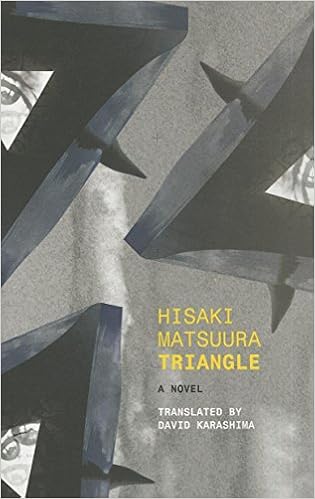
Hisaki Matsuura - A metaphysical thriller, surreal noir, and "moral tale" gone wrong, "Triangle" is an unsettling peek into the dark and irrational reality lying beneath a city.

Image result for Hisaki Matsuura, Triangle,
Hisaki Matsuura, Triangle, Trans. by David Karashima, Dalkey Archive Press, 2014.


excerpt (issuu)


A chance meeting draws the shady Otsuki to the home of a master calligrapher, where he is subjected to a bizarre pornographic movie in which shots of a teenage girl alternate with close-ups of insects. Otsuki is then introduced to the calligrapher's attractive granddaughter, the star of the film, and is asked to shoot the remainder of the work himself. A metaphysical thriller, surreal noir, and "moral tale" gone wrong, "Triangle" is an unsettling peek into the dark and irrational reality lying beneath a city.


The latest addition to Dalkey Archive’s Japanese Literature Series is a suspenseful and phantasmagorical work by Matsuura (The Jest of Things). The curtain rises on an already ominous setting with Otsuki, a recovered drug addict and college dropout who lives a parasitic life in Tokyo and engages “in a kind of fantasy to see how far [he] could let [him]self go, how deep a hole [he] could wallow in, before reaching nothing.” A coincidental encounter on the street with Sugimoto, a former colleague who “oozed madness,” brings him back in tune to his troubled past, leading him to a job with shady Koyama, a master calligrapher. Otsuki is shown a screening of an unfinished, explicit pornographic film starring the master’s granddaughter, spliced with images of insects and is relegated the task of filming the rest. His involvement results in an extended labyrinthian nightmare introducing double moons, exposing the seedy underbelly of the criminal underworld, characters who are not what they seem, and delving into a metaphysical and philosophical conundrum on the nature of time. Fans of Murakami will find this an esoteric and experimental read that will leave them pondering the book’s unanswered questions long after reading. - Publishers Weekly


"That the mysteries of Triangle are not easy to resolve will be, for some readers, frustrating. Others, however, will find that Matsuura’s willingness to eschew facile resolution at the novel’s end, and to allow, instead, the mystery to remain is what makes this one of those rare novels that one wants to reread as soon as the last page is turned." - David Cozy


Triangle is narrated by Otsuki Shun, a University of Tokyo dropout and former drug addict in his mid-thirties who is basically getting by on handouts from the women he gets involved with. He happens to run into a co-worker from his stint at the very dubious Oriental Economic Research Institute, Sugimoto, who remembers that Otsuki knows some French and wants to set him up with a little translation job. It turns out to be something more complicated than that: the man Sugimoto sends him to is named Koyama, and he's working on a film. Otsuki gets to watch what they have so far -- though even as he is shocked by what he sees he also finds himself dozing off during the screening -- and Koyama makes his pitch. Not that that helps much:
So, overall, I wasn't clear on anything. What he did seem to be saying was that the film was not complete, that further filming and editing were needed, that completion of the project would take several months, and that he wanted me to help with the "task".
       Meeting the girl introduced as Koyama's granddaughter, Tomoe, doesn't help convince him: she is the teen that appeared in the pornographic sections of the film he saw. Nevertheless, he lets himself get drawn into the project, and takes part in it for a while.
       Matters get more complicated when he finds that the woman he's been seeing, Hiroko, is also somehow involved. Hiroko has now left her husband -- and took something with her which he now wants back, badly, and he pushes Otsuki to get it back to him. Otsuki, however, has no idea what the guy is talking about; here, too, he finds himself in way over his head -- and the warning: "Terrible things happened here" comes way too late for him.
       Otsuki -- like the reader -- wonders:
But why ? Why me ? Why did they choose me ? What did they have against me ? What did they have to gain from using me like this ?
       In fact, Otsuki holds some of the answers to these questions: there are a few details about his past he failed to mention early on, and they certainly come into play here, in what turns out to be a rather elaborate set-up of sorts. But, yeah, someone is messing with him something bad.
       Triangle is a thriller of sorts, with a decent if a bit confusing plot. Several of the actors aren't quite who they seem, and it takes a while for Otsuki to learn (more or less) the truth; of course, he too wasn't entirely upfront about himself, either. As Otsuki is told (too late, of course): "It's all a lie".
       Triangle is also a more abstract, metaphysical thriller. Koyama is presented as a celebrated calligrapher, and his film is a sort of culminating art-work. Central to it is Tomoe (and/or tomoe ...) -- and, indeed, the novel is titled 'Tomoe' in the original; given its centrality, it's a shame Dalkey didn't dare to go with that -- or, preferably, just the kanji 巴 itself -- as a title.
       Koyama explains to Otsuki:
What I wanted to do was to turn Tomoe into a single, perfect kanji ... I'll even go so far as to say this is the ultimate objective of my life. And Mr. Otsuki, it maybe something that only you can do.
       The 巴-aspect of the novel gets a bit lost in translation, with Koyama's explanations not quite as effective in Latin script and a different language, e.g.:
This kanji for tomoe. It in itself is a spiral. A movement. Try writing tomoe with a brush. It signifies the movement of the brush starting at the center and moving in a counter-clockwise arc. In other words, it is the movement of the universe. Or put another way, the universe is tomoe. Everything in this universe, every existence, exists within tomoe.
       (There is a set stroke-order for each kanji -- see for example -- and the calligrapher's art entails much more than it does with the Latin script. Of course, maybe not this much more .....)
       It makes for an odd mix of a novel. On the one hand, it reads, for the most part, as a solid little thriller, Otsuki pulled into a complicated scheme as a disposable element that fits the bill in more respects than even he first realizes. But things also get quite surreally out of hand, as Koyama's grand design is a bit more complicated (or convoluted). The mix does allow for an effective underlying violence and depravity that Otsuki doesn't even recognize at first (even though he, too, has it in him, in one of the nice touches of the novel).
       It doesn't all quite work -- just as the whole 巴-idea(l) gets a bit lost in the English re-telling -- but it's still a decent, unsettling read, with a few very nice touches. - M.A.Orthofer
http://www.complete-review.com/reviews/japannew/matsuurah.htm


Many great novels present extreme situations that confront a character with challenging questions. Hisaki Matsuura’s Triangle is ambitious enough of a novel to present situations too extreme for a character to endure and leave these questions to the reader.
Shun Otsuki is a recovered heroin addict described by more than one of the novel’s supporting characters–possibly facetiously–as an “intellectual.” Before he is convinced by his acquaintance Sugimoto to assist the mysterious Mr. Koyama with the production of a graphic experimental film, his day-to-day interests seem to extend no further than walking alone through Tokyo and lamenting his casual partner Hiroko’s inability to satisfy his sexual needs. Gradually, through Otsuki’s eyes, the reader observes the patterns of a world that is impersonal and uncompromising to the point of what appears to be sadism on the part of an unseen higher power.
As soon as Otsuki receives the slightest indication that he might be the target of conspiring malignant forces–his garden is deliberately vandalized–the reader is indoctrinated into Otsuki’s worldview, one dominated by narcissistic fears that extend to misanthropy:
Since my morning glories were ripped from their vines, that fear–the stifling fear that had plagued my junk withdrawal–had come back to stay twenty-four hours a day. It was a constant reminder that something that was not me could invade my body anytime, anywhere. Suddenly, the wall I’d built between myself and the world was punctured with holes, battered until thin, until it no longer served any real purpose, allowing evil spirits to come and go as they pleased, eating away at my insides.
Otsuki protects himself until he isolates himself for fear of becoming infected by a dark power beyond his own that will force him to succumb again to base impulses. This self-protection removes him from the rest of the world, leaving him antagonistic toward and suspicious of every external influence.
As the events the novel describes become more and more horrific, Otsuki becomes less and less able to decide whether he is the source of the horror himself or the horror has been imposed on him by the evil whims of others or the imperfect laws of nature. This conflict between the self and the external world is the subject of the novel. The reader never realizes whether Otsuki, still haunted by the demons that drove him to drug addiction in the first place, is hallucinating a world that is designed to hasten his destruction, or he has been targeted by criminals with twisted motives, or he is living in a world that is governed by abject disharmony.
Otsuki’s primary antagonist is Mr. Koyama, an elderly calligrapher who is either uncommonly wise or uncommonly arrogant. Koyama offers numerous high-flown monologues concerning the power of calligraphy to organize reality along distinct lines. He articulates repeatedly that human behavior and thought, like the mechanisms of language, adhere to predetermined rules that deny free will. The novel escalates in a way that forces Otsuki to confront the possibility that all of his actions are decided by a grand scheme that resembles the system of written language, and that humans can manipulate each other so that their behaviors perform certain functions like written characters.
The system according to which the novel and Otsuki’s world and experience are organized is represented by the symbol tomoe, an ideogram with a three-point spiral shape that represents harmony and stability in the universe. Koyama’s project from the beginning, it turns out, has been to describe the symbol sakasatomoe, or “fake tomoe,” a spiral that turns to the right instead of the left, like a three-point Nazi swastika. As Koyama describes the world that turns with the sakasatomoe, it is a perfect analog to Otsuki’s world:
Yes, sakasatomoe, you could call it that. A tomoe that keeps spiralling to the right. Normally, no such thing should exist. A circle that puts a crack in the order of this world and reverses time. A fake tomoe. If the tomoe spiral is the protector of good and stability in this world, the sakasatomoe is the bearer of evil and misfortunes, It completely defies providence. It is contradiction itself. The embodiment of impossibility. A monster.
After taking right turns throughout the novel (figuratively and literally) either on a whim or in pursuit of another guiding agent, Otsuki is destroyed by the notion that he is a servant of the sakasatomoe, and that his thoughts, his actions, and his experience will always force him to move and feel further out of step with nature’s proper patterns. Unfortunately, this notion does not answer the question of whether the sakasatomoe lives inside or around Otsuki, and after reading Triangle, the reader must as herself: do we suffer because our world is chaotic and cruel, or because we are chaotic and cruel ourselves? - Stephen Piccarella
https://electricliterature.com/review-triangle-by-hisaki-matsuura/


Otsuki, former junky, university drop-out and something of a jack-of-all-trades, runs unexpectedly into Sugimoto, a shifty character with whom he once worked. Sugimoto has a new boss, a master calligrapher called Koyama, and he wants Otsuki to help them out. Koyama is shooting a porn film starring his teenage granddaughter, Tomoe; he makes Otsuki watch it and later hires him to shoot some extra scenes. Otsuki refuses, then relents, and later gets pretty worried indeed when odd, violent things start happening: what’s the connection between his married lover, Hiroko, and Koyama? What’s going on between Koyama and Tomoe? In the midst of a mid-life crisis, Otsuki is on the brink of something: will he escape from, or plunge right into, this peculiar underworld that he’s discovered?
We’re not easily confused here at Bookmunch Towers, but this one had me scratching my scalp. It’s actually been several weeks since I read it, so there’s been an extended period of mulling and pondering, but to little avail. To wit: it’s set up in a pretty standard fashion, with a down-on-his luck protagonist endowed with a fairly predictable set of issues (drug use, petty crime, a run of seedy relationships behind him) who meets a (sort of) stranger so that his life shifts and he has to decide which path to take – salaryman safety or crooked danger? Obviously enough, he chooses the latter, and the first half of the book tracks this decision as he runs back and forth, ridden with angst, between his bachelor pad and Koyama’s domain. So far, so good. There’s a strong whiff of Crime Novel to it at this point – there’s a bad guy, a bunch of henchmen, an apparently exploited young girl and an unhealthy love affair. In the second half, though, it all gets esoteric and manic: nobody seems to be whom they claim to be; unexpected connections are drawn between disparate characters; occult shenanigans are going down in the back streets of Tokyo. The interpersonal complexities (who’s allied to whom? who’s sleeping with whom?) pale into insignificance when we get to the metaphysical stuff: Komaya is trying to ‘place a crack in the order of this world and reverse time’; he’s trying to create a type of spiral, a reverse tomoe, that he says is the ‘embodiment of impossibility’. It’s no wonder Otsuki is flustered.
On the one hand, then, this is a criminal underworld story; Otsuki is implicated in a series of distasteful occurrences – pornography, beatings, potential rape – even as he’s trying to investigate and escape from them. On the other hand, it’s a philosophical investigation into the nature of time, embodied experiences and good and evil. It’s gritty gangsterland meets the creepy occult. It’s not far from Pynchon, and it’s not far from Murakami, and it’s all fitted into just over two hundred pages. I was intrigued, throughout, but, like Alan Garner, maybe, Matsuura raises his metaphysical concerns, introduces the uncanny, but doesn’t offer the reader any answers. Like Otsuki, we’re left at the brink of a chasm of understanding, into which Koyama has hurtled, but we can’t follow. The book feels unbalanced – so much build-up, so little conclusion. This is deliberate, sure – after all, how could we leap into the embodiment of impossibility? – but I can’t quite figure out to what end we’re being told the story. If reversing time is the order of the day, what are the implications for Otsuki, and, more importantly, what are the implications for the reader? There’s no particular narrative turn that would make me want to return to the beginning of the book, or track through it backwards: what, then, has Koyama’s obsession got to do with either me or Otsuki? It’s definitely a text that’s engaged with experimentation – Komaya is experimenting with time, Otsuki is testing out lifestyles – but rather than feeling like an experimental text, it feels like Matsuura is road-testing a set of ideas that haven’t quite found their best instantiation in this particular narrative.
Of course, perhaps I’m just not getting it.
Any Cop?: An interesting read, sure, but one that’s ultimately unsatisfying – excepting, of course, for those readers that yearn for a dash of creepy unsolved esoteric magic in their fiction. - Valerie O’Riordan
https://bookmunch.wordpress.com/2014/03/25/an-interesting-read-sure-but-one-thats-ultimately-unsatisfying-triangle-by-hisaki-matsuura/


Not being able to read Japanese makes it twice as hard to review Triangle, a stark and disturbing novel by Hisaki Matsuura and translated into English by David Karashima. The problem with reviewing any work of translation is that they’re books twice-written, and I don’t have any idea of what the original Japanese text was like. I take it on faith that there’s a good portion of parallel meaning between the two books, but the details of the relationship are invisible to me. As an example of what I’m talking about, take this excerpt from TRIANGLE’S shady narrator, Otsuki:
Wasn’t that the most terrifying thing that could happen to this world? Since my morning glories were ripped from their vines, that fear — the stifling fear that had plagued my junk withdrawal had come back to stay twenty-four hours a day. It was a constant reminder that something that was not me could invade my body anytime anywhere. Suddenly, the wall I’d built between myself and the world was punctured with holes, battered so thin, until it no longer served any real purpose, allowing evil spirits to come and go as they please, eating away at my insides.
It’s a wonderful passage. The words tiptoe around some surreal vortex of self-loathing, flirting with annihilation. It’s interesting writing even out of context. But like Jonathan Blitzer wrote recently in Words Without Borders, “There is a certain paradox to reviewing the work in translation. The translation is both utterly immediate (its effects totalizing) and at the same time impossibly elusive.” That powerful ambiguity makes translating as difficult as it is necessary. The hidden relationship between writer and translator charge the best translated works with a strange energy, the origins of which should remain a little occult if done well. In fact, the better the translation, the more paranoid it should make the reader: ‘how much of the original author am I actually reading in any given passage? Who is in charge here?’ The best translations are a perfect conspiracy.
One imagines (or hopes) that Triangle is suffused with a similar sense of paranoia-inducing conspiracy even in its original Japanese. The protagonist, Otsuki, is a jaded, crusty, ex-junky drifter who works at random jobs while mostly living off of the various women that come in and out of his life. He was a Romantic once, but “. . . now that I was a jaded thirty-something, the best moments with a women were not when she arrived at your door, or when you were undressing her, but when you watched her face in the window of a taxi disappear as it drove off.” He’s a character we’ve met before in a hundred other noir and mystery narratives. And like in Chinatown or any Philip Marlowe story, Otsuki must mimic an Orphic descent into a contemporary Underworld — a place where natural order is upturned and the stoicism, or callousness, of the protagonist is put to the test.
The invitation to set off on the journey is extended by Sugimoto, a shady criminal associate from Otsuki’s past. Sugimoto explains that a great Sensei and Calligrapher named Koyama wants to meet with Otsuki about a tantalizingly vague job offer. Reluctantly meeting with him, Otsuki is shown a film composed of images of insects spliced with graphic sex scenes. He’s initially as repulsed by the project as fascinated, and this melange of disgust and desire sets the the gears of the narrative into motion. Otsuki is eventually asked to begin filming his own portion of the project, an erotic study of the lead actress’s hair. He obsess over the task. The affair he’s been having with a married woman skids out of control, his job ends, his fascination with the very young (but how old exactly?) lead actress nudges him to the frayed end of his own consciousness.
Like every noir hero, Otsuki’s callousness, his junky stoicism, is tested when the coordinates of his reality shift to reveal hints of a parallel and hidden world. From this new perspective, everyday objects resonate with alien energy. These objects are heralds of the new reality that the noir hero finds himself inhabiting.
I rolled onto my side and saw, on the floor by the window, a dented 350-milliliter can of Sapporo Black Beer. Was it there when I laid out the futon? Did I not notice it? I didn’t like the way my thumb seemed to fit the dent perfectly. The tab had been pulled and left standing up, the can was half-full, and there was a trace of saliva on the edge. Were there fingerprints too? Of course if there were, how would I know whether they were mine or not?
The objects possess a Lynchian resonance, in which they act as reverse-mandalas — leading not to higher states of consciousness, but instead frenzying the ego into delusional fixations and hauntingly vague intimations of paranoia.
In the 2006 film The Pervert’s Guide to Cinema, Slavoj Zizek says that to really figure out what a horror film is about we should ignore the horror aspect and just pay attention to what else is going on parallel to the hauntings and possessions. While that isn’t so easily done in a novel like Triangle, a novel continually smoldering with low levels of horror, it becomes quickly obvious that a lot of this book’s psychic energy is dedicated to a fear of women.
Otsuki is neurotic and paranoid about the agency of women, about men being left behind financially and socially in a new social order. Hiroko, the married woman that he has an affair with, is a constant threat to Otsuki with her money and ability to leave whenever she wants (read: her freedom), “In her skirt and stockings and only a bra on top, she ignored my last comment and concentrated on putting on her makeup, which made me feel lonely, like I wasn’t important to her, and it made me go quiet.” Otsuki’s pain and violence is a worthless currency in a new world inhabited by sexually and financially free women. This misogynistic fear overtakes Otsuki’s mind by invading his senses. The female image devastates him. Smells disorient him. Even, maybe even especially, the female voice confounds him:
I’m confused, not sure I’m hearing correctly. But are those screams like the screams in the film — the cries of ecstasy? They would never be like Hiroko’s screams — the screams of a woman at the peak of her femininity, screams with richness, a range of high and low tones, and a sweet persistence and thickness. How many women who died in this very location 150 years ago died with cries like that?
Otsuki can’t locate Hiroko’s scream in either agony or pleasure. Her voice blends the past with the future, confusing cause with effect, and undermining Otsuki’s sense of reality.
A wonderfully complete paranoia saturates Triangle. The heavy misogyny and reverse-mandalas collude to weight the plot with an existential unease that we can be critical of even as we empathize with Otsuki suffering through it. It’s a useful paranoia. Drugs can cause this. Conspiracy can cause this. By extension, translation can cause this, with paranoiac attention hanging on each word, and each word resonating with as much occult energy as the objects in Triangle. As T.E. Hulme said, nothing suggests itself. Paranoia is the attention paid to the possibility of a new reality. -         

Hisaki Matsura, a professor of French literature at the University of Tokyo, initially made his literary trade as a poet before moving onto novels. There are certainly elements of poetic symbolism and surrealism in sections of Triangle that reflect his earlier work. His 2000 novel  A spoiling Rain won the Akutagawa prize in that same year, while his 2004 novel Peninsula, a follow-up to Triangle, won the Yomiuri Prize.
One thing that may be apparent to anyone familiar with the work of John Fowles is the striking similarity of Triangle to Fowles’ 1965 work The Magus. Certain events and concepts of timelessness, entrapment, helplessness and misdirected desire are mirrored throughout. And while the endings diverge and the setting is quite obviously different, the similarities are hard to ignore. The protagonists’ fatal flaws, however, are almost polar opposites. While Nicholas in The Magus is betrayed by his own arrogant assumptions and often brazenly wanders into traps laid for him obliviously, Otsuki, a former drug addict, is driven more out of a self-hatred and paranoiac fear at his own circumstances, falling in line with a self-destructive enthusiasm.
‘What was important was feeling comfortable with an idle lifestyle while maintaining a hatred for being a deadbeat.’
While this characteristic may be necessary for the reader to understand Otsuki’s persistence, when those of sounder mind may have stayed well away, it also makes it harder to sympathise with his character, as he wallows in his self-made squalor.
Despite the flaws with Otsuki’s character, the story is an intriguing one. While wondering through the maze-like Tokyo backstreets after an unfulfilling romantic affair with a married woman, Hiroko (who, as in the Magus, is transformed into tantalising bait), Otsuki is surprised to bump into one of his old colleagues, Sugimoto. Otsuki’s distaste and fear of this character is clear from the offset, and Sugimoto represents a seedy and nefarious past that Otsuki is ashamed of, trying unsuccessfully to forget and move beyond. Sugimoto implores Otsuki to meet his new boss, Koyama, who he refers to deferentially as ‘Sensei’. After much persuasion, Otsuki agrees. At Koyama’s house he is shown a pornographic film shortly after his arrival, in which images of hardcore sex are inter-spliced with grotesque images of feasting maggots and cannibalistic insects. Shortly after this aversion therapy-like film, which Koyama refers to uncompromisingly as ‘art’, Otsuki is asked to contribute his own directed scene, featuring Tomoe, a young girl he will come to desire and detest in equal measure. Here is highlighted the conflict in man of his baser instincts against his civilisation, his constant struggle to stand above other living things with an assumed transcendental nobility.
‘…Things of beauty, things of filth, they’re all the same when you burrow down to the core. If you descend to the depths, you reach a place where everything becomes one, a place where total opposites melt into each other completely. Beauty and pollution, life and death, lowliness and nobility, penis and vagina.’
From this point on events take a surreal and pernicious turn as Otsuki is sucked into a savage and convoluted maze, where each turn only offers more questions, or nothing at all. In-between each bizarre occurrence, Otsuki wanders through never-ending backstreets in the Tokyo summer heat, trying to find answers, or trying to find himself. There is a strong feeling throughout that everyone is implicit in the deception, further highlighting the isolated position of Otsuki and adding to the drama.
As the story is set in central Tokyo, anyone familiar with the city may recognise the names mentioned, such as Yotsuya, Asakusa and Shinjuku. In tone with Otsuki’s own desperate feelings are the economic times, the novel taking place slightly after the economic bubble has burst, leaving manual labourers out of work and destitute, the national mood sombre.
As mentioned before, there is a metaphysical element to the narrative, with philosophies on time similar to that which Vonnegut set out in Slaughterhouse 5 and a buried layer of existentialism. There is also a meditation on the art of Japanese Kanji, as Koyama tries to match the achievable perfection of the inanimate with the imperfect animate, but this will have little resonance with many western readers, and doesn’t always feel convincing. These elements, combined with the ongoing mystery and suspense of Otsuki’s journey encourage the reader to press on, searching for that answer that literary fiction often makes temptingly elusive. This narrative drive, however, does ebb away towards the final third of the novel, as it assumes a more conventional action narrative, the intrigue and introspection taking a back seat to a sequence of scenes that feel ill-fitted when compared to the rest of the novel, better suiting a Hollywood blockbuster.
Overall, Triangle is a brave and sometimes brutal novel that isn’t afraid to bend conventions and use the surreal to disorientate the reader. While its promise marginally outweighs its delivery, it is still a commendable, and for the most part, intriguing and addictive work. - Chris Corker

Forthcoming from Dalkey Archive Press, Triangle is translated by David Karashima, it could be said that it could be added to the slowly growing number of titles that feature the presence of two celestial globes, although Triangle predates another well known one, (Murakami's 1Q84), by some years, it seems that perhaps the presence of two moons or two suns could become the common motif of novels with characters that find themselves caught in alternative realities, maybe one of the earliest appearances of this could be in The Invention of Morel by the Argentine novelist Adolfo Bioy Casares which was published in 1940. Perhaps the protagonist of Triangle, Otsuki, doesn't find himself in an alternative reality in a literal sense, but does find himself becoming embroiled in dark circles which he struggles to comprehend across this at times unsettling novel.
With an unsettling film at its centre the narrative style of Triangle also feels in places cinematic and could perhaps be described as being a blending of somewhere between Yamada Taichi and the darker side of Murakami Ryu, much of the novel is situated in Tokyo's Taitō District in particular San'ya, a notoriously rough and rundown area. Otsuki is a rather dissolute character, a recovering drug addict, who on returning home one night encounters an old acquaintance, Sugimoto, standing out in the street in only his boxers and vest, (this rather enigmatic incidence is returned to later in the novel and given it's fuller and darker context), through Sugimoto's insistence and the offer of easy work Otsuki is introduced to Koyama, an older man whom Otsuki begins to understands is a renowned calligrapher whose home is labyrinthine with glass panelling and conservatory, at first Otsuki imagines that he is needed to act as a translator into French, but Koyama shows him a film that he has been working on. The film is experimental in nature, a young woman or teenager is seen having sex with an older man, these scenes are cut and interposed with close up images of various insects, later Otsuki is introduced to the young woman as being Koyama's granddaughter, Tomoe, Otsuki is propositioned with completing the film.
To degrees the novel's concerns could be seen as being about the fabric of identity, over the course of the book and through scenes of violent intimidation and torture, at the hands of Koyama's brutal henchman, Takabatake, who also turns out to be the man in the film with Tomoe, Otsuki is faced with re-constructing and de-constructing his own identity, in the past he had burnt out in a normal 9 to 5 job, but finds himself unable to live with the alternatives and finds himself seeking again the reliable safety, albeit the emptiness of this kind of existence. Another interesting aspect to the novel is some of the parallels going on subtly with the narratives, Otsuki's voice is that of the contemporary man and his dilemmas, the extremes that he faces in the novel represent in a way extremes that the age faces, counter to his is Koyama's, the elder established man, in another way Koyama, who we believe at first to be a darkly cultivated aesthete offers the deeper, although much darker, philosophical voice, added to this the narrative poses some post-modernist musing about the fallible nature of representation in the arts. Throughout the novel, Otsuki is caught between two women, Hiroko, a married woman who he is a having an affair with who offers to leave her husband for him and also, Tomoe, the central and most enigmatic character of the novel, (there are at times rumours of levitation), whom Otsuki becomes increasingly infatuated with. Otsuki finds himself filming in San'ya above Takabatake's shop which in places is a curiously laid out and reconstructed replica of Koyama's house.
The threads of the novel begin to come together, or perhaps untogether when Hiroko's husband begins to drop clues after her disappearance, pursuing Otsuki over an incriminating ledger filled with names and also begins to fill in the blanks concerning Koyama whose past holds the truth to his assumed identity, Hiroko's past as well is not what Otsuki believed it to be and forges links to places he'd rather not acknowledge. Dalkey Archive describe Triangle as a moral tale gone wrong, and the darkness here seems to swamp the light, it fuses and defuses in almost equal measure, unnervingly, rather than concluding it seems to point to further darkness, further corruptions and whilst reading it provokes questions on the dilemma of how modern or contemporary novels might depict or mirror the contemporary world that create them. - http://nihondistractions.blogspot.com/2014/03/triangle-by-hisaki-matsuura.html

The savagery, the degradation, the malaise, the amorality, the brutality, the loss of one’s way.
Welcome to the world of the outsider Otsuki, our narrator, who we learn in the first two pages of this novel is sleeping with a married woman, Hiroko, is unemployed and broke:
Not job, no money, and only the weakest grasp of another man’s woman. This was a life built by picking up the pieces of one that had crumbled. Darkness was the only thing on my horizon, and I knew no way to come back out into the light.
Otsuki is talked into visiting an ex-co-worker’s current sensei, Koyama, where he is offered employment (as he had conned people into believing he spoke French), is given a theory on the concept of time, whereby it is not a loop, not linear but a case of multiple “nows” each within the present “now” and is then shown a film “The structure of the film was simple – scenes showing the habits of various insects inter-spliced with scenes of explicit pornography.”
The insect scenes show females devouring males after mating, other insects feasting on yet other insects from the inside out and decay, the film blending in to reveal, what appears to be a teenage girl in explicit scenes with a savage unidentified male.
We learn that our protagonist, Otsuki, lost his mother early in life “before I’d had a chance to mature mentally and physically, maybe this was why the desire for a female guardian figure has always remained with me, lodged in the deepest core of my being, preventing me from ever becoming a true adult.” Yes we are dealing with an insecure, adolescent here even though he is in his 30’s.
As the novel opens with a theme of cinematic “art” the vivid imagery sits quite nicely. This section reminding me of Peter Greenaway’s “The Pillow Book” from 1996:
I pressed my face into the creamy pale skin of Hiroko’s back as she lay on her stomach, drifting off to sleep. I was enjoying the warmth of her body through closed eyes, allowing myself to be drawn to the verge of slumber before raising my head to drag myself back into the waking world. Drinking in her fragrance, I open my eyes to see her paleness extend mercilessly. It is all I see, and I am engulfed. Her velvety smooth skin moist with perspiration seems to go on forever, at once imprisoning and protecting me.
As that stifling feeling transforms into an immense pleasure that relaxes me from the tips of my fingers and toes to every part of my body, I am overcome by the feeling that this is the kind of thing – no, that this is the one thing – that I live for. I am being bathed from outside and in, my body is soaked, more deeply and more sweetly drenched with every passing moment. Hiroko transforms from being herself, or anyone else, to being the essence of woman, and I give myself to her paleness, to be carried away by a silent stream, bumping along with the current…Then again, I bury my face in her back and I surrender to the gentle ebb and flow that is the rhythm of her breath. From the window, dusk is already seeping into the room, and the paleness of this body next to me and the jet-blackness of her hair that teased its way across the pillows begin to melt into darkness.
As our novel unfolds we are introduced to more shadier characters, we understand more of Otsuki’s past, his shameless exit from University, his demise into drugs, his employment as a con-man and his unstable state of mind:
I stood at the top of the hill and watched the sun set, thinking how, deep inside, I’d always gotten perverse pleasure from my self-destruction. But at the same time, my body had accrued a fatigue over the weeks, the months, and whole ten years of my demise. Was I ever going to find a steady job, start a fami8ly, and claim my place in society? Or was I going to let myself rot away? Perhaps change started with small steps toward a more orderly and comfortable life. But has I let things go too far, allowed my life to shatter into too many pieces for it ever to be put back together?
The back cover refers to this as “surreal noir”, I wouldn’t go that far, even though it does contain a mysterious heroine in Tomoe (the “young” girl featured in the film), a hero who wants to rescue her and numerous blockages to his quest. A story peppered with hallucinatory states, déjà vu, people following you, shadows that move across your path:
Again, I felt as if all human life had vanished, that I’d wandered into a wholly different world where spirits lurk.
You are reading this work as though you’ve read parts of it before, surely I read that 50 pages ago? As a reader “we go back to a different ‘now’”.
Our sensei Koyama is meant to be a reputable calligrapher:
“And because I’m a calligrapher, I think about my work, about words and kanji, all day long. And what I think is that humans are just like kanji. Writing, it is said, was invented by imitating the actual shape of things. But it seems to me that it’s people who are imitating the kanji. The movement of the human body. A running man. A dancing woman. Aren’t these kinds of characters, too? Written characters? Not just the body. The human mind and spirit are also composed of combinations of strokes – dots, flicks, flowing lines, bold lines, lines that fade away.”
The theme of calligraphy is also repetitive, at one stage Otskui returns to Koyama’s conservatory to meet his lover who has mysteriously appeared there and we then have a number of chapters that are the recollections of a drug induced haze. What is reality, what is subconscious, what is the line between beauty and depravity, life and death, black and white? (calligraphy?) “Everything is the equivalent of nothing”.
This leads me to the title of this novel, “Triangle”, something I do not understand. The original title in Japanese was “Tomoe”, a Japanese abstract shape described as a swirl that resembles a comma or a round arm protector used by an archer, or a magatama (jade beads from prehistoric Japan – again shaped like a comma). So why “Triangle”? A sharp edged shape. Our heroine here is called Tomoe and of course the style of the novel with the circular “now” references and the repeating spirals in no way resembles a triangle.
Further mystery occurs when Otsuki manages to return home to recover from the “binge” only to discover cans of beer, glasses of water, cigarette butts in his sink all appearing over time. Is he still hallucinating? Is his reality becoming circular and he doesn’t recall his own actions? But he is nonchalant about these occurrences as he’s “stepped outside this world”.
Then out of the blue Hiroko’s (his lover’s) husband calls, “you can keep her, but what I won’t let you keep is the thing she took from me when she left”….our mystery deepens. And I haven’t yet even mentioned our protagonist’s obsession with Tomoe (the girl in the movie) nor his employment to finish the film…a complex web has been woven, can it be untangled?
I’ll leave the revelations at that as you may want to read this yourself however be warned there are a large number of loose ends that are not fully solved here. This would be the one criticism I have of the book (besides the absurd title choice) in that there are people introduced who we no longer hear about, themes that simply fade away, and a publicists view that the “bizarre pornographic movie” is central to the theme, it is simply a way to introduce our heroine and our anti-hero’s obsession with her.
An intriguing work which does have its moments, I really enjoyed the feeling of space and time and the repetition, déjà vu, mystical and calligraphy themes, the shallow shady side characters a little less so. - Tony Messenger
https://messybooker.wordpress.com/2014/11/06/triangle-hisaki-matsuura-translated-by-david-karashima/


For most of us the notion of life in a tight-knit village is pure fantasy: We have lived our whole lives in and around cities. One would think, therefore, that we would have grown comfortable with the anonymity and the promiscuous mixing with strangers that define city life. Novels such as Hisaki Matsuura’s “Triangle” suggest, however, that cities, particularly those as multifarious as Tokyo, still make even seasoned urbanites nervous. Rich with possibility, cities are also rich with peril: They are places where anything can happen.
We might, for example, when walking through a city at dusk — “known as omagatoki, ‘the time of evil encounters'” — run into, as Matsuura’s protagonist does, a faintly antagonistic acquaintance who, wearing an undershirt and boxer shorts, appears to be waiting for us. Our encounter with this acquaintance might then propel us into a nightmare that will include a hidden garden containing a steamy conservatory in which a sinister philosopher/pornographer holds forth on the cyclical nature of time, and the machinations of this cracked aesthete may eventually lead us underground, to rivers that run deep under the metropolis. Reading “Triangle” we might, following Matsuura’s protagonist, enter a psycho-geographically informed version of city life, the darkness of which will remain unresolved at novel’s end.

Matsuura, a professor in the French department at Tokyo University, is clearly comfortable in the place where the gothic and the decadent meet. On the gothic side he gives us the sinister philosopher, Koyama, who may be a master calligrapher; a damsel, Tomoe, who may be in distress; and an estate that, though in the midst of Tokyo’s shitamachi (downtown) in the mid-1990s, feels remote both in place and time and includes secret passages as well as the overheated conservatory, rank with tropical decay, where the aesthete holds forth.
Decadence enters the novel in the person of the protagonist, Shun Otsuki, an enervated junkie, two years clean, whose addiction is far from being his darkest secret. He’s aimless, anonymous, and powerless, it seems, to resist the urgings of the urban tide, including the suggestion made by Sugimoto, the fellow in undershirt and boxers he runs into during “the time of evil encounters.” He lets Sugimoto take him to meet the sinister aesthete, Koyama, who apparently wants to offer him a job, but who first shows him a film in which close-ups of insects fade into scenes of the possibly distressed damsel — who may be the aesthete’s granddaughter — engaged in “less the erotic act of lovemaking than a close-up of genitals having sex.” While Otsuki watches the film he notices that, “at the exact moment that there was a close-up of the moon on the screen, outside the glass conservatory the clouds parted to reveal a real full moon.” The film, he comes to feel, is somehow dictating his life. That Otsuki is hired to complete the film which exerts such force over him adds a further twist.
The footage that Otsuki produces — Koyama tells him it will be incorporated into the genitals and insects film — seems, in an art-house sort of way, vaguely interesting. He spends a week filming Tomoe, who is floating in a tank of water, “as she hung upside down, by the crook of her knees, swinging trapeze-like as her hair trailed through the water … [and] as her face slowly emerged from under the water.” Filming her face emerge, Otsuki plunges deeper in.
“Triangle” incorporates elements of noir thrillers, but Otsuki is no detective. Detectives in the classical mode move through the city with unrelenting focus. Truth is out there, and they will find it. The mysteries they investigate will be solved. Otsuki, on the other hand, is a piece of urban flotsam tossed here and there by forces more powerful than he is, a character in a plot concocted by others. He is not, however, without agency: he does try to figure out the life he has fallen into. He tries, but he fails. Tomoe’s face never quite emerges.
Early in “Triangle” we can only believe that she is a victim of her perverted grandfather. Otsuki believes this, too, but of a later encounter with her he notes: “I was face-to-face with a beautiful girl, yet staring into the compound eyes of a filthy fly. Could these eyes really belong to a human? Up until that moment, I’d thought they were beautiful and innocent. Had I really been such an idiot all along?”
That the mysteries of “Triangle” are not easy to resolve will be, for some readers, frustrating. Others, however, will find that Matsuura’s willingness to eschew facile resolution at the novel’s end, and to allow, instead, the mystery to remain is what makes this one of those rare novels that one wants to reread as soon as the last page is turned. - David Cozy
https://www.japantimes.co.jp/culture/2014/05/17/books/book-reviews/decadence-time-evil-encounters#.XJyHRmeGPIU


Hisaki Matsuura’s Triangle has elements and the mood of some European fiction, for example André Gide’s The Immoralist and Albert Camus’s The Stranger. In these novels, moral and existential dilemmas provide obstacles for the characters to overcome, or mysteries to solve. It comes as no surprise, then, that Matsuura is a professor of French literature at the University of Tokyo, and received his doctorate from the University of Paris III.
In Triangle, Shun Otsuki is a thirty-something recovering drug addict who formerly worked in a shady so-called “research bureau”. He is adrift in life, unmarried and without good friends except for a married woman, Hiroko, with whom is having an affair.
One evening, Otsuki runs into Sugimoto, a former co-worker from the bureau. The rough and down-on-his-luck man recalls a scam where Otsuki would pretend to speak French with an actor posing as a consultant. Sugimoto would casually come across their meeting with a potential client. They would sell the client on investing in the imminent opening of a Paris branch of the bureau—a completely fictional branch, of course.
Sugimoto brought up the French scam because he just came from the house of a famous calligrapher, who happens to be looking for a French speaker. Despite Otsuki’s reminders that he doesn’t speak French, or very little anyway, Sugimoto insists he is perfect for the job and anyway the calligrapher’s house was just down the street. Otsuki had been curious about the octagonal western-style house Suimoto is pointing toward, so he agrees to go with him and inquire about the job.
Koyama sensei is the name of the calligrapher. After Otsuki settles in with the older man in the home’s conservatory, it becomes clear that the job isn’t about translating something from or into French, rather it involves completing a film.
Before showing him the partial film, Koyama tells him about an eerie phenomenon that happened to him late one night in Italy. Walking on a deserted street in the fog, he was following a shadowy figure that he never could catch up with or leave behind. Their movements matched perfectly, and when he eventually got closer to the figure, he realized that the figure was himself. Koyama speculated that it was his future, or past, self. The “now” in which we exist is just one of many “nows”. As Koyama says: “I suppose you could say that the ‘me’ on the other side came back to the ‘now’ on this side � in every ‘now’ is every other ‘now’.”
Otsuki doesn’t fully grasp the idea, but Koyama doesn’t seem to care.
After discussing the nature of time and other topics, Koyama starts the film. Otsuki grows increasingly uncomfortable as the film cuts from close-ups of insects in their natural habitats to pornography. In those scenes, a very young woman—Otsuki speculates she might even be underage—is having sex with a man about his age. Koyama claims it’s an art film to be distributed in France.
Otsuki is still not clear what he is supposed to do, but agrees to think about it. On their way out of the house, a young woman appears—she is the woman in the film. Koyama introduces him to Tomoe, his granddaughter.
The story has been masterfully set up and what follows is not only driven by the moral and existential dilemmas, but also takes on the feeling of a work from the Theatre of the Absurd. Characters in this genre exist in an incomprehensible world, where rational thought and actions have no effect, or the opposite of that expected. Characters may or may not be who they claim to be. Seemingly coincidental relationships connect the characters in a web that draws them tightly together like a noose around Otsuki’s neck.
But Matsuura’s novel isn’t all European influence. He also includes some uniquely Japanese twists, especially with the alternate kanji and meaning of “Tomoe”, the (supposed) granddaughter of the (supposed) calligrapher. Indeed, the Japanese title of the novel is “Tomoe”, a hint of the importance of the character as well as the “characters” of her name. Such word play is often used in Japanese literature. For example:
Tomoe. A pattern with a spherical base connected to a curving tail-like shape. �
The word “spiral” immediately caught my attention. Tomoe was a curve after all. Not a horizontal line, but originally a spiral. So why was there a need for a curve to “complement” something that was already a curve? Or was she in fact a straight horizontal line, making her a fake Tomoe?
 
Triangle is a spellbinding, rich reading experience. And that the author can incorporate the best of multiple literary traditions is additional evidence of his skill as a writer. - Todd Shimoda
http://asianreviewofbooks.com/content/archived-article/?articleID=1821


Tokyo, 1994. Japan is now well into what observers will later call the “lost decade,” a downward spiral triggered by the Japanese central bank’s bursting the speculative bubble of the 1980s. The seemingly inviolable climb of the Japanese economy—and society—has reversed.
Triangle, the 2001 novel by the respected Japanese writer Hisaki Matsuura released in its first English edition by Dalkey Archive Press (233 pages) this month, is an attempt to transform the Japanese downward spiral into a metaphysical thriller. But novels—even literary ones—based on conceptual ideas rarely work.
This one, in the English translation by David Karashima, is unsuccessfully grounded in Tokyo’s dark underside circa 1994—seedy neighborhoods, fog, derelict storefronts, and sewer canals. Our guide is the disaffected thirty-something Otsuki, a recovered heroin addict who lives in a lightless, “six mat” apartment in a neighborhood so hot and humid “it’s like a basin.” Otsuki has gotten himself out of the worst of Tokyo’s dead zones, like Sanya, “an area that would shock most Japanese,” but about 45 pages into the book he’s headed back there. Danger looms.
Much of Otsuki’s trouble is self-made, of course. He’s both streetsmart and naïve (the source of his clichéd narrator’s voice), addicted to sex and incapable of intimate emotional connection. “The best moments with a women were not when she arrived at your door, or when you were undressing her, but when you watched her face in the window of a taxi disappear as it drove off,” he tells us almost immediately. The distance in his voice is supposed to give the novel a hard, dime store sound, to make the book bristle, to enable the reader to feel Otsuki’s—Japan’s—pain.
The pain emanates from a mini-cell of perverse, Gothic monsters led by the calligrapher Koyama. Their perversity reminds me, in fact, of the first widely read American Gothic novel, The Quaker City, about a secret sex and drug lair in Philadelphia in the 1840s run by a classic misanthrope named Devil Bug, just as the U.S. was coming off its most brutal economic depression (that novel, too, was a metaphor for a nation gone wrong). Koyama uses drugs and sex to draw Otsuki into his trap. But what for? What do they want from him? Ostensibly, it’s to finish making a film. But can this be real? Otsuki isn’t a director or cinematographer. This is slim pretense, too slim for the reader, just enough, apparently, for the narrator. His questions lose narrative power (all reversals in the plot are fleeting) as he’s sucked into their weird, rococo drama. The underbelly is lurid, titillated, violent, and worse—rationalized by metaphysical nonsense. And since the book hinges on this nonsense, Triangle can never be taken seriously.
On the face of it, the nonsense is interesting. Says, Koyama, about what he calls the “natural spiral” of the universe,
“It goes to show how little our lives really mean. We have to accept that fact…graciously, without making a fuss about it…If we accept the spiral, if we can give ourselves to it, it will become much easier to endure life, aging, and death.”
Matsuura personifies the spiral in a character, Tomoe, an alluring teenager who Koyama uses to lure Otsuki. Tomoe is a spiral shape; three tomoes together make the forceful mitsudomoe, the Bermuda Triangle of the book’s title. The author extends the metaphor to the counter-clockwise method of writing the symbol for tomoe. “We are all born within tomoe,” says Koyama. But what if some dastardly, devilish fella wants to reverse direction, put “a crack in the order?” This is Koyama himself, who takes the narrator on an underground, clockwise, chase through Tokyo.
Here, symbol is everything, and that’s shaky novelistic ground. What about the story itself with its layers of feigned intrigue (none of which seem real), its veiled explanations, its final revelation? They drift away once the metaphor is revealed. Otsuki’s transformation is slight.
A book doesn’t have to fail if it’s based in a metaphor, but it’s more likely to if it also gives into the easy fetishizing of lurid sex, of the young female form. This is a shame because Matsuura is skilled at dialog and sensitive to the way we feel our bodies as extensions of our emotions. Here’s a sweet sampling:
My body melts, mixes, dilutes, spreads endlessly, shrinks endlessly, becoming endlessly smaller, becoming sperm and egg, no, even smaller and smaller into lukewarm nothingness, to a place where I am not me nor anyone, a place with no color, shape, smell, or taste.
But just as Otsuki is trapped by his own inadequacies and then, later, the villainous cell, Matsuura (and by extension, the reader) is trapped by his choice of the first person narrative form. Otsuki isn’t compelling enough to carry the story. An omniscient, or even playful third person narrator may have better handled the metaphor by contextualizing the act of calligraphy, giving it both historical meaning and grace. Moreover, if the author is really interested in social commentary about the state of Japan, a more detached narrator might have built this aspect of the metaphor more carefully, with greater nuance. The third person may also have given Matsuura a way to reveal some of the story’s secrets to the reader without having to clue in Otsuki, who spends the book thinking he’s being duped, but to no conceivable end.
Nathaniel Popkin, author of Lion and Leopard, 2013
https://dactylreview.com/2014/05/14/triangle-by-hisaki-matsuura-translation-by-david-karashima/
excerpt: As I was telling Hiroko about the night with Koyama and Sugimoto, I suddenly remembered how, while I was in something of a hypnotic state, at the exact moment that there was a close-up of the moon on the screen, outside the glass conservatory the clouds parted to reveal a real full moon. I got the eerie feeling that what was happening in the film dictated what was happening in the real world. But because I found it difficult to put this strange experience into words, I decided not to say anything about it. I put out my cigarette and began to make love to her again so as to fill in the absence of conversation, but that dark sky with the its twin moons hovered. I even imagined that the two moons overlapped and became one just as I experienced a long, intense ejaculation–smelling Hiroko’s slightly sour breath in my face.
The vision left me feeling stifled, guilty, but I didn’t understand why. As soon as I’d sent Hiroko on her way again, another close-up vision of the moon came to mind, except that this time the moon was reflected on the surface of a lake. It was an image from the final scene of the film, that had faded into nothing. It brought with it a frightening vertigo–a feeling of falling, flailing, into the void. But there was no way I could know whether this fragment of memory was real or not, and the irritation of this uncertainty burned inside me.
That night when I lay down to sleep, I was overcome by the desire to watch the film one more time–not to look at the naked Tomoe having sex, but to take a closer look at the final image of the moon. It was a desire that wouldn’t leave me, that kept sleep at bay as I tossed and turned into the night.

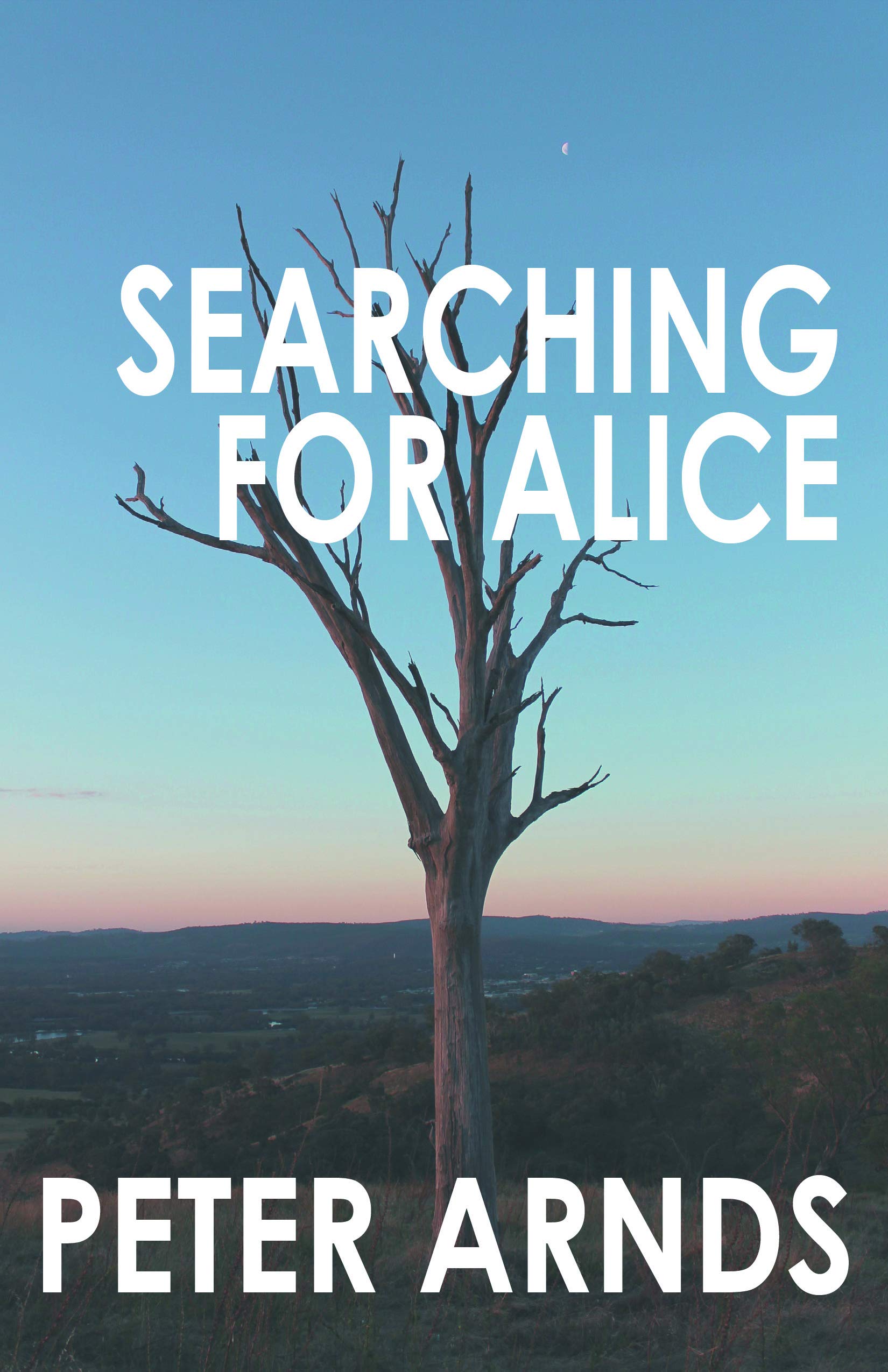
Peter Arnds - Leaving behind his eccentric family and stifling German hometown, Jonathan embarks on a hitchhiking adventure through Australia in search of Alice, an exchange student he knew back in school who left mysteriously one night without explanation.

Image result for Peter Arnds, Searching for Alice,
Peter Arnds, Searching for Alice,  Dalkey Archive Press, 2018.


Sehnsucht: the yearning for faraway people or places. When Jonathan graduates from university with a degree in literature his father hands him two gifts: an alarm clock and the chance to work in the family business. But Jonathan has different plans. Leaving behind his eccentric family and stifling German hometown, he embarks on a hitchhiking adventure through Australia in search of Alice, an exchange student he knew back in school who left mysteriously one night without explanation.
This stunning and rich debut novel is a story about coming of age and coming to terms with the past. Searching for Alice explores the lure of the open road and the joys of traversing geographic borders, language barriers, and cultural boundaries.


“Castles in the Sand” (story)
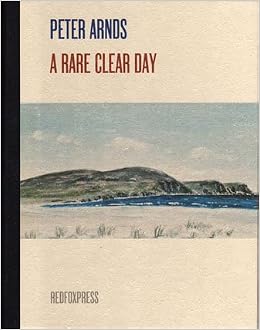
Image result for Peter Arnds, A Rare Clear Day
Peter Arnds, A Rare Clear DayRed Fox Press, 2014.       


Poems and paintings from Achill
Works made during a stay at the Heinrich Boell Cottage.
Laser printing on Verena bulky 100 gr.
Hand bound


A member of PEN (German writers abroad) Peter Arnds is the author of six books and approximately 50 essays of literary criticism. Recently he published a volume of his poetry and water colours (A Rare Clear Day, Red Fox Press 2015), which he produced during his residence at the Heinrich Böll Cottage on Achill Island in 2012, and a translation of Patrick Boltshauser’s novel Stromschnellen (Rapids, Dalkey Archive Press, 2014). Rapids was nominated for the International Dublin Literary Award 2016. Peter has published numerous short stories and poems in journals such as Cyphers (A Dublin Literary Journal), Animal: A Beast of a Literary MagazinePrairie PoetryCape Rock MagazineBy & By Poetry, as well as in Landing Places: Immigrant Poets in Ireland, an anthology published by Dedalus Press.


T. O. Bobe - a mix of poetry and prose, presented in short chapters/pieces, featuring a barber, Mr.Gică -- "the world's greatest barber". His barbershop forms an off-kilter microcosm: a world of melancholic kitsch that includes opera singers, football players, gladiators, the secret police, fantasies of Edith Piaf, four lost hippies, and other ludic figures

CurlCover4


T. O. Bobe, Curl, Trans. by Sean Cotter, Wakefield Press, 2019. 

“Death doesn't scare me. Its barbershop does.”
Mr. Gica is the world's greatest barber. He is one-point-sixty-two meters tall and weighs fifty-eight kilograms. He is also the fastest barber in the world. He holds the world record for sculptural hairstyling and has won three Olympic golds in neck massage. But his specialty is the shave.
Mr. Gica’s shop has six mirrors on the walls, six sinks, six barber chairs, and no employees. Always crowded, its chairs always occupied, the barbershop forms an off-kilter microcosm: a world of melancholic kitsch that includes opera singers, football players, gladiators, the secret police, fantasies of Edith Piaf, four lost hippies, and other ludic figuresincluding our superhuman protagonist's ever-lurking antagonist in perpetual disguise, Dorel Vasilescu.
Trying on a variety of voices and modes like so many work coats, Curl scissor-snips love poems, mock-critical commentaries with footnotes, dreams, diary entries, streams of words without punctuation, cultural references, and a number of rebellious hairs off a number of necks to sculpt a patchwork portrait of universal loneliness.


Curl is a mix of poetry and prose, presented in short chapters/pieces, featuring a barber, Mr.Gică -- "the world's greatest barber". He is completely devoted to his craft -- obsessive, even, and fast: his shop has six chairs -- always full -- but he has no assistants, just going down the line, morning to night, snipping away. Apparently, he never even sleeps (he has pajamas, but he never wears them, only occasionally taking them out to admire them): when the barbershop closes for the night, he becomes: "the world's greatest clandestine hairstyler", coiffing six women's hair in the fanciest styles.
       Curl presents the man, his accomplishments -- Olympic medals, an impressive clientele --, and some of his dreams (to own a car -- "But not to drive" --, or how he wants to be preserved after death). He has a nemesis -- Dorel Vasilescu -- who features in a variety of the vignettes, while real-world figures feature as well, as customers or, for example, annual visitors on World Mental Health Day (when Einstein, Napoleon, and Yuri Gagarin, among others, drop by).
       Most of the pieces are short prose vignettes, in some way presenting Mr.Gică, but there are also numerous (more-obviously-)poems; some pieces build or even directly comment on others (for example, the prose-and-poem 'Barbershop Nights: An Eyewitness Account' is followed by 'What the Pagodas Dreamed in the Poem "Barbershop Nights"').
       For all his expertise and genius, there's a melancholy feel to Mr.Gică's single-minded focus, a pervasive loneliness that's nicely conveyed by Bobe. The mock-seriousness ("Hair is humanity's greatest enemy") is kept at just the right pitch -- and Mr.Gică's fundamental sadness well-conveyed:
I killed the apprentices,
because they wanted to repeat that which cannot be repeated,
that is, the ephemeral.
       Mr.Gică faces his loneliness, and also faces mortality, leaving him wondering about a life spent doing nothing else -- and worried that, that too, is his fate ever after; as one of the loveliest lines has it: "Death doesn't scare me. Its barbershop does."
       Presented in a typically lovely little pocket-sized edition from Wakefield Press, and with a helpful Afterword by translator Sean Cotter that gives some biographical information about the author, as well as offering some interesting observations about the translation itself, Curl is an appealing little work. - M.A.Orthofer
http://www.complete-review.com/reviews/romania/bobeto.htm


T. O. Bobe is a prize-winning Romanian poet, novelist, and screenwriter living in Bucharest.

3/26/19

June Caldwell's modernist style and tendency to switch forms never let the reader rest. Each of her stories announces itself with a bang. The outrageous ideas for the most part have a realistic undertone, grounding her stories in a world that is oddly, awfully, familiar

35422302. sy475
June Caldwell, Room Little Darker, Head of Zeus, 2018.


From one of Ireland's most grindingly authentic and radically original talents, Room Little Darker explores the clandestine aspects of modern life through jagged, visceral tales of wanton sex, broken relationships and futuristic nightmares.
An abusive father haunts his daughter and wife from the confines of a nursing home; a couple with an appetite for S&M discover their escapades have led them into something unimaginably bleak; a desperate addict scours the depths of degradation in a nightmare Dublin; an unborn foetus narrates her torturous experience of the Irish legal system; a paedophile acquires a robotic little boy as part of his sex therapy.
At once hilarious and profoundly moving, Caldwell's stories probe sexuality and disturbing psychology, and the darkess and light that lives within us all.


The roar of fury and clarity that Irish fiction has been needing. You haven’t read anything like this before . . . Just brilliant.’ – Belinda McKeon

‘There is a seriously charged imagination at work here . . . Caldwell brings a dangerous new voltage to the Irish short story.’ – Mike McCormack

‘Savagely inventive, full-throttle snapshots of the creepy, pitiable world it seems we all now have to live in. If the ghost of Angela Carter and a hungover George Saunders ever got together, they might turn out tales as full of the righteous ire and strychnine wit as these uproarious stories.’– Colin Barrett
‘June Caldwell’s writing is audacious, wicked and profoundly funny; her prose cracks and sizzles. These stories are literary electrical storms.’– Nuala O’Connor

‘You’ve probably never read about contemporary Ireland quite like this … Strong, salty, swaggering new voice in Irish fiction … A bitches’ brew of anger, spiky rage and deft humour … All told, Caldwell has more in common with the likes of Irivine Welsh or Hubert Selby Jr than any of her homegrown contemporaries, but this is writing that does not lend itself easily to categorisation or comparison.’ – Irish Independent


‘Caldwell’s first collection is a mark-maker … This is an unflinching collection which thuds with life and kicks with horror.’ – The Sunday Times


‘Caldwell’s stories are ferocious beasts, kicking and screaming in rabid, frothing rage…although there are moments of tenderness, too…If you like your fiction raw and angry, smeared in bodily fluids – and solids – then Room Little Darker is for you.’ – Sunday Independent


‘A remarkable collection, and unlike anything you will have read from her Irish peers…Room Little Darker heralds a major new Irish literary talent. Caldwell is a savage, audacious and brilliant new female voice.’ – Hot Press


‘There is no better writer of soul-stopping, confrontational prose working in the English language today.’ – The London Economic


‘If these stories are dark, they are also linguistically dextrous. The writing is full of surprises, bold and yet reined in, being bereft of platitudes and the consoling comfort of white lies. This startling debut will linger long in the memory.’ – Sunday Business Post


Room Little Darker by June Caldwell, a glitteringly dark collection of short stories, is this month’s Irish Times Book Club selection. First published to acclaim last year by New Island, it is the first of their titles to be released in Britain by Head of Zeus under their recent deal.
Over the next four weeks, we shall be publishing a story from the collection and articles by the author and fellow writers Joanna Walsh, Maighread Medbh, Alan McMonagle, Michael Harding, Justine-Delaney Wilson, Elske Rahill and Frankie Gaffney. The month will culminate with a podcast of an interview with Caldwell by Irish Times Books Editor Martin Doyle, which was to have been recorded today at the Ennis Book Club Festival but has been cancelled because of the bad weather. Details of its rescheduling will be published as soon as this is confirmed.
Reviewing Room Little Darker in The Irish Times, Sarah Gilmartin wrote:
“Robot boys that rehabilitate paedophiles, sex-change clinics, demoralising orgies, alpha submissives caged in a Leitrim farmhouse and ogled by rubber clad gimps – June Caldwell’s debut collection of short stories makes Fifty Shades of Grey seem like a Disney movie.
“Room Little Darker is a fiercely inventive collection with a strong social slant. Caldwell, a former journalist, laments the current state of Irish society and seeks to rip up the rule book. The 11 stories in her challenging collection sometimes go so far into the surreal that they lose the plot.
“Caldwell’s modernist style and tendency to switch forms never let the reader rest. Each of her stories announces itself with a bang. The outrageous ideas for the most part have a realistic undertone, grounding Room Little Darker in a world that is oddly, awfully, familiar.
“Room Little Darker has similarities with Claire Louise Bennett’s debut Pond. Short story writers like Diane Cook, Kirsty Logan and Northern Ireland’s Jan Carson also come to mind in the collection’s preoccupations with the surreal, sex, reproduction and gender inequality.”
Currently living in Dublin, Caldwell has an MA in creative writing from Queen’s University Belfast. She won the Moth International Short Story Prize, and has been shortlisted for the Calvino Prize in Fabulist Fiction, the Colm Tóibín International Short Story Award, the Lorian Hemingway Prize, and the Sunday Business Post/Penguin Ireland Short Story Prize. 
Ian Sansom in the Guardian wrote: “The shape and conception of the stories are often shocking enough, but Caldwell’s linguistic verve is what keeps you paying attention, fascinated and appalled ... The book amounts to an unsparing portrait of a city and a nation, with a singular voice heard throughout, lost in grief and longing, interrogating every motive and intention. It is banshee bold.”
Dermot Bolger in the Sunday Business Post wrote: “If these stories are dark, they are also linguistically dextrous. The writing is full of surprises, bold and yet reined in, being bereft of platitudes or the consoling comfort of white lies. This startling debut will linger long in the memory.”
The Irish Independent, likening Caldwell to Irvine Welsh and Hubert Selby jr, said: “Where some writers favour the lilt of poeticism, the cadence of beautiful prose, Caldwell has stirred up a bitches’ brew of ­anger, spiky rage and deft humour. She has captured the fetid air of Catholic Ireland, the pedestrian grey despair of the old folks’ home and the cloying stillness of suburbia. Yet the stories themselves are neither pedestrian, nor fetid. Each crackles with writing that doesn’t so much bristle the reader as approach them with a roaring chainsaw.
“Despite being a relative newcomer, Caldwell’s writing bristles with chaos and confidence. Her characters don’t always have the most charitable or charming worldviews, but they’re all the better for it. It’s clear there’s a strong, salty, swaggering writer behind such prose: better still, she has the literary nous to make her views on everything from dementia to contraception pulsate.”
https://www.irishtimes.com/culture/books/room-little-darker-by-june-caldwell-is-march-s-irish-times-book-club-choice-1.3412763


As Leonard Cohen asked: you want it darker? How about a story about a couple kept as sex slaves in a farmhouse in Leitrim, their desperate antics livestreamed to an audience of perverts worldwide? Or a junkie who gets a beating and a shoehorn “scoopslide right in and up on over” his “stink tunnel”? A story narrated by a foetus? The tale of a paedophile who is enrolled on a “dynamic new domestic-environment therapy with 100 per cent effectiveness demonstrated in trials across twelve countries on three continents”, which involves him adopting his own boy robot that he can abuse in the comfort and privacy of his own home? Room Little Darker, June Caldwell’s debut collection, couldn’t get much blacker. It reads like boiling tar.
As Irish fiction once again awakens to its true power and potential, Caldwell emerges as one of those giving the tradition a good old-fashioned shaking. (To name just a few others: Sara Baume, Lisa McInerney, Kevin Barry, Colin Barrett.) In the words of the narrator of “Dubstopia”, “Come out of charity, Come dance with me in Ireland, that cunt Yeats said in the book by their mattress. But he didn’t know fuck all about the skank or fiddlers like Carol, all thumbs and kettledrums, sucking off ghosts at the window in the Old Bank on Doyle’s Corner.” If you prefer your Irish fiction sweet, ponderous and full to the brim with twinkles and craic – horseman, pass by.
In “Upcycle: An Account of Some Strange Happenings on Botanic Road”, a woman renovating her parents’ home in Dublin finds that her dead father is haunting her. The story is pure north Dublin gothic, the house “mischievous and corrupt”. The narrator is reduced to horrible inaction:
There are days when I crumple on the couch giving in to endless interlude, boom-box of Jeremy Kyle, mini flask of vodka, crows crying their lamps out in the chest-hair back garden. Slow Joe next door moving his furniture around to nothing but his own sound. Eventually I’ll squirm up to bed when I know I’ve successfully folded enough hours of the day into the next so that neither is in much of a shape to be useful. Even then I cannot escape the watching. That his eyes are stuck on me and me alone, I am completely sure.
Paranoia and fantasy mix and merge throughout the book.
The whole collection is an account – in the words of the narrator of the Poe-inspired story “Imp of the Perverse” – of “so much ugly craving”. The shape and conception of the stories are often shocking enough, but Caldwell’s linguistic verve is what keeps you paying attention, fascinated and appalled. A woman cooks a poisoned stew for her husband, toiling over it like a “schitzy witch”; a man’s head “had begun thoroughly to scoff itself”; letters to a husband expressing difficult emotions are thrown in the fire because “it wouldn’t be fair to expect a man like that to take on all manner of female fragmentary”. Caldwell forever has her eye on language, stalking it everywhere, through the demotic, the street slang and on towards the realms of the sinister sublime: “In the garden I watch the guests through the heat of amber eyes. Grasses bristle and jostle. I stretch forward to lie flat in the flimsy sunshine of early evening. The clouds are hungry and my mouth waters.”
The book amounts to an unsparing portrait of a city and a nation, with a singular voice heard throughout, lost in grief and longing, interrogating every motive and intention. It is banshee bold. “People belonging to me have passed on. Others are refusing to. […] We learn best from when we mess up most. The humanity in that. Think about that. How do I explain that?” It begins with the story about a reviled dead father but ends with a piece about a beloved dead brother, a small masterpiece of grief. “Cadaverus Moves” shifts continually from past to present, from childhood memories to undying love and pain, “zipping across the chaos”. In the words of the narrator of “Upcycle”, “Even in retelling the story, I find I’m just as upset and confused as when I lived through it. I cannot be absolutely sure of what occurred, of the timeline.” A work more attentive to – and understanding of – the terrible derangements of simply being alive I have not read in a long time.
It is perhaps difficult to imagine where Caldwell might go next, having gone all the way and far over the top in this collection; but then presumably it was difficult to imagine what William Burroughs or Kathy Acker or Irvine Welsh might do next. In a recent interview, she said she imagines that “one day someone will say: ‘Yer one, she was a difficult narky character alright, but she could string a sentence together OK.’ That to me, would be a life well lived.” Job done. -
www.theguardian.com/books/2017/jul/12/room-little-darker-june-caldwell-gothic-irish-short-stories


Robot boys that rehabilitate paedophiles, sex-change clinics, demoralising orgies, alpha submissives caged in a Leitrim farmhouse and ogled by rubber clad gimps – June Caldwell’s debut collection of short stories makes Fifty Shades of Grey seem like a Disney movie.
Room Little Darker is a fiercely inventive collection with a strong social slant. Caldwell, a former journalist, laments the current state of Irish society and seeks to rip up the rule book. The 11 stories in her challenging collection sometimes go so far into the surreal that they lose the plot.
Caldwell’s modernist style and tendency to switch forms never let the reader rest. Each of her stories announces itself with a bang. The outrageous ideas for the most part have a realistic undertone, grounding Room Little Darker in a world that is oddly, awfully, familiar.
The opening story, Upcycle: an account of some strange happenings on Botanic Road, concerns a former tyrannical father who haunts his wife and daughter when he dies. To the daughter he appears as “a ferret slinking in and out of the bed bars at my feet, leaving drops of sweat and other depositions for me to see in the mornings”. That this is perhaps the most conventional story in the collection says plenty about what is to follow.
Graphic sex links the next three stories, from the “pain so excessive and profound, I pass out cold” that the alpha submissive experiences in Leitrim Flip, to the drug addict in Dubstopia who wants “to bang the nurse in the Mater who took his bloods”, to the animalistic sex in a doorway that a student has with her lecturer in Imp of the Perverse.
Behind the explicit detail, everyone is hurting. The nurse that Gonzo wants to bang wants to know if his girlfriend Carol “took mushrooms when breastfeeding the day the baby died”. It is a grimly evocative story, a powerful portrait of the pain and debasement of addiction that has echoes of Jon McGregor’s Even the Dogs.
The Glens of Antrim sees two former lovers remember their smutty sex life with a nostalgia that turns bitter. BoyBot, arguably the most subversive story in a collection that thrives on destabilisation, sees a convicted paedophile writing to his former lover about a new robot that’s designed to satisfy paedophiles’ sexual wants but also rein them in when they get too perverse.
Another interesting take on sex and betrayal sees a woman undergo a futuristic sex-change in The Implant. “This shouldn’t hurt,” goes the foreboding opening line, delivered by a doctor “from one of those Eastern bloc countries with no wallpaper, where teenage girls are pushed into steel shipping containers”. The woman, or “subject”, undergoes the operation to punish herself for her partner’s infidelity.
Maligned females are a recurring theme, strikingly in SOMAT, which was first published in Sinéad Gleeson’s anthology of Irish women writers, The Long Gaze Back. Centred on a decision by male doctors about euthanising a female patient who is pregnant and brain dead after a stroke, there are strong overtones of the pressing social issue concerning women’s reproductive rights in Ireland.
Husband Peter Papadoo looks for “an in-the-know, big league doctor, an expert, an un-doer of crummy miracles”. The doctors, meanwhile, think of their tee times. Head honcho Falvey acknowledges that the right to life is a complex issue, “without being sure exactly. Sometimes that’s how complex complexity is.” Caldwell’s fury at the injustice jumps from the page.
With its modernist style, Room Little Darker has similarities with Claire Louise Bennett’s debut Pond. Short story writers like Diane Cook, Kirsty Logan and Northern Ireland’s Jan Carson also come to mind in the collection’s preoccupations with the surreal, sex, reproduction and gender inequality.
Currently living in Dublin, Caldwell has an MA in creative writing from Queen’s University Belfast. She has won the Moth International Short Story Prize, and has been shortlisted for the Calvino Prize in Fabulist Fiction, the Colm Tóibín International Short Story Award, the Lorian Hemingway Prize, and the Sunday Business Post/Penguin Ireland Short Story Prize.
In a collection loaded with arresting imagery, some of the analogies overreach. A drug dealer is a “grade A psycho who’d snap your fingers off quicker than a fat kid at the zoo smashes a Kit Kat”.
But there are countless others that do work: “the grubby suitcase inside his head”; eyes that are “yellow as a frog’s belly”; a taxi driver who’s just learned about dating apps, “a kind of Hailo for getting your hole”.
For all its shock factor, the collection can also be deeply moving at times, as with the final story, Cadaverus Moves, that charts in vivid scenes a sister’s relationship with a beloved brother who is terminally ill. Flitting from the grim present day back to childhood, it offers a snapshot of a life in reverse lived to extreme. In Caldwell’s worlds there is no other way. - Sarah Gilmartin


Room Little Darker will excite S&M enthusiasts. Not only by virtue of the lewd and lascivious descriptions of their fetishes therein – but also because the experience of reading the book is like being trapped somewhere between pleasure and horror, all the while being relentlessly pummelled by a brutal master.
As an author, June Caldwell is a pitiless dom, sparing the reader no blushes while hammering home remorselessly all the natural and unnatural shocks that flesh is heir to. But it is no blunt paddle the author hits you with, it is instead a sharp crop – a precise silk switch fashioned of sleek similes, sophisticated metaphors, and sly metonymy.
The language is as lecherous as luxurious, and the subject matter intensely shocking. The elegant (if profane) prose incongruously illustrates disgusting scenarios. This creates a jarring disjunct, startling the reader on average not once per story, or even once per page, but in many passages once per sentence. No mean feat. A woman clumsily spreading her legs is “a faulty mussel shell”, a fella’s cock is functionally wanked off like “a boat part I’d no interest in but had to rough house to get on with the holiday”, and a woman’s perspective of fellatio during bondage – “ . . . having to chomp on it interminably until he shot a bad-diet load down my gullet” – subtly but inescapably calls to mind a trapped, force-fed foie gras goose.
Yet there are moments of startlingly unpretentious beauty here too, such as when snow turns streets “to collapsible soft meringue”. It is nonetheless an exhausting experience, precisely because of this linguistic lavishness. Caldwell is not a creature of habit when it comes to methodology, deftly employing a disparate variety of formulations to achieve her aims.
Joycean compound coinage when a woman looks “brothel-weary”, the compelling simile when an over-confident man talks too much on a car journey (“the lyricism of his voice swinging around his Adam’s apple like a Satanic hammock”), and refreshingly irreverent literary allusion as a busy idiot flies around “in a Dickensian mania – Mr Bumblefuck”.
It is perhaps such irreverence that makes this book so important. In this age of intense anxiety about the hordes of keyboard critics waiting to pounce on a hint of transgression, a new set of constantly evolving standards is being unilaterally installed. Despite the fact these rules are near-impossible to abide by (the call-out kings and queens are cannibalistic, turning on their own as often as anyone else), many fields of media have become trepidatious about transgression, afraid to fall foul of the mob.
Although the new puritans are ostensibly concerned with “equality”, in their vicious focus on superficial language policing they betray the traditional bourgeois concern with empty etiquette – style over substance (and indeed over sustenance). Caldwell’s complete lack of concern for such sensibilities makes for a truly refreshing aesthetic. With enthusiastic and gleeful abandon she smashes the stultifying atmosphere of false piety that has seen a new Legion of Mary try to replace the Catholic Church as Ireland’s self-appointed moral arbiters of culture.
Caldwell is certainly egalitarian in her task – nobody is spared her savage eye: men, women, the elderly, the stupid, the clever, the weak, the strong, the lumpen proles, the bourgeoisie, immigrants, racists – in short the variety of people who compose our society. What could be interpreted as misandry is counterposed by what would be almost certainly classed as misogyny if she were a male writer (her blunt Houllebecqian honesty about the female body, for example).
Yet there is an unmistakeable and inextinguishable flame of kindness throughout the collection that recognises the shared humanity of even the most wretched. It is from this the true horror of the book stems, as the misery and suffering people inflict on themselves and each other is all the more horrifying where their sentience and intelligence is so emphasised.
There’s a healthy dose of creative vernacular too, with novel verbs like to “fuckarse about”, condensed ejaculations like “getouttameway”, and lurid local descriptions, such as “Henry Street’s orgy of phone shops”. It is not only these signs of origin that sets the collection so firmly in Dublin, but also its relation to that other great short-story collection, Joyce’s Dubliners.
If Dubliners was a realist masterpiece, Room Little Darker is its hyper-realist counterpart, applying Joyce’s stated rubric of “scrupulous meanness” to the city’s contemporary inhabitants, and a future that’s approaching all too fast. As such, one story in particular could have provided an alternative title for the collection, the appropriately Joycean portmanteau of “Dubstopia”. - Frankie Gaffney

Although ostensibly outrageous in theme, the stories in Room Little Darker are all rooted in the grimness of materiality, where trauma lives in the plaster walls and our bleeding, shitting, wanting bodies are our most stifling prison. The collection delves into extremes – fetishism, states of non-living, and chemically-modified sexuality – but, at core, these are the tales of everyday heartbreak.
Leitrim Flip chronicles the fate of a master-submissive pair who find themselves trapped in a cage in the back-of-beyond with no escape in sight, routinely ordered to perform as the bitch and dog for a genuinely abusive couple and their “rubber gimp” guests. As in many of these stories, fetish is characterised by a coldness seeking its inverse. Sex drive and death drive; omnipotence and abjection fantasies collide, and our narrator takes us on a tour of self-degradation and immurement that is slowly, subtly and expertly revealed as an attempt at sublimation:
“After it’s all over we’ll curl tightly together, snuggling into well-deserved sleep. Free to run at breakneck speed along the most beautiful sweep of beach. Tearing up lumpy dips of sand so relentlessly our tails stop wagging and our legs collapse under the weight of yummy ecstasy. Running, scampering, sprinting, until nothing we’ve ever been through before matters.”
The collection has been described as erotic, but there is no titillation here; no sexy sex scenes or arousing hints; nor are there lofty theories or pretty metaphysics. Rather, Caldwell brings an ultraviolet gaze to bear on the grubbiness of human hurt and the cruelty of desire.
In Dubstopia – a story of a once-in-love couple destroyed by poverty and addiction – the “two lezzers on the couch” are all too real: “One of them, skinny as rashers, was pretending to grate her tongue. ‘Yewer fucken gas,’ her bird said, bending over for a sludgy on the cake hole. Both wearing dolphin necklaces, glitter leggings, squeegees of burnt yellow hair in bobbles of teapot spouts.”
Most of these stories are narrated in the stark, bigoted and unapologetically impressionistic voices of Dublin’s quietest – a paedophile, an addict, a delusional stalker and even a foetus kept growing in a brain-dead host. Caldwell has something of Des Hogan’s forensic eye and the kind of freely-associated imagery that works by instinct, but is hard to unpick:
“Out past the squiggle of purposeless shops and homeless men who nudge their heads up like broken birds from splintered eggs in the basement of the church.”
Clamouring with anomalous analogies, piles of adjectives, an indulgence of simile and warring imagery, the prose may at times seem to lose the run of itself, bamboozling the reader into retreat – “The droplights buzzed like a circle of certifiable bluebottles… Then quick as weather in February, they were gone…” More often than not, however, the manic prose fits the situation, and, the payoff is there in the deep-dug sense of a city teeming with soon-to-be forgotten lives: “Up Henry Street with its orgy of phone shops and factory leggings and onto wet brush Moore Street. Last of the stallholders manically plying for trade outside the Euroscoff supermarkets that had colonised the gaff. On by Ballsy Bingo where his Ma used to take him long ago. All those mad bitches with Rothmans-stained chins…” - Elske Rahill

I first came across Caldwell in Sinead Gleeson’s edited collection of Irish women’s writing, The Long Gaze Back: Caldwell’s ‘SOMAT’ was one of that book’s (many) high points, detailing the enforced gestation of a foetus after a woman suffers a fatal stroke and the doctors ignore her family’s wishes and keep her body on life-support so that the pregnancy can continue. If you think that sounds intense, you wouldn’t be wrong, and its daring brutality sets the tone for the rest of Caldwell’s debut collection, Room Little Darker, a book that’s as graphic, confrontational and daring as they come (but funny on top of it, so don’t worry). And if Caldwell’s subject matter is bold – abortion, dementia, paedophilia, sex-bots, drug abuse and more – then her style is even bolder: the stories are densely voiced, laden with colloquialisms and allusions that make them seem, perhaps, difficult, at times, to penetrate, but it’s a difficulty that generally pays off, because to stick with these characters is to be fully submersed in their worlds, and these are each worlds as well imagined as those of any five hundred page epic; Caldwell doesn’t do anything by halves.
‘SOMAT’ aside, top marks go also to ‘Leitrim Flip’ (after a breakup, the narrator embarks on an S&M fling to explore the far reaches of her sexuality, but it goes very wrong when the couple get imprisoned by a demented couple someplace off the N4), ‘Dubstopia’ (a junkie who’s lost all his kids gets into trouble trying to score gear for his wife), and ‘Cadaverous Moves’ (a woman’s faced with the dead body of her brother and recedes into memories of their childhood – there’s not a sappy or nostalgic word in sight, so don’t stress). Caldwell’s cities, particularly Dublin, are manic: her streets are filthy, sexy and bloody, and her characters hold nothing back. But there’s a bawdy humour alongside the politics and the horror: she’s not writing polemics or entertainment pieces – her characters and their situations, however apparently extreme, ring true, which means the stories carry a weight that isn’t to be underestimated: she’s a writer to watch.
If we were to quibble, it is occasionally a little too hard to parse (a quick Google throws up a couple of wildly differing interpretations of the plot of ‘The Implant’) and there’s a touch of the gimmick now and then – ‘Natterbean’ is a great snapshot of a taxi-driver’s night, but the repeated slang loses some impact after a while, and the plot of ‘BoyBot’ would still have as much impact if the Oryx and Crake style sci-fi was toned down. But ‘quibbling’ is the word: it’s a madly impressive debut. It’s feminist, pro-choice and sex-positive, and it’s about as far from the polite clean world of stereotypical middle class literary fiction as you’re likely to get outside a Dennis Cooper novel.
Any Cop?: Thumbs up if you like it good and sordid. - Valerie O’Riordan
https://bookmunch.wordpress.com/2017/07/13/as-graphic-confrontational-and-daring-as-they-come-room-little-darker-by-june-caldwell/


“It is hardly worth telling, this story of mine, or at least in a modern context, because so many people go through the same these days and feel it too dull and inconsequential to mention.” These are the first tongue-in-cheek words of June Caldwell’s debut collection, and never an untruer word was written. These stories are anything but standard fare; dull and inconsequential they certainly are not. There is a dark surrealism ripping through these pieces, with strange and magical inflections. And yet the Dublin evoked is instantly familiar and tangible, a world of dingy flats, brown stockings, packs of Amber Leaf tobacco, the “winter sun bouncing off the river in solid shards of light, turning the faces of pedestrians to warm plastic”.
Emotional and social vulnerability, supernatural and psychological phenomena, sexual deviance and degradation, wildly inappropriate desires, substance abuse and physical violence abound. In ‘Upcycle’, the narrator’s ailing father, having spent a lifetime terrorising his family, comes to haunt the family home, “crawling around the wall like a crazed lizard”, his body “partially flattened . . . his neck bent as if it had been snapped and yanked back into place with a heap of loose skin sewn back on roughly”. ‘Leitrim Flip’ is the tale of an alpha submissive and her partner who are kidnapped and held captive in a cage by a couple, Lord Canine and Mrs Mutt, while spectators in gimp masks look on. In ‘Imp of the Perverse’, we witness the disastrous trajectory of a lecturer/student relationship, ending in the student’s pregnancy, dismissal from university and mental decline/transformation into a werewolf. ‘SOMAT’ chronicles the hideous, science-fiction-turned-reality of a brain-dead woman kept alive as an incubator for the 14-week-old foetus inside her: the grisly story here is narrated by the foetus. And ‘Boybot™’ is the story of a falsely convicted paedophile in rehabilitative treatment involving Conor, a sex robot built to resemble a “blonde muscular ivory innocent” teenage boy.
The subject matter is as dark as it comes, graphic and violent, but the treatment is the surprising thing. Caldwell never lets her readers stand on easy ground, and the stories shift delightfully, moving and writhing in unpredictable, electrically charged directions. Their true power resides in an uncanny combination of the familiar and the outlandish – this is the real world, alright, but through a lens unlike any other. And this reality rings true, preventing the shocking content from feeling like it is there for shock value alone. For all its swagger and guts, there is a tender humanity at the heart of this collection, a deep understanding of pain, and a righteous fury – these stories matter, they demand to be told, and to be read. This reviewer’s advice is to obey and read them. I for one will be sitting on the edge of my seat waiting for whatever June Caldwell publishes next. (Warning: I have been having some very strange dreams over the last few days while reading this book: the two things may or may not be related). - Liza Cox
https://www.totallydublin.ie/more/print/book-review-room-little-darker-june-caldwell/


June Caldwell: ‘I wanted to write about complex families, messy sex, the pulsating f**k-up of NOW’


Image result for June Caldwell, In Love with a Mad Dog,
June Caldwell, In Love with a Mad Dog, Gill Books, 2006.


What happens when a woman who falls in love with one of the world's most infamous terrorists? Jackie McKinley tells the story of how her affair with Johnny 'Mad Dog' Adair changed her life irrevocably. This honest, revealing and frank memoir is an intimate glimpse into a world normally hidden from public gaze.


Author June Caldwell: 'My book on Johnny Adair's mistress caused a storm'


Natterbean, a short story by June Caldwell