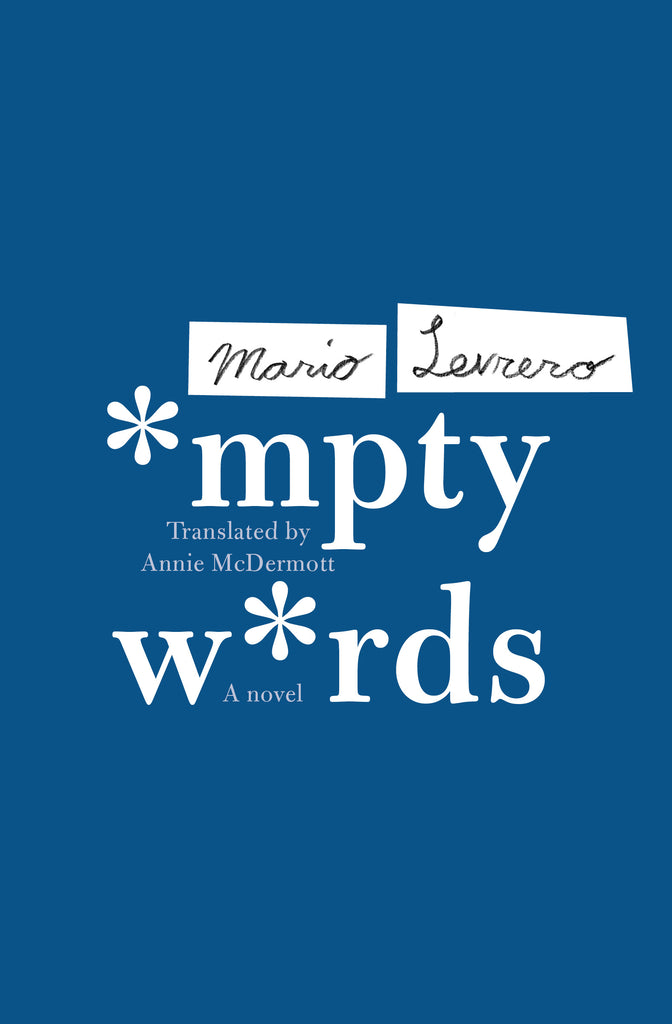
8/24/19

Mario Levrero - his writing, structured around humour and unease, takes the form of a clean prose based on the psychological that has been characterized as “introspective realism”. A cult writer, later in life he was seen as a master and point of reference for many of the best writers in Latin America

Image result for Mario Levrero Empty Words,
Empty Words by Mario Levrero 
Mario Levrero, Empty Words, Trans. by Annie McDermott, Coffee House Press, 2019.
excerpt (pdf)


An eccentric novelist begins to keep a notebook of handwriting exercises, hoping that if he’s able to improve his penmanship, his personal character will also improve. What begins as a mere physical exercise becomes involuntarily colored by humorous reflections and tender anecdotes about living, writing, and the sense―or nonsense―of existence.


“A lighthearted wisdom beats in every sentence of Empty Words, a little masterpiece by Mario Levrero, who is, to me, one of the funniest and most influential writers of recent times. This book might change your life, or at least your handwriting.” —Alejandro Zambra

“We are all his children.” —Álvaro Enrigue

Praise for Mario Levrero

“Levrero is Kafka’s ‘everyday’ flip side, a shadow of Camus with a comical take.” — El País

“Style and imagination like Levrero’s are rare in Spanish-language literature.” — Antonio Muñoz Molina

“Mario Levrero is a genius.” — Enrique Fogwill

“Levrero is an author who challenges the canonical idea of Latin American literature. If you really want to complete the puzzle of our tradition, you must read him.” — Granta

“Mario Levrero is the great discovery of the century for Latin American literature.” — Revista Eñe

“Reading him draws us into experiencing the order of the irreversible, we leave our reading and encounter another reality on account of the simple fact that something inside us has changed, that our way of seeing is no longer the same. The man who never died.” —Germán Beloso


A grumpy writer seeks to focus his mind with handwriting exercises in this charming novel, the first by Uruguayan author Levrero (1940–2004) to be translated into English. Frustrated by his “mindless, scattered days” of attempting to write amid the constant distractions of family life, Levrero’s narrator embraces “graphological self-therapy,” hoping that improving the legibility of his handwriting will translate into an improvement in “my concentration and the continuity of my thoughts.” But as quotidian events such as a maid’s abrupt departure and his partner’s desire for a new house continue to intrude, the narrator realizes that “these exercises are becoming less calligraphical and more literary.” He begins varying them with explorations of his dog’s conflict with a neighborhood cat and of his dreams, but those subjects prove even more distracting. The narrator’s histrionics over his mundane responsibilities may be laughable, but his anxieties and preoccupations are captured with such precision by Levrero that the reader will breathe a sigh of relief whenever the exercises resume after a stress-induced break. “Going back to these exercises is always a first step toward psychological health,” the narrator writes, and it’s hard not to be persuaded that clearly printing one’s S’s and G’s may just be the secret to a happy life, after all. - Publishers Weekly


A cult writer, later in life he was seen as a master and point of reference for many of the best writers in Latin America.

Levrero’s writing, structured around humour and unease, takes the form of a clean prose based on the psychological that has been characterized as “introspective realism”.
He is the author of an extensive body of literary work which includes journalistic writing (some of the best articles are to be found in Irrupciones I and Irrupciones II), short stories, novels and essays.
Levrero hated interviews and prologues. He was interested in self-hypnosis, believed in telepathic phenomena, read about Zen, was addicted to computers, loved science, hated being addressed in the “usted” form, could not abide solemnity in general, read detective novels even at breakfast. He was a lover of cinema.


I’m not sure when I first came across Mario Levrero. It was probably in the nineties, although it could well have been in the first few years of the twenty-first century. He was born in 1940 and started publishing in 1968. His work is made up of novels (most of them short), stories and a couple of hybrid books in which he mixes fiction with memoir, diary entries, essays and reflections on the process of writing.

The thing is, even before I’d read anything by him, Levrero’s name occupied a special place in my head: I knew he was a ‘strange’ writer, unclassifiable, with a boundless imagination, who was creating one of the most intriguing, thought-provoking bodies of work in the Spanish language. I also knew that his books were hard to get hold of (that is why, at this point, I still hadn’t read him), and I knew that he was from that tiny country from where some of the authors I hold most dear also come (Felisberto Hernández, Juan Carlos Onetti, Marosa di Giorgio): Uruguay.

Then one day, a book of his ended up in my hands at last. It was a short novel called Nick Carter se divierte mientras el lector es asesinado y yo agonizo (Nick Carter amuses himself while the reader is murdered and I expire). I bought the novel and read it in one euphoric sitting, although there was scarcely any need to read it at all; the title was sufficient. Nick Carter is a detective who is hired by an aristocratic Englishman (with a castle and everything) whose assistant lives inside a bag and spends his time folding little bits of paper. There are sea monsters and a nymphomaniac secretary from whom Nick Carter is never able to escape. What more do you want?

Immediately afterwards I read Dejen todo en mis manos (Leave everything in my hands), and I went mad (more so). The protagonist is a writer who, desperate for money, accepts a mission to go to a small town in Uruguay to track down the author of a brilliant manuscript sent to a publishing house with no return address. Once again it is a detective story, hilariously funny and, once again, one with a lot of sex (the writer falls in love with a prostitute).

Perhaps Levrero’s best-known book, and the one that many consider to be his masterpiece, is La novela luminosa (The luminous novel). La novela luminosa was written in a period when Levrero had received a Guggenheim Fellowship in order to write a novel that he does not write, the proof of which is the subsequent diary of the fellowship where he reflects on the most varied topics: his addiction to his computer, his nocturnal habits, the movements of the pigeons he observes from his window, his compulsive reading of detective novels, his relationships with women and his curious ideas about parapsychology (a recurring theme in his novels), among other things. Levrero is an author who challenges the canonical idea of Latin American literature. If you really want to complete the puzzle of our tradition, you must read him. - Juan Pablo Villalobos
Translated from the Spanish by Rosalind Harvey
https://granta.com/best-untranslated-writers-mario-levrero/


“The best part about Coffee House Press books is that they are often difficult to categorise, difficult to describe . . . because they are pushing the boundaries of form, language, syntax, genre, and so on,” says Chris Fischbach, publisher for Coffee House, in a recent interview with Asymptote’s Sarah Moses. Empty Words, the first book by Uruguayan author Mario Levrero to be translated into English (by Annie McDermott), fits this description to a tee. The premise is simple: the narrator, whose voice Levrero claims to be his own with some (potentially heavy) editing, is determined to alter his personality through altering his handwriting. Since, according to graphology, “there’s a profound connection between a person’s handwriting and his or her character,” surely altering one’s handwriting through diligent daily practice would bring about discernible changes in personality.

However, this intention is fragmented and repeatedly disrupted from the very beginning of the narrator’s exercises for two key reasons: external interruptions, and the repeated intrusion of “The Discourse,” an unintended literary by-product of his handwriting exercises “that won’t leave (him) alone.” The former is evident from the beginning of the diary/novel in “Part One: Exercises.” After two detailed goal-setting entries dated September 10 and September 11, 1990, the narrator is derailed only to return on September 24 “since (his) mother’s stroke took (him) away from home.” This serious disruption is coupled with an immediate distraction “in the form of a small, flustered woman calling to me in an angry voice.” The high and noble aims of these exercises which the narrator hopes will “catapult (him) blissfully into a life of happiness, joy, money, and success with women” are thus undercut almost immediately by the intrusiveness of daily life and family. This fragmentation continues over the course of several months as the narrator’s ailing mother continues to worry him, and his annoying wife and son, Alicia and Juan Ignacio, repeatedly distract him. His intentions to become as focused and as unrealistically solipsistic as possible are thus punctuated with mundane distractions, standing in comic juxtaposition with the narrator’s lofty ambitions.
A primary conflict that emerges in the first part of Empty Words is therefore the individual’s struggle for control, where the attempt to manipulate his handwriting acts as a microcosm of, or perhaps even an outlet for anxiety around, the powerlessness the narrator feels in his life. While the handwriting exercises are intended to be fully centred on calligraphy and “empty words,” the diary-like format of daily practice results in the narrator’s frustrations bleeding into his practice. Over time, his complaints centre around “this family (he) finds (himself) in,” presided over by Alicia, who he describes as “[a] fractal being . . . with a fractal pattern of behaviour.” The family is governed by a law the narrator formulates as: “Any movement toward a goal will immediately be diverted toward another goal, and so on, and the movement toward the original goal may or may not ever be resumed.” This is mirrored in the narrator’s own handwriting exercises, which are perpetually sidetracked by “subject matter” and literary material, reflecting a fractal/fractured psyche within himself that becomes more apparent as “The Discourse” emerges.
This brings us to “Part Two: The Empty Discourse,” in which the narrator’s writing is split into “The Discourse” and “Exercises.” The former essentially becomes free writing aimed at some therapeutic reconciliation between the Freudian ego and trauma or truth that the narrator believes is hidden from his conscious self by his unconscious. This takes place alongside the original “Exercises” featuring the ongoing battle between the narrator’s discipline and the chaotic nature of his household,  the family’s impending move to a new house, Alicia’s hyperactivity, and the appearance of a cat that baits the family dog with its comings and goings.
It becomes clear in “Part Two” that Empty Words is not really about the narrator’s attempt to reverse engineer the process of graphology, but is rather an insight, via introspective daily entries, into the embattled narrator’s struggle to come to terms with his present situation as well as the trajectory of his life thus far. Dreams and Freudian terminology receive frequent mention throughout the novel as the narrator struggles to get a hold on what it really is that bothers him so very much, creating immense psychological stress and physical degradation via excessive smoking and lack of exercise. This struggle for clarity through self-regulated therapy-by-writing is what makes “The Discourse” so compelling. Here, “empty words” become the narrator’s attempt to make sense of himself via words that come close to, but cannot really pin down, that unnameable “something” alluded to in the prologue:
“Something within me, which is not me, which I search for”
“Something
Which is close to love but not quite love,
Which could be confused with freedom,
With truth,
With the being’s absolute identity—–
But which can’t be contained in words”
While this “something” is un-signifiable through words, there are points in “The Discourse” where we get a glimpse into the probable causes for the narrator’s psychic discomfort. Initially, “The Discourse” focuses on the family dog, whom the narrator gradually liberates by slowly widening a hole in their backyard fence. The symbolic freeing of the dog through an eroding defense is compared to “another, psychological gap, which I’m also gradually widening with some kind of freedom in mind.” It is through this free writing that the narrator discovers a point of trauma and dissociation in his past, when he left Montevideo for Buenos Aires in 1985, a painful moment that resulted in a choice “to anesthetise myself instead.” Yet Empty Words suggests that this process may not necessarily be liberating, as the dog returns at one point with an injured eye and is found developing other erratic behaviours, like burying meat that eventually rots in the garden. Regardless, “The Discourse” stops some two months later, following the narrator’s glimpse of that “something,” when a chance encounter with a recording of Enrique Rodríguez’s tango orchestra gives him vital insight into his being. The narrator grows comfortable with the forgotten fragments of his life, claiming, “I’m not interested in finding answers anymore for a few moments I glimpsed those fragments of memory.”
True closure remains elusive, however, as the handwriting exercises continue in parallel to and beyond “The Discourse” in increasingly dishevelled attempts to enact some sort of control over the chaos in the narrator’s life. “Part Three” features a narrator increasingly detached from his exercises, becoming almost frustrating as he leaves large gaps between entries and describes  a “fragmented” mind “in the grip of a psychological paralysis.” Any curiosity of the reader’s to know more is deflected by statements like “I’m tired of being more specific, and I don’t want to repeat myself. After all, this is just a handwriting exercise.” Other issues annoy or provide the narrator with reasons to procrastinate, including a lack of a proper workspace, bad weather, the non-stop buzzing of a generator, and the usual disruptions of dog and family. Eventually, other distressing circumstances are revealed to the reader belatedly and without detail, as the narrator reflects on these events and is filled with a newfound, if vague, determination “to turn back toward myself” and “[return] to a normal life.”
Thus the narrative comes to a somewhat abrupt close as the narrator appears more stable and determined to move on in a positive fashion, having come to terms with the things he cannot change, “the consequences of things you’ve already done.” Whether this is satisfactory for the reader is a different question, as one eventually realises the paradoxes of the “diary” that is Empty Words. What is stranger than the narrator’s estrangement from himself is the foregrounded estrangement of the reader from the text, or any text, where words threaten to be “empty,” incomplete signifiers. We are not explicitly told why the exercises come to an end, or if they do at all, but are instead left with a text that operates as a metacommentary on writing as both “a tool for exploring the unconscious and a by-product of those explorations.” That this is done throughout with humour, self-deprecating yet sincere introspection, and poetic insights into the mundane life of the narrator is Levrero’s primary success.
Ultimately, Empty Words is a sufficiently striking full-length introduction of Levrero to the English-speaking world, as well as a not-too-serious reflection on the possibilities of writing and its relationship with internal and external worlds. That being said, as anyone who has read Levrero’s short story “The Abandoned House” in Asymptote’s Summer 2015 issue would know, his oeuvre has plenty more to offer in the surrealist, dream-like, genre-bending vein. I have a sense that Empty Words is only the beginning of the potential Levrero has for English-language readers, and am looking forward to more of his work appearing in translation in future. - Chloe Lim
https://www.asymptotejournal.com/blog/2019/07/11/that-unnameable-something-mario-levreros-empty-words-in-review/


This riddling novel is the English-language debut of the Uruguayan writer Mario Levrero (1940-2004). His translator, Annie McDermott, tells us in an introduction that he was an uncategorisable cult figure formed of omnivorous influences, from comic strips to tango music. “It’s a mistake to expect literature to come only from literary sources,” he told a rare interviewer, “like expecting a cheesemaker to eat nothing but cheese.”
Seemingly autobiographical, Empty Words (1996) is set between 1989 and 1991, taking the form of the diary of a depressed and overweight fiction writer with eczema. His mother has just had a stroke and his wife wants an expensive new house, which he’s hoping to fund with a pay rise from his job, setting crossword puzzles.
When a friend says handwriting exercises might help him feel better, he ditches his typewriter for a pen and sets about making his crabbed script more uniform and free-flowing, without pausing to worry what his words mean. “I know these daily exercises will do wonders for my health and character... catapulting me blissfully into a life of happiness, joy, money, and success with women and in other games of chance.”
There’s a dry humour here. In his entry for 6 October 1990, he pats himself on the back for keeping up his regime; yet the previous entry is dated 4 October. “I think the antidepressants are starting to do something,” he says later. “I’m definitely noticing the side effects, anyway.” His plea for a pay rise gets him fired, by alerting his bosses that they’ve been overpaying him.
In 1990, Uruguay had only recently surfaced from more than a decade of military rule, a period in which torture, political imprisonment and disappearances were commonplace. It’s probably no coincidence that, while Levrero’s narrator craves meaning-free prose, concentrating only on each letter’s strokes and loops, he still finds himself haunted by the years between 1985 and 1989, when he suddenly left the country for Argentina, for reasons kept hazy. “A vague narrative relating to a war and various soldiers or policemen I had to hide from” features among his recurring dreams, some comically erotic, others plain surreal.
At the same time, his travails could belong to any writer, scorning interruption while secretly craving it; his teenage son, (“he’s seen his name written down and wants to know what this is all about... so I write: Juan Ignacio is a fool”), his pet dog and the noisy electricity substation next door are among various things enabling his inactivity. Despairing of “an environment where everything colludes to make you aim low”, he resents being “bound by the omnipotent will of a woman who is in turn completely bound by social conventions”: his wife just wants to celebrate Christmas.
McDermott tells us that, in his first novel, The City, Levrero set out “almost ... to translate Kafka into Uruguayan”. I half-wondered if Empty Words was his shot at Thomas Bernhard; in particular, the Austrian’s 1982 novel Concrete, about another sickly procrastinator blaming all and sundry for his inability to finish a book, although Levrero – at least on this evidence – feels the sunnier writer, relishing the mundane comedy of household dynamics as much as more cosmic jokes of existence. Just as you’re wondering where it’s all going, a last-minute revelation concerning the narrator’s mother confirms a lingering suspicion that the real action in this teasing jeu d’esprit lies between the lines, not on them, as the writing itself begins to look like a form of displacement activity.
As a calling card for Levrero’s talent, it’s certainly enticing. Next up, we’re told, is The Luminous Novel, which contains “a 450-page prologue explaining why it was impossible to write the book itself”. Can’t wait. -
https://www.theguardian.com/books/2019/jun/30/empty-words-mario-levrero-review-uruguays-kafka


Immerse yourself in the literary culture of Latin America and it will not be long before you encounter the following observation: Chile ­produces poets, Mexico produces novelists, Argentina produces short-story writers, and Uruguay produces los raros – the strange ones.
There can be exceptions to such statements , but th e translation of Empty Words (originally published in Spanish in 1996, and now available in English for the first time) lends the final clause of the proposition an undeniable force . Here is a book that introduces us to a Uruguayan author Mario Levrero , who died in 2004 and a raro of the first degree.
His novel chronicles the efforts of a writer (similar in many respects to Levrero himself) to elevate his character by embarking on a series of daily exercises designed to improve his handwriting. The book’s unnamed narrator works from his home in Uruguay’s Colonia del Sacramento , where he endures the passing of the “depressingly oppressive” seasons in the company of “a woman, a child, a dog and a cat” and “a big invisible clock [that] marks the same time for every day, every month, every year” . He charts the evolution of his project by recording in a series of diary entries the concerns, setbacks and progressions generated by his foray into calligraphical refinement.
The motives come from the recognition that he has been living for some time in a sorry psychological state, often waking to a sense of metaphysical unease . “ For too long now – too many years – I’ve been living outside myself, concerned only with what’s going on around me ,” he says.
In order to combat this sense of self-alienation, he wonders if devoting himself ­assiduously to the craft of penmanship, and stripping his writing of all literary concerns, might enable him to make a journey inwards in a quest to find the elusive essence of his being.
As the narrator journeys towards his inner self – “the miraculous being that lives inside me and is able, among so many other extraordinary things, to fabricate interesting stories and cartoons” – he striv es to become the artist of his own destiny . He finds himself distracted by the presence of his lazy son , who keeps dropping by for chats about romance , and worries that his attempt to divest his writing of novelistic concerns is showing signs of failing.
These exercises are becoming less calligraphical and more literary as time goes on; there’s a discourse – a style, a form, more than an idea – that won’t leave me alone, and it’s getting the better of me ,” the narrator says. What he means is that, despite his best efforts, another kind of text is fighting its way on to the page , a text to do with time, emptiness, anxiety.
None of this is as daunting as it sounds. Levrero writes, on the whole, with lightness, economy and precision, and throughout the book the predominant tone – beautifully captured by Annie McDermott’s elegant translation – is one of appealing curiosity and bemused wonder. Although there is little here to engage with in terms of plot, barely a page goes by without the reader encountering a charming phrase, observation or moment of humanity.
Often these moments contain a humour that is dry, deadpan, sardonic or possessed of a peculiar kind of pathos, as when the narrator opens a diary entry by wryly assuming that the record of his humdrum activities is already assured of posthumous fame . “Allow me to record, so it’s known in the centuries to come, that I am writing this at 8:30 in the morning .”
A similar moment comes when he remarks upon his ongoing battle to master the mystifying workings of his computer . “The problem of making sounds on the computer is still plaguing me ,” the narrator says.
In addition to these lovely moments, Levrero also offers moving reflections on what his narrator calls “the magical influence of graphology”. “Big writing, big me. Small writing, small me. Beautiful writing, beautiful me .” It shows an aptitude for giving a voice to his thoughts in a manner that is edifying, memorable and affirmative.
In such formulations, time is characterised as a phenomenon that permits us the luxury of enjoying while we are alive “the cold that awaits us in the tomb that bears our name”.
To reconnect with your inner being is to make contact with an entity that is “ part of the divine spark that roams ­tirelessly through the universe”.
Not all of Levrero’s prose is so stirring: he has a weakness for dead expressions such as “blissfully unaware” and “time, the great healer”. But these do little to diminish the force and freshness of the book as whole. Redemptive, enlarging, poignant, humane – it is a testament to the value of the strange. - Matthew Adams
https://www.thenational.ae/arts-culture/books/book-review-empty-words-is-redemptive-enlarging-poignant-and-humane-1.871456


I’m writing this review by hand, something I rarely do. No matter how hard I try, I find it impossible to write legibly, let alone beautifully, and my handwriting has been this bad since at least high school. But if I’m to follow the example set by Mario Levrero, I should try my best not to get distracted from the task of handwriting.
Empty Words is the first novel to be translated into English by the Uruguayan author Levrero (1940-2004). Originally published in 1996, the book follows the attempts of the narrator (a stand-in for the author who, for the purposes of this review, I’ll call Levrero) to improve his handwriting through daily writing exercises. He hopes this “self-therapy” will help him improve in other areas of his scattered life, but when he sits down to his exercises, he can’t help but be distracted. Noise, heat, life responsibilities, family members, pets, and his own mind all conspire against him. He records these distractions, incorporating them into the exercises, although this results in a contradiction: without the distractions, Levrero would supposedly be happier, but the book would be less interesting. He writes: “If I want my handwriting to be good, I can only write about my handwriting, which becomes very monotonous. But writing only about my handwriting keeps my mind on what I’m doing and means I form the letters properly.”
Empty Words contains two threads: the handwriting exercises (complete with distractions) and what Levrero calls “The Discourse,” which has the stated aim of being about nothing. These two threads are interspersed throughout and every entry is dated. In the “Discourse,” Levrero believes writing about nothing will eventually reveal something authentic. “There’s a flow, a rhythm, a seemingly empty form; the discourse could end up addressing any topic or idea.” As with the writing exercises, the rules here are strictly limiting. Seen another way, they are freeing. By throwing off the burden of an idea, Levrero can follow his “Discourse” wherever it takes him. He quickly turns to his dog, Pongo, as subject matter. “It’s false content,” Levrero writes, “or perhaps semi-false, since, like all things, it could easily be seen as symbolic of other, deeper things.”
Levrero writes about gradually pushing open a gap in the fence so that Pongo could escape. When the dog returns from its disappearance with a bad eye injury, the author is overwhelmed with guilt. But what did he expect? Throughout the book, Levrero demonstrates a habit of falling into his own traps. It might be that Levrero focuses so much of the “Discourse” on the needy and neglected Pongo because he sees so much of himself in the dog. If he notices this parallel, he doesn’t say. The author admits to being afraid that the reader “who isn’t me would have already have found something of the true content of the discourse in these lines. . . . How humiliating to give myself away to the reader before I’ve given anything away to myself, blissfully unaware that anything’s been given away at all!”
When Levrero turns his attention to an impending move, his anxiety ratchets up, and when he moves into the new house and notices a nearby electric substation that won’t stop buzzing, he feels even worse. In response to this and other frustrations—including the demands of his nagging child Ignacio and his partner Alicia, who he thinks doesn’t understand his decision-making process—he retreats into his exercises: “Concentration. Relaxation. Focus on forming the letters and focus on your muscles.”
Given how unhappy he is with his surroundings, why doesn’t Levrero pack up and leave? Is he afraid of returning, like Pongo, with some injury inflicted by the outside world? “When you reach a certain age, you’re no longer the protagonist of your own actions: all you have left are the consequences of things you’ve already done,” he writes. “I can’t get free of the tangle of consequences, and there’s no point trying to be the protagonist of my own actions again, but what I can do is find my lost self among these new patterns and learn to live again, only differently.”
What I’ve written down is barely legible, especially the letters g and r. I wasn’t able to concentrate on forming the words because I was too distracted by the difference between Mario Levrero and the character Mario Levrero created of himself. On the bright side, there were no interruptions. - Adrian Glass-Moore
https://www.raintaxi.com/empty-words/


The sweetly daffy narrator of “Empty Words” is comic stand-in for its Uruguayan author, sharing a wife, son, dog and professions: novelist and constructor of crossword puzzles. In order to improve his character and find fulfillment, happiness and money, he embarks on the discipline of “graphological self-therapy.” In other words, words as beautifully crafted handwriting. One could see it as a cerebral KonMari method of decluttering the mind. And so begins a heroic if batty effort at meticulous form devoid of content.
It is, of course, impossible not to make sense when using words with dictionary meanings in grammatical sentences. But the narrator wages a guerrilla war on meaning by constantly harping on the act of writing and questioning its relation to physical reality. He will say one thing and immediately contradict himself. For example, one has to have beliefs, expressible in words, “Which means that to get anywhere in life, you have to believe in something. In other words, you have to be wrong.”
What results is a very funny satire on the realistic novel with its emphasis on character development, progress from one point to another, big themes of love and hate, life and death and so on.


Nothing develops here, and important matters, such as the narrator’s relationship with his wife and son, his fraught relations with his mother — who dies in a brief, passing mention — are treated as peripheral topics or elided altogether.
The continuity of the realistic novel is torn into bits of interruption. Wife and son appear in the doorway to ask him to do something and he bats them away as he concentrates on forming the letter G.
A murder warrants only a brief mention as he worries about the best way to form an X.
So what increasingly gets his attention are trivial matters. He notices passing aches and pains, the effects of changing weather on his body, the increasing dust and chaos around him as he and the family move from one house to another. Star billing goes to the dog Pongo and his mysterious comings and goings, and the choreography of his relations with the cat.
The more our man flails against imposing a verbal order on his life, the more chaotic his circumstances become. But underneath the willed nonsense, a sly philosophy of language presses more and more against the feverishly jaunty surface. More and more, the opaque, mostly illogical narratives of his dreams obsess him, and he runs up against the fundamental question of the self. Is there such an entity outside of words? What kind of narration comes closest to translating self and world?
Ironically, Mario Levrero’s brilliant little tour de force, first published in 1996, is an extremely realistic book. It captures the daily self-interrupting chatter of the mind which goes hither and yon, notices odds and ends, does not narrate from a beginning to middle and end. What makes us on a daily basis is not tragedy or even pain, nor sparks of joy. It is thinking about where I left my keys, dreading that interview, wondering if there are enough potatoes for dinner, sighing at the rain.
- Brigitte Frase

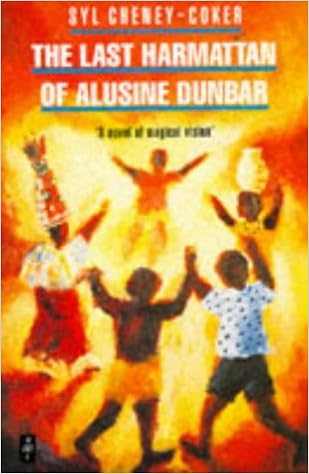
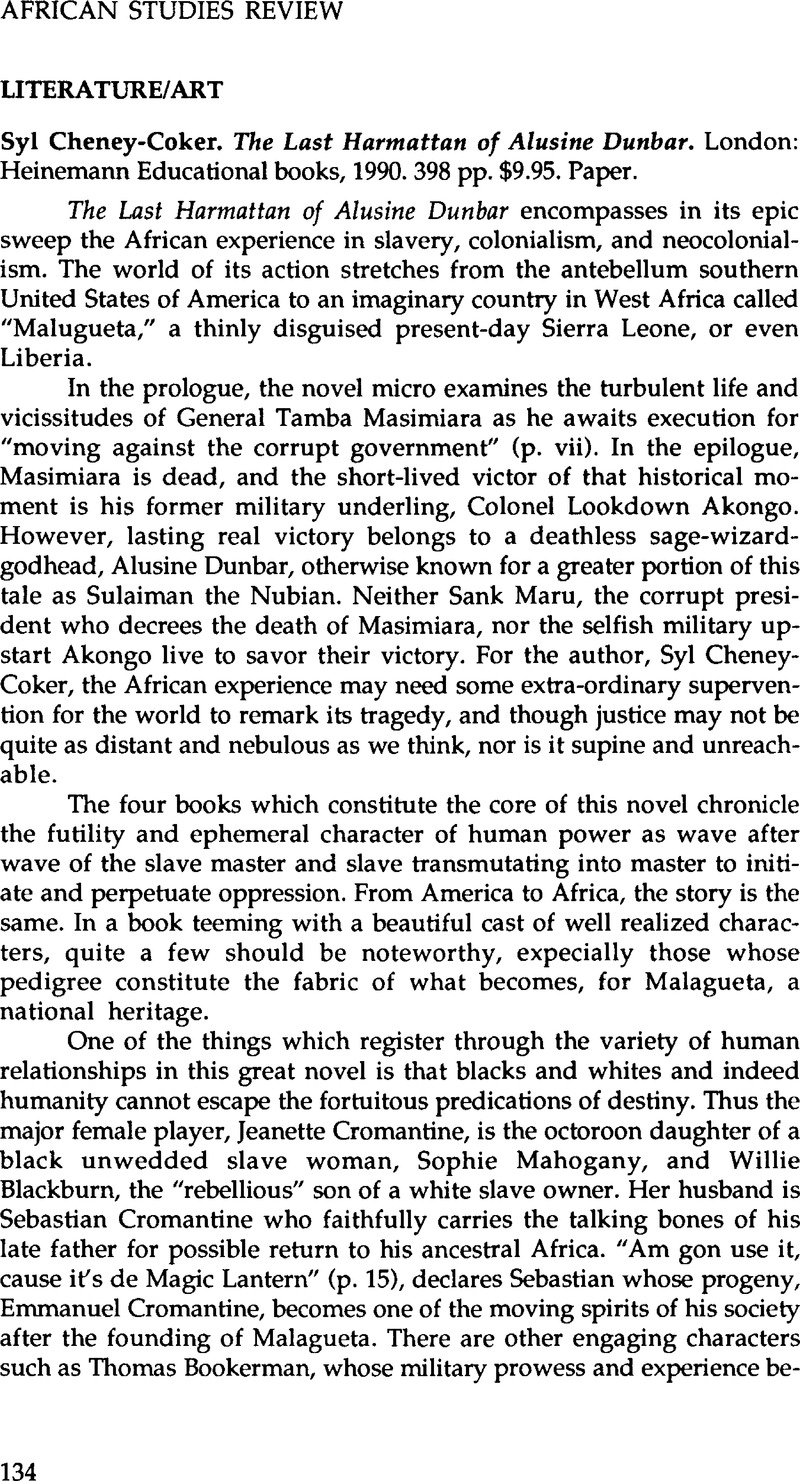
Syl Cheney-Coker - In a chimerical world of illusion and truth, fired by a language that challenges the imagination, this book tells the story of a Sierra Leone-like country, from the time of the freed black American slaves who returned to Africa

Slikovni rezultat za Syl Cheney-Coker, Last Harmattan of Alusine Dunbar
Syl Cheney-Coker, Last Harmattan of Alusine Dunbar: A Novel of Magical Vision , Heinemann, 1990.


In a chimerical world of illusion and truth, fired by a language that challenges the imagination, this book tells the story of a Sierra Leone-like country, from the time of the freed black American slaves who returned to Africa.


Pioneering former slaves from New World plantations, Englishmen, Arabs and natives marry and murder in this passionate epic history of the small town of Malagueta on the Atlantic coast of Africa. Covering two centuries, the tale ends with a modern-day failed coup. The harmattan, a dust-laden wind that sometimes blows in the area, comes to symbolize the misfortune of the town's inhabitants as it grows, prospers and is finally ruined by disaster in an unavoidable, bittersweet cycle of events first prophesied by the legendary Sulaiman the Nubian. Renamed Alusine Dunbar in his active afterlife, in which he occasionally returns to Malagueta, Sulaiman develops testicles with vision, which hang to the ground. This first novel by West African Cheney-Coker is full of such unusual occurrences, but in the tradition of magical realism, a sense of history and psychological drama make the story believable. The riveting skeleton of the narrative is often slowed, however, by fatty adjectives and verbiage, and tired metaphors (such as "the floodgates of her desires") sometimes mar the otherwise titillating love scenes. - Publishers Weekly


Magic realism is all too often restricted in its use to Latin American writers like Gabriel García Márquez. However, there are many other examples, from Salman Rushdie to Italo Calvino. Syl Cheney-Coker, in this novel, produces a first-class example which can compare favourably to those of the Latin Americans and others. His novel tells nothing less than a the history of an African town (and the surrounding area) from its early settlement by (black) immigrants to its present-day, post-colonialism under a ruthless and exploitative dictator. But the story is not a conventional historical novel but a magic realism story. Though he focuses on the development of the town, he is far more interested in the magic behind the story – the magic of the people and the magic of the place and his gift is to make this a convincing story but also a beautiful one. The only mystery is why this book is so little known and why it is out of print.
It starts with the present, as a general awaits his execution in a prison for planning a revolution against the current despotic dictator but then soon jumps back to the arrival in Malagueta (the name of the town) of Jeanette Cromantine, wife of a former slave. It then jumps further back to Sulaiman the Nubian (an approximate anagram of which is Alusine Dunbar, the name he later adopts), the half man, half sorcerer who predicts what will happen to Malagueta (good and bad) and influences some of the developments, not least through his magical, though herniated testicles. - The Modern Novel
read more here


Slikovni rezultat za Syl Cheney-Coker, sacred river
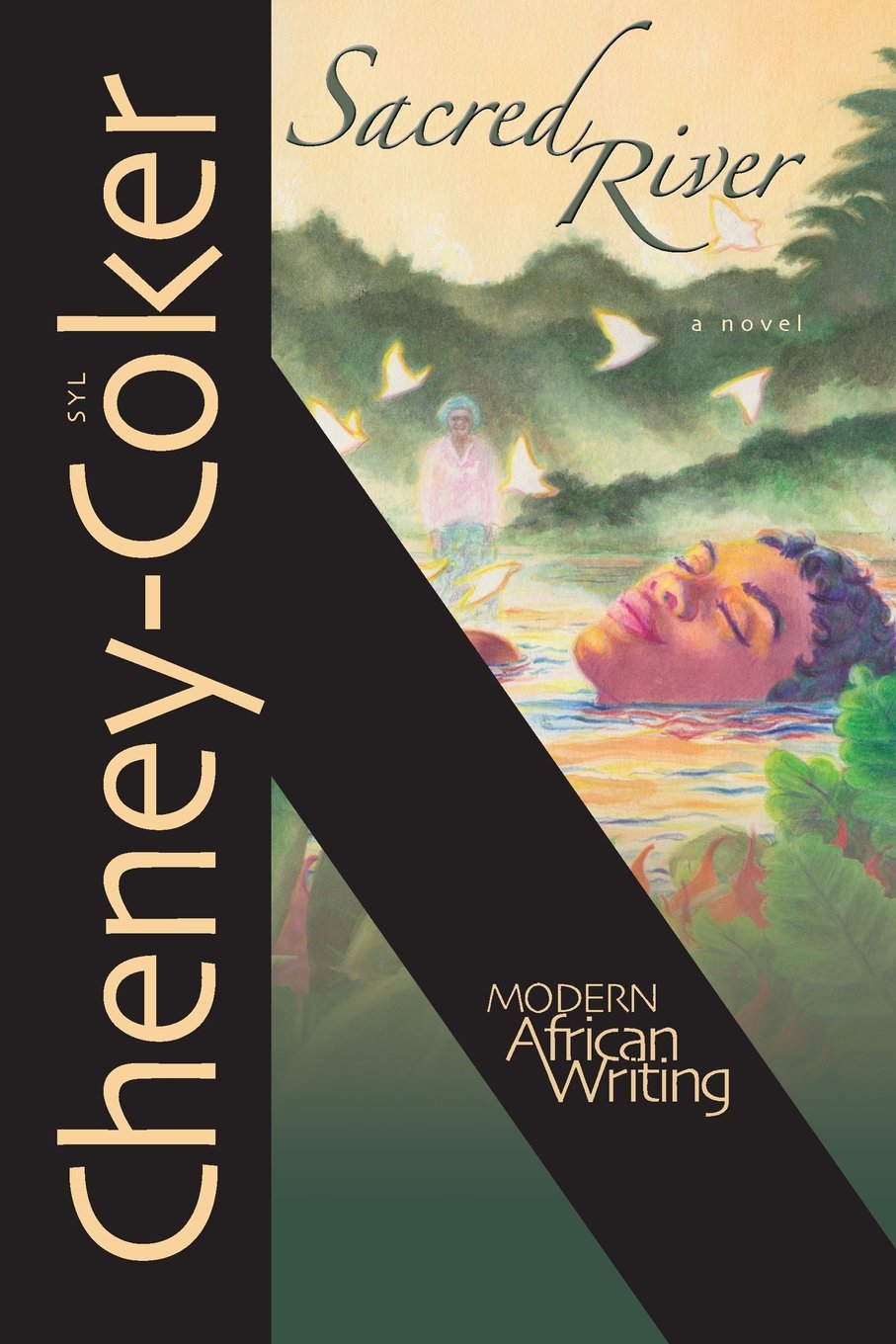
Syl Cheney-Coker, Sacred River, Ohio University Press; Reprint edition, 2014.


The reincarnation of a legendary nineteenth-century Caribbean emperor as a contemporary African leader is at the heart of this novel. Sacred River deals with the extraordinary lives, hopes, powerful myths, stories, and tragedies of the people of a modern West African nation. It is also the compelling love story of an idealistic philosophy professor and an ex-courtesan of incomparable beauty. Two hundred years after his death, the great Haitian emperor Henri Christophe miraculously appears in a dream to Tankor Satani, president of the fictional West African country of Kissi, with instructions for Tankor to continue Henri Christophe’s rule, which had been interrupted by “that damned Napoleon.”
Ambitious in scope, Sacred River is a diaspora-inspired novel, in which Cheney-Coker has tackled the major themes of politics, social strife, crime and punishment, and human frailty and redemption in Malagueta, the fictional, magical town and its surroundings first created by the author in The Last Harmattan of Alusine Dunbar, for which he was awarded the coveted Commonwealth Writers’ Prize. Sacred River is equally about love and politics, and marks the return to fiction of one of Africa’s major writers.


Sacred River is a novel of epic proportions powered by a microscopic gaze and magisterial sweep. Told with pain and passion, withering wit and satiric humor, this is a tale of these and other times: thronged, sensuous, cerebral, and visionary in the most unpredictable ways. There is magic in the telling, a magic wrought from the myths and legends of the African world, and facts which belie the strangest fiction. Sacred River reads like a magnificent poem with multiple chapters. A truly virtuoso achievement.” - Niyi Osundare
“The novel fits easily into the post-independence disillusionment novel canon along with Achebe’s A Man of the People, Armah’s The Beautyful Ones Are Not Yet Born, and wa Thiong’o’s Wizard of the Crow.” - African Studies Quarterly
“Syl Cheney-Coker’s beautifully written book explores life in a fictional West African country in all its pain, spirituality, and glory. The poetic lilt of the sentences combined with intertwining stories of suffering, hope, and historical allusions make for a breathtaking and thought-provoking read.”  - World Literature Today
“The promise and problems of postcolonial Africa mix with a rich tradition of mythology and magic in this sequel to The Last Harmattan of Alusine Dunbar (1990)…. Readers of this work, part of the publisher’s Modern African Writing series, will be reminded of writers such as Gabriel García Márquez and Salman Rushdie.” - Booklist
This innovative epic by Sierra Leone native Cheney-Coker (The Last Harmattan of Alusine Dunbar) is firmly set in West Africa and features magical realism grounded in native myth. In the fictional capital city of Malagueta, Tankor Satani, a 65-year-old ex-dogcatcher, is inspired to seize power by his potent dreams of Haitian independence leader Henri Christophe. The extravagant, violent, and politically cagey Satani constructs a hilltop mansion he dubs Xanadu to insulate himself from Malagueta’s poverty and civil unrest. The pervasive influence of West African legends emerges in Satani’s sorcerer-eunuchs, his bizarre dreams, and his theft of a mermaid’s golden comb, which magically ensure his good fortune. This sprawling story describes Satani’s eventual death, when his “magic plane” crashes into the sea and the mermaid, in the guise of a barracuda, devours him; it also tells of his successor, General Dan Dogg, who, like Satani, enjoys an opulent lifestyle underwritten by the wealth generated by the local diamond industry. The central figure of the latter part of the book is 16-year-old Yeama Iskander, who represents a new generation seeking to effect social change as a brutal insurrection in a neighboring country spills across the border and Malagueta is threatened with destruction. Despite the perils facing the city, Yeama refuses to abandon her homeland for the security of Senegal. Cheney-Coker’s sweeping tale climaxes with the “sacred river,” the spiritual center of the story, offering Yeama its healing and rejuvenating powers. - Publishers Weekly


 Sacred River is set in the fictional West African nation of Malagueta, and in an Author's Note prefacing the novel Cheney-Coker avers that his story is: "a work of fiction, although some of the events are set against the background of recent political history in the region where Malagueta is located". He offers the usual claim that: "Any resemblance to actual people, dead or alive, is purely coincidental", too, and yet there's no way around seeing Sacred River as a close -- if very creatively respun -- history of Sierra Leone in recent decades.
       Malagueta is a small, diamond-rich West African nation of only about five million souls (roughly Sierra Leone's population at that time) and has suffered a similar history as its real-life counterpart. Malagueta was (mis)ruled by Tankor Satani (with his devilish name) for roughly the same period as Sierra Leonean president (from 1971 to 1985) Siaka Stevens was in office (though at least Cheney-Coker imagines a different fate for the retiring president's alter ego). The fates of several of Steven's underlings, associates, and opponents -- notably minister of finance Mohamed Forna -- are also mirrored in the story. And while Tankor Satani is the dominant figure for much of the book, he's washed off-stage for its final parts, and the brutal events in neighboring Bassa (a thinly-veiled Liberia) also spread to Malagueta. (As in Liberia, Bassa finds its ruler, President Kangoma (William R. Tolbert, Jr.) overthrown by "Sergeant-turned-General Sey Warawara" (Samuel Doe), only to be overthrown a decade later by the brutal Judas Sampata (Charles Taylor -- and like him: "a deserter from U.S. justice").)
       Events and personalities provide a strong framework for Cheney-Coker's novel, but this is not realist historical fiction, as instead the author impressively builds on these in essentially demythifying them through the use of traditional stories, traditions, and beliefs. Cheney-Coker's portrait of Tankor Satani -- a man occasionally visited by the spirit of self-styled Haitian King Henri Christophe and a mermaid -- is a corrupt and decadent but ultimately also very small man, of peculiarly petty, blind ambition.
No, he was not corrupt. It was worse than that. He was an empty shell of a man, someone not driven by an uncontrollable passion to possess people, to control them.
       He builds a ridiculous Xanadu, "the biggest example of presidential architectural madness in the whole subregion" until "his brother-presidents built a huge basilica in the Côte d'Ivoire" -- but it is ill-fated, "a grove of the dead". Tankor Satani goes all out in setting up a "Versailles-like convention", but his claims for posterity continue to fall short. Cheney-Coker's portrait -- as also that of several of the other figures, from the eunuch Pallo to the strong female figure of Habiba Mouskuda -- impresses, built up over the course of the story rather than simplistically laid out from the first for the reader.
       While Tankor Satani is the major figure for much of a Sacred River, the novel suffers some from a lack of focus. Despite his prominent role, it is is far from just Tankor Satani's story -- and the storylines of the many other significant characters largely move too tangentially to his own to make for a sene of a larger whole. Oddly, too, Malagueta -- which could be the core of the novel -- isn't given enough space of its own, and so, despite being a nation-chronicle of sorts doesn't come to feel like a true national saga.
       A page at the end of the book lists the dates and places of its writing -- recording it as begun in Sierra Leone in 1991-93 and completed in December 2005 (and then revised in 2012) -- and it has the feel of a book that has been too worked over. The writing is often remarkable, the individual chapters very strong, and yet there's a clear sense of the forest having been lost for all the trees. As the dates suggest, whatever Cheney-Coker's original conception was (presumably a fiction focused entirely on Siaka Stevens's years in power), it changed as history continued to unfold in and around Sierra Leone (hence the distinctly appendage-like latter parts of the novel dealing with the post-Tankor Satani years in Malagueta), and he never quite managed to pull it all together.
       In his Author's Note Cheney-Coker also explicitly distances himself and his writing from: "that intellectual humbug called 'magical realism'", arguing also:
African writers really have no use for so-called magical realism because our lives, contrary to other people's misconceptions, have the pulse and sense of the magical on a day-to-day basis.
       One can understand his wish to not be labeled by a term that has been twisted and warped in so many ways as to render it near-useless, but its worth noting that in its writing, incidental detail, and understanding and presentation of the characters Sacred River compares -- and compares favorably -- to the work of Gabriel García Márquez (while avoiding the various excesses of many of his Latin American imitators). Sacred River is rooted firmly enough in the West African -- and, indeed, in Cheney-Coker's own myth-making ("Malaguetans had not really lost their capacity for magic since the fantastic days of Alusine Dunbar" -- a reference to his earlier novel) -- that he shouldn't have to worry about being lumped together with other 'exotic' works under a (completely) worn-out designation like 'magical realism' . (Perhaps it's meant to serve as a warning to critics and reviewers; it didn't work with Publishers Weekly, where they promptly slapped the label on .....)
       Sacred River is a strong work, and an often wonderful read, even as ultimately it is not entirely successful (as an entirety). - M.A.Orthofer
http://www.complete-review.com/reviews/sierraleone/cheneycoker.htm

H. L. Humes - Scientist, novelist, activist, inventor, filmmaker, architect, prophet, healer, and madman Harold L. 'Doc' Humes was, by all accounts, an exhilarating, infuriating and terrifyingly brilliant man

Slikovni rezultat za H L Humes, The Underground City:
H. L. Humes, The Underground City: A Novel, Random House, 2007. 
The Doc Humes Institute
read it at Google Books


Back in print after nearly fifty years–the acclaimed fiction debut of novelist H. L. Humes, co-founder of The Paris Review


“Immensely intelligent and energetic, intensely dramatic and melodramatic, heroically overwritten yet sharp, insightful, and precise, The Underground City is an astonishing book by a writer of abundant gifts whose resurrection is long overdue.” –Peter Matthiessen


It is the late 1940s and Paris is in turmoil. A man named Dujardin is sentenced to death for treason, sparking general strikes and threats of riots across the city. In the meantime, John Stone, a war-weary American and former secret agent, finds himself being investigated as a suspected Communist. What has brought these two men to their fates? H.L. Humes spins a thrilling account of the French underground during the last years of World War II, and the events that lead to the Dujardin affair. His many memorable characters include Adriane, loved by both Stone and Carnot, a fanatic Communist; Bruce Sheppard, the American ambassador to France, a statesman of vision and compassion; and Solange Récamier, the sophisticated young Parisian widow who finds meaning in trying to salvage Stone’s broken life.

The Underground City displays H.L. Humes’s youthful literary skill and a striking capacity for fast-paced narrative. This is a brilliant tour de force.


“A major achievement . . . [The Underground City] attains its full stature in poetry and truth. . . . [This is a] many-sided, absorbing novel, written on a grand scale, that holds the reader’s attention from the first to the last of its many pages.” New York Herald Tribune


“Magnificent . . . [The Underground City] has verisimilitude and scope, action and depth of emotion.”Chicago Tribune


“A work of power, maturity and distinction.” Newsweek


A great amorphous novel, this, in which a newcomer to the field of fiction attempts too much, and achieves a rather confused melodrama with political implications. There's the making of three books here:- one, the story of the baffling resistance forces in southern France, when friend scarcely knew friend from enemy, when the De Gaullists and the Communists worked often at odds, when help from the English, from the Americans ended in supplying the wherewithal for civil warfare; two, the story of the Dujardin affair, built up by the Communists after the war's end to augment anti-American feeling, and to involve in suspicion some against whom they wanted to take action; three, the story of Stone, former American O.S.S., whose first hand witness against Dujardin made him a target for suspicion, a subject of investigation in Washington, and a man no longer able to fill a job anywhere- a victim of his own earnest desire to serve. The author falls of his own weight of material into confusions that baffle the reader. He drags too many polemics into his dialogue, turns what might have been straight adventure with a cynical commentary on the wages of valour into now a defense, now an attack, on attitudes engendered by the war. At times it makes exciting reading, but the finale leaves a bad taste in the mouth, and a sense of excess of matter smothering what there is of distinction in the manner.  - Kirkus Reviews


Humes’ novel opens in post-war Paris. Dujardin, a former collaborator, has been on trial for his alleged role in a massacre of a French village during the War. Major John Stone, an American, testified against him and he was condemned. Stone, born Giovanni Sasso (which translates literally as John Stone) in Trenton, had two talents as a child. He was a very competent linguist and a skilled cellist. When he won a cello competition, he was sent to Paris to study. He returned home when his mother was ill – she died before he arrived home and he stayed there, even after his father lost everything in the Wall Street Crash. He gave up his music though, after studying and becoming a teacher, he took it up again as a high school bandmaster. When France fell to the Germans, he joined the army. After the war he worked in France for the US Graves Commission, as a civilian.
The novel starts both with the Dujardin affair and Stone’s background. Dujardin had allegedly been responsible for the massacre of an entire village. He had been arrested by the Americans and confessed. His trial was straightforward and he was condemned. However, he later claimed that the confession had been beaten out of him by the Americans. -The Modern Novel
read more here


h. l. humes–harold Humes to the FBI, Doc to the rest of us–published two novels in the late fifties before going crazy. The Underground City, 755 pages on France’s occupation and postwar paroxysms, made him a literary star, but as his mind left this world, so, seemingly, did his work. When Humes died in 1992, The Underground City had been out of print for thirty-four years.
It seemed too ignoble a fate for the man who cofounded The Paris Review, especially given the recent revelation that Humes’s paranoid complaint–that the CIA was closing in on him–was sorta-kinda true: Peter Matthiessen, one of the other PR founders along with George Plimpton, was a CIA agent. Which isn’t to say he spied— Matthiessen claims he used the CIA to pay for plane tickets to Paris–but it was the final cut on Humes’s thin tether to reality. The author spent the rest of his life holding forth in college quads, dismissed as a beatnik burnout.
The Underground City was recently republished, and it deserves to be followed. Though populated by spies, turncoats, reporters named Striker and agents named Stone, the novel uses espionage the same way Matthiessen used the CIA: for a free trip to Paris. The plot circles around the case of Dujardin, a French officer who slaughtered an entire village to impress the German occupancy. At the novel’s outset, a year after the liberation, Dujardin is on trial for war crimes, and the French Communist party has opportunistically taken up his cause, arguing that he is really a patriot being martyred by the United States, which wants to maintain control over France because they’re, like, imperialists. Enter Agent Stone, Code Name Dante, the sole survivor of the massacre and the only one who can impugn Dujardin. Stone becomes a scapegoat for the Communists and a patsy for the Americans, and is burdened by the infidelity of his own memory. In the moral bedlam that followed World War II, which saw the world imagine punishments for unimaginable crimes, Stone personifies the problems of knowledge and truth, and the ways both are manipulated by those who seek to claim or maintain power.
That’s the first third, anyway. The meat of the novel is a four-hundred-page flashback that follows Stone/Dante on the lead-up to the massacre. Stone functions less as a character than a proxy, sneaking us through the streets of Paris and the fields of France to more interesting fare: the wonderful Carnot, a Communist spy who skirts the blurry line between idealism and efficacy; Ambassador Shepphard, a statesmen given to autumn musings on life and war; and his estranged son Berger, who is, inexplicably but delightfully, a French monarchist trying to return the Louis line to the throne. To name just a few: Humes’s novel is huge, not just in page count but in seating capacity. One of its joys is the room it makes for bit players, who function as foils for the subterfuges of the main characters. In one memorable scene, Stone and Carnot argue over the fate of the French populace while Henri, the loutish brother of an operative, is locked in a closet to keep him from the booze. The stage directions are subtle, but their implications unavoidable: a world war is waging over the right for Henri to drink a bottle of burgundy a night, but those who claim to fight on his behalf don’t even let him in on the discussion. It’s enough to make a guy like Henri get drunk, ruin their operation, and never appear in the novel again.
Needless to say, much of this doesn’t add up to anything. Humes is interested less in the intricacies of his plot than its forward momentum, and the book blows by in big bursts of prose. For instance, here comes a plane:
As it approached it increased until its hugeness made it seem that it would surely fall. The winglights swept over the brown winter grass and came rippling toward the paved runway, as the machine felt its way down, the beams sweeping onto the wet pavement as the plane roared closer, flaps down, braking hard against the sluggish air; as it came toward the administration building its silver size and speed suddenly became real. Eating up the distance in seconds, it roared down the fleeting length of airstrip and swept immensely past the tiny group of men, one huge wheel glancing the earth a smoking kiss. The wings lurched slightly and lifted with the bounce; then there was a final yelp of rubber, and big plane was down. Overhead, the passenger flood lights went on, bleaching the staging area in brilliant white light.
And that’s just a plane landing. Any writer who can bring something out of the sky and set it down like that has earned the right to prattle on about man’s place in the universe for forty pages at a time, which, don’t worry, Humes does.
Alas, as a street protestor warns, MEN DIE. Humes dispatches most of his characters with dignity, but the more he pushes eastward, towards a different scale of death, the less all of his philosophical gobbledygook comes off as charming. Humes only glances at a concentration camp, in a sub-drama involving a Jewish spy Stone may or may not have impregnated, and runs away before he really sees anything. For a novel so portentous in its musings on men’s fate, this squeamishness at the camps is cowardly.
A lesser book would have been ruined by it. Humes recovers, and though the novel’s last third is knotted by the inevitable tying of loose ends, he still finds time to take a grand drunken tour of the Paris sewer system. Wading through the organized excrement that flows beneath the city could have left the reader holding his nose at the symbolism, or knee-deep in Virgilian allusions. But Humes just lets us enjoy this unusual ride. The section is a novella in-and-of-itself, and it’s brilliant: after seven hundred pages of fighting and death, this mucking around is, paradoxically, like a breath of fresh air, a reminder that life seeps on, even after the wars.
Humes’s sanity lasted long enough for one more novel. After that, he was good only for theories on massage cures for heroin addicts and the government cloud that was after him, following as a believer the fictions he had so successfully conjured as an author. Or, as the reporter Striker says about the agent Stone, “He’s not really a tragedian, because he’s in the tragedy himself.” –Evan McMurry
http://frontporchjournal.com/the-underground-city/
Slikovni rezultat za H L Humes, men die


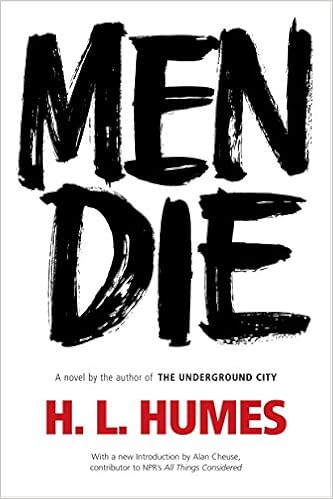
H. L. Humes, Men Die, Random House, 1959.
read it at Google Books


Just before World War II, Lieutenant Everett Sulgrave is stationed at a Navy ammunitions base in the Caribbean, along with Commander Hake—an anguished, intimidating leader nicknamed “Admiral God”—and Hake’s right-hand man, the enigmatic Lieutenant Dolfus. Dolfus has dark premonitions that soon come true when a massive explosion destroys the island. Sulgrave and five black enlistees with scores to settle are the only survivors. Now Sulgrave must contend with his memories and his reality, with the aftermath of the tragedy and the beginning of his volatile affair with Hake’s widow, and with his disturbing past and the abyss that is his future.
Infused with intrigue, symbolism, and mounting drama, Men Die, back in print after more than forty years, showcases H. L. Humes’s astounding versatility, proving itself a timelessly intense and exciting read.

“Humes’s novel is tersely and convincingly composed, and while it echoes other works [it] never seems derivative, the result perhaps of its powerfully made scenes . . . and the essentially clear and direct nature of Humes’s prose.”—Alan Cheuse, from the Introduction

“Clean writing, crisp description . . . Every page of Men Die implies an underlying sense of doom for mankind; yet every page is also immensely readable.”Time

“Hume [was] sublimely confident and alarmingly talented.”The New York Times

“[An] achievement of dazzling virtuosity.”Partisan Review


H. L. Hume's first novel The Underground City, published last year, was a powerful if discursive story of the implications of war. This second novel does not match the first in length but is fully its equal in vigorous complexity. Shortly before World War II Lt. Everett Turner Sulgrave was stationed on the island of Manacle Shoal Rock when the Navy was stocking the island with munitions as an advanced submarine base. He was among the three white officers in charge of Negro construction groups whose Commander was a violent racist and drunk, a raging maniac. Bitter with the suspicion that his command was a punishment, desperate over the alienation of his wife and his conviction that his aide Dolfus is in love with her, Commander Hake pushes his men beyond their capacities and blows up the entire outfit. Only Sulgrave and a few prisoners escape. At Hake's funeral Sulgrave meets his beautiful wife Vannessa, they become lovers and she reveals a tortured history which includes an early seduction by Dolfus, her husband's eventual impotence, the death of their son and her involvement in the death of every man she loved. Pearl Harbor takes Sulgrave away from her mistaken in his certainty of survival. Suggesting, where it does not explore, every devious labyrinthine area of Freudian symbolism, this remains a consistently compelling book. - Kirkus Reviews

“Somewhere on the bookshelf between forgotten and neglected, between the tragic and the strange, stands the reputation of the American writer Harold L. Humes,” writes Celia McGee an article in the 13 January 2007 edition of the New York Times:
The Third Man of the postwar Paris expatriate crowd — he was a co-founder of The Paris Review in 1953, with Peter Matthiessen and George Plimpton — Doc Humes, as he was known, went on to produce two novels in the late 1950s that placed him at the head of a new generation of writers to watch. But in the '60s he succumbed to a mental illness that left him paranoid and peripatetic. Yet to those who remember him, he remained so brilliant that even in madness he dazzled, delighted, educated and touched.
Now 'Doc' a documentary by an Oscar-nominated filmmaker (one of Mr. Humes's daughters) and fresh awareness among several publishers is raising hopes that Mr. Humes's long out-of-print novels will finally resurface.
If availability of his books is any measure of a writer’s neglect, Humes is currently up in the top ranks. Neither of his two novels are available (even used) on Amazon, and a search of AddAll.com today produced a sum total of two copies each of The Underground City and Men Die.
Alan Cheuse wrote an essay on The Underground City in Rediscoveries II and Ted Morgan named it as one of Antaeus magazine’s “Neglected Books of the 20th Century”. Time magazine wrote of Men Die,
A talented young first novelist named H. L. (for Harold Louis) Humes last year produced an almost classic example of the ambitious book that tries to say too much. The Underground City was at once a war novel, a treatise on right and wrong, an indictment of the human condition. Its 755 pages were too many and too tiring. Now, in less than one-quarter the wordage. Author Humes, 33, has produced a new book that gives off more significance than his first could even suggest….
Author Humes does his work in flashbacks, not the smooth ones of a Marquand, but brusque revelations carved out like sections of a monument to doom. Unfortunately, he also chooses to interpolate interior monologues, which prove only that he has not read James Joyce well enough. But these form a minor irritant compared to the book’s merits — clean writing, crisp description, and a surprisingly accurate sense of the bitter relationships, mostly unspoken, between the enlisted Negroes and their commander. Author Humes is no optimist. Every page of Men Die implies an underlying sense of doom for mankind; yet every page is also immensely readable.
Immy Humes has also set up a website, The Doc Humes Institute, to promote Humes and her documentary. You can also read a short sketch of Humes’ life and work at Wikipedia. - https://neglectedbooks.com/?p=137


[Humes is] one of the least-known and most enigmatic members of his writing generation....
[His] are rare books in the best sense, great feasts and fiestas, and my reencounters with them have convinced me that in the raw instinctual days of early recognitions my admiration for Humes’ writing was not at all misplaced. I recommended them at nineteen because I found the books thrilling in ways that I could not at the time explain. Today, in my late forties, I find them just as thrilling, and in addition I can offer a few ideas as to why.
The Underground City stands as one of those rare birds of American fiction, a true novel of ideas that never lacks for credible characters and a powerful realistic plot. Humes divides the book into three large chunks, and by the way in which he sets his scene, with a vast canvas of cloud and sky on the opening of the day above Paris about a year or so following the end of W.W.II, he seems to have nothing less in mind than the desire to create a monumental story of epic range...
...we encounter a broad cast of characters and become engaged in a masterly setup for a dramatization of the world of modern Western geopolitical affairs. Just as the trial will rip open the wounds on the French body politic still fresh from the war, the large central portion of the novel gives us the narrative of Stone’s undercover work during the war—a dense, dramatic novel with the novel that may be the best story of the Resistance told by anyone in English.... 
Humes’ treatment of the military and political aspect of the events would have alone been brilliant enough, but he underlays these public matters with the burning psychology of personal motives, stories of lost sons and troubled fathers...
There is, too, a philosophical level to the book, the presentation of a number of warring philosophies of history and politics, from the fated notions of the ambassador on through the paranoid psychohistorical theories of the Communist manipulator Picard (which, as critic James Bloom has recently pointed out in a brief note on Humes, perhaps the only critical notice that the book has received in the thirty years since its publication, portends the now-fashionable strategies of paranoiac fiction as exemplified in the work of Thomas Pynchon.) Moreover, there is a rich mythological overlay to the story, beginning with the ambassador’s descent from the heavens at the beginning of the book on through the central return back in time to the years of the Resistance in the Stone Resistance narrative, as well as a lot of seeming counterparts among various characters to figures out of European poetry and myth, including the physical descent into the underworld of the sewers made by Stone (“Dante”) in the final section of the novel.
If The Underground City appears deceptively at first look to be one of those loose and baggy monsters of which Henry James complained, the compactness of Men Die, published less than a year later, might give the initial impression of simplistic story-telling about a complex period, the months leading up to the US entry into the Pacific War. The Underground City seems almost wholly anomalous in its essence, a work that no other American writer tried to write before Humes...
It’s unclear to me why neither of these novels is now in print, except that perhaps when Humes himself went, in his own way, “underground,” there was no one else partisan enough to lobby on behalf of further editions. Taken together they not only give us a picture o the Cold War mentality that augments the dramatic vision in Mailer’s Barbary Shore and Vance Bourjaily’s Hound of the Earth, but show the hand of a writer whose inventive projections and first-rate narratives deserve to see the light of day again. The books are good enough to become part of the education of all the good readers in the house. -  Alan Cheuse
http://www.dochumes.com/novels


A biography of literary figure Harold Louis "Doc" Humes by his daughter, DOC tells the story of a life crammed full of ideas about politics, literature and protest. Exploring Doc's paranoia and mental illness, this homemade, improvisational piece sheds light on an original mind as well as the cultural history of postwar America.


watch it here


“A national treasure—America’s greatest living paranoid…” —Timothy Leary


Filmmaker Immy Humes presents a portrait of her father, the legendary forgotten novelist and counterculture icon Harold Louis "Doc" Humes. Doc’s friends and family—including Norman Mailer, George Plimpton, Timothy Leary, William Stryon, Peter Matthiessen, Paul Auster, and Jonas Mekas—weaving together a story of politics, literature, protest and mental illness, shedding light on an original mind as well as the cultural history of postwar America.
http://www.pbs.org/independentlens/doc


“He was brilliant. He was one of the few people I have ever met who was essentially, at bottom, more vain, more intellectually arrogant, than I was.” —Norman Mailer
DOC is an unorthodox portrait of the life and times of the almost forgotten, yet fascinating literary and counter-culture figure Doc Humes. Featuring a generation of cultural luminaries, from Timothy Leary to Norman Mailer, the film tells a moving story about the man who founded The Paris Review, wrote two great novels and then, after becoming mentally ill in the 1960s, reappeared as the original Hippie Philosopher King. A stylistically original take on a literary mind DOC is a political and personal tale filmed over many years by Immy Humes, an Academy Award–nominated filmmaker and Doc’s daughter.
Harold L. Humes, known by the nickname “Doc,” was brilliant and precocious (he went to MIT at age 16). In Paris after World War II, he founded The Paris Review—a magazine he envisioned as “by writers, for writers, with an emphasis on the act of writing itself.” He then wrote two acclaimed and ambitious political novels about war and what it does to people: one in 1958 and the other one year later, in 1959. The books were well received—The New York Times described Humes as “alarmingly talented”—but after the second book, he never wrote again. (Thanks to the film, Random House has recently republished both titles, The Underground City and Men Die, after decades out of print.)
A stellar cast of Doc’s family and friends—including writers George Plimpton, Norman Mailer, Peter Matthiessen, William Styron and Paul Auster; avant-garde filmmaker Jonas Mekas; and the pied piper of LSD, Timothy Leary—recall an extraordinary man who defied all categories and expectations.
After winning fame as a novelist, Doc quickly moved from one fascination to another. As Gay Talese writes, he “hit on a theory of cosmology that would jolt Descartes; played piano in a Harlem jazz club; shot a movie called Don Peyote, a Greenwich Village version of Don Quixote; and invented a paper house that was waterproof, fireproof and large enough for people to live in.”
“I didn’t know whether to kiss him or kill him!” —William Styron
With Jonas Mekas and others, he created the New American Cinema Group, which sought ways to have movies break away from “boredom” and incorporate new forms of creativity. He led crusades for free expression and against police brutality and helped abolish the “cabaret card” laws, notorious rules long used by the NYPD to bar artists—from Billie Holliday to Thelonious Monk to Lenny Bruce—from performing. He lived a wild, creative life that included leading a beatnik riot in Washington Square Park, championing the use of medical marijuana and managing Norman Mailer’s infamous 1961 run for mayor of New York.
By the mid-1960s, Doc was unable to write. And after taking a lot of LSD in London with Timothy Leary, he began showing signs of mental illness. He thought that he could intercept thoughts, that he could see dangers others could not and that he was being followed. He believed the CIA, among others, was spying on him. (One of the film’s most startling revelations is that the CIA had infiltrated The Paris Review crowd; Peter Matthiessen was, in fact, a CIA agent when he helped found the magazine.)
“The man talked a blue streak, chewing our ears off with a monologue that resembled nothing I had ever heard before. It was the rant of a hipster visionary neo-prophet.” —Paul Auster
Doc reinvented himself, yet again, turning up on the Columbia University campus in 1969 giving away cash in a notorious piece of proto-performance art. For 25 years, Doc lived on or near college campuses, especially his alma mater Harvard, as a kind of resident crazy genius, surrounded by student acolytes who took care of him. He preached that we live in a society run by fear and shadowy powers, and that protest, the arts and healing—especially relaxation techniques using massage and marijuana—are necessary practices to preserve human freedom. Immy Humes, in Doc’s own words, “puts a frame around the wreckage” in this affectionate, yet disquieting portrait.
After Doc died of cancer in 1992, Immy filed a Freedom of Information Act request that eventually turned up a thick file. It turns out that the U.S. government was keeping tabs on Doc, from 1948 to 1977.
Update
From filmmaker Immy Humes:
Many people I interviewed have died since I filmed them, because it took a long, long time to put this film together. So, starting with the main character, my father Doc Humes who passed away in 1992, a whole generation of famous American cultural figures followed him out the door, from Timothy Leary to William Styron, George Plimpton and Norman Mailer. It’s quite sad for me to watch the film now, as I miss all of them. I think that their generation did have a special something: they were into living large, thinking large, being engaged with values and ideas, acting out and taking risks. For better and for worse, they were different people than we are.


Scientist, novelist, activist, inventor, filmmaker, architect, prophet, healer, and madman Harold L. 'Doc' Humes was, by all accounts, an exhilarating, infuriating and terrifyingly brilliant man. His Oscar-nominated documentarian daughter Immy Humes has gathered testimonials from luminaries including Norman Mailer, William Styron and Timothy Leary... Fascinating, wryly distanced documentary. Casual footage from the era captures the excitement of liberation and the headiness of artistic ferment...Immy imaginatively segues from unexpected angles, mapping out the complex historical, cultural and personal synapses that link the man to his times... Ronnie Scheib, Variety


Fascinating Doc, so many memories...he was, as said above, infuriating and terrifyingly brilliant...he had answers to all of our questions and talked non-stop because there was so much to tell us...but sometimes he would just take out his flute and charm us like Pan...utopia is the only way out, yes, Doc, you are right... - Silvia Escorel

Allen Tate - Since its publication it has received very little attention, considering that it is one of the most remarkable novels of our time. Its occasion is a public one, the achievement and the destruction of Virginia’s antebellum civilization. Within that occasion it discovers a terrible conflict between two fundamental and irreconcilable modes of existence

Slikovni rezultat za Allen Tate: The Fathers

Slikovni rezultat za Allen Tate: The Fathers

Allen Tate, The Fathers, Ohio University Press, 1938.            

Set during the Civil War, The Fathers is the story of two old Virginia families, the Buchans of Pleasant Hill and the Poseys of Georgetown. It tells of the collapse of a way of life, hastened not by the onslaught of Yankees but by a tragic flaw within the civilization of the Old South. Major Lewis Buchan, patriarch of the family, is the consummate southern aristocrat; his son-in-law, George Posey, is the modern man, steeped in the southern tradition yet restless and outside it. Young Lacy Buchan, just coming into manhood, narrates the sequence of events that tears his father and brother-in-law apart and his family asunder - betrayal, rape, madness, murder, suicide - and his tale foreshadows the paradoxical love and respect Posey will ultimately command in him. In the end, both "fathers" are heroes, and the values of both are retained, a lesson not just for Lacy but for the South.


The Fathers is the powerful novel by the poet and critic recognized as one of the great men of letters of our time.
Old Major Buchan of Pleasant Hill, Fairfax County, Virginia, lived by a gentlemen’s agreement to ignore what was base or rude, to live a life which was gentle and comfortable because it was formal. Into this life George Posey came dashing, as Henry Steele Commager observed, “to defy Major Buchan, marry Susan, betray Charles and Semmes, dazzle young Lacy, challenge and destroy the old order of things.”
The Fathers was published in 1938. It sold respectably in both the United States and England, perhaps because people expected it to be another Gone With the Wind, wheras it is in fact the novel Gone With the Wind ought to have been. Since its publication it has received very little attention, considering that it is one of the most remarkable novels of our time. Its occasion is a public one, the achievement and the destruction of Virginia’s antebellum civilization. Within that occasion it discovers a terrible conflict between two fundamental and irreconcilable modes of existence, a conflict that has haunted American experience, but exists in some form at all times. The Fathers moves between the public and the private aspects of this conflict with an ease very unusual in American novels, and this ease is the most obvious illustration of the novel’s remarkable unity of idea and form, for it is itself a manifestation of the novel’s central idea, that “the belief widely held today, that men may live apart from the political order, that indeed the only humane and honorable satisfactions must be gained in spite of the public order, “is a fantasy.”
—From the introduction of The Fathers


"A masterpiece of formal beauty … deserves to be recognized as one of the most outstanding novels of our time." - Janet Adam-Smith
"Great novel of the broken South." - George Steiner
"A psychological horror story … concerned with life rather than death, with significance rather than with futility." - Henry Steele Commager
"The story displays so much imagination and such a profound reflection upon life that it cannot be neglected by anyone interested in contemporary literature." - Edwin Muir

This is Putnam's headliner among newcomers. Allen Tate may be a newcomer as a novelist, but his writing shows the results of years of experience in various fields of writing, he is no novice with the pen. He shows himself too as a thorough student of the Civil War -- where his previous writing has been along biographical and critical lines, he has adapted his understanding of underlying motives to the needs of fiction, and given the sense of conflict an authenticity that enhances the drama. There is vitality and robustness in the picture of the life, with its chivalry, its conflicting codes of morals and accepted digressions, its social standards, its loyalties. The vast canvas of a family with all its ramifications and the community background of Georgetown, Alexandria, Washington -- before and at the start of the war. The form in which the story is told gives it a unique character; though at times it seems confusing, bit by bit the pieces fall into place, as after events clarify the past for young Lacey Buchan, through whose eyes the story is enacted. One dominant figure emerges, George Posey, fascinating, somehow a trifle sinister, egotistic, loving power, generous, hot-headed, a rebel against the dictates of his caste and his times. It is a tragic story -- tense with currents of animosity and conflict restrained -- and it holds the interest even when it is not wholly clear...The publishers plan an extensive promotion campaign, -- giant books, posters, envelope stickers, paper books. This is one of the books included in the plans for a letter contest among booksellers. Write Putnam for particulars.
- Kirkus Reviews


The Fathers was Tate’s only novel and he had great difficulty writing it. He said he would have been happy to throw away this moment if I were not a sharecropper who must pay back the advance from his landlord. He was even critical of it before publication – They [the reviewers] will say that the narrator beats about the bush for a hundred thousand words but never comes to grips with the characters. Tate was too hard on himself for though still underestimated, this is undoubtedly one of the best Civil War novels.
The hero is Lacy Buchan, who is telling the story as an old man, though, during the story he is still a fifteen-year old boy. The story starts with the funeral of Lacy’s mother. Lacy worships his older brother-in-law, George Posey, and can only admire him when Posey rides off from the funeral. However, there is a contrast between Posey and Lacy’s father, Major Buchan, who is”old-fashioned” and conservative. Indeed, Lacy’s father feels that nothing should change and sees his home – Pleasant Hill – as a place where everything will remain the same. - The Modern Novel
read more here


However onerous history’s burdens become, history itself grinds on. Even amidst the ruin wrought by a catastrophe like war, what’s left behind is already transforming itself into new ground, a kind of alchemy that turns ashes into earth. By such cycles nations and cultures renew themselves, their recreation often arriving with a new patina of sorrow, the inevitable heritage of war. The scourge that was the American Civil War produced such a fracture in the young country’s history. The literature that was part of its new culture was profuse but mainly the factual record of its disasters, whose eventual telling was to produce more books than any other subject in the national lexicon.
The serious fiction of the Civil War, however, has been a thin and lonely genre. At its best—in Stephen Crane’s The Red Badge of Courage, for instance, and Charles Frazier’s Cold Mountain—it’s a literature that takes the near destruction of an entire region as a backdrop, and pores over its manifold consequences. A generation and more was usurped not only from their families, but their anchoring traditions, and plunged into wrenching change. Before it was finished, the four years of killing would darken the American heart as it had never been darkened before. The Civil War’s victims and survivors would require, in the end, more from it than a mere chronicle. They would need touchstones that carried the force of myth and symbol, powerful, imaginative creations that had the ability to reveal the truths underlying the aberration of internecine conflict. They needed great novels.
That syllabus of great Civil War fiction, tiny though it is, must have near its head Allen Tate’s almost forgotten novel, The Fathers. Tate was a native Kentuckian who grew up with a strong consciousness of the South, its unique traditions and its history. It was not only table talk at dinner, it was an obsession, especially for Tate’s mother, who spooned up a version of the family genealogy that she constantly fed to her son. By the time he sat down to write what would be his only novel, he did it, among other things, to untangle the truths and fictions of what he’d been told. He was already a celebrated poet and critic by then, known by his contemporaries as a man given to contention and polemics. He relished a good literary fight. In appearance he was lean and dapper, with an immense cranium that made him stand out physically, a fitting distinction for one whose obvious brilliance had to come, it seemed, from a well deep within. (In a poem, his friend Robert Lowell described him as having “an enormous brow,” the “cannonball head of a snowman.”)
His early marriage to novelist Caroline Gordon began as a knockabout affair in which the two, often literally penniless, moved from place to place and situation to situation, making their living as writers by their wits and their gifts. Finally, Tate’s brother Ben, a successful businessman, bought a house for the couple in Tennessee which they teasingly dubbed Benfolly, simultaneously imitating the habit of the gentry for naming their estates and gently poking fun at the practical brother for investing in the future of a poet. Of all the Southern writers who were his contemporaries, Tate was possibly the most Southern in his temperament and in his sympathies. In politics he drifted further and further to the right as he aged, sometimes championing ideas, especially about race, that caused even his friends dismay. In childhood, his mother had led him to believe that he came from a line of Southern aristocrats. That notion, which turned out to be his mother’s illusory effort at self-dignity, caused him to think of himself as remarkable and thus to carry himself in the world as the issue of patricians.
The realization that a lie was at the heart of his sense of self turned Tate into a kind of orphan, as his biographer, Thomas A. Underwood, put it. Though the loss of his fictional ancestry was not the same as actual loss, it was a loss to his ego, and it made him wonder who he really was. It was not until he was a student at Vanderbilt in Nashville that he felt the stirrings of a true self. At Vanderbilt he recklessly threw himself into the life of the mind, distinguishing himself as a student and as a young poet, ultimately exchanging the illusory pedigree of high birth for a Phi Beta Kappa key.
Whatever the validity of his own lineage, Tate had come to identify strongly with and to profess the world view of the Southern aristocrat. He believed that bloodlines were the most reliable test of human character, that family must act at all times as both bulwark and ark, that the possession of land is a matter of husbandry and perpetuation, not a vehicle for commerce and wealth. The Civil War had sounded the death knell for that way of thinking, and Tate believed that only an artist—in his opinion, a novelist—had the tools to expiate and redeem a doomed inheritance. He put that melancholy belief into service when he sat down to write The Fathers, a task he had long delayed and would frequently abandon. The finished novel was highly autobiographical, calling on his own family’s history and the history of its relations. The novel’s narrator and central character, Lacy Buchan, was a version of Tate himself, the thinker in a family whose members valued action over thought.
The Fathers is set in 1860, at Pleasant Hill, the family seat of Major Lewis Buchan, in Fairfax, Virginia, though by means of an intricate interior design, Tate makes the novel traverse half-a-century and the breadth of an entire state in its telling. The opening scene takes place on the day when Sarah Semmes Gore Buchan, the mother of Lacy Gore Buchan, is to be laid to rest. Lacy recalls the day’s events—he was a boy of fifteen then—from the vantage of fifty years later, by which time the old doctor he has become will have weighed the novel’s story and asked of it the satisfactions a teller of tales expects. The funeral of Sarah Buchan has drawn family members from far and wide, called to attendance by ancient funerary rites, making them the players in a ritual that stresses the communal importance of family and its dance of progenitor and progeny. It’s to be the last time young Lacy will see his family in assembly. “A year later came the war,” Lacy ruefully notes; “We were uprooted from Pleasant Hill, and were never together again.”
George Posey is at the funeral, too, Lacy’s brother-in-law, a dashing interloper on horseback who’s forged his way into the Buchan clan as the husband of Susan, the Buchan’s only girl child. But Posey has no use for the Buchans and their outdated ways. To him, the only respect due a thing was its monetary worth. A horse was as good as what it could fetch in a trade; land was valuable only for the marketability of the crops it produced; a slave was worth the selling price of his back. At Sarah Buchan’s funeral, George Posey shows disrespect for the Buchans by arguing with his wife, and then riding off in a disdainful whirl, leaving the gathered mourners, including some of the Buchan’s slaves, scandalized. Old Major Buchan, Tate’s embodiment of the Old South, is scandalized, too, offended by his son-in-law’s impudence.
The plot that follows is essentially a gloss on that opening scene, an extension and explication of the manners and motives of characters poised at an abyss they don’t know is before them, an elegy to what became the dissolution of the fabric of the Old South. “Why,” Lacy Buchan asks himself, “cannot life change without tangling the lives of innocent persons? Why do innocent persons cease their innocence and become violent and evil in themselves that such great changes may take place?” Tate bravely if reluctantly documents the change that flows from that moment on Pleasant Hill, taking a panoply of characters through war, making them confront slavery and its attendant evils, including miscegenation. He also shows us the warfare within a family rocked by sudden change, an old guard being destroyed from within.
The Fathers is anything but a schematic treatment of good versus evil, old versus new. It witnesses both and allows each to have its moment at center stage. Complex and demanding, the novel wants the full attention of its readers. It’s also a deeply formal work whose design and writing borrows from the style of another century. (A reader first dipping into it might think it written by Melville or Hawthorne). At one point he ingeniously employs classical mythology, magically bringing in pieces of the legend of the Golden Fleece as a plot device. Tate does not hesitate to take the reader into dark places, whether it’s the battlefield or the human heart. Some of book’s most moving moments are filled with presentiments of the disaster it tells so brilliantly:
At dawn next morning I heard a big forest tree fall, the trunk breaking the branches off the other trees with a crackling thunder. Another tree fell and I turned over in bed. Then another and still another until the entire big woods…had fallen down. I put my feet upon the floor and listened. There was a lull and it began all over again. In a few minutes as I put on my clothes I ceased to hear it, being aware of it as one occasionally acknowledges after awhile the presence of a storm. - Roger Sauls
http://porterbriggs.com/allen-tates-the-fathers/


Barry T. Wireman: The Abyss in Allen Tate’sThe Fathers:What Can be Seen in the Darkness of American Literature? (pdf)

Slikovni rezultat za Allen Tate, Essays of Four Decades,


Allen Tate, Essays of Four Decades, ISI Books; 3rd ed. ed., 1999.

borrow it here


This classic collection of nearly fifty essays by one of the century's most acclaimed poets and literary critics speaks poignantly to the concerns of today's students, teachers, and general literature readers alike. It covers the broad sweep of Tate's critical concerns: poetry, poets, fiction, the imagination, language, literature, and culture.


Allen Tate is one of the best poet-critics of our time. He ranks with John Crowe Ransom and Randall Jarrell, both of whom have been his associates at one time or another, while behind all three stand the example of Eliot, their acknowledged master. One stresses these relationships since the background of Essays of Four Decades is so heavily a part of the modernist sensibility and the development of contextualist criticism (or as it is popularly called, the New Criticism). Many of the pieces here (the earliest dates from 1928) have surely influenced more than one generation of graduate students, and some of Tate's once radical ideas are accepted theoretical dictums, e.g., ""The meaning of poetry is its 'tension,' the full organized body of all the extension and intension that we can find in it."" Nowadays Tate stands out (perhaps anachronistically) for his almost obsessive concern with aesthetic and moral unity, his hatred of secularist or naturalist ""heresy,"" and his anguished search (always apparent beneath his Southern gentleman prose) for absolute values or ""truth,"" which eventually brought about his conversion to Roman Catholicism in the Fifties. Surprisingly, ""Christ and the Unicorn,"" his most interesting and inflamed apologia for neo-orthodoxy is not included here, though his famous tributes to Poe and Hart Crane, two extremely unorthodox poets (and, oddly enough, his favorites), are very much present. A major retrospective.  - Kirkus Reviews


Thomas A. Underwood, Allen Tate: Orphan of the South


About Allen Tate