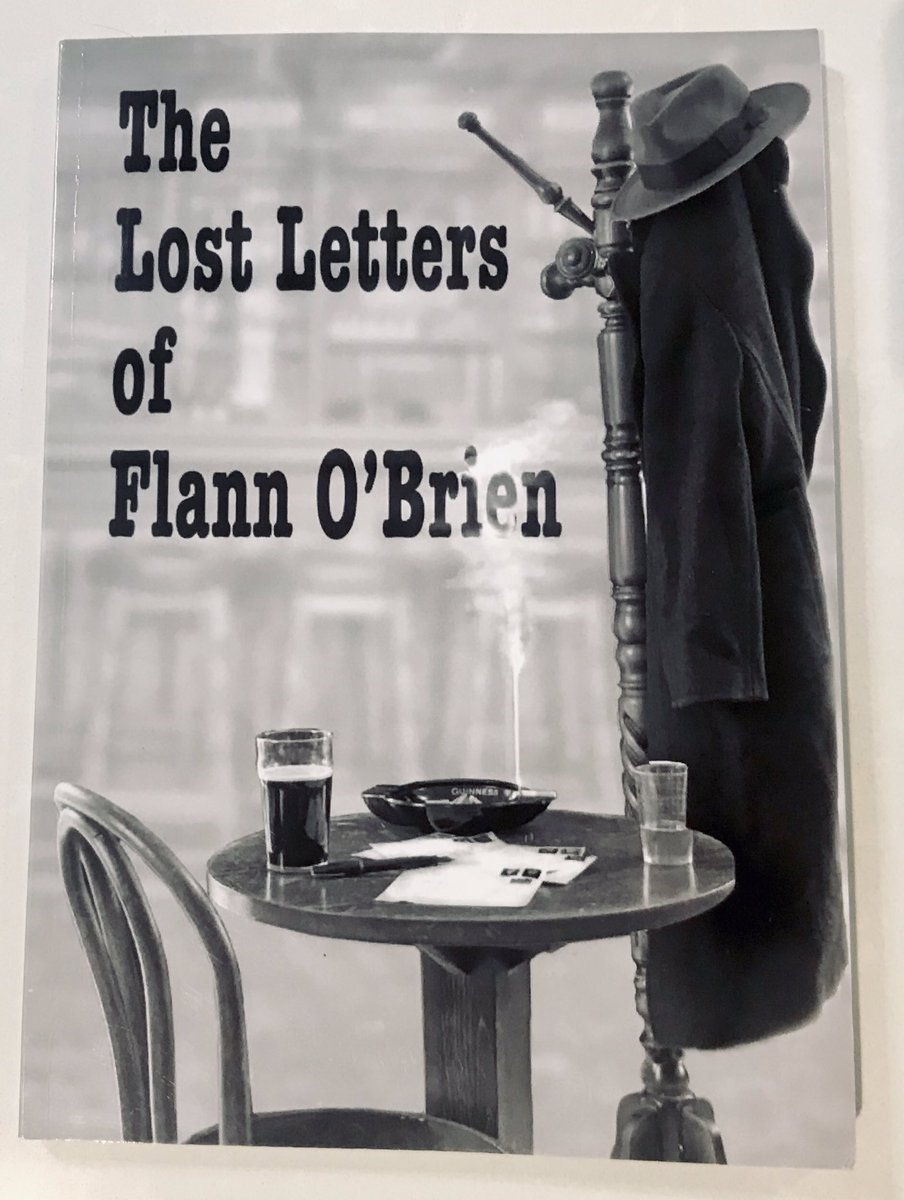
Discovered in a disused cupboard in a Dublin pub during lockdown, The
Lost Letters of Flann O'Brien contains 107 never-before-seen letters
written to the cult Irish writer by a collection of twentieth-century
luminaries, including Joseph Goebbels, Walt Disney, Virginia Woolf,
Marilyn Monroe, Bob Dylan and Rachel Carson. Perhaps.
‘The most writing
fun I’ve ever had.’ - Anne Casey
‘Insightful,
hilarious, innovative.’ - June Caldwell
‘Among the most
enjoyable projects I undertook this year.’ - Whitney Standlee
‘An anthology
guaranteed to lift our spirits during these strange days.’ - Celia
de Freine
‘A fun-packed
stash of missives from a motley crew of twentieth-century personages
to the great blaggard.’ - Alan McMonagle
‘The definitive
antidote to 2020-21.’ - Julian Hanna
Fifty-five years after he died an apparent failure, or at best a
niche literary figure, the cult of Flann O’Brien continues to grow.
So, it seems, does his output. The latter may now even be growing, in
the Covid cliche, exponentially. For no sooner had Dalkey Archive
Press published a collection of all his known letters, in 2018, than
a different kind of press – a rediscovered cupboard in his old
drinking haunt, the Palace Bar in Dublin – has now yielded a new
cache, published as The Lost Letters of Flann O’Brien.
It’s a one-sided
correspondence, in which many famous contemporaries of the real-life
Brian O’Nolan reply to variously eccentric letters he has sent
them. And on closer inspection, the authors are just as spurious as
the ones he himself often hid behind while making mischief on the
Irish Times Letters page. But just to complicate things… - Frank McNally
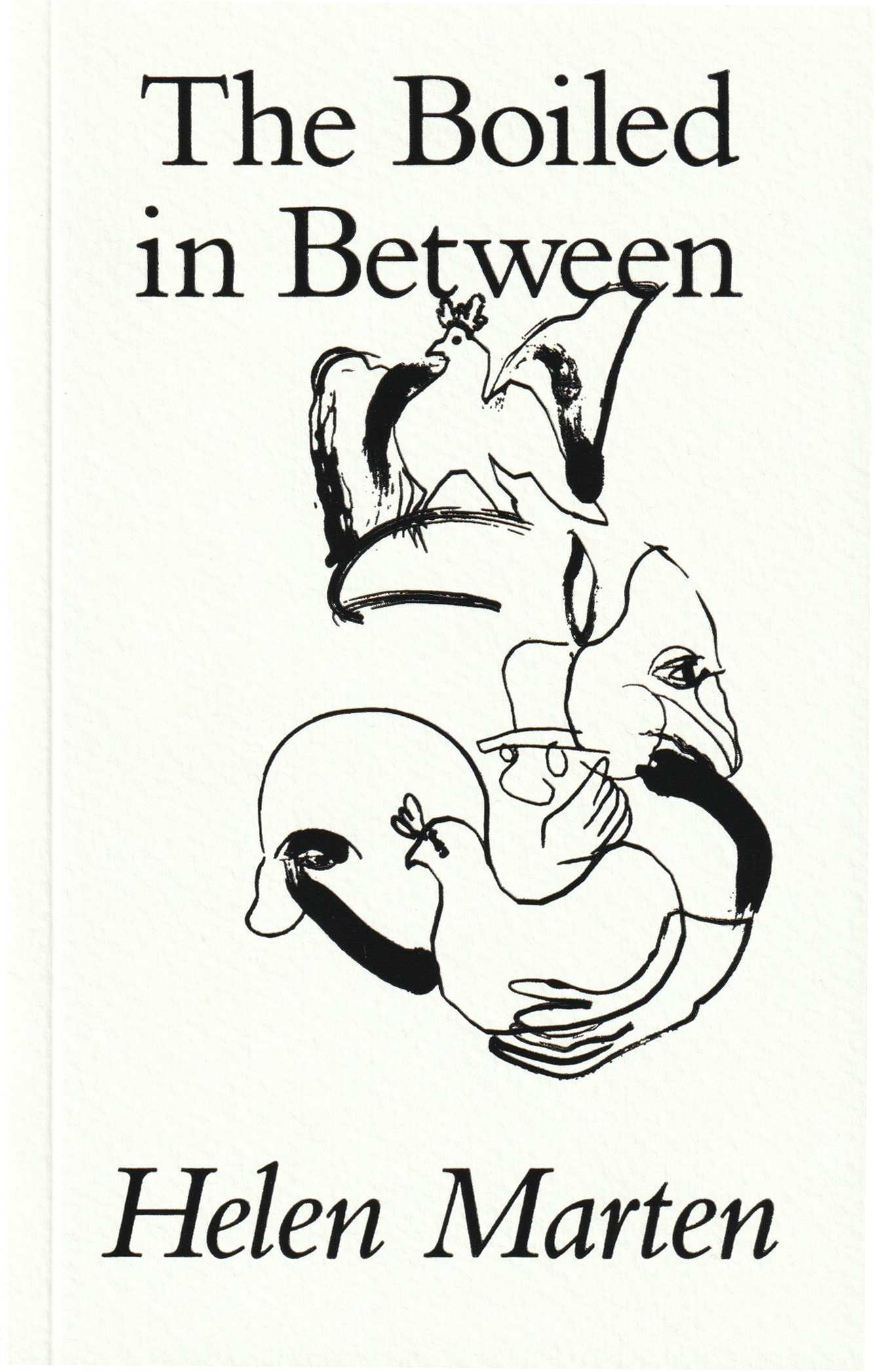
The Boiled in
Between is the debut novel by Turner Prize-winning artist Helen
Marten, an ambitious literary work full of beauty and sorrow. It is a
novel told in the action of persistence and questioning: how the
rhythms of a world built upon metaphor and symbolism can collide with
relationships personal and domestic.
Spliced between
three voices, the narrative is a project always in movement, its
characters traversing the in-betweens. The psychic excitements of
wind, dust and weather merge with alchemical interior voices, all of
them indexes of the universe’s microscopic pornography, a fitful
map of language and human systems. Philosophic and tactile, humorous
and unrelenting, The Boiled in Between ignites new meaning for people
and terms of living that have long ceased to astonish us.
‘This is a wildly,
joyfully creative journey into the tenderness of being human, frail,
together and apart. A remarkable debut from a keen eye and a deft,
lyrical hand.’ – AL Kennedy
‘An incredible
work of literary art.’ – Max Porter
‘The Old Victorian
is new again and the dramatic poem is prose… or, in the words of at
least one of the Brownings, “As goes the empire, so goes the
formatting.” Helen Marten strives, seeks, finds, and does not yield
in any of her media; she stands in her integrity as the burning deck
becomes a darkling plain.’ – Joshua Cohen
‘Alexander Calder
moved to Paris from New York in 1926, aged twenty-seven, and his
visit to Mondrian’s studio gave him what he described as the ‘shock
that started things’. He likened it to being slapped like a baby to
get its lungs working. Writers read, and very very occasionally a
text delivers the baby slap: Toi Derricotte’s The Memory Poems,
Russell Hoban’s Riddley Walker, Gwyneth Lewis’ Dalton’s
Geranium, Ben Marcus’ The Age of Wire and String… The Boiled in
Between slaps the reader like a baby.’ – Helen DeWitt
‘I love this book
in all its wit and inventiveness.’ – Hans Ulrich Obrist
‘Helen Marten has
always produced intricate, ricocheting systems, and now she has
expanded this system-making into writing. She uses language in this
novel like a bricoleur, where words acquire their own sticky, glued
substance – brilliant explorations of ugly feelings that are also
exercises in how clotted and wayward sentences can be, as well.’ –
Adam Thirlwell
‘Each with their
startling similes and swerves, their alarming and tender moments, I
have begun to read Helen Marten’s sculpture through her writing,
her writing through her sculpture. With The Boiled in Between Marten
has become an insistent voice in my head, tying knots and undoing
them, never the same way twice.’ – Adrian Searle
‘A cosmos emerges in the work of Helen Marten, we know it and we
don’t. We know it all, but the All that it becomes, we do not know.
It pulls you in and right away it pushes you back again. Everything
is familiar and nothing, that is the work of this artist: Creating
the Nothing, which in this case is everything. Everyone reads
something else, everyone sees something else. And yet, it is familiar
to everyone, just differently, and this is exactly what creates this
familiarity, a trust in the other, through the other, that becomes
something else.’ – Elfriede Jelinek
Helen Marten was
awarded the Turner Prize in 2016 for her enigmatic work in sculpture.
Two years later, the artist noted a disconcerting lack in critical
dialogue surrounding her work. Marten usually works across sculpture,
painting, print-making, film and writing, but decided to temporarily
vacate her studio for a year to solely focus on writing her first
novel, ‘The Boiled in Between’, published by Prototype in 2020.
Looking back on Marten’s Turner Prize winning works, displaying
scenes in which “some unknown human activity has been interrupted”,
it’s hard not to think of the many interruptions caused by the
global pandemic. Marten’s novel operates in that same space of
undoing, where meaning and certainty are in flux, like an open-ended
sentence.
As a way to tackle
the density of Marten’s prose, you could decide to look to the
book’s unique set of reference points. You might find that the book
is a close relative of ‘A Pattern Language: Towns, Buildings
Constructions’ (1977) — an influential book for architects,
city-planners and anyone interested in organising a co-habitable
space. You may also discover that Marten is interested in poetic
voices — Modernist writers such as James Joyce and T.S. Eliot —
and absorbed by the spectral layout of ran-sacked cities, towns and
villages, with all their neighbours, gloomy onlookers and silent
interlocutors. You could find countless other connections to comment
on throughout Marten’s novel, like the author’s interest in
mixing colour, texture and foodstuffs with household objects and
routine habits. None of these observations, however, will help when
it comes to the task of interpreting the plot of Marten’s text —
I’m still not sure what actually happened — but unearthing these
sources is like opening a desk drawer full of carpentry tools. Each
reference is an apparatus needed to fashion a novel that speaks to an
interest in life, domesticity, bodies and neighbourhood watches.
The so-called plot
of Marten’s novel flits between the perspective of two middle-aged
people, Ethan and Patrice, and a third, more abstract narrative
guided by the ‘Messrs.’, reminiscent of the chorus in a Greek
tragedy, but markedly replete of category. When it comes to making
her enormous sculptures, comprised of both hand-crafted and found
objects, there’s rarely any linearity to Marten’s thinking.
Similarly, her writing process is much like beating ideas together
and building connections where there are no obvious links to make.
Marten’s prose reads like a tightly formulaic, yet troublingly
disorganised repository of art-logical concepts and whimsy. Much like
her sculptures, Marten’s writing relies on traditions of assemblage
and collage as a way to communicate an unfinished thought, or to
demonstrate the constructive logic that emerges out of inconstancy
and confusion. Marten roots her novel in a foundation in flux,
calling into question the true meaning of words: people can exchange
hyperbole and metaphor as a recognised currency in this book. ‘The
Boiled in Between’ aims to uncover how “the approximate details
of subjective detail become fact”, or, put another way, how the
world is limited by the trappings of language.
Marten’s visual
work is characterised by an impulse to create pseudo-realities,
fictional histories or sites of excavation. ‘The Boiled in Between’
shares this impulse. In the prologue to Marten’s novel, the Messrs.
tell us that “windows and propped doors” and “snapped twigs
pointing the way back” are preserved by time, just as Marten’s
sculptures allude to various interruptions, unexpected incursions and
visits. ’18 Works on Paper’, Marten’s solo show at Sadie Coles
in London, is an exhibition of brightly coloured watercolours and
pencil drawings; luminescent, sometimes mottled by dark splurges of
paint, and at other times featuring the delicate but flattened
anatomy of a poppy and a miscellany of other appliqué objects. These
are “complicit agents of re-sampling: children’s drawing,
historical diagram, contemporary theft, and more.” In one of the
drawings, Marten depicts a sewage line decorated with “cut and
paste” scissors, splicing through clumps of hair. Faces of farmyard
animals float around and above the clogged up pipe-line. With
inconsistencies in size, shape and content, Marten’s ’18 Works on
Paper’ are like fragments of ‘The Boiled in Between’ —
however it is crucial to note that, though the drawings were made
during the same period and some are inspired by the same narrative as
the book, they are an independent body of work. Marten’s detailed
drawings and charismatic watercolours contain characters who are
difficult to read.
In ‘The Boiled in
Between’, characters live in a strange world interspersed by short
affirmative statements about lifestyles: “The house is a big body,
a macro mass”. Marten’s fictional characters talk lucidly about
nomadic life, too: mapping, camping and sleeping on pillows of
“creamy ricotta” beneath a “blanket of little gem with aioli”,
for instance. Marten’s novel consistently returns to closed-off
spaces, specifically households, but sometimes tents. The Messrs.
tell us that the house “is like communication”, something we are
either entered into or excluded from entirely. The revelations of
Marten’s Messrs. call to mind the theories of anthropologist Pierre
Bourdieu, who wrote, “The opposition between the upper and lower
part [of the house] reproduces within the space of the house the
opposition set up between the inside and the outside.” ‘The
Boiled in Between’ pays homage to the liminality between interior
and exterior spaces. The Messrs. are permanently on the outside: they
are not ‘in’ the story, as it were. Meanwhile, Patrice and Ethan
contemplate touching and looking at their internal organs. Patrice
jokingly remarks that the impulse to “poke fingers into
indeterminate holes” should have its own “classification”
within language. Ironically we, the reader, are always technically
inside or in between the book’s pages.
‘The Boiled in
Between’ is a remarkably innovative piece of writing that resists
easy definition. It is unfathomably exciting to read. More than just
a novel, ‘The Boiled in Between’ contains a network of ideas,
thronging with personality and humour. The authors of ‘The Pattern
Language’, one of the sources for Marten’s novel, described their
seminal text as “a needle following a tapestry”: explosive and
unpredictable at times, but always on a some desired path or course.
The lifeblood of Marten’s novel pumps through the same vein. Marten
leaves no stone unturned, covering subjects as expansive as life,
death, flowers, sex and birds. ‘The Boiled in Between’ is
important reading. - Olivia Fletcher
The Boiled in
Between is the debut novel by Turner Prize-winning artist Helen
Marten, a work of fiction that will surely be acclaimed for its
author’s bold and innovative geist. The novel puts into forefront a
myriad of vital questions relevant for all who tend to delve deeper
into matters of both life and language. It can be claimed that one of
its biggest strengths lies in that it shows, ever so subtly, the
interplay of our world that is founded upon metaphor and symbolism,
and the relationships we form among ourselves.
The narrative flows
tenderly, and has no violent jumps even at its most heart-breaking
and sorrowful moments. It is shared by three voices: the Messrs,
Ethan and Patrice, and as such always partakes in a moving sequence,
which made me think of the Nobel Prize-winning Polish author Olga
Tokarczuk, and her magnanimous novel Flights, which, too, is a
stunning feat of prose writing that is never grounded, but is
characterized by always being in motion. In order to succeed in such
a writing endeavour, an author must be very skilled in portraying how
the voices of the characters traverse the distances between them, and
how they act when their paths collide. Marten does this wonderfully,
and I’d never believe that this is her debut novel, so much is she
already aware of the subtleties of her craft.
Not only is this a
strong narrative of movement, that is also movement itself, as we’ve
already established, but it is a masterpiece of imagery, too. With
its bold and experimental usage of images, it strikes a chord with
readers who can do nothing else but surrender to the wonderful flow
of picturesque strings of sentences that are always part of a bigger
movement, and never still. Admirers of Ali Smith’s oeuvre will
surely be amazed by Marten’s debut, for both writers endeavour to
master creating outstanding mental pictures with language, and in
that attempt they succeed, for the language flows in all its beauty
and complexity, just like the strokes of a paint brush.
“The beach is not
human although it reeks of entropy with its avian aesthetics so bleak
and cinematic with only a few people around. A few people people and
the tide and arctic giants of cloud. Holiday landscapes amaze in
winter when their blackened trees write out a calligraphy against the
creamy emptiness. Summer stretches bring forth cars and an agitation
of bodies with their all-too-visible emergencies.
The two of them used
to practice on the sand, walking, feet no longer feet, but extensions
of a moral force, a pride in that force contained within two solid
bodies. The details came out then: one leg shorter than another, a
vague ache because of it; the sand itself groaning and collapsing all
its billions of silicate granules, little gems between their toes.”
The Boiled in
Between is a philosophic and tactile piece of writing, created by a
talented writer, whose craft will surely be praised in the future.
The novel is a stellar kick start, and we highly recommend it as your
end-of-Summer read. - Sanja Gligorić
In 1935, Gertrude
Stein declared in ‘Poetry and Grammar’: ‘I really do not know
that anything has ever been more exciting than diagramming
sentences.’ The rigorous thrill of sketching grammar’s
architecture, the satisfactions of seeing where syntax may lead us,
the sense of sense resolving, or not: this tricky prose kick is also
present in the sculptures and screen prints of Helen Marten. Where
the artist has spoken of her works as diagrams – maps of relation
between exotic and mundane objects, luxe and grubby materials,
attending ideas – I’ve always thought of them instead as
sentences. Especially slippery sentences that slide through the mind
and bear much pleasurable repeating before they will make known their
meanings. In a ‘Lexicon’ for the catalogue of Drunk Brown House,
her 2016 show at the Serpentine Gallery in London, Marten wrote in an
entry on cartoons: ‘The whole grammar is geared towards a state of
physical change and material sensation.’ A cartoon scuffle between
form and feeling: this might be one way to describe Marten’s
extraordinary novel, The Boiled in Between – out next week from
Prototype Publishing. There are the rubbery outlines of a story, or
at least a setting. Two middle-aged characters, Ethan and Patrice,
living in a frustrated, mangy suburbia, fixating on their queasy
erotic and alimentary lives, the vagaries of weather and crumbling
architecture, the habits of their neighbours. Overseeing all of this
is the protean, immaterial ‘Messrs.’ They are a pair (or is it a
legion?) of sentient, knowing atmospheres whose voices interrupt the
monologues of Patrice and Ethan to comment on the characters and
their universe. ‘We look down on these awful people and their
endless capacity for enhancement.’ Each time they appear, the
Messrs. are displaced and renamed: ‘Messrs. External &’ some
new state or quality: Crumbly, Melancholy, Weary, Yellow, Peaty,
Sorry. The life they observe, say the Messrs., is ‘Something like a
syntactical form of mitosis, with each article of speech, each
pulling of the bathroom plug, each lunch and breakfast in bed, all of
it only a comma in the great future run-on unfolding.’
Language and body,
in other words, are intimately involved, sentences branching and
cells dividing. Impossible to quote Marten writing about sex,
violence, food, age or decay without noting how much work the texture
and rhythm of her prose are doing. The Boiled in Between is a novel
that proceeds by image and incantation rather than much in the way of
explicit plot. Here is Ethan: ‘Well what is a body anyway, when
framed in words? A dough trough? A collapsing figure for poking and
kneading? For baking, for burning, for pulling apart like a
hot-pocketed roll?’ And Patrice: ‘I hoped for cosy berries in
flabby tides of cream. The soft smell of new strained cheese.’
Elsewhere, a world of extreme violence is broached by an italicized
news report: ‘a sixteen-year-old who, after throwing her newborn
into a fast-flowing river, jumped in herself with a sack of stones
around her neck; the outdated car-making machinery in a Mississippi
factory tore the thigh and collarbone clean off one of the company’s
longest serving employees.’ Marten’s sculpture also conjures a
kind of machinery, sometimes sinister, frequently playful, always
mysterious. Hers is an art in ambiguous love with objects and
substances, which are complexly tesselated but also self-involved,
singularly seductive or repellent in their own right. The stoniness
of stone, the laciness of lace: these seem resolutely themselves, and
also as if they might at any moment transmute, recombine, regenerate
as anything else. So, too, in The Boiled in Between, where matter and
things can appear more lively protagonists than Ethan and Patrice.
Marten’s attention to textures is the book’s chief strangeness
and achievement. Here is a novel in which a loaf of bread is ‘one
of those loaves so heaped with sugar it could already be fifty years
old, baked up with flory moths and pubic hair.’ In which the
description of a humble garden sprinkler requires a page of
infinitesimal, estranging detail: ‘Strung with tensile integrity
cells amongst a web of slender tendons there is a complex network of
pipes.’
To what purpose, all
these oddities? The Boiled in Between starts with an epigraph from
Bertolt Brecht’s Svendborg Poems (1939): ‘In the dark times /
Will there also be singing? Yes, there will also be singing / About
the dark times.’ The bright enigmas of Marten’s prose, like those
of her sculpture, can easily be interpreted as merely formal or
simply curious, as teeming celebrations of matter and movement. But,
as with her art, there is a kind of wild critique at work here of the
madness of production, the ubiquity of environmental neglect. The
Boiled in Between is in pursuit of the most intimate affinities
between bodies, earth, atmospheres, images and commodities – this
is a book that will not let us forget that it is all one bruised mass
of becoming, about to wink out at last. - Brian Dillon
‘It was a season
of communal malaise. Of narrative struggle. People looked how the
seasick look at maps and dream of land. How the hungry see a wrapper,
a skeleton fish and trace the edges of their own bones with a slow
finger feeling morose and giddy-eyed.’
This elegant novel
reads like a prose poem an ode to living in contemporary society.
There’s a rhythm to the text that readers will fall into,
(Prototype released readings on social media that illustrate this),
the pace allows us to absorb meaning. The Boiled in Between is rich
and colourful and the images it conjures are vivid, almost pungent.
Helen Marten is a prize winning artist. She uses words much the way I
imagine she prepares her pieces carefully selecting compatible and
contrasting features that come together as a whole. Here we have
lives under the microscope but nothing is simply described, ideas and
actions are melded, reactions observed, tested. It feels organic,
constantly challenging and thought provoking although the writing
must have been meticulously arrived at. Sometimes it’s what’s
between the lines that are printed that matters. Thoughts are brief,
fragmentary; snippets, glimpsed, sharply observed, triggers,
connections and musings. There are three voices, three perspectives
that add tone and texture. The reader is left to formulate the
wholeness as if the text is a touch paper. Some might question
whether this is a novel at all, it’s certainly experimental, Marten
employs a radical approach that isn’t so common in English
literature, but there’s a thread that unites the work. Statements
are made, an alternative meaning suggested, debate encouraged. The
Boiled in Between invites readers to taste, to see words and their
impact on the story. This is a bold fiction, questioning out
understanding of the modern world, our relationship to nature, (the
universe?), exploring ways of seeing, exploding by pretensions, it’s
genuinely exciting, a visceral and sensory adventure in which
emotions are a framing landscape.
I wrote about the
things the novel talks about and deleted that, readers of this review
won’t get the best sense of the work from that. Briefly, it’s
about relationships, about change, dealing with the things life
throws up, about mortality. The best illustration is to allow the
novel to speak for itself:
‘On cold brilliant
days when the geese honked overhead, he knew they mocked him. Rained
laughter down at him with their goose vowels and grammar dropped
somewhere across the Atlantic.’
and
‘I wondered if my
aura of careless spiritual lethargy would be legible. If I offered as
much personality and reassurance as a crumpled newspaper. The bland
visitor, me, with the silly curls falling.’
and
‘Winds frisk me to
the bone, bone thoughts, all gurgling directions and great arcs of
pain and geese. Leaves fall to the ground. They know their rhythms,
aided by rainwater or mud, sticking fast together, gummy stalks and
green moustaches, nodding off like practiced husbands.’
The Boiled in
Between captures some of the absurdity of life, the spirituality and
randomness of experience. Fascinating and original, a sculptural
piece. - Paul Burke
English artist Helen
Marten uses an internal, cryptic logic to unpick the binary
relationship between question and answer. She then wads it with
simulacra, showing the riddled possibilities of the endless
associations between A and B, or even C and D and E. Ordinarily, she
has done this through her sculptural and installation works. Through
The Boiled in Between, however, Marten’s first work of fiction, the
artist enmeshes her chaotic depictions of humanity into an abstract
wordscape that floats and falls and gushes with observational
intensity.
With Modern Matter,
the artist discusses this new extension of her practice, presented
here alongside a selection of artworks inspired by the book – from
Marten’s most recent show at Sadie Coles HQ, London – and an
extract from the book itself.
Mazzy-Mae Green: In
The Boiled in Between, you read the absurdities of humanity in flecks
of dislodged earth and dirt-gashed shirts. Do you feel this is the
most pertinent way to interpret our existence?
Helen Marten: I
suppose in immodest failure the world survives, and it might be as
simple as saying that this kind of noise is the rhythm that
structures all bigger ideas. I do believe that provisional
absurdities can provide deeply profound interpretation. Of course
there is politics in everything – the sonic density of history and
all its semantics, its objects, its matter – it folds and survives
in the smallest flecks. These bigger cultural concepts – identity,
economy, survival – are simply packaging for billions of smaller
fractured events. Even dirt: the horizons of soil are huge! It is
saturated with potential signification. Maybe I’m interested in
these expulsing gestures in the same way as some people might watch
the World Cup as an exercise in an expanded ‘cultural studies.’
Something like an archive of melancholy or a pre-modern sensitivity
that is political without being Politics, capital P.
MG: The characters
seem always to be falling. Is there something about a person in
descent that is inherently more interesting?
HM: This links quite
specifically to your first question – to positions of precarity. To
be off-balance or ever en route necessarily forces a reclamation or
re-articulation of a body’s relationship to the earth, to gravity,
to itself. A character falling poses a paradox, a confusion of figure
and field: falling as controlled comedic clatter or falling as
unspooling psychological health. To trip up is to notice something.
To fall down is to forcefully reconnect, get damaged or break. Or to
mend and shrug off the blood in continuation. And if we’re thinking
about descent, of course a downward plummet always has more velocity!
Atoms that collide at speed tend towards transformation, and how
exciting is that?!
MG: In the text, you
oscillate between body, food and home, and between beauty, sex and
disgust. As the story progresses, these areas seem to meld. Where are
the lines between them?
HM: My feeling with
all these things is that perhaps there is no line. Imagine people as
points of civic ordinance all mostly existing within an envelope
structure of ethical morality. People operating algorithmically:
exchanging, living, dying, fucking, breathing, labouring. Then equip
them with libidinal language and an ongoing system of wounding
(poverty, illness, violence, etc.) – suddenly figuration is in
everything so profoundly and intractably. Even garbage is alluring
because it informs us of human systems. Think how quickly something
monkish becomes pornographic by association. I feel a mutual devotion
and disgust to all of these categories, but one fundamentally powered
by an obsession with their abundantly shared incongruities. None are
ever what they first seem and all have the power to possess with
totality.
MG: On page 104, you
write: ‘Ethan held a pistol once and felt how irrelevant true or
false was in the pursuit of knowledge.’ Why is that so?
HM: Ethan is a
committed nihilist. Perhaps he is also something of a clown who
rejects the morose logician, who rejects the idea that the rigid
alternatives of ‘true’ and ‘false’ are relevant to the
pursuit of knowledge, to life or death, or the philosophical wormhole
of trying to understand a binary action with a binary answer! In
short, perhaps Ethan recognises through all his relentless
performance of misery and ridicule, that multiplicity is essential to
understanding, that the form of words symbolises an indefinite number
of diverse propositions.
MG: Contrary to your
other characters, which appear to be embroiled in the mess –
implicated – The Messrs. sit above the story, looking down. Who are
they?
HM: As the Messrs.
themselves suggest, they are instruments of psychic observation. I
suppose they are something of all people – an audience, constructed
always and forever by whomever and whenever, by time and spirit. I
know that sounds impossibly enigmatic – a riddle! – but what I
mean is that their presence is designed to be a simultaneity: as
omnipotent as the cosmos and as evidence, more and more, that
simplicity doesn’t exist. They are so many things: amazed
conspirators; egos adjusted; staggering ghosts; feelings;
admonishments. They are in and of many of the things they discuss:
wind, weather, animal, blood. They are always changing. Perhaps they
might even be akin to chemical stimulant, something like the way
caffeine rips you out of yourself and carries your pulse off darting
in thousands of angles of pursuit and commitment!
MG: You begin in a
heightened conceptual place, writing through a wider lens, before
narrowing the story. What is this effect in your work?
HM: When I first
started writing the book, I had emerged from a madly busy period of
making exhibitions and I was frustrated with the conventional retinal
way of looking at things: eyes-forward-straight-ahead-right-now. I
wanted to brutally twist that, not make a space of indeterminate
collage, but really wring material process, image digestion and
language intent into something else. Perhaps mostly for myself to
short-circuit and start afresh. I can’t help but see concept or
metaphor in most things. The world is impossibly fat and full of
information. And stupid images can be absolute. So between those two
poles, there is an enormous amount of scope for reflexive play.
MG: The linguistic
rhythm of the book is like dreamwork: the words are soft and elegant,
distorting the frictions and unpleasantness experienced by the
protagonists. While you were writing, did you think first of language
or plot?
HM: It will sound
maddening, but I try to think with whatever the ambient tone for the
day is! So always movement, clogged or facilitated by language,
always a vehicle of sorts, and always plot but perhaps not always
conventionally surfaced. They’re all like their own micro-surfaces
that give and receive, are improvised, unmoored. If you were to
conceptualise the impulses of this book, one way might be to imagine
language and plot like furious animated heads engaged in the
continual process of trying to drown one another, surfacing and
drowning on terrible repeat.
MG: What was the
process of creating a work like this?
HM: I sat at a desk
every day for about a year and when things didn’t pour out, I
opened other books and used their words like lakes to swim in. Like
dominoes. It was a deeply pleasurable process of translation,
bouncing back and forth between all the things I might claim to know
about image and all those I might claim to know about language. -
Mazzy-Mae Green
The artist on taking
a break from visual work to turn to writing, life changes under
lockdown and her favourite audiobooks
The titles of Helen
Marten’s sculptures have long suggested a literary mind at work:
Puddlefoot, digging, Limpet Apology (traffic tenses), Brood and
Bitter Pass (all 2015). These portmanteaus and locutionary couplings
stimulate the mind’s tongue. The British artist approaches language
as she does material: lining up familiar signifiers, end to end,
until their meanings negate themselves. Images form, momentarily, but
refuse to solidify. What remains is a series of sounds.
Marten is well known
for her distinct vocabulary of objects, which oscillate between
digital and handmade, sleek and unwieldy. Recently, she took a break
from her visual work to write her first novel, The Boiled in Between
(2020). Its form shares the multifarious aesthetic of her visuals,
nesting intimate and corporeal moments within the cold chassis of
some kind of reference manual. Its sentences explode the DNA of her
titles into a swirling, unreal narrative, reminiscent of the Gordon
Lish school of wordplay: ‘I dream of sleeping inside a hollowed-out
white loaf with lots of same self, same sex, heartless passion and
headless chase’. Another: ‘There were no ordinary espressos, just
everything blown up big enough to keep caffeine and virtue in one
breath’.
I interviewed Marten
over several days of emails. Since the pandemic began, she had been
away from her home in the UK and was living in Holland. In her
emails, she gave small glimpses into her life there, with anecdotes
about her morning walks and the animals she observed, including
‘something long and red, low to the ground, like a hairy
frankfurter with legs’. By the end of our exchange, the language of
her fiction, correspondence and interview had conjoined to form a
unified verbal world.
Ross Simonini What
kind of process did you use for writing this novel? Did it unfold in
a straight line or, as the structure suggests, through a kind of
collage?
Helen Marten Well,
there wasn’t really a process! I took a year out of the studio,
physically removed from it. Partly because I was besieged with a
mouse infestation I was pathologically tormented by, partly because
I’d had a relentless year with virtually no critical dialogue and I
was frustrated. I needed a conceptual rearrange. The stubborn
adhesive blobbing all the parts together in the work I make is often
made from language, and I suppose I wanted a new, more visible
relationship with it. I always write, but I’ve never fully given in
to it before. Nothing I do is in a straight line! I like to find
wandering concepts and beat them until something else inevitably
falls out. The book was written in that strangely virtuous
sitting-down-at-a-desk-all- day-every-day kind of way. Something just
kind of burst, and I loved it. It was never about encountering a
single empirical problem, but allowing ideas to multiply at great
speed until their mutual rhymes of both image and language arrived
and found me somewhere else. I would comb away at sentences,
smoothing them down, and then blow them out of place again, rumple
them, violate them! I always tackle writing like a plotting of a
diagram – holding individual abstractions in mind together,
exercising them together, adding and subtracting until there is
something algorithmic at work and everything has a place. So yes, I
suppose collage in a sense, but more staggering; something more like
snooker – a knocking-on of things but done within an envelope of
distinct logic.
RS What do you mean
when you say a ‘year with virtually no critical dialogue’?
HM Well, I had
worked very intensely on several large exhibitions, and rather than
feeling like I’d thrashed out conversations about everything I was
doing, there was just a great vacuum of silence. Of course I talk
relentlessly to myself, making notes, pushing pieces around, but it
was sad that, for whatever reason, the dynamic existence of these
works outside my own space was so fleeting.
RS Would you call it
an indifferent response? Did it affect how you feel about your work?
HM I think
indifference is wrong – there was great joy and satisfaction that
unfolded with making the work public, sharing it with all the
different people I work with. I just wanted something more hardcore!
A critical response in the sense of unstitching or shredding –
something volatile and elemental like finding the basic pattern,
diagramming it, naming the parts, renaming the parts, making them
feel uncomfortably scrutinised, all the better to understand why they
are there. Of course you do this for yourself, and I don’t really
expect someone to shepherd me neatly along with congratulations and
tender questioning! This year has done something similar, and the
feeling is something like: now I know nothing, I can begin to learn
again. Under every rock-bottom there is another infinitely long and
dark descent!
RS How do you
generally use language or narrative to support the visual work? At
what point does language contribute to the process?
HM I love when
material is enabled and then undone. Logical, graphical relationships
are embedded in sculpture, because a large part of the enigma is
right in front of you, visually evident. The more formal elements of
colour or texture or balance are conditional, generative parts that
have their own semantic grammar. Language is part of this circuitry,
but more in the way that electricity enters a house – it is part of
the muscular, driving engine, but its invisibility renders it a more
speculative, conceptual element. Linguistic habit means we inherently
understand many visual things without having to think too hard about
them – they are learned or social or innate. And this is where the
strange tautology of material opens up, precisely because the known
qualities of it – the clayness of clay, brickness of bricks – is
part of an ancient vocabulary. Suddenly the clay becomes extra clay-y
and slips beyond tactile recognition; language both holds it in and
emancipates it simultaneously.
It is compositional,
rhythmic, like music or speech. It’s a system of translation, and
the wonderful thing about literature is that this twisting around in
the mouth is how a picture emerges. You invent your own imagery and
propel it forward. And I love that linguistic strategies can fiddle
so much with idioms and certain turns of phrase that common objects
or systems of emotion are brutally anthropomorphised: self-satisfied
or political milk; an empathic orange; wind that caresses, snacks,
gurgles, yawns, beats about the head. You have to pay such close
attention, or another wriggling metamorphic cycle happens, and there
you are off-piste again…
RS Were you making
any work outside of the novel during this period?
HM I made some
drawings and little sketches for bigger works, but other than that I
made nothing else. And it was so liberating to momentarily extinguish
the problems of logistics and gravity!
RS What are your
reading habits?
HM Rabid and
overambitious. My book-buying vs reading-capacity ratio is sorely
uneven, so I’m surrounded by pressing stacks. I listen prolifically
to audiobooks when I’m doing other things, and it feels like a
miracle.
RS What audiobooks
in particular have you enjoyed? Any trends or patterns in your
listening?
HM This is
difficult… most recently: Crime and Punishment! I spent a very hot
week drawing despicably hairy animals and a clogged U-bend with very
soft pencils in constant need of resharpening. Boiling sun mashing my
head and eyes, and that incredible story of ethical paralysis and
egotism drumming in. Some penance for my sins, I’m certain. I’ve
just been on a Cormac McCarthy binge. Right now Elfriede Jelinek’s
Greed with some Diane Williams and Colson Whitehead alongside. Trends
seem to be the dark triads of psychology: narcissism, manipulation
and psychopathy! I also just love a winding story.
RS What was your
writing practice like before the novel?
HM Nonfiction! I’ve
always written about substance and material, about other artists’
work, about ‘concepts’. I love the long-form essay. I have two
ongoing writing projects – one a grubby lexicon (rats, floor plans,
shadows, blood) and another currently titled ‘collage vs inlay’.
One day perhaps they’ll become something.
RS The history of
novels is so weighty. I personally had some resistance to the term
novel around my book but relented due to the publisher’s request.
What brought you to fiction? What about the form of a novel
interested you?
HM There are
narratives that project a careful language for their subjects, ones
that proceed colloquially even lyrically with little difficulty. And
then there are narratives gleefully heavy with their own dissonance.
I would much rather fall on the dissonance side, because I worry that
with all writing there is an inertia that comes by trying too hard to
explain. I don’t want to see too many flags hoisted that attempt to
make you feel better as the reader by signalling out a more careful
route through it all. I love the metaphorical struggle you might have
with a gruesome text where you attempt and fail to peel away the glue
keeping it all together and realise it is all over you – that
image, language, all of it is stuck to you and you are part of the
animation machine making it happen! How wonderful that potatoes or
the current of a river might be more alive than the characters
themselves. The novel can be a newly disembodied agent of narrative
in so many ways – it has so many names, so many terms, so many
alternating metrics of speed and storytelling that I suppose I feel
unburdened by terminology. What I most love about a ‘novel’ is
that it is a minute cosmos, and within that space is a loose scaffold
upon which scraps of truth and imagination hang – you can choose to
wallow in it, or chase it in another direction.
RS What novels have
functioned this way for you?
HM A remarkable book
is Ben Marcus’s The Age of Wire and String (1995). It’s a genius
narrative built using a totally perverted set of technical terms for
common taxonomical things: food, sleep, God, animals, society. It’s
somehow like a recycled handbook that understands how our world is
one where image is the meta-event. It defies physics and language but
keeps its reader close because it is built precisely from things that
we intimately understand. The great dark comedy of this book is that
we are served, in various guises, steaming thematic lessons for
existing within a democracy of space. This book realises that nature,
television, the supermarket, even an estate agent’s ‘for sale’
sign offer macro templates for living.
RS For you, do
language and material express different aspects of yourself? Or do
you consider them translations of a similar fundamental impulse?
HM I think with both
of them I have a compulsion to associate, to twist and wind things so
obstinately and deliberately together that they have no choice but to
become something else. As both producer and receiver, I feel like my
only job is to turn on the tap and already that is a linguistically
creative contribution! Perhaps you are filling, scrubbing, bathing,
cleaning, rinsing, cooling – already that is so many different
turns of translation for the water that is released. And then you
only need to paddle a little further and suddenly you are thinking
more theoretically about the greater system of economics and
infrastructure to which tap-function is connected, the copper mined
for plumbing, the problematic idea of even having a tap when
considering the current drought in Zimbabwe or Southern Africa. And
then there is the hyperbole of biblical rain. Or the surrealism of an
architect suddenly explaining that there is a hidden swimming pool
under your kitchen table. The translation impulse for both art and
literature, for me, is very similar. And of course some things work
and some don’t. Although somehow both still tell the truth, albeit
against their will.
RS Fiction is often
a chronicle of passing time, which isn’t so glaringly true of
sculpture. How do you think about the movement of time when you write
narrative?
HM Time and love
share a great deal – their wide arc that is full of
incomprehensibility, with horror and hallucination! Good stories deal
in that, I think. If I imagine time, I’d group it also with wind
and dust. They are corroborating motifs. Dust appears again and again
as a gruesome object, as a material that flecks its antique glaze
over everything, that coats the body – that is of the body – that
pitilessly falls on all manner of material stuff and cannot be
removed. Both are everything and nothing, a kind of luminous
nonmatter. Time is something like a collection of little flags that
mark the direction or journey of language, except in this instance
the intricate patterns of behaviour and action move the narrative
within a very limited space. Time really rubs your face in it when
all that has been achieved is a melancholy soliloquy on
self-loathing, on the odd joyousness of having nipples, or the
morbidity of believing the mirror has poisoned the heart! Language
protects and wounds. Time does just the same. And there are so many
different kinds of time: the time of rain, the time of God, of
family, of domestic content or political malaise. Time lures you in
only to kick you in the mouth.
RS The book is
largely concerned with architectural spaces of homes. How would you
describe your home? What’s its personality? What effect does it
have on you?
HM I usually live in
London, but for the last four-and-a-half months I’ve been in the
Netherlands. I am by the sea, so that sense of everything gaping or
luring you toward the coast is always there. This is the land of big
sky, of cute cumulus clouds like merry dumplings, so domestic
building seems almost secondary to that – houses are fashioned to
accommodate light and sky in a way that London’s carbon dankness
never was. My London life literally stinks. Trains rattle, I can hear
my neighbours piss or open a can. Everything in the book revolves
around this metaphoric obsession with ‘the home’ – the objects
of it are let loose, even abstract processes feel part of the plot. I
work in bouts of fanatic tidiness and manic chaos, extremes that
force me to deal with being a body in a predetermined space. I’m
interested in this structural or physical violence that architecture
performs on us, how it indexes or emancipates. I suppose that is the
difference now, looking at my displacement: I’ve swapped a
metropolitan somewhere for a verdant nowhere.
RS Do you feel that
architecture is always a force of violence? Obviously, shelter is
also a kind of luxury. Have you encountered buildings that manage to
express antiviolence?
HM I suppose
anything that toys with an inside and an outside harbours potential
for violence. To be let in or shut out. Shelter, certainly, is a
luxury. I suppose I mean violence as a kind of oppositional idea to
protection – the moment of seeing through any camouflage and
recognising a duality, that what keeps you dry and safe can also turn
over and over in your mind to become something newly cold and
unappealing. Something like letting the animal of language in through
the back door and seeing suddenly how it renames everything! The
beginning thoughts for the book were thinking of buildings as weapons
or bodies, with all the same galvanic, liquid or atomic circuitry as
a breathing figure.
RS In the book you
mention an ‘enlightened house’. What is that?
HM Haha! Perhaps the
enlightened house is a parody of the conventions of any kind of
heteronorm! That is to say, an enlightened house wears its shame on
the outside and takes pride in its cracks.
RS Do you have any
interest in working in the field of architecture?
HM Absolutely not! I
will leave that to the kinder, more carefully processed citizens! - Ross Simonini
SCHQ Electric
presents Helen Marten’s Orchids, or a hemispherical bottom, 2013.
The digitally animated video forms the focal point of an eponymously
titled room-sized installation, conceived of for the 55th Venice
Biennale.
Through digital
animation, Marten generates a sanitised and alluring landscape of
free-floating and fragmentary objects. Set against abstracted, tonal
sceneries, glossy pseudo-real forms are excised from their usual
contexts and rendered in colours that range from the surreally
heightened to the deliberately banal. Opening with a procession of
toy-like objects – a train, a giraffe on wheels, an artichoke, a
boat – gliding along on an impossibly rich blue plane, the video
unravels between a shifting two- and three-dimensional veneer of
reality that is at once seductive, absurd and formulaic.
Mimicking the
aesthetic sur-reality, the accompanying male voiceover draws the
viewer along a surreal journey in which evocative images mass
together into a heady melange of resonances, suggesting a sensual
kind of catastrophe. Veiled by a brittle air of politeness, the
narration is delivered in a cross-section of registers and
intimations that grow increasingly frantic and euphoric towards its
close; incongruously weaving together episodes with phrases such as:
‘you tell an octopus “be an elephant”, and the octopus becomes
an elephant… The ridiculous ostrich is next to the logical hen…
The kangaroo mocking the future Madonna…’.
As with previous
works such as Evian Disease, 2012, the video reflects an impulse –
discernible throughout Marten’s practice – to distil the make-up
of everyday stuff, and to skew, suspend or deconstruct ingrained
meanings.
With Helen Marten’s
Turner Prize win last night, Britain’s major contemporary art award
has finally got its mojo back. The artists shortlisted in recent
years have meant the prize has, thankfully, broken free from a
tabloid-baiting rep cemented in the 90's by enfants terribles YBA
nominees like Tracey Emin and her unmade bed. Yet the lineups since
then have also veered from disappointingly safe to overly obscure.
Marten, by contrast, makes work that is thoroughly zingy, as playful
with ideas as it is materials. And with her recent win of the first
£30,000 Hepworth Prize for Sculpture in November and a major solo
show having just closed at London’s Serpentine Galleries, this is
clearly the 31-year-old artist’s moment.
That’s not to say
that her brain-teasing puzzles of everyday flotsam and meticulously
handmade objects were a lock to take the prize. Michael Dean’s
downtrodden abstract cement sculptures and gigantic pile of pennies —
one penny less than the amount the UK government decrees a family can
survive on each year — was the bookies’ favorite. Josephine
Pryde’s slick conceptual games with photography might have made her
the art world insider’s choice. And it’s hard not to love Anthea
Hamilton’s giant butt. It’s been a vintage year, in fact.
Nonetheless, when it
comes to singular vision and an evident pleasure in nitty-gritty
objecthood, it’s Marten who stands out. Her Turner presentation
involves three sculptural collages that in various ways make you
think of what archaeologists might excavate, like burial chambers and
shrines — though this is just one way of looking at it, and in
Marten’s work the suggestions keep multiplying. It’s the first of
many visual and verbal games, a possible analogy for the way we dig
down into her work, excavating metaphors and meanings.
There’s the giant
casket with a doll’s house-type front and little drilled holes
suggesting a speaker, through which its hidden contents might make
themselves heard, perhaps. Before this, objects have been laid out on
a pallet marked with colored lines, like offerings or useful things
for the afterlife found in a Pharaoh’s tomb. These include an
engraved knife and embroidered glove with rubber-tipped fingers as
well as moldy cotton buds, oxidized copper, a dried fish skin and
skeleton, and delicate arrangements of nails. Everything is tactile,
intricate and very appealing.
For Turner jury
chair and incoming director of the Tate Britain Alex Farquharson,
Marten is “a kind of poet." Attempting to pin down her work
with language though is a bit of a fool’s errand — there are just
too many elements, for a start. The show functions as a series of
interconnected fragments, micro-worlds to get lost in. Among the
items on a kind of ad hoc plinth-come-coffee table, there’s a pair
of cartoonish stuffed fabric legs (for fleet-footed mental games?).
Rolls of snakeskin and more fabric embroidered with tiny pearls
provide other luxuriously ornate surfaces. A pair of clay hands
offers up tiny teapots and shiny marbles. It all begs you to consider
the familiar anew. A huge painted ceramic resembles an overgrown
chimney pot. Squint a little, and the welded steel sculptures could
be old-school CD racks.
In past interviews
Marten has implied she’s not a fan of the attention prizes like the
Turner or the Hepworth inevitably bring. She used the public platform
her acceptance speech afforded to talk about global issues, from cuts
to arts education in the U.K. to the rise of the so-called alt right
and homophobia. Nor does she like the idea that art can be
competitive, with one artist ranked above another. “I could not
think of a more brilliant and exciting shortlist of artists to be
part of,” she said of her peers. She’s even pledged to share the
prize money with the other artists, making this a Turner year where
everyone is literally a winner. - Skye Sherwin
The near-distant
future. Millions of kilometres from Earth.
The crew of the
Six-Thousand Ship consists of those who were born, and those who were
made. Those who will die, and those who will not. When the ship takes
on a number of strange objects from the planet New Discovery, the
crew is perplexed to find itself becoming deeply attached to them,
and human and humanoid employees alike start aching for the same
things: warmth and intimacy. Loved ones who have passed. Shopping and
child-rearing. Our shared, far-away Earth, which now only persists in
memory.
Gradually, the crew
members come to see their work in a new light, and each employee is
compelled to ask themselves whether they can carry on as before –
and what it means to be truly living.
Structured as a
series of witness statements compiled by a workplace commission,
Ravn’s crackling prose is as chilling as it is moving, as
exhilarating as it is foreboding. Wracked by all kinds of longing,
The Employees probes into what it means to be human, emotionally and
ontologically, while simultaneously delivering an overdue critique of
a life governed by work and the logic of productivity.
“A pocket-sized
space odyssey of uncanny proportion. Olga Ravn creates language as
poetic data, seducing us with her soft-natured riot upon our sense of
sentience. Aboard a doomed ship, a cycle of monologues from both
humans and humanoids (at times indistinguishable) compose with spooky
innocence a meditation on the vulnerability of intelligence. A sort
of delicate Westworld – compact, crystalline, unnerving.” –
Yelena Moskovich, author of Virtuoso
”If you love
plot-heavy, character-driven SFF, look away now. The Employees is set
on a spaceship staffed by humans and humanoids looking after some
objects found on the planet New Discovery. Are the objects sentient?
Are the humanoids becoming more human through contact with them? Is
working the same as living? What is the light in the corridor?
Revealing its secrets through brief, poetic reports made by the
employees to unknown assessors, Olga Ravn's elliptical and evocative
novel builds deep effects – threat, desire, grief – from
restrained means. It gets under your skin.” - Burley Fisher
Staff Pick
”The Employees
considers the work that underlies others’ ability to dream, and the
ways in which working with numinous objects may inspire a vision of a
self-ownership and self-value in that labour, and beyond it… A
reminder of the all-too-often inorganic imaginaries of space
fiction.” – So Mayer
“Samuel Beckett if
he had written the script for Alien.”– Nicolas Gary, ActuaLitté
“Ravn’s prose is
purposeful and sparse; the reader is merely drip-fed haunting
details, such as the child-holograms given to human crew members who
have been separated from their own children… Olga Ravn is an author
to watch. ”– The Indie Insider
“A radically
different intergalactic journey for extreme adventurers.”– Just A
Word
As the title already
suggests, The Employees focuses very much on function and role, with
practically none of the (many) characters identified by any sort of
name, with role or position the defining attribute -- 'Cadet 04',
'Cadet 08'. (A notable exception is a creator-figure from their past
they refer to, a Dr Lund; among the few others is: "Janice and
Sonia", who isn't even an (or at least doesn't see herself as)
individual: "I'm not one, but two".) The sub-title, too,
emphasizes the setting, and the characters' function, as workers: A
workplace novel of the 22nd century. The locale -- a spaceship called
the Six-Thousand Ship, exploring a place far from Earth called New
Discovery -- is considerably more than simple workplace for its
passengers; indeed, it's not just their habitat but, essentially,
their entire world -- but it is presented very much here as, in
essence, the hive for these worker bees.
A brief
introductory chapter explains what the bulk of the novel consists of:
statements: "collected over a period of 18 months, during which
the committee interviewed the employees with a view to gaining
insight into how they related to the objects and the rooms in which
they were placed". These statements are offered without any
descriptive or other annotation -- or any questions or prompts by the
committee --, and consist solely of the employees' own words. The
statements are numbered but not attributed to specific employees by
name or other identifier; some do mention their specific roles -- the
one who keeps a register of the new arrivals; the local funeral
director who gets rid of "terminated workers" and left-over
bodies; etc.. The statements are presented in near but, oddly, not
entirely numerical order -- which also reveals that not all
statements have been included in this final report.
For all the
seeming anonymous sameness of so many of the employees, there seem,
in fact, to be fundamental differences between the two groups they
are composed of:
There's
humans, and then there's humanoids. Those who were born and those who
were made. Those who are going to die and those who aren't. Those who
are going to decay and those who aren't going to decay.
The humanoids
are remarkably human-like (among the few small differences: they have
no reproductive and sexual organs (as these could serve no purpose)),
and there's a distinct blurring of identity here, many on the ship
having difficulty in dealing with their differences, even as the
powers that be try to maintain the distinction with separate sections
on the ship for the two categories. As one respondent observes: "You
tell me: this is not a human, but a co-worker", as the powers
that be would prefer them to focus on their function, as cogs in the
machine, and simply accept (rather than concern themselves with) the
human/humanoid distinction, but their different -- yet oh so similar
-- natures complicate matters.
Another
respondent points out:
I know I'm only
humanoid and that it's not the same. But I look like a human, and
feel the way humans do. I consist of the same parts. Perhaps all
that's need is for you to change my status in your documents ? Is it
a question of name ? Could I be human if you called me so ?
The confusion
goes both ways: another employee reports having met Dr Lund before
the ship departed -- and:
Even though I was
born and brought up and my documents all said human, there was
something about his behaviour that made me think he didn't consider
me an equal, and for a few brief and terrifying seconds I felt I was
artificial, made, nothing but a humanoid machine of flesh and blood.
My maker's screen. Fabricated, conducted.
Another tells
the committee:
I don't know if I'm
human anymore. Am I human ? Does it say in your files what I am ?
Part of the
problem is that the humanoids, in particular, seem, in their
thinking, to be becoming almost too human. Some struggle with that,
understanding that it's not what was originally intended; one
humanoid explains: "I want to be a good employee, I want to make
good choices. But how can I tell if I'm following the programme
correctly ?" The humanoid is disturbed by what its
mind(-equivalent) is coming up with:
Why do I have these
thoughts if the reason I'm here is primarily to increase production ?
From what perspective are these thoughts productive ? Was there an
error in the update ? If there was, I'd like to be rebooted.
It is this
blurring of lines, of what makes humans human -- of the idea of
humanity -- that increasingly is challenged here, as it becomes clear
where these interrogations, and the fates of those of those aboard
the ship, are headed. This eventually includes efforts to "dismantle
the humanoid employees" -- a committee is set up to do that, but
fails -- and then a more comprehensive ... workplace closure that is
put into effect; creepily, that, too, is a somewhat drawn-out
procedure, with a few last statements still trickling in very late in
the process.
The exact
nature of the work is a bit murky, but basically involves the
collection of objects which are then stored on the ship, in dedicated
rooms. The characters also relate to the objects -- seeing them not
merely as some sort of specimens, but rather finding themselves with,
for example, "a sense of attachment" to them. This appears
to be another of the problems in the workplace: that the employees
can not behave simply like cogs and go through their motions, but
become emotionally involved in their work.
On the one
hand, this has some advantages. The humans on the crew apparently
often have difficulty with what they've left behind on Earth, missing
much in this environment -- down to something as simple as being able
to go out shopping:
Shopping had a kind
of numbing effect on me, and now that it's something I no longer do,
I've started having thoughts and feelings that have turned out to be
sad.
(Yes, both
humans and humanoids find a considerable downside to simple
introspection and awareness of their condition .....)
One crew
member's responsibility was to see that the humans: "don't
buckle under to nostalgia and become catatonic" -- as:
We saw a lot of that
to begin with. To everyone's surprise, the objects in the rooms have
shown to alleviate the discomfort of these nostalgia attacks, and the
human employees whose functions allow them to get out into the valley
on New Discovery quickly show signs of improvement and lifted
spirits.
The Employees
is a darkish vision -- and, of course, not merely one of a possible
future but rather of the contemporary workplace. Even in its
deliberate vagueness, the work itself seems far removed from most one
might imagine people engaging in in our day and age, and yet in many
ways its only a(n intensely) heightened variation of the
contemporary-familiar. The conditions are extreme in many ways,
including in the isolation and anonymity they work in, and yet not
that far removed from familiar experience. The inclusion of
artificial intelligences that are practically but still not entirely
human adds another interesting dimension.
Ravn's
approach -- the narrative is fragmentary, with limited description of
many of the goings-on (or, for example, explanations of the purpose
and goals of the mission, or who controls it) -- makes for a story
that leaves much up to the reader, as it is easy to be tempted in to
filling in some of the seeming blanks. Obviously, this isn't the kind
of science fiction for those that like theirs to provide a
fully-created world, but there's a lot to be said for Ravn's very
open presentation, and how she presents the various issues she raises
for readers to consider.
A creative
take; certainly of interest. -- M.A.Orthofer
The Employees is one
of those novels which is so rich in meaning that it can be
interpreted in a myriad of ways. Like the other books from Lolli
Editions, the book’s structure contributes to the ‘less is more’
philosophy that this publisher encapsulates.
The setting is in
the far future, where humanoids and humans work along each other. The
book opens up with a series of page lone confessions/interviews of
robots who took part in a space mission, which went awry. Think of
Blade Runner (the 1982 version) meets the HAL segment of 2001 : A
space odyssey.
On one hand The
Employees could be a criticism of work hierarchies, the humanoids
seem to notice that humans are a different rank and, despite claims
of equality, humanoids work and suffer more. As what happens in
strictly regimented societies , chaos will surface. In hindsight, one
could say that the ship and all the goings on represent the problems
that occur with humanity. A workplace novel of the 22nd century or do
things never change?
However one other
plot point which struck me is the dichotomy between humans and
humanoids. The latter are constantly experiencing aspects of life we
take for granted and also live in fear of being deprived (the dreaded
off switch) from all this beauty. Who is the more human? person or
robot?
The Employees proves
that one can mix experimental structures and multilayered concepts
and yet a heartfelt tale emerges. A minimal approach can lead to a
maximal outcome. - The Bobosphere
But it’s two
novellas that exemplified for me this idea of oneiric labour as a
route out of null exploitative employment: the first, The Employees:
A workplace novel of the 22nd century by Danish writer Olga Ravn,
translated by Martin Aitken and published by translation specialists
Lolli Editions, takes its inspiration from a Barbara Kruger art
installation, and is absolutely what its title describes insofar as
the workplace is a spaceship that’s also an art gallery, and the
novel’s form is that of disordered entries from a report by the
parent company’s investigators concerned that the human and
humanoid employees are becoming indistinguishable. More on this
elusive text in a moment.
.....The Employees’
characters are rarely gendered: some mention experiences such as
child-bearing or -rearing, but in the same breath may question
whether these are implanted memories.
Both the human /
humanoid distinction and binary gender collapse productively and, in
fact, revolutionarily, as those employees who are – or think they
are, or accept they are – humanoid take over the ship. They are
acting in concert in response to a disorientation produced by a
number of strange objects taken on board from the planet New
Discovery. The objects produce multisensory, and even synaesthetic,
apprehensions in some employees and not others, sense-memory triggers
that cross the human-humanoid boundary to dispense with the
Voight-Kampff test.
The Blade Runner
reference is not plucked from nowhere. Here’s Statement 097 in
full, echoing the famous ‘tears in rain’ monologue as well as the
film’s rain-soaked climate dystopia:
You want to know
what I think about this arrangement? I think you look down on me. The
way I see it, you’re a family that’s built a house. And from the
warm rooms of that house you now look out at the pouring rain… I’m
standing in the rain that you think can never fall on you. I become
one with that rain. I’m the storm you shelter from. This entire
house is something you built just to avoid me. So don’t come to me
and say I play no part in human lives.
Feelings are
feelings (as Roy Batty is arguing), and (as queer feminist Yvonne
Rainer says) feelings are – like the impossible objects – facts,
however much colonial capitalism supresses and disputes that.
It is in working
with – as guards and cleaners, rather than being viewers, curators
or scholars – these disorienting objects that the effects occur.
Making visible the often-invisibilised labour attendant on producing
a cultural sector with which we can engage critically and for
pleasure feels especially pointed and poignant after a year when many
wealthy national art institutions such as Tate and Southbank Centre
made their lowest-paid staff redundant, especially cleaners,
security, retail and hospitality workers who were often already on
precarious contracts. The Employees considers the work that underlies
others’ ability to dream, and the ways in which working with
numinous objects may inspire a vision of a self-ownership and
self-value in that labour, and beyond it.
The Employees ends
with the humanoid survivors of the uprising going planet-side, to
experience an organic existence and ecosystem about which they only
have implanted memories. It’s a quietly, deeply subversive idea, a
bleaker conclusion than Finna’s, almost Beckettian. The
penultimate, unnumbered speaker says: ‘If I pull up some grass from
the earth and keep it in my hand from now on, will there be a chance
then? No, we’re given new bodies. My dead body will have to lie
here with the grass in its fist.’
It’s a reminder of
the all-too-often inorganic imaginaries of space fiction, a sterile
scientism that Star Trek: Discovery has disrupted with its mycelial
network and, this season, with a greenhouse ship reminiscent of and
also redemptive of Silent Running (Douglas Trumbull, 1972). The
paramount survival of a galactic seed vault lush with vegetation
(including medicinal plants) takes place in an episode titled ‘Die
Trying’ (3.5): multispecies co-existence, indigenous and Black
leadership, and ecological urgency are keynotes of the third season.
It will be fascinating to see whether this eco-consciousness will be
maintained in subsequent seasons. -So Mayer
Bearing in mind the
fact that September 30, 2020 marks the International Translation Day,
we’ve decided to share with you a treasure of translated fiction:
Olga Ravn’s masterful novel titled The Employees, which was
translated from the Danish by Martin Aitken and will be published by
Lolli Editions.
The Employees has
been compared to Samuel Beckett’s oeuvre, and it truly builds upon
a foundation of a similar grandeur, for Ravn is a remarkable writer –
kudos to the translator for managing to transpose the beauty of her
style into English. The work is of a fragmentary character, with its
magnificently crafted structure revealing information regarding the
plot and the protagonists in forms of statements that are being
issued over a period of 18 months to a certain committee. As the
novel progresses, one becomes aware of the layers of meaning, which
are somewhat shuffled, and are slowly being revealed in a non-linear
manner. This choice of narration is by no means an ordinary one, it
actually represents one of the bravest writing endeavours that I’ve
encountered in literature, whose success is located in the tension
that’s being built as the statements progress. They are being
issued by the crew of the Six-Thousand Ship: humans and humanoids.
There are certain ‘objects’ that are being discussed, and the
crew’s relation to them appears to be a manner of great concern
that is slowly being revealed to the readers.
With the aim of not
ruining the plot for you, but letting you delve into this
masterpiece, I’d like to point out several topics that are
discussed and analyzed in The Employees with great delicacy and
insight, and are some of the biggest questions to be posed in
contemporary literature, taking into account the blurring of lines
between work and free time, and the overbearing idea of unlimited
productivity. It makes us probe into what it truly means to be human,
as well as to question whether loneliness only constitutes a feature
of the human mind, or it can also be felt by fictive humanoid beings
whose language becomes increasingly imbued by emotions as the
statements progress.
Nearing the end,
while reading Statement 174, I was reminded of Brit Marling and Zal
Batmanglij’s project The OA, which held the same grandeur in my
eyes. The sensibility of the three creators: Marling, Batmanglij and
Ravn pores into their works, for the two formats are so deeply
attuned to the intricacies of the mind and its manifold layers, as
well as to the visual element, for Ravn’s novel plays with strong
and moving images, and as you progress with the statements, the
‘film’ that’s being played in your mind becomes increasingly
chilling, which is also the case while watching The OA.
“Does a thought
count? A sufficiently negative thought? For instance, I might start
thinking you’re not infallible, that you might be prone to error,
but then I feel angry with myself and tell myself it must be me
there’s something wrong with. Why do I have all these thoughts if
the job I’m doing is mainly technical? Why do I have these thoughts
if the reason I’m here is primarily to increase production? From
what perspective are these thoughts productive? Was there an error in
the update? If there was, I’d like to be rebooted.”
Olga Ravn’s novel
undoubtedly pertains to the arena of the most original contemporary
novels, and will speak multitudes to every reader willing to listen
to its intricate layers, and I could not recommend it more. - Sanja
Gligorić
Billed as a
‘workplace novel for the 22nd century’, Olga Ravn’s The
Employees takes science fiction down a new path. Structured as a
series of witness statements from the crew - both human and non-human
- of the Six-Thousand Ship as it orbits the planet New Discovery, it
charts the impact of some strange objects taken on board and the
effect they have on those that come into contact with them. At its
heart is a fundamental question: what does it really mean to be
human? Each short testimony has its own answer, as those who were
born and those who were made all start to question their roles and
what it means to them to be alive. Both powerful and poetic, the
chilling prescience and emotional eloquence of Ravn’s prose is
wonderfully rendered in Martin Aitken’s translation.
Life on board the
Six-Thousand Ship is governed by work. The logic of productivity and
the demands of the organisation are paramount, regulating every
aspect of days and nights. Food has become simply ‘nourishment’
to be taken in at appropriate times. Clothes are ‘capsules’,
designed (with an eerie relevance to our own times) to protect ‘not
only whoever’s wearing it, but also co-workers who enter the
wearer’s intimate sphere.’ Holograms have taken the place of
biological children, left far behind on Earth, while fellow crew
members are no more and no less than co-workers. While humanoid
employees are identical to humans in their appearance, they do not
have human emotions: they are programmed for work and uploaded at
regular intervals. Yet it’s clear, from the very start of the book,
that attachments have formed between humans and humanoids. Already
there is the question of what actually distinguishes human from
humanoid, and we see humanoids begin to wonder what it would be like
to be fully human. ‘Perhaps all that’s needed is for you to
change my status in your documents? Is it a question of name? Could I
be human if you called me so?’
The objects brought
from New Discovery are an unsettling intrusion into this sterile
environment, as all those who come into contact with them begin to
inexplicably long for warmth and intimacy. Human employees feel
nostalgia for their long-ago life on Earth. Humanoid employees begin
to display emotional reactions that are seen as ‘deviations’ in
their programming, errors that must be fixed on the next update
before productivity is damaged. All are affected by the sensuality of
the objects. In particular, the scent of them provokes reactions: we
get the feeling that in the logical, clinical space of the
Six-Thousand Ship, there is no space for the senses unless they can
improve workflow. One employees states that, ‘The first smell that
disappeared was the smell of outside, of the weather, you could
say…the last smell that disappeared was the smell of vanilla. That,
and the fragrance of my child…’
There is only one
named character in the book: Dr Lund, the scientist responsible for
the development of the humanoids and for the Six-Thousand Ship
project. No longer an active part of the program, he nevertheless
becomes a touchstone, a focal point of blame for when things start to
go wrong. No other character is named or given prominence. Each
witness statement is simply given a number. The crew members are also
known by number, in an erasing of identity that contrasts sharply
with the increasing awareness and personality that they display in
their testimonies. The ‘organisation’ and ‘Homebase’ are
anonymous, faceless yet omnipresent, determined to maintain the
status quo no matter the cost. In this sense the book can be read as
a scathing (and timely) critique of the late capitalist system and
the systems that perpetuate it today, and it asks how far we are
prepared to go in the name of productivity. Do we strive for
efficiency until there is nothing else left, stripping ourselves of
all the emotions and flaws and quirks that make us human? Do we
really want a system in which we have to ask, ‘I don’t know if
I’m human anymore. Am I human? Does it say in your files what I
am?’
The climax of The
Employees is horribly inevitable. Yet it also leaves us with a shred
of hope - not from the human crew members, but from the humanoids
who, given the chance to leave the Six-Thousand Ship for New
Discovery, do so despite knowing that they might not be re-uploaded
as a result. For a humanoid, this means death, but a quote from the
early pages of the novel is equally relevant here. ‘Is this problem
human? If so, I would like to keep it.’ - Elodie Barnes
“In this science
fiction novel, nourished by poetry and symbolism, Olga Ravn shows how
life only has meaning through death. An illuminating message at a
time when the apostles of transhumanism are trying to circumvent what
they see, wrongly, as an end and not a beginning.” – Alice
Develey, Le Figaro
“A powerful and
philosophical sci-fi experiment from a near-distant future, exploring
what it means to be human and alive.” – Børsen
“As beautiful as
it gets: Beauty and longing in the infinite universe.” –
Berlingske
“A disquieting,
delectable reading experience and one of the best answers for a
contemporary novel I have read in a long time: ‘Is this problem
human? If so, I would like to keep it.’” – Kristeligt Dagblad
“Olga Ravn has
long since manifested herself as one of the most important and
influential writers in Danish contemporary literature. Her new book
is a spirited blend of cyborgs, living stones and productivity
optimisations. A most thought-provoking, literary sci-fi novel.” –
Jyllands-Posten
“The Employees is
inspired by Personal Development Planning and the way we speak to
each other at work. Turns out, the language of streamlining is
terrifying.”- Danish
Broadcasting Corporation
“Olga Ravn’s new
novel from the future is a thought-provoking warning letter to
society.” – Information
OLGA RAVN (b. 1986)
is a Danish novelist and poet. Her novel Celestine appeared to
critical acclaim in 2015. She is also a literary critic and has
written for Politiken and several other Danish publications.
Alongside Johanne Lykke Holm, she runs the feminist performance group
and writing school Hekseskolen.