Lee Siegel, Love in a Dead
Language, University of Chicago Press, 1999.
Love in a Dead
Language is a love story, a translation of an Indian sex manual, an
erotic farce, and a murder mystery rolled into one. Enticing the
reader to follow both victims and celebrants of romantic love on
their hypertextual voyage of folly and lust-through movie posters,
upside-down pages, the Kamasutra: Game of Love board game, and even a
proposed CD-ROM, Love in a Dead Language exposes the complicities
between the carnal and the intellectual, the erotic and the exotic
and, in the end, is an outrageous operatic portrayal of romantic
love.
"Rare is the
book that makes one stop and wonder: Is this a literary masterpiece
or do I need my head examined? But such is the alternately
awe-inspiring and goofy thrall cast by Lee Siegel's Love in a Dead
Language. . . . His work stands out as a book that is not simply a
novel but its own genus of rollicking, narrative scholarship . . . it
is just the cerebral aphrodisiac we need." — Carol Lloyd
"Immensely
clever and libidinously hilarious. . . . [T]he most astonishing thing
about Love in a Dead Language is its ingenious construction. Insofar
as any printed volume can lay claim to being a multimedia work, this
book earns that distinction." — Paul di Filippo
"Now along
comes Lee Siegel, who mixes a bit of Borges with some Nabokov and
then adds an erotic gloss from the Kama Sutra to write Love in a Dead
Language, a witty, bawdy, language-rich farce of academic life. . . .
Whether it is post-modern or not, Love in a Dead Language is pulled
off with such unhinged élan by Mr. Siegel that it is also plain good
fun, a clever, literate satire in which almost everything is both
travestied and, strangely, loved by its author." — Richard
Bernstein
"The publishers of this masterwork deserve a prize for their
creative collaboration in Siegel's methodical madness. If his
ingenuity is limitless, so is the author's felicity with language."
- Shashi Tharoor
"It is a great book. I can’t recall when last I read one so
hard to put down. It is bawdy, irreverent and extremely witty. Siegel
does not spare anyone." - Khushwant Singh
"Love in a Dead Language is a celebration of kama and a travesty
of it; a love affair with India and a spoof on it; an affectionate
expose of reality-challenged American academia and a wildly-comic
farce inspired by it. It is witty and sophisticated and devastatingly
satirical; and if at every odd moment the sex in it seems
overwhelming, that's clearly intended too." - Brinda Bose
"Love in a Dead Language [is] a major laughing matter and
deserves space on the short, high shelf of literary wonders." -
Tom LeClair
"Whether it is post-modern or not, Love in a Dead Language is
pulled off with such unhinged élan by Mr. Siegel that it is also
plain good fun, a clever, literate satire in which almost everything
is both travestied and, strangely, loved by its author." -
Richard Bernstein
"This is a campus novel and, as such, never erupts from its
self-congratulatory camp. (...) a programmed wank performed for
friends in front of mirrors." - Marianne Wiggins
Philip Roth has done it. So have Updike and Nabokov. Now Lee Siegel
joins the ranks of novelists who write novels that pretend not to be
novels at all. Love in a Dead Language, for example, purports to be
the work of one Professor Leopold Roth, and comprises both a
translation of, and commentary on, the Kama Sutra, as well as the
professor's more personal annotations concerning his amorous
yearnings for one of his students. Siegel himself appears in a
foreword, protesting vigorously that "I would never permit my
name to be associated with a book such as this." This
squeamishness is understandable when it becomes clear the entire
purpose for this translation is to aid Roth in seducing young Lalita
Gupta while leading a study group in India. Seduction, betrayal, and
eventually death all follow on one another's heels; when Roth rather
abruptly dies midway through the "translation," Siegel
refuses to finish it and the task is left to a graduate student,
Anang Saighal. So now we have yet another author who is not Siegel
adding another layer of commentary to both Roth's professional work
and his private journals--contradicting, criticizing, footnoting,
while at the same time revealing details about his own unhappy life.
Though there's plenty of story in Love in a Dead Language--romance,
transformation, and even a murder mystery--a magical delight in
language in all its myriad forms is at its heart. From the academese
of professional papers to the more intimate epistolary communications
between friends, colleagues, husbands, and wives (letters between an
earlier translator of the Kama Sutra, Richard Burton, and his
wife--who later burned the translation--are included), Siegel--or is
it Roth? or perhaps Saighal?--covers the gamut. Readers who love
complicated plots, soaring language, etymological puzzles, and
academic tomfoolery will have a ball with this playful instance of
literary smoke and mirrors. - Margaret Prior
"General observations, copulation, seduction, marriage,
adultery, prostitutes, and erotic arcana," the seven subjects
treated by the Kamasutra, are also the motifs of Siegel's whimsical
farce. Presented as the unscholarly annotated version of the Indian
erotic lexicon as translated by deceased professor of Asian studies
Leopold Roth, the novel interpolates the commentary of Roth's
skeptical literary executor and former student, Anang Saigha, with
notes from ancient translators of the text. Roth's Kamasutra bears
little resemblance to the original Sanskrit. It is, in fact, a hymn
to entirely uninterested college senior Lalita Gupta, whom Roth
construes as the vessel for all his romantic, Eastern fantasies.
Ditsy, foul-mouthed Lalita cares nothing about her parents' native
land, but to Roth she is a goddess, repository of the East's erotic
and spiritual wisdom. Half-mad with love, Roth carries Lalita off to
India for a "summer study course" (she's the only pupil)
and seduces her in a hotel at Khajuraho where a famed erotic
sculpture stands. Upon their return to L.A., Roth is suspended from
teaching, Lalita's parents charge him with rape, and his wife,
SophiaAwomen's studies prof and chair of the sexual harassment
committeeAdumps him. While inserts and footnotes heighten the
absurdity (the book is dense with cartoons, Hollywood memorabilia,
news clips and 19th-century travelogues), Siegel's criticisms of
orientalization and exoticism are serious. And Roth has more than
just Lalita on his mind: his daughter Leila was murdered at the age
of 12, leaving Roth, his wife and Leila's twin bereft. This
multifaceted novel is also a whodunit, for Professor Roth died no
natural death. His body was found in his office, hit from behind with
a Sanskrit-English dictionary. While this ribald romp, satire on
Westerners' spiritual hunger and sendup of academia may prove too
rarefied and serpentine for some tastes, others will find it a
sophisticated treat. - Publishers Weekly
Siegel’s sixth book (after City of Dreadful Night, 1995, etc.) is a
flat chore, defrauding the reader of an engaging story with dense
typographical hocus-pocus and the bland tatter of footnotes,
appendices, and an ostensibly saucy theme. The novel’s structure is
distractingly complex. At the core of the text is Professor Leopold
Roth’s translation of the Indian taxonomy of sex, the Kamasutra.
Appended to this translation are Roth’s commentaries on each
section of the work, and contained in them is the vaguely
entertaining story of his seduction of Lalita, a Californian
undergraduate of Indian descent who is tricked into taking a trip to
India with the professor. This tale is intended to illustrate Roth’s
understanding and practice of the Kamasutra’s precepts—with
Lalita as his object. The plot concludes with Roth’s murder; after
the death, one of Roth’s graduate students, Anang Saighal, assumes
the thankless task of assembling the uncollected translation into
book form, while providing his own footnoted commentary on both the
translation and the story already told in the commentaries. A
transparently Nabokovian strategy emboldens Siegel throughout.
Footnotes and references to the Zemblan language recall Pale Fire,
while the seduction theme mimics Lolita: “Once I had seen the
beautiful Indian girl in the sari with the red bindi on her forehead
in my Comparative Phonology class, I threw out the Mao poster, folded
up the Chinese flag, and bought a poster of the Taj Mahal and a print
of Krishna playing his flute for love- enraptured, dancing milkmaids
. . . .” Nabokov, though, undergirded his complex constructions
with brimming plots and full characters. Siegel’s counterparts are
flat, dull, relentlessly trivial—a cascade of comments, asides,
interpretations, and appendices. Textually dense, erotically
lukewarm, and narratively inert: an unrewarding novel, with its
inverted pages, computer-screen replications, and transcripts, that’s
too fascinated with how it looks to concern itself with how it
reads—poorly, at best. - Kirkus Reviews
I wonder, wonder who, mmbadoo-ooh, who, who wrote the Book Of Love?
Wonder no more, for the answer is Lee Siegel, that’s who, the
seagull whose wing is a lee for love!
Love in a Dead Language belongs to what I’m calling a perversity
trinity of age-gapped intellectual horndog novels in love with both
language and illegal labium, the other two being the popular Lolita
and the invisible Darconville’s Cat. Even more, this book is a
lovechild of Lolita and Pale Fire, about the coitus that produced
itself no less, “an anatomy of passion” of the worst and lowest
type of love: “Rakshasa: A deviant (hyperpredacitic) form of rape,
as practiced by demons, in derision of the Veda, in which a man
kidnaps a girl.”
The anti-hero is Leopold Roth, a name that echoes the hero of Ulysses
and the author of Portnoy’s Complaint. Roth is a Sanskrit scholar
who has steeped himself in everything India, but for as deep as he’s
gone, he’s never gone balls-deep. That is, he’s never consummated
his obsession by sleeping with an Indian woman, “an erotic spanning
of East and West.” Despite being a father and married to a woman he
loves, his Indophilia causes him to fall for a student of Indian
descent, Lalita Gupta, “Lewd-Lee-ta,” “All-eat-a” (Lalita
being an obvious echo of Nabokov’s nymphet but it’s also the name
of a Hindu goddess of beauty and, ironically, pure perception). His
lust is less for the nubile than for some intellectual if not
metaphysical notion of fully integrating (or dominating) the cuntry
he’s spent his life studying.
While she may look like an exotic Indian girl, she is completely
Americanized and about as tuned into her ancestry as Kelly Kapoor
from The Office. In fact, Lalita loathes anything traditionally
Indian because it evokes her overbearing parents who hope that she’ll
reconnect with her roots even though they emigrated to America for an
ostensibly better life, and she tells as much to Roth after their
first kiss: “‘I was born in California. I’m an American. And
I’m not typical of anything, Indian or American, except myself.
I’ve never had an Indian lover. I’ve never even kissed an Indian
either, except my mother and father and once or twice my uncle Shyam.
Get it straight: I don’t exist just to be your fuckin’ fantasy.
Try to take me a little more seriously. Me. Not India. Me!’”
This is why Roth decides early on to translate the Kamasutra, “to
bring close something distant in time and space and to substantiate
[for her] a delicate dream of what might have been, the inconstant
subcontinent of my incontinent subconscious,” even though the
ancient work has already been (mis)translated by Sir Richard Burton
(it’s even suggested that Roth is Burton reincarnated, finally
recreating the truest version of his labors): Roth hopes to use his
project as a teaching tool—tumescent tool too, for he thinks the
work will help seduce her. This is where Pale Fire comes in because
the entire novel is written as his translation of the Kamasutra, with
heavy and digressive commentary from Roth and even footnotes from his
literary executor and former teacher’s assistant, Anang Saighal.
Indeed, the metafictional deposits are as deep and diverse as they
are delightful: a Kamasutra game board with instructions, cunnilingus
sheet music (“‘The clitoris is the reed…in the mouth of the
instrument of pleasure.”), screenplay excerpts from an unfinished
film called Taj Mahal that featured Roth’s late father in the lead
role, panels from a graphic novel adaption of the Kamasutra, CD-ROM
web-like pages from an interactive and multimedia Kamasutra (“…a
text that is like a woman, to provide an experience of that text that
is more like making love than reading.”), upside-down text written
in “kumkum” ink instead of the usual “kohl,” a
pieced-together letter retrieved from a trash bin, among other clever
ideas that predate the publication of Mark Z. Danielewski’s House
of Leaves by a little under a revolution of the earth ‘round the
sun.
Roth is so love-drunk and ego-driven that the commentary serves as
the meat of the narrative and equals if not rivals Charles Kinbote’s
digressions—a pandemic of the academic between the two, and the
latter is even referenced twice in the bibliography, as well as
quoted in an epigraph: “For better or worse, it is the commentator
who has the last word.”
Like hubba-hubba Humbert Humbert, Roth connives and prevaricates till
the fruition of his pernicious plot, which is to go on an extended
‘educational trip’ to India, making it so that the only student
who is accepted into the ‘program’ is Lalita, the light of his
life, the fire of his loins, “…Imperial Lalita, begging begum of
the lunatic fringe, maharanical mystress of the house performing acts
of congress…O concupiscent Lalita of Konarka—prurient priestess
of the Black Pagoda, devastating devadasi and noumenal nautch girl,
subaltern subject of my subtext.” By the time we get to book III of
the Kamasutra, under the title of “Seduction”, Roth has arrived
in India with his ‘napped kid, his spiritual child bride, Lalita
Gupta, whom he’ll gulp down. As the chapter title suggests, rather
than clear-cut rape, Roth does what he can to seduce his victim,
using the tips outlined in the Kamasutra and more. That they cum
closer together in India is inevitable, he being her rock in an alien
land (as explained in a footnote, Roth’s depiction of the ghastly
funeral pyres they come across on the trip is plagiarized from Lee
Siegel’s own City of Dreadful Night, a novel published almost 5
years before Roth’s unfinished Kamasutra translation/commentary).
Whether out of some Stockholm syndrome or that combined with pity and
the like, Roth indeed succeeds, and the consummation scene isn’t as
carnal as one might expect; rather, much like the scene in the
Darconville’s Cat, it is hyperbolically romantic: “In making love
there were no fixed centers, no edges either, no ends nor boundaries.
All lines vanished into the erotic landscape of an exitless maze,
with beginnings, middles, and ends no longer part of the immediate
display of love. We explored all the possibilities that love provides
to human beings.” [Roth’s emphasis]
There are other similarities to the Cat that are worth mentioning
(even if Siegel’s amazing effort is at times more clever than
Theroux’s is earnest, as Steven Moore briefly mentions in his My
Back Pages): They both feature essays written by the maturing
nymphets in question, except Dead Language gives the full paper in
all its poorly-written glory rather than just a précis, with
comments from the TA and Roth, each paper of course receiving high
marks from their concupiscent professors. Both novels adapt Tristram
Shandy’s mourning page, but Siegel takes it further and includes a
blank white page before it, which “replicates…the Emperor’s
architectural dream of two Taj Mahals.” And while few if any books
can rival the range of vocabulary in Alexander Theroux’s
masterpiece, Siegel still offers readers a generous dose of the
archaic, medical, and all-out sesquipedalian, including osculatory,
paronomastically, mentula, coloratura, phatically, catachresis,
hetaera, scotoma, manumitting, coir, vellicate, peccavi, persiflage,
lingam, velar, asterisms, geste, alimentary, malovulturine,
verbocracy, demulcent, lixiviation, and one of my personal favorites,
formicating (which is not the same as fornicating, you pervert!).
Last but not beast, not quite, a lovely symmetry that is almost
certainly coincidental involves what other animal but felines?
Whereas the cat in the Cat goes missing at the climax of love
forlorn, a cat comes into Roth’s office as if having pounced from
one novel into another: “…a black stray with irregular orange
spots and white blotches, which he named [not Spellvexit but]
Mayavati. Within the first twenty-four hours of their cohabitation,
Roth discovered that he was allergic to cat fur…but refused to
evict the animal. ‘How can I throw Mayavati out?’ Roth asked with
a sneeze and a smile. ‘She loves me.’”
This is essentially the only love Roth receives in his exile upon
returning to India, his plot having been made public, which results
in “a leave of absence without pay for the semester” as sexual
harassment investigations are conducted. While Roth is mostly
disenchanted with it all (“…I know all too well that India is not
Lalita. I know that I know very little about India.”), he still
persists in some, shall we say, antiquated views, as explained in an
interview with the Western Crier: “‘Love, and I mean sexual love
for all its power and sanctity, is essential to effective pedagogy.’”
He goes on to cite the possible pederast Socrates and others.
Along with everything else that’s going on in this layered novel,
there’s also a light mystery element because early on we learn that
Roth was murdered, struck in the head by the almost 8-pound
Sanskrit-English Dictionary which then caused him to fracture his
skull on the edge of his desk. One suspects various possibilities,
especially Roth’s own love-insane stalker, Maya Blackwell, till the
truth is revealed at the very end and I laughed out loud, a fitting
conclusion to a romance of pleasurable reading.
Despite its tight focus, Dead Language manages to be richly peopled,
giving us a relatively diverse number of voices and opinions, from
Lalita’s boyfriend, the basketball player Leroy Lovelace, to a
feminist author who changes her name with each book she writes (in
typical metafictional fashion, there’s also a character named Lee
Siegel who gets along with Roth about as well as John Self does with
Martin Amis in Money). Unlike Lolita (which is not a criticism but
merely an observation), we get some of Lalita’s perspective on the
situation. This occurs mostly near the last quarter of the novel when
many of the characters’ endings are explicated in almost Dickensian
fashion, except, in the context of an academic document, it’s made
more natural and necessary.
In sooth, Love in a Dead Language is some of the most fun I’ve ever
had between a book’s splayed and eager pages, and it also has a lot
of substance to it, filled as it is with facts, speculation, and
overall intriguing erotology. Among other things, it makes for an
ultimate example of how not to love, even if love sometimes or
alltimes feels synonymous with obsequious obsession. Aye, ponder the
following: “Is it that we do and can love only because we have
language, and that eloquence is actually a state of the heart? Do
words stand between us and our beloved, or are they the only bridge?”
- George Salis
https://thecollidescope.com/2021/08/22/love-in-a-dead-language-by-lee-siegel/
Rare is the book that makes one stop and wonder: Is this a literary
masterpiece or do I need my head examined? But such is the
alternately awe-inspiring and goofy thrall cast by Lee Siegel's "Love
in a Dead Language." It is a book of many things
- a satirical romp among the bloviated windbags of academia, a
translation of the ancient sex manual the Kamasutra, a cross-cultural
Lolita tale, a scholarly exegesis on love, and a murder mystery --
told in myriad whimsical ways through four nested narrators, a
Kamasutra board game, a design for a CD ROM of multiple translations
of the Sanskrit text, sheet music for a romantic aria, Kamasutra
cartoons, numerous newspaper clippings, a bad undergraduate student
essay, excerpts from never-to-be-made, presumably apocryphal
Hollywood scripts, and countless fictive and factual quotes from real
and fabricated historical lovers of India. As if that were not enough
to sate even the horniest linguistic slut, Siegel further molests the
reader's experience by sometimes turning the pages upside down or
simply offering text fragments for the reader to puzzle together. The
result is a contemporary "Tristram Shandy" that makes the
original look as spare and controlled as Raymond Carver.
For anyone who hoped that the days of Robbe-Grillet-esque anti-plots
had been relegated to the literary dust heap forever, "Love in a
Dead Language" may sound like a dangerous step back into the
dark ages of postmodern tosh. But that's the beauty of this book: It
instills a pleasure so guilty only illicit sex on a hot summer night
could outdo it.
The first few pages daunt with their structural complexity, but once
the plot is set in motion the novel gyrates and twists with all the
disarming energy of a royal whore trained in the court of Agra. The
hero is Leopold Roth, a middle-aged, romantically overwrought
professor of Indian Studies
at one "Western University," a sun-drenched L.A. college.
He falls madly in love with the coyly named Lalita Gupta ("Lolita
with an A+," as Roth puts it), a foul-mouthed, second-generation
Indian-American undergraduate with no interest in India. At the same
time, he embarks on a translation of the Kamasutra -- and it is never
quite clear if the translation inspires his infatuation or the other
way around. As the translation unfolds, Roth's accompanying
"Commentaries" tell the story of his demented obsession
with the vapid American student. From the beginning, his love is
fueled by his patently racist conception of India as a land of
mystery and beauty he can't quite conquer or understand; sex with
Lalita, he reasons, will give him some much-needed insight into his
subject. Killing two birds with one stone, he contrives a summer
study-abroad program in which Lalita is the sole student. In the
seduction that unfolds, Roth applies the rules of the Kamasutra, a
large portion of which is dedicated to helping the male reader seduce
an unlikely lover. In the end (which we know from the beginning),
Roth -- ruined by accusations of sexual harassment -- meets an
untimely death from a blow to the head from his 10-pound Monier
Monier-Williams' Sanskrit-English Dictionary (1899; reprint, Oxford:
Oxford Univeristy Press, 1945).
Again, Roth is but one of four narrators: The others include
Vatsyayana Mallanaga, the author of the Kamasutra; Pralayananga
Lilaraja, Hindu intellectual and Persian translator of the Kamasutra,
whose own past commentaries inform the scholarly background for the
final narrator; and finally, Roth's only graduate student, the
half-Indian/half-Jewish Anang Saighal. Charged with being Roth's
literary executor, he undertakes to bring the entire manuscript
together, offering personal and scholarly footnotes for the whole,
unwieldy mess that Roth has left. In the process, he sets out to
discover the mystery of Roth's death.
The mix of ivory tower babble, murderous intrigue and sicko love
story is enticing; the sheer breadth of Siegel's style makes the book
irresistible. Reeling from hallucinatory poetry to wry parody, high
theory to base eroticism, Siegel seems engulfed by the same rapture
over language that his debauched protagonist feels for love.
At times, Siegel shows himself to be a wicked ventriloquist,
mimicking a range of writing styles and making each sing with its own
perfect stupidity. Here's an announcement of his death from the
fictive student newspaper: "Leopold Roth will be remembered not
only as a sexual harasser,
but also as a teacher by some undergraduates (who took his Asian
Studies 150 class) and by a few graduate students (for his advanced
seminars on Sandscript [sic]). He may also be remembered as a person
by some of the people who knew him."
Yet such mockery disappears when Siegel approaches his most revered
topic: sex. When Anang Saighal details a furtive search through his
parents' gynecological texts, the prose turns incantatory and
precise. "In secret study, I marveled over the extravagantly
flocculent mons veneris, the demure
prepuce, the pearly clitoris, the shadowy vestibule, the puckered
urethra meatus, the yawning labia majora and minora, the ravening
vaginal portal, the esoteric fourchette, and the contumelious anus."
A few pages later, Siegel offsets the beauty of high-flown and base
language
as Lalita Gupta enters Roth's office for an admissions waiver and
Roth
rhapsodizes about her sewer-mouthed speech.
"Fuckin'
bureaucracy!" She sighed and sat down. "Will you sign me
in?"
My
heart lubdubbed itself into a gyroscopic spin. Oh, Her use of the
precious present participle, "fucking," from the
Indo-European peik, cognate with the Latin pungere, related to the
Germanic ficken, purloined from the Middle Dutch fokken, associated
with the Zemblan
fogen,
universalized in the Esperanto fuga.
Despite the inane etymological gushing of such love-drunk passages,
Leopold Roth is, finally, more emotionally complex than his
cradle-snatching precursor, Humbert Humbert. Roth dearly loves his
wife, a professor of feminist studies, and he feels his fall from 20
years of fidelity as a sadness if not a sin. Upon arriving home after
running into Lalita at the supermarket and trying to impress her with
his purchase of an expensive bottle of champagne, his wife notices.
"What's
the occasion?" asked my dear, bright, and beautiful wife.
"I'm
in love," I sadly answered, and Sophia smiled.
Despite the plethora of such poignant, understated moments, however,
"Love in a Dead Language" can't help but suffer at times
from its elaborate facade. Just as an overdressed lover can use his
ornamentation to distract from his beloved's inquisitive gaze, so too
does this rococo linguistic playland keep us from seeing into the
hearts of all but the two primary characters -- Roth and Saighal.
And it's hard not to wonder if Siegel has put just as much misguided
faith in the power of the Kamasutra and its intricate codification of
love as Roth has. To the extent that Roth's seduction of Lalita
works, it also strains the credibility of her character as a naive
but basically sensible modern
chick. When Lalita accepts Roth's advances (the extent and result of
which I won't disclose) she seems to drift behind the veil that Roth
has erected for her -- becoming a full-blown embodiment of his
fantasies, but all the more invisible for us. It's compelling that
intimacy with Lalita causes Roth to quit idolizing her and begin to
see her more as an individual, a process nicely paralleled in
orthographic fashion as he drops the Biblical pronominal
capitalization. But this doesn't help the fact that we've lost sight
of one of the book's most important characters.
Yet, this is nit-picking. "Love in a Dead Language"
triumphs in so many areas -- poetic, intellectual, comic, erotic --
that it hardly matters that Siegel bends the integrity of his
characters in order to pursue his peculiar vision. His work stands
out as a book that is not simply a novel but its own genus of
rollicking, narrative scholarship, and in an age when many, inside
the academy and out, are finally merging the dreary mind-body split,
it is just the cerebral aphrodisiac we need. - CAROL LLOYD
https://www.salon.com/1999/06/07/love_in_a_dead_language/
Lee Siegel's new novel, ''Love in a Dead Language,'' is a novel
masquerading as a translation of and commentary on the Kama Sutra.
Since that Sanskrit book of love synthesizes hundreds of earlier
texts and may or may not have been written by a man named Vatsyayana,
who may have lived between the first century B.C. and the sixth
century A.D., let's begin with Siegel, an American professor of
Indian religions who has published over the last 12 years three
increasingly quirky books about India that contribute features to
this new one.
''Laughing Matters'' (1987) describes, classifies and analyzes comedy
in Sanskrit literature and, in its last 60 pages, reports Siegel's
humorous attempts to gather pop-culture comic materials in
contemporary India. In ''Net of Magic'' (1991) the author's
experiences with New Delhi street magicians supplement and then
overwhelm his scholarly study of ''wonders and deceptions'' in Indian
books. ''City of Dreadful Night'' (1995) begins with Siegel's
traveling to India to interview wandering tellers of horror stories.
When he can't find an informant in Benares, where Hindu corpses are
burned, Siegel makes up a storyteller and a tale out of ''Dracula''
and his knowledge of Indian lore. At book's end, he finds the
storyteller he has invented.
Lee Siegel clearly can't be trusted, and he proves it in the foreword
to ''Love in a Dead Language,'' where he writes, ''I would never
permit my name to be associated with a book such as this,'' one in
which Siegel's ''acquaintance,'' Prof. Leopold Roth of California,
records his lust for an American-born Indian girl in his class,
prepares a special translation of the Kama Sutra to help seduce her
and maneuvers the girl, Lalita Gupta, into a ''group'' study tour of
India that is really a Roth tutorial in sex and love.
When Roth is killed, the character Siegel refuses to complete the
translation and leaves the task to Anang Saighal, Roth's only
graduate student. Also American born, the son of an Indian father and
Jewish mother, Saighal fills gaps in Roth's text, edits his
confessional journal, provides commentary on both, reveals his own
loveless life, discusses his study of ''Tristram Shandy'' and writes
long footnotes on earlier Kama Sutra commentaries, one of which
Saighal may have invented to criticize his mentor. In his six-page
bibliography, Saighal lists the three books by Lee Siegel that I've
mentioned, an earlier one entitled ''Sacred and Profane Love in
India'' and many items that don't exist.
''You'll never pull off that trick,'' the audience yells in Hindi (my
paraphrase of Siegel's translation) at the street performers
described in ''Net of Magic.'' You may be saying, ''Philip Roth has
used up all the Roth jokes.'' Not the ones about Roth as neocolonial
pedant. ''Nabokov already did the novel-as-commentary in 'Pale Fire.'
''But not a collegiate ''Lolita'' at the same time. ''Siegel can't
match John Barth's act, in 'Letters,' of juggling six earlier books
and a new one in the air.'' ''Love in a Dead Language'' is balls,
saucers and torches -- letters, musical notes, formulas, designs,
paintings, photographs -- plus a pullout board game.
The ''game of love'' in the Kama Sutra supplies the plot for Siegel's
literary game. Like Vatsyayana's clever lover, Roth uses ploys to
deceive his wife, trick Lalita's parents and misdirect her boyfriend
so Lalita will go to India. While Roth is plying her with romantic
lectures on the Taj Mahal, the free-spirited, expletive-spouting
student is playing around with a young American she meets. Roth does
manage to sleep with Lalita in Khajuraho but not because of the
erotic statuary there or Vatsyayana's devices. Instead, Lalita pities
her 50-something guide and continues with him because she has fallen
in love with India and with herself as an Indian.
Like Humbert Humbert, Roth begins with a fancy prose style, lush and
lilting with alliteration, and like Professor Kinbote in ''Pale
Fire,'' Roth has cross-cultural delusions, but he's just realistic
enough -- bumbling Leopold Bloom as American academic -- to support
the almost-December and May story until the ''romance'' (Siegel's
subtitle) becomes a murder mystery. To elicit early sympathy, Siegel
gives Roth an eccentric childhood with parents who acted in movies
about India, a series of wacky lovers who exacerbate his Indian
obsession and a daughter named Leila who was murdered at 12. Seen
mostly through Roth's eyes and rarely heard in his narration, Lalita
struggles to be a person and has some success by responding to
tourist India. Lalita says she even comes to love Roth. But that's in
another country. Back in California, Roth is exposed, deserted by
Lalita and then killed with the heavy Sanskrit dictionary he loves.
We're not meant to love the plot or the characters here. Not even the
setting, the vividly described sites and cities. They all exist --
even sex exists -- so that Siegel can display his love of language.
His title first points to the Kama Sutra, which was composed in an
ancient, though not dead, language. Then Siegel throws wonderful
''living'' voices -- Mr. Gupta's Indglish, a basketball player's
dialect, an aging movie actor's inspired vulgarity, the crazed patter
of Indian hawkers, cabbies and tourist fixers. But the author's true
passion is written language, dead on the page, revivified by a new
context or by art. Roth attempts to rewrite the Kama Sutra in
contemporary terms. Much more interesting, Saighal and Siegel show,
is the process of retrieving the original's linguistic combinations
-- Sanskrit words' multiple meanings, the strange categories they
create, the cognitive frisson they cause, all impossible to
experience without learned commentary.
''Not text, but texture,'' the poet John Shade says in ''Pale Fire.''
Siegel replies with poetic texture and multiple texts -- mirror,
backward and upside-down texts, intertexts and hypertexts. Not
Vatsyayana's synthesis but syncretism. Siegel fakes contemporary
facsimiles -- a term paper by Lalita, screenplay fragments, pages
from a Classics Comics Kama Sutra, a scientist's technical study of
snails' sexual slime, a letter of recommendation in academic jargon,
newspaper articles. With these he mixes quotations from older texts
connected to India: correspondence from Laurence Sterne's friend Mrs.
Draper and from the Kama Sutra translator Richard Burton's wife,
Isabel; a travel account by the 19th-century amateur indologist
Edward Sellon; meditations on the Orient by the 17th-century English
playwright Nathaniel Lee. The history Siegel doesn't gather he
creates -- letters to Lee by the intrepid traveler Thomas Lovely,
reminiscences by Francis White, a gung-ho Victorian Bengal Lancer.
Siegel's inventions, new and old, are too lovingly done to be mere
parody. They are revels in languages -- in specialist or popular
discourses -- presumed dead. While the novel's historical texts, both
actual and imagined, give pleasure, they also tell an incisive
history of Orientalism, Europeans' construction of Indian sexuality,
the elision of exotic and erotic from which Roth and Lalita suffer.
And since Roth finds anti-Semitism in the Orient, Siegel shows racism
travels both east and west.
''Love in a Dead Language'' has paper chases and derivation quests,
fine-print notes and multilingual puns. Even spaces between words get
attention. Like Professor Roth, Professor Siegel plays verbal
charades, inserting or closing up a space. One example: ''penis''
becomes ''pen is.'' When I found ''le clair de lune,'' this LeClair
was Kinbote, certain ''Love in a Dead Language'' was for me, another
professor. It's obviously not for every reader, and yet its
fundamental and ingeniously varied theme is for everybody. Like
snails, we may do sex by chemicals, testoserone and pheromones, but
we love in language, dead or alive. Lalita's father calls Dr. Roth
''Dr. Ruth.'' Dr. Siegel advises all lovers anywhere.
Magicians whom Siegel interviewed swore the Indian rope trick -- the
ultimate deception -- was possible. Unlike magic acts, a novel need
not top fictions that precede it. Ultimately, I think, Siegel's
professorial need to clarify, or his lover's desire to please,
sometimes censors the artist's urge to let language loose. If a
reader is confused by a plot development or allusion, Saighal soon
shows up to explain. The novel's whodunit element panders,
unsuccessfully I'd guess, to plot-seeking readers. Siegel ardently
caresses words, relishes their sound and appearance on the page, but
the seduction narrative in Roth's journal more often sounds like
Philip Roth's Zuckerman than Nabokov. If ''Love in a Dead Language''
isn't a freestanding rope, it's a major laughing matter and deserves
space on the short, high shelf of literary wonders. - Tom LeClair
https://archive.nytimes.com/www.nytimes.com/books/99/05/23/reviews/990523.23leclait.html
The professor of Indian studies is a happily married man but he is
obsessed by his one carnal failure – he has never made love to an
Indian woman. In his quest to overcome the shortcoming, he sets out
to seduce his nubile student, Lalita Gupta, even though the second
generation Indian American is not interested in India.
The comical and erotic adventure, however, ends in tragedy when the
professor is found murdered with an exotic weapon – a Sanskrit
dictionary. But this is not a mere mystery. For as the story
continues – the book has 408 pages packed with words – the reader
is drawn into philosophical and linguistic mysteries.
Love in a Dead LanguageWriter Lee Siegel, who teaches Indian
religions at the University of Hawaii, offers a quaint novel, Love in
a Dead Language (University of Chicago Press). Partly an exotic
farce, partly a murder mystery, and partly a meditation on
Vatsayana's Kama Sutra, the book has started gaining a lot of
exposure.
'If Love in a Dead Language isn't a free-standing rope,' wrote The
New York Times, 'it's a major laughing matter and deserves space on
the short, high shelf of literary wonders.'
The book, which has 40 line drawings, offers many delightful puzzles.
As one commentator writing for www. amazon.com noted, 'Siegel has
joined the ranks of John Updike and Vladmir Nabokov and Paul Theroux,
who have written novels that pretend not to be novels.'
'Love in a Dead Language, for example, purports to be the work of one
Professor Leopold Roth, and comprises both a translation of, and
commentary on, the Kama Sutra, as well as the professor's more
personal annotations concerning his amorous yearnings for one of his
students,' the commentator notes. 'Siegel himself appears in a
foreword, protesting vigorously that "I would never permit my
name to be associated with a book such as this." '
'This squeamishness is understandable when it becomes clear the
entire purpose for this translation is to aid Roth in seducing young
Lalita Gupta while leading a study group in India. Seduction,
betrayal, and eventually death all follow on one another's heels.
When Roth rather abruptly dies midway through the translation, Siegel
refuses to finish it and the task is left to a graduate student,
Anang Saighal. So now we have yet another author who is not Siegel
adding another layer of commentary to both Roth's professional work
and his private journals -- contradicting, criticizing, footnoting,
while at the same time revealing details about his own unhappy life.'
The long novel not only offers a complicated plot and etymological
puzzles and digs at academia but also involves the likes of Richard
Burton, the explorer who translated the Kama Sutra for the first time
into English in the late 19th century.
The reaction of some early readers posted on the Internet has ranged
from outright hostility ('boring, over-blown, self-indulgent, Lee
Siegel can't tell a story') to high praise ('the book is in the best
tradition of Borges and Nabokov.')
'HATE IT HATE IT HATE IT,' declared a New York reader. 'People who
like this book have to be the author's friends. This so-called novel
is all about the stream of consciousness, sub-consciousness,
unconsciousness of a very boring man.
'Knowing something about the author, this professor of Indian studies
has to be his alter-ego. You are always inside his head, there are no
real characters, no dialogue, and no atmosphere. The ideas are
half-baked, the narrative is repetitious. No wonder it's published by
an academic press.'
A reader from Evanston wrote saying the novel would be either hated
or loved. 'I loved it and would like applaud: ''Author, author,"
but where IS the author in the text? In fact, this is one of Siegel's
chief questions in this tale of erotic love and murder.'
The reader continued. 'The story unfolds through a series of mirrors,
each held up by a different character as he or she vainly struggles
to dominate the narrative.
'Writing through an abyss of mirrors is a tricky business, but by and
large, Siegel pulls it off admirably. And, not least, the book offers
a great introduction to the Kama Sutra. Plus game boards!'
Warned a reader from Phoenix, Arizona: 'Those of us who wants to read
a good story should NOT buy his book.'
But a reader from Houston jumped to defend Siegel, arguing that his
book should be read in the same spirit as one reads the works of
Borges and Nabokov.
'Lee Siegel isn't trying to tell a story. He's telling several at
once, following in the literary tradition of Borges, Nabokov, Barth,
and Cortazar,' the reader said. 'Not an easy task, but by and large,
he pulls it off with wit and care. And the reader should bring wit
and care to the reading of this book: not easy, but infinitely
rewarding. And a real tease in terms of the ways in which various
formal aspects of a book (text, footnotes, illustrations) constitute
discrete narrative voices.
'In this book, the voices weave, fight, talk back to one another,
swallow one another, and ultimately tell an intriguing, ironic tale
of murder and -- guess what – love.' - Alysha Sideman
https://www.rediff.com/news/1999/may/26us3.htm
Lee Siegel's multilayered romance is: a translation of the Kamasutra,
a commentary on that classical text, a murder mystery, a love story.
It is, primarily, a big mess. Lee Roth, professor of Indology and
translator of the Kamasutra, falls in love with one of his students,
Lalita (oy veh, indeed). He gets killed, eventually (not soon
enough). This text -- Love in a Dead Language -- is presented as an
annotated edition of his Kamasutra, which doubles as a journal of
sorts, and also comes with the annotations of Roth's literary
executor and student, Anang Saighal. It recounts, basically, Roth's
affair with Lalita and the consequent end of his academic career.
This overclever academic thriller naturally also features a
Professor Lee Siegel. It also includes a bibliography consisting half
of invented works and half of real ones. There are far too many nods
to master Nabokov, including lots to the Zemblan language. There are
multimedia concepts, newspaper articles, and even a whole section
printed upside down. Of everything there is too much.
Siegel redeems himself to some extent by writing that is
generally very solid, often clever, and sometimes funny. However, he
gets too carried away and so the good is lost with the bad. A
professor of Indian religions himself Siegel gets the Indian stuff
down decently, but to little purpose and end.
Parts of the book are fun, but the story itself is
particularly empty and pointless, at least as presented in this
manner, and the reader wants to go conk all the cartoonish characters
on the head with the oversize dictionary that is the murder weapon.
It is a neat looking text, and it seems like it might be an
enjoyable puzzle. Regrettably, it is not. A disappointment and a
curiosity, it is nothing more.
https://www.complete-review.com/reviews/siegell/lovein.htm
The book has an impossibly long title: Love in a Dead Language, a
romance by Lee Siegel, being the Kamasutra of Guru Vatsyayana
Mallanaga as translated and interpreted by Professor Leopold Roth,
with a foreword and annotation by Anang Saighal, following the
commentary of Pandit Pralayananga Lilaraja. Whew! The title says it
all about the several participants who created this multi-layered
enterprise. Take a deep breath, because now the dedications begin.
"To Bridget...who taught me how not to be Leopold Roth in love"
- this is Lee Siegel's dedication. But there are other players in
this farcical story, and they, too, want to dedicate their efforts to
their various muses: Vatsyayana Mallanaga to Auddalaki; Leopold Roth
to his Lalita, and so on.
And then there are the sections of the book; there is even a
Prolegomenon. The chapter headings are wickedly provocative, from
"Lifestyles of the Rich and Famous" all the way to "The
Come-on", "The Move", "The Kill". For good
measure, there is a blank page (translation), and there is a black
page (commentary). If there is a section entitled "Wives and
Mistresses", there is another entitled "Mistresses and
Wives" - only, it's printed in red ink, and upside-down. There
are quotations, asides, commentaries, footnotes to commentaries,
clarifications, newspaper cuttings, poorly-written pieces from the
student papers, and even a torn-up letter pieced together.
There are two narrators: one, Vatsyayana Mallanaga, Indian
philosopher-pedagogue known for his Kamasutra; the other, Leopold
Roth, American Indologist, linguist, and translator-interpreter of
the Kamasutra. To add to this, we have interpretation and commentary
by Pralayananga Lilaraja, "Hindu intellectual ornament to the
Moghul court", and Anang Saighal, Indian-American doctoral
candidate and witty, often vicious annotator. Love is the theme,
preoccupation, and grand obsession of the work, built around
Professor Roth's dangerous attraction to the lovely Indian-American
student, Lalita Gupta. Roth, son of movie stars, studied first at
Berkeley and thereafter at Oxford, where he met the woman he would
marry, Sophia White. Both took up academic positions at Western
University in California. Even as Roth was suspended from teaching in
fall 1997 as a consequence of his relationship with Lalita, his wife
demanded a separation. Mysteriously, during the Christmas vacation,
he was found dead in his office, apparently the result of being
struck with a large book, the heavy Monier-Monier-Williams
Sanskrit-English Dictionary (1899; reprint, Oxford 1945). "Dead
Language Professor", says the student paper in a telling
headline.
This is the background of the work: but the story in the inside pages
is a tale of lust, love, obsession and a comically dangerous liaison.
Lalita, American-born and out of touch with her Indian roots, has
been persuaded by her NRI parents to take Roth's course for the
experience of Indian culture. Roth is immediately obsessed, a Humbert
to a Lolita; and manages, through a series of devious means, to take
Lalita on a trip to India, leaving her basketball-playing boyfriend
Leroy behind. What happens in India is the real story being unfolded
by the annotator Anang Saighal, and through him, by Roth.
And who is Lee Siegel, you ask, in this complicated story? He's also
a fringe player in the tale: he was a friend of Roth's at the Faculty
of Oriental Studies at Oxford, but Roth liked to write dismissively,
even scathingly of Siegel's work.
All the ingredients of a densely packed, hilariously funny, globally
and historically allusive, post-modern academic novel, are here:
western midlife crisis, exoticism, intellectualism, pompous prose,
pseud's corners, campus romances, faculty politics, even an
Indo-American Right wing, the mental health problems of immigrants,
and an American-Born Confused Desi. The problem, of course, is that
for me, the book was at least a hundred pages too long. An
exhaustingly funny read, and there are parts where you might laugh
out loud; but stretched out beyond a manageable length. Nevertheless,
it's a must-read for its humour, its exuberance and its endless
ability to surprise. Love in a Dead Language is not only a raunchy
romp through the hallowed halls of academia, but also through the
corridors of contemporary angst. - Uma Mahadevan-Dasgupta
https://www.indiatravelogue.com/book/book8.html
Lee Siegel is a professor of South Asian religions at the University
of Hawaii and the author of several books, including Net of Magic:
Wonders and Deceptions in India and City of Dreadful Night: A Tale of
Horror and the Macabre in India. His most recent book, Love in a Dead
Language, tells a tale of love and death in academia through journal
entries, news clips, film posters, and excerpts of the Kama Sutra.
Writing in the Far Eastern Economic Review, Shashi Tharoor calls it
"a work of brilliance and originality... that will delight
anyone who cares about love, India, or the pleasures of language."
The author spoke with Asia Society from his home in Hawaii.
Have
you always written fiction in addition to academic writing? Do you
find it difficult to switch back and forth between academic writing
and fiction? How do the two types of writing inform each other? Is
there that much of a distinction between the two?
While the challenge for me in academic writing has been to figure out
how to be interesting despite having to tell the truth, the challenge
for me in writing fiction is to figure out how to be interesting even
when lying. I consider scholarly writing as much a literary genre as
fiction or poetry. I like fiction that teaches me something and
scholarship that entertains me. Each genre has a different set of
conventions that deserve continual reconsideration and challenge. In
my academic writing I had employed the conventions of narrative
fiction in the service of scholarship and, after pushing that as far
as I could, it seemed reasonable to try to use the conventions of
academic writing in the service of fiction. Love in a Dead Language
was the result. The great thing about being able to make up all the
facts--all the footnotes, entries in the bibliography, and
epigraphs-- was that I didn't have to go to the library or
double-check my sources.
I
see much of your book as a satire on academia, on a white, male
professor's obsession with India and, on a larger scale, with
Orientalism and the West's fascination with India. How does satire
function in this book? How important is it to know how to make fun of
yourself?
In my understanding, satire is moral, acrimonious, and condemnatory;
it exposes and, as it comically castigates human folly, it demands
reformation. In that sense, my book isn't meant to be a satire
especially since I am, after all, a white male professor who is
obsessed and fascinated with India. In any case, I'm not interested
in morality, denunciation, or changing people. I appreciate human
folly and enjoy all that is goofy about us. But I suppose it's
because I used parody, lampoon, caricature, and other rhetorical
devices that are associated with satirical attack, that many of the
reviewers of the book construed it as satire. This has particularly
been the case in India where reviews have consistently characterized
it as a satire of Orientalism. I'm pleased because, as a result of
that, the book has been on the bestseller list there (second for a
while only to Harry Potter and the Goblet of Fire); but in my mind
it's about a thoroughly universal human need for fantasies about
love, a pandemic belief that there are experiences of sexual intimacy
in other times and places that are different from our own (and
somehow grander and more voluptuous) and yet possible to be imported
and known. The book could just as well have been a satire of
Occidentalism, written about an Indian Professor of American
literature at Banaras Hindu University who falls in love with an
American girl enrolled in one of his classes.
When
you were writing this book, who was your intended audience?
When David Brent, my editor at the University of Chicago Press, was
asked by a member of the publication board who the audience for the
book was, he answered, "anyone who has both gone to college and
been in love." My intended audience while writing the book,
however, was one substantially smaller than that; in fact it was an
audience of one (though someone who had gone to college and been in
love), namely me. Before beginning to write I spent a good deal of
time trying to imagine reading a book, a book that entertained me
enormously, with the idea that, if I could imagine it clearly enough,
I might be able to write a version of it down. Once I stopped
imagining that the first line was "Call me Ishmael," I
started writing the book we're talking about.
I
thought the book was a marvelous account of the love-hate
relationship many academics have with academia. Do you this think
this is an accurate characterization?
A couple of years ago, while working in India on an ethnographic
piece about snake charmers, I'd ask each of the many of them that I
met if they liked being snake charmers. Every single one of them said
that, even though it wouldn't make them rich, they loved their
job--that it was fun and easy and they had plenty of free time, that
they got to meet a lot of people and show those people something
interesting. Although the same things could be said about being an
academic, I doubt that every American professor likes his or her job
as much as all of the snake charmers seemed to like theirs. I
personally have revelled in the 25 years that I've spent as a teacher
in the academy. When I say something, people write it down--that
rarely happens outside the classroom. And teaching pays better than
snake charming.
How
much of Love in a Dead Language is inspired by the Kama Sutra
specifically and Sanskrit literature in general?
In writing Love in a Dead Language, I aspired to do for the Kama
Sutra what the Talmud did for the Torah. It's confusing to refer to
the Kama Sutra, however, without distinguishing between the
scientific-sexological treatise compiled by a Brahmin moralist in
Gupta India and the romantic-erotic symbol construed in the
nineteenth and twentieth century and still developing. While the
ancient Sanskrit text itself has inspired very little other than a
few obscure commentaries, the symbol has inspired a full line of
products including massage oils, body dusts, pleasure balms,
lingerie, lubricants, condoms, sex toys, plenty of X-rated videos and
adult web sites, lots of illustrated sex manuals and compilations of
erotic art, a major motion picture, and Love in a Dead Language. The
symbol is incredibly powerful--it intrigues me that people who have
never heard of Sanskrit or the Veda, who would not be able to name
the capital of India, have heard of the Kama Sutra and could tell you
exactly what it's about. When Clinton was in India last year, an
Indian diplomat gave him a book; the President looked at the cover
and, seeing that it was the Kama Sutra, immediately and wisely handed
the dangerous symbol back. It's a cheerful thought that with George
W. Bush in the White House, Bill Clinton will finally get to read the
Kama Sutra.
What
is the relationship between yourself and the character that bears
your name in Love in a Dead Language?
In real life I am much more handsome than the Lee Siegel in the novel
(although, I must admit, he does know more Sanskrit than I do).
What
are you working on next?
A new novel about the same old stuff: sex, love, death, and trying to
have a good time anyway.
https://asiasociety.org/lee-siegel-and-love-dead-language
The Kamasutra, the Indian manual on sex and love, has fascinated many
a writer, artist, and film-maker. It inspired Lee Siegel, a professor
of Indian religions at the University of Hawaii, to write Love in a
Dead Language, a book that blends fact with fiction. It is a love
story, a translation of the Kamasutra, an erotic farce and a murder
mystery.
Love in a Dead LanguageThe hero of this protean comedy, Leopold Roth,
complains, "I am a tenured professor of Indian studies and a
Sanskrit scholar, and yet never, never in my life, have I made love
to an Indian woman." Imagining that such an intimacy would
provide a deeper and truer understanding of what he has spent his
academic life mastering, a happily married Roth becomes obsessed with
Lalita Gupta, a nubile student and avatar of his fantasies of a
sexually-idyllic ancient realm.
Although this California-born Indian girl has no interest in India,
the past or him, Roth sets out to seduce her and, at the same time,
to teach her who she is in terms of the history of Indian culture. To
that end he begins to translate the Kamasutra for her, interspersing
that translation with confessional commentary. By inventing a bogus
summer study abroad program, the professor is able to abduct Lalita
to India.
After an emotionally tumultuous summer, Roth returns home only to be
suspended from teaching, left by his wife and beaten to death with a
Sanskrit dictionary. Roth's murder leaves the completion of his
translation to graduate student Anang Saighal.
Love in a Dead Language exposes the complicities between the carnal
and the intellectual, the erotic and the exotic, the false and the
true. According to the amazon.com review, "Readers who love
complicated plots, soaring language, etymological puzzles, and
academic tomfoolery, will have a ball with this playful instance of
literary smoke and mirrors."
A graduate in Fine Arts from Columbia University, with a post
doctorate in Sanskrit from Oxford University, Siegel was smitten by
teaching when he chanced upon a job in Washington which he had to
take up as his wife was expecting. He moved to the University of
Hawaii in 1976 when he was offered a position in the Department of
Religion. Since then his interest in everything Indian has grown,
which is reflected in his books which include Net of Magic: Wonders
and Deceptions in India, City of Dreadful Night: A Tale of Horror and
the Macabre in India, and now, Love In A Dead Language.
In a telephone interview with Madona Devasahayam, Siegel, 53, speaks
about how his new book came about and his impressions of India.
How
and why did Love In A Dead Language come about?
There are a variety of ways to respond to this question. My earliest
notions of India have to do with the Kamasutra, the temples of
Khajuraho, everything erotic and exotic about India. The Kamasutra is
not about India, but about dreams of love-making, about facing the
reality of longing. There is this temptation to imagine there is
something exotic.
When
one thinks of India, two books come to mind, the Bhagvad Gita and the
Kamasutra. India knows something about religion and sex and we don't
know but we want to know.
The worst and best books ever written are about love. My inspiration
is the Kamasutra. The book is an attempt to write about love. Most of
the people attempt to write about love, some fail, some don't.
How
much time did you spend on this project?
I had thought about it for a long time, almost six to seven years. I
made a few bad starts. I started off by translating the Kamasutra,
making the book an academic one. But I soon let go of the need to be
truthful. I guess all lovers do that. I wrote a lot, then junked it,
then did nothing for 8 to 9 months. The book was a little bit of a
struggle. I decided to make it a narrative for scholarship. It is a
pure novel which looks like scholarship. I realized that writing
novels was hard, but scholarly writing was easier, and it was easier
to get a publisher. In each of books I have played around with two
literary genres.
For
whom is this book intended?
Anyone who has been to college and has been in love could be the
reader. It is not so much restricted to the academic circle. But I
think it is a book that is not easy to read, and therefore caters to
a specialized audience. I cannot expect people in Hawaii lying in
bikinis reading this book. The book makes an argument, it educates.
One should have fun reading the book and I hope there a few around
who would have a laugh. I am sure Khushwant Singh would be interested
in reading it.
What
is the feedback you have received from readers on this book?
The review in The New York Times was flattering. I felt so lucky. I
liked the reviewer's appreciation. He focused on the language. But
readers who read it for page turning plot would be disappointed.
People who love me have responded positively and lovers lie. The
press was nervous about the book earlier, considering it a tricky
book. But it is selling. All my earlier books sold not more than
3,000 copies. But this book is getting much more attention than I am
used to.
What
are some of the moments you cherish while working on this book?
What is interesting about working on this book was that I spent
writing it at my mother's home in Beverly Hills. It was where I grew
up as a child. It was there I felt the emotions of a child, a
teenager, the first awakenings of love and fantasies of being in
India. The long-lost feelings came back to me when I wrote the book
in the poolhouse at home. The experiences were more internal.
Why
did you choose the names you did in the book?
I am a sucker for Indian languages. People in India have names that
mean something. That is so attractive. The names in the book had some
association. All of them have some reason. Lalita Gupta means
"perfect" and "hidden". Anang (in Anang Saighal)
means "bodiless." Roth is taken from my mother's maiden
name, and not Philip Roth as the New York Times Reviewer noted.
Why
did you to decide to study Sanskrit?
What interested me in the rich culture, the grand civilization that
is India. India was a place where one could go to. The past there is
persistent with the present. Both the modern and the 1,000-year old
co-exist there. I was attracted to the art and culture.
How
often do you go to India?
I have been to India about 15 times since 1974. I was in Madras for a
long time. So many centuries overlap in that city and I had a
wonderful time. I have been to Calcutta, Puri, and I am very happy in
Delhi. While in Benaras, I felt as if I were in ancient India.
Benaras is a struggle. I worked on a book about jadugars (street
magicians) and saperas (snake charmers), and spent a lot of time
travelling and performing with them. We had a pet python named
Phoolan Devi that we would take with us to the bar and would ask for
"Do beer, ek doodh!" ('Two beer and one milk'). I spent my
51st birthday at the Taj Mahal. There is something about walking
there and sitting on the cool marble. You love places where you have
friends and I love India.
https://www.rediff.com/news/1999/jun/02us2.htm
Anatomizing the Language of Love: An Interview with Lee Siegel
Lee Siegel, Typerotica, Deuxmers, 2020.
Typerotica is a hilariously comedic and poignantly nostalgic portrait
of an aspiring artist as a young man. Consisting of the typed
manuscripts of two love stories—QWERTYUIOP and AZERTYUIOP—it
illustrates an analogy: typing was once to literature what sex is to
love.
As a fifteen-year old, Lee Siegel is dazzled by a then contraband
copy of Henry Miller’s Tropic of Cancer, and decides that he must
become a writer. He imagines that in order to do that he needs to
learn how to type and then go to Paris to drink French wine, smoke
French cigarettes, and have sex with French women. Imagining,
furthermore, that in order to become a writer of compelling
literature he needs to learn how to type, he enrolls in a typing
class at a secretarial college in Los Angeles and falls in love with
the typing teacher.
The two stories are framed by nonfictional introductions and
annotations, including a true account of the author’s friendship
with Henry Miller.
Set in the early 1960s, the novel nostalgically evokes that period
when it was actually illegal to read authors like Henry Miller—who
plays a large role here—and for that reason was thrilling and
liberating for some readers.
Unfortunately, as Siegel notes in his mournful introduction, that
earlier Puritan revulsion at frank depictions of sex seems to be
making a comeback in politically correct/woke culture. Healthy,
joyous, even silly depictions of sexual allure are now subjected to
ludicrous sociopolitical theorizing, and subject to cancellation.
But don’t let that prevent you from reading this handsomely
produced book. “Don’t be such a prude,” the narrator’s French
lover tells him. “Don’t be so puritanically American.” —
Steven Moore
Read a review by Richard Polt on The Typewriter Revolution blog
Lee Siegel, City of
Dreadful Night: A Tale of Horror and the
Macabre in India,
University of Chicago Press, 2018.
read it at Google Books
When Lee Siegel went to India to do research for a book on Sanskrit
horror literature, a friend in New Delhi told him about an itinerant
teller of ghost and vampire tales, a man with clusters of amulets
around his neck and a silk top hat with peacock plumes on his head.
Siegel set out in search of the old man—called Brahm Kathuwala—to
hear his stories and to learn about his uncommon life.
But what started out as a study of other people's stories became a
compelling story itself. City of Dreadful Night is an astonishing
work of fiction, a tangle of tales that transports the reader from
the Medieval India of magicians, witches, and vampires, through the
British India of Brahm Kathuwala's childhood, into the chaos and
political terror of contemporary India. Vividly recreating Indian
literary and oral traditions, Siegel weaves a web of possession,
reincarnation, and magical transformation unlike any found in the
Western tradition. Flesh-eating demons, Rajiv Gandhi's assassin, even
Bram Stoker and Dracula populate the serpentine narrative, which
intermingles stories about the characters with the terrifying tales
they tell.
Siegel pursues Brahm Kathuwala from the ghastly lights of the
cremation ground at Banaras through villages all over north India.
Brahm's life story is revealed through countless tales along the way.
We learn that he was raised, and abandoned, by two mothers—one the
destitute floor sweeper who bore him; the other her employer, a
wealthy Irish woman who read and reread to him the story of Dracula.
We hear of his marriage to the daughter of a cremation ground
attendant, his battles against her demonic possession, and their
painful parting. We come to understand the daily life and motivations
of this "horror professional," who uses terrifying tales to
ward off the evil he himself fears.
This unorthodox book is more than a story; it blends scholarship,
fantasy, travelogue, and autobiography—fusing and overlapping
historical accounts and newscasts, literary texts and films, dreams
and nocturnal tales. Siegel uses imagination to explore the relation
of real terror to horror fiction and to contemplate the ways fear and
disgust become thrilling elements in stories of the macabre.
This book is the product of Siegel's deep knowledge of both Indian
and Western literary and philosophical traditions. It is also an
attempt to come to grips with the omnipresence of political and
religious terror in contemporary India. Shocking, original,
beautifully written, City of Dreadful Night offers readers a
captivating immersion in the wonder and terror of India, past and
present.
City of Dreadful Night is an astonishing work of fiction, a tangle of
tales that transports the reader from the Medieval India of
magicians, witches, and vampires, through the British colonial period
with its culture clashes and simmering unrest, into the chaos and
political terror of contemporary India. Flesh-eating demons, Rajiv
Gandhi's assassin, even Bram Stoker and Dracula populate the
serpentine narrative, which intermingles stories about the characters
with the terrifying tales they tell. At the heart of the book is an
itinerant teller of ghost tales called Brahm Kathuwala, an old man
wearing amulets around his neck and a silk top hat with peacock
plumes. As Siegel follows him all over north India, Brahm's life
story is revealed through countless interlocking tales. We learn of
his two mothers - one the destitute floor sweeper who bore him; the
other a wealthy Irish woman who read and reread to him the story of
Dracula. We hear of his marriage to the daughter of a cremation
ground attendant and his battles against her demonic possession. We
come to understand the strange life of this man who uses terrifying
tales to ward off the evil he himself fears
Ancient Sanskrit tales of horror meet Bram Stoker's Dracula by way of
an elderly storyteller in postcolonial India: Siegel, a professor of
religion at the University of Hawaii, has assembled this bizarre but
brilliant novel from sources spanning the corners of anthropology,
history and oral storytelling traditions into a garish, fanciful
kaleidoscope. Divided into seven sections headed by quotes from
Sigmund Freud, Stephen King and 11th-century Indian religious texts,
the narrative falls into three basic layers. The first is Siegel's
straightforward account of his 1991 trip to India to research a book
on "horror and the macabre in India," where he learns of
Brahm Kathuwala, a renowned vagrant storyteller. At the novel's core
is Brahm's own story, fluctuating from the present to flashbacks that
reveal his surrogate English mother, Mary Sheridan Thomson, a leader
of her Gothic Literary Club who taught English to Brahm by reading
him Dracula; and his marriage to Mena, a woman raised among the
ever-burning funeral pyres which her father attended. Finally, to
villagers, Brahm tells tales drawn from "the river of stories"
that are often as gruesome as they are ancient. The narrative's
endless interlocking stories-within-stories make use of elements as
diverse as Hollywood horror films, a trunk full of Bram Stoker's
research on vampires and the assassination of Rajiv Gandhi by a
"human bomb." In Siegel's explorations of why horror
fascinates, Brahm's belief that "ideas tear people apart;
stories bring people together," proves correct?especially when
the story is as inventive, entertaining and over-the-top as this one.
- Publishers Weekly
In addition to its tradition of nonviolence, India has other
traditions in which ghosts, vampires, and horrific monsters appear.
Siegel (religion, Univ. of Hawaii) uncovered these traditions when he
traveled to Banaras to research a book on Sanskrit horror literature.
In a fast-paced style, he interweaves his actual experiences with the
violent events of 1991 India and the life and work of Bram Kathuwala,
an elderly storyteller who specializes in macabre tales. In this
re-creation of a storytelling tradition dating from medieval times,
magicians, vampires, and flesh-eating devils pop up?as does Rajiv
Gandhi's assassin. The line between fact and fiction quickly blurs,
and the reader soon is absorbed into this spellbinder. A hair-raising
book that is not what you'd expect from an academic publisher;
recommended for collections on South Asia and/or mysteries.? - Donald
Clay Johnson
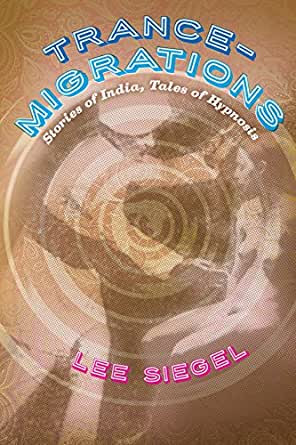
Lee Siegel, Trance-Migrations:
Stories of India, Tales of Hypnosis,
University
of Chicago Press, 2014.
read it at Google Books
Listen to what I am about to tell you: do not read this book alone.
You really shouldn’t. In one of the most playful experiments ever
put between two covers, every other section of Trance-Migrations
prescribes that you read its incantatory tales out loud to a lover,
friend, or confidant, in order to hypnotize in preparation for Lee
Siegel’s exploration of an enchanting India. To read and hear this
book is to experience a particular kind of relationship, and that’s
precisely the point: hypnosis, the book will demonstrate, is an
essential aspect of our most significant relationships, an inherent
dimension of love, religion, medicine, politics, and literature, a
fundamental dynamic between lover and beloved, deity and votary,
physician and patient, ruler and subject, and, indeed, reader and
listener.
Even if you can’t read this with a partner—and I stress that you
certainly ought to—you will still be in rich company. There is
Shambaraswami, an itinerant magician, hypnotist, and storyteller to
whom villagers turn for spells that will bring them wealth or love;
José-Custodio de Faria, a Goan priest hypnotizing young and
beautiful women in nineteenth-century Parisian salons; James Esdaile,
a Scottish physician for the East India Company in Calcutta,
experimenting on abject Bengalis with mesmerism as a surgical
anesthetic; and Lee Siegel, a writer traveling in India to learn all
that he can about hypnosis, yoga, past life regressions, colonialism,
orientalism, magic spells, and, above all, the power of story. And
then there is you: descending through these histories—these tales
within tales, trances within trances, dreams within dreams—toward a
place where the distinctions between reverie and reality dissolve.
Here the world within the book and that in which the book is read
come startlingly together. It’s one of the most creative works we
have ever published, a dazzling combination of literary prowess,
scholarly erudition, and psychological exploration—all tempered by
warm humor and a sharp wit. It is informing, entertaining, and, above
all, mesmerizing.
Lee Siegel, Horseplay: Equine Fables of Love and Death, Deuxmers, 2020.
If we are to believe critically acclaimed fiction writer Lee Siegel,
the author of Horseplay is actually a horse, yes, a talking horse
named Gulliver. And if that is not unbelievable enough, this witty
and erudite equine waxes quite eloquently on myriad subjects in
various languages.
According to Siegel, Gulliver dictated the series of twelve stories
that constitute this fantastic text. Each marvelous tale is about one
of his male progenitors, each of them endowed with the gift of
speech. The stories, passed down to Gulliver by those amazingly
garrulous ancestral stallions from generation to generation,
constitute a kind of comedic stud book or literary breeding registry.
The stories are at once sublimely romantic and yet bawdily down to
earth, occasionally melancholy but fundamentally hilarious. Horseplay
is indisputably one of the greatest books ever composed by a horse.
Lee Siegel, Who Wrote the
Book of Love?, University of Chicago
Press, 2010.
read it at Google Books
Who Wrote the Book of Love? is acclaimed novelist Lee Siegel's
comedic chronicle of the sexual life of an American boy in Southern
California in the 1950s. Starting at the beginning of the decade, in
the year that Stalin announced that the Soviet Union had developed an
atomic bomb, the book opens with a child's first memory of himself.
Closing at the end of the decade, when Pat Boone's guide to dating,
'Twixt Twelve and Twenty, topped the bestseller list, the book
culminates just moments before the boy experiences for the first time
what he had learned from a book read to him by his mother was called
"coitus or sexual intercourse or sometimes, less formally, just
making love." Between the initial overwhelmingly erotic
recollection and the final climactic moment, all is sex—beguiling
and intractable, naughty and sweet. Who Wrote the Book of Love? is
about the subversive sexual imaginations of children. And, as such,
it is about the origins of love.
Vignettes from the author's childhood provide the material for the
construction of what is at once comic fiction, imaginative historical
reportage, and an ironically nostalgic confession. The book evokes
the tone and tempo of a decade during which America was blatantly
happy, wholesome, and confident, and yet, at the same time, deeply
fearful of communism and nuclear holocaust. Siegel recounts both the
cheer and the paranoia of the period and the ways in which those
sentiments informed wondering about sex and falling in love.
"Part of my plan," Mark Twain wrote in The Adventures of
Tom Sawyer, "has been to try to pleasantly remind adults of what
they once were themselves, and of how they felt and thought and
talked." With the same motive, Lee Siegel has written what Twain
might have composed had he been Jewish, raised in Beverly Hills in
the 1950s, and joyously obsessed with sex and love.
Siegel continues his Love series of arch and diverting novels about
the body-mind conundrum, sexy tales that revolve around the influence
of texts as much as the libido. In his larkiest work yet, the focus
is on the sex manuals his young, curious, and affectionately indulged
narrator studies so avidly in his comfy Beverly Hills home. The elder
son of an actress and a doctor to the stars, lucky Lee (who is and is
not the author) tells the story of his sexual education from
kindergarten to his bar mitzvah in a hilarious mix of candor and
naivete, while Siegel parses the absurdities of the good life, 1950s
style. Precocious Lee plays cowboy, fears communists, gets into
scrapes, covets cute girls, and discovers the thrill of lying. As
always, mischievous Siegel revels in the magic of language while
offering tart social commentary on everything from Jewish
assimilation to racism to the atomic bomb, but never has his humor
been sharper or his characters more alluring than in this shrewdly
spiked, cheerfully erotic, incident-rich Hollywood coming-of-age
tale. - Donna Seaman

Lee Siegel, Love and the
Incredibly Old Man: A Novel, University
of Chicago Press, 2008.
read it at Google Books
“It was the best of times, it was the worst of times” begins one
chapter of critically acclaimed Lee Siegel’s new novel, Love and
the Incredibly Old Man. “In the beginning” starts another. What
else can a novelist do when hired as a ghostwriter by an elderly,
irascible, conquistador-costumed man claiming to be the 540-year-old
Juan Ponce de León? The fantastic life of that legendary
explorer—inventor of rum, cigars, Coca-Cola, and popcorn—is the
frame for Siegel’s fourth chronicle of love, lies, luck, loss, and
labia.
Summoned with cold hard cash and a pinch of flattery, a
professor and novelist named Lee Siegel finds himself in Eagle
Springs, Florida, attempting to give form to the life of the man who,
contrary to popular and historical opinion, did indeed find the
Fountain of Youth. Spending humid days listening to the romantic
ramblings of the old man and sleepless nights doubting yet trying to
craft these reminiscences into a narrative that will satisfy the
literary aspirations of his subject, Siegel the ghostwriter spins an
improbable tale filled with Native Americans, insatiable monarchs,
philandering cantors, deliriously passionate nuns, delicate
actresses, androgynous artists, and deceptions small and large. For
de León, and for Siegel too, centuries of conquest and colonialism,
fortune and identity, are all refracted through the memories of the
conquistador’s lovers, each and every one of them adored “more
than any other woman ever.”
Comic, melancholic, lusty, and fully engaged with the act
of invention, whether in love or on the page, Love and the Incredibly
Old Man continues the real Lee Siegel’s exuberant exploration of
that sentiment which Ponce de León confesses has “transported me
to the most joyous heights, plunged me to the most dismal depths, and
dropped me willy-nilly and dumbfounded at all places in between.”
"Whimsical, erotic and comic all at the same time."―
Kirkus Reviews
"A creative attitude to the novel is in abundant evidence across
all Siegel's fiction; and this new novel is a worthy addition to a
body of work which deserves a wider audience." - Stephen Burn
Mix a history of Spanish conquistadors in the New World with a porny
pulp tale, and the result is this entertaining novel. The premise:
Juan Ponce de Leon, the venerable 16th-century Spanish conquistador,
is alive and living in Florida thanks to the Fountain of Youth (which
he discovered). But with the fountain running dry, the explorer is
anxious to chronicle his 540 years on Earth before shuffling off this
mortal coil, and summons ghostwriter Lee Siegel to record the lurid
details of his countless love affairs. The irascible explorer—between
coining imaginative words such as cardarring (meaning, among other
things, to have sex)—lays out a reasonably reliable (lurid
embellishments notwithstanding) rendering of Ponce de Leon's travels.
In addition to his other vices, Ponce de Leon (who claims to have
invented cigars, rum and popcorn) leans heavily on cocaine-infused
rum punch and morphine as he and Siegel race to beat the explorer's
quickly approaching death. While this novel offers a decidedly goofy
point of view, surprisingly, it works. Siegel slips in the history
lessons so deftly that readers will barely realize they are being
educated as well as titillated. - Publishrs Weekly
A better title for this novel would have been “Sex and the
Incredibly Old Man,” because there’s little love in this
compendium of carnal adventures related by a 16th century Spanish
conquistador.
Here’s the premise: The author receives a letter from a man who
claims to be Ponce de Leon. Having discovered the Fountain of Youth
five centuries ago, Ponce faked his death and lived under a series of
aliases, shifting livelihoods and religions as required in order to
protect the fountain through the years. Now the fountain has run dry,
and Ponce is feeling his mortality. He needs someone to write his
memoirs.
Five hundred years of history, yet all Ponce wants to talk about are
his lovers. Spanish aristocrats, Native Americans, artists,
actresses, whores, and other men’s wives—they all fall to their
knees to worship him. Ponce insists that he “loves” every one of
them: He also lies, cheats, denies them the secret of the fountain,
and then abandons them when they notice he fails to age. This
treatment of women is offensive enough, but it’s not the worst
example of a subtle, insidious anger in this novel. What begins as a
series of awkward metaphors—an attempt to thematically connect sex
and religion—soon solidifies into something blatantly
anti-Christian. The tipping point is a scene involving rosary beads
and masturbation. After five hundred years, you’d think old Ponce
might have learned something profound. Something about love, perhaps.
Don’t look for it here. - LISA ANN VERGE
https://historicalnovelsociety.org/reviews/love-and-the-incredibly-old-man/
Lee Siegel, Love and Other Games of Chance, Viking, 2003.
Circus performer, entertainer, and world traveler Isaac Schlossberg
shares, in one hundred chapters, his experiences as the son of Jewish
immigrants, a sideshow performer, carnie, stage and movie actor, and
lover. 15,000 first printing.
This second novel by Siegel (Love in a Dead Language) lives up to its
subtitle: it's organized as a game of Snakes and Ladders, with each
chapter representing a square on the game board; the reader can
choose between a traditional reading, from start to finish, and a
playful one, letting the roll of the dice decide. The story follows
Isaac Schlossberg, a swindler, circus performer and entertainer. As
Schlossberg travels around the world (and across the board), his
stunts-from childhood appearances in sideshow acts with his Jewish
immigrant parents at the turn of the century to his attempts to beat
Sir Edmund Hillary to the top of Mount Everest-are woven together
into one exceptionally tall tale. Depending on one's point of view,
this is either the book's failing or its forte: the reader hardly has
time to take in Schlossberg's romance with a Hindu snake charmer, for
example, before he flies off to a different corner of the earth, a
different occupation and a different woman. At the beginning and end
of the novel are somewhat more grounded first-person accounts by a
writer called Lee Siegel, Schlossberg's estranged son, who explains
that "a person's lies always reveal some truth about them."
The whole enterprise is finally redeemed by Siegel's amusing deadpan
style: "The end of the war was... a blow to my father....
without a government paycheck... my father had to take agricultural
work, using [his plane] to spray citrus groves with a poison that,
developed for use on German infantrymen, proved lethal to American
fruit flies..-- to spray citrus groves with a poison that, developed
for use on German infantrymen, proved lethal to American fruit
flies." - Publishers Weekly
Raucous adventure tale of a man’s journey from the Dead Sea to the
top of Mt. Everest, in a hundred vignettes touring early 20th-century
pop culture.
Author Siegel’s mother reveals in a prologue that Siegel’s
recently deceased father wasn’t really his father. His real father
was Isaac Schlossberg, a showman and adventurer who left behind a box
of papers and a mysterious game that looks a lot like Chutes &
Ladders but is actually Snakes & Ladders, a chessboard-like
device of Eastern origin. Stories are written on each of the squares
of his version of the game, and such is the book: a hundred chapters
detailing Schlossberg’s madcap adventures. Says second-novelist
Siegel (Love in a Dead Language, 1999), “To play the game, it seems
to me, is to become acquainted with the author in the same way we get
to know a person in real life.” The “squares,” or chapters, go
from the Wild West to the Mystic East, and through the Prime Meridian
to Novel Antipodes, eventually heading toward the enlightenment of
Everest, where it may turn out that Schlossberg made it to the top
before Hillary. The story, fragmented and random (and entirely
without paragraph breaks), offers up history in an old-fashioned pop
culture—biblical figures in the context of vaudeville acts, for
example. There are cameos from famous figures (“Buffalo Bill and
Geronimo were shooting it out for the heart of Matanka Hickok at the
Old London Theater,” or ‘ “I act according to the intent of the
Almighty Creator,’ ” Germany’s chancellor, Adolf Hitler, said
in a speech at an anti-Jewish rally in Munich”). It’s never clear
whether we’re supposed to read the book or play it, and one wishes
the “game” came with a clearer set of instructions. But the cast
is lively and the history complete. Even if we don’t buy into
Schlossberg’s adventure entirely, Siegel is there to tell us that
“A person’s lies always reveal some truth about them.”
Vast and zany. - Kirkus Reviews
Has Siegel launched a series of hilarious literary tall tales with
the word love at each title's helm? First came Love in a Dead
Language (1999) and now another love novel, in which Siegel is even
more adept at lacing outrageous storytelling with shrewd observations
and exuberantly erudite eroticism as he celebrates and mocks
humankind's seemingly endless capacity for make-believe, chicanery,
tomfoolery, adventure, and, yes, love. He uses the old game of
chance, Snakes and Ladders, as the underlying structure for a
gleefully episodic romp through 40 years in the improvisatory and
peripatetic life of charming, wily, and romantic Isaac Schlossberg,
who makes his way from the close-knit Jewish immigrant community in
early-twentieth-century New York to California, Calcutta, London,
Honolulu, Miami, and Tibet. The son of performers, Isaac is a snake
handler who acts in phony seances, Wild West shows, vaudeville, and
silent movies, all the while getting entangled in myriad absurd
escapades, one involving a fake wolf boy and a sexy, animal-obsessed
gal named Pythia. Siegel himself is a conjurer and a tease, a
connoisseur of language and a great fan and purveyor of
entertainment, and this three-ring circus of a novel is as smart as
it is ebullient. - Donna Seaman
Using the game of snakes and ladders as an organizing principle,
Siegel has constructed a work of 100 almost perfectly equal chapters
to be read in the order presented or by sliding back and forth as the
rules indicate. Magic and illusion form the core of this book,
whether at Wild West shows or circuses. The story begins at the
lowest point of the Dead Sea at the winter solstice of 1899 and ends
on the peak of Everest at the summer solstice of 1946. In between we
have followed the career of Isaac Schlossberg and the bizarre cast of
characters who witness its twists and turns.
The tightrope walker he calls angel meets him while he earns his
living charming snakes. As the principal love of his life, she pops
up in many of the book’s hundred sections, especially on the ones
where ladders throw the narrative forward or snakes drop it back. His
attachment to her does not prevent experiments with a female pilot in
the early days of erotic aviation. A fake feral child gains fame as
the boy raised by tigers who is a reincarnation of Warren Hastings.
We are told that Bachnele Poopik, the Yiddish-speaking dwarf who is
irresistible to women, has “stooped” Eleanor Roosevelt.
This is one of the details which make us think Siegel relied more on
invention than history, but you can’t prove a universal negative,
as one of his characters observes.
This novel does not conform to much of what makes an historical
novel, but it delivers the novelty it promises. Sprinkled throughout
the text we find colorful Yiddish, appropriate Bengali and the
universal language of magic. - JAMES HAWKING
https://historicalnovelsociety.org/reviews/love-and-other-games-of-chance/