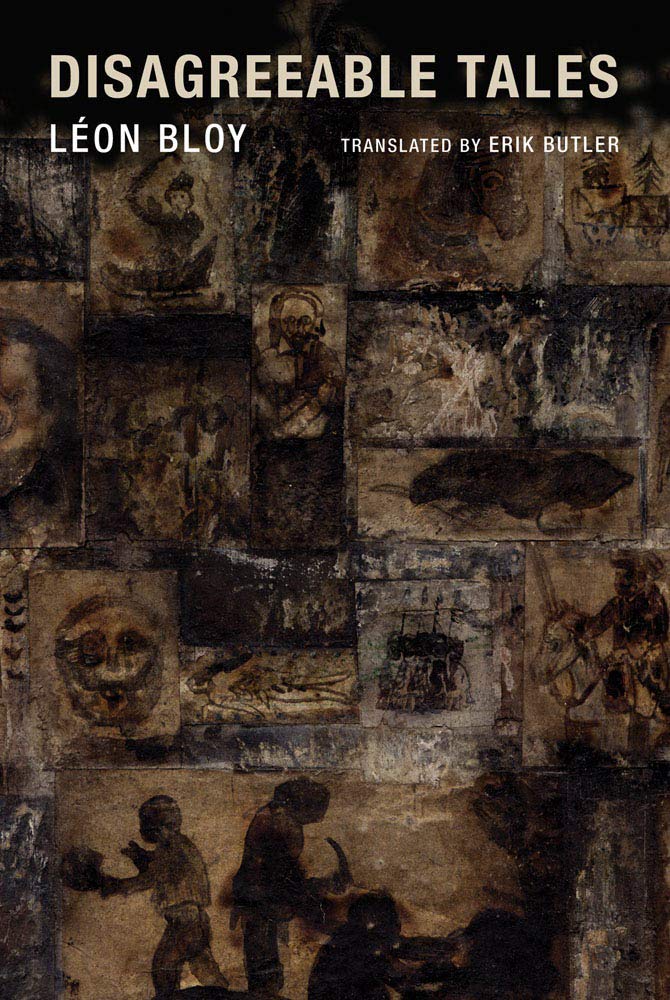
Léon Bloy, Disagreeable Tales, Trans. by Erik Butler, Wakefield Press, 2015.
Thirty tales of theft, onanism, incest, murder and a host of other forms of perversion and cruelty from the "ungrateful beggar" and "pilgrim of the absolute," Léon Bloy. Disagreeable Tales, first published in French in 1894, collects Bloy's narrative sermons from the depths: a cauldron of frightful anecdotes and inspired misanthropy that represents a high point of the French Decadent movement and the most emblematic entry into the library of the "Cruel Tale" christened by Villiers de l'Isle-Adam. Whether depicting parents and offspring being sacrificed for selfish gains, or imbeciles sacrificing their own individuality on a literary whim, these tales all draw sustenance from an underlying belief: the root of religion is crime against man, nature and God, and that in this hell on earth, even the worst among us has a soul.
A close friend to Joris-Karl Huysmans, and later admired by the likes of Kafka and Borges, Léon Bloy (1846-1917) is among the best known but least translated of the French Decadent writers. Nourishing antireligious sentiments in his youth, his outlook changed radically when he moved to Paris and came under the influence of Barbey d'Aurevilly, the unconventionally religious novelist best known for Les Diaboliques. He earned the dual nicknames of "The Pilgrim of the Absolute" through his unorthodox devotion to the Catholic Church, and "The Ungrateful Beggar" through his endless reliance on the charity of friends to support him and his family.
“His fire is nurtured by the dung-heap of modern times.”—Franz Kafka
“Bloy has come my way... He is an iceberg hurled at me to break up my Titanic and I hope my Titanic will be smashed.”—Flannery O'Connor
“Léon Bloy is a cathedral gargoyle who pours the waters of heaven down on the good and on the wicked.”—Barbey d'Aurevilly
The Infusion
An "Unsavory Tale" by Léon Bloy
Granted, the title is not necessarily enticing -- but at least Bloy is upfront from the beginning. And these are, indeed, tales of the disagreeable -- the often monstrously disagreeable. They're strikingly amoral, too: Bloy doesn't tuck edifying lessons into them. Yet Disagreeable Tales isn't mere profaning revel in the worst of man (as, for example, de Sade's endless cataloguing novels are).
The subject matter is striking. The first two tales alone see, respectively, a mother responsible for the death of her child, and a daughter responsible for the death of her father; in neither case is there any doubt about responsibility for the death, and yet the true cruelty, or at least final twist, is in it being accomplished (slightly) indirectly. The first tale, too, is typical of how Bloy tidies up his tales and what he offers in conclusion, the closing paragraphs reading:
"Finally !" she sighed, somewhat weary, and reached to ring for a servant.
Jacques had a severe aneurysm, and his mother had a lover who didn't want to be a stepfather.
The simple drama occurred three years ago in the neighborhood of Saint-Germain-des-Prés. The house that served as its theatre now belongs to a demolitions contractor.
There are many other deaths, too, -- including one truly horrific parricide -- but even beyond that there's a great deal mired in the repulsive. Personal descriptions such as: "Her face resembled a fried potato rolled in scraped cheese" and "Your face is like a straw mattress they've all cleaned their boots on" abound. One character is introduced:
The very sight of the old man engendered vermin. The dung heap of his soul extended so far into his hands and face one could not possibly imagine a more frightful contact. When he walked the streets, the slimiest gutters, shuddering at the reflection of his image, seemed to flow back to their source.
Occasionally, Bloy explicitly acknowledges
I am getting to the culmination of the story -- which kills me, devours me whole, and defiles me beyond all conception.
But most of these tales speak for themselves in their abasement.
There's a surprising casual lightness and stylishness to the writing too, making more of them than just ugly tales. Bloy's short pieces move along quickly, a succession of short paragraphs that often summarize compactly and leap quickly ahead. He may revel in filth and obscenity, but Bloy does not wallow; he observes, records -- and moves on. And Erik Butler's translation nicely captures the language and style of the era that Bloy relies so heavily on (as Disagreeable Tales is very much a decadent literary product of the French fin-de-siècle).
There's a great deal of variety to the tales too -- quick summings-up of lives (that usually weren't exactly what they seem), anecdotes of decisive episodes. Bloy has some fun in making several of his protagonists literary types -- but there's no romanticizing of this path here:
He had been given literary genius in addition to everything else. It was the kindling of his torments.
And no matter how bad it gets, Bloy can always ratchet things up another notch:
Nor is that all, O, my God ! Behold the abyss of woe.
There's something ridiculous to all of this, too -- but then there has to be; to read it seriously seems almost unthinkable. Yet despite a light and occasionally even comic edge, this isn't really satire. Perhaps what makes for their staying power is an underlying sincerity to the stories; Bloy isn't a traditional moralizer, but there's a firmness of belief in society and men's failings, perhaps colored by his (surely complicated) religiosity, that underpins these tales: Bloy isn't just mocking, or aiming to shock; he really means to shake his readers with his depictions of the baseness of life at all levels.
Decidedly odd, these Disagreeable Tales are nevertheless weirdly appealing. - M.A.Orthofer
“(He) was an utterly generic man – the next best, in a host of insignificant and vacant individuals, to happen by; he seemed one of those people who exist in the plural, so fully do they express atmosphere, collectivity, and sameness... His face seemed to be cast by a spade; it belonged to the innumerable number of fake he-men from the South no interbreeding can refine – but in whom everything, even the uncouthness, is just for show...”
From 'A Dentist's Terrible Punishment,' featured here with twenty-nine other raucous faux anecdotes, this passage reminded me of one of British Prime Minister David Cameron's recent rhythmically alliterative, but ultimately empty, speeches. I had to smile, in a way that the tale's author Leon Bloy (1846-1917) would surely have approved.
This is a theatre of blood from the perspective of a catholic outsider. A born contrarian, who seemed to lose as many friends as he gained, Bloy swung from a youthful hatred of the Catholic Church to converting to it in adult life under the pervasive influence of local novelist and short tale author, Barbey d'Aurevilly; a dandyish figure of the previous generation whose open literary non-conformity would soon inspire Bloy's own. Proudly unclubbable as Bloy became - being also unemployable - left the permanently destitute writer with little choice but to plead for financial aid from friends and found acquaintances. This left him with the unenviable moniker, 'the ungrateful beggar,' yet one, if connected to his output, that might also be deemed a selling-point. Among what he produced (three autobiographical novels and eight volumes of journals) nevertheless stand as a barefaced antidote to stuffier English cousins.
Oddly, what all my biographical sources leave unwritten is Bloy's disparaging, satirical humour; at least highlighted in this collection. Here, he punctures the sinecures of self-serving middle-class complacency with as much black vehemence as any contemporary anarchist. Translator Erik Butler, in his Introduction, at least acknowledges this:
“A few years after Bloy's birth, in 1851, Louis-Napoleon Bonaparte staged the coup apropos of which Karl Marx, glossing Hegel, made the famous observation that historical events occur twice: 'the first time as tragedy, the second as farce.' The less-than-great man's reign, which began with harshly repressive measures and, ten years later, introduced the so-called Liberal Empire, was imposing but hollow. The 'real' Napolean had been a revolutionary general who succeeded in conquering half of Europe. Napolean III, as his nephew called himself, measured up only in appearance.”
Understanding this context helps understand the trigger for Bloy's ripe, lampooning venom. I'd argue he did too well, if not protesteth too much. The paradoxical effect – far from accusing the guilty back into the fold – surely only highlighted to his readership the hypocrisies in organised religion all the more.
While the tone – at least in this collection – is openly misanthropic, by the standards of the day it is surprisingly un-misogynist; the women characters of their class as well delineated – and taken down – as his men, with the latter on the receiving end of marginally greater contempt.
Yet, again, how can even today's politically-correct critics not find irresistible wit in, “Her face resembled a fried potato rolled in scraped cheese...her whole person exuded the odour of a landing in a furnished hotel of the twentieth order --- on the seventh floor.” ('Two Ghosts').
As with most of Wakefield Press's reissued translations, (and Butler has done a deliciously sinuous job), I can give near fulsome recommendation; as long as you are prepared to keep a wryly jaundiced tongue in a capacious, accepting cheek. - Mark Andresen
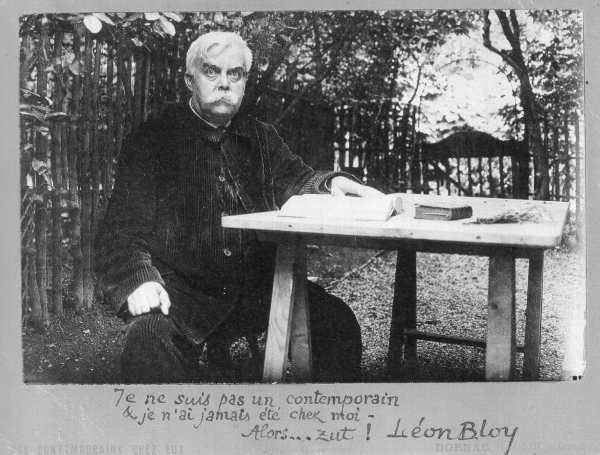
Bloy observed the vows of both poverty and suffering; he earned the nickname the Ungrateful Beggar.
In his first homily as Pope Francis, in March 2013, the Pontiff included an obscured voice of the French fin de siècle. Restating one of the most entrenched principles of Catholic dogma, Francis declared, “When one does not profess Jesus Christ, I recall the phrase of Léon Bloy—‘Whoever does not pray to God, prays to the devil.’ ” Though it may have struck religious scholars as unusual, the reference to Bloy indicated the Church’s cautionary role against the millennial idolatry of technology and humanism. Bloy, who wrote a series of pamphlets, novellas, and essays during the increasingly scientific climate of the Second Empire and the Belle Epoque, included himself among the cabal of symbolists and decadents who had taken Satan as the object of their literary obsessions—specifically, the resurgence of the devil in the popular French imagination.


