 Matt Bell, Wolf Parts (Keyhole, 2010)
"Told in a number of very brief fictions, the reader is introduced to Red, the Wolf, the Grandmother, the Woodsman and all the usual players, but Bell takes these familiar constructs and adds a dash of the visceral, the macabre, the erotic, and a simple elegance that would make the Brothers Grimm proud not just for following the tradition of their cautionary tales (of which many readers are only familiar with the watered down, Disneyfied versions), but for taking a step beyond what they might have ever envisioned and creating something special that stands all on its own." —Erik Smetana
"Bell paints Red’s alternate histories with precise brushstrokes that map viscera and chart the rocky (and sometimes paradoxically abstract) landscape of a victim’s psychology. The aptly named Red... is alternately innocent girlish victim, initially unaware of but forced to acknowledge her sexuality, and then heroine, who prepares reprisals following the unwanted lessons that have sharpened her edges to points as fine as the knife concealed in her goodie basket. Other times, as in the opening story, she attempts to empower herself by stopping the destructive cycle she is trapped in... The stories themselves are both intimate and elliptical, giving just enough information for readers to vicariously experience and also extrapolate beyond the boundaries of what’s told." —Savannah Schroll Guz
"When I found out Bell was releasing a minibook retelling the story of Little Red Riding Hood, I knew this story would not be one for my mother's 1st grade class. Rather, Wolf Parts is a collection of fragmented flash fictions that took me to sights I wish I wouldn't have seen, but at the same time, feel like a different man for seeing. Stories, I believe, should do something to me. These flashes frighten me, enliven me, rage me, touch me with their haunting metaphors and visual descriptions.
The image I can't get out of my head is Red laying naked on the skinned fur of the Wolf, after her dad has killed him to prove a lesson about protecting his daughter. When Bell writes, When she howled, it was with her mouth against his unhearing ear, her lips close to his stretched and taxidermied jaws, full of the teeth she had just once felt so lovingly against her skin. , I was at once disturbed and also moved by Bell's ability to capture such haunting moments with his pitch perfect language.
My mind is full, I said, in a previous post, from processing images like these: predatory, daring, truthful. In these stories, the predator changes: the Wolf of course, but also the grandmother as the wolf, the woodsman as a killer, Red and other girls as wolf-slayers. We are all wolves, it seems, or we have the chance to be.
I can't quite say enough about this collection as a whole. Each story shouts with a such ferocity and diversity that I will have trouble sleeping tonight, not from being afraid of the Wolf, but rather from being afraid of language and all its power." —Tyler Gobble
"The epigraph to Wolf Parts comes from Kate Bernheimer, editor of Fairy Tale Review, who writes that "Fairy tales see things as they are. To be real is to know the consequences of becoming. Never to own, and always to die." Bernheimer's words could not have been selected more carefully, more particularly, speaking as they do to the reality of fairy tales, which so often acknowledge the persistence and finality of death; Never to own, indeed—nothing, not even the body, is ultimately, finally, one's own.
Here, the tales themselves are wolf parts, literal fractured fairy tales, written and rewritten and splintered and pieced back together to reflect the myriad possibilities of story. Wolf Parts is the quintessential fairy tale dissected. The characters that traditionally accompany the wolf are those he is linked to in endless, circular inevitability, an inevitability as certain as death. These are parts, episodes, and retellings, that indicate both an attempt to break the cycle and the characters' enslavement toward it; there is the resulting failure to escape the binds of story and myth, which ironically, refuse to be broken. Story proves itself stronger than its players:
'After Red cut herself out of the wolf's belly [...] she again found herself standing on the path that wound through the forest toward her grandmother's house. [...] Afterward, she went to her grandmother's, where she again discovered the wolf devouring the old woman, and where he waited to devour her too, as he had before. Once again, she was lost, and once again, she cut herself out of his belly and back onto the stony path.'
The retelling over generations of fairy tales, and how the story lives as such, is made real by its countless retellings and generational re-readings: It is through this that the story, a reflection of reality, is made real and given voice and life, a life that human characters cannot take with them in the end—and there is always an end. Story itself, as made evident in Wolf Parts, represents the persistence of death in the human life cycle and yet captures an immortality that humanity will never be able to achieve, but that its representatives do. It is story as art, as immortal, a signpost to humanity that states, This is who we are/this is who we were. Bell writes of Red that "she trusted her grandmother, even though it hurt worse than anything that had come before": the power of story is evident in the ultimate trust it draws from us.
The episodic structure lends itself to the mincing and dissection of the fairy tale, and with each page (the tales are never more than a page in length), Little Red, the wolf, and the grandmother all turn and return to their natural capacities, at the beginning of every tale existing simultaneously in both their pre- and post-horror states: the wolf is always ready to engorge himself on the flesh of the women, and they always climb, scratch, bite, or knife their way out of his stomach or the bed, ever-fated.
Even beyond the book's episodic structuring, the rhythm of the syntax points to the fatedness of its characters, to the rhythm inherent in the retelling and in the timelessness of the fairy tale. For instance, Bell writes, "And then on the third day, a knock, and on the third knock, a voice." In this particular episode, the grandmother lies in her bed at the mercy of the tale: "Raise the latch, she cried, before she'd fully heard the voice, and certainly before she realized how deep it was, and how terribly unlike a little girl's." And so the story goes, and there is no hope of escape from the narrative.
The wolf remains the villain, as he is also at the mercy of story, even when the narrative twists and the women turn against him. The tales evolve thematically over the course of the book, holding on to a thread for several episodes, and then suddenly turning everything on its head. Through this, Bell not only distills the essence of story, but also of narrative, which itself becomes nearly a character, one that is mostly invisible, but powerful as story. When it is Little Red who wields the knife, it is she who is positioned as pack leader, teaching in one particular instance the young girls sent out in sacrifice to the wolf in the forest how to assail their attacker.
As with the evolutions and introductions of variables that tend to occur with fairy tales throughout generations and across continents, every episode represents a possibility, a branching off of the tale in a universe of alternates, but most importantly, these nuances represent interpretation. There is room for variation, as Bell seems to indicate: "I say wolf, but of course there are various kinds of wolves." Even aside from the presence of variability, there is the persistence of roles. Every character has an essential role that (s)he does not veer from. The wolf is always the fanged, slavering beast, the representation of all that is cruel and unjust in the natural world, and Little Red is always Little Red, always a figure of the feminine, even when she is perpetrator rather than victim.
When, one time, the wolf commands Little Red to strip off her clothes, she removes everything but the cape: "she wore only her red cape and hood, which she would not remove, no matter how urgently he pleaded." Her refusal to remove the cape indicates not so much an unwillingness as an inability to step outside her role: after all, who else could she be? She can exist as none other than Little Red Riding Hood just as she will always be female, just as the wolf will always be the wolf. Their roles are fixed, even when a sort of thematic turning point occurs: Little Red becomes an adult and incites the feminine revenge against the tormentor who has not only consumed her and her ilk, but who has raped her time and again.
Identity is also questioned through the interchangeability of roles. What could it mean, such fluidity of identity? Bell writes, "If the wolf had always been the wolf, and the grandmother always the grandmother, why did Red so often struggle to tell them apart?" Sometimes, when the wolf has control over the girl, he bids her to consume the grandmother, and she is turned ravenous beast, transformed into an insatiate carnivore: "Clenching her fork and knife in her tiny fists, she searched the empty platters, and when she found nothing else to eat, she clambered quickly toward the yawning wolf, hungry for more." Transformation, when it takes place, does so at the level of story and character: what ascension is there, after all, beyond that, if not into the realm of theory and rhetoric?
And the moral of it all?
If I told you the wolf deserved this lonely end, that his slow, struggling starvation was justified, then that would be one kind of tale. But he was not a moral wolf, and this was never about to become a moral story, no matter how it ended.
The moral is that sometimes there is none. Sometimes, a wolf is just a wolf." - Cynthia Reeser
"I’m going to try something different with this review. I often find that an author’s own words, perhaps selectively chosen, are a better summation of a text than any review. However, I do understand that the point of a review isn’t merely in summary, but is meant to judge a book as well. Here, I will give a bit of both modes, though with a heavier weight on quotes taken from the text. Here is my first “Mostly Quotes Review.” Let me know what you think.
Wolf Parts is vicious fairy tale excursions:
Pg. 7: “…she laid across the stones and, with the knife her mother had given her, gutted herself, quickly, left to right. She cried out in wonder at the bright worlds she found hidden within herself…”
Wolf Parts gives metaphor to the ambiguity of adolescence, turning the cautionary tale of “Little Red Riding Hood” into a predatory one:
Pg 14: “The wolf’s breath smelled of chalk, and his paws were covered in flour. It wasn’t enough to trick the girl, but she allowed herself to pretend to be fooled. She opened her cloak and invited him in, so that he might do what he came to do.”
Wolf Parts turns the morality lessons of our established fairy tale and turns it inside out, sometimes literally:
Pg 15: “From inside the wolf’s stomach the grandmother could only hear every third or fourth word her granddaughter spoke…She bit down hard, first on lung and heart, then indiscriminately, casting about in a great gnashing, devouring all she could until the wolf she was inside was also inside her..." - Caleb J Ross
Here's the beginning of the book:
"After Red cut her way out of the wolf’s belly—after she wiped the gore off her hood and cape, her dress, her tights—she again found herself standing on the path that wound through the forest toward her grandmother’s house. Along the way, she met with the wolf, with whom she had palavered the first time and every time since. Afterward, she went to her grandmother’s, where she again discovered the wolf devouring the old woman, and where he waited to devour her too, as he had before. Once again she was lost, and once again, she cut herself out of his belly and back onto the stony path. Over and over, she did these things until, desperate to break the cycle, she laid across the stones and, with the knife her mother had given her, gutted herself, quickly, left to right. She cried out in wonder at the bright worlds she found hidden within herself, and with shaky hands she scooped their hot wet flesh into the open air, where with a flick of her wrists she set them each free."

Matt Bell, The Collectors (Caketrain, 2009)
"The tale of compulsive hoarders Homer and Langley Collyer so shocked 1940s Manhattan that the brothers and their Harlem brownstone live on today as one of the most notable American case studies of acute disposophobia. With a nervous energy and obsession to match his protagonists, Matt Bell’s prose burrows, forensically, into the layers of the brothers’ lives, employing a multilinear narrative structure and a frenetic plurality of perspectives to reach a core of despair that is both terrifyingly primal and distressingly familiar."
"‘Even a book can be a door,’ suggests the narrator of Matt Bell’s The Collectors. What you’ll find behind this particular door are two shaken and shaky brothers losing their tenuous grip on reality, slowly filling their house with decades of booby-trapped detritus and precious trash. The Collectors is a compelling portrait both of the way a heated mind can come to recreate the world and of how fascination with such a mind can end up being its own sort of trap. A wonderful, obsessive novella." —Brian Evenson
"Matt Bell makes of the pathology of the miser, hoarder, or packrat an emblem of the obsessive life and makes his reader understand how the compulsion to collect may be only the mind’s seeking to construct for itself a refuge from an intolerable and otherwise inescapable reality. Bell’s fiction excites pity for those who live, as though walled up, in ruins of their own necessary construction. I admire The Collectors for the certainty of its prose and its unflinching observation of a most profound alienation—envying the first; fearing the second; and unhappily aware that artifice—no matter how splendid—is inadequate to ameliorate the despair." —Norman Lock
"In the 1950s, Samuel Beckett brought out his groundbreaking trilogy: Molloy, Malone Dies, and The Unnamable. These were stories of renunciation, as in the brilliant central novella, when the bedridden Malone gives up the scrap he's carried this far and lets his consciousness fade into a story. Beyond that, Beckett renounces the culture in which he came up, the High Modernism of his mentor Joyce. He insists on a new field of discourse, primarily by means of doing without. So as I read these two latest challenges to what we expect of fiction, stories stripped of their vestments, I couldn't stop thinking of Beckett's trilogy. Bell's novella does have a setting and a history, mid-town Manhattan during the same period when Beckett was bringing out his trilogy. To establish this much, though, takes digging - and that's precisely the word. The abode of these "collectors" is a garbage heap. The bachelor brothers Langley and Homer Collyer were packrat-psychos. They occupied (boy did they) an Upper East Side brownstone, and died crushed beneath their own cram: "three baby carriages, rakes and hoes…, several rusted bicycles, kitchen utensils (including at least four sets of china…), a heap of glass chandeliers that had been removed to make room for the piles and the tunnels." And this is just one list, from one of the several short chapters that Bell labels "Inventory."
The Collyers, in his reimagining, don't live in a place so much as a passion. The Collectors, keeping things in-house, burrows deep into the mind. Most of the two or three-page chapters deal out imagined snippets of the brothers' dying days, the point of view shifting between two men beyond help: Langley crippled and Homer blind. The latter's name and disability are another fact of the history, but they suggest of course the famous first storyteller, and so add an intertextual irony. Both war and odyssey stay within the city walls.
Bell visits one or two other perceptions as well, in chapters set after the brothers' demise, but the feel remains claustrophobic. The style tends to lists and compound-complex constructions, such as when we get an inkling of psychology, regarding the father's abandonment: "Every stray hair clinging to a shirt collar, every scrap of handwriting left in the margins of his texts, all of it is him, is who he was. It's all that's left, but if you keep it safe then it's all you'll ever need." Hard feelings have calcified, leaving everyone pretty well paralyzed even before the accident to the (slightly) more mobile brother. That accident's the only event; the rest is inventory, including the death rattle.
Yet such a description violates the story's sprightliness. The brief volume has almost thirty chapter breaks, and these are arranged in an outline of numerals and capitols, pleasantly confounding while it's reliably repetitious. More than that, each "Inventory" embodies, in its archeological slice of the home, some smaller tragedy. The dolls in one room, uncovered at what would be the climax point of an ordinary fiction, amount to "no more a family than anything else." So while the madness of the situation remains beyond our ken, the sorrow's brought down to human scale.
The reader, you could say, becomes both cleanup crew and Author. These are the two other perspectives that turn up, again imaginary; the Author isn't the historical Matt Bell, no more than Homer and Langley are the historical Collyers. But a few of the passages here speak with re-animating force, amid the wreckage. The Collectors suggests, ultimately, that there exists no better form of renewal than the accommodating art of story." - John Domini
"The Collectors is a small story, a puny story, a little story, a big story, a huge story, a big, big story, a narrow story, a dank cave. Matt Bell wrote it. It was published by Caketrain. Brian Evenson picked it as a runner-up for their contest. It’s 64-pages long, but spatially it spirals upon itself and throbs back out because of the peculiar way Bell structured it, and also because of the ordinary way Bell structured it.
It’s about two brothers named Homer and Langley who live in a house filled with tons of junk. Newspapers and stuff. 120 tons of junk. They’re real, I guess. It happened, something along these lines actually happened. Matt Bell did not make this up. It was probably in the newspaper. Matt Bell researched the source material then wrote it differently. The story occurs in the third person, but there are portions in the second-person and a framed story told with an I-voice, which covers the discovery of the larger framework and I wonder: what’s Matt Bell trying to pull?
Bell could well have written this after reading Endgame by Beckett and whatever book is the opposite of Endgame by Beckett – maybe Krapp’s Last Tape by Beckett.
Endgame is always called “Cartesian” because the set, a barren room with two windows, represents the interior of a skull. Clov, hardly mobile, cares for Hamm, who is completely immobile. Homer is chair-bound (like Hamm) and Langley assists him (like Clov). The story about Homer and Langley is cerebral too, but it isn’t brainy. Also, it isn’t not brainy. It’s a little nugget, a walnut. If Endgame functions as a cogito, then The Collectors works as a cluttered one.
Thus the cluttered comparison to Krapp’s Last Tape. There are disorderly piles of boxes and old archival reels in Krapp’s room, where he’s listening to that recording he made about his lovely boat ride or whatever. There’s only one person in this story, Krapp. There’s a thing with a banana, with the peel.
In The Collectors there’s a thing with orange peels. When Langley’s self-set traps pin him under a boulder of sewing machines outside the master bedroom, Homer is left stranded on his own. He tries to find his brother, but gets lost among the labyrinthine stacks. Dejected now, Homer tries to make it back to where he keeps his chair and realizes he’s arrived when, with exhausted fingers, he touches fruity detritus.
Homer, blind, eats lots of oranges to cure his eyesight. That was Langley’s idea.
There’s a lot of stuff in the house. This is a big story, one “[s]upported by scraps of lumber and stacked newspaper or cardboard” – (which is how Bell describes the house). The whole thing is like a maze, and the story matches that framework. Even the chapter headings are jumbled. The chapter headings have all gone awry. The Collectors doesn’t walk the line of Ch1–Ch 2–Ch 3, it goes 1A–3A–2A–4A– 3B–1B and so on. It’s cool. On page 52 comes chapter 5A.
First I read straight through the book. Then I read straight through the A sections, then through the B sections, like that. Someday I plan to read all the 1 sections. Why not? You can choose however you want to read The Collectors. You can read it several times and be fooled into thinking it’s several books. Having written several books and then collapsing them all into the same story, Matt Bell’s The Collectors is a jaw-dropping achievement.
Naturally, you can choose however you want to read any book, but with The Collectors (and Nabokov’s Pale Fire), it makes sense to mix it up a little. Because the story’s layers, like the packing of Homer and Langley’s house, are so dense, even fans of convention can enjoy the innovations here; even a glossing of the rich depths makes for an enveloping read." - Adam Robinson
“A voice comes to one in the dark.” So begins Company, Samuel Beckett’s dense novella from 1980. Company concerns, perhaps, a man recollecting his youth. There are scenes from a childhood, at least. A boy recalls one of his father’s romantic affairs. That same boy, ostensibly, recovers a box from a shed in which he left weeks earlier a mole, now rotten and flowering with mold.
Matt Bell’s new book, The Collectors–released this summer by Caketrain–is likewise a compact novella about deterioration and recollection. It begins, not dissimilar to Company, “How long has Homer been sitting here in the dark?” The parallels to Beckett do not end there, by any means. In fact, The Collectors often reads like a thematic distillation of Beckett’s oeuvre. The protagonists of The Collectors, the Collyer brothers, live alone in a dark mansion where they spend most of their time wasting away amidst disintegrating piles of newspaper. They’re the sort of men—sexless, and solitary—one finds in Beckett’s mid-century work. In Endgame, the blind Hamm wakes and sleeps in a wheelchair. In The Collectors, where there isn’t room enough to move, Homer Collyer, also blind, sits on an old leather chair in his reading room, eating only oranges. “After Homer lost his sight, his brother [Langley] put him on a diet of nothing but oranges, convinced that the fruit would restore his sight.” This is a marvelously absurd prescription, and one Beckett might have applauded. At the beginning of Krapp’s Last Tape, in one of the play’s few light moments, Krapp, perennially constipated, eats two bananas.
Though no more teleological, Bell’s work is more immediately accessible than Beckett’s—and despite some brutal passages, less cruel.
Wherever Langley is, he’s quiet now too, or else something worse, something Homer doesn’t want to think about. He feels bad enough for not hurrying, for not being able to find his brother and save him. His lungs ache and his ankles throb… He centers himself in front of the piano and starts to play, then stops when the sound comes out wrong. He sighs, starts over with more realistic expectations.
Beckett is devoid of so many things, not least of which is recognizable remorse. One cannot imagine Moran, in that more conventional half of Molloy, feeling guilty about abandoning his son; Molloy himself, in that ninety page second paragraph, may regret his compulsion to move, but of killing a stranger in the woods or having sex with his mother, he isn’t exactly penitent.
Oh well, I may as well confess it now, yes, I once rubbed up against [a woman]. I don’t mean my mother, I did more than rub up against her. And if you don’t mind we’ll leave my mother out of this. But another who might have been my mother, and even I think my grandmother, if chance had not willed otherwise…It was she made me acquainted with love.
Bell’s characters, conversely, seem to long for each other. The Collyer brothers, as inept as they may be, attempt to help each other. Abandoned by their father, they’ve spent the entirety of their lives attempting to reconstruct the home, and the family, that the patriarch discarded. Even in this passage—certainly the most enigmatic in a book replete with mysteries—one finds a desire to recapture the past, rather than eradicate history:
Now you have [your father] trapped, boarded behind the doors of the second floor, and he will never escape, not as long as you live. Every stray hair still clinging to a shirt collar, every scrap of handwriting left in the margins of his texts, all of it is him, is who he was. It is all that’s left, but if you keep it safe then it is all you’ll ever need.
Last week I wrote to Matt Bell to tell him Flatmancrooked would be posting a review of The Collectors in High Horse. “I’m a big fan of Beckett,” I wrote, “and I love to see this generation of writers reacting to his work in their fiction.” To my surprise he responded by saying:
You know, the funny thing is that I’ve never read Beckett until right now (I’m reading the Three Novels at the moment). Yet, he’s come up in discussion after discussion about my work, in blurbs and in reviews and in writing group and so on. As soon as I started reading Molloy, I saw why, and I saw how he had influenced so many of the people I’ve been influenced by. But there hasn’t been any direct influence on me to this point, although I’m sure there will be going forward.
To have engaged unknowingly in such an exact dialogue with Beckett is astounding. That alone is worthy of note. One can’t help but think of Pierre Menard composing word for word the Quixote, having never read Cervantes. It’s exciting to think what Bell will tackle next. He may abandon the subjects of solitude and decay, or he may improve the canon." - James Kaelan
"Matt Bell's The Collectors is a lovely and elegant fictionalization of the final days of the tragic Collyer brothers. The Collyers were reclusive hoarders who filled their Harlem brownstone with junk for decades before finally being found dead - Langley Collyer crushed under a mound of debris, the blind and helpless Homer starved - in 1947. Their story has been heavily explored by writers of both fiction (including E.L. Doctorow, who recently published a widely-exposed novel on the brothers a few months ago) and non-fiction, but Bell brings a fresh perspective to their sad tale. His novella consists of several dozen ultra-short chapters, many of them only one or two pages, which are divided into five interspersed groups: one for Homer, one for Langley, one for descriptions of the possessions which clog their home, one for the narrator, and one for a couple of outsiders (the policeman who first enters their home, and a city sanitation worker who later labors to clear out the house).
Homer's chapters poignantly show him as a helpless dependent of his older brother, one whose days are spent confined to an armchair drinking brandy and consuming a diet of oranges and pipe tobacco as Langley putters around him. Langley's chapters, in contrast, present a man of action who accumulates all of the junk on nightly excursions through the city and, once the junk begins to overwhelm the house, tries to organize it all to some extent in a hopeless effort to make the squalorous house remain liveable. The author admirably resists any outright explanation or rationalization for Langley's actions, though he does subtly suggest that the hoarding represents Langley's obsessive urge to fill a major void that has existed in their lives since childhood.
Most interesting of all, however, is the role of the narrator, who is the writer of the story itself, looking back from the modern day over the intervening decades. The narrator - every bit as obsessive as Langley Collyer - imagines himself in the Collyer house just before the brothers' deaths, trying futilely to help them. His inability to change the Collyers' fate is an insightful metaphor for a writer's inability (in the narrator's estimation) to effect genuine change and have a meaningful impact on society - especially one who writes about the distant past.
The Collectors is a very thoughtful and well-crafted meditation on loneliness, belonging and the writer's role in society, one which I know I'll be returning to again and again in the coming years." - Pete Anderson
"Now, this guy has gone and written one of the most amazing things I’ve read in a very long time. I read The Collector’s twice last night, it was so good. I’m going to read it again today. Then, I will contemplate fatwa. When I read the description, while awaiting my copy, I thought, okay, Grey Gardens, with brothers instead of a mother and daughter. I love movies. My natural instinct is to make comparisons between anything and a movie. This has nothing to do with that.
The Collector’s, much like Sam Pink’s book, is relentless. The way the story is told creates such an aura of claustrophobia that you are in that house trapped in the detritus of those lives. You can feel the slick surfaces and the humid stench. You can hear the scurrying of creatures, the floors groaning beneath the weight of things seen and unseen. In the mid 20th centur, a guy name Hans Laube developed a system that would release odors while a movie was playing called Smell-O-Vision. It never took off, but it was a grand idea, the idea that you could add an extra dimension to the movie going experience by associating visual images with certain smells. While reading both of these books, I thought about Smell-O-Vision, because using words, both writers were able to add that extra dimension to the reading experience.
The Collector’s was heartbreaking and heartwarming. To think of these two brothers, living in their own world, one trapped by his body, both trapped by their minds, and the ways they cared for one another, surrounded by a bewildering inventory of things. I don’t want to give too much of the story away but the most painful and beautiful part of the story is the aftermath, when we, as readers, are forced to witness a sort of betrayal as strangers breach the perimeter of their home and excavate their things and their bodies and their secrets and then take it all way." - Roxane Gay
"In both of the recent New York Times reviews of E.L. Doctorow’s new novel, Homer & Langley, which is based on the lives of the Collyer brothers, the reviewers go out of their way to point to other artists whose work has been drawn from the lives of these eccentric, hoarding bachelor shut-ins. Michiko Kakutani notes that in addition to Doctorow’s book, their story “reportedly inspired Marcia Davenport’s 1954 novel, My Brother’s Keeper, and Richard Greenberg’s 2002 play, The Dazzle.” Liesl Schillinger adds to this list by mentioning that “A few years ago, Franz Lidz wrote a riveting, fact-filled account of the brothers, Ghosty Men, interwoven with reminiscences of his uncle (also a compulsive hoarder).” And to further underscore their influence as artistic subject matter, she goes on to say that “the peculiar pair have also popped up, by name or reputation, in plays, television shows, and films, as well as in the horror and crime genre—from Steven King’s Salem’s Lot, in 1975, to Linda Fairstein’s Lethal Legacy, published last February.” In short: we are obsessed with the obsessed.
Nowhere is this clearer than in Matt Bell’s The Collectors, which is also based on the lives of the Collyer brothers, and deserves to be added to this canon. His novella, published in book form earlier this summer by Caketrain press, explores the final moments of the lives of Homer and Langley. Though even time itself is bent and distorted here—by blindness, by pain, by the elusiveness of memory. So that we proceed in a tactile fashion, feeling our way through the story just as the blind brother, Homer, maneuvers his way through the maze-like halls of his house.
Yet unlike Homer, we never feel lost here. The narrative is ordered, numbered, and categorized according to its various threads. As such, we experience the pleasurable slowness that accompanies being attuned to the sensory (the texture of old orange peels, the scent of molding newspapers) while still feeling there is momentum and urgency propelling us forward.
Part of this urgency has to do with a third voice that accompanies those of the brothers: an unnamed writer, who grows increasingly infatuated with and even protective of his subjects. In the opening lines of his first section, he says, “I came in through a history of accumulation, through a trail of documents that led to you, Langley, and to him, Homer.” It is an old trope, of course: the writer as unhealthy obsessive, disappearing into the work, agonizing over the fates of the people in his hands as he narrates to his readers. Yet Bell manages to make this new. Not only because in this case obsession is at the core of the Collyer brothers themselves, but also because of the honesty of the narrative voice. The directness of his language. Coupled together, these qualities are what give the book one of its greatest strengths: compassion.
Because, ultimately, The Collectors is as much a confession as an investigation, action and apologia braided together. For despite our greatest attempts at authenticity as fiction writers, we cannot help—in fact, we must—alter the histories and pasts we seek to animate, which is a kind of ruin. Even the most rigorous attempts to dignify and understand the lives of our subjects will eventually distort them, if for no other reason than they are a means to an end: the writing itself. And this side effect of the process is something that Bell’s narrator, the unnamed writer, is keenly aware of. Near the end of the book he even says, “I want them to see you as I saw you when I first came to this place, before I started telling your story to my own ends.”
But at the same time he understands, as we do, that this is ok. That preservation is not the only goal of writing. That facts alone can’t capture the essence of what it feels like to be alive. Yet by taking the time to legitimately recognize the tension that exists between what the art needs and what the life that’s been lived deserves, Bell manages to honestly grapple with the dilemma we all face, rather than simply pulling out the old cliché about “emotional truth” superseding “factual truth” that we often use in our profession to justify our actions when we sit down at the desk.
In the end, though, the reason that The Collectors deserves to be read—and the reason it also deserves a place alongside these other texts that have explored the lives of Homer and Langley—is not simply because it illuminates the pleasures and dangers of being a writer, but also because it’s a good story. This is what matters most, right? It’s certainly what’s kept us coming back to the Collyer brothers and their sagging brownstone for the last sixty years. " - Jeremiah Chamberlin
"This house is a body, and you move within it. Rooms like cells, floors like organs, and you two—like what exactly? Pulses of electricity, nervous messages, the tiny sparks that one day might bring this place to life? Listen— Somewhere Homer is crying again, isn’t he?
You probably know the story of the Collyer brothers, the compulsive hoarders Homer and Langley who not only never threw anything away, but obsessively sought more stuff to hoard. How they were found dead in the Harlem brownstone where they lived reclusively among literally tons of belongings for several decades. Tell me that doesn’t spark your imagination. Tell me it doesn’t make you want to know why. If not why, then at least more. Tell me you will read Matt Bell’s The Collectors if these or they are on your mind.
But what is The Collectors? It’s not exactly fiction and it isn’t biography and some of it’s so sublime I claim it as poetry. It reminds me of something Graham Greene wrote in his A Sort of Life about referential texts:
As opposed to all forms of fiction, biography and autobiography are referential texts: exactly like scientific or historical discourse, they claim to provide information about a “reality” exterior to the text, and so to submit to a test of verification. Their aim is not simple verisimilitude, but resemblance to the truth. Not the effect of the real, but the image of the real.
Here is where The Collectors exceeds “simple verisimilitude” but departs from biography: it provides “the effect of the real, but [not] the image of the real.” Although, sometimes, it provides both:
The thin biography tells me nothing, doesn’t help me penetrate past the birth and death dates, the one extant photograph, the mere facts of your father leaving you. ...The only way I feel close to you is when I read the list of objects you left behind, because I know that in your needy acquisitions, there is something of me.
Bell gives us confessional glimpses of an authorial presence, in this case actually (really) reading the biography of the brothers and “the list of objects” left behind, identifying with their “needy acquisitions” and frustrated by the immensity of what’s left out. And what’s left out, necessarily a fiction, is the obsession of The Collectors. This play at hybridity is particularly interesting in contemporary fiction, where realist traditions and the empirical structure of the bildungsroman, for example, are appropriated and destroyed, rather than modeled, as theories of identity and self become increasingly fragmented, subjective, and even absurd. And while forms of biography, as historical documents, are typically considered less elusive, less mysterious, and more real than fiction, the evolution of the postmodern “self” necessitates mutations of both.
For instance, part of what gives The Collectors its fictional skin is the very nature of the relationship between the authorial presence (the writer/narrator of the text) and the subjects of the story: they are to some degree a unified fictional identity. This “unification” permeates not only the matter of the text, but its mock-scientific structure. Chapter titles such as “4B Where I Am in Relation to Where You Are” suggest a cataloguing or presentation of text and character as “exhibit.” Bell curates these specimens out of linear order and incomplete, teasing at what is curtained-off from the “gallery.” All of this illustrates failure in the experiment, where even the unified identity fails to be a whole self. This identity, then, is “re/collection” or memory, an involuntary bodily process of our puny subjectivity and reality.
The weighty and material insistence of memory, and its ever imminent decay, are parallels Bell taxidermically stuffs in his pairing/trapping of spirit and body, brother and brother, author and obsession. We fixate in The Collectors on things so holy they become Body, or bodies so holey they are stuffed with things, or a house so stuffed it becomes timeless, everything not alive but lifelike:
No brother without a piano, without a bathrobe, without a chair, a pipe, a mouthful of oranges and black beard. No self without these ghosts. No ghosts, without— No. No ghosts, or rather: No ghosts, no ghosts except in things.
This possibility of reality in fiction is a (crucial) part of the genre from the beginning. Throughout The Collectors, a dialogue between the fictional and biographical is spoken, interjected, presented in the very texture of what the characters seek/avoid: definition. There is a sense in this text that writing-the-real, that defining-the-real, is no longer an endeavor towards reality. That Greene’s “image of the real” can never truly succeed. That classifications, collections, issues of public and private in terms of perspective/exhibition, and issues of what is inherited/kept/collected (or isn’t) in terms of identity and definition, always serve to undermine and flaw reality, fracturing any whole image of what is, in part, presented, because “there is so much to see here, but only in fragments, in peripheries.” That is, there is a tenor of failure in The Collectors, a vibration throughout of deficiency:
Homer didn’t understand—of course he didn’t—but that didn’t stop you, because you knew that what you were doing could work, could solve the failure of your family, if only you gathered enough. Of course, in all the stuff that is kept, the defect persists, because “despite my whispered assurances you will know that I am not real enough to save you or him, and then it will be over.”
We are told: “I am conducting an investigation. I am holding a wake. I am doing some or all or none of these things.” What is achieved then is more than just fiction, more than just referential, and more than just real. It is simultaneously a comment on each of these ideas, which is even more effective at communicating a sense of these characters. The authorial “I” who is making this, a testament, to “you Langley and to him, Homer” makes these characters most fragile, most human, most identifiable to the reader in a shared search for answers, a persistent questioning. The characters in The Collectors may not be Real, but they’re real enough. Maybe even more than real in their very human “defect,” their indefinable and changing subjectivity, and their inability to even define themselves, no matter how much stuff belonged to them, or them to it." - Kim Gek Lin Short
"Close your eyes for a second. Remember Faulkner's Sartoris family? Now imagine the last two men of the Sartoris clan are now old and living together as their lives dissipate. Imagine they are hoarders. Worse than anything you've seen on Oprah. Think of decay, the kind that only time can make a person and their belongings suffer.
Got it? Now you're on the way to understanding Matt Bell's The Collectors. Bell's language is as obsessive as his characters in this novella, and that's what really makes the story churn. The story is presented in short chapters, vignettes about the miserly Homer and Langley interspersed with inventories.
Where Bell really shines is when you find him in dialogue with his own characters, such as in the section, "How I Came In." Bell writes, "After you are both gone, I am afraid that I will still be here." Of course, I am not saying that Bell is writing himself into the story (no more than any other writer does), but in effect this third voice is Bell. It's authorial, it's the voice of discovery, of historian, of antiquiter. And it is in these moments where the voice lights upon the characters and the story, frees it up for the reader to be welcomed into the museum of Homer and Langley, to experience first hand their decay.
"How long has Homer been sitting here in the dark?" The story begins, and by the end the reader is left wondering the same thing, but not just about Homer, about themselves as well. Homer's darkness is not just the physical lack of light, or the depressing state in which we discover his life, no, it is the nature of growing old. Homer and Langley have grown old together, clutching their disappointments, the way they hang on to their posessions. In this way they are a cautionary tale, one the first person narrator affirms when he says, "Once, I wanted to be just like them." - Ryan W. Bradley
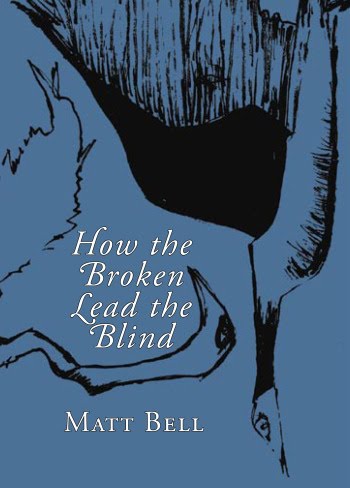 Matt Bell, How the Broken Lead the Blind (Willows Wept Press, 2009)
"Matt Bell does something to me, something altering, chemically altering, that makes me feel like I've come face to face with something ungodly beautiful, still partially obscured by my limits of comprehension, each time I finish one of his stories. He finds a depth beneath his stories that, at times, seems limitless, unknowable, perhaps more efficiently, more effectively, and more consistently than any writer currently stitching together words." —David Peak
"Matt Bell is a beautiful contradiction, a romanticist who wields his pen without mercy. In How the Broken Lead the Blind, Bell's eye for the small details that bind is undeniable. His collection of short-short stories wastes no time with extraneous prattle, delivering instead characters and tales that rattle the senses with stark surprise. In an uncompromisingly good gathering of fiction, Bell gives us worlds upon worlds through the imagination and observations of a gifted new talent.
—Steven Gillis
"Matt Bell writes startling stories about personal connections, how they break under the slightest pressure, how they mend—all stories in which occur fantastic little twists: a severed hand appears, a piano gives up its secret, disoriented geese tumble from the sky. How the Broken Lead the Blind is a useful relationship manual for those of us still waiting to receive our very own hair box." —Ryan Call
"There is an insistent rhythm in everything Matt Bell writes. Not the thudding hammer blows of fraudulent drama, not the drip of leaking satire, certainly not the jolly click and tap of a story that could be--ought to have been--texted. It's gentle and enormously powerful: the beating of a heart. It's hard not to think of Bell's work as a living, breathing thing--which is in fact what it is, holding us in its ebb and flow, consoling and inspiring us the way real, true art always has and always will." —Gary Amdahl
"Like a perfect rock album, Matt Bell's How the Broken Lead the Blind both celebrates and explodes the form. The form here is flash fiction, and while there may be others who are doing it as well, there is certainly nobody better than Bell. Like the songs on Sgt. Pepper or Odelay or Paul's Boutique or [insert name of genre-busting, wildly inventive and eminently satisfying album here], each of these stories offers a jump-cut into the pain, fear, hope, joy, and questions of everyday life. Which is to say, Matt Bell does in 500 or 1000 words what it takes most writers - if they're lucky, talented, innovative, and soulful - about five times the space to accomplish." —Dave Housley
"Matt Bell's short-short stories gush with intricate details of love, loss, and sorrow. Each story holds a miracle waiting to be unearthed, as if this young writer was in all our lives, recording those subtle, key moments that pass quietly but speak to us forever. He is a writer with so much to say, but like with those moments, he understands they don't have to be loud, or long, to bestow their greatest impact." —Michael Czyzniejewski
"So many short shorts veer toward willful absurdity for its own sake, but Matt Bell’s How the Broken Lead the Blind manages to get beyond that stereotype in ways that will reward the reader. Bell does not veer toward pyrotechnics, as so many practitioners of this burgeoning subgenre do, but maintains the authorial discipline to give us thick, complex insights into human wants and confusions.
Many of these stories take place in a personal limbo, on a razor’s edge where things could turn out well or turn out badly. We don’t usually stick around to learn the result, but Bell gives us enough to go on. In the title story, a blind woman whose seeing eye dog has been spoiled from too many treats goes running and experiences a delicious loss of control before her inevitable crash. On a sentence level throughout the collection, Bell finds moments like these and uses propulsive, almost metrical language—often with skillful short sentences—to create from them the sense of foreboding and imminent surprise we have come to expect from flash fiction.
It is all too easy, in the tiny spaces the subgenre provides, to succumb to its temptations: relying on foreboding, summing people up, dismissing them, or ridiculing them for their lack of self-understanding. But Bell, to his credit, refrains almost entirely from easy potshots and maintains respect for the unknown lives of his characters. (The Present, a bit flippant and out of kilter with the rest of the collection, is the lone exception). He creates a sense that his characters are stuck in a murky purgatory and waiting—mostly with a resigned but edgy patience—to see whether the next day holds an opportunity for clarity. When we get to the end of their stories we feel we’ve been given a snapshot of the moment that most clearly exemplifies their struggles, yet that leaves us with something left to explore in their inner lives. A quote from The Trophy Wife exemplifies this approach well:
"Each statuette is frozen between one motion and the next, a pose that tells you nothing. It is impossible to know what will happen next when you only see the middle of the story. This is the moment right before victory becomes failure, or when a sure strike turns into a gutter ball."
This territory is becoming traditional—and perhaps even hackneyed—for the short-short, and I am happy to say that in How the Broken Lead the Blind I learned more about Bell's characters than the surface tension of this frozen pose would suggest.
Bell tills the soil of flash fiction well, with great awareness of the subgenre's capabilities for peering efficiently into the lives of his characters. But we learn considerably more than nothing about them; from the well-rendered contours of their silence and their stuck-ness, we learn enough to yield a probing, satisfying literary." - Steven Wingate
"In high school I read a Zen Koan about finding a horse. This rich guy sees a black stallion or something and hires an old master to retrieve it. He returns with a spotted mare. The rich guy is like, “Wait, what?” and the master says, “Oh no, it’s cool, this is a horse.”
It’s like that with the very short stories in Matt Bell’s collection, How the Broken Lead the Blind. They aren’t just great because of what they are about on the surface, but because of the tension between what’s on the surface and what accumulates behind the words. Bell’s work manifests Susan Sontag’s notion from “On Style,” that “the subject is on the outside; the style is on the inside.”
Accordingly, many of these microfictions work as conventional, plausible narratives, like “Once She’d Been a Brunette.” This one begins with a man shaving his head to support his cancerous lover and ends a year later when, giving his stubbly scalp a rub, she thinks about the springtime she’ll die before seeing. Bell encapsulates that whole drama in the first sentence: “They shave their hair together, before she even starts to lose hers.”
Meanwhile, other stories invert the question of narrative belief admirably. They would probably work as allegories if they had some distinct second meaning, but the second meaning isn’t distinct at all – at least not in what we have come to think of as a meaningful meaning for meaning. Like, take “Player Piano.”
In the first few sentences of this piece, a man who seems like he’s been lifted (masterfully) from a John O’Hara story boasts about his full head of hair. Life is great for him. “My wife and I were blessed all right,” he says, until the piano repairman unfolds the secret to their happiness from a scroll wedged into their upright. Supposedly this will put an end to their luck. But instead of bearing this out, the story ends with their terror at the possibility of unhappiness.
In “The Present,” a wife gifts her hand, severed, to her husband. This one is really absurd. The man is delighted with the gift, especially the surprise of it, but when his wife comes home from the hospital, she’s displeased to find that he’s using it for an ashtray.
Then another straight story, “The Trophy Wife,” begins with a gift too, this one from a man to his married lover. It’s a bowling trophy, representing her alibi and also their infidelity. And bowling represents their dilemma: “There are four hundred and fifty-nine combinations of possible splits. She said, It’s hard to pick up after a split.”
Regardless of the logistical framework of any story, my first judgment of each is simply that it is interesting. This is a rare feat in a genre which prioritizes mood and ingenuity over coherence and occurrence. It’s canny of Bell to tip off his authorial focus early, in “Ten Scenes from a Movie Called Mercy.” He writes, “Resist denouement, resist the solving of mysteries and the revealing of truths, because it is in these things that you may be judged.”
The point is almost cynical – don’t try to do much, because you might fail – but Bell is exceptionally good at writing in such a way that nothing ever seems to be lacking. This is what I’m most fond of in Bell’s writing, what continues to strike me each time I read it: in abstraction, it is never alienating. Complete from every first sentence, How the Broken Lead the Blind is always unresolved, always resolving." - Adam Robinson
"I read this chapbook from Willows Wept Press twice. I generally don’t read things twice. I don’t watch movies twice (except Woody Allen films [early ones] and Caddyshack—I watch them over and over). I know a lot of humans post about how they read books two, three, fourteen times a day, etc., in between screenings of black and white Swedish indie films (gulls and waves crashing) and writing their memoir(s), and DJing off their Ipod, but not me.
I got disc golf practice.
[I am hungry now. What should I eat?]
A mortgage (implies a house).
Why does the kitchen drain guffaw and sputter? Why does one bathroom smell like mottled banana, and the other like a waterfall? [Why can’t I eat that pink cotton candy that covers my attic?] Does anyone know how to make a flower live? I’m close to done with flowers. I’d rather landscape my mind with Dos Equis. My throat hurts like an economy. And: How do I use my programmable thermostat? It looks all neon and modern, but just blinks at me green, like E.T., or some bored cashier at a health food store.
A crushing existential crisis on my hands. Lots of night-thoughts. Dogs howling, or is that a siren? Etc.
So.
How the Broken Lead the Blind is obviously a drug.
No. You can not trade me a Cornish hen for that cough syrup. Get a hobby (I suggest bocce, or parkour.)
The title glitters and pulls like “a present wrapped in purple and gold.” I keep teaching my fiction students about titles and here is Matt Bell summarizing all I teach. Make your title a drug, people. Make it grab me by the subtropical Wendy, the rumbling Atlanta. Make it a metaphor umbrella, eclipsed and reddening. I went to the mailbox slightly drunk and pulled an envelope out of the mailbox and ripped open the envelope and Matt’s chapbook appeared. It bloomed there.
On the cover (by Christy Call) were two fucked up cranes. One of them looked like it stuck its neck into an episode of Will It Blend? Here is the one where they blend an Iphone.
I read the title of Matt Bell’s book and thought:
1.) This reminds me of a quote, I think Auden, wherein the evil of the world are motivated, speak out, actually act—as opposed to the peaceful, the good hearts, who keep quite, and therefore useless, in the big picture. Dictators as great speech-makers. Jim Jones. That idea. Or maybe that no one really feels or speaks with real conviction anymore. When is the last time you heard a speech with real conviction? Or gave one?
2.) Who are the blind? A Flannery O’ Connor (To the hard of hearing you shout, to the almost-blind you draw large and starling figures.) feel to the blind. Are we, as readers, the blind? Will our eyes be opened?
3.) This is the second time a Matt Bell story made its way into my skull and classroom. I have preached and preached for years to my students to GET-A-JOB! That’s the best advice for a writer. Get past the reality of the situation, behind the counter/the swinging door, into the kitchen, the stock room, the office, where all the insanity takes places. Get a job. Grab material and 34 bread sticks. Bring a notebook, or a memory cell.
An aside: Do all chefs smoke weed? I have worked in 3 restaurants and all the chefs smoked weed. Anyway.
[I wonder what is in my fridge. It is 11:30 and I am hungry. Do I have hot sauce?]
Matt wrote this gem about work, about PLACE: Alex Trebek Never Eats Fried Chicken.
This book can levitate.
How the Broken Lead the Blind has blurbs (see all here) the way War and Peace has characters (600 of them, if you are counting).
Matt must have many friends. Or at least compromising photos of many people. Also the writing is good, so that helps.
(If I gave a blurb I would have mentioned detachment. Characters seem to float. They want to communicate more fully, but cannot. Example (pubbed in Night Train). Very Chekhov in this way. I would have also used the word fuck in my blurb. I would just want to see if the word fuck could make it into the blurb, as genre question. Also I think I would have mentioned the obvious: this fucking book can levitate.)
William Walsh says, “Matt Bell is a maker of fine fictions.”
I like that: Maker. Fine Fictions. A fiction being fine as whole, complete, every word in its place, every sentence, to create a sensibility in the reader, to move me place to place, to hinge the text open, to work. Flash fiction as art, as science, as intricate machine.
When I say art of flash fiction I mean just this, a done thing. As in the right words. As in recipe—one more grain of salt, too much, one less, too bland. I think some of these flashes out-delect the others, out-born them–as if arrived formed and complete (all connotations), that word.
Example:
Surely, “How the Broken Lead the Blind until They Both Become Something Else Entirely” (Jesus, what a title!) is the best work in the chapbook. It flows, it blooms, runs forward like the endearing and rather remarkable blind woman, her seeing-eye dog, both on “new found running legs,” both “accidental artists” in their running free, acceleration and verve, embrace of possibility, of crash, of actual free-will-ness—finally.
Everything about this story is surprising, yet inevitable. A well-wrought thing, this art. That’s what I mean.
A close second in pure skill and quality is “Once She’d Been a Brunette.” Again, the words lead to their own world, create it, and the ending line (“She touches his hair with both hands and for just one moment she swears she can feel it flourishing, can feel the new cells pushing through the skin, like a springtime she’ll never see.”) is a fine example of epiphany (not an attempt, but the actual thing: the character brought to a state of enlightenment, a realization of significance).
Well done, Mr. Bell.
I am always one with an eye and admiration for structure, especially the organic form, the forms and functions of the world. Martone selects a travel guide. Mcphee uses a Monopoly board. Lorrie Moore an entire genre of pop culture writing as scaffolding for her fiction. Etc.
Matt does several interesting structural things here. “Ten Scenes from a Movie Called Mercy” uses the language of film, footage and jumpcuts and candlelight and tracking shot and wardrobe and high-angle somethings and symbolic use of music and/or guilt and frames-per-second and cellulose nitrate as highly flammable (note: there are many factoids scattered throughout this text, and I wish more writer’s would follow Bell’s example—I like to learn something new while I read [besides theme]).
In “Her Ennead” the author uses the technique of repetition to convey the utter absurd surprise of pregnancy, the awe and disequilibrium.
“Excerpt from Volume H-HN: Hair Boxes” (surely the strangest and freshest text in the entire chapbook) appropriates an encyclopedic voice, a hint of Barthelme (or do I dare say Borges?), as it weaves a human tale of odd construction. As the author writes, “In the end, an urge always proves too strong for the maker to resist.”
Sounds like writing, eh?
Chapbook as box of hair?
[I need nachos now, that’s it]
Yes. Images. Poetry.
Words. I said WORDS…“touching us one at a time until finally all of us are healed.”
Fuck yes.
There you go. “A laying on of fucking hands,” that’s what I would put in my blurb. Hey. You.
Consume." - Sean Lovelace
"In Bell’s The Broken Leading the Blind, most of the stories depict a disruption or break from routine, such as a blind woman allowing her seeing eye dog to run unrestrained while she is dragged along behind knowing full well how their unchecked motion will end. But those endings, however inevitable they seem in the story, don’t actually come — there’s a sense that consequences will follow the disruptive moments, but the stories tend to end with the disruptions instead of reaching their aftermaths. The characters tend to be only aware of the moment they’re in, with suggestions of how they got there, as in “This Showroom Filled With Fabulous Prizes”:
She says, “You don’t drink anymore, but you used to,” and he nods without looking. “She says, “Are you quit for good?”
He thinks for a moment, says, “I’m trying to be.”
It’s not specific, it’s not full exposition, but it’s enough to give the character complexity and history within the quick, focused moment of the story, and that restraint makes the stories feel complete even if the lives of the characters aren’t." - Steve Himmer
"Matt Bell’s How the Broken Lead the Blind seems deceptively simple at first, consisting of 55 pages, with only ten stories, of length ranging from a sparse page and a quarter to nearly seven pages in length. The ten stories, though, are carefully arranged, their trajectories minutely adjusted and sent to spin and crash together with a precision that would seem cold if it didn’t have beneath it a true concern for the human condition.
This seems to be characteristic of Bell’s writing, and the first unifying theme that stands out is that of convergence and inevitability. Bell sets his characters into seemingly intractable trajectories that challenge the reader’s notion of fate and control. The first story in the collection is “Ten Scenes From a Movie Called Mercy.” Here we have the convergence of an (unstated) murderer and a child, told through the metaphor of scenes from a move. The metaphor does allow for an escape from the perceived inevitability, though:
“Off camera, pray for editing, for the rearrangement of film. The editor could remove the first scene, just cut it out. With a pair of scissors, he could let the second scene tumble to the cutting room floor in a clatter of 8mm frames. Cellulose nitrate is highly flammable, so pray for the fourth scene to be cut short by fire. Pray to keep her safe from the person that wants to hurt her… Resist deoument, resist the solving of mysteries and the revealing of truths, because it is in these things that you may be judged.”
I love this passage; it is lyrical and reads almost like a lament, unexpected in its sudden sympathy.
As the collection progresses, these ideas of convergence become more and more complicated by the idea of communication, and a true struggle over how it occurs, if it is truly possible, and what danger it might have. One interesting piece in this is “Player Piano” In which a couple, living an idyllic life, choose to tune their piano, because the wife, “claimed it had always been the slightest bit out of tune and now she was finally tired of just living with it.” The repairman finds it is out of tune because a powerful prayer “was hidden inside. That’s why you’ve been happy your whole life.“ Unfortunately, “prayers only work if they’re secret. Now you know, you’re finally on your own.” The idea here, of this secret source of happiness being a secret sour note that must remain unplumbed is hauntingly powerful and evocative. Here we see that full communication does indeed have consequences, often dire.
The last piece in the collection was my favorite: “Excerpt from Volume H-Hn: Hair Boxes.” Here, Bell takes a step back in narrative distance, setting the piece as a backward looking encyclopedia entry. He describes a ritual that seems to be compelled, again these trajectories, of constructing a box, filling it with one’s shorn hair, burning it, and sending it to someone else. Perhaps because of the narrative distance, this story becomes not an inevitable trajectory, not an exterior compulsion, but a powerful metaphor for the persistent human need to communicate, to be understood, even if the matrix of that understanding is often sacrifice and loss.
I said at the beginning of this review that the trajectories of each of these pieces are carefully calculated, and they are, but in a way that eschews collision. In the end, the parts dance around each other with the persistence of a Swiss watch, meshing together with geared teeth. And I think that while those teeth do draw real blood on occasion, this collection has a true heart and belief that we can reach out to each other, even as it challenges us to examine our ideas about the way we communicate and interact." - Todd B. Stevens
How the Broken Lead the Blind can now be read on Issuu or downloaded as a PDF for free


