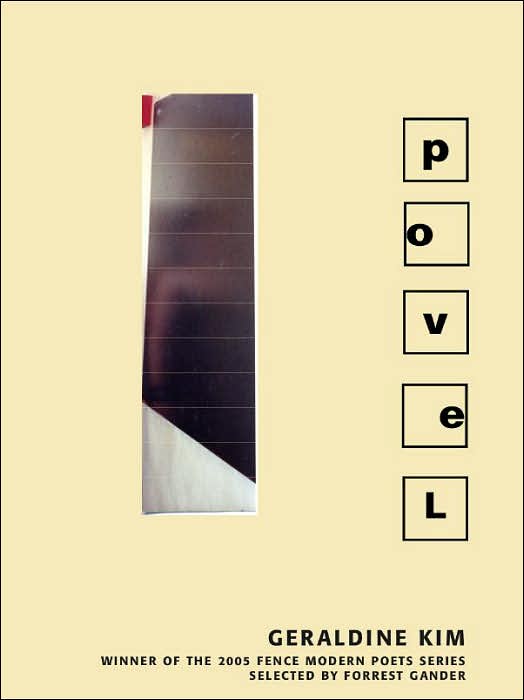
 Geraldine Kim, Povel (Fence Magazine, 2005)
"Geraldine Kim, a young, first-generation Korean-American girl born into the most modern of all situations: the end of the 20th century in a small town in New England, from which she launches herself through venues urban and cerebral, academic and commercial. The book-length poem's stream of consciousness is just that: a stream, untrained and unleashed. Its form, however, is strictly, if arbitrarily regulated by another or our most modern conveniences: the "centered" stanza, which provides not only a container for the author's thinking, saying, and doing, but also a means of signification: This is a poem-novel - or "povel" - by virtue of its self-reliance and its bold marking of territory. Povel is, in the author's own words: "a successful merging between confessional verse poetry and the novel" - hence the coinage of its title. Povel is also a radical entry in the annals of the several genres. The author purports an omniscient skepticism about its future: that it will ever be read; that it can be appreciated. Its reader cannot help but be amazed and heartened at the vigor this book injects into its chosen forms, and the humor with which its despair is tempered."
"Kim's centaur debut is a constant notebook, humming with graffiti and gossip, bad jokes, great jokes, bodily functions, lyrics, juvenile glosses, sudden sadnesses. Povel comes equipped with a hilarious, spurious Lyn Hejinian intro, the longest title in the world, and observations on how her writing-workshop cohorts are responding to the text. Kim comments on the spell-checker's comments, Rage Against the Machine, the NYU suicides, Infinite Jest. She's her own A.D.D. Boswell, a self-mythologizing Korean American diva worth a thousand Margaret Chos." — Village Voice
“Povel may not sound like a potentially revolutionary new form but it in fact is. This is because it, and its inventor Geraldine Kim, do far more than they outrageously lay claim to- or perhaps exactly what they claim- in any case charting consciousness through observation and at the same time remapping it through rigorous prosodic attention. Scientific evidence that hysterical symptoms are not only here to stay, but structure and control our perceptions, this book dares you to attend to it. Most highly recommended reading.” —Stacy Doris
“Somewhere over the rainbow of Lyn Hejinian’s My Life, Pamela Lu’s Pamela: A Novel, and Kenny Goldsmith’s Soliloquy, Geraldine Kim’s Povel debuts as a startling confessional, conceptual novel in verse, or vice-versa. Both culture maker and cultural processor, Geraldine Kim captures, in excess, the milliseconds of our daily ponderance- our anxieties, ambitions, jokes, authentic and inauthentic insights, etc…” —Robert Fitterman
"In aesthetic and attitude, Geraldine Kim’s debut, Povel, aligns itself with Lisa Carver’s seminal zine, Rollerderby. To make the comparison a better fit, take lefty scissors to Carver’s back catalogue and paste its juiciest parts onto Lyn Hejinian’s My Life. Kim might not know Carver—according to her press bio, she was born in 1983—but she has anticipated the My Life linkage, appending a faux Hejinian intro to the work that defines Povel as an invented form blending “poetic and novelistic aspects.” Writing under the guise of the Language Poetry queen, she continues her intro: “When asked to choose which genre would apply ‘better’ to her povel-text, Kim promptly threw a lemon meringue pie in my face.”
That flippant pie toss at the old-guard nails Kim, a self-described “mixture of pop culture and romance” who’s armed with a quicksilver mind given to glorious one-liners. She wants “to be taken seriously. Like a dead rapper’s unreleased tracks,” and when asked about her sexual orientation, she thinks to respond, “Visually oriented.” Beyond Hejinian’s walk-on, Kim lifts Jim Carrey’s Golden Globes acceptance speech for her own purposes, crams Nick Nolte’s messy-haired mug shot into her endnotes, and appropriates George W. Bush’s biographical blurb (collaging her mug over the Prez’s in a photo of W. chilling with Laura). Kim was voted class clown in high school and brandishes postpunk chutzpah, but hey, don’t mention Margaret Cho. (When friends do, Kim claims “Yeah because I’m the other Korean chick that speaks English.”)
Soundtracked by Rage Against the Machine, Mindless Self Indulgence, and At the Drive-In, Povel’s a fractured time capsule concocted to replace the one she lost after burying it in first grade. In the text, she tells her ex the book’s chronological. An average passage: “I should wear gloves. ‘Are you guys done tomorrow?’ she says. After I planted a tree in our friend yard, it died. Then my brother planted a tree in the same spot and it thrived.” Despite the playful nonlinearity, her claim doesn’t feel like a bluff: Povel’s characters gain significance through each walk-on and eventually even the smallest echoes feel huge (she returns a book by Gaddis to the library and JR casts a shadow across the next stanza/graph). The most emotionally fragile moments explore the relationship between Kim and her ex’s mother (both refuse to let go) and various hijinks with her Madden-playing brother, whom she thinks would make a better boyfriend than most other folks she comes across. (Things are less rosy with her chipped-tooth parents—her father’s given to smacking her in the head—and a somewhat shadowy sister.)
Others caught in Povel’s orbit include a poetry workshop (one character disses Povel as “willy nilly”; another sees it as an attempt at “shock value,” though he wants to chill with her after she submits her “sex cycle poems”), an NYU-area pamphleteer, a cute guy in her poetry class, and best of all, the “Sarcastic Starbucks Guy named Fish.” (She allows her dialogue to exist outside of Povel’s pages, too, leaving graffiti clues on NYU’s campus with footnotes telling the reader where to locate her messages.)
Ultimately, the most important character’s the author herself. Kim thinks obelisks and fingers resemble penises and hopes for a ménage-à-trois with Woody Allen and David Foster Wallace (“a self-conscious/neurotic orgy”). Displaying Ackerian bravado, she meditates on “how cool it would be to have sex with a dolphin” as well as inventing a wall of glory holes and a “drinking-straw apparatus” so she can “give [herself] head.” All this firecracker sex talk’s mixed with a dose of smart-ass self-deprecation (she believes she possesses “the IQ of a small shellfish”) and a cocksure gamesmanship (see Hejinian intro, for example). Battling a caffeine addiction and grammar check, her project itself is a race against time: more or less, she’s a mosh pit–friendly Proust dipping madeleines in soy chai, finding a way of translating her life into words “before it goes away.” —Brandon Stosuy
"In her first book, the 22-year-old Korean-American poet Geraldine Kim chronicles her life in prose stanzas that she describes as “helical,” alternating justification from left to center to right to center, back and forth across over a hundred pages. Although the text initially presents itself as a brilliantly condensed, Joycean stream of consciousness, the subject matter never escapes the insular world of a 21st-century American teenager: pop music, cable TV, consumer brands, food, Internet culture, school, cell phones, budding sexuality, and parents. “Stealing carrot sticks from the cafeteria,” writes Kim. “It says ‘Shortcuts’ on the bag... My Met Studies teacher asks us who has ever stolen anything. I would have raised my hand if I hadn’t been busy writing. Better left unsaid, I decide.” The problem with this limited purview is that the text never really resonates outside its own range, often reminding one of a teen blog or yearbook entry. That said, Kim’s confessions are honest (brutally so), and her verbal skill must be unparalleled among poets her age. Her syntax shifts from complete sentences into fragments and back again, yet remains relaxed and reflects her book’s grander design, mesmerizing the reader: “The woman sitting in front of me reclines in her seat. Everyone dressed like a funeral. A funeral bus. Wanting to act intoxicated. My high school teacher freshman year was surprised when I said I didn’t know what ‘inebriated’ meant.” But Povel is also a clever send-up of the narcissism of its own brand of formal innovation, as evidenced in the work’s painfully self-conscious textual scaffolding: a fake introduction claiming Lyn Hejinian as its author; 200 endnotes, such as “Hello Kitty has to go potty” and “Why do we chase pigeons?”; and blurbs on the back that identify their authors as “former teacher of Geraldine Kim.” And it is appropriate that this impressive debut ends with a page titled “WTFHJN (What The Fuck Happened Just Now)” that encourages readers to record their reactions to the wonderfully bizarre hybrid (Povel = poem + novel) they have just read." — Aaron Belz
"It is difficult to say exactly where the poetry starts in Geraldine Kim’s Povel. A lot happens before you reach what would, in another book of poetry, be considered the text. The book begins with an introduction by Lyn Hejinian, claiming that “there has never been a successful merging of confessional verse poetry and the novel... until now.” Before you can consider why on Earth Hejinian would care about this potential merging of styles the intro proceeds to quote a bewildering three-page long book title, which is a comically self-effacing stream of consciousness. And it turns out that Hejinian does not care: the intro is a fake. Another fake-into follows, which is Jim Carrey’s Academy Award acceptance speech given the new title of “Transcript of Geraldine Kim’s Acknowledgment Speech.” Then the previously quoted expansive title reappears in bold font, spread over four pages. After this comes the epigraph: “’Beginning texts by quoting someone else’ –Me.” And then a seemingly nonsensical list that equates important characters in the book to musical instruments. And then we get to the poetry. Or novel in verse. Or whatever.
These false starts and bad jokes refuse a stable, chin-strokingly serious reading of Povel. It takes joy in the silliness in contemporary poetic conventions. However these jokes reinforce the importance of the mocked conventions. Lyn Hejinian is fake-quoted because she is, in fact, a driving influence behind the book. Povel bears significant influence from Hejinian’s My Life in its fragmented creation of personal experience. The acceptance speech points out the strange equivalence between status in award honors and the choosing of first books through poetry contests. Kim gets the chance to both express an exuberance for having her book chosen and to completely undercut the possibility that she would take it this seriously. And it's pretty funny. The epigraph both negates itself and works as a useful epigraph to the satirically self-reflexive narcissism in Povel. There is a formal constraint to the presentation of the work; each stanza has a different kind of justification, left, right, centered and repeated. This constraint, however, is so arbitrary as to be almost a joke on the conventions of formal constraint. Following the body of the book is an almost book-length set of footnotes. The book works to situate the reader between attitudes about poetry and the text before you get to the main body. It tells you that this is a book that both cares reverentially about the conventions of contemporary poetry and also finds them silly. It is as much a book of poetry as it is a work of situating the writer in relation to the forced constraints of a constructed text.
The main text of Povel spills out in a caffeine-fueled dance of statements, individual moments, non-sequiturs, information heard from others or read, family events & pop culture references. The book is so packed that it seems to emulate the Romantic mode in which the expression of experience cannot be written quickly enough (I’m thinking of stories about Shelley writing frantically with both hands). The language of Povel is in action; first person statements lack the subject, instead jumping into the action of each moment. This energy and propulsion is the prosodic driving force to the book.
From the first moment I opened it I found Povel is wildly delightful. The problem with writing a review of it is that this delight is an effect of the book as a text. Any passage is going to lack the provisional situation that makes the writing come alive which makes most of the passages lose their energy when quoted out of context. The book is delightful because of its brash comprehensiveness and inertia. The first stanza sets up some of what makes reading Povel exciting:
My roommate complains to me about how she couldn’t enjoy
Matrix Revolutions because everyone else in the theater was laughing at it. ‘Too
much psychobabble for your puny minds?!’ she asks our dorm room. I glance at her cow-print slippers. The vomit from my Vicodin overdose was green. One of the first things I am told as a writer is to write about what I know.
Kim shifts sharply between internal and external, between immediacy and reflection, between concrete and abstract. These shifts are propulsive, and within the framework that the opening materials set up the shifts all seem to be based on a kind of desperate playfulness. These shifts consistently turn attention back to the creation of a sense of self in the book and in the writing of the book. Because of the propulsion this inward turn works to consistently recreate, and further understand Geraldine Kim as a stable entity. She reveals a life in the immediate moment-to-moment expressiveness of experience, but contains enough direct personal connection to allow for it to be read as more than an experiment. Povel is a constantly unfurling, seemingly stream-of-consciousness exploration of an individual attempting to make sense of her coming of age intellectually, culturally and sexually. But this stream is deceptive. Despite the constant search for a new turn or a new move a story builds. Characters reappear. An autobiography develops through the work. Kim doesn’t shy away from including seemingly anything in Povel.
Because of her continuous multiplicity she succeeds in moments that would seem precious in another book. “My dreams where my ex and I are siblings anyway. Feeling as lonely as a dependent/ clause without. Instead I said ‘no’ and watched his sneakers run back in the rain.” But she is also able to include moments of simple presentation that ring especially true in counterpoint to the poetic play. When she talks about her brother Kim is especially direct, turning even the most ridiculous scene into a moment of dry existential wonder such as this moment of understanding budding sexuality:
‘And when I see a guy and girl kissing, it starts to rise,’ my brother says to his
twelve-year-old friends while we’re all watching TV, his voice wavering. ‘Me too!’
says his friend. Feeling extraterrestrial.
Because of the exuberance of revelation Povel continually surprises me. Statements or moments arrive that feel entirely new, but continue to be absorbed by the growing body of Povel. These moments are sometimes immediate and the familiar becomes somehow profound, such as “‘Paypal scamming worm asks for bank/ details’ the computer says. That explains everything.” Some of them are more traditionally imagistic, such as “Imagining the/ inside of my body as a densely crowded forest.”
Even those moments that are so affecting to me are couched in the overall framework of the text and I have to distrust them. What is important about them in the context of Povel is that they are not to be dwelt upon. There may be moments of beauty or personal revelation, but they are always going to be followed by something else. Sometimes the following statement undercuts the effect; more often it is simply disinterested in it. Povel pushes forward, refuses to make any single statement more important than the next.
This form of autobiographical writing, of confessionalism, challenges the reader to mediate between the very things the writer mediates between, ironic awareness of the sterility of conventions (even experimentally-based conventions), a belief in the power of these very conventions, a desire to accurately present a life and the awareness of not only the conceit of this desire but the impossibility of successfully satisfying it. Kim builds this mediation by her switches from meta-contemplation of the text itself, mild profundities, personal experiences and reportage without hesitation:
Thumbing through everything I’ve written. The granite was shaped into a
gravestone. An elaborate attempt at immortality. My avoidance of reading The
Denial of Death on my desk. For his birthday, I got my ex a Jesus nightlight and
seventy-five dollars worth of stickers. The protagonist of Fight Club chose the
penguin as his power animal. ‘Quality over quantity’ my physics teacher said to us. marx said it was quantity over quality since the chances of quality are higher when there is more.
This comprehensiveness creates an intimacy that for me is more interesting and direct than the attempt to tell the “story” of a life. It is not a confessional poetry impressed by its own epiphanies nor a revelatory bragging about personal failings but rather an accumulation of experience. It is a fresh form of personal poetics, based on the daily revelations of blogging or late night conversations rather than the linearity of narrative or even the conceptual openness of Hejenian’s My Life.
Neither does Kim attempt a solid stand about sexuality or gender identity, though these are also important to the book. She is constantly aware of the eyes of men on her. They arrive at the most simple times, giving daily life a creepy feel: “I could use my declining dollars all day, drinking coffee and staying permanently/ awake. The guy sitting across from me watches me.” She grows angry in the text at being constantly looked at, but does not display her anger in the actions of the book.
This creates a fascinating and frustrating version of biography. That force me to be aware of the conventions I expect out of autobiography. I came to this book with an expectation that somehow cultural identity would be important to Povel. Perhaps it seemed to me that a young Korean American woman talking about her life would have to focus on categories of cultural identity. Though we know in this book that Kim is Korean American and this comes up frequently she is never attempting anything like a categorical definition of her place in relation to this identity. Out of context I can analyze the cultural politics at work in Povel, such as when she relates “Watching my sixty-six-year-old/ Korean dad copy the gestures of a car dealer on TV. How my tall friend kept on being/ asked if he played basketball.” (111) With any other book I might try to understand the anti-essentialist elements of this, but with Povel I instead move forward into another experience and moment.
‘What were you listening too? It sounded familiar’ the guy sitting next to m says. Stop looking at my legs. ‘I’m sorry was it too loud?’ I say. Stalling. Go away. ‘No not at all, I was just wondering since it sounded familiar,’ he says. ‘It was Control Machete, a Mexican rap group,’ I say. Dull nodding. ‘And before I was listening to Cex. C-E-X,’ I say.
She considers the kind of sexual identification by which one builds structures of understanding the world:
Sleeping at my bass teacher’s apartment when he introduced me to pot and his dick. ‘Kiss it,’ he said in total seriousness. Since I felt obliged to. Deciding what constitutes ‘rape.’ Before that he said, ‘You’re beautiful,’ to my black bra.
She expresses her own fourth-wave style redefinition of sexuality and identity as well, at one point stating “It’s pathetic that these knee-high boots give me such joy.” But the following sentence immediately undercuts the potential for digging into these kinds of statements: “I start to get jealous of/Quentin Tarantino. Shit he’s even included on the spell checker.” Though identity is crucial to Povel, it refuses to give you time to stop and attempt a structured system of ideas. Instead Povel resists definition by pushing forward, the moments that could be definitional pass by as quickly as name-checking a punk band or discussing coffee again.
A reader might look for clues or keys within the text for ways to decode and understand Povel. Instead of satisfying this desire Kim packs the book with self reflexive ars poetica statements; rather than giving a single key to the rhetoric of the book the reader receives multiple keys that provide new ways of viewing the writing. In the same way that the book presents identity in action, constantly reforming it presents potential reading strategies that evolve, rather than allowing for a single way to understand it. In the end content gives way to the prosody of propulsion.
And this is the pleasure of Povel, the constant dance and play of self-in-action rather than a static self recollected and recreated for a reader to consume. However there comes a point in this book where the poetic moves Kim pulls fail to surprise. The book becomes too comfortable in its twists and turns. It becomes a novel without a plot, which reflects somehow on the experience of the twenty-year old writer, but does not create a satisfying complete book. By the end of the book a stanza that might have been evocatively puzzlingly is instead too easily understood:
It’s acceptable here. Fold my legs into themselves then sit atop them. Pushing back chairs that sound like farts. I tried parables. When I was done with the popsicle, I would chew the fibers of the stick apart. Why I wasn’t born with a filter between my mouth and brain. A matter of tautology, really.
The movement between internal and external seems rote by this point and the comfort level makes the scatological jokes fall flat rather than providing new ways of looking at a life. With a book that bases so much of its effectiveness on brash intimacy I don’t want to feel safely intimate with it. I feel that this happens because Povel is a book that resists a reader sitting down and reading it in one sitting. It invites you to dip in and out, to find a few great lines and then page forward to find some more.
I say this because the book is thrilling for its brashness, it’s constant play and its willingness to show its smarts & be silly and banal at the same time. Povel is a creation in process. Not only in a standard reading response way but in the mechanisms of how the text relates to itself. Its ideas continue to reach for satisfaction as it reaches for an understanding of identity. Povel resists or works through poetic constraints of both form and expectation to express an individual experience in a manner unmediated by structural clichés. It attempts a convincing confessional mode within a poetic aesthetic based on the prosodic experimentation (and implicit anti-Confessionalism) of the Language poets. It is not the reporting of a life but an attempt to present the experiential qualities of a life. There is not beginning or ending. You can open it anywhere and find some moment of delight, some moment that evocatively situates the highly poetic with the mundane or even the crass." - Mathias Svalina
"I'm pretty sure the claim that Geraldine Kim's book Povel represents a new form that successfully merges confessional verse poetry and the novel should be taken as tongue-in-cheek, appearing, as it does, in an introduction that claims to be written by Lyn Hejinian and claims to have originally been published in An Exaltation of Forms CXXXVIII, only to turn around to tell us, in a footnote at the very end, that "Lyn Hejinian never wrote this and An Exaltation of Forms CXXXVIII is not an existing text."
This fake introduction, with its sense of pomo gamesmanship and its willingness to cleverly tweak elements of "the book as form" (the author photo, bio, and epigraph are all played for gag effect, too) initially seems to place the book in a tradition staked out by David Foster Wallace's Infinite Jest and later parlayed into a literary career by Dave Eggers, particularly in McSweeney's and A Heartbreaking Work of Staggering Genius. But perhaps Povel's claim to hybridity is not all red herring, as the book does ring akin to Lyn Hejinian's My Life, at least in the way that it makes a sort of biographical narrative by aggregating a set of tenuously-related details.
The main difference is that Kim renounces just about all claim to "poetic"-sounding language. A Hejinian line might say something like "The waves rolled over our stomachs, like spring rain over an orchard slope," a sentence that might contain the somewhat ungainly noun "stomachs" but which also is built around a "nature-y" simile that should sit pretty comfortably with readers of traditional lyric poetry. Contrast this against Kim's "Sarcastic Starbucks Guy runs like a frantic penguin to get tea for the lady in front of me." Still based on a nature-themed simile, but the difference feels pretty stark, even if what exactly distinguishes it is hard to articulate. Is it just the presence of the corporation name? Is it the fact that this image feels, to me, familiar, whereas the "orchard rain" image feels, frankly, exotic?
Whatever the reason, Hejinian's book feels like a poem, whereas Kim's book feels not exactly like a poem or like a novel but a bit like reading straight through the archives of a breezy, funny blog. "It would suck to be a unicorn". "A woman walks in front of me as we climb the stairs and I notice that her ass resembles a pair of tympanis". The whole book is like this, ten thousand bits of random observation, accumulating in various ways, some of which take on some of the features of narrative (the book does have, for instance, characters, some of whom have back-stories, although how much "character development" is happening here is questionable).
The fact that the book piles on these observations and leaves them in free suspension qualifies it as an "Everything Device," although one that's fragmented and trivia-focused in comparison, to, say, Juliana Spahr's This Connection of Everyone With Lungs. One could almost think of Kim as the anti-Spahr: where Spahr's book keeps focusing consciousness outward, broadening it, attempting to see each detail as part of the Big Big Picture, Kim's book seems more focused inward, the sheer massive weight of detail-to-be-collected cramming out any sense of wider connectedness as it overtaxes the very consciousness responsible for collecting it: "Trying to constantly remind myself to write it down before my short-term memory takes it away." I'm not saying that Spahr's book is better—in fact, if you asked me which one works as a better representation of everyday consciousness, I'd say that while we all might wish we had minds like Juliana Spahr's—concentrated on making sense of world atrocity and issues of personal agency—I, for one, feel the shock of recognition much more when confronted with the mind of Geraldine Kim, fixated on TV shows, celebrity trivia, momentary impulses, vaguely narcissitic anxieties, and things said to me by an ex, years ago. This may or may not be lamentable." - Jeremy P. Bushnell
"Last week I dove right in to reading Povel by Geraldine Kim without researching the purpose of the book. I began reading without researching because I was so intrigued by the constant one-liners that seem to come out of her ‘stream of conscience.’ Immediately after I began reading the book I realized that I needed to grab a highlighter. It wasn’t until I was a few pages in that I realized… these seemingly random one-liners have a plot?! Within the first twenty-five pages I can tell already that there is a story developing centered around Geraldine Kim and her ex-boyfriend, and his mother too. Also, the “Starbucks worker” seems to be a developing character in this story.
I knew that I needed to do a little “google” search of this book to get an understanding of what Kim is trying to achieve, also, in class we were instructed to do this. So, I googled Povel by Geraldine Kim and one reviewer said, ‘POVEL is, in the author’s own words: “a successful merging between confessional verse poetry and the novel.’” (a little tid-bit that I did not immediately pick up on) A tid-bit I did pick up on is her extreme use of humor in throughout the book. I realized how far she is willing to take her humor when I read her “About the Author” on the last page. It was George W. Bush’s life story with the insert of her name… I guess it made me laugh, but come on–I really would like to know about the author without having to look it up on-line!!
I have really been enjoying this book and have been highlighting my favorite lines… I will now share some of my favorites:
‘It’s because I’m a vegetarian, ‘ is my answer for any/all health infirmities I encounter.
I say I don’t regret things because I regret things.
I’d like to think that someone who was put in my place would end up the same way.
In every room of our house, aside from the bathrooms, you can find a crucifix hanging somewhere. You can’t masturbate in peace.
Email: 0 New.
As quiet as a crowded elevator.
I’d like to believe in God if my mind would let me.
The worst feelings are boredom and fear." - mddorse
"Wow. Geraldine Kim is hilarious. So far I have thoroughly enjoyed reading this book. It took me a few pages to decide how I needed to approach the text but I’ve decided that it is very much like reading Naked Lunch in that I’m sort of letting the text wash over me. That’s not to say I’m not paying attention to it. There just isn’t any clear linear narrative or any discernible structure that I can see. I am very insecure about my own writing and feel I can relate very much to the author (unfortunately not in terms of talent). I like that she undercuts herself by beating the reader over the head with the idea that she doesn’t take herself (or seemingly anything) seriously. As you read on, however, there are some very personal confessional moments where she lets her guard down. Like the line where she mentions that the vomit was green from her Vicodin overdose. She masks her pain in humor but I feel that the more you read, a much clearer picture of Kim begins to emerge. I feel this way despite the fact that she has established in the introduction that it is quite likely that a large portion of the text is fictional. The book is rife with pop culture and academic references I recognize, which is also very satisfying.
The challenge I’m now facing is how I can incorporate her style into my writing without the connection being too obvious and while still remaining original. Only my next workshop shall tell." - leftfield78
From the Book:
"My dad suggests writing about how expensive lawn care can be while my mom suggests writing about how she refused to have an amniocentesis while she was pregnant with me. A feeble effort to make time go faster. I wish I were exaggerating, but: In every room of our house, aside from the bathrooms, you can find a crucifix hanging somewhere. You can't masturbate in peace.”
“It's almost like a dream now. He named his car 'Maria' after the blue-veiled Wonder herself. The tone of his voice had an eerie quality to it, like talons. He asked me again to lie down. My warm face pressed against the cool white wall. Eyes closed, his knocks on the door reverberating throughout the bathroom. I could never bring myself to get completely buried by the snowflakes. 'Of course I'd fuck you if I was a guy,' I tell her. Sunday afternoons. I write 'As edgy as a blanket and as smelly as paper' because it's funny. I decided to become a vegetarian the day we dissected chicken legs in middle school. Not because of the chicken legs.”


