10/29/15

Helen Adam belonged to the avant-garde, but she was not a formal innovator. She did not adhere closely to one particular form; she invented her own style, experimenting with ballads for which she is most remembered

A Helen Adam Reader
Helen Adam, A Helen Adam Reader, Ed. by Kristin Prevallet, National Poetry Foundation, 2007.


A HELEN ADAM READER, edited, with Notes and an Introduction by Kristen Prevallet, is a voluminous collection of Adam's life and work. Prevallet's introduction offers an in-depth biography of Adam, chronicling her work in relation to political and personal events. Movements in the late fifties and early sixties, Black Mountain, the San Francisco Renaissance, the Beat Generation, and the New York School, both influenced and were influenced by Adam's work. She did not adhere closely to one particular form; she invented her own style, experimenting with ballads for which she is most remembered. Adam is increasingly important to poetry's history and evolution.


"This magnanimous scholarly compendium of the work and life of Helen Adam is a recovery and reclamation project of major importance, giving weight and measure to an iconic and unique figure"- Anne Waldman


The publication of A Helen Adam Reader is of historical interest, feminist interest–and poetic interest. Adam belonged to the avant-garde, but she was not a formal innovator. Unlike Ezra Pound and William Carlos Williams, she never issued edicts about making it new or there being no ideas but in things. And while she did lead an unconventional life, she was too eccentric to be valorized as a “role model.” Born in Peeblesshire, Scotland, in 1909, Adam was a teenage poet whose Victorian fairy ballads captivated the British public and earned the praise of the Queen of England. Reviewers lauded her “perfect ear” and “delicate imagination.” The composer Sir Charles Villiers Stanford, who had collaborated with Tennyson, adapted Adam’s first book, The Elfin Pedlar, to music, and performed it with orchestras all over Europe. But this fame, and Adam’s posh Victorian girlhood, vanished into the past in 1939 when Adam, who lived with her mother and sister until their deaths, immigrated to the United States virtually by accident. The three women had traveled from London to Hartford, Connecticut, for a wedding; two months later World War II broke out, and relatives warned them against returning to a city of blackouts and rations.
Adam was included in the landmark anthology The New American Poetry, 1945-1960 but was dropped by its editor, Donald Allen, when the volume was reissued as The Postmoderns in 1982. Adam’s previous collections were only partial and have been out of print for decades. Her possessions were lost when she died a ward of the state, and by the merest of chances they were acquired in a warehouse sale by a used bookstore owner whose manager recognized the cache of poetry and papers. As her things arrived piecemeal to their archival home at SUNY, Buffalo, Prevallet used them to reconstruct Adam’s equally fragmented, enigmatic life and work. Helen Adam may not have been a Modernist giant, but Prevallet’s Reader makes the case that she must be taken on her own terms: as a balladeer, playwright, collagist and necromancer. Adam wrote to raise gooseflesh. Her brand of ballad derived from the northern regions of Scotland, where minstrels evoked the grue (whence our “gruesome”). The grue manifests itself physiologically in the audience’s shiver: the authenticity of a bodily response is the outward sign of the performer’s otherworldly power. Helen Adam had, as they say, “it,” as in these lines from “Kiltory”:
Come hither, my lady, lie doun wi’ your dear.
A rival sae braw I ha’ reason tae fear.
Come lie wi’ your true love for ten starry nights.
I’ll grudge ye nae hour o’ your stolen delights.”

Tae the dead man he flung her. He nailed up the door.
“Kiltory, I wish ye the joy o’ your whore!”
Awa in the woodlands the wild throstles cried,
And the waters ran red on the brant mountain-side.
Adam combined the narrative economy of ballads–where each line is a discrete unit of information–with the lush sonic tapestry we associate with older Anglo-Saxon and Celtic strains of British verse. It’s not just in the way she wields the Lallans dialect (those wi’s and ha’s, sae’s and braw’s), trimming consonants to highlight the more musical vowels. Nor does her art boil down to the exotic word choice–“throstle” (with its associations of “thistle,” “jostle” and “throttle”) over the more English “thrush,” for example. She could turn a phrase like “Kiltory rides hunting though love bids him stay”–a nutshell description of the huntsman–or deploy a descriptive prowess verging on the ornamental. On the page, Adam’s intricate soundscapes compare with anything by Gerard Manley Hopkins and Dylan Thomas. But to see her sing her ballads–she chants “Kiltory” on the Reader‘s accompanying DVD–is to appreciate how the language, trilling and seething by turns, possessed its acolyte. Adam gets so lost in it, she dances a jig to her own bloodthirsty tale.
When Adam settled in San Francisco, she found herself among various avant-gardes dedicated not only to overthrowing the shackles of the East Coast literary establishment but also to founding a new social order. In true anarchist fashion, San Francisco would merely be a landscape for a plethora of interlocking “magic kingdom” households, co-ops and communities. Several of the older generation of poets and artists–Kenneth Rexroth, William Everson–had met at Waldport, Oregon, the detention camp for conscientious objectors during World War II. (Morris Graves and William Stafford were fellow detainees. Rexroth wrote about the experience in this magazine, in 1957.) After the war, the artists who had met and theorized in a government camp influenced a younger, restless, Romantic generation that, amid the general prosperity, sought to imagine a society and a poetry in which humanity could flourish and be free.
One of those poets was Robert Duncan. Thirty-five years old, he was already on his way to being one of the most complex poets of his time: native Californian/midcentury Modernist; alumnus of the maverick Black Mountain College in North Carolina; writer of one of the first homosexual liberation manifestoes (“The Homosexual in Society,” 1944); a mystic with an encyclopedic mind, absorbing everything from Homer to Marx into what he would term the “grand collage” of his poetry. When Helen Adam landed in his class at the Poetry Center in 1954, the effect was literally electrifying–classmates recalled a thunderstorm erupting at the moment Adam chanted William Blake’s “Introduction to the Songs of Experience” from memory for him. Prevallet is eloquent on the seeming contradictions embodied by the Duncan-Adam alliance:
It was, after all, by freeing poetry from the shackles of traditional forms that this generation of writers hoped to help create a world where individual freedom would take precedence over allegiance to tradition, country, and literary merit. By sticking to predictable meters and rarely varying her rhythmic structure or rhyming quatrains, Adam seemed to be writing against her time. Within a milieu of artistic innovation and rebellion, where could the ballad tradition possibly fit in? Duncan was surprised by the force of her influence: “What was important was not the accomplishment of the poem but the wonder of the world of the poem itself, breaking the husk of my modernist pride and shame, my conviction that what mattered was the literary or artistic achievement.” “The husk of my modernist pride and shame”–extraordinary words coming from this disciple of Stein and Pound and H.D. A Helen Adam Reader is chockablock with marvels, but none are more marvelous than the publication of the correspondence between Duncan and Adam in 1955, when he had left for a sojourn in Mallorca. They exchanged poems, news and encouragement; it was during this time that Duncan wrote his visionary masterpiece, “Often I Am Permitted to Return to a Meadow,” which opens his breakthrough volume The Opening of the Field. He sent a draft of it to Adam, who recognized its genius: “It is flawless, one of the very loveliest things you have ever done.” Encountering this privileged moment gives the reader a different sort of shiver, not of grue but of whatever its counterpart among the angels is.
Adam also cast a spell over austere, uncompromising Jack Spicer. This conjunction was even stranger, on the surface: Spicer worshiped virile boys, Billy the Kid, Federico García Lorca. But his interest in folklore and ballads preceded their acquaintance (he had even assisted Harry Smith in compiling what would become the Anthology of American Folk Music, which would occasion yet another ballad revival, in the ’60s, courtesy of Joan Baez and Bob Dylan, among others). Spicer was struck by Adam’s rejection of the folky and fey, her chthonic appeal to the grue. No hippie she, in these lines from “I Love My Love”:
There was a man who married a maid. She laughed as he led her home.
The living fleece of her long bright hair she combed with a golden comb.
He led her home through his barley fields where the saffron poppies grew.
She combed, and whispered, “I love my love.” Her voice like a plaintive coo.
Ha! Ha!
Her voice like a plaintive coo.
How different the ballad’s “Ha! Ha!” from the Romantic odist’s “O!” (Think of Shelley: “O wild West Wind, thou breath of Autumn’s being.”) The note of mockery imbedded in the nuptial scene is but a foreshadowing of horror: in the climactic stanza “The hair rushed in…. It swarmed upon him, it swaddled him fast, it muffled his every groan”:
Like a golden monster it seized his flesh, and then it sought the bone,
Ha! Ha!
And then it sought the bone.
Like “the living fleece” of her protagonist’s golden hair, Helen Adam’s grue is animated by primordial femaleness. Even when monstrous acts are committed by the men in her verses, they are driven by and against the femme fatale’s generative power. The collages she made (some of which are reproduced in the Reader and the DVD) show coiffed models from advertising pages juxtaposed with insects and rodents–the teeming life of the earth. Some might detect a whiff of misogyny in the approbation of these overwhelmingly homosocial and -sexual poets for a balladeer who portrayed woman’s power as unremittingly monstrous. And while it’s true that her acceptance into the inner circles gave her pleasure and encouragement, it also came with a price. Michael Davidson’s groundbreaking history The San Francisco Renaissance relates a famous episode to which Adam was a witness: In 1957 poet Denise Levertov traveled to the Bay Area for the first time and was fêted at a party thrown by Robert Duncan, with whom she had been in close correspondence for several years. There were readings from local poets, including Jack Spicer, who read from a new series called Admonitions. “People who don’t like the smell of faggot vomit/Will never understand why men don’t like women,” he began. “The female genital organ is hideous.” Spicer had ambushed the celebrated poet. The moment of ferment ran its course. Friendships disintegrated, Spicer died, financial problems set in. Adam moved to New York in 1965. There, she became known for her riveting performances, opening for Patti Smith and singing at the Poetry Project New Year’s Day Marathons. And she threw memorable dinner parties, where she read the Tarot for her guests. What Duncan’s and Spicer’s enthusiasm had in common was the belief that Helen Adam was the real thing–a link to an authentic past and authentic power. For two Modernists who sought to “make it new,” this seems like a contradiction. That is, until one remembers that the avatars of the Romantic movement, Wordsworth and Coleridge, wanted to start a revolution with Lyrical Ballads. Poetic innovation and ballad revivals were made for each other: the one tending toward all the bad traits we associate with the avant-garde–obscurity, theory, solipsism–and the other pulling it from the brink with its emphasis on dialogue, reportage and violation. When ballads, like horror movie monsters, return from the cultural grave, we know something uncanny is afoot. If zombies lack individuality in their relentless march upon the living, ballads likewise seem to extinguish the lyrical “voice” (a poetry workshop term gone stale) and run on regular centipede feet. In an interview, Adam admitted, “One critic called me a pre-Christian poet, which I think is nice…most of my poems are about an eye for an eye and a tooth for a tooth.” So how, exactly, did the primal terror of Adam’s vision square with the utopian hopes of a “heavenly city,” the pacifism and humanism at the root of the San Francisco Renaissance? Was this antihumanism the real crux of her appeal across different sensibilities? Why? As Prevallet notes, Duncan linked the grue “with the demotic urge of poets, like dictators, to ‘touch upon terror.'” It is in Duncan’s essay “Man’s Fulfillment in Order and Strife” that we get a clue as to the real function of the grue as it pertains to both poets and dictators. Recalling Hitler in Triumph of the Will, Duncan wrote, “This entity, the feeling into which we can be swept out of our individual realities into belonging to the demos, is the creation of an enthralling speech.” The avant-garde needed Adam not only because she was Romantic, authentic and transgressive. They needed her example to unite their own fractured poetics, their own wounded demos. Despite herself, Helen Adam showed them how to be one again; she exerted authority, and they recognized it. From “Counting Out Rhyme”:
Then cam’ the unicorn, brichter than the mune,
Prancing frae the wave wi’ his braw crystal croon.

Up the crisp and shelly strand he trotted unafraid.
Agin’ the lanesome lassie’s knee his comely head he laid.

Upon the youngest sister’s lap he leaned his royal head.
She stabbed him tae the hert, and Oh! how eagerly he bled!
Now we can read Adam’s poems for ourselves and judge whether Duncan was right that “what was important was not the accomplishment of the poem but the wonder of the world of the poem itself.” She may not have invented a new form, but she did create a world. - Ange Mlinko


“She wrote to raise gooseflesh,” says the review in The Nation. Helen Adam called it the “grue” (whence the word “gruesome”), which manifests itself in the audience’s shiver. That’s what the minstrels were going for. The beautifully produced A Helen Adam Reader (published by The National Poetry Foundation) has been a revelation to me. Adam was born in 1909 in Scotland, but found her home in the Beat-era poetry scene of San Francisco. (She sat in the front row at the Six Gallery in San Francisco when Ginsberg read “Howl” for the first time.) Adam was welcomed, it seems clear, because the city’s literati saw in her use of the traditional ballad form a direct link to the mystical Jerusalem past of William Blake and the mysterious hair-raising visions of Poe. Her emphasis was on performance; many of the ballads were sung. Her reliance (and I quote) on rhyme, rhythm and traditional narrative has seen her somewhat written out of the SF Beat story, despite her inclusion (one of only four women) in seminal 1960 anthology The New American Poetry. (She was then omitted from 1982 sequel The Postmoderns: The New American Poetry Revised.) But it’s Adam’s mastery of the traditional ballad form that will find her a new audience today. Joanna Newsom should be re-setting her lyrics to music as we speak. She probably isn’t, on the other hand; so it may sadly fall to me. Adam died in 1993, and it is truly amazing to me that we lived in San Francisco at the same time, that I could have passed her on the street. I may have noticed only a batty old woman.
A Helen Adam Reader is a perfect summation of and tribute to her career, including a DVD that includes plenty of audio of Adam in performance, films of the poet singing (including the wonderful “Cheerless Junkie’s Song”; watch a video after the jump), her collages, the scripts for and recordings from her successful ballad opera San Francisco’s Burning and much more. But all these wonderful extras pale beside the poetry. Very little can be found online, so you have to buy the book. I give one example, the first verses of “The Stepmother”:
My Lord’s young daughter in the earth finds rest
They laid her doll upon her shrouded breast
So the waxen image with its crown of glass
Is the child’s companion under churchyard grass

I had little liking for that silent child
With her ways so quiet, and her eyes so wild
And the first wife’s beauty in her wistful face
To stir his memories and mock my place

She had no playmates, and was much alone.
To secret cruelties I will not own
It was only, only that I could not bear
His smile of pleasure when he called her fair.

I shan’t spoil the ending.
- John Wesley Harding


Helen Adam and Jack Spicer: Birds of the Fifties by Annie Finch (Poetry Foundation)
A conversation about Helen Adam with Lee Ann Brown published in the Poetry Project Newsletter (.pdf)

Sound and video files as well as essays and other links can be found at
Helen Adam’s Page at the Electronic Poetry Center


Helen Adam, Ghosts and Grinning Shadows: Two Witch Stories, Hanging Loose Press, 1979.

The only published prose by the incomparable balladeer. Choice calls these two long witch stories "a welcome and timely treat."


Helen Adam (b. December 2, 1909 in Glasgow, Scotland - d. September 19, 1993 in New York City) was an American poet, collagist and photographer who was an active participant in The San Francisco Renaissance, a literary movement contemporaneous to the Beat Generation that occurred in San Francisco during the 1950s and 1960s. Though often associated with the Beat poets, she would more accurately be considered one of the predecessors of the Beat Generation. She was 82 when she died.
ahelenadamreader


Kristin Prevallet - Screw the wisdom of old men, let’s hear about their stupidity. The only sustainable resource left on this planet is humility: humility is renewable


Kristin Prevallet, Trance Poetics: Your Writing Mind, Wide Reality Books, 2013.
Trance Poetics Introduction
www.kayvallet.com/


Drawing from the fields of clinical hypnosis, neuroscience, energy psychology, and poetics TRANCE POETICS: YOUR WRITING MIND will stimulate your creative and intellectual processes and give you new ways to access the images, memories, feelings, and language that lie beneath the surface of your conscious awareness. A guide into the world of poetry, language, and consciousness this book will bring a freshness and authenticity to your writing process.


Access heightened states of language and consciousness to enliven and expand your creative process.


"Trance Poetics poses neurological frameworks for entering such mysterious realms as divine inspiration, epiphany, metaphor, free association and automatic writing. As Prevallet takes the reader on a wild brain-mapping adventure, she continuously traces a history of language that reifies the power of poetic intelligence." - Marissa Perel


"Trance Poetics is a magnificent guide to hidden sources of linguistic happiness. Kristin Prevallet gives inspiring, practical advice on how to invigorate one's creative practice, and how to rediscover the delight of unfettered play. This book--a magical toolkit--has the power to reawaken dormant verbal resources in all of us. Rapture and gratitude are logical responses to the gift that Trance Poetics bestows on its lucky readers." - Wayne Koestenbaum 

"Is there a more important -- or more necessary -- vocation for poets today than showing others a way to process for themselves the epiphanic possibilities of our beautiful, difficult existence? To experience these beautiful difficulties, as Kristin suggests in these pages, in ways that reconfigure one's most deeply-held beliefs regarding self and world? Trance Poetics: Your Writing Mind is more than just a navigational tool for poets; it is handbook of epiphanic possibilities for absolutely everyone interested in living fully alive."  - Sharon Mesmer


Kristin Prevallet, You, Resourceful: Return To Who You Want To Be, Wide Reality Books, 2012.


The new book from the critically acclaimed author of I, Afterlife: Essay in Mourning Time. This book will teach you powerful and strategic ways to use your creative mind to rewire your brain using metaphor, internal narrative, and the placebo effect. Synthesizing the latest research in neuroscience and mind/body medicine, you will learn how to change habitual patterns and access your inner resources in a refreshing new way. Integrating techniques and ideas from the fields of clinical hypnosis, biohacking, Neuro-linguistic programming, Cognitive, Behavioral, and Energy Psychology, You, Resourceful: Return To Who You Want To Be will help you to open lines of communication with your unconscious mind in a language that it will understand. Melissa Tiers, award winning author and celebrated hypnotherapist, writes: "Kristin Prevallet has written a little book with massive implications. Bringing a poet's eye to the unconscious, she beautifully simplifies the complexities of the mind and makes practical the path to change. This book is an active metaphor we will all do well to walk within."


This book blends over five years of experience and research as a clinical hypnotist with my own personal struggles -- including my daughter’s tics and my life partner’s addiction. I know the emotions of trying to maintain calm in the midst of constant turbulence, and I used to torment myself reading self-help books that seemed to proclaim some ultimate and total relief from all of life’s stresses. When I finally realized that there was no magic carpet that would fly me into the perfect life (and no health insurance to ease the burden), I hunkered down and dealt with my anxiety and depression by using the only resources I had available to me at the time: my inner resolve, creative imagination, and ability to take small steps.
I wrote this book with the intention of passing down the knowledge of inner healing in a way that integrates both alternative and scientific approaches-- to be intellectually meaningful yet soulfully understood.


I, Afterlife: Essay In Mourning Time

Kristin Prevallet, I, Afterlife: Essay in Mourning Time, Essay Press, 2007.


Much admired by her contemporaries for her experiments in poetic form, Kristin Prevallet now turns those gifts to the most vulnerable moments of her own life, and in doing so, has produced a testament that is both disconsolate and powerful. Meditating on her father's unexplained suicide, Prevallet alternates between the clinical language of the crime report and the lyricism of the elegy. Throughout, she offers a defiant refusal of east consolations or redemptions. Driven by "the need to extend beyond the personal and out the toward the intolerable present," Prevallet brings herself and her readers to the chilling but transcendent place where, as she promises, "darkness has its own resolutions." According to Fanny Howe, here elegy and essay "converge and there is left a beautiful sense of the poetic itself as all that is left to comfort a person facing a catastrophic loss."


"This is the quietest and most intimate book by one of our best poets" - Forest Gander


Kristin Prevallet delves into loss and grief in this collection of essays and poems I, Afterlife: Essays in Mourning Time, where a stunning precision in language cracks open the elegy exposing both its limitations and its necessity. Prevallet begins by turning first to another poet, Alice Notley, allowing Notley’s “At Night the States” to function as an echo that reverberates around the edges of this text. Notley’s dedication to poetry and her direct handling of death become a springboard in this book, launching Prevallet into her uncovering of how the elegy performs on the page. Prevallet boldly confronts the reader’s expectations by heading straight into the burning core of this text: how to make sense of the suicide of her father, if such a process can even be approached. “Preface” begins the book with a narrative that outlines the events surrounding her father’s suicide and tries to define how sublimation works in regards to grief: “this is elegy,” the poet announces. In part one, “Forms of Elegy” Prevallet tries to understand the language of grief, exploring how emotion is handled within the form and how solid words try to capture the inexplicable. She even questions the function of poetry to communicate this at all:
There is a connection between the insect and my father that goes
———-
beyond the physical presence of one and the absence of the other.
I know precisely what that connection is.
But you, in reading this, may never know.
I may refuse to reveal the truth of what I am mourning.

This statement forces the reader to examine what exactly is being revealed and what is being withheld; the loss of the father and the violence of his suicide become the surface for whatever murky waters lay beneath. This is how elegy speaks, Prevallet says, again and again throughout the text, but she also asserts that the voicing of grief does little to fill the holes in the story or to bring light to that which remains veiled in mist.
Prevallet’s spatial relation to grief is sharply condensed in this text as the reader is forced to confront at a rapid pace a movement that took the author several years to express on the page. The effect is startling and troubling; Prevallet’s language tears into the body and then seeks to keep the wound from healing. Visually, the layout of the book is jarring as black pages stand out starkly against the white space surrounding her text reminding the reader not only of the traditional Western mourning color but constantly drawing the eye of the reader back to the illusion of black and white interpretations. As well, the images that accompany, “Crime Scene Log” unnerve and throw the reader off balance. The grayscale, grainy images are presented as though they reveal something about the text directly below them, but what that is remains unclear. Are we seeing the crime scene or the lack of the crime, and what can be contained within these precise squares with their varying hues? Prevallet challenges the reader to “see,” and the lack of clarity is as frustrating as the author’s desire to know her father’s mind the day of his suicide. In these squares, Prevallet suggests that there are large spaces that are neither black nor white, and by looking into them the reader experiences the mind’s desire to make sense where there is none. One may discern a square, a grave, an asphalt lot, an ultrasound, a ghostly mirage, but how does the interpretation match the description of the police officer’s report about the crime given below each picture. Ultimately, the images and the words speak two different languages.
“What is the language used to describe a person who has deceased?” Prevallet asks bringing the reader’s attention to language’s ability to create a gap between experience and communication. Words literally are abandoned within part two’s poem “The Distance Between Here&After” as Prevallet tries to talk about the “unspeakable,” but she returns to words acknowledging that these are her tools for navigating through the gaps in her life:
——————————Commence. Again.
One more Time. Start over. Here.

This text is an investigation into the elegiac form and its context within the process of grieving; it offers no solution, but instead circles like a season haunted by loss that turns into another with no pause for the particulars of death. - Megan Burns


More reviews:
Intercapillary/Space (by David Berridge)
Mark Wallace
Selah Saterstrom
Kevin Killian
Laura Hinton
Poetry New York
(by Erik Podhora)


Kristin Prevallet, Alter§Body, Least Weasel Press,


Here is an interview about the book for The Next Big Thing:
What is the title of the book? Alter§Body
What is the one sentence synopsis of your book?This is a book about the unconscious mind. Therefore, the form it takes is strange.
Where did the idea come from for the book?I’ve been reading the case studies of the hypnotist Milton Erikson and started paying attention to certain phrases that he was repeating. I realized that these phrases, even extracted and presented out of context, tell the larger story of the patients’ inner struggles as well as of their healing process, which begins as an altered way of thinking. This led me to think about the healing power of language and its effects on the unconscious mind which surfaces in the space between the symptom and the words that are spoken.
What genre does your book fall under? Poetry, psychology.
What actors would you choose to play the part of your characters in a movie rendition?I’m reading Nick Flynn’s memoir The Reenactments about the bizarre experience of having his core life traumas reenacted as a film, with Robert De Niro playing his father and Julianne Moore playing his mother. In one chapter, Nick recounts a hypnosis session I did with him the day after he and his real-life father watched the film. Hypnosis is one way to “see” how the movies that are playing in our minds trigger emotional reactions in our bodies, and visa versa.
During our hypnosis session Nick was able to reenact a movie in his mind which reflected his core traumas and his healing process, which reflected a scene in the movie in which Robert De Niro played his father, which reflected all of the people involved in making the movie, and which reflected the movies they were making based on their own core traumas and healing processes. And so on.
Without the eloquence of narrative, AlterBody is a reenactment of fragments from mind-movies. A movie version of this book would have four actresses who reenact the fragments of movies as retold by Milton Erikson, but who also reenact the fragments of movies that are playing in their own minds. Milton Erikson is the only stable character, but even he is reenacting movies in his mind as he listens to the movies of his patients.
This would make for a very complicated film but Robert De Niro would do a good job playing Milton Erikson.
How long did it take you to write the first draft of the manuscript?I don’t write first drafts – books happen for me because I gather together materials from disparate notebooks and sources that only come together because of some kind of catalyst – in this case, Karen Randall who asked me for a manuscript. After that happened, the energetic push into form took around 45 minutes.
Who or what inspired you to write this book?Milton Erikson, Karen Randall, 30 years of thinking about the mysteries of the universe and 2 years being in practice as a clinical hypnotist.
Will your book be self-published or represented by an agency?Karen Randall is one of finest, most elegant, most meticulously creative book designers of the century. I am extremely lucky to be represented by her.


Kristin Prevallet, Shadow Evidence Intelligence,
Factory School. 2006.

Prevallet's third (and boldest) book of poems, SHADOW EVIDENCE INTELLIGENCE, is a fierce and direct confrontation of political insanity and poetic form. Drawing inspiration from the news, these poems seek to create epiphany out of the fallacious, tormented, and violent logic that is currently being used to justify war, injustice, and torture. These poems bring together multiple frames of reference that logically cannot add up to a single thought; they restore to poetry the bold experimentation of form and content necessary to imagine a saner world. - Sandy Schmitz

Shadow Evidence Intelligence confronts political insanity with poetic form. These poems expose  the fallacious, tormented, and violent logic that was used to justify war, injustice, and torture leading up to the War on Iraq.


Some mornings I wake up and wonder what’s wrong.
Then I turn to poetry.
If it doesn’t tell me I turn away.
SHADOW EVIDENCE INTELLIGENCE – these words could be separated by slashes. But I don’t think the anger of the present moments of being alive would permit that. It has to (have that) bite. That sound bite. Or we’re wounded (for life).
Life is obligatory. So is suffering. So is poetry. Get it? There’s space in this (there has to be space in this) for verbs. (I’m writing from memory.)
These texts come back upon themselves in ways that almost erase them(selves). Life cracks / emits poems / so much dust (shadow). I’m paying attention (it might just not look like it to me).
 O I must start building my own life, before we all die!
and –
 O brilliant, burning, amazing youth!
O visionary slogan-makers, still writing dissent on subway walls!
and –
 O Whitman, you never saw it coming!
O my soul! Oh powerless speech!
O infant, speck on the century!

Indeed – there’s no way out of the mind-grit of the negative euphoria.
This is of the kind of spiritual poetry that I’ve come to be able to expect of Kristin. And I’ve always defined spirit as life energy / soul as life source. And this has – both.
I’m missing everyone that isn’t here.
Whitman included everything. This excludes nothing. Are these two approaches the same or different? I leave it for you to decide. Or perhaps I’m merely being clever. The reality is (I think) that only the times have changed (deteriorated). It’s much harder now to write poetry than when Whitman did. When last the church licked the lilac’s groom.
 If a soldier dies while maiming
another person the last
living memory of that soldier’s life
will be in the mind of the
person maimed:
so the last memory of you
is in the mind of the
people who behold you
so be gentle with them lest
they be gentle with your image
in memory
in mourning
in the work of
seeing you in life.
Memory survives
the corporal state:
this is the only afterlife you can be sure of.

We fly away / fly away / fly away home. Responsibility keeps us alive – or it could if we’d listen. Responsibility to life (life (life (responsibility to life))). And then I could stop – here.
The text of hers from which the above is taken – Amateur Order – is divided into sections the way a business plan might be – I / A / 1 (for example) – and as such it stands counter to all business plans but the plan for the business of shared life. A counter plan. Or – a plan counter to all that.
This is a thrilling book in the sense that it can pace us. Give us a reason for being in this place (is there a time (left)?).
OIL
And yes – it is all about the fucking OIL – as if there were any left.
OIL
In another sense – in a very real other sense – what this country is drilling for (everywhere) is death. Tears come to mind.
There really is nothing left to laugh about these days. Unless we make it up (a very very very very temporary respite).
John Tavener wrote The Protecting Veil (I’m listening to it now) – but we don’t have one (unless we make that (that) up). Can we make it up? Can we make such things up? I don’t know.
We find ourselves engrossed upon the sea. But what of what is happening? To you? To me?
The sad dead palpable insult of a fact.
If we were more cadenced we would be more free.
Poetry is not free.
It costs so fucking much it hurts.
The letters of the alphabet are the most powerful things in the world.
Nobody needs a syllabus to know where they’re going. Don’t freak me out. I love happenstance. Ie – keep it egoless.
We bring ourselves down into the world – in order to cope with it – and it doesn’t help. O well (well! (o well!))!
 (The content of the moment is the act of being continuously present.)

And yet everything is as important as all that.
Actually – there is no time.
 The word force in and of itself does not include a sense of measure; i.e., used on its own, it assumes total and complete power over another body. In the case of a “forced entry,” for example (the use of violence to clear a passageway, either through a doorway, or through a woman) there is absolutely no sense of measure; the entry was completely and absolutely cleared of its obstruction.

This makes me so unalterably sad.
We have only ourselves to pardon for the mess we’re in – and I think Kristin knows it or she wouldn’t write with such passion and forgiveness (which is compassion (after all)). We’re in it with her – and made to feel that – and that’s a good thing – the stuff of ageless lambasting poetry. A sort of satire in a way – but dead (dead (dead)) serious.
 This is the difficulty of poetry.
and –
 
No one can escape being implicated in the flow: this is the difficulty of poetry.
But the present is the tense of poetry. The present is the only tense of poetry. (Thank god (oof!) for those of us who are tense!)
For all writing is a palimpsest. If only it could be so (and enduringly so) all over the pathetic text written by abhorrent history.
Thank you – Kristin. - Alan Davies


Kristin Prevallet, Everywhere Here And In Brooklyn: A Four Quartets, Belladonna, 2012.


Kristin Prevallet has made a work of beautiful seriousness by her variation on, homage to, shadowing of, and critical intelligence about T.S. Eliot’s Four Quartets. Everywhere Here and In Brooklyn re-examines Eliot’s premises about time, eternity, stillness, consciousness, suffering, and attentiveness while intently exploring our world today—its ecological, social, and political disasters, one’s sense of feeling and meaning, one’s grief and hope. This is accomplished with a temperate casualness, in neighborly and local imagery, with wise aphorisms, and an overall meditative intransigence. Prevallet has accomplished something far beyond any quietist resignation or non-secular redemption. This is a moving and rich cultural intervention.Rachel Blau DuPlessis


The strength of Kristin Prevallet’s Everywhere Here and in Brooklyn is in its ability to make waking seem one of the most sought-after, and always ever sought after, experiences. If my memory serves me, I remember T.S. Eliot’s The Four Quartets being about a religious sort of quest. He returns home at the end, and, like Eliot, Prevallet’s book takes us through twists and turns of always returning, always coming back to “here,” where we are, where we could not otherwise be. Prevallet talks a lot about concrete things in the world where she lives, which is, presumably, Brooklyn. The book is peppered with thoughts of wanting to transcend experience, and also to be part of the world, though seeing it differently, sort of like Eliot’s book of poems. This is a philosophical book that lets us in on the thoughts of the speaker as she weaves a tapestry of language around the issues of place and space and time. All things return to the same place, in the end, as Eliot would have written of the fire and rose becoming one, at the end of a journey. Prevallet writes: “We can go this way, or another: both lead to the same place, the same place, we’re not moving (there you are, sitting), you’re ‘not’ going anywhere, it’s the earth that moves, rock of oil, rock of molten, metallic core, sitting still, very still.” She weaves this tapestry beautifully,  in language that is made of the things of the world, with abstractions thrown in for good measure.
Prevallet’s book takes us through the meanderings of place. In the second poem of the book, “Dias Y Flores (The Garden),” she writes about what it feels like to live in a certain place, for her, Brooklyn. But there is a global perspective at work in these poems, too. The poem says:   
The East River quivers as does the wind.
I am here.
Or you are. Or we are, there. Or elsewhere.
Wherever, we are just beginning.  
Each of her poems is a little homage to Eliot in that they circle through images and thoughts much like the Four Quartets does also. Prevallet even weaves her way toward a religious understanding in the following lines, from the second part of “Dias Y Flores (The Garden)”:    
Screw the wisdom of old men, let’s hear about their stupidity,
Their terror of terror and chaos, their fear of pleasure,
Fear of submission to something beyond themselves, call it other, call it god.
The only sustainable resource left on this planet is humility: humility is renewable.
Prevallet continues by giving advice, and much of this book is about the advice that she has for those who may read her words: 
If arrival is your goal, if getting from one place to another as fast as possible is what you want, if leaving one place and emerging someplace else is what you want more than anything else …
You’ll get there when you stop desiring, planning, wondering, waiting, being impatient, shopping, over-indulging, chattering.
Further, she discusses the ins and outs of desire, how desiring is what makes problems for those who are involved in the world, and how a zen approach to not-wanting so much is the answer to resolving these problems. She continues in the poem to talk about the problem of ecology, in a world in which we live with problems that are almost beyond our control. Her meditations on the problems with our world are rendered beautifully. She moves from meditations on what is like to be a poet, a 45-year-old, and a thinker in a world full of problems to a consideration of the Gulf of Mexico, one of the greatest disasters that have happened in recent years. Her poem, “The Gulf of Mexico,” moves through the thoughts of disaster and problematic spills to a consideration of people hurting: “And it won’t stop—the wail of suffering people and animals, / The quiet falling of bark shedding from dead trees, now motionless.” Prevallet moves through her book able to use concrete details but also relies on abstraction to “lift” the reader, in a sense, above the problems of our world. 
In the book’s last poem, “Transmitter Park,” Prevallet writes about the seasons (I confess: one of my favorite topics). She begins with the following lines:   
What can be said of seasons except
    That we think each should be perpetually its own
    Momentum of long days toward sundown
    Riding the meridian between pole and tropic.
She writes about place from the perspective of someone who has experienced many phases of it, many seasons in one place, too. The book, throughout, is threaded with intuitions of what the world is like, and what it is about the hurting that we as a society have done to nature. This is what I most love about this book: it’s not a set of poems that rely on an interior so much as it is a book that weaves the exterior and interior together so that there is a sense of a person, a poet, fully embedded in the world, in a very concrete and real way. Prevallet continues to give advice, through the guise of a character:
    So here’s what I think she was saying:
    There are three states, often confused, because they come from the same place,
    And yet they’re different.
    First there’s being too self-absorbed and attached to things and people;
    Second is being clueless about oneself and other things and people;
    And third is being in between, meaning completely indifferent to things and people,
    Like death-in-life, neither growing nor wilting,
    The dandelions not yet dried in the sun.
She gives stellar advice here, and writes about “Time without the attachment of to-do lists,” and the diffusion of love “Beyond desire”—in religious fashion. At the end of the book, Prevallet revisits beginning and ending, again. This is her theme, and she works on it beautifully as she writes about the ways that she sees the world being hurt and yet also the possibility of redemption within this hurt. She says:
    Here is the end, call it the beginning
    To write the ending is to start the beginning and the end
    Is where it all begins.
    Every line is both here and there.
    Because every line a leaf.
The end of the book takes a somewhat scientific approach to what Eliot is getting at, when he ends with his “fire and rose” thematic: Prevallet writes, “Patterns form the leaf: / The water and the chemical used to disperse it / are one.” This is a fitting ending to a book I can’t find enough good to say about.  If you enjoy the meanderings of a thoughtful poet, check out this book. - Laura Carter

Kristin Prevallet, Scratch Sides: Poetry, Documentation, and Image-Text Projects, Skanky Possum Press, 2003.


Scratch Sides is a series of formal inventions and conceptual projects designed to test the limits of lyric. Includes graphs, charts, and documentary photographs


Reviews:
Harry Thorne (How2)
Steve Halle (Jacket)
Steven Ellis (Big Bridge)


Picture


Kristin Prevallet, The Black Dot,

Little chapbook based on William James’ experiments with The Black Dot — the piece was inspired as a response to Mark Sutherland for Volta’s “Vispo” issue edited by Nico Vassilakis. And it was reviewed in Coldfront by Timothy Liu.


Picture a black dot. Now imagine staring at it for five minutes (as William James directs). Picture two black dots. Picture a lower-case letter “m.” Place the two dots under the arches. Now move the dots a bit to the right. What do you think you will see? The mind at work, unable to stop? Mammary glands? That’s one way Prevallet’s meditation on making meaning in somatic space might begin. Don’t forget to breathe.
Disclosures: Prevallet’s poetics is partly informed by her vocation as a hypnotherapist.
Favorites: Repeated readings of this text at random will open up new spaces inside your head.
Read Prevallet on Trance Poetics at Drunken Boat. - Timothy Liu


Kristin Prevallet, Lead, Glass and Poppy, Primitive Publications, 1996.


a riveting work incorporating past and present news stories into a "millennial convergence poem."


About this chapbook, Mark Wallace writes: "Kristin Prevallet's work presents a distinctly modern witchery, a series of spells and counterspells designed to drive us from complacency with a paradoxically generous black magic. In her new chapbook, 'Lead, Glass and Poppy,' Kristin details exactly what happens when human beings take off blithely for the sun; they experience intense heat, destructive fallout, and the debris of deluded dreams. What surprise, then, that they find themselves once more in the chaotic history of misunderstood desires for transcendence." Excerpt from Lead, Glass and Poppy
Review by Henry Gould


Kristin Prevallet, Perturbation, My Sister: A Study of Max Ernst’s Hundred Headless Woman, First Intensity, 1997.


Kristin Prevallet  is a poet, essayist, performer, educator, and hypnotherapist (info on her practice can be found at www.mindbodystudies.com). Recent interviews appear on Brooklyn Poets,  The Examiner and the Best American Poetry Blog. Recordings are available on PennSound. A nice nod by David King appears on The Kenyon Review.
Kristin is the author of five books and nine chapbooks, including most recently her re-envision of T.S. Eliot’s Four QuartetsEverywhere Here and in Brooklyn, published by the Belladonna Collaborative, designed by H.R. Hegnauer, and set to music by Colette Alexander.
Other books include I, Afterlife: Essay in Mourning Time, an experimental elegy designed by poet Jeff Clarke and published by Essay Press in 2007; Shadow Evidence Intelligence, a book of conceptual confrontations with the form/content rift that occurred during the Bush II years, published by Factory School in 2008; Scratch Sides: Poetry, Documentation and Image-Text Projects, a book of form/content experiments written and designed in Quark and published by Skanky Possum in 1998. She is the editor of A Helen Adam Reader (National Poetry Foundation).
Recent poetic documents that blend conceptual and collaborative forms have appeared in VLAK: Poetics and the Arts; Rhythm of Structure: Mathematics, Art, and Poetic Reflections and the anthology I’ll Drown My Book: Conceptual Writing by Women. A short story based on horror writer Robert Chambers’ The King In Yellow appears in the anthology A Season in Carcosa edited by Joseph Pulver.
An associate of Bard College’s Institute for Writing and Thinking, she has taught poetry, poetics, and creative/critical writing at Naropa University and Pratt Institute. She has received grants from the New York State Council on the Arts, the Mellon Foundation, the New York Foundation for the Arts and the PEN translation fund. Her essay “Blood on the Illusion” was a 2013 notable essay selected by the editors of The Best American Essay anthology, and is now available on kindle.

Luis Felipe Fabre's poems are built out of sixteenth century octosyllabic tetrameter and pulp novels, out of horror movie trailers and pompous academic papers, out of Medusas and dreams, Bat Sisters and rhymes. But more than that, they are made of language, a language brimming with irony, black humor and dread as he reflects on the many transformations of Sor Juana and of Mexico itself.

Sor Juana and Other Monsters
Luis Felipe Fabre, Sor Juana and Other Monsters, Trans. by John Pluecker, Ugly Duckling Presse, 2015.


Sor Juana and Other Monsters

Notes on a Zombie Cataclysm


In seventeenth century, colonial-era Mexico, Sor Juana Inés de la Cruz’s visionary and passionate verse assured her a seminal place in the literary canon. Luis Felipe Fabre has reimagined this mysterious figure, so often appropriated and dissected by academics and literati. Fabre’s poems are built out of sixteenth century octosyllabic tetrameter and pulp novels, out of horror movie trailers and pompous academic papers, out of Medusas and dreams, Bat Sisters and rhymes. But more than that, they are made of language, a language brimming with irony, black humor and dread as he reflects on the many transformations of Sor Juana and of Mexico itself.


Fabre uses brutal irony—an irony that operates through reiteration and self-criticism—to reflect on the transformation of Sor Juana into academic and literary merchandise.Álvaro Enrigue

Luis Felipe Fabre knows the power of fantastic literature, its ability to invoke ghosts of uncomfortable subjects, urgent protests and darkly comic desires. Do you like horror movies? Well, this book of poems should definitely be on your bookshelf.Sopitas.com


Sor Juana scholars publish articles, essays, papers, rebuttal letters
in specialized magazines, on personal blogs, in the proceedings
from conferences that they themselves organize in order to differ with what other Sor Juana scholars say.

Sor Juana scholars are very busy people.
Sor Juana scholars are very strange people.
Sor Juana scholars tend to have their own separate cubicles.

But even among Sor Juana scholars,
whose essential task is to differ with other Sor Juana scholars,


there are some points of convergence:
almost none:
one:

all Sor Juana scholars concur that Sor Juana was a monster.


Luis Felipe Fabre (1974) is a poet and critic based in Mexico City. He has published a volume of essays, Leyendo agujeros. Ensayos sobre (des)escritura, antiescritura y no escritura, and the poetry collections Cabaret Provenza, La sodomía en la Nueva España, and Poemas de terror y de misterio. He is the editor of two anthologies of contemporary Mexican poetry, Divino Tesoro and La Edad de Oro, and Arte & Basura, an anthology of Mario Santiago Papasquiaro's poetry work. He has been curator of the Poesía en Voz Alta Festival and Todos los originales serán destruídos, an exhibition of contemporary art made by poets.

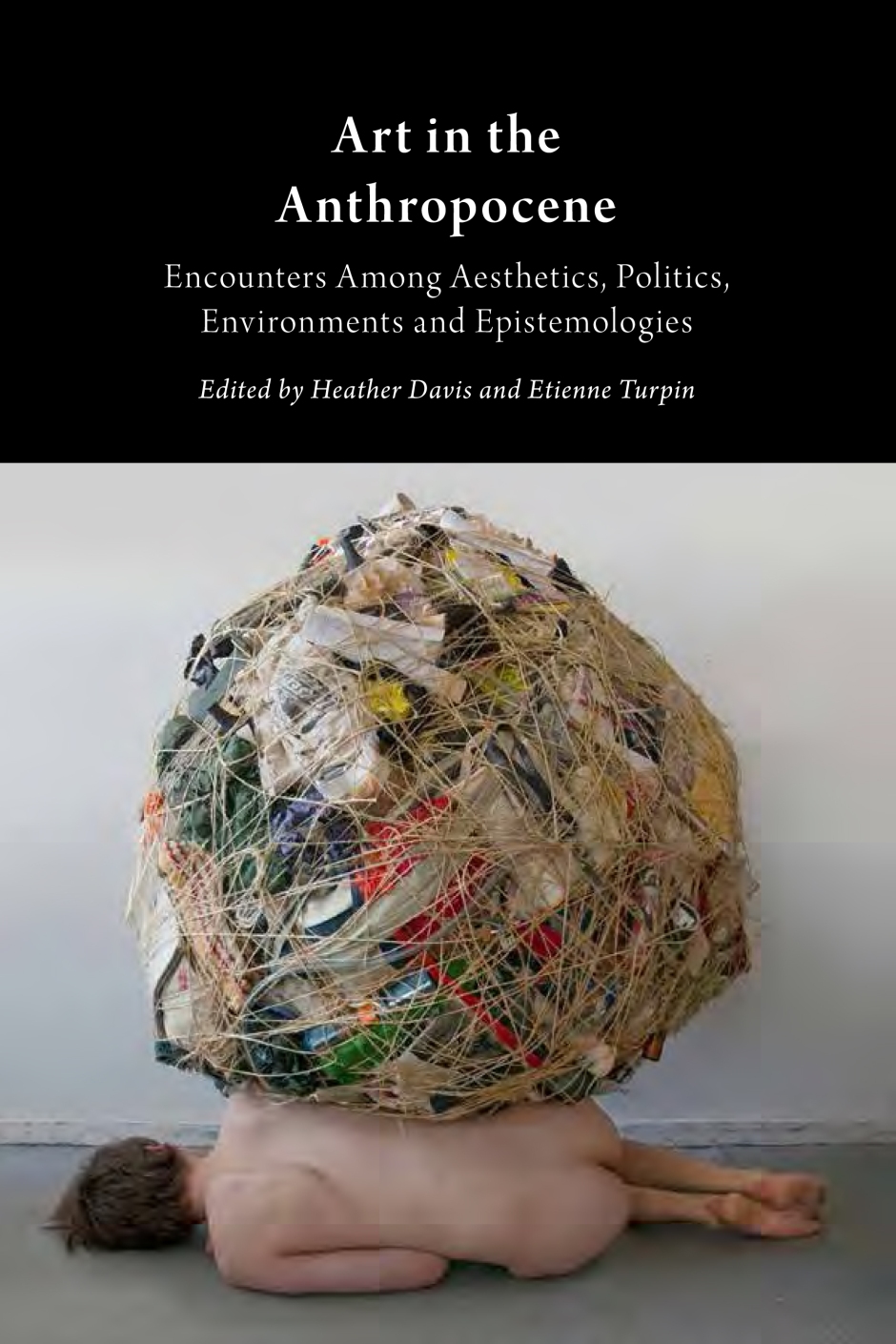
Art in the Anthropocene - Taking as its premise that the proposed geologic epoch of the Anthropocene is necessarily an aesthetic event, this book explores the relationship between contemporary art and knowledge production in an era of ecological crisis

Davis-Turpin_2015_Art-in-the-Anthropocene-1


Art in the Anthropocene: Critical Encounters Among Aesthetics, Politics, Environment and Epistemologies, Ed. by Heather Davis and Etienne Turpin, Open Humanities Press / Critical Climate Change Series, 2015.


Taking as its premise that the proposed geologic epoch of the Anthropocene is necessarily an aesthetic event, this book explores the relationship between contemporary art and knowledge production in an era of ecological crisis, with contributions from artists, curators, theorists and activists.

Contributors include Amy Balkin, Ursula Biemann, Amanda Boetzkes, Lindsay Bremner, Joshua Clover & Juliana Spahr, Heather Davis, Sara Dean, Elizabeth Ellsworth & Jamie Kruse (smudge studio), Irmgard Emmelhainz, Anselm Franke, Peter Galison, Fabien Giraud & Ida Soulard, Laurent Gutierrez & Valérie Portefaix (MAP Office), Terike Haapoja & Laura Gustafsson, Laura Hall, Ilana Halperin, Donna Haraway & Martha Kenney, Ho Tzu Nyen, Bruno Latour, Jeffrey Malecki, Mary Mattingly, Mixrice (Cho Jieun & Yang Chulmo), Natasha Myers, Jean-Luc Nancy & John Paul Ricco, Vincent Normand, Richard Pell & Emily Kutil, Tomás Saraceno, Sasha Engelmann & Bronislaw Szerszynski, Ada Smailbegovic, Karolina Sobecka, Zoe Todd, Richard Streitmatter-Tran & Vi Le, Anna-Sophie Springer, Sylvère Lotringer, Peter Sloterdijk, Etienne Turpin, Pinar Yoldas, and Una Chaudhuri, Fritz Ertl, Oliver Kellhammer & Marina Zurkow.

This brilliant collection of essays and projects, gathered from all over the world, reflects the limits and possibilities of how visual art might respond to what Sylvère Lotringer describes as a "state of emergency." Art in the Anthropocene is at once an investigation and an homage to the natural world. It describes what we possess and what we have lost. —Chris Kraus

Art in the Anthropocene is an art book like no other, embracing an extraordinary range of subjects that affect what we call "our" environment. Visual artists are, for once, equal participants in these imaginative, intelligent, and informative discussions of the most pressing issues of our time, and deep time. —Lucy R. Lippard

Call it the Anthropocene, the #misanthropocene, or something else—there’s a growing recognition that these are damaged times, even if nobody is quite sure how to see, think, or feel them. That’s why Art in the Anthropocene is so important. Davis and Turpin have gathered up the seeds for a whole biome of art and thought about the things that really matter in this world. —McKenzie Wark

 This is a rich, ambitious, and beautifully edited collection that reimagines the Anthropocene as an affective rather than a scientific fact. It touches the very core of our being (post)human—and of the space around us we variously call “the environment” or “the world.” Art in the Anthropocene is vital read for anyone who cares about art, animals, climate, ethics, extinction, justice, plants, poetry and the weather! —Joanna Zylinska


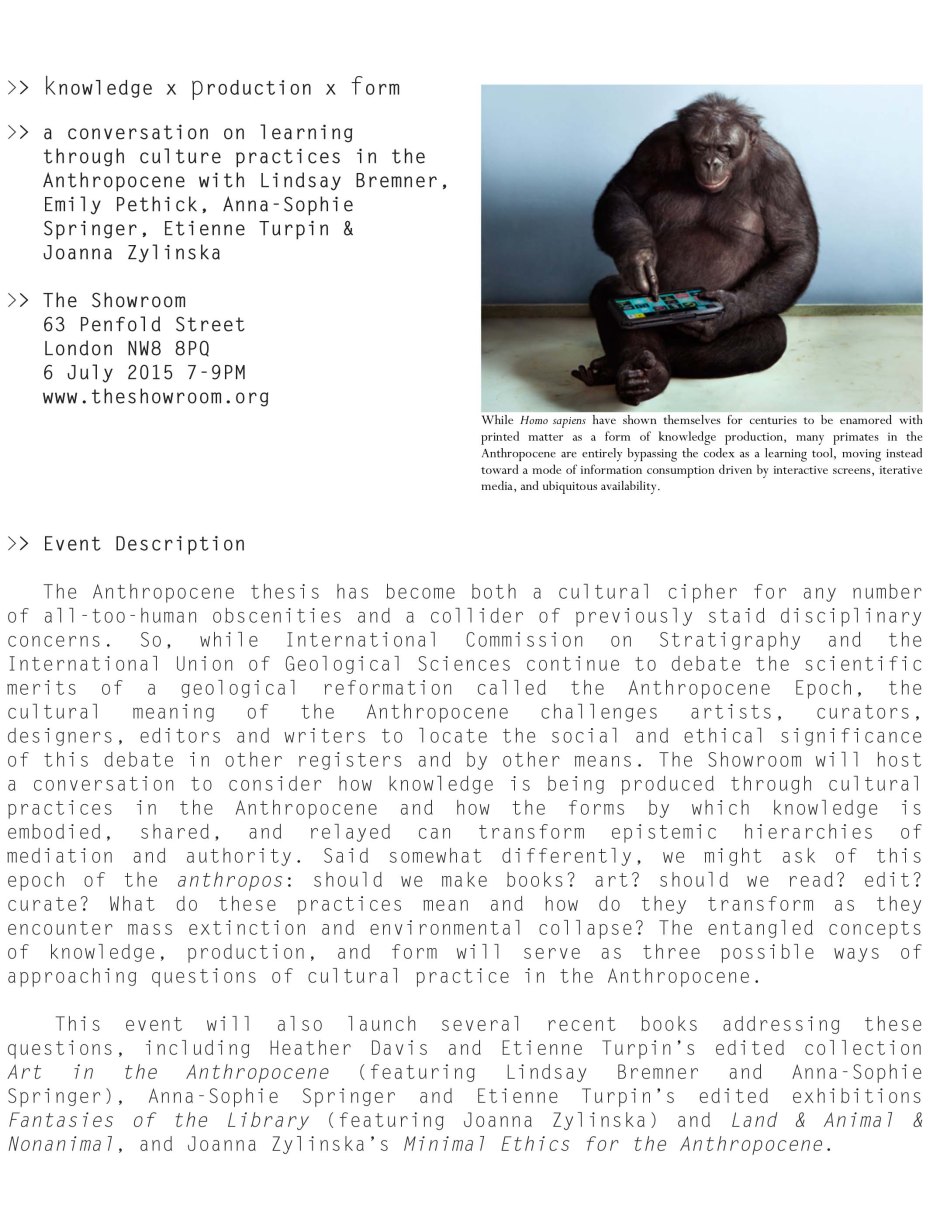
Microsoft Word - 20150626_TheShowroom_EventDescription_v2.docx

John Marmysz - Following the death of his mother and the increasingly bizarre deaths of his closest friends, the nameless main character is afflicted with a mysterious malady that forces him to confront the absurdity of his own meaningless existence


John Marmysz, The Nihilist, No Frills Buffalo, 2015.


marmysz.wordpress.com/tag/john-marmysz/


It seems so important as you do what you do, But in times to come no one remembers you.
Your actions are forgotten and your feelings destroyed.
You've become one with the nihilist void.


Inspired by real-life events, as well as by classic philosophical novels such as Jean-Paul Sartre's Nausea, Albert Camus' The Stranger, Yukio Mishima’s Confessions of a Mask, and Chuck Palahniuk's Fight Club, The Nihilist tells the story of a philosophy professor caught in the grips of nihilistic despair. Following the death of his mother and the increasingly bizarre deaths of his closest friends, the nameless main character is afflicted with a mysterious malady that forces him to confront the absurdity of his own meaningless existence.
Brain parasites, scatological dreams, punk rock, and spontaneous human combustion appear alongside the ideas of Heraclitus, Socrates, Diogenes, Schopenhauer, Nietzsche and Heidegger. The result is a wryly humorous philosophical allegory of hopelessness and resignation in the face of the void.


"Marmysz has crafted a 21st Century philosophical novel, complete with narrative hints from Dostoevsky and Kafka, Sartre and Camus. His simple, straightforward style is clear and accessible with just enough punk rock, rebellion and violence mixed in to keep the interest of today's reader." - Jason McQuinn               

"Kafkaesque! Delves into subjects nobody usually wants to go into: death, vomiting, rectal exams, disease, meaninglessness. Scary, sad and true. It's a work of art." -
Christopher Anderson


My Interview With a Nihilist Means Nothing, As Does Your Life

10/28/15

Pedro Serrano - gutsy, bodily poetry. Verbiage is associated with the genitals – writing is a kind of fucking or, at the very least, a process that engages the physical over the intellectual – the head remains “a heavy slab”.


Pedro Serrano, Peatlands, Trans. by Anna Crowe, Arc Publications, 2014. 


The poems in the first full-length collection to be published in the UK by the acclaimed Mexican poet Pedro Serrano are taken from Desplazamientos, a volume of selected poems which draws on all his collections since 1986. Chosen by both the poet and his accomplished translator, Anna Crowe, these poems are wide-ranging, passionate and linguistically thrilling, together forming a beautifully-balanced introduction to Serrano’s work.


These poems are wide ranging and passionate. Linguistically thrilling, they explore the world of snakes, swallows, valleys and skyscrapers, weariness and love. Reading through the eclectic subjects, provokes a sense of searching, a sense of chaos from which ultimately grows a unification of all things, so the dung beetle, scribe and mermaid are all part of one entity. Just as he enjoys presenting both image and concept in his poems, he gives the reader the space in these slowly unraveling poems to immerse fully in his particularly intense worldview.


Pedro Serrano is an exquisite poet, and this is a collection that sings with virtuosic touches – Serrano’s verse itself, the work of the translator and the scope of the Arc Visible Poets series, which profiles both poet and translator. Parallel text editions are such a pleasure, even if one does not read the original language – to gain a sense of the interplay between Anna Crowe’s sensitive translations and Serrano’s Spanish originals adds a vitality and intellectual excitement to the reading of the collection. Arc are to be congratulated.
In “Dry Rain/ La LLuvia Seca” Serrano refigures the creative act of writing poetry into a destructive, unpleasant act, an act that depletes:
At times the poem is a collapse
a slow and painful landslide
a dark and scandalous rockfall.

Throughout the collection, Serrano is interested in uttering what should not be uttered, looking at the unseeable, communicating what is painful. Here, poetry is the natural disaster that reveals something underneath – landslides both eviscerate what exists and reveal new layers. If poetry is “the scab/ the image finally broken in pieces” then it can release the blood beneath, and can reach behind the image.
As the title of the collection suggests, Serrano is a keen observer of natural phenomena. In this area, his tastes err toward the Romantic and sublime: he favours the storm, the gale, the wind in the trees. In “The Wind’s Trust/ Confianza Del Viento”, love and death are figures as movements equivalent to seasons, which are represented by extreme weather. The four part poem begins:
I heard her afar off, like a blue sword of midnight
like an edge that grew from the frozen point of her lips
like a knife made of water that in its stridency could not be heard.

Is this the wind or a lover? The coldness of the wind and the fear of the tempestuous female form approaching meld, as do the senses – hearing swords and hearing the water. Serrano’s poetry is not ordered and logical, and it does on occasional run the risk of throwing off lucid imagery in favour of atmospherics and the accretion of feeling. As a poetic technique this tends to be divisive, but in Serrano’s hands it is wielded masterfully and unforced.
If it is lucidity and clear-cut images that the reader is after, however, Serrano is more than capable of delivering. In “Peat”, there is no reliance on Romantic imagery: the poetry is pared back and striking.
There is no
ownership
over things.
The yarn
of this world
unravels.
The beech loses
its leaves
from the crown down.

The beech tree decays like an old man balds, the world unravels like a ball of yarn: Serrano has an uncomfortable ability to link to domestic to the vast, undifferentiated spheres of time and being, to make small things seem suddenly lonely. “The world/denies itself/and falls apart” – there is a Lear-esque feel to Serrano’s poetic voice, as if the world is a blasted heath and he its sole and final resident.
Some lightness and relief come in his love poetry, however. He is a Nerudian love poet, moving from the metaphysical to the physical with simplicity and grace. In “Rosary”, Serrano draws on small images and bodily sensations, but pans out, giving these images the potential for global resonance:
In the shoulder the creeper and the root.
On the head a heavy slab
In the sex the dense crowd, thick thirst, speech.

Verbiage is associated with the genitals – writing is a kind of fucking or, at the very least, a process that engages the physical over the intellectual – the head remains “a heavy slab”.
Serrano’s gutsy, bodily poetry is a dark joy, and Crowe’s translation is the polish that makes it shine. This is a fascinating collection and an excellent advert for the broader series. - Alice Tarbuck


To turn to Pedro Serrano's Peatland is to experience an uplift; it's a joyful book, simple in mode, complex in imagery and its poems' pleasures. By mode I mean the poems' free-flowing forms at ease with their purpose. It is one of those books I feel talks to me, this log of Pedro Serrano's experience, his being alive with language.
It is also and no less a book of the translator's pleasure. Anna Crowe's Preface starts from when she hears the poet read in Scotland, having provided translations for the reading, and finds herself hooked. She relates the task then of finding English equivalents for the very different flow of the Spanish, and it is surely her pleasure in working the detail while staying with the emotional flow that makes this such an enjoyable collection.
The poet gave the translator a book of his selected poems, this book now of five sections translated. And while I have spoken here of pleasure, of the job well done, the book is not easy entertainment. Here is a section from a sequence, 'de Turba'/'from Peat',
Everything coagulates like curdled milk,
like sour vomit that throws up
bits of intestine, seeds, bile,
what could be swallowed and what could not.
On the sheet of glass lie the remains,
on the aluminium tray the detailed account,
on the skin, ash and dead static.
The entire past now moves like cloudy water,
like a dead donkey rotting upstream
and which others drink further down, unaware.
The whole of the past remains here, regurgitating.


The book goes with the physical, the being-a-body,
Shitting is a pleasure, to bawl
along the feverish pipe and then abate
without the haste that might lead us to hatred.


and so on for eight more stanzas ('The limiting art'). A a poem sometimes takes off into a longer flow (The wind's trust'),
   I heard her afar off, like a blue sword of midnight,
like an edge that grew from the frozen point of her lips,
like a knife made of water that in its stridency could not be heard.


leading by walk and sense to many lovely lines,
   like a dress striped with black and pearl that could fall off her back,
for they were touching every edge and the sea was green now,


as if such an experience and such a poem should never end. Yes, this book I recommend for a joyful or an uneasy day. - David Hart


Pedro Serrano has published five collections of poems. He has co-edited and co-translated the groundbreaking anthology 'The Lamb Generation' which brought together translations of 30 contemporary British poets in 2000. His libretto for the opera 'Marimbas de l'Exile/El Norte en Veracruz' was first staged in Besancon France in January 2000, then travelled to Paris and Mexico. He has also translated Shakespeare's King John into Spanish. Many of his poems have been translated into English and have been published in widely in the UK and abroad. He teaches in the Faculty of Philosophy and Letters at the National Autonomous University of Mexico (UNAM) in Mexico City, and is editor of UNAM's highly-regarded poetry website, 'Periodico de Poesia'

'C’Lick Me: A Netporn Studies Reader' - Based on non-conventional approaches and mixing academics, artists and activists, it reclaims a critical post-enthusiastic, post-censorship perspective on netporn


6468291


C’Lick Me: A Netporn Studies Reader, Katrien Jacobs, Marije Janssen and Matteo Pasquinelli eds.,  Institute of Network Cultures, 2007.
download here


C’Lick Me: A Netporn Studies Reader is an anthology that collects the best material from two years of debate from The Art and Politics of Netporn 2005 conference to the 2007 C’Lick Me festival. The C’Lick Me reader opens the field of ‘Internet pornology’. Based on non-conventional approaches and mixing academics, artists and activists, it reclaims a critical post-enthusiastic, post-censorship perspective on netporn, a dark field that has been dominated thus far by dodgy commerce and filtering.
The C’Lick Me reader covers the rise of the netporn society from the Usenet underground to the blogosphere, analyses economic data and search engine traffic, compares sex work with the work of fantasy, disability and accessibility. The reader also expands the notion of digital desire beyond the predictable boundaries of the porn debate and depicts a broader libidinal spectrum ranging from fetish subcultures to digital alienation, from code pornography to war pornography. C’Lick Me concludes by re-contextualising queer discourse into a post-porn scenario.

Juan Villoro - From the semiotics of pet iguanas to the disillusionment of mariachi singers, Villoro reveals the deep dissatisfactions and absurdities of life in Mexico and its carnivalesque capital


Slikovni rezultat za Juan Villoro, The Guilty: Stories,
Juan Villoro, The Guilty: Stories, Trans. by Kimberly Traube, George Braziller, 2015.   
      

Mayan Dusk by Juan Villoro

“The literature of Juan Villoro… is opening up the path of the new Spanish novel of the millennium.” - Roberto Bolano

A brilliant, prize-winning collection of stories by Mexico’s most important living writer. From the semiotics of pet iguanas to the disillusionment of mariachi singers, Villoro reveals the deep dissatisfactions and absurdities of life in Mexico and its carnivalesque capital. We encounter a border trucker making a movie about illegal migrants, a cuckolded football superstar, and a gluten-free American journalist seeking the authentic Mexican experience. A master of the post-modern narrative, Villoro gives us contemporary Mexico through a complex interplay of culture and character psychology in the most surprising, fresh and humorous ways.


In the last few years I’ve read a lot of literature in translation, much of it in Spanish and much of it from Mexico. To try and describe the range and diversity of writers from this country would take forever and it may simply be impossible. There are magical and elemental writers (Guadalupe Nettel), master historian writers (Sergio Pitol), and clever,
philosophical writers (Valeria Luiselli). One thing I’ve also noticed is that Mexico produces some very funny writers.
Take these lines from Juan Pablo Villalobos’ English language debut Down the Rabbit Hole: “I like French people because they take off the crown before they cut off their kings’ heads. That way the crown doesn’t get dented and you can keep it in a museum in Paris or sell it to someone with lots of money.” See? Funny. Did I mention the narrator is a seven year old who collects hats and happens to be the son of an infamous drug lord?

Mexico is constantly derided for its violence and corruption; the government, the political process, the police force and drug cartels, all rife and seemingly in cahoots or, perhaps worse, in conflict. This is not something lost on its inhabitants. It faces them every day when they open their eyes. A gritty and absurd fatalism is abundant in the humor of Mexican literature. This might come from the seemingly endless contradictions their homeland contains, a complexity of contemporary life impossible to ignore and, incidentally, who would want to? The Guilty, Juan Villoro’s incredibly compelling short story collection, displays these complexities to a thrilling degree. The writing is razor sharp, the satire brilliant and biting. There is hope. There is misery. There is optimism shaded by fatalism. You see? Everything is complex.
A celebrated journalist and novelist, Villoro’s English language debut presents seven expertly crafted stories that are funny and agile but also illuminating, exploring the paradox of being a Mexican in Mexico. Can everyone relate to the world-weary humor of these stories? Just about. There is a universality to these damaged characters laughing from the abyss because, as one quickly discovers, they are all of us.
The protagonist of the first story is a mariachi who is tired of being a mariachi and gets involved in adult films in order to find himself, only to further lose himself. The title story features two screenwriting brothers, one a trafficker in border crossers. “Holding Pattern” focuses on a bottled water salesman circling endlessly over London in the hopes of making a connecting flight. Villoro’s stories are populated by the exhausted and the desperate, people at the end of their ropes, all connected seamlessly by the world-weary humor of the condemned. In fiction, just as in life, levity is often a succor for anguish. It sustains us. It tells us we’re less alone. Humor is a form of grace. Villoro understands this. As tragic and hopeless as the subjects and characters may be, there is always the humor to keep us going. What at first appears to be a collection of curious and offbeat characters—soccer players, window washers, mariachis—quickly becomes the bleak and hysterical kin of the everyday. It’s not that these people are exciting to read because of their occupations; they’re exciting to read because, like us, they’re trying to survive.
Injured, but still playing soccer, the narrator of “The Whistle” remarks:
I got used to playing through the pain. Then I got used to the injections. I played on painkillers more often than a normal body should. But my body isn’t normal. It’s a kicked-in lump. When she was feeling for my nerve with the needle, the doctor talked about my calcified flesh, as if I were turning into a wall. I like that idea: a wall the opposing team smashes into, where Argentinians crack open their heads.
But even the world of soccer is teeming with violence and corruption. Keeping one’s sense of humor might be the only way of keeping one’s sanity. Later he considers heaven:
Heaven for strikers is full of balls, I guess. But for midfielders, heaven is an empty field where there’s nothing to do and you can finally scratch your nuts, the balls you haven’t been able to touch your whole career.
The interplay of flippancy and frustration is adroitly translated by Kimi Traube, who clearly understands the tone and nuance Villoro is going for. Finding the balance for expressing the downright unpleasant from the lips of a detached but likable narrator is no easy task. And, incidentally, why are these characters likable? Because they’ve been down hard roads. Life has dealt them bad hands. They’ve seen things. You just know it. And translating this feeling can’t be easy. Sometimes the effort involved in artfully translating a book is discernable, other times the art lies in its subtlety. The translation of The Guilty is striking in the sense that the reader distinctly hears the voices of Villoro’s characters, senses their desperation and disquiet; the perception of impending violence that’s palpable.
Another subject in this collection is Americans, or gringos. Reminiscent of the stories of Álvaro Enrigue, the give-and-take between Mexicans and Americans is a topic of fascination and comedy. Mexicans often look at their northern neighbors with a sense of charmed befuddlement and genuine perplexity, sometimes both at once. Samuel Katzenberg, the gluten-free gringo reporter in the story “Amigos Mexicanos” asks the narrator to be his contact in Mexico City as he searches for an “authentic” Mexico, after having done his “bazillionth story on Frida Kahlo.” Katzenberg, of course, asks about the violence: “How violent is Mexico City, really?” And the narrator reflects: “I remembered something Burroughs wrote to Kerouac or Ginsberg or some other big-time addict who wanted to come to Mexico but was scared he’d get jumped: ‘Don’t worry: Mexicans only kill their friends.’”
The stories in The Guilty not only delve into the psyches of Mexicans but into the shallow perceptions “gringos” have toward Mexico. In fact, “Amigos Mexicanos” showcases the way we as neighbors perceive one another, chiefly through misunderstandings and shallow abstractions, seldom if ever correct, like a married couple continually misinterpreting the other, as if language were a hindrance more than a tool. At one point the narrator says: “The planet had turned into a new Babel where nobody could understand anybody else.” Yet these stories do the opposite by deciphering the myriad attitudes of its Mexican characters.
One of the most important aspects of translated literature, I think, is the glimpse we get of people in other places, how they think and feel and conduct their lives. If one doesn’t visit a country or speak its language there is simply no other way but through translation to open the door to these places. Do I think translators are magicians of a sort? I do. When I look back at the last ten years of books I’ve read, the stack would be largely diminished if translations were taken out. This wasn’t something I sought out, at least not at first, but after reading three or four Thomas Bernhard novels and just as many by Roberto Bolaño and an equal amount by Elena Ferrante and Javier Marías I was compelled to seek them out.
The service translations do isn’t easily summarized. It’s art. It’s literature and history. It’s a million unseen decisions oblivious to the reader. Sometimes, by default, it’s political. But it allows a person who’s willing to take the time a portal into the intricacies of another place, sometimes distant, other times right across a border. A collection like The Guilty displays the diverse challenges and staggering contradictions a country like Mexico embodies but without relying on gun-toting narcos or the simple cliches of good and bad. And lucky for us, this is done through the transcendent act of comedy.
I decided to write my first post about The Guilty for several reasons: it is a slight book (in size) and could easily disappear in the deluge of great books we’re getting sent and lucky enough to read. It is also a debut (in English) and like any debut, the future of that author’s works rests heavily upon its success. Although Villoro is highly regarded in Mexico (and has a large body of work in Spanish) it is often the success of that debut that determines if readers will see any more books by that writer in translation. - Mark Haber


AT A CRUCIAL MOMENT in “Amigos Mexicanos,” a story by Juan Villoro (1956), the narrator, a frustrated screenwriter, explains to the cinephile Mexico City detective investigating the disappearance of a US magazine reporter: “When a gringo journalist finds something ‘Buñuelesque’ in Mexico, it means that he saw something horrible he thought was magical.”
Nearly two decades of teaching Latin American literature in US universities has led me to suspect that Villoro’s narrator is definitely onto something. US readers expect books from south of the border to be repositories of experiences that are mystic, mythic, often violent, and wholly different from their own. I, myself, began studying Latin American literature with such assumptions, and they never entirely went away. And although few US readers would identify “funny” as one of the top 10 (or even 20) adjectives that best describe Latin American letters, Juan Villoro is funny. In fact, he is laugh-out-loud funny.
And he is not alone. As a young writer in Mexico in the 1970s, he studied with one of Latin America’s finest humorists, the Guatemalan-born Augusto Monterroso (1921–2003). Among the others who have made humor an important part of Mexico’s literary tradition are the satirist Jorge Ibargüengoitia (1928–1983), the mordant playwright Sabina Berman (b. 1955), and Carlos Monsiváis (1938–2010), the master of the chronicle, a genre he brilliantly adapted from US New Journalism and then made his own. One of my most vivid memories, in all my reading, is a scene in Villoro’s 2004 prize-winning novel, El testigo (The Witness), in which the protagonist rails against the 1970s English rock group Supertramp: “Why did Supertramp exist?” he asks himself. “Was it even conceivable that changing styles hadn’t annihilated something so derivative and lacking in personality?” When I had the chance to interview Villoro in 2010 he told me he actually liked Supertramp. He recognized that it would be harder to vilify a more successful band: “Taking on the Rolling Stones, for example, is complicated. I would have had to bring in the heavy artillery in order to demythify the Stones, the Beatles, Jimi Hendrix, or the Doors, you know, the legendary bands. I needed a lesser band.”
His carefully calculated humor serves as an approach to serious themes. In El testigo, Supertramp reminds the protagonist of a particularly shameful event. In the case of the US journalist in “Amigos Mexicanos,” humor arises from cultural misunderstandings, which, in Villoro’s work, are far from limited to foreigners. Neither gringos nor Mexicans really get Mexico. Villoro shows us that this occurs not because people have just failed to understand Mexico. The real problem is that any attempt to understand a nation as if it were a thing whose size, shape, color, and function you could precisely define is doomed to fail — a problem that can be as funny as it is important to recognize.
I translated the passage about Supertramp from El testigo because the novel is one of several by Villoro that have not appeared in English; literature in translation is famously hard to sell in the United States. Therefore it is no surprise that the publisher of Villoro’s first complete book in English, The Guilty (2015), a collection of stories that ends with “Amigos Mexicanos,” chose to employ Roberto Bolaño’s help in introducing Villoro to US readers. Villoro, himself an admirer of Bolaño, would probably appreciate the ironies associated with the fact that Bolaño died five years before the Spanish original, Los culpables (2008), was published in Mexico, and that Villoro was a well-established author years before Bolaño was. Villoro’s translation is long overdue, his reputation secure among Spanish-language readers, and the independent house of George Braziller deserves credit and praise for publishing a fine edition of The Guilty, which Kimi Traube has translated superbly.
Bolaño’s seal of approval of Villoro’s work — even if not this specific work — raises questions about books and how they circulate. What endows them with value? How and why do their meanings shift? Who buys them and which desires motivate their purchase? The rather arbitrary association of Villoro and Bolaño expresses the hope that Bolaño’s commercial success will rub off on Villoro. It is too simple to say that Villoro does not need Bolaño’s help, or that such assistance is only reductive and distorting. Their association is fitting, since Villoro, as made clear in his writing in general and in several stories in The Guilty in particular, is an author acutely aware of the tensions and contradictions intrinsic to the production and circulation of signs, chief among them the fact that the value of any given commodity is never a function of the thing in and of itself, but of its place in a system of exchange. Villoro makes the most of the humor inherent in this process.
¤
In the first story in The Guilty, a mariachi singer becomes a symbol of Mexican virility and an object of national pride after a porn star’s enormous (and prosthetic) penis is portrayed as his own in a Spanish film called Mariachi Baby Blues. “The next day, all of Madrid was talking about my raunchy shamelessness. I thought about killing myself but it seemed wrong to do it in Spain,” a decision typical of Villoro’s tragicomic take on national identity. The mariachi won’t kill himself on foreign soil, he does not ride horses, and he dreams of flattening sombreros with a Ferrari. To say that he suffers an identity crisis is an understatement. Villoro’s thoughtfulness and skill humanize the most stereotypical of Mexican characters while sending up machismo — less as an actual phenomenon than as yet another stereotype Mexicans find themselves obliged to belie.
The first line of Villoro’s story is: “Should we do it?” The question is asked by Brenda, a production assistant and cinematographer who was born in Guadalajara but left for Spain “to get away from mariachis.” The reader has very little clue about what the “it” refers to until the story’s end, and even then “it” remains somewhat undefined. The mariachi’s thoughts, when he tries to express them, are not entirely formed either. He loves Brenda’s prematurely white hair, but says: “albino women don’t excite me. I don’t want to explain my reasons because when they’re made public I realize they aren’t really reasons.” “It” is gradually revealed to be Brenda’s full-frontal nude shot of the mariachi for a movie she’s directing, thereby revealing to the world that his penis is “sort of little,” as he puts it. By this point in the story “it” becomes something more complex than any single referent could contain and, rather, a sign of the mariachi’s awareness of his commodified self. His “real thing,” a relationship with Brenda based on the truth, may or may not arrive. The real thing remains outside of the circulation of words that comprise the story.
An emphasis on words with multiple and often indeterminate meanings structures practically every story in The Guilty. “Mayan Dusk,” like all the stories, has a first-person narrator, although it begins by using the plural “we,” allowing a brief sense of community. When the narrator switches to “I” on the second page, he returns us to the feelings of awkwardness, solitude, and alienation common to many of Villoro’s characters, both in The Guilty and in his other short story collections and novels — the ironic first-person embodiment of himself that Villoro also uses in his essays and chronicles. All other pronouns are suspect; in “Mayan Dusk,” the narrator bridles when a mutual acquaintance describes his friend’s concerns about him: “It bothered me that he could become a pronoun and take advantage of my deterioration to play the caring friend.”
In “Amigos Mexicanos” the narrator’s friend Gonzalo agrees to write and submit a script under the narrator’s name. Gonzalo’s writing is so effective that the narrator’s agent, Cristi, is seduced by it. Explaining the script’s romantic powers, Gonzalo says, “I did it in first person, as if it were you talking. I’m an actor; first person sounds very sincere in the voice of actors.” Questions of identity, self-perception, and authorship are central to Villoro’s writing, and as with the “it” at the beginning and end of “Mariachi,” a word related to these themes appears at the beginning of most stories in The Guilty and is only explained gradually — be it the ghosts the masseur tells the soccer player about in “The Whistle,” the shears that the brothers’ dad in “The Guilty” once used to kill chickens, or the iguana who’s to blame for catastrophe in “Mayan Dusk.” This technique of slow and not necessarily complete revelation builds suspense and mystery while emphasizing technique, the process of storytelling, and the relation of interiority to exteriority, especially as that relation breaks down at the moment of expression, as in the case of the mariachi in the lead story who tries to but cannot explain why albinos do not turn him on.
The narrator of “Order Suspended” suffers a similar inability to express his own feelings. He washes windows on the outside of a high-rise office building, which at one point allows him to see an artist and a blank canvas in a meeting room on the 18th floor. When the painter begins with a dripping black spot, the narrator reminds the reader that he hates spots. He sniffed too much glue as a teenager and was once convinced that spots on his arms were spiders underneath his skin. But he cannot tear his eyes away from the canvas. On an assignment to clean the building’s interior, he meets the artist and asks to smell the painting. “It smelled like the world, the world from the inside,” he writes. He experiences the painting in a way that is reminiscent of the passage in Borges’s “The Aleph,” in which the narrator sees everything that has ever happened all at the same time. Villoro’s narrator finds in the painting’s abstract design a strange mix of impressions, many of them details from his own life:
I saw plaster dust under fingernails, three bars of light, the grate, the sky from a storm drain, the golden spires of Kuala Lumpur, the blood mole, the grainy chocolate powder, the sheet over Rosalía’s face, rising and falling with her breath. […] I saw the earth under the earth, the magnet that pulled everything together like the curve of fate. I wanted something badly without knowing what it was.
An interior force drives the narrator, and he cannot put it into words. The external world, the social and material world, alters interiority before the latter can even be glimpsed, let alone grasped.
Such self-knowledge also eludes the narrator of “Amigos Mexicanos.” In a passage that is poignant, humorous, and able to develop a convincingly coherent voice in just a few sentences, Villoro portrays the narrator’s dilemma. Referring to his ex-wife Renata’s eventual disillusionment with him, the narrator writes:
In scripts, ‘INT’ refers to the interior, and mine is decorated with sofas. That’s as deep as I go. Anything else is the delusion of a woman who made a mistake searching for depths in me, and who hurt me by believing I was capable of plumbing them myself.
When the script his friend Gonzalo writes in his name impresses Cristi, his agent, the narrator wonders what’s in it, what “he” had written. Like the painting in “Order Suspended,” which gives the narrator a sweeping view of his own past, the script Gonzalo writes says something about the narrator’s whole personality. “Either Gonzalo’s text was very long,” the narrator says, “or my interior was very sparse.” The narrator realizes, later in the story, that his so-called friend Gonzalo had sex with Renata when she and the narrator were still married, making him question his grasp on reality, which is further strained when he learns Gonzalo had staged the kidnapping of the US journalist in order to provide him with an authentic Mexican experience. (Villoro returns to the topic of fake kidnappings and supposedly real encounters in his 2012 novel Arrecife [Reef].) “I walked into his apartment without saying a word,” the narrator tells us, aware that he is comically short on understanding. “Too many things were swirling around in my interior, that place I take such care to avoid when I write screenplays. When I finally started talking, I couldn’t convey the complexity of my emotions.”
The narrator’s inability to convey his complex emotions is funny. The representation of friendship as a network of tensions, betrayals, and horrible revelations, a constant struggle that never reaches a tidy conclusion, is also funny. The narrator’s inability to write the script that Cristi wants him to write and his messy, inchoate relationships betray the artificiality of first-person narrative, as does Gonzalo’s ventriloquistic script: only an actor can act like himself. Villoro rejects identity, showing it to be a comedy of misunderstanding and deceit, an empty signifier with constantly changing referents and meanings. In “Mariachi” the changing referent is the “it”; in other stories, spots, shears, or an iguana; in the final story, friends, friendship, and selfhood.
The narrator tries to reassure the quasi-kidnapped journalist that Mexico City is safe by saying, “Don’t worry: Mexicans only kill their friends.” Determining what “Mexican” or “friend” means, of course, is a futile task, and, in the case of the narrator and Gonzalo, complicated by the fact that they are selling an image or an experience of the buyer’s often unfathomable desire. The search for authentic meaning is further undermined when the narrator reads the script that he has supposedly written and realizes that Gonzalo is, perhaps, actually his friend:
I read the script Gonzalo had forged for me with defiant precision. He had drawn a perfect pantomime of my manias, but he managed to make my limitations seem brilliant and interesting. His autobiography of me was a display of his actor’s skill at forgery, but also of the tolerance with which he had borne my flaws. He had a strange way of being a great friend, but he really was.
The narrator tempers this momentary lapse of insincerity in the next sentence: “On account of my pride, it took me two months to tell him so.”
Villoro’s humor illuminates the ways in which we rely on signs in a mass-media world defined by markets for images. Somewhere in relation to those images more substantial thoughts and feelings circulate, but who knows which are real? Are any of them? They come to the surface occasionally but hardly ever as anyone had imagined they might, with the probable exception of the prescient Juan Villoro. - Ryan Long

Violence and Drug-Trafficking in Mexico

Holding Pattern

The Guilty

The House Loses

Escape from Disney World

An inheritor of Jorge Ibargüengoitia’s sense of humor, Carlos Monsiváis’s acute perception, and Juan Rulfo’s poetic density, Juan Villoro has gracefully established himself as a central figure within Latin American literature. His versatility, evident in his prolific and protean production, is famous in the Spanish-speaking world. From his early short stories to his famous crónicas, from journalistic essays to academic ones, from children’s books to literary translations of German classics, from books on soccer to monumental novels, his capacity to intertwine, in every possible register, political reflections and literary imagination, provides each of his interventions with an impressive poignancy. His work is an exploration into the perverse social fantasies driving Mexico’s violent modern history and leaves nothing untouched.
His 2004 novel El testigo, winner of the prestigious Herralde Prize, is arguably where Villoro’s literary reflections regarding violence, history, and literature have been most brilliantly embodied. The novel tells the story of Julio Valdivieso, a Mexican émigré intellectual who, after a long stance in Europe, returns to Mexico after the ruling political party loses, following seven decades in power, the elections. His research into the figure of modernist poet Ramón López Velarde quickly leads him into a landscape of violence where history and spectacle overlap to the point of confusion. A novel about what it means to be a historical witness, El testigo remains Villoro’s masterpiece, a monument to his versatility as a writer and to his complexity as conjurer of Mexico’s social fantasies. With the recent events in the Mexican state of Guerrero, where forty-three students from the Raúl Isidro Burgos Rural Teachers College of Ayotzinapa have disappeared, his work seems today of the utmost relevance.
Despite its uncontested centrality and visibility within contemporary Latin American culture, Villoro’s work has only recently become available in translation to an American audience. On the tenth anniversary of El testigo’s publication, and with the English translation of two of his recent titles—The Guilty and Arrecife—forthcoming from New York publishing house George Braziller, Jeffrey Lawrence and I thought it pertinent to interview him on the political as well as aesthetic repercussions of his recent novels. We wish to thank him for such an enjoyable conversation.
Carlos Fonseca  The epigraph to your 2004 novel, El testigo (The Witness), is a line from a Cavafy poem: “When you set out on your journey to Ithaca, pray that the road is long.”
Jeffrey Lawrence And the first section of the novel is called “Possession by Loss.” How does Cavafy’s idea of a journey in which one deliberately gets lost or sidetracked play into the plot of El testigo?  
Juan Villoro That quote from Cavafy implies that a journey’s purpose is beyond its goal. We always think that an odyssey’s endpoint is the return home, but a journey’s real value is in the extent to which the unexpected happens and there can be change. Some trips transform travelers—the person at the beginning of the journey is different from the person at the end. El testigo is about a character, Julio Valdivieso, who has been away from home for twenty-four years (a bit longer than the wanderings of Odysseus in the Odyssey). His return to Mexico is meaningful in the sense that it is also part of his journey; he’s no longer the same person, so his return is uncomfortable. He can no longer engage with others in the same way as before, and he has to rediscover his country. He becomes more of a witness to the events that unfold than a protagonist. The last line of the book, about the country tasting like earth, comes when he’s fully understood that he has gone through a rite of passage.
The background of this phrase—“Sabe a tierra ­­–dijo Julio.”—is mentioned in the novel. When Octavio Paz and Jorge Luis Borges met, Borges, who had the memory of an elephant, recited Anglo-Saxon poems by memory, among others. He knew Ramón López Velarde’s poem “La suave patria (Sweet Land)” by heart, and some of the language in it—containing domestic evocations of the homeland—really surprised him. Borges, a descendant of generals, once said, “For me—simply because I'm a coward myself—bravery is an essential virtue.” He had this heroic idea of the homeland, and it surprised him that López Velarde had written about his Mexican homeland in a totally domestic, playful way, describing food, the green lightning of parrots’ wings, and the toylike ways in which trains puff down the tracks. Borges didn’t know the word “chia” in the poem, so he asked Paz what it referred to. Paz explained that it was a seed used locally in drinks, such as lemonade. Borges asked him what these drinks tasted like, and Paz simply responded that they tasted like earth. Chia seeds do have a rather earthy taste, but Paz’s response was beyond literal. He was alluding to the homeland, linking it to “La suave patria,” defining it as something that you can drink on a daily basis without realizing it.
Julio Valdivieso’s path as protagonist—to really arrive in Mexico, to find his place, and be able to drink the earth-tasting homeland—is extremely long. What Octavio Paz and Borges arrived at in a quick conversation, took five hundred pages for me.
CF And that somehow unravels the paradox behind the section title, “Possession by Loss.”
JV The theme of absence is very clear in the book. A person is not only defined by what she or he does, but also by what she or he doesn’t do. We are all made up of lost opportunities. We are writers or researchers as much as we’re not lawyers or doctors. Our inaction defines us. This is what happens with Valdivieso and Nieves, the woman he couldn’t marry. This hangs over him; her absence defines him. The idea of possession by loss has a lot to do with the literature of love too. In Love in the Western World, Denis de Rougemont writes that unrequited love is the foundation of courtly love. When you lose something, you try to seize it in your memory and imagination.
CF There is a strong sense of fate in the novel. It’s one of the things that has fallen by the wayside in contemporary society. In El testigo, however, the world of drug trafficking, represented by the character of El Vikingo, a drug lord fixated on filming a soap opera of the Cristero War, seems to take the place of the fateful driving force. Drug trafficking is introduced in the novel as a dark, invisible network in which the protagonists become entangled. All of a sudden they are involved in something they don’t understand at all. We could perhaps call this a “modern fate.”
JV At some point in the novel, I write that everyone has stories but very few have fates. It’s a qualitative difference that is essential to understand the novel’s narrative composition. To what extent can we trap a character at that breaking point where his story truly becomes his fate? In terms of archetypes, Hector and Achilles come to mind. Achilles is a semi-god; he is going to win the fight. Hector faces him in combat with full awareness of his mortality. He is perhaps one of the first heroes in literature who knows that he is going to die and there is nothing he can do about it. He still wants his fate to be meaningful, though, and here his own will plays a role.
There are also fates with uncertain outcomes. I think about, for example, the protagonist in Bioy Casares’s The Invention of Morel, who falls in love with Faustine, who lives in a parallel reality, in a world of projections where people appear and disappear. He makes a Faustian deal to enter Faustine’s world, but at the cost of his life. He is a fugitive and has nothing to lose, but what’s interesting is the enormity of his sacrifice when there is no sure reward. Maybe Faustine won’t even recognize him after he makes the leap to her world; it’s his fate to bet everything in return for something rather uncertain.              
  Julio Valdivieso is involved in this sort of thing too; he wants his rite of passage, his return, to have meaning. We could almost say that he wants to go through a process of unlearning, of leaving behind the cosmopolitan person he was when he went to Europe. When he comes back, he finds a barbaric country that seems to be looking more toward the past than the future. He understands he has the opportunity of arriving at a new perception, of returning to basic values and feeling like he belongs, in a purer sense. His encounter with Nieves, who has become such a different woman, is probably going to be a disaster, but that’s the risk he takes.
           
In regard to drug trafficking, I wrote the novel at the beginning of 2000, when the climate was not as controversial as it would become later on, in 2006, when President Felipe Calderón launched his war on drug cartels. But the topic was already in the air. What interested me about drug-trafficking was how it was like what physicists call an “event horizon”—a dark and powerful force to which inexplicable actions can be attributed. Inside a black hole, everything is material folding in on itself and, technically, nothing can happen. On the edge of a black hole, however, there is a circle where events can start to happen. Back then, unexplained violence and crime were being attributed to drug trafficking, which was already considered powerful enough to be responsible for everything, even those things it wasn’t responsible for. It wasn’t omnipresent yet, but it was lurking in the shadows. 
LJ Julio comes back to Mexico for many reasons, but one of them is to do research on contemporary authors and also on Ramón López Velarde, whose work he doesn’t entirely know. So it’s like a double return, in the sense that he comes back to his homeland and also to its literature.
JV That’s very true. Valdivieso had been an academic reader, a somewhat dispassionate one who conformed to the conventions of the academic world. He’d been successful and therefore could focus on topics that were ever more narrow and specialized. Others left him alone since he didn’t have a lot of competition. He was curious but not passionate or fervent. Returning to Mexico, however, as you point out, gave him an opportunity to read in a different way.
I wanted to have a figure appear who would not necessarily be a contemporary of Valdivieso’s. Many in Mexico consider Ramón López Verde to be a great national poet. People know his poems by heart. Beckett translated him, and Borges read him a lot, but he is not very well-known outside of Mexico. Although he is a national poet, he is a poet of many contradictions and dualities. He is a Catholic poet and, at the same time, a sinful poet, a transgressor. He is conservative in many ways—he writes picturesque, even folkloric poetry—but, at the same time, he is also an avant-gardist. The following two Alexandrine lines condense this contrast: “Yo tuve en tierra adentro una novia muy pobre” (Inland I had a very poor girlfriend) is traditional: someone travels to the countryside to see his girlfriend. The next line is dazzling: “Ojos inusitados de sulfato de cobre” (Rare eyes of copper sulphate). Often, in the same poem, you find the traditional man and the literary transgressor from one line to the next. These contradictions might explain why he has been so attractive to very different types of readers in Mexico. I wanted to write a novel not so much about López Velarde’s poetry, but rather about the way people read him.
One day I was having a drink at a cantina with my friend Luis Miguel Aguilar, who is a poet. I told him about my interest in López Velarde’s extraordinary life. He died at age thirty-three, like Christ, already a mature poet. He participated in the Mexican Revolution as an advisor to Francisco I. Madero, ran for Catholic representative, and never had a home, or a watch. He dressed in black because he was in mourning for his father. He dated four women—all of whom loved him—but didn’t marry any of them. They were all single when they died. Luis Miguel told me, “Look, what you have to do is talk about him not as a poet but as a person, because so much has already been written, and very well, about his work.” Yet it seemed more original to me to write not so much about him but, rather, about the ways in which he has been received, about the multiple interpretations of his work.
El testigo is about López Velarde’s readers; the radicals, leftists, populists, and others who, like the priest Monteverde, have been inclined to over-interpret his poetry as proof of his Catholic saintliness. It’s like Nabokov’s Pale Fire, where the poem proves an assassination. I was interested in playing around with what Ricardo Piglia calls the “last reader”—a reader who finds himself in a reality derived from his readings, who confuses poetry and reality. Julio Valdivieso is the last reader; he is a secular, rational nonbeliever who rejects Father Monteverde’s opinions, even if they seem seductively interesting, which were that López Velarde worked miracles and that his poetry proves them. There must be three miracles to submit to the Vatican’s Congregation for the Causes of Saints, and the third miracle is missing. I wanted to make the third miracle’s witness precisely someone who does not believe in miracles and to have the miracle be almost a hallucinatory extension of López Velarde’s poetry. So there we have two possibilities: what Valdivieso sees could merely be a feverish hallucination, or his fever and illness are caused by what he actually sees. There’s this ambivalence—he himself does not really know if he has witnessed this miracle or not.
CF Testimony and the act of witnessing are loaded terms, so I wanted to approach them from another perspective—that of the dogs. At some point in the novel, Julio says that a dog sees regardless of its curiosity or will, as if by accident. I remembered how in Under the Volcano the dogs chase the Consul.
JV Yes, the dogs are essentially a symbol of witnesses; they serve that purpose. For the Aztecs, one traveled to the underworld accompanied by a dog because someone had to witness the crossing. The dog is the silent companion. López Velarde has a poem about Saint Roch, the patron saint of dogs.
There is a rather disturbing animal in the Hacienda de los Cominos—a dissected dog—which is precisely a monument to the witness. People interested in taxidermy can, I don’t know, dissect a lion, a wolf, a coyote, but then, on a whim, someone dissects a domestic animal. As the story advances, we realize this dog was actually Aunt Florinda’s witness, so the witness is frozen in the act of witnessing, making it do so eternally, so to speak.
LJ In Mexico the figure of the witness, especially right now, is very controversial because of the risks that witnesses assume. This also plays a role in the novel. On the one hand, we have Julio, who is sort of a witness to all of the events narrated in the novel, but then we also have his “problem,” let’s say, with authority, with detectives, and with his old friends.  I wanted to hear your thoughts on the more legal side of the notion of the narrator as witness, a topic that, as the novel goes on to explain, proved to be of interest to Julio’s father, lawyer Salvador Valdivieso.
JV I was interested in having a progression in the figure of the witness throughout the novel. First I wanted there to be a person who returns to his country and undergoes a strange experience. He feels foreign, out of place, and at that point he becomes a direct witness to events, though in the beginning this isn’t exactly conflictive or defining—it puts him in interesting situations. For example, he becomes the unlikely confidante of many different people, because he is sort of on the margin, from another reality, almost from another era. People start to seek him out and tell him things they wouldn’t tell him if he were a more permanent presence. It’s as if time and distance had given him a kind of sacrament, like the priest, whose sacrament allows him to listen to confessions. Or like a psychoanalyst, whose role is so interesting; you lie down on the couch and never see his face. The practice is related to the Catholic tradition, where you don’t see the person with whom you’re speaking in the confessional. You hear a voice, but it may be one voice or it may be another.
Let’s say that Julio Valdivieso has taken enough time away to qualify as someone to whom people can confess things. People seek him out with different reasons; relatives who he didn’t even know seek him out. He comes from far away, and this is meaningful. He’s on the margin of events and yet has more information than others about them. I am always surprised that in places like Mexico, all of a sudden the best-informed person is the foreigner. Everybody thinks he’s outside of their reality and therefore confesses things to him, thinking there is no risk.
On the other hand, the witness has this parallax effect, a concept from physics that I love. The object being studied does not change, only the perspective, and by changing the perspective the object is seen in a different way. So, the witness sees in a different way, and he is also seen in a different way. That’s the first dimension.
The second dimension is a reflection on who is a genuine witness. That’s where the legal side comes in. In jurisprudence there are external conditions that establish the legitimate attributes of a witness. The witness can’t be drunk when the events occurred; he can’t be a relative of the victim because then he would be biased. Or, if he uses glasses he had to have been wearing them at the time of the events. There are plenty of conditions that are debated in court. The lawyer and the prosecutor debate whether or not someone meets the conditions to be a trustworthy witness. Yet, in a psychological or moral sense, it’s very hard to say if one person is a better witness than another because psychology and morality are determined by interior subjective circumstances. That starts to happen to Julio—he questions the idea of a witness. Up to what point can the witness understand what he sees? That’s the phase in which he questions himself and the extent to which he understands things. That’s where we have the witness as a problem. For instance, there are things we see by accident that we didn’t want to see, and yet we had to see them. We can close our eyes, but we’ve already noticed them. This is an instance in which the witness becomes problematic.
           
I am very interested in what Giorgio Agamben has written on the figure of the witness. He talks about the impossibility of being a witness without being part of the experience. Talking about Auschwitz, he says that the only full witnesses of the Holocaust are its victims. Only those at the crematories knew what it fully meant, but they were at the point of no return. Agamben explores a figure very close to the full witness: the “Muselmann” in concentration camps. These were men who had lost all sense of purpose. They no longer spoke; they were the living dead, but then, all of a sudden, they would come back. And by coming back, they could say something that, in some sense, came from a realm where there is no language, from the realm of silence, of death. That’s the closest we can get to having a living archive of death, of the other side. So without exaggerating, I was interested, because this is not a novel about the Holocaust, in having the character go through a filter at the end where he practically becomes something close—let’s say temporarily, a Muselmann. There’s Florinda and the pond, the fever, hallucinations in which Julio no longer knows if his testimony is real or imaginary, literal or literary. For a few moments, he is like the Muselmann who has lost reason and the ability to speak. And he goes back. And by doing so, he returns with the attitude or the awareness of going to this lost, empty country, to Mexico.
All Mexican mythology, all Mexican imagination, the Mexican revolution, Pancho Villa’s rides on horseback, ranchero movies from Mexico’s golden age of cinema, ranchero music, everything comes out of a place that is empty, this land within from López Velarde. So he goes there and looks for sensory contact—there the witness is already a witness. That’s why I said he has to try to relearn a language. He is more of a sensory witness, more sensitive than rational, a little bit like what would happen to a Muselmann. He hasn’t gone through something as terrible as the Holocaust, but on his own level, he has suffered a shock. He has experienced a secret and the secret must be kept as such, veiled. I’m thinking of the priest Monteverde’s reflection when he talks about a hidden God and says that sometimes the revealed truth must be kept from the public eye. It can’t be made the subject of a television series. It will have a good rating on the television for a few days, but television cheapens. Nothing is more powerful than a secret. We are going to preserve it like Christianity. In the end, that’s what Christianity is—God has never shown himself very clearly to anyone; we decide to believe or not believe in him. So, that’s also the moment when the witness decides to accept this last step. By burning the papers, he preserves a secret; there will no longer be a tangible demonstration, a verifiable proof, and this is, of course, one of the conditions of a miracle.
CF In terms of the secret and something that resists being illuminated, I found it interesting that your novels show traces of the works of two very important twentieth-century fiction writers whose works somehow resist the interpretative drive of academic discourse: Juan Rulfo and Juan Carlos Onetti. I know that you believe their work still provides a lot to think about, even though for a lot of other people they’re already buried. Formally, I’m interested in terms of how you write, looking at a lost tradition that would include both Rulfo and Onetti.
JV They are central influences and two essential authors to read. Both Rulfo and Onetti have this idea of researching literature as it is produced. In Onetti’s A Brief Life, “Goodbyes,” and “The Pit,” or in Rulfo’s Pedro Páramo, the figure of the narrator conveys a strong sense of uncertainty. In “The Pit,” for example, the protagonist Eladio Linacero tells a story two times, and nobody cares about this story within the text. His story is a failure, and yet Onetti writes a masterpiece about this story that doesn’t work. In “Goodbyes,” the narrator is libelous; he has invented a love triangle between some characters and only later we realize that everything he told us was false. He’s a supremely unreliable narrator; we suppose what the real story is, but it is never told. In A Brief Life we have a person who is writing a film script and one of the characters invents the city of Santa María, to which Brausen imaginarily moves. We see how this imaginary place is written into the novel. It’s very clear that Onetti is not writing because he knows something in advance, with a preset structure of discourse, like a god who explains the world. On the contrary, he is writing to figure out his own book. It’s challenging to retell the plot of A Brief Life; a kind of Onetti appears as a very secondary character, he has been cast out of the novel, as if it were writing itself.
In the case of Rulfo, Juan Preciado, the protagonist of Pedro Páramo, dies on page seventy-nine in my edition, about halfway through the novel, and says, “The murmurs killed me.” However, the novel continues without him. No other narrator’s voice is left in charge, so we can say that the novel is also a reflection on how it is being told. El testigo is not so complex or rich in that sense, but I was interested in mirroring the witness, in having his investigation be somehow identical to the way the reader investigates the novel. The characters will arrive simultaneously, with the reader, to this rite of passage where reading is now just a sensory perception of a place to which they want to belong.
Then there is also the stylistic influence of Onetti and Rulfo. I think a lot of the best twentieth-century poetry and prose in Spanish has been written by Onetti and Rulfo. My prose is much less dense; I couldn’t write a 500-page novel with that density. Roberto Bolaño and I had a rather heated discussion about literary texture and the tension that a novel’s prose should have. He found that my writing had a tension of phrase that reminded him of a short story. He said, “You really exhaust yourself, because if you want to do a long novel with this type of epigrammatic phrasing, and so many adjectives, and it creates a lot of tension. A novel requires a certain fluency.” It’s not that he was in favor of literature without style; in fact, his literature had a very marked style, but he found a torrential fluidity to be able to tell stories, and what he achieved is extraordinary.
So, perhaps I am a bit more devoted to Onetti, Rulfo, or Borges, for example. I don’t agree with Ignacio Echevarría that the novel that Borges would have written is The Savage Detectives. First of all, the idea of the novel is almost antithetical to Borges. I don’t think Borges’s tension of phrase would be able to last for a whole novel like The Savage Detectives without exhausting the author and the reader. The book would burn up at some point. My novel obviously doesn’t have this dense poetic capacity, this dark light that Borges and Onetti have, but something I would like to think, perhaps ambitiously, is that some of their stylistic traces are present.
LJ There is a phrase in El testigo that I love, because I study comparative literature. At a point in the novel, Julio and El Vikingo are talking about Félix and they say: “People who study comparative literature know everything about everything; they’re on top of their game.” That made me think about the part with the critics at the beginning of 2666, but also about the journalist who’s the protagonist of Javier Cercas’s novel Soldiers of Salamis, and also about many of Piglia’s novels. Going a little from fiction to reality, I wonder to what point the character as an academic, journalist, or intellectual is important to the way you think about literature.
JV Well, in terms of character, I am very interested in something that Piglia has worked a lot on, which is that, in the end, almost all literature depends on a search. A character wants to find something, and one way to do so is through literary research: the researcher is a detective of ideas in the sense that he is trying to find someone and is sometimes driven by paranoia. In other words, sometimes he overinterprets; he believes there is something deeper in a quote, and he seeks connections. So I was interested in the possibility of a character who is researching archives. But I don’t like literature that is overly self-referential—at least I don’t like to write it. There are authors like Claudio Magris, Sergio Pitol, Enrique Vila-Matas, and even Borges, who create literature very centered on literature itself, though Borges is much richer since he has marvelous stories about unsophisticated people and also about people who are generally more educated. Borges is an encyclopedia of the imagination and he encompasses everything. I am not so interested in self-contained literature; I am interested in literature that is immersed in life and is tense, confused, tormented.
I wanted my novel to concern the lives of readers, in other words, people who have read and are defined by what they have read in different ways. Valdivieso is an academic looking for something, but then his research overwhelms him; he goes outside of the field, outside of the book, though he will still be someone who understands the world through literature. In my novel El disparo de Argón  (the shot of Argon), the protagonist is a doctor. He works at an eye clinic and evidently, when interacting with other people and with other bodies, what he sees are symptoms. A patient is a girl he likes, but he sees, first, an illness, and it’s normal for a doctor to see the world like this. Maybe he even likes this girl because she has a certain type of illness—it’s morbid in the double sense of the word. So I am interested in the figure of the researcher going beyond the borders of the field, in the moment when the researcher no longer is interpreting texts and books only, in how they take him to other experiences and places in life.
Repetition, or the possibility of repetition, concerns me as well. I don’t want to always write from the same point of view. El testigo’s character is closest to me. That’s why he has my initials; he is more or less dedicated to what I do. I was able to get close to someone so similar to me after having written about other characters very different from myself.
In my latest novel, Arrecife (Reef), Tony Góngora, the protagonist, has severe memory problems because he’d been a drug addict. He is an old rock musician, dedicated to music, and he’s also missing a finger. I was very interested in narrating from a very, very different point of view.
CF Arrecife is a detective novel that takes place in La Pirámide—a resort singular for its capacity to recreate the pleasures of fear. The narrator declares that today we live under an ecology of fear. How does this “ecology of fear” work? What type of relationship do you see between the cartography of violence that you trace in Arrecife and the one that you sketched in El testigo?
JV Both novels have to do with investigations. In El testigo, the protagonist is searching for the lost papers of the poet Ramón López Velarde, while Arrecife deals with a murder—here I was interested in coming up with a satisfactory solution to the enigma of who had committed the crime, but I was also interested in eliciting the reader’s moral doubts. One of the things that interests me the most in literature is when an initial clarity becomes a puzzle. That is to say, when a problem’s solution leads to perplexity. In Arrecife we know who the assassin is, but that doesn’t matter too much. In part, this has to do with the Mexican justice system. In this country knowing who the murderer is doesn’t imply that justice will be done. The solution to Arrecife’s plot leads to moral uncertainties: How evil is the assassin? How innocent is the victim? We know the facts, but their value remains an open question.
In El testigo violence is peripheral. It is a latent threat that not always defines the life of the characters. It works as a short circuit that interrupts the plot without controlling it completely. The novel takes place the year in which the PRI lost the presidency that it had held for seventy-one years. This strong apparatus wasn’t substituted by a single force but by a confederation of authoritarianisms (television, the Church, the right-wing groups, drug trafficking). Violence is one of the axes that threaten history, but not the only one.
Arrecife, on the other hand, takes on the question of violence from many different angles to the point of being immersed in it. In La Pirámide, the resort where the novel takes place, violence has become a form of entertainment. It produces adrenaline rushes that the visitors enjoy—it’s almost like an extreme sport. At the same time, there is the real violence, a product of drug trafficking and the sacrificial violence of the oldest inhabitants of the zone, the Mayans. In a country that has had close to 80,000 deaths in its war against the drug trade over the past few years, the blood spilled is useless. It is completely different from the Mayan sacrifice, which might horrify us from a contemporary perspective but had clear ends in their conception of the preservation of the cosmos.
CF Arrecife begins with a quote from Malcolm Lowry: “But one day I shall find a land corrupted and depressed beyond all knowledge, where children are starving for lack of milk, a land unhappy, although unenlightened, and cry: ‘I shall stay here until I have made this place good.’” This place is, one would imagine, the Mexico you portray in the novel. This makes me think about the epigraph of The Savage Detectives, also from Lowry: “Do you want Mexico to be saved? Do you want Christ to be our king? No.”
I wanted to ask about that imaginary Mexico which takes Lowry’s work as its point of departure. How do you understand the fact that Latin American writers, even Mexican ones, in their attempt to analyze Mexico, begin by quoting Lowry?
JV Lowry found a contradiction in Mexico, a mixture of heaven and hell. That was what he needed for his masterpiece. The epigraph of Arrecife doesn’t come from that novel but from Ultramarine. It somehow prefigures the place Lowry would later find: Mexico, a miserable land that he could improve. Mario Müller, the director of La Pirámide, has an obsession. Like a character from Conrad or from Lowry, he sees himself as someone who can make a difference in the midst of horror. Not everything Lowry saw in Mexico came from reality. He was a full-time paranoid and he over-interpreted what he saw. The country was less dramatic and less magical than he thought it was. His virtue was to add a dimension to that reality, to highlight it. Something similar happens with Bolaño. Most of the things that he tells in The Savage Detectives were real. I knew many of the people and stories that inspired the novel, but he empowered them through narrative. He didn’t seek, as Lowry did, a delirious, hallucinatory, poetic tone. Although many of his characters are poets, the tone of Roberto’s book is closer to that of the epic.
The foreigner’s gaze lends itself to this type of distortion of the country. It is highly fruitful in creative terms. What the outsiders don’t understand, precisely because they are on the margins, is filled in with unreal conjectures that are, however, faithful to their own logic. The paradox of many passages of Under the Volcano or The Savage Detectives is that both novels end up portraying Mexico better than some testimonial works. So in Arrecife, the epigraph from Lowry is a sign that I am trying to imagine my own country in this key, fracturing common codes, searching for an alternate, a symbolic truth, in which the observer can find a dignity in horror. It’s possible that the presence of so many foreigners in the plot also has to do with an outsider’s perspective: I’m seeing my country as a foreigner would.
CF One last question regarding the unforeseen ending of Arrecife, which could be read as a subtle ode to those modern families that have learned to live with the delirious figures of  violence turned spectacle. The ending reminds me of the two versions of Tolstoy’s first sentence in Anna Karenina: “Happy families are all alike; each unhappy family is unhappy in its own way.” Then there is the inversion that Nabokov proposes: “All happy families are more or less dissimilar: all unhappy families are more or less alike.” Which, do you believe, is the narrative logic that the modern family exhibits in this novel?
JV The novel leads to the construction of an accidental family. Arrecife is a negative utopia; I wanted there to be, within a history of decomposition, an alternative, a possible redemption. Tony Góngora wasted his career as a musician; he suffered two accidents that, though not serious, limited him physically; he destroyed his great love affair; he doesn’t have kids or family (and doesn’t even know what happened to his father.) We are dealing with an incomplete person who, at the age of fifty, seems to have wasted his last chance. The plot then confronts him with a murder, with the illness of his best friend, with networks of corruption, and, all in all, with a series of problems which, little by little, transform him. The real drama makes him better after having suffered many unreal, neurotic dramas. The great paradox is that the amnesiac character is the one that must take custody of the most valuable thing in his best friend’s life: he inherits his child, his most beloved being. The life of his friend Mario Müller continues through his assumed paternity. In a moment of social rupture, nothing shows more solidarity than adoption.
The novels ends by showing the resistance and force that victims can have. When I say it like that, it sounds too programmatic. The truth is that I had no ideological purpose when I finished the plot. It was something very intuitive. In the end, solidarity is something very mysterious. Why do people resist and help each other in the midst of violence? In Mexico, women have basically been the ones weaving the social fabric in the midst of the blood spilled. The weak and helpless have tremendous reserves of energy. At the end of the novel, Tony Góngora escapes with a little girl and his mother, a woman he has met and fallen in love with but also someone who he somehow fears because she has experienced worse things than he has. I was trying to work out the relationship between these characters when, without knowing why, I remembered a challenge children pose to other when they race: ¡A ver quién llega primero! (Let’s see who gets there first). This desire to run toward a goal is strange, because it’s not always competitive. If those who race are a family, then the youngest one wins. The rest let themselves be defeated. In this gesture, I find a symbol of filial affection: they are a “family.” We don’t know what will happen to them; it is not a matter, in this sense, of a happy ending, but they have won something. In a territory where everything conspires to annihilate life, they are together. Tony Góngora hasn’t searched for this destiny but he has behaved with enough integrity to deserve it. The mutilated one shows his integrity. - Jeffrey Lawrence Carlos Fonseca


Juan Villoro, God is Round, Trans. by Thomas Bunstead, Restless Books, 2016.

A brilliant and kaleidoscopic exploration of the world’s favorite sport and the passion, hopes, rivalries, superstitions, and global solidarity soccer inspires from award-winning author and Mexico’s leading sports journalist, Juan Villoro.What was the greatest goal of all time? Why do the Hungarians have a more philosophical sense of defeat than the Mexicans? Do the dead play soccer? On a planet where FIFA has more members than the United Nations, Juan Villoro’s examination of soccer and its 3.5 billion-person fandom has stakes beyond those of such playful questions. Soccer is more than just a game; it is a catalyst for panglobal unity and even, Villoro suggests, the “recovery of childhood.”
At once serious and fun-loving, Villoro reports from the last World Cup of the twentieth century, paints portraits of contemporary soccer’s most prominent stars (Lionel Messi, Cristiano Ronaldo, and Diego Armando Maradona), chats with Jorge Valdano, and teases out the contradictions of the Spanish league. A book for both soccer fanatics and neophytes who long to feel the delirium of the faithful, God Is Round will keep readers on the edge of their seats and shouting ¡Olé!


A Coversation with Juan Villoro