10/17/16

Jen George - Combining slapstick, surrealism, erotica, and social criticism, Jen George's sprawling creative energy belies the secret precision and unexpected tenderness of everything she writes

The Babysitter at Rest
Jen George, The Babysitter at Rest, Dorothy, 2016.


 Five stories—several as long as novellas—introduce the world to Jen George, a writer whose furiously imaginative new voice calls to mind Donald Barthelme and Leonora Carrington no less than Kathy Acker and Chris Kraus. In "Guidance/The Party," an ethereal alcoholic "Guide" in robes and flowing hair appears to help a thirty- three-year-old woman prepare a party for her belated adulthood; "Take Care of Me Forever" tragically lambasts the medical profession as a ship of fools afloat in loneliness and narcissism; "Instruction" chronicles a season in an unconventional art school called The Warehouse, where students divide their time between orgies, art critiques, and burying dead racehorses. Combining slapstick, surrealism, erotica, and social criticism, Jen George's sprawling creative energy belies the secret precision and unexpected tenderness of everything she writes.

"I had to judge a story contest of 600+ anonymous stories and I read each one and without hesitation Jen George's story was my favourite. I'm so happy this collection exists. I feel drunk with love for these stories. They're so funny and weird and true."—Sheila Heti

"Reading THE BABYSITTER AT REST is an immersion into a hidden world. It's a place which is at first recognizable, before it becomes completely warped. Jen George has a way of bending the narrative which is distinctly her own. Her stories are at once poignant and disciplined in their abstraction, and hilarious in their inappropriate and reckless abandon."—Matthew Barney
"With a weird, beautiful energy, George explores the challenges of woman-being: singlehood, self-doubt, motherhood, the dismaying fact of aging, the (dis)ability to love. A modern-day Jane Bowles, George engages these mysteries in prose that is funny, charming, dark, and insightful."—Deb Olin Unferth


Reading the stories of Jen George’s debut collection The Babysitter at Rest was akin to witnessing a distress signal explode directly into my face—a flare made out of the remnants of garbage, used paint brushes, thimbles full of absinth, giant mirrors, ice cream cones, dirty bikini bottoms, expired weight loss tea, dead horses, and black spinal fluid. There is absurdity in every story (a “forever baby,” a hospital’s “Mummification Room”), and yet I felt like I knew these absurdities from the reality of my own life—or, rather, I’d encountered them in a kind of danger that comes with age and knowledge. The wounds of self-doubt and painful self-awareness manifest in a myriad of ways throughout life, and, despite myself, I related deeply to the inner landscape of George’s narrators.
What unites these five stories is a distinct and alarming female loneliness—George’s characters wallow in a pool of stagnancy, the missed opportunities of their twenties. They are not, in any apparent way, successful, are possibly barren, and seem consumed by their failures. However, what saturates this loneliness is George’s deadpan humor. In the first story, “Guidance/The Party,” the narrator (a thirty-three year old woman) is given an unsentimental pep talk from “the Guide,” who will be her ethereal coach in preparation for a party she must host in order to be saved from her own inability to transition into adulthood:
‘Though you’re visibly aging, you’ve failed to transition properly and now is the last hour.’ The Guide enters my kitchen and looks over my tea collection: teas for energy, for shitting, for sleep, for being calm, for being present, for liking what I’ve been given, for being my inherent self—most of which are long expired.
Implied in this, the collection’s opening scene, is the image of a subject embodied by all she lacks, a woman who at thirty-three is already decaying. No babies, no boyfriends, no husband, no semblance of cherished stability, no book or art deal, a body that is going. That’s what you need a Guide for—to make you right, to make you whole, to force you back into the light of productivity no matter how undisciplined of a human you’ve become. (What has she been doing all this time, the Guide would like to know. “‘Looking around. Watching stuff on TV. Having weird dreams. Eating sandwiches.’”)
But there are remedies to all this. Roll your neck, whip your arms, elongate your neck to stave off the turkey wobble. No more sitting in the shower; no more television; no more social anxiety; no more complaining about not being a genius. Like a weird mash-up of a gender-neutral angel and bored Kardashian-like neighbor friend, the Guide wanders around the narrator’s apartment dispensing the implied wisdom and subtext of every self-help book and women’s magazine I’ve read: If you are not happy, you are failing. If you are not trying to be happy, you are losing. Even a faker of happiness is a winner in some way, or at least inspiring. That adage “Fake it ‘til you make it” seems forever apropos.
It is both hilarious and heartbreaking that the defining characteristic of George’s narrators are their earnest and damnedest attempts to flit through the narrow gates of acceptable 21st century adulthood, in this story portrayed to the hilarious extreme—the narrator takes it for granted that 10,001-ingedient mole sauce (with albino peacock talon paste), a self-given enema, diuretic “shit” teas, and large quantities of flower bouquets adorning a party everyone will show up to and probably rank as poor to middling are not just impressive, but sure proof of inhabiting an authentically adult sphere. This is her “last hour” party after all, and the stakes are high, at least in the eyes of the Guide, who, even so, leaves mid-story to get back to its own life. In the end, it’s left ambiguous as to if this party is truly a defining moment for the narrator’s continuing forward momentum, and something more than just a formidable and desperate public display of getting her shit together. Even after she throws the party, we won’t know if she ever does.
On the flip side, however, George’s harsh portrayals present us with a mainstream society that now seems rigged, destined towards its own insane horizon. What becomes revealed more than a woman’s various failures is the inherent absurdity of a patriarchal hierarchy where women are equated to sexual treats and the apogee of their existence is procreation. In a world where mothers are debating whether to name their unborn children Whirling Dervish (girl) or Phallus Maximus (boy), we must question everything.
The prize of the collection is “The Babysitter at Rest.” It is messy and perfect, and unlike any story I have read before. “I’ve been given a fresh start, a new beginning,” says the narrator. “It’s almost like being reborn, but without birth and childhood. I get to start as a young adult, when you are capable of looking after yourself and making decisions. When your body is in its prime. The only rules are you start pretty broke, and you have to have roommates.” The narrator is allowed to work in a newspaper office because she is interested in the arts, where her duties include ordering sandwiches and watering potted plants. Hobbies are essential here, so she takes up growing tomato seeds; she paints a little, but her roommate is better at this—she seems better than the narrator at everything. The narrator begins an affair with Tyler Burnett a pedophiliac chemical plant owner who is married to the successful artist she wishes she could be and with whom he has a forever baby, a baby that will never age and becomes the narrator’s main charge.
There’s such a dysfunctional dread to all this—for instance, the inappropriate sex scenes between her and Tyler Burnett who feeds the narrator ice cream and candy on their excursions to the ocean. “ ‘Child,’” he says, “ ‘please don’t pursue obscure aspirations of becoming something, though I know you wouldn’t know how to even if you wanted. It’d spoil you. You are better the way you are.’” To be a prize, she must remain hopeless. She fills her days with trips to the swimming pool, and eventually wears nothing but a bathing suit at all times, having inexplicably lost the rest of her wardrobe. As she watches Tyler’s forever baby, she realizes she can only interact with it a handful of ways, because it’s will never achieve the potential she and others squander.
‘It is a curse to have a forever baby’ [says Tyler Burnett]. ‘The baby will not inherit my property, my good looks. I thought the point of having a baby was so you could age and die. You could be released after cursing someone else into this existence. With this baby sealed in infancy, I fear I may live a very, very long time. I age, but I’m not dying. I can think of nothing worse.’
Tyler’s and the baby’s plight extend to the worlds in each of George’s stories—that there is no such thing as true success without a wink of acknowledgment that success is measured by the lame ideals of a condescending society that celebrates individualism and shuns community. The parody of the self-aggrandizing leader/artist is both a comical and sinister black hole: “ ‘Cry for my little penis, you stupid fucking bitch,’” says a painter to the narrator in “Take Care of Me Forever” as he paints himself into a matador scene with a pile of slain bulls at his feet. And she does, because when it comes to mourning, she could have been a professional, and this, unquestionably, is what the little penis wants.
These stories are weird, and get weirder as they get darker; that’s the beauty of the collection. In “Instruction” a group of art students attend an orientation that includes lying for five days on black trash bags without moving, eating, or drinking. They must vomit, shit, and infect themselves in a kind of pseudo cleanse meant to reveal the smallness of their existences. They have orgies, bury dead racehorses, and compete for the attention of the Teacher/older man with large hands who keeps a jar of nail clippings from the last thirty years on his desk and expects sexual dalliances in his office. The plot and characters descend into a kind of rabid whirlpool of sex, art, and narcissism. This final story makes the collection an homage to lost dreams of identity and recalls the first story “Guidance/The Pary”: ‘I first forgot who I was when I was very young,’ whispers the narrator to the Guide as it sleeps.
…At the moment of realization, I walked out of my backyard and into the street. I was able to see the world spinning. It went very fast and made me dizzy. A police officer pulled over and said, ‘What is a little girl doing out here alone?’ I said, ‘I don’t know.’ ‘Where do you live?’ he said. ‘I don’t know,’ I said… didn’t know the answer to any of his questions. I was someone else after that, and since then I’ve forgotten who I was and have become someone else completely over and over again.
The expectations of domineering authority figures (teachers, husbands, doctors, artists, ovulation machines) moves to obliterate these female narrators. It’s the plight of the protagonists and the hilarity of this kind of culture that creates one of the most tender and grittiest collections I have read. That forever baby haunts me—a baby who never ages, who traps adults into roles they are incapable of transcending, never evolving, who keeps the babysitter in a state of arrested development, forever at rest, but who itself, in a way, is saved from this awful mess, the mess of life, the mess of being a woman or a man: “ ‘Your father’s good looks and his property will never be yours because you will always remain a baby,’” says the narrator. “ ‘It is better this way.’” - Jennifer Christie             

10/14/16

The Time Complex. Post-Contemporary - Human agency and experience lose their primacy in the complexity and scale of social organization today. The leading actors are instead complex systems, infrastructures and networks in which the future replaces the present as the structuring condition of time

The Time Complex. Post-Contemporary, Ed. by Armen Avanessian and Suhail Malik, Name Publications, 2016.

download

Edited by Armen Avanessian and Suhail Malik, designed by Federico Pérez Villoro with drawings by Andreas Töpfer. Contributions by Benjamin Bratton, Elena Esposito, Victoria Ivanova, Laboria Cuboniks, Aihwa Ong, David Roden, Nick Srnicek & Alex Williams.


Time is changing. Human agency and experience lose their primacy in the complexity and scale of social organization today. The leading actors are instead complex systems, infrastructures and networks in which the future replaces the present as the structuring condition of time. As the political Left and Right struggle to deal with this new situation, we are increasingly wholly pre-empted and post-everything. The contributions in The Time Complex. Post-Contemporary re-localize the present as part of a changed, speculative time complex and draw a precise diagnosis of the situation in order to negotiate speculative predictions of a future presence.

10/13/16

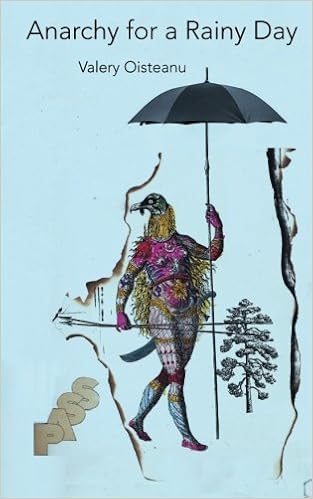
Valery Oisteanu - king/queen/jack of all dada/east village “Absurdistan” – gallops on the hobbyhorse of our blasted times; and the poems here echo the blasts. Poems point to and mock the “Unending killing cycles,” while surreal images abound and become visual realities

Image result for Valery Oisteanu, Anarchy for a Rainy Day,


Valery Oisteanu, Anarchy for a Rainy DaySpuyten Duyvil Publishing, 2015.                            


WARNING! EXPLOSIVE! KEEP AWAY FROM SAFE ACADEMIC WRITING CUBICLE OFFICES AND C.I.A. POETRY WORKSHOPS! - Charles Plymell

To read Valery Oisteanu is to enter into yourself and emerge with a vocabulary you never knew existed. To read him is to regret the wasted life you lead before you read him. - Judith Malina

Valery Oisteanu, king/queen/jack of all dada/east village “Absurdistan” – gallops on the hobbyhorse of our blasted times; and the poems here echo the blasts.  Poems point to and mock the “Unending killing cycles,” while surreal images abound and become visual realities.  Dada is reincarnated in Oisteanu’s troubling vision where “Darkness evaporates into more darkness.” Despite the hi-jinks, the ebullient sexuality, dadaistic lust, there’s a deep abiding sadness here – over deaths (see especially “Mostly Unavailable”) and universal madness: poetry “from the forbidden dreams of the Asylum.” Mid-way into the book he cries – “Freedom is still a foreign word,” well, not here, not in the voice of Valery Oisteanu.  - Barry Wallenstein

Geologists have labeled our age the Anthropocene because man has become the most powerful force on earth even as he heads towards extinction, surrounded by clichés and useless artifacts. Valery Oisteanu knows this, and like a surreal Atlas astride the rubble, he rails against the Absurd, but it is a warning sheathed in love. Anarchy for a Rainy Day is a book of poems by a romantic. Read this book, and then keep it close; it is a life preserver. -  Ron Kolm


When I first heard the title to Valery Oisteanu’s new book, I began to sing. On a rainy day with a bit of anarchy in the wings almost anything can happen and, in these poems, often does. The readiness to embrace them is all. Valery Oisteanu is ready.
From his East Village perch in Manhattan, wandering close to home or traveling far and wide – Amsterdam, Bucharest, Paris, the Belgian Shore, Sardinia, Santorini, Venice, Rome, and more, each a place where he writes -- he reveals as only he can what makes living so poignant. Balanced by an incisive sense of mortality, his pleasures, despairs, rages, and humor enliven. Here, deft portraits, incandescent trysts, and solitary somersaults captivate. Here, in his solitude or with his friends, we learn not only “How to be a poem” but how such being in the full light of day can inspire beneficence and revolt. Love, of course, superb and erotic, predominates. And it is from and to love that Oisteanu writes some of his best poems.
In “Dancing with Nudes,” dedicated to the Belgian artist, Paul Delvaux, Oisteanu tells us: “A lonely skeleton strolls into rooms of seduction.” It is a place without “bad dreams, just abandonment in ecstasy” with “Lips touching, red nipples, breasts colliding”; a place of “dream paintings, breathing sexuality into the lifeless.” In another poem, “Khatmandu Prostitute,” Oisteanu chronicles a chance meeting with the same woman in a bus station after her work has finished. No longer dressed to entice, he recalls her as she was, whispering to him: “I love anal,” as she bites his lips in “my horizontal lingam temple”; a metaphorical lever that air lifts the poem but not before we discover that “Erotic carvings on the gates are laughing silently.” “The Jazz of Sex in Flight” paints a portrait of fleshy encounters where “Flashes of toxic psychedelic light/Radiate the bed with a blue glow all night” and “Bullet dreams of incomparable pleasure/…blaze behind the magician’s eyes.” A beautiful homage to his wife, Ruth, “A Miracle in Manhattan,” celebrates their “four-decade-long stream” where “All our desires flow like a dream/A dream within a dream within a dream.”  A second, equally beautiful poem to Ruth, “”The Wilderness of Her Lips,” tell us, almost as a leitmotif to the entire collection: “The astral goddess does her nightly dance.” 
These are heady way stations through the pages of this book, fonts of desire fulfilled that pull back the curtains to other scenes where different issues raise their tensions and laughter. What happens as age increases and “It,” meaning everything related to the body, “only gets worse” – a deep, sweetly serious bass line that configures the poem “Ripened Life Goes On”? Or how, in “A Zen-Dada Cyborg is Born,” Oisteanu emblazons an “absurdly sunny October day” with an unfortunate, nearly mythic fall and broken arm right “In front of St. Marks Church” – that theater devoted to avant-garde culture. In the poem, “Italian Faces and Places,” he studies the “impatient,” “grave,” “long,” “blasé,” “distorted,” “annoyed,” “confused,” “radiant Fellini-like” faces of those he meets or those that pass before him: “faces reminiscent of Dante’s Divine Comedy,” a charged reference within a moment of perception and appreciation. In a real or remembered St. Petersburg, Oisteanu encounters Lenin’s ghost, as he charts in brief the history of the city that carried the revolutionist’s name “for almost 70 years” before returning to its original with Putin, the new proto-czar, in charge, and “Pussy Riot,” our subversive female punk group, imprisoned with “forced labor” as a result. What has changed, in terms of politics and morality, between this new century and its brutal predecessor? Turning to Oisteanu’s immediate locale, the apartment where he lives, who can forget the wry humor of “The Golden Roaches,” unwanted inhabitants of his kitchen stove, their base transformed into “an existential tombstone”. Or his poem to the 9/11 terrorist attack, Manhattan itself become an exemplar of the surrealist game, cadavre exquis, but here envisioned as an “Exquisite Corpse Remembered and Dismembered,” with Billie Holiday’s rich rendition of “Autumn in New York” in concluding, somber counterpoint.
Filtered through the book, especially in the last section, which he dedicates to poets he knew well or fleetingly, but who touched him profoundly, he writes about Gellu Naum, founder of surrealism in their native Romania, and the illimitable Ira Cohen, Judith Malina, Tuli Kupfeberg, Ted Joans, Philip Lamantia, Eugenio Granell, Sarane Alexandrian, Peter Orlovsky, Barney Rossett, Taylor Mead, Harold Norse, and others and more. Oisteanu is one of them but happily with us in the here and now creating poems and his “violin collages”, as he calls them, ten of which appear in the book, in parallel with his many public readings, and his art and literary criticism.
Rooted in Dada and surrealism, which he revivifies, ever present, ever new, sensitive to the least alteration in the cosmic weather, Anarchy for a Rainy Day sings.
Go ahead: turn the dial on your inner ear to these poems and listen. Oisteanu is conducting an ensemble of visible invisibles from "manic panic street", "The sky roaring above Souda Bay" while "cats are flying freely over. secret gardens."
His gardens, but also mine. and yours. - Allan Graubard


Reading the new book of poetry by Valery Oisteanu, Anarchy for a Rainy Day, which is written in Surrealist style, the author himself an avowed member of this school, makes me think of an earlier, critically powerful critique of this literary and artistic movement.
In T.A.Z., Hakim Bey levels a ferocious attack, saying that for one thing — and I will get to his second complaint below — no matter how liberating Surrealism was in principle, the fact that its style lent itself so easily to appropriation by Madison Avenue and other capitalist-friendly users counts heavily against it. He writes, “Advertising, using Surrealism’s colonization of the unconscious to create desire, leads to the final implosion of Surrealism.” Bey argues that any purported avant garde must be judged not only by its productions but its ability to resist coopting.
It seems a bit harsh to blame inventive artists for what use is made of their innovations once they become known to a wider public. However, there is a further implication to Bey’s invective, one which has been heard and responded to in Anarchy. That idea is: while the first generation of Surrealists can be forgiven for not knowing the future, the current crop of Surrealists must acknowledge and confront how traduced and compromised their trademark style has been. To rephrase that, the only neo-Surrealists who deserve continuing respect are those who, like Oistenau, face up to and compose in full awareness of the dangers of dilution and compromise.
Oisteanu faces this problem by providing lyrical elegies for recently deceased male and female Surrealist masters in which he emphasizes that they stayed true to principles and, directly attributable to this, they were shunned or hunted out of existence by the mainstream, dying without recognition in the shadows. The concept is that no matter how much Surrealist styles have been denigrated by marketers, true uncompromising partisans of the movement have upheld its rebel heritage and suffered the consequences.
So, Oistenau hymns Harold Norse, saying he has been left out of
A virtual museum of the Beats
They who have forgotten you so soon
Omission accomplished.
He writes of Peter Orlovsky, left to die in a mental hospital,
Insanity follows him to Creedmore’s mental ward
But on that fragile morning, the last day of May
A sunflower blossomed and began bleeding petals
lone in death, alone and still, alone and naked
Folded arms, closed lips, heart full of unwritten poems.
And he tells a poet, barely known in the U.S.,
Sarane Alexandrian, never forgotten
Forever remembered, even in total silence.
Thus, part of the book is a Surrealist obituary column, memorializing these unknown greats and refusing to participate in the culture of “
Celebs-made USA, everywhere
each product different, flavors of the day … Fame and Name-Game casualties.
By doing so, the author calls on all second generation Surrealists to remain faithful to their remarkable but all-too frequently forgotton Surrealist forbears.
However, let’s return to Bey and his even more savage complaint against this artistic movement. “Surrealism was made for advertising, for commodification. Surrealism is in fact a betrayal of desire.” Why? Because “all projects for the ‘liberation of desire’ (Surrealism) which remain enmeshed in the matrix of work can only lead to the commodification of desire.” To rephrase that, Surrealism, for all its radicalism, did not defend alienated labor. This, Bey argues, can be seen not only in the focus of the movement’s creative attacks but in its affinity for ‘the Communist Party and its Work-ist ideology.”
Certainly, Bey’s assertions are open to challenge, but let’s set aside the question of the validity of his attacks on the earlier figures and take this as a second challenge to the new generation. The demand is that the newer Surrealists once and for all break their ties to contemporary work culture. Has Oisteanu been able to do this? Speaking frankly, I would have to say that in some ways Oisteanu falls short here. As was the case with Breton, Aragon and others, his unrelenting, fiery attacks on the state’s war-mongering, imperialism and environmental degradation are not matched by equally passionate attacks on the slavery of work.
Yet, if one reads with a less literal-minded search for denunciations of the world of labor, one can see in Oisteanu an important transmutation of Surrealist forms that has a bearing on this issue. One characteristic of early French Surrealist poetry (though not of all their novels) was a tendency to abstraction. It was a curious abstraction, of course, that of common nouns doing odd, discontinuous things like the characters in Magnetic Fields, who appear only to be joined to other abstractions: “A man standing in front of a perfume shop was listening to the rolling of a distant drum. The night that was gliding over his head came to rest on his shoulders.”
This type of writing is one reason for Bey’s criticism, his feeling that Surrealism is delinked from the life of ordinary people.
It can be argued that Oisteanu moves against this tendency, not by casting off abstraction, which is central to Surrealism’s self presentation, but by linking these abstractions to daily life. Perhaps, he owes some of this shift to being influenced by the O’Hara wing of the New York School. This means, for instance, he can discuss a mundane affair like stumbling on the street and ending in the hospital. Calling himself, modestly enough, Mr. Zen-dada, he narrates:
Mr. Zen-dada, Bacchus of the East Village
Ready to take off, to fly vertically
Tripped by Peter Stuyvesant’s ghost
Nearly surreally unconscious
Suddenly something snaps, shrinks rapidly
Left humerus on a sidewalk …
Falling like an old tree into a cloud.
Mr. Zen ends up in a hospital to say he has “a metal plate in my arms” and contemplates whether he can still “compose jazzoetry – jazz-inflected poetry.” He asks, plaintively, “Will I ever play the violin-collage as I did before?”
There are still abstractions, “Bacchus,” “a tree falling into a cloud,” and so on, but they are tied into prosaic events, giving them grittiness and reality. The same could be said of poems in which Oisteanu writes of his love for his wife,
Woman and man strung on life’s path
The sound of pleasure and pain
Your breath on my lips
tongue on my nipples
and of the horrors of visiting over-touristed Sicily,
The highway is winding to the east
the scooters, the cars, the trucks
Nearly invisible in the long tunnels
Love Sicily, hate the mass tourism.
In all these poems, Oisteanu braids together the strands of documentary observation with Surrealist ebullience, making Surrealist verse more quotidian.
It’s as if Bey threw down a gauntlet to second generation Surrealists, asking them, “Can you show me a Surrealist who has not sold out?” Oisteanu points a finger at Harold Norse, Sarane Alexandrian and others. Then Bey asks, “Can you show me a Surrealist poem that will speak to every woman and man, dropping the over-reliance on abstractions?” Oisteanu sets about writing them.
Anarchy for a Rainy Day shows that, while literature does not progress, in the sense of each generation producing better writing, it is moved forward by those who, while remaining in one literary current, can dialectically redirect the stream so that it no longer carries all the old silt.

- Jim Feast


Avant-gardist, art critic, hedonist, World traveler, Valery Oisteanu’s Anarchy for a Rainy Day is a poetic celebration of bohemian life. The reader joins the poet as he journeys through Europe, Nepal, South America, consorts with sex workers, activists, memorializes artists, and enjoys a long, loving and lustful marriage to his muse.
Some of these poems seduce with their sly wit and wordplay.
“So please advise before it’s too late/How can I gauge my mental state? Also imperative that I can self medicate/” from “Letter to My Shrink”. Addressed to Sigmund Freud, who Oisteanu beautifully played in an off Broadway play, the poem resounds with a charming and urbane urgency.
A long time proponent of surrealism, the poet is also an accomplished art critic, and his language is infused with rich and unexpected resonance. “Take it from this poet in Absurdistan, New York/who wants to exchange a poem for a vagina/” from “Smoke of Radical Aggression”.
Whether he is ranting about travels in Sicily, or reminiscing about a Katmandu sexworker, Oisteanu‘s quest for liberation unifies the dozens of knock out poems that comprise the handsome volume. His own collages add a poignant visual punch to accompanying text. This is the sagacious voice of a seasoned poet, one who mourns his lost friends while keeping an eye on the chaotic and ever changing New York City that is his home.
A true romantic sentimentalist, Oisteanu memorializes cultural icons like Louise Bourgeois, Allen Ginsberg, Judith Malina, Robert Creeley, Ted Joans, my own beloved friend Janine Pomy Vega, Barney Rossett, and other creative luminaries. His haunting lines, “A sunflower blossomed and began bleeding petals” from the “Forest of Blue Glass Peter Orlovsky” are perfect homages.
I especially loved the gorgeous love poems addressed to his wife. “I have shamelessly robbed the Garden of Eden/ Stolen a goddess for special sacrifice…” from “The Wilderness of Her Lips” to “A Miracle in Manhattan” ending with “A dream within a dream within a dream.”
This is a book to savor, to read randomly, to remind yourself of how magnified moments enrich and embroider our world. Valery Oisteanu’s voice is that of a true cosmopolitan, his unique sensuality seeping into essential words and images. - Ilka Scobie


Valery Oisteanu, Lighter Than Air: Vispo Collages, Spuyten Duyvil, 2017.


A fascination with hands and the female body, a kind of natural history of sultry affairs with high heels and Rococo sugars, an insolent funny erotic weightless "expose" of just what it is that we're missing: Akhenaton riding a carousel horse, facing skeleton face, gardens with bushes of blue tuna, a bird man sings, the pleasure of wearing red gloves is contagious, a poignant tribute to "The Lunatic," a popular Yiddish play from another era that premiered up the street. ..."Forbidden Windmills," "Asymmetrical Shoe Master," "Mystical SEances in the Circus..". Valery Oisteanu's world of collage is porous, generative, iterative, erotic... He said it best: Lighter than Air... - Allan Graubard


At the hand of the poet Valery Oisteanu we find a world of event and happenstance worthy of our attention.
A catalog of all that happens. Art (the hardest calling) is not for the faint of heart. Or for the heartless. But for the person alive lusting to be heard. Collage is the hymn of the modern era from Braque and company to Schwitters and Hannah Hoch to Dizzy Gillespie to Stockhausen to Fluxus to DJ Kool Herc. Valery Oisteanu in his book Moons of Venus says:
My heart
Shines like a haunted star
These works are that star
Haunted with the wreck of history
Not a mirror on the world but the poet's hammer with which to shape it
- Fletcher Coop

Valery Oisteanu's collages are alchemical mirrors in which oneiric elements are steeped in the most delirious eroticism imaginable. Breathless as lightning, these collages are raw, uncompromising, and subversive. They summon you into a trance state in which the unexpected always triumphs over the mundane. - Bill Wolak


Valery Oisteanu is a poet, writer, and artist of the avant-garde. Born in USSR (1943) and educated in Romania. He debuted as a poet with the collection Prosthesis in 1970 (Litera Press, Bucharest). A the age of 20, he adopted Dada and Surrealism as a philosophy of art and life and a few years later English as his primary language. Immigrating to New York City in 1972, he has been writing in English for the past 43 years. He is the author of 12 books of poetry, a book of short fiction, The King of Penguins (Linear Art Press, 2000), and a book of essays, The AVANT-GODS.
Over the last 10 years he wrote art criticism for Brooklyn Rail, artnet.com, White Hot Magazine, and NY Arts. He is also a contributing writer for French, Spanish & Romanian art and literary magazines (La Page Blanche, Art.es, Viata Romaneasca, Observatorul Cultural, Artout.ro, levurelitteraire.com, etc.)
As an artist he exhibits collages and assemblages on a regular basis at galleries in New York and also creates collages as covers and illustrations for books and magazines.  
He has performed in theater and in poetry-musical collaborations with jazz artists from all over the world in sessions known as Jazzoetry.
His work has appeared in international Surrealist publications of the last four decades, including Dream Helmet (1978), What Will Be (Brumes Blondes, 2014), A Phala (Sao Paola, Brazil), The Annual (Phasm Press, 2015). Member of Poets and Writers, Inc., New York (1977-2015) Founding member of PASS (Poets and Artists Surrealist Society) (1973-2015) “It’s the End of the World As We Know It” Award (2000) (Vault Literary Society award for exceptional cutting edge artists who consistently take risks with their art). Awarded CHIVOT Order of the Chevalier of the Tower, for the dissemination of Romanian Avant-Garde in Diaspora, 2010 Recipient of the Kathy Acker Award NYC 2013 for contribution to the avant-garde in Poetry Performance.

10/12/16

Marlon L. Fick - The Nowhere Man follows the life and travels of an American novelist, Bolivar Collins, from his youth to adulthood through the later half of the 20th century, a time of war and political turmoil

Nowhere-Man
Marlon L. Fick, The Nowhere Man, Jaded Ibis Press, 2016.


The Nowhere Man follows the life and travels of an American novelist, Bolivar Collins, from his youth to adulthood through the later half of the 20th century, a time of war and political turmoil. Socially awkward and introverted, Collins looks for answers in books of philosophy, trying to understand the chaos around him and the chaos he feels. When he cannot find explanations for the mysteries of human behavior, human sexuality, love, war, etc., he attempts to apply philosophical explanations, which in turn results in a dark irony. Rapid changes in settings—from the United States, to France and Spain, then to Gabon, the Congo, and Zaire, then to Cuba, Nicaragua, and Mexico—echo Collin’s own evolution, while external forces beyond his control place him directly in the path of history: The man, who began as a bookish adolescent, is compelled to participate in the Nicaraguan Civil War, presumably as “a spy.” Caught between allegiances—the United States vs. his family, now Cuban—Collins becomes a fugitive, wanted by the FBI and the CIA.


“Marlon Fick is one of the most fluent writers in American today.” —Robert Haas

“Impressive and magnificent—a serene lyricism and narration which is both tender and passionate. Destined one day to be a classic.” —Myriam Moscona


“Marlon Fick is a writer of high energy, imagination, and intelligence. His work is for the human voice and the human ear.” —Thomas Lux


“Marlon L. Fick joins an honorable group of ex-patriot American writers—Katherine Ann Porter, Hart Crane—making the most out of the Latin Experience.” —Jonathan Holden

10/10/16

Gösta Oswald - This relatively short poetic work primarily inspired by Hieronymus Bosch’s The Haywain Triptych and Dante’s The Divine Comedy is regarded as one of the most original and challenging texts in Swedish literature

Image result for Gösta Oswald, Rondo
Gösta Oswald, Rondo


Gösta Oswald was a prodigy of the Swedish modernist scene, publishing his first collection of poetry at the age of nineteen. His tragic death in a drowning accident in 1950, when he was just twenty-four years old, cut short a formidable literary career in the making. By that time the young man had published only one more text, the novel En privatmans vedermödor (A Private Man’s Hardships). The rest of his literary works  came out posthumously, the most notable of those being his highly experimental novel Rondo that was still unfinished at the time of Oswald’s death. This relatively short poetic work primarily inspired by Hieronymus Bosch’s The Haywain Triptych and Dante’s The Divine Comedy is regarded as one of the most original and challenging texts in Swedish literature.
In this intriguing piece, unfortunately available only in Swedish, writer and critic Carl Johan Malmberg mentions Rondo in the same breath as In Search of Lost Time, Finnegans Wake and Bottom’s Dream. This does not mean, of course, that the novel by the precocious Swedish talent is on a par with these heavy literary monuments, but rather that Oswald’s ambition of creating a work that would be marked by bold stylistic experiments with language as well as over-saturated with cultural and literary references placed him within the tradition of ground-breaking encyclopedic narratives represented by Proust, Joyce, and Arno Schmidt.
the_pedlar_closed_state_of_the_hay_wain_by_hieronymus_bosch
Hieronymus Bosch. The Pedlar, closed state of The Hay Wain.


Rondo lacks conventional plot. It is a poetic tapestry woven from a variety of motifs hearkening back both to the old masters such as Plutarch, Dante, Rabelais and the more recent ones: Dostoevsky, Hölderin, T. S. Eliot, Joyce. Structurally, Oswald’s text follows the arrangement of the scenes in The Hay Wain, as each part of the novel corresponds to a certain panel in the triptych. The most prominent theme of the novel is that of a metaphysical search. The main character Aran, named so after the group of Irish islands, is a wanderer just like the dog-deterring pedlar depicted on the closed shutters of Bosch’s triptych. The hostile environment in which the protagonist of Rondo wends his way, looking for a way out, is represented by the City, an allegorical dimension of suffering, sin, and death. The doomed City is counterpoised by Inis, a Beatrice-like character, who is the personification of love and beauty. The novel explores the beautiful and the grotesque in equal measure. It is written in gorgeous musical prose verging on baroque poetry and is replete with striking dream-like imagery.
Itself a product of intense artistic inspiration, Rondo, in its turn, has inspired Swedish composer Bo Nilsson to compose an orchestral tetralogy called Brief an Gösta Oswald (Letter to Gösta Oswald). The tetralogy consists of an overture and three cantatas based on the text of the novel. If you would like to learn more about this creative synthesis, there is an illuminating article by Anders Nilsson available online.
Gösta Oswald’s unfinished novel has not been translated into any language yet, which is understandable, given the fact that the author is virtually unknown outside Sweden. An important landmark of Swedish literary modernism, Rondo has to find its way to a wider readership. Publishers of literature in translation, it’s your chance. - theuntranslated.wordpress.com/2016/10/07/the-great-untranslated-rondo-by-gosta-oswald/


Tillgängliga verk:
faksimil   pdf   Christinalegender
faksimil   pdf   En privatmans vedermödor
faksimil   pdf   Rondo
faksimil   pdf   Skrifter I
faksimil   pdf   Skrifter II
litteraturbanken.se/#!/forfattare/OswaldG/titlar


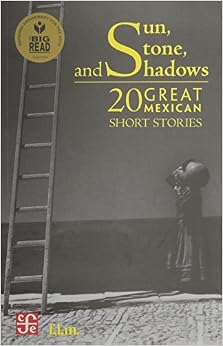
Sun, Stone and Shadows: 20 Great Mexican Short Stories

Image result for Sun, Stone and Shadows: 20 Great Mexican Short Stories
Sun, Stone and Shadows: 20 Great Mexican Short Stories, Ed. by Jorge F. Hernandez, Fondo de Cultura Economica, 2008.


Literature is perhaps Mexico's best landscape, encompassing both past and present, revealing the multiple colors of its geographic expanse and the shapes of its imagination and memory. The Short story provides our best and quickest view - or our most faithful mirror- of all things Mexican. This anthology presents a collection of twenty tales of extraordinary quality, written by the finest Mexican authors. - Josefina Vazquez Mota


The Big Read is the largest literature program in the history of the U.S. government. Created by the National Endowment for the Arts, in partnership with the Institute of Museum and Library Services and in cooperation with Arts Midwest, the Big Read is designed to revitalize the role of reading in American Culture and promote the transformative power of literature. Sun, Stone and Shadows: 20 Great Mexican Short Stories has the distinction of being the first book published expressly for The Big Read Program. Its stories, selected with U.S. readers in mind, represent a remarkable array of Mexico's rich and vibrant literary history. Sun, Stone and Shadows is a catalyst for cultural understanding and conversation between the people of Mexico and the United States. - Dana Gioia


It can be tricky reviewing an anthology. Especially a general anthology that strives to introduce the literature of a particular country or region, since in an attempt to be all-encompassing, these anthologies can seem too diffuse, without anything linking the included pieces.
When I first picked up Sun, Stone, and Shadows I was pleasantly surprised by two things: the quality of the authors included (more below) and the way these stories were grouped into five distinct sections. These sections—“The Fantastic Unreal,” “Scenes from Mexican Reality,” “The Tangible Past,” “The Unexpected in Everyday, Urban Life,” and “Intimate Imagination”—are good guideposts for readers and useful for introducing some of the overarching themes and styles found in Mexican literature.
One of the other things that’s interesting about this book is that it’s published by the Fondo de Cultura Economica in collaboration with the National Endowment for the Arts Big Read program and was also published in a Spanish version. As a result, this anthology will be the basis of two Big Read programs in the U.S. (both in Texas) and two programs in Mexico (including one in Ciudad Juarez, which, after reading 2666 totally freaks me out). According to the NEA press release this is in the tradition of the Big Read Russia and Big Read Egypt. Hopefully this aspect of the Big Read will continue to expand, both in terms of the countries involved, and in supporting Big Read events around the country that are based around these international titles.
In terms of the actual anthology, the authors included are a hit-list of some of the biggest names of Mexican literature: Octavio Paz, Carlos Fuentes, Salvador Elizondo, Juan Rulfo, Rosario Castellanos, Jorge Ibarguengoitia, Juan Garcia Ponce, Sergio Pitol, and Jose Emilio Pacheco, in addition to eleven more. It would’ve been nice to include some younger Mexican writers, but the editors decided to restrict this to writers born between 1887 and 1939, providing a decent range of material that fits nicely with the overall scope of the Big Read.
As someone who reads a lot of Latin American literature, I was already familiar with the work of most of these authors, although on several occasions, the stories included in this anthology were new to me. What I particularly appreciated about this book was that authors like Ibarguengoitia (who was published in that Avon mass market series of Latin American authors that came out in the 80s) and Elizondo (whose bizarre, yet captivating Farabeuf came out from Garland Press in the mid-eighties) are included here. Both are somewhat “risky” authors, whose work is pretty unconventional.
For instance, the Elizondo story included is “History According to Pao Cheng,” which is a metafictional piece in the vein of Cortazar’s “Continuity of Parks.” In “Pao Cheng,” a philosopher is sitting by the edge of a stream contemplating the flow of history and imagining life to come for several millennia, until he focuses on a particular moment, a particular city, and a particular man.
“The man is writing a story,” he said to himself. Pao Cheng read once again the words written on the pages. “The story’s title is History According to Pao Cheng, and it’s about a philosopher of ancient times who one day sat at the edge of a stream and began to ponder . . . Then I am but a memory of this man, and if this man should forget me, I shall die! . . .”
Another of my personal favorites is the absurd story “The Switchman” by Juan Jose Arreola—an author I wasn’t previously aware of but whom Jorge Luis Borges said “could have been born anywhere, and in any century.” “The Switchman” is about a strange train station and a man’s attempt to get to his destination.
“This part of the world is famous for its railroads, as you know. Up to now, we haven’t been able to work out all the details, but we’ve done wonders with the printing of timetables and the promotion of tickets. The railroad guidebooks criss-cross every populated area of the country; tickets are being sold to even the most insignificant and out-of-the-way whistle-stops. All we have to do now is to make the trains themselves conform to the indicated schedules—actually get the trains to their stations. That’s what people hereabouts are hoping for; meanwhile, we put up with the irregularities of the service, and our patriotism keeps us from any open display of annoyance.”
Overall, this is a solid anthology that will fit nicely into the Big Read program. I’m not sure if this book will be stocked in bookstores (hopefully it will be, but I’m not sure how FCE is distributed in the U.S.), but it is available through Amazon, and with a list price of $10, it’s a great bargain.
- Chad W. Post


Contents:
Introduction, Jorge Hernandez
The Fantastic Unreal
Scenes from Mexican Reality
The Tangible Past
The Unexpected in Everyday, Urban Life
Intimate Imagination

Pablo Ruiz - What myths have been thought up to explain the transition from "nothing" to a work of art? And when did the "account of composition" turn into a literary genre of its own?

Image result for Pablo Ruiz, Four Cold Chapters on the Possibility of Literature: (Leading Mostly to Borges and Oulipo),
Pablo Ruiz, Four Cold Chapters on the Possibility of Literature: (Leading Mostly to Borges and Oulipo), Dalkey Archive Press, 2014.


What can be said about the silence that precedes a poem or a story? What myths have been thought up to explain the transition from "nothing" to a work of art? And when did the "account of composition" turn into a literary genre of its own? These questions are the heart of Pablo M. Ruiz's excursion into the center(s) of literary creativity. Filled with paradoxes and parables, "Four Cold Chapters" takes in Borges, Perec, and Felisberto Hernandez, as well as several suggested but politely avoided doctoral dissertations, on its journey through the universe of writing (and writing about writing).


Pablo M. Ruiz is Assistant Professor of Latin American Literature at Tufts University. His literary essays, translations and travel pieces have been published in Variaciones Borges, Formules, Yzur, La Habana Elegante, and Hermano Cerdo.

10/6/16

Carlos Fonseca Suárez - Loosely based on the fascinating life story of the eccentric mathematician Alexander Grothendieck, Colonel Lágrimas is a world-spanning tour de force of history, politics, literature, mathematics, and philosophy that wears its learning lightly, forming an appealingly human story of the forces that have created the modern world


Colonel Lagrimas
Carlos Fonseca Suárez, Colonel Lágrimas, Trans. by Megan McDowell, Restless Books, 2016.               


excerpt
excerpt 2


A dazzling debut about the demented final project of a brilliant mathematician, recalling the best of Bolaño, Borges, and Calvino, Coronel Lágrimas is an allegory of our hyper-informed age and of the clash between European and Latin American history.Holed away in a cabin in the Pyrenees, the world-famous and enigmatic mathematician Alexander Grothendieck is working furiously on a final project. But what exactly is this monumental, mysterious undertaking? Why did this man, one of the greatest geniuses of the century, a politically militant man himself, suddenly decide to abandon politics and society altogether? As the reader pursues the answer to these questions, two layered narratives emerge. One is a series of unforgettable characters that have transfixed the mathematician’s imagination: Chana Abramov, a woman obsessed with painting the same Mexican volcano a thousand times, Vladimir Vostokov, an anarchist in battle with technological modernity, and Maximiliano Cienfuegos, a simple man who will nonetheless become the symbol for the Colonel’s as well as Europe’s restless political conscience. The other is the protagonist’s life story: a picaresque journey that traverses the 20th century: from the Russia of the October Revolution to the Mexico of the anarchic 1920s, from the Spanish Civil War to Vietnam, all the way back to France and from there to the Caribbean islands. Out of this Borgesian web emerges a tragicomic allegory for the political arch of the past century, one that began addicted to political action and ended up hooked on big data.
Loosely based on the fascinating life story of the eccentric mathematician Alexander Grothendieck, Colonel Lágrimas is a world-spanning tour de force of history, politics, literature, mathematics, and philosophy that wears its learning lightly, forming an appealingly human story of the forces that have created the modern world.


No one writes to the Colonel, and so the Colonel must write for himself: debut novelist Fonseca looks to the golden age of Latin American literature while pondering the mysteries of mathematics.
More to the point, Fonseca, who teaches at Cambridge, limns the mysterious life of the enigmatic mathematician Alexander Grothendieck, who, stateless, settled in the foothills of the French Pyrenees and filled thousands of pages with formulas, jottings, and diary entries. In Fonseca’s hands, this untidy, seemingly random archive becomes something of an alternative history of “an imploding century,” a time in which our erstwhile mathematician, a “monastic aristocrat” who answers to Colonel for reasons unknown, has seen manifold terrors, from the Spanish Civil War to Vietnam. The Colonel, for whom the adjectives mount in variety and number as the story progresses, nurses memories and perhaps a few hallucinations. Though the narrative centers closely on him, he is not alone: among other characters, there is an elusive refugee named Chana Abramov, whose monomania is to paint landscape after landscape of a volcano that she once populated with humans, then erased them one by one. Then there is pen pal Maximiliano Cienfuegos, who, having once played a game of chess with the Colonel, now receives packages from him for reasons unknown; “perhaps the colonel believed he heard aristocratic echoes in Maximiliano’s name,” writes Fonseca, “the irony of a name that played with a history, now almost forgotten, of impossible emperors and transatlantic projects.” Readers without groundings in Latin America will know little of that history, which, Fonseca’s novel insists, is fully part of the larger history of the world. Though the novel nods mostly to García Márquez, Fonseca plays with the possibilities of hypertext raised by Julio Cortázar, and there are hints of Bolaño and perhaps even of younger contemporary Daniel Galera (the latter in the Colonel’s diagnosis of prosopagnosia).
Sometimes precious and perhaps a little too short to contain all the author’s ambitions. Still, a lively, smart study of a decidedly offbeat character. - Kirkus Reviews


The Colonel of the title is aging and, from things said in passing, this book encompasses what could well be his last day and his final project, the aforementioned biographical trilogy of historical female alchemists. Apparently obsessed with a single mathematical formula which is repeated throughout the book, the Colonel has turned his back on the world, preferring to write about alchemy in the stillness of his Pyrenean home/prison/hermitage. And, it appears that he’s never had a military background, but has conferred the title of ‘colonel’ on himself.
As the book progresses, we learn a great deal about his past, including his refusal to speak Russian any longer, preferring Spanish and French, and the fact that he has prosopagnosia, meaning he is unable to recognise people. Many tantalising hints are placed through the book, but few are substantiated, almost as if we’re sharing the decline of mental faculties of the Colonel. We are also placed in the position of somehow spying on the Colonel as he goes about his day, able to open drawers and examine various writings and photos we find as the book progresses.
I found this a difficult book in that I kept waiting for something to happen — when I reached the end, it was almost a sense of ‘is that it?’ mixed with surprise that it was over. Not that I wanted it to continue, as frustration was making me impatient with the character and the author. I can’t say I hated it, I just was hoping for more. Sadly for me, it felt a bit like one of those thought exercises that got carried away and oops, it’s a novel.- Dean Fetzer


Carlos Fonseca’s biography is marked not only by constant territorial displacements — he was born in Costa Rica in 1987, grew up in Puerto Rico, did his studies in the United States and now lives in London — but also by the multiple literary traditions that interest him. Despite his young age, he has already accumulated a vast series of influences, ranging all the way from Latin American to European authors without eluding the United States. Reading his works, one feels the presence of voices as disparate as those of W.G. Sebald, Alexander Von Humboldt, Simón Bolívar and Roberto Bolaño, among others. Fonseca is, without a doubt, a cosmopolitan offspring of cultural globalization as well as an attentive inheritor of both literary and cultural history.
In 2015, the prestigious Spanish publisher Anagrama published his debut novel Coronel Lágrimas, a novel that was praised both by the Argentine writer Ricardo Piglia as well as by the legendary editor Jorge Herralde for its singularity, experimentation, intrigue and elegance. It couldn’t have been better described. Lágrimas is a novel inspired by the life of stateless mathematician and hermit Alexander Grothendieck. Through an attentive and rigorous attention to detail, Fonseca is able to construct a collage where the mathematician’s life finds its ultimate meaning amidst a series of series of historical, metaphysical and poetic fragments that end up giving shape to a fascinating literary artifact that shines like an eclectic mosaic.
After its extraordinary critical reception in Latin America and Spain, unusual for a debut novel, Fonseca has established himself as one of the most promising and interesting new voices of his generation.
In a typical cloudy afternoon in London — with Bloomsbury’s literary landscape as backdrop — I sat to talk with the author about the publication of the English translation of his novel, Colonel Lágrimas, which is out today from Brooklyn-based publisher Restless Books this coming October.
Tomás Peters....  read the interview


Colonel Lágrimas is a close-up of the eighty-three-year-old Lágrimas, writing away on an historical work ("an autobiography by means of a megalomaniacal catalog of other people's lives") in his Pyrenean retreat as death approaches. He's not an actual Colonel, but arguably the label fits him. (Or not: the militaristic connotations surely drown out anything else about it.) And:
The Colonel used to be mathematician, but no longer. The Colonel saw the war from the battlefield, but he was unarmed. The Colonel was famous, but he decided to stop being so.
       (The Colonel is, in fact, closely based on the mathematician Alexander Grothendieck (1928-2014), who abandoned mathematics and retreated to the Pyrenees. However, while Fonseca uses aspects of Grothendieck's life as the basis for his character, he also changes many features and details to fit his novel-vision.)
       The narrative voice in Colonel Lágrimas is essentially the unusual first person plural, though in fact the otherwise omniscient narrator only occasionally demands of readers this forced collusion; still, already in the second sentence readers are pulled in: "We have to come near". The reader is not allowed to pretend to be a neutral observer. Appropriately, perhaps: life-accounts, even as they are based on facts, are subjective. But the reader also doesn't have any say in how or where things are headed, even as the narrator pretends we're all in this together.
       The novel's early scenes also focus on the Colonel himself at work at biography -- a volume of: 'Portraits of Three Alchemical Divas' -- and allows some consideration of the nature of historical re-creation on the page. The work is a: "project of other people's lives, a kind of autobiographical amnesia" -- while the work in which the readers are participating (as readers, and as part of the 'we' of the text itself) is an anti-text, against the character's wishes. Because as far as the Colonel goes, he just : "wants to be forgotten"; he wants: "to erase all legacy".
       The narrator certainly won't let him: Colonel Lágrimas is a full life-examination, and while the Colonel is seen as an: "anachronistic child of his age" he is nevertheless witness and participant, indeed representative, in many ways:
He was there -- in the Mexico of the twenties, in the Spanish Civil War, in the Second World War, at Woodstock and Vietnam -- but always a little before or after, a little out of time and place.
       The account is an attempt to: "get, narratively speaking, from doodle to equation". To capture this unusual figure in a more exact form. (Though one has to wonder -- not that the narrator lets us ... -- whether an equation is in any way a better rendering than a doodle might be .....)
       Among the Colonel's defining features is his statelessness (in an age of the nation-state), allowing him also to be seen as "a true vagabond", condemned "to a kind of eternal pilgrimage" (even though he seems to have settled down fairly happily as a hermit in the Pyrenees for quite a while now ...).
       Fonseca has some nice ideas here, and the Colonel is in many ways a fascinating figure, but Fonseca's methods and approach aren't entirely successful. He's prone to some excess in expression, which works in part but, given its extent, can get tiresome too:
Is it nostalgia the colonel is feeling? Only if by nostalgia one means the presentiment and anxiety that the phantasmagorias of the past, projected onto the wall of the future, are stalking one's steps. 
       Shifting between the present -- the day, and how the octogenarian spends it -- and the Colonel's varied pasts, as well as his limited communications with a chosen one, Maximiliano Cienfuegos, with whom he shares a sometime-project, Les Vertiges du Siècle ('Vertigos of the Century', Maximiliano suggests), Fonseca builds up an evocative character-portrait. Yet it can feel like too much is being asked of the Colonel -- or what he (can) stand for, representative of so much of the past century, and that not enough room is made for the scope of his retreat.
       Though often intriguing, Colonel Lágrimas is only partially successful -- and often weighed down by the writing style (and the involuntary coöpting of the reader in(to) the narrative). - M.A.Orthofer


A unified theory: that was the dream of Cambridge mathematician Srinivasa Ramanujan. A correspondence between the marks on paper and the structure of the skies, a single formula that could encapsulate the universe. Ramanujan wasn’t successful in finding his theory of everything, but his ideal remains a covert presence and source of strength for many who have embraced a life in the sciences. But what happens when that ideal is applied to history? Is history a science too? Is the attempt to create a blueprint misguided if we’re talking about human endeavor? Or can one look for a pattern there as well? If so, how should one go about trying to find it? Is it best to remove oneself from the world to ensure peace of mind and the tranquility necessary for tracing larger arcs? Or should one try to be as actively engaged in daily life as possible? Do the aims of history writing undergo development, in the same way that ideas of modernism marked a literary shift, partly in response to scientific discoveries? And is there some shining pattern or arch-truth behind these changes? Or is history just an infinite parade of possible anecdotes to arrange, catalogue, exhibit, assemble and frame in a Duchampian exercise, like a box of old film reels? Can the historian in his observational role play some part in affairs, creating change through his attempt to understand? Or is this withdrawal into the imagination folly?
This flood of questions lies behind Carlos Fonseca’s intelligent and elegantly written novel Colonel Lágrimas, translated from the Spanish by Megan McDowell (Restless Books, 2016). The book takes the form of the notes of Alexander Grothendieck, a mathematician who retreats to a remote location in the Pyrenees and embarks on a tragicomic project to discover an allegory for the political trajectory of history. Dissolving into his story, transforming into an enigmatic presence that comes to seem like time itself, Grothendieck refers to his own persona throughout as the ‘colonel’, possibly due to the efficient, quasi-military way he goes about his writing, possibly because of how he views the past as a battlefield of meanings. Fueled by alcohol and coffee — after all, ours has been a ‘caffeinated age’ — he sets about his work.
Left alone for hours with his texts, the colonel jumps from one volume to the next, ‘making impossible connections between impossible continents and eras’. Vertigos of the Century, his masterpiece in progress, is intended to be a blueprint of himself and all the events that have occurred in the last hundred years. He is obsessed by the beauty of brevity, the elegance of simplicity, and he wants to fit everything that has happened into one equation. Abstract symbols become a way to make sense from a mess of meaningless facts. And so he takes notes for an ‘autobiography of others that gradually extends over everything, threatening to become infinite’. Jumping from one idea to the next, his prose fragmented and structurally demented, he writes and writes, yet nothing actually happens, or everything.
Is he a genius or is he cracked? In the cover image, the colonel’s head explodes in a scrawl of black ink, as he holds an enormous pencil to mark out his lines on graph paper. The image may just have been a publisher’s choice, but the colonel doesn’t really come off as deranged — just an exaggeration of the tendencies many introverted or solitary people exhibit. Obsession with some big idea combines with close attention to detail and a wandering mind prone to distraction, whether the source be drawings in the shape of Cuban 8 loops or a Jacques Brell chanson.
*
There are dangers to an existence so entirely oriented toward thought, of course. Seen from the outside, the author is a man who is eighty-three years old, schizophrenic, in dialogue with the voices in his head. In an absolute ‘loneliness populated by ghosts’, he analyses and reanalyses the same events from infinite angles. Guilt is a major theme, and to some extent his project is also ‘the equation of his guilt’. His life is the story of the things he didn’t do but should have done, and he alludes to an old lover named Cayetana Buamante. ‘Was it so difficult to take a plane, load up the chalkboards and some chalk, and go and build the revolution in America, that continent that saw his birth? So difficult to follow the footsteps of that woman he loved and of whom he now only has some photographs without memories left, a few lifeless equations?’ Considered this way, it seems easy to criticize excess passiveness as a negative historical position, and glamorize action and living in the present moment.
‘Not understanding is perhaps his way of life,’ the colonel writes. ‘This same man who, as a child, would distract himself from hunger by untangling invisible knots, this man whose passion gets tangled up among doodles and equations, knows full well there is a beauty that consists of allowing oneself to be caught up in life and following it to its final consequences.’ And so, battling amnesia, he sets about trying ‘to codify life in small postcards, build an encyclopedic Babel for his cracked memory’ and begin to reconstruct his past. The reiterated question becomes that of the relationship between mind and action, which is both a historian-actor problem and an observer-participant problem. Do one’s ‘public persona’ and social activities matter, or is what matters the life of the mind?
When the colonel is photographed, there’s an artificial quality to it, and he ‘seems to assume the posture of a dandy posing for the posterity of a futuristic camera.’ What is the line between truth and the public appearance of truth? And at what point do impressions cease to matter and give way to the story told about them afterward, reducing people to their appearances? At one point the colonel writes a postcard to his character Maximiliano:
You know, Maximiliano, that this Ronald Reagan, man of a thousand facets and a dapper walk, illustrious president of the United States, had the most interesting job before he found success as an actor: he was an announcer for American football games. The strange thing, the magnificent thing, Maximilianoand here is the point of this anecdoteis that this future president didn’t watch what he was narrating: he simply received bits of information, strung like rosary beads, whose whole he never saw, loose bits of information about a spectacle he didn’t see, but whose tone he imagined in a kind of blind broadcasting. Our project is a bit like that. Broadcasting for an age without witnesses, a kind of blind narration of this dance of crazies. So, learn to tell without seeing.
An obvious displacement exists everywhere, between mind and behavior, event and interpretation, fact and memory. A constant slight sense of slippage suggests the colonel has not quite been in the right place at the right time. ‘At times we feel that Vertigos of the Century is a kind of blueprint of the colonel’s true heroic attempts,’ writes the narrator. ‘At times we feel that our hero arrived late to the epic of his age. He was there — in the Mexico of the twenties, in the Spanish Civil War, in the Second World War, at Woodstock and Vietnam — but always a little before or a little after, a little out of time and place.’
*
Although he is the only character, in a sense the colonel is still in good company. He imagines a cast of other beings, his ‘divas’. These include a female artist named Chana Abramov, an anarchist named Vladimir Vostokov battling technological modernity, and a man named Maximiliano Cienfuegos (recalling the monarch of the Second Mexican Empire Maximilian I and the Cuban revolutionary Camilo Cienfuegos) who gets involved in revolutionary political activity. For the colonel, reason is not the opposite of imagination; it is what gives fuel to his invented images. His ‘great work’ is mirrored in the minor endeavors of various characters, such as Maximiliano’s ‘Diatribe Against Useful Efforts: A Thesis Against Work in the Practical Age’, critiquing useful work. The colonel himself maintaining pages of notes that link seemingly disparate concepts, such as ‘an entry about tightropes and history, about risks and politics’.
If a grenade is thrown, it will only ever be symbolic. Anecdotes of retreat transform into anecdotes of obsession, as in Chana’s obsessive and repetitive painting of ‘the same landscape of a volcano that little by little, with the fading of memory, became simpler and simpler, less figurative and more abstract, and that went from being the recognizable volcano of her Mexican years to a collection of sparse green dots on a terribly white canvas, in a kind of catastrophe of the image from which only the color was salvaged in a posthumous ruin’. Reading is a way to remain silent, and here silence is preferred over action. ‘One must carry entropy to the edge of the possible, play with absolute equilibrium, and only then finally act: entering the panorama with a totalizing gesture,’ writes the colonel. ‘They are wrong, those who believe that a man who speaks is more worthy than the one who stays silent. It is a simple matter of not really doing anything, of concentrating one’s energies for a future moment in which the being is fully expressed.’
The spiraling involutions of the colonel’s thoughts are drawn with great complexity, as well as sympathy. Action is difficult, but so is thinking, and mental life is seen to be very rich. The colonel finds delight in unexpected and complex new forms, such as the ‘pleasure of bewilderment’ and ‘transverse pleasures’, which connect elements across time. The distancing method is appropriate for Fonseca’s mission to transcend local references and do something other than simply describe reality. The colonel wants to think in a way that isn’t limited to a single place or even time, as the small lives of humans are part of much bigger processes: ‘The real work happens on a different plane and a different scale. Take genetics: Man takes pains to sculpt his health, his face, his body on a human scale, though he has a legacy from long before chiseled by millions of years… The true Copernican Revolution would consist of our realizing that human ability can do little against nature… I’ve said it to Maximiliano: life is not made to the scale of man, but rather to the scale of these white mountains.’
The concerns mirror those of their young author. Fonseca, who published the original novel in Spanish last year with Anagrama, was born in Puerto Rico, grew up in Costa Rica, studied at Princeton and is now a Postdoctoral Fellow at the University of Cambridge. The alternate ambition and futility of the mathematician’s ‘project’ at times resembles a doctoral thesis. Fonseca is intelligent and well read, and his book very much reflects the modern(-ist) condition of a jet-lagged, on-the-go, post-national and post-temporal world, in which anyone could theoretically travel anywhere, even if they would prefer to stay in one place and think deeply into a single subject. ;Intelligence’, always been a nebulous concept, here comes to mean the ability to forge links or connect disparate concepts into a narrative.
Displacement is the situation of the writer, who tends to note or interpret rather than act, and this story of a man who isolates himself on a mountain with his memories is an analogue to the trajectory of not just 20th century history, but also 20th century literature. The lines between ‘Latin American’ and ‘non-Latin American’ literature have broken down in meaningful ways, and the question of whether identity based on geographical location even makes sense is a serious one. Writers like Fonseca, living abroad and writing with influences from US, UK and French literature, clearly have a sense of identity that goes beyond the place where they were born. This can often push a text toward abstraction and wordplay, making the result a fascinating linguistic Molotov cocktail, but also generate a literary self-anxiety, a concern with being an observer outside of events.
*
Observation can be fun, in some circumstances. Two of the most fascinating and magical childhood toys are the stereogram (usually called the ‘Magic Eye’) and the kaleidoscope. Both play with perception, with a key difference. With the stereogram, you have to stare at a repeating field of patterns until, in a brilliant moment of intuition, a three-dimensional shape reveals itself to you. With the kaleidoscope, on the other hand, you look into the eyehole of a mirror-filled cylinder, which you turn. Images are likewise revealed, but in a succession, one after the other, never repeating. These two toys might be used to compare the trajectories of Fonseca and his teacher, the Argentine writer Ricardo Piglia, author of Respiración artificial, Prisión perpetua, Plata quemada, La ciudad ausente and other classics of contemporary literature.
Last year Fonseca wrote an essay on Piglia’s Antología personal for the Mexican magazine Horizontal, arguuing that for Piglia, reading is a utopic activity and political gesture. The world offers up a certain image, and reading gives it a new form. Everything that occurs seems random, but is really a code, and reading is a form of cryptonomics, a way of deciphering it. Piglia, he notes, compares his own work to a stereogram, which can reveal an unknown dimension. Through literature, the world is seen with not an innocent but a playful and mischievous eye, and this dimension is potentially political, as ‘seeing’ differently can disrupt the causal logic of pragmatic capitalism and draw out a sense different from common sense.
Piglia’s work in some sense responds to the challenge of social realism, with its demand that literature reflect reality. His writing argued just the opposite, that literature should operate on reality. A recurring image in his work is his personal rewriting of Borges’ Aleph, in the project of ‘a photographer who from his house in the neighborhood of Flores, dedicates his days to imagining an impossible project: a replica so exact of the city of Buenos Aires that, far from being the mere representation of urban life, it becomes its secret cause’. The miniature world seeks to alter the real world; the stereogrammed image can alter reality.
The opposition between social realism and metafiction was a real one when Piglia began writing. Now, though, it seems the literary landscape of even what we call ‘metafiction’ has segmented, with the line between fiction and non-fiction breaking down. Some writers pursue metafiction by making their own lives into essays with an unstable narrator or altered details, drawing on but subverting the realist approach of using real life as the material for fiction. Fonseca takes the opposite tack, still working within metafiction but drawing from the Piglia (and Borges)-inspired position that literature can alter life, even if this position has by now also become self-conscious and uneasy with itself.
What happens when life-inspired fiction goes on to alter life, for better or worse? A pseudonym or altered version of oneself is no longer avant-garde or scandalous, and is not necessarily an angled way into a single true identity, but the creation of an entirely different possible self. Without the belief the image produced by playful new self-creations will lead to a definitive image, the stereogram can become a kaleidoscope. ‘Verbal kaleidoscope’ is a phrase found in Piglia’s blurb on the back of Fonseca’s book. Like all quasi-marketing material, this image is not perhaps meant to be read with undue seriousness. But it offers a way into understanding how Fonseca departs from his teacher, as well as the challenge faced by a new generation.
While a stereogram is a way of offering a perspective, at least it retains a certain solidity, a single solution. A kaleidoscope, on the other hand, is infinitely unreliable. Words turn ever inward, yet the meaning they seek remains forever elusive. Will the colonel’s “divas” help him discover the one true formula? Or will these identities simply proliferate meaninglessly? If a faith in political commitment (or something else) is missing, what ‘Magic Eye’ image can one hope will emerge? This is also a question for Fonseca and others — at what point does a multiplication of anecdotes transform into the unified vision of a book? Does this have to do with the sequencing and feedback loops of how it is assembled? I remember something Gabriel Jospovici said in an interview once, talking about Infinity, The Story of a Moment: ‘I at any rate dream of making a work that is like some complicated toy you can dismantle and put together again, and that is always not just more than the sum of its parts, but in a different dimension.’
*
Whether out of the necessity of his position living abroad or his personality, Fonseca has turned to this particular way of writing, and in doing so is discovering a new strangeness and complexity to history. Colonel Lágrimas suggests that perhaps there is a way to understand history that distances itself from direct representation of the past to better understand it, capturing how memory and imagination saturate the texture of the historical fabric in complicated ways.
Fonseca’s Cambridge PhD dissertation, ‘States of Nature: Catastrophe, History and the Reconstruction of Spanish America’, explored the emergence of catastrophic representations of history within the transatlantic historiography of the so-called ‘Age of Revolutions’ which marked the collapse of the Spanish Empire, as well as the subsequent foundation of the Latin American nation-states. One might similarly think of the behavior of a kaleidoscope as the behavior of a disaster. One image becomes another, and then another, and then another, unpredictably. There is no state of nature, only infinite change. In this situation, words become even more important, for as in situations of unstable reality, the most convincing idea wins and shapes the reality around it. In the phrase of J L Austin (an Oxford man), the question becomes ‘how to do things with words’, how to use language to shape actions in the world. Literature doesn’t just reflect reality, but can operate on it in indirect but real ways.
At some point we get a glimpse of the colonel’s shelf: a Mexican translation of A Thousand and One Nights, the Islamic eschatology of Kitab-al-Miraj, Shakespeare’s Tempest, Cicero’s De Inventione, Quintiliano’s Institutio Oratorio, Mao Zedong, Simon Bolívar, Joris-Karl Huysman’s À rebours, an edition of Tristam Shandy, and Flaubert’s Bouvard and Pécuchet are all there, among others. These influences inform Fonseca’s book, which in various places also seems his personal homage to other writers, from Thomas Bernhard (Correction), to Gabriel García Márquez (No One Writes to the Colonel), to the lepidopterist Vladimir Nabokov (there’s a description of the colonel in short pants in the middle of a Swiss river, holding a butterfly net to catch specimens for arrangement in his private collection). There’s a dark comic element too, along the lines of some works by António Lobo Antunes, or Joaquim Maria Machado de Assis in Posthumous Memoirs of Bras Cubas.
Colonel Lágrimas forms part of this line of works that turns to non-chronological, non-systematic fragmentation to transcend local references and anthropological approaches, and incorporates the complexities of the imagination. The colonel isn’t just an antiquarian, but a historian in a new and full sense. At the beginning of the 21st century, as we attempt to understand our past and present in an increasingly technological age, the portrayal of his confusions seems illuminating.
Here we reach a final quandary. The more beautiful the telling, the more likely a story will be received as true. Truth and aesthetics, the question of whether a theory is accepted because it proves something real or because it has a certain allure, threaten to become synonyms throughout the project. Fact and fiction are intertwined, so that history becomes a myth, a cipher, a colorful geode. In the middle of the Amazon jungle in 1824, the colonel notes, Johann Moritz Rugendas picks a rock off the ground. In it he sees ‘the strata of a past time, history turned pure geometry, and thinks: it was with this rock that Cain killed Abel’.
The distillation of various ingredients into a single potion of meaning and beauty may sound like magic, and there is a sort of alchemy at work here. Not only does Grothendieck think of his work as a charm or amulet, an enchantment, he literally turns to magical explanations in his efforts to understand history, realizing historiography is simply another kind of magic. His various works of reference include the Spiegel der Kunst und Natur (Mirror of Art and Nature), written by Stephan Michelspacher in 1614, and the Natural System of Colours, written by Mary Gartside in 1766, outlining a theory that ‘construes the color palette in a way that never ceases to seem magical’.
This magic can mean a sense of wonder, a replacement of certainty with stardust, a questioning of linear chronology, a disintegration of time into rearrangeable quantum units. Reading Fonseca, and writers like him, we find ourselves in a world that is not our familiar old sphere, but the y = 1/x equation of a hyperbola, as in Christopher Priest’s novel The Inverted World. No simple narrative is offered to us. But the kaleidoscopic proliferation of visions investigates all the ways the intellect can get tied up in silk knots, while eluding the merely erudite. Colonel Lágrimas is a book you can read multiple times, and each time discover new meanings, new rays of interpretation radiating from the anecdotes. The seductive danger of such a tale is that the reader too is caught up in trying to assess and decipher the damage.

The formula
(after Carlos Fonseca)

Bivouacked in a cave on Pic Maudit, he tries to find the equation. He wants to find the expression that captures all of himself, the century, the landscape around. He sets about piling up stones, arranging them loosely but with purpose, paying close attention to the small gaps between them. Apocrypha is what the stones are, anecdotes whose meaning no one quite understands, lucidly told but lacking that indefinable thing that makes you say, yes, this one here, this is the formula. In truth, finding the formula isn’t the hard thing. Recognizing it as the formula is what’s difficult, since likely it will arrive in the form of metaphor. He writes potential formulas in black with felt tip pen, paints a stone blue, writes a single line on the surface of another. What if I’d been a father? He scrapes a third all day with a piece of raw leather, the syncopated sound of stone on stone suggesting he’s getting closer to something, ever closer  —  but no, more stones. On one, he writes What if I’d been a mother an animal a plant a wire a cable a different person. On another, Inconnue, résistance! The piled up stones accompany him as he putters about the ledge. He picks up his canteen. Moving toward the pebbles, he lets the canteen tip as an executioner would drop a hatchet, without emotion, love, hatred. The water falls over the rocks, and as it trickles down he wonders if it has to fall that way, if there’s any freedom in that falling. Compelled by its own cascade, the water glazes the stones, clarity. The formula might appear if the water never stopped running, he thinks. If it kept trickling through for infinity, maybe all his meaningless scribbles would be washed away, so the hidden message in the stones could emerge. Something clean and simple, something that explained everything… - Jessica Sequeira