3/28/17

Sophia Roosth reveals how synthetic biologists make new living things in order to understand better how life works. The first book-length ethnographic study of this discipline, Synthetic documents the social, cultural, rhetorical, economic, and imaginative transformations biology has undergone in the post-genomic age


Image result for Sophia Roosth, Synthetic: How Life Got Made,
Sophia Roosth, Synthetic: How Life Got Made, University of Chicago Press, 2017.  


In the final years of the twentieth century, émigrés from engineering and computer science devoted themselves to biology and resolved that if the aim of biology is to understand life, then making life would yield better theories than experimentation. Armed with the latest biotechnology techniques, these scientists treated biological media as elements for design and manufacture: viruses named for computers, bacterial genomes encoding passages from James Joyce, chimeric yeast buckling under the metabolic strain of genes harvested from wormwood, petunias, and microbes from Icelandic thermal pools.
In Synthetic: How Life Got Made, cultural anthropologist Sophia Roosth reveals how synthetic biologists make new living things in order to understand better how life works. The first book-length ethnographic study of this discipline, Synthetic documents the social, cultural, rhetorical, economic, and imaginative transformations biology has undergone in the post-genomic age. Roosth traces this new science from its origins at MIT to start-ups, laboratories, conferences, and hackers’ garages across the United States—even to contemporary efforts to resurrect extinct species. Her careful research reveals that rather than opening up a limitless new field, these biologists’ own experimental tactics circularly determine the biological features, theories, and limits they fasten upon. Exploring the life sciences emblematic of our time, Synthetic tells the origin story of the astonishing claim that biological making fosters biological knowing.


"In Synthetic, talented science historian Roosth describes her observations of the field's early evolution—the fruit of embedding herself in the working lives of synthetic biologists at the Massachusetts Institute of Technology in Cambridge. She chronicles the adventures of players such as bioengineer Drew Endy and computer engineer Tom Knight, who championed the field. She covers highlights including whether we can patent new life and how automation is changing the way we do biology. She looks at biologist George Church's dream of resurrecting the woolly mammoth. And she examines the start of the do-it-yourself synthbio scene, in which amateurs set up labs in garages and bedrooms." - Nature


Synthetic is essential reading for anyone wanting to know what’s been going on in the exciting and disturbing world of synthetic biology. But it’s much more than that. It addresses the current state of a long-standing cultural argument about the conditions in which you can know the world. Does the artificial belong to a different order from the natural, or, as synthetic biologists now maintain, can you only know what you can make? The result is both brilliant anthropology and vivid reporting from the research front.” - Steven Shapin


“This is stimulating, entertaining, and engrossing reading, which combines ethnographic richness with sophisticated theoretical reflection. Every chapter of Roosth’s book will challenge you to think about the topic of synthetic biology in new and refreshing ways.” - Jane Calvert


It is at times hard to distill that which unites the people and projects that travel under the name ‘synthetic biology,’” Sophia Roosth notes in this new ethnography, but that doesn’t stop her from following the field in flux, tracking “brave new organisms” (and those who make them) through classrooms and industrial laboratories from Boston to the Bay Area and from neighborhood bars to far-flung conferences. A chimera of anthropology bred with a dash of history, Synthetic reads synthetic biology’s constructs both as “materialized theories” and as “postcards from a particular cultural moment.”
Navigating the shimmering categories of the natural, unnatural, supernatural, and postnatural, Roosth plays with traditional ethnographic conventions of the anthropologists’ toolkit—religion, kinship, economy and property, labor, household, and origin tales—to show how “the form and function of life-forms have … oftentimes paralleled social, historical, and political forms of life.”
Roosth turns in her first chapter to Drew Endy’s early work redesigning the T7 virus. Keenly aware that the field’s “distinctiveness is more apparent in its approach and its practitioners’ speech than in the day-to-day benchwork of its labs,” her broader interest here is in tracing the diffusion of “evolutionary tales MIT synthetic biologists tell themselves about themselves.” Not only did Endy want to fight against the tyranny of evolution and “mutation without representation,” but in the wake of the Kitzmiller decision, tropes of “creation,” “construction,” and “intelligent design” regularly played out in lab conversations.
The second chapter shifts to California, where Roosth explores the “genealogical logics” inherent in the work of Jay Keasling and others and relates advances in metabolic engineering to queer ideas of kinship and biocapital. Encountering “promiscuous” enzymes and “unnatural” metabolic pathways, Roosth troubles notions of synthetic relatedness and traces biological messiness through “scrambled species boundaries” that range, literally, from queer to kosher.
Legal frameworks can generate bugs, too: “I don’t want wheat fields in 2100 to operate like Windows 95,” Endy once said. Norms of sharing, commitments to an open-source biology, and concerns regarding intellectual property—patents, copyright, and copyleft, not to mention breaches of credit—dominate the third chapter, a retelling of the BioBrick road and of the contestation surrounding Craig Venter’s synthetic genomic watermark moment. By lifting the contributions of others to our attention, Roosth reflexively illustrates how even egregious representation without citation is “never neatly resolvable.”
But if that was the synthetic biology that was, the deskilling and robotization of synthetic biology emerges as Roosth’s next focus. Examining the assembly lines of Gingko Bioworks and Amyris—which she also sites under the specter of Marx and the “sway of management theory”—she argues that “when biological manufacture is scaled up and routinized, biology no longer requires biologists.” Indeed, as design is decoupled from manufacture and “scale replaces skill,” biomanufacturing “no longer furthers biological knowledge. Instead, it is antithetical to it.”
The ironies persist into the fifth chapter, in which—following a quick interlude of Kant—we arrive at the world of DIY amateurs, the field’s cool but “disqualified and illegitimate kin.” Converting labor into leisure by making hacking a home-based hobby, these bio(p)artisans critique “the behemoths of biotechnology” with manifestos promoting biohacking as a mode of political action. Conducting labwork in kitchens scarcely ensures domestic tranquility, however, and Roosth characterizes some of DIYbio’s efforts as “noticeably antagonistic, roguish, and mischievous in tone.”
Other limits of coolness are reached in the sixth chapter, where Roosth explores the “frosty enterprise” of “biotechnical resurrection.” Recounting recent efforts at de-extinction, she suggests that frozen embryos are not beholden to time in the same way as other biological creatures. Freezing, she notes, “grafts the past (species whose time has run out) and the past imperfect (rare or endangered species) onto the present (species filling in as surrogates for rare animals) in order to capacitate future life-forms.”
“There is no there there,” Roosth ultimately concludes, channeling Gertrude Stein’s method of wreaking worlds with words. “What counts as ‘real’ or ‘original’ no longer makes any genetic, genealogical, ontological, or historical sense.” But at this point it becomes clear that such conflation and endless recursion is at the very center of her inquiry. The book fittingly reaches a crescendo with a queer self-portrait, a surreal “reading of a reading of a painting about painting” by René Magritte.
Synthetic offers a writerly assemblage of our synthetic moment, where densely evocative analytical contributions and cognitive fireworks are juxtaposed with intimate confessions, all in the poetry of contemporary ethnography. - Luis Campos

3/27/17

Thomas McGonigle - a rollicking pub-crawl through multi-sexual contemporary Dublin, a novel full of passion, humor, and insight, which makes the reader the author’s accomplice, a witness to his heartfelt memorial to the fraught love affair between ancestors and generations


Thomas McGonigle, St. Patrick's Day: another day in Dublin, University of Notre Dame Press, 2016


On Saint Patrick's Day, an Irish American writer visiting Dublin takes a day trip around the city and muses on death, sex, lost love, Irish immigrant history, and his younger days as a student in Europe. Like James Joyce’s Ulysses, Thomas McGonigle’s award-winning novel St. Patrick’s Day takes place on a single day, combining a stream-of-consciousness narrative with masterful old-fashion storytelling, which samples the literary histories of both Ireland and America and the worlds they influence. St. Patrick’s Day relies on an interior monologue to portray the narrator’s often dark perceptions and fantasies; his memories of his family in Patchogue, New York, and of the women in his life; and his encounters throughout the day, as well as many years ago, with revelers, poets, African students, and working-class Dubliners.
 Thomas McGonigle’s novel is a brilliant portrait of the uneasy alliance between the Irish and Irish Americans, the result of the centuries-old diaspora and immigration, which left unsettled the mysteries of origins and legacy. St. Patrick’s Day is a rollicking pub-crawl through multi-sexual contemporary Dublin, a novel full of passion, humor, and insight, which makes the reader the author’s accomplice, a witness to his heartfelt memorial to the fraught love affair between ancestors and generations. McGonigle tells the stories both countries need to hear. This particular St. Patrick’s Day is an unforgettable one.

"This is first rate prose. From the evidence of both this book and his previously published novel, The Corpse Dream of N. Petkov, we realize we are in the presence of a great novelist in Thomas McGonigle. He puts a certain period of Dublin literary history before our eyes with freshness and honesty. Not only that but by his skillful use of modernist techniques he gives the 'Irish Novel' a long outstanding and much deserved kick up the arse into the twenty-first century. I praise the work mightily." —Nuala Ní Dhomhnaill

"A retrospective portrait of a young Irish American in Dublin, St. Patrick's Day combines the acute vision of the best fictional memoirs from both sides of the Atlantic Ocean. It has both Edward Dahlberg's acid lucidity and the caustic tone of A Fan's Notes by Frederick Exley. I make mention of these two uncommon American writers because Thomas McGonigle ranges with the lone rangers, the unique writers." —Julián Ríos
 
"Thomas McGonigle is a second-story man called Lamont Cranston. He is the shadow figure who winkles out the secrets that lie in the dark hearts of men. And what better ground to work than the dark city of Dublin, and what better meretricious myth and all the crap that goes with it than the myth of St. Patrick's Holy Ireland. Never in the history of the Western world has there been such a bogus 'state.' Heinrich Böll famously declared, "Out on the Atlantic verge lies the beating heart of Europe." What he forgot to say was that heart is worn, tattered, and badly in need of a triple bypass, one for each of the leaves on that shamrock, the symbol of this land of benighted hypocrisy." —James McCourt

"If you crack open St. Patrick's Day, prepare for a stream-of-consciousness trip around Dublin's Grosvenor Square, with plenty of stops in pubs and parties. The reader is put in the mid of author Thomas McGonigle—both Thomas then and Thomas now. He intentionally obscures when the book takes place." —South Bend Tribune

"True to the self-revealing character of stream-of-consciousness, what you see is what you get with Tom. And other characters, whatever their status, are just as much mixed bags and passers-by as he is. No particular distinction or merit inheres in being a local, a native, a national. . . . But if in its simultaneous combinations and dislocations, its momentariness and recollection, St. Patrick’s Day provokes, in the long run it’s worth it. We could do with a bit more provocation." —Dublin Review of Books


Thomas McGonigle has published three novels. The first, The Corpse Dream of N. Petkov (1987), is a treatment of the last moments of the leader of Bulgaria’s Agrarian Party, executed by hanging in 1947. The second is Going to Patchogue (1992), the story of a day trip there and back to the town on what the natives call Longh Island where the author grew up (he was born in Brooklyn in 1944).
Now, more than forty years in the making – “Dublin-Sofia-New York 1972-2015” ‑ comes St. Patrick’s Day: Another Day in Dublin – St Patrick’s Day 1972, that is, when the narrator, one “Tom McGonigle”, returns to the city where he was once a student at UCD, although the action, if that’s the name for it, is not confined to Dublin or to the year in question, but wanders hither and yon through time and space. Headlines referring to later events, such as the hunger strikes, and an evening out with, among others, a poet by the name of Nuala and a man called Jonathan who writes history about Belfast and Ulster, earn their unpredictable though unexceptional keep as readily as do recollections of Patrick Kavanagh and lectures by “Denis” at a certain university. Spatially, while the eponymous day essentially consists of a via dolorosa taking in Grogan’s, Neary’s, McDaid’s, the Russell Hotel (where Tom is staying) and ending up in a bacchanal in Poolbeg Street, there are also side-trips to Paris, Sofia, Copenhagen, Flensburg, and other international locations, not forgetting Patchogue -- a name whose resemblance to the title of a book by, say, An t-Athair Peadar is just about the only literary connection that’s beyond this novel’s range, both in terms of names dropped and (mainly modernist) techniques adapted.
But then Tom isn’t much of a one for the Irish – for the Irish in any form, animal, human or mineral (though few minerals are in evidence on the day in question). Or rather, it’s more accurate to say that he is and he isn’t. He acknowledges attachment – by blood and also by virtue of emotional and sentimental ties – but he also maintains detachment. He knows everyone, without seeming particularly close to anyone. He’s a displaced Yank, a deracinated Paddy. These and many other contrasts (not conflicts, interestingly) equip the narrator with his presence and his uneven though ineluctable momentum, and generate an extensive series of registers which constantly give way to each other, phasing in and out with no discernible pattern, with nothing, really, but their own unavoidable multiplicity. From such layering what might be described as a collage-like portrait of the protagonist emerges, as the book’s cover suggests by featuring a piece entitled Pub Crawl Down Memory Lane by New York-based, Belfast-born artist David Sandlin. Tom is in mourning, that essentially modernist condition. He’s also a boozer, a jilted lover, an ugly American -- at least in the eyes of many of his fellow imbibers, allegedly ‑ a traveller, a loner, a writer, a littérateur and an emigrant traversing not the briny the ocean but that of his consciousness of loss. The collage view of St. Patrick’s Day, an assemblage of scraps, bits of material that have outlived their use but which are still knocking around, is also reinforced by the use of different type-faces. These too signal different registers, but they also suggest the distracted, or distractable, nature of the apprehending subject and depict the mind as a sphere through which anything might pass at any given moment. There is, then, an inveterate restlessness, or a kind of passive-aggressive attitude to direction and purpose, to the novel, so that the narrative’s stream of consciousness technique, to which restlessness is endemic, spills over into all aspects of the book, aesthetic, psychological, social and whatever you’re having yourself.
This is all fine and large in its way no doubt, and it’s interesting to find in this age of literary reaction a work still committed to the indivisibility of matter and manner. One result of this commitment is that St. Patrick’s Day flaunts much of what might be expected of it. This is not to say that the story (for want of a better term) is completely random and arbitrary. Tom’s visit to Dublin, and his ability to afford it, is one outcome of the sudden and undignified death of his Donegal-born father in an upstate New York car park. Thoughts of his father’s working life as an executive tacitly question the worth of such a career, which in the end turns out to be no more solid than the drink that lubricates the moment’s passing and then itself is passed.
The mourning note is accentuated by attempts to undercut it, such as the fingering of the grimy banknotes that sustain the many rounds stood in the course of the day. The Yank has cash, but it’s a poor thing, all in all – the novel ends on an absurdist financial (and textual) note, reproducing a cheque for half a million pounds signed by Derek Mahon. Time’s uneven current and its inscrutable value is more to the point than the supposedly invariant reliability of currency. The rounds of drinks, and the rounds of the various pubs, are only the most obvious instances of a more general notion of circulation deriving from recollections of travel and, indeed, from recollections of all sorts. An interplay of repetition and difference underlies this shifting around, as “another day in Dublin” suggests, the subtitle in addition paying a downbeat homage to, as well as establishing a distance from, the book of June 16th, 1904. This same sense also resides in Tom’s active dating life as a UCD undergraduate, which features a beauty from Réunion as well as various Europeans, and above all Barbara, a local, the moment of parting from whom, casual and unnecessary as it seems, continues to haunt him (haunting being a form of returning, which is a fundamental component of circulation). But special moments with Barbara coexist with a nostalgie de la boue for other people and places from earlier days – African students, dodgy lodgings, coffee at the New Amsterdam in South Anne Street or the Copenhagen on Rathmines Road.
In view of its mentioning so many well-known writers of the day, not all favourably by any means – and no doubt readers familiar with the scene back then will recognise many of the other personages – it might be thought that St. Patrick’s Day is a roman à clef. But there’s no clef, because there’s no one thing to be unlocked. True to the self-revealing character of stream-of-consciousness, what you see is what you get with Tom. And other characters, whatever their status, are just as much mixed bags and passers-by as he is. No particular distinction or merit inheres in being a local, a native, a national. On the contrary, although they may be at home in a certain geographical sense, the great majority of the characters seem displaced, the pub acting as a wayside chapel, a time-out from the difficulties, domestic and otherwise, of so many other nameless days. Tom has found no basis for believing that being Irish is in any way a privilege. If it is, surely St Patrick’s Day is when such a privilege would take persuasive form, one combining public affirmation with personal conviction. What we have instead is the pub and its personalities, or alternatively bands and cheerleaders from Tom’s native country. Such polarities are expressions of resistance and acknowledgement, allowing Tom to state that this may be how it superficially is but that he remains unaffiliated. And these differences are additional contexts for the confession of the remorse-free estrangement that constitutes the narrative as a whole.
In the course of the concluding bacchanal Tom is told: “It was a foolish idea coming over to Ireland to relive the past, when all grown people know the past is only in books.” Well, not only. But whatever about this remark’s accuracy, it does underline the status of time in the book, both in how it is simultaneously the medium of memory and of the present (and, as noted, there are a few flash-forwards too, bringing to mind TS Eliot’s formulation: “Time present and time past / Are both perhaps present in time future / And time future contained in time past.”) Even the remark itself is coloured by temporality, coming too late as it obviously does. The result is that, intriguing as the presences of, say, James Liddy, Leland Bardwell, Philip Hobsbaum and related figures may be, theirs are walk-on roles, appropriate representatives of that time and place. Their names remain with us, but in themselves, like Tom himself, they are embodiments of transience, just passing through. Time is a lot more powerful than any of them are, a superior character, as it were, replete with unpredictable agency and archival authority. It might be that, as Tom is told: “You talk too much of the past and your part in it.” But there’s a strong sense throughout that one of the few sure things is that spending time is our basic enterprise, an outlay whose recompense is as dubious as it is inevitable.
Those lines of Eliot continue: “If all time is eternally present / All time is unredeemable.” Tom would appear to go along with that, at least up to a point, as with everything else. On the other hand, it also seems that acknowledging transience, as memory inevitably does, is a way of not being at its mercy. And it may be argued that such acknowledgment is the novelist’s singular office, given his engagement with duration, change, mutability, persistence, the whole chronological apparatus of story. For that reason perhaps, one of a kind though St. Patrick’s Day might be, it also glancingly gives its avatars their due – Ulysses, Under the Volcano, The Ginger Man being the most broadly hinted at cases in point. Tom does come across as a something of a latter-day Stephen Dedalus, death-haunted, recalling to the reader Stephen’s memorable borrowing: Il se promène, lisant au livre de lui-même (He strolls about, reading from the book of himself). He also has elements of Lowry’s Geoffrey Firmin, a soused consul from another country, his own state of mind. And if Tom is a peppery type of presence, the kinship between this book’s pub-crawl core and the world of The Ginger Man is plain enough.
The glimpses of these works, and numerous others, in St. Patrick’s Day help the reader find some bearings in its complicated discursive domain, and they also affirm the possibility of capturing transience while at the same time rendering it. A kind of continuity, however uneven, is thus paradoxically proposed whereby the impermanence of experience is a precondition for its retention. In that way, reading and writing are models of temporality, making their mark but always moving on to the next surprising thing. The particularly layered, stylistically unadorned treatment of this type of conceptual material is undoubtedly demanding, not that Tom or his author are going to apologise for that. Nor should they. And that’s not the only reason the book could get up people’s noses. But if in its simultaneous combinations and dislocations, its momentariness and recollection, St. Patrick’s Day provokes, in the long run it’s worth it. We could do with a bit more provocation. - George O’Brien


Thomas McGonigle’s St. Patrick’s Day has won the annual Notre Dame Review Book Prize. McGonigle is the author of two previous fascinating novels: Going to Patchogue (1992) and The Corpse Dream of N. Petkov (1997). The former chronicles an American ex-pat returning home, while the latter examines the surreal landscape of politics in pre-World War I Bulgaria.
Like the late Edward Albee, Thomas McGonigle is not “a friend of mankind” (words of critic John Lahr), and like Albee he may be more European in literary sensibility. Like Albee, McGonigle worked for many years in a messenger service. Yet unlike Albee whose “The Zoo Story” was an early success, McGonigle has struggled in the shadows of the literary world, even though he has been a prolific book reviewer of primarily European novelists like Thomas Bernhard, Alain Robbe-Grillet, Milorad Pavic, Andre Bitov, Peter Nadas, Imre Kertesz, Peter Esterhazy, Cees Nooteboom, and older German novelists not read by American writers—Ernst Junger, Gottfried Benn, and Peter Handke.
St. Patrick’s Day paints one day in the life of an aspiring writer drinking his way through pubs: Grogan’s, Neary’s, McDaid’s, the Russell Hotel, those bohemian hotspots of 1972 Dublin. This quest is patterned on the 1904 Aristotelean chronology of James Joyce’s Ulysses. What has changed in the interval since Joyce abandoned Dublin is that a sophisticated underground literary world has developed amid poverty, cynicism and drink. McGonigle deftly conjures the atmosphere of desperation, mordant wit, and eloquent hypocrisy of this subculture. Humorous passages recount anecdotes from the life of poets like Patrick Kavanagh, James Liddy, and Leland Bardwell, among others.  
Amid stream-of-consciousness dislocations, this pilgrimage in Ireland is interlarded with personal recollections and memories of other locales: Paris, Sofia, Copenhagen, New York City. Collage (newspaper scraps, letters, posters, and postcards) enlivens dialog. McGonigle also has the knack of winding up syntax to land in an unexpected corner with a sudden burst of light.
The comic and abrupt deus ex machina conclusion of the novel, in terms of technique, recalls the reversal of fortune motif in The Octopus by Frank Norris wherein the poet protagonist gives up poetry and sails to India to make his fortune through colonial exploitation. While Norris appends a lengthy and terribly amusing tongue-in-cheek sermon postscript, McGonigle’s deadpan brevity remains shockingly concise. Having miraculously inherited a fortune, the protagonist will never develop as a writer. This succinct multi-layered satire with Horatio-Alger ending pokes fun at the American Dream as well as the American-Irish Postcard Dream. The novel reminds me of Samuel Beckett’s early satiric novel Murphy as well as Donleavy’s The Ginger Man, yet McGonigle’s voice and style remain uniquely his own.
If anyone attempts to read this narrative with fundamentalist understanding, the novel’s wit, radiating irony and oblique humor will remain beyond their reach. Joyce’s Ulysses concluded in ambiguity about the future of the protagonist asthete (does not the reader feel it was a mistake not to take Bloom’s offer of a tryst with Molly? Yet is not Molly a kind of Circe who might have destroyed the young writer?); McGonigle’s whimsical, documentary-like cynicism mocks the tsunami of vulgar fundamentalism that now consumes the average American novel out to strike-it-rich at the casino of the American Dream while it offers a trenchant critique of American identity lost in a Disneyland of unthinking dreams.
This book is an important literary landmark. I read an early draft of the book back in 1980 and managed to find a major editor to glance at the manuscript, but he sneered that the novel had no commercial future. Artists are often ahead of their era. It’s time America caught up to Thomas McGonigle. He has a trunk of other unpublished novels.    
St. Patrick’s Day is that rare novel that must be read with attention to stylistic shifts and an alert sense of humor; it’s a bit like the dry layers of a really good Spanish rioja. -  Kevin T. McEneaney
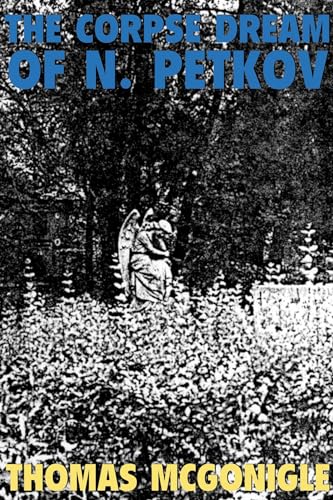
Image result for Thomas McGonigle, The Corpse Dream of N. Petkov,
Thomas McGonigle, The Corpse Dream of N. Petkov, Dalkey Archive Press, 2000 [1987]                         

This fascinating novel presents the dying thoughts of Nikola Petkov, the last significant opposition leader to defy the Communist takeover of Bulgaria, before he was hung in 1947.

On 23 September 1947, Nikola Petkov, the last significant opposition leader to the Communist takeover in Bulgaria, was hanged in the Central Prison in Sofia, Bulgaria, sentenced to death after a rigged trial: “Petkov was hanged by the neck and was dead, slowly, as they expected . . . a poor job of it in the eyes of some, though in their eyes: well done, the life of him squeezed out, pulled out, gasped out.”
The son of a former Bulgarian prime minister and the brother of a murdered revolutionary, Petkov might have lived out his life as a gentleman of leisure in Paris or Venice. Instead, he had returned to Sofia as the leader of the Agrarian Party, was active in the underground, was imprisoned in the concentration camps, and later was minister of the first postwar government in Bulgaria.
In a novel that mixes history and fiction, biography and imagination, Thomas McGonigle records the last minutes of Petkov’s life and death, a death that his executioners purposely intended to be prolonged and painful. At the same time, we see glimpses of the author sitting at his typewriter in New York City reconstructing Petkov’s dying moments as Petkov remembers and reflects upon his and his country’s past.
McGonigle has resurrected for us a political and historical figure, as well as a country, that has been forgotten in the West. In the very best sense, this is a subversive novel that remains faithful to both history and art.

"Why a young American writer in the 1980s chose to imagine seriously the end of a Bulgarian revolutionary is cause for wonder in itself. That he also seriously employs new narrative techniques to do so is doubly impressive. One comes away from this little book with a bitter taste at the back of the throat, a taste that may very well be that of recent Eastern European history." --Andrei Codrescu


"[A] thoroughly informed and deeply disturbing meditation on the ultimate futility of overdetermined conviction, of ideological commitment, of absolute politics itself." --James McCourt

"Everyone knows that dead men tell no tales. But this book offers a suggestion that maybe it's a shame they don't. Here's a fine effort to capture disappearing history—history that vanishes by being forgotten. And here's a sharp reminder that all countries are potentially obscure, and all people potentially unknown."—Madison Smartt Bell

Such a book as THE CORPSE DREAM OF N. PETKOV by Thomas McGonigle was missing here [in Bulgaria] for a long time-expressive, multi-faceted, short of breath and choking [the reader] at the same time. A voice coming from outside-different, strange and startling, uttering that which we ourselves have not yet uttered. - GEORGI GOSPIDINOV


The Corpse Dream of Nikola Petkov is the lost avant-garde Bulgarian novel that never happened in Bulgarian. A novel, which, like a ghost, returns at last to its native home after long years of otherworldly exile in order to tell us about our own past. Thomas McGonigle has succeeded in doing for Bulgaria what Faulkner once did for the American South: to elevate the gray facts of a historical event into a literary myth. - DIMITAR KENAROV


Thomas McGonigle interweaves facts and imagination in a striking and stunning narrative about the last minutes of the life of an honorable statesman-Nikola Petkov-brutally tortured before he was hanged. Petkov's story-of a man departing this world-sounds so powerful that it has to be true. And it sounds so true that it could only have been born in a writer's imagination. What must have provoked precisely this American writer to empathize with some of the most painful pages in the history of faraway Bulgaria, remains a mystery to me. One of those mysteries that make me believe that stories follow invisible and unfathomable ways. And that stories can bring us closer to the truth-not the abstract truth that is taught in textbooks but the other truth-concrete, personal, and human. - ZACHARY KARABASHLIEV


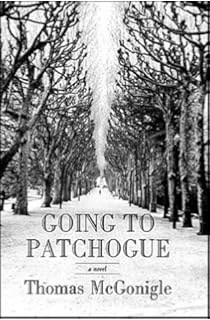
Image result for Thomas McGonigle, The Corpse Dream of N. Petkov,
Thomas McGonigle, Going to Patchogue, Dalkey Archive Press, 1992

Patchogue is a village on Long Island sixty miles from New York City. A man now married and living on the Lower East Side of Manhattan decides to return to the village where he grew up. He carries the dead heaped on his shoulders and the memory of the first love that sent him forth from the village, both fortunate and cursed by this memory. The trip to and from Patchogue assumes the contours of the oldest journey of all: the search for paradise, impelled by the embarrassment of reality. Yes, it is always greener on the other side of the fence, but then that grass has been well fertilized by heaps of decay and rottenness.
After a prologue of facts about Patchogue calling to mind the opening of Moby-Dick, the book divides naturally into three inevitable parts: the going to, the being in, and the coming back from Patchogue by way of Bulgaria, Turkey, and Italy. Each section assembles itself around the moment of the journey: the going to is fraught with hesitation as the past is accumulated to qualify the traveler for this journey; the being in underlines how anticipation is usually better than . . . while the coming back provides the courage to continue the journey to the heaven of the known and the knowing.
Written in a prose that recalls Céline’s, Going to Patchogue is a moral book that will be misjudged as racist and bitter only by those who thought Swift wanted modestly to put Irish babies on sale in the London meat markets. It is a book of flesh and guts, of blood, sperm, and saliva. But to go to Patchogue is also to go to Paris, Venice, Istanbul, to Sofia. Because the traveler doesn’t want to repeat the same journey back, he returns via Bulgaria, Istanbul, and the Villa Paradiso in Padua, the ironically named journey’s end of this travel book for those who never travel, who never want to travel.

Opening with snippets of information about the Long Island, N.Y., town of Patchogue which, the reader is warned, may not be true, McGonigle ( The Corpse Dream of N. Petkov ) sets the tone for this novel of memory with a narrator contemplating suicide. Tracing a journey to Patchogue from "the City," a stay there and a return, the narrator (whose name is Tom McGonigle) tells an episodic and disjointed tale in earthy and demented prose, echoing that of Celine, who is often quoted. Into his stream-of-consciousness prose McGonigle splices railway schedules, poetry, reproductions of handwritten notes and scenes from a play, all of which work to expand the boundaries of the narrative. At the end of his peregrinations, the narrator comes to realize that his life has been empty and pointless: he is left with merely the ashes of his experiences. While many may find this literate and haunting novel difficult, others will treasure it as an exploration of those recesses of the mind where we can be most honestly ourselves. For McGonigle that territory is called Patchogue. - Publishers Weekly

In his second novel, McGonigle ( The Corpse Dream of N. Petkov , Dalkey Archive Pr., 1987) explores the American literary tradition of place as a determinant of identity--you are where you are--and the search for self. Through his writing, McGonigle travels to his hometown of Patchogue, Long Island; Sofia, Bulgaria; and various other sites in Europe, seeking a sense of self and personal well being and to recapture a love for schoolmate Melinda, who had rejected him. In Patchogue, instead of Melinda, he encounters less noteworthy characters from his past, some hilarious, others pathetic. Much of the time, the reader is unsure if the narrator is in New York City, Patchogue, or Bulgaria, which adds to the general atmosphere of displacement. McGonigle writes in various styles of fiction and nonfiction, and includes vague literary references. The book will not appeal to every reader, but is recommended for literary fiction collections. - Harold Augen


Thomas McGonigle, Party of Pictures, Mercer

Street Books Publishing, 2023


Does Party of Pictures capture a holy pilgrimage to a bacchanalia? Or an annual visitation by Greenwich Village la bohême? The whole book is one big party. Thomas McGonigle, gatekeeper and guide, navigates the ephemeral world of downtown New York City as it manifests itself year after year in a West 11th Street apartment on St. Patrick’s Day. Snapshots of the living and the dead cover the walls. Not everyone has been invited to the Party of Pictures but all are caught in the photos.


"PARTY OF PICTURES is a reel, both the dance and the loop, and I suppose the stagger, highly diverting."GEORGE O'BRIEN


"Party of Pictures is a splendid invitation to an annual fete, one honoring a madcap saint, a party both ordained and yet unexpected. McGonigle excels at capturing memorable dates and places - and who can resist a St. Patrick's Day bacchanal, especially one hilarious and reflective, that repeats year after year at the same Greenwich Village apartment, an event engendering spiritual and spirited commentary? McGonigle excels as the perfect host: attentive, gregarious and generous. Enjoy!" - WILLIAM O'ROURKE


"Narrated by a sort of track-skipping DJ, Party of Pictures is a high-wire-enacted party-of-fools satire that glides us through a Greenwich Village apartment mined with literary trapdoors. Tours de force are what I praise highest and that's what Party of Pictures is." - TOM WHALEN


Thomas McGonigle, Empty American Letters,

Spuyten Duyvil Publishing, 2023


Like Samuel Beckett, McGonigle observes what might be full is empty and what appears to be empty may, in fact, be full. In this collage of verbal snapshots (where remembering becomes forgetting and the attempt to forget becomes obsessive frustration), we wander through the byways of Bulgaria and America during the forty days via the Orthodox aerial toll booths until the soul is judged. Absurdity becomes sanity and vice versa. Autobiographical fragments coalesce in mosaic format conjuring a pilgrimage to discover love, loss, laughter, irony, and significance in the oddest quirks of life…. —Kevin T McEneaney


Thomas McGonigle, The Bulgarian

Psychiatrist, Spuyten Duyvil, 2022


THE BULGARIAN PSYCHIATRIST arrived with a suitcase filled with ties, and knowing how to wear a dead man's clothes, and how to initiate a son into the art of beating a prisoner to death and ... all of which did not prepare him for a life of listening in the USA.


McGonigle possesses a highly attuned affinity for gallows humor, a type that readers who are fond of the works of Lazlo Krasznahorkai and Elfriede Jelinek will be able to appreciate, so it is not surprising that George is an especially dour, sardonic raconteur, and that The Bulgarian Psychiatrist is rife with his hard-bitten expressions. - Sean Nam in Full Stop


There is no McGonigle but McGonigle, and McGonigle is his prophet... no, but seriously! McGonigle brings to The Bulgarian Psychiatrist the gifts of a born raconteur, a regression of digression that absorbs the reader toward the center of a hypnotic spiral of captivating prose. - Madison Smartt Bell


With a clear, historically informed gaze, The Bulgarian Psychiatrist examines an immigrant Bulgarian doctor in the US and the US within the immigrant, as narrated by its US author/narrator via free indirect discourse, interviews, photos, monologues, etc. That the book’s primary pleasure is found in its looping run-ons and experimentation is understandable. After all, as the book says: “People can only take so much honesty. The fictions they live by are more powerful than anything they can say and which I can hear and it is this speaking and my listening.” Especially recommended for readers of Laszlo Krasznahorkai and Gerhard Roth. - Tom Whalen


A truth stronger than fiction informs and shapes this double take of a fascinating case history, an intelligent, probing table-turning interrogation of the psychiatrist’s loose tongued mental, emotional and spiritual condition. The Bulgarian Psychiatrist is a deft accomplishment worked by an able hand. McGonigle’s trademark skill in adorned, head-on style is made manifest in this deep dive into the fathoms of human complexity. - James McCourt


3/24/17

Ida Börjel - At once practical handbook, philosophical inquiry, and series of fables set in Putin's Ru

Miximum Ca'canny the Sabotage Manuals
Ida Börjel, Miximum Ca' Canny the Sabotage Manuals, Trans. by Jennifer Hayashida, Commune Editions, 2016.
excerpt (pdf)

"One of the most important poets in Scandinavia."—Kamilla Löfström

At once practical handbook, philosophical inquiry, and series of fables set in Putin's Ru
ssia, The Sabotage Manuals throws a wrench into the machinery of contemporary language, generating strange solidarities between saboteurs past and present. Sourced from political pamphlets and factory workers' diaries, Börjel's profound poem allows for the most expansive (and explosive) sense of sabotage.


II. the sabotage manual
In nineteen-sixteen
Industrial Workers of the World
(IWW) publishes the handbook
Sabotage:
The Conscious Withdrawal of the Workers
Industrial Efficiency
authored by
Elisabeth Gurley Flynn

In nineteen-fourty-four
The American Office of Strategic
Services (OSS) publishes
The Simple Sabotage
Field Manual
, de-classified
in the year two-thousand-and-eight

The human factor. To widen a
margin of error.

Intentional stupidity goes against
human nature. The saboteur may
need to reverse her thinking. If
before she made sure to keep her
tools sharp, she can now let them grow
dull. What was brightly polished will now
be scratched; what was carefully tucked away can
now be left out. The assiduous grows full
of indolence. The keen grows torpid,

the firm begins to give way. When the saboteur
starts to think backwards about herself and hers
she does not let the opportunity slip
out of her hands. Anything might be sabotaged.

What was firmly rooted
lies rotted. What was cast solid
is perforated. Into those openings the
saboteur sticks her fingers.

A certain measure of humor in the following
proposition helps the tension and
fear dissipate.

Commit acts for which a large number
can be held responsible. So that it could have
been anyone.

Do not be afraid to commit acts
you can personally be held
responsible for, as long as you do not do it
too often and assuming that you have a
plausible excuse   dropped the wrench
there   by that circuit   the little one cried
and kept me awake all night   I
must have been half asleep   well   so
I dropped the key

[…]
Communication
now and then when I want half a day off and
they don’t give it to me I let the belt slither off
the machine so that it doesn’t work and I get
my half day   I don’t know if you call it
sabotage   but that’s what I do

delay   give the wrong number   happen
to disconnect   forget

mutter   make conversations difficult or
impossible to understand

distort telegrams so that additional ones need to be
composed   sometimes simply by
changing a letter   from “minimum” to
“miximum”   then they won’t know if
minimizing or maximizing is at stake
a letter   a punctuation mark   to move a
comma   from “access denied, control” to
“access, denied control”

at the screening of propaganda films place two or
three dozen large moths in a paper bag   bring
to the movie theater   place on the floor in an empty row
the moths will fly out into the theater
towards the light
and when they climb over the projector
the film becomes an agitated fluttering shadow play

so they will sound as though they were passing
through a thick cotton blanket with mouths
full of gravel
so that the line can no longer be used

so they do not move
but flutter   disturb
the automated gaze


Born in Lund, Sweden, Ida Börjel is one of the most radical voices in contemporary conceptual poetry. Since her multiple award-winning debut collection Sond (Probe, 2004), Börjel has been investigating the current conditions of our world, raising questions such as ”Why do we walk in circles when we are lost?”, and, ”what is a waist measure of nationalistic characters?” Her poetry absorbs and reinvents language from consumer law, juridicial clauses, racist radio, political pamphlets and other sprawling sources to expose our contemporary, linguistic, and societal circumstances in relation to various forms and systems of power and authority. Her collection Miximum Ca’Canny the Sabotage Manuals (Commune Editions, 2016) is available to English-language readers in the translation of Jennifer Hayashida. Hayashida is working on a forthcoming translation of Ma, Börjel’s most widely-acclaimed book, which received many awards in the original, including the prestigious Erik Lindegren prize and Albert Bonnier’s poetry prize.
Asymptote‘s Sohini Basak caught up with the poet over email last month.      
Sohini Basak (SB): In your collection Miximum Ca’Canny the Sabotage Manuals, a collective of industrial workers’ voices confound and sabotage capitalist machinery and “the boss” in various ways, including providing instructions for what to do when they “cutta da pay”: hide paperwork, peel off labels, forget tools, embrace slowness, hold meetings, ask questions—it’s a very real and fascinating interaction between materiality and ownership of language. I’m interested in the blueprints of this collection. Where did you begin?
Ida Börjel (IB): It began, I guess, with that old question about free will, about akrasia and how we might come to deviate from a given pattern. What compels a person to step across the threshold, out on the piazza, into action? Or to activate a gesture of refusal, discontinuation, or silence? And, in addition, the question I’ve been dragging along in my writing since day one: How, in what kind of language, can I think differently about a system of which we are a part? In which we are apart?
So, in pursuing those questions, I conducted a minor survey of sabotage in time and space, from above and below, inside and out: from Elisabeth Gurley Flynn and her 1916 pamphlet ”Sabotage: The Conscious Withdrawal of the Worker’s Industrial Efficiency,” to—still in the U.S. but directed overseas—the OSS (a predecessor to the CIA) pamphlet ”Sabotage: A Simple Field Manual,” which suggests the ”citizen-saboteurs” in France and Norway during WWII issue two tickets for one seat on the train in order to set up an ”interesting” argument, just to name example. It also states that ”purposeful stupidity is contrary to human nature,” so the citizen-saboteur ”frequently needs pressure, stimulation or assurance.” From there, I I looked at contemporary workers in the textile industry in Pakistan or the closing of an Ericsson factory in Gävle, Sweden, in 2009, and many others—there are pamphlets, diaries, blog texts, conversations, memories to sift through. There is much to be found and read out there, though there are sources that need to stay anonymous.
SB: That’s very immersive … and once you had points of references, memories, material, how did you map it all out?
IB: What seemed urgent to me in rewording and sampling texts from these various sources was not a simple whodunnit, but rather, how does one find and pick up that ”fine thread of deviation,” as Gurley Flynn puts it, in the present order of things? In the factory or at the office, yes, but also in factory life outside of the factory. In the prevailing social structures, in our daily lives… Do we speak, think, write, like in a factory? Leslie Kaplan, author of Excess– The Factory, asks this.

In the Fordist factory the workers were silenced by the noise of the machines. In the post-Fordist factory—I’m thinking of Christian Marazzi’s Capital and Language here—the factory is produced by and produces linguistics. A language that is politicizing us, quantifying us, desensitizing us, atomizing us. Changing the structures of our brains, the nerve paths, the responses of the synapses—into ersatz behaviour, ersatz sensitivity, ersatz stimulation. And there we go, trying to attach the little we have of ourselves to, trying to identify ourselves with the objects we buy or only dream of buying and then to move around in our homes. In a swirling circulation of triggered stimulus response where subjectivities turn into lubricators, it’s hard to get a grip on things.
And you can’t reason with the unreasonable. The bullshitters do not play the same game as the liar and the truthteller does. But you might joke about them. As the students did on the placards in Parliament Square, UK, in December 2010 for instance. ”I’M SO ANGRY I MADE THIS SIGN.” As the youth did in the monstration (sic!) in Novosibirsk on May Day, from 2004 and onwards. Through applying a language of absurdity in their banners they passed the demonstration ban. That doesn’t mean they did not get arrested. Non-sensical? ”I CROCODILE…” read one of the posters, echoing samizdat publications in the sixties.
This became a lengthy answer. And yet I feel, with Gurley-Flynn, that, ”I have not given you a rigidly defined thesis on sabotage because sabotage is in the process of making”.
SB: Right. As you just said, there is a lot of the absurd and the unreasonable in the language of oppression and authority, and one of the most effective ways to point that out is to claim the same language and turn it upside down. It might not be action per se, but it does raise hopes and express solidarity.
On that note, I absolutely love these lines from one of the poems in Miximum Ca’Canny:
say something when nothingmakes sense in life all words crashinto the abyss say something inabsurdum say something in silencewith the placards this is not allhereis there is more there is more
IB: The words in the abyss are Herta Müller’s, referring to how all dictatorships take language into possession. I’m thinking now of a salesman I met in east Jerusalem, how he said that living under occupation also meant that language, single words even, were replaced, nullified, deprived of their actual meaning…
Humour is one way—as the Dadaists knew—of expressing a non-confidence vote against the deceitful language of the current order. One might think of the slogan, “Everyone is the creator of one’s own happiness.” The downside to that one, if we read Mark Fisher—and we should—is the view of mental health as something natural. ”We need to re-frame the growing problem of stress,” he wrote, ”Instead of treating it as incumbent on individuals to resolve their own psychological distress, instead, that is, of accepting the vast privatization of stress…we need to ask: how has it become acceptable that so many people, and especially so many young people, are ill?”
SB: A lot of your work is geared towards opening public dialogue in various ways, breaking down the authoritative structures; on the other hand, form seems to be crucial to your poetics: systematically taking apart found material, using theatrical devices, animal fables, invoking Gertrude Stein, Inger Christensen...
Could you tell us more about the play between making and breaking structures and form in relation to the content and agenda of the works…?
IB: Yes, I tend to let formal structures mirror social conditions in negotiation with the artifact, the question of the book. Social conditions as laws, rules of conduct, paper thin or impenetrable laws of thought that dictate civilization. Human conditions.
But my efforts to process events into experience don’t always make sense. Understanding is not a given goal. Sometimes the grip is lost altogether, lost into poetry. Whether writing about national characters and stubborn prejudices, about lonely and mentally retired elderly having their say at local radio station, about rules and regulations in civil law, or a research study on the poem, “Why do we walk in circles when we are lost”, a common denominator has been trying to grasp a tone that reflects a certain (varying) kind of authoritarian voice. Be it bureaucratese, double-speak, or missionary. For that to work, one needs to stick with it for a while. I believe in lingering in uncomfortable zones.
SB: And did Ma come out from such an uneasy lingering? Inger Christensens Alphabet is a fascinating book, using the Fibonacci series and a sort of free-but-also-framed association to expand on the is-ness of things. But you have used its numero-linguistic template to chart grief…
IB: Yes, and no. Ma, is a very different, and dark, matter. It didn’t come about out of a sense of having a choice. Ma is an attempt at enacting a linguistic violence, a grammatical violence even, saying ”this is possible”, as well as an immersion into the infernal; life disdains language acts that tear people apart. It is a book written in despair after a year-long silence. The title stands for the Japanese kanji sign, the ideogram symbolizing a moment of moonlight shining through an entrance door cracked open, meaning negative space, interval, gap. Ma is also the universally first syllable an infant utters. Ma is the mother, torn apart, the tormented soul, anima.
In my case, the trauma caused a loss of linguistic ability. I mistrusted literature, and I couldn’t go back to writing in the way I had done before. Later (it felt so long!) I found that Inger Christensen’s Alphabet was one out of three books that didn’t start to dissolve when I was reading it. And so I told to myself that the alphabet was the one logical order that I had to accept, as a beginning, as an attachment for a new worldview, a scattered one. Of a world that also would contain a requiem of the child that died.
Ma was written in response to Alphabet, which is also the reason why the poems are right-aligned, printed on the right pages of the book. Like negative imprints of Christensen’s poems, yes, but also, in a way, negations of the traditional poems that were impossible to write on the left pages.
Alphabet repeats, like a mantra, the word “be” (or exist) in the present tense—Ma was written in the past tense, the tense of loss. For someone suffering from depression, a future might not be possible to imagine, or put faith in.
Christensen writes about the comfort of the name, to which Jaques Robaud, whose book some thing black was the second of the three books I could read, answers, “by saying your name I wanted to give you a stability that couldn’t be assailed.” The myriad of feminine names in Ma are all invocations for the lost ones … Kassanda, Memoranda, Laurasia, Virginia, aspidistra …  But the hope of getting an answer draws in the maelstrom, a mesh of traumas, of catastrophes and our dead, the the stigmatized and the ones left behind in Gaza, in Aleppo, at the Taksim Square, at the Greek border, in the U.S., in Belarus … left behind in the human era we call Anthropocene, that alleged human apotheosis, in the name of big politics, of petit bourgeoisie.
In a world catalog where the impossible is tucked in under the possible, a mother is raging. Her grief being neither beautiful, elevated, elegiac or forgiving.
SB: Yes, there’s something terrifying but also affirming about that, despair and its negative articulation… In Miximum Ca’Canny too, you write: “the image of fractals alters the meaning / of the silence to put language into practice articulation / erects the border between static order and / incomprehensible chaos”.
When I was reading this collection, I immediately recalled Solmaz Sharif’s Look, in which she uses various techniques to make poems out of military terminology and bureaucratic conversations. And now I’ve learnt that you are in the process of translating the collection into Swedish. What has been the experience of putting language into practice as a translator, especially with a book like Look?
IB: It really is a wonderfully disturbing and delicate book. I hope that I, in collaboration with Jennifer Hayashida, will be able to recreate that kind of friction between authoritarian violence and subjective sensibility.
Translating it into Swedish. And to the contemporary literary, societal, and political context in Sweden. At first glance it might seem like we are placing a book of war poems in a time of peace—Sweden being a country that hasn’t been at war for two hundred and two years. But it is a truth in need of modification. Since Sweden claims a policy of neutrality in armed conflicts, it aims at being self-sufficient in arms. Today the country I live in is one of the world’s biggest exporters of the euphemism ”defense materials” in relation to GDP and capital. Between 2001 and 2011, such exports were quadrupled. Moreover, the notion of Sweden as a nation untouched by war rings a bit awkward considering the fact that a large number of the citizens, inhabitants, asylum-seekers, and undocumented immigrants have experienced war first-hand or second-hand. I’m thinking of the refugees from Finland during WWII as well as of today’s refugees from Afghanistan, Syria, and other war zones.
A crucial question has been how to treat the military terms from the DOD embedded in the poems. The vocabulary of the Swedish military doesn’t (well, not in their dictionary at least) contain terms flavoured with sex, popular culture, or machismo. The Swedish counterparts, if there are any, tend to be of a somewhat grey matter: bureaucratic, technical, neutralized. Question: should the English terms be kept or translated? Lexical correctness—semantic loss? Here we have struggled with the complexity of trying to both decipher and depict the U.S. military’s language acts in Swedish.
Trying to find a balance between the English version, portraying an experience of linguistic violence sanctioned by the U.S. state, and recreating those acts of violence in Swedish. In doing so, we are losing the glamour, translating away the ”make-don’t-believe” of American English, i.e American popular culture in the eyes of non-Americans, i.e a world of dreams. Does that mean we are, in a sense, making it real? Simultaneously, paradoxically: does that mean that we are enacting a linguistic violence that has yet to be realized in Sweden? Questions that need to be considered and worked through. Although, in the end, the lines might come to cross. To speak with Oana Avasilichioaei and Erín Moure: ”I wanted to translate what was not yet there… The paradox of borders—national, corporeal, and linguistic—is that their primary value is not to keep out, but to let in. Translation involves permeability, not equivalence.”
SB: That Oana Avasilichioaei and Erín Moure quote is fantastic! Your own poetry has been widely translated into fifteen languages (correct?) including Danish, French, Icelandic, Belarusian, Persian, Arabic, and into English by Jennifer Hayashida. How closely do you work with your translators, given that much of your poetry hinges on etymology and linguistic play? And what you just said about equating lexical correctness with semantic loss…
IB: As of today, I believe it to be 19 languages, which have meant tickets for me to participate in poetry readings in 18 countries. Makes me wonder about the whole travelling community of poets that, daemon-like, wouldn’t be able to go anywhere without the invitations—how far do we reach in a year? And how heavy is the total weight of the books that we carry around? I do feel immensely honoured and grateful for all the work done by translators out there. I’ve had the fortune to work closely with a few of them, in translating my poems or theirs. Together we have spent an indefensible amount of time searching for an equivalent to the little word “guldtacka” —buillion, or gold ingot, or ? —in different languages, not wanting to sacrifice the cute sheep since the word ”tacka” also denotes an ewe in Swedish. In Palestine, Dahlia Taha found a word related to the animal kingdom when thinking of the merchant mentality in Hebron, in Romania Elena Vladareanu found a word, if I remember correctly, related to a rooster and a roma gold coin…
There are some really sympathetic translators out there … Maybe it really is a universal truth, what Don Mee Choi said in her ALTA key note about The Silence by Ingmar Bergman: that all the women in the movie who are not translators are ill.
Some of these translation meetings have taken place in disqualified translations workshops, though, inviting poets to translate without notable knowledge of the source language. Spivak would disapprove for sure. Disqualified, I’d say, but not without meaning. (It should be mentioned that those workshops weren’t about translating entire books, which made all the difference since it didn’t prevent other, professional translations from being made later on.) The purpose of these workshops is just as much about encounters, about introducing voices, start conversations and to enable international networks.
SB: So, translation as an encounter, as a real conversation … not with a goal of reaching to a new, but analogous text?
IB: Yes, although just because we had no real chance of succeeding that didn’t mean we didn’t try. We did. But to engage in conversation is risky. There might be a risk in trusting the other as you blink, because what happens if the other blinks at exactly the same time? What if the dual perspective, supposed to provide insurance against the” home blindness” of the other, suddenly blurs into double vision?
That being said, it’s nice to stroll down that quirky path of endless revisions and comments together with someone, for a change.
Alone but together.
SB: Absolutely. Reading poetry these days somehow never occurs to me in isolation, what I mean to say is one book leads to another, a phrase here knocks off a domino there and sentences avalanche. While reading Miximum Ca’Canny, I thought of Claudia Rankine’s Citizen: An American Lyric, and also Juliana Spahr and the young Russian poet Galina Rymbu. Several women writers are reclaiming the lyric I with experimental, at times avant garde collections critiquing the nation-state, capitalism, oppressive systems of power and discrimination. Do you consciously negotiate with (or try to keep aside) the lyric I while writing a more public poetry?
IB: Sohini, are you setting a dinner table for us? In an open space in Delhi somewhere? If so, I’ll bring some earthy wine and those delicious Iranian saffron crackers. May I invite NourbeSe Philip’s Zong? And Bhanu Kapil’s Ban en Banlieu? Next to her an empty seat – following the Polish Christmas tradition – I’d like to reserve a plate for the Unexpected Guest. As an interlude I could recite Gertrude Stein: ”I am no longer I when I see. This sentence is at the bottom of all creative activity. It is just the exact opposite of I am I because my little dog knows me.”
And as the hours go by and the jokes have had their way, we could talk about the Swedish poet Birgitta Trotzig, who urged us to stay in dialogue with the unbearable. We could ask what her writings about an intentionless language mean to us, and we could probe into exercises of seeing, in her words: ”exercises in not denying, not letting unsuitable parts of reality disappear through that mental trapdoor that our self-preserverance ceaselessly offers.”
Hours under a night sky, Delhi velvet blue, with one cloud that resembles Audre Lorde and one that really doesn’t.
SB: Okay, that dinner needs to happen! And I have a rooftop in mind too … Im also curious about your current project City Fables at the Malmö University that combines stories of urban life, how they are circulated, the systemic illnesses, tax structures, heavy corporate language, and … cute animals. Do tell more.
IB: In City Fables: Follow the Money, we have analyzed as well as counter-narrated dominant narratives that frame the city of Malmö. Instead of focusing on the so-called poor and troubled neighbourhoods of Malmö, where media attention thrives, we set out to understand and counter-narrate the successful side of the city.
That steered us into examining the language of neocapitalism and its global flows of financial and human capital. So we analyzed data from 2000 companies and 200 annual reports of larger companies in Malmö (turned out 30% don’t pay any taxes), conducted interviews with politicians, bankers, auditing companies and activists, arranged a taxathon weekend for concerned citizens, and documented tax-haven products in our homes.
The experiment has led to, among other things, four cut-out animation films (for instance ”Is There Swedish Coffee in Panama” and ”The Small Businessman’s Package Trip to Tax Haven”, soon on YouTube), micro plays with cute animal puppets and a quiz/personality test called ”Animal Spirits” —which economical beastie are you?
”Cuteness is a way of aestheticizing powerlessness,” writes Sianne Ngai, adding that when the cute object gets injured, we find it even cuter. Spongy, fluffy, tiny and big-eyed, it manipulates you to feel that you just have to have it. You hear yourself utter some diminutive swooning sound of confirmation. The cute just looks back at you, watery eyes. But what happens if the cute start to speak, if they start making claims on our way of reasoning?
SB: That sounds revolutionary. Perhaps I will never look a baby panda video in the same way again. I have a final if somewhat cliched question: what or who are your influences? Are there some works of art you keep going back to?
IB: Hm. Why am I reluctant to answer? Maybe I don’t see it as a ”going back,” as if returning to something solid, fixed. Or that I don’t have a sense of a homecoming… Would you mind asking me again in twenty years? I wish I could return, though, to watch the dance performance, ”It’s going to get worse and worse my friend,” by Lisbeth Growez. It made me cry. - Sohini Basak

3/23/17

Prabda Yoon - In these witty, postmodern stories, Yoon riffs on pop culture, experiments with punctuation, flirts with sci-fi and, in a metafictional twist, mocks his own position as omnipotent author. Highly literary, his narratives offer an oblique reflection of contemporary Bangkok life,


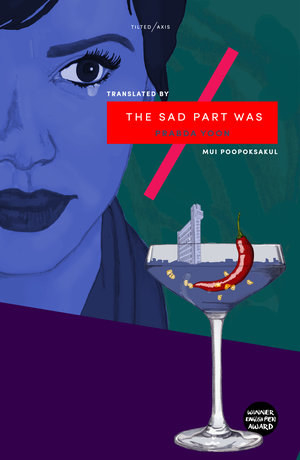
Prabda Yoon, The Sad Part Was, Trans. by Mui Poopoksakul, Tilted Axis Press, 2017.
Includes the stories:
Pen in Parentheses
Ei Ploang
The Disappearance of a She-Vampire in Pattaya

Winner of a PEN Translates! grant. Selected as a 'book to look out for in 2017' by The Guardian and BuzzFeed Books. In these witty, postmodern stories, Yoon riffs on pop culture, experiments with punctuation, flirts with sci-fi and, in a metafictional twist, mocks his own position as omnipotent author. Highly literary, his narratives offer an oblique reflection of contemporary Bangkok life, exploring the bewildering disjunct and oft-hilarious contradictions of a modernity that is at odds with many traditional Thai ideas on relationships, family, school and work.

‘Evocative, erudite, and often very funny stories of Bangkok life.’The Guardian

‘Formally inventive, always surprising and often poignant, with the publication of this fluid and assured translation of The Sad Part Was, Prabda Yoon can take his place alongside the likes of Ben Lerner and Alejandro Zambra as a writer committed to demonstrating that there’s life in the old fiction-dog yet.’— Adam Biles

‘An entrancing and distinctive collection. Yoon’s limpid prose faces up to large, transcendental questions, all the while flickering with beautiful other-worldly images and flashes of deadpan humour.’— Mahesh Rao

Prabda Yoon is one of Thailand’s finest writers. These witty, adventurous, and wholly brilliant short stories were a necessary shot across the bow when they first appeared in Thai, a deceptively revolutionary collection that helped to transform the country’s literary landscape. Long deemed untranslatable, given their interests in linguistic wordplay, their appearance in English—in this supple, agile translation by Mui Poopoksakul—is a cause for celebration.’— Rattawut Lapcharoensap

A humble traveller discovers a monumental secret from outer space in the forests of southern Thailand. A vampire named Rattika goes missing in Pattaya. A couple engaged in an extramarital affair witness the death of a man crushed by fragments of an advertising sign (they are playing Twister when this happens; the killer debris spells “N” “O”). Elsewhere, a mother in Bangkok strives to save enough money to take her troubled son to Alaska to see snow, and a young man obsesses over the loss of buttons on his shirt.
The stories that form Prabda Yoon’s mind-bending and strangely melancholic universe are unfailingly provocative, both in their choice of subject matter — there isn’t a single dramatic situation that can be said to be conventional in the collection of 12 stories — as well as their narrative form. Protagonists cede their place to a chorus of casual acquaintances, or else rebel against their creation by addressing the reader directly; heroes are also anti-heroes; plot lines streak ahead but are deliberately thwarted; the writer Prabda Yoon even appears in one of the stories. Despite their playful, coolly surrealist wrappings, however, the stories are built around more solidly old-fashioned notions of displacement and loss, with people struggling to make sense of life in the booming metropolis of Bangkok, the setting for most of the stories in the collection. In the first, and longest, “Pen in Parentheses”, neither the stylistic flourishes (the story is told in one gigantic set of brackets that contains the entire story, save the first and last few words) nor the characters’ eccentric devotion to Bela Lugosi’s Dracula mask the poignancy of a young man trying to reconcile himself to the loss of his parents and, later, his grandparents.Despite the narrator’s success as an advertising executive — his day-to-day existence is the epitome of modern Bangkok life, complete with funky clothes and a great job — he lives with a sense of confusion as to who he really is. Orphaned as a child and raised by his congee-seller grandfather and schoolteacher grandmother, he knows he has changed, despite his childhood promises to himself never to do so. “Change from what, I can’t remember anymore,” he muses as he finds a scrap of paper from an old school book in his late grandmother’s house.This sense of grappling with material and emotional change — and ultimately failing to understand it — underpins almost all of the stories in The Sad Part Was, and at times it feels as if the author himself is part of a collective effort to understand the rapid evolution of Thailand, and Bangkok in particular, in the two decades straddling the millennium. In “EiPloang”, two strangers meet in Lumpini Park and strike up an unlikely friendship born out of a shared sense of isolation and thinly veiled frustration. Around them, they observe the daily stream of joggers and families out for a stroll, but seem incapable of finding their place in the crowd. Their oddly formal relationship masks deep frustrations with their place as outsiders: the narrator can no longer discern goodness in himself, and can barely form normal, healthy friendships.
The majority of the stories that form this landmark collection — which is not only the first of Yoon’s work to be translated into English, but a rare international publication of Thai fiction — are taken from Yoon’s second book, Kwam Na Ja Pen, which translates roughly as “probability” in mathematical terms. A sensation upon its publication in Thailand in 2002, the book won the SEA Write Prize, Thailand’s top literary honour, and made Yoon a cult figure in Bangkok, where the country’s readership is concentrated.Praised for its linguistic flexibility, with constant plays on words and an unusual use of punctuation, Yoon’s prose exploits the peculiarities of Thai, exploring the disconnect between the written and spoken forms of the language as well as influences drawn from other languages. These textual gymnastics make the translator’s task a nightmare. How fully to convey the richness of “Miss Space,” for example, in which an incipient love affair is viewed through an obsession with the space between words and sentences, if you don’t know that Thai does not employ spaces between the words in a sentence? Mui Poopoksakul’s translation renders the stories fluent and accessible, ironing out the linguistic kinks and allowing Yoon’s portraits of Bangkok lives to take centre stage.In his concentration on the lives of urban dwellers, Yoon also broke the stranglehold of the countryside on the Thai literary imagination. Yet his work shares much of the deep melancholy traditionally attached to writing inspired by rural settings. His characters live with a troubled sense of loss that resists articulation: people and places dear to the narrators are notable by their absence, creating a void that the characters cannot fill. Nowhere is this more clearly seen than in “The Crying Parties”, in which four young men in love with the same woman attempt to get over the trauma of her suicide by recreating the chilli-and-cocktail parties they shared when she was alive. In a tragicomic sequence of events, they bribe the new occupant of her apartment; they do everything exactly as they had done before, but are ultimately — inevitably — unable to comprehend their loss. -
Tash Aw

Due to their condensed nature, short stories often rely on novelty to hold attention; whether that be a quirky cast, unusual perspectives or unlikely scenarios. The Sad Part Was, a short collection of tales from celebrated Thai author Prabda Yoon, employs all three to excellent effect.
The very fact that Yoon is bringing a contemporary South East Asian consciousness to a wider audience with this collection (superbly translated by Mui Poopoksakul) contributes to this novelty, but to say it overly depends upon this for its attraction would be hugely unfair. Yoon is never one to shy away from invention, with his stories a playful mixture of pop culture references, abstract concepts and metaphysical self-awareness.
Indeed, in perhaps the most memorable tale from the collection ‘Marut by the Sea’, Yoon calls into question the sagacity of supposedly omniscient authors and their validity in society as a whole. This derisive stance on his own career is an interesting and original exploration of the relevance of writers in a modern world, challenging us to think above and beyond the words on the page.
For a refreshing, engaging respite from the exhaustion of the daily grind, The Sad Part Was is an accomplished balancing act between sadness and silliness, wit and whimsy, wry insight and incisive rhyme. Well worth the few hours it takes to knock the stories out, not least for the fresh perspective they may provide for your own life. - Jonny Sweet

New publisher Tilted Axis Press has made it their mission to publish world literature that ordinarily wouldn’t make it into English translation and shine a light on difference. Prabda Yoon’s short story collection The Sad Part Was certainly showcases both inventive storytelling and an innovative translation process. So much so that the volume carries an afterword by its talented translator, Mui Poopoksakul, which provides some invaluable information regarding the intriguing idiosyncrasies of Thai wordplay and the challenges of rendering these as accurately as possible in English.
As Poopoksakul explains: "any given language is a game with its own internal logic – a challenge for the translator, who attempts to recreate his moves in a language where the rules are different." Apparently, for example, the use of punctuation in Thai is "relatively rare", not to mention the fact that it’s a language that doesn’t utilise spaces between words in the way western readers are used to. Armed with this information, the story Miss Space’ – note the nicely translated wordplay – becomes all the more absorbing. In it, the narrator first takes note of a fellow passenger who is composing diary entries while riding the bus, due to "the extraordinary size" of the spaces between her words: "They catalysed my consciousness as though it had been struck by lightning," the narrator declares, "and I briefly became abnormally perceptive, able to absorb information about my environment instantaneously and effortlessly. Thank god I stopped short of Nirvana." This same wry wit can be heard throughout the collection – Poopoksakul successfully transmuting the mischievousness of Yoon’s original tales, a liveliness that extends to the syntax itself.
As its title suggests, the piece with which the collection opens, Pen in Parentheses, exists entirely within parentheses. The story of the narrator’s life – how he was orphaned as a young boy, subsequently raised by his grandparents, one of the lasting memories of his childhood being his grandfather’s regular Friday night screening of old films, of which the black-and-white version of Dracula, starring Bela Lugosi, was a favourite, something the narrator uses later in life to inspire the advertising campaign (for breath mints – Dracula himself popping a mint in his mouth before he attacks his victim, fangs bared) that sees his career take off – squeezed into the middle of a single sentence: ‘The sheet of paper fell […], so I bent down and picked it up."

Another story, Marut by the Sea, quirkily defies its own creation. "Before it’s too late, may I tell you, dear readers, that my name is not Marut? And I’m not sitting by the sea at all," begins the enraged protagonist, character and author having swapped roles for the duration, the latter taking control, ripping apart the notion of an omnipotent, egotistical author. "There’s this guy," he indignantly continues. "He likes to think that he knows it all. He bosses people around, dreaming up their destinies as though he were God." Yoon is playing with his readers, but we’re in on the joke with him.
Other stories in the collection, however, are more oblique. In Shallow/Deep, Thick/Thin, a traveller stumbles upon "a secret from outer space". He agrees to go on a television talk show in order to divulge his discovery to the world, but the event turns into a media circus of constant commercial breaks, all meaning lost in translation and the presenter’s inability to recognise the real wisdom his guest has to share. Meanwhile, Snow for Mother is a strange but moving tale of parental love; a woman scrimps and saves for years in order to take her son to Alaska in the hope that turning what was once a childhood game between the two of them – the boy daily bringing his mother a handful of imaginary snow – into a reality.
Familial relationships often take centre stage; the values of traditional Thai culture juxtaposed alongside a younger generation clearly torn between the demands of their heritage and increasingly hard to ignore western ways of life. There’s much to delight in here, Yoon’s is an original and innovative voice, and this inviting collection is a welcoming gateway to a new world of narrative possibility. - Lucy Scholes

The Sad Part Was collects a dozen short stories by Prabda Yoon. From the beginning, Prabda keeps readers on their toes, pushing boundaries with the surreal edge and quirkiness to the voice, elements, and episodes in his stories that in other ways also lean heavily (or deceptively) on the seemingly everyday.
       In 'Something in the Air' a couple finds two letters from a huge sign flung onto the roof deck of the man's home during a massive storm -- only eventually realizing that there is man, crushed and dead, underneath them. The heavily stylized language the story is presented in -- "What state is the person in ? Approach and inspect", the woman says when they discover the body -- gives a disarmingly formal feel to the absurdity of the situation and the characters' actions. The language and tropes of classical tragedy meet farce in a story of greater, higher powers, and fate and guilt -- the latter poignantly inescapable, even as the young man knows that in his ignorance he was innocent.
       The stories range from the as-the-title-has-it The Disappearance of a She-Vampire in Pattaya to the story of a mother taking her now thirty-one-year-old son on a trip to Alaska to finally actually see snow, after a lifetime in which he constantly brought her what he called snow (but apparently was just whatever was at hand -- and, this being Thailand, that was never actually snow). In 'The Crying Parties' four men reunite after the loss of the woman they all loved, holding a 'crying party' of the kind they had with her -- but finding, unsurprisingly, you can't home again (especially when a new tenant has moved in).
       Many of the stories play with story-telling itself --beginning with the first: just five words into Pen in Parentheses the narrator gets sidetracked, and nests his story and explanation in parentheses -- which only close again right at then end. The 'story', in its ostensible totality, is the simplest of events and descriptions: "The sheet of paper fell so I bent down and picked it up", but of course the actual story is everything in between.
       In 'Marut by the Sea' the protagonist rebels against his creator, spending much of the story complaining about the author --"Prabda Yoon, [...] that's him, that's the guy I'm talking about". And he wants readers to know:
Believe me, Prabda's stories don't get any better than this. I myself could write ten or twenty a day. But I might kill myself first -- it's too easy. The examples I brought up are his specialty. In other words, the type of bizarre story which he makes end so cryptically, as though the harder it is to understand, the better.
       In 'Miss Space' the narrator writes about learning to write -- and how, eventually, "after I'd mastered writing (or at least scrawling)"
An up-to-me anarchy prevailed. Without checks or and bounds, the letters became brash -- they got loose, lax and liquidy, lumped together or leaning forwards and backwards in a carefree and shameless manner.          The narrator here encounters a woman on a bus, Miss Wondee, who he sees writing in her diary, and he's fascinated by it. As he tries to explain to her: "Your spacing has left a big impression on me". Here is writing where:
One might say that you give as much weight to the spaces as the letters in your sentences. Or maybe even more
       While more obvious in the original Thai -- where, as translator Mui Poopoksakul explains in her Afterword, spacing is rather a bigger issue -- there's obvious resonance even in English. And Prabda nicely uses the idea in how he ends this particular tale.
       In the opening story, the narrator recounts studying art at university, and notes that simple artistic talent, like being able to draw, isn't enough any more: "You have to think deep. You have to have a 'concept.'". Prabda plays with concepts, but doesn't ignore the craft, either. Translator Mui Poopoksakul's Afterword suggests much of the wordplay -- distinctive to Thai -- is necessarily lost, but enough comes through, or is adequately rendered in English, to give a feel for what Prabda does.
       All in all it makes for an enjoyable, playful collection, with some creative ideas nicely realized. - M. A. Orthofer