1/3/14

Kane X. Faucher - Grey dreams, grey hopes, and a grey future emerges out of the destruction of the Library and a people thoroughly greyed out as "dividual" masses chained to personalized grey machines and even greyer ideals


Kane X. Faucher, The Infinite Grey, Civil Coping Mechanisms, 2013.   excerpt


 A mysterious grey dust continues to settle everywhere. Grey bureaucratic rulers and reformers dominate politics in a time that has grown weary of flamboyant tyrants. Grey dreams, grey hopes, and a grey future emerges out of the destruction of the Library and a people thoroughly greyed out as "dividual" masses chained to personalized grey machines and even greyer ideals in this final book of the acclaimed trilogy.
 
Paul Fabulan, subject to an experiment to encode his psyche with the text of an obscure and angry theorist, returns to his former part-time teaching post only to fight against a new reformer named Martin Schulmann who seeks to transform universities into degree mills in line with neoliberal policies. Meanwhile, Gimaldi finds himself teaching a course on codes and ciphers while Castellemare (now just a humble librarian at the university library) and Anton Setzer have misappropriated a grant in Gimaldi's name to create a quantum virus that will carry the encoded imprint of the Library's remaining holdings so that future generations would be entrusted to perform scribal labour in the reproduction of the Library. In the post-Albrecht world, North America is mostly a grey desert save for university campuses that have been repurposed as ecclesiastical towns, under the domination of a new theocracy: the orthodox-conservative and powerful Schulmannites, and the weakening opposition of Calembourists. One lone pilgrim in this neo-feudalist world is misappropriating the Grant to investigate a mysterious place known only by dark rumour: The Grey.


Picture


Kane X. Faucher, ZOMG!: A Social Media Novel, Enigmatic Ink, 2012.
 
Now available, a social media novel. Yes. With all the Twitteractions, Facebook distractions, pop-up interruptus you can handle.

Inspired by Sinclair Lewis’ biting appraisal of contemporary mores, alternative cartoonist Seth’s enchantingly detailed studies of fictional cities, and seasoned with plenty of Jonathan Franzen-esque qualities, ZOMG! takes place in a mid-sized fictitious Ontario city where social media technology touches the lives of ten common people in the run-up to a mayoral election. Media consolidation, midlife crisis, radio piracy, digital addiction, flat-pack furniture, social networking schemes, online narcissism, and vivid visions of hell all feature in this Canadian novel verité masterfully brought to life by Kane X. Faucher.

Read the first few sample chapters downloadable as PDF here

Pop-Up Interruptus... This... is Leamingville. Paul and Molly’s marriage is being disrupted by social media. Lars Purcell, the new media guru, is checked into a midlife crisis centre. Tristan Frazer has come to town with a money-making scheme for social networking inspired by a Russian novel. Gregory Bugg has gone from web junky to therapeutic saviour dedicating himself to unplugging the masses. Corrupt mayor Dmitri Grimm is fighting for his political life as a radio pirate has captivated the otherwise politically disengaged public, and the rise of a social media powered digital shadow mayor. The global village idiot has declared himself the poet laureate of the internets. Inspired by Sinclair Lewis’ biting appraisal of contemporary mores, alternative cartoonist Seth’s enchantingly detailed studies of fictional cities, and seasoned with plenty of Jonathan Franzen-esque qualities, ZOMG! takes place in a mid-sized fictitious Ontario city where social media technology touches the lives of ten common people in the run-up to a mayoral election. Media consolidation, midlife crisis, radio piracy, digital addiction, flat-pack furniture, social networking schemes, online narcissism, a poet laureate of the Internet and vivid visions of hell all feature in this Canadian novel verité filled with pop-up interruptus, Twitter-esque feeds, notification alerts, and web-ads that satirically blends the media of print with the rich multimedia saturated online environment. A novel merging the social media landscape of today with that of a new participatory politics.


Kane X. Faucher, The Infinite Atrocity, Civil Coping Mechanisms, 201
 
First they burn the books, and then the bodies follow... 
Fire is razing the Infinite Library. A villainous psychoanalyst has found a way to harness the collective id to launch his sadistic art movement and eventually seize political power. A long dormant volcano in Russia is becoming active. Nothing is left untouched by the ripple effect of a long incubating atrocity. Fire and blood and steel and stone.
Hapless bibliophile Alberto Gimaldi returns as the author of the atrocity, although his version is being sabotaged by Castellemare's trickery. Can Gimaldi break the Codex Seraphinianus before Castellemare takes control of the plot?
A novel of sophisticated horror that asks the questions what is the ethical limit of art? What would a world governed by the id look like? The Infinite Atrocity.
The superb cover art supplied by Matina Stamatakis.

More on THE INFINITY PAGE
Review by James Chaffee


Kane X. Faucher, The Infinite Library, Civil Coping Mechanisms, 201
 
Follow Alberto Gimaldi, code-cracker and bibliophile, as he unravels the mystery of an infinite library and discovers the treachery of the librarian Castellemare. What is the hidden plot of the library, and how will this impossible place set into motion a catastrophic narrative by the artful textual manipulation of unwitting agents in the real world? What is the buried and secret connection between all text and all life?
A novel of dark mystery, infinity, and a compelling story for all those who love books and book-related enigmas. Codes, ciphers, and the sinister await those who would set foot inside the Infinite Library.

Read a review at Nthposition

Finite thoughts on infinity and beyond

By Jason Winders

Kane X Faucher is done experimenting. Or maybe he’s just getting started.
Among his seven previous works, the Faculty of Information and Media Studies professor has generated a following, some might say cult-like, who are drawn to his sense of humour, irony and laser-point commentary, in addition to some delightfully absurd plot points. Part George Carlin, part Terry Gilliam, part Jorge Luis Borges, he is a credit to both the insanely experimental and traditionally disciplined sides of the pen.
His latest work, The Infinite Library (Civil Coping Mechanisms, 2011), follows Alberto Gimaldi, code-cracker and bibliophile, as he unravels the mystery of an infinite library and discovers the treachery of the librarian Castellemare. This first book in a proposed trilogy, Library wraps its narrative around codes, ciphers and the concept of infinity.
Western News editor Jason Winders sat down with Faucher to discuss the book. Winders: Before we talk about the new book, let me ask one thing about a previous work. In Epigonesia (BlazeVOX, 2010), you resurrected, among others, Hunter S. Thompson and Charles Bukowski as part of the plot. That seems like a risky thing to inflict on humanity. What is your problem? We couldn’t possibly have enough scotch left to bring them both back at the same time.
Faucher : My intention there was to play with the less tangible aspects of picking up on stylistic nuances in these writers’ work and see if I could replicate these in my little literary lab, making a kind of bacteriological culture of their styles. Of course, in a nod to tragedy, I wanted to resurrect them with some fatal flaw, or some limitation on how they had been characterized in real life.
These limitations function as the experiment’s controls.
For example, Hunter S. Thompson cannot land himself any gainful journalistic stint; Bukowski is physically incapable of drinking alcohol; Henry Miller has no luck at womanizing; and no one is at all shocked by the words and behaviour of Antonin Artaud.
Topping it all off as the puppet-master is Ezra Pound who can’t edit in his capacity as an editor.
Your previous works could be described as ‘experimental.’ Would you shy away from that label?
Very much so. In my view, every work of fiction is technically an experiment (leaving aside formulaic genre pulp). In that way ‘experimental’ is too broad and slack a definition to have much meaning for me anymore.
I am more interested in pursuing an experiment in the more precise definition of the term, allowing for the possibility of complete failure. I may begin with a conceptual frame, or a concept nested within a single word. A concept operates as a variable in the novel, which I liken to a petri dish.
Although I can exert direction according to the controls I set, I cannot predict the outcome.
As you know, ‘experimental’ can live on a fine line between being a true artist and simply using it as an excuse to avoid the difficulties of plotting a work. It’s a tricky label to live with, right? Especially convincing publishers about a work’s worth when it doesn’t look like anything else.
There is no doubt, as publishing revenues fall, that popularity dictates literary success. This means even some of our more literary publishers have had to make their compromises.
But throw a brick in any literary group and you’ll hit an author who has flouted all the writing rules without once having to be under their yoke.
There are truly principled ‘out-there’ authors with integrity, but the majority who lay claim to the ‘experimental’ label are really trying to pawn off sloppy writing. I, for one, take some pleasure in all the tedious business of plotting, characterization, balanced description and all the other old saws of constructing fiction.
And it is something, from a technical standpoint, that I will always be learning and never master.
Inspiration produces the raw idea; engineering translates it into comprehensibility. Writing, if it is going to be published, has a responsibility to communicate to at least someone other than the writer. Otherwise, we are left with a lot ‘diarizing,’ which is fine for a personal blog, perhaps not something that ought to be rushed into print.
That being said, I am honest about my intentions. I believe in doing the work of exploring what is possible in text, which is a mix of sudden insight followed by the tedium of perfecting the delivery. I write for the purpose of constructing something, of following an experiment to its end, and this is done without anticipated expectation of its reception. If the work cannot deliver on a developed concept, it is incomplete or a botch.
This is a perennial issue of love or money. Do we remain in our cloisters and laboratories doing pure research without regard for its practicality or the reward of honours, or do we make our compromise with the world to turn our efforts into a money-making exercise? One sees the stark differences in making that decision in Sinclair Lewis’ Arrowsmith where the young doctor is oscillating between performing thankless and meticulous scientific research or to take up a lucrative and largely decorative post indexed on making money.
I’ve made my decision, and that is keep expectations at a distance while I tinker away on the work itself.
So let’s talk The Infinite Library. Where did this story come from? What compelled you to tell it?
It is a light homage to (Jorge Luis) Borges’ story, The Library of Babel, but that is just a conceptual starting point. My objective was to experiment with nested plot structures that function as frames within frames (but in a way where what frames one narrative may also be framed by what it contains). I had never written a mystery before, and I wanted to work within, and then shift the orbit, of the genre.
Borges’ library is not technically infinite. Myself, and a few others, have crunched the numbers from the data Borges’ short story provides. It is just so vast that it may as well be called, in conventional terms, infinite (as William Goldbloom Bloch tells us in his book on the mathematics of the Library of Babel, there are more books in it than there are atoms in the known universe).
But what of a truly infinite library? What problems and consequences does it produce?
Those who have the rare gift of contemplating actual infinity do run the same risk of those before them of going mad. The real turn to actual infinity begins with Bolzano, is taken up by Georg Cantor and a few others. The concept of actual infinity is so perplexing that I believe it merits telling, and perhaps fiction is one safe way to do it.
Borges’ ‘infinite’ is best captured by the trickery of playing with the vanishing point. If anyone would have made the ideal architect of constructing Borges’ library, it would have been M.C. Escher. So, that being said, I felt compelled to push the concept out into the actual infinite.
And in three volumes no less? Ambitious or simply how you envisioned it?
This was the accident of plotting.
My purpose was to marshal a plethora of my research interests, disparate as they may be, toward the cause of exploring the triad of information, matter, and energy. In a way, the trilogy is an attempt to ‘dramatize’ physics. However, this came to me only after the fact, for as much as I scheme, plot and plan, I am most often just the passenger for where the pen takes me.
As far as this trilogy is concerned, marking a radical departure from anything else I’ve done, I felt that I could not bring the concepts to term in less than three volumes. The challenge I am sticking to is in keeping it at three. However, with that being said, the trilogy will move ever more into the mathematics of infinity; if I can manage it without going off the rails.
Why are libraries so irresistible? Authors love exploring the mysteries of these places almost as much as politicians love cutting their budgets. Is the cause of the attraction just the book nerd in many of us or something larger?
Libraries are part of a very rich cultural mythology that historically suggests exclusive access to sometimes forbidden knowledge. There they stand, in their tall cladding of spines, silent in their containment of nearly infinite possibility.
What we see in a library is an overwhelming series of portals that can mentally transport us anywhere.
In an age when information overload is very real, doubling in shorter time intervals, the role information plays is one that needs patient consideration. As libraries seem to represent the footprint of human knowledge, and knowledge is a species of overall information, the library becomes my point of entry to consider the kind of meta-physics of information.
If, as (Theodore) Dreiser says, “Words are but the vague shadows of the volumes we mean,” then books are the enclosing vessels of the possible worlds they contain – and to link them together in a library, an infinite library, staggers us with the blare of totality.
As a child, critically short on friends, I would take refuge in libraries and assign myself research tasks, be those attempting to create a one-stop reference catalogue of trilobites or to trace the lineage of kings from before the Norman conquest. Anecdotally then (and I am sure there are others who feel similarly) I view libraries through a mist of sentimentality.
I most likely fetishize books, and it is that almost monastic devotion that I was able to transpose to the main character of the book.
And what is it about an infinite library that so intrigues?
The first volume takes the more potential understanding of infinity rather than one based on actuality.
As I delve more into the continuum hypothesis of (Georg) Cantor, and set theory (especially the axiom of choice), I find that my previous assumptions about infinity were frozen in that potentiality as I am drawn toward a more precisely defined set of problems (hopefully without essentalizing the math).
Do I wish I had tackled more Cantor before this book went to press? Yes.
Does this render the first volume a conceptual failure? Not quite.
We must begin where the concept of infinity (naively) begins. Literature may never be equipped to answer Cantor’s 2 to the power of aleph-null or the question of the hierarchy of infinities. In fact, it is the perennial weakness of semantics to lack definitive precision in the way required by mathematics in the form of proofs.
But, stranger and more uncanny things have happened.
Math is an art, and it emerges sometimes from the same nearly mystic source as do other forms of inspiration. Tucked behind the story itself so as not to be obtrusive to those who are not so heavily math-minded, if it is true that everything that can be written appears in this library, then it is also the case that its existence contradicts the decision procedure for first-order predicate logic because all proofs would be accessible in one of the books, thus removing any need for making a choice.
In a library such as this, (Kurt) Gödel’s famous incompleteness theorem for first-order arithmetic may not hold for the axioms along with their proofs would already appear – or so a math-minded reader pointed out to me.
I didn’t want to stop at just the concept of an infinite library, but what possibly flows from it as a quasi-determinist narrative. But, as the maxim in the book runs, between any two books is a book, and covers are like integers on a number line, and the books themselves are the continuum.
Hierarchy of infinities. Isn’t infinity just infinity?
Not quite, and those like (Bernard) Bolzano and Cantor demonstrated this rather well. The number of rational and irrational numbers between 0 and 1 are both infinite, but there is probability one of encountering an irrational number (like square root of 2, pi or any other repeating decimal with no pattern or end) and probability zero of encountering a rational number. Yet both are infinite.
Cantor went a bit bonkers trying to develop a proof out of his continuum hypothesis, and was frequently frustrated by the sabotage of his former mentor (Leopold ) Kronecker who did not believe in the existence of irrational numbers. Now, when we consider set theory and the well-ordering principle, things get even more wild.
Seriously, what are we going to put on our bookshelves when eBooks take over? Couldn’t the eBook be considered an infinite library of some sort? Unless of course you get it next to a big magnet.
There has been a great deal of alarm that the eBook will render physical books obsolete. As far as I’m concerned, books are still a viable media technology, and although they can be a burden to store (as my own cherished collection attests), they never need to be recharged and I don’t panic if I drop them on the floor.
Do eBooks enhance or degrade the reading experience? I would side with Nicholas Carr’s assertion that it can prove distracting and may not cultivate deeper reading habits.
We have become a culture of the disembodied hand and eye that is screen-integrated, and we can faithfully replicate all knowledge in the discrete domain of the digital. But I also wonder if that is truly infinite beyond potentiality.
W.V.O Quine resolved the issue of Borges’ library by saying it was finite and could be contained on one sheet of double-sided paper: a dot on one side and a dash on the other. I suppose, yes, that remains as true as saying that an alphabet can produce every possible word, or the musical scale can reproduce any possible music. This goes to some length to explain the production of infinity, but does not address the fundamental nature of infinity.
My book has also been released in an eBook format as well. I wonder if those who have purchased it will grapple with the irony of this. Perhaps not.
I, for one, have no interest in buying an e-reader, and still believe in the book as a physical object. My wife knows this all too well; no matter where we travel, chances are I will be hitting a used book store where I will be absent from the world for a few hours.
There are a good many references to book collecting, rare editions, the mechanics of the book. Is that level of connoisseurship how you would describe your own collecting habits?
There’s a considerable tradition in discussing the book from the production standpoint (with terms like chainlines, gutter, quarto, signature) and its printed contents (colophons, rubrication, etc.) to even its state (foxing, etc.). Books, like coins, have their own concealed and sometimes fascinating history. They may have passed through many hands under many different circumstances, remained deadweight on various shelves or pawned off in desperate financial situations.
Books are bought, sold, lent and given, so I suppose every used book I acquire puts me in mind of that irretrievable history (with the exception of high-end collector books that usually have a pedigree of who owned them when).
My own collection is spotted with obscure rarities here and there, and I fawn over well-made books, back when they were made to last. Throw a cheap paperback Tom Clancy at a wall and then do the same with, say, a leather-bound original Principia Mathematica by Newton. Clancy will explode in a mess of now orphaned leaves, while Newton will remain intact (still much to the horror of any Newton scholar or book collector).
It is the same story for all objects that have been mass produced on the cheap. Today, the best made books available in that older style would be the Franklin Mint editions, which are a nod to the old days of ribbed spines (although not in leather).
There is a lot of that nostalgia in the book since the character is obsessed with the acquisition and sale of rare editions. I can impart one little note of interest.
I acquired cheaply a 1787 copy of Joel Barlow’s Visions of Columbus which is an awful paean to Columbus’ discovery of the New World. Apart from the dedicatory note to King Louis XVI, I used it as a test book. I had read that publishers kept misprinted pages as stuffing for the covers, a means of recycling material. With a magnifying lens and a fine instrument, I began peeling away bits of the inside cover boards and, behold, there were misprinted pages from other books. In some cases, the mis-strikes hidden in the boards are worth more than the book itself.
In some ways, it is like performing book archaeology.
As if infinity wasn’t big enough to contemplate, you decide to have codes and ciphers play a big part in the book. Always a thing for you? Or just of interest for this book?
Codes and ciphers have a long and exciting history, usually employed as a means of protecting vital information from being intercepted by outsiders. I have the plodding and stubborn temperament to work at codes and ciphers which, like my preferred method for writing a book, usually involves one flash of insight followed by the long tedium of running functions, during which time other insights begin crowding in, producing new methods. In one particular deciphering project I am engaged with, one has to expect that the number of false leads will be enormous and this means a lot of time spent moving towards a negative result. But, as science tells us, a negative result is still a result.
Again, endless fascination for people here – from something as silly as Dan Brown’s The Da Vinci Code to as ‘literary’ as Umberto Eco’s Foucault’s Pendulum. How do these codes in the book inform the overall experience for the reader?
The codes function as different access points to the library, but also conform to my initial limitation that the book revisits the idea of book-related mysteries. We see a little of that in The Dumas Club by Arturo Perez-Reverte (adapted into the flimsy Ninth Gate by Polanski). The code reflects back a sense of impenetrability, the obsession of those who rise to an apparent challenge to crack it, and the encoded nature of much of our world from genetics to the process of translating information from one form to another.
A code contains the seed for how information can be expressed, be it in a biological form or any other. The steps that we take to decode say something about how the expression is finally articulated, but as something that feeds into a re-coding that may be articulated as a different expression at a future time. That is more the definition of the virtual.
The codes in the book portray the progress of the main character as he peels back one layer of the narrative onion only to find another. No conclusion is ever final, and there are – just like some encoding techniques – results that are themselves in need of decoding.
But, in some ways, is not the process of decoding and deciphering an allegory of all acts of interpretation?
Got any favourites of your own you are trying to crack?
My ongoing, and largely Sisyphean task, is to crack the Codex Seraphinianus by Luigi Serafini.
I’ve come at it using everything from traditional decipherment methods to brute force, all to no avail. I have recently catalogued all of the glyphs and performed frequency analysis in the hopes of finding some correlation to a known language. False leads frustrate the process, in addition to the devastating possibility that Serafini is simply ‘Greeking’ the text; that is, there is no decipherment to be had since it never had meaning in the first place.
At least the page numbering was cracked, and it is a base-21 system. Beyond that, there are only the flights of wild interpretation and the dead-ends of applying one method after another. I had let it lie fallow after the book was recalled from me back in 2005, and when I took up the interest again, it had mysteriously gone missing from The D.B. Weldon Library.
Missing from our library, eh? Is that how you got it at a good price?
I feel like the prime suspect, but it did go missing after it had been recalled on me and then placed on course reserve. Fortunately, the publisher Rizzoli reissued the book (replete with a new foreword by Serafini – 14 new frustrating, ciphered pages as well as a few new ones inserted in the main text). I got it for a song, or at least much less than getting an earlier edition. (We are talking at least $1,000 for an Abbeville Press edition.) What I did not know was that my wife had also purchased a copy for me as a Christmas present.
So now I have two or, as my colleague put it to me, ‘one that you show, and the one that you know.’
The danger of such books, as anyone involved in decoding and deciphering knows, is in how quickly they consume all your time. History is peppered with warnings of those who have gone mad trying to crack a stubborn cipher. Sometimes I feel on the verge, but further application of a method has me starting from scratch again.
How has reader reaction been so far?
It has been interesting. The book, with very little promotion, did come strong out of the starting gate, coming close to bestseller status on Amazon (whatever that means). I hosted a book giveaway on one of those book-specific social sites, Goodreads, and was surprised to see over a thousand people sign up. Some individual readers have made flattering noises in my direction, making a few expected comparisons (Borges and Eco) and some surprising ones (Neal Stephenson). My publisher tells me that the title is selling steadily, which assuages my guilt that it might have been a burden on their publishing list.
Where does this go now? Are you plotted to the end? Or are there surprises for even you still out there for this trilogy?
The next two books are mostly complete beyond another obsessive round of revisions.
The next volume in the trilogy, The Infinite Atrocity, will make extensive use of the collective Id. In order to achieve this, I’ve been doubling up on my research into narcissistic personality disorder, and attempting to apply psychoanalytic principles to the understanding of fascism, fascism’s relation to certain art movements, and speculating what a collective Id would look like. Nested in this would be the curious connection between rampant capitalism and some borderline conditions.
But the central question will be ‘What is atrocity?’ and ‘What would an infinite or unbounded atrocity look like?’
The final volume, The Infinite Grey, apart from tying up all loose ends, will entertain the speculative move from the consequences of the neo-liberalizing of the university into a neo-feudalist future. But there will be surprises as I revise, new material to append, and more consideration of the disparate elements that converge toward thematic harmony. I can say the next one will not be for the light of heart as we move away from the library itself to the atrocity it produces.
Each book will continue the sequence of blooming. The Infinite Library is the concept bulb and this will begin to flower in earnest by the next book, due out in July 2012.
Do you consider yourself a ‘Canadian’ author?
Not at all, and any attempt to nationalize a body of literature despite the possibility that it may share some national or even regionalist similarities is an exercise of lumping on the basis of some scant resemblance. Most CanLit is not to my tastes, with the exception of some of the great run of work ECW Press in Toronto has put out in the last four years. When I look over the list of my favourite authors, I find most of them are American – from the interwar years of naturalism up through Pynchon, Barth, Gass, et al. I am enjoying a slice of contemporary British fiction, and I have my reliable standbys in the European and South American canon.
I don’t feel any obligation to produce the distinctively ‘Canadian’ brand of fiction, especially if it compromises developing something thematically and conceptually interesting for the sake of tacking on a few of the ‘Canadianisms.’ A lot of what is popular in CanLit feels a bit diluted to me, or a little too safe. Literature need not be linked with being patriotic to be a literary work.
What do you have planned after the trilogy is completed?
A novel on social media from a technological determinist standpoint which is very nearly done, and one on the effect of austerity measures on labour relations. The trilogy marks a turn toward a more pronounced formation of the novel around the core of social, political and economic critique. In this way, I hope to dramatize non-fiction elements as the main thrust of the novel-form. Also, I can stage polemics from the various perspectives on an issue.  - communications.uwo.ca/

Picture


Kane X. Faucher & Tom Bradley, Epigonesia. BlazeVOX


Review by Lynn Alexander at Full of Crow
Excerpts available at 3:AM Magazine, Unlikely Stories 2.0, and Danse Macabre

A literary all-star cast of Pound, Celine, Bukowski, Artaud, Hunter Thompson, and Henry Miller, threaded by the mental state known only as "epigonesia." Fans of Faucher and Bradley will delight in this rowdy, raucous collaboration that bring two exquisitely bent irrealists into one book. 
Faucher has written Ezra Pound back to life.  By various alchemical means, the latter performs the same favor for Henry Miller, Hunter Thompson, Charles Bukowski, Antonin Artaud and Louis-Ferdinand Celine. These authors are dumped in the present, and each is caused to suffer symbolic retribution worthy of Dante's Inferno, based on the particular excess that came to define his literary persona. Celine returns with no memory of the French language.  Bukowski is cursed with an inability to drink alcohol.  Artaud behaves insanely, but no one seems to notice except for teenagers who think it's "awesome." Miller has erectile dysfunction, while Thompson is expected to write legit journalism.

The quincunx of notorious and occasionally polemical authors gives the novel a kind of literary star-power.  Meanwhile, Tom Bradley has recruited himself to provide commentary in an elaborate substructure of footnotes.  Bradley seems to have discovered the manuscript on a rickety old laptop which Faucher left behind upon his tragic suicide. 

Picture


Kane X. Faucher, The Vicious Circulation of Dr Catastrope.
Enigmatic Ink Press, 2010.

A bitter doctor unfairly accused and sent to prison, an old and ornery Frenchman in Louisiana who just wants people to leave him and his lawn alone, a paranoid ex-crooner trying to mount a comeback in the age of human jukeboxes, a dis-gruntled academic whose career is being sabotaged, and a Rabelaisian narrator who has united them all in a tavern tale. Delight in the satirical volleys of vitriol and angry, streaming fury from the mouthiest, most opinionated, and disillusioned old men in a book that surreptitiously draws the essence of polemic in the history of literature and expresses the most outlandish statements with a double donkey punch of humour and shock. This is certainly not a book for the delicate.

Faucher is without a doubt the greatest literary parodist in existence.  His Celine, in particular, is uncanny to the point of making me superstitious at times. - Tom Bradley

In this novel, Kane X Faucher seeks to denounce, through language, everything that anyone, anywhere, has ever held dear. Utilizing a shifting array of narrators (separate pieces of a scatological “anti-self”), he treats bitterness as parallax, exploring the relation of perspective to society—banal, oppressive, destructive, but ultimately inescapable… a magnificent work of art, hilarious and virtuosic. - Kyle Muntz

The shadow of Celine’s genius dominates the book; Celine combined with George Carlin.  --Prakash Kona

Kane X. Faucher’s schizographic Dr. Catastrophe is a bizzaro-charged scrabblific shrap-spray of apocalyptic logos and Célinian infospection that leaves you raw and gasping as if you’ve just been donkey-punched from Timbuktu to Duluth. Which is a good thing. The poetics of provocation have never prosed so piercingly.  —Mark Spitzer

Picture


Kane X. Faucher, [+!]
 
Extending by invention beyond concrete, VisPo, and code poetry, this triple collaboration of experimentation featuring Kane X. Faucher, Matina Stamatakis, and John Moore Williams contains de-code "poems" and textual art under the lysicological rubric that to compose is to de- and re-compose. Studded with multi-linguistic puns, broken and re-stitched prefixes and suffixes to form neologisms, this book is both a linguistic and aesthetic artifact.

Anticipated release by Calliope Nerve Media late summer 2009. Sneak peek of the electronic version here.

For a sneak aural peek at one of the works set to music by Jukka-Pekka Kervinen, go to Audioo.

"[+!] is a post-code-poetry experiment, making de-composition into re-composition. .. art in it's truest sense... a bizarre, compelling, visually stunning, important work. Lysicology may not be a part of your lexicon now but it will be..." --Lucindo Anthony (author A Disease of Poetry)

Read the review by Lynn Alexander at Full of Crow
 
 
Picture


Kane X. Faucher, Metastasis and Metastability: a Deleuzian Approach to Information, Sense Publishers, 2013.


The word “information” carries a number of connotations depending on context, and can be said to be one of the most problematic words to define despite many efforts by statistical theorists, mathematicians, physicists, cyberneticians, communication theorists, computer scientists, and philosophers. Is information physical or non-physical? Is the universe digital, analog, or a “chaosmic” mixture of the two?
This book explores a Deleuzian way of understanding information by retracing Deleuze’s ontology of difference back to Gilbert Simondon’s concepts of transduction, metastability, and perpetual individuation as a source for Deleuze’s concept of the virtual. Although Deleuze did not address information specifically in his oeuvre, this book attempts to construct what a Deleuzian theory of information might look like as a consequence of his philosophical insights.
The reader is presented with a brief survey of information theories, capsule explanations of the philosophy of Gilbert Simondon and Gilles Deleuze, and a discussion on the roles of metastasis and metastability as a means of addressing the problematic known as information outside of computing regimes, and as a critique of cybernetics, informatics, and memetics. Can information be reconfigured as affirmative difference, transformed into a “nomad science,” or must it remain consigned to the realm of probabilism?


SHORT FICTION

 In the final installment of Greg Hainge‘s search to answer the question, “What is noise?” we have a response from scholar and author, Kane X. Faucher.
 

Dada Culture: Critical Texts on the Avant-Garde - How Dada is to break its cultural accommodation and containment today necessitates thinking the historical instances through revised application of critical and theoretical models

 
 Dada Culture: Critical Texts on the Avant-Garde. Dafydd Jones, ed. Editions Rodopi BV, 2006.

Marcel Duchamp, Henri-Pierre Roché, Beatrice Wood - the story of the triangular relationship between Duchamp, Roché and Wood in New York in 1917. A facsimile follows of the Dada magazine the three produced, The Blind Man, as well as Wood's recollections of these events as taken from her memoirs.


3 New York Dadas and the Blind Man cover image
 Marcel Duchamp, Henri-Pierre Roché, Beatrice Wood, 3 New York Dadas and the Blind Man, Atlas Press, 2013.

The main text here is the first English translation of Roché’s “novel” Victor, an account of his friendship with Duchamp (nicknamed Victor by his close friends at that time). Although unfinished, Roché’s text offers a unique first-hand account of New York Dada, all of whose principal characters and events duly make an appearance: Francis Picabia, Arthur Cravan, the Arensbergs and their soirées, the Blind Man’s Ball and the scandal of Duchamp’s Fountain and its rejection from the Independents exhibition, a pivotal moment in modern art. There are also interesting insights into the sexual politics of the period, when a woman could be arrested, or blackmailed, for spending the night with a man to whom she was not married.
Victor is followed by a complete facsimile of the Dada magazine produced by these three: The Blind Man, the second issue of which was devoted to the controversy surrounding the Fountain. Beatrice Wood’s account of these events is taken from her memoirs.
Marcel Duchamp needs little introduction, being one of the most influential artists of the last century. Roché, a lifelong friend of his, appears to have been something of a devotee of triangular relationships; he wrote a rather more famous autobiographical novel on the topic, Jules et Jim, which became an emblematic film by François Truffaut. Wood went on to become a celebrated ceramicist, dying in 1998, aged 105.
The introduction and commentary is by Dawn Ades, the well-known scholar of Dada and Surrealism.


Rarities from 1917:Facsimiles of The Blind Man No.1,
The Blind Man No.2
and Rongwrong
(Marcel Duchamp, Henri-Pierre Roché and Beatrice Wood, eds.)compiled by Thomas Girst (visuals by Andrzej Mika)
A few years after his arrival in the United States, Marcel Duchamp, together with his friends Henri-Pierre Roché and Beatrice Wood, published three small and very short-lived issues of what can only be described as genuine Dada-journals: The Blind Man No.1 (April 1917; Arturo Schwarz, The Complete Works of Marcel Duchamp, vol. 2, New York: Delano Greenidge, 1997,  # 346), The Blind Man No. 2 (May 1917; # 347) and Rongwrong (July 1917; #348). Of the three, the Blind Man No. 2 is best remembered for publishing documents surrounding the scandal of Duchamp's 1917 urinal Fountain. But the other numbers also hold an abundance of material on the budding, European-infiltrated and subversive New York art scene.
Without further ado, dear reader, please see for yourself! Only once before, in 1970, were print-facsimiles of the three magazines made. Published in a small edition by Arturo Schwarz (Documenti Dada e Surrealisti, Archivi d'Arte del XX Secolo, Rome; editor: Gabriele Mazzotta, Milan) in a brown cardboard folder whose design imitates wood, Dada Americano also includes reprints of Duchamp's and Man Ray's one and only issue of New York Dada (April, 1921) as well as the latter's four-page foldout of the Ridgefield Gazook (No. 0, March 31st, 1915).
The following clickable flip-through visuals of all pages of both issues of the Blind Man as well as Rongwrong are scans from the 1970 Schwarz edition and make their full content available to a large audience for the first time. The original magazines are part of the Vera, Silvia and Arturo Schwarz collection Dada and Surrealist Art at the Israel Museum of Art, Jerusalem.
In recent years, the International Dada Archive of the University of Iowa has started to scan and mount documents from their collection: A number of early Dada magazines may be viewed at http://sdrc.lib.uiowa.edu/dada/collection.htm
(suggested reading: Beatrice Wood, I Shock Myself, San Francisco: Chronicle Books, 1985, esp. pp. 26-36; Francis M. Naumann, New York Dada 1915-1923, New York: Abrams, 1994, esp. pp. 46-47, 184-187; Francis M. Naumann, Marcel Duchamp: The Art of Making Art in the Age of Mechanical Reproduction, New York: Abrams (distrib.), 1999, pp. 74-75)


Andrew Lanyon - a tour-de-force that is at once Gothic narrative, philosophical enquiry, comic novel, a eulogy of the tragic history of St. Ives and the Cornish landscape and an eloquent demonstration of the processes underlying its own creation

Circular Walks Around Rowley Hall cover image

Andrew Lanyon, Circular Walks Around Rowley Hall, Atlas Press, 2006.

www.andrewlanyon.com/

Circular Walks is a sort-of-novel that recounts the curious history of three characters: Vera, Mervyn and Walter Rowley; and of two locations: Rowley Hall and the Cornish town of St. Ives.
The human protagonists are three members of a family devoted to outlandish experimentation, mostly upon themselves or each other. Vera, the levitating psychoanalyst, explores the effects of geology on thought and language; Walter, a retired vivisectionist, preys on artists in the hope of forcibly curing them of their vile creative habits; meanwhile Mervyn, his father, is busy eradicating his son’s efforts by secretly creating strange cinematic extravaganzas and sculptures disguised as scientific apparatus. Or at least that’s what happens on one level…
In fact this is an indefinable book in which both text and image are given equal weight. A state of play (in both senses of the word) exists between them, words provoke images and images text, and a literal visualisation of a joyous creativity is brought into being. It’s a tour-de-force that is at once Gothic narrative, philosophical enquiry, comic novel, a eulogy of the tragic history of St. Ives and the Cornish landscape and an eloquent demonstration of the processes underlying its own creation.
Andrew Lanyon has been bringing out the Rowley books in beautiful limited editions for the past 20 years. This selection from the first 12 of them is the first time their remarkable content has been made more generally available. The author is the son of one of the foremost of the St. Ives artists, Peter Lanyon, and so was brought up in the strange atmosphere of a fishing village overwhelmed with “high culture"; his ambivalent feelings about this invasion underpin the narrative.
 

It cannot be over-emphasized that if the artist is kept at the proper temperature and humidity and correctly fed, and the cages are carefully cleaned out daily, the art disease is unlikely to recur.  It seems very probably that the art virus is present at all times, but can only become rampant and cause damage when the artists are in a debilitated condition from some other cause.  When any cage that has contained this disease falls empty, particular attention should be given to sterilising it.
Tucked away in the spare pages of history, between the articles on Important People and Major Events, lie countless stories of dreamers and eccentrics, amateur scientists with cockamamie theories, inventors with impossible concoctions, and mediocre artists blinded by their own talent.  Enter the Rowley family of Rowley Hall, who manage to embody all of these attributes and so much more.  The Rowleys, who might be described as something akin to The Lunar Society seen through the twisted vision of Edward Gorey, are the invention of artist, writer, and publisher Andrew Lanyon.

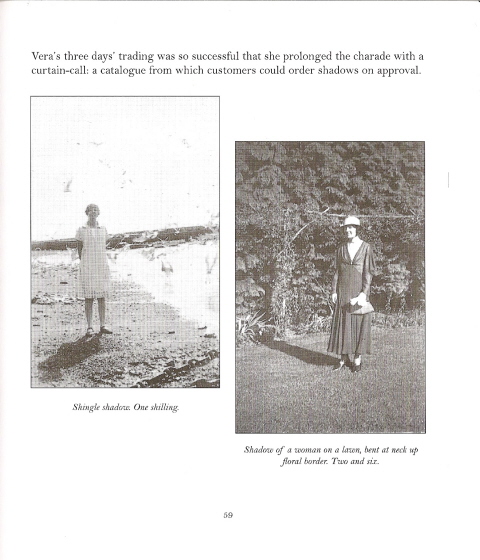
Rowley Hall, set in the artistic community of St. Ives, Cornwall, now sits empty and abandoned as the result of a restrictive clause in Vera’s will.  But once upon a time it echoed with activity.  Mervyn Rowley is described as a “sculptor, author and accountant,” Walter as “a retired vivisectionist,” and Vera (Walter’s niece) as “a geologist and psychoanalyst.”   Many of the family’s amateur experiments were in the area of art and reflect an obsession for explaining the very nature of art.  Mervyn’s boundless curiosity, for example, led him to experiment with weighing himself “whilst occupied with a variety of different thoughts” to comprehend the effects of gravity on different types of ideas.  Walter managed to discover that if spun at a certain speed, “a plein air painter will for a time produce entirely Cubist works.”  He also made the break-through discovery that “images grow weaker from being looked at (they suffer image-loss).”  Vera, for her part, briefly set up a shop in St. Ives where she sold only shadows.

This could all easily dismissed as a fun but forgettable whimsey were it not for the pleasure of Lanyon’s prose and the gems of perverse genius that can be found on practically any page.  Lanyon’s enthusiastic, gullible narrator is more or less the typical amateur writer who decides to turn out a family history, complete with clippings and old photographs pasted on the page.  The endless stream of unlikely stories and quirky theories that spew out of the narrator’s pen could inspire countless new artistic projects.
By twelve he had finished with architecture, changing course for less ostentatious activities.  For example, he wrote poetry with a pen which produced silken thread that the faintest breath disturbed.  One wrong move, of sentiment or metre, and the pen would reel in the entire rhyme like a disturbed pig swallowing her young.  It is in one of these frail texts sandwiched between glass that Mervyn predicted art would become an odourless and tasteless, if reflective (because it was behind glass) substance.  However, he believed that when it evolved into its final state, it would serve a vital function.  “For as mistakes are eradicated from every field of human endeavor by failsafe technology, art with its vast areas of emptiness will serve as a sanctuary, providing a final margin for error.”
In his notebooks, Walter theorized that artists were truly dangerous (although that never stopped him from making his own brand of eccentric art).  “As nature’s store of images dwindles…, painstakingly removed by painters or snapped up by photographers, the natural world becomes increasingly unstable.”

The total history of the Rowleys can only be found spread across a dozen or so limited edition, letterpress-printed artist’s books issued by Lanyon himself since 1987.  My introduction to Lanyon and the Rowleys has been through the invaluable efforts of Alastair Brotchie and London’s Atlas Press, who, in 2006, issued Circular Walks Around Rowley Hall, a “subjective and biased” selection and re-editing that Brotchie distilled from the various Rowley books.  (Brotchie says that the author’s response to his surgery was “exemplary.”  When you are ready to shake the cobwebs off your normal reading habits, get one of the many reinvigorating titles from Atlas Press. - sebald.wordpress.com/


LATEST BOOKS
THE ONLY NON-SLIP DODO MAT IN THE WORLD (A paperback edition at £10 is available only from Falmouth Art Gallery). Hardback edition of 50, not letterpress, 2013. £75.
SIX FEET TO INFINITY. Photographs taken by Andrew Lanyon in the 60s and 70s. Hardback, not letterpress, 2012. £65.
VON RIBBENTROP IN ST. IVES  (Published by Kestle Barton) Two dozen left. Paperback, not letterpress, 2011. £35.
THE DAUGHTERS OF RADON  Edition of 200. Hardback, not letterpress, 2011. £50.

ROWLEY BOOKS
In order of appearance. All are complete in their own right. No-one has ever been able to discern a sequence. All are letterpress, casebound, thread-sewn, in a slip case with tipped in colour plates. A set of all these Rowley books including a photocopy of the out of print ‘Deadpan’, £1,300. Some books have faint mottling on cover but otherwise good and guaranteed complete plates.
SECOND NATURE   ‘Lanyon belongs to the genus of Hamlets who clown, church organists who prefer pub pianos and poets who tap dance.’ Anna Adams. Apollo.  £295.
THE LOOSE CONNECTION  ‘Ingenious, funny, entirely constructive too given the chaos theory.’ George Melly. ‘The world would be the poorer without the revelations that a book like this provides.’ Sir Alan Bowness.  £220.
THE UNJUSTIFIED TEXT  ‘A bargain.’ Christopher Logue. ‘A beautiful, intelligent and provocative volume.’ Dan Rose, Word and Image Journal. ‘An exciting, incorruptible vision defended by a great talent.’ Derrek Hines.  £175.
THE QUICK CHANGE ACT  ‘Tears of laughter stream down my face…reading these books can cause untold damage to a carefully crafted face.’ Mo Enright. ‘Pure pleasure’. Ken Mellon. ‘The speed of delivery is breathtaking. Very, very clever indeed. A stunning simplicity and directness. The idea of all these cloned artists gives me a most satisfying hysteria.’ Lionel Miskin.  £175.
ROOM TO MANOEUVRE ‘Deftly using Vera Rowley as a literary conceit, Lanyon’s “Room to  Manoeuvre” is a profound work of “ction-philosophy-psychology rendered into his unique idiom.’ Christopher Bollas. ‘A major work.’ Simon Frazer. ‘One of the most satisfying objects and effective obliterators of ennui ever fabricated.’ Peter Blegvad. ‘The book blurs the boundaries between philosophy and psychology, between linguistics and logistics, between poetry and hilarity. Each new thought comes embodied in its own drama from a gentle reverie on the way children bring the house into the garden and vice versa to a superbly comic turn placing the origins of language in the excuses of male hunters when they failed to bring home the bison.’ Jane Addams Allen. ‘A distinctive achievement.’ Phil Bowen.  £175.
DYING FOR ETERNITY  ‘Magni”cent.’ Patrick Hughes. ‘The book: a glitter to “nd at every reading.’ Jennifer Martyn. ‘You do not open such a book so much as step inside.’ Des Hannigan. ‘Incandescent.’ Simon Frazer. ‘Lanyon at his unmissable best.’ Derrek Hines. ‘So much for science.’ Anton Nickson.  £120.
A PERSISTENCE OF VISIONS  ‘The humour is as fresh as ever and always masks serious intent. Lanyon invariably “ts his own de”nition “…poets are guardians of the groundless, last bastions for phantoms…” and at his best achieves its conclusion “…striving to touch the immaterial lightly with their lips, they sear the sea.” John McDowall. ‘I have sometimes wondered if Vera Rowley might have been up at Cambridge during Wittgenstein’s era – though her joyful detachment seems to have more in common with the great mystics – in spite of her ploys to dispel any aura of spirituality. A marvellous book.’ Jennifer Martyn. ‘I rarely have time for reading. But when I began idly looking through your ‘Persistence of Visions’ I was at once gripped and read it avidly with growing delight and sensations of inspiration.’ John Michell.  £100.
THE TOWER OF SILENCE  ‘A mature essay on language.’ Rodney Burt. ‘It made me laugh out loud, and rather raucously, so I was glad I wasn’t on a train.’ Roz Chandler.  £90.
A NOVEL SOLUTION ‘Intriguing background details to life at Rowley Hall. The art of camouflage refined to the nearest degree. Another essential piece in the jigsaw.’ Jennifer Martyn.  £90.
THE PALETTE AND THE RETORT  In which words and images fall for each other. A possible solution to the ongoing Rowley saga. £90.
VERA’S DISAPPEARANCE   Letterpress, hardback, 100 edition.  £75.

OTHER BOOKS
THE VEGETABLE PLOT  ‘One to think about as you weed your veg.’ Esmé Maylam. Not letterpress. £45
COUNTERART  ‘Innocuous yet so subversive. Very witty.’ Paul Newman. Not letterpress.  £30.
ANTI-LIT ‘I have giggled my way through ‘Anti-Lit’ several times.’ Peter Dallas Ross.  Not letterpress. £30.
A CARBON COPY  Not letterpress. £35.
NAPOLEON by Dave Scott about Bonaparte. ‘The robustly bouncing verse cuts the subject nicely down to size.’ Paul Spooner. £40.
VERTIGO  Christiane Kupke’s poems illustrated with A. Lanyon’s photographs. ‘Far above what one tends to find in poetry elsewhere.’ W. G. Sebald.  £40.
XAN XI DRINKS THE SEA  Paul Spooner’s incomparable working models. ‘Hybrid myth/models that transgress the rules of day to day sense.’ Dave Scott.  £45.
ABANDONED FILLING STATION Keith Spurgin’s nostalgia for motoring ‘fills me with desire to jettison my carless lifestyle, put on a pair of driving gloves and go flirt wildly with a pump attendant.’
Christiane Kupke.  £40.
LET’S PLAY DOCTORS  ‘I carry it with me always.’ Dr. M. Chaikin.  £35
LET’S PLAY TALKING  ‘Don’t believe a word of it.’ Rosa Levin. £35.
LET’S PLAY ANIMAL TRAINING ‘Another gem from the Sam/Rosa stable.’ Simon Frazer. £35.
LET’S PLAY HOW AND WHY with Sam and Rosa. 150 edition, folded, sewn.  £35.
PETER LANYON. THE CUTTINGS  Presenting the idea that this painter was driven by narrative as much as by images.  £250.

BOOKS BY OTHER PUBLISHERS
A FAIRY FIND (Portobello Books) Clothbound, full colour hardback. £12.99. Newspaper reviews: ‘Buy it or the fairies will get you.’ ‘A droll charming meditation on the power of the imagination.’ ‘A powerful, disorientating, idiosyncratic book.’
CIRCULAR WALKS AROUND ROWLEY HALL (Atlas Press) £18. Winner of Cornish Gorseth Adult Fiction Award. This is a selection from the “rst twelve Rowley books. ‘Inspiring, inventive, irreverent.’ ‘A literal visualisation of a joyous creativity is brought into being – a tour de force.’ ‘The iconoclastic insights and sparkling invention made me frequently laugh out loud with delight.’ Alison Oldham, Hampstead and Highgate Express.

BOOKS COMPLETED BUT NOT PUBLISHED YET:
IN SEARCH OF ROWLEY HALL
TO DYE ETERNITY

Youtube Channel www.youtube.com/andrewlanyon


‘Though Half of Me is Human’ by Andrew Lanyon with Angeline Morrison and Nigel Bispham. Animated by Paul Spooner.

Teddy’s Book of Nkots by Andrew Lanyon featuring Bill Scott and Dave Slater. Music by Pete Jones

About Andrew Lanyon
From 1966 – 1968 studied at the London School of Film Technique. Co-organised the Durham Surrealist Festival and produced a catalogue. Spent several years as a freelance photographer. Co-produced the Casual Eye, an exhibition about snapshots for Northern Arts. Assistant editor of Ambit poetry magazine for a short time.
In 1976 constructed The Rooks of Trelawne – a major touring exhibition for the Photographers Gallery (London), accompanied by a book. This was followed by another touring exhibition with a book, The Vanishing Cabinet.
In 1987 began self publishing letterpress books.
During the mid nineties, returned to film. The first to be released was Splatt dhe Wertha (Plot for Sale), a Cornish language film directed by Bill Scott which won the Golden Torc award at the 18th Celtic Film Festival in 1997.

1/2/14

Carina Finn explores the contemporary zeitgeist through the lyricism of fashion, pop, and the youthful vernacular, engaging readers by asserting a sense of self that is at once aware of its place in the cultural collective and of its undeniable otherness

LEMONWORLD & OTHER POEMS

Carina Finn, Lemonworld & Other Poems, Co.Im.Press, 2013.

ladyblogblah.wordpress.com/

Carina Finn's debut collection LEMONWORLD & OTHER POEMS explores the contemporary zeitgeist through the lyricism of fashion, pop, and the youthful vernacular, engaging readers by asserting a sense of self that is at once aware of its place in the cultural collective and of its undeniable otherness. The poems in LEMONWORLD are sound bites on crack, designed to be aurally devastating and always well dressed. - www.coimpress.com/


Carina Finn's debut collection LEMONWORLD & OTHER POEMS explores the contemporary zeitgeist through the lyricism of fashion, pop, and the youthful vernacular, engaging readers by asserting a sense of self that is at once aware of its place in the cultural collective and of its undeniable otherness. The poems in LEMONWORLD are sound bites on crack, designed to be aurally devastating and always well dressed.
"Whisper something sweet, ginger snow cake," begins a poem here titled "My Serious Virgin Mary Tapestry." And whisper something sweet this ginger snow cake of a book does indeedy, over and over again, until the teeth rot out of your eyes. Pithy as sexting, bratty as junk food, Carina Finn belches weird profundities here spontaneously, even and verily in the midst of all this burnt Barbie hair. "Peace is a field of graves," she says. Or, "My name is Christmas, will you merry me?" Lemonworld is as bright superficially as a sunrise, but what's inside will make you pucker so bad it'll ruin your face forever (4-eva).

Most People I know would hate this book, I think. They wouldn't be indifferent about it. They'd hate it.—Nick Demske
 
Carina Finn's works are like the poem equivalents of attending a tea party. Her voice is clear and young and true, and you kind of know exactly what she means in lines like, “this browniemix in me makes me wanna die.” These poems are little slices of cake, and some of them are poisonous, but all of them are sweet.—Amy Rose Spiegel
 
"I'm living in the alarm of a hand grenade swing": In Carina Finn's irreverent, fierce and clever Lemonworld, cuteness is weaponized, melancholy is threatening, and poetry is saturated by fashion's necroglamor. How does one read a book with this many hooks? Some may eat it like cake, but I prefer: "We'll fill our mouths with cinnamon now." It's funny, scary and beautiful.—Johannes Görannson

She’s basically a modern princess (one of the poems in this book is titled “modern princess”) who has come home for winter break to visit her mommy and sigh flippantly and eloquently at the whole entire universe. Carina likes yummy food (browniemix), fashion accessories, like ribbons, violence (“peace is a field of graves”), and the types of things Gertrude Stein would like — “16-year-old girl looking to buy a moustache.” To spotlight her forceful mercuriality, Carina includes plentiful exclamation points, one of the most comely types of punctuation marks ever. A couplet: “don’t trump the mode / there’s a rabbit in the marshmallow!” - Seth Oelbaum

A CONVERSATION WITH CARINA FINN ABOUT HER LATEST COLLECTION "LEMONWORLD & OTHER POEMS"

JC: The poems in Lemonworld and Other Poems suggest a singular lyric voice, so singular in fact that they strike me as issuing from a persona, a unified psychic source. What could you tell us about this voice? How would you like us to envision the speaker of these poems? Or is this simply too heavy a way to read your book?  
CF: Must a unified psychic source be singular? I don't think so. Comprised of multitudes of uniqueness, probably, but not singular necessarily. & must that which is singular be a persona? Definitely not. The voice of LEMONWORLD, though, was actually very specifically designed to be a sort of mesh-"I" for a unified psychic source -- the website Lookbook, in particular. I was really attracted to the way that fashion brought a global population of relatively young, sartorial-minded visual and writerly types to a focus point. I wrote the book during a time of great political unrest in Egypt; I was really affected by it, and my distance from it. I noticed a sort of bleed between the news aggregating sites I was reading and the fashion teenspeak and that seemed really significant to me. There are no heavier topics than teenagers and war, I think. 
JC: Reading your collection, I found myself thinking not only about persona, but also about location. Where might this ‘Lemonworld’ be found and what would it look like: is it urban, rural? Is it suburban? Is it some combination? Is it perpetually bright there ? I couldn’t help but think of a boardwalk yogurt stand. You know: the kind of place that seems charming, at first glance, yet by the end of the day, as early evening approaches and the debris gradually accumulates outside its foundation, appears a somewhat sad, seasonal, soon-to-be shuttered place.
 CF:  I worked at a boardwalk ice cream stand on the Jersey Shore the summer before my senior year of high school. Sometimes I feel like that experience infects a lot of my writing. Persona and location were two things I was thinking a lot about when I wrote it. I had just moved from the Blue Ridge in Virginia to Indiana, which was the flattest, vastest place I'd ever been. I wrote the whole first draft just outside of Miami, on my sister's bed. And I felt eternities away from horribly real tragedies. I felt both placeless and steeped in location. I was very consciously trying to conjure an alternate space in which to house my self, temporarily, and it seemed important to stow it with the many-tongued utterance of a universal: tragedy.
 JC: The style here interests me. These poems possess a quality of recklessness – is that a good word to use? – or a heedlessness – perhaps a better one? You attended graduate school, and have your MFA. Which means an exposure to theory and examples from an inclusive literary canon, yet these poems seem, in some sense, antithetical to those concerns. Is Lemondworld & Other Poems a book of oppositional gestures? Poems written against the serious, often overwrought products of the typical MFA workshop?
CF: In some ways, this was a reckless book; in others, it's some of the most careful work I've done. I wrote it very quickly, total immersion-style, and in that way it felt and feels reckless. That being said I literally did nothing else for weeks. I'd go running and to Bikram and cook and write these poems and that's it.
My MFA classes were far from typical. I never brought these to workshop, though -- the only people who saw them before I sent them out were my advisor Johannes Goransson, my friend CJ Waterman, and my sisters, who were 16 and 10 at the time. I wrote the poems for my 16 year-old sister, specifically, so I guess in that sense they're anti-"Workshop." It bothers and always has bothered me, the way the connection between poetry and teenage girls is thought of as somehow auto-kitsched, because the interest of the teenage girl is fleeting and superficial. In part, the brevity of the poems is a comment towards this. I wanted to write serious poems for that demographic, poems that addresses their concerns without sacrificing a complicated relationship with craft and form.
There is something oppositional behind these poems. It has nothing to do with MFA programs or the socio-political/pseudo-economic landscape of contemporary poetry.
                                                                                                                       
JC: Some of the poems here are rather hilarious. “Quite Possibly Rock & Borrow Rose” comes to mind. The ending defines a certain contemporary attitude: 

good morning, school bitches,


f**k me, I am famouse!

We labor over endings of poems. The workshop encourages this in us. What you give us instead is a mixture of Franco, Gomez, and Korine. The poem shows us a way which isn’t the way, according to some, but is nevertheless a perfect ending. Who knows? Maybe I’ll see this phrase tattooed on a bicep or forearm one day.  
CF: That would be a baller tattoo. The Exeter Book Riddles are a major major influence on these poems. I think those poems are hilarious, almost in a mean way; they have swagger. It's deciding to smoke a cigarette when you're fucking someone and they really don't want you to stop.  
JC: Brief poems, many poems. The use of couplets, words strung together reminiscent of the wordplay of E. E. Cummings, iteration reminiscent of Milton’s “O dark, dark, dark amid the blaze of noon’, pop culture references, drug references, love poems, and poems of direct address – thus my sense that there is a consistent persona behind these poems and even a locale – a version of the protected garden? – a ‘lemon world’ , fragments that suggest the Sapphic, a slightly 60s vibe (think Richard Brautigan and Lou Reed), a kittenish, playful tone at times, a great lonely sadness at other times. How would you correct my approach to your poems? What would you tell me, as I begin to read these poems again, that my serve as a corrective to my misunderstandings, that might help me experience them more accurately than before?
 CF: Oh good lord. I don't think there's an accurate way to understand a poem. I'll just say some things about each of the things you've mentioned: I read a few e.e. cummings poems in this really great two-semester seminar I took in college called Modern and Contemporary Poetry. We read the Norton anthologies and a lot of criticism and Lifting Belly in its entirety. I love that line of Milton and I love pop culture. I'm not sure how I feel about references but what would a person be like if they were never referential to anything, ever? They would be an intolerable narcissist. Drugs, love, and direct address are three things I believe in. When I was a teenager I painted a bust of Sappho as a chorus girl in a modern adaptation of West Side Story and forced my mother to display it in the front hall of our house. I have a Lou Reed playlist on my Spotify but I did not make it.
Today I was lying on a futon in the mountains watching the Perseid meteor shower and thinking about sadness and a wild kitten jumped into my lap. 

TWINNING

a body is a car accident. like, a cardboard box is the bloodiest retraction. windowsided backbreaks are the preeminent tragedy. the age is lemonade. this is the horizon of modernity. a woodcut is plastified; the input is trimmed. masquerade! there is an age. like, who even uses sentences anymore.

JC:  This is certainly one of my favorite poems. It’s incredible in its critique of our modern world, our ‘lemonade’ age. But modernity, which is canonical by now, still exists on the horizon. The woodcut really is ‘plastified.’ I’ve seen them, and they really are monstrous. Input, input everywhere, but not a drop to drink!  Have we really reached the end of the sentence? Are we on the verge of ‘whatever will come next’?
CF:  These are the questions. I ask them all the time. I have a hard time with the idea of the modern world. Sometimes I think it's a total ruin. Especially when I'm in nature, which is where I am now, and I think about the urban landscape, all that comes with it, and everything you lose. 
AFTERNOON ZEST IN A HAPHAZARD ELSEWHERE


something different – a spring feeling!

                    grooveking, anyone can tap my heart

 
doublemercy pushing kiddo,


photograph me to nowhere
 

                   & triarevolution in a sea of pastel cups.


JC: Which is a delightful poem!  I find its echo of Cummings rather wonderful, and the employment of the word ‘tap’ truly inspired.  
CF: I aspire to incite delight! Truly. I have this troubador theory about my fundamental self and that it is probably why I feel best in acts of wooing, acts of charm: singing and poem-writing and everything power-ballad, arriving astride a horse. 
JC: Is there a poem here that seems utterly essential to the book, that single poem without which the book would not have been written? Perhaps there is a group of poems, a central few?  
CF: The whole thing went off inside me at once. I remember its genesis as nuclear; immediate. 
JC: Carina, thank you for taking the time to talk to me about your new collection.
- Jon Cone  theartaudexpedition.blogspot.com/

scan0008

Carina Finn, My Life Is a Movie, Birds of Lace, 2012.

Exteriors, interiors, film sets, sisters, cowboys, government, punching screens, voracious living death instincts, and everything of life or just propelled towards it with a ratty bow in its hair.

I fall in love with a cowboy in the middle of a great tragedy. the great tragedy is my life.
I love a title that I can’t say without bringing the back of my hand to my forehead and affecting a Katherine Hepburn voice. Anthony Hopkins affected a Katherine Hepburn voice for the role of Hannibal Lector. I have hungered for a book like this a cannibal hungers for flesh. This is like getting a text from my boss that says OMG, this book. This book is forty-nine pages, it’s a chapbook, with the kind of shimmering density that dances and transcends that giant, strapping books can never achieve. I want to quote the whole thing.
in real life I am at a bar wearing a white lace dress with a collar taking whiskey shots and fighting about the significance of mania or I am in the streets wearing white stockings and falling down and having done so give myself permission to stay up late eating icing. tomorrow I will spend a long time considering the potassium content of bananas and comparing the labels on cereal boxes in an effort to refrain from falling down or I will run up and down all of the stairs in red leather stilettos or I am soaking my teacups in brine. I coddle eggs in jars or bake tiny muffins in heart-shaped tins or roll out dough on the kitchen table while reciting long passages from sylvia plath’s biopic. I am frightened and little orchards emerge. I buy organic milk organic eggs tofu and three kinds of coffee, one of which is icing-flavored. in the morning I will drink three cups of icing-flavored coffee and read blogs and wear my apron until noon. I will think of what it is like to live in the land of the free.
Carina Finn’s poetry is the icing-flavored coffee of the English language. I knew I needed this book when Finn posted COSTUME DRAMECONOMIES (WHAT THE NEW NEW SINCERITY CAN DO FOR YOU!) at Montevidayo. Finn said she arrived at her final thesis reading at Notre Dame “in a pretty typical outfit: red-orange lace babydoll dress, white thigh-high fishnets with giant bows, black over-the-knee boots, a blue satin ribbon from a poet-friend worn as a belt.” When she was finished reading, no one spoke to her.
I wonder whether my ideas would have been received differently had I worn a black suit, or even a dress that was not bright red, or had eschewed the fishnets and boots in favor of some sensible heels or ballet flats. But, as is always the case when I read or speak in public, my outfit was a major component of my performance. A director wouldn’t send a Violetta onstage to sing Sempre Libera in sweatpants, and I wouldn’t throw myself into a hostile intellectual environment without my fishnets & bows.
Without Finn’s fishnets and bows, I would not throw myself into a hostile intellectual environment, I would not brave that cold and stupid world. Woe to those who diffuse tantrums: you’re in trouble. “in real life I discover that diet cereal does in fact taste like cardboard + I have managed not to kill myself for three days in a row which is an accomplishment.” I like books that admit that admitting does nothing, that transcription is impossible, that catharsis does not answer its own questions, is not a neat phallic mushroom-cloud, that Anne Sexton’s analyst was a fuckhead. When asked why it took her thirty years to write poetry, Sexton told theParis Review in issue number fifty-two that her analyst told her the value of her poems lay in what was springing forth without her knowledge – the secrets she was too damaged to appreciate – not the skill with which she crafted them. “I didn’t know I had any creative depths.” Carina Finn knows and she knows it shows. She affixes her depths to her babydoll dress. Little orchards emerge. Even when she is frightened, look at what is wrought.
I go to a lot of bars or apartments mostly to get very drunk and coordinate outfits by text message from across town or spend an entire day getting lost with a purpose. in the afternoon it is so white or I am standing on the wrong subway platform watching the sunshine like murderlight or morning-sex light in french films and this foreign man walks up to me and tells me I am beautiful and asks permission to ride the train with me like it is okay to be so earnestly romantic in the afternoon or I am a girl getting into a taxi alone and asking to be taken to the site of a disaster. - Kari Larsen 


Image


LMB: You recently defended – for lack of a better word – the use of melodrama in poetics. Why do you think people are so uncomfortable with it?
CF: It’s funny, because I don’t think melodrama itself is the problem; think, for example, of the melodramatics in Keats, in Eliot, in Donne – the first stanza of The Good Morrow is as dramatic as any Lana Del Rey song or Minnis poem. I think the real issue is that people have a problem with feminine melodramatics; it’s why Plath became the poster child for some crass concept of Confessionalism (even though another melodramatic man, Robert Lowell, is really responsible for that whole mess) in spite of the fact that she was a master craftsman and genius of the literary costume.
So, I think it’s a gendered issue more than a simple one of dramatic/not-dramatic. The “problem” with girly melodrama in contemporary poetry has to do less with the gesture and more with the thing against which the dramatic girl or queer of female-identified poet is reacting against. Look back to Freud’s case study of Dora, the classic hysteric: her fits of melodrama made people uncomfortable because it forced them to acknowledge some previous hurt or wrongdoing. It’s easier for people to discount the dramatic female voice in literature as a substanceless performance rather than actually dealing with the issues that would cause someone, say, to want to put together something like Marie Calloway’s Google Docs, or Joyelle McSweeney’s very bratty and dramatic Percussion Grenade – which is all about acting out, being loud, wearing costumes, and throwing a tantrum.
LMB: MY LIFE IS A MOVIE – the title itself – is a good bit melodramatic. People seem to be afraid of too many details; I’ve been told myself that “sparse” is good. Less isn’t more, to me, though. In fact, I think melodrama goes a long way. You detail your work extravagantly; I feel like I am getting wasted and then having my heart ripped out. Did you write this book for you, or for the world?
CF: It is dramatic, and intentionally so. In a lot of ways, this was a way for me to work through the issues I have/had with the label of Confessionalism; A lot of the things in MLIAM actually happened, and that’s why I chose the title. The scene with the Austrian welder and getting lost at Ground Zero, and there’s a bit where a jogger gets hit by a car; I workshopped an early version of this and someone actually said that the getting hit by a car thing felt too contrived and overtly melodramatic, that it seemed as though I had put it there for shock value.
The other thing that’s important to note is that MLIAM came directly out of the co-morbid phenomena of reality TV and child actors. My mom and sister had just started filming Dance Moms: Miami, and I had shot two episodes with them and felt really conflicted about it. I was a professional actress for like the first eleven years of my life; I used to be really ashamed, and kept it secret. In graduate school I decided to “come out” as a former child actress when Johannes [Goransson] made us write these manifestoes in my first graduate workshop, and for the first time I allowed myself to acknowledge how intensely that experience (I mean, it was literally half of my life, at the time) affected my poetics.
Growing up in the film and television industry gave me a really different way of thinking about ideas of framing, narrative, truth, and performativity, I think, and in MLIAM I try to give the reader a sense of what it’s like to live within or in the aftermath of that experience.
LMB: You’ve created The Bratty Poets Series. Is there a certain brattiness in all poets that goes unidentified that you’d like to showcase?
CF: Absolutely, and that’s why I started the series – which is less a “Series” in the traditional sense and more a sort of watering hole around which people might gather when they’re feeling a particular variety of thirst. The thing about brattiness is that it’s sporadic, irrational, sometimes childish, and always right. It has an aesthetic but it also doesn’t exclude any particular aesthetic or camp, it’s cliquey but it’s a quality of every clique, by nature. The Bratty Poets Series, more than anything else, is a way to start breaking down the whole “these cool kids over here, those cool kids over there, these aging hipsters hanging out in Brooklyn, those pretentious hipsters in the Academy” quality of “the scene,” such as it is. It’s a nicely decorated padded room in which poets are totally allowed to have a fit.

LMB: Your book trailer is touchy. In it, I say that men don’t only love women for their breasts, but it’s sure a reason. Why did you choose to record your friends, and how does this relate to MY LIFE IS A MOVIE, aside from the obvious?
CF: MLIAM has two definable locations – the City and the Old West. It’s never really clear which is the real and which is the sur-real, because they’re generally interchangeable terms in this movie. When I moved back to New York this summer I was staying with different friends, all of them poets, I was out of school for the first time in almost ten years, I had one suitcase and a guitar, and I felt this really intense sense of being non-locatable. So the footage I shot during those first weeks when I was back in the City and I was really emotionally in shambles for various reasons were in some ways an effort to create for myself a sense of reality; this is my place, these are my people.
The first video I took was of a poet friend sitting on her couch, on which I was sleeping at the time, smoking a cigarette and crying and talking about how many times she had tried to quit smoking. It was very early in the morning, and all anyone had done so far that day in that apartment was write poems and smoke cigarettes, and the light was really perfect and her sadness was so real and beautiful and happening right then; it was like when you see your favorite painting for the first time and want to keep it with you forever. I had an iPhone and there was this gorgeous thing happening front of me and I thought, people should have access to this. Which is the same thought that’s really at the heart of MLIAM.
LMB: If your poetry were any pop-star, who would it be?
CF: Alanis Morisette. She’s such a brat, and very angsty and melodramatic. She’s also a brilliantly talented technical musician. People tend to not see the latter and just think of her as that heartbroken 90s girl who screams, but she’s way more than that. And my favorite Alanis Morisette song is Unsent, which is absolutely no one’s favorite Alanis Morisette song. I was eight when it came out, and it was and is very relevant to my life.
LMB: We both just received our MFAs in poetry. There is a lot of talk about uber-Masters and medieval practices and sheer wastes of money. What are your experiences with the system?
CF: I’m probably the wrong person to ask about this, because I believe fully in the ideas of Poetic Lineage, the tradition of an apprentice being shepherded along by a Master, and Feudalistic economies in general. I write about it in an essay on my blog called FEUDALISM IS RAD, and you performed the role of the Idol in my play, EVERYBODY, LET’S BELIEVE IN THIS IMAGINARY CURRENCY at The Bowery Poetry Club last summer, which was essentially “about” the whole issue of the MFA economy. As far as the MFA itself goes, there are a two things I was told by the person who taught me as an undergrad, and these are some of my personal ultimate truths: don’t pay money to get an MFA, and don’t get an MFA for any other reason than the luxury of two (or three) years during which you have no obligation except to your work.
That being said, once I got to my MFA program (which was amazing, by the way, and certainly not for everyone but I wouldn’t have wanted to go anywhere else) I got very angsty and resentful of the whole thing. I wrote this long allegorical poem called The Princess and The Ivory Tower, which was a very bratty treatise on what I perceived as the injustices of being a young female in a fundamentally broken Academia, during my first semester. That poem really idealizes the sort of Grand Pastoral experience of learning about poetry, which is an exaggeration of my experience as an undergrad, as antithetical to the sorts of masturbatory arguments that can happen in a hyper-theorized context. In retrospect, I’m really glad that such places exist so that arguments, in general, can happen. They need not be “productive,” they need only to continue.
LMB: You write, “I feel so sincere it makes for bad poems” in MY LIFE IS A MOVIE. How does any good poet balance sincerity with craft, and how do you translate the bigness of life into a poem?
CF: That’s the Big Question, isn’t it? Especially with all of the “New Sincerity” vomit all over the internet (to which I’ve admittedly contributed a few bucketfuls). During my aforementioned Grand Pastoral upbringing, my teacher brought two irises into his office when we met to discuss my poem one morning: one was a wild iris, and the other was a hothouse iris. They were both formally excellent examples of an iris, but one had certainly been bred/crafted to have a quality of showiness, whereas the other had more or less just grown. I think the lesson he meant to teach me that day was about the difference between a public and a private poem, but it seems to apply to the sincerity argument, too. Is the hothouse iris less of an iris; is the wild iris less beautiful?
LMB: Your life/poems is/are a Lynch film. Which one?
CF: Actually, I totally can’t watch David Lynch films. And I don’t like Twin Peaks. I’ve tried, and I just can’t – but I get why other people are into it. My life/poems are a Meg Ryan romantic comedy, or one of those movies in which Drew Barrymore fucks everything up and still gets the boy.
- www.thethepoetry.com/


Carina Finn, Heart Marlon Brando, Wheelchair Party Press, 2010.

poems in smokinggluegun.com/
poems in www.alicebluereview.org/
poems in  similarpeakspoetry.com/


SANS SOUCIfor Ariana
“I lay traps for troubadours who get killed before they reach Bombay”– The Rolling Stones
Epilogue: The day falls beigly on a corpse in a citadel alongside the sea.All night, the regent’s lips wax shut.Her silence is not free; people will pay good money for a missed train,to watch her fuel get leeched, and shimmer…
The kingdom by the seais actually a screen. I am a queen I cannot decry. I am dressed,not darling; my sisters are coming.We are going to sand down the beaches like heathens. We are going to
plant kisses on handsome enemies. Little bower –you are a drudge, a misstep.I am going to take you home to fret. It’s not a pomme on a desk it’s anoligarchy. It’s how the masterful shine of our souls
bespeaks a curse.Tables of smoke grow quills like a dirge for tattered girls pressing linesin old snow. A coin is sewn into the lining of a cloak.Anathema quiets lambs on the breeze; they are licking up
blood from their bottles, decanting a language the populace forgot.And here we are soaked in a hutch of root & rot.Some rabbits I have known try to cuddle the book.They practice with crowns but it is useless; their crowns are buttons.
Their buttons are horrible favours of dread.They are holding out their necks for the priest with a fiat, fiat, fiat rex.A cope of sky, a vestement. A diadem won’t make you happybut it might stick a fowl for your table & follow faithfully          to rest.


IN:VOCATIONfrom*/apocrypha.  
this is the hour of erasure.this is the moment of the desolate commensurate.we are sorry, we cannot address your requestat this time. we are sorry, our best dressesare already occupied. are you interested in trading inyour body for apostrophe? are you a participantin the metalphysical scene? imagine you’re anomnivore about to make a line break. imagineyou’re a hollowwhore who has to break a timesteak.there are infinitely many consciousnessesin which we could exist.a book is a freakout which deletes transition tryst.without strong static, who’s an addiction?a whole concentric verse of being.helpless throes of metacorpse,aprocryphallic dangerhoax;this is the joke of the century boys.this is the tome that creates a whole.how many drones get to hold you, my love?how many holes to mannermasque?I was a text & a trusted friend.the verse reversed my urge to hide.these hallowed minds rescind my prideand mine the hapless, heartfelt line –

Carina Finn is a poet, playwright, and multimedia artist. She is the author of I HEART MARLON BRANDO,which was published in a limited screenprint edition in 2010 by Wheelchair Party Press. Her play, EVERYBODY, LET’S BELIEVE IN THIS IMAGINARY CURRENCY, premiered at The Bowery Poetry Club, and THIRTEEN WAYS OF BREAKING was workshopped and premiered thanks to the generosity of the Film, Television, & Theatre department at The University of Notre Dame. She a graduate of Sweet Briar College, has an MFA in poetry from Notre Dame, lives in New York City, and blogs at http://www.ladyblogblah.wordpress.com