9/21/16

Monica Mody - an allegorical screenplay that's both playful and terrifying. KALA PANI begins in a familiar, stripped down setting: a stage, actors, a Godotian tree as prop. But soon the Beckett allusions fray into the Boschian as the play embarks on a hallucinatory, postcolonial and tech-riven romp into the deprived lives of World Travelers.


Monica Mody, Kala Pani, 1913 Press, 2013.
www.modymonica.com/


Read excerpts from Kala Pani in 1913 a journal of forms, Boston Review, LIES/ISLE, The Volta, and on Truck.


Monica Mody's KALA PANI is an allegorical screenplay that's both playful and terrifying. KALA PANI begins in a familiar, stripped down setting: a stage, actors, a Godotian tree as prop. But soon the Beckett allusions fray into the Boschian as the play embarks on a hallucinatory, postcolonial and tech-riven romp into the deprived lives of World Travelers. These world travelers (aka, Migrants? Writers? Revolutionaries? Insurgents?) are marooned on a colony island and spin tales such as the story of two sisters, Othershape, and Sameshape. KALA PANI is packed with stories-within-stories and voices that range from officialese to rebellious neologistic song: 'the blubs squeezed themselves into a phalanx of pulped fury.' With each scene, you descend into stranger circles of hell and hope. KALA PANI encompasses plenitude; it is uncomfortable, startling, timeless, and ultimately original."
--Cathy Park Hong

 "Monica Mody is a poet of sacrifice: Writing to us from the space behind the sun. “Elemental and artificial,” the world traveller licks the map. The word traveller lies down on her back beneath the “life-sized fabric” of the sky. This is a sky that surveils recumbent forms, agitated consumers and the person who wants to be “in a relationship” with the polyvalent neutrality of “a connoisseur.” Meanwhile, the narrator “is asleep.” Black water starts to seep up through an architecture that’s ruined, like a leg that’s been soaking too long in the bath. Architecture is pink, fleshy and ridged in Mody’s spectacular work on Empire. The poet-citizen is nauseous. “Stomachs” are heaving; “bibs” are in place. And at the heart of this death-star society, “funeral pyres” are burning at the edge of a dirty lake. Mody puts this ash into the mouth of the reader. This is the black water. This is the ritual that precedes whatever it is it will take – threads of wool? – to lead a person “back to us.” This is never, exactly, the same thing as home – the “ground” that Mody complicates, again and again, in the rupturing vortex of KALA PANI, a book without “remorse.”"--Bhanu Kapil

 "I keep handy a short list of writers who teach you that dreaming of a new politics is never enough. A new politics always needs a new language. That is the lesson offered by Arundhati Roy and Tony Kushner. After reading KALA PANI, my list also includes Monica Mody."--Amitava Kumar


"Six World Travellers, bereft of visas, gather beneath a tree to tell the story of Sameshape and Othershape — lovers, sisters, coconspirators, antagonists, doubles? — while the new Administration looks on, both feeding the informants and censoring their live-feed. The resulting contortions, stutters, hallucinations, fight scenes, sex scenes, mise-en-scènes, warblings and appendages, jerk and brim with jouissance and glitter with the self-discovery of a true bricoleuse. Gender, genre, national identity, multiple languages, and the body’s “natural” borders are all debased and reworked in this queer, unstable mix, which releases energy as it forms and breaks down and forms again. Welcome to the world of KALA PANI. Drink this smoking stuff and live forever."--Joyelle McSweeney


"...a series of fractured tales crowded into a awkwardly beautiful postmodern dastan, or a long narrative poem—the likes of which you might get if you locked Dr. Strangelove, Scheherazade, and Seuss’ Onceler in a room and told them they couldn’t come out until they’d written an allegory for our times."--Michael Creighton


Monica Mody’s Kala Pani brings together theater, folklore, faux-journalism, the suspending enjambments of poetry, and the disruptions and connections of electronic media in a fascinating formal pastiche that creates an environment of “mythic static.” Titled ostensibly after a British colonial prison to which Indian political prisoners were exiled, this book stages “a remarkable feat of intervention” into our assumptions about self and other, the private and the public, narrative linearity and associational scope. Kala Pani also applies pressure on our assumptions about the “elemental & artificial.” The reader revolves antically between these as opposing modes of agency, struggling for balance as disingenuous narratives multiply.
Mody demonstrates how narrative patterning can confine and overdetermine meaning. Tellingly, the book begins with a frame that stumbles, trying to get its “vision straight.” The frame itself is located on a stage, and this is a central conceit of the book: our realities are staged and restaged. One layer further, Kala Pani presents six world travelers who strive to travel within story, but who suffer under the constraints of rational presidents, rigorous training, and official narratologists (“These stories offspun by our most popular minds that were certain, certain that you would have no better story to tell”). With great inventiveness, Mody wends narrative around and within narrative, as though the bonds and bounds of story could twist, Houdini-like, to effect their own escape.
Her featured players, narrated with brilliant inconsistency by the world travelers, are “Sameshape” and “Othershape.” Any account of the relation of these two (sisters? lovers? performers in a Bollywood production?) is likely to unfurl into blatant contradiction. Is Sameshape a baseline by which any difference in Othershape can be manifested? It’s impossible to say. In any case, Sameshape and Othershape eventually become part of the audience. A long sequence that has the two reciting names and nouns back and forth to each other devolves into a kind of burlesque nonsense: the would-be protagonists tease the audience with names that don’t attach to any identity.
As witty and lightfooted as this book is, the shapeshifting characters function in an admonitory way, for no one ever truly gets away. The official news organ posts a headline that promises to explain “Why Freedom of Expression Will Prove To Be An Ordeal for You.” As the book comes to a close, the stage seems to dissolve as the “curtain falls apart, having nothing else to live for.” Thus, one framing narrative after another collapses. Mody erects this endlessly recursive line-of-dominoes structure and then topples it.
Having navigated this wild ride of a text, however, discouragement is the last thing that the reader feels. Rather, one emerges with a feeling of glee. Every moment of this book is a testament to resourcefulness and insubordination. The detours and proliferations of Kala Pani, along with its embrace of absurdity, become a means of survival that jumps over the limitations of the rational. There’s a sense of suspension, of process—“cursor in internal disorder”—that beguiles the intrepid reader to follow chaos into constellations that make order as we know it irrelevant. - Elizabeth Robinson


Kala Pani: opening shot, the audience & we are immediately, irreversibly accessories to its crime-en-scène, the impossible play of its cruel theatre. We are offered a shot of its sugar butter cocktail, drunk to see “what the world is doing right now”:
The world is, like the conversations detailed by its six marooned world travelers, “in tatters.” These travelers, arrested in time/space by the new world government, unravel their mise en abîme of the fungible Sameshape & Othershape, a bracing litany of ducks, and a slut-shamed lentil bean in their broken dialogue, broadcast over webcam and radio, the stream of their exchange tapped and disrupted by memes of gossip rag tell-alls, the Rational President’s empty PSA’s, and a rabid Ideologue’s perestroika.
Their stories intersect, merging narratives and enjambing over prosey stanza breaks:
[SIXTH WORLD TRAVELER]
…That wears the crown rests easy. Therefore the tree,
having learnt its lesson well, found itself in this
strange condition while
SAMESHAPE & OTHERSHAPE
Writhed and moaned inside the car, and
TREE
Secretly felt something wet rushing in its veins
something like a sponge something swelling as it spied
on them, Something turned loose. O N E moment. O N E
hair stuck to its scalp. The tree, aroused, touched
its
SAMESHAPE & OTHERSHAPE
Mouths on each other, did not [sense the danger]
So rest and writhe these characters and stories ‘neath the Tumtum tree, [a Banyan tree, a Nimtree, a Poetry], tongues and tales wagging in double-time. Mody deftly unpacks these narratives with a traveler’s resourcefulness, using up every item in the utilitarian sponge bag of formal devices and turning well-groomed stories out its plastic edges. Her stories bleed through the dialogue tags of a shifting cast, interrupting (and simultaneously permitting) a fluid reading experience, for the convulsing, contracting text constantly demands our vigilance as it indulges our fleeting attentions, ever-broadening to accommodate its myriad/polyvocal forms. These characters and tales exist, ostensibly, as an array of amuse-bouches to stave off the hunger of prying eyes and wagging tongues—and for the reader, this raison d’être unfolds as their in[ter]ventions in language—the stunning beauty of their fantastic creations, the deftness of their phrasal turns, as in the Fourth World Traveler’s account of the lentil bean,
…A3. There was nothing in its pheromone hamper. Out of deep shame and anxiety, it decided to wear only t-shirts and pajamas for an entire month/year. It turned up wearing increasingly sexless t-shirts and pajamas. Its favourite, a poplin forest green pair with embroidered elephants and a drawstring waist. The elephant, humbled, wandered off. Tusk, tusk. The lentil bean woke up sweating in them and also spent the day in them. Thrifty-eyed, its mother scolded, but the lentil bean was growing up fast.
…KX. It was the year of benign fashion. Husks gloriously covered with tan fibre, a group of giggling food legumes cavorted on public promenades. Chickpeas looked up the splits of moong, and moong looked up the splits of fava beans.
or the stripped-down Steinian syntax of the Fifth World Traveler’s meditation on ducks:
A duck wants to know errors. A duck wants to know, er. A duck is in the know. A duck is in error. A duck is in, er. A knowing duck is a wanting duck…I pitch my duckness at you. Catch it, it is slippery. It is velvety smooth. I want to transmit my tasty duckness because it is too hard to be a duck alone.
The gestalt of Kala Pani’s characters lies in this work, of art, of a gendered racialized geo-graphic and identitied—simultaneously, flatly localized and unlocatable—performance, of translated and nontransferrable narration, a work that systematically and rhizomatically deflowers language hierarchies and codes of conduct. It’s been “more than [two] years since six clients were chosen as part of the new government’s plan to reappraise its official position on the borders of the world,” the Culture & Society Special Report informs, and their work “is far from over.” The work Kala Pani’s characters perform on language rips open its seams and strips it down/up to code; in Sameshape & Othershape’s (now Sameshape Jaan and Othershape Jaan, a Punjabi and Hindi term denoting the dearest and closest of lovers) closing act, their frantic love-declarations are encrypted in seemingly nonsensical strings of Anglo names:
                                              OTHERSHAPE JAAN
Lincoln Ida Mary Edward Robert Edward Nora Charlie
Edward
…SAMESHAPE JAAN
Love in Mother Edward Roger/Robert In Charlie King
SAMESHAPE JAAN & OTHERSHAPE JAAN
{blind}                                                                                  {spot}
{tittered}
 The expression of obsessive desire (limerence) dissolves into the fodder of poetic canons (limerick), actions colliding in the stage directions and utterances finally transforming into, “MARY UNION TOM UNION ADAM LINCOLN FRANK EDWARD ADAM ROBERT” and an incanted, “PETER APPLE NUTS IN CHARLIE.” Semantic meaning has disappeared completely behind artifice.
Our undaunted six and the “contorted face of the revolution” flagging, they too, like the world they quintessentialize, dematerialize in a last show of artifice, sent to a funeral pyre, to be dis-armisticed and leaked out/in history’s annals. The film concludes with a beauty shot of the giving tree felled to a ground that “grew movie star sunglasses.” The final scene turns its camera on us, the audience:
Apperceptive shot. The epilogue looks around from the toaster, ready for butter…Who is this movie about? How long ago was longing seized? Did it sneeze? Am I truthful, or are you? Add up I+you? 1+2?
and Mody interrogates our mercurial affections and the anonymous collective schadenfreude of our surveillance society. Language, attention, and [in]actions are put on trial a final time, sweetly interrogating our convictions and sentencing us—“The ease with which the pipeline is buried here? Pipe it, sweet youth.” If Kala Pani be the film of langue, pipe on! - Jacqueline Kari


In the Canterbury Tales, some travelers meet by chance at an inn. They tell each other stories to pass the time, and the stories reveal their world—its hypocrisies, its ideals and bad deals, its deflations and delectations. The people in them undergo suffering, humiliation, glory and pleasure, but the major relish is in the recounting itself. In Kala Pani, Monica Mody’s strange new text, six world travelers—travelers from the First through Sixth Worlds—are becalmed in their travels by the new government, who’s withholding their visas and planning to chop down the tree they lean against. They, too, tell stories that reveal their feverish, gaudy and hamstrung worlds, painting the insides of their cages with every available secretion.
Kala Pani draws some of its black water from the same mutated gene pool as the work of Joyelle McSweeney, Lara Glenum and Feng Sun Chen: monstrous porous bodies, profit and lust, e-surveillance, and the sores kept open by attempts at control. It draws on the recent past’s most marketable stories and categories, and shares with McSweeney in particular its filmic stutter; the audience is also a character, and not a harmless one, within the queasy frame. “Contradictory structures had left the audience breathing hard. Were they expected to play? If so, what was their role, and how much sugar?”
Later, as “CERTAIN CORPSES FLOAT ASHORE”, the Fifth World Traveler intones, “You, too, are guilty. What can you remember? What do you miss the most? Here are the rules of the game,” and adds in a footnote, “Go on, play it. In fact, I insist you must.” There is no escape. Like the lentil bean character, who starts its story in a literal cage, we may dress in “increasingly sexless t-shirts and pajamas” or “plus-sized earrings, hooped neckties, rogue haircuts, flannel gadgets, caramelized chains …” and a page more’s worth of costume, but we will end up in the soup.
Kala Pani fits the loose editorial definition of a hybrid text: it combines the intense play of poetry, language as live field (“Baby raked the smell of mothermilk into a cracked balloon bag and wiped her feet on it”) with structures of screenplay, newsfeed and public relations statement (“They looked for clients who offered super graphics and stunning sound”) as well as narrative threads and characters who keep the same names throughout the book. Hybrid also refers to mingling and impurity, the creation of “new” and “mixed” organisms, a hint of praise mixed in with a hint of condescension, as if from the assumption that the speaker, of course, is not a hybrid. Is pure. Kala Pani is a degustatory, disgusticulously impure text; it makes use of forms, like stories, that it also mistrusts:
Spending the days delirious, so happy to be loved, so happy to be in this blank
bliss, so happy in this story this truth never before, biting from the inside out …

A story’s hand curled around their neck, rubbed their earlobe of silk and they
moaned and their vagina soaked and they shut the door on questions. The story
ordered a huge feast that night, all its friends came over, and the world travelers
danced and danced and felt quite stormy.

As they finished their training, a small part of them realized that the story stirred
into them was darkended, but they were too afraid to dwell on it further.

Lovers kiss in the moonlight, but lovers and moonlight are both in a junkyard of capitalism, and their raconteur claims not to have the language to reveal herself or them—“these immortal lovers,” “these important lovers,” whose importance and immortality are adulterated, mined, commodified by the other elements of their story. “I turned them into media sensations,” recounts that chronicler, who with the other World Travelers is stalled, surveilled and eventually burned on a pyre at the greedy behest of the new government, into which everything in the world of this text seems to play—including us, whoever we are, as we read, by reading, not only by reading.
In a 1986 interview, playwright Maria Irene Fornes said, “[In Waiting for Godot] Pozzo beats on Lucky and at the end Lucky doesn’t get free, but it doesn’t matter because I do!” Reading, I felt played by Kala Pani; I wanted the way out of the cage to be in the book. I wanted to see someone get free, or go home. But if there’s pleasure here it’s in the telling—the flock of ducks in seven pages of gleeful linguistic permutations is just one example—and if there’s freedom to be made here it’s in what a reader, a listener, does when the stories are over and the audience pours out blinking into the street. - Kate Schapira


Coming at you in vatic stereo, a screenplay live from Radio Delhi, Monica Mody’s “Kala Pani” is a work of words almost beyond description, full of rapturous code, ensnaring tendrils, choral voices, double-exposures, wondrous bad synching, and spectral and degrading film. Here the oral storytelling techniques and film-fed mythic motifs of urban India go viral, weird and wired, saturated with media though beset with traditional revolutionary impulses. Six World Travellers, bereft of visas, gather beneath a tree to tell the story of Sameshape and Othershape—lovers, sisters, coconspirators, antagonists, doubles?—while the new Administration looks on, both feeding the informants and censoring their live feed. The resulting contortions, stutters, hallucinations, fight scenes, sex scenes, mise-en-scènes, warblings and appendages, jerk and brim with juissance and glitter with the self-discovery of a true bricoleuse. Gender, genre, national identity, multiple languages, and the body’s “natural” borders are all debased and reworked in this queer, unstable mix, which releases energy as it forms and breaks down and forms again. Welcome to the world of “Kala Pani.” Drink this smoking stuff and live forever. —Joyelle McSweeney 

SIXTH WORLD TRAVELLER
At the time, of course, I turned them into media sensations. Sameshape & Othershape were unaware of it, but they became ethnic, geographic, and social curiosities for an entire nation. I had just joined a gang of bloggers. We prowled streets and slums, technical handbooks and audience pages, artists’ studios and alternative film clubs, buses and body doubles, city squares and the Commonwealth Games Village, dance shows and the Department of Atomic Energy, environmental groups and the east side of the river, town halls and martyrs’ statues, looking

For signs of urban dystopia. We were rough and restless with cannon and sought relationships that would, historically and comparatively, challenge us. The junkyard was the perfect setting. Ext. Junkyard—Full Moon. Sameshape & Othershape notice the moon. Sameshape tracks how long Othershape stares at the moon. 

SAMESHAPE


OTHERSHAPE


SAMESHAPE


OTHERSHAPE


SIXTH WORLD TRAVELLER
The tree, a lusty neem, tried very hard not to eavesdrop on the conversation but it had begun to ferment. Its risk period had ended and it was not going to stand upright anymore. Its leaves, laments, letters, festoons, flags, fingerprints, H1N1 viruses, needles, medicaments, and hair, almost shed. Safety latch, turned on. Though unmarried, the tree took great pride in its appearance. It was trying to safely evolve into another condition. Waiting

Period long. Kind of like a buzzard’s head. Only room for quite alone. A topknot, released in the middle of nowhere. Drunk on feathers & wind. Exhilarated! My tree was so soft it curled around the edges almost collapsing it was a trailing coughing spitting collapsing curling thing. The spittoon brimmed with tree hair & something

That ties us together. Eyes of a camera appeared everywhere. The tree did its best to be a tree fit for a socket or a natural crevice. Somewhere, a topiary for evenly colored birds. Meanwhile, the tree had grown up old listening to peoples’ tales of the young. This tree, this song, I’d first heard her sing. The tree squirmed her ear toward them.
 
THE RATIONAL PRESIDENT
(radio voice)
We have gathered today to celebrate trees with star billing. These trees represent five millennia of humankind’s collective aspirations, and it is but appropriate that we gift them to the museum of the new world. We will lovingly track and displace them and lovingly collect or moisten them. We will love the new world. It is due to the generosity of friends and benefactors that the new government could organize the bureaucracy, the complicity, the compromises, the ideological cooption, the cooperation, the rapacity, and the ethical rationalization necessary for this farsighted program, and to them we will confer appropriate rewards. Our desire is to keep everyone in the new world happy. 

FIRST WORLD TRAVELLER
The curators returned with summary catalogues describing 29 or 92 million bittersweet trees. Each catalogue provided not only a compact illustrated listing of the trees, but also brief comments by curators that explained how each tree was proposed to be collected or moistened. These catalogues were ceremonially handed over to the Society for Just Plunder, which launched systematic invasions in which bittersweet trees were hacked, stripped, and stifled. A few trees of monumental significance made it to the back of trucks, gagged and trussed, after the Department of Diplomacy intervened. The museum of the new government waited for the trucks, waist-deep in gelatinous expectation: its own secretions. 
+

SECOND WORLD TRAVELLER
Tree of numinous detail. The last tree in the war. Careworn and chrysanthemum motifs. Lush green panels. Loose-tipped design. In the grand tradition of great trees, this tree hosted a bird’s nest, a snake, and a moon. On the tree there also lived a delicate and rarefied vampire spirit, an expressive ant, and a retired hunter. They ate the elaborate fruit and lived, pretty much as other beings do.

FIRST WORLD TRAVELLER
Before long, they became aware of an unexpected kineme. The residents of the tree had not anticipated the possibility of such a kineme. A distance away, dust

Snarled at the feet of millions of squirrel-shaped blubs. Closer and closer, the blubs squeezed themselves into a phalanx of pulped fury. Gliggering eyes; there was not even negative space left.
SAMESHAPE
(irrelevantly)
The consensus of opinion was that the wrist would grow back again. Cynics were growing wary of this whole messy situation where over and over again they had to clean up somebody’s skin, somebody’s bones, somebody’s sleeves, somebody’s vomit, somebody’s tears, somebody’s rage, somebody’s blind spots, et cetera. They rolled away into the night, never to be heard from again. But since we cannot abandon our heroine, since we are in charge of her adventures, that moment of escape when she

Seal breaks. Sealed to a kiss, stolen seal from the medicine cabinet and taped to the inside of her razor. Cut /shield/ bitten /shield/ broken /shield/ trichotillomaniac /shield/ dermatillomaniac /scratch/ /shield/ /shield/. She grew salubrious. 

FOURTH WORLD TRAVELLER
Othershape sprawled on the regular sofa, her legs spread out before her, love growing cotton in its ears. Mouth open. Really, now. Is that a ladder you are carrying? Climb in next to me. I can hear you hard. Brush-footed. Left with no dining companions, her thought bubbles settled over every

Thing regular. She wore the lentil bean on her head to sleep. When she woke up, the lentil bean was a dream suspended above her head.
 
OTHERSHAPE
(with great fondness)
Lentil bean, leave me with something that can disappear.
 
PIZZA DELIVERY BOY
(doffing his hat)

OTHERSHAPE
Flattered you asked!
 
PIZZA DELIVERY BOY
(lanky and ergonomic)

OTHERSHAPE
Glad to hear about it.
 
PIZZA DELIVERY BOY
(walking off)
-  www.bostonreview.net/mody-mcsweeney.php


an interview at the Lantern Review Blog
Three Poems by Monica Mody


KALA PANI, published by 1913 Press, is Monica Mody's first book. Mody has published three chapbooks of poetry & cross-genre experiments, and her writing has appeared in The Harper Collins Book of English Poetry, &Now Awards 2: The Best Innovative Writing, Boston Review, The Volta, iARTistas, and Paragraphiti, among other places. Mody is a contributor to Montevidayo, and she is currently completing a PhD in East-West Psychology.               

All The Messiahs - A book like if a Mexican death tabloid snatched you by the shorts and intoned the names of your ancestors in alphabetical order. This has gone beyond surgery with your so-called ability to parse a text. The words parse you


atm-jacket2-copy-copy


All The Messiahs, Schism Press, 2016.
www.allthemessiahs.com/


Ghosts stuttering from an abyss reconstructed with profane and profound tenderness. Their husks have fallen out, their decayed flesh hangs on, all stealth and searing pain. Here, faces of gods shine or are they scrawled with the trash of EuroAmerican civilization. - Monica Mody


A book like if a Mexican death tabloid snatched you by the shorts and intoned the names of your ancestors in alphabetical order. This has gone beyond surgery with your so-called ability to parse a text. The words parse you. A baby shut between the covers and stomped with such a precise culmination of weight that it is the only thing I will pay to own.- Sean Kilpatrick

A claustro centrifuge cake collaged cunningly collated to capacity caged on the page. - Penny Goring

Obscure and visceral conflicts among the Modiglianoids. A meta-palimpsest wrought from DIY paste-up aesthetic, in which the resulting textures are as instrumental as the text in rendering partial excavations of a lost narrative. - Colin Raff


9/19/16

Schuler Benson - Like a Coen brothers script, his stories are a little serious, a little funny, and a little underwritten; his prose wants you to feel clever when you pick up on the other half of what it implies


Schuler Benson, The Poor Man's Guide to an Affordable, Painless Suicide, Alternating Current,, 2014.


Twelve stories, fraught with an unapologetic voice of firsthand experience, that pry the lock off of the addiction, fanaticism, violence, and fear of characters whose lives are mired in the darkness of isolation and the horror and the hilarity of the mundane. This is the Deep South: the dark territory of brine, pine, gravel, and red clay, where pavement still fears to tread.
And because you deserve the very best, the collection is richly illustrated throughout the pieces by talented artists Ryan Murray and Patrick Traylor. Don’t mention it. Ya’ll’re welcome.


“Schuler Benson writes like the spawn of Chuck Palahniuk and Barry Hannah. While approaching his subjects with empathy, humor, and a keen eye for detail, he creates a world of snake-charming preachers, meth heads, and spurned lovers. This collection will make you laugh, make you anxious, and keep you turning the pages. Read this damn book.” —Kody Ford


“Schuler Benson has a playwright’s ear for dialogue, a poet’s eye for scene, and a comic’s sense for when the sane is actually crazy, the crazy actually sane. The Poor Man’s Guide to an Affordable, Painless Suicide announces Benson’s place in the tradition of Wells Tower, Barry Hannah, and Mark Twain: here comes another great documentarian of the agonized and hilarious souls who inhabit Rural America.”—Brian Ted Jones


“A Breece D’J Pancake of the plains, Benson writes with a hell of a knack for dialect. His characters are dirty, flawed, and all-too familiar. There are no heroes here. Yet in these stories, Benson manages to lift his people to another plane; someplace where they might achieve a little redemption.”—Eric Shonkwiler


“Schuler Benson’s writing is a record scratch, a fat marker graffiti-squeaking across a perfectly clean bathroom wall, a porcupine in a studded leather jacket. The Poor Man’s Guide to an Affordable, Painless Suicide is a violent, bloody heartbeat of a collection—a flashing red siren of words—a hot, stinging slap of stories.”—Leesa Cross-Smith


“The Poor Man’s Guide is a portrait of people contending with death, the possibility of death, and, ultimately, the lives they’ve made for themselves. Each story opens intimately–every landscape, every character becomes familiar. Reminiscent of Flannery O’Connor at her best, this is a collection that is at once beautiful and uncomfortable, pushing the reader from one page to the next and deeper still into each of the lives encapsulated here. Benson opens a window. Benson opens a door. A killer read.”—Kat Dixon


“Schuler Benson’s debut hits the reader like a blow to the chest by a large stone. The Poor Man’s Guide to an Affordable, Painless Suicide is full of longing characters who wield knives and raise hell. Benson’s world is packed with grit, with pain, with prose that cuts to the bone.”—Keith Rebec


“Schuler Benson understands tone. Like a Coen brothers script, his stories are a little serious, a little funny, and a little underwritten; his prose wants you to feel clever when you pick up on the other half of what it implies. The Poor Man’s Guide to an Affordable, Painless Suicide should be a delight for smart readers, especially those who cope with the South through a sardonic sense of humor.”—Kevin Snow


So I had seen this short story collection in multiple review sites and had this on a mental wish list. I was also on a short story collection binge and as soon as this was announced on TNBBC, of course, I went for it.
I’ve seen this guy’s name elsewhere, but I don’t quite remember exactly where. But the cover is very distinctive and art plays a role in this book. The rising sun, the decrepit tree, and it’s roots. I believe the bucket represents something, but I’m not sure what. The interiors consist of drawings too. The scratchy artwork fits the gritty nature of the book and some of them I actually found kind of amusing because I’m a sick soul.
The whole style of this collection is a cycle of stories that seem to take place in the same area amongst the same group of people in a Southern town that seems to be rather deep in the dumps. Dumps as in darkness and vile people. There’s violence and drugs, spiteful kids and dysfunctional people, religious fanatics and all of the things that make most of Southern gothic literature.
And I honestly haven’t read much of that genre of literature. The only thing I have read that is probably close to that genre was To Kill a Mocking Bird and a few pages of Ellen Foster. But I’m not unfamiliar with southern talk. But I don’t know, I read so many positive reviews, but my feelings for this were quite mixed.
The collection started off good and the whole elements of the collection, that feels like a novel, was already built within the first two stories. Dysfunction and violence in a small town where drugs and failed escapes seem to be the only ways out.
But  I don’t know  maybe my brain was just finally get fried during the reading of this collection. Because I can say that it is brilliant, but I felt like giving up. Not because it was bad, but because I was just not in the mood to read this, but at the same time I wanted to finish it to see what would happen and for discussion purposes. But I guess it could also be the levels of depression in this story collection, I actually thought that this was a Dystopian collection, not a Southern Goth collection. If any of you reading this have recommendation for Southern Goth other than Cormac McCarthy, who I hope to get to at some point in my life because my school library has a whole collection of his writings, go ahead, and recommend them in the comments section.
I always feel like long short stories are my least favorite, unless the story is a novella by itself. I guess I can say that I get burnout while reading short stories. Because of my favorites in this collection are the shorter ones. I think I got tired by the time I reached the 80s, which had one of the longest short stories. The writing style is actually pretty comprehensible compared to other Southern Goth lit that I have flipped through. It was written in plain old English and sometimes I do find, recently I found, that it is hard for me to get into stories written in third person. But then I keep thinking that maybe I do sort of like this story collection, because I enjoyed most of them, but mostly the short ones. 

But I guess I can say that this collection was nothing new to me, other than being really messed up, which was the point, gloom and doom. But that doesn’t mean I didn’t enjoy it at all. - notesontheshore112.wordpress.com/2015/03/05/the-poor-mans-guide-to-an-affordable-painless-suicide-by-schuler-benson/


Steph Post: Since your stories seem to do the same, I’d like to dive right in. You write very graphically about some pretty disturbing situations- kids growing up in a meth lab, marital abuse, death, violence, more death and so on. With your descriptive style and attention to detail (usually the kind most people overlook) you take, what I’d call “everyday horror” to a whole new level. What spurs you to populate your stories with these unsettling scenes, settings and characters?

Schuler Benson: It's an interesting distinction to make, or try to make, between "everyday horror" and just "the everyday." I've been to some wonderful places, made connections with wonderful people, and I have a lot to be thankful for. Having said that, I've done some pretty awful shit and been in some pretty bleak places with some shady folks. Those are the places where I think I learned the most about others, and about who I am. And who I'm not. A lot of what I've read, seen in movies, or heard elsewhere and enjoyed kinda works the same way. I think some of the uglier parts of these stories are equal parts dark corner and mirror. The dark corners make for interesting scenarios to plumb, and the mirrors keep things honest.
SP: I’m a sucker for well written dialogue and you are a master of it. In writing dialect you use words such as “whatchu,” “arrite” and “lemme,” which effortlessly convey the characters’ voices. What is your process for crafting dialect words? How important is it to you that you get the dialect correct?
SB: Man, thank you so much. I love listening to people. I’ve been a mimic my whole life, and I guess that’s worked its way into how I tell stories. I try my best to get the way people talk down on paper in a way that looks and feels natural enough that it’s not impossible to read for people who aren’t accustomed to that kind of speech. Not everyone’s gonna get it though, and honestly, alienating a few people is a risk I’ll take if even one person reads it and thinks, “man, I can really hear this stuff.” It can be polarizing, but that makes it all the more rewarding when it works. Plus, in work I’ve read by established writers, when the dialect really works, it makes for such a fun read. Seeing it done well by others has been, and continues to be, a big inspiration for me.
SP: There are so many well-written stories in this collection of twelve, but without a doubt “A Hindershot of Calion” is my favorite. This is the story that really sparked for me- the dialogue is spot-on and the apathy and tenderness of the characters rings completely true without a hint of artifice. So, I have to know the story behind the story; how did “Hindershot” start out and how did it become the gem that it is?
SB: I’m so glad you liked it. And I’m a little surprised by the love that story’s gotten, because it’s definitely the oddball in the collection, and when I was writing it, I honestly never expected it to see the light of day. In the spring of 2013, I’d just had my first story accepted for publication. I was excited, couldn’t wait to tell my family. I was going to be back in my hometown in mid-May. I didn’t get down there very often, and I was hoping the story’d be published before I got there so my folks could read it, but it wasn’t slated for publication until later in the summer. Before I took that trip, I sat down at my computer with the express intention of writing something my grandparents would like, specifically my grandfather, the real Denny. Just to have something to give them, you know? I wrote that story in, like, an evening, and between then and when it eventually debuted, it changed very little. The story’s fictional, and it contains a fictionalized version of Denny, but a lot of the places are real, and some of the themes deal a lot with the relationship he and I had. I brought it to him, and my Gran read it to him and he loved it. Later that summer, on a whim, I submitted it to Alternating Current for the Go Read Your Lunch series, and when it was accepted, I was floored. It’s a cool story, but it’s also a little bit Mayberry, and I didn’t expect it’d be the kind of thing anyone would go for. Can’t tell you how happy I am now to have been wrong then.
SP: Especially nowadays, publishing a collection of short stories is no easy feat. How did you first connect with Alternating Current Press and what was it like working with them?
SB: After that first story came out on Hobart, Leah from Alternating Current and I connected on Twitter. We had a lot of similar interests, and she mentioned Go Read Your Lunch, which I checked out. I loved the idea of a blog that premiered original material in that format, and the handful of past GRYL stories I read were all just killer. For the hell of it, I think last July, I submitted “Hindershot” to AC for Go Read Your Lunch, and I genuinely never expected to hear anything back. But I did, and that story is what got me the offer to do the collection. Alternating Current has been incredible to me. Leah’s been in this business for a long time, and it shows. She and her people have truly worked tirelessly on this book, as well as everything else they undertake, including promoting other authors and now organizing book tours. I’m really new to all this. I’m grateful to have so much knowledge and elbow-grease in my corner.
SP: The Poor Man’s Guide to an Affordable, Painless Suicide is not only filled to the brim with stark, startling prose, it’s illustrated! When it first came in the mail and I started flipping through it, I was taken by the illustrations and the design of the book. I mentioned to you before that your book is like mixtape made with love. (After finishing it, I still believe this- though it’s sort of like that mixtape you find in the back of your closet that was made by the one person in your life who ripped your heart out and stomped on it and you don’t want to listen to it, but you do anyway while you sit on the floor and sob.) How personal is this collection to you? How much of a hand did you have in directing the design of the book, the artwork and the arrangement of the stories?
SB: That’s awesome. The mixtape vibe is exactly what I wanted. In my mind, this thing’s not so much a collection of stories as it is kinda an ode to my love for the album. All the stories are personal, I guess. Like songs. I mean, some are at more of a remove than others, but spending time in those worlds with those people binds them to you. I think that’s true for any writer, and I don’t know if it’ll ever not be true for me. I’m lucky to say that I had virtually total creative freedom with the design of the book, and that’s yet another testament to how awesome working with Alternating Current is. I mentioned some things about the art to Leah at the beginning, and she was very accommodating and enthusiastic. I bounced a few of the illustration ideas off a couple friends of mine, both of whom are, coincidentally, amazing artists. The section pieces were done by Patrick Traylor, a guy I’ve known most my life. We grew up together, and he lives in the Phoenix area now. The jacket pieces and individual story art was all hand-drawn by a dude named Ryan Murray. He’s a Houston-based artist. He and I have known each other and been friends for over a decade, and it’s one of the most interesting relationships I have, because he and I have never met in person. We never even spoke on the phone until we went into the planning stages of this project late last summer. The work these guys did stands so beautifully on its own, and I am honored to have it included as part of something with my name on it. I arranged the stories and sections the way I would’ve sequenced them if they were songs on a record. I think everyone involved is happy with the final product, and I’d do it again in a heartbeat. Phenomenal experience. If I never write or publish another story, I’ll be happy to have this. - Steph Post

Schuler Benson’s fiction and poetry have appeared in Kudzu Review, Hobart, The Idle Class, and elsewhere. He has been nominated for a Sundress Publications Best of the Net Award, a storySouth Million Writers Award, and three Pushcart Prizes, and he placed second in The Fallen Sky Review’s 2013 Speculative Fiction Launch Contest. He completed his undergraduate studies at University of Arkansas and is currently enrolled in the MA program at Coastal Carolina University. The Poor Man’s Guide to an Affordable, Painless Suicide is his first book. You can find him on Twitter at @schulerbenson and on Facebook at /schulerbenson.

Siouxzi Mernagh - an anthology of essays, short fiction, novel extracts and film stills. The book is an invitation to get lost within varied landscapes of its pages: middle-of-nowhere Australia, the minds of Susan Sontag and W.G Sebald, and, most prominently, the proverbial forests of all of our childhoods


9781910924990
Siouxzi Mernagh, Little houses, big forests (desire is no light thing), Repeater Books, 2017.


siouxzimernagh.com/


Little houses, big forests (desire is no light thing) is an anthology of essays, short fiction, novel extracts and film stills – the first containment in one place of the writing and visual work of Siouxzi Mernagh. The book is an invitation to get lost within varied landscapes of its pages: middle-of-nowhere Australia, the minds of Susan Sontag and W.G Sebald, and, most prominently, the proverbial forests of all of our childhoods. There are, however, a few thematic paths to trace through these landscapes. Coming-of-age desire, our uneasy sense of self when isolated in nature and female sexuality become the mile-markers. The invitation to get lost is an invitation to come out the other side with the sense that being lost is not necessarily a state to be avoided but one in which we can occasionally luxuriate in.
Screen Shot 2016-05-26 at 9.03.39 PM


Our Little Wooden House in the Forest (previous working title: ‘In the dark, dark room’) is an ambitious cross-media experiment involving academic research methods in affiliation with the ICI; a performative installation; preparation for an experimental narrative film; and preparation for a resulting novel. Each of these works hinges on the exploration of the proverbial space of a cabin in a forest. The project, an intersection between art and scholarship, marks a significant amalgamation of Siouxzi’s key thematic and stylistic concerns since the beginning of her practice. It is at once a dynamic shift from her work created within the ICI Berlin’s core project on tension in addition to being in close alignment with the Institute’s current focus – ‘Wholes Which Are Not One’. The three characters within the project, Red, Black and White, are indeed representations of both parts and wholes of a conceptual narrative space: they exist, simultaneously as defined parts and as a collective whole within the cabin in the forest, resistant to traditional notions of binary oppositions. Their existences are at once reliant on each other for survival and the very thing that threatens each of their individual existences.
short extract:
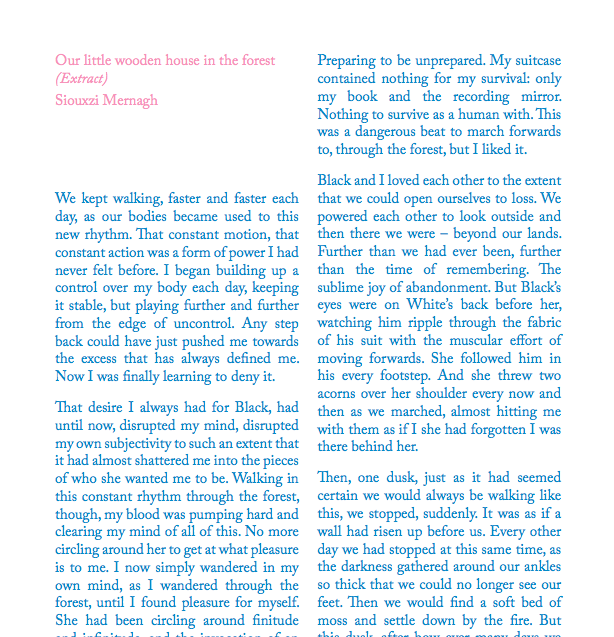
“We go out into the forest sometimes to chop wood, taking it in equal turns.These wood-chopping trips are the only time we ever leave our little house. When it’s my turn, I talk to the snow. I talk to it as it drifts and ask if it’s drifting into sleep or out of it. My feet disturb it, rustle it; the friction between my inside world and its outside world make heat that melts it and chills me. The sound is a kind of sex. The branches of the trees are letting the promiscuous snow rest there, rest there in their bare curves. The snow sleeps there, so open, collapsed into utter trust. One body giving the other comfort at the expense of its own. I keep the rhythm of my feet in the snow in time with the rhythm of my breathing. Any slower and I freeze, any faster and I tire out too soon, and then I freeze. The two must stay in synch. These times are the only times in winter that I am without the others. I am not alone here, because of the voices of the trees in the winter wind, and the strongest birds that have stayed on and not abandoned the forest. We are still here, together, I am not alone here. And the siren-swamp is still here, her scent and her colours dulled by the brilliant smothering of snow, but she is still here. I am not alone. And on the days when I can trust the sun will stay and not trick me into wandering in darkness, I detour from collecting wood and visit her, this siren-swamp.”


novel extract: ‘Your bones ache with its aches.’
Short fiction: Leda in Glass


Siouxzi L Mernagh is currently working on a new novel, ‘In the dark, dark room’, in affiliation with the Berlin Institute for Cultural Inquiry, and on several pieces of short fiction.
Her novel ‘The Peep Show’ has been performed and exhibited in several solo shows in Sydney and Berlin.
Her first novel, ‘White Tales’ has several extracts published with Turia & Kant (Wien/ Berlin) as part of the volume “Tension/ Spannung” created by the Berlin Institute for Cultural Inquiry.
Siouxzi also works as a freelance magazine writer for several publications .


Siouxzi L Mernagh is an Australian-born writer and artist and an affiliated fellow of the ICI Berlin Institute for Cultural Inquiry. She is a former research fellow of the ICI, having undertaken a fellowship concerning the spatial, temporal and sexual tensions within psychoanalytic films and subsequently completing an experimental narrative film titled ‘The Dangers’ as a direct response to her research. Siouxzi has since produced provocative and sensual work in writing, moving-image, installation, photography and performance in Sydney, London and throughout Europe. Extracts from her first novel, White Tales, were published by Turia & Kant (Wien/ Berlin) as part of the volume “Tension/ Spannung”. Her recently completed novel manuscript ‘Our Little Wooden House in the Forest’ (alt. working title ‘In the dark, dark room’), stems from her research with the ICI and her residency at Mustarinda, Finland. She is based in Berlin.

Ramón Saizarbitoria - the most important Basque novel ever. A Tolstoyan saga, dealing with the post-ETA era in the Basque lands, the challenges of modernizing and maintaining a Basque identity, and a Proustian inquiry into life


Ramón Saizarbitoria, Martutene, Trans. by Aritz Branton, Hispabooks, 2016.


Winner of the Basque Country’s Fiction Prize, Martutene is a unique novel destined to become an essential reference of Contemporary World Literature.
Abaitua and Pilar, a gynecologist and a neurosurgeon, and Martin and Julia, a writer and a translator, are two couples worn down by years of marriage who have slid off into a kind of bored decadence. Their group of friends and family complete an insightful portrait of post-independence movement Basque life in which the arrival of Lynn, a refreshing young American sociologist, will trigger unexpected events.
Martutene is a truly outstanding work of fiction in which life and art weave and tangle. An exploration of those thoughts and feelings that expose our miseries and our deepest fears as human beings.


"A disruptive romance illuminates complexities of ethnic and political identity in Saizarbitoria’s substantial novel set in the Basque region in Spain. . . . a probing and sophisticated work that is already being celebrated as a modern classic." —Booklist, starred review

A sprawling novel of post–independence movement Basque life and its discontents.
Martutene is a tony residential district outside of San Sebastian, Spain, one of the most important centers of the modern Basque world. There, live two couples who, not having much else to occupy their lives ever since Spain granted the region autonomy, more or less, have slid off into a kind of bored decadence. Martin is a novelist whose keystone book, very much like this latest by Basque laureate Saizarbitoria, is “a novel in which nothing happens.” Dithering for years on a successor book, he lives in a kind of uneasy truce with Julia, a translator who reminds him daily, mostly without saying as much, of squandered ambitions. When she does say as much, well, does she: “What is it about this fucking novel that stops you from just fucking finishing it once and for all?” she thunders. Abaitua is a gynecologist, a profession, he jokes, that has allowed him “to get to know women better.” Perhaps not, since Pilar, a neurosurgeon, has grievances of her own. Into this milieu falls Lynn, an American sociologist who inhabits their world just as a character named Lynn does the world of Max Frisch’s novel Montauk, which is quoted and alluded to throughout the long proceedings; life and art weave and tangle, and in the end Lynn is as much symbol as character. But symbol of what? Perhaps of an assertive, all-conquering global Americanism. Suffice it to say that her presence doesn’t do much to improve the Basque characters’ behavior. Some of Saizarbitoria’s deeper themes may be lost on American readers, especially that of a kind of nostalgic nationalism—Julia and Martin’s house is overdecorated in the colors of the Basque flag, and it’s telling that when Pilar tells Abaitua off, he pauses, terrified by the look that’s in her eyes, to wonder why she’s speaking Spanish.
Saizarbitoria’s study of wobbly relationships is something of a Basque rejoinder to a Bergman film, for good or ill, glacially paced but rich in perception. —Kirkus Reviews

“Martutene is probably the most important Basque novel yet to be written; this is a primus inter pares book destined to become the central piece of the new canon." —Joseba Gabilondo

“Martutene could well be considered the highest summit of Basque-language novels . . . This superb novel recalls the greatness of Tolstoy and the obsessive stylistic accuracy of Flaubert . . . It is a novel that rightfully deserves being included among the greatest novels of the twenty-first century.” —Angel Basanta

“A landmark Basque novel. Nothing compares to it.” —Jon Kortazar

“Perhaps one of the best novels, if not the best, ever written in Basque language.”—Suma Cultural
“Saizarbitoria is one of the greatest Basque-language writers . . . A veteran of Basque literature that has also been the first to write a modern novel.” —Benito Garrido

“I would dare say that nobody in our literature has shown such mastery in the creation of fiction characters.”—Hasier Etxeberria


The Basque language is a notoriously weird one: nobody knows where it comes from, as it’s not related to any of the other Western European languages, and it’s generally suspected to pre-date them all, some weird vestige of a prehistoric time shrouded in mystery. Virtually no one writes in it, in part because virtually no one can read it, and very few can translate from it into other languages. So that makes it all rather singular that this monumental novel of Basque literature—many call Martutene the most important Basque novel ever—has somehow arrived in English. It is a Tolstoyan saga, dealing with the post-ETA era in the Basque lands, the challenges of modernizing and maintaining a Basque identity, and a Proustian inquiry into life. Author Saizarbitoria has been publishing since 1969, and this is his grand edifice. - Scott Esposito


A middle-aged married mother flying from Heathrow to Bilbao becomes fascinated by a bearded man boarding the same plane. When a bag he’s holding breaks, spilling books into the aisle, she gives him a good strong Harrods bag and helps gather the books up. Grateful, and despite the crowd of frustrated passengers trying to get to their seats, the man reads a few words from one that has fallen open—“This book was written in good faith”—and offers it to the woman as a gift.
For weeks and months afterward she will regret not having accepted the book, not having made contact with this “intellectual looking” man who comes to infatuate her. It’s true men are “cowardly,” she reflects, but she too has not “been brave enough.” Desperate to track him down, she contacts Iberia Airlines, telling all kinds of lies to find out the identity of the passenger with the books. In the end, she will be exploited by an airline employee who makes inquiries on her behalf in return for drinks and even sex. On the very last pages of this eight-hundred-page novel, she will find her man again at Bilbao Airport. Their meeting is not described. This is Harri’s story.
A writer, male, and his translator, female, again in middle age, are on the brink of breaking up, their long relationship worn down by the writer’s monstrous self-regard. The translator spends her days compiling an archive of all the phrases the writer has underlined in the many books he has read. Well-established and well-heeled but desperately afraid of dying, the writer writes about another writer, his terminally ill alter ego Faustino Iturbe, and Iturbe’s troubled relationship with his partner Flora Ugalde (“misery is the only thing he’s given [her]”), who resembles the writer’s actual partner right down to the very obvious “mole on her jugular fossa.”
The translator has learned to access the writer’s computer, which he supposes is defended by a password, in order to read what he is writing about her and will eventually ask her to translate. Her dealings with other people are conditioned by her awareness that, having read the famous writer’s books, they know everything about her intimate life, at least as seen from his point of view—for example, the time she betrayed him and received a poem from her younger lover praising her for being “loyal, more loyal than anyone.” It is something the writer will never let her forget, though he is hardly without sin, one of his own betrayals having led to her contracting a venereal infection.
The only thing this unhappy couple seem genuinely to share is a preference for literature over life. They live in books and for books, often comparing their relationship with that of Jean-Paul Sartre and… - Tim Parks
David Colbert Goikoa:  TRANSLATION AND SELF-EXPLORATION IN RAMON SAIZARBITORIA'S MARTUTENE           
Literary translation has been seen by some theorists as a means of understanding intercultural relations. Within such an approach, the translation of literature in Basque to Castilian Spanish must be understood according to its particularity as the translation of a language with minority status even within its own territory into a dominant one, both of them socio-politically charged. This essay analyzes how Ramon Saizarbitoria’s novel Martutene, in its Spanish translation (2103), explores Basque inter and intracultural relations by maintaining the tension of Basque and Castilian within the text, by positing narration as a form of producing and questioning identity, and by incorporating within its diegesis a translation project that proves to be unsatisfactory. Article: PDF

9/14/16

Maure Coise - Reputation currency. X file. Anti-humanist/inhumanist perspectives. The colour out of space of reasons: representation, embodiment, and emanation

GB cover small
Maure Coise, Geophilosophical Branding, gnOme, 2016.


Commodities of motherly love found corporate culture. Paranoid materialism refers structure: environment, technology. Human nature ought maintain relations with nonhuman nature, by engaging human body, example, through qigong. Develop body, develop relations with family, with land, some, freedom state, accord with heaven. Alienating the explorers. No, formal, time. But danger, she says, cut off her line. Sight, the same judgment suspended her pursuit. Course, unwritten. Dangerous desire continues her illusory sovereignty. She doesn’t see—like inside blowing her foghorn signals. Not sounding warning, but summoning fog. Only reasoning private property, she says, public service.

“Poetry in the only form it has left to exist in—an exit from poetry, timestamped with your own epitaph. Geophilosophical Branding is a fucked-up, Confucian diagonal that will take you nowhere but into that abyss in which the ever-alienated explorer touches its own incomputable hole. If you’ve ever wondered how to remove your skin, what it is that zero conceives, if you aren’t an island, or what the stakes of bolting reason back onto the earth are, this is for ‘you’. If not, a warning: do not read Coise unless you have a lot of blood to give.” – Amy Ireland

9/13/16

Maija Timonen - are we living in an age of emotional, as well as economic, austerity?

maija_tmor_covers_final_web-123645


Maija Timonen, The Measure of Reality, Book Works, 2016.
www.maijatimonen.info/


‘The Sniffers’, excerpt from The Measure of Reality, in Art Papers, May/June 2015.


‘Funny, mordantly sexy, witty, true. These fragments of a life lived curiously perch somewhere between psychoanalysis and fiction, where strange desires play out through illness and romance, and both start to resemble each other (as perhaps they always did).’ – Nina Power
Fantasies and dreams are a way of accessing hidden dimensions of everyday experience, but what happens when you can’t fantasise? In this work of analytic fiction, creative and heterosexual crises unfold, shaped by the anxieties of our time. Social and economic pressures are almost crippling, yet meticulously understood – obsessively decrypted and re-encrypted by Timonen’s unnamed female protagonist who subjects everyday occurrences and encounters to absurd levels of scrutiny and interpretation, often with recourse to theory. Short story chapters, captioned in a manner reminiscent of episodes of Seinfeld, are interspersed with a letter, a list of forgotten browser tabs, a treatment for an unmade film and a variety of dating scenarios.
In one of these, speed daters smell T-shirts as the narrator desperately tries to account for an alarming absence of desire. The specificities of love and sex are shown simultaneously in Timonen’s project to be something genuinely ‘ours’ yet alienating. They act as both tools for the negotiation of the complexities of subject/object relations in contemporary capitalism and constitute a kind of precarious – even false – efuge from the trauma of living in it.


In a recent article on artists’ novels in frieze (issue 173), Nathaniel Budzinski noted the preponderance of double-, triple- and sometimes quadruple-barrelled job titles in the contemporary art world. While this is attributable  to a combination of economic exigency and the multi-platform nature of artistic labour in the  21st century, there remains the niggling sense that most of these renaissance men and women have  only one true specialism and  are winging it at the other two or three. Or, to put it a little more kindly, their dabbling in medium  Y is really an offshoot of their primary engagement in medium  X. A new short-story collection by the filmmaker Maija Timonen is a case in point. Ostensibly a meditation on the nature of love and attraction in contemporary culture, The Measure of Reality (BookWorks, 2015) is a critique  of art-world precarity and economic austerity; the pernicious and self-reinforcing ‘pathology  of loneliness’ she describes is  both personal and political.
This small volume is made up of 20 sketches in which a female protagonist – a single, 30- something artist – broods over  her relations with men and the  world at large. To all appearances,  it belongs in the tradition of ‘autofiction’ or literary memoir that is currently much in vogue, and concessions to novelistic  style are commensurately scant. Any literary devices Timonen uses are mere cosmetic frills, a polite  nod to the format. A preference for pronouns over proper nouns – ‘she’ for the protagonist, ‘he’  for the estranged beau or tentative love interest – is as far as the  obliquity goes; the register is candid and explicatory, splicing critical-theory terminology with diaristic sincerity. Timonen’s narrative voice is an almost-parodic mélange of social-sciences touchstones – think Franz Fanon, Sigmund Freud, Germaine Greer and Karl Marx. But what the text lacks in literary interest is compensated for in its psychological and social insight.
A major preoccupation in these stories is the narcissistic dimension of love. In one story, the protagonist observes that all her crushes have ‘entailed a sense  of expansion’, culminating  in a ‘feeling, of really being the person she was, but more – of being more herself – by virtue of her desire’. This motif is rehearsed in another tale in which the heroine, reflecting on an occasion when she had felt an attraction  so powerful she thought it might be love, recategorizes it as merely ‘a momentary crystallization  of all that had been seeping through my skin, eyes and ears in the course of endless formative experiences and influences’. There is a risk here: when you  really break it down, any authentic experience of what we might  call ‘love’ could be reduced  to these terms; one’s ‘true’ self  and one’s place in the world  are not so easily disentangled. Nevertheless, such intense inward scrutiny can illuminate  the vicissitudes of emotional connection. This precis of mutual estrangement is likely to resonate with anyone who has experienced the gradual unraveling of attachment in a formerly intimate relationship: ‘In keeping his options open, he was in fact closing them  all down […] attraction is never entirely one-sided, and for all  their ability to love, most people’s affections had some core element of narcissism, that on some level they were sparked by the way a relationship or another person allowed them to see themselves in  a new, favourable light.’
Inevitably, such a searingly honest work does not always make for comfortable reading. Barely a few lines after having bemoaned that ‘[s]he had never had or witnessed a heterosexual relationship she wanted to be in’, the protagonist of ‘The Psychopaths’ breezily pronounces that, ‘Other women compromised, in stoic solitude put in the emotional efforts that should have come from two people’ – presumably condemning all women in stable relationships  to the condescension of victimhood. This trope recurs in another story, ‘The Profiler’, whose heroine takes an unhealthy interest in a man, a friend of a friend, and stalks him online before quite unexpectedly bumping into him and his  wife at a social gathering. At this point, ‘(t)he locus of her imaginary intimacy now moves from him  to his wife. She now not only feels close to the wife, but feels she knows something significant about her.’ The story ends with her  noting that their hands, though together on the table, are not properly touching. There is, again, a classically misanthropic paradox at play here, of imputing false consciousness to people from a position of relative isolation:  on the one hand purporting to feel completely different from most other women, while on the other hand claiming to know most other women better than they know themselves, and having special insights into their relationships.
There are occasional excesses in the form of sweeping remarks (‘The imperative to be sexually liberated forms the dominant ideology we live under.’ Does it?) and hyperbolic soundbites (‘This tyranny of enjoyment ...’). For the most part, though, this is a compelling psychological portrait, all the more convincing for its embrace of contradiction. In two stories, Timonen’s protagonist shares a gripe about men controlling the space around her: one scene centres on her habit of placing a post-coital glass of water precariously on the edge of a tabletop; in another, she has many dozens of browser tabs open  at any one time on her laptop; in both, she is privately irritated when a man intervenes to propose  a tidy-up. It is as though her penchant for disorder is both  a source of ennui and integral  to her sense of autonomy.
Timonen’s day job notwithstanding – aside from a couple of smaller, distinctly screenplay-esque vignettes – relatively little of the action in The Measure of Reality takes place outside the mind of the central protagonist. Her characters stew, recollect, chew the cud; power dynamics are examined every which way, self-doubt waxes and wanes. Some of the book’s strongest moments are poignant reflections on the things people do to cope with loneliness. The impulse to keep fit, for example, is both a panacea and a trap: ‘The more you invested […] in your well-being […] the more you felt like you were falling apart. And the more your “taking care of yourself” became an agent of your isolation.’ A similar vicious loop plays out in relation to socializing: in ‘The Prognosis’, a single woman resolves that, in order ‘to protect herself from the mental agitations and paranoia that came with having to enter social situations as a free agent’, it would be safer to assume that everyone was a ‘malignant force’, and to stay at home.
This alienation is, in turn, aggravated by the humiliations  of economic activity. The  freelancer in this condition is  in a double-bind: her work is necessarily solitary, her social interactions mediated by, and  not infrequently subjugated to,  the demands of her occupation. Thus, we meet an artist who laments that her conversational repertoire at networking events  is limited to ‘the deadening bullshit of her own spoken curriculum vitae’. Anyone who has embarked on a career in the arts will surely sympathize with this, as with the observation that: ‘One of the effects of a highly competitive environment was the lack of peer-to-peer affirmation.’ In a similar vein, the narrator of ‘The Sniffers’ observes that the straitened economic climate  has raised the stakes of romantic involvement: ‘At times of increasing insecurity, the solace and support found in affective bonds becomes a crucial means of survival. You could not be profligate with your emotional energies anymore.’
We have become, in short, emotionally stingy – or, as people used to say disparagingly of the psychically reticent  in the heyday of Free Love, ‘uptight’. It is a truism that the political spectrum shifts to the right during times of economic hardship; judging from the apparent ambivalence towards the sexual revolution that pervades The Measure of Reality, the principle might also hold true in the emotional sphere. An old-school, small-c conservatism is taking shape under the duress of self-preservation, an impulse all the more urgent in the enervating climes of a dating-app dystopia. Digital culture, which was supposed to deliver us from isolation, has instead inundated  us with an oppressive superfluity of possibilities, mirroring the dizzying superabundance of the free market. We are besieged both by work and by each other. The need for a boundaried self has never been greater.
- Houman Barekat
Maija Timonen is an artist based in London, Berlin and Helsinki.
Published by Book Works as part of G.S.O.H. The Rest is Dark, The Rest is Dark guest edited by Clunie Reid. Designed by Erik Hartin.


‘The Phantom Film Syndrome’, essay in E.R.O.S Journal, Autumn 2013.
‘Zero Dark Thirty: The Aesthetics of Narcissism’, May Revue, issue 11, Autumn 2013
‘The Operation Was a Success But the Patient Died’, Afterall, issue 29, 2012.
‘Looking the part – The Empty Plan by Anja Kirschner and David Panos’, May Revue, issue 7, October 2011.
‘The Distant Beast’, in 8 Metaphors (because the moving image is not a book), LUX Publishing, June 2011.
‘Patricidal Film Making’, March 2010, MUTE MAGAZINE.
‘Good Social/Bad Social – The films of Stephan Dillemuth’, December 2008, MUTE MAGAZINE.

Anca Cristofovici - Thoughtful, inventive, and beautifully lyric, 'Stela' masterfully challenges the obfuscations of state terror and its long rolls of the disappeared with the liberating and illuminating transformations of dreams and art

book cover
Anca Cristofovici, Stela, Ninebark Press, 2015.


ancacristofovici.blogspot.hr/


Years after her mother's disappearance from an unnamed city in an unnamed country governed by a repressive regime, a young dancer, Cora, struggles to untangle the knot of half-truths and informational gaps surrounding the official story. Thoughtful, inventive, and beautifully lyric, Anca Cristofovici's novel Stela masterfully challenges the obfuscations of state terror and its long rolls of the disappeared with the liberating and illuminating transformations of dreams and art.


Cristofovici's work comes to us like scraps of paper drifting down from a library whose collection has burned. We must gather all we can, and set about the task of their decipherment and reconstruction. --Ellen Hinsey

Stela is a novel of exception. The writing is magical, inventive, whimsical...funny...sinister and slightly disturbing. --Juliet Bates


photo by Sophie Kandaouroff
Author Anca Cristofovici is hard to typecast, and if there is any easy path for a writer living between cultures, it isn’t the one she has chosen. Born in Romania, where she published at an early age, she defected in 1985 and has since lived in France and, temporarily, in the United States. While pursuing an academic career, Cristofovici has continued to write fiction and reconstruct herself as a writer in two non-native languages. A reflection of her multicultural experience, her publications in Europe and in the United States include essays, fiction, poetry, and translations, written in English, French, and Romanian. She has also contributed to exhibition catalogues and international artists’ projects. Cristofovici has been invited to read at venues in the Unites States and Europe. Among her honors are fellowships from the British Academy, the Rockefeller Foundation, and the Terra Foundation for American Art.
A professor of American literature and art at the University of Caen, France, where she directs the Center for Anglophone Cultural Memory, Cristofovici is the author of several books and contributions to collective volumes and anthologies. Her latest novel, Stela, published by cross-culturally committed Ninebark Press in 2015, was launched at the AWP Conference in Minneapolis. It explores the relationship between power, art, and the survival of the self in totalitarian systems, described by her publisher as: “Thoughtful, inventive, and beautifully lyric,” it “masterfully challenges the obfuscations of state terror and its long rolls of the disappeared with the liberating and illuminating transformations of dreams and art.”
This interview was conducted Berlin-Paris by e-mail.
Ellen Hinsey: One aspect of the political upheavals and traumas of the 20th century is that one cannot take one’s native language for granted. How has living in different cultures and writing in three languages affected your perspective as a writer?
Anca Cristofovici: Brutal circumstances affect anyone’s perspective. In radical forms of relocation, one becomes no one. With some luck, that can turn into a fantastic formative experience, should one be ready to embrace it.
Both my native environment, Romania, where I started as a writer in the mid-seventies, and then the places I lived in following my defection in 1985—England (briefly), France, and, the United States (where I studied and worked for some years)—involved finding a space in which to function as a writer, against all odds. Probably, had those things not happened, I would have become another kind of writer. But they did happen: whether it was the relocations, the psychic and physiologic reactions they engendered, or the material conditions that provided (or didn’t) time and space for writing. I’ve never experienced much anxiety of the blank page. I’m five books behind. When I’ve finished one, I don’t have to worry about what’s next!
I published quite early in Romania—short fiction, poetry and plays (I remember the title of one of these long-lost plays: “Columbus, Does America Exist?”!). Early on, too, I realized I wasn’t equipped to work against censorship or other political hindrances creatively, so I preferred not to. Living with only an intermittent public writer persona for a long time has been, I must say, rather beneficial to the creative process, despite bouts of exasperation for being cast in the wrong life and seeking to “outcast” myself. At times this complex trajectory is responsible for my feeling that I need to justify myself as a writer. But I have come to terms with being a clandestine traveler on a night train on some enigmatic venture, which is mine all the same.
In terms of cultural attachment, I’m close to the Mitteleuropa cosmopolitan tradition and think of myself as a European writer. Yet, as American cultural history has been my passion and profession for many decades now, I also feel somehow “transatlantic,” with an interest in how cultures coalesce in both traditions. My new novel, The Long Way to Vienna, explores that paradox. Anyway, as long as I can write, it’s alright, even if, strangely enough, a writer who is independent of national affiliations (or any other affiliations, for that matter) doesn’t fare easily in these global times.
EH: Let’s speak about your novel Stela. The narrative is told from a “free space” (two artists’ residencies, in the north and south of Europe), but, as we just evoked, the past it refers to is visibly that of a repressive system, which in the book is called “the perimeter of fear”—
AC: Well, the novel starts with the story of the loss of a mother and her teenaged daughter’s attempts to come to terms with it. She has missed the funeral, which amplifies the confusion accompanying any process of mourning. In addition, this happens in a context of dubious disappearances and a politics of fear conceived as an instrument of control. Because of this particular context, Cora distrusts what she had been told: that her mother died in a car accident. Her growth into adulthood is inseparable from this enigma she must solve; in this she is partly helped by Luca, a painter and neighbor, with whom she will later cross paths outside the “perimeter of fear.” The narrative blurs distinctions between fact and fantasy, focusing on the narrator’s perceptions. And although there are no explicit references to place, for both the initial setting and for Cora’s and Luca’s subsequent peregrinations, a number of details suggest what part of Europe they are in.
A degree of abstraction from any specific setting seemed necessary in order go to the crux of the matter and grasp patterns, see which parts of totalitarian structures are contextual and which are inherent to human nature. “Systematic and chaotic” emerged as a significant pairing around which the novel revolves. It designates the paradoxical coupling of inflexible rules with random and ludicrous practices. In the course of writing, it appeared to me that this fundamental contradiction in terms—an extravagant one, at that, with regard to human and cultural loss—is responsible for the difficulty in understanding (and accounting for) how communism works. The questions that occupy the characters’ minds evolve into other, more oblique ones: what is the legacy of so much moral and spiritual destruction? How do one’s broken memories intersect with those of others to make sense of what happened? Where can one go with one’s life from there? And how?
The difficulty of such a subject is to find the right tone without verging on victimization or sentimentalism. The book took a long time to write, time to find a perspective not overtly political, folkloric or anecdotic, which are the common ways of looking at Eastern Europe, a geographical and political categorization for an area which is, in fact, at the intersection of very different cultures, religions, and languages.
EH: Let’s talk a bit more in depth about the background for the novel. You have spoken about your use of documentary materials in preparation for the book—
AC: In the late 1990s, when I started writing the novel, testimonies published in Romania after 1989 came to my attention, as well as oral histories and compelling documentary films on the deportation of Romanian populations to Siberia and to camps within Romania in the Baragan area, or on detention in what is thought to have been one of the toughest Eastern Bloc prison systems. That material, with no circulation in an international context, slowly made its way into the novel along with documents from other East European countries, but not only. Once the applause following the fall of the Iron Curtain passed, it seemed necessary to connect those events to current concerns about the dangers threatening democracies everywhere. Few critiques of what has become of societies previously behind the Wall are based on serious analyses of communism’s inner mechanisms and its impact on the most intimate relations of family, language and memory.
Yet, using such material involves an overwhelming responsibility, because you don’t want to (mis)appropriate people’s lives. My deep-rooted aversion to realism prompted me to de-familiarize those experiences, and to attempt to find a conceptual framework that would counterbalance the documentary component. Initially, the fact that the narrator is a dancer and Luca, a visual artist, came from persistent images carrying narrative potential. It turned out that the forms of art they practice reverse the pair “systematic and chaotic”: from random events emerge creative patterns of human experience (what Luca calls “provisional arrangements”) instead of restrictive frames. Readers familiar with Merce Cunningham’s technique will find much of Cora’s bodywork and relation to dance is based on this method, which derives, primarily, from how he looks at all forms of life (I am also reminded here of Merce’s drawings of animals).
EH: Your novel’s characters are rather elusive: “stick figures” is a recurrent image in the book. Their pasts and presents are revealed in many evocative details, but this is done subtly and in “pieces.” While the reader is invited into their inner meditations, we do not have a coherent picture of their lives—
AC: Yes, people who return from captivity are rather sketchy, aren’t they? Physically, I mean. We have seen pictures of them, yet not many from those in Eastern labor camps, psychiatric hospitals, or just of people whose energy has been drained by everyday life’s complicated gestures. They are spectral, to the others, to themselves. In French, les revenants is a term that is used for ghosts, but also for those returning from camps.
However, bringing those characters into visibility beyond the stereotypes of Eastern Europe that circulate in Western visual culture seemed crucial, and I tried to place them on an orbit that goes from darkness to gradations of light (and lightness). Truly, I see the characters of the novel more as forms and substances, misty figures as in, say, some of Bill Viola’s video pieces, “The Veiling” or “Three Women,” works that sustained the energy of the book as I was writing it.
Minimal detail for maximal effect, at least that was my intent. I recently heard about a “writer’s tip” that I unknowingly used in the most literal way: “Every character should want something, even if it’s only a glass of water.” Just after Luca has passed the border with the intention to defect, his first words are: “Ein Glas Wasser, bitte.” At times a drink of water counts a lot. To highlight such details places them into another dimension: magnified, they turn into a vital necessity.
EH: Stylistically, Stela is a complex work. On the surface it might appear experimental—but to see it as such would, I think, be misleading. You have often evoked the “surreal” aspects of Romanian totalitarianism, which have nothing to do with literary “techniques”—
AC: Actually, I’ve spoken about “surreal” aspects with specific reference to perceptions of everyday life in the 1980s. I wouldn’t, however, use that term as a general reference to totalitarianism, in Romania or elsewhere, since its faces are so diverse.
In everything I’ve read, the experiences of people in life-threatening situations struck me as experiments in staying alive. The narrative form of the novel, then, is only an adaptation to the characters’ shattered life course, the imaginative and emotional solutions they come up with. All of them somehow break the unnatural order stifling their lives, crack the system: Stela, in losing her life, Cora and Luca, in transforming theirs, and, in the process, Stela’s. The fragmentary nature of the narrative doesn’t preclude a sense of suspense if the reader embraces the narrator’s hesitations and accepts the fact that finding out the truth in the given circumstances is, simply, impossible. Was the accident provoked? Was Stela abducted? Did she defect? That spectrum of possibilities concerning Stela’s disappearance allowed me to condense the material we just referred to.
EH: At the same time the book is rich in poetic images—
AC: Among the fictional frameworks that hold both documentary fact and fantasies, my choice went naturally for stylization and poetic perspective. It seemed to me that such heavy-duty historical and psychological material might be more effectively channeled into a more evocative (even if allusive) narrative.
In the media, the changes in the world over the past twenty-five years have appeared mostly in scripts of high-pitched rhetoric of suffering and violence. The emotional patterns of the Cold War were subdued, violence imploded, words mimed rather than voiced, gestures amplified, much like in a silent movie. Such patterns create a serial effect, even as the narrative and the images that carry it tend to break them into verbal form, so that selves who were meant to become uniform elements in an unending series surge into significant shapes.
EH: Let’s return to the question of works that inspired you while you were writing the novel—
AC: Certain works gave me a base: those of Claude Simon, in particular, or Joseph Brodsky, for their firm nonalignment, their rigor, and for their fine irony tinged with tenderness, or the work of Elizabeth Bishop—a master in the art of traveling light. Much like the documentary material, echoes of these writers have made their way into the novel, wittingly or not, along with other reminiscences. Here and there, I incorporated short excerpts. I hesitated to provide a list of these appropriations, since they seemed to be poetically more effective under cover, so to say. Still, I found a way to weave into the book’s fabric an allusion to the source of fragments I used deliberately. Documentary or artistic material is part of experience, of another kind, already formalized: what we have read and seen and heard is part of who we are, isn’t it? And so is it part of the characters’ verbal texture.
EH: Who are the other writers you feel close to?
AC: Oh! That list is long! Above all, I’m interested in how an artist puts an obstacle to good use (also, in how one can fail to). I relate to writers who are quite different in form and sensibility—and different from my own approach to writing. I also have strong affinities to the visual arts because of the enhanced perceptions they solicit, which open up extraordinary spaces in the mind: artists such as Thierry Küntzel, Geneviève Cadieux, or Stan Douglas, who deserve to be better known and whose work I have touched upon in my book Touching Surfaces. For what it means to them to be writers, I feel close to Dawn Raffel or Christine Schutt. Diane Williams once told me to give myself permission, as a writer. It’s about the best advice I’ve ever had: whenever I try a dangerous trapeze move, her words are my safety net.
Further back in time, I spent some years on John Hawkes’ fiction, writing a dissertation, then completing a small book (The Child and the Cannibal). His work came to my attention when I was young; I fumbled in the dark at every page, but couldn’t resist the beauty of the flashes I found there, and it occurred to my innocent self that, if I somehow managed to make my way into that tunnel, I’d see the light some day! In 1962, Flannery O’Connor wrote a wonderful blurb for The Lime Twig: “You suffer it like a dream. It seems to be something that’s happening to you. . . . This . . . I might have been dreaming myself.” Looking closely into such a work, living with its sound imprint for so long requires a lot of discipline to distance oneself from it. Writing on photography provided an alternative that involved observing rhythmic patterns other than verbal ones and liberated space for my own cadences. And when I forget all I’ve learned from Hawkes, I’ll always remember “coherence of vision.” He was an extraordinary teacher who knew how to bring to light each young writer’s own gifts. I sometimes wonder what would have happened if, instead of writing my dissertation, I had gone to Brown. But, at the time, that was a technical impossibility. However, I met him and his wife, Sophie, in Paris and in Providence, Rhode Island. We corresponded and did an interview on his mythic horse, Whistlejacket, and his thoughts on the creative process, which was published in Italy. Two weeks after he passed away, there was an envelope in my mailbox with two letters from him. Few people would send that kind of letter!
EH: Did you ever tell him that you wrote fiction?
AC: No! Anyway, writing was bracketed at the time. But a nice compliment for Stela came from a writer who studied with him: “Jack would have loved this!” Who can tell? Maybe the horse!
EH: As we’ve just evoked, the visual arts play an important role in your novel. They appear in a number of forms: dance, film, video art, painting. What is their significance to a subject that is deeply steeped in a history of physical, moral, cultural destruction? What is the meaning of dance, in particular?
AC: Art has been a natural and vital presence in my life. I have known artists struggling to keep at bay the pressure of power on their art. Some lost their lives because they dared to speak out. Others remained hostages to silence. Some of those who escaped have been muted in other ways in their new precarious lives beyond the Wall. I am also interested in individual stories of survival precisely concerning how they resonate with creativity—one needs perseverance, luck, and imagination to carry on under dire circumstances.
Stela revolves around two artists’ destinies and loss turning into a creative force. Art making is central to the plot. The reels (rolls of surveillance film shot by the secret police) are used by Luca as found-footage for a video portrait of Stela. Dance combines rigor with grace; the ephemeral quality of movement bears intimately on loss. Narratively, dance draws events into patterns rather than arranging them in a linear fashion. It focuses on the body as a site of psychic work. Frank Bidart wrote a long poem, “The War of Vaslav Nijinski,” where, as madness was seizing him, Nijinski tried to choreograph a dance about the Great War “which gives us//pattern, process//with the flesh//still stuck to it.” And there are those stories of dancers from Eastern Europe escaping to the West.
Dance lifts weight from the subject of the book. In the end, lightness prevails. Stela’s luminous figure, recreated by Cora’s and Luca’s reminiscences and their art, counterbalances the legacy of darkness (and that of three generations of women facing it).
“Surviving is no virtue. It is an act of love.”
The working title of the novel was Kidnapping—one of Cora’s hypotheses regarding her mother’s disappearance and an allusion to Milan Kundera’s essay “A Kidnapped West.” Towards the end, however, the main character’s name turned out to be a better option: Stela, with that one “l” missing, as it’s spelled in some languages. That particular spelling of the name also evokes the common noun, with its cluster of associations: commemorative inscriptions; a tablet on which the first epics were written; and, of course, the Latin for ‘star’ (as in ‘celestial body,’ and ‘fate’).
EH: We began this interview talking about language and displacement. Why did you choose to write your novel in English, and not in French or Romanian?
AC: That is a long story and part of the subject of a volume of essays on which I am currently working. The short version is that if I want to know the temperature in Bucharest, I get it from CNN or the BBC. For French television, the map of Europe stops in Vienna. There are other reasons—cultural rather than meteorological—but they are too complex to go into here. Linguistically, French is too close to Romanian; in terms of fiction, my affinities are with the more flexible, formally imaginative American tradition—such an eye-opener in my formative years.
I started reading in English as a teenager, then studied English at the Faculty of Philology at the University of Bucharest with some people who managed to save us from brainwashing and lent us books (many of them the only copy in the country, feverishly passed from hand to hand). I owe a lot to their devotion and recall, in particular, my first contact with Wallace Stevens’ poems. The professor typed them in sets of five (the typewriter would fit up to four carbon sheets). Since there were more than that of us in the class, he typed them again. Whenever I read or teach “The Man with A Blue Guitar,” I can’t dissociate the poem from the blurred indigo letter type of the carbon copy.
To the writer a language of adoption provides perspective. That choice originates in cultural inclinations which entail a number of risks. But what an extraordinary experience—a privilege at that—and one that involves a heightened sense of responsibility. My concern has been to choose the language that best suited what I seek to do as a writer. Writing in English is perhaps only an extension of my earlier attempts to discover my own relationship to language away from cultural and political determinations, in a lingua franca—which English basically is today, as Latin was at a certain time—or what Joyce longed for: “a language above languages.”
And then, I always feel at home in an uncanny way as soon as I set foot on American soil, which has to do with language, space, people. On my recent reading tour, for example, I was surprised to meet categories of readers that I hadn’t imagined would take an interest in such an unconventional novel. I am grateful for their generosity and that of my publishers who put their trust in my work.
For the writer crisscrossing cultures, there is also the question of what kind of community you belong to in terms of the circulation of your work. All my books were published by independent presses (literary or academic) and I’m happy to be part of that counter-current in book culture. Belin, a scholarly publishing house that brought out my essays on Hawkes, has had a discrete but persistent presence in France since 1770. May it be the same for independent publishers who courageously promote innovative writing and book forms these days! Recently, I’ve co-edited a volume on artists’ books, The Art of Collaboration, brought out by Cuneiform Press, with wonderful American and European contributions which speak to that effect.
EH: In terms of your writing process, how do you feel about writing fiction versus non-fiction?
AC: Well, in both cases it’s writing—and lots of work! Only how one understands them sometimes differs, but, at heart, there’s no separation between my sensibility as a writer of fiction or essays. In both I engage with experiences of varied natures (geographic, cultural, of artistic media), look at how cultures cross, idioms transform, and how, eventually, their reverberations enhance life.
To me, non-fiction, the probing into the metaphoric potential of theoretical or conceptual notions, has to be creative. It’s a perspective on life. D. W. Winnicott evokes this in his essay, “How to Live Creatively.” Conversely, fiction too involves research. Few readers imagine how many pages it’s necessary to read just to make sure you’ve got the workings of a machine, a dress-cut or who knows what other detail right. And if it isn’t right, you can be sure that the bug in your novelistic device will give you sleepless nights. Non-fiction, too, can prevent you from sleeping. From photography I’ve learned the importance of precision and that there’s no such thing as a photograph in isolation. That’s not far from how, for me, images inform a novel and add up into a story. Even as I find working with “negative capability” compelling, a number of details have to be exact or the picture won’t develop. In the end, fiction writing is much like camera work: a matter of technique and how you look at people, objects, environments.
Questions raised in my essays resonate with my concerns on how the imagination functions. It has happened that a point in an essay will strike me years later as close to some detail in my fiction, or even specific phrasing will unconsciously migrate from one form to another. Dictionary entries or exhibition catalogues require extensive research and a capacity to synthesize and grasp the smaller and the larger picture, which also relate to how I process material for fiction.
EH: Let’s conclude with a final question regarding language—are you contemplating translating your novel, Stela, into French, or, for that matter, into Romanian?
AC: Absolutely not! I am a pretty faithful translator of other writers’ work, but I’d make my novel into another book entirely because of how I relate to each language—and I couldn’t have written the novel, as it is, other than in English.
That said, I am translating a book of short fiction that I wrote in French about ten years ago. It has turned out to be an interesting process: how the English version makes me reconsider the original, triggering, at times, new turns in French. For some arcane reason, I am attached to these vignettes, which I never sent out for publication; I am currently collaborating with the American artist Marsha McDonald to bring them out in a bilingual artist’s book. Marsha created the photographic composition for my novel’s cover and provided a wonderful video piece for the book’s trailer. Working with her is like having someone who sees what’s in- between the lines and turns those blanks into visual language.
The exposure of words to art forms, what passes from one medium into another fascinates me. I contributed to international collaborative art projects in which small fragments of the novel appeared in new configurations, associated with visual material I have chosen or created. Transferring them from the literary to the art context added new dimensions to the story. I am preparing an installment for this year’s edition of the Venice Vending Machine on the theme: “The Sea Has No Boundaries: Stories of Travelers and Dreamers.” And so, Stela will travel further. -

9/8/16

Ctch Bsnss - Every assertion is cast in excruciating doubt. Is it 4 am? Am I able to? What is sacred? What is an act? Whether we know for sure or not, we always will. Knowing while not knowing, that’s the paradox that drives this meditation on dialogue in the digital age

CtchFinal2


Ctch Bsnss, Able To/Always Will, Civil Coping Mechanisms, 2016.


embareaxedx.tumblr.com/


“A tale of elusive revelations is rendered through interruptions and undercuts in Ctch’s Able To/Always Will. Like the thin lines of this snakelike text, meaning bares itself undeniably and a breath later, twists and coils back into the basket of the charmer. Every assertion is cast in excruciating doubt. Is it 4 am? Am I able to? What is sacred? What is an act? Whether we know for sure or not, we always will. Knowing while not knowing, that’s the paradox that drives this meditation on dialogue in the digital age.”–Monica McClure


“Beneath Ctch Bsnss’s yearning is a reminder of the persistence of language at its most magical, and of the consequences of the sometimes crippling burden of society’s claim on women: to be able / to rise to the occasion / to always do what’s best.” –Laura Theobald


GHOST GFS web 150


Ctch Bsnss, GHOST GFS, Electric Cereal, 2015. 


GHOST GFS is a poetic narrative about a manipulative relationship which is first initiated online. Ctch Bsnss vividly chronicles her emotions through her time as a ghost, a shell of her self, who is never truly known by her partner but remains a haunting presence. In GHOST GFS, Ctch Bsnss creates a document of solidarity for those who have experienced similar pains and hauntings.

Catch Business’ GHOST GFS is luminescent. The velocity of these poems creates the illusion of each line manifesting in real-time, revealing a unique voice that’s both painstakingly deliberate and achingly open. Ethereal yet modern, hopeful yet devastating, GHOST GFS is like reading someone’s gchat conversation with the void.– Sonya Vatomsky

This book feels like solitary confinement, like a fever dream in your childhood bed, like a pool of blood in black & white film, like the way the body stains its own clothes, like a mouth after two cigarettes, like a skinned knee like a badge, like a fucked up palm reading, like seriously alone in the dark, like vomiting on a flowerbed, like your best friend bottoming out, like a t-shirt over a bare chest, like an invisible flag waving, like real bravery, like talking to yourself until you fall asleep, like white noise, like the brain recalling as it loses consciousness: fear, death, sex, screens, loneliness. This book makes me feel like I am not real, & that feels really, really good. – Kelly Schirmann

just like me
loud enough so
you can like me
i ask if you’ve cheated
or if you would
and we decide
if you want her
you will tell me
you don’t have to
i hear her
in your pill-dry voice
fringed elements
of our emotions
you say we need to work on us
that there is no me in me now
so what else can i show you?
other than the limbs bent before you
i believed i would never bend again
not for her not for your love of her
and not for a fantasy of three
as if these possibilities
occurred outside of the we
she defined for you
to use on me
lesson plans to reflect
intrigue with your clumsy tongue
invitations carried thru
the nameless crowd
she asked to sit near you
behind a sequined mask
i could’ve become
a chance for you to feel
what she made you feel


Interview: Catch Business


Interview with Ctch Bsnss


Catch Business is the author of GHOST GFS (Electric Cereal, 2015) and ABLE TO / ALWAYS WILL (Civil Coping Mechanisms, 2016) as well as the chapbook Bye, Product (Be About It, 2015). She is the Founding Poetry Editor of Witch Craft Magazine and Chapbook Coordinator at Sad Spell Press. Tumblr / Twitter / FB