11/6/20

Aleksis Kivi - "the greatest Finnish novel of all time", the classic among the classics in Finnish literature.


Aleksis Kivi, The Brothers Seven. A Tale. Trans. by Douglas Robinson, Zeta Books, 2017. [1870.]


Seitsemän veljestä (The Brothers Seven), the 1870 Finnish novel by Aleksis Kivi (1834-1872), is one of the most (in)famously unknown classics of world literature—unknown not only because so few people in the world can read Finnish, but also because the novel is so incredibly difficult to translate, the Mount Everest of translating from Finnish. It is difficult to translate not only because it blends a saturation in Homer, Shakespeare, Dante, Cervantes, and the Bible with a brilliantly stylized form of local dialect, but because it is wild, grotesque, carnivalistic, and laugh-out-loud funny on every page. It has been translated 58 times into 34 languages—but somehow the translations always seem to fall short of their flamboyant original.

Douglas Robinson’s new translation is a bold attempt to remedy that. He aims to make Kivi as rhythmic, as alliterative, as brash, as grotesque, and as funny in English as he is in Finnish. Since Kivi deliberately used an archaic Finnish, but used it playfully—and since Kivi was steeped in Shakespeare, to the point of memorizing whole plays—Robinson translates him into a playful Shakespearean register. As he notes in his Preface, this makes the translation a bit difficult to read—but the original is difficult for Finns to read as well, and the Finnish readers who love Kivi (and that is most of them) read him with pleasure despite the words they don’t know, because his prose is so intensely alive.


Seven Brothers

This is a novel about seven brothers living in rural Finland in the mid nineteenth century. It is quite unlike any other book I have ever read.

There is an earthy, bawdy humour to some of the brothers' behaviour but they can also be violent and difficult. Sometimes the writing is comic, sometimes it is Homeric and feels almost mythic in scope, such as an account of a battle with forty bulls. You get the sense of all kind of deep things going on here - I often found mysefl thinking of the Kalevala (the great Finnish epic which inspired the music of Sibelius), and I enjoyed the deep sense of the beauty, mystery and strangeness of the Finnish landscape - and the Finns.

This is a rich and multi layered novel which reveals different things at subsequent re-readings. I like this kind of thing; others don't. I'm also fascinated by the other-ness of Finland and the self sufficiency of its people. There isn't much of a plot - not a tight linear one, anyway. If you like a more "straightforward" story, and if you haven't much interest in Finland, you may not care for it much. I wouldn't say it is a "difficult" novel - no more so than most novels over a century old. There are some archaisms, and some historical references which may be obscure to many. But if you are alive to the richly textured nuance and the landscape, the myths, and the history, then you will find much here to enjoy - as I did.

It's also one of the most widely read books in Finland, so if you know any Finns, or have an interest in going there, you will want to read this book to get some insights into the people, the land and the history. - Monty Milne 

review at amazon.com


Seven Brothers

Seven Brothers, Aspasia Books, 2005.

Along with The Kalevala, Aleksis Kivi's Seven Brothers is Finland's most celebrated literary treasure. The crowning accomplishment of Finland's first literary genius, Seven Brothers remains "the greatest Finnish novel of all time", the classic among the classics in Finnish literature. 

Published in 1870, in the author's 36th year and two years before his untimely death, Seven Brothers laid the foundation for what Kai Laitinen later called "The Great Tradition in Finnish Prose". This tradition is characterized by realism, humor, respect for the common people, and depiction of nature as both friend and foe. 

Received at the time of publication by uncomprehending arbiters of literary taste, who still delighted in romantic approaches to literature, Seven Brothers fared poorly in early reviews. Posterity, however, has resurrected the reputation of Aleksis Kivi, and critics, scholars, and readers at large continue to praise the virtues of this trail-blazing, exceedingly rich novel.

Richard Impola's superb English translation captures the brothers' rustic milieu and the exceptional dynamics of Kivi's creative style and artistic conception.


Aleksis Kivi's Seven Brothers is a unique classic of 19th century Finnish literature, a work that has remained an unrivalled favourite among Finnish readers for almost 150 years. At the time of its publication the work was initially seen as an allegory of the birth of the Finnish nation and its path from ignorance to civilisation. More recently it has been understood to be one of the great melting pots of European literature, as the story of a group of illiterate brothers in the Finnish countryside borrows, modifies and reshapes a wide variety of classical and Renaissance literature. First published in 1870, Seven Brothers was the first novel written in Finnish. Almost singlehandedly the novel created the literary Finnish language. Stylistically Seven Brothers explores a wide variety of narrative styles, the prose at times parodying the language of the Bible and at others employing poetry and dialogue. Today the world of the novel, its characters, events, stories, songs and poems, permeates every layer of Finnish culture. AUTHOR: Aleksis Kivi (born Aleksis Stenvall,18341872) is widely considered the father of the Finnish novel. Kivi also wrote poetry and plays which are now considered classic works but it is for Seven Brothers that he will always be remembered.


Douglas Robinson, Aleksis Kivi and/as World Literature


Aleksis Kivi (born Aleksis Stenvall, 1834–1872) is widely considered the father of the Finnish novel. Kivi also wrote poetry and plays which are now considered classic works, but Seven Brothers (‘Seitseman veljesta,’ 1870) is his seminal work and without a doubt the classic of Finnish literature; indeed it was the first full-scale novel ever published in Finnish. Although it is written in the spirit of realism, the novel demonstrates through the brothers the extent to which the world of myth and legend was very real and palpable, and fundamentally rooted in the Finnish mindset of the day.

Volter Kilpi - an unfinished novel manuscript about Lemuel Gulliver’s fifth voyage—this one supposedly to the North Pole, though along the way the ship is sucked into a vortex near the Pole and hurtled two centuries ahead in time.


Volter Kilpi, Gulliver’s Voyage to Phantomimia. A transcreation by Douglas Robinson, Zeta Books, 2020.

When the great Finnish modernist genius Volter Kilpi died in the summer of 1939 at the age of 64, he left behind an unfinished novel manuscript about Lemuel Gulliver’s fifth voyage—this one supposedly to the North Pole, though along the way the ship is sucked into a vortex near the Pole and hurtled two centuries ahead in time. He and three surviving shipmates end up in London in 1938, wondering how to get back to their time.

In addition to translating what Kilpi wrote into Swiftian English, Douglas Robinson has here written the incomplete novel to the end, based on Kilpi’s report to his son on how he planned to return the men to 1738.

Because Kilpi also playfully pretended to have “found” the original English manuscript, presumably written by Lemuel Gulliver himself, and “translated” it into Finnish, Robinson goes along with that pretense and pretends to have rediscovered and “edited” and “annotated” the original English manuscript—written, perhaps, not by Gulliver but (at least partly) by Jonathan Swift.

The addition of Robinson’s English translation of Volter Kilpi’s “translator’s preface” and two fictional constructs—anonymous “random notes toward a vorticist manifesto” (1914) and an ersatz “reader’s report” by an imaginary Finnish Kilpi scholar named Julius Nyrkki—transforms the entire volume into a postmodern “critical edition” that would have tickled Volter Kilpi pink.


Book reviews:

Interviews:


Vain harva on lukenut, mutta silti moni väittää niin – huomisesta lähtien  helpottaa, sillä 900-sivuisen merkkiteoksen voi kuunnella äänikirjana | Yle  Uutiset | yle.fi

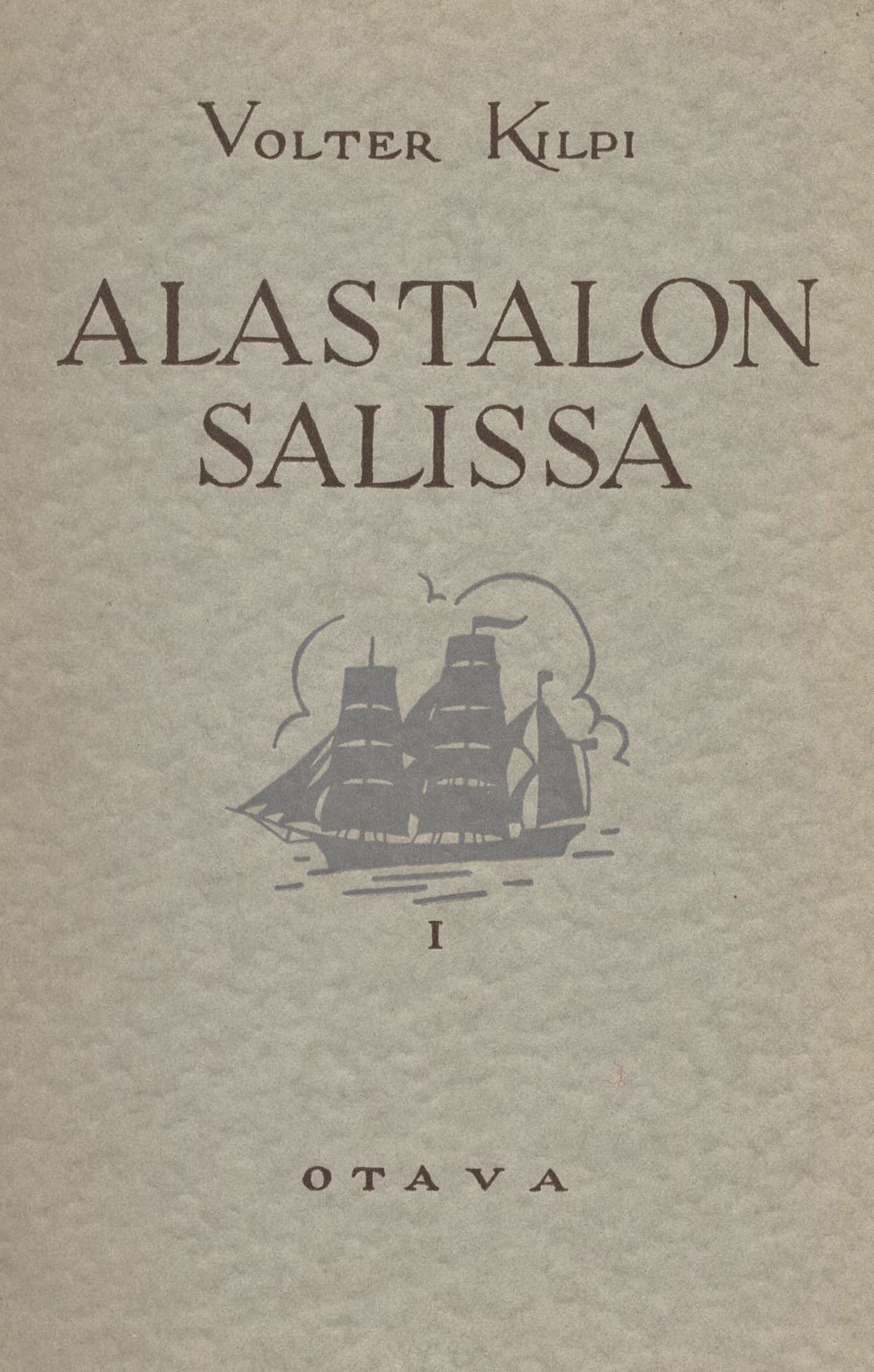
Volter Kilpi, In Alastalo’s parlour, 1933.
extract


Volter Kilpi’s classic novel Alastalon salissa (‘In Alastalo’s parlour’, 1933) has a reputation as a ‘difficult’ book. A Swedish translation is finally ready, but no one has ever succeeded in translating the work into English. Books from Finland decided to commission an extract – and had to admit defeat
‘Volter Kilpi is no good for people with weak lungs,’ said the poet Lauri Viita, some time toward the end of the 1940s. ‘Reading him, you get out of breath straight away.’ Kilpi’s major work, Alastalon salissa (‘In Alastalo’s parlour’) will take even an experienced reader two weeks, wrote another, older poet, Aaro Hellaakoski, in a 1937 essay.
Both were right. If one begins to read Volter Kilpi’s extended novel Alastalon salissa (1933) in the spirit of an entertainment or a detective novel, one soon tires. One can negotiate the slow tempo of its text, its long, curlicued sentences and wildly original vocabulary only by applying the brakes and pausing from time to time. For myself, I have found the two­week reading period prescribed by Hellaakoski about right. Kilpi is a demanding writer: every word must be read, the path of each sentence followed to the end.
When the book appeared, contemporary reviewers were already mentioning the names of Marcel Proust and James Joyce. Kilpi had certainly read Proust, but Joyce exceeded his knowledge of English. Kilpi himself saw the connection with the modernists of his time, but also emphasised the differences; most important was the encouraging consciousness of the works of the French and Irish masters.
With the appearance of his great novel, Kilpi was immediately branded a difficult writer. He never became a favourite of the general public, but he soon attracted his own faithful readership, as well as posthumous revenge. His masterpiece has appeared in three editions. When, in 1992, Finland’s biggest newspaper, Helsingin Sanomat, asked a group of writers and critics – elite readers and literary gourmets – to name the best Finnish novels to have appeared since the country gained its independence in 1917, Kilpi’s Alastalon salissa made a surprise appearance at the top of the list.
Volter Kilpi (1874–1939) was by no means an unknown writer. He had al­ ready, at the turn of the century, published three novels, Bathseba, Parsifal and Antinous (1900–03). The names are indicative: the tone is aesthetic and meditative – the subtitle of the first novel is ‘David’s conversations with himself’. The young Kilpi was a sworn symbolist, or ‘romantic of the new century’, as Vilho Suomi, scholar of his early work, has characterised him. In his collection of essays Ihmisestä ja elämästä (‘Of man and life’, 1902), Kilpi stressed introspection, the importance of attending to one’s emotional experiences and perceptions, the role of art as a mirror of the inner life.
Kilpi’s early work was followed by a pause which was broken only by some interesting essays and personal criticism and a couple of works on contemporary political and cultural questions, Kansallista itsetutkistelua (‘National self-examination’) and Tulevaisuuden edessä (‘Facing the future’, 1917–18). After these, Kilpi withdrew into his private life and his work as principal librarian of the university in Turku.
The silence was broken only in 1933 by the novel Alastalon salissa, which was followed by a collection of short stories on the same subject, Pitäjän pienempiä (‘Lesser parishioners’, 1934) and a novel, Kirkolle (To church’, 1937). Kilpi gave the three books the collective name ‘the archipelago series’: they are all set around his home town of Kustavi, in the archipelago of south-western Finland. In the preliminary chapter of Alastalon salissa, which is at the same time the prologue to the entire archipelago series, the writer describes wandering through the churchyard of his native town, reading familiar names, ‘extinguished years and decades ago, whose lives are nevertheless before me like yesterday’. Like Proust, Kilpi is à la recherche du temps perdu.
Alastalon salissa was completed as its author approached his sixtieth birthday. Kilpi had been writing it for ten years. The initial subject, the building of a barque as a joint project among the inhabitants of an island parish, had been clear for some time, but the shaping of the correct narrative form and composition took time. Kilpi was not satisfied with conventional style; he wanted ‘plastic narrative instead of silhouette narrative’ and compared the result to solving an equation in many stages. Kilpi broke the bounds of conventional narrative and language in four directions: vocabulary, syntax, the handling of time and the depiction of characters. He took vocabulary from the dialect of his home area of Kustavi, but also invented his own neologisms and broke down the borders between parts of speech, nonchalantly changing nouns into adjectives, verbs or adverbs (and vice versa) almost in the manner of Finnegans Wake. Writing was, for him, a process, as irrational ‘as any other element of life’. Attempts have been made to explain Kilpi’s use of language with reference to his increasing deafness, which may have strengthened his predilection for detailed visual description.
The novel does indeed include extended descriptions of, for example, a pipe-shelf or tea-tray, but the auditory aspect is not neglected. Sentences of half a page or an entire page are not rare; in the case of a couple of them, it is known that he spent as much as a month constructing and polishing them. His narrative is slow throughout in terms of vocabulary, sentence structure and general composition. Thus time, in the novel, moves exceedingly slowly.
The novel describes a meeting in which freeholders and sea-captains (a common combination in island parishes) negotiate and decide to build a barque together. The meeting lasts for a total of around six hours, but the account of it occupies more than 900 pages. The imbalance between the story and the descriptive material is considerable and deliberate.
Kilpi offers detailed descriptions of the appearance of his characters, but most importance is what is happening inside. Inner monologue and summaries of thought processes are major factors in the novel’s structure. Kilpi uses them to sketch his central characters: the chairman of the meeting, the resourceful Alastalo; his thoughtful friend Härkäniemi; the big, rich Langholma and his opponent Pukkila, who is distinguished from the rest by his jumpy style of speaking and thinking.
The elongations of the temporal perspective and the emphasis on the characters’ inner lives develop the novel’s philosophy of the value of every individual and the importance of every moment. The framework of the novel and the elements, too, have their tasks. As Pirjo Lyytikäinen, who has studied Kilpi’s late work, remarks in her book Mielen meri, elämän pidot (‘Sea of mind, feasts of life’), the sea and seagoing are constantly present, both as symbols and in language, through metaphor. In the background is a broad artistic and philosophical perspective with constant references to Homer and Plato – there is a trace of the Symposium in the meeting in Alastalo’s house. The men are planning a profitable economic venture but seek, at the same time, a fantasy, their life’s dream.
Kilpi hoped his book would be translated into other languages. His works, or parts of them, have appeared only in Swedish, through the efforts of the Finland-Swedish writers Elmer Diktonius and Thomas Warburton. ‘Kilpi is not for everyone, not even for one person in two,’ Diktonius wrote, although he himself, as an experimental stylist, well appreciated Kilpi’s value. Every translation of Kilpi, then, is a voyage of discovery, an act of defiance, which demands of its translator both courage and creativity.
In his last, unfinished work, published in 1944, the aged Volter Kilpi set out on a completely new tack. Gulliverin matka Fantomimian mantereelle (‘Gulliver’s travels to the continent of Fantomimia’) is a sequel to Swift’s novel, but at the same time a sharp satire on the increasingly technical and coldly mechanical world of our times, in which people are, to one another, ‘only objects’. -


If you are the kind of person who would find fascinating a 70-page account of a character walking across the room to choose a pipe from the mantelpiece, then Volter Kilpi’s novel Alastalon Salissa (In Alastalo’s Parlour)  is up your alley. The book was published in 1933 and forever changed the landscape of Finnish literature, as the modernist techniques employed by Kilpi allowed him to demonstrate to a stunning effect the creative potential of the Finnish language. The two volumes of Kilpi’s novel amounting to 900 pages of dense experimental writing narrate just six hours from the life of well-off dwellers of an island parish who have gathered in Alastalo’s parlour of the title to negotiate the building of a barque. The paucity of action is overcompensated by detailed overlong descriptions, the disjointed interior monologues of the characters, the use of dialect and linguistic innovations. The novel has been deservedly compared to Ulysses and In Search of Lost Time, although, as Kilpi’s knowledge of English was not sufficient to read Joyce’s masterpiece, it is more appropriate to talk about the artistic affinities between the two authors than about one’s direct influence on the other.

DieAlbatros
Although most of the novel consists of the verbalised thought processes of the participants of the meeting and the meticulous descriptions of the setting, there are also more conventional narratives appearing in the text as set pieces. One such story is about Ville from Vaasa, an accountant who runs into debt to fulfill his dream of building his own ship and sending it to Brazil to bring back a load of coffee beans. This story has been translated into German as Die Albatros.
Despite the obvious challenges of translating this modernist classic, the complete translation of Alastalon Salissa into Swedish saw light in 1997. The gargantuan task was undertaken by Thomas Warburton who had previously translated Joyce’s Ulysses, and, as of now, it is the only complete translation of Volter Kilpi’s novel into any language. As for the prospects of seeing an English translation, there is little to be optimistic about. Only a short passage from the novel has been Englished and made available in the now extinct journal Books from Finland. The first sentence of the translator’s letter to the editors says it all: “Reluctantly (I really have tried) I have been driven to conclude that Alastalon salissa is untranslatable, except perhaps by a fanatical Volter Kilpi enthusiast who is prepared to devote a lifetime to it.” (You can read the rest of it as well as the translated excerpt here.) Of course, it is an assessment of just one translator, and who knows, maybe there will appear a daredevil who will be self-confident enough to shoulder this daunting task.
In case I have sparked your interest and you would like to learn more about Volter Kilpi and his monumental novel, without further ado, I’m redirecting you to Kai Latinen’s informative article (also from the defunct Books from Finland) with the dispiriting title On Not Translating Volter Kilpi. - theuntranslated.wordpress.com/author/theuntranslated/

10/29/20

Rone Shavers - a syncretic tour-de-force that recombines elements of Afrofuturism, sci-fi, and wartime fiction with linguistic and literary theories to issue a dire warning about what happens when we choose to pretend our past never happened, thereby ensuring that we stumble blindly into a future we've already lived

Rone Shavers, Silverfish, Clash Books, 2020.

https://roneshavers.com/

What if the apocalypse already happened and you just didn't notice? That's one of the central questions of Silverfish, a novel that details a slice of life in the Incorporated States of America: a country much like our own, but one in which the corporatization of culture is so total and complete, so deeply ingrained so long ago that no one can remember an alternative. And in this America, citizens are "born to fail" - mainly because they lack the language and cognitive skills by which to identify their condition. That's the premise of this experimental novel, a dark Borgesian romp into the labyrinthine depths of language. 

Silverfish is a syncretic tour-de-force that recombines elements of Afrofuturism, sci-fi, and wartime fiction with linguistic and literary theories to issue a dire warning about what happens when we choose to pretend our past never happened, thereby ensuring that we stumble blindly into a future we've already lived. Part prophecy, part literary collage, and part social justice remix, it's a wholly immersive, intertextual sojourn. More than just a damning indictment of our contemporary moment, Silverfish is fiction written both for and after the end of history.

“Rone Shavers’ debut novel Silverfish is a lodestar of imaginative brilliance. Dazzling in its linguistic and technological breadth, abounding in voices and allusions, and a model of narrative economy and virtuosity, Silverfish is a 21st century Afrofuturist masterpiece.” - John Keene


“The hyper-capitalist world Silverfish satirizes so keenly is neither brave nor new. It’s ours already—only mixed through a peak trickster’s crossfader. On the 1, a concentrated slice of sci-fi life during Profit War-time. On the 2, a jam of code and language/langaj. With the brilliant Rone Shavers on the cut, what could be a perfectly lacerating record of a plutocratic dystopia, gets spun into something even more wild: a hot-to-death fiddle solo played as ‘the world, and word, [are] already shifting around us.’”— Douglas Kearney


"Silverfish has left me with big feelings that I need to sit with and explore. It has also left me with big questions that don't necessarily have answers, but requires an intense process of thought and being, in order to come close to some answers. You're in for a treat, Reader/Elegba/Hermes/Alternate Being." -

-Steven Dunn


"Part incantation, revelation, and elegy, Rone Shavers' Silverfish offers a surprising New World, Du Boisian source code. Reminiscent of Percival, Harryette, Ishamel, and Ralph Ellison himself, this is an experimental novel you must read."- Sheree Renée Thomas


Rone Shavers’s debut novel Silverfish is a lively, intelligent, and ambitious book, and refreshingly difficult to categorize. It is an experimental work that combines elements of sci-fi, dystopian, and war fiction with linguistic and literary theory, intertextuality and metacommentary, multiple perspectives and voices, social criticism and satire—all of which is injected with pace and humor and firmly grounded in an Afrofuturistic stance. One of the text’s central concerns is whether language can lose its power to transform the world, and that this slim volume manages to be so complex and inventive while also being so entertaining to read is a fitting testament to Shavers’s writerly preoccupations and prowess.

The work opens with a first-person prologue delivered by Elegba, the Yoruba trickster god of the crossroads, intermediary between the human and the divine, “translator and transmitter of mind … myth, maker, myth-maker, and metaphor.” He has appeared on this occasion to exhort us to “play language” and to tell us a “story of you, or people like you, or people who were once like you and will be again,” which is to say a tale of a possible future that some of us will hear and heed and, in turn, “know how to survive.”

But survive what? In the first instance, the brutal and stultifying conditions of the novel’s alternate reality, a world where multinational corporations, the military-industrial complex, financial services, information, and bio-technology industries have all joined forces to create a global hellscape of incorporated nation-states under the rule of “corporatocracy.” In this age of Profit Wars, there are routine, militarized invasions of “primitive” territories led by nigh-indestructible cyborg warriors—enhanced humans known as “Angels”—with the expressed intent of correcting fluctuations in the Dow, bolstering markets, and “incentivizing investment.” Unbeknownst to the “combat associates” (formerly called soldiers) on these missions, they are as expendable to their “civilized” paymasters as the “prims” they reflexively slaughter, but they may be rewarded with raises, promotions, and “social stock options,” depending on the recommendations of their “financial advisors,” in the unlikely event they return.

As the action begins, Elegba conjures or transports us to one such invasionary “jump”—“a standard extraction, a search and destroy operation”—albeit told from the multi-layered, first-person perspective of an Angel, a “self-aware artificial intelligence that relies upon biological parts and systems,” i.e., “cyborg technology.” The Angel’s brain is connected directly to a vast network of information, which it constantly “spools” in order to stay up-to-date on crucial facts, such as the current position and trends of the Dow Jones Industrial Average. Although the Angel can both answer questions from lesser-enhanced humans and respond to commands, its language capabilities are otherwise limited, and the distinguishing feature of Angel consciousness at the outset of the work is that the Angel experiences a running series of thoughts within its own mind that it cannot express (more on this below).

The jump starts well: within two minutes the Angel reports being in a “crater of viscera” from all the primitives it has maimed and killed and notes in passing the high fatality rate of its own unit, in addition to the “odd” circumstance that Machinist Clayton is somehow still alive. Then something goes wrong. The unit is attacked by “silverfish … a bio designed object that consumes polyferrous and conductive plastic-based material.” Not only do the “technovore” silverfish devour the cybernetic materials alloyed to Angels’ biological wetware, but they also grow and multiply rapidly as they feed, making them more or less unstoppable, “the scariest wetwork on the planet.” They summarily consume and capture the Angel and bring it back to the underground bunker of Dr. Huey S. Beagle, Lead Codeswitcher of Wetworx Industries, original inventor of Angels and silverfish alike, and one of the alter egos that Elegba explicitly names in the prologue.

The Angel awakens but is “webblind” and cannot “spool” while Beagle regenerates its biological body with stem cell therapies in a bath of synthetic amniotic fluid, and the two discuss the Angel’s origins, its consciousness and thoughts, and the state of the world, among other things. We learn that before becoming a cyborg the Angel was a woman named Roberta Nansi, that “the apocalypse happened and no one noticed,” and that Roberta is “an agent of that apocalypse.” The apocalypse in question is, of course, reflected in the violent and dehumanizing social conditions under corporatocracy during the Profit Wars, but also in the cataclysmic culturo-linguistic shift that those conditions either necessitated or occasioned: “Simply put, the apocalypse happened when humans saw fit to end metaphor and use euphemism in its place.” Like Orwell’s 1984, where newspeak and doublethink curtail language and thought in the service of totalitarianism, Silverfish explores the consequences for language, thought, and society at large when our utterances are reduced to “solely informational transactions” with exchange value.

In this scenario, which occurred in the novel’s past, human communication was stripped of its richness and vitality, and “the capacity for nuance, for linguistic fungibility” was lost. So too with human understanding: “The apocalypse did happen, but there were few around who had the means to recognize it for what it was.” Our minds reduced and fettered in this way, the apocalyptic “absence of metaphor” resulted in “an absence of the chance to make alterations or substitutions, new patterns.” And without this capacity, the capacity to envision and articulate unforeseen combinations and possibilities, we likewise lost the ability to resist or reform our world.

Hence the urgency for Beagle to restore Roberta’s language in the narrative’s present, not as a pre-programmed code by which the Angel could be commanded and controlled, but rather as what Beagle calls “langaj” or “langay”—pure language, which is “something that one can learn” without anything “to be immediately gained from it.” Fortuitously, Beagle glimpsed the possibility of the cultural and linguistic change that in fact came to pass, and, when creating the Angel several years before, embedded langaj deep within its base code as a hedge against just such an emergency. Traces of the Angel’s capacity for langaj have already been apparent to readers throughout the work, however, in the record of private thoughts that it could not express. These mainly take the form of short citations or textual allusions to other works of literature, music, philosophy, and so on (there is a partial list of references in the epilogue), which briefly interrupt the narrative in order to reinforce, extend, elaborate, or subvert it at various moments. Beagle calls this the Angel’s “doubled consciousness,” which allows her to “complete tasks and focus on them” while “thinking of something else at the same time.” It also allows her to be “multi-referential in a way that very few understand, let alone come to appreciate and know.”

Of course, the Angel’s “doubled consciousness” is also an explicit reference to W.E.B. Du Bois’s concept of “double-consciousness,” which he defines in The Souls of Black Folk (1903) as the inner conflict of being Black and American. Langaj, moreover, is not just the bud of pure language seeded deep within the Angel’s intellect, but also the ritualized speech of Haitian Vodou ceremonies, which begin by invoking Elegba (“Papa Lebga, Ouvri barrie”). The Angel's former name, Roberta Nansi, is also a cryptogram for Anansi, an Akan trickster god of stories and knowledge, celebrated for his cleverness and intellect. The multi-referential citations within the Angel’s thoughts not only function very much like samples in a hip hop track, but also summon such luminaries as Ralph Ellison, George Clinton, James Brown, Kamau Brathwaite, Jamaica Kincaid, De La Soul, Percival Everett, Public Enemy, Bob Marley, and Prince Jazzbo (among many others in a diverse and eclectic assemblage) to add to the proceedings. When Beagle restores language and self-awareness to the Angel, then, a long and rich tradition of African folklore, religion, and story-telling as well as the works of Afro-Caribbean and African American poets, musicians, and prose writers emerge along with them.

While Beagle is rebooting this virtual canon of African diasporic artists and intellectuals within Roberta Angel’s consciousness, Machinist Clayton is on a mission with another unit to retrieve her. They succeed; Clayton survives again and is immediately promoted to sergeant. But since the Angel returns badly damaged, Clayton is designated a “loss-leader” and suffers an overall decline in his “profit-making potential.” He is advised not to exercise any of his options due to recent economic events and is ordered to speak with a financial planner about the number of additional, probably fatal jumps he’ll need to take to improve the outlook of his portfolio. Until that meeting, the Angel is placed in Clayton’s diagnostic care, during which time she embarks upon her “new mission,” one of her own choosing, which is “to speak to those who know no better than what they have been taught or told.”

Such is Clayton, a disposable pawn in corporatocracy’s geopolitical game of global domination. In that game, “Clayton has already lost. His role in the game is to lose.” More colloquially put, his “black ass” is trapped. He risks his life on dangerous missions against primitives with the hopes of earning a raise or advancing to a higher pay grade. But his superior officers and financial planners just give him the runaround, they dissuade him from exercising his options while assuring him that signing up for ever more jumps is the best strategy for his fiscal health and wellbeing. Worse still, Clayton has internalized the self-defeating tenets of the corporatocratic worldview, which insist upon bettering the present through the never-ending pursuit of profit and wealth. As he says, “income-negative and revenue-neutral people aren’t civilized members of society,” and so Clayton, like all the other combat associates, continually puts his own life on the line and takes the lives of others to remain “income-positive” and “civilized.”

The Angel’s new mission is to help Clayton (and those like him) see that the game is rigged, that “social stock options are a method of forcing you to make short-term decisions that are detrimental to your long-term survival.” Clayton somehow already knows this, but he doesn’t see how it can be any other way. The Angel does, but first Clayton must change his approach—he must first see the game as a game and then he must “play to win.” Winning, in this sense, means that Clayton’s “long-term outlook will guarantee” his life, rather than his death, “with only short-term risk.” The way for him to break the cycle he’s caught in, to stop being “serviced” by those with higher pay grades and social standings, is to put all of his income, assets, credits, and options into “language acquisition.” Language acquisition is “pay grade restricted” and ostensibly prohibited to someone of Clayton’s status, but the Angel has discovered a loophole, “one of the secrets of the game,” with which to subvert the game itself: “You have amassed enough options and credits to take a position in language acquisition, but only if you do it without first asking to do it.”

Clayton must take initiative, exercise his own agency, and make a choice. If he opts for language acquisition, the pay grade penalty will cost him everything he has and he’ll become a “revenue-neutral citizen … a deficit to civilization … as bad as a primitive.” What the Angel is also trying to get Clayton to grasp, however, is that the word “civilized” is loaded, too—it’s “a catch-all … used to indicate the ideological correctness of the corporatocracy”—and that being a primitive isn’t nearly as bad as he has been led to believe. From the perspective of incorporated nation-states, which are themselves “heavily congested, heavily industrialized environments,” primitives tend to live in territories that are “hot, unordered, and unclean” and are considered “backwards, lazy,” and “guilty of sloth.” According to Beagle, however, who was living in a primitive territory when the Angel was sent to extract him in the first mission, “they have done nothing wrong. They just want to fish and hunt, farm, raise families, to not necessarily contribute to the great global economy.” In fact, their main failing is living in “the few territories around the world” with “open fields and farms, mineral-rich or arable land,” which in turn makes them “targets of the various incorporated nation-states’ troops.”

The refusal of “prims” to exploit their territories through “contractual obligation or market necessity” may have “predetermined their outcome,” as the Angel asserts in the opening pages, but there are virtues to being a primitive, too. Chief among these is their linguistic virtue. Beagle, who has lived among primitives for years, speaks “in the primitive way, using abstraction, allusion, and signification.” This non-utilitarian, non-transactional language is the langaj that Beagle restores in Roberta Angel, and which she, in turn, encourages Clayton to pursue. Full of nuance, subtlety, irony, allusion, playfulness, metaphor, multi-referentiality, codeswitching, double-consciousness, and more, this is the language that connects Beagle, Angel, and Clayton directly to Elegba the god and story-teller, and to the primitives and their linguistic traditions. These are the traditions that have been jettisoned in the “civilized” shift from metaphor to euphemism and are continually endangered by the grasping might of the incorporated nation-states. But there is always more to the world—even dystopian worlds—than power, profit, and massacre. “There is a way out” of the corporatocratic nightmare, the Angel informs Clayton, and Shavers’s delightfully intricate debut suggests that learning, reclaiming, and embracing the languages and ways of life that were all but lost to Clayton may just save his life. - James W. Fuerst

https://brooklynrail.org/2020/10/books/Rone-Shaverss-Silverfish

10/27/20

Allegorithms - Oscillating between the algorithmic & the representational, the human agent navigates its environmental niche in a way which is conducive to its further psychological, social, & biological existence

Allegorithms: Vit Bohal & Dustin Breitling (eds.): 9788073087081:  Amazon.com: Books

Allegorithms, ed. by Vít Bohal & Dustin 

Breitling, Litteraria Pragensia, 2017.

Contributors: Alexander R. Galloway, Marco Donnarumma, Sam Samiee, Paul Chaney, Sarah Kember, Martin Štefl, David Bates, Louis Armand, Václav Janoščík, Inigo Wilkins


The title of the book is predicated on the basis of a tri-partite framework – the algorithm, the allegory & the rhythm of their mutual interaction. Oscillating between the algorithmic & the representational, the human agent navigates its environmental niche in a way which is conducive to its further psychological, social, & biological existence. Yet how transparent & how predetermined is such a dynamic? Where are the points of contact, friction & overlap within the variegated pulls & counteractive flows inherent in the choreography of the “democracy of objects,” & how conducive is such an ecology of relations to the continuing survival of the human, here understood as an intersectional juncture between the biological, technological, cultural, semiotic etc?