1/30/15

Warren Motte - a book about reading and looking, about what people seek when they read, and about what stares back at them from the printed page. Motte has collected around ten thousand mirror scenes from roughly 1,500 books


Warren Motte, Mirror Gazing, Dalkey Archive Press, 2014.


Mirror Gazing is a book about reading and looking, about what people seek when they read, and about what stares back at them from the printed page. It is an archival project, based on a wealth of material collected daily by celebrated critic Warren F. Motte over thirty-five years and squirreled away for some eventual winter. It is also a love letter, a confession, a tale of deep obsession, and a cry for help addressed to anyone who takes literature seriously.


“I believe (and I’m choosing my words carefully) that this is the most extraordinary book about reading I have ever read” – Jacques Jouet

“Wonderfully luminous, entertaining, thought-provoking, and wide-ranging…an essential book” – Gerald Prince


What do we see when we read? For Warren Motte, the question is more properly stated, what do we see reflected when we read? This is a book first and foremost about the literature of self-regard. Over the course of his career as a decorated scholar of French and comparative literature, Motte has amassed a collection of over ten thousand scenes in which mirrors play some kind of role in the plot of a story. Mirrors are where we see people seeing themselves and, presumably, where we as readers are made aware of the way we see ourselves. Mirrors are stand-ins for the narcissism of reading. “We read,” writes Motte, “but we also watch ourselves read. In doing so, we construct a version of ourselves.” As Witold Gombrowicz writes in his autobiography, celebrating great readers everywhere: “Monday / Me. / Tuesday / Me. / Wednesday / Me. / Thursday / Me.”
Following Motte provides all the pleasures of following in the footsteps of a great reader. The trail meanders, but the vistas are always rewarding. Mirrors suddenly become newly fascinating (“mirror, mirror on the wall . . .”), and you won’t read about one the same way again. Mirrors are sites of banality, like learning how to shave well (Salinger, Franny and Zooey), but they are also sites of inspiration: “Art should be like that mirror / Which reveals to us our own face” (Borges, “Ars Poetica”). They allow us to try on new selves (Hemingway, A Farewell to Arms) or feel the pangs of conscience (T. C. Boyle, A Friend of the Earth). They can be reminders of time passing or intense moments of self-love: “Cornell buttoned his blazer, turned sideways to the dresser mirror to look at himself. ‘You a lean, handsome motherfucker, ain’t you?’” (Elmore Leonard, Stick). Mirror scenes can be straightforward (“‘I’m me,’ she whispered. ‘Me.’” (Toni Morrison, Sula), or they can be complex enunciations of the not-quite of resemblance. “The mirror showed her someone who was so nearly her that she had to lean forward to see what was missing from her face” (Robert Wilson, The Company of Strangers). In the end, as Motte ably shows, no two mirror images are alike. The hall of mirrors extends to infinity.
Motte has built an impressive array of examples, which he admirably tries to tame into a system of types. And yet the joy of this book is in its contradictions, not its resolutions. Mirrors are places of estrangement and self-knowledge, boring and intense, magical and mundane. They are themselves always double. One of the most poignant things about mirrors, as Motte notes, is that even as you see yourself, you can never see your back. Our need for self-reflection is endless because never quite complete. - Andrew Piper

Warren Motte admits early on in his strange and thought-provoking new book Mirror Gazing that his habit of collecting mirror scenes in literature is a little obsessive. “For a very long time now,” he says, “I have been fascinated by the way that characters in fiction encounter mirrors, and by the different things they see when they gaze into those mirrors. That fascination looms exceedingly large in my mind, grossly out of proportion with the many other fascinations that literature exerts on me. It is irrational and largely inexplicable, but there it is.”
There it is, indeed – that’s his book in a nutshell. It’s a gathering of mirror scenes culled from a collection of 12,000+ examples, all of which Motte jotted down on index cards over several decades of reading. He has rules for his burgeoning collection (“admittedly arbitrary and extremely quirky,” is how he characterizes those rules): First, he has to encounter the scenes spontaneously while engaged in otherwise “undirected readings”; second, he has to find the scenes in books he has in his own personal library. In other words, Motte, who is a professor of French and Comparative Literature at the University of Colorado, doesn’t go looking for mirror scenes. He doesn’t take suggestions from colleagues, family, friends or helpful acquaintances who hear of his interest, nor does he find these scenes in books he cannot pull down and refer to later – nothing from university or city lending libraries, nothing borrowed. He doesn’t cast a wide net on social media, begging for examples to be sent to him like someone less well-read might do, someone with a narrower frame of reference. All the examples he comes up with (and there are many, many examples) arrived via his own reading of his own books.
When reading non-fiction, I usually look for precise explanations of why authors are interested enough in their subjects to begin the long journey of writing it all down in a book and sharing it. I look for the passion to shine through, even if the origins of that passion are “inexplicable,” and Motte doesn’t disappoint: 
The notion that we might actually have not one, but two selves (or more!), and that the mirror might put that duplicity (multiplicity!) upon display, is reason enough for us to tread lightly when in the presence of that object. Because in many cases, specularity escapes from our control. It ramifies instantly and inevitably, duplicating as it does so, and positing thus a fundamental question of authenticity that cannot fail to trouble us. What is “real“ in a reflection of the real, and what is not? Or, in other terms, what is it that a mirror reflects?….My own sense is that problems such as that one do not bear too much thought. Like the paradox of the Cretan liar, or like certain Zen koans, one could wander into it and never find one’s way out….I myself have been caught for a very long time, I confess. Perhaps not by the mirror itself, but by these mirror scenes. I’m counting on this project, you will understand, to help me find my way out. But I’m not particularly sanguine about my prospects.”
What fun to read a book that tackles an obsession and confesses to it being mysterious and labyrinthine and slightly out of control. How exciting to find a book where the author doesn’t pull back despite his own confusions. As we watch, Motte works to construct a reasonable narrative from his collection, almost as if he were both personal tour guide and curator of a large natural history museum. Motte’s observations about these mirror scenes put me in mind of an old-fashioned wonder cabinet, filled with a few familiar objects but even more unfamiliar objects, brought back from Terra Incognita. And Warren Motte is the slightly grizzled explorer, willing to share his journey with us, sea serpents and all.
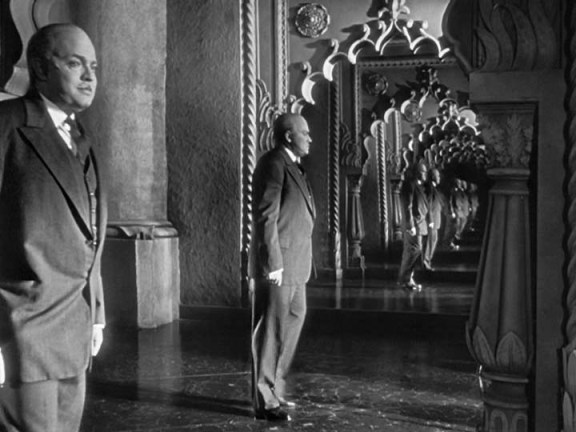
kane37
Orson Welles, reflected in multiple mirrors in Citizen Kane.
(Photos of artists/authors in this post are not from Mirror Gazing.)
I found myself wishing that I could see even one photo of the author with his collection of 12,000 index cards. I imagined the cards organized in multiple shoe boxes – a little disheveled – with labels on the outside for easy identification: “Implicitly Implicit Non-Mirror Scenes” and “Explicitly Implicit Non-Mirror Scenes.” How does one organize such a collection? Much of what is delightful about this book is not its surface subject matter but its subterranean one; we read between the lines to see how Motte himself reads these mirror scenes and conducts the art of classification. At heart, this is not just a book about mirror scenes, interesting as they are— and they are interesting— it’s a look at passion, at collection, at personal taxonomies and the game of creating order from disorder (do we ever win that game?) It’s about how we read and why we read. And it’s about the Delphic maxim, “Know thyself.” Motte explores how characters look for (or suddenly catch) themselves in mirrors, as well as how (or whether) the act of writing is a reflection, distorted or true, of writers themselves.
Motte is a born taxonomist; he enjoys categories. That the examples he presents are a little fuzzy around the edges (fuzziness usually impedes categorization) was not a problem for me. I get the feeling many of his examples could slip easily into and out their categories, according to Motte’s changing perspectives. Readers like me who can relax and go with a little disorder during the classification process will be happiest with this book. In the almost seventy pages of examples that are not true mirror scenes the author offers up his thinking about the following distinctions (and remember, these are only the NON-mirror-scene categories):
  • Definitely Not
  • Probably Not
  • Me, Me, Me
  • Self-Knowledge
  • Reassurance
  • Avoidance
  • Unavoidability
  • Close Shave [Yes – a collection of scenes of shaving in a mirror]
  • Fathers and Sons, Mothers and Daughters
  • On the Other Hand
  • Banalaties
  • Virtualities
  • Implicit Mirror Scenes
  • Metaphorical Mirrors
  • Conscience
  • The Eyes of Others
  • Skepticism
  • Fools and Churls
  • Writing as Mirror
  • Fictions
  • Whys and Wherefores (in which, about a third of the way into the book, we discover some things that might have imposed more order on the material at the opening of the book.)
It’s clear from this list, I think, how elaborately Motte studies the nuances of any scene in literature that includes a mirror (actual, implied or metaphorical) and makes his decision about which shoebox (my own metaphor) to put his index card into. What’s not quite as clear is why the book itself is organized the way it is. Motte shoots for a system of classification for his mirror scenes, but he does not appear to be particularly wedded to the idea of orderliness in his own writing. In the middle of the section about non-mirror scenes, he offers one example and then says, “The temptation to call this a mirror scene is very real. And indeed we must give in to it, because this is in fact a mirror scene, and a fairly mainstream one at that.” Let’s just say some drifting occurs, organizationally. It’s unsettling, but not uninteresting. Motte speaks often of trying to get his explanations under control and to get back, amid the decision-making about yes-true-mirror-scene vs. no-not-true-mirror scene examples, to a more regulated presentation of his material. He calls his thoughts “scattered,” which they occasionally are (charmingly, I think, though some might be annoyed), and he says, in the section titled Fictions, “Let us re-visit together, briefly and on tiptoe, but nonetheless a bit more systematically, the terrain which that notion occupies, bearing in mind how uneven and slippery that terrain is.” A given reader’s tolerance for slippage (mine is high) will determine whether Motte’s book is appreciated.
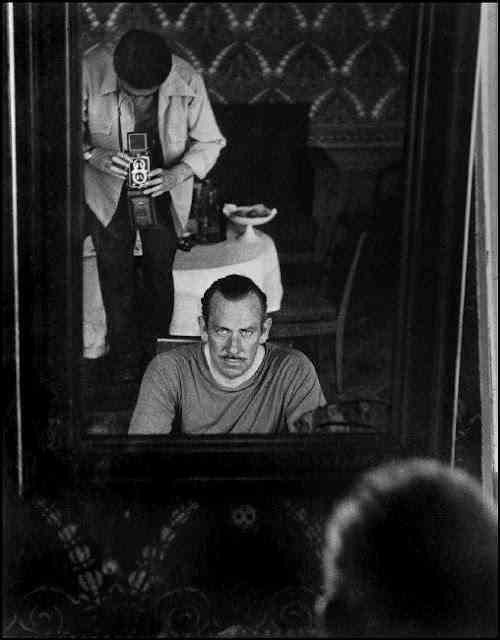
Robert Capa and John Steinbeck
Photographer Robert Capa catches his own mirrored reflection
along with that of author John Steinbeck.
I did find myself wondering one thing consistently: Could Motte have been persuaded to offer up the definition of a true mirror scene before the nearly seventy pages of definitions of what it is not? The opening chapter is a speech presented at Johns Hopkins University which makes a stab at summary but feels a little tacked on (even the font is different.) Would it have been possible to integrate the speech into the text more smoothly and present a more concise version of the non-mirror-scene rules, holding off on elaborations of those until after we understood true mirror scenes a bit more? The author’s trust that we can fill in the gaps and understand, via negative space, what really constitutes a mirror scene by understanding what one is not is a little out of whack. The book could just as comfortably – and less confusingly – have started with the brilliant lines that open the section titled “Imagine My Emotion,” which go like this: “Imagine my emotion when I learned, a few years ago, that elephants are self-aware! A team of scientists had just discovered (so it was reported in my morning newspaper) that elephants are capable of recognizing themselves in a mirror.” What immediately precedes these lines (the Whys and Wherefores section) and follows them (a fairly precise presentation of what true mirror scenes do) helps steady the boat. Mirror scene shows characters looking for themselves, Motte says, and recognizing themselves or not. That might just be the goal of all stories (again, the adage Motte referes to several times: “Know yourself”…gnothi seauton.) We – and a few other species, including elephants – engage with our self-images either seriously or playfully. If the book opened there, readers might get a firmer grasp on the idea of a true mirror scene (and its nuanced shadings) before the boat got rocked. On steadier ground then, readers could look at the non-mirror scene examples and discern the differences more easily.
vivianmaier_selfportraits7
Self-portrait of  the recently discovered photographer Vivian Maier
That reservation aside, I come back to the strengths of this book, not the least of which is Motte’s ability to make a work of scholarship un-fusty and conversational. He talks directly to his readers as if his thoughts were being delivered to friends around the dinner table. He recounts being baffled by the word “heresay” via a personal story about pedaling uphill (literally, not metaphorically) on his bicycle and being “misperceived” by bicyclists riding downhill (perception of ourselves by others being part of what Motte terms “specular encounters.”) We feel like we know Motte personally, because of his chatty delivery – in fact, by the end of the book, I concluded Motte was bright, compulsive, amiable, confused, and just silly enough (dolphins, he jokes, look at themselves “on porpoise”) to wish he were a friend. “Oof! There. That’s better,” he says at the end of the section about non-mirror scenes. “So much for that,” he says at the end of another section, “for the time being at least.” And after his quick dismissal of anything television has to offer (maybe he hasn’t seen some of the good writing television offers up lately?) he says, “But there. My prejudices are showing. Not for the first time, certainly, but still.” Every once in awhile we see self-mockery; that’s rare in an academic. And what’s not to love about a writer who can say at the end of his book, in a completely relaxed way, “…things have not turned out exactly as planned. The categories that I postulated have broken down under close inspection….I can live with that, quite happily, in fact.”
As for Motte’s intelligence, that’s made clear in the 32-page, single-spaced list of works cited. A more well-read author is hard to imagine, especially given those rules I mentioned previously (all examples came from his personal library of books and were found during “undirected” reading.) The list of books cited is deep and wide. It includes work by pop-culture authors (Elmore Leonard, Jeffrey Archer, James Lee Burke, Agatha Christie), science fiction and fantasy writers (Isaac Asimov, Edgar Rice Burroughs), poets (Charles Baudelaire, Paul Valery) and even writers for children (Kenneth Grahame, Dr. Seuss, Margaret Wise Brown.) Translated authors are well represented – Russian, Italian, French, Spanish, Czech, Norwegian, Swedish, Dutch, the list goes on; they include many writers of the Oulipo school (Motte’s book Oulipo: A Primer of Potential Literature is a fine guide to that movement.) He includes songwriters (Bob Dylan), critics (Harold Bloom), philosophers (Johan Huizinga) psychologists (Sigmund Freud) and even politicians (Barack Obama.) I am leaving out many dozens of writers, especially contemporary American and British, who made it onto those index cards and into the book. It’s not everyone who can refer to both Yahweh and Popeye in the same sentence (“That’s the best and most reassuring lesson of the mirror: like Yahweh and Popeye, we are what we are.”)  One of the loveliest passages Motte offers us of a true mirror scene (subcategory: what Motte calls “doubling”; that is, “a recognition of one’s own alterity”) is this quotation from Andre Gide’s Si le grain ne meurt:
The desire to seem exactly what I felt I was, what I wanted to be, that is, an artist, actually prevented me from simply being, and made of me what people call a poseur. In the mirror of a small writing desk that I had inherited from Anna, and that my mother had put in my room, and which I used for writing, I contemplated my facial features tirelessly, studying them, training them like an actor does, seeking out on my lips, in my gaze, the expression of the passions that I longed to feel. Above all I would have liked to make myself loved; I would have given my soul for that. During that period, I could not write (I almost said think), it seems to me, elsewhere than in front of that mirror. In order to understand my own thoughts, I felt that I had first to read them in my eyes. Like Narcissus, I was bent over my own image; because of that, each sentence that I wrote in those days remains a bit curved.
Motte ends Mirror Gazing in a self-effacing way and leaves me convinced he is the kind of scholar I would love to work alongside (and have as a dinner guest) and whose books I will continue to seek out. He describes what he sees in his own mirror: “A sixtyish professor, beavering away at a piece of scholarly writing. A person who lives a great deal of the time in his imagination, giving full rein to that imagination. A committed reader, surveying the particulars of his commitment. A collector, perusing and arranging his collection in order to put it on view. A man at work. A boy at play. I confess that I’m more attached to the latter sort of image, for reasons that will be, by this time, massively apparent.”
Maurits-Escher-Self-Portrait-in-a-Globe-1
M.C. Escher’s Self-Portrait with a Globe
Of course, the down side to this fascinating book is that Motte ruins things for us – we can never encounter a literary mirror scene again and just speed past it without slowing down and pausing to reflect (pun intended.) I’m satisfied with that sacrifice. Slowing down is not a bad idea when what we’re doing is complicated, and Motte manages to make us feel the complications of self-knowledge. One moment we’re over on the dark side of the mirror: “The things that we fear the most may be those that lurk right inside us, for goodness sake. An encounter with the mirror and the introspection that it entails present the very real danger of recognizing that tough truth.” The next moment, we’re having a fine time at a little road-trip game called “Mirrors.” We’re not sure what the rules are, exactly, but we’ll learn them as we go. If the ride gets bumpy, well, the bumps keep us alert, and a smooth road, as often as not, puts us to sleep. The thoughts I had as I came to to the end of Mirror Gazing were these: Reflection – as in a mirror – is pervasive, and reading itself is an act of reflection. Motte’s journey into reflection is an on-going process, he’s in the driver’s seat, he’s having fun on this road trip, and for several days I rolled down the window, got a little windblown, and had fun alongside him. - Julie Larios

Many readers make notes about their reading; many mark or even copy out and collect quotes or sentences. Some, like Warren Motte, focus on something specific: as he explains, he has made note of very specific mentions on index cards for decades now:
Since the late 1970s, I have been collecting mirror scenes in literature, moments when a subject glimpses himself or herself in a mirror. 
       An avid reader, he's collected a great deal of material over his many reading years. In a talk he delivered in 2004 he admits:
I find that I now possess something approaching 10,000 mirror scenes -- far too many to be of any practical use -- in roughly 1,500 books, from say, Homer to Jacques Jouet.
       Mirror Gazing is, finally, his attempt to shape something out of this reading-sideline, both an attempt at some analysis of the collected material itself and an examination of his fascination with it.
       Mirror-mentions in literature tend to be incidental -- a glimpse in passing. Even where a character stares at and actively considers his or her reflection, it's rare for the scene to be particularly protracted. But it's not an unusual occurrence either: any given novel might well offer a fleeting glimpse here or there.
       Mirror-images are also striking, even just in passing: reflections of and on the observer -- and, despite being 'perfect' mirror-images (except, of course, when the mirror itself is not -- a not too infrequent occurrence as well) still so often not quite the picture the observer expects or imagines.
       Motte offers a sort of taxonomy of mirror-scenes, describing the many variations he's encountered, grouping together examples and suggesting what can be read into the authors' uses of mirrors in these particular ways. Mirror Gazing isn't truly encyclopedic -- neither in its presentation (which has a personal-digressive touch) nor in the collection of material itself (the sampling is selective -- again also personally so -- rather than fully representative) -- but it seems safe to say that readers are unlikely to easily come across such a thorough consideration of mirror-scenes in literature -- or one that is this entertaining; it helps a great deal that Motte doesn't take his enterprise entirely too seriously.
       The book benefits greatly from Motte's catholic approach to reading: though an academic, he doesn't limit his discussion to what is generally called 'literary fiction'. Explaining what books he draws his material from he writes:
I read a lot of "serious" fiction and a lot of "popular" fiction, but very little "bestselling" fiction. (I am not happy with these categories, but I lack better ones.) 
       So, for example, a typical sequence of quotes is from: Stanisław Lem, Elizabeth George, Vladimir Voinovich, Walter Mosley, Louis-René des Forêts, Muriel Cerf, Lydie Salvayre, José Donoso, and William Gaddis.
       A thirty-two page list of books is included, citing all the books that get a mention -- a solid reading list, though with some rather large gaps (particularly weak on Japan, India, and Africa, scraping only the Chinese surface, very hit and miss on contemporary European fiction beyond France and the UK). A specialist in French literature, it's not surprising that much of Motte's reading (and hence examples) come from modern French literature (or are published by the publisher of this book, Dalkey Archive Press, whose general sensibilities Motte seems to share). It is difficult for anyone's readings to be all-inclusive enough to satisfy others, but -- though perhaps biased because of the great overlap with my own reading -- Mirror Gazing certainly seems built up on a good foundation.
       Reading is a personal and individual matter, and Motte is aware that his reading-list is unusual; he pokes some fun, too, at his reading -- as when he cites: "Sharon Kendrick's contemporary classic, The Playboy Sheikh's Virgin Stable Girl", and jokingly takes for granted: "You have read the novel, I trust, so I have no need to point out [...]". (It's a Harlequin romance, and is in fact the least likely of the several hundred titles cited in the book that readers will have come across.)
       The personal asides and comments can be a bit hit or miss, but lend a nice backdrop to what could otherwise easily become too academically dry and dreary. Motte's willingness to step back and wonder (aloud): "Am I reading too much into these things ?" helps ground the book.
       As Motte demonstrates, a lot can be made out of looking into mirrors. The examples he cites show just what authors can do with them, and with the reflections they offer, ranging from the apparently perfect and true to the surprising. Significantly, too, mirrors don't merely serve for introspective reflection; indeed, among the more interesting aspects revealed by Motte is in the more incidental uses of mirrors.
       The idea of books as mirrors themselves is of course impossible to ignore throughout, and Motte's mirror-examples reinforce that notion. Though mirrors would seem far more objective -- offering an accurate reflection -- time and again authors show and use them in ways that demonstrate that the observer often finds the unexpected there, that the reflections on offer are, just as when reading a book, shaped by both the observer and the mirror, as well as an often unexpected interplay between the two.
       Looking into texts -- reading -- is a kind of mirror-gazing; Motte's highlighting of the mirror-incidents in his reading allows us to consider the variations all the more closely. It makes for a worthwhile -- and entertaining -- exercise. - M.A.Orthofer

Warren Motte has been collecting literary mirror scenes for the past twenty-five years—a remarkable, if somewhat curious, undertaking. Motte, a devoted reader who absorbs “a healthy mix of so-called ‘serious literature’ and so-called ‘popular literature,’ ” has kept 3×5 notecards within each book to record the author, title, and page of each encountered mirror scene. His fascinating new book, Mirror Gazing, is a lovely reflection on these many mirror scenes and the peculiar pursuit of collecting. 
What is a mirror scene? In the most literal sense, a character actually looks into a mirror, but characters also catch their reflections in train windows or coffee cups. And then there are bodies of water or dark, rainslicked streets. In the modern world, we cannot escape screens. We are, in a sense, surrounded by mirrors, and as often as we encounter them in real life, so too do characters in fiction.
There are many ways that we look metaphorically into mirrors, perhaps gazing into our souls while listening to a record. But mirror gazing, for Motte, cannot take place on this purely figurative level. He writes, “I do not consider Roquentin rereading his diary in Nausea a mirror scene, however, because the level of abstraction therein is unacceptable, stretching the working definition such that it might eventually include everything in literature—and everything outside of literature, as well. The scene in Marguerite Duras’s The Lover where the narrator describes her ruined face is not an example of the breed, for me at least; the scene where a man who used to know her when she had been young tells her he prefers the face she has now, ‘ravaged’ (3), just barely clears the bar; and the scene where the narrator looks in a shopkeeper’s mirror, and says, ‘Suddenly I see myself as another’ (13) is an almost perfect example of the genre.”
Motte has collected around ten thousand mirror scenes from roughly 1,500 books. This, in and of itself, is noteworthy, but the book is not simply a reprinting of quotes from various books. It is a deeply considered analysis of what it actually means to look into a mirror. For the serious reader, this book will serve as a trip through your reading past. I was reminded—somewhat nostalgically—of much of the literature that has defined the early part of my adult life. From Nabokov to Salinger to Rilke to Calvino, the book makes its way into just about every corner of American and European literature. Some books have no mirror scenes, and thus are left out, whereas others have just a few. Motte says, “The record, insofar as my own readings are concerned, is held by William Gaddis: I’m pleased to report that The Recognitions contains no less than eighty-three mirror scenes.”
When digging through these ten thousand passages, one has to wonder where to begin when writing such a book. Motte suggests that this project is emblematic of “the kinds of impossible situations that certain, stubborn, fixated academics get themselves into.” But, as someone who spends her days in the academy, I found the book to be a refreshing departure from much of the dense, arcane text that lives within the university. Mirror Gazing reads like a lively conversation with your favorite English professor. When thinking about the project, it is easy to wonder how might we productively look at or analyze these index cards. In other words, what is the point? This is not, I believe, the right question to ask of such a book. I’m not sure that we need an explanation for such a project, because the fundamental concept of collecting requires a certain kind of intellectual inquisitiveness that justifies itself. At any rate, Motte is such a thoughtful and engaging writer. The explanations he offers for these mirror scenes are, simply put, an absolute joy to read.
The project is not as haphazard as it may sound. There are, in fact, some rules to the collecting. Motte writes, “First, I have to come upon each scene myself, in the course of otherwise undirected readings. That is, I have never gone in search of mirror scenes, nor have I accepted them when upon rare occasion benevolent friends aware of my project have contributed them. Second, they have to occur in books that I own, and have shelved in my personal library. For how else would I find them again, one day, with only page references to go by, in an age when editions change so quickly?—and I confess, too, with some chagrin, that I am as loathe to leave the comforts of my own library as Oblomov was to leave the comforts of his couch.”
And so, with the ever-evolving collection in hand, Motte begins the process of categorizing the mirror scenes. As I began this book I could only think of a handful of reasons that one might even look into a mirror in the first place, but I soon learned that the reasons (and contexts) are infinite. The sheer variety of mirror scenes is perhaps the most absorbing thing about this book. To name just a few of the themes that run through the book: narcissism, avoidance (or the unavoidability of looking into a mirror), banalities, voyeurism, conscience, skepticism, alienation (on being a stranger to oneself in a mirror could be a book in of itself), ageing, shock, self-loathing, truth, difficult recognition, and happy events (let us not forget that these do exist in literature from time to time). In fact, a happy mirror scene (of which there are few) is a nice example of how the book arranges itself: 
“The limit-case of these happy recognition scenes is one where happiness swells into something approaching ecstasy. Catching a glimpse of herself in the mirror, Raymond Queneau’s Zazie reacts in a way that leaves little room for doubt, alienation, or otiose introspection: ‘Zazie gazed at herself in the mirror, salivating with admiration’ (Zazie dans le métro 63). One easily understands her, and my own feeling is that we ought to allow ourselves to share her admiration—otherwise, where is the plaisir du texte? In a more macho vein, a character in Elmore Leonard’s Stick expresses his pleasure with an eloquence all his own: ‘Cornell buttoned his blazer, turned sideways to the dresser mirror to look at himself. “You a lean, handsome motherfucker, ain’t you?” ’ (105). Sometimes the mirror serves to correct and improve an impression of the self, and that correction can be a very dramatic one indeed: ‘Though she and Youqing’s wife had similar figures, the blouse seemed a bit tight in the waist. But when she looked in the mirror, Yumi nearly jumped out of her skin. She’d never looked so good—as pretty as a city girl’ (Bi Feiyu, Three Sisters 48).” The juxtaposition of such vastly different characters and writers is typical of Mirror Gazing, and Motte effortlessly moves through book after book making connections and observations along the way.
Beyond the literature itself, there is something about the very nature of a collection that is captivating. We often encounter collections in the public space, in museums or shops. Consider a collection of paintings or butterflies or buttons. There is something quite curious and beautiful about the arrangement and cataloging of things for our viewing. But what of the personal collector? The basement full of National Geographic, the drawers full of maps, or the shelf lined with antique dolls. For my part, I collect cigar boxes. It’s something I took up over a decade ago, when I discovered a small, worn box filled with letters in the basement of my childhood home. Over the years, I have picked up unique cigar boxes at flea markets and antique stores, often as mementos from trips. These boxes are lined up on my windowsill, and when people come to visit, they often become a topic of conversation. When people ask why I collect boxes, I am never able to provide a satisfactory explanation because I really don’t know. Motte says, “Any collection, undoubtedly, is a way for the collector to impose order upon the world, his or her world, or at least a very small corner thereof.” This is the best explanation I have come across. It is something that is all mine, a collection unlike any other, and one that I can carry with me as I make my way through this world.
For Motte, the project of collecting seems to have become something that is almost unconscious, an inexplicable task that is an ingrained part of his reading life. It is the kind of project that can happily fill a lifetime. He says, “One thing I know, for example, is that my fascination with these mirror scenes is both endless and end-less. That is, it is ongoing and uninterrupted, with no end in sight. Moreover, it is not directed toward any particular goal; it is largely disinterested; it is playful. If I felt an absolute need to bring my activity to a close, I guess that I could restrict myself to reading only those books that I’ve already read—or indeed to stop reading entirely. But I’m not likely to do that. More than anything else, it’s a question of quality of life.”
Perhaps what makes Mirror Gazing such an extraordinary book is that there is something deeply human and deeply personal about looking into a mirror. One of Motte’s collected scenes neatly sums up the experience of looking in the mirror: “For there are at least two ways of looking into a mirror: ‘The first is to see your face. The second is to probe your conscience. When we size ourselves up in the mirror, we are always struck by the different forms of the self that we see there’ (Patrick Roegiers, L’Artiste, la servante et le savant 12–13).”
Can we really see ourselves in a mirror? This is the question—if not literally—that every great piece of literature asks. How are we to perceive ourselves? How are we to understand the face that looks back at us when we gaze into a mirror? And how do other people perceive that face? Motte’s book doesn’t answer these questions outright, though they are at the heart of the project. He writes, “The fact of the matter seems to be that the face, considered as a crude image, is never entirely congruous with the image of ourselves that we construct in function of our desires, our hopes, our fears, and our obsessions. There is always—almost always—a distance between the two. And a close consideration of that phenomenon suggests that it is the face, rather than the self, which mostly bears the weight of difference.”
At the end of the book, Motte reflects on twenty-five years of collecting mirror scenes: “When I gaze into the mirror of this project, I see different things. A sixtyish professor, beavering away at a piece of scholarly writing. A person who lives a great deal of the time in his imagination, giving full rein to that imagination. A committed reader, surveying the particulars of his commitment. A collector, perusing and arranging his collection in order to put it on view. A man at work. A boy at play.” 
Reflection is at the core of Mirror Gazing. Of course there is the literal reflection of characters looking into mirrors, but there is also the theoretical task of reflecting upon one’s life. We often open up a piece of literature in order to find ourselves, to understand how we measure up. Even beyond the books, this is an endless pursuit. Like the collector who socks away trinkets, we are all, always, cataloging and arranging our lives, if only to make sense of the face that looks back at us in the mirror. - Nancy Smith

Entropy’s Top 93 Poetry Books in Translation of 2014

translation


Since Coldfront didn’t mention any books of poetry not originally in English in their list of the top 40 poetry books of 2014, and since we don’t want to wallow in bitterness, we present…
Drumroll…


Entropy’s Top 93 Top Poetry Books in Translation in 2014!
Yes, in fact, there were only 93 books of translated poetry published in the United States in 2014 (according to the Three Percent database). 93 books to represent the entirety of world poetry in other languages! So few, you say?
This is an old and by much-discussed situation: the US doesn’t translate and publish many authors from other countries, especially not in comparison with other countries. US literary culture is insular and isolated. US literary culture is all too wary of translations (¿¡¿what if something is lost?!?). And if translations do get published, attention is less than overwhelming. So when a list like Coldfront’s—full of contemporary writers we love—misses all of these books, it’s worth pointing it out. We could select our favorite books from this list, but honestly, there are only 93! We want to let the love go to all of them.
So yes, these were definitely the best. No doubt about that. We are 100% sure these are the absolute best.
Here goes:

  • What Have You Carried Over? by Gulten Akin, Various translators from Turkish, Talisman House
  • Sleepless Eye by Ibrahim al-Koni, Translated by Roger Allen from Arabic, Syracuse University Press
  • Fullblood Arabian by Osama Alomar, Translated by C. J. Collins from Arabic, New Directions
  • Chronic Hearting by Cristina Annino, Translated by Adria Bernardi from Italian, Chelsea Editions
amnesia
  • Amnesia of the Movement of Clouds & Of Red and Black Verse by Maria Attanasio, Translated by Carla Billitteri from Italian, Litmus Books
  • Digamma by Yves Bonnefoy, Translated by Hoyt Rogers from French, Seagull Books
  • Collected Poems by Rainer Brambach, Translated by Esther Kinsky from German, Seagull Books
  • Rubble Flora by Volker Braun, Translated by David Constantine from German, Seagull Books
  • Love Poems by Bertolt Brecht, Translated by David Constantine from German, Liveright
  • Breathturn into Timestead by Paul Celan, Translated by Pierre Joris from French, FSG
  • Diorama by Rocio Ceron, Translated by Anna Rosenwong from Spanish, Phoneme Books
  • Return to My Native Land by Aime Cesaire, Translated by Anna Bostock and John Berger from French, Archipelago
cesaire
  • Seven Dreams by Feliciano Sancez Chan, Translated by Jonathan Harrington from Mayan, New Native Press
  • Hypnos by Rene Char, Translated by Mark Hutchinson from French, Seagull Books
  • I Must Be the Wind Moon by Chung-hee, Translated by Richard Silberg from Korean, White Pine
  • Nothing More to Lose by Najwan Darwish, Translated by Kareem James Abu-Zeid from Arabic, New York Review Books
  • Across Borders by Xue Di, Translated by Alison Friedman from Chinese, Green Integer
drago
  • Endarkenment by Arkadii Dragomoshchenko, Translated by Eugene Ostashevsky from Russian, Wesleyan University Press
  • Acrobat by Celia Dropkin, Translated by Faith Jones from Yiddish, Tebot Bach
  • Openwork by Andre Du Bouchet, Translated by Paul Auster from French, Yale University Press
  • Seven String Quartets by Frederic Forte, Translated by Matthew Smith from French, Fence Books
  • Selected Poems by Corsino Fortes, Translated by Daniel Hahn from Portuguese, Archipelago
  • Starry Womb by Mihail Galatanu, Translated by Adam Sorkin from Romanian, Dialogos
  • Description of the Lie by Antonio Gamoneda, Translated by Donald Wellman from Spanish, Talisman House
  • Alma Venus by Pere Gimferrer, Translated by Adrian West from Spanish, Antilever
girondo
  • Poems to Read on a Streetcar by Oliverio Girondo, Translated by Heather Cleary from Spanish, New Directions
  • Eros Is More by Juan Antonio Gonzalez Iglesias, Translated by Curtis Bauer from Spanish, Alice James Books
  • I Am the Beggar of the World: Landays from Contemporary Afghanistan Ed. Eliza Griswold, Translated by Eliza Griswold from Pashto, FSG
  • Chronicles of Majnun Layla and Selected Poems by Qassim Haddad, Translated by Ferial Ghazoul from Arabic, Syracuse University Press
  • Iceland Sakutaro by Hagiwara, Translated by Hiroaki Sato from Japanese, New Directions
  • Song of Shadows by Xiao Hai, Translated by Zhu Yu from Chinese, Restless Books
  • Guarding the Air by Gunnar Harding, Translated by Roger Greenwald from Swedish, Black Widow Press
  • Always Rebellious by Georgina Herrera, Translated by Maria Rodriguez-Alcala from Spanish, Cubanabooks
  • God and the End of Satan: Selections by Victor Hugo, Translated by R. G. Skinner from French, Swan Isle Press
hyesoon
  • Sorrowtoothpaste Mirrorcream by Kim Hyesoon, Translated by Don Mee Choi from Korean, Action Books
  • Phoenix by Ouyang Jianghe, Translated by Austin Woerner from Chinese, Zephyr Press
  • One Is None by Katlin Kaldmaa, Translated by Miriam McIlfatrick-Ksenofontov from Estonian, Midsummer Night’s Press
  • October Dedications by Mang Ke, Translated by Lucas Klein from Chinese, Zephyr Press
  • Where Are the Trees Going? by Venus Khoury-Ghata, Translated by Marilyn Hacker from French, Curbstone
  • One Day, Then Another by Kwang-Kyu Kim, Translated by Young-Shil Cho from Korean, White Pine
  • Puppets in the Wind by Karl Krolow, Translated by Stuart Friebert from German, Bitter Oleander Press
  • I Wait for the Moon by Momoko Kuroda, Translated by Abigail Friedman from Japanese, Stone Bridge Press
lanlan
  • Canyon in the Body by Lan Lan, Translated by Fiona Sze-Lorrain from Chinese, Zephyr Press
  • Missing Pieces by Henri Lefebvre, Translated by David Sweet from French, Semiotext(e)
  • Pybrac by Piere Louys, Translated by Geoffrey Longnecker from French, Wakefield Press
  • L Notebook by Sabine Macher, Translated by Eleni Sikelianos from French, Fence Books
  • Withering World by Sandor Marai, Translated by John Ridland from Hungarian, Alma
  • Wallless Space by Ernst Meister, Translated by Graham Foust from German, Wave Books
  • Rain of the Future by Valerie Mejer, Translated by A.S. Zelman-Doring, Forrest Gander, and C.D. Wright from Spanish, Action Books
  • Out of the Dust by Klaus Merz, Translated by Marc Vincenz from German, Spuyten Duyvil
  • Thousand Times Broken by Henri Michaux, Translated by Gillian Conoley from French, City Lights
  • Iraqi Nights by Dunya Mikhail, Translated by Kareem James Abu-Zeid from Arabic, New Directions
homing
  • Homing Instincts by Nancy Morejon, Translated by Pamela Carmell from Spanish, Cubanabooks
  • Star by My Head by Malena Morling, Translated by Jonas Ellerstrom from Swedish, Milkweed
  • At the End of Sleep by Tal Nitzan, Various translators from Hebrew, Restless Books
  • Light Everywhere by Cees Nooteboom, Translated by David Colmer from Dutch, Seagull Books
  • Selected Poems by Sean O Riordain, Various translators from Irish, Yale University Press
  • Light within the Shade by Zsuzsanna Ozsvath, Translated by Frederick Turner from Hungarian, Syracuse University Press
  • Selected Poetry by Pier Paolo Pasolini, Translated by Stephen Sartarelli from Italian, University of Chicago
  • Book of Anger by Marta Petreu, Translated by Adam Sorkin from Romanian, Dialogos
  • Secret of Hoa Sen by Nguyen Phan Que Mai, Translated by Bruce Weigl from Vietnamese, BOA Editions
  • Diana’s Tree by Alejandra Pizarnik, Translated by Yvette Siegert from Spanish, Ugly Duckling
  • Mirror of Dew by Alam-Taj Zhale Qa’em-Maqami, Translated by Asghar Seyed-Gohrab from Persian, Ilex Foundation
  • Every Third Thought by Giovanni Raboni, Translated by Michael Palma from Italian, Chelsea Editions
movement
  • Movement Through the End: A Portrait of Pain by Philippe Rahmy, Translated by Rosemary Lloyd from French, Bitter Oleander Press
  • Interior Landscape by A. K. Ramanujan, Translated by A. K. Ramanujan from Tamil, New York Review Books
  • Alliance and Condemnation by Claudio Rodriguez, Translated by Philip Silver from Spanish, Swan Isle Press
  • Letters to Milena by Reina Maria Rodriguez, Translated by Kristin Dykstra from Spanish, University of Alabama Press
  • Soy Realidad by Tomas Salamun, Translated by Michael Thomas Taren from Slovenian, Dalkey Archive
  • Poetics of Wonder: Passage to Mogador by Alberto Ruy Sanchez, Translated by Rhonda Buchanan from Spanish, White Pine
  • only fragments found by Giovanna Sandri, Translated by Guy Bennett from Italian, Otis Books
  • Dissection by Care Santos, Translated by Lawrence Schimel from Spanish, Midsummer Night’s Press
  • Derangements of My Contemporaries by Li Shangyin, Translated by Chloe Garcia-Roberts from Chinese, New Directions
end
  • End of the City Map by Farhad Showghi, Translated by Rosmarie Waldrop from German, Burning Deck Press
patterns
  • Patterns by Lee Si-young, Translated by Brother Anthony from Korean, Green Integer
  • Skin by Tone Skrjanec, Translated by Matthew Rohrer from Slovenian, Tavern Books
  • Guantanamo by Frank Smith, Translated by Vanessa Place from French, Les Figues
  • World Shared by Dariusz Sosnicki, Translated by Piotr Florczyk from Polish, BOA Editions
  • Anything Could Happen by Jana Putrle, Translated by Srdic Barbara Jursa from Slovenian, Midsummer Night’s Press
  • Mountain Poems of Stonehouse By Stonehouse, Translated by Red Pine from Chinese, Copper Canyon
  • White Tea Bowl by Mitsu Suzuki, Translated by Kate McCandless from Japanese, Rodmell Press
  • Sheds/Hangars by Jose-Flore Tappy, Translated by John Taylor from French, Bitter Oleander Press
  • Spines of Love by Victor Teran, Translated by David Shook from Zapotec, Restless Books
  • Moscow in the Plague Year by Marina Tsvetaeva, Translated by Christopher Whyte from Russian, Archipelago
iraqi
  • Fifteen Iraqi Poets, Translated by Dunya Mikhail from Arabic, New Directions
  • Full Load of Moonlight, Translated by David Lunde from Chinese, Musical Stone Culture
  • Selected Poetry by Emilio Villa, Translated by Dominic Siracusa from Italian, Contra Mundum Press
  • Wandering Hong Kong with Spirits by Liu Waitong, Translated by Desmond Sham from Chinese, Zephyr Press
  • Something Crosses My Mind by Wang Xiaoni, Translated by Eleanor Goodman from Chinese, Zephyr Press
  • Grass Roots by Xiang Yang, Translated by John Balcolm from Chinese, Zephyr Press
  • Selected Poems 1957-2009 by Mikhail Yeryomin, Translated by Jim Kates from Russian, White Pine
  • Salsa by Hsia Yü, Translated by Steve Bradbury from Chinese, Zephyr Press


1/29/15

Salvador Novo describes coming of age during the violence of the Mexican Revolution and “living dangerously” as an openly homosexual man in a brutally machista society

Pillar of Salt
Salvador Novo, Pillar of Salt: An Autobiography, with 19 Erotic Sonnets by , Trans. by Marguerite Feitlowitz, University of Texas Press, 2014.          excerpt  + Google Books


Written with exquisite sensitivity and wit, this memoir by one of Mexico’s foremost men of letters describes coming of age during the violence of the Mexican Revolution and “living dangerously” as an openly homosexual man in a brutally machista society.


Salvador Novo (1904–1974) was a provocative and prolific cultural presence in Mexico City through much of the twentieth century. With his friend and fellow poet Xavier Villaurrutia, he cofounded Ulises and Contemporáneos, landmark avant-garde journals of the late 1920s and 1930s. At once “outsider” and “insider,” Novo held high posts at the Ministries of Culture and Public Education and wrote volumes about Mexican history, politics, literature, and culture. The author of numerous collections of poems, including XX poemas, Nuevo amor, Espejo, Dueño mío, and Poesía 1915–1955, Novo is also considered one of the finest, most original prose stylists of his generation. Pillar of Salt is Novo’s incomparable memoir of growing up during and after the Mexican Revolution; shuttling north to escape the Zapatistas, only to see his uncle murdered at home by the troops of Pancho Villa; and his initiations into literature and love with colorful, poignant, complicated men of usually mutually exclusive social classes. Pillar of Salt portrays the codes, intrigues, and dynamics of what, decades later, would be called “a gay ghetto.” But in Novo’s Mexico City, there was no name for this parallel universe, as full of fear as it was canny and vibrant. Novo’s memoir plumbs the intricate subtleties of this world with startling frankness, sensitivity, and potential for hilarity. Also included in this volume are nineteen erotic sonnets, one of which was long thought to have been lost.


I'll begin by reminding us all that Salvador Novo's Pillar of Salt, as it's reviewed here, is a work in translation. Too often readers and reviewers discount this fact -- we praise or lambaste verse or prose as it's been presented to us, disregarding its translated nature. Translators therefore (and unfortunately) are treated as understudies for the actors we went to the theatre to watch in the first place.
With this in mind, I want to say that Marguerite Feitlowitz's translation is nothing short of beautiful. I can only imagine that, like a translator of Marquez or Neruda, her challenge of bringing Novo's text to the English language might have felt insurmountable at times, finding herself at a crossroads with every choice and question of diction and nuance.
"To mind," Edith Grossman writes in Why Translation Matters, "a translator's fidelity is not to lexical pairings but to context -- the implications and echoes of the first author's tone, intention, and level of discourse. Good translations are good because they are faithful to this contextual significance." Novo, from what I can tell, is quite contextually significant. The introduction to Pillar of Salt, written by Carlos Monsiváis, especially helps to position us in front of so much of this context. And if "translators translate context," as Edith Grossman asserts, then what we encounter when we read Pillar of Salt is a supreme translation not only of language but also of culture, politics, sexuality, and boyhood.
"The bildungsroman," Monsiváis writes in his introduction, "the novel that charts the progress from youth to maturity, finds its form in this case through the extraordinary nerve of an essentially autobiographical writer who takes pleasure in showing that which he considers normal because it is inevitable, but which others will judge highly pornographic." Use of the word "pornographic" here refers to the explicit detail by which Novo gives us his experience of growing up. But if any of us, really, were to be honest in our coming-of-age stories, I doubt that at every turn they would be appropriate for an immature audience. There may be some G-rated kissing, but those points at which we really discover ourselves -- our bodies, our confusion, our desires -- should perhaps take responsibility for making us turn our heads and blush.
Novo's work here -- really, his ambitions -- bring to mind the memoir The Factory of Facts by Luc Sante, a book praised for its playfulness and experimentation with the memoir form. This comparison encourages us to ask how, exactly, the memoir (or autobiography, in general) can "play" -- I suggest that autobiography reaches playfulness when it prioritizes the interpretation of experience over fact. The dull autobiography acts as mere reportage, a chronicling of events that lead to one's present spot in life. But autobiography that reels us in often does more than just chronicle. It interprets. It's at times unsure of itself. It embraces Keats's Negative Capability.
"In his memoirs," Monsiváis also writes, "Novo is the novelist who will not be held back this time by the urgencies of journalism, he is the re-creator of a most unusual provincial childhood, and he is the forty-year-old gay man trying to impart the highest degree of materiality -- that of writing -- to the fundamental experience of his life, which is being homosexual." Use of the words "being homosexual" here provides a way for us to focus not on homosexual acts but on Novo's identification. Novo's book is no more a mere list of experiences than a manual for how one should act during teenage discovery.
Novo himself holds an impressive instinct for reflexivity; or, at least, Feitlowitz's translation gives us this impression, with moments like the following:
This is the period of my first sexual memories; though discontinuous and disjointed, they are recounted here in close proximity. We had at home a little servant, named Samuel, with whom I used to play. When I played alone, making altars with my blocks and empty cookie boxes, I didn't need anything or anyone else. But when I played with that boy, I wanted us to pretend to be mother and son, and he then would have to suck on my right breast with his hard lips and erect tongue. This caress filled me with a strange pleasure, which I only recaptured many years later, when in a moment of exquisite surrender, I recalled that first and perhaps definitive experience, which may have been the original trauma that explains the formation of my adult libidinal predilections.
We come to know that Novo is very, very good at working temporally with his prose. Without an ability to shift seamlessly between narration and reflection, autobiography often runs the risk of falling flat; with Novo, however, a careful craftsman with temporal details, we're able to glance at both who Novo was and who he is in the moment of his writing, which reminds us that he is, above all, thoughtful. Both thoughtfulness and uncertainty can be difficult things to translate, but Feitlowitz has handled both with care. She's provided us not only with a text but with a character -- Novo is a charismatic and charming individual here, one with whom I would make certain friends, and I owe this assumption to the treatment of language and idiosyncrasy given to the book while translating.
Lastly, we can't forget that Pillar of Salt contains erotic sonnets, which Feitlowitz has translated with equal skill. "Playing on the gender values of his native Spanish," Feitlowitz writes of Novo in "This Flower of Fourteen Petals," her introduction to the sonnets, "he said the soneto was the 'gallant husband' of the sonata in a marriage of music and mind, sense and sensibility." With stanzas like "A Proust who lives in Mexico! In these / pages I would paint the wordless idylls -- / delicious and forbidden -- / of a chauffeur, a robber, a policeman" we see that Novo is always at play. Calling himself "a Proust who lives in Mexico" should be evidence enough of this "marriage of music and mind," and we read on with ecstatic giggling and glee.
"Novo infuses his sonnets with the characteristics of other literary genres," Feitlowitz writes, "he sets the scene; weaves a plot; establishes a palpable identity for both the speaker and the one to whom the lines are addressed; he creates and manipulates our expectations; he draws us in, often, ultimately, to fence us out." Novo as Speaker is easy to hold, as his charisma shines through in every line, but locating "the one to whom the lines are addressed" is a more difficult task. With so many of his sonnets performing as love poems, one can't help but wonder to what lucky boy the poems might be addressed: "What do I do in your absence? I stare at your picture / trying as best I can for consolation; / when I get hot, I introduce a finger / in effigy of the plantain I pine for."
"It is fascinating and often fruitful to try on another skin," Luc Sante writes, "but it is ultimately meaningless if one hasn't acknowledged one's own." As with any good autobiographical performance, whether in verse or in prose, Novo has shown both his skin and others', giving us a titillating view of what it means to be both revealing and reserved. This may be the summit of Novo's presentation: the gaze we discover when we peek with an almost pubescent curiosity. - Micah McCrary

Written in 1945, but published for the first time in Spanish in 2008, Salvador Novo’s (1904-1974) secret memoir Pillar of Salt takes readers on an honest, unapologetic, whirlwind tour of the author’s formative years, spanning from his earliest childhood memories through the conclusion of high school. During this period of time Novo would become a first-hand witness to the brutality of the Mexican Revolution and quickly learn that his budding preference for members of the same sex was in direct contradiction of the machismo society into which he was born.

After opening the book with a brief introduction to each of the major members of his family, Novo wastes no time in recounting his earliest memories of sexual exploration. The first of these occurs as a very young boy:
We had at home a little servant, named Samuel, with whom I used to play. When I played alone, making altars with my blocks and empty cookie boxes, I didn’t need anything or anyone else. But when I played with that boy, I wanted us to pretend to be mother and son, and he then would have to suck on my right breast with his hard lips and erect tongue. This caress filled me with a strange pleasure, which I only recaptured many years later, when in a moment of exquisite surrender, I recalled that first and perhaps definitive experience, which may have been the original trauma that explains the formation of my adult libidinal predilections.
Salvador_Novo
Salvador Novo

The sheer number of sexual encounters that Novo reveals to have had as a child would be cringe worthy to any parent, and one would think, damaging to the child himself. However Novo’s retelling of these experiences, as a then forty something year-old adult looking back, is never tinged with any signs of regret, remorse, anger, or guilt over that which has occurred, and his raw and unabashed honestly about his sexual experimentation and the feelings it awakened within him lend a sense of power and purpose to each of the tales he recounts. Furthermore, he makes no apologies for who he is or what he’s done, because none are deemed necessary. These are the experiences that have shaped and influenced the person he has become, and if anyone has a problem with it, well then that’s clearly on them. Two of the more hilarious stories that Novo recounts from this period include the unexpected benefit of his mother having taught him that the proper word for penis is actually anus (why she does this is in the first place is never actually explained) and a doctor/nurse play date with a young female cousin who wants Novo to insert his member into one of her holes, while he’s busy trying his best to convince her that it needs to go in the other.
Before he can reach his teenage years, a time where he’ll work to decipher the signs, codes, and inner workings of Mexico City’s “gay ghetto,” Novo will have to contend with more than just the dangers of his sexual curiosity. Among other things, he recounts in harrowing detail his family’s efforts to escape from the Zapatista Liberation Army of the South and his uncle’s tragic death at the hands of Pancho Villa’s men. When Novo finally does arrive however, he opens the reader’s eyes to a hidden world of endless desire, one that comes complete with its own unique cast of catty characters, built in stereotypes, and rules for conquest:
he who with such descriptive acuity forever marked his friends and enemies with cruel nicknames: Walled-In Eva (on account of her deafness); Straining Gasbag, a name that perfectly described the constipated gait of the person alluded to; Emma Moreno, who was excessively morena (dark); Annie the Cock (who in deferring to Wagner and Levien by selling their printed music, sublimated her own faded but not renounced hopes of becoming an opera singer); Cushion Cunt, who by night received her friends (selecting them so that Annie the Cock, with whom she maintained a kind of old matrimonial tie full of mutual but mutually hidden infidelities so as not to arouse jealousy) in the tiny apartment that the laborious leisure hours of the government employee had yielded an infinity of capricious silk cushions that were, like the delicate merienda she offered, and the large blue floor lamp with gilded fringe and flowers, the work of her own hands.
Candid yet also conversational, Pillar of Salt is a fascinating piece of history told by a respected intellectual who would go on to become a famous writer and poet, work for the Mexican government, and be elected to the Mexican Language Academy, all without ever attempting to hide his sexuality from those at the time that would deem it to be both filthy and offensive. This volume’s publication now, over sixty years after it was initially written, serves as a bold testament of just how far we’ve come as a society, and serves as a much needed reminder that we’ve still got a ways to go.
[Pillar of Salt also begins with an in-depth introduction by Carlos Monsivais and closes with nineteen erotic sonnets written by the author which are both amusing and shocking in their content.] - Aaron Westerman


Poet, journalist, critic, historian, editor, anthologist, and permanent “exile from respectable behavior,” Salvador Novo (1904-1974) is one of Mexico’s most distinctive and original literary figures. With his dear friend Xavier Vilaurrutia, he founded two seminal literary journals, Ulises (1927) and Contémporaneos (1928). Other members of the influential Contemporáneos group included Jaime Torres Bodet, Jorge Cuesta, Bernardo Ortiz de Montellano, Gilberto Owen, José Gorostiza, Enrique González Rojo—all of whom maintained a kind of double life, working in official government, administrative, or cultural ministries even as they wrote provocatively about their society.
No one was more provocative than Salvador Novo, whose lifelong war against hypocrisy outraged “proper” Mexicans and could upset even his closest friends. Famously effeminate, Novo spoke in a high voice, tweezed his eyebrows, wore elaborate makeup, dressed with an extreme elegance all his own, and brooked no conflict. “Wearing the toupee is the toupee,” is one of his legendary quips. His humor was sharp like a sword, and aimed for the jugular. At a time when jotos were arrested in violent round-ups and made to sweep the streets on the way to the train that would take them to forced labor camps in the Yucatán, Novo’s bearing was courageous.
As Carlos Monsiváis notes, Novo wrote “to be read one day, and by himself at the moment of composition.” Time catches up to Novo, who wrote at a time when Mexico had no non-derogatory word for homosexuality (if it wasn’t in the dictionary, it didn’t exist). Luckily, there is a large body of work, much of it as-yet untranslated or out of print. In addition to Pillar of Salt, the University of Texas Press will also be re-issuing War of the Fatties. But there is more, much more to be (re)discovered.Marguerite Feitlowitz

Henri Lefebvre - an incantatory text, a catalog of what has been lost over time and what in some cases never existed. Through a lengthy chain of brief, laconic citations, Henri Lefebvre evokes the history of what is no more and what never was: the artworks, films, screenplays, negatives, poems, symphonies, buildings, letters, concepts...

The Missing Pieces


Henri Lefebvre, The Missing Pieces, Trans. by David L. Sweet, Semiotext(e), 2014.

A boarder for two years following a national funeral, Mirabeau is removed from the Pantheon and transferred to the cemetery of Clamart when his pornographic novels are discovered • A photograph taken by Hessling on Christmas night, 1943, of a young woman nailed alive to the village gate of Novimgorod; Hessling asks his friend Wolfgang Borchert to develop the film, look at the photograph, and destroy it • The Beautiful Gardener, a picture by Max Ernst, burned by the Nazis -- from The Missing Pieces

The Missing Pieces is an incantatory text, a catalog of what has been lost over time and what in some cases never existed. Through a lengthy chain of brief, laconic citations, Henri Lefebvre evokes the history of what is no more and what never was: the artworks, films, screenplays, negatives, poems, symphonies, buildings, letters, concepts, and lives that cannot be seen, heard, read, inhabited, or known about. It is a literary vanitas of sorts, but one that confers an almost mythical quality on the enigmatic creations it recounts -- rather than reminding us of the death that inhabits everything humans create.
Lefebvre's list includes Marcel Duchamp's (accdidentally destroyed) film of Man Ray shaving off the Baroness Elsa von Freytag-Loringhoven's pubic hair; the page written by Balzac on his deathbed (lost); Spinoza's Treatise on the Rainbow (thrown into a fire); the final seven meters of Kerouac's original typescript for On the Road (eaten by a dog); the chalk drawings of Francis Picabia (erased before an audience); and the one moment in André Malraux's life in which he exclaimed "I believe, for a minute, I was thinking nothing." The Missing Pieces offers a treasure trove of cultural and artistic detail and will entertain even those readers not enamored of the void.


Each sentence or phrase in this haunting project from French poet and publisher Lefebvre (not to be confused with the Marxist philosopher) describes something lost, erased, destroyed, or otherwise unfinished within the life of an artist. Some seem frivolous: “Tintin’s bedroom doesn’t appear in a single album by Hergé.” Others are serious: “The composer Max Deutsch mercilessly destroyed his musical scores, having chosen to leave no trace other than teaching.” A few subjects are terribly sad, and very famous: the ancient library of Alexandria; the Archaeological Museum in Baghdad, the art that perished with the World Trade Center, and a broken litany of lives, books, manuscripts, and visual art destroyed during WWII. The destroyed volumes of Thomas Mann’s diary are there, as are Sylvia Plath’s never found, perhaps never written, sequels to The Bell Jar. David Sweet provides clear, idiomatic translation of the work Lefebvre published, in installments, 10 years ago. These postmodern memento mori may lose their force read all at once. On the other hand, gathered all in one place, unrelenting, they feel more like the American conceptual poetry of recent years. - Publishers Weekly


The Parisian author and publisher Henri Lefebvre’s unprecedented prose poem The Missing Pieces begins and ends with pre-meditated gestures. Out of the nothing at the left hand margin of page 7 leaps:
Murder, The Hope of Women, a twenty-five minute opera composed in 1919 by Paul Hindemith •
The poem closes, 76 pages later, with:
• In 1959, Balthus asks Giacometti to give the canvas Coffee Pot with Three Fruits [Cafetière aux trois fruits] to a waiter named Henri, whom they both know; forty years later, the painting is mysteriously found in the Giacometti estate; Henri still hasn’t been identified
In between the sudden emergency of “Murder” and the unidentifiable waiter “Henri,” 531 bullets are fired. Look between any two bullets and you are likely to find Lefebvre’s idiosyncratic single-sentence sketch of a single thing (or a class of things) we once had or might have had but now (or someday) we may no longer have — to see, or read, or hear, or touch. Mainly these are people, texts, scores, films, choreographies, and other art projects — individuals, capacities, and works conceived, begun, perhaps even completed, but no longer extant.
The complexity of Lefebvre’s poem is belied by the simplicity of his project. Lefebvre provides no index, no table of “missing” contents; the organisational principles of the poem must be inferred (or not). As you will see, the range of items which make up The Missing Pieces can make even an erudite reader anxious that they do not read enough: Lefebvre’s poem characterises its author as one who knows loss, who attends to loss—and perhaps to everything—better than we do, one who has been remade by his attendance upon perdition and un-making.
The letters of Proust torn up by Marie-Laure de Noailles (six years old) •
• There are two manuscript copies of the Jena Symphony, one signed by Ludwig van Beethoven, the other by Friedric Witt; we still do not know who is the actual author of the work •
• Stendhal dies without completing Lamiel
• Net Art:  Any work of virtual art is hereby condemned to disappear •
• Abandoned in a studio since its inventor’s death, Dieter Roth’s chocolate sculpture is inexorably deteriorating; Roth sought the sculpture’s total disappearance; it’ll go fast •
• The pregnancies of Frida Kahlo •
• Goethe, lost orthographic ability; Dostoyevsky, lost syntactic ability •
• The library at Alexandria in 47 BCE •
Not all of the pieces of Lefebvre’s poem detail single losses; a few lists make the list. Take, for example, a catalog of artists on hiatus:
George Oppen’s first collection of poems is published in 1934 and the poet stops writing for twenty years; for thirteen years Verdi doesn’t write a single opera; Rossini abandons composition at forty; Mozart didn’t produce anything in the year 1790; Strindberg called the seven years during which he could not write a novel an “Inferno Crisis”; before writing A Throw of the Dice Will Never Abolish Chance, Stéphane Mallarmé had renounced publishing for ten years; during divorce proceedings with Olga, Picasso stops painting and tries his hand at writing
Stéphane Mallarmé
Or see below, where one piece which names three lost passages of music is followed immediately by a litany of precious printed texts lost to a holocaust:
Missing, the conclusions to the opera Die Drei Pintos by Carl Maria von Weber, the Third Symphony of Anton Bruckner, and the Suite as seinen Orchester Werken by Jean-Sebastien Bach • On May 29, 2002, three million books go up in smoke in the warehouse fire of publishing company Les Belles Lettres, in Gasny in the Department of the Eure; go missing: Chinese texts of the Ming period, the complete works of the Italian philosopher Giordano Bruno, the Corpus Flaubertianum (a diplomatic edition of Gustave Flaubert), a first bilingual edition of the texts of Shakespeare, six hundred leather-bound, limited editions of Budé (1921-1960), all or part of the archive of forty-five publishers including Unes, Fata Morgana, Chandeigne, L’Escampette
• • • • •
The Missing Pieces derives its power from how it pitches its content against formal manipulation of two kinds of syntax: the order and patterning of the unit losses, and the word order and patterning of clauses between the bullets that separate those units. The poem’s content is non-fictional, hews close to fact, but it operates like fiction: as with King Lear or Ulysses or Star Wars, the poem grows bigger, and longer, as it names and addresses—and so, in a way, makes present—only cultural artifacts or producers or proposals which cannot actually be present. Lefebvre collects and collates perfectly immaterial materials, losses strung in the perfect order, along a 76-page-long wire.
Manipulating either of the poem’s principal syntagms, Lefebvre is pressed to find appropriate kinds and degrees of sameness and difference. The first syntactical challenge is less constraining, and less difficult to master, due to the sheer volume of the poem. Lefebvre has composed discrete, brief prose passages, some of which record the losses of several items, or persons, or chances, that the reader of The Missing Pieces is gradually instructed, by his work with each concise segment, in how to make sense of the poem. Carefully tuning himself to the variations and repetitions in the kinds of pieces Lefebvre presents, the reader comes to feel, and perhaps to understand intellectually, the bittersweet music of aggregated absences.
Sometimes a given piece misfires. Even if it is grammatically correct, for example, the seven consecutive modifier-noun phrases in the bulletin below also acts to deaden it:
In British author J.G. Ballard’s office a fake Delvaux painted by an unknown artist and based on a destroyed work by the Belgian surrealist occupies a place of honor
I cannot tell whether lapses in grace like the one above (and some of the other unnecessarily repetitious phrasings) are weaknesses in the translation or in the editing of the book, or if they are in some way faithful to Lefebvre’s original French.
Though I’ve called Lefebvre’s poem unprecedented, it has cousins in, for instance, the work of legions of contemporary artists who have embraced an archival impulse, Christian Boltanski, for example, or Rachel Whiteread, or Fred Wilson, even Gerhard Richter in his Atlas mode. Thankfully The Missing Pieces stands apart from most of such work in its respect for a reader’s time. Passages meditating on measure in Georges Perec’s Species of Spaces (Espèces ddesies o, 1974) also come to mind. More distantly related, perhaps, is French writer Félix Fénéon’s Novels in Three Lines, collected and translated by Luc Sante for New York Review Books (2007). They are utterly different in form—Fénéon’s novels trace independent narrative arcs and delineate individual psyches, and Lefebvre’s bulletins, so steadfastly non-narrative, repeatedly drive home the point that no there is no such thing as loss independent of other losses—yet Lefebvre’s and Fénéon’s texts induce a similar wonder and pleasure via repetition and variation of a concise basic unit. Even in English translation, though, each of Fénéon’s three-line narratives is exquisite; Fénéon with a pen was like Van der Weyden with a brush; if the trace in English is accurate, Lefebvre is not a stylist. No doubt Fénéon’s novels amount to an aggregate portrait of fin de siècle France (he drew his facts and circumstances from newsroom reportage), but that portrait’s elements turn inward, toward individuals. By contrast, the accumulated losses recorded by Lefebvre point the reader toward the human condition. Perhaps for Lefebvre, then, style is not the point. The form he’s devised—invented is too strong a word—is flexible and modest, and what happens to the language between two bullets is never so important as that a loss be marked. (Perhaps the marking of a loss reduces, somehow, its degree.) His book asks us to attend to his list of pieces and to imagine how our lives have been altered by what we no longer have the opportunity to know, read, see, hear, or touch; his project does not call for tormenting sentences into arabesques to indicate the quality of that alteration.
• • • • •
My father’s heifer, fourth prize winner at the 4-H Club fair, sold by his father, who had promised he would never do so • A Junior year and a Senior year my younger sister might have spent as a student at St. Francis High School, had my father not decided to move the family to Florida • My mother’s left breast and pectoral muscles and lymph nodes, 1964 • Two hundred thousand dollars that my father would have made on the family home—if only he had waited one more year to sell it • The sex life of my mother, taken from her by her father, though she would bear three children • Several hours of sleep, never found on the floor of an apartment in Tampa, Florida, because I’d had a girl over to dinner, though I was “in love” with my sweetheart back home • My younger sister’s middle name • My mother’s right breast and lymph nodes, 1978 •
As I read and reread The Missing Pieces I began to wonder how Lefebvrean bullet points might feel if the content they recorded were not pieces loosed from a canon, but bits missing from the life of an American lower-middle class family at the end of the twentieth century. Having fitted some of my own family’s losses into Lefebvre’s template, I’m aware of how the disciplined indirection of The Missing Pieces amplifies its claim on the reader’s emotions, of how the personal is addressed the more powerfully because it remains unsaid. If my parody shows that to choose a particular family’s history as the fund for a non-fiction is to choose to narrate, it may also show how Lefebvre’s refusals to narrate strengthen the “nos” in nostalgia. And though his poem is not about the elements that it assembles, if we take his curatorial practices to be ethical and serious—a note at the end of the book acknowledges how he sourced the facts for his poem, and admits that some of The Missing Pieces have turned up since the poem’s initial publication—I’d argue Lefebvre’s is one of only a few poems published in America in the last decade from which a reader is extremely likely to learn something they didn’t already know.
• • • • •
Diego Rivera’s Rockefeller Center fresco
One person who must be stayed from oblivion by any book as beautiful as The Missing Pieces is its author. (The book was given to me by a friend who had assumed it was written by the famous French philosopher and sociologist. How delightful it was to tell her that it isn’t, that the extremely oblique self-portrait painted by this book must depicts no one we already care about, but rather one who may be himself in danger of going missing.) Analysis of the bullets fired by the Paris publisher Henri Lefebvre should allow my trained eye to identify or characterize the “weapons” he used, and perhaps to delineate some of what was at stake for him in shooting so many bullets the ways he did. Well, my reading of The Missing Pieces has turned up four auto-references (there may be more), none of which help very much in drawing a picture of the author, and one of which points to his famous Marxist namesake:
The List of Transparencies, text by Henri Lefebvre and linocut by Marie-Noelle Gonthier •
• We no longer know why Henri Lefebvre fell out with Guy Debord •
• Oils on wood by the painter Pierre Lefebvre, cut into strips then nailed to strengthen the framework of more recent works
Add to these the final entry, which as we know leaves a waiter named Henri hanging unidentifiably in the wind. Only in English is waiter so close to writer.
• • • • •
The Missing Pieces has as much to do with presence as with absence, and this tells us something about the canon, and—forgive me—about “poetry in general.” I mean that no equivalent list of artworks or gains or successes could be so powerful as The Missing Pieces. As if the ubi sunt and elegiac and epitaphic traditions were not proof enough, Lefebvre’s book is further evidence of poetry’s continuing commitment to strengthening those who suffer loss, to those who grieve yet would remember; at some level his list speaks on their behalf. One of the compelling mysteries of The Missing Pieces is framed by the question: from what are all his pieces “missing”? Or, put another way, who is the “we” who has lost or will lose these precious things? The answer is not just “Henri Lefebvre.” The entity that has lost his list of things and people is trans-historical and trans-national (and arguably even global, though Lefebvre’s inventory is decidedly Western.) If shrinkage-control or hypothetical taxonomy is its mode, the ground of his prose poem is a vast treasure-hoard of culture that is not lost. 
Readers determined to find more of what is missing in The Missing Pieces will complain that Lefebvre would preserve the memory of too many long-dead white males and their works, and it is true that the book is easily misread as a one-man wiki of already-immortals. Yet even such readers may find it humbling to encounter so many artists and works for the first time. And because his book names and addresses so many things and people which are so close to the brink of perdition, or have fallen into it, The Missing Pieces performs one of poetry’s essential duties. Staying oblivion for the pieces he has chosen to include, Lefebvre demonstrates one way to stay oblivion for any text or project or person. As we all know, to curate—to include a person or thing in a list or collection—is to care. - Daniel Bosch

Lists are a way of taking inventory, a way of discovering not only what we have but also what we've lost. They're also one of the oldest forms of writing, stretching back to the ancient Sumerians, who, ignorant of their cultural impact, influenced the way succeeding civilizations chose to communicate.
Henri Lefebvre's The Missing Pieces (Les Unités perdues), translated by David L. Sweet, capitalizes on the list form. This inventory is certainly not one of things possessed, but rather a gathering of things so far gone we might have otherwise never known they were there in the first place. "James Joyce and John Milton wrote their masterpieces," Lefebvre writes, "Finnegan's Wake and Paradise Lost, while losing their sight," or "On the Road: the final, seven meters of Jack Kerouac's original typescript were eaten by a dog," are items on Lefebvre's list that show us the missing pieces: bits of information we find we're surprised to learn but that should have been, seemingly, obvious all along.
Like Roland Barthes (A Lover's Discourse), Walter Benjamin ("One Way Street"), Joan Didion (The White Album), or Maggie Nelson (Bluets), Lefebvre doesn't merely use but is supremely conscious of the list form -- a book like The Missing Pieces could potentially have been written differently, presented as a series of vignettes with a little explication accompanying each missing thing, or as a patchwork of quotes, getting the exact words of those who've made us aware of what's gone missing. "Several pages in this text," Lefebvre writes in a "Remarks" section following the book, "were published in serial form every half-year in the journal IF, from 2001 to 2004." He additionally notes that much of the information gathered for the book was taken "from biographies and autobiographies or from print newspapers," or collected from "statements from writers and painters, statements published here as a mark of respect for those men and women." This book thus rightly appears as a list, not only as a way of honoring as many informants as possible, but as a way of showing us Lefebvre's composition process.
More missing pieces: "As a student, Ezra Pound wrote a sonnet every day and destroyed all three hundred and sixty-five poems at the end of the year"; "The name of the imbecile who interrupted the life of Roland Barthes and the novel Vita Nova by the latter, victim of the hit-and-run"; "Ten thousand five hundred films made with nitrate film before 1950 in the United States have self-destructed." There's no guarantee that, even in Google's age, without Lefebvre's book we wouldn't be totally lost when searching for these facts. But this isn't the point of compilation -- the point is to look at the list both in parts and as a whole, a synecdochic examination of the fact that, as human beings, we overlook. The Missing Pieces is a list not only to be read an item at a time, but, as the very cover of the book itself might imply, to be viewed as a mishmash of things forgotten, and of things we need to dutifully remember. - Micah McCrary

...This is not the only question implicit in Henri Lefebvre’s The Missing Pieces, also out this year in translation by David L. Sweet, but it is the most pertinently challenging. Henri Lefebvre—not the Henri Lefebvre you are thinking of—has assembled, in no apparent order, an extensive mosaic of books, paintings, compositions, manuscripts, collaborations, and the like, all of which share one quality: we have some notional trace of them, but each is, for one reason or another and presumably forever, unavailable for consultation. These pieces—Joyce’s Stephen Hero, Mussorgsky’s Khovantchina, Molière’s handwriting, and so on—are all lost to theft or censorship or lassitude or miscellaneous destruction or death; in theory, the stories behind their missingness could be, like Perec’s lacunae, little bits of fabrication whose romance and mystery gain only a minor additive frisson from their basis in fact.
The Missing Pieces is interesting, though not good—it is frustratingly selective, sometimes objectively inaccurate, and awkwardly variegated in syntax, tense, and curatorial attitude—and it might, at best, be considered grist for the ouroboric corpus of what Spanish pseudo-novelist Enrique Vila-Matas calls “the literature of the No.” But Lefebvre’s thrall to the muse of inexistence serves a worthy purpose here, for in it we can glimpse the empty spaces in both Levé’s hermetic echo chamber and Perec’s ceaseless search for wholeness: we see that the once-was and the never-been are unified by the manipulation of what is lost in both space and time, propelled by the search for something beyond the present—both in the sense whose opposite is past or future, and in the sense whose opposite is absence.
Lefebvre’s particular gift to us is the occasion to consider how little difference there is between those senses. We might wonder how many people since the beginning of time have made things that are now missing, and how many of those things were the same as things that we currently know to exist. We might wonder how many pieces, potentially worthy of remembering, potentially worthy of mourning, have been conceived but not brought into being. And we might wonder, when they cross over into being, what becomes of their absence—what that absence becomes, if not a new kind of potential. - Daniel Levin Becker


We are a culture that likes to make lists. We have top 10s. We have the five best. The three worst. We have every story ever written on Buzzfeed. But Henri Lefebvre's
"The Missing Pieces" turns the listicle into a platform for storytelling, a funereal poetry of sort. The book is an 83-page list of objects, ideas and concepts that have been lost, gone missing or simply never been seen in Western culture.
Among the missing chronicled in Lefebvre's brief entries are the destruction of the library at Sarajevo, which was bombed in 1992-93; the whitewashing of Diego Rivera's controversial Rockefeller Center mural in 1934; the poetry of Cicero; a never-seen rock opera written by American sculptor Dan Graham; and the disappearance of the final seven meters of Jack Kerouac's original scroll manuscript of "On the Road," which were eaten by a dog.
Certainly, the whole exercise is permeated with plenty of dry humor. One listing pokes a stick at a fellow French poet: "'The Field of May' by Pierre Oster; missing a comma on page 124, line 7." Another lists Internet art among the missing, because "any work of virtual art is hereby condemned to disappear." A particularly acerbic entry states: "The pregnancies of Frida Kahlo."
Or this, about the 18th century painter Francisco Goya: "In 1899, the Spanish demand Goya's remains, dead and buried in Bordeaux in 1828; the body, without the head, is returned to Spain." Some suspect it was taken for study by phrenologists, who were taken seriously at the time. Certainly, there's some Sherlock Holmes-level mystery behind that missing head.
One begins to ponder alternate realities, such as how this mysterious waiter's life might have been transformed (or not) if he'd come to possess a canvas by Balthus.
For those interested in the missing, think of this as a work not to be missed. - Carolina A. Miranda