3/30/15

The Uncanny Reader - From the deeply unsettling to the possibly supernatural, these thirty-one border-crossing stories from around the world explore the uncanny in literature, and delve into our increasingly unstable sense of self, home, and planet

uncannyreader

The Uncanny Reader: Stories from the Shadows, Ed. by Marjorie Sandor. St. Martin's Griffin, 2015.


From the deeply unsettling to the possibly supernatural, these thirty-one border-crossing stories from around the world explore the uncanny in literature, and delve into our increasingly unstable sense of self, home, and planet. The Uncanny Reader: Stories from the Shadows opens with "The Sand-man," E.T.A. Hoffmann's 1817 tale of doppelgangers and automatons--a tale that inspired generations of writers and thinkers to come. Stories by 19th and 20th century masters of the uncanny--including Edgar Allan Poe, Franz Kafka, and Shirley Jackson--form a foundation for sixteen award-winning contemporary authors, established and new, whose work blurs the boundaries between the familiar and the unknown. These writers come from Egypt, France, Germany, Japan, Poland, Russia, Scotland, England, Sweden, the United States, Uruguay, and Zambia--although their birthplaces are not always the terrains they plumb in their stories, nor do they confine themselves to their own eras. Contemporary authors include: Chris Adrian, Aimee Bender, Kate Bernheimer, Jean-Christophe Duchon-Doris, Mansoura Ez-Eldin, Jonathon Carroll, John Herdman, Kelly Link, Steven Millhauser, Joyce Carol Oates, Yoko Ogawa, Dean Paschal, Karen Russell, Namwali Serpell, Steve Stern and Karen Tidbeck.


SOMETIMES I THINK there are two kinds of readers: readers for whom books are bread and coffee, and readers for whom books are magic mushrooms. The bread-and-coffee people prefer to read about real life (marriage and parenthood, vocations and vacations, adultery and war), while the magic mushroom readers live for the shadow in the corner, the mysterious figure on the train, and the eerie music floating over the darkened lake. For these people, Marjorie Sandor’s new anthology, The Uncanny Reader: Stories from the Shadows, offers an abundance of delights. Even better, many bread-and-coffee people, should they take the plunge, may find themselves under the spell of the kind of story to which they believed themselves immune.
Though containing fewer than three dozen pieces, The Uncanny Reader feels remarkably generous and comprehensive. Casting a wide net chronologically and geographically — and, more important, stylistically — Sandor grounds this collection with E.T.A. Hoffman’s classic tale “The Sand-Man” (1816) and Edgar Allan Poe’s creepy “Berenice” (1835); moves forward through de Maupassant, Wharton, and Chekhov; touches essential 20th century masters from Shirley Jackson to H.P. Lovecraft; then finishes up by devoting a fair amount of space to contemporary writers both well-known and otherwise, including Kelly Link, Karen Russell, and China Miéville. She samples works from all over the world, including Egypt, France, Japan, Russia, Sweden, Uruguay, and Zambia, as well as many from the United States.
Did you stumble over Chekhov’s name in the previous paragraph, wondering what his fiction is doing in an anthology of the uncanny? It’s a good question, and the answer sheds light on what Sandor is up to here. In her smart and engaging introduction she writes, “[B]ecause I don’t think of the uncanny as a literary genre so much as a genre buster, a kind of viral strain, I have included here a story of Anton Chekhov’s with nothing remotely supernatural about it.” “Oysters,” one of Chekhov’s brief slices of life, concerns a hungry boy standing on the street with his unemployed father. The boy is so famished that his mind takes an unfamiliar word — oysters — and spins strange fantasies around it. Informed that an oyster is “an animal… that lives in the sea,” he imagines a “creature in a shell with claws, glittering eyes, and a slimy skin… The grown-ups would take it and eat it, eat it alive with its eyes, its teeth, its legs!” Who knew Chekhov could sound so much like Poe? A story like this suggests how the uncanny may wriggle up from the sea — or out of the mind — onto a prosaic Moscow street; onto any street.
This is exactly what interests Sandor. Citing Russian critic Viktor Shklovsky’s concept of “ostranenie,” or defamiliarization — the way literature makes the world seem strange and new — she writes, “This aesthetic principle is at the heart of this anthology: Every writer in this collection strips away the armor of familiar, overused language…they make us see and hear anew.” It is this conceit that makes room under one sprawling mansard roof for a horror story like Poe’s “Berenice,” in which a crazed lover disinters his beloved in order to rip her teeth out of her head (“…and still the phantasma of the teeth maintained its terrible ascendancy”); a surrealist story like Bruno Schultz’s “The Birds,” in which the narrator’s father turns the family home into an incubator for exotic eggs (“Characteristically, both the condor and my father used the same chamber pot”); and a fantastical story like Karen Russell’s “Haunting Olivia” in which two brothers use a pair of magic pink underwater goggles to hunt for their dead sister’s ghost (“There are ghost fish swimming all around me. My hands pass right through their dead bodies”).
Sandor traces the word uncanny back to 16th-century Scotland, and she usefully unfolds its relationship with the German word unheimlich, about which Sigmund Freud wrote an influential essay. “Heimlich,” which may mean “private,” “secret,” or “belonging to the house,” is related to our word “haunt” — it’s no coincidence, it seems, that houses are so often haunted. Sandor also passes along a partial catalog of the disparate experiences Freud collected under the unheimlich umbrella, which include:
When something that should have remained hidden comes out into the open.
When we feel uncertainty as to whether we have encountered a human or an automaton.
When we see someone who looks like us — that is, our double.
The fear of being buried alive.

There are stories in this anthology for each of those categories. One of the strengths of this collection is how broadly women writers are represented, beginning with Edith Wharton. Like Henry James, Wharton wrote many ghost stories, and though Sandor doesn’t include my favorite (“Kerfol,” about a house haunted by ghost dogs), the story she has chosen is a gem. “The Pomegranate Seed” is told from the point of view of the young bride of a man whose first wife has died. No sooner does the happy couple return from their honeymoon when mysterious letters begin to arrive for the husband. You can doubtless guess who they’re from, but what I love about the story is that the psychological realism here is as acute as in any of Wharton’s more thoroughly realistic works. Her skillful portrait of a sensible young woman racked by jealousy reminds us that characters in uncanny fiction can — and should — be as fully developed as any others in literature. If fantasy or horror fiction has a bad name in some quarters, it is perhaps because some writers don’t expend as much effort on this aspect of their craft as we might wish, apparently feeling that dark surprises or shivery effects are sufficient. Not every writer in this collection has Wharton’s literary chops, but the overall quality of the work— the complexity of the characters, the satisfying unfolding of action, the compression and force of the prose — is largely outstanding.
One surprise: how many of the stories involve a sex doll (or puppet). Sandor gives us three in a row starting on page 310 — all, unsurprisingly, written by men.
A notable omission in the collection is Henry James, close contemporary and correspondent of Wharton, but of course you can’t include everybody. Sandor does, however, discuss James in her introduction, explaining something that has always puzzled me: Why is the tale of the governess in James’s classic ghost story The Turn of the Screw read out loud from a manuscript written by someone long dead? Why does the manuscript have to be sent for? What’s the point of interposing all those layers between the reader and the tale? I have always vaguely speculated that James wanted to build our anticipation, and perhaps make the story feel more precious, or more authentic; but Sandor argues convincingly that what James has his finger on here is our modern impulse to distance ourselves from the uncanny: “We want the story, and we will pay for it,” she writes. “But it is not ‘ours,’ we tell ourselves. Our hands are clean.”
There are advantages and disadvantages to collecting so many stories in a single category. Should you read too many at once, a certain sameness sets in, Sandor’s wide net notwithstanding. Over and over in these pages those distant voices, or that music, or the anachronistically dressed figure, or the faint spidery handwriting on an envelope, turns out to belong to the dead. If we guess a story’s twist in its opening pages, what is the point of reading on? Certainly one can appreciate the endless variations on the theme, admire the different textures of the language, or measure the varying lengths of the shadows; still, I found that I was relieved when stories took place in mid-afternoon instead of in the dark, just for the change of pace.
One of my favorites, Steven Millhauser’s “Phantoms,” doesn’t save up the fact that we’re dealing with ghosts as a final twist but adroitly gets it out of the way in the very first sentence: “The phantoms of our town do not, as some think, appear only in the dark.” This story of a haunted town is told through short sections called “The Phenomenon,” “Explanation #1,” “Case Study #1,” “Fear,” “Photographic Evidence,” and so on. In Millhauser’s hands, the elemental relationship between phantoms and death, worn thin thanks to centuries of ghost stories, becomes new again. Death is no longer a rabbit pulled out of a narrative hat, but a shocking hole at the center of life. In a section called “Forgetfulness,” the narrator explains,
There are times when we forget our phantoms. On summer afternoons… [s]hadows of tree branches lie against our white shingles… The air is warm, the grass is green, we will never die. Then an uneasiness comes, in the blue air. Between shouts, we hear a silence.
Other standouts: Shirley Jackson’s energetic and urban “Paranoia”; Chris Adrian’s surprising suicide-on-Nantucket story, “The Black Square”; and Kelly Link’s haunted and haunting tale of domestic life, “Stone Animals.” (I have been hearing Kelly Link’s name for so long and spoken so reverentially that I confess I have resisted reading her until now. I have been missing out.)
In “Stone Animals” a family moves out of an apartment in New York City and into a big house in the country that turns out to be haunted. The little boy, Carleton, knows something’s wrong right away: “I don’t like this staircase. It’s too big,” he says as the real estate agent shows them around. “I don’t like the house,” he insists. “I don’t like houses. I don’t want to live in a house.” His parents think he’s just being difficult, as usual. “[W]e’ll build you a tepee out on the lawn,” his mother offers. But the lawn, it transpires, is overrun with creepy haunted rabbits.
The unexpected and poignantly human way in which this house turns out to be haunted is one of Link’s great achievements. Basically, in this story, being haunted means that people find themselves suddenly and unaccountably uncomfortable using or touching a thing. This isn’t such a big problem when the thing in question is only a toothbrush, but pretty soon the contagion spreads to the alarm clock, the dishwasher, the downstairs bathroom, and the cat. The bathroom haunting is very inconvenient for heavily pregnant Catherine, and things only get worse from there.
Like the baby Catherine is expecting, the new house is part of a plan to save this couple’s marriage, and as the pages go by it becomes clear that it’s the marriage, not the haunting, at the center of the story. Or rather, the house is haunted because the marriage is unraveling. It’s not that haunting is a metaphor exactly — that would be too easy; it’s more like a sad, quotidian condition of these people’s lives. “We have to get a new dishwasher before I have this baby,” Catherine tells Henry. “You can’t have a baby and not have a dishwasher.” And then, a little later, when he reaches for her, “You can’t touch that breast… It’s haunted.” It’s Link’s understanding of the uncanny supernatural horror of daily life that makes me love this story so much:
When Carleton was three months old, Henry had realized that they’d misunderstood something. Babies weren’t babies — they were land mines, bear traps, wasp nests. They were a noise, which was sometimes even not a noise but merely a listening for a noise; they were a damp, chalky smell; they were the heaving, jerky, sticky manifestation of not-sleep.
And wait till you get to the killer last line.
Who or what is an anthology for? You might want to keep this volume on your shelf and dip into it now and then, rather than read it straight through. And I imagine many college English classes will find it a valuable resource — maybe particularly undergraduate fiction writing classes. When I have taught such classes, I have sometimes been made weary by the number of students — bright, hard-working, often extremely well read — who want only to write about zombies, aliens, and ghosts. This anthology might persuade such students to push themselves in new directions, revealing that the universe of the uncanny is bigger and stranger than they suspected. It will certainly remind them that good fantasy (or horror, or SF) writing is, at its core, good writing, period. And that, seen from the proper perspective, all of our houses are haunted. - Rachel Pastan 

Marjorie Sandor talks about her new anthology The Uncanny Reader

Majorie Sandor
I’ve always thought of weird fiction and uncanny literature as being one and the same. It was only until recently when I read an anthology called The Uncanny Reader: Stories from the Shadows that I realized that while there are many commonalities and similarities, the uncanny and the weird aren’t exactly synonymous. In The Uncanny Reader, the editor, Marjorie Sandor, opens with an incredible essay on the word uncanny: what it means, its history in literature, and her own personal account of how she became interested in it. From there the anthology goes on a whirlwind tour of the uncanny from the diverse areas of modern international literature to centuries old tales about ghosts and strange occurrences. Sandor does a fantastic job of balancing out newer, diverse names like Yoko Ogawa and Mansoura Ez-Eldin with established classics like E.T.A. Hoffmann and Edgar Allan Poe.
In short, this anthology is bound to put uncanny fiction on the map for modern audiences and the only thing I think that matches its excellence is Sandor’s enthusiasm for the subject which she was happy to speak to us about. Be sure to stick around this week as we’ll also be featuring an exclusive essay on the uncanny based on the anthology’s introduction that Sandor has generously adapted for us to feature at Weird Fiction Review. Also, we’ll be posting the same translation of E.T.A. Hoffmann’s “The Sand-man” that is included in The Uncanny Reader.
Weird Fiction Review: Why do you think the uncanny has been around for so long and pervaded so many cultures and countries?
Marjorie Sandor: You probably already know the wonderful opening salvo of Lovecraft’s Horror in Supernatural Literature: “The oldest and strongest emotion of mankind is fear, and the oldest and strongest kind of fear is fear of the unknown.” If we think about this in terms of what art has always done for humankind, it’s always hovering in this intersection between the known and unknown — between the “official story” and the obliterated history that is not really gone, but suppressed or forgotten. We’ve been using this word, uncanny for hundreds of years, to describe the way we feel when something utterly mysterious happens close by—in the neighborhood, in the house-and-family, in our own bodies and sense of self. It might be supernatural. It might not. It might be fate. Or it might be chance. The crucial thing is that we can’t resolve it. The uncertainty — and what it makes us do and say — makes us uncanny to ourselves.
One cool thing to add here: the really old Scots/Gaelic word, “canny,” and its German equivalent, “heimlich,” originally meant not only safe and cozy but also private, hidden, and in old Scots, possessed of supernatural knowledge.” You might, for instance, go to a “canny man” to lay a curse on someone who’d pissed you off. This means that canny, as a word, has already secretly given birth to its eventual opposite, uncanny. That’s creepy, no?
But to go back to your question: we’ve always told ourselves stories after meeting with something inexplicable. The more we try to light up all the corners and rid ourselves of dangers, the more this primitive sensation takes root — like a seed of anxiety that will find a home wherever it can. The harder we try to expel it, the more it wants in. You can see why this is so rich and complex and unnerving when it comes to the art of storytelling, and all art forms, for that matter.
WFR: This anthology seems to be quite different from the rest of your work in that you’re the editor (not the writer) and also in terms of subject matter. Why the change?
MS: I’m so glad you used the word “seems.” I used to think of myself as a writer of more-or-less realistic stories, but there’s always been another current running beneath — in fact, I turned in a fairy-tale when I applied to MFA programs in the 1980s. Terrific timing. But now, having taught “the uncanny-in-literature” to my own MFA students for the last decade, I can see it secretly pervading everything I’ve written, fiction or creative nonfiction. For instance, in Portrait of My Mother, Who Posed Nude in Wartime, a young woman is forever trying to dig up family secrets that should have remained hidden. The final story contains the most well-guarded family secret of all: she receives an incomplete sketch of it from her father on his deathbed, and the key figure from his past might be an apparition, an invention — we never know. In an earlier story, “The Gittel,” a child on the brink of Holocaust-Germany dreams of being stuffed into a black grand piano by his mother. Wouldn’t Freud have loved that? In my recent nonfiction, The Late Interiors, weird dreams, hauntings, and strange coincidences abound. Why is this? I don’t know: I come from a family of Russian-and-Hungarian Jewish immigrants, and I think we dragged a great mystical and folkloric tradition with us to Ellis Island without quite realizing it. Add to this the fabulous ghost stories I was told as a child growing up in the San Gabriel Valley of Southern California — those suburbs are miles-deep with repressed histories going back to the first inhabitants of the place.
WFR: Do you view uncanny fiction as a distinct sub-genre or more of a tradition or narrative element?
MS: What a great question. In fact, I don’t think it’s a genre or sub-genre at all — it won’t stay pinned-down. In life, it’s a sensation; so, in literature (or in any art, really), it’s an effect, and finally, it’s one that morphs from reader to reader. In fact, I think it defies genre. You might experience it in a work of total realism about an impoverished and hungry child confronting, for the first time, the foreignness that is the oyster (Chekhov, “Oysters”), or during the slow transformation of an English train-station waiting room on a dark winter’s night, as a whole ghostly world reasserts itself (Aickman, “The Waiting Room”). I titled the anthology The Uncanny Reader to put the emphasis on the reader rather than the writer: to invite other readers into this weird (and yes, idiosyncratic) library. The sensation of the uncanny is so individual, so variable from reader to reader, that there’s no telling who will be unsettled by what. It’s kind of subversive that way, and it lets us, as readers, discover just how peculiar we are.
WFR: Were there any stories you wanted to include but weren’t able to due to copyrights?
MS: Big time. I envisioned an anthology composed almost entirely of reprints, and I also wanted it to have an international scope. And, alas, I was the greenest of greenhorns when I began the process. My vision turned out to be almost comically at odds with the reality of rights acquisition on a limited budget. I was, early on, a bit like Dorothy at the great doors of Oz, confronted by the guard who yells, “Go Away! The great Oz cannot see you now — or ever!” Early on, I longed for Kawabata’s “The Arm” and Julio Cortázar’s “Bestiary.” I probably could have gotten them; I just didn’t know how, at the early stage, to pull it off without spending my whole advance. Then, too, I wrote heartfelt letters to a few very famous contemporary writers and/or their editors, and was greeted with silence — I shan’t name them here; they actually don’t know who they are. So, let’s just say that financially and spiritually, I had to let go of a few. But a lot of people in the business turned out to be angelically kind, and some of them saved me from bankruptcy.
WFR: What other works would recommend to those who’ve enjoyed The Uncanny Reader in terms of books and perhaps other media like film and art?
MS: Films: The Babadook (2014); The Spirit of the Beehive (1973). The Innocents (1961); The Haunting of Hill House (1963). The Quay Brothers’ animation of Schulz’s stories, watchable on Youtube.
Humor — in the sense of the uncanny feeling caused by “unintended repetition.” Watch youtubes of “The Great Flydini” routine by Steve Martin, and “No One Expects the Spanish Inquisition,” Monty Python (with great thanks to the British literary and cultural critic Nicholas Royle for pointing that out.)
Visual Art: most recently, this very exciting art installation of gigantic self-propelled creatures made of PVC pipe and fabric, by Theo Jansen. As I write this, his Strandbeests are moving along Miami Beach. Going back a century, you might check out the work of the symbolist painter Odilon Redon, especially his series of “noirs” based on the stories of Edgar Allan Poe. If you look at just one, make it “The Teeth,” based on his story “Berenice” (which is in the anthology).
More very early short fiction: the late 18th century Scottish writer James Hogg—I didn’t include him here because I ran out of room and was dedicated to Hoffmann’s “The Sandman” above all. But Hogg’s Country Dreams and Apparitions are a delight, as is Margaret Oliphant’s late 19th c. novella, “The Library Window.” And The Turn of the Screw, by Henry James — uncanniest novella of all time. To leap forward to the 1970s: Michael Lesy’s Wisconsin Death Trip (a great example of uncanniness in photography-and-writing.
Nonfiction: Start with Freud’s very strange essay, “The Uncanny,” then follow it up with a dip into Nicholas Royle’s The Uncanny, Anthony Vidler’s The Architectural Uncanny, and Lawrence Weschler’s essays in Uncanny Valley. Puppet, by Kenneth Gross, is also a dream.
WFR: Have you found other works outside of the uncanny that have been influenced by uncanny fiction in some way?
MS: Ah, yes. That way lies madness — in a good way. You’ll find it in studies of architecture, medicine, robotics design, war, race relations. Nicholas Royle, says in his book The Uncanny, “the world is uncanny.” Why is this? Because it provides an incredibly valuable — and ever surprising — lens through which to look at the way we live now. I’ve discovered that if I reconsider an unsettling encounter, a disturbing work of art, or something as potentially mundane and depressing as an abandoned shopping mall, I don’t look away quite as quickly. Thinking about the uncanny forces us to slow down and consider the nature of our own “first reading” of a moment, person, or place. This could have profound implications in our political and cultural life.
WFR: What are your plans for the future? Do you plan to return to the uncanny again sometime or somehow reuse things you’ve learned while editing this anthology?
MS: I’ve been infected for life. I’ve got a novel-in-progress and new stories and I can feel them edging, of their own accord, deeper into ghostly territory. My most recently published short story is about a haunting: it’s an update of “Pomegranate Seed,” the Edith Wharton story in this anthology. As I wrote it, I found myself confronting my fear of contemporary technology — the story is called “Darkfruit.com.” What a surprising title, given that I’m practically allergic to the world of devices and the Internet. I’m also at work on a novel set in Inquisition Spain: it opens with an old man sitting in an empty palace, holding an obsolete musical instrument and invoking the shade of his dead lover. I think that “knowing” about the uncanny has heightened my sense of just how storied and haunted all our spaces and bodies are. I don’t think my material has changed. But my view of it absolutely has. There’s no going back.

Uncanny: a Brief History of a Disturbed Word

And the crack in the teacup opens
A lane to the land of the dead
–W.H. Auden
Trust me: trying to define the uncanny, whether as a sensation in our lives or as an effect in a short story, is a fool’s errand. From its roots in old Scots/Gaelic to its recent renaissance as a field of inquiry, it eludes the firm grasp. A student of mine once called the uncanny “a rabbit hole with no Wonderland at the bottom.” Amen.
And yet I’ve just gone through the exercise of shaping an anthology of short stories called The Uncanny Reader: Stories from the Shadows, suggesting that in this volume, a certain kind of reader will find a certain kind of story. So it seems to me I ought to try to provide a blueprint, if only to show you how full of unsuspected rooms and dead-end staircases and trapdoors the house of uncanny fiction might be.
Already I’ve fallen through the floorboards. Surely there’s no such animal as “uncanny fiction.” The uncanny-in-fiction might be a better phrase. Let’s just say there are stories — and they come in every shape, size, and genre — capable of inspiring a special form of unease in the susceptible reader. Such a story might begin in a world deeply familiar to its characters, and in a voice which, if only for a moment, establishes an intimacy, a sense of trust. But drop by drop, that familiarity will begin to wobble. Sometimes the whole structure of the story itself begins to fracture — so faintly the reader might miss it. We undergo, like the most hapless of characters, a growing sense of dreamlike disorientation, as if the story’s terrain has begun to waver and reorganize itself — and us.
Think of Poe’s “The Fall of the House of Usher.”
Of Henry James’ The Turn of the Screw.
Of almost anything by Franz Kafka.
All shapes and sizes.
However it comes, the uncanny is a haunting sensation. A bit like a curse passed down from writer to reader. A new — and disturbing — awareness seems to have formed. It won’t dissipate. The world beyond the page looks different now.
***
Uncanny. Look it up in a standard collegiate dictionary, and it appears to stay neatly in its bounds. Seemingly supernatural; mysterious [orig. Sc & N. Engl.].
But the slippage has already begun. Seemingly.
Scholars have traced the word back as far as 1593, and discovered something very telling about its roots. Long ago, the Scots/Gaelic word from which it emerges, canny, meant not only what you’d think — “safe” and “cozy” and “prudent” — but also “sly of humor,” and “having supernatural knowledge.” You might go to “a canny man” to have a spell cast on an enemy, or to have one reversed. So you might say that from early-on, “canny” secretly contained the seed of its own negative. A shadow-word just waiting to emerge.
Maybe it’s that wobble in the parent-word that invites uncertainty into the tales of the early 19th century Scottish writer James Hogg. His Country Dreams and Apparitions are set in country villages and croft-houses, and are full of the homely dialect of his time and place. Ghost stories, yes, but with strange hanging endings, a sense of unfinished business both in language and action. They create a deeper sort of shudder than the Gothic tale. They speak to crimes we’ve buried. And the human compulsion to confess — or bear witness. To share the news.
Around the same time, in Germany, the künstlerroman, or art fairy tale, is coming into being. Hoffmann, Tieck, von Kleist and others are writing long tales in which something extraordinary happens in a familiar world. The locales are usually urban — the coffee houses and market squares of university towns and cities — and rich with recognizable place-names, known figures, and scrupulous attention to realistic domestic detail. Then something strange happens to the protagonist. Something seemingly supernatural. From that moment forward, his perception — and ours — is fundamentally, violently, shattered. The experience of seeing differently isolates him from his oh-so-rational friends. Neither he nor the reader can fully resolve whether he has imagined all of it, or it’s simply that no one else is “aware.”
The stories in E.T.A. Hoffmann’s Nachtstucke, or Night Tales left a lasting mark on such writers as Poe, Dostoyevsky, and Hawthorne. Think of the great tradition of the doppelgänger — a feeling of the self as split in two. Of the artist as hero. Of the artist’s fear that his culture does not value him, let alone the deep strangeness of the human imagination — and all it might perceive beyond that which can be proven. And one story in particular, “The Sandman” (1817) continues to leave generations of readers feeling deeply unsettled.
***
Terry Castle, in her book, The Female Thermometer: the Eighteenth-century Culture and the Invention of the Uncanny, suggests that “the aggressively rationalist imperatives of the epoch also produced, like a kind of toxic side effect, a new human experience of strangeness, anxiety, bafflement, and intellectual impasse.” This brief quote gives you only a micro-glimpse of the critical work that’s been done, across a range of disciplines, to trace the roots of the uncanny in modern history. The late 18th century and early 19th century saw the rise of great urban centers, a proliferation of new technologies in science, transportation, mass communication. Those years also saw the rise of a new kind of ghost story, one which, unlike its Gothic predecessors, takes place in familiar domestic locales. From the early 19th century tales of Hogg and Hoffmann to James’ 1898 novella The Turn of the Screw, a story of “general uncanny ugliness and horror and pain,” homely spaces — country houses, city apartments, private gardens and cozy libraries — become sites for the uncanny, the suppressed past in ghostly form. As editors Cox and Gilbert write in their introduction to Victorian Ghost Stories, “[T]he ghost story seemed to thrive precisely because it dealt in possibilities that were in fundamental opposition to the explicatory march of science.”

But it was Freud’s landmark 1919 essay, Das Unheimliche (The Uncanny) that blew open the door of the uncanny as a field of inquiry — and ushered in a century of new thinking about modern forms of alienation and estrangement. Freud wasn’t actually the first person to explore the uncanny: credit goes to Ernst Jentsch and his short 1906 essay, “On the Psychology of the Uncanny.” But Freud’s effort to net as many instances of uncanniness as he can, along with a delightful strangeness in the writing itself, makes his essay the definitive introduction to the modern conception of the uncanny as a way of reading the world.
In his effort to expand on, and argue with, Jentsch’s notion that the sensation of the uncanny comes from intellectual uncertainty, Freud found himself drawn into the sticky web of the word’s many uses, its capacious and unstable quality. His essay brought out into the open its ever-proliferating range of psychological and literary capacities.
In a nutshell, his catalogue of uses of the word unheimlich turns up its own unstable habit: like the word “canny,” heimlich appears to have leaned toward its own opposite from early in its history. Not only did it mean “belonging to the home,” and “familiar,” but also, “private” and “secret.” There is even mention of the word “magic” and “supernatural.”
In their efforts to get ahold of the idea of the unheimliche, both Jentsch and Freud try to account for human experiences that create the sensation. Freud lists at least twelve such categories of experience. I’ll paraphrase just a handful here, to give you a glimpse of the glorious range of possibilities for experiencing the sensation of the uncanny — and arousing it through literature.
  • That which should have remained hidden has come out into the open.
  • The return of the primitive in an apparently modern and secular context.
  • Uncertainty as to whether something that appears to be alive is, in fact, dead, or something that appears to be dead, is, in fact, alive.
  • Uncertainty as to whether one is speaking to a human or an automaton.
  • Something familiar occurring in an unfamiliar context.
  • Something strange occurring in a familiar context.
  • The experience of unintended repetition, which makes us think of our own mortality.
  • The experience of a foreign body inside our own, or ourselves as a foreign body.
  • The fear of being buried alive.
  • The experience of seeing one’s double.
While any of these definitions might make us think of the “seemingly supernatural,” what matters is that they do so in relationship to — and in danger of exposing — something hidden uncomfortably close to home. The sensation of uncanniness is, at its core, an anxiety about the stability of those persons, places, and things in which we have placed our deepest trust, and our own sense of identity and belonging, that which we hold most private, from style to perception to the most hidden unhomelike subjects locked away in our private selves.
Notably, both Jentsch and Freud turned to fiction — and in particular, to E.T.A. Hoffmann’s “The Sandman,” to try to describe the sensation and how a writer might achieve the “effect” of the uncanny in imaginative writing. Again, what matters, for our purposes, is the sheer fact that these two psychologists turned to a tale — to work of fiction — as a sort of laboratory in which to observe this deep — and in their time — unplumbed psychological sensation.
Freud, near the end of his essay, seems slightly envious of fiction writers. He writes, “The uncanny that we find in fiction — in creative writing, imaginative literature — actually deserves to be considered separately, it is above all much richer than what we know from experience; it embraces the whole of this and something else besides., something that is wanting in real life.” Still later, he tries to get at what the fiction writer does: “In a sense, then, he betrays us to a superstition we thought we had surmounted; he tricks us by promising us everyday reality and then going beyond it. We react to his fictions as if they had been our own experiences. By the time we become aware of the trickery, it is too late.”
***
As much as our sense of “what’s uncanny” has changed and grown since Freud wrote his essay, this sensation, both in life and literature, has retained at least one consistent trait: it likes to burrow into domestic spaces. It likes, above all, to remind us that the places we call “home” are profoundly unstable: from the trailer-home to the rental apartment, right on up to the penthouse and the perfectly-kept suburban mansion. Buildings, like official histories, conceal the lost and buried stories of the past in their walls. We are haunted by childhood homes, by ruins and construction sites, by houses we once knew, now revised or demolished by later occupants. We are haunted by the terror of homelessness: in her novel, The Haunting of Hill House, Shirley Jackson’s heroine, Eleanor, registers humankind’s condition as “a creation so unfortunate as to not be rooted in the ground, forced to go from one place to another, heartbreakingly mobile.”
Does the lean toward the private and domestic also account for the prevalence of first person narrations in stories which feel uncanny — and if not first person, then its cousin the “limited third” — which burrows into the consciousness of one character and makes the reader go along? As Freud and Jentsch understood, the uncanny is nothing if not personal and idiosyncratic. It happens to one person at a time, and isolates that person, heightening the terror or the exaltation.
What then, of omniscience, a form of narration that might appear, at first, to forbid uncanniness, since the narrator “knows all?” Such voices are full of authority, and you might just want to be aware of tiny cracks and fissures, signs that even this kind of narrator might be concealing an agenda, one that might never fully reveal itself. In cases like these, it is the reader, more than any character, who finds herself destabilized. For she cannot resolve or trust the very structure in which she’s been dwelling in so cozily — the house of the story.
***
Betrayed to a superstition we thought we had surmounted.
Reminded that we carry inside ourselves a forgotten but not dismantled belief in a world — and forces — far beyond our ken.
The late 20th and early 21st centuries have inspired an ever richer range of artistic expressions of the uncanny, and a parallel movement of inquiry across many disciplines. Anthony Vidler, in The Architectural Uncanny, observes that a new sensibility is emerging, one that “sees the uncanny erupt in empty parking lots around abandoned or run-down shopping malls…in the wasted margins and surface appearances of postindustrial culture.” Nicholas Royle, in The Uncanny, finds the uncanny in everything from a Monty Python comedy sketch to “politics, economics, autobiography and teaching.” The uncanny, he asserts, is “a province still before us, awaiting our examination.” And you’ve no doubt heard of Masahiro Mori’s 1970 theory, the Uncanny Valley. I won’t try to describe it here. Let’s just say that you don’t want your automaton or your computer-generated figure to fall into it.
Consider the speed of globalization, the paradox of technologies designed to improve our communications that, in fact, isolate and alienate us from each other, from language itself, from the act of remembering. Are we in danger of turning our planet unheimlich?
The French philosopher Michael Serres writes that “Every technology is used before it is completely understood. There is always a lag between an innovation and the apprehension of its consequences. We are living in that lag, and it is a right time to keep our heads and reflect.”
The uncanny-in-fiction invites us to pause. If not to “keep our heads,” exactly, then to practice, in the still-private act of reading, a form of free-fall and wonder. The chance to pay close attention to the strangeness of life in our moment. Our lag-time.
The uncanny-in-literature might be a way to reclaim the power of language itself. To occupy it once more.
The early 20th century Russian thinker Victor Shklovsky coined a term for this subversive act: ostranenie. In English, defamiliarization. A long word, yes, but worth slowing down for. It’s what language, reclaimed in art, can do to awaken us from our stupor. “Habitualization,” he wrote, “devours work, clothes, furniture, one’s wife, and the fear of war. ‘If the whole complex lives of many people go on unconsciously, then such lives are as if they had never been.’ And art exists that one may recover the sensation of life; it exists to make one feel things, to make the stone stony.”
The uncanny-in-fiction reawakens us to the strange in the world, the strange in ourselves. It opens a crack in the teacup. It makes the stone stony. Surely this is not a bad thing, to have our perception of a given moment — or our own selves — shocked awake. We are brought back to wonder. How else will we start thinking differently about how we live now, before we go uncanny to ourselves?

Neil Jackson - conversations with Chris Petit and Iain Sinclair


Film Without Film: Chris Petit in Conversation with Neil Jackson, Post-Nearly Press, 2015.


Chris Petit in conversation. Compelling insight into Petit’s work, methods and creative outlook; engaging content on his collaborations and history with Iain Sinclair.


extract:
An extract from the forthcoming Film Without Film; Chris is discussing some of the ideas behind his cult 1979 road movie Radio On.
NJ: Radio On has this ostensible plot which seems to dissolve. And this leads on to the concept of drift: abandoning the car and taking a train to nowhere; The Hard Shoulder with O’Grady in his car heading for a tunnel – yet we don’t really know where he’s going; characters end up in this state of drift. Cookie in Robinson is an opportunistic drifter. Incidentally is he partially based on Derek Raymond/Robin Cook?
CP: I thought of Raymond, or Cook – and I had cousins who were a bit like him – as a kind of upper class ne’er do well. There’s normally some short-service commission involved.
There’s always charm, however. The ability to carry it off; to win you over. I believe Raymond was a very charming man.
Extremely charming. But of course charm can be used as an offensive. The drift in Radio On came about, in a way, by default. The problem I had with English drama and cinema was that it was so structured around class. I didn’t want to make a film about English class. I wanted to make a film about space and movement and weather and music; and not about class.
It still comes through very strongly in British TV and cinema.
That whole area of English sit-com is completely structured around class. So I thought that if the film was going to look ahead at all, it would have to be different to that. One of the things that make it different is that it’s about technology. Radio On is partly about that whole Kraftwerk thing. It clarified what the film was about. Airwaves; communication. It’s not about what Mike Leigh makes films about. And also I thought – which has both happened and not happened – I thought that the class system would flatten out. It has done, but at the same time everything has become much more entrenched. You only have to look at the Daily Mail to see that. As part of a Museum of Loneliness project I said that I would cover the World Cup, and I would read the Daily Mail for as long as the World Cup went on. And it was unbelievable.
You’re a Norwich City fan, I’m informed.
In as much as I lived there when they were in the third division and got to the semi-final of the FA Cup. I’ve been stuck supporting them ever since. In Radio On I took the football results from a particular weekend at the time, but I reversed the score line for Norwich. So
it says Norwich 1 Chelsea 0. In reality, however, it was Chelsea 1 Norwich 0.


Improving the Image of Destruction: Iain Sinclair in Conversation with Neil Jackson, Post-Nearly Press, 2014.


The writer, poet and film-maker Iain Sinclair in conversation. 26 pages


Extract :
Walking itself, if you have the time to walk for a period of hours, does engender a fugue-like state, which is an interesting thing to achieve. You get into a natural rhythm, establish a dialogue with the landscape, and it brings with it a receptive state of mind for creating fiction or gathering documentary evidence, whatever you might be doing. So in that sense it’s a useful tactic. In another sense it has almost become a radical political act just to walk. The whole political bias in London is moving towards getting people onto bicycles; so you have these rows of blue Barclays-sponsored cycles, and you’re supposed to ride about advertising a disgraced bank that isn’t even putting money into the scheme anymore. Bicycles are taking over the pavements, the canal banks, everything – and of course walking, as a life style, goes to the bottom of the pile, because there’s no way you can exploit the walker. There’s nothing to buy into, nothing can be done with pedestrianism, unless you can get walkers dressed up in sponsored T-shirts advertising some conspicuous charity. Making a designer boast about ecological credentials. The walker is the last anarchist of the city.
There’s a sense that everything, particularly with London, is now scoped out as a branding opportunity.
There’s always a slogan. Improving the image of construction. Working for a better Hackney. People come with their own advert. Even myself: to carry on being published, it only works if I have a brand – and that brand is to do with walking. I find that a little bit depressing. I’m stuck with it, but really that’s only an element of what I’m interested in.
One development with city walking is the way so many people are wired in to electronic devices. Physically they’re moving; mentally they’re not. At Liverpool Street station you can be swept aside by them, coming at you, heads down. Gabbling. Shouting. Jabbing at screens. So all those benefits I’ve been mentioning are no longer part of it. You’re logged in to the supernova digital cloud, speeding away from the sense of a physical locality. It’s eroding the present tense of the act of walking. When you do that, you’re taking everything away.
Devices are powerful in the way they end up changing mass behaviour.
I feel that what I do is already redundant. It’s from another age. There are still a lot of people doing exactly what I do, but it’s not the way the world is configured. The ability to navigate a passage through a large book, or to negotiate a complex structure, is vanishing fast. You want what you want before you know what that is. You want it now. Students who might be looking into the things I do, for an essay or a doctorate, wouldn’t dream of reading the books. They send an email and ask if they can come round, so that I can tell them what I’m on about. Bullet points. Make a recording. Transcribe. Print. Edit.
Just like this, our conversation. I think JG Ballard was the person for whom the interview form, or the transatlantic phone conversation, became as visible as the books. The publication of the Re/Search collection of interviews in 1984 was a significant moment in Ballard’s career. Personality, attitude, archive were as important now as text.

3/28/15

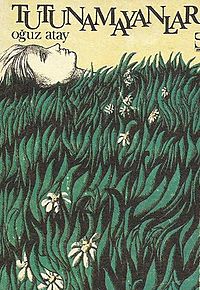
Oğuz Atay - Probably the most eminent novel of twentieth-century Turkish literature, a work that won high critical acclaim and popular following, Tutunamayanlar offers an endless series of tragicomic observations, an expansive and critical panorama of Turkish manners, attitudes and clichés through a profound sense of irony, parody, dark humor and existential questioning

https://theuntranslated.files.wordpress.com/2015/03/tutunamayanlar.jpg


Oğuz AtayTutunamayanlar (The Disconnected), 1971-1972

http://www.readin.com/blog/?id=3414

When it comes to Turkish literature, we are lamentably deprived. The gaping lacuna is what is considered by many to be the greatest 20th-century literary achievement in Turkey: Oğuz Atay’s experimental, linguistically complex novel of ideas Tutunamayanlar (The Disconnected). It has been quite a while since it was put up on the UNESCO site as an important literary work in need of English translation, and, just like German Espinosa’s masterpiece The Weaver of Crowns, it still remains unavailable for a host of the prospective readers. Granted, the author’s use of different varieties of Turkish such as the heavily arabicised Ottoman Turkish and the purist, reformed Turkish, the so-called Öztürkçe, renders the job of the translator extremely demanding, but not unfeasible. The conclusive proof of that is the Dutch translation of the novel published four years ago. At the moment it is the only translation of Otay’s book into any other language, so, I guess, we should congratulate the Dutch on having the privilege to read the cult classic.
The plot of the novel focuses primarily on the quest of engineer Turgut Özben to find out the reason for his friend’s suicide. The investigation leads the main character to the array of different texts left by the deceased, and the further  Özben proceeds with his inquiry, the closer he approaches his own radical transformation. If it sounds like something written by Orhan Pamuk, you should not be surprised as Otay has exercised considerable influence on the Nobel Laureate. Within the context of Turkish letters, Otay was a trailblazer whose innovative techniques left a lasting impression on the next generation of writers. The manner in which the story of Özben’s search is presented took the Turkish reader at the time by surprise, which partly explains why Otay’s novel received due recognition much later, already after the writer’s untimely death at the age of 43. As one of the Dutch translators of the novel Hanneke van der Heijden writes: 
The literary form of Atay’s novel was not exactly what readers were used to either: the unbridled stream of consciousness, all kinds of short texts in different genres, that cut across the story, such as a poem of 600 lines plus commentary, a chapter of 70 pages, written without a single comma or full stop – it may remind us, the readers of today, of James Joyce, of Nabokov, Virginia Woolf and other western modernist writers – writers Atay was very familiar with. But, as the critic Ahmet Oktay once remarked, the number of Turkish readers that in the beginnings of the seventies had read Ulysses, was no more than ten.
The more pity that most of us who have read Ulysses and seem to be ready for this seminal text of Turkish modernism have to live with our frustration for an unknown period of time. Maybe learning Turkish or Dutch could be a more realistic alternative to waiting for a quality English translation to materialise in the foreseeable future.
Hanneke van der Heijden has her own blog dedicated to Turkish literature. Most of it is in Dutch, but the written version of her talk on the translation of  Tutunamayanlar is available in English. It’s the best article about Otay’s novel in English you will find on the Web, and I urge you to check it out. - - theuntranslated.wordpress.com/


Hanneke van der Heijden: ‘Language is the mirror of our lives’: Oğuz Atay’s novel ‘Tutunamayanlar’ and its Dutch translation

It’s often surprising to see how literature resists globalisation, how famous books in one language can be kept a secret from readers in other languages for many years. Dutch masterpieces, many of which have not been translated into German, French, English, or Turkish, are a good example. How many readers outside of The Netherlands and Flanders have heard of Gerard Reve, Hella Haasse or Willem Frederik Hermans, and the novels they wrote? Who knows the poetry of Jan Slauerhoff or Lucebert?
Unfortunately, many Turkish literary masterpieces share this fate. A prominent example is the novel Tutunamayanlar (‘The Disconnected’) by the author Oğuz Atay. Oğuz Atay started typing the first sentences some time in 1968. Since its publication in 1971/1972 Tutunamayanlar has had 49 reprints. Over the years Atay’s debut novel became one of the best selling Turkish titles ever, even in illegal prints: the thick book is a sine qua non of many stands selling pirate editions in the streets. Forty years after its publication, the novel and its author are still vividly discussed in Turkish internet forums and on Facebook.
Yet, except for the Dutch translation by my colleague Margreet Dorleijn and me, which came out under the title Het leven in stukken in November 2011, the novel has not been published in any other translations. Ms Sevin Seydi made an English translation at a very early stage, ‘while Atay was still writing his book’, as his biographer Yıldız Ecevit put it. But until now no publishing house in the Anglophone world has published an English translation. The few publishing houses abroad that did publish translations of Atay’s work, didn’t choose Tutunamayanlar but other titles: the Swiss publishing house Unions Verlag chose Bir bilim adamının romanı, published as ‘Der Mathematiker’, a biographical novel about the famous mathematician Mustafa İnan. In Germany publishing house Binooki published Atay’s short stories, Korkuyu beklerken, under the title of Warten auf die Angst, as did the French Editions L’Harmattant (‘En guettant la peur’). Atay’s other work, the novel Tehlikeli oyunlar (‘Dangerous games’), a play with the title Oyunlarla Yaşayanlar (‘Those who live by games’), his diary and an unfinished piece of fiction Eylembilim (‘Science of action’), has thus far not been translated into any other language. Still, the very first book that comes to the mind of Turkish readers whenever Atay’s name is mentioned, is the very first novel he wrote, a book that over the years reached cult status: his debut Tutunamayanlar.
Let’s start with the book the way a reader starts, or rather someone seeing the book in a bookshop: with the title, Tutunamayanlar as it is called in Turkish. The title word is a noun derived from the verb tutunmak ‘to hold on to (sth.)’. The negative, expressed by the infix –ama–, adds the meaning of ‘not being able to’, an inability, which at the same time, however, has a touch of unwillingness to it. As a noun the word is a neologism which was coined by Atay; the popularity of the novel made the word enter the Turkish language.
Who are these ‘tutunamayanlar’, the ‘disconnected’ as they are called in the English translation, or ‘griplozen’ as we named them in Dutch? Maybe we should first listen to Oğuz Atay, or rather to one of his characters, Selim Işık, to let him explain the characteristics of this species. It will also give you a taste of the style of the book – but only partly, because the novel contains many different styles. One of the texts that interrupt the story line in this dazzling novel, is an entry on the ‘Tutunamayanlar’, a lemma to be included in the Encyclopeadia of Strange Creatures.
Since I’m one of the Dutch translators, I’d like to read the passage from our translation – it will give you some idea of what the translation sounds like. Though Dutch is the mother tongue of some 22 million Europeans, 17 million Dutch and 5 million Flemish, it is not widely known outside of the Netherlands and Belgium. Therefore, just to make sure, I should maybe quickly explain that Dutch belongs to the Germanic languages, together with languages like English, German, Norwegian and Danish. Although the languages in this group share close similarities, Dutch is certainly not a dialect of German, or a mixture of German and English, as is often thought. For centuries, it evolved independently from the languages spoken in its neighbouring countries. Speakers of German, English, Danish, or any other Germanic language, will usually not understand Dutch without language instruction. Flemish-Dutch is spoken in the Northern part of Belgium; it’s a variety of the Dutch as it is spoken in the Netherlands. Although there are differences in accent, grammar and vocabulary, Dutch and Flemish are mutually understandable.
For those among you who don’t know Dutch the Turkish original will be shown on the screen.

Griploze (Erectus Disconnectus): onbeholpen en schichtig dier. Kan zo groot worden als een volwassen mens en vertoont daar oppervlakkig gezien ook veel gelijkenis mee. Klauwen en vooral nagels zijn echter niet erg sterk. Is niet in staat om in bergachtig gebied steile hellingen te beklimmen, heeft dan geen grip. Daalt hellingen bij voorkeur glijdend af (waarbij vallen vaak voorkomt). Lichaamsbeharing is verwaarloosbaar. De ogen zijn groot maar het zicht is slecht ontwikkeld. Naderend gevaar wordt daardoor vaak te laat onderkend.
De mannetjes slaken smartelijke kreetjes als ze alleen gelaten worden. Dezelfde kreten gebruiken zij voor het lokken van wijfjes. Griplozen houden zich meestal op in de holen van andere dieren (zolang die hun aanwezigheid kunnen verdragen). Ook vestigen ze zich wel in verlaten nesten. Ze kennen geen familiestructuur. [...]
Religieuze spijswetten verbieden het eten van deze diersoort. Toch wordt erop gejaagd en komt het vlees illegaal op de markt. Griplozen laten zich eenvoudig bejagen. Indien men hen met begripvolle blik aankijkt, komen ze zonder meer naderbij. Daarna is het een koud kunstje om ze te doden. De Gemeentelijke Keuringsdienst van Waren heeft een verbod ingesteld op het slachten van griplozen; ze zouden drager zijn van voor de mens schadelijke micro-organismen. Medici zouden meermalen hebben vastgesteld dat mensen na het eten van griplozenvlees symptomen vertoonden als matheid, lichte verveling, gewetensnood van onduidelijke herkomst en oprispingen van onverklaarbare schuldgevoelens. [...]
Doordat ze altijd met gebogen hoofd lopen, stoten ze overal tegenaan en hebben ze over hun hele lijf blauwe plekken en verwondingen. Weekhartige mensen die griplozen in dergelijke toestand aantroffen hebben wel geprobeerd de dieren te domesticeren. Maar gezien hun onvermogen zich naar huiselijke regels te voegen is het bijzonder lastig hen als huisdier te houden. Ze kunnen zonder aanleiding hun baas aanvallen. Als ze vervolgens op straat worden gezet, weigeren ze te vertrekken. Ze blijven dan dagenlang smartelijk janken bij de voordeur en werken zo hun baas op het gemoed. [...] (1)

Tutunamayan (disconnectus erectus): beceriksiz ve korkak bir hayvandır. İnsan boyunda olanları bile vardır. İlk bakışta, dış görünüşüyle, insana benzer. Yalnız, pençeleri ve özellikle tırnakları çok zayıftır. Dik arazide, yokuş yukarı hiç tutunamaz. Yokuş aşağı, kayarak iner. (Bu arada sık sık düşer). Tüyleri yok denecek kadar azdır. Gözleri çok büyük olmakla birlikte, görme duygusu zayıftır. Bu nedenle tehlikeyi uzaktan göremez.
Erkekleri, yalnız bırakıldıkları zaman acıklı sesler çıkarırlar. Dişilerini de aynı sesle çağırırlar. Genellikle başka hayvanların yuvalarında (onlar dayanabildikleri sürece) barınırlar. Ya da terkedilmiş yuvalarda yaşarlar. Belirli bir aile düzenleri yoktur. [...]
Din kitapları, bu hayvanları yemeyi yasaklamışsa da, gizli olarak avlanmakta ve etleri kaçak olarak satılmaktadır. Tutunamayanları avlamak çok kolaydır. Anlayışla bakışlarla süzerseniz, hemen yaklaşırlar size. Ondan sonra tutup öldürmek işten değildir. İnsanlara zararlı bazı mikroplar taşıdıkları tespit edildiğinden, Belediye Sağlık Müdürlüğü de tutunamayan kesimini yasak etmiştir. Yemekten sonra insanlarda görülen durgunluk, hafif sıkıntı, sebebi bilinmeyen vicdan azabı ve hiç yoktan kendini suçlama gibi duygulara sebep oldukları, hekimlerce ileri sürülmektedir. [...]
Başları daima öne eğik gezdikleri için, çeşitli engellere takılırlar ve her tarafları yara bere içinde kalır. Onları bu durumda gören bazı yufka yürekli insanlar, tutunamayanları ev hayvanı olarak beslemeyi de denemişler. Fakat insanlar arasında barınmaları – ev düzenine uyamamaları nedeniyle – çok zor olmaktadır. Beklenmedik zamanlarda sahiplerine saldırmakta ve evden kovulunca da bir türlü gitmeyi bilmemektedir. Evin kapısında günlerce, acıklı sesleriyle bağırarak ev sahibini canından bezdirmektedirler. [...] (2)

Summary of the novel
I will tell more about the reception of the novel and about some of the translational aspects, but let me first give you a short summary of Tutunamayanlar.
One morning in the second half of the twentieth century, ‘on a site in the northeast of the big city, between points with a latitude of fourty one degrees, zero zero minutes one second North, a longitude of twenty nine degrees twelve minutes East and twenty nine degrees twelve minutes one second East’, Turgut Özben wakes up and reads the news of Selim Işık’s suicide in the paper.
The former soul mates Selim Işık and Turgut Özben, who met at university while studying to become civil engineers, lost touch with each other once Turgut got married. Although in their student years both of them decided never to give in to the bourgeois life style and the expectations by society, Turgut finds himself married, a father of two daughters and employed as an engineer working in an office.
Shocked by the news of Selim’s death, Turgut starts reconsidering his own life: how did he get to the point where he’s now? He recalls his memories of Selim, their days together, their conversations and debates, and comes to the conclusion he never really knew Selim. In order to find out who he was and what drove him to kill himself, Turgut traces some of Selim’s other friends – all of them unknown to him, as Selim didn’t like to introduce his friends to one another, even kept them strictly apart. Turgut visits Selim’s mother, finds all kinds of texts written by Selim, meets his friends Süleyman Kargı, Metin, Esat and his sister Aysel, gets into contact with Selim’s former girl friend, Günseli. And from every story by Selim’s friends, from every text written by Selim, a different Selim arises.
The more Turgut makes efforts to enter Selim’s world, the more he becomes alienated from his own life and routines. Finally, in order to read Selim’s diaries, given to him by Günseli, he sets off on a journey, knowing he won’t come back to his family and his regular life. He and Olric, the inner voice that has started to join him during this exploration, the one he is in constant dialogue with, finally get on a train. They crisscross the country until they get off at a distant railway station, and disappear in the crowd.
Maybe this comes across as a rather simple story line for such a fat novel – a novel which is presented to the reader as Turgut Özben’s manuscript, published on his request by a journalist. Though the book could be called an adventure story, Turgut’s adventure is not so much an adventure taking place in the outside world, an adventurous journey full of action. His is rather an adventure in the inner world, one that explores ideas and values. An adventure that at the same time takes place in the realm of language. The joy to play with language and to extend the possibilities offered by it as much as possible, the heartbreaking struggle with the shortcomings of language literally burst from the pages. The story line itself is intersected with an abundance of other texts and exposés – texts written by Selim mostly, such as a play, a long poem with a commentary, entries for an encyclopaedia, letters, diaries, an old document listing the principles of a secret society, police records of their meetings etc. It is this overwhelming abundance, this creative outburst that so many readers find attractive. But this very same quality made one of the first critics of Tutunamayanlar cry out that ‘the guy had apparently written down every bloody thing that came to his mind!’

Unfamiliar form and themes
Indeed, when we speak of the popularity, and even cult status, of Atay’s novel, we must add that it wasn’t until 1984 that Tutunamayanlar started to become popular, that is some 12 years after the book was first published. Atay himself unfortunately didn’t live long enough to see the success and recognition he had hoped for. He died in 1977.
In 1970, right after Atay had finished the manuscript of Tutunamayanlar, his book received a literary prize awarded by the radio and television channel TRT. Still, there were hardly any publishers willing to take the risk of publishing the voluminous debut novel of an unknown engineer – for just as the characters in his debut, Atay was as an engineer by profession. Finally, by the end of 1971, a new and small publishing house, Sinan, ventured to publish the book. The publisher lacked the money to bring out the whole novel, and split it into two volumes, which were published several months after one another.
What was it that made publishers so hesitant, and critics so critical?
‘What I had in mind when writing Tutunamayanlar, was something very simple,’ Atay remarked in an interview in 1972, soon after his debut was published. ‘I simply wanted to describe mankind. [...] I don’t have the talents of a great novelist who turns individuals into puppets whose strings he pulls as he likes. I have no big theories to apply to my characters, no big ideals I let them pursue.’
Today’s readers might consider this statement as an open door. But the climate of the seventies was extremely polarised, and ideological differences between people could easily turn into fatal fights. It was a violent climate which eventually, in May 1971, resulted in a harsh coup. In the literary circles at the time, novels that ‘praise people to the skies for not making up their minds’, as one critic put it, were not particularly appreciated.
In addition, Atay is rather critical when it comes to the world of left wing hard liners. He criticizes the authoritarian and inconsistent behaviour some of them expose. What’s worse, it’s not a criticism coming from someone from the outside: before Atay embarked on his first novel, he had been writing for left wing magazines himself. He knew their world from within. Surely critics were not amused by the disillusionments apparent in his novel: most critics, most of the prominent magazines, were left wing.
But it was not just the unusual content that made readers frown. The literary form of Atay’s novel was not exactly what readers were used to either: the unbridled stream of consciousness, all kinds of short texts in different genres, that cut across the story, such as a poem of 600 lines plus commentary, a chapter of 70 pages, written without a single comma or full stop – it may remind us, the readers of today, of James Joyce, of Nabokov, Virginia Woolf and other western modernist writers – writers Atay was very familiar with. But, as the critic Ahmet Oktay once remarked, the number of Turkish readers that in the beginnings of the seventies had read Ulysses, was no more than ten. As a matter of fact, Ulysses was translated into Turkish in 1992, and translations of Pale Fire (‘Solgun Ateş’) by Nabokov, and Man without Qualities (‘Niteliksiz Adam’) by Robert Musil didn’t appear before the nineties either; the original editions of these novels were hard to find, and required an excellent proficiency in the original languages. To his Turkish readership Atay’s literary experiment was, in other words, rather unusual.
In fact, criteria that were often applied to evaluate novels, that is: the formulation of clear-cut political stand points, expressed in a transparent, conventional literary form, were the heritage of the 19th century, when the remainders of the Ottoman empire were undergoing huge and comprehensive political and societal reforms. Many intellectuals and artists were at the forefront of this political movement. They considered it their task and responsibility to take part, and they used their works of art as a means to convey the new ideals. In the same period, under the influence of western, notably French literature, the genre of the novel entered Turkey. Thus, important representatives of Turkish literature considered individualism and playfulness as something close to a mortal sin. Atay committed both.
In Atay’s novel not uniformity is the norm, but pluriformity, expressed in a literary form that is as pluriform as the many forms taken on by Selim, varying according to the angle Turgut looks from, the people he talks to, the texts left behind by Selim. This brings the question to mind what we are, what makes us the person, the individual we are? What distinguishes us from others? What does it mean to be oneself? As much as we can raise this question with regard to the individuality of a person, we can ask ourselves this question in relation to a culture, a civilisation, a society. Considering all the different influences that affect and have affected a culture, what is it that distinguishes a particular one from all other existing cultures? It is this issue that is one of the core questions in Atay’s debut novel, and in many other texts he wrote.
It is an issue which is also addressed by other Turkish authors preceding Oğuz Atay, however different their work may be from what Atay wrote: Examples are Halid Ziya Uşaklıgil with novels like Kırık hayatlar (‘Broken Lives’) Ahmet Hamdi Tanpınar, Yusuf Atılgan – again, authors whose work has hardly been translated into other languages.

Uniformity in the new republic
Considering the history of modern Turkey, it’s not surprising that the issue of the identity of a culture is so often referred to and explored in literature. Few countries have seen such an intense orientation to another culture or have experienced such a disruptive cut off from their past and their cultural traditions as Turkey in the process of transformation from empire to republic.
When the Ottoman empire lost more and more of its power and territory, while being threatened at the same time by internal ethnic nationalist movements that demanded independence for their own people, a transformation process was undertaken which showed a strong orientation to the west – as much in economic terms as in military, political and cultural questions. In 1923 this resulted in the establishment of the republic of Turkey by Atatürk and his companions.
But it was a scattered country the new regime inherited, poor and traumatised, with a glorious past that had gone to pieces, and an unclear future ahead. One of the main issues the new rulers were facing was how to mould a new national identity which would hold together the patchwork of different ethnic, religious and social groups that inhabited the remainders of the Ottoman empire – a diversity which, I think, is still one of Turkey’s most striking features for anyone coming from abroad. Since precisely this diversity was considered to be one of the main causes of the decline of the empire, the new focus was on uniformity.
In the process of creating a new national identity which was to include all inhabitants, regardless of their ethnic, linguistic or religious background, two elements played a key role: Turkish history and the Turkish language. Both of them were used as a means to unite the inhabitants of the new nation state. Very soon after the proclamation of the republic, the new regime established two institutes under direct state control: the Turkish History Society (Türk Tarih Kurumu; 1931), and the Turkish Language Society (Türk Dil Kurumu; 1932).

Clearing the language
The Turkish Language Society was appointed the task of standardising the language, making it apt to be the symbol of Turkish national unity. To this end, drastic language reforms were implemented. The replacement of the Arabic alphabet by the Latin one (with minor adaptations for Turkish sounds) is one of the best known reforms. From 1929 onwards texts could no longer be printed in the Arabic alphabet (although many people kept writing their private notes, their letters and diaries in the so called ‘old letters’. The diaries and manuscripts of the author Tanpınar (1901-1962), for example, are written in Arabic script.).
Although less well known abroad, the reform of the language itself, of its lexicon and grammar, was at least as far reaching as the alphabet reform. A large scale campaign was started to replace Arabic and Persian words and their grammatical structures by what was called Öztürkçe, ‘pure Turkish’ equivalents. These replacements were often borrowed from dialects spoken in Turkey, or from Turkic languages in Central Asia, such as Tatar. But words were also newly coined, gluing together different Turkish stems. However, to free a language from all external influences is a venture which is doomed to fail: what is endemic? The further back one goes in history, the more even the most original things prove to be borrowed or influenced by ‘the other’. In order to counter any objections and contradictions, the Sun Language Theory was constructed, a pseudoscientific linguistic hypothesis proposing that all human languages are descendants of one Central Asian primal language. According to this theory, Turkic is the only remaining language which is still more or less the same as this primal language, thus implying that eventually every word or morpheme is Turkish.
In pursuing this purification campaign, the Turkish Language Society issued lists of pure Turkish (Öztürkçe) words to replace their Arabic and Persian counterparts. This often affected very frequent daily words such as in the case where örneğin, a pure Turkish neologism, was proposed to replace the common mesela, of Arabic origin. In its extremes, the purification campaign resulted in a newspeak of long-winded descriptions, often made fun of with neologisms like çok oturgaçlı göturgeç ‘bringing device with many sitting devices’ for otobüs, ‘bus’. That these newly formed words were not always comprehensible is also clear from the fact that in many books written in Öztürkçe, the daily, normally used Arabic or Persian word is given in brackets. Some of the pure Turkish new formations survive until this day, others died a very early death.
Though Arabic and Persian were associated with a past that was to be forgotten as soon as possible, French, the language of the new Leitkultur, was very popular among reformers. Thus, French loan words and borrowings, such as konfirme etmek ‘to confirm’ or empoze etmek ‘to impose’, were frequently used in pro-western movements.
This stringent language policy, in combination with the wilfulness of reality, resulted in two parallel varieties of Turkish, both of which were highly ideologically coloured. Öztürkçe, the pure Turkish, or zuiverturks, zuivertaal as we translated it, was associated with left wing, progressive movements – an amalgam of different political tendencies, including kemalist and nationalistic ones; the language of conservative segments in society, on the other hand, had a more Arabic/Persian taste to it. In addition, pro-westerners liked to flavour their Turkish with French loans, a role that was later taken over by English.
Language became, in other words, a medium for expressing ideological preferences. At least: it was perceived as such. Since in the polarised society of the seventies there was hardly such a thing as ideologically neutral language use, anyone opening his mouth, or writing something on a piece of paper, was forced to choose between Öztürkçe or an Arabic/Persian variant – and was judged accordingly. For people not wanting to be included in either of the ideological camps, language became a true Scylla and Charibdis, a constant navigation between two undesired extremes.

Language varieties in Tutunamayanlar and their translation
In Tutunamayanlar Atay pushes the prevalent range of language variation even further. As a modernist writer, he doesn’t simply reflect an objective reality. On the contrary, he perceives reality as something that can’t be reached, can’t be discussed, because language, the order of language, always stands in between object and subject. ‘Language is the mirror of our lives,’ says Turgut with a sigh. A mirror indeed, reflecting, but not showing what is behind.
Thus, apart from the Öztürkçe and the more Arabic/Persian flavoured variant of Turkish, Tutunamayanlar includes texts in a stately official Ottoman as it was used in previous centuries, containing hardly a single word in Turkish; there’s a text in semi-Gök-Turkish, the language attributed to the Central Asian stem of Gökturks, living in the 8th century, the supposed ancestors of all Turks; and there are fragments of horrid translations of French texts, a Turkish full of halfheartedly turkificized French words.
Finding equivalents for the different language varieties was obviously one of the biggest challenges in the process of translation. Dutch was never subjected to such a stringent language policy as Turkish (and frankly, I assume few languages have been). Trying to find two parallel, coexisting varieties of Dutch, to exactly meet the nearly diglossic situation in Turkish, would be a mission impossible. But like all languages, Dutch too has been exposed to the influence of foreign languages in the course of history. The French occupation at the end of the 18th, beginning of the 19th century, left its marks on Dutch. Like in negatieontkenning ‘denial’, there are quite a lot of pairs of synonyms, one with Romanic, the other with Germanic roots. Often the Romanic word has an old fashioned, or a more stately connotation. French was a language with high prestige, in schools, in trade, and in daily life. Until far in the 20th century, many upper-class families in the Netherlands used French at home, for dinner conversation for instance, and raised their children in this language.
In Flanders, the north of Belgium, contact with French lasted longer and was more invasive. As a consequence the resistance against incorporating French loan words into Flemish has always been much stronger than in The Netherlands. Punaise, for example, a loan from French, is the common word for ‘drawing pin’ in The Netherlands, paraplu for ‘umbrella’; in Flemish however, Germanic loan translations are often preferred to French loans. Instead of punaise one uses duimspijker, that is ‘thumb nail’, instead of paraplu regenscherm, ‘rain screen’.
In our translation, we used this dichotomy of Romanic vs Germanic rooted words in order to translate the Arabic/Persian and the Öztürkçe variants. In cases of excessive use of Arabic/Persian words we chose from a Romanic (French / Latin) vocabulary existing in Dutch; in cases of Oztürkçe, we used Germanic words or invented words made of Germanic roots.

Some examples
An example of a part from the book with an excessive amount of Öztürkçe words:

5- Gökçın Karma: Azılı bir düzen yağısıdır. Orta boylu, kaslı, saçları dökülmeye başlamış, gökçeses (müzik) düşkünü, günbatımına (akşam) değin çadırında bağırır (şarkı söyler). Saçları dökülmeye başlayalı bıyık bıraktı. Okuduğu betikler tüm yabancı dildendir. Olaydan birkaç gün önce bütün betiklerini at uşağına armağan etmiş (uşağı da salıvermiş) ve gece gündüz demeden Bilig-Tenüz okumaya vermiş kendini.
5. Gökçin Karma: vurig weerstrever van de heersende orde. Van gemiddelde lengte, gespierd, kalend, groot liefhebber van hemelklank (muziek), bulderbrult (zingt) van ochtendstond tot avondstond in zijn zeildoekspansel (tent). Laat zijn snor staan sinds zijn haar is gaan uitvallen. Leest alleen leesklanktekenbanden (boeken) in vreemde talen. Heeft een paar dagen vóór de geschiedenis echter al zijn leesklanktekenbanden aan zijn rosknecht gegeven (en die rosknecht ook weggestuurd) en leest nu dag en nacht in de ‘Wereldzee van Wijsheid’.

An example of a fragment in some kind of ‘high Ottoman’, with many words from Arabic or Persian origin.

6          Takdir-i İlâhi’nin mümkün kıldığı nev-i beşerin idame-i hayat edebilmesi için elzem olan muvazene unsuru ise, Müşfik Salgan’ın şahsında tebellür eder. İlâhî Uzviyetin küçük beyni mertebesinde addedilmesi iktiza eden ve tevazunun müşahhas misâli olan Ulu Salgan, Nâmütenâhi Orkan’ın kuvvet ve kudretini, cemiyyetin âlî menfaatleri için tahdit ve tesbit etmek üzere mevcuttur. Şöyle ki: [...]
6          En waarlijk, het element van equilibrium, conditio sine qua non voor het voortbestaan der menselijke species, door de Goddelijke Voorzienigheid mogelijk gemaakt zijnde, manifesteert zich in de persoon van Salgan de Liefhebbende. De Grote Salgan, die in het Goddelijk Lichaam dient te worden beschouwd als het cerebellum, en die de incarnatie is der ootmoedigheid, existeert teneinde de macht en kracht van de Grenzeloos Grote Orkan te limiteren en fixeren ten behoeve van de sublieme belangen der societas. Op zulk ene wijze dat: [...]

A fragment of a bad translation of a French novel, the French shining through conspiciously in the Turkish:
En sevdiklerim de tercüme romanlardı:
Lagranj, Lökok’a sert bir nazar atfetti. Aşağı Löretanya’nın bu iki muannit serserisi için mutavaat kabul etmez bir vaziyet hasıl olmuştu. Her ikisi de müthiş bir hâlet-i ruhiyenin esiri olmuşlardı. Lökok, nevmîdane konuştu:
- Hissiyatına mağlup oluyorsun. Mersiyer bu elim vaziyetten bilistifade, Margörit’i avucunun içine, o menfur arzularına ram etmek üzere ve gayri kabili red bir şekilde bu toprakların üzerinde bize hayat hakkı tanımayarak alacaktır.

Ik hield het meest van vertaalde romans.
Langrange wierp Lecoq een strenge blik toe. Aan deze twee obstinate schavuiten uit Nederlauretanië deed zich thans een circumstantie voor in welke enige mate van indulgentie onacceptabel zou zijn. Beiden verkeerden in een horribele état d’esprit. Lecoq sprak vol van desperatie:
- Gij valt ten prooi aan uw gemoed. Mercier zal zeker deze deplorabele toestand utiliseren en Marguerite inpalmen om haar zodoende met zijn abjecte désirs te doen instemmen en hij zal ons in deze contreien niet langer dulden.

Increasing popularity
Before looking at some examples from the translation, I mentioned the publishers’ and readers’ initial hesitations and their disinterest in Tutunamayanlar. The book was considered too different to ever reach a large audience. By now, though, the book is widely popular. To conclude this talk, I want to summarize what happened in between.
Another violent coup, on 12 September 1980, brought political life in Turkey to a temporary end. Many political activists were arrested, and put in prison for years. Turkish society which had been polarised and politicized to such a high extent, was depoliticized in a very short time. Outside Turkey, the dominant political ideologies lost their importance when the Iron Curtain came down. They were largely replaced by consumerism.
It was a bitter time in Turkey, which not only killed political, but also cultural life. Many people didn’t survive, or were damaged for the rest of their lives. After a while however, there was also some relief: a relief at the loss of a straitjacket of ideologies, of being forced to choose from a fixed number of alternatives. In this new climate Atay was welcomed as a kindred spirit, ironical about the status quo – not out of bitterness or indifference, but out of grief and revolt, because one could think of such a different kind of life too.
At the same time, thanks to my Turkish colleagues and their publishers, more and more translations of western modernist literature, and of academic studies on modernist literature appeared in Turkish. These helped readers and critics to value Atay, not only as a sincere human being, a kindred spirit, but also as an avantgard artist.
Modernism and postmodernism so intensively explored by Atay for the first time in Turkish literature, was further elaborated by authors that came after him. Orhan Pamuk is the best known of his inheritors, but also younger authors (whose work has not yet been translated into Dutch) like Ayfer Tunç and Hakan Günday are among them. Recently, Ayfer Tunç described Atay’s influence as a kind of dna, that via his novels was passed on to young authors, hereditary material that they in turn will pass on to next generations. Turkish literature, in sum, has changed since the nineties, it has become more playful, and it owes this quality to a large extent to Oğuz Atay.

References
(1) Oğuz Atay, Het leven in stukken. Amsterdam: Athenaeum, Polak & Van Gennep, 2011. Original title: Tutunamayanlar. Translated from the Turkish by Margreet Dorleijn and Hanneke van der Heijden.
(2) Oğuz Atay, Tutunamayanlar. İstanbul: İletişim. (First published: 1971/1972).

This is a slightly revised version of a talk I gave in Istanbul at The Netherlands Institute in Turkey on 26 January 2012.
- www.literatuuruitturkije.nl/english/language-is-the-mirror-of-our-lives-oguz-atays-novel-tutunamayanlar-and-its-dutch-translation/


Oğuz Atay
While Waiting for Fear, Trans. by Fulya Peker, Contra Mundum Press, 2022

In “Railroad Storytellers — A Dream,” Oğuz Atay’s narrator admits that all he knows how to do is write stories, that even the illusion of starting a new life is forever beyond his reach. Atay finished this piece, the last short story he ever wrote, in September 1977, in London, where he was under treatment for a malignant brain tumor that would claim his life only three months later, at the age of 43. It’s a fitting finale for his only collection of short stories, Waiting for Fear. At some point the narrator can’t help but to wonder where his readers might be. While this almost reads like Atay’s own epitaph, it was never the cry of a clownish figure, of a greenhorn desperately seeking a stage, but of a craftsman who believed that his share of spotlight fell on a desolate set, of a man who believed that he was bound to remain unseen, unread.

The only son of a criminal judge and an elementary school teacher, Oğuz Atay was born in 1934, in the small city of Kastamonu, on the shores of the Black Sea. In 1952 he began his studies as a civil engineer, but this was on his father’s insistence, and Atay’s heart and mind were set on literature. During those formative years he worked for literary magazines, made translations, and contributed to an encyclopedia. In 1968 he started working on what would become his masterpiece, The Disconnected. That novel would go on to win the Turkish Radio and Television Corporation’s Best Novel Prize, and be published in 1971 and in 1972, in two volumes. While the critical response amounted to little more than lukewarm silence, Atay quickly moved on to a second novel. Dangerous Games came out in 1973, yet again without catching the public eye. He would then go on to write his third and final novel, The Life of a Scientist: Mustafa Inan, plus his only play, Those Who Live by Games, and in between he penned the stories that would first be published in 1975 under the title Waiting for Fear. It is not a story cycle but a collection of standalone pieces, which makes a reading order anyone’s pick. But I think if one wishes to get a sense of Atay’s progress as a writer, a chronological reading is best. This makes Waiting for Fear a collection of two story clusters, plus an epilogue.

The first three stories, which make up the first cluster, belong to 1972, the year before the publication of Atay’s second novel. His will to experiment on diverse styles is evident from the book’s opener, “The Man with the White Coat.” The adjective “Kafkaesque” comes to mind in this iconic piece, but I feel that this is constrictive rather than illustrative. What really is in the foreground is Atay’s ability to capture characters at their most vulnerable, when all they can do is discover for themselves that even their vulnerability is a pastime, and all that can follow is an expulsion which feels terribly self-inflicted. Here the expulsed is an automaton-like man, almost entirely devoid of any ability to communicate, who resigns himself to the current of a pitiless, curious crowd.

Modern Turkish literature has a long tradition of these characters that are marionettes by nature, like the three servant figures of commedia dell’arte –– Pierrot, Harlequin, and Columbina. The beginning of the modern era coincides with the Tanzimat (Reorganization) reforms of 1839-1876, a period which marks the modernization of the Ottoman Empire. The influence of Western literature was quick to follow this social and political renewal, and almost instinctively these automaton-like characters emerged. We have Felatun Bey (of Felatun Bey and Rakim Efendi by Ahmet Mithat), a spendthrift who likes elegant clothes; we have Meftun Bey (of The Quick Lover by Huseyin Rahmi Gurpinar), an avid reader of a user’s manual on the European way of life; and, last but not least, we have Bihruz Bey (of A Carriage Affair by Recaizade Mahmut Ekrem), arguably the greatest of them all, a young man forever stuck between his poor Persian and his rudimentary French, who tries his hand at a love letter, using little understood words. These characters were, to my mind, a projection of these Ottoman writers’ self-doubt on the threshold of a world they never intended to understand, only wanted to cope with. The frame of mind of the empire, a clapped-out-alpha-male insecurity, allowed little room for a healthy renaissance. Small wonder that those characters were depicted as bewitched, awakened, yet weakened by the West: they read classics in French, openly flirted with the opposite sex, lived in rented houses — proof of decadence — and had no reservations about getting drunk. All cardboard, only after the declaration of the republic would they turn into fully developed beings. Atay’s writing is the logical next step in the evolution of these puppets. But it also marks a fracture in the chain, in that his style frequently mirrors the psychology of his characters.

Which makes the second story, “The Forgotten,” an oddity, because here Pierrot is a not-so-forgotten ex-lover, now dead, and Columbine is a resigned housewife, little more than a human dust bunny. The influence of a great tradition, stretching from the Gothic all the way back to Lucian’s Dialogue of the Dead is obvious here. But Atay’s condensed scene from a marriage leaves no room for irony, making this supernaturally realistic piece an awakening on the part of the unnamed housewife.

The first cluster ends with “Waiting for Fear,” which, in fact, is more of a novella than a short story. A tale of paranoia and unchecked threat, it is among the most celebrated of Atay’s writings. Written in the first person, it begins with the narrator finding a letter, written in an apparently pseudo-language, at his doorstep. Not being able to make heads or tails of the message, he shows it to a friend of his, who happens to be an expert on dead languages. The latter hints that an underground sect could be the culprit, and that his (the narrator’s) life depends on his not leaving home. Obsessed with his newfound fear, the way that perhaps a Hopper figure is obsessed with navel gazing, the narrator is stuck inside an ever deepening, ever accelerating eddy of dawdling and compromise, culminating in a logical, yet disturbing final act.

Immediately after this novella Atay focused on his second novel, a metanarrative based on the theories of the psychiatrist Eric Berne. Dangerous Games would be published in May 1973, but there was little the critics and readers could do than to ignore his linguistic friskiness and literary hopscotch. Keep in mind that he was a superstitious man, a lifelong hypochondriac who believed that he was born to die young. The late literary critic Yildiz Ecevit, in her critical biography of the writer, points out that Atay’s premonition is based on a genetic susceptibility to cancer. But his reservations take on a new meaning when you add in the fact that, all through his adult life, he was a man who did everything he could to keep himself on the outskirts of Life, as if the center, that beehive, as it were, held an incorporeal queen, waiting to deprive him from a career in letters. The critics having taken care of that, it is no wonder that when 1974 came and the second cluster of stories materialize, what we have is a melancholic, introverted Atay. The period begins with “A Letter,” an unsent one at that, about absolutely nothing — a negation of the form. Next comes “Neither Yes Nor No,” this time a mockery, about an advice columnist who has had it with the constant whining and can’t help but proofread the letters, maybe just to have a little peace of mind. Atay’s final epistle is “Letter to My Father,” an autobiographical writing that turns out to be a belated reckoning, on the part of Atay, with his father, as well as an intimate homage to Kafka.

The oddity of the second cluster is “The Wooden Horse,” a point-blank criticism of petit-bourgeois tawdriness. Inspired by the Trojan Horse of Çanakkale, a small town municipality tries to raise funds for a statue that, they think, would attract tourists. Yet an intellectual is in strong opposition with the public authorities and turns into a Don Quixote figure, tilting at windmills. While his intention is to warn them against mimicry, he can’t help but to act like the very fundamentalists that he is supposedly in opposition with.

It is interesting to note that half of the stories in the collection are (or are incited by) a letter. The epistolary form gives him some freedom for trying out differing narrative voices, and makes it easier for the reader to trace his influences (Dostoevsky, Chekhov, Laclos, etc.). But given the frustration that was his lot, an obvious fictional character comes to mind as well, namely Saul Bellow’s Herzog. This makes Oğuz Atay a burrower of the dead letter office, desperately seeking relevance amidst indifferent readers, because the books he read are of no avail against the silence that his peers saw fit to shut him in. After the 1974 stories he did his biographical novel and his play, and his premonitions would eerily come true in the form of a tumor. Thus the resigned “Railroad Stories — A Dream” is a beautiful, sad embracing of his own calling. It is the story of a man tired of dreams of transgression and success, yet scared to die. In his final entry to his diary, he observes, matter-of-factly, that a future lost makes the present futile.

A translation of Oğuz Atay is always a welcome effort, but there is an irony at play here, in that what Atay stood for in Turkey, which once dreamed that it was a distant European nation, is gone and done for, and he is now lonelier than even when he was alive, when he was not so much the best kept secret of Turkish literature as a terribly mistreated blood relative. He is still outrageously strong as a buzzword, but is rarely read through and through. A decent number of his earliest admirers, the progressive university students of the 1970’s, are now the supporters of the current government, who, during the last two decades, turned Turkey into what it is today. This is why I sometimes think, in spite of myself, that his unnecessarily early death was a blessing in disguise, that he has the lamentable luxury of not living to see the days when disillusionment is outlawed, if not categorically declared blasphemous. - Emre Aganoglu

https://www.full-stop.net/2022/03/23/reviews/emre-aganoglu/waiting-for-fear-oguz-atay/