5/28/15

José Hernández - a masterpiece of world literature. Those interested in the Martin Fierro as literature, as social protest, as anthropology, or as an example of the annihilation of a minority group--and its very identity--have joined in making it the most widely read, analyzed, and discussed literary work produced in Argentina.


845333
José Hernández, The Gaucho Martin Fierro, Trans. by Catherine E. Ward, State University of New York Press, 1974.


Introduction by the translator
 Martin Fierro the Gaucho
 The Return of Martin Fierro
 The Epic of the Gaucho (Americas Magazine, 1965)


This is a poem of protest drawn from the life of the gaucho, who was forced to yield his freedom and individuality to the social and material changes that invaded his beloved pampas--a protest which arose from years of abuse and neglect suffered from landowners, militarists, and the Argentine political establishment.
This poem, composed and first published more than a century ago, could have been written today by spokesmen for other oppressed groups in other parts of the world. For this reason, perhaps, the poem has such universal appeal that it has been translated into nineteen languages, making it available to more than half of the world's people.
Hernandez's poem was an attempt to alert the government, and particularly the city dwellers, to the problems faced by the gaucho minority in adjusting to the new, unfamiliar culture imposed on them by the Central Government soon after the fall of the dictator Juan Manuel de Rosas in 1852, under the slogan "Politics of Progress." Moreover, the poem supplied a historical link to the gauchos' contribution to the national development of Argentina, for the gaucho had performed a major role in the country's independence from Spain. They had also fought in the civil wars of Argentina and had cleared the pampas of marauding Indian bands that plagued the pastoral development of the region. According to Hernandes they had been by turns abused, neglected, and finally dispersed, ultimately losing their identity as a social group.
Those interested in the Martin Fierro as literature, as social protest, as anthropology, or as an example of the annihilation of a minority group--and its very identity--have joined in making it the most widely read, analyzed, and discussed literary work produced in Argentina. Now, after several hundred editions in Spanish and other languages, Martin Fierro is recognized as a masterpiece of world literature.
The aim of this English version has been to achieve a line-by-line rendition faithful to the original in substance and tone, but without attempting to recreate Hernandez's meter or rhyme. The translators present it here as a catalyst for enjoyment, provocation, and insight.


The Indy’s ‘Beyond Borges’ series has so far introduced five of Argentina’s influential authors. Among them, romantic prose writers Esteban Echeverría and José Mármol, controversial essayist Domingo Faustino Sarmiento, and two significant poets of the gauchesque genre, Bartolomé Hidalgo and Estanislao del Campo.

José Hernández


The sixth in the series brings us to the most celebrated poet in the gauchesque canon, and the best-known name in 19th century Argentine writing. José Hernández, the author behind Argentina’s national poem ‘Martin Fierro’, is credited with the immaculate consolidation of the gauchesque genre in a single, yet hugely impacting work.
‘Martin Fierro’
One of few gauchesque poets to have lived for any time as a gaucho, Hernández was born in 1834 and raised on a farm in the Buenos Aires province. He lived a large portion of his life in rural Argentina and fought on the federal side of several civil conflicts and border wars.
His epic poem ‘Martin Fierro’ assumes the voice of an Argentine gaucho conscripted to serve at a border fort in defense of the national frontier.
Originally written in two parts, ‘El gaucho Martin Fierro’ in 1872 and ‘La vuelta de Martin Fierro’ in 1879, the poem follows Fierro as he deserts military service and returns home to find his farm abandoned and his family gone. Together the two parts chart the downfall of an individual who grows rebellious against the laws that have not served to protect him, and descends into a life of crime and immorality.
‘Martin Fierro’ as a Product of its Time
Hernández’s poem is celebrated for having its feet firmly in social conflicts. Twenty years earlier, the Argentine provinces had joined in a confederation that Buenos Aires was not to join until 1862. The four years of provincial revolt that followed were some of Argentina’s most conflictive, and a crucial period in both the process of state formation and the destruction of the gaucho way of life.
New laws of vagrancy and conscription saw Argentina fall under a dual justice system that differentiated between urban and rural, and prioritised one above the other. The passing of a ‘Rural Code’ in 1865 further discriminated against the gaucho by imposing stringent regulations on rural life and labour.
In ‘Martin Fierro’ Hernández returned to the pro-gaucho sentiment and themes of conflict that had traditionally provided the content for populist gauchesque poetry. The poem serves as both a lament for the loss of a romanticised lifestyle, and a protest against the persecution of the gaucho at the hands of a centralised government. In this respect, Hernández revived the element of protest that had faded from gauchesque poetry soon after Bartolomé Hidalgo had given birth to it.
The appearance of ‘El gaucho Martin Fierro’ in 1872 turned the tables on then president Domingo Faustino Sarmiento. In his political essay ‘Facundo’, Sarmiento had presented the gaucho as an enemy of civilisation and his barbarism as a product of his rural existence. In ‘Martin Fierro’, Hernández presents Fierro’s behaviour as responsive to the actions of a government that sought to destroy him.

Running of the horses (Photo: Felicitas Molina)
The Success and Legacy of ‘Martin Fierro’
Hernandez’s ‘Martin Fierro’ was an unprecedented and immediate success. ‘El gaucho de Martin Fierro’ had 48,000 copies in circulation throughout Argentina and Uruguay by the time that ‘La vuelta de Martin Fierro’ was published seven years later.
The poem met with similarly positive reactions from critics, who admired the work for its aesthetic merit rather than its protagonist. So convincing was Fierro’s character that many believed him to be a real person, who in spite of his immoral actions, was taken in to the hearts of the Argentine gauchos as someone who fairly depicted their circumstances and their plight.
The success of ‘Martin Fierro’ might be attributed to the fact that it appeared to many to be an example of genuine gaucho literature. Whilst critics take care to differentiate between the poetry of the gaucho and the poetry of the gauchesque, some position Hernández’s poem at the confluence of these two important literary traditions.
By brightening the eight-syllable lines of rural ballads with language, imagery and a local colour that wouldn’t normally have been found in solemn payadas, the gauchesque cultivated a popular style. But in an attempt to imitate a vocabulary and a way of speaking, it had succeeded in creating something forced and false.
Although many poets before him had made use of this same eight-syllable line, none had done so with the same level of authenticity. In the scenes of the poem where payadas are sung, Hernández writes unfalteringly within the discipline of the form. When writing about abstract themes, his language bears the closest resemblance of all the gauchesque poets to the language of a payador singer.
Some interpretations have incurred the wrath of the poem’s supporters by contesting the Argentine nature of the work – annexing it to Spanish literature, or even European. Regardless, the poem is one of few works to have shaped the course of Argentine literature so significantly, drawing inescapable comparisons with the importance of Cervante’s ‘Don Quixote’ in Spanish literature.
Its infamous protagonist has since lent his name to more plazas, avenues, pizza restaurants, literary reviews, films and television awards than the author himself.
Often imitated but never matched, Hernández is credited with the neat consolidation of Argentina’s most important literary genre in a perfect example of gauchesque writing. Whilst Argentine authors continued to experiment with gauchesque writing, some argue that the 1810-1821 wars of independence and the 1880 constitution of the Argentine state marked the opening and closure of the genre – making Hernández not only the greatest writer of the genre but also one of the last.
English language translations of ‘Martin Fierro The Gaucho’ and ‘The return of Martin Fierro’ are available for download at sparrowthorn.com  - Kate Bowen


José Hernández (1834-1886) is the author of the book that Leopoldo Lugones claimed was the national book of Argentina: Martín Fierro. It shows the stereotype of the gaucho, who lives in the plains of Argentina, Uruguay and Rio Grande do Sul in Brazil and is a poem describing the independence and freedom of these people.
Following the new independence from Spain, many of the new republics that emerged in America started to look for their own national identity, and the gaucho Martín Fierro became a symbol of that of Argentina. The book has many examples of their way of speaking, how they used vos instead of and changed letters (juego for fuego, etc.), which Hernández was criticised for by many intellectuals at the time.
Published in 1872, the main story of the first part of the work centres around the recruitment of Martín Fierro to the army, in order to defend a fort against the onslaught of the Indians. Martín Fierro becomes a fugitive hunted by the police, and in his escape meets the sergeant Cruz, who joins him. Together they escape to go live with the Indians because a native life is better for them than what awaits them in civilization.
In 1879, José Hernández published “The Return of Martín Fierro”. In this second part he changed the plot of the play and the idyllic setting of freedom with the Indians is discouraged, and instead shows him looking to adapt to the civilization that was rejected in the first part of the work.
It is thought that many of the characters of Martín Fierro were inspired by real people. In the area where José Hernández grew up, Lobería Grande (Mar del Plata), there was a rebel gaucho with the same name, however names and surnames such as these were fairly common. The most likely thing is that Martín Fierro was a paradigmatic character of the Argentine gaucho of 1880.
The two books of Martín Fierro have had a significant influence on Latin American literature in general, and Argentina literature in particular. This is as much for the topics treated as the way in which they are treated, especially through language, another symbol of the Argentine nation.
- www.donquijote.org/spanishlanguage/literature/history/latin-america/martin-fierro

Alberto Laiseca - a visionary, erudite, cruel, surreal, uproarious, smutty, silly, puerile, absurd, cartoonish, megalomaniac and, many would say, downright psychotic work that is destined for a perennial cult status. Nothing prepares you for the weirdness of this book. Abandon sanity, all ye who enter here…


Alberto Laiseca, Los Sorias. Simurg, 1998.

albertolaiseca.blogspot.com/


Alberto Laiseca is the buried giant of world literature. Without his wild imagination, which surpasses even the most baroque and audacious exploits of the Latin American Boom, the literary jigsaw of the 20th century would be deplorably incomplete. The fact that he is virtually non-existent for English language readers is one of the most flagrant injustices that could ever have been inflicted on them. We are so much the poorer for this gaping absence. I cherish a vague hope that my review of his magnum opus will generate  enough buzz to provoke at least a slight interest in this writer among publishers of literature in translation.
The Sorias is .  Laiseca is the inheritor of the cultural codes left by François Rabelais, Dante Alighieri, Jonathan Swift, the Marquis de Sade, Hieronymus Bosch, Pieter Bruegel the Elder and Francisco Goya. The only contemporary writer I can compare him to is Thomas Pynchon: The Sorias is the Gravity’s Rainbow of Latin America. On more than one occasion I was compelled to interrupt my reading, get up from the desk and take a dazed walk around the room in sheer disbelief: what the hell have I just read? Nothing prepares you for the weirdness of this book. Abandon sanity, all ye who enter here…
With  more than 1300 pages, this is the longest Argentine novel ever written, and since it hasn’t been translated into any language yet, this might be the most notorious obscure novel of whose existence very few readers outside the Spanish language are aware. Which is not to say that the novel is that famous in the Spanish speaking world either. The Sorias had a long and tortuous journey to its reader. It took Laiseca 10 years to write it, and 16 more to publish. There have been three editions of the novel so far with the total print run amounting to a measly 2,850 copies. The Sorias is a cult classic par excellence, read only by a small cenacle of the initiated, but much talked about amongst those exposed to its mythos. Many are now ardently seeking an opportunity to get hold of it, which might be a tall order not only because of the small number of the copies available on the market, but also due to the forbidding price. One of the earliest champions of the novel was the living classic of Argentine literature Ricardo Piglia, who famously said: “The Sorias is the best novel that has been written in Argentina since The Seven Madmen“.
The novel is set in an alternative universe that, nevertheless,  shares many of its features with our world. A cold war is in progress. There is growing tension between the superpowers called Technocracy and Soria. The latter has a close ally whose name is very well familiar to many of us: the Soviet Union. Despite being an imaginary construct, this country is very similar to the historical USSR. A crude map drawn by Laiseca himself represents the political geography of  the known world consisting of a hispanicised Europe called Eurisberia and the colossal Soviet Union. The countries making up the Eurisberian continent are a farrago of fictional and real territories. On the one hand there is Catalonia, Castillia, Aragon, and the Caliphate of Cordoba; on the other, such exotic places as Protonia, Protelia, Chanchelia, Dervia,  Goria, the already mentioned Soria and Technocracy, and a bunch of others. When the political organisation of these countries is described, there is hardly a hint of any democratic rule. So, most of them, if not all, are dictatorships of various stripes.
The cold war unravels  on the background of a bloody conflict ravaging the divided country of Chanchin. The Soviet Union and Soria provide military support for North Chanchin, whereas Technocracy is allied with South Chanchin. The struggle between the geopolitical rivals over the domination in this jungle-covered part of Eurisberia, which we immediately recognise as thinly disguised Vietnam, eventually leads to the outbreak of a great war whose major stages are narrated in great detail throughout the second half of the novel.
Although the novel’s title refers to Soria, most of the book is devoted to Technocracy. The virulent hostility between the two states makes us think about them at first as the sworn enemies with a long history of confrontation. But, as it turns out, both dictatorships are relatively new political entities, and in the past they used to be one nation. Faithful to its name, Technocracy is a state underpinned by well-nigh religious worship of technologies. The political elite is almost entirely composed of engineers. Most of the spheres of everyday life rely heavily on different machines, computers, and robots. The head of Technocracy bears the title Monitor, and that is how he is referred to throughout the narrative; we are left in the dark as to his first name. His last name is unsurprisingly Iseka, as everybody living in Technocracy has the same last name. There is a similar situation in the neighbouring Soria, where every inhabitant’s last name is Soria.
The omnipotent dictator of Technocracy  rules his state with a rod of iron from a sumptuous palace in the capital city of Monitoria. He is a pathological control freak with sadistic inclinations and a perverse sense of humour who has built an enormous underground city beneath Monitoria that is a crossbreed between Fritz Lang’s Metropolis and Dante’s Inferno. Travelling on a self-propelled slab through the dark tunnels of the subterranean complex that contains the powerful machines providing energy for the various needs of the state as well as numerous torture and execution chambers, the Monitor usually conceals his identity by switching on an illusion machine in order to check incognito how his perverse orders are enforced by the Secret Police of Technocracy. All this may sound gloomy and outright terrifying, but believe me, not a single torture scene is exempt from the underlying hilarity. The further we descend into this underground hell, the more we realise that its ominous atmosphere has been contaminated by the absurd slapstick worthy of the Marx Brothers and Daniil Kharms. Laiseca’s goal is not to denounce the abuse of power in a totalitarian state by making the reader wince at the horrors perpetrated by the state against its dissident citizens. Like a medieval court jester or a skomorokh, he makes a laughing stock of tyranny by blowing its grotesqueness out of proportion. For example, a separate category subject to horrible tortures in one of the circles of this Technocratic Inferno includes old women who tend to hog public phone booths for long conversations, jump queues or protest against smoking. Despite the nauseating, genuinely Sadean methods of their slow execution, we cannot help but smile at the absurdity of the whole situation. The first thing that came to my mind was the notorious “plummeting old women” from Kharms’ collection of short stories. No less grotesque is the orchestra consisting of 70 specially trained executioners equipped with blowtorches, goads, pincers, knives and other tools of such kind and their human instruments: 280 naked men, women and adolescents of both sexes who are subject to sophisticated  tortures  under the guidance of a conductor so as to produce a faithful interpretation of Mozart’s Requiem with their groans and shrieks of pain. The Monitor strives to satisfy not only his sadistic impulses, but also artistic ambitions. Many of the tortures and executions are filmed and edited together with pornographic scenes, all of which one day will be part of the Monitor’s epic cinematographic debut.  Many aspects of the Technocratic state remind us of the Nazi Germany. The parallel becomes crystal clear when the Monitor starts aggression against Soria and Russia, throwing Eurisberia into an abyss of total war. However, besides the militaristic aspects of this alternative Reich, there are also cultural similarities. The presence of Richard Wagner and his famous Ring Cycle is overwhelming in the cultural life of Technocracy. For the Monitor, Wagner’s music is the pinnacle of artistic creation; it’s more than music, it’s the very spirit of technocracy manifested in sounds. Hitler’s love for this composer is obviously alluded to here. But there is no way Laiseca will keep it solemn and proper when dealing with such a “serious” issue. In his world Wagner is alive, his name is Ricardo Wagner Iseka, and he wouldn’t answer the dictator’s exalted letters. The idea of economic autarky, something which was achieved by the Third Reich partly thanks to the industrial use of coal in the production of synthetic oil and rubber, is also pursued by the Monitor, but in the same off-the-wall manner as almost everything else he does:
Fortunately, we have plenty of the mummies of the pharaohs of Corrientes; we will transform them into coal, and then we will synthesise everything we need from it: gasoline, butter, beans etc. To cut a long story short: all types of fuel, nourishment and plastics.
Mummification is a widespread practice in Technocracy, which along with the Nazi Germany elements has also borrowed to various extents some features of the pharaonic Egypt as well as those of Sumer, Babylon, Ancient Greece and Rome. As for religion, Technocracy does not have a particular state-supported cult the way Soria does, but there is nevertheless a vast spiritual dimension to the technology-obsessed  existence of the Monitor’s state. The Technocrats’ beliefs are similar to the ancient doctrine of Manichaeism, as they are convinced that there are two antagonistic principles in eternal conflict: the positive one which they call Mozart and the negative: Anti-Mozart. The absolute evil for them is concentrated in the concept of Anti-Being, which can be either just an abstraction or some dark energy, or even a malevolent creature. The state of Soria for the Monitor is the essence of everything which is Anti-Mozart, and whatever it does is considered to be strengthening the baleful influence of Anti-Being.
Now, if you thought Technocracy was crazy, what will you make of Soria, ruled by the Monitor’s nemesis Soria Soriator? In contrast to their technology-obsessed neighbours, Sorias are not averse to religious practices. The most popular religion is exatheism, apparently modeled on the bloodthirsty beliefs of some Meso-American civilisations; it includes worship of six terrible gods and requires human sacrifice. Each of the deities with the Aztec-sounding names like Tritaltetoco or Tetramqueltuc has its own temple whose design contains elements of the Chinese pagoda and the Arabic mosque. Each year forty-two sacrificial rituals take place. Men and women to be sacrificed are tied to the altars on top of the minarets of the temples, and, after the priest utters magic incantations, a diabolic creature called vurro (which is pronounced in the same way as “burro”, the Spanish for a donkey) who has the head of a donkey, a vaguely human body and is equipped with an enormous fallos, descends upon its victims and rapes them to death.
The leader of Soria is as ruthless as the Monitor, but completely blows him out of the water when it comes to sexual perversions. His copro-necrofiliac tendencies are better left unexemplified. Not lacking in megalomania either, the Soriator considers himself to be the reincarnation of Almanzor, the famous Muslim warlord who succeeded in bringing most of Moorish Spain under his control in the 10th Century. After winning the war against Technocracy he wants to change his name to Al-Manzur Billah (Victor by Grace of God). In his architectural ambitions,  Soriator goes well beyond the wildest dreams of Albert Speer or Étienne-Louis Boullée. Besides contemplating the construction of sprawling city-cemeteries where each tomb would the size of a  building, he dreams of erecting the new capital, Soriatoria, which would be just one cyclopean edifice:
That city was to be a single building with a hundred blocks at the base and a kilometre in height, with the capacity to accommodate four or five million people. It would be full of  caretakers, incinerators for the disposal of rubbish, consortia,  internal regulations prohibiting to have pets, to listen to music after certain time, etc. Instead of buses and underground trains: lifts. The lift operators would have ticket machines hanging from their necks: “Which floor are you travelling to, señor?” “Floor 2380.” “Twenty-five centavos of soriator.”
Despite the reciprocal hostility, in many respects Soria and Technocracy resemble each other, which is hardly surprising when we think of real life dictatorships. Both Monitor and Soriator are gluttons for power, intent on expanding it at any cost and regarding human beings as disposable material geared to the attainment  of their egomaniacal goals.
The hostile actions of both nations against each other are not limited to the tangible world. There are also astral battles. Each dictatorship has cohorts of magicians in its employment whose task is to protect their master against the evil spells, jinxes and other harmful paranormal activities unleashed by the opposing force as well as to perpetrate all the above-mentioned against the aggressor. The special team of shamans, astrologists and wizards of Technocracy is headed by Decameron de Gaula, the most powerful magician of Eurisberia. He is capable of undertaking dangerous astral journeys in time and space, communicating with birds and plants, predicting future, and creating golems. However, his main mission is to withstand the devastating irruptions of Anti-Being into the world. De Gaula is not only famous for a vast number of exploits against the hostile esoteric teams of Soria and the demonic creatures spawned by Anti-Being, but he is also a notorious practical joker, and his hilarious pranks, always tinged with patent gallows humour, make for a welcome comic relief. At some juncture, Decameron de Gaula becomes a guardian of the novel’s protagonist: the aspiring writer Personaje Iseka.
In the very first episode. which can be read as a parody of the Martello Tower scene in Ulysses, Personaje is depicted as a harassed budding novelist who has to share lodging with churlish and arrogant Sorias in a town on the border between the two hostile states. Quite Buck-Mulliganish, the Soria room mates of Iseka disturb and oppress him all the time, never losing an opportunity to lower his self-esteem and undermine his belief in his own creative potential. Realising that enough is enough, Personaje leaves the border town and sets out on his picaresque journey to Technocracy. There he takes on a number of jobs, working as a telephone repairman, a secret agent, and a cemetery watchman. The latter position allows him to put to practice the basics of magic he learned while serving in the Secret Police of Technocracy: he tries his hand at manufacturing zombies, and assists a mad scientist in bringing to life a cyborg, which, like  Frankenstein’s Monster, is put together from different body parts. With the aid and under the guidance of Decameron de Gaula, Personaje Iseka contrives to get to the underground city and even penetrate into the very heart of the metropolis: an immense automated palace completely managed by robots. Personaje Iseka intends to use the exclusive knowledge gained during this journey to complete The Book of the Hordes, a national epic of Technocracy. For several months he explores the delirious jumble of tunnels, megaliths, pyramids, and colossus-lined avenues meticulously documenting the intricacies of the forbidden part of the underground Monitoria for his grand poem. We are even allowed to read an excerpt form this work-in-progress, which likens the capital of Technocracy  to ancient city-states anachronistically manifesting the presence of technologies thousands of years ahead in time. The collection of Iseka’s experiences gets further enriched when he finds himself on the front line, fighting the Soviet tanks pushing ahead during the major offensive of the Russian troops against Monitoria. Eventually, for most of the citizens of Technocracy there is no escaping war, and one begins to wonder if war, perhaps, was the real main character of The Sorias.
The conflict starts after Technocracy invades and occupies North Chanchin routing the indigenous troops supported by Soria and the Soviet Union. Only some guerrilla detachments under the command of octogenarian general Vo Nguen Teng, who is clearly based on the Vietnamese military genius Vo Nguen Giap, maintain sporadic resistance against the occupying forces. The next targets of Monitor’s Blitzkrieg are the allied Soria and the Soviet Union. The Technocrat army invades them one after another and in a very brief period of time succeeds in seizing half of Soria and a huge territory of the Soviet Union stretching beyond the Urals. Soon enough the whole Eurisberia is engulfed in large-scale hostilities that are dubbed the Twenty-Third Carlist World War. (In our world, as you might know, there were only three Carlist Wars, and all them were limited to the territory of the 19th century Spain). The global conflict depicted by Laiseca in many ways reminds us of the Second World War. Quite a few events unfolding on the Soviet-Technocrat fronts evoke familiar episodes of the war between Nazi Germany and the real Soviet Union. What makes the conspicuous difference is the futuristic weaponry and the magic employed by the belligerents. The warfare in The Sorias is carried out with a range of armaments and hardware right out of a science fiction novel: electrical guns, laser weapons, freezing guns and bombs, astroships, armoured hunters (more advanced versions of the tank), and combat robots made to look like human skeletons. There is also genetic engineering involved, as the Technocrat scientists design gigantic insects to fight in the Russian steppes. These monsters wear masks which they take off before killing their victims to reveal the beautiful female faces beneath. Luckily for the population of the planet, the warring factions have agreed not to use the most powerful weapon: the temponuclear bomb.  This bomb is capable of damaging spacetime, causing unimaginable destruction. The victorious progress of the Technocrat troops is checked in Samarkand.  This Central Asian city, due to some weather anomaly, is subject to the effects of abnormal freezing temperatures, and a whole Technocrat army is trounced in this pocket of piercing cold amidst the sultriness characteristic of the area. The defeat in Samarkand spells a sea-change in the course of the war. This episode brings to mind the Battle of Stalingrad, of course, and the crushing  debacle of the German Sixth Army. The chapter recounting the encirclement of the freezing Samarkand by the Soviet army contains a fascinating set piece about the last three seconds in the life of a mortally wounded Technocrat soldier. In the tradition of Ambrose Bierce’s An Occurrence at Owl Creek Bridge, this soldier manages to spend this brief moment before his death on a long and adventure-packed journey. In his vivid and protracted hallucinations he takes command over an army of  qliphoth (the evil forces in Kabbalah), crosses the desert by ascending and descending a ladder measuring many miles in length in order to escape a cannibalistic tribe, gets stuck in the hollow centre of the earth, shuttling up and down a bottomless well, and ends up as a crew member on a whaling boat. There is no end to the most outrageous and bizarre episodes dotting the lengthy narrative about the world war that seems to be never-ending. If you disregard all the sci-fi and fantasy elements employed in the depiction of the numerous military engagements, you would be surprised to discover how faithfully Laiseca conveys the logic of conventional warfare. When it comes to the decision making process, the movements of the troops, the offensive and defensive tactics, the officers show themselves as adherents of the tried-and-true concepts put forward by Carl von Clausewitz in his treatise On War.
There is also plenty of music accompanying the war, most of it from Richard Wagner’s monumental opera cycle The Ring of the Nibelung. In the most relevant places there are excerpts from the libretto and the corresponding sheet music for the convenience of those who can read musical notation. The pervasive presence of The Ring Cycle, which is made apparent in a variety of ways in the novel, adds to to the conflict a mythological dimension. The greed for power and the untiring pursuit of self-aggrandizing seem to be driving the “divine” dictators and the nations under their despotic rule towards the Twilight of the Gods, which on the material plane will manifest itself as the total annihilation in the war. And again, Laiseca wouldn’t be Laiseca if in the midst of this portentous Wagnerian allegory he didn’t set up a carnivalesque counter-narrative, in which the gloomy Teutonic mythology of The Ring Cycle gets an unexpected comic reappraisal in the best traditions of Beckett or Ionesco. In a brilliant set piece two philosophically-minded hobos, Moyaresmio Iseka  and Crk Iseka (veritable Vladimir and Estragon in a futuristic setting),  supervise the construction of the False Bayreuth in the thickets of a primordial forest which looks like a surviving sample of the Tertiary Period. The vagabonds from all over Technocracy collect funds to erect the wooden opera house mimicking the famous Richard-Wagner-Festspielhaus in northern Bavaria. Piling one fascinating detail onto another, Laiseca meticulously describes the whole building process, the casting for all the main parts among homeless artists, and the premiere performance itself.  Even somebody who has never heard about The Ring Cycle will feel knowledgeable about all the twists and turns of its complicated plot after reading the ridiculously detailed description of the first night. And surely, besides being highly informative, this chapter is unbearably funny and absurd. It can easily be anthologised as a stand-alone short story in any collection of the best comic writing from Latin America.
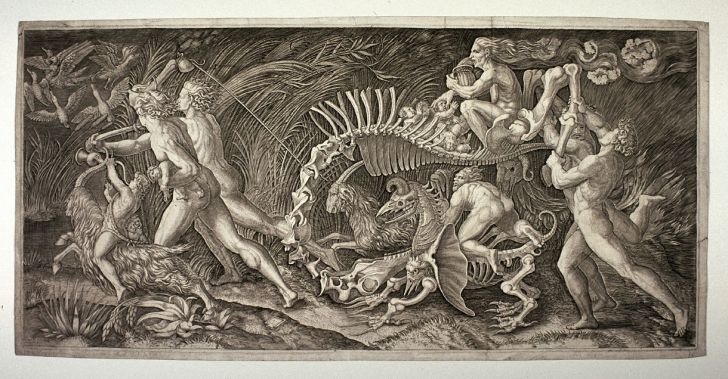
Wagner’s masterpiece is undoubtedly the main intertext in Laiseca’s novel, and without knowing rather well The Ring Cycle and Norse mythology, it is hardly possible to fully appreciate The Sorias. Nevertheless,  I think it is worth briefly mentioning the other considerable influences on this remarkable work. Like any novela total, The Sorias aspires to contain everything, and the sheer number of allusions to different literary works, musical compositions, visual arts and cinema is so overwhelming that it would require a separate monograph to do the justice to the intertextual dimension of Laiseca’s novel. I am sure that a lot of the references went over my head, but just the handful I did manage to notice are sufficient to set your head spinning. Besides the obvious nods I have already mentioned, Laiseca pays tribute in various ways to the following authors and works: Edgar Allan Poe (short stories), Mika Waltari (The Egyptian), Miguel Cervantes (Don Quijote), Amadis de Gaula, Borges (short stories),  One Thousand and One Nights, Classical Chinese  poetry, Lao Tzu, I Ching, Ian Fleming, Stephen King, H.P. Lovecraft, Gaston Leroux (The Phantom of the Opera), Mary Shelley (Frankenstein), Lewis Carol (Alice in Wonderland), George Orwell (1984), Herman Hesse (The Glass Bead Game), Gustav Meyrink (Golem), Alfred Jarry (Ubu Rois), Gustave Flaubert (The Temptation of Saint Anthony), Miguel Angel Asturias (El Señor Presidente, Men of Maize), Stanley Kubrick  (Doctor Strangelove), the Star Trek series, Werner Herzog (Fitzcarraldo), Federico Fellini films, the major classical operas (too many to list here), the music of Schoenberg, Honegger and Stockhausen. Besides being a distorted mirror reflecting the horrors of our recent history, The Sorias is also an anarchic, disorganised encyclopedia of our culture that is subject to similar deformation and estrangement, and, as result,  looking like heritage left by a Borgesian Tlön-like civilisation. It is truly fascinating to see how Laiseca operates with different mythological and cultural motifs by refuelling them with psychedelic energy of such high intensity that I wouldn’t be surprised if somebody had an actual acid trip just by reading certain episodes of the novel. For example, one of the mythologems that gets reworked to a spectacular effect is the Wild Hunt. It is a well-known myth that appeared in Northern Europe in the Middle Ages and described a host of ghosts riding on horses either in the skies or on the ground led by a pagan god or a cursed prince. Woe to those who meet the spectral hunting party!
LoStregozzo
Agostino Veneziano, Lo stregozzo
Laiseca places the Wild Hunt into a story-within-a-story about the medieval Baghdad where a certain qadi Mahmud Abdullah Masseidi, riding on a magic carpet that scurries across the ground on its little paws, tries to reach the ruins of the ancient city of Ur, but is unable to do it because the desert landscape before him turns into a calcined grove and a very strange company appears on his way.
Little by little, the calcined grove transformed into something living. Interlaced with the trees of ash there appeared bananas and giraffes, interwoven in their turn with mammoths and beasts of the Pleistocene. A sabre-toothed tiger – now it could be seen – was walking among the diminutive ferns, Alice’s rabbits, Hatters, March Hares, and treading on the sand mixed with trilobites. There were shells of enormous araucarias, poplar alleys, platypuses and mandrills alongside the mighty Siberian rivers rendered tropical by the inversion of the poles and the tropics as well as the confusion of the solstices. There, near these thawed-out rivers, tremendous ichthyosaurs (each dorsal fin big as a shield) were yawning near breadfruit trees. […] Thanks to his concealment machine the qadi could find out what those types intended to do. It seemed that their lord, the general, was leading them to a place where some of his buddies were about to perform a grimoire. Also, thanks to the speakers he learned the dismal details about the personality of this chieftain. In the territories which he ruled as the Master of the Gallows and the Knife, when some of his subordinates made a mistake, to let him know that he had fallen in disgrace, he sent to his house a barrel filled with shit: thus the man understood that it was time to commit suicide. Otherwise, one or some of the following things could occur to him: he could be forced to swallow entirely the contents of the barrel; his spinal column could be sawed in two in order to suck out his cerebrospinal fluid with a straw as a refreshment; with due patience and diligence ten holes could be made in the bones of his both legs with a drill so that later there could be inserted big screws to attach him to a wall and leave hanging head down; […] For the feast — it had been in progress for three days already and they intended to continue for four more — they had prepared braziers with new coals, torches made of skeletons inside whose ribs, skulls and around whose sacra flammable substances had been placed. If you take a closer look, a skeleton is an assembly kit. These white jigsaw puzzles, with the pieces juxtaposed and matching, were distributed among the gibbets from which they were gently swaying — others were put in chairs, which also were ablaze –; on white thrones; on black thrones; seated at the table and playing with tarot cards; disguised as Death, scythe and all, — the “all” included white tunics, hoods and plastic sandals.
What we see here is the Wild Hunt legend rewritten by a surrealist in which starkly incongruent images are put side by side and words are disenfranchised from their habitual meaning: thus “grimoire” does not signify here a book of spells anymore, but a feast of ghosts.
Even more bizarre is the treatment of the famous legend of the Temptation of St. Anthony, with which Laiseca sets out to rival the very Hieronymus Bosch. The “temptation” comes in the guise of the dark powers of Anti-Being that materialise to attack Decameron De Gaula in the desert with the ominous name the Bronze of Satan. The head magician of Technocracy comes to the desert alone to perform the annual ritual of subtracting a particle from Anti-Being, thus making its presence in the world less powerful. From all sides he is assailed by phantasms, terrifying and laughable at the same time. The goal of the magic monsters is to trick Decameron de Gaula into swearing allegiance to Anti-Being. The grotesque bestiary comprises the already mentioned lascivious vurros, skinless rabbits with the front paws consisting of coagulated vomit, Babel towers  made of penises, breasts and vulvas, the false Canadian Great Totem comprised of a hundred scrawny chickens perched on top of one another, gigantic Chinese dolls dressed as mandarins, even bigger Japanese dolls dressed as Samurais, a humpbacked leprous dwarf, and an obese Lenin. All these nightmarish creatures commit acts of unspeakable atrocity in front of Decameron to shake his determination, but the most powerful magician does not lose his concentration for a second and successfully goes through the enervating test set up for him by the black magic of Anti-Being.
The Sorias is a novel of excess in all respects, and any attempt to convey its richness within a simple review is doomed to failure. If, at this point, you think that I’ve been trying to reveal all the plot elements and all the major themes of this book, you couldn’t be further from truth. I haven’t even scratched the surface. Perhaps a five-hundred page monograph could claim to perform such a feat, but definitely not this review, which, although dwarfing all my previous posts, cannot do the justice to Laiseca’s creation. What I intended to do by this confused and amateurish write-up is to push this book a few inches forward on its journey towards the wider readership. It is my firm conviction that sooner or later, The Sorias will get the attention it deserves: it will be translated into other languages, it will be widely discussed, Internet communities dedicated to its hermeneutics will spring up. Maybe it’s not such a bad thing that so many readers have yet to discover this strange novel which is like nothing else, that so many readers will find out that there are books which are still capable of arousing in them a sense of wonder. - theuntranslated.wordpress.com/author/theuntranslated/


Graciela Ravetti: Una reflexión a partir de Los sorias, de Alberto Laiseca


  • Su turno para morir (1976)
  • Matando enanos a garrotazos (1982)
  • Aventuras de un novelista atonal (1982)
  • Poemas chinos (1987)
  • La hija de Kheops (1989)
  • La mujer en la muralla (1990)
  • Por favor ¡plágienme! (1991)
  • El jardín de las máquinas parlantes (1993)
  • Los sorias (1998)
  • El gusano máximo de la vida misma (1999)
  • Gracias Chanchúbelo (2000)
  • En sueños he llorado (2001)
  • Las aventuras del profesor Eusebio Filigranati (2003)
  • Sí, soy mala poeta pero... (2003)
  • Las cuatro Torres de Babel (2004)
  • El Artista (2010)
  • Cuentos Completos (2011)
  • Manual Sadomasoporno (Ex Tractat) (2011)
  • Beber en rojo (Drácula) (Muerde Muertos - 2012)
  • iluSORIAS (Muerde Muertos - 2013)
  • La puerta del viento (2014)

  • Alberto Laiseca, Bludgeoning Dwarfs to Death (Matando enanos a garrotazos) 


    The debut short-story collection by the recently departed Argentine maverick Alberto Laiseca contains the seeds of all the major themes that will be brought later to exuberant fruition in his mega-novel The Sorias. The thirteen stories first published together in 1982 cover a lot of grotesque, cruel, and absurd topics save the titular extermination of the dwarfs. As a matter of fact, there are no dwarf characters at all in this collection. Laiseca’s book begins and ends tongue-in-cheek, dragging the reader through the diseased Disneyland of his perverse imagination, in which each attraction is an affront to the good taste and an ingenious exercise in gallows humour that will make you  guffaw at the ridiculous atrocities unfolding before your eyes and immediately feel embarrassed at such a reaction. Not since Jonathan Swift’s A Modest Proposal have we been in the hands of such an incandescent satirist holding a distorting mirror to our reality twisted beyond repair in the first place.
    The world of The Sorias is already present in the collection, albeit in a rudimentary state. Most of the stories are set in the dictatorial state of Technocracy ruled by the cruel Monitor. There are also references to the rival state of Soria and to some geographical features of  Laiseca’s fictional universe such as the desert Satan’s Bronze. Here we meet for the first time the duo of hobos Crk Iseka and Moyaresmio Iseka relaxing at a vagabond resort which nobody would risk to take away from the homeless folks as the Monitor has a soft spot for hobos, believing them to be “magical animals”. Crk and Moyaresmio provide some degree of cohesion to the collection: they are featured in two stories  (the second and the last one) and one more story is presented as a tale narrated by Moyaresmio to Crk.  Moreover, in the final story there is a metafictional trick of suggesting that the whole collection might have been written by Moyaresmio and is to be submitted for a literary competition.
    Despite the overall playfulness, the stories mostly deal with grim and disturbing topics. The most shocking, and at the same time, strangely enough, the funniest, is the first story titled The Great Fall of the Indecorous Old Woman (Gran caída de la indecorosa vieja). It is a tale about the sadistic torture of an old lady in an ostentatiously exoticised Arab land that one could only hope to encounter in One Thousand and One Nights re-written by the Marquis de Sade. It can be read as a morbid  allegory of the legal injustice of a totalitarian system. Maybe I am reading too much into it, but I think that the satirical effect is achieved by the inversion of the ludicrous situation described by Anton Chekhov in his short story The Death of a Government Clerk. In Chekhov’s story a petty clerk accidentally sneezes on the head of a high-ranking official sitting in front of him in the theatre and cannot forgive himself such an impudence. After several increasingly annoying apologies to the official, the miserable man arouses in his high-status “victim” an angry outburst and goes home to die, unable to reconcile himself with the offence he has committed. In Laiseca’s story  the tables are turned as a similarly minor insult provokes a disproportionate response from the affected party. An old woman inadvertently pokes a qadi in the eye with a corner of her bag while riding on an archaic bus propelled by a team of slaves. This hardly grave incident leads to her suffering unimaginably painful tortures at the hands of the qadi’s assistants, while the sadistic magistrate keeps wondering at the discourteous behaviour of the woman who refuses to answer his questions after red-hot nails have been driven into her gums as a new set of false teeth. Even the sweet music played on the flutes fashioned from the shinbones of her amputated legs is unable to obtain from her an intelligible response!
    Laiseca’s two well-known interests, classical music and ancient Egypt, converge in The Mummy of the Clavichord (La momia del clavicordio), a tale recounted by Moyaresmio Iseka to his companion. The story tells about two egyptologists and their aides visiting the Valley of the Kings of Music with the purpose of extracting Mozart’s clavichord from the tomb of pharaoh Tutantchaikovsky (sic!). The clavichord is cursed, for, as it later becomes known, there is the mummy of Mozart hiding inside. The removal of the musical instrument triggers a chain of mysterious deaths among the members of the team led by the egyptologists. Quite soon everyone is dead except one of the heads of the expedition, a fellow called Pedro Pecarí de los Galíndez Faisán. His fate is the most dreadful of all: he is chased in a nightmare by the mummy of the great composer, bowed ponytail and all, wielding a huge fork.
    The citizens of  Technocracy appearing in the collection, from the highest state officials  down to the grass roots, are usually obsessed with solving some intractable problem. For example, Professor L.B.J. Iseka aspires to build a flying machine capable of taking its pilot inside a tornado. Luckily for him, it is up for his assistant Laponio Iseka to find out whether the newly invented apparatus can sustain the destructive force of the rotating wind. Dionisios Kaltenbrunner, the chief of the secret police of Technocracy called the I Double E, wraps his head around the challenge of disposing of the millions of the dead bodies of the enemies of the state murdered in the numerous concentration camps. His solution, based on the mathematical calculations faithfully reproduced in the story, is to throw the corpses from aircraft into an enormous crevice with a recently discovered cavern adjoining its bottom. The cavern, which was exposed  by the Technocratic engineers, will provide the necessary additional space to accommodate all the victims of the regime. Political commissar José Kaltenbrunner Garbanzo (no relation to Dionisios), after declaring the independence of a small province in Technocracy and staving off the inept attempts of  the secrete police chief to oust him, now faces the major invasion led by the great Monitor himself, an operation which might grow into a civil war. During a staff meeting in the Situation Room of his HQ guarded by the SS troops (he has adopted the Nazi style of dictatorship) Garbanzo is also trying to solve a problem: he wants to put his finger on the exact moment during the historic Battle of Stalingrad when the equilibrium between the Soviet and the German forces was broken, which precipitated the ultimate defeat of the Third Reich. A typical Laiseca touch is the presence of the Nazi-sympathising dictator’s importunate mother who turns out to be a cartoonish stereotypical Jewish mum. She is constantly interrupting the meeting in the headquarters, asking in Yiddish if her son is alright and even brings to the participants a platter with traditional Jewish hot cross buns. The three problems that have been puzzling humankind for centuries are “solved” in the short story with the telling title The Quadrature of the Circle, Perpetual Motion, Philosopher’s Stone (La cuadratura del círculo, el movimiento perpetuo, la piedra filosofal). The leader of an esoteric sect talks about the outlandish ways in which he has succeeded in squaring the circle, inventing a perpetual motion machine and transmuting lead into gold. It is obvious that his elaborate solutions are just groundless fantasies worthy of a madman suffering from the delusion of grandeur. However, woe to those will dare to dispute his grandiose achievements: terrible retribution is in store for them. Perhaps, it is the sad fact the leader of the sect spent sixty years dividing the circle into ever-diminishing triangles that has made him so cruel and intolerant?
    The last problem to be solved in this short-story collection is finding the right name for it. In the concluding piece, appropriately called Inventing Titles in the Winter Cave (Inventando títulos en la caverna de invierno), Moyaresmio Iseka discusses with Crk various possible names for the collection of short stories he has almost finished. There are dozens of variants: some are funny, some absurd, and some are pilfered from well-known literary classics. Finally, the cultured and respectable hobos decide to opt for the same title which, as we know,  Laiseca gave to the story collection in which they are prominently featured. Indeed, Bludgeoning Dwarfs to Death is a cool title, especially considering the absence of the little pesky creatures in the book. But what does it mean? Of some help is the epigraph to the collection taken from a quote in Argentine writer Horacio Romeu’s novel A bailar esta ranchera:
     A la vera de un camino
    dos enanos castigaban una flor
    mientras le decían:
    —Aunque tengas buen olor
    ¡no nos gustan las florcitas!

    On the edge of a road
    two dwarfs were tormenting a flower
    all the while telling it:
    “Although you smell good,
    we don’t like little flowers!”
    Far from demanding to exact revenge on the flower-hating little men from a verse, Laiseca calls upon us to bludgeon to death the metaphysical dwarfs of political and cultural intolerance, state-sponsored violence and bigotry. At least, that’s my interpretation of the title. We shouldn’t forget that all these stories were written during the so-called Dirty War in Argentina, a period of mass persecution and murder of thousands of political dissidents by the military government of the country. So, the dwarfs must be a symbol of all things heinous in human nature that Laiseca exposes and castigates in this work the way he does it best: by diluting the mundane horrors of repressive regimes with the grotesque, the absurd and the fantastic. - theuntranslated.wordpress.com/2017/08/04/bludgeoning-dwarfs-to-death-matando-enanos-a-garrotazos-by-alberto-laiseca/


    5/26/15

    Amelia Rosselli - a virtuoso, subversive, neo-Petrarchan sequence of poems. These explosive poems, a furious cacophonic crescendo of semantic and syntactic accumulations deeply admired by Pasolini, place Rosselli among the greatest writers of her generation


    Amelia Rosselli, Hospital Series, Trans, by Deborah Woodard, Roberta Antognini and Guiseppe Leporace, New Directions, 2015.

    Hospital Series, a bruisingly intimate colloquy with an elusive lover, is Italian poet Amelia Rosselli s virtuoso, subversive, neo-Petrarchan sequence of poems. Rosselli wrote much of the series in the mid 1960s after being hospitalized for a mental illness she suffered from for most of her life, and whose pain shapes her language and difficult vision. These explosive poems, a furious cacophonic crescendo of semantic and syntactic accumulations deeply admired by Pier Paolo Pasolini, place Rosselli among the greatest writers of her generation"


    In 1996 a woman leapt to her death from her fifth-floor apartment balcony in Rome. Fifty-nine years earlier two brothers were found dead by a road in Normandy, their carotid arteries severed. Later identified as the Rosselli brothers, Carlo and Nello, it soon became clear the pair had been assassinated by Mussolini’s agents; and with those deaths in 1937, Italy had lost two of its bravest anti-fascists just when it needed them most. What many didn’t realize at the time was that these deaths also signaled great loss for one little girl, who had lost a father and an uncle in one fell swoop. It was this little girl who would jump to her death fifty-nine years later, a great poet on the brink of old age.
    It’s unsurprising that Amelia Rosselli, Carlo’s daughter, only eight years old at the time of his murder, was to live a life plagued by the turmoil of her early years. Art and suffering are often said to keep close company and in this case Amelia’s frequent bouts of depression, and her mother’s death shortly after her father’s, led to a childhood in exile from Fascist Italy in which creativity and poetry became a natural means of escape, a manner in which to channel grief to larger effect.
    Working in the aftermath of World War II Rosselli became one of the most important poetic voices emerging from Europe, but most importantly a notably isolated female voice in the dominantly male narratives of war. Serie ospedaliera (Hospital Series), Rosselli’s second book, was first published in Milan in 1969. A self-professed ‘Poet of exploration’, the collection certainly lives up to Rosselli’s declarations of pioneering new expressions of language and form. Unfortunately, at times these ambitions fail to fully deliver in what is an intriguingly complex series.
    It’s not every writer who has the luxury of choice when deciding which language to write in, and the trilingual Amelia chose very deliberately to write in Italian, her mother tongue. It stands to reason then that to translate her work into English—a language, like French, she chose to disregard—is particularly difficult. Rosselli knew the parts of Italian that remained singular to the romance language—the tones, the rhythms, the ease of its rhymes—all aspects that overwhelm the language unlike any other. She understood acutely the manner in which Italian words allow a compacting of meaning, the way a single Italian word can tell you many things an English one can’t simply by its ending. She chose Italy as the ‘ideal fatherland’, and, with it, its language.
    Writing in a confessional mode, Rosselli desired to create stanzas that could be characterized by a new objectivity, what has been called a “collective orientation”, “where the I is the public, where the I is things, where the I is the things that happen.” This statement itself needs a moment or two to digest, a factor that a reader soon realizes is a commonplace when encountering Rosselli’s work. There is a breathlessness to this poetry, a rushing hurry that infiltrates every line, every comma and every upset pause. Ironically, despite its own velocity, Rosselli’s work remains poetry made for slow digestion, for repetition and quiet meditation. Whatever increased tempo the lines urge the reader into they also beg for a stuttering repeat, a re-watch, a careful scan (and re-scan) to pull them together again into a larger whole. So many of the images that Rosselli invokes are deeply powerful, but they appear like flashes in a minefield. It becomes harder as one reads on to snatch at these moments as they run through to the next line.
    In other words, Rosselli is a demanding poet, her verse reminiscent in some respects of Eugenio Montale’s, always asking more of the reader – to re-read, to revise, to look away and come back with greater understanding. However, whereas in Rosselli’s other collections there remains a congruence of content, in this collection it is unsurprising to learn the entire series was composed while she was a patient in psychiatric care. The evident distress of such an experience comes to the fore again and again; at times her language collapses completely: “I know not: I want not: you are not: I see not: I stay not: not: not, not, not.” The fragmentation of voice itself becomes a crucial part of the creative process. It is through this “experience impossible and dauntless we laboriously ruptured isolation”, and ultimately this seems to be Rosselli’s goal, to rupture isolation, to escape to a greater freedom.
    This escapism also manifests physically within the collection. Her enjambment is striking and used often and to dramatic effect, the slippery nature of her lines becoming in and of itself a task before the reader, one of fluid navigation and understanding. The structure of the poems invites reconsideration to gain clarity, something Rosselli self-consciously addresses while presenting emotional conflict openly on the page:
    I’m not sure if I’ve made myself clear, but I no
    longer see you taking shape
    reduced to an industrial love.
    Sections reveal an absolute clarity.
     Rosselli herself translated the likes of Sylvia Plath and Emily Dickenson and with this knowledge it’s hard to view this collection without noting the similarities of their work. The resemblances, particularly with Dickenson’s fragmentary voice, the scattered often stream-of-consciousness dissolution, combined and contrasted with razor sharp and incisive observations made in overly clipped clauses. Her eye never passes, but pierces. Even sex becomes objectified: “violent as an object (quarry of whitened marble)/(curved amphora of clay)” – and, with this objectification, seen again anew.
    Amelia Rosselli
    The musical nature of the Italian language is almost impossible to render in English, and yet the translators, Deborah Woodard, Roberta Antognini and Guiseppe Leporace, have clearly made an effort to mimic the rhythms of Rosselli’s words. The translations ache with the effort, yet on some occasions the effects chime brilliantly, as with the line: “Inkling inkling your gloves will never touch a living thing.” There is poetry alone in the detail of such translation. In fact the naming of the ‘series’ remains as a subtle nod to Rosselli’s own musical training (she was both an accomplished musicologist and musician, who played the violin, piano, and organ), something that becomes clear very quickly when reading her work out loud wherein the highly musical metric structures of her poetry come into full light. Rosselli’s words are as powerful as musical notes, and their composition, whether on a page or when spoken aloud, maintains this sense of importance.
    There is one poem towards the end of the collection in which Rosselli transforms her body into a ship, cast out into the ocean of life, wrecked and wonderful in a single moment. Painting, like writing, is presented as an artistic act that creates but also one that strips back and destroys; layers are added, but so too are they taken away. The same analogy could well be used for Rosselli’s poetry. In fact, on re-reading such a section, it is hard not to see the reader as the ship “storm-tossed” in the sea of Rosselli’s mind:
    Your watercolors discomposed my mind
    loquacious from winterstice. Throughout spring’s
    discomfiture, I, storm-tossed ship, was still craftily
    scaling the bright carousels: drowned treasure
    yours and mine. The paintbrush quivered gently
    in the simplicity of a shack discomposed by winter
    that was an unremitting cruelty, a sleep of yours hidden
    from my prayers, a slipping away from railroad tracks
    often sliding toward my head instead, bowed
    when there was light.
    One failing that remains ingrained within this collection is the fluidity that plagues its production. Individual poems are difficult to pick apart from the whole, which although immersive is also bewildering. To read the series is to wander until a sudden change in direction makes you stop and reflect; it can be hard to recognize at which points certain poems end and others begin. Rather than individual poems, then, the reader finds it is instead sections and moments that come to the fore. One passage in particular near the collection’s end speaks to the title and again seems to resonate both with Rosselli’s personal experiences within the confines of her hospital bed, along with the reader’s experience of encountering her poetry:
    In the chamber you were lying on the bed so narrow
    as to be my mate, while you fared
    anything but close, in a house of bordellos
    closed only to me. You lived in the very air!
    and it was a self-querying, this silence, that
    dragged oblivion throughout its sentences.
    Later, the speaker reaches out:
    I lay my hand on the air that separates us
    as if I could touch all that unripeness: you don’t
    see it, you’re too touched by your illness.
     I don’t withdraw my hand; I leave it there suspended
    as if there were a void to disobey, and
    often I see it transforming itself that soul
    of yours you detest enlarging.
    Without moving her hand, the speaker is left with a “stillborn gesture”. Left alone, she turns inward:
    I step back, I no longer nurse the slightest
    desire to enchant you; in your illness you’re
    a zebra moving, taut in its
    preserve.
    The clarity of such action, the pained simplicity of it, heightens the beauty of Rosselli’s account of the entire situation. Rather than the chaotic crisscrossing of ideas that often permeates these poems it is at these moments of stripped back observation that Rosselli comes into her own. - Thea Hawlin


    Severe the threefold sentences. En route with the archipelago we were
    swept up by the current, inorganic event, land and sea spit
    blood instead. As you split, I stared at myself in the vast
    archipelago that was my mind, very severe, logical,
    desperate before so much void: a battle, two, three battles

    lost. But the furor of our looks, you lantern
    who thought to guide, I routed crank, but the furor
    of these two looks of ours blocked: the victory taken for
    granted the battle conquered the bandits stronger than us, the union
    of two souls a tarantella.

                                        *
     The unhappy moon bowed down in its lament.

    Innocent rivulets, halfempty boats, the mountains’ lakes agape
    premise that I should be yours, and obedient.
      
                                       *
     Your aquarelles discomposed my
    mind loquacious for the winterice. With the mess of
    spring, storm-tossed ship, I cut footholds still
    among the merry-go-rounds colored with cunning: your my
    drowned treasure. The paintbrush sweetly shook
    in the modesty of a hovel discomposed for the winter
    that was a continual cruelty, a sleep of yours hidden
    from my prayers, a straying from the railway
    that often rather veered toward my head, reclining
    when there was light.

        And the light discomposing itself in equal parts evolved
    economical colorations on the map of the railroadman.

        Pallid, enervated, irascible, you warded off swallows
    while I painted on, equally enamored of

    nature and of my need.


    Amelia Rosselli’s Serie ospedaliera among the poet’s most haunting, imaginatively intense and formally rigorous collections, has just been published by New Directions as Hospital Series, translated by Deborah Woodard, Roberta Antognini, and Giuseppe Leporace .
    Originally published in Italian by Il Saggiatore, Milano, in 1969 Serie Ospedaliera also contained an earlier long poem, La Libellula, The Dragonfly, composed in 1958.
    For the first edition, Rosselli insisted on an IBM monospaced font (one in which each letter occupied the same amount of space), and on a layout with each poem printed on its own recto, accentuating a geometric and formal rigor.
    Each stanza can be read in equal amount of time, composing a square, echoing the arresting image chosen for the cover: a series of squares receding one inside the other.
    Rosselli worked on the poems of Hospital Series from 1963 to 1965, yet in an interview with Renato Minore (in Il Messaggero, Feb 2, 1984) she stated they were written all at once during a fifteen day creative burst.
    Following Amelia Rosselli’s first collection of poems Variazioni belliche (War Variations), the title Hospital Series again contains a musical term: series is a reference to serial music which Rosselli was studying.
    Alessandro Cassin interviewed Deborah Woodard a poet and translator living in Seattle and Roberta Antognini, Associate Professor of Italian and Chair of Italian at Vassar College.
     
    Alessandro Cassin. When did you encounter the work of Amelia Rosselli, and what was your initial response to it? Given for formidable challenges of Rosselli’s language, what drew you to undertake this translation?
    Deborah Woodard. I think it helped that, when I started, I had no idea what I was getting into. An old friend of mine, Linda Lappin, who is herself a translator, sent me a bundle of books she was discarding from her library, and Variazioni belliche was among them. I stowed the books in the lower compartment of a sideboard in the dining room and, eventually, drew out the Rosselli. I opened it up and put it back. It was too difficult to parse. But then having lost interest in another translation project, which seemed too thin, I went back into the sideboard stash, and picked up the Rosselli once again. Fascination trumped doubt. I translated a sample poem, brought it to Giuseppe Leporace, whose classes I was auditing at the University of Washington, and we began translating. When we learned that Lucia Re and Paul Vangelisti’s translation of Variazioni belliche was forthcoming from Green Integer, we made the decision to switch to Hospital Series.
    Roberta Antognini. I truly encountered Amelia Rosselli and her poetry through Deborah. I teach Italian language and Literature at Vassar. A few years ago, realizing that in the foreign literature classroom, translation is inseparable from writing and reading, teaching and learning, I decided to build on my lifelong passion for translation by developing a seminar on literary translation from Italian to English, for fourth year students of Italian. As a consequence of this course, I found myself increasingly immersed in translation studies, fascinated by a field that defines me as an individual and, in this country, as a professional. Although I had some previous experience as a translator—I translated Shirley Jackson’s short story “The Lottery” and Teodolinda Barolini’s book, The Undivine Comedy, into Italian—it was this course that whetted my appetite for translation. The first time that I offered it, I invited Deborah Woodard for a class presentation on her work on Amelia Rosselli. And I soon discovered that Rosselli is one of the most interesting and innovative Italian poets of the past half-century. As she was both a poet who wrote in three languages—Italian, English and French—and a translator, questions of translation are central to her work. Deborah asked me to collaborate with her in preparing Hospital Series for publication and I enthusiastically accepted.
    AC Amelia Rosselli’s first collection of poems, Variazioni belliche, was published in Italy in 1964, and her last, Sleep, in 1992. How do you explain the long delay in translations and critical attention in America?
    DW Translation doesn’t fare all that well in the United States in general. And poetry itself is a hard sell. Each translation that comes out adds to the momentum and reaches out to new readers. Having translated Rosselli for twenty years, I know that she only gets better. This process of bestowing upon her the attention she deserves, though still achingly slow, is irreversible.
    RA One can even say that Amelia Rosselli is more appreciated in the United States than in Italy. Although quite known in Italy, she has not yet received the critical attention she deserves. Partly because her poetry requires such a strenuous, almost physical, mental effort, and partly because Rosselli was a particularly difficult individual, an outsider somewhat isolated from the contemporary literary scene.
    AC Now at last, thanks to your work, that of Lucia Re and Paul Vangelisti, and of Jennifer Scappettone, there are a variety of different translations available. Many scholars are beginning to study her work. Do you have any hypotheses for why her moment has finally arrived?
    DW As I said above, it is a slow build. But we are getting there.
    RA There is a tendency among American scholars in Italian studies to translate, especially women. To the point that, for instance, we have the paradox of Italian original texts by sixteenth, seventeenth hundred women writers available in Italian in a modern edition only because of the English translation. I believe Amelia is part of this trend.
    AC Translations are often done in teams: could you describe the specific nature of the collaboration between you, Giuseppe Leporace and Roberta Antognini on Hospital Series?
    DW Giuseppe and I worked on Hospital Series for several years. We put the translation on the back burner when Alfredo de Palchi of Chelsea Editions invited us to compile The Dragonfly: A selection of Poems 1953-1981. By the time I returned to Hospital Series, several new books on Rosselli had been published, and the Mondadori definitive edition of her work was in the offing. It was time to take a fresh look at Hospital Series. When Roberta and I met at Vassar, and subsequently attended the Barnard symposium in 2011 on Rosselli, we agreed to work together to review Hospital Series and prepare it for publication. We came to terms over a couple glasses of red wine. Thanks to Roberta, the translation is crisper and more accurate, and there is more of Amelia’s music in it and a pinch more of her word play, all of which makes me very happy.
    RA Even though I was revising more than translating, the experience of co-translating Serie ospedaliera with Deborah has been exhilarating. In Amelia, tradition and innovation are so deeply intertwined that almost every word is a challenge. When Deborah was looking into the depth of the target language, I was digging into the source language as profoundly as I could, trying to find out as much as I could in order to convey to her the movement of Amelia’s poetic voice.
    AC In 2009 you translated with Giuseppe Leporace a selection of Amelia Rosselli’s poems (The Dragonfly. A selection of Poems 1953-1981, Chelsea Editions). That earlier collection included 17 poems from Hospital Series. In your new book you have reworked those same poems, at time making different choices of words, word order and entire verses. Can you contrast the experience of working on the two translations and describe how your understanding of this material has changed?
    For example, in your first translation of Sex violent as an object (whitened quarry of marble)
    You first translated: “Non gaudente, non sapiente serpentinamente influenzato da esempi illustri o illustrazioni di candore, per la pace e per l’anima purulava” as: “Not pleasure-seeking, not learned serpentinely influenced by illustrious examples or illustrations of candor, it festered for peace and for the soul.
    In your new translation it becomes:
    Not sybaritic nor sage
    serpentinely influenced by illustrious examples or illustrations
    of candor, it festered for peace and for the soul.
    DW I wanted to speed the lines up a bit, too, as this poem moves so beautifully. In general, few translations are written in stone. With a poet such as Rosselli, one can always have a new idea because she presents us with concentric circles of sound and meaning. I consulted the thesaurus, came up with “sybarite” and “sage,” and loved the sure-footedness of these new choices. In fact, as Roberta pointed out to me, “gaudente” and “sapiente” are hapax words, occurring only once in the text. We needed something a little out of the ordinary, for a poet who is always out of the ordinary.
    AC Now that several translators have worked on Amelia Rosselli’s poetry, the English language reader has choices. One measure of the difficulty of translating Rosselli is highlighted by the fact that even the title of her first collection, Variazioni belliche, has been translated alternatively as War Variations, Martial Variations and Bellicose Variations… Would you care to elaborate?
    DW I’m not completely convinced by any of these translations of Rosselli’s title. At the time, I felt that Martial Variations flowed well, but, rethinking that choice, I fear that it suggests a regimented display that is the complete antithesis of what the text is about. War Variations is accurate but sacrifices the Latinate mellifluousness of the original. At the moment, I think that I prefer Bellicose Variations (Scappettone) because the attitude, the bellicosity of the narrator’s voice, is so prominent in these poems. It is more of a mouthful in English than in Italian, but, for whatever reason, this title is tricky. Fortunately, Hospital Series is always going to be translated as just that (I think!).
    RA The discussion of this title provides a great example of the way Deborah and I worked on the final draft of Hospital Series: literally dissecting words and debating solutions. In this case, the great fascination of the vaguely oxymoronic title Variazioni belliche comes from the combination of the (also but not only) musical term variazioni with the adjective bellico that retains the Latin etymology (the noun would be “guerra” which has the same German origin of the English “war”). However, bellico means “pertaining to war”, rather than “bellicose”, eager to fight, for which there is the adjective bellicoso. Hence, the variations are not bellicose, they just belong to war. Personally I like best the more literal translation of War Variations, which in English has a nice alliteration to it.
    AC Rosselli’s experimentation with language takes radical new turns from book to book. Having translated both earlier and later work, how would you characterize the specific language of Hospital Series?
    DW With the exception of the heightened lyricism of the Campana-influenced “La Libellula: panegirico alla libertà” (“The Dragonfly: panegyric to liberty”), I didn’t find the language between her first two books to be markedly dissimilar. Hospital Series is a bit more meditative than Variazioni belliche at times, perhaps. The issues are the same, but the theater is smaller and more intimate—again, with the notable exception of “The Dragonfly”, which was written earlier. Documento strikes a very different note, but I can’t adequately characterize the ways in which its language differs as of yet. I might provisionally term it more austere.
    AC Do you plan to translate more of her work in the future?
    DW Yes, once our schedules synch up, Roberta and I will be reviewing Rosselli’s poetic prose / veiled autobiography Diario Ottuso (Obtuse Diary), which I initially translated with Giuseppe Leporace for The Dragonfly, and which I worked on with another translator, Dario de Pasquale, as well. I love this little book of “prosa d’arte.” Then, finally, Roberta and I will turn our attention to Documento (Document). Documento is a challenge, to say the least, but we are drawn to the magnitude of this text. It is an entire landscape, and a very social and political one, it would appear.
    RA All of Amelia’s poetry is characterized by an inner tension between the geometry of the prosody and the freedom of the language. Amelia considered Documento her most mature work, and, if we intend for maturity a sort of crystallization of this tension, it probably is.
    AC How, if at all, do you feel that your work on Rosselli has impacted your own poetic practice?
    DW I was very influenced by “The Dragonfly,” specifically by the way Rosselli interrogates lyrical imagery at the same time as she rejuvenates it. In my view, she renovates the lyrical line by finding ways to distort it, if that makes any sense, and by stopping it in its tracks and then picking it up again. I learned a lot from Amelia about timing. Her ear is impeccable. The extended riffs of “The Dragonfly” gave me a sense of freedom—the poem is, after all, a panegyric to liberty. I hope that Documento will give me another key, somehow. - primolevicenter.org/printed-matter/hospital-series/


    Amelia Rosselli, Locomotrix: Selected Poetry and Prose of Amelia Rosselli, Trans. by Jennifer Scappettone; a bilingual ed., University Of Chicago Press,  2012.

    A musician, musicologist, and self-defined “poet of research,” Amelia Rosselli (1930–96) was one of the most important poets to emerge from Europe in the aftermath of World War II. Following a childhood and adolescence spent in exile from Fascist Italy between France, England, and the United States, Rosselli was driven to express the hopes and devastations of the postwar epoch through her demanding and defamiliarizing lines. Rosselli’s trilingual body of work synthesizes a hybrid literary heritage stretching from Dante and the troubadours through Ezra Pound and John Berryman, in which playful inventions across Italian, English, and French coexist with unadorned social critique. In a period dominated by the confessional mode, Rosselli aspired to compose stanzas characterized by a new objectivity and collective orientation, “where the I is the public, where the I is things, where the I is the things that happen.” Having chosen Italy as an “ideal fatherland,” Rosselli wrote searching and often discomposing verse that redefined the domain of Italian poetics and, in the process, irrevocably changed the Italian language.
    This collection, the first to bring together a generous selection of her poems and prose in English and in translation, is enhanced by an extensive critical introduction and notes by translator Jennifer Scappettone. Equipping readers with the context for better apprehending Rosselli’s experimental approach to language, Locomotrix seeks to introduce English-language readers to the extraordinary career of this crucial, if still eclipsed, voice of the twentieth century.

    In Scappettone, Rosselli has found an inventive, aesthetically kindred translator, one who rightly chooses ‘to startle when Rosselli startles, and not to gloss';—to maintain, that is, rather than tame, the singularities of Rosselli’s capacious and difficult work. But the word ‘maintain’ makes it sound too easy, as if the translator had only to leave well enough alone, when of course what is often required is the invention in English of sympathetic singularities, which Scappettone, a poet herself, provides in abundance. As if that weren’t enough, the poems themselves are framed by Scappettone’s excellent introduction and by well-chosen prose selections and helpful bibliographies and notes. . . . Locomotrix is an exemplary volume and by far the best introduction to Rosselli now available to English-language readers.” - Geoffrey Brock

    “After more than a decade of research, travel, translation, revision, and cross-examination, Jennifer Scappettone offers to the Anglophone reader an extraordinary harvest of texts by Amelia Rosselli, under the comprehensive (and Rossellian) title Locomotrix . . . in a bilingual edition, which permits the volume to continue the dialogue across languages that is in fact the powerful root of Rosselli’s imagination and poetry. A poet herself, beyond being a scholar, Scappettone is the ideal translator of a dense and multifoliate writing like that of Rosselli. . . . [B]oth readers for whom the voice and history of Rosselli are still unknown and those already familiar with her work will find elements of reflection and annotations that interrogate and reinterrogate the texts (which are now legible in a new light thanks to the insight/translation into English).” - Marco Giovenale 

    “Jennifer Scappettone’s selection from the full corpus of [Rosselli’s] work, with a substantial introduction to match, offers English speakers with little or no Italian the best chance yet of engaging in depth with Rosselli’s demanding and strangely rewarding voice.” - Peter Hainsworth 

    “Scappettone succeeds more consistently in rendering the intensity and grit of Rosselli’s language than the previous translators, contending imaginatively with a poetic style in which words are often twisted, invented, or forced into use from other languages; besides which she gives us a very substantial introduction to Rosselli’s life and poetics, not to mention useful endnotes, along with Rosselli’s most important statement of intent, the essay ‘Metrical Spaces.’  Also included are an interview, a handful of letters, and appreciations of her work by Zanzotto and Pier Paolo Pasolini.”
    Barry Schwabsky

    “[Scappettone] is always conscious of trap doors and multiple meanings to unravel and iron out . . . [and] knows how to render the tone of reflection or desperation, invective, shock, spontaneity, and freedom in the poetry of Amelia. All with great daring—or rather, thanks precisely to this daring of hers.” - Giulia Niccolai

    “Poet, translator, and professor, . . . Scappettone—who has also translated authors of her own generation, like Giovanna Frene, Florinda Fusco, and Marco Giovenale—offers a truly compelling example of the vivacious osmotic exchange between the current experimental poetry of the United States and that of Italy. Her Locomotrix is not only an accomplished example of an ‘expanded’ anthology (that includes critical writings, letters, and photographs), but also a stimulating and felicitous theoretical attempt to present the complex—and certainly not easily translatable—work of the splendidly ‘obtuse’ giantess-mother of a great part of today’s poetic research to a global public.”
    - Gian-Maria Annovi

    “In the landscape of twentieth-century Italian writing, Amelia Rosselli’s poems stand out as a unique achievement, cultivating oblique, discontinuous forms that mix social diagnosis and satire, memory and introspection, tragedy and utopianism. Jennifer Scappettone’s editorial project is a work of cultural restoration that helps to create a broader context in which the anglophone reader can more fully appreciate Italian poetic traditions. But she has done much more: drawing on her own formidable skills as an experimental poet in English, Scappettone has produced an ambitiously innovative translation whose effects are at once stunning and uncanny in recreating the Italian. The result is a body of poetry that is challenging, to be sure, yet tremendously powerful.” - Lawrence Venuti       


      Half a century after the searching start—across and between tongues—of her uncompromising poetic practice, the poet Amelia Rosselli has emerged in global literary discussions as exemplary: as both prophetic and crucially contemporary. She has come to occupy a prominent position in literary history as one of the twentieth century’s most significant and demanding poets of the Italian language and beyond, with a body of work that concretizes in its agitation the postwar era’s fallout and bequest. Her books of poetry and recently collected prose are testaments to a uniquely multiform sincerity, and to a fiendishly restless mind, synthesizing a literary tradition that stretches from the thirteenth-century dolce stil novo through Rimbaud, Campana, Kafka, Joyce, and Pasternak with the frankness of the news. The daughter of an assassinated hero of the Italian Resistance who spent her childhood and adolescence in exile between France, England, and the United States before settling in Rome, Rosselli is esteemed for the idiolect she forged to voice the aftermath of this experience while resisting both the confessional first person dominating mainstream poetry during the years of her production and the aesthetic conformities of vanguardist schools. Self-described “poeta della ricerca” (“poet of research”), she regarded poetry as a sphere of activity exceeding the narcissistic gamut of self-expression and constraint of genteel intellectualism: language in Rosselli’s handling is a site of innovation with imperative philosophical and political consequences. Never mere linguistic exercise, her writing launches explicit and implicit structural assaults on the authority of traditional poetic forms, as well as the social and cognitive forms that gave rise to them.
    She has fed me senseless small change, brought me to the bank, had me counted and found the sum surplus. —“My Clothes to the Wind” (1952)
    To summarize her oeuvre, then, is but “an obligatory cruelty”; in its errancies, this work draws into question the synthetic categories of postwar poetry that have been forged thus far. In the early English prose piece called “My Clothes to the Wind,” the young author describes those who would encompass her as “Biscuit-makers all, and I a crumb who’d not coagulate,” voicing an attitude of alienation from reigning forms that would persist on many fronts. Rosselli’s tumultuous upbringing in the midst and aftermath of the Second World War as a victim of Fascism fostered her estrangement from the Italian literary establishment for decades. Being linguistically and culturally heterogeneous, her writing was initially regarded as a key exception to the rule of this national literature, even in the face of acclaim by prominent poet-critics and her historical distinction as the first—and still one of few—female Italian authors included in canon-defining anthologies of twentieth-century poetry. Yet as consciousness rises regarding the fundamental reciprocity between italianità (Italianness), emigration, and immigration, her poetic output has been subject to an explosion of attention. The impulses of Rosselli’s work in and against the Italian language are best appreciated when aligned with aesthetic trends that are international, while her role in shaping the future of this particular language and its literature is best grasped if we listen for the way it articulates the Italian patria, or “fatherland,” as itself a hybrid, transnational cultural formation. Rosselli’s is arguably the poetry most vital to evolving understandings of global modernism and postmodernism to have emerged from postwar Italy, testifying to the privations and hard-won inheritance of cultures bound by colossal networks of commerce and violence. Her poetic transmutes the war into which she was born into a battle against every species of tyranny: literary, cultural, sexual, economic, and, congenitally, political.
    Rosselli was born in Paris in 1930 into a prominently, ardently antitotalitarian climate—into a family living in political exile. Her paternal grandmother and namesake, Amelia Pincherle Rosselli, was a secular Jewish Venetian feminist and republican thinker from a family active in the unification of Italy; Amelia Pincherle was the celebrated author of plays, some in Venetian dialect, and of short stories, children’s literature, political and literary essays, and translations. Amelia’s mother, Marion Catherine Cave, was a brilliant English activist of the Labour Party, from a family of Quaker and distant Irish Catholic heritage and modest means. Her father, Carlo Rosselli, was an intellectual leader and eventually a martyr of the anti-Fascist Resistance. Having been convicted—in a trial he exploited to critique Mussolini’s regime—of facilitating socialist Filippo Turati’s flight from Italy, Carlo himself escaped from the penal colony on the island of Lipari in 1929; Marion, pregnant with Amelia, was briefly arrested for complicity before the family was reunited in Paris. It was from the French capital that, with his brother Nello, Carlo launched Justice and Liberty, a prominent non-Marxist resistance movement based on principles of “liberal socialism,” which included Primo Levi, Cesare Pavese, and Leone Ginzburg among its affiliates, and later became the influential if short-lived Action Party. Upon the outbreak of the Spanish Civil War, Carlo was among the first to mobilize an armed brigade of volunteers in the fight against Franco, articulating the importance of organizing resistance to Fascism across Europe with the rallying cry “Today in Spain, tomorrow in Italy.” Identified as prime enemies of the regime, the Rosselli brothers were brutally murdered by the French Fascist terrorist organ La Cagoule in Bagnoles-de-l’Orne, Normandy in June 1937. The news was dealt to the seven-year-old “Melina” and her younger brother Andrea by their mother as a problem of language: “Do you know what the word assassination means?” She recalled in a 1987 interview, “We answered yes.”
    from the introduction by Jennifer Scappettone

    from Variazioni belliche / Bellicose Variations (1964)

    What ails my heart which beats so suavely
    & maketh hee disconsolate, ese
    soundings quite steel? lle Those
    scomminglings therein ’mprinted fore Ille
    be harrowed so
    fiercely, alle hath evanished! O shhd mine
    hares rampant thru th’nerves &s thru
    channels rimed ’f thisse my lymph (o life!)
    not stopp, thus yes, th’I, mio
    nearyng unto mortae! In alle claundors soul of mine
    thou dost propose a cure, thee I imbrace, you,—
    find ’at Suave Word, you, return
    to the comprehended saying that makes sure love remains.


    from Documento / Document (1966-1973)

    It comes
    blown down the stairs,
    likeness that I make of each thing
    that passes through my mind
    as if forgiveness were always at the ready there.

    To barter the cigarettes of others
    for a dormer full of good books . . .

    In the court and the percentages I saw
    the trial extended between the lines
    and I acquitted the commanding officer
    because you were the usual slaughterer

    of women in the labyrinth
    frightened by the scream
    between mountains of stone
    in the horror of a bomb
    undetonated

    like all of our best things:
    politics in its chintzy sale
    you bestow your assembled powers liberally
    amongst the illiterate of the neighborhood

    and amongst the dust you were carrying intact
    in grey luggage.

    •••
    this is the sea today
    in waves more serene that slash
    that scream & that toil of yours deliberately

    fusing the
    vision of a gash with a gash
    everything remakes itself,

    & from the top & again
    •••
    the fragrant lymphatic canals
    of mosquitoes
    in the empty shack
    no one can any longer lay hands on
    knotty histories
    trading them for a metaphor.

    •••
    There’s something like pain in this chamber, and
    it is partly overcome: but the weight
    of objects wins, their signifying
    weight and loss.

    There’s something like red in the tree, but it is
    the orange of the lamp base
    purchased in places I don’t wish to remember
    because they also weigh.

    Like nothing I can know of your hunger
    the stylized fountains are
    precise in wanting
    a reversal can be settled of the destiny
    of men divided by oblique noise.


    General Strike 1969

    lamps wholly alight and in the howl
    of a calm audacious crowd
    to find yourself there, acting with seriousness:
    taking risks! May this apparent
    childishness shatter even my own
    power not to give a damn.

    A deep inner God could have sufficed
    my egotism did not suffice for me

    the taste of riches in an otherwise
    throttled revenge did not suffice

    for these people. We had to
    express something better: allow ourselves

    this rhetoric that was a howl
    of protest against undaunted

    destruction in our frightened
    houses. (I lost on my own that vertical
    love of solitary god
    revolutionizing myself in the people

    removing myself from heaven.)
        

    Please welcome the scholar and translator Diana Thow, who for today’s entry has generously provided poems from her translation of Amelia Rosselli's Serie Ospedaliera (Hospital Series) in addition to some illuminating and insightful Rosselli context and commentary.
    —RF
                            From Serie Ospedaliera (1963-1965) 
                            Amelia Rosselli/translation Diana Thow 


                            Lifting of weights and particularities of fate
                            little doves eyed my strength
                            taken from your take-off like
                            candy, the vocation melted into
                            a semantic revision of our quarrels
                            and birds. None of the soldiers who really
                            wanted to remarry was able to tell me
                            who is it that really marches.

                            ….solitary in the didactic regions
                            I held the brigantella disappointed by
                            such a miserable fate, oh
                            see I’m exploding, don’t run away, the
                            piano’s machinegun subtracts
                            sensations, metro, camphor, the curved
                            red lips bricks of the safe.

                             * 
                            A thin little voice: enough to open the shutter
                            of the little window, that changes the world
                            and its surfaces are a part of your
                            migraines. Enough to barely open, open, your
                            sleep measures itself against the sky, where
                            a tragic image stays.

                            You open a wall: another appears, to take
                            your pulse. You can’t razor the wall, you don’t want
                            to save yourself those few spirit hours, forcing
                            its mysterious cells. And still, you feel like
                            a fallen pine between the new pine groves,
                            straight end to rotten pity. 

                            *
                            You scare yourself with all your heart
                            with the air that shakes and sheds you;
                            dreams radiate down through the
                            illiterate facades, you count
                            blood in fat drops
                            falling full into your hands
                            withdrawals from the anguish of knowing
                            where the air is what does it move why
                            it speaks, of ills so watered down
                            to seem, so many things together
                            but not one you forget, your
                            dragging night and blood
                            through immense days.

    [Note: “You scare yourself with all your heart” first appeared in the estimable THERMOS]

    RF: Who was Amelia Rosselli?
    DT: In her words:
                Born in Paris afflicted in the epoch of our fallacious
                generation. Laid out in America among the rich fields of landowners
                and the statal State. Lived in Italy, barbarous land.
                Fled from England land of the sophisticated. Hopeful
                in the West where nothing now grows.
                —from “Contiamo infiniti morti…”
    in Variazioni Belliche, translation Cinzia Blum and Lara Trubowitz)
    Amelia Rosselli (1930-1996) was a dynamic, idiosyncratic and intensely lyrical presence in postwar Italian poetry. She was in a category of her own: not only multilingual (she grew up speaking English, French and Italian), she was often the token female in the largely male dominated field of Italian literature at that time. Rosselli was born in Paris in exile. Her father was the famous antifascist leader Carlo Rosselli, and her mother was British. Her very name bore the scars of Italy’s struggles to liberate itself from the fascist regime in an era that was trying to forget its fascist past. After her father’s assassination, she spent formative years in upstate New York with her extended family. During this time her grandmother read the children Dante in Italian so that they wouldn’t forget their Italian language and heritage. Amelia finished high school in London, and moved with her grandmother to the family home in Florence in the 1950s, eventually relocating to Rome, where she would live for the rest of her life. Her voice was as distinctive as her poetry: she spoke Italian with a hint of a French accent (most noticeable in her French pronunciation of the letter R). In addition to her work as a poet, she also worked as a journalist, editor, and mentor to younger poets.
    Rosselli was deeply interested in prosody (both English and Italian) and had a background in both visual and musical studies. She was largely an autodidact, but had extensive formal training as a pianist, organist and composer in her teens and twenties, and in the decade before her first book of poetry was published she was intensively involved in the experimental music scene in Rome. She attended the famous Darmstadt music conference at the end of the 50s and beginning of the 60s, and met composers such as Cage and Stockhausen and studied with Italian composers Guido Turchi and Luciano Berio. Even when she left music for a career in literature the influence of her musical upbringing lingered: there is a recording of Rosselli reading her final poem, “Impromptu,” in which she basically sings sections of the long poem.
    RF: Tell us about the traditions Rosselli was working out of and about her associations with her contemporaries.
    DT: Rosselli’s trilingual background is crucial to her poetics—her verses reflect this particular mesh of languages in their linguistic flexibility and complexity. She was associated with the neo-avant-garde poetry movements of the 60s and 70s, in particular the experimental Gruppo ‘63, which included poets Edoardo Sanguineti, Antonio Porta, Adriano Spatola, Giulia Niccolai, and Elio Pagliarini. Rosselli was reticent about her affiliation with the group, as she felt herself to be working within a more lyrical tradition; she named Montale, Campana and Saba as influences, as well as Mallarmé, Verlaine, Rilke, and T.S. Eliot. Yet, within the group she felt a special affinity for Antonio Porta [For those unfamiliar with Porta, I recommend picking up the recently released selected Porta here —R.F.], who also translated some of her English poetry into Italian (the bilingual volume is called Sleep-Sonno). In Rome she frequented literary circles that included Alberto Moravia (her cousin), Elsa Morante, Carlo Levi, Pier Paolo Pasolini, and she performed with Carmelo Bene. John Ashbery published her first English poems in his Paris journal Art and Literature in 1965.
    RF: What work have you chosen to translate and why? 
    DT: I’ve translated her second collection, Serie Ospedaliera (Hospital Series), because I love the book. I was living in Rome when I translated it and the city truly saturates the collection—the Roman cobblestones (sampietrini, named after Saint Peter’s Square) are mentioned by name, the Tiber winds in and out of the poems, the green spaces are often the hidden gardens of the Janiculum Hill, above Rosselli’s neighborhood in Trastevere. The screech and shrill of the squares and scooters and markets are audible in these poems, the solid stone of the buildings, their windows and blinds opening and shutting. The poems share an intensity, what Rosselli called a linguistic rigor, with Variazioni Belliche, yet there is a softer edge to them. Petrarch returns often, as does Montale, and the violence of the first collection turns inward, becomes more searching and contemplative. In the collection Rosselli navigates the interiors of the lyrical subject, destabilized by illness. The figure of the sick lover transforms sickness itself into a lover; the lyrical object of desire also becomes the lyrical subject, the one who speaks and observes. This reflexivity is also true on a linguistic level: in Rosselli’s Italian there is always the pull of the English language; the effect, for someone who reads both, is that of looking through Italian at English. Translation always creates a space in which the translator is asked to think about the translating language in a new way, one that is estranged from its standard patterns and enriched by its new associations with the source text. Rosselli’s multilingualism opens English up to Italian and French in a way that illuminates all three languages, sharp rays of light cast through a prism.
    blog.bestamericanpoetry.com/the_best_american_poetry/2012/07/poems-by-amelia-rosselli-and-a-conversation-with-rosselli-translatior-diana-thow-robert-fernandez.html