1/2/17

Fairy Tales for the Disillusioned collects thirty-six tales, many newly translated, by writers associated with the decadent literary movement, which flourished in France in the late nineteenth century


Fairy Tales for the Disillusioned

Fairy Tales for the Disillusioned : Enchanted Stories from the French Decadent Tradition, Ed. by Gretchen Schultz and Lewis Seifert, Princeton UP, 2016.


The wolf is tricked by Red Riding Hood into strangling her grandmother and is subsequently arrested. Sleeping Beauty and Cinderella do not live happily ever after. And the fairies are saucy, angry, and capricious. Fairy Tales for the Disillusioned collects thirty-six tales, many newly translated, by writers associated with the decadent literary movement, which flourished in France in the late nineteenth century. Written by such creative luminaries as Charles Baudelaire, Anatole France, and Guillaume Apollinaire, these enchanting yet troubling stories reflect the concerns and fascinations of a time of great political, social, and cultural change. Recasting well-known favorites from classic French fairy tales, as well as Arthurian legends and English and German tales, the updated interpretations in this collection allow for more perverse settings and disillusioned perspectives--a trademark style and ethos of the decadent tradition. In these stories, characters puncture the optimism of the naive, talismans don't work, and the most deserving don't always get the best rewards. The fairies are commonly victims of modern cynicism and technological advancement, but just as often are dangerous creatures corrupted by contemporary society. The collection underlines such decadent themes as the decline of civilization, the degeneration of magic and the unreal, gender confusion, and the incursion of the industrial. The volume editors provide an informative introduction, biographical notes for each author, and explanatory notes throughout. Subverting the conventions of the traditional fairy tale, these old tales made new will entertain and startle even the most disenchanted readers.


"[F]un and intriguing . . . . [E]xcellent windows into a period in history, especially in France, when politics and world strife . . . made it hard to embrace the [happily ever after] of the popular fairy tales."--Heidi Anne Heiner


"[S]ometimes sardonic, sometimes brutal, often blackly funny and possessed of a peculiarly modern sensibility."--Cameron Woodhead


"It’s easy to see why Fairy Tales For the Disillusioned is capturing rave reviews. Our cultural climate is ripe for such a round of stories and, as the series from which it appears states, these are, indeed Oddly Modern Fairy Tales."--Once Upon a Blog


"Fairy Tales for the Disillusioned brings together fairy tales by canonical and noncanonical nineteenth-century French authors. Many of these works have not been anthologized for an English audience--nor a French one--and these translated texts provide a complex view not only of the decadent tale but also of the possibilities of the fairy tale in general."--Anne E. Duggan


"French fairy tales are too often associated only with the emergence of the genre, especially Charles Perrault's influential stories, and then much later with fairy-tale films. Where did all the fairies go in the nineteenth century? Featuring a wide range of translated decadent fairy tales from France, this welcome and entertaining collection fills a large gap in English readers’ access to such texts. It will definitely have a place in my library."--Cristina Bacchilega


TABLE OF CONTENTS:
TALES
Charles Baudelaire
Fairies' Gifts 3
Alphonse Daudet
The Fairies of France 6
Catulle Mendès
Dreaming Beauty 11
Isolina / Isolin 17
The Way to Heaven 22
An Unsuitable Guest 27
The Three Good Fairies 31
The Last Fairy 36
The Lucky Find 41
The Wish Granted, Alas! 45
Jules Lemaître
The Suitors of Princess Mimi 48
Liette's Notions 60
On the Margins of Perrault's Fairy Tales: The White Rabbit and the Four-Leaf Clover 68
Paul Arène
The Ogresses 72
Jules Ricard
Fairy Morgane's Tales: Nocturne II 77
Marcel Schwob
Bluebeard's Little Wife 84
The Green She-Devil 88
Cice 92
Mandosiane 95
Willy
Fairy Tales for the Disillusioned 101
Henri de Régnier
The Living Door Knocker 108
Rachilde
The Mortis 115
Jacques d'Adelswärd-Fersen
Sleeping Beauty Didn't Wake Up 128
Jean Lorrain
Princess of the Red Lilies 137
Princess Snowflower 142
Mandosiane in Captivity 148
Renée Vivien
Prince Charming 152
Albert Mockel
The Story of the Prince of Valandeuse 157
The Pleasant Surprise 165
Pierre Veber
The Last Fairy 173
Anatole France
The Seven Wives of Bluebeard 183
The Story of the Duchess of Cicogne and of Monsieur de Boulingrin 210
Emile Bergerat
The 28-Kilometer Boots 226
Cinderella Arrives by Automobile 233
Guillaume Apollinaire
Cinderella Continued, or the Rat and the Six Lizards 238
Claude Cahun
Cinderella, the Humble and Haughty Child 243
Bibliography 247
Biographical Notes 251


review by Richard Marshall excerpt:
Pierre Veber’s ‘The Last Fairy’ includes an advert: ‘Get eternal youth with Z cream…’ It’s a version of our impassible contemporary world, all its freights, crew and cargo, where even champagne feels like prison water. A sensibility that grew out of the 19th century and the chaos of France: its perpetual revolution, regime change, two empires, two monarchies, three republics – these are this time’s fairy stories, and so ours too in a certain mood. Decadent fairy stories were popular between 1870 and 1914 and have been told ever after, versions of ourselves as ‘… diminished and more unhappy than before, because they have understood that mankind has succeeded in conquering supreme magic, and that there is no longer a place for fairies in the modern world.’ This is a beautiful book that features a wide range of decadent fairy tales from France that fills a large gap in English readers’ access to such texts. Gretchen Schultz and Lewis Seifert have done a wonderful job in bringing these together in what is increasingly becoming essential, the great Jack Zipes’ ‘Oddly Modern Fairy Tales’ series.
The conte de fees appeared from the late 17th century to the Revolution and were aimed at adult readers. New versions of the familiar fairy stories appeared via writers such as George Sand, translations of the Grimms and Anderson, opera adaptions by Offenbach and Dukas, the films of Melies and so forth. A burgeoning children’s literature made Puss N Boots, Cinderella, Red Riding Hood etc ubiquitous and so distortion, perversion and deliberate tinkering with them became an effective vehicle for agendas political, social and aesthetic. So, for example, Charles Perrault’s ‘ Stories or Tales of Yesteryear’ of 1697, became mistranslated deliberately so that ‘spectre de la rose’ became ‘ spectrum of rose’ on wet nights, and the mood and atmosphere changes just like that. The innocence and enchantments of flowers were translated into something much more wild, sexual and violent in these writings. In Rachilde’s ‘The Mortis’ everyone becomes ‘… larval men wrapped in filthy rags, creatures struck with vertigo who spun faintly before dropping to the ground. Roses repopulated the deserted city. They came to life tumultuously, rushing forward with heads knocking together like troops of children in love with ruins for the disorder they provide. They were no longer bouquets, but rather gangs…’
What drove this was a refined, desperate, reactionary and anti-modern, usually religious sensibility that asked in all seriousness sequences such as: ‘Who hasn’t dreamt of dying gloriously at the Battle of the Dunes casting dice upon a drum, smithereened by a cannonball? Of receiving inheritances from cousins of Outarde? Gazed on towers ruined on orders from Richelieu, pale and quaking, as if a dream without rain would not be anything less than an absolutist craving for rain as charm?’You get the gist. Here gravity is of the order of ‘an ogleful of tears’, a crooked homage to the gulf between the here and the light of an aristocratic beam of eternity, a hungered nice little whimper of the mystic strange and exalted death of a wronged Bluebeard by treacherous Pierre and Cosme, those two with him a syzygetic threesome who ‘… ran their swords through his body from behind and continued to strike at him long after he had breathed his last.’ It’s an imagination that tends towards a truncated and perverted version of what has been lost.So here the version of Bluebeard takes this infamous character from a different perspective where everything points to something else and gestures beyond itself to something which stands in its place not in allegorical glory but as a form of post truth realism. It’s a cavalier attempt that criminalises the wives, working like the uncanny feeling Freud’s wolfman feels witnessing the beating of horses, the same guy who asks Ninya whether God has an arse. It is the conquest of intellectual modernity filtered through some wild supreme magic and the queasy yellow of lost absolutism.
This is the imagination of the decadent movement in France reacting to the Third Republic (1870- 1940), the flames of the Franco-Prussian War (1870-71) and the Paris Commune of 1871. Devastating losses to Prussia, rapidly evolving class powers, the entrance of women to the workforce were all seen as the start of the last events of last times. Decadent fairy stories were squibs of savage irony in the face of fierce modernist mortality. Labour movements, women’s rights, education for girls and marriage, all these reforms were threats and forced the aristocratic imagination to go backhanded against the shift. Anticlerical ressentement pressed a right royal ‘auf dem Tisch’ ie show your hand, commit yourself to the way back to the ancient forests. Republican secularism led to a secular state by 1905 and Auguste Compte and positivism. Science and progress. Darwin and evolution, modernity, railroads, automation, electricity, medicine and Louis Pasteur’s germ theory, photography, x rays, transatlantic ocean travel, automobiles, the telegraph, these all contributed to an episode of personal engulfment for the ancient regime that lay nakedly exposed, doomed and confined without sanctuary before the influx. The crisis was a very real thing, though cast in terms of a very particular social setting, that of an Absolutist French Enlightenment in contrast to the Scottish Enlightenment across the channel which, sans Absolutism, responded differently. But Aristocrats and Positivists both were aware of the link between knowing and being, and the vernacular of life resists translation into any sacred new modern language of truth. The question for Positivism was what had humanism of any kind got to offer in terms of truth and for the Absolutist they too saw how Positivism eroded a link that sanctified their powers and privileges. Both saw that no matter how we live and what we seem to need to do so, nothing of that linked with science and what was actually true. How the world really is and how we dwell in it were rightly seen by both Positivists and Aristocrats as irrevocably irreconcilable. The enchantments we live by are condemned as false by science and the disenchantment leaves us as exiles. This cognitive and sociological exile is the modern predicament and is the predicament shaping these fairy stories of the disillusioned.
The writers of these stories were serious and faced up to the crisis in their stories, posing the issue in terms of the end of fairies and fantasy worlds, but knowing that a whole new social order was being built out of the ruins of enchantments. So Ernest Renan recognized that ‘ … the richness of the marvelous endures up until the incontrovertible advent of the scientific age’ and Goyau wrote that ‘railways… put fairies to flight.’ Naturalism, hyperrealism, scientific approaches to literature championed by Zola required no irrationality, no talking animals, no naivety and wondrous didacticism. Science fiction such as that developed by Jules Verne worked with the acknowledgement that; ‘The good fairies of yesteryear are no longer among us… There is only one remaining today: the fairy Electricity, whose godson Jules Verne might well have been.’ Jean Lorrain wrote that the ‘… children of this generation read Jules Verne rather than Perrault,’ and as we noted at the start, Pierre Veber’s ‘The Last Fairy’ showed that any real fairies were now outperformed by technology.
The Decadence movement literally was a move to ‘to fall away’ from this. It was politically conservative, harking back to the lost Absolutism of an Aristocratic Ancien Regime but was nevertheless aesthetically radical. Philippe Jullian wrote that decadence ‘… responds to the profound need for a change of scene; their magic wand is a protest against Edison’s discoveries.’ These decadent writers looked back to classic fairy tales. The stories are more perversions than revisions where villains relate their version of tales against the original victims. They challenge the seriousness and authority of Perrault using mocking ironical voices. They also, as might be expected from their politically reactionary standpoint, ignored the women writers who dominated 17th century vogue for fairy stories. All the writers collected here are men. They also referenced other traditions beyond Perrault such as Arthurian legend and fantastic literature. The fantastic according to Tzvetan Todorov ‘is predicated on a narrative hesitation about the reality of seemingly supernatural events’ and this reminds me of Beckett’s letter to Axel Kaun on Beethoven’s seventh symphony being a ‘ sound surface torn by enormous pauses.’ Decadent writers used this hesitation to realign and reset their tales, tearing holes in the original stories as if rending them strictly to their shattered other side, jazzier and mirrored.

The Planetary Turn - the planetary model of art, culture, and cultural-aesthetic interpretation. The living planet is emerging as distinct from older concepts of globalization, cosmopolitanism, and environmentalism and is becoming a new ground for exciting work in contemporary literature, visual and media arts, and social humanities


Image result for The Planetary Turn: Relationality and Geo Aesthetics in the Twenty-First Century,
The Planetary Turn: Relationality and Geoaesthetics in the Twenty-First Century, ed. by Amy J. Elias and Christian Moraru, Northwestern University Press, 2015.


A groundbreaking essay collection that pursues the rise of geoculture as an essential framework for arts criticism, The Planetary Turn shows how the planet—as a territory, a sociopolitical arena, a natural space of interaction for all earthly life, and an artistic theme—is increasingly the conceptual and political dimension in which twenty-first-century writers and artists picture themselves and their work. In an introduction that comprehensively defines the planetary model of art, culture, and cultural-aesthetic interpretation, the editors explain how the living planet is emerging as distinct from older concepts of globalization, cosmopolitanism, and environmentalism and is becoming a new ground for exciting work in contemporary literature, visual and media arts, and social humanities. Written by internationally recognized scholars, the twelve essays that follow illustrate the unfolding of a new vision of potential planetary community that retools earlier models based on the nation-state or political “blocs” and reimagines cultural, political, aesthetic, and ethical relationships for the post–Cold War era.


“This is a particularly timely collection. Indeed, one could read this book as a kind of performative description of a conceptual field that it wishes to bring into existence, and it succeeds admirably. The Planetary Turn gathers together sophisticated and innovative contributions to the topic.”—John Frow


As it happens, I write this review through a constellation of three significant moments of the past several weeks of autumn 2015 which impact my sense of the “planetary”: the discovery of a “new,” early human species, Homo Naledi, in South Africa (Wilford) that is altering views of evolution, the “discovery” of liquid water on Mars (Chang) that may reveal the existence of life “elsewhere,” and the dramatic ongoing story of human suffering—and resilience—as Syrian, Afghan, and African refugees fleeing war and economic devastation seek asylum in a Europe unprepared (and largely unwilling) to accept them (Reuters). There would seem to be no better time to address the urgent need for a “planetary turn” in the arts and social humanities that would help us respond to the interrelation of these events in the present, and imagine their entwined implications for multiple futures. The question of course is, what such a “turn” might offer that a critical cosmopolitanism, or other similar frameworks, has not. The Planetary Turn: Relationality and Geoaesthetics in the Twenty-First Century, addresses this and other questions in a rich and often compelling set of meditations on the idea and practice of planetarity.
Comprised of twelve essays by a multi-disciplinary, international group of scholars, launched with a manifesto-like introduction by the editors, the collection seeks to establish a critical commons for a range of approaches to contemporary literatures, media, the arts, and politics in the wake of postmodernism and poststructuralism. At the same time, the contributors as a whole address the potential for a new paradigm that might move beyond the perceived limits of globalization, new cosmopolitanism and environmentalism. Elias and Moraru, whose previous scholarly interventions addressing literary and aesthetic postmodernism, world literature and the arts are well known, offer a definition of the “planet” and “planetary” as “a multi-centric and pluralizing, ‘actually existing’ worldly structure of relatedness critically keyed to non-totalist, non-homogenizing, and anti-hegemonic operations typically and polemically subtended by an eco-logic” (xxiii; their italics). As that definition suggests, they aim to bring into dialogue approaches articulating a “relationality” based in a new ethical framework that encompasses not only human culture, but planetary culture as inclusive of “the non-human, the organic, and the inorganic in all of their richness” (Elias and Moraru, xxiii).
Fellow Travelers of the Planetary
The twenty-first century has given rise to a number of neologisms for negotiating the global afterlife of postmodernism’s circulation of ideas, aesthetics and movements (see especially David Rudrum and Nicholas Stavris’ 2015 collection, Supplanting the Postmodern: An Anthology of Writings on the Arts and Culture of the Early 21st Century, for a good review of these, which also includes essays by two of the contributors to The Planetary Turn). Many of these efforts to announce the end of postmodernism (e.g. digimodernism, cosmodernism, performatism) find a new framework in the planetary, particularly in connection to a spatial analytics focusing on “earth” (e.g. geoaesthetics, geomodernisms, geopolitics). As Elias and Moraru state in the introduction, “The planetary field’s most significant counter to the global—understood primarily as a financially, economically, and technologically homogenizing force—is its relationality model and return to ethics” (xvii). The “planetary” itself as a concept has also been circulating for awhile: the late Ihab Hassan was among the earliest to invoke the term. Elias and Moraru’s introduction references the volume’s significant points of departure as the work of Gayatri Chakravorty Spivak, Masao Miyoshi and Wai Chee Dimock. A key touchstone for a majority of the volume’s contributors is Spivak’s Death of a Discipline (2003), in which she urgently called for comparative literature (the discipline in question) to reinvent itself as “planetarity” in order to prevent its further complicity with the forces of globalization, including a homogenizing cultural studies approach to reading literature. Spivak’s text, repeatedly cited in this volume, haunts it in fascinating ways: various theorists articulate their own perspectives, often against her signature poststructuralist one. Many frequently attune themselves instead to an approach to the planetary offered by Dimock (whose essay “Gilgamesh’s Planetary Turns” in the current volume offers a pertinent example of her own innovative method of reading the planet as “duration and extension,” as she put it in an earlier publication). The often heated debate with Spivak in some of the essays—Raoul Esherman is particularly emphatic about the need to distance criticism from what he suggests is her view of the human “as a mere effect of language or discourse” (102)—reveals a specific impatience with deconstruction’s focus on textuality, among several other legacies of postmodernism and poststructuralist approaches. John D. Pizer differentiates his idea of world literature from both Spivak and that offered by Franco Moretti (2000), aligning his approach more broadly with Dimock’s in his discussion of the eighteenth-century German debate on world literature. This tension with Spivak’s invocation of planetarity is one to which I’ll return.
Masao Miyoshi’s “Turn to the Planet: Literature, Diversity, and Totality” (2001) is also noted by the editors (and several contributors) as a significant touchstone for the volume, sounding a critique of globalization and the neoliberal nation-state in one of the early calls for “planetarianism,” in his view the only appropriate goal for literature and literary studies in the current historical moment. The work of Emily Apter, Paul Giles, and Dimock (the latter two with essays in the present volume) is also noted as fundamental to the planetary turn. Dimock’s “trans-nationalist, ‘deep-time’ forays and conceptualizations of a new, planet-oriented scalarity and aggregation scheme in literary history have been particularly influential in this burgeoning planetary vocabulary,” according to the editors (xix). Giles is one of the few to adopt a cautionary note on this move to the planetary: “there is often an uneasy conjunction between the planetary and the parochial, a sense that the idealist rhetoric of planetarity serves to obfuscate narrower material or ideological interests” (144). His intricate analyses of Australian fiction here provide a counter to what he posits as a tendency toward an “abstract universalism of U.S. critical discourse on the planet” (147). Invoked by several contributors to the present volume, Apter’s compelling defense of “untranslatability,” countering what she sees as the too-easy commodification and emptying-out of the cultural and linguistic specificity of world literature, has affinity with Spivak’s use of the planetary to counter globalization and its reductive narrowing. These critical variations in conceptualizing the planet and adopting it as a reading strategy are felt throughout the volume by the present set of contributors, giving the collection a multi-faceted take on why and how planetarity matters.
To these important critics and theorists, one could also add the collective reworking of modernist literary studies by a diverse number of contemporary critics including but not limited to Jessica Berman, Laura Doyle and Laura Winkiel, and Susan Stanford Friedman, who have contributed to a significant rethinking of modernism from a geoaesthetic perspective. Friedman’s contributions, starting with Mappings: Feminism and the Cultural Geographies of Encounter (1998), a landmark essay on planetary modernism in Modernism/modernity (2010), and a new book published this year on that topic, are critical for humanities scholars contemplating the planetary in literary studies. Other scholars noted by this volume’s contributors as significant critical travelers of various trajectories of the planetary include Edward W. Soja, Paul Gilroy, Edouard Glissant and Gilles Deleuze and Felix Guattari; the list is obviously much longer. The present collection builds upon this wide range of prior work, takes it in multiple directions, outlines a new paradigm and offers new methodologies: in others words, it calls into being the need for a new epistemology. As Moraru boldly puts it in his concluding essay, “No other chapter in history, I contend, has literalized the planet’s figure so extensively, making it so ineludible in its ubiquitous physical immediacy, so non-figurative in its concrete, geocultural presence, and so productive conceptually, so consequential for how one thinks—for how ‘immanent’ to thinking thinking with the planet has become of late across disciplines” (215; Moraru’s italics). The volume will no doubt be seen as a landmark effort in that endeavor.
Establishing planetarity
Moraru and Elias, who each contribute an essay to the volume in addition to their critical joint introduction, capably frame the volume’s primary mission: “(1) theorizing the planetary condition; (2) devising and testing modalities of reading aesthetic and cultural symptoms of planetarity in a fashion germane to the planetary ethics of relationality; and (3) working out, albeit independently and, for the most part, inductively, a reasonably functional and sufficiently detailed model of the planetary aesthetic and its geocultural modus operandi” (xxvi). Actively cultivating a sense of stewardship in the “world commons,” understanding relationality as “bioconnective,” and “actively worlding the world” as a “world of relations” (xxiii-xxiv) are key aspects of their critical framework. Each contributor’s take on these aspects varies, of course; the effect is to create a multifaceted set of approaches to the question of what it means to think and act planetarily. Elias’s meticulous exploration of “The Commons…and Digital Planetarity,” asks how one’s virtual life is part of living in the planetary commons, and “what direction might be posited for commons life in this virtual, planetary space” (41). She demonstrates how the digital commons functions as “a social space that is organized neither on the nation-state model nor on the neoliberal global model” (41), aligning the internet instead as a “new planetary collective” that raises crucial issues of ethics. Tracing the need for a rigorous discussion of common pool resources, or CPRs, Elias draws on affect theory among others to posit ways that the digital planetary commons can participate in “worlding the world” in positive, ethical ways. Her work on the commons and the arts is part of a forthcoming monograph.
Moraru’s contribution, “Decompressing Culture: Three Steps toward a Geomethodology” concludes the volume. Drawing on material from his forthcoming book, Moraru plays with the metaphor of the planet’s “face” increasingly “turned” toward “us,” a “development [that] is […] bringing about a ‘discontinuity’ in how we understand ourselves and others and, in that, has all the makings of an event” (213). How does one “read ‘with’ the planet” in an ethically informed manner? he asks. In a performative reading that includes an eclectic range of critical encounters with post-Cold War fiction as well as contemporary theory, Moraru’s essay also serves as a meditation on Heidegger’s “Age of the World Picture” and “The Question Concerning Technology.” It goes without saying that Heidegger will come up short of the ethical bar the volume seeks to establish; in fact, Moraru, (via a critique he adopts from Michael Lang in 2003) seeks a way to detach from what he calls the “Heideggerian-[David] Harvey line of thought.” In Moraru’s reading, the legacy one needs to overcome or distance oneself from is a Heideggerian “technology” that “de-spatializes”—and that “does so unethically” (238). Instead, Moraru turns toward Levinas, whose “completely different” understanding of technology from Heidegger’s, “spatializes ethically” (238; Moraru’s italics). Levinas’ “ethics-before-ontology argument,” Moraru suggests, offers a strategy for articulating a geomethodology that “decompresses” the topological, the “structural, or relational,” and the ethical (216-217), areas that Heidegger’s ontology served to “compress” (Lang’s term, adopted by Moraru). This methodology, he suggests, makes possible a reading “with” the planet that also becomes a reading “for” the planet.
Together with Elias and Moraru, the additional ten contributors—John D. Pizer, Laurie Edson, Hester Blum, Paul Giles, Robert Tally, Jr., Alan Kirby, Terry Smith, Bertrand Westphal, Dimock and Eshelman—offer a dynamic, multi-layered conversation on what it means to engage the planet digitally (Elias, Kirby), to figure its recent appearance in visual culture (Edson, Eshelman, Kirby, Smith, Tally, Westphal) and contemporary literature and theater (Giles, Moraru, Dimock, Pizer, Kirby), and to consider the implications of that encounter historically (Blum, Dimock, Tally, Pizer). As Giles suggests, drawing on recent Australian fiction and its locational complexities, “The most fundamental thing to say about a planet is not that it is a finite resource, a scientific hypothesis which may or may not be true, but that it is by definition always in rotation. A greater recognition of how planetary perspectives are inherently mutable and shifting might thus help to reorder the idea of the planet more within a material force field” (145). A similar idea is expressed differently by Blum, writing on the terraqueous: “An oceanic standard helps … to give new meaning to the figure of the ‘turn’ in thinking of planetarity, as well as in the many turns of recent decades (the transnational, the linguistic, the temporal, the spatial, and the hemispheric, among many others)” (34). The wide range of texts, locations (e.g., White Sands, NM, in Westphal’s compelling reading of the “white globe”) and histories illustrates the pervasiveness of this turn toward the planet on the part of contemporary artists, writers, filmmakers, musicians and others, and repositions historical texts, from Gilgamesh to Moby-Dick, Chocolat to Babel, contemporary Romanian and Australian fiction to the famous “Earthrise” photo captured from space, in significant new ways.
Collectively, these writers affirm an alternate way of looking at and relating to the planet, no longer as static object, but as a potentially vibrant and active participant in a present dialogue. Affirmation is a strong theme in this collection, and each writer contributes uniquely to exploring why and how this matters. Among its many connotations, the planetary “turn,” one could say, is a turning away from the perceived exhaustion and negation/negativity of postmodernism and poststructuralism. The contributors take up this task in quite nuanced ways: Tally’s affirmation of the “alterity of fantasy” (not fantasy as a genre, he stresses), “[i]n theory and in practice […] makes possible new ways of seeing—and by the same token, of interpreting and perhaps changing—the world-system forming the untranscendable horizon of all thinking today” (195). Westphal’s remarkable extension of his own “geocritical” approach to “the white globe” offers the principle of “transgressivity, which does not correspond to a ‘transgression’ in the moral sense […] but to a state of cultural and social mobility” (166). Despite the continual efforts to close off such mobility - the refugee crisis is but the most obvious current example—Westphal concludes that, “The globe is battered but, ideally, it can be rethought, emptied of its non-sense.[…] Without a doubt […] the spiritual state is often a prelude to the state of things. This idea is refreshing, and given our present circumstances, not at all negligible” (172). In a different register, Smith offers a “host of actions” he calls “connectivities” as part of a strategy of “world-making, or worlding” that “does not begin from the image of the globe, or that of a map of continents, but of course includes them within a broader pictorial imagining of worlds-within-the-World that now stretches through more space and more time and in more differentiated ways than hitherto imaginable” (188). Perhaps more tentatively, Kirby’s “digimodernism” “appears as the possibility of a planetary cultural practice, its potential prompt, mediator, and platform: its impulse toward either a ‘global’ or ‘planetary’ scale is relentless but ambiguous both structurally and ideologically” (78). Edson’s close reading of Claire Denis’ Chocolat provides a suggestive reading that embraces but moves beyond cosmopolitanism, which, she reminds us, “can still be, as it has been at various moments in its history, ethnocentric.” Practicing the ethics of relationality outlined as one of the volume’s goals by the editors, Edson offers her sense that “Planetarity is thus an epistemological as well as an ethical project geared toward this relational ideal, a way of thinking that necessitates thinking-in-relation, where the terms themselves are not already marked in advance according to value or hierarchy” (122). Collectively, these essays carefully gesture toward a mode of addressing contemporary cultural production and its planetary implications that potentially offers a way out of what many have perceived as the impasses not only of postmodernism and its affiliation with globalization but of poststructuralist methodologies, particularly deconstruction, psychoanalysis and neomarxism.
Planetary unsettling
Despite the persistent sense that the planetary turn is generally an affirmative one, a trace of anxiety or tension somehow remains as a discordant thread in this volume. One way of thinking of that tension might be framed as ontological; Elias for one indicates that “if stewardship of the planet is to be the goal of the new planetary commons—and I think it is the only option linked to human survival” then there needs to be a discussion of an “operational commons […] supplemented by some kind of discourse—philosophical, religious, affective—that posits a way to fashion its ethical keystone” (60-61). There’s a strong desire announced variously by the contributors to rethink the ontological, and specifically, to retrieve it from the “thanatological” that is perceived as the legacy of Heidegger (and still active in the work of Giorgio Agamben among many others) as part of their call for a new ethics of the planetary, a desire that has not as yet been adequately articulated here. Elias suggests that a rethinking of humanism may well be in order. I would agree, and also agree with her that a critical posthumanism such as that articulated by Rosi Braidotti (and additionally by Stefan Herbrechter, who seeks to think in common with “ ‘feminist’ materialist theorists such as Braidotti, Vicki Kirby, Karen Barad, and others” [212]), offers important opportunities for a generative dialogue between those attempting to develop this new paradigm of posthumanism with those attempting to articulate the planetary. The question of subjectivity is one that is largely absent in the present volume; rethinking the relation of human—and posthuman—subjectivity in relation to the planet seems an important task.
Further, the tension with and in several cases, outright rejection of, Spivak’s approach to planetarity seems to mask a discomfort with her “utopian” feminist reading process through which she articulates this concept (via Freud and Derrida) in the third chapter of Death of a Discipline. Although nearly every contributor cites the chapter in some way, not one comments on the substance of the chapter which seeks to articulate “planetarity” through encounters with the work of Luce Irigaray, Toni Morrison, Diamela Eltit, W.E.B. DuBois, Jose Marti, and others.
Can the foothold for planetarity be located in the texts of these spread-out sectors of the world’s literatures and cultures? Perhaps. The new comparativist is not obliged to look for them, of course. One cannot adjudicate the task of an entire discipline, in spite of the efforts of the world literaturists, the Encyclopedists. I think this drastic epistemic change must be imagined by Comparative Literature. But I cannot will everyone to think so. (Spivak 87)
Of course, few contributors to the present volume are comparativists, so they cannot be held to such a measure. Still, I wonder at the way in which some contributors articulate more of an affinity with Spivak’s reading, while others seek to distance themselves as strongly as possible. It’s a tension that seems to reveal some of the fault lines in planetary thinking at this moment, one could say. Most of the literary scholars in this volume would likely feel more at home with Susan Stanford Friedman’s articulation of her differentiation from Spivak in using the term “planetarity”:
I use the term planetarity in a different sense than Gayatri Chakravorty Spivak in Death of a Discipline…where she invokes “planetarity” as a utopian gesture of resistance against globalization as the geohistorical and economic domination of the Global South. Terms such as planet, planetary, globality, globalism, world, worldness, worlding, and worldliness abound in cultural theory without stable meanings; they are often utopic or dystopic, typically connoting a transnational consciousness or world system beyond the national paradigm, though seldom denying the continued significance of the nation-state. I use the term planetarity in an epistemological sense to imply a consciousness of the earth as planet, not restricted to geopolitical formations and potentially encompassing the non-human as well as the human. (“Planetarity” 2010; 495).
Friedman’s definition suggests other alignments as well, for example with those embracing posthumanism and its articulation with the post-anthropocene, among them Claire Colebrook, Cary Wolfe, and Donna Haraway. The planetary turn offers worlds-within-the-World for reimagining and an arena for thinking with many other critical interrogations of our contemporary moment. As we struggle to find adequate theoretical frameworks for addressing the still-too-human degradations of the implosion of nation-states under global capitalism, while also imagining new futures in dialogue with a reconceptualized way of “being with” the planet, this significant collection points us in multiple, fruitful directions. It is destined to have lasting impact on how we engage in that process.
- Jeanette McVicker


12/30/16

Melchior Vischer - Proclaimed as the “first Dada novel” & the “literary equivalent of Cézanne,” Melchior Vischer’s Sekunde durch Hirn (Second Through Brain, 1920) is composed as a series of disconnected vignettes that flash through the mind of one Jörg Schuh as he falls from the scaffolding of a 40-storey construction site


Melchior Vischer, Second Through Brain: a novel, Trans. by David Vichnar & Tim König, Equus Press, 2015 [1920]


Proclaimed as the “first Dada novel” & the “literary equivalent of Cézanne,” Melchior Vischer’s Sekunde durch Hirn (Second Through Brain, 1920) is composed as a series of disconnected vignettes that flash through the mind of one Jörg Schuh as he falls from the scaffolding of a 40-storey construction site. With its boldly idiosyncratic technique, Vischer’s novel is a major document of the Zürich-Prague-Berlin Dada axis. Largely forgotten after World War II, Sekunde durch Hirn is an important rediscovered landmark of the inter-war European avant-garde, here translated into English for the first time.


Originally published in 1920 and only translated into English in 2015, Melchior Vischer’s Second Through Brain remains one of the most radical experiments of the Dada movement.

The book offers a textual equivalent to cinematic montage, presenting the simultaneity of modern experience through a barrage of sensory fragments, abrupt shifts, and hallucinatory juxtapositions. Vischer compresses perception into a single ecstatic instant: “At once the tram, the cathedral, the grenade, the kiss—all flashed together through the skull” (p. 9).

In such moments, the prose abandons linear causality to mimic the velocity and violence of modernity, collapsing war, technology, religion, and intimacy into a single perceptual overload. The literary merit of the work lies in its refusal of stability: it transforms narrative into a field of shocks, ruptures, and collisions, anticipating techniques later associated with modernist montage, Futurist simultaneity, and postmodern textual experimentation.

At the same time, Second Through Brain retains the anarchic spirit of Dada—its determination to disrupt coherence, ridicule bourgeois sense-making, and stage art as an event of rupture rather than continuity. Nearly a century after its first publication, it still reads as a manifesto of speed, chaos, and refusal, a testament to the enduring radicality of Dadaist prose.


“Second Through Brain is both a pioneering literary work and a very revealing historical document, and Equus Press are to be congratulated for publishing a fine first English edition of this long-forgotten Dada text.” - Derek Sayer


“Apart from using some of the typical dadaist stylistic techniques as visual typography, non-lexical onomatopoeia, meta-narration, and textual montage, Second through Brain also seeks to programmatically align itself with the Zürich/Berlin dada group. There is, famously, the ‘intertelluric greeting to Serner and Tzara,’ with the prospect of ‘a boat ride over the Niagara.’ […]
Vischer’s attempt at aligning himself with international avant-garde can be seen as a logical step toward overcoming his WWI traumas by creating an international network (stretching out from Prague via Berlin, Hannover and Zürich to Paris) of creative brains within which to weather whichever future storm may be in store. Second through Brain, and the sinuous fate of its author, stand as useful reminders of how important are internationalism & cosmopolitanism to any radically innovative art – especially now, as we’re celebrating the centenary of Dadaism (Feb 1916), and the times seem once again strangely ‘molluscan.'” (David Vichnar, read more at Equus Press)


“In every line of this extraordinary work there’s the effortless gift of grace: poetry […]. A second through brain, a dream-second through the brain of a man deliriously falling, the metamorphoses of Venus, the thousand faces of the earth spirit, heads and their contraries experienced at a thousand-mile tempo, sucked away by an overpowering drive for being […]. Dada is a form, Dada itself is a form for a poet.” (Ernst Weiß, 1920)


Second Through Brain is a curious book. It appears that the ambitions of its author, Melchior Vischer, aim to portray the very extent of human existence through its protagonist Jorg Schuh as he takes on a multitude of identities through a series of vignettes whose execution creates a good sense of the dizzying confusion and upheaval felt by those living within Europe at the time of this novel’s first publication (1920). The tension between the modern and the primitive, religion and science, tradition and innovation are felt throughout this novel.
And this is the sort of world that this novel depicts; its series of vignettes depict a world overwrought with anxiety and doom. At the same time this strangely reminded me of the Stanley Kubrick film Barry Lyndon in that both protagonists seem to share similar fates, their fortunes fluctuate from high to low; but transform from naive young men into rakish confidence tricksters who cheat and fornicate their ways through the course of their respective stories. In fact Jorg Schuh and Barry Lyndon are most similar in their seemingly uncontrollable lust. Early in the novel Jorg’s sexual talents are established. His love and mistress Rahel asserts:
“No, you don’t belong among the eunuchs, you’re the artist of your bodybuilding, oh, so wonderful an instrument, which you put to use like a chisel, assuredly, tightly, precisely. If not a sculptor, then you’ll surely turn out a ladycomforter. You’re Goliath, my Goliath.”
Jorg is an anti-intellectual, rather like a Dadaist response to Goethe’s Young Werther and Jorg is further than anything from the sensitive, angsty death obsessed young protagonist of Goethe’s novel. Jorg is promiscuous, a poor student and highly skilled in crafts and trades such as wood carving and that of a stuccoist. He is a far more primitive and brutish sort of man. He is at odds with humanity and true to form is absurdly misanthropic: “LOVING HUMANITY, I MUST HATE HUMANS”.
The image of an egg appears throughout the novel thus preceding the frequent appearance of that self-same image in the works of later experimentalists such as George Bataille and Salvador Dali. What exactly eggs represent in this novel has proved to be one of its most enigmatic features for me whilst reading it.  Like Bataille does it become of sexual importance in this case? Like Dali is it symbolic of the power of transformation? Does it represent new life or possibly entrance into the afterlife what with Jorg seemingly meeting his demise within the first few pages of this novel.  It’s possible that all of these are true but what is certain is that Jorg is obsessed with eggs.
One vignette opens with the line: “Jorg was on the verge of establishing an Institute for the Conservation of Eggs Ltd. In Caoutchoucstate….”
And in the concluding events of the novel as we return to Jorg where we left him in the beginning, falling from a skyscraper after having distracted by a women in the building opposite. He sees an advertisement for eggs and his mind flashes:
“O the biddy! cluck, cluck, egg, egg, biddy uncackled egg, the Hanne the maid just out of the basket now lost, not knowing it’s Jorg’s brain. Egg spritzed on the asphalt, broke forth into yolk, mixed-in slimily with the muck, & expired”.
As we can see there is a playfulness with language and symbolism that can be attributed to the influence of Dada. What’s more the image of the egg comes to represent Jorg’s brain, and by proxy all he perceives, his world, his life, the totality of everything as it relates to Jorg comes to be represent by an egg. In essence it is all very fragile and easily cracked and broken.
The novel is purposely disjointed and jagged like shards of glass smashed all over the pavement. There is a sense of potential lethality about this work. A prevailing sense of doom hangs over its subjects maybe because the author himself felt sensitive to the apocalyptic mood of an age that was rapidly modernising and increasingly unforgiving. And in this Vischer displays his greatest sense of affinity with the Dadaist movement that he claimed membership of; in addition to boasting that this, Second Through Brain, was in fact the very first example of a Dadaist novel.  I could not help but be reminded of Bruno Jasieński’s The Legs of Izolda Morgan (Twist Spoon Press) Which in manners I felt if Second Through Brain is the Dadaist novel then this is its Futurist counterpart. A novel which “cautions against the machine supplanting the human while the human body is disaggregated into fetishized constituent parts”. As such I feel that Vischer is also weaving a cautionary tale for us one in which we should not be wary of machinery but humanity itself and the evils and injustices that it is capable of as seen in this novel.
However it does feel that Vischer’s ambitions were greater than his ability to execute them and it can be at times frustrating to read this novel, realising what Vischer is trying to achieve yet falls short of. Why I say this is because Vischer appears to want to encapsulate the absolute nature of the universe itself in this short novel when it is a feat possibly too large for any one book to truly achieve. But then you can’t blame a man for having ambition as a result of this the novel is a heady mixture of industrial, mystical and apocalyptic imagery which whilst falling short of portraying the entire universe succeeds in capturing the disorientating complexity of life in the wake of the First World War. In manner ways Second Through Brain perfectly channels the desperation of that time. This is evoked most prominently in inventively chaotic passages such as:
“Having landed on Earth, Jorg grabbed bones, looked up: a new Balkan was around him with hugemanavid little nations, voicetanglement hoarse, untoward, flagged nonetheless Slavonic vicinity, motleysplodged, festive hurricanes by tinder lighting with minusvaluta as the ruler of the hours: Prague. A yellow funnel by the plagued canopy bed of Europe.”
This is language of the apocalypse and it describes the grim reality of Europe at the time in a very poetic way. - Mark O’Leary


Jindřich Toman: Now you see it, now you don’t


Surrealism, Dadaism, Chaplinism, Bojan Jović


Born in Teplitz-Schönau (modern Teplice), in the former Sudeten region of Northwestern Bohemia, Melchior Vischer (1895-1975) belonged to the same cultural milieu as Franz Kafka & Robert Musil. Regarded as the pre-eminent figure of Prague Dadaism, Vischer's notable works include Sekunde durch Hirn ("Second through Brain," 1920), Strolch und Kaiserin ("Tramp & Empress," 1921), Der Teemeister ("The Teamaster," 1921), and Der Hase ("The Hare," 1922). An obscure figure during the last thirty years of his life, Vischer died in Berlin in 1975.

12/28/16

Patrick Stuart & Zak Sabbath - Lethal gardens, soul-rending art galleries, infernal machines—Maze of the Blue Medusa reads like the poetic nightmare of civilizations rotted to time, and plays like a puzzle-box built from risk and weird spectacle


Patrick Stuart & Zak Sabbath, Maze of the Blue Medusa, Satyr Press, 2016.


Infinite broken night. Milky alien moons. Wavering demons of gold. Held in this jail of immortal threats are three perfect sisters...
Maze of the Blue Medusa is a dungeon. Maze of the Blue Medusa is art. Maze of the Blue Medusa works with your favorite fantasy tabletop RPGs. And Maze of the Blue Medusa is the madly innovative game book from the award-winning Zak Sabbath of A Red & Pleasant Land and Patrick Stuart of Deep Carbon Observatory. Lethal gardens, soul-rending art galleries, infernal machines—Maze of the Blue Medusa reads like the poetic nightmare of civilizations rotted to time, and plays like a puzzle-box built from risk and weird spectacle. Art by Zak Sabbath; text by Patrick Stuart and Zak Sabbath.
Maze of the Blue Medusa is a 7.5" wide and 9" tall Smyth sewn hardcover book that features: 288 full-cover pages; full-color endpapers featuring tables, maps, and art; foil stamping on the front cover and spine; hand-tipped debossed images on the front and back covers; a jet black cloth cover; FSC-certified interior paper stock; and a bookmark ribbon. And it's being printed in Canada by Friesens. For more information, click here.


The book of my dreams was always one that I didn't actually have to read, I think, or even exactly know how to hold or look at, but rather, one that seemed to change every time I opened it, that revealed secrets via maps, indexes, fragments of description, cryptic drawings, and instructions that you weren't sure how to apply but that seemed to suggest the portal to another reality. MotBM is a full-color dungeon game book designed to be played as a tabletop RPG. But, to me, it's a kind of encyclopedic novel you could spend forever just flipping open, staring, searching out the impossible combination to its labyrinthine lock. - Blake Butler


Infinite broken night. Milky alien moons. Wavering demons of gold. Held in this jail of immortal threats are three perfect sisters…
Known then that it is the year 2016. The known universe is ruled by the DIY RPG. Future generations shall think themselves accursed they were not here and hold their manhoods cheap whiles any speaks they played Maze of the Blue Medusa.
Executive Summary: The PDF is $5. It’s magnificent. This is the type of D&D I want to play. Go buy it.
This is a 304 room dungeon described over 144 pages. It houses a medusa “timeless eons old” who runs the place kind of like a prison, petrifying the worst of the worst. It’s not a maze, in the minotaur/labyrinth sense, but rather a large (304 rooms!) and complex map. Some of her friends live there. Some nut jobs are running around. It’s magnet for anyone and everyone who is interested in a timeless eons medusa and the threats she imprisons. This isn’t a hack piece where monsters attack when you enter the room. Some people are going to be turned off by the flavor of this. It’s not orcs in rooms. If you can handle Planescape then you can handle Maze of the Blue Medusa. And you should. It’s one of the best adventures ever produced, ranking among the best both in creative content and usability.
In the forward there’s a short note from the publisher. He notes that games can contain art & writing better than most of the work spat out from the big four publishers or hung up in Soho. Clearly referring to his own publishing industry, the existence of a work like Maze of the Blue Medusa makes one wonder about the big publishers in our own little niche. The dreck keeps rolling out from the big names doing work for the big RPG publishers. I have no idea why people tolerate it. The blathering platitudes of the fanboys shouting THANK YOU SIR PLEASE SIR MAY I HAVE ANOTHER (Princes of the Apocalypse sits with a rating of 90% at ENWorld.) gives one pause. And then something like Maze of the Blue Medusa comes along and you can breathe again. I should retract that last statement. Nothing like Maze of the Blue Medusa has come along before.
Patrick has written a lot of great content on his blog as well as putting out the masterful Deep Carbon Observatory. DCO is one of my favorites of all time; a magnificent work of terseness and evocative language with wonderful situations centered around the players characters. Zak has published a couple of excellent gaming supplements and writes pretty insightful adventure commentary on his blog. His writings are spot on when it comes to adventure design. Will two great tastes taste great together? Of course. I already said they did. You did go buy this, right?
Forgive me while I stick my head up my own ass a bit before I get to the usual bits of reviewing. There are a couple of interesting things going on with this adventure that go beyond my usual review criteria. First, in relation to DCO, this is different. It shares the creativity and evocative language of DCO, but that’s about it. I think Patrick has published three things so far. Each has been very distinct from the others. That’s quite remarkable.
Second, the adventure has a different style. It’s make different assumptions. Most of the WOTC/TSR campaign settings are just D&D. High D&;D. Low D&D. King D&D. Space D&D. A foray into CoC. And then there was Planescape. It was different, somehow. It made different assumptions, it had a different feel. Clearly on the same D&D spectrum but way down at the end of it. There’s an OSR game, Mazes & Minotaurs, I think? It does a bit of the same thing. Instead of Gygax/etc writing D&D based on LoTR and Appendix N, it presumes that instead that context did not exist and they made a fantasy RPG based around their love of Greek myths and legends. Maze of the Blue Medusa feels closer to that. There was this vibe in Caverns of Thracia where things felt a bit … older? A bit more mythic or inspired by things other than Appendix N. A little more classical, in reference to the greek. Maze of the Blue Medusa ramps that up. Where Thracia may have dipped it’s toes in then Medusa is some magnificent mash up of a classical vibe and the weirdness from Planescape and/or Vornheim. Mosaics come to life. Philosophers. Tragedy. Things come in threes. Three swords, three sisters, and so on. Creatures and NPC’s take on platonic qualities. “I do not age.” “All who see me love me.” and so on. It’s not similar to the classics because it has a medusa in it. It’s similar to the classics because of the themes and re use of the shared consciousness from those stories. This creates, I think, some kind of universal context that almost everyone can relate to. This may be a bit off putting to folks who want their standard orcs and standard ogres to fight their standard Wizards and stands dragonborn fighter in a standard set piece room. It appeals to a different kind of play, a kind of play that I find exciting and wonderful. A play centered around the imagination. Tower of the Stargazer had this, to a certain small degree. The Tower of Gygax con games and to a lesser extent the DCC “continuous play” games have this as well. A kind of raw purity that you then interact with, but not so much in the mechanical way that Standard D&D has become.
One more thing. This plays with format in the same way that the One Page Dungeons do, and in the same way Stonehell does. I’m big on things beings USABLE at the table. This means the product, in form + function (hey, I bought my sofa from Helmut at that store!), must help the DM run the adventure. The one page dungeons focus on that. Everything is on one page, the DM is never hunting. Stonehell does that also. A couple of pages of introduction for each level just to get you oriented and then everything including the map, on one page. These format are, I think, all trying to solve the problem with the DM having to take notes. You read the source material, in the case of Stonehell, and then the map and keyed entries, all on the same page, serve as your notes. They trigger you to remember what you read earlier in the more extensive couple of pages about the level. If you don’t get it all right then who cares? You’re the DM, it’ll be ok. Medusa tries a different formula to do something similar. Hmmm, actually, I might say it’s very similar to the Stonehell formula. There’s a big overall map, of course, but the sections of the dungeon are split up into little parts. Each little part has it’s own map. Two maps, actually, spread out over two facing pages. One map has pretty pictures on it, along with ONE sentences, usually short, describing the room. The second … Fuck fuck fuck. I’m getting ahead of myself. More on the maps later. For this section let me say that there’s a map, with notes, and a short key with a couple of sentences per room, on facing pages. The next couple of pages describes the keyed rooms in more detail. The intent is that you read the entre section once through and then actually run the adventure from the facing map/terse-key facing pages. IE: one page per section, just like Stonehell. But oh so much better than Stonehell in both form + function.
Ok, meta-gushing is over. Time for specific gushing. Again, my standard warning apply: I don’t think I do a good job reviewing good adventures. I’m too excited.
The language used to describe the various encounters, objects, and NPC’s is stunning. Longtime readers will recall that I think that the purpose of the adventure text, the actual language used, is to inspire the DM. One well crafted sentence can do more than pages of boring fact-based dreck in communicating the vibe and feel that the designer is going for. The most important tool the designer has is the DM. If the designer can communicate the swirling chaos of the idea in their head to the DM, effectively, then the DM can take it and run with it, expanding it, augmenting it. So many designers fail in this. I’m sure that in their head they have something great and wonderful swirling around … but they then fail to get it out of their head and on to the page in a way that communicates their idea to the DM. Not so Maze of the Blue Medusa! Here’s an example from the garden: Bad Statues: Everything is black. Flares and vines grow around and into black soapstone statues depicting the forgotten dead.” Wonderful! Even without reading the supplemental text I can picture the scene in my head and I immediately start to expand on it! The black light of dead stars! A mixture of the dead and black thriving plants. Shades of black. It’s great. Massive hearts molted with a pulsing green. Pathetic, unwary, mute and terribly dangerous, NO-FACE is a shambling and tendrilled beart that guards the pipes. Constant screaming laughter drifting through all of the surrounding rooms. These descriptions inspire. They make you WANT to run the room/adventure. They make you want to draw others in and have them experience them as well. “Soft cello music emanates from this room. It is the music of the Moon Man mourning his stolen sons.” You don’t need a thesaurus to write an impactful description.
The encounters proper are creative and full of potential energy. “Hiding in the darkness behind the fallen shelves is an ID pig.” That’s full of action! Characters poking about in a ruined scene, full of shadows and potential danger. A sudden bursting out of a squealing pig. One of the first rooms, available in the preview I believe, is the Starlit Stones. Shadows turn into pits in this room, allowing you to fall into the pit shadow cast from a fellow party member if you are unaware/not careful. It’s weird. It’s not explained WHY. It just IS. Zak & Patrick understand that you don’t need to understand the why’s, you just need to know enough to run the room. Room after room after room. Some one to interact with. Some thing to interact with. Something weird. Something mysterious. One of the great joys of an environment like this is the players having their characters mix and match what they find to overcome obstacles. Maybe they come up with some need, later on, to trap someone in a shadow, or sea someone away. Ta da! Goofy plan time! Let’s lure it to the pit room! Escher stairs, with gravity reorienting toward the door last opened. Line walking with consequences … and creatures nearby that know and lurk. How about tiny lilliputian toy machines committing crimes of war? No? How about “A curly-horned devil with a twisted blade. He paces back and forth on cloven feet, listening at the western door, waiting for his chance, whispering to the knife he holds: “Now ..? Wait … now?” Jesus! Can you imagine?!?! I mean, now that we’ve been infected with the idea seed you obviously CAN imagine. That’s the entire point. Potential. Energy. Interaction. The players are confronted with a situation. I don’t even think I have the words to describe it. (Maybe that’s why I have a problem describing good adventures?) It’s not that it’s in medias res. It’s something else. You WANT to know what’s going on. It lures you in. It does this time and time again. It’s magnificent.
I count 139 named individuals in this adventure to interact with. Not monsters. Essentially, every creature you meet has a name. Every one has a motivation, something they want, something they don’t’ want, and at least a modicum of a personality. One of the key difference between this adventure and most others, and what it shares with the best, is that you can interact with the creatures you meet. This is SO much more interesting than just getting attacked by everything. It adds roleplaying, and plotting, crosses and double-crosses, and maybe even make friends and allies.The creatures are in the keys, but also summarized in the rear for easy reference. That section is an excellent aid to playability, ease to use, ease to find what you need, and the creatures/NPC’s goals. Here’s one of the entries I’m fond of “Waerlga: Animated statue of a Vampire. Telepathic, but can’t move. Very well informed about crowned heads. Wants: Blood spread all over hi. Someone to turn the lights off. Does Not Want: To be destroyed. That’s wonderful! The interaction possibilities for the party are mind-boggling! You can ALWAYS resort to hacking someone, but to be offered other choices … wonderful! The stories I remember are the ones where the hero is talking to the creature, and outsmarts them, or takes advantage of them, or does them a boon. Besides, there’s NOTHING more delicious than tempting a party with a friendly NPC that has something they REALLY want. An anarchic wax golem wanting to overturn the power structures … but who is terrified of the consequences … or getting found out. Just about every creature in the “maze” a relationship, positive or negative, with at least one other entity. There is very little presumption of guilt or innocence in their descriptions. Just people, with people problems, who have wonderful things for you to steal, or problems and boons if you help them. While a lot of their goals intersect with the medusa, it is her pad after all and that’s why they are all there, it’s not a black and white situation. This extends to the medusa proper; she’s not necessarily evil. It’s not that simple In fact, she might be thought of as doing good, or, given your own proclivity for moral absolutism, maybe a corrupt cop. This NPC/monsters are truly one of the special parts of this adventure. The factions, the possibilities, it’s wonderful. Time and time again there could have been the temptation to tell us about these creatures. It’s evil. It’s frightful, etc. But they don’t do this. Instead they SHOW why the creature is horrid, or a moral, or super-intelligent. You the DM, and implicitly the players are left to draw their own conclusions and make their own judgements.
The map in this adventure is quite interesting, in the way the Stonehell maps were., from a functionality standpoint. A full page map shows a color inset of the rooms about to be described, along with a picture in each room that acts as a reminder as to what the encounter is. It’s also got a nice sentence in the room on the map that describes the encounter. “Divided monster” or “indecisive devil” or “fountain with trapped elemental.” This section, without the notes, is based on the original work of art Zak produced that the adventure then flowed from. The surrounding rooms, with their room numbers, are also shown along with their room number, albeit in a subdued grey. This gives you the context of what’s nearby. The facing page shows another version of the map section in question, closer to what one would expect a traditional supplement map to look like, along with a small inset showing this section relation to the greater section it’s a part of, and where it fits in the entire maze/dungeon. (Zones, with themes! A megadungeon requirement to be sure!) This same page has the one or two sentence summary of what the room is, along with a hyperlink to the full romo description. As I mentioned, earlier, this format is quite functional and essentially shortcuts the note taking and highlighting that marks most adventure prep. I’m hesitant to use the word “perfect”, but the format is pretty damn spot on for running a megadungeon, expanding and improving on what the one-age dungeons do, and on what Stonehell then expanded upon.
Let’s finish up with the PhaT L00T. We’ve all seen adventures with +1 swords and potions of healing. Not so here! The best way to describe it is that many objects in the adventure can do things. Some of those things are swords & armor. Others vary wildly. The shield Rex Absentia, bears a fierce heraldic lion. It only provides a bonus if you run away, and then the first attack on you misses. Looking closely, the lion on shield is actually waving goodbye. That’s great! Interesting, detailed but not overly so, an effect that’s not just a mechanical +1! That’s a pretty perfect magic item in Brycelandia. How about a sword that turns blood into wine? Or one that transfers thoughts between any plant creature cut? (Rest assured, there are LOTS of plants in the maze.) Magic that’s actually wondrous and magical! Imagine that! Beyond the ‘typical’ objects there are hosts of others. The Tears of Time can undo one event, with a chance of failure/disaster equal to the number of syllables in the request. Mechanically brilliant AND mythic. A wrench that makes machinery breakdown? A bag of gremlins. An oil that corrodes moving parts? A book called “Moving on with your life” that will end a negative effect suffered from the undead? The place is teeming with non-standard items and things the tears, objects that can be “reused” for effect. These are the sorts of things that Rulings not Rules revolve around. How can the characters exploit what they’ve found an/or their environment? It’s this type of play that ENGAGES the players. It’s this type of play that I luv Luv LUV.
Each element of Maze of the Blue Medusa is near perfect. And I dare hazard to say that the entire thing is greater still than the sum of its parts. One could quibble with a stinker here or there, like the giant snail encounter that seems more static than other encounters, but given the overall quantity of the quality that would be the epitome of gauche. There are a handful of products that rank among the best. Choosing among the best is hard. It would be foolish to ask “What is the best painting?” Zak and Patrick are both very creative and produce creative work outside the bounds of traditional RPG channels. Zak, in particular, is quite vocal about the DIY community. The best content in the last few years is coming out of the DIY community. This work is no journeyman’s. It’s result of two DIY masters coming together and collaborating on something blindingly brilliant. I’m struggling here. I’ve been fighting myself for hours. I’m fighting against saying this is the best thing ever produced. I’m suspicious of absolutist statements. I’m suspicious of my own feelings and in the dangers of conflating preference with best, and with the confusing addition of nostalgia to the mix.
Maze of the Blue Medusa is in some higher tier than The Best. I love the gonzo of ASE1. The love the vision of Deep Carbon Observatory. I love the childlike wonder of The Darkness Beneath: The Upper Caves. Maze of the Blue Medusa is right up there with those four products. It’s not just good. It’s doesn’t just rank with the best. It ranks with that very smaller group of three adventures that I love. It ranks with those adventures that are not just the best but with that small handful that tower over the rest of the field known as The Best. And so three becomes four. Team Lead? First among equals? The best? I don’t know. Best to not think of artificial labels Bryce. Of the over one-thousand adventures I’ve reviewed this is the best. And because I’m a weasel and hypocrite I’ll say it’s tied for best with those other three.
The PDF is $5. It’s got some hyperlinks in it. A more hyper-linked version is coming out soon. There’s a print book on the way which, I believe, is claimed will drool-worthy gorgeous. I can believe it. The preview can give you a good overview of the style of the product, the map layouts and “DM Notes” I referenced earlier, and so on. I believe it’s the first eighteen rooms. I’m not sure that’s the section I would choose. The first room, in particular, is one of the more challenging of the text. It could also be the case but the first room also faces the challenge of getting you oriented to the text/layout style and that the later rooms are easier to pick up because you are already oriented to the text. The escher stairs, the shadow pits, Lady Nine Bones and most of the NPC’s are, I think a little more representative of the work as a whole than that first room, in terms of ease of comprehension. I love the first room, it’s just not the easiest to grok.
You can find a preview at the publisher, Satyr Press: http://satyr.press/motbm-teaser.pdf
Oh, did I mention that one of the wanderers are the Chameleon Women? And they are armed with machetes? If I were a murder hobo and I ran in to a group of women armed with machetes in a dungeon I think I’d pee myself a little. - bryce0lynch


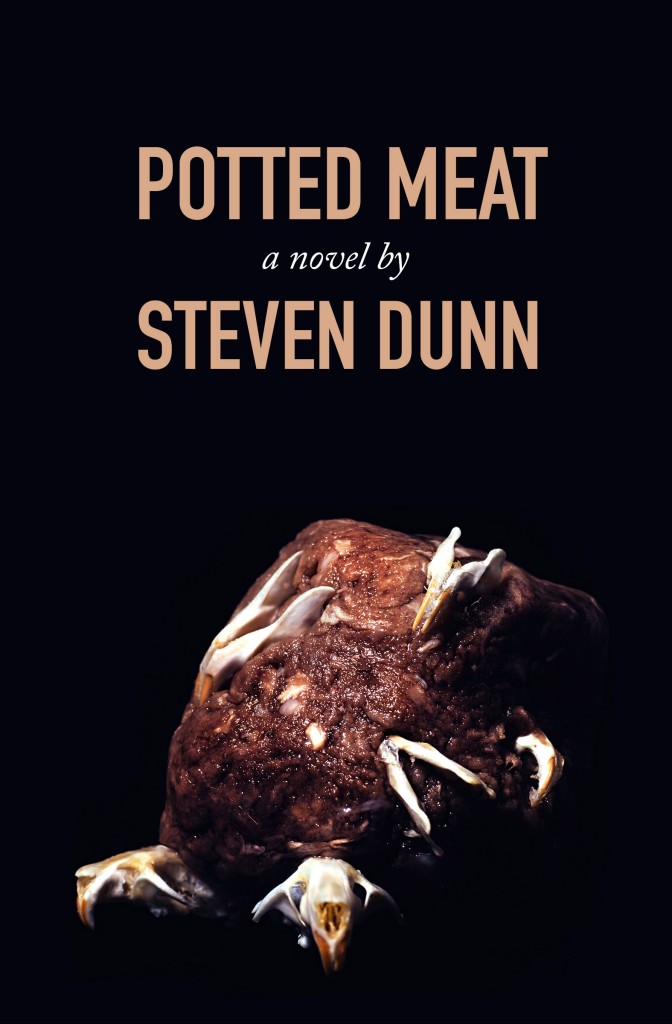
Steven Dunn's writing is here, like a visceral intervention across the surface of language, simultaneously cutting to its depths, to change the world


Steven Dunn, Potted Meat, Tarpaulin Sky Press, 2016.
www.stevencdunn.com/


Potted Meat, a novel set in a decaying town in southern West Virginia, follows a young boy into adolescence as he struggles with abusive parents, poverty, alcohol addiction, and racial tensions. Using fragments as a narrative mode to highlight the terror of ellipses, Potted Meat explores the fear, power, and vulnerability of storytelling, and in doing so, investigates the peculiar tensions of the body: How we seek to escape or remain embodied during repeated trauma.


Steven Dunn’s Potted Meat is full of wonder and silence and beauty and strangeness and ugliness and sadness and truth and hope. I am so happy it is in the world. This book needs to be read. — Laird Hunt


Potted Meat is an extraordinary book. Here is an emerging voice that calls us to attention. I have no doubt that Steven Dunn’s writing is here, like a visceral intervention across the surface of language, simultaneously cutting to its depths, to change the world. My first attempt at offering words in this context was to write: thank you. And that is how I feel about Steven Dunn’s writing; I feel grateful: to be alive during the time in which he writes books. — Selah Saterstrom


Some folks need a hundred pages to get you in the gut. Potted Meat, meanwhile, contains 101 pages of miniature texts that keep tapping the nails in, over and over, while speaking as clearly and directly as you could ask. A childhood of confusion and abuse blossoms into military inscription like watching a life pass before your eyes. Zero indulgence, all formative. Bone Thugs, underage drinking, alienation, death, love, Bob Ross, dreams of blood: This thin thing is flooded with power. - Blake Butler


excerpt:
Bob Ross is on. He has paint. I don’t. First I grind flowers with a rock but it don’t work. I chew and chew dandelions. Spit mixes into yellow paste. I chew grass. I chew mulberries. I chew wild onions. They don’t make color so I swallow. Tingles back of the neck and waters my eyes. Chew coal. Chew red clay. Chew what a grasshopper chews. I chew a grasshopper. Crunchy, then juice squirts to back of throat. The paste is chunky brown green white. Lick off hand and chew until smooth. Open jar, chew lightning bugs. Wait till night when they light, then rip off the ass, smear it on my face.


more excerpts:
Shade
Chrissy Ann hears someone say she stinks. She goes to the corner of the playground and kicks the fence. I ask her whats wrong. Nothing, she says. I ask her if she is coming to baseball practice. I already know she is because her dad and my stepdad are the coaches. They say her dad is racist but he is always nice to all the black people on our team. She asks can she wear my hat. I give it to her. Blondish brown hair hangs out. Whats this X stand for, she says. Malcolm X, I say. Who is that.
Buck runs over and says, Stinking bitch, you smell like wolf pussy. How do you know what wolf pussy smells like, she says, wolves aint even in West Virginia. Yeah, I say, wolves only live in the North Pole, you stupid muthafucka. So, Buck says, you still stink.
Chrissy Ann don’t stink. She smells like work. Like how I smell like coal smoke. She lives at the end of the holla on top of a mountain and has lots of hogs and chickens. She feeds them every morning. When I was at her house her little brother stuck a stick up the hog’s butt. Chrissy Ann slapped the shit out of him. Then she hugged the hog. Then she said we should take a walk in the woods to get out the heat and away from her stupid brother.
We stroll through old trees. Dirt is black and soft. Dark green ferns and bright green moss. We pick blackberries and blow on them before eating. Mushrooms the size of saucers. Not for eating, she says, but to keep cool. She rubs the mushroom on her forehead and cheeks. Tells me to. The brown inside of the mushroom feels like a damp sponge. She picks another and rubs it on her neck and arms. Grabs my wrist and rubs the mushroom on the inside of my arm. My neck. She presses her lips against mine and pushes her tongue in my mouth. It tastes like blackberries. Is this okay, she says. Yeah, I say. We look at my shorts poking out. She smells like mushrooms and hogs.
 
Money
I get my first summer job. On the trash truck Mondays through Friday. Four-twenty five an hour. I get up at five-thirty and meet the truck at the city hall at six. Just throw the goddamn bags in the truck, Russell says, then hit the side to let me know when you done and I’ll pull off. I throw a bag in, hit the side of the truck, he pulls off. He drives slowly up hills, down hills, around curves, up hills again. Throw bag, hit truck, pull off.
Some of the bags bust. Meat and milk drip onto my chest. Diapers, chicken bones, maxi pads. I lift a bag above my head and brown jelly oozes into my mouth. Lunch time, Russell says, we behind schedule cuz of you. We’ll just sit right here on the back of the truck and eat real quick. I sit with my bologna sandwich and Fritos. Gray milk, I think, soaks through my pants until I feel it in my crack and on my balls.
Russell pulls a blue cooler from behind the seat. In it are two ice cold bottles of MD 20/20. Orange Jubilee and Banana Red. He gives me the Banana Red and says, A little afternoon refreshment, good sir. Why thank you, Sir Russell, I say, you are most kind. You are most welcome, but don’t think you gonna get some free shit every day, nigga.
 
Tell You a Story
Grandad is shuffling his cards at the kitchen table. Counting money. Shuffling more. Come here for a sec, he says to me. Lemme tell you a story. I sit next to him. What do you want, he says. You said you wanted to tell me a story, I say. Nope, he says, I said I wanted to tell You a story. Is your name You. No, I say. He busts out laughing. I been lookin for that muthafucka all my goddamn life, he says, if you ever find You, let me know.


Dustin Holland's review. Here’s an excerpt:
When Steven Dunn reads excerpts from Potted Meat at events, it’s easy to forget that you’re listening to pieces of a novel. Each of his selections manages to stand on its own as a powerful moment taking place in an established, well developed universe. In fact, when he’s reading, it’s hard to imagine the text being a part of a larger body of work. It’s hard to imagine that he’s left anything out: they’re just so fucking solid. Like, this is it. This is the art.
But,Potted Meat is a novel… in pieces. And, while, yes, each piece is excellent — they have more power as chapters. The psuedo-episodic quality of each chapter propels the reader through a maze of love, growth, struggle, abuse, and discovery with an unrivaled energy that builds throughout the novel. Dunn doesn’t waste any time. Every scene advances the reader’s understanding of the narrator and the world he is growing up in. Instead of taking the time to describe the passage of time between chapters, Dunn throws us into new situations and lets us try to get our bearings as his characters attempt to do the same. Childhood, or at least the way we experience childhood, isn’t linear. Growing up is all about trying to make sense of the world and our place in it without much context and with a rapidly changing understanding of self. Potted Meat’s fractured pace is a perfect articulation of that experience….
When I think about this book I want to run up to people on the street, grab them by the shoulders, shake them, and shout “You need Potted Meat in your life!!” I realize that accosting random strangers and shouting at them isn’t the best way to start conversations or promote books, but I might do it anyway. Because honestly, I don’t know anyone who wouldn’t find some value and beauty in this book.


Steven Dunn at Necessary Fiction
Steven Dunn Interviewed in Rocky Mountain Revival Podcast
Steven Dunn interviewed at Full Stop
Steven Dunn interviewed at Tethered by Letters
Steven Dunn interviewed at Freedom Train Radio
Interview at Counterpath


Steven Dunn is the author of Potted Meat, co-winner of the 2015 Tarpaulin Sky Book Prize. Steven was born and raised in West Virginia, and after 10 years in the Navy he earned a B.A. in Creative Writing from University of Denver. He is the Reviews & Interviews Editor for Horse Less Press, and currently lives in Denver.


12/27/16

Gerard Reve - a novel that is not only a masterpiece but a cornerstone manque of modern European literature, that I hesitate before setting down a response; a gripping, bizarre and often very funny testimony to ennui"


Gerard Reve, The Evenings, Trans. by  Sam Garrett, Pushkin Press, 2016.[1947.]


'I work in an office. I take cards out of a file. Once I have taken them out, I put them back in again. That is it.'


Twenty-three-year-old Frits - office worker, daydreamer, teller of inappropriate jokes - finds life absurd and inexplicable. He lives with his parents, who drive him mad. He has terrible, disturbing dreams of death and destruction. Sometimes he talks to a toy rabbit.
This is the story of ten evenings in Frits's life at the end of December, as he drinks, smokes, sees friends, aimlessly wanders the gloomy city streets and tries to make sense of the minutes, hours and days that stretch before him.
Darkly funny and mesmerising, The Evenings takes the tiny, quotidian triumphs and heartbreaks of our everyday lives and turns them into a work of brilliant wit and profound beauty.


Ashamed of his middle-class family, twenty-three-year-old anti-hero Frits van Egters hurls sarcastic remarks at his friends and parents. His nightmares, along with his unrelenting observation of all the details that exude quiet despair, form a poignant contrast with his tender words to a toy rabbit, the sole object of his affection.
The closing scene, in which Frits learns his mother accidentally bought fruit juice for New Year’s Eve instead of wine, prompting a solemn, ceremonious monologue in which he addresses his parents with love and compassion (‘It has been seen. It has not gone unnoticed’), has often been called the most beautiful passage ever written in Dutch.
- www.letterenfonds.nl/en/book/387/the-evenings


"The funniest, most exhilarating novel about boredom ever written. If The Evenings had appeared in English in the 1950s, it would have become every bit as much a classic asOn the Road and The Catcher in the Rye." - Herman Koch


"Unlike John Williams, Gerard Reve's work was critically acclaimed and sold exceptionally well during his lifetime. But, just like Stoner, The Evenings is brilliantly written, and has a maximum impact on the reader's soul." - Oscar van Gelderen


"Very funny and strange... Reve is a writer who may yet 'catch on' in the Anglophone world" - Lydia Davis


Published for the first time in English, this is the 1947 debut novel by controversial Dutch writer Reve (1923-2006), who went on to a rich career offending Dutch sensibilities.
He’s a mean man. He’s a sick man. No, he’s just a bored man, although he does spend time pondering what to do with the solid contents of his nose, deciding that the best place for them is the underside of a chair: “wherever you go, if you feel around under the chair the pieces of dried snot fall to the floor.” It is Christmastime, a year and a half after the end of World War II, and Frits van Egters is thoroughly disaffected. The young man works in a meaningless office job, pushing paper from one stack to another. He’s a Dostoyevski-an character in his malaise and spitefulness, but Frits is more or less than that; he still lives at home, tormenting his mother on the details of how to properly smoke a cigarette, giving his pimply brother a hard time; if the war were still going on, Frits might well be working for the bad guys, but now he’ll spend the days between Christmas and the New Year wandering around Amsterdam loudly voicing his barely post-juvenile opinions about things to whomever will listen, including a stuffed rabbit when no human is available: “Rabbit, I am alive. I breathe, and I move, so I live. Is that clear? Whatever ordeals are yet to come, I am alive.” Alive, yes, but an irredeemably unpleasant twerp all the same, given to killing insects and thinking about edema. Not much happens because not much is meant to happen, as if to say that apart from the occasional invasion by a malevolent neighbor life is pretty dull. If listless existentialism is your bag, then this is your book, which, though written well enough, hasn’t aged particularly well.
Unpretty but true to life—at least life of a sort, however uninteresting. - Kirkus Reviews


With the first English translation of 1947 Dutch masterpiece The Evenings, by the out-of-time, out-of-step gay Catholic convert Gerard Reve, it makes perhaps its most crucial contribution yet to bringing quietened, radical non-English voices into the open. Reve’s debut doesn’t have the mainstream-baiting sensationalism of his later, sex- and religion-focused work. But it’s debatable whether he ever wrote anything better.
Trying to sum up the rare quality of this novel in a few hundred words is akin to tossing off a pithy one-liner on Karl Ove Knausgård’s six-volume opus My Struggle. Comparisons to that chronicle of domestic minutiae are actually rather neat; much of The Evenings’ enticing devilment is in its mesmerising detail, as protagonist office worker Frits recounts, with a combination of contempt, agitation and amusement, the oppressive repetition of his fruitless evenings spent at home with his parents. That he still lives with them is a mark of the man.
Not unlike insurance company employee and fellow absurdist Kafka, Frits is steeped in a contemplation deep and dark enough to make him ill but does not possess the dynamism nor social adaptability to improve his lot. The more pallid Frits’ efforts to find meaning or light in his life, the more exhilarating the read.
Appropriately, this gripping, and often very funny, testimony to ennui is set in that most spirit-sapping of times, the low-lit dreary days and black empty nights at the end of December. Pathological clock-watcher Frits counts off the interminable minutes of his neighbourhood walks with the exasperation of uninspired columnist Tony Parsehole repeatedly calculating his word-count as he writes.
Tormented by his wastefulness and plagued by vivid, unfathomable dreams, Frits fills out his evenings with visits to depressed friends, chats with his toy rabbit, and musings on baldness, table manners, disease and death. For the reader, the experience is like wandering through a Magritte painting come to life – bizarre, enchanting and, yes, surreal enough to warrant the comparison of a literary giant with Viz colossus Tony Parsehole. - Jane Graham


"As the reader accompanies Frits through a string of strange encounters, his recurring monomania and morbid, surreal dreams contribute to a mood that is listless and oppressive, yet curiously compelling." - Laura Garmeson, Financial Times

"By the time you reach the end of this novel, in which very little happens yet very much is told, you can’t help but feel a little lost." - Fiona Wilson


"(W)hat a curious work it is. (...) It is the repetitions of the novel that make it so mesmerizing: the cyclical days, the jokes, the scurrilous stories, the endless disquisitions on baldness and its remedies, the slow, claustrophobic mealtimes (.....) The novel is dark, funny, unsettling and lingers vividly in the mind." - Shaun Whiteside, Times Literary Supplement


The Evenings recounts the days of Frits van Egters -- ten days, from 22 December 1946 through New Years, recounted in ten chapters. Frits is twenty-three, living -- though fairly independently -- with his parents, with a good if dull job:
I work in an office. I take cards out of a file. Once I have taken them out, I put them back in again. That is it.
       The novel is an account of his largely uneventful days (and nights), through Christmas and up to New Year's. While there's an omniscient narrator, the focus is entirely on Frits, and a great deal is interior -- what he thinks, often presented in quotes, as if he were speaking in his mind, as well his dreams, which play out almost like real-life and blend into waking moments (as he often sleeps rather fitfully)
       Real life is pedestrian and numbing, and often he finds himself facing: "'The empty hours,' he murmured, turning away". There's almost nothing of Frits' office life -- as if it isn't even worth mentioning -- beyond the fact that it doesn't appear very taxing, and that in this holiday season he can go home fairly early and he gets a few days off. His main concern is how to fill his evenings, and over the course of these ten days he visits and meets a number of his friends, goes to the cinema and a school reunion, and even gets completely drunk at a casino. But that still leaves a lot of empty time: "'I just sit here and don't do anything,' he thought".
       There are also meals and casual time with his parents, though they also often go their own ways, the family in a loose sort of orbit that finds them together often enough but also drifting apart.
       There's a theatricality to Frits' interior monologues and observations; while he tends to the civil -- if occasionally confrontational and/or abruptly direct in interaction, in his mind he rolls his eyes and comments more dramatically, as when observing his father eating:
Gritting his teeth he watched as the man speared three potatoes from the platter with his own fork. "Tht is unclean," he thought, "a violation of every precept. But we stand powerless."
       He gets along well enough with his parents, but in typical fashion -- Frits tends to the glib and callous, or even cruel in his very direct manner -- he responds to one inquiry about how his parents are doing.
I'm only waiting for them to hang themselves or beat each other to death. Or set the house on fire. For God's sake, let it be that. So why hasn't it happened yet ? But let us not despair. All things come to those who wait.
       He goads others, notably the petty thief, one-eyed Maurits; "'Let's see how far I can go', he thought", for example, in seeing just how far he can cruelly prod his acquaintance. Frits also enjoys telling hard-edged jokes and anecdotes, and claims to revel in stories of misery:
     "The devil take me," said Frits, "it is a delight to me each and every time. Those reports like: child killed by exploding grenade. Glorious. Deferred suffering from the war. That is always a joy. They always start of so cosily, those reports," "the seven-year-old son," he said in an impassive voice, "of the Karels family, agriculturalists in Breda, attempted on Wednesday afternoon to dismantle a small anti-aircraft shell with a claw hammer."
       Though set shortly after the end of the Second World War, there's barely any mention of it -- only a few looks back to those times, as well as hints of some of the lingering consequences (including those instances of "deferred suffering" that continue, in various forms, to surface -- or the fact that there are still shortages and: "everything is still so hard to get"). Yet even as on the surface the war has been put behind them, the aftereffects clearly still hang in the air, contributing to the sometimes almost nihilistic atmosphere.
       Even as Frits is active and involved, seeking out company and doing something, he doesn't find the satisfactions he is looking for, moaning:
"What an evening," he thought, "what an evening. When is it going to end ?"
       Frits tries to force himself to participate, to play along, but even as he and everyone else goes through many of the motions, there's a sense of a society that's battered and only slowly putting itself back together again -- as evidenced particularly by much of the sharp and even cruel banter. Frits does well with the banter, and tries to go along with the rest:
"There is no going back," Frits thought. "Let us adopt an impassive or, if need be, even cheerful expression."
       Frits suffers from his generation's ennui and his own uncertain position -- he has a job, but with his limited schooling perhaps limited prospects; he doesn't have any sort of love-life -- and stumbles on in these dark, wintery days: "'The day is void, and the evening without content,' he mumbled". He's frustrated with his situation, and with himself:
Things take place around us. Yet we barely notice them. We have ears, but we hear not, eyes but do not see.
       Maurits voices what many of Frits' acquaintances surely also feel about his hard statements: "I just wish I could figure out when you're being serious". But Frits carefully controls his serious side -- so that, at best, those that know him might react like his father: "'Don't pay him any mind,' his father said, 'he's only blathering'".
       Nevertheless, he is not as indifferent as he makes himself out to be: tellingly, tears come to Frits repeatedly -- "'And now the moment for tears has arrived,' he thought. His eyes grew moist." -- breaking the hard shell of indifference he tries to maintain
       In summary, the relatively uneventful The Evenings sounds like it should be dull -- or, as Frits sums up:
"All in all, it is dreary," he thought, "most dreary."
       Yet it is anything but. In his cataloguing of the simple, everyday Reve's sharp eye makes for a consistently enjoyable read. And while Frits is a determinedly unsympathetic protagonist, and yet Reve humanizes him: he is a representative of his generation, warts and all, and fascinating as such.
       Projecting on his father, Frits internalizes his own misery:
"It is no disaster to be unhappy," Frits thought, "but how discouraging must it be to know that there is nothing to pin the blame on, outside oneself ?"
       An almost deadpan tone also helps make this a very comic novel, along with some genuinely funny interactions (including the New Year's disappointment when the mother mistakenly buys a 'berry-apple' beverage, rather than a bottle of wine: "Help us, O eternal one, our God. See us in our distress. From the depths we call to you. Hideous.""), as well as running gags such as Frits' obsessive worry and theorizing about baldness (and his constant pointing out to others that they are growing bald), as if this were the worst thing that could befall anyone (displacing his more serious concerns):
"Deliver me from baldness," he said, pushing back his hair and examining the hairline. "It is a gruesome infliction."
       Reve's pitch-perfect tone -- especially of Frits' stilted interior voice, but also in describing the humdrum -- and Sam Garrett's well-attuned translation make for a very engaging read. There is considerable ugliness here -- moments of great unkindness, and flashes of darker undersides -- that can be off-putting -- but they fit with the work, and Frits' world; the surrounding everyday absurdities do help make it more palatable.
       The Evenings is not a novel in which much happens -- not much of note, anyway -- and the characters are not particularly sympathetic. There is no great arc of growth or adventure, either -- and yet it is a near-perfect novel, an astonishingly accomplished work for such a young writer, who captures a time -- of life, and in history -- exceptionally well.
       Highly recommended. - M.A.Orthofer


It is so rare, as a reviewer, to come across a novel that is not only a masterpiece but a cornerstone manque of modern European literature, that I hesitate before setting down a response: what can I say, in a world of hype, that will put this book where it belongs, in readers’ hands and minds?
Gerard Kornelis van het Reve was born in Amsterdam in 1923 and published The Evenings: A Winter’s Tale in 1947, shortly before his 24th birthday. It follows the movements of the 23-year-old Frits van Egters in the last 10 days of 1946. If the title focuses on the evenings, it is because, for much of the day, Frits is at work, where he scarcely exists. What does he do? “I take cards out of a file,” he responds to a friend’s question. “Once I have taken them out, I put them back in again.”
But Frits never complains about his job, nor expresses any desire to change it. Those hours are at least taken care of. His problem is his evenings and days off – Christmas in particular – and his one ambition is to get through them without losing his mind. Both for its hero and its author, this novel is a tour de force of filling space, of turning tawdry emptiness into comedy of the highest order: it is up there with Henry Green’s Party Going, and Beckett’s Waiting for Godot. Never has the business of arriving at bedtime been more urgently and richly dramatised.
Everything takes place in a few suburban streets in Amsterdam where Frits shares a small flat with his half-deaf father and well-meaning if clumsy mother. An older brother has left home. The parents live in a state of stalled conflict that Frits is determined to ignore. Their eating and grooming habits – described with a mixture of savage fury and grudging affection – are a constant torment, their conversation so predictable that Frits takes masochistic pleasure in prodding them towards old platitudes. His only ally, between stoking the stove, feeding guilders into the electricity meter and criticising Mother’s cooking or Father’s table manners, is the radio, whose scattered fragments of news and music offer themselves to the shipwrecked Frits as life-saving flotsam in an ocean of wasted time.
“‘All is lost,’” he thought, ‘everything is ruined. It’s ten past three.’”
One thing that astonished and infuriated early critics of this precocious debut was that, amid so much despairing realism, nothing was said about the war. Barely two years had elapsed since the Nazi occupation of the Netherlands, only three since the “Hunger Winter” of 1944 when 18,000 people died of starvation. The extent of Dutch collaborationism was at the centre of heated debate. But Frits simply isn’t interested, recalling the conflict in passing merely as an inconvenience that prevented him from retaking failed school exams.

All the same, Reve’s novel is drenched in an intensely phobic atmosphere that must surely be the legacy of war. Utterly frustrated, having no girlfriend, nor making any attempt to find one, Frits moves like a ball in a bagatelle between his lonely bedroom, where he is terrified by the materiality of his body, the sitting room, where he confronts the horror of his parents’ aimlessly hostile middle age, and fitful forays to the houses of friends and relatives, where he allays his own fears by playing on everyone else’s. At this he is a past master. Barely has he greeted someone before he is wryly commenting on their sickly complexions, their impending baldness, their early ageing and likely imminent demise, always with a frightening wealth of detail and an imagination as reckless as it is jaundiced. Other characters differentiate themselves by their reactions, humouring him, growing anxious, assuming he’s joking, or even joining in, often trading truly gruesome anecdotes of accident, illness and violence in a mood that fuses hilarity and horror. One deeply disturbing scene has Frits asking the petty criminal Maurits whom he would like to torture: “Age, gender and nature of bodily harm: please, do tell.”
It may sound dire, but Reve’s sparkling collage of acute observation, droll internal monologue and pitch-perfect dialogue keeps the reader breathless right through to the grand finale, which sees Fritz tying himself in knots to survive an interminable New Year’s Eve with his parents and a bottle his mother is convinced is wine and Frits knows, alas, is berry-apple cordial. “Eternal, only, almighty, our God,” he begs in one of many appeals for divine mercy, “fix Your gaze upon my parents. See them in their need. Do not turn Your eyes from them.”                
Why has The Evenings not been translated into English until now? Reve’s international career, or lack of it, reminds us how important politics can be in deciding what books make it to our shelves. He did not write in one of Europe’s major languages, hence could not benefit from the attention we understandably give to French and German literature. He tried to write directly in English, but it didn’t work out for him. In a period when publishers tended to the liberal left, he was ferociously anti-communist; he converted to Catholicism but at the same time came out as gay, long before such openness was commonplace. When sex did begin to appear in his writing, it was disturbingly violent and sadomasochistic; on one occasion he was put on trial for describing a character who has sex with God in the form of a young donkey (“the dearest, most innocent creature I can think of,” he defended himself in court).
Always ahead of the game, he enjoyed huge success in Holland with a form of creative non-fiction mixing travel writing and letters, authentic and otherwise. None of these reached the Anglo-Saxon world. In 1990 Fourth Estate published Parents Worry, but brilliant as it is, this late novel, with its ominously obsessive, anxious, insistent voice, was not the place to start. It lacks the charm, freshness and immediate recognisability of the world described in The Evenings.
So, huge respect to Pushkin Press for finally doing the business, and in particular to Sam Garrett for a translation that avoids a thousand pitfalls to give us this enfant terrible of Dutch genius in an entirely convincing English. Shame that Reve, whose evenings ran out for him in 2006, is not around to enjoy it. - Tim Parks

The Evenings was voted the best Dutch novel of all time by the Society of Dutch Literature, and its author, Gerard Reve (1923–2006), was the first openly gay writer in the Netherlands. It's a historic book for its native country, but will it have the same impact in English translation? Contemporary Dutch novelist Herman Koch compares The Evenings to the works of Kerouac and Salinger, and I can see how it could have achieved cult status for a certain generation, but plot-wise I found it more tedious than revelatory.
The novel takes place on the 22nd through 31st of December 1946: a total of 10 evenings, described over the course of 10 chapters. Twenty-three-year-old Frits van Egters lives with his parents, works at an office job, and spends his evenings wandering the streets of Amsterdam and visiting friends and relatives. Chapters generally begin with him waking up late (on a weekend) or leaving the office (on a weekday), and end with him falling asleep, only to sleep fitfully and wake up briefly between disturbing, symbolic dreams.
Frits is a mighty odd character. We are privy to his melancholy thoughts as well as to his often jokey speech. He swaps gruesome stories with his friends and seems obsessed with baldness and the elderly. He's constantly needling his male compatriots about possible signs of baldness and railing against the annoyances of old people – could it be that these are in fact his two key fears for himself? Everything his dull parents do irritates him, and even though it's the holiday season there are precious few signs of jollity. Even in a post-Christian European setting, I expected at least a few Christmas traditions to crop up.
The protagonist's self-absorption means he is generally immune to other people's problems, including his parents' seemingly troubled marriage and a friend's casual cruelty to his dog. Frits is selfish, yes, but mostly he's just tremendously bored. Lines capturing his ennui are among the best in the book:
'I just sit here and sit here and don't do a thing,' he thought. 'The day's half over.' It was a quarter past twelve.
'Why do I think that way?' he thought then. 'What right do I have to be so blasé?'
'I work in an office. I take cards out of a file. Once I have taken them out, I put them back in again. That is it.'
'This day was empty,' Frits thought, 'I realize that.'
Anyone who has been stuck in a dead-end job, living with their parents in their mid-twenties, will sympathize with Frits's situation. I particularly enjoyed his dream sequences, like the one where he's trapped in a department store and can't find a toilet so has to urinate in a bunch of vases. But in general I found the novel's format repetitive and the 'profound' thoughts rather prosaic. Luckily, the final chapter, set on New Year's Eve, ends strongly. I had been worried that the miasma of meaninglessness would lead to a very dark conclusion, but instead Frits comes to a sort of epiphany – perhaps even in the religious sense of the word – that affirms his small life. This is an unusual book, but if the synopsis appeals to you or you just fancy trying a classic from another country's literature, you will find it an atmospheric wintry read. - Rebecca Foster


In a a poll of theTop 100 works of Dutch literature of the 20th century, this book came top. (As far as I can determine, the poll was done by the De Amsterdamse Leesgroep (The Amsterdam Reading Group) so I am not sure how authoritative it is. However, their other choices seem very worthy. The site does not seem to have been updated since 2007.) Part of the appeal of the book may stem from its origins. Reve came from an aristocratic Dutch family and it was expected that he would follow a military career. He became a lieutenant in the Engineers and was sent out to the Dutch East Indies (now Indonesia). He hated war but still managed to obtain two citations for bravery under fire. However, he helped a prisoner escape and was arrested. He was initially sentenced to twelve years in prison, which was reduced to seven years, on appeal. During his imprisonment, he wrote this book and, fortunately, made a copy of it. When the original was found, it was destroyed for being nihilist and immoral. He managed to escape prison with the copy of the manuscript. He fled to Belgium, where he hid out in an abbey. His book was published but he stayed in Belgium, continuing to write. After Indonesia gained its independence in 1952, there was a general amnesty and he was able to return to the Netherlands.    read more at The Modern Novel


Gerard Reve’s The Evenings was first published in the author’s native Netherlands in 1947. Now, almost 70 years later, it appears in English, although not as a lost-and-found masterpiece but a woefully late arrival.
Reve’s debut novel caused an uproar on its immediate release but went on to be critically-acclaimed and hugely popular. Today, Reve is hailed as one of the greatest post-war Dutch writers. The Evenings has never been out of print and was ranked by The Society of Dutch Literature as the country’s best novel of all time.

All the more remarkable, then, that this perennial favourite has never been available to Anglophone readers. Sam Garrett’s expert translation allows us to see what we have been missing. This is an edgy, atmospheric and sardonically funny book which was way ahead of its time. Still possessing the power to shock but also to beguile, the novel’s bold stylistic tricks and its hero’s original thoughts and deeds mark it out as a classic in any language.

The book unfolds over 10 consecutive evenings at the end of December 1946. Frits van Egters is a 23-year-old daydreamer, idler and procrastinator who is besieged by boredom and ashamed of his middle-class family. His office job is dull ("I take cards out of a file. Once I have taken them out, I put them back in again. That’s it.") and his home-life consists of moping around, listening to the radio or squabbling with his parents. Time out involves listless, directionless walks along Amsterdam’s streets and canals or venting his spleen to a toy rabbit.

Despite regularly frittering away hours doing next to nothing, Frits never actually squanders a whole day. A morning and afternoon can be lost, even ruined, "But the evening can still make up for a great deal."
Come twilight he becomes animated. Whole chapters are devoted to each evening’s entertainment: outings to cinemas, theatres and dancehalls, visits to his brother Joop and his friend Jaap. Frits opens up, sloughs off his humdrum daytime self and becomes the centre of attention or life and soul of a party.

This may sound compelling enough to constitute a diverting romp, but not a country’s touchstone text. However, Reve’s magic touch is his protagonist’s unique mindset and captivating mood swings. After dark, Frits lets loose bawdy jokes and grisly tales. He indulges in existential debates, reveals illicit desires, and rants about his greatest fears, including that "gruesome infliction", baldness. Every day culminates in sleep that is sullied by a surreal and disturbing dream.

The Evenings was published five years after Albert Camus’s The Stranger, and whether by accident or design the former has much in common with the latter. Both revolve around the empty pursuits of alienated and disaffected young men; both are studies of ennui tinged with cruelty. "I have a sick soul," Frits declares to his rabbit, by which point he has discussed killing with his sadistic friend Maurits, recounted anecdotes about torturing insects, and admitted that old people are a "plague" and a "burden".

Fortunately, he may be spared the job of bumping off his own parents: "I’m only waiting for them to hang themselves or beat each other to death."
Frits’s nihilistic outlook combined with Reve’s experimental novelistic flourishes make the novel feel considerably more modern. Plot is dispensed with entirely. Dialogue comes bunched together in the same paragraph, sometimes to disorientating effect.
As with Karl Ove Knausgaard’s My Struggle cycle of novels, Reve clogs sentences with the unfiltered minutiae of daily life. Everything is recorded: quotidian detail, inane exchanges, inconsequential impulses and gestures.

None of it should work: neither Frits counting down the hours at home, watching his mother knitting, "Needles ticking like a fast clock", nor Frits unleashed at another soirée and sharing his seemingly unedited, untelescoped nocturnal movements.
Or, on a more banal level, Frits with his family rhapsodising over his mother’s gravy, or Frits with his friends differentiating between a draught and wind. And yet by day and by night Frits remains curiously vital, his wayward antics and rambling thoughts possessing a strange allure, hypnotically energising not soporifically draining.

"Every man has his story," Frits says, "but it is seldom an important one." Reve went on to tell more stories until his death in 2006, but it was this one which proved to be far and away the most important.
After entrancing generations of Dutch readers, it is now time for a wider audience to discover its weird textures and dark delights.  - Malcolm Forbes


Baldness has begun preoccupying young Frits van Egters, not his though, only the impending hair loss of others. He cultivates the role of prophet of doom, assessing bare patches on the heads of those around him and often expresses his views in a formal rhetoric and delights in including some science. The torpid days between Christmas and New Year crawl by as he counts the relentless minutes between eating, sleeping, visiting his friends and executing outings to the cinema and elsewhere.
Frits is restless; given to complex and disturbing dreams as well as ongoing melancholia. Then there is the matter of observing his aging parents. His father is becoming deafer by the day and his cheerfully fussy mother refuses to serve black coffee, does the cooking, monitors the coal and does her best in generating small talk, usually about food. Joop, the older son, is married. He too, in common with many of the men in this poised, brilliantly well sustained masterwork of comic pathos, appears to be losing his hair.
It is not surprising that Reve’s debut, which was published in 1947, is considered by the Society of Dutch Literature to be the best Dutch novel of all time. It should also be acknowledged as one of the finest studies of youthful malaise ever written. Frits is an Everyman, or more accurately, every person, caught up in an ongoing personal drama of wondering what exactly his life is about.
It comes as a small shock to discover that this is the first English translation. The distinguished American translator Sam Garrett, who has lived in Amsterdam for more than 30 years, has conveyed each sigh and sly aside with majestic tonal panache and the outcome should cause many readers to revise their opinions of The Catcher in the Rye (1951). In all fairness to Salinger, The Evenings is so much better and while it is immensely more sophisticated, it also expresses that bewildering sense of being very young, if already decidedly weary of grown ups who appear so stupidly unaware of life’s true menace. If Holden Caulfield is a bit of a pain, Frits van Egters, with his vile if hilarious jokes, astute observations and offbeat humour, is slightly terrifying but more real and far better company.
Unlike Meursault in The Outsider, which established Albert Camus as a seer, Frits is not an isolated figure. He lives with his parents and although 23 and working as a clerk in a lowly job which he describes as a tedious ritual involving moving files around, remains very much a boy. As he counts his father’s sighs and other annoying habits, a running commentary plays in his mind – it concerns the tension between what Frits says and how he really feels. There is also a soundtrack provided by the radio with its endless variety of music programmes which emerges as a clever narrative device, as does a borrowed toy rabbit.
Meals are prepared and eaten, the washing up helps to deal with some of the time if not enough. His mother sits down, “knitting something in white wool” and the sound makes him think of “needles ticking like a fast clock”. Frits must take action; he dons his coat and heads out into the cold streets with only one mission on his mind – to get through the hours between his next, big nocturnal adventure which arrives fast and furious in the form of vivid nightmares.
In Frits, Reve, who was born in 1923 and enjoyed a colourful, if provocative literary career, has with this random if very deliberate narrative expressed the dilemma of a post-war generation, too young to have served, yet sufficiently old to be aware of what has happened. There are passing allusions throughout of a society dealing with rationing and beginning to relax. Austerity remains part of daily life, only no one discusses the past. Frits is caustic; aware he is expected to shock his buddies and makes nasty jokes about parents killing their children, albeit by accident.
Yet he puts some effort into buying a present for a friend’s child. He also has deep thoughts. The sound of a train in the distance causes him to reflect: “And so our hours pass.” Elsewhere when pondering his desire for sleep during the day, “I should get up. . . and fetch a blanket from the cupboard. But I cannot force myself to sit up straight. . .” He hears children playing and it makes him recall: “When I was seven, I cut grass on the lawn with a normal pair of scissors and saved it in a paper cornet. I’m laying here like a sick man.” He falls asleep. Cue for another dream in which he weeps. On waking his pillow is wet.
For a narrative so funny, it is also profoundly moving. Frits is obviously suffering and exists in a state of muted panic. On the morning following a cinematically detailed binge drinking session with his friends – his parents having subsequently helped him get to bed – Frits wakes and on peering into the shaving mirror, mumbles, “The body is gravely damaged.” After another evening spent visiting a friend, he returns home and collapses on his mattress, but remembers he hasn’t cleaned his teeth. “He tried to sit up a few times, but was unable to rise. “I’ll count to 20,” he thought. At 24 he hopped to his feet and went into the kitchen. After brushing his teeth, he dropped his underpants and, holding the shaving mirror between his legs, examined his crotch. . . ”Very distasteful,” he mumbled. “If you saw a photograph of it, taken from below, you would hardly believe it was human.”
Little happens, yet a great deal does. It is a people-watching novel, rich in character and bantering dialogue. For Frits the end of the year is also about the end of life, or rather some lives, of those close to him. “Everything is finished,” he whispered, “it is passed. The year is no more. Rabbit, I am alive. . . Whatever ordeals are yet to come, I am alive.” Although it has taken close on 70 years to reach an English-speaking readership, The Evenings, as a novel possessing a wide appeal, deserves to begin making up for lost time very quickly - and will. - Eileen Battersby

The Evenings caught my eye because it was described as the great postwar Dutch classic, following a young man on his meanderings through the night-time streets of Amsterdam. As some of you may remember, I spent some time working out of Amsterdam a couple of years ago, and grew rather fond of the city’s laid-back spirit, so I thought I’d give the book a go. The result – and I beg my Dutch friends to forgive me – is bemusement. It turns out that one man’s classic is another man’s bafflement, and perhaps the translation is to blame, for I found little to enjoy in this unremittingly bleak tale of youthful stagnation.

It is 1946 and Amsterdam is still scarred by the privations of war: coal is expensive; gas runs on meters; and chocolate is only available under the counter for those who know to ask for it. Frits van Egters is twenty-three and still lives in his family’s modest apartment, where he turns a scathing eye on the dull, repetitive routines of his disenchanted parents. A high-school dropout and uninspired office worker, Frits finds nothing joyful in his situation and exists in a kind of purgatory, waiting for life, perhaps, to suddenly hit him over the head. This book follows his wanderings on several evenings between the start of December and New Year’s Eve, as he tries to make the most of his time – having some pompous idea of how it should be spent and yet, unfailingly, finding that day after day slithers out of his reach. We only see Frits in the half-light, watching his own life like an embittered observer, needling at his parents, sniping at his friends and having weird uneasy dreams. He seems to have some vague, unarticulated ambition to escape this uninspiring existence, but he doesn’t have the motivation to do anything about it: rather than actually shift himself to improve, he makes do with sitting back and congratulating himself on how superior he is to everyone around him.
I can cope with books in which nothing much happens. I can cope with books in which I don’t like the protagonist. And I can cope with depressing books. But to bring all these things together is to demand a great deal! Frits is entirely uncharismatic. He’s a navel-gazing, pompous, arrogant, insensitive, hypocritical mediocrity and his life is utterly pointless – and he knows it. But he stumbles on, behaving like an impossible student rather than the grown man he is. He sneers behind their backs at his parents’ foibles, wincing at his father’s lack of social graces and looking down on his mother, but at the same time he’s terrified of any marital discontent which might threaten his own existence. He spends family meals in a welter of anxiety, trying to think of something – anything – to say so that the silence doesn’t weigh down upon them all, all too often finding solace in mundane questions. He’s petulant and entitled: a strange, sullen creature, half-child, half grown-up, trapped in some midway stage that he can’t seem to escape. He’s bored. So, probably intentionally, are we.
And things are no better with his acquaintances – I say that, rather than friends, because I don’t think Frits really has any friends. He spends his evenings popping in to see Jaap or Louis or Viktor or Bep, but no sooner has he arrived then he’s panicking at the weight of silence again, and tries to fill it with sound. He’s obsessed with baldness and torments his friends without cease; he thinks of horrific murderers or accidents which are supposed to amuse; and he’s both misogynistic and misanthrophic. Some of his friends are no better, trading stories of disabled people or unfortunate deaths with great hilarity, and you find yourself wondering exactly what has caused this generation of unfeeling young people. Is it something to do with the horrors of the war, still fresh in their memories? Is it some strange fight to cope with all the dreadful things that have happened? Or is it simply the brutal callousness of youth?
Classics are funny things. A national classic will often be deeply bound up with some trait in a people’s character or history which they perceive much better than outsiders. So perhaps my dislike for this book is simply because I don’t fully appreciate the world in which it was formed. But I struggle to understand the five star reviews proliferating on Amazon, as no one offers a reason why the book is so good. It’s true that I don’t warm to existentialist novels, as we discovered with the trial that was The Woman in the Dunes. But I simply can’t understand the point of something in which all the characters are so cold and detached and cruel and bitter and spiteful and petty and unhappy, with no charisma and no true story at its heart… The Evenings is simply an unfolding, a snapshot of a life which is dreary and which shows no sign of being anything other than that. I suppose existential fiction is all about the pointlessness of doing anything… but this novel really did leave an unpleasant taste in my mouth.
I would very much welcome dissenting views – not just telling me I’m wrong, because that doesn’t help anyone, but explaining what cultural contexts I may have missed. Why is this considered to be so great a classic? Is it genuinely regarded with such fondness in the Netherlands? Or is it one of those classics, like Lucky Jim, perhaps, that captured the mood of an era but now feels awkwardly outdated? I don’t like not liking things, especially something like this which a lot of people have clearly thought is brilliant. Tim Parks in the Guardian effused that it is ‘not only a masterpiece but a cornerstone manque of modern European literature‘. (Mind you, he also compared it to Waiting for Godot, and I would rather nail my tongue to a table than sit through that again.) Good God: what am I missing? - theidlewoman.net/2016/12/06/the-evenings-gerard-reve/


I was really looking forward to this book.  The Society Of Dutch Literature voted it the greatest Dutch novel of all time and some 59 years after its first appearance it is making its debut in its first English translation.
I have recently discovered Dutch author Tommy Wieringa and after reading the excellent “Joe Speedboat” was keen to read more from a country whose literature I had pretty much ignored.  I was even more thrilled to discover that the translation was by Sam Garrett, who was  responsible for bringing “Joe Speedboat”, a book which is going to be battling it out amongst the front runners for my Best Read of The Year, to a new audience.
Reading the blurb it reminded me of my last year’s best read “Alone In Berlin” by Hans Fallada, a novel which took 62 years to arrive in English and which has since been acknowledged as a modern classic.  “The Evenings” is also published by the rather marvelous Pushkin Press.  All of these positives made me eagerly await my review copy.  It seemed like the perfect match for me.
It is set in Amsterdam in the last couple of weeks of 1946.  The main character is 23 year old Frits Van Egters and it starts very much in a simple, unfussy style which can be quite common in European literature and is really quite appealing.  I settled down and prepared to enjoy.
However, it soon became clear that it was not going to match my expectations.  It didn’t seem to be going anywhere.  Basically, Frits leaves the home he shares with his parents most evenings, visits friends, says things without thinking, worries about anyone’s impending baldness and goes to bed where he dreams and that’s about it.  There’s no plot development and the characters did not come alive particularly and the whole thing comes across as sadly, for this reader, insignificant.  It was at this point that I realised that I was not quite so attuned to Dutch literature as my limited experience of it had hoped.  Compared to “Joe Speedboat” this is a damp squib.  It might end with the odd firework on New Year’s Eve, but it was without any explosive writing.
Frits, an anxious outsider, becomes annoying.  He describes himself, fittingly, as a small time neurotic; believes everyone over sixty should be done away with, that male baldness is one of the worst things that could happen to a man, that’s there is little point in women and who has a need to fill in gaps in conversation with observations that are often idiotic.  At times he comes across as a young Dutch Alf Garnett! Johnny Speight’s creation was ironic but I’m not sure if we should view Reve’s Frits as an example of Dutch humour.  I don’t know if we should latch on to what are some underlying mental issues.  I really don’t know what I am supposed to feel for him, other than irritated.
I needed to find out more about the author.  “The Evenings” was Reve’s first novel in a long career, originally written under a pseudonym.  A film has been made of it as has a graphic novel.  Reve’s work, I discovered, is credited with making homosexualiy acceptable to his Dutch readership, largely through humour and irony.  I don’t know how much this statement applies to this particular work but reading the book I didn’t pick this up.  Frits displays misogyny ( probably) and narcissism (definitely) but I didn’t pick up on any coded references to his sexuality.  True, he did seem to like going to the toilet together with male friends but I put that down to the amount of alcohol consumed!
Is this a novel, which on its first British publication, is now too dated?  Are the concerns I’ve raised the reason why it has taken so long to arrive over here?  It’s certainly enigmatic  and I haven’t cracked the puzzle.  It is a book I thought would be ideal for me and as it didn’t grab me it makes it seem an even bigger disappointment than perhaps it deserves to be.  I’m certainly going to be on the lookout for other reviewers to see just what they made of it.  I don’t want to be the one sat by the wall if a party is in the offing. -

Gerard Reve (1923-2006) is considered one of the greatest post-war Dutch authors, and was also the first openly gay writer in the country's history. A complicated and controversial character, Reve is also hugely popular and critically acclaimed- his 1947 debut The Evenings was chosen as one of the nation's 10 favourite books by the readers of a leading Dutch newspaper while the Society of Dutch Literature ranked it as the Netherlands' best novel of all time.
IMDb page
en.wikipedia.org/wiki/Gerard_Reve