Years later, by her bedside, the narrator remains really, really mad at this woman. Why couldn't he have a better life? But within his anger are moments of awareness. One of the rare times the family rented a proper house (rather than a brick shed or shared bedroom at a brothel), they planted a small plot of carrots "that never grew." But something magical happens anyway. Evicted from this house, the boy is allowed by the police to remove just two books before they lock up. "Literature has always been generous with me," he writes. "If I had to go back to that moment, knowing what I know now, I'd choose the same books."
What luck. If mothers let us down, maybe literature is enough. Beyond all the power and poetry of a reckoning with poverty is the book's sly and wonderful handling of the literary world, from the narrator's assignment to write about a slain union boss to his boozy, opium-fueled trip to Havana with a writers' conference. In these moments, Herbert is at his surest and funniest, blurring the line between fact and fiction, between the idea of story as something we inherit versus the idea that any good narrative is merely a record of invention itself. Also: Cocaine can be really fun.
Especially in the Cuba scenes, it's hard not to think of another poet-memoirist, Ben Lerner, whose first work of prose, "Leaving the Atocha Station," shares much with "Tomb Song," including an ability to make us admire and despise our hapless narrator at the same time — he's not really gonna cheat on his wife with that lady spouting Lenin, is he? — while subtly reorienting, for instance, how we might understand the post-Castro elite's pursuit of joys, despite all the obvious reasons for unhappiness.
Appearing only sparingly, the narrator's wife emerges as a wonderful counterpoint to dying mother and bitter son, because she loves them both, and this pure feeling keeps us reading. Good thing too, because the book is propulsive and sly and studded with memorable moments that feel irresistibly wise.
A few favorites: After a hangover, "the light of the real world feels brutal: coarse powdered milk made atmosphere." Suffering in the morning: "It's not reality that makes a person cynical. It's the near impossibility of getting any sleep in cities." The simplicity of sitting outside: "Cynicism requires rhetoric. Sitting in the sun doesn't."
Family matters aside, wisdom shelved for later, it's government incompetence and the violent power of the state that hang over "Tomb Song" like a dark cloud. The Mexican government's failure, after all, is why his mom had no choice but to turn tricks. The
narcos sever heads. A hospital is a place to stand in line all day for a dose of cancer medicine. The president is an idiot. So, probably, is the next one. He's only able to write at all because of grants and sponsorships.
No diatribe or bitter complaint, Herbert's ambitious novel is the pleasing work of a high stylist having fun, loving life, making a good story despite a country's miseries and his own. "So long as I have the will," he writes, "I can go out, negotiate friendship, ask for plain speech, buy things at the drugstore, carefully count change. So long as I can type, I can give form to what I don't know and, in that way, be more human." It feels like a blueprint for us all.
Our mothers will die. Our country will let us down. The next president will probably be an idiot too. The future contains as many or at least as final a set of ways to die as the past. All we can do, even if our mother was a prostitute, is hope she lives long enough to meet our daughter, if we have one, and then to try our best to love both. As Herbert writes, to love is to agree to bury someone — or indeed to be buried by them. "I am," the narrator whispers to his wife toward the end, "the one who will cover your face in that hour." -
Nathan Deuel
http://www.latimes.com/books/la-ca-jc-tomb-song-20180316-story.html
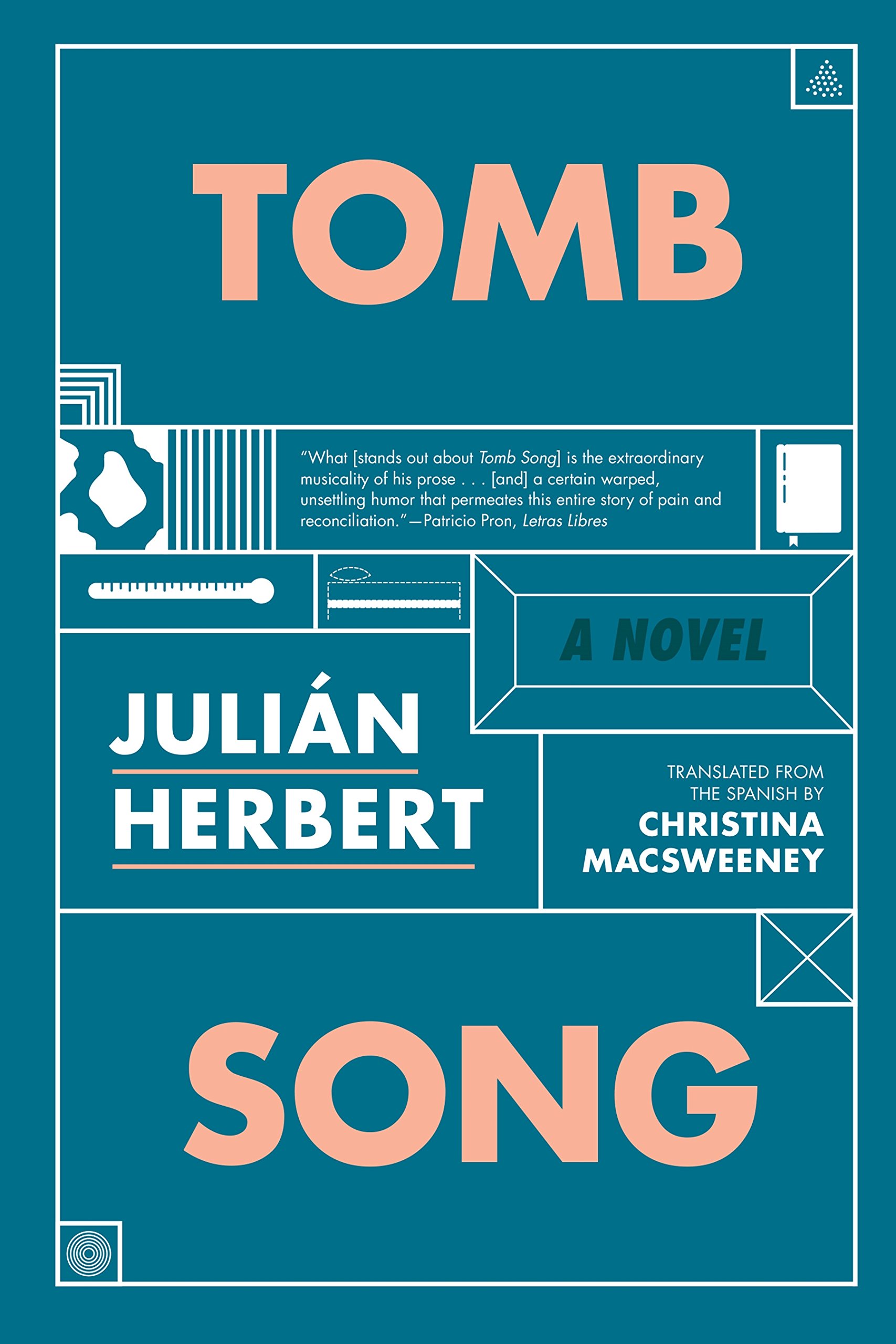
Sometimes the simplest premises can result in complex, philosophically rich narratives. That’s certainly the case with Julián Herbert’s novel “Tomb Song,” which takes as its starting point an almost primal moment in the life of its narrator, a writer who shares several qualities with the book’s author.
As the book opens, the narrator’s mother is hospitalized, and it’s doubtful whether she will recover. “I don’t have much experience of death,” he says at one point — but this isn’t only the story of one person grappling with the sudden presence of mortality and the loss of someone close to them. Those are certainly elements of the narrative, but they’re not the only ones.
Early on, the narrator talks about how “my mother worked in the prostitution industry” — which involved her working under different names, and which led to his having several half-siblings.
In the present-day scenes of the novel, the narrator’s attempts at wrangling a geographically and temperamentally widespread family are one of several scenes that keep the book grounded.
Elsewhere, he takes a more philosophical and even experimental approach: The book leaps around in time and space, echoing the ways in which memory can follow an emotional trajectory rather than a temporal one.
Sometimes this involves descriptions of his own childhood and early adulthood; sometimes, his mother’s life; sometimes, other aspects of the family’s history.
“Tomb Song” leaves space for the high-minded, the sociopolitical and the pop culture-obsessed.
Sometimes the simplest premises can result in complex, philosophically rich narratives. That’s certainly the case with Julián Herbert’s novel “Tomb Song,” which takes as its starting point an almost primal moment in the life of its narrator, a writer who shares several qualities with the book’s author.
As the book opens, the narrator’s mother is hospitalized, and it’s doubtful whether she will recover. “I don’t have much experience of death,” he says at one point — but this isn’t only the story of one person grappling with the sudden presence of mortality and the loss of someone close to them. Those are certainly elements of the narrative, but they’re not the only ones.
Early on, the narrator talks about how “my mother worked in the prostitution industry” — which involved her working under different names, and which led to his having several half-siblings.
In the present-day scenes of the novel, the narrator’s attempts at wrangling a geographically and temperamentally widespread family are one of several scenes that keep the book grounded.
Elsewhere, he takes a more philosophical and even experimental approach: The book leaps around in time and space, echoing the ways in which memory can follow an emotional trajectory rather than a temporal one.
Sometimes this involves descriptions of his own childhood and early adulthood; sometimes, his mother’s life; sometimes, other aspects of the family’s history.
The changing political situation in Cuba is a perpetual touchstone throughout the novel. At one point, the narrator cites a number of creative works as references for a period of his youth: This includes Luis Buñuel’s 1950 neorealist classic “The Young and the Damned” and the beloved 1978 martial arts film “The 36th Chamber of Shaolin.”
At other times, the narrator refers to the narrative we’re reading as a kind of coping mechanism to deal with his mother’s illness. He describes what we’re reading as a book, then delivers a parenthetical aside: “(if this does become a book, if my mother survives or dies in some syntactical fold that restores the meaning of my digressions).”
“Tomb Song” is an inherently contradictory book: The experimental aspects of its structure have a playfulness to them, which in turn contrasts with the (literally) life-or-death stakes at its core. That it’s also able to fold in such disparate elements as a meditation on perceptions of the Cuban revolution, ups and downs of a small-town soccer team and explore the nature of parenthood serves as a testament to Herbert’s narrative deftness.
This novel sprawls, but never loses sight of the human connection at its core — and it’s all the more moving as a result. - Tobias Carroll
http://www.startribune.com/review-tomb-song-by-julin-herbert-translated-by-christina-macsweeney/475596723/
I find value in Julián Herbert’s words because they feel true, they relate a powerful variety of suffering and marginal behavior without surrendering to melodrama or getting stuck on the sentimental flypaper that makes some pages of Jean Genet, Henry Miller, Nelson Algren, or even, Orwell’s Down and Out in Paris and London, pretty overwrought. To take a more contemporary, and Latin American example, Antonio Ungar’s Tres Ataudes Blancos is a terrifying novel, but it’s also a leering, artful dodger of a book which flexes its literary technique with real panache. With Julián Herbert I feel more like I’m in the pages of something like Bill Buford’s Among the Thugs; with no need for guile, Herbert simply shows us the sad, sordid life he was forced to endure as a prostitute’s child, and this is what gives the story its power.
All writers reassemble the past but there is not a jot here that feels unlikely or necessarily embellished. Life routinely outstrips fiction. By comparison, a highly stylized, smoothly poetic story like Roberto Bolaño’s “Prefiguration of Lalo Cura”, whose narrator recalls the life of his porn actress mother, feels crammed, baroque, and cloying. Maybe therein lies an authentic difference between pornography and real prostitution. Bolaño’s story is comically blue, making fun of the weird toil involved in committing sex to celluloid. “Mama Leukemia” succeeds by way of its hard, simple, realism: the exhausted prostitute taking her boy to the market in the morning, a family having all its belongings repossessed, surviving for three years in a self-constructed cinderblock hut with a cardboard roof.
—Brendan Riley
numerocinqmagazine.com/2014/02/07/mama-leukemia-novel-excerpt-julian-herbert-translated-by-brendan-riley/
Julián Herbert’s mother is dying from cancer in the Saltillo University Hospital. He sits by her side, keeping notes, remembering her life as a runaway and a prostitute, cataloging their family’s slow ascent into the middle class, sharing, at times, in her fever dreams. His bedside thoughts become the novel
Tomb Song, a piece of lucid autofiction that finds its structure in association and metaphor more than in any conventional plot. In one chapter, we move from the history of the small fighter squadron Mexico committed to World War 2, to the construction and architecture of the University Hospital itself, to eavesdropping on two orderlies having sex in the morgue in the present day. In
Tomb Song, the present serves as more than a framing device, it constantly resurfaces with acute descriptions of Julián’s mother’s failing body and the machines attached to it, of the Kafkaesque hospital bureaucracy, of Julián’s own excursions around the complex. Though any small association can lead from the present to a memory, or story, or dream, we always return, eventually, to the reality of the hospital room, the helpless son, the dying mother.
The primary point of departure from other contemporary autofiction like Knausgaard or Lerner, is
Tomb Song’s willingness to abandon the truth. Specifically, Julián seems interested in the corrosive effect that narcotics and fevers have on both actual and narrative reality. During an opiate binge in Cuba, we are introduced to a degenerate artist named Bobo Lafrauga, who Julián follows to a bar called El Diablito. We later learn that Bobo was the intended protagonist to a novel that Julián scrapped when his mother fell ill, that Bobo and El Diablito are aborted fictions blurred into autobiography. In one breath, Julián will describe a prolonged, heated affair with a television weather woman and in the next he’ll claim that none of it was true. Fiction and non-fiction intersect in this way throughout much of the novel and Julián is always present to help or hinder the distinction between the two.
The associative propulsion from one tangent to another, from the real to the unreal, is often smooth but, due to the distractibility of the narration, topics are sometimes dropped before they have a chance to develop into anything substantial. Micronarratives start off focused then wander. In one instance, Julián remembers what he characterizes as his complicity in the death of a neighborhood boy and how this complicity has haunted him. He then steps back, describes how his family had come to live in the area and only later mentions that the extent of his involvement, in what turns out to be an accidental killing, was that he was there when the murdered boy’s brother bought the gun. There is little reflection here to guide the reader to understand Julián’s self-blame. The benefits of fiction could be used, in instances like this, to enhance these tapering anecdotes or to better calibrate suspense.
Early in the novel, Julián takes stock of the state of fiction while setting a challenge for himself, saying: “we demand it (narrative art) be ordinary without cliché, sublime without any unexpected change of accent.” The real achievement of
Tomb Song lies in Julián’s solution to this paradox: his narrative voice. Throughout
Tomb Song, we have access to Julián’s lucid, honest, perspective. His voice provides continuity and allows for beautiful and unusual motifs (including a particularly strange sea cucumber metaphor). Though the subject matter is often clinical and bleak, and though he is far from the first narrator to wax poetic by the side of a deathbed, Julián provides so many fresh perspectives, analogies, and turns of thought as to make avoiding cliché in such weighty moments seem simple. It should be noted that it is Christina Macsweeney’s excellent translation deftly brings Julián’s pin-point word choice to English.
In
Tomb Song Julián Herbert draws unexpected associations between dozens of disparate topics, stories, observations, and dreams. In the last chapters, from this kaleidoscopic fabric, a larger picture takes shape, a unique perspective on life and the living of it. Readers looking for a current, honest, and unique novel or fans of Ben Lerner, Michel Houellebecq, Samanta Schweblin, and even Roberto Bolaño, will find a lot to love in
Tomb Song. -
Joseph R. Worthen
http://thelitpub.com/tomb-song-a-novel-by-julian-herbert/
The debut novel from Mexican author Julian Herbert, “Tomb Song,” seems like a simple story: a middle-aged man, also named Julian, sits at the bedside of his mother, a former prostitute who is dying of leukemia.
But “Tomb Song” is more than an elegy, more than a meditation. Herbert takes a deep dive into an emotional, interconnected story on death, family, love and ambition, resulting in a work that is at once personal and universal.
The story opens with Julian contacting family members he hasn’t seen in years. His distant older brother, now living in Japan, implores Julian to gather everyone at their mother’s bed side. “I suppose he’s lived abroad for so long he’s ended up swallowing the exotic pill of advertising via the Abuelita cocoa powder slogan: There’s-No-Greater-Love-Than-The-Love-of-the-Great-Mexican-Family.” In reality their siblings, all of whom had different fathers (“my father ... is the least spectacular boyfriend”), have grown apart, and the Mexico his brother remembers resembles little of the country Julian lives in today.
As Herbert tells the story of Julian’s vigil, he allows for the emotional trajectory of memory to dictate the narrative structure, meaning we move easily from the hospital to ruminations on the Mexican pollical system, to childhood events that established Julian’s complicated present-day relationship with his mother, to meta passages about the writing of this novel — which largely takes place at his mother’s hospital bedside.
The book — like Julian, like his mother, like their relationship — is messy, but given the careful, poetic language and musical paragraphs, it’s clear the leaps and transitions between narratives, times and countries, are intentional, meant to mimic the reflective turmoil that comes when experiencing death for the first time.
Besides, Herbert provides plenty of footholds for readers to catch their breath, such as a one-page chapter on Julian reconnecting with a childhood friend after 20 years.
“We were perfectly comfortable: it was as if our last chat had taken place the day before ... I guess the next time we’re together, when we’re 60 or so, we’ll go back to being children again. Friendship is one of the great mysteries of life on Earth.” - Laura Farmer
www.thegazette.com/subject/life/books/review-author-takes-on-death-in-tomb-song-20180311
In the introduction of the new English translation of
Tomb Song, Mexican author Julián Herbert explains that as a child he simply couldn’t believe the world was round. He casually blames this on his mother, a career prostitute, and on the fact that he and his family of half-siblings traveled constantly “because of her hysterical life crisscrossing the whole blessed country in search of a house or a lover or a job or happiness, none of which have ever existed in this Sweet Nation.”
As a teen observing the neighborhood trainyard in motion, he is struck by the sudden realization of his mistake. Life is much more fluid than he thought — and memories, as well. And we all search madly, and often unsuccessfully, for the same things his mother sought.
Set against the backdrop of his mother’s on-again, off-again hospitalization for leukemia, Herbert’s autobiographical novel drags his readers through a dream-like, drug-infused tour of pinnacle points of his life, interspersed with musings on the successes and failures of his career as a writer, son, and father.
Fidgeting in his mother’s hospital room, faced with the indignities of her illness, he drives himself to memory partly out of boredom, and partly to escape truths he can’t quite accept. We learn about his eccentric but brilliant mother’s five husbands and the children these unions produced.
We learn about the seedy neighborhoods they lived in, the friends and father figures who come into their lives as she moves between brothels, and Herbert’s troubled relationships with women and his own children.
Among his Spanish-speaking fan base, Herbert is known for his dazzling language, and this, his English debut translated lovingly by Christina MacSweeney, does not disappoint. Simultaneously gorgeous and dirty, he brings us poignant moments of beauty only to quickly destroy them with the filth lurking naturally behind. This is his life — driven by opium one moment, by love or sense of duty the next — and how he chooses to see, feel, and write it.
As much as
Tomb Song reads like a disjointed memory maze, the format feels appropriate for a man whose life so closely resembles his mother’s. In a section titled “Fever,” Herbert spins a weird tale of sex, drugs, and writing conference after-parties, only to later take it all back. It was all a lie, he says — the fabrication of a week-long fever that suddenly blurs his past and present.
In one of her more fragile moments in the cancer ward, his mother tells him about her life after his grandfather’s death (and her memory of the lights of “La Habana” at night), and while realizing he’s “her only apostle, the sole evangelist of her existence” and steward of her life story, Herbert also admits to himself: “I no longer know if it’s the fever or my mother speaking.”
Time and truth are troublesome in
Tomb Song. It’s easy to excuse the inconsistencies of Herbert’s memory; he often succumbs to his addictions or his ego, and he’s also digging out from beneath the grief and confusion of his mother’s ailment, so he’s as unreliable a narrator as they come.
He has at least once attempted suicide. He’s a bit of a lovable rogue but also earnestly excited to have a new child on the way. Perhaps this is why it makes so much sense to present these lives and events as a fiction.
“Whenever you write in the present...you’re generating a fiction, an involuntary suspension of grammatical disbelief,” he explains within his own novel. “I always narrate in the present in the hope of finding velocity. This time I’m doing it in the hope of finding consolation, while I perceive the progress of the plane through the sky as a free fall into an abyss on pause.”
Whether we trust him or not, the stories weave elegantly. And whether you like him as the protagonist or not, his performance leaves you intrigued and invested. That personality plays out as he accepts “the challenge of conquering a certain level of beauty: achieving a rhythm despite the sound-proofed vulgarity that is life.”
In other words, life is beautiful and not beautiful. And Herbert, like anyone who approaches his problems creatively, can re-frame, or rationalize, or take what’s terrible and precious and either deal with it or run away. As he ponders the end of one life, the beginning of another, and the failures that have brought him to this place in time, he chooses to stay and examine it.
Love rises above truth. And in the end, he can offer “a love encoded in words.” -
Jenny O’Grady
http://www.washingtonindependentreviewofbooks.com/index.php/bookreview/tomb-song-a-novel
7 Questions for Christina MacSweeney on Julian Herbert