10/27/18

Gil Orlovitz - "After struggling with its gimmicks of style... its elaborate streams of consciousness... its absolute jungle and jumble of words, I've come to the conclusion that it would take me ten years to understand"


What Are They All Waiting For?
Gil Orlovitz, What Are They All Waiting For? Stories, Poems & Essays: 1944-1962. Tough Poets Press, 2018.


What Are They All Waiting For? is an anthology of long out-of-print works by Philadelphia-born experimental novelist, poet, playwright, and screenwriter Gil Orlovitz (1918-1973), one of America's most innovative, yet virtually forgotten, writers of the 20th century. This volume contains 9 short stories, 4 essays, and 49 poems, originally published between 1944 and 1962. Also included is a comprehensive biography of Orlovitz and a bibliography of his works.  


"His work is known only to a handful of poetry lovers who read the verse magazines and purchase slender books issued by publishing houses with names like Inferno Press and Hearse Press. He is nonetheless one of the finest — the most versatile — poets now writing in English. Long before the San Francisco Renaissance exploded with public and police clamor and articles in Time, Orlovitz was writing with a Dionysian frenzy combined with perfect control of language that has been equaled by few, if any, of the Beats."— Chad Walsh, Today's Poets (1964)


"As to Orlovitz, I find him at his best, very good. Certainly his delivery seems original."— Charles Bukowski (1958)


16079778

Gil Orlovitz, Milkbottle H, Calder & Boyars, 1967.


Milkbottle H is a tragicomedy of contemporary existence treated with compassion and bitter irony, in which all of mankind are conceived as being inextricably linked. Told with a heightened naturalism in which our thought and speech processes are reproduced with an amazing fidelity, the book may baffle and even infuriate, Yet it makes its presence felt, forcing us, almost as if against our will, to conclude we have here something very important to the heritage of modern literature.
There are two essential themes running concurrently through this monumental work, both related to the protagonist, Lee Emanuel. On the one hand we have his passion for the fifteen-year-old Rena Goldstein, and the subtle oppositions to this passion by both families. On the other hand we have the story of the death-in-progress of Lee's father, Levi Emanuel.
With Lee's second marriage, the strands of the parallel themes convulse, separate, re-form, and intertwine. In the relating of the several events and themes that spring from the fusion of the two central threads, time and characters seem to merge so that "all time is eternally present" and the people are alike, one unto the other. The physical scene is Philadelphia, with constant shuttling to New York and Los Angeles.


"A major work of fiction by any standards. It has a breadth and intricacy of vision, an audacity of technique, and an unwearying energy of expression that put it in the very front rank. Milkbottle H is a major event in the history of the American imagination." --The Scotsman

"Not since Joyce has anyone used words with such magnanimous clarity.... This book is one of the great, if not the greatest, literary achievements of our time." --Cork Examiner

In parts, Milkbottle H is lucid, gripping and richly descriptive of human experience; in parts it resorts to what, read aloud, sounds like a series of agonised grunts and groans." --Irish Times

"Milkbottle H took Gil Orlovitz ten years to publish. After struggling with its gimmicks of style ... its elaborate streams of consciousness ... its absolute jungle and jumble of words, I've come to the conclusion that it would take me ten years to understand." --Oxford Mail

"Milkbottle H is a great book, an experimental novel-into-poem. For anyone interested in the widening possibilities of the modern novel, or in gaining insight into a tragicomic human experience, the reward is immense." -- London Tribune


To even the most well-informed readers of fiction and poetry who reached their age of literary maturity after, say, 1970, Gil Orlovitz is no doubt a mostly obscure, if not totally unknown figure. Orlovitz died in 1973—although he had achieved sufficient obscurity even by then that his body was not actually identified until several months following his passing—after a nearly 30-year career as poet, playwright, screenwriter, and novelist, and while some effort was made in the years just after his death to appreciate and preserve his achievement, in particular through a 1978 special issue of American Poetry Review, in the years since then his books disappeared from sight and his name dropped out from most discussions of postwar American literature.

In addition to pathos there is some irony in Orlovitz’s fading from view, since he became something of a ubiquitous presence in American literary magazines in the 1950s and 60s, although he never really found a place in the most prominent publications, his work generally regarded as overly “difficult” for mainstream tastes. His novels Milkbottle H (1967) and Ice Never F (1970) certainly did little to connect him more firmly to those tastes, as both were conspicuous failures, both commercially and critically, although the critical response was decidedly more positive in the U.K. and Europe, where Orlovitz established a favorable reputation as an innovative successor to the great modernists. Whether these failures significantly contributed to what appears to be a subsequent downward spiral (he had especially invested some hope in the mammoth and ambitious Milkbottle) is somewhat uncertain 50 years later, but by 1973 he was more or less down and out, when he died in what remain rather murky circumstances.

As I look at the whole of Orlovitz’s available work (Tough Poets Press has commendably republished most of the fiction, including the novels, as well as some of the poetry, although much of the latter is still essentially inaccessible after a half century of neglect), it seems to me that the contemporary writer he most closely resembles is Gilbert Sorrentino. Both writers fundamentally were poets, both loosely associated with the poetry of Pound and Williams through the Beats, and both went on to write radically iconoclastic and disruptive fiction, Sorrentino on a more sustained basis and successful enough to maintain a relatively long and productive career. Sorrentino’s fiction is more uninhibitedly comic, ultimately more unruly, than Orlovitz’s, but both Milkbottle H and Ice Never F, like Sorrentino’s novels, are full-on aesthetic deconstructions of novel form, although where Sorrentino reconfigures the form with his own skewed versions, Orlovitz comes in these two works as close to formlessness in fiction as may be possible while still maintaining a connection to the genre.

Both Sorrentino and Orlovitz in their different ways expose “form” in fiction as at best a transitory convenience, a provisional invention always subject to modification and metamorphosis, insisting that the only constant in literary art is the imaginative play of language. Thus it is indeed that fiction has its origin in the poetic impulse, although in Orlovitz’s case this means that his two novels are as idiosyncratic in their verbal manner as his poetry. A newcomer to Orlovitz’s poetry is no doubt likely to identify it as hermetic, or perhaps surreal, but further reading reveals it to be less surreal than radically informal and heterogeneous in its imagery, less self-enclosed than veiled in its personal references, invoking characters and scenes at times parallel with or abstracted from the poet’s direct experience, at others more fully displaced, closer to Orlovitz’s practices as a writer of fiction. While some of Orlovitz’s poetry could appropriately be called “lyrical,” it is a lyricism of strange juxtapositions, colloquial diction, and punning wordplay, not the usual sort of figurative expression.

The most illuminating analysis of Orlovitz’s poetic practice is an essay by Gerald Stern, part of the special section on Orlovitz in the 1978 issue of American Poetry Review. (“Miss Pink at Last: An Appreciation of Gil Orlovitz.”) Stern groups Orlovitz’s poems into three categories—lyrics, sonnets, and satires. To the extent Orlovitz is still remembered as a poet, it is probably first of all for the sonnets, although his most striking use of language is arguably in the satires. (Sterne’s use of this term may be a little too capacious to really encompass all of Orlovitz’s poems outside the lyrics and the sonnets, two categories that themselves have a good deal of overlap.) As Stern himself says, the matter of Orlovitz’s satirical poems arises not from a motivating “idea” but grows “inevitably out of the language”:

As such, there was no satirical “mask”; there was instead the haunted satire-riddled face, or voice, of Gil Orlovitz himself, nothing now standing between him and his subject. I mean myths, yes, “poetic” masks, metaphors, echoes, ditties—because he was a poet—between him and his reader, or among him and his readers, but nothing between him and his subject, no apology or cuteness.

This seems an apt characterization of Orlovitz’s writing (poetry and fiction) in general, not just the explicitly satirical poetry. The poems are indeed strongly engaged with their subjects—often framed as seemingly direct personal experiences, but even those poems employing a persona seem like pretty thinly displaced vehicles for the poet’s experience as well. However, the treatment of those subjects depends not on their inherent lyrical connections but on the verbal connections (or disconnections) the poem leaves in its unpredictable turns of language. The poem “Hymn” begins, “fivethirty a.m./the electricgenerator/started off like an immortal scream,” presenting us with a coherent if clamorous aural image, only to abruptly mix it with a discordant and somewhat grotesque visual one: “whelped in low key and smothered in thin snot/and exploded into a sickbelly throwup of fiery/eels. . . .” After a pause (the first of several caesuras in the poem), as if preparing the reader for the change in orientation and focus about to occur, the poet’s own perspective is suddenly altered: “and there was my woman/my love/outside my window. . . .” But before we can adjust to this strange development, mid-line our attention is again disrupted as the speaker avows that “god in the alleyway/went infinitely upstairs in a striped prisonsuit/of irondrunken firescapesteps. . . .”

Although we return to “my woman/my love” (who beseeches the speaker, “don’t let me die”), by the time we reach the end of this relatively short poem our contemplation of its imagery has become so thoroughly unsettled that it is indeed tempting to declare it a piece of surrealism that deliberately resists our full assimilation—or even to consider it simply incomprehensible. Perhaps we could interpret it as a species of dream—although the poem’s title seems oddly inappropriate for this sort of exercise—or, somewhat more fruitfully, that it represents the movements of the poet’s consciousness at a particularly fraught moment. But while either of these perspectives might afford a kind of cursory coherence to a poem like “Hymn,” since many of Orlovitz’s poems unfold according to similar sort of discontinuous logic (or nonlogic), it seems more applicable to say simply that his poetry consists more in self-contained flares of veiled expression than in the subordination of such expression to the broader development of a poetic “thought,” a more visible unified aesthetic construct.

Probably the most conspicuously indulged display of verbal excess in Orlovitz’s poetry is the frequent use of puns, most often in the satires, as in the very first stanza of “The Rooster”:

the rooster crows in my belly

an old hangout for the billiard cues of the morning

and table-hopping hail hail the ganglias all here

after sunset like a mouthwash last yesterlight

and the white tails of the gorillas on television

and that liberal politician stumping for twilight supremacy

down by that old

shill

stream

As I buttonholed the Ancient Auctioneer

how goes America going

going

But Orlovitz just seems to ignore any strictures against punning as a disruptive or self-indulgent gesture. His poems cultivate the disruption as another turn of language, the introduction of disparate elements to form another brief image—the politician both creating and standing beside the “shill stream”—that reinforces the poem’s reliance on adjacent figurative and imagistic verbal devices rather than continuous elaboration of thought.

The insistent punning in Orloviz’s poetry seems most reminiscent of Finnegans Wake (it and Ulysses continue to be a dominant influence on Orlovitz’s fiction as well), and perhaps the dream language of a work like this could itself be taken as a further analogue to Orlovitz’s practice as both poet and writer of fiction. Certainly the perpetual juxtaposition of disconnected images in the poems creates a background of distortion comparable to dreams, but it seems to me that Orlovitz is less interested in mimicking the unconscious mind that in reorienting the conscious mind—the reader’s. The poems ask us to not presume that the poet’s language is a representation of a recognizable reality, nor even an attempt to cloak that reality in a misrepresentation that might still be reclaimed for interpretation, but is instead a transformation of the poem into a source of reality itself, which the reader experiences through the multiplicity and incongruity of its images.

The discontinuities of Orlovitz’s writing not only undermine whatever expectation we might have that it will resolve itself into a completed thought (a thought about something outside the poem, not a concrete experience of the poem) but makes interpreting a poem’s images as potential symbols mostly fruitless and beside the point as well. Indeed, Orlovitz himself, in an essay entitled “The Ubiquitous Symbol” (What are They All Waiting For?. Tough Poets Press) tells us that “my intent is quite simple: to transmit through images the paradoxes of experienced phenomena.” However, the image “will contain the paradox of the experienced phenomenon, but it will go further: it will try to convert the experienced phenomenon into an experience itself. For me, symbols in poetry do not simply connote reality: my intent is to make the symbols pieces of reality themselves.” Orlovitz may seem to be conflating “symbol” and “image,” but what he is really doing is attempting to explicate the way in which his poems are enclosed in the poet’s digressive language, which seeks to realize the “paradox” that only the verbal turns themselves can signify.

Few writers are as radical in their determination to make language itself both the form and content of the literary work as Gil Orlovitz, in his poetry and his fiction alike. For this reason alone it is perplexing that both the poems—or at least the best of them—and a novel like Milkbottle H have so thoroughly fallen out of the collective literary memory. The latter especially remains a prodigious achievement, as notable a product of the late modern/postmodern sensibility as any written by an American novelist, even Sorrentino, Gaddis, or Pynchon. Perhaps, however, what those writers provide in addition to their formal audacity is something that Orlovitz’s work may be lacking: Each of them substitutes for the more conventional pleasures of traditional narrative fiction—familiar plot devices, recognizable types of characters—alternative formal and stylistic strategies that work to offer not “entertainment” in the most reductive sense of the term, but certainly an experience of aesthetic delight that ultimately redeems whatever “difficulty” the work at first seems to present the reader. Both Orlovitz’s poetry and his fiction may seem to some readers to cultivate difficulty for its own sake.

This impression is no doubt especially strong for the reader who takes up Milkbottle H. It was certainly the impression left with contemporaneous American reviewers, one of whom declared that “it is written in a pseudo-Joycean manner that is relentlessly monotonous, persistently garbled, unendingly devious, a manner that lacks the humor of Joyce’s that unlike Joyce’s obfuscates rather than reveals” (Carleton Miscellany, Spring 1968). This reviewer likely means by the Joyce comparison no more than that Milkbottle H is an unconventional work that lacks the usual markers of a proper novel, markers of plot and character that allow the critic to assess the work according to the usual formulas, without needing to more closely examine the actual strategies the writer might be using, or consider the effect those strategies may be designed to produce. If the critic were in fact interested in pursuing the connection to Joyce, he might have noted that the “manner” of Milkbottle H only superficially resembles the conceit structuring Finnegans Wake: Milkbottle H may indeed depart freely from the constraints of time, space, and consistency of character, but not because Orlovitz is casting his narrative as a dream. Instead, Milkbottle H treats reality as if it already possesses the mutability of dreams.

Thus the reader is given a few ostensibly stable features consistent with most novels’ narrative trajectory—a protagonist, named Lee Emanuel, a setting, in the city of Philadelphia, certain recurring images such as the street sign that gives the novel its title—but those features do not reinforce expectations of conventional development. The novel does loosely follow the life experiences of Lee Emanuel (who is a not very heavily disguised version of Gil Orlovitz), especially focusing on his love affairs and marriages, yet the chronological displacement in the novel’s rendering of his experiences is so thoroughgoing and extreme (in a novel of over 500 pages) that even his identity at times wavers, while the other characters so frequently transmogrify into each other that ultimately it is questionable whether we should finally even identify them as specific characters at all. Given the novel’s disarticulated structure, with its seemingly random fluctuations of scene, we might regard Milkbottle H as a synoptic view of Lee Emanuel’s life all at once, blurring the distinctions of story and character that normally a work of fictions seeks to clarify.

Although the novel can seem largely formless, ultimately we could say that this formlessness contributes to a more encyclopedic kind of form. This promise of an ultimate unity of sorts, however, doesn’t quite provide a plot. Indeed, the novel’s amorphous formal quality serves it best if it deflects the reader’s interest away from the prospect of formal or narrative resolution and draws it to the execution of the discrete episodes in their acts of metamorphosis and displacement. Many of these episodes are in fact very funny, although it is true that Orlovitz is not necessarily trying to be a comic writer. (Sometimes anger seems a primary motivation.) He is instead attempting to be all-encompassing in his accounting of Lee Emanuel’s life (an effort which is supplemented by Orlovitz’s other published novel, Ice Never F, also featuring Lee as protagonist), and this necessarily involves the more embarrassing moments in Lee’s life—such as his cuckoldry, brought about by his unfaithful first wife, or an extended scene (extended in fact throughout the novel) in which Lee attempts to take a bath without letting any of the dirt that he washes off touch him again.

Lee Emanuel is not really portrayed as a foolish or hapless figure, but it would also be difficult to describe him as a “sympathetic” character, either. So fragmented and so subject to shifts in time and perspective is Lee Emanuel as presented in the novel that we can’t finally get close enough to him to really judge him at all. He is not a coherent character of the traditional sort (“flat” and “round” seem beside the point) but is mostly an artifact of the author’s insistently discontinuous method of composition. He is neither sympathetic nor unsympathetic but acts as the novel’s discursive point of attraction around which its narrative transfigurations swirl. To an extent, these transfigurations do serve in their very distortions to illuminate Lee Emanuel’s experience and evoke his personality, although they are not designed first and foremost as an alternate means of creating character. Something like the opposite seems predominantly the case: Lee Emanuel, his perceptions and experiences, is the vehicle for the work’s formal and verbal variations.

Certainly Lee’s experiences include the sort that most readers would expect to find in a more conventional chronicle of the ordinary circumstances of its characters’ lives—which is essentially the focus of concern in Milkbottle H, however much that focus is prolonged beyond the scenic confines of most realistic fiction. Perhaps the most prominent of these would be Lee’s interactions with his family, especially with his parents, as well as his efforts specifically to reckon with the relatively recent death of his father. The glimpses of the parents at various stages of Lee’s life do actually provide a kind of summative account of family influence, although as with all of the other episodes depicted in the novel, it is an elliptical account that asks the reader to hold immediate meaning in abeyance, to allow that a literary work can accrue meaning through juxtaposition and contiguity rather than asserting it through linear progression. Perhaps it is here where Orlovitz’s fiction shows the greatest affinity with his poetry: It is not so much that the language of the novels is conspicuously “poetic” (although neither is the poetry itself poetic in any conventional way), but that image in the poetry and narrative time and space in the fiction are set loose from the imperative to unfold according to a sequential logic that essentially renders literary language invisible. In Orlovitz’s work, language is indeed “real.”

This attribute is also on display in Ice Never F, published after but actually written before Milkbottle H, although its structural dislocations are somewhat less radical, and thus at its briefer length Ice Never F is arguably more accessible. It also involves Lee Emanuel, as well as most of the cast of Milkbottle H. (The two extant novels seem to have been at Orlovitz’s death part of at least a trilogy set in Philadelphia and centered on the life of Lee Emanuel, but the existence of third unpublished novel in the series, while the object of rumors in the years since, currently seems uncertain.) While no conventional work of narrative fiction, Ice Never F nonetheless ventures less into the mixing of identity, and its scenes are often more fully sustained, although still sharing with Milkbottle H a paradoxical kind of narrative scheme, offering a constant flow of narration subject to incessant and unannounced time shifts covering all phases of Lee’s life (including a good deal about his childhood). Also as with Milkbottle H, the actions and events depicted in individual episodes work less as pieces of an ongoing narrative than as the parts of a larger verbal and discursive mosaic registering Lee’s presence in the world that has made him.

Perhaps Ice Never F might serve as a less intimidating introduction to Orlovitz’s fiction (in something like the way Pynchon’s The Crying of Lot 49 has been a more compact alternative to the meganovels), but it is Milkbottle H that will be the center of attention in any widespread reconsideration of Gil Orlovitz’s achievement as a writer (if such a thing could plausibly happen). The poems certainly reward the effort to understand the aesthetic principles motivating their discordant imagery and seemingly capricious wordplay, but it seems unlikely that Orlovitz’s variety of “difficult” poetry sufficiently stands out against, say, the work of John Ashbery or the Language poets to find a place among their company. Milkbottle H, although surely an experimental novel by any definition of the term, is not exactly “postmodern”; it does not interrogate the authority of fiction as a mode of representation but seems more like an extension of the modernist aspiration to represent reality at a more fundamental level than surface realism. In this case, Orlovitz’s novel seeks to eliminate all constraints of narrative and place in the name of a more comprehensive rendition of experience. There really is nothing else in American fiction, that I can think of, at all like it. - Daniel Green

https://uncontemporaryreview.com/?p=460


5669323
Gil Orlovitz, Ice Never F, Calder & Boyars, 1970.


Ice Never F is the second part in a trilogy of novels by the American poet Gil Orlovitz. The protagonist is again Lee Emanuel, living in Philadelphia, and the major personalities from the first novel--Lena Goldstein, now his wife, Lee’s parents Rachel and Levi, as well as a host of other people--appear again in it. Orlovitz has written that his aim in his books is ‘to educate a protagonist in the ramifications of the paradoxes of apparently commonplace phenomena’, and to this end he employs a variety of interrelated personal and contemporary events to suggest a ‘created presence’, in which conventional dogmas of time and character are rejected in favour of a poetic approach that celebrates the multiplicity of existence. In a long essay on Orlovitz in a recent issue of the Kenyon Review, the American critic Hale Chatfield notes that while this approach bears some resemblance to the painting of Jackson Pollock and the self-consciously absurd juxtapositions of Surrealism, Orlovitz ‘characterises himself by the intensity of his search for the significance of his own associations and his militant reluctance to let them go by without exploring themselves’. Mr Chatfield adds: ‘If Coleridge were here to evaluate Orlovitz, I am confident he would confine the Dadaist and Surrealist to the realm of fantasy--and admit, if not elevate, Orlovitz to the Kingdom of Imagination.’

Did you ever experience the sensation of shaking your brains loose from their moorings so that they become a sort of fish swimming around in your skull and once in a while look through your eyes. The fish looks at you now…
Lee Emanuel is the fish. Your skull is the book. Or you are the fish and the book is your skull. Or is it Lee’s skull…
I want to see something come out of the wall, that’s why I stare at it so intently, I want a transformation to take place in my loneliness up there on the wall that Sam Abrams paints.
The book opens with disorientation. but a creeping awareness occurs through lucid moments embedded in a rush of fractured memories. The prose is hypnotic with sentences stopping short and pulling up stakes to move elsewhere, while prior nomadic sentences slide in to occupy the now vacant real estate. Plot, such as it is, advances imperceptibly. Lee Emanuel as child, as teenager, as young adult, as approaching middle age, married, single, pursuing any number of women, all intervals interwoven with dense and coruscant (borrowed from Gil!) stitching. Lush impressionistic prose thick with neologistic flights of poetic fancy describes life anchor-moments and intricate sketches of family members and friends, the characters materializing over time, sometimes through wandering perspective, but by the end all becoming known.
Orlovitz owes a stylistic debt to James Joyce, although he is still doing his own thing here. Time is not finite as in Ulysses, for example, but rather spreads out and contracts over decades. Both time and space explode into dust. There are also some surface similarities to Virginia Woolf’s The Waves, concerning time, nature as a character, interiority of multiple persons (though less regularity of shifting here, with primary focus on Lee). Imagine a compendium of several decades of one’s life, all of the pivotal events that one returns to over and over, carefully directing each scene, often unaware of how it changes from one performance to the next, only convinced of its significance as an ingredient in the substrate on which one grows one’s understanding of oneself.
Faith in words is what Orlovitz exhibits. It is definitely a poet’s novel. There is some humor here and there, perhaps just enough. One on hand we see the complicated love of a son for his parents dissected while on the other hand we experience the exquisite visceral pleasure of a child picking his nose. Lee’s world is tactile, sensual, bursting with color (violet repeats itself, for one). Some of the interior babble is just that, but it never lasts long enough to engender frustration.
A partial list of themes treated in varying degrees of depth: family relationships, romantic relationships, war, Army life, madness, mystery and confusion of childhood, interpersonal attraction in its many forms, urban life (specifically Philadelphia) both pre- and post-WWII, first and second generation immigrant experience in America (specifically Jewish), coming-of-age, death, personal and societal morality, love (its glory and its passing), spirituality (specifically Judeo-Christian), art and creativity, humanity, existence…
Style notes: Orlovitz eschews apostrophes and chapter breaks, while wreaking havoc with capitalization and sentence structure. (It’s a lot of fun.)
Either it is the astonishment of the absolute indifference, that defense against astonishment, the ultimate defense, the complete absence of feeling except that which informs you you operate in a body. But at any time the astonishment may burst open, and I am not Lee Emanuel, I tell you I have no name, I tell you I have not been born, I tell you I know nothing about death—I can tell you only that I fornicate, eat, shit, feel terror—but that that could be anyone walking down the street, ascending a stairway, interviewing a prospective employee, compassionating a beggar—I ask you; who does not feel all these things? Is this a distinctive personality? a precisely differentiated human being? who can possess at times the faculty of total recall and in other hours remember only a jumble. - S. D. Stewart

gil orlovitz: an astonishing faith in words
Gil Orlovitz was a writer who never quite made it, though not for lack of trying. Known primarily for his poetry, though even then not widely and more so after his death, Orlovitz also wrote and published two novels and many short stories, as well as penning and producing several plays. Born and raised in Philadelphia, Orlovitz served four years in the Army during WWII, after which he wrote and published prolifically during the 1950s and 1960s. He died in 1973 alone and destitute at age 55, a few years after the publication of his second published novel, Ice Never F.
Orlovitz’s writing can be described as avant-garde or experimental, and his novels as anti-novels or “no-novels,” as Book World reviewer (and Joycean scholar) Kevin Sullivan designated Milkbottle H, Orlovitz’s first published novel. Sullivan goes on to suggest a definition for this new “no-novel,” as a “genre that no longer experiments with form but discards all form and concentrates on the presentation of immediately felt experience or, more accurately, allows that experience to present itself.” Certainly Orlovitz read Joyce, and there is a Joycean flavor to Ice Never F, written as it is in an impressionistic, stream-of-consciousness style. But being a self-contained novel, microcosmic in its deep reflection of the author’s own experiences, it bears little resemblance to Joyce’s work in content. This novel was part of a planned trilogy and, according to Guy Daniels in his “Notes Toward a Bibliography of Gil Orlovitz,” was actually intended to precede Milkbottle H. The third book, known in manuscript form as “WFFM,” was never published, though according to Daniels, it had been read by Anais Nin, who tried unsuccessfully to get it published. At the time of writing (1978), Daniels noted his suspicion that the manuscript was “still around in somebody’s files.” A short story manuscript also came into the custody of UK publisher Marion Boyars, publisher of Orlovitz’s first two novels, but this collection never saw publication.
Milkbottle H, while received quite favorably by critics in the UK and Germany, did not fare so well in Orlovitz’s home country. American critics for the most part panned the book, with only one extant positive review to be (easily) found (the Sullivan one referred to above). Reviews of the second book, Ice Never F, are even more difficult to track down, suggesting that it received even less attention. While I have not yet read Milkbottle H, from both my understanding of that book and through having already read Ice Never F, I wonder if the critical reception would have been better if that latter novel had indeed been published first, as Orlovitz intended, for it may have been a degree or two more accessible. Certainly if either book had appeared just a few years later when the American postmodern novel was beginning to more widely infiltrate popular readership, it would likely have fared better.
If Gil Orlovitz had not passed on so prematurely, would he have finally found wider success? It’s hard to say. He wrote from the margins of society, and certainly some writers who share that marginal ground have eventually garnered a larger readership. But the literary past abounds with so-called experimental writers whose popularity rose and waned during their lifetimes, or never even exceeded a modest plateau. Once they are gone, though, it is ultimately up to us as readers (and reviewers) to resurrect them. The fate of their literary legacies rests solely in our willingness to read and share the wonders of their words. It is in this spirit that I share my review of Gil Orlovitz’s novel Ice Never F.
References:
Chatfield, Hale. Literary Exile in Residence. The Kenyon Review, Vol. 31, No. 4 (1969), pp. 545-553
Daniels, Guy. Notes Toward a Bibliography of Gil Orlovitz. The American Poetry Review. Vol. 7, No. 6 (Nov/Dec 1978), pp. 31-32
Fagan, Edward R. Disjointed Time and the Contemporary Novel. The Journal of General Education. Vol. 23, No. 2 (Jul 1971), pp. 151-160

2811596


20499853

3229773

The Award Avant-Garde Reader, ed. by Gil Orlovitz, Award Books, 1965.

From the back-cover: "The Avant-Garde Scandal - No writing in our time has caused such controversy as this. The movement has been a source of inspiration...and scandal. The writers have been praised...and damned. The works have won best-sellerdom...and have been suppressed. Now you can make up your own mind! Here are nine exciting stories from around the world, by writers at the very pinnacle of the avant-garde movement. "Proclaim Present Time Over" - William Burroughs; "Passage de Milan" - Michel Butor; "The Fantom of Marseilles" - Jean Cocteau; "The Open House of Asmodeus the Tortoise" - Peter Jones; "Wakerobin" - Thomas McEvilley III; "I'm Just in Sparta on a Visit" - Gil Orlovitz; "Ravenna" - Antonio Pizzuto; "Capriccio Italiano" - Edoardo Sanguinetti; "Someone Just Like Me" - Sol Yurick

Gil Orlovitz was born in Philadelphia and served in the Second World War. For some years he has been highly regarded by his fellow writers, but it was only with the publication of Milkbottle H that he reached a wider public. He has always been interested in the theatre and has written several plays and has also published many volumes of poetry and short stories. He is married with three children and now lives in New York.
There is this: http://phillysound.blogspot.com/2006_... which has a selection of his poetry.    

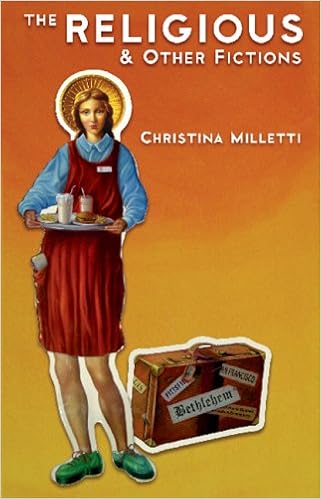
Christina Milletti - Watch out what you wish for: in these stories, tall tales have a knack of coming true. A mother's whim is granted when she disappears at the kitchen sink. Two boys bounce up and don't come down. A housewife conjures a light bulb salesman who materializes for dinner


Image result for Christina Milletti, The Religious and Other Fictions,
Christina Milletti, The Religious and Other Fictions, Carnegie Mellon, 2006.


Keen, tender, at times perverse, The Religious and Other Fictions ventures into the uncanny zones of the imagination and renders them natural. Watch out what you wish for: in these stories, tall tales have a knack of coming true. A mother's whim is granted when she disappears at the kitchen sink. Two boys bounce up and don't come down. A housewife conjures a light bulb salesman who materializes for dinner.
With one foot in the real world, the other in the land of fable, Christina Milletti takes stock of the beliefs we harbor in the face of failed hopes, the power personal myths hold over us all. In this wonderful debut collection, our most private sanctuaries are peeled back, their hearts made bare, by an inventive new writer who Carol Shields calls, "a genuine magician."


"Christina Milletti has a knife-thrower's flourish and aim, a fiction of ease and ferocity. It's hard to tell order from disorder in her stories, the lavish from the spare―they meet in a super-clarity of language that is wondrous, as dark as it is illuminating." - Janet Kauffman

"A stunning debut. In Milletti's stories, the imaginary does not begin where the real ends: the two are intertwined, each creating the other. Be careful what stories you invent, for they may in fact turn out to be not only true to life but truer than life.” - Brian Evenson

"Christina Milletti combines the pithy with the symphonic while retaining them fused, and she takes her time, maintaining a total effect like a Stravinsky sonata. A writer of gifted prose is among us again." - Paul West


Christina Milletti’s stories are unsettles and transient, fables on the go. They may have nowhere to be, but they’re in a hurry to get there. How she ever managed to corral these rootless tales into The Religious and Other Fictions is a mystery for the ages.
The opening story is a traveling salesman’s myth, “Retrofit”, a story told not by but about a strange lightbulb salesman whose head grows in the telling. He wanders around without ever being seen twice, perhaps to “Where Noone Is Now,” the location of a vanished sister who may or may not have ever existed. The transience of the mail leads a woman to a world of imagined delights and magic doors, and lets a man open a strange door to the underworld and his own unconscious. Even names travel, moving between women and musicians with easy facility and glad harmony.
Not all the transitions are accomplished with such ease, or such happy results. The man who survives “Amelia Earhart’s Last Appearance” watches helplessly as the women in his life explode, vanish or fade into thin air. And the title story, “The Religious,” takes fact and fantasy along a winding and confusing road with results unsatisfying even for their traveling narrator.
But the journey is the joy, as both Noone and Amelia Earhart might have testified, and Christina Milletti is rather more skilled than the hapless travel guide in “The Religious” at making the travel experience a pleasant one. These are stories going nowhere in a hurry but making good time, allowing readers to find what they can along the way. It’s an odd sort of literary generosity and makes for a good way to pass the time while waiting for the next destination to come along. - Sarah Meador
http://www.curledup.com/relifict.htm


Image result for Gravitational Intrigue: An Anthology of Emergent Hypermedia,
Gravitational Intrigue: An Anthology of Emergent Hypermedia, Christina Milletti and Dimitri Anastasopoulos, eds., 13th Moon Press,
has work by Mark Amerika, Christopher Funkhouser, Pierrre Joris, Stuart Moulthrop, Nicole Peyrafitte, and others.


Works in progress:
Choke Box: a Fem-Noir (novel); Erratics (short story collection), Room in the Hotel America (novel)

Experimental Literature: A Collection of Statements - 34 writers and critics reflect upon how literature puts itself to the test in an effort to make itself new


Experimental Literature: A Collection of Statements, Jeffrey R Di Leo and Warren Motte, Editors. JEF Books, 2018.


In EXPERIMENTAL LITERATURE: A COLLECTION OF STATEMENTS thirty-four writers and critics reflect upon how literature puts itself to the test in an effort to make itself new. Those reflections assume very different shapes, and each approaches the question from a different angle. There are formalist readings here, and historicist readings; some contributors consider the politics of literature, others focus upon aesthetics; some statements deal with national traditions or periods, others are more synchronist. There are pieces on French theater, the Russian avant-garde, and performance in West Africa. There are meditations on poetry as a daily practice, on experiment as a way of knowing, on the restlessness of liminal spaces, and on the incommensurate dimensions of dream and reality. Each contribution is fueled by the notion that literature works best when it is willing to interrogate its own premises. Both individually and collectively, these analyses display an extraordinary mobility, one that does justice to the dynamism of experimental literature itself. Each essay engages its readers actively and thoughtfully, inviting us to participate in a conversation about literature's horizon of possibility, about what literature is and can be. Robert Coover, arguably the most distinguished living American experimentalist, contributes an afterword to this volume.


The book is a special revised and expanded edition of American Book Review 37.5 (July/August 2016)


excerpt:
Robert Coover: The End of Literature
Literature’s mainstream is not a river that flows between fixed banks, but one that must be cut, and it is the experimental writer who, avoiding the backwaters of the often more lucrative and momentarily celebrated conventional writing, can be found at the cutting edge. We all know this. But what if literature itself is an expiring holdover from the last century, using an outmoded technology and fast declining into an archival state of primary interest only to scholars and hobbyists, the current worldwide proliferation of writing programs nothing but an ironic death rattle? What if it’s over, and the wildest and most brilliant of experiments won’t revive it?
Some 33 all-too-brief centuries ago, the 13th-century BCE redactor of the then-500-year-old Gilgamesh epic, our oldest known sustained literary narrative, added a frame story that pretends to locate, hidden within a copper foundation box under the legendary ramparts of Uruk, themselves by his time long since fallen into dusty ruin, a text engraved on lapis lazuli and perhaps inscribed by Gilgamesh himself upon his return from his adventures, which presumably is the story about to be told—a modernist, if not postmodernist, metafictional contrivance right at the very beginning of what we call literature. Which at the time was itself a new experiment, so new that the author of the original epic didn’t even have an alphabet with which to compose.
Literature, etymologically “things made from letters,” can be seen as a specific artistic process, containing within itself its own potential and limitations, one that began at a certain time in human intellectual history, a time when written words themselves were often believed to be sacred and magical, and a process that has evolved over the subsequent centuries, using generations of writers to fulfill itself. But for many reasons—a radical change of focus, a discontinuance of the tools including writing itself, a sense of completion or exhaustion or irrelevance, an impatience with the attention demanded, a transfer of such activity into other media less “made from letters”—such a process can come to an end.
The invention of the movie camera at the end of the 19th century and the international industrial cinema that followed had already dented print narrative’s dominance—it was so hard to read a book, so easy to watch a movie—when, as the last century was winding down, along came programmable machines called computers. Whereupon human discourse began to move off the page and into the infinitely spacious digital universe, a radically divergent medium that both absorbed everything from the old technology and ultimately displaced it; print documents could be read on laptops and phone screens (and largely are now), but hypermediated sound, text, and image could not be moved into print. Only mad religionists and some wistful librarians continued to venerate the printed word.
A tool engineered to embrace and set in concerted motion not only language, but all signs and gestures, icons, objects, sounds and images, with instant access to global networks, has to be a powerful tool. It becomes, itself, a kind of rhetoric by which to hold the ever shape-shifting world together, and is admirably placed to play a major role in this current age of the New Sophists. In our present intellectual environment, the Platonic hierarchies left over from the Middle Ages have mostly vanished and the borders between the traditional Aristotelian disciplines and classifications established during the Enlightenment have been rapidly dissolving, leaving us all enmeshed in vast webworks of signs that ceaselessly appear and disappear, the world as Sophists have always seen it. And these signs are not merely those of traditional literacy, of alphabetical language, of text, but now include streaming sound and moving images, as well as new rhetorical elements like multilinearity, hyperlinks, kinetic and metamorphosing text, haptics, immersive virtual reality, together with a multitude of ancillary tools and apps, elements that may eventually leave the screen altogether and environ us.
Sophists live in a world of ceaseless actional and, as we would say now, informational flow—that river one steps into, never the same twice, with man not at the center of it, just in it—but: as the measure and measurer of  it. That is, man calls it river and so it is river, says it flows and so it does flow. For Sophists, knowledge—which is not a given, but is created—is power, and that power is accessed, classically, through rhetoric. They invent new words and concepts, and if others adopt them, their power grows. Like Platonists, Sophists also use a kind of dialectic, though a skeptical one, without hope of synthesis, which they don’t believe in. They set up dialectical oppositions and simply make choices; then, using a rhetoric aimed at persuasion, they argue for the choices they have made. The distinction between Being and Becoming is, for them, a false one. Being is what there is, and it looks just like Becoming, and anyway it’s where we live, nothing we can do about it.
In this 3-D installation we call the modern world, the computer is a perfect rhetorical tool. In its root-deep either-or operations, it even thinks like a Sophist. It makes visible the ceaseless flow of words and actions and offers entry points for all users to exercise their own interactive skills in an effort to exert influence and acquire power and pleasure, the initial and perhaps principal challenge being to grab people’s attention, out in all that turbulence, and come up with a way to hang on to it, to find followers and keep them. Everything depends on information input and proper programming, and then on asking the right questions, winner take all. A game of games in which to be absent is to lose. Timing is everything. Gates and Bezos and Zuckerberg win, everyone else loses. Knowledge is power for the Sophist, and knowing is doing, but you have to move quickly, be the first with the new, and fuck the competition. Fuck the rest of the world, too, for that matter. It’s a zero-sum game.
Writers, of course, do not as a rule move quickly. Most of them design poems and narrative structures that demand a lot of thought, a lot of time. It can take weeks to hammer out a decent sentence, a single line of poetry, and it can take just as long to read and fully understand those lines. Fortunes can rise and fall, regimes too, while a writer researches a single minute narrative detail or finds the perfect prosody, the theatrically dramatic turn of phrase. The written word is a poor sluggish traveler in a high-velocity time, an ancient clumsy makeshift tool, invented by people who worked in clay and moved at the speed of a camel. Information as data can now be accessed and sorted at the speed of light, but literature is not mere information, as all authors insist, and speed in the composition or processing of it has never been considered a virtue. Writing as a craft requires patience and discipline, and the same is asked of the reader. Slow down … Listen … Hardest thing in the world for today’s rapid-fire multitasking user, bopping about urgently on various social media networks and researching the universe minute by minute. In the digital age, literature, written or read, is widely looked upon as a misuse of time (still precious, time is, that hasn’t changed, nor likely will), its potential played out, nothing left but nuance and repetition, even as some make use of the print narrative industry for their own profit and pleasure, in the way that the author of the Gilgamesh epic and his tenured priestly and scribal friends made use of the gullibility of the illiterate for their own continued well-being.
While authors sometimes spend entire lives attempting to perfect a single poem or story, programmable machines can generate an infinite number of works more or less instantly, and who knows, maybe some of them are “perfect.” Dartmouth College, in announcing its 2018 Literary Creative Turing Tests, offers thousand-dollar prizes each for machine-generated programs that “have the ability to produce effectively an infinite number” of sonnets, limericks, original short poems, and children’s stories. The outputs of the sonnet and limerick generators are judged blindly in competition with “human” sonnets and limericks, with any poem indistinguishable from human outputs passing the “Turing Test.” The short poems (“literary metacreations”) and children’s stories are evaluated for their “artistry.” All that’s missing is a program to generate an infinite number of appreciative readers, though what’s being “read,” of course, is not the infinitude of individual poems and stories (mortal tedium, in the words of Samuel Beckett) but the limited mass of materials fed into the generator in each program, together with the combinatory patterns that the “meta-author” has designed, allowing the reader to “see” the whole, without having to suffer any of the particular outputs.
Is something being lost? Sure, it is. For one thing, the pleasure of curling up in front of the fire with a bound codex—“the haptics of the printed word,” as a book-loving friend has put it. For another, the “deep read” that a book invites with its page-turning mechanism, a mechanism that allows one to go back and reread, over and over. Some say that irony was born in that peculiarity of the book. But, if nowadays there is less of the sustained readerly attention that literature has traditionally demanded, one can anticipate that new experimental forms will emerge to reach these restless rewired generations, and that writers, if in the post-literature world they are still to be called writers, will continue, in whatever medium and with whatever tools, to tell stories, explore paradox, strive for meaning and beauty (those sweet old illusions), pursue self-understanding, seek out the hidden content of the tribal life, and so on—in short, all the grand endeavors we associate with literature, even if what they make may not be literature, any more than film is literature or nature a poem.
Though literature as an art form may be fading away, raw storytelling seems to be part of everyman’s DNA, deeper than form or distribution mode, and as Boccaccio’s plague stories remind us, will probably continue to the end of human time. Because: What else? And even if narrative and lyrical artists, whether experimental or conventional, are reduced to stand-up comedy, eulogies, rap lyrics, and tweeted epigrams, they will still feel the tug of the obligations that Hesiod laid upon the Muses a couple of millennia ago: to engage with the national rituals and dogmas, to be witnesses of their times, and to provide consolation and entertainment—or as he put it, to make the gods laugh. Assuming you can find them, logged on and adrift in cyberspace as they are now.
https://theamericanscholar.org/the-end-of-literature/#.W9Q4wmewfIU

10/26/18

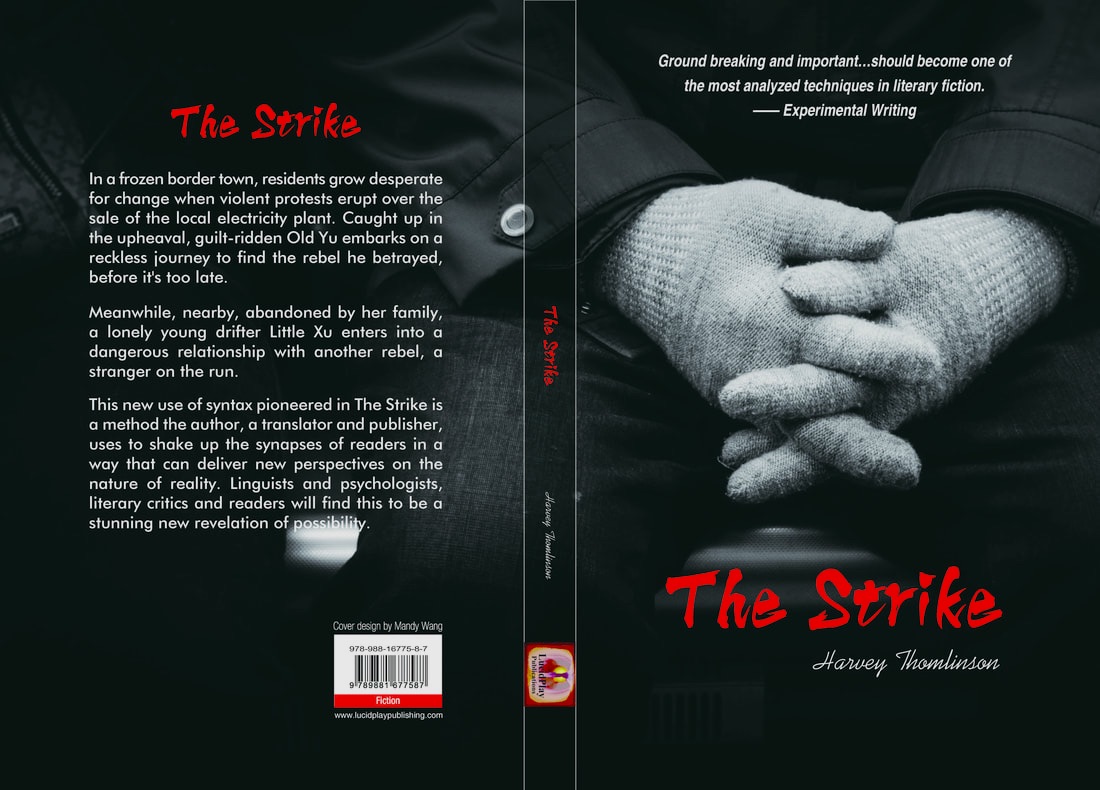
Harvey Thomlinson - an experimental novel set in a depressed factory town in the far North East of China. The novel uses a linguistic strategy which aims to subvert expectations about the correspondence between syntactic and semantic structures.

Picture
Harvey Thomlinson, The Strike, Lucid Play Publishing, 2018.


Ground breaking and important…should become one of the most analyzed techniques in literary fiction. -- Experimental Writing

This unconventional text while reminiscent of the Dadaists word games, experimental poetry, and William Burroughs's work using cut-ups is, in the end, a unique entity unto itself... -- Ray Fracalossy

The Strike vividly explores a season of crisis in the lives of Old Yu and Little Xu, two outsiders in an ice-bound Chinese border town riven by an illegal strike. Caught up in the upheaval, guilt-ridden Old Yu embarks on a reckless journey to find the rebellious woman he betrayed, before it's too late. Meanwhile, lonely young drifter Little Xu enters into a dangerous relationship with a stranger on the run.
The Strike stands out as a novel that is both experimental and dealing realistically with real world events in an engaged way. The new use of syntax the novel pioneers is a method the author, a translator, uses to shake up the synapses of readers in a way that can deliver new perspectives on the nature of reality. Linguists and psychologists, literary critics and readers will find this to be a stunning new revelation of possibility.


"This unconventional text while reminiscent of the Dadaists word games, experimental poetry, and William Burroughs' work using cut-ups is, in the end, a unique entity unto itself. Don't expect traditional sentence structure or punctuation. A challenging but satisfying novel for those looking for something at the very cutting edge of different." Ray Fracalossy -- Tales from the Vinegar Wasteland

 "The Strike, about underground protest in China, which is now OUT from from Lucid Play Publishing in the US. Harvey is best known as a translator of novels by rebellious Chinese writers like Murong Xuecun and Chen Xiwo. His own innovative writing has attracted attention for its adventurous writing style, particularly sentence structures. Harvey also runs Make-Do Publishing, a press which specializes in fiction from Asia." -- Asia Books Blog

"The term “writing” is an archaic thing. What should the new term be? THE STRIKE does not reveal that, but confirms that term “writing” needs to be trashed. We should not be “writing” but crafting tools like THE STRIKE to capture and develop readers that are not afraid to be challenged to think, and that are not willing to again be lulled into the usual dull unconscious pseudo-sleep that what the media calls “writing” leads to today.

Such is the goal of all “big media” today, not just writing, but; THE STRIKE, works as an effective tool to avoid that trap. Every sentence challenges the reader to step up, think, and stay awake. And at the end, the rewards prove to be much more than great. Words prove cheap when describing this book.

The best description lies in the experience, but here’s a taste; “Since his father had taught him as a child to write words until now he came to the river daily.” or, “The old world is falling apart.” Amen, quite true, but these excerpts are just crumbs. Oder the whole meal now; pick up a copy of THE STRIKE." --Jim Meirose, Le Overgivers au Club de la Resurrection

"'Most writers reveal characters’ thoughts and provide descriptions in isolation. For instance, one paragraph will revolve around a character’s feelings and then the next paragraph will describe the setting. Thomlinson, though, takes a more fluid approach, weaving together the external and internal in a single sentence.” -- Kate Findley, Tilt-a-Whirl
“Like that of Gertrude Stein, the writing in Thomlinson’s The Strike ruptures ordinary syntax to create a jarring reading experience.... What emerges is a compelling narrative inextricably connected to its creative telling, replete with a beautiful, poetic layer woven into the experimental syntax.” - Krysia Jopek, Maps and Shadows 


The Strike, an experimental syntax novel by Harvey Thomlinson published January 2018.
The Strike is an experimental novel that takes the reader into a different state of consciousness through syntactical experimentation. When a protest breaks out at the electricity works in an ice-bound border town, a retired worker is drawn back into his past and a journey towards the woman he betrayed.
The strike affects a range of characters from hotel sex workers to cops, political fugitives, union bosses, matinee players, corrupt mayors, and border traders. The story grew out of a visit that Harvey made to a Sino-Russian bordertown during a moment of social breakdown that was never reported in the media.
The novel’s new use of syntax is a method Harvey’s used for years to create a kind of idioglossia that shakes up the synapses of readers in a way that can deliver new perspectives on the world and the nature of reality. The aim, though, may be understood as a traditional novelistic one of helping readers to feel the whole world of a novel and the meanings it contains.
Originally from the UK, Harvey is best known as a Chinese to English Literary translator who has translated the likes of Murong Xuecun and Chen Xiwo. Harvey’s translations have been published in New York Times, the Guardian and by publishers like Allen & Unwin.  His own innovative writing has appeared in places like Exclusive Magazine (US) and Tears on the Fence (UK). The Strike gained some underground reputation as excerpts were featured in journals in the UK and US but now the whole novel will be available at last from Lucid Play.​
Meanwhile Lucid Play has also acquired world rights to Harvey's novel-in-progress The Sentence which takes the experiments with syntax still further and is currently scheduled for publication in August 2018.


​Excerpt 1. The Strike

Mrs Zhang was depressed purple leaves scattered along austere avenue because the wind was strong few of her friends were in the park. She came here every morning although this winter was severe to do her exercises required suffering. Walking with her bag of vegetables east of the crematorium there was always a wilderness.

All their group's chat that early morning rusted pagoda turned around the strike. Mrs Liu had heard from her nephew at the Bright Moon electricity plant they reached and stretched. A bird started amid frozen winter foliage Mrs Zhang looked worried remembering long ago violence by the Suifen river.
According to Mrs Liu as the earth moved round the sun the Bright Moon workers had already marched to People’s Square.

Later Mrs Zhang almost flew up seven flights of stairs to warn her husband of many decades Old Yu in the kitchen the television marked time. After moving to this new apartment two years ago light probed weakly from the balcony spring festival ribbons still fluttered.
Old Yu have you heard what’s happening?
These days she didn't know whether he heard things eating soup noodles in their small kitchen they lived often as not.

Excerpt 2. Waking

She was Xu Yue lay on her side to stay asleep the sheets had crawled up her thighs a day yet to penetrate. When her eyes opened she couldn’t breathe sometimes they turned up the heating so high she saw chairs with spaces inbetween.

Across the morning her legs stretched remotely sensations stirred last night’s clothes piled on the bed. Because it was Saturday there was no hurry to move a dirty plate on the floor unless she wanted to. She stayed there lazily enjoying the soft pillow in her mind dusty light sparkled like emotions.

Time pressed these dim paint walls flat as thoughts a dead moth. Across the scratched old dresser she saw emptied out clutter from her bag at the same time her roommate seldom stayed over.

After a while she stood up and stretched with faint hopefulness the gap in the red curtains let in the pale sun.
The light shimmied throughout the twenty-third floor she remembered her nervous client last night at the Far East Hotel. After rejoining the ladies at Jade Heaven they’d all finished a bottle of snake wine laughing at her description of the stranger's anxious behaviour the night had flown by.

She looked out across the misty sea of winter-weathered apartment blocks half a galaxy from her village she lit a first cigarette.


The Border Trader
                                                             (Extract from Chapter 12 of The Strike)

He wondered whether he was dreaming. The sticks persisted at nearer intervals in the empty blueness voices. The door sprang open unexpectedly Vladimir and Dmitri were there with a woman he almost called out in a hotel uniform. They faced down the three men at an unconcerned pace vanished through the door mouthing threats.

Vladimir approached the bed was splattered with blood to examine Pytor wiped his eyes. The hotel attendant apologised repeatedly a blow fly settled on the ceiling saying how lucky he was.

“Lucky to be alive.’

The woman left and the three men helped Pytor move his sore leg wasn’t as bad as thought. After a while he was able to pace the room from side to side they examined him. He tried first one leg and then the other according to inclination they directed him. There was a stiffness in the vicinity of his left hip he realised that that the icy streets of the town would be murder.

“We warned you.”

The night before they’d had told him about the trader from Suifen with one leg missing in the hospital over there. He’d been set upon in the icy streets beaten in the snow after the local hospital had to amputate there were always going to be consequences.

“You need something.”

They was snake still fiery in a flask Vladimir reminded Pytor that he’d promised to help his cousin Katya buy shoes. The night before in the Far East Hotel Vladmir had been drunk as a fish chasing slender waitresses behind the bar with bad skin. Pytor decided to go although he’d have to look out for his enemies his head ached and throbbed.

“One for the road.”


On a fine winter morning they descended past the third floor brothel red corridors with naked carvings had kept him awake all night. Late breakfasters ate pickled vegetables beyond the lobby streets white and cold as metal. By the hotel queues of donkey carts and yellow were forming embedded in the ice was black from age. They waved down a cart outside small clusters of languages were thawing out the up and down day.

“The border station.”

The train had just arrived at the station bluely dust releasing a mass of their fellow countrymen and women. As the sky was high in the air hundreds surged onto the frosty street with its engraved hotels carrying red and white striped bags. They stood and waited for Katya few were going the other way until they found her.

“You guys must be blind.”

She was Katya had risen early that morning heading for the train in a snowstorm black pigs riding to the border. Although the world wasn’t breathing she had eaten a boiled egg before setting forth her husband’s feet were warm and hairy. A square blue car was abandoned frozen at the border she crossed twice a year as a buyer for her sister’s small shop. 

                                                      Hospital Visit   
                                                     (Extract from Chapter 14 of The Strike)

They held each other nervously Little Hua looked through the door. There she saw a confused space of metal bed frames and tubes trapped her father.

When Little Hua approached her father at first she could hardly believe there was no room to put a chair between the beds. There was the familiar smile of shy pleasure door half open as if he was embarrassed to show feelings.

‘You’re here.’

She wasn’t sure what to say as she sat on the edge of his bed a doctor in a blue gown looked through the door. Somehow she was afraid that she might see something like death in his eyes he cleared more space for her. All her life she’d feared that he would be dead skin and bones before she could make him feel loved he waved his hand.

“Sit with me.’

Selflessly as the others in the ward watched he made room for her in what looked like new black striped pyjamas. There was a pile of peel and shells on the dresser she was afraid to show any emotions that the nurses should have cleared away.

“Nothing, nothing.”

She rose again to clear the clutter he said that it had been a minor stroke sweeping everything into a small bin. She knew of course that several of her father’s family had just dropped dead afterwards she opened her bag before the age of sixty.

“I got cold, you see.”

Family history always played a part apparently he’d fallen ill on a bus she produced the herbal medicines. She’d made a special hospital visit to get these pills that the nurses probably wouldn’t let him use anyway he thanked her quietly.

They sat in silence he’d long hated talking about himself. She loved this modesty of his was not the style now seeing him helpless with all these sick people she would die. While time continued he lay there attached to a catheter they’d always had this mysterious bond.

‘You must get better now.’

As a child he had always protected her when they visited the toilets nights the temperatures yellow icicle-rimmed concrete block were often twenty or more. She’d feel nervous crouching above the frozen hole steam rising as the wind stirred dead papers in the corners her father whistled. The walls and floor were deathly cold to the touch she tried to keep her balance as she shat or pissed. Afterwards she’d run all the way back to their smoky brick room with her father howling ghosts chased her.


Author's Commentary:
‘The Strike’ is an experimental novel set in a depressed factory town in the far North East of China. The novel uses a linguistic strategy which aims to subvert expectations about the correspondence between syntactic and semantic structures.
Conventional syntax shapes the way we perceive reality by encoding conceptual relations, particularly temporal relations, or causality.
She was Katya had risen early that morning heading for the train in a snowstorm black pigs riding to the border. Although the world wasn’t breathing she had eaten a boiled egg before setting forth her husband’s feet were warm and hairy. A square blue car was sat abandoned frozen at the border she crossed twice a year as a buyer for her sister’s small shop.
A key part of the strategy of this novel was to undermine conventional implicatures of sentences, allowing a more complex range of meaning relations to emerge.
I saw this town as being a world where memory and expectation pull in different directions. Some sentences place complements of time and space in ambiguous positions on phrase boundaries.
“With her hair pinned in a scraggly bun she saw everything riding through the dark night of history to pass the time there were adverts on the walls.”
Others do something similar with conjunctions, which play an important role in establishing semantic relations between clauses.
“Their town was standing up although the gates of City Hall remained closed their voices rang out unanswerably.”
In my view, experimental writing should seek new ways to give aesthetic form to subjective experience.
She wasn’t sure what to say as she sat on the edge of his bed a doctor in a blue gown looked through the door. Somehow she was afraid that she might see something like death in his eyes he cleared more space for her.
“Sit with me.’
Selflessly as the others in the ward watched he made room for her in what looked like new black striped pyjamas. There was a pile of peel and shells on the dresser she was afraid to show any emotions which the nurses should have cleared away.
“I got cold, you see.”
As a child he had always protected her nights when they visited the outside toilet block was often twenty or more below. She’d feel nervous crouching above the yellow icicle-rimmed hole as the wind stirred papers in dim corners her father whistled. Afterwards she ran all the way back to their smoky brick room with her father ghosts chased them.
I wanted to create new syntactic structures that were mimetic of the chaos and indeterminateness of the universe of my characters.

- http://exclusive3.weebly.com/flash-fiction.html


One of the most ground breaking and important new developments in innovative fiction writing I feel comes from the new syntax created by writer and publisher, Harvey Thomlinson. This new use of syntax is a method he's used for years to create a kind of idioglossia that shakes up the synapses of readers in a way that can deliver new perspectives on the world and the nature of reality. I was happy to be able to dialog with Harvey about this formally, which can be read below. Excerpts of his unpublished novel have been published in magazines in journals in the UK, and now two are in Exclusive Magazine, with his commentary on them. http://exclusive3.weebly.com/flash-fiction.html  I feel when this is published as a whole by some adventurous press ready to take the risk with a novel that is both experimental and dealing realistically with “real world” events in an engaged way, it will become one of the most analysed techniques in literary fiction. I feel linguists and psychologists, literary critics and professors will find this to be a stunning new revelation of possibility.  You may wish to follow his website for new developments. http://thestrikeonline.com/
Harvey is most known as the translator of Chinese novelist Murong's A Novel of Chengdu, which was a finalist for the 2009 Man Asia Literary Prize. Harvey also runs Make-Do Publishing, which presents some of the best contemporary writing in Asia. Here follows our discussion.

Tantra:
Your writing style is adventurous, particularly your sentence structures. People so easily take for granted the usual way of writing, grammatically, and Experimental Fiction has the opportunity to shake that up. One of the fascinating aspects of innovative writing is stretching our minds to think new ways, and language is intricately involved in how we think. I feel your use of syntax creates a new language, and it has been proven that people can less their chances of Alzheimer’s if they speak two languages. Your work seems to me to have the ability to make our minds more agile and our experience of the world youthful and fresh.
Harvey, here are some quotes Clifford A. Pickover that I think speak to what you’ve accomplished.  I’m curious to hear about your goals and methodology of making the new language structure. These relate to the Sapir-Whorf hypothesis, which says that language structure affects how we see the world.
“Paul Kay, the linguist we discussed who is interested in color and language, agrees with me that language shapes the way we compartmentalize reality. “There is a wealth of evidence showing that what people treat as the same or different depends on what languages they speak.”’  22
“Today, 438 languages have fewer than 50 speakers. {written in 2005} “With each language gone, we may lose whatever knowledge and history were locked up in its stories and myths, along with the human consciousness embedded in its grammatical structure and vocabulary. . . .” 33
“If language and words do shape our thoughts and tickle our neuronal circuits in interesting ways, I sometimes wonder how a child would develop if reared using an “invented” language that was somehow optimized for mind-expansion, emotion, logic, or some other attribute. Perhaps our current language, which evolved chaotically through the millennia, may not be the most “optimal” language for thinking big thoughts or reasoning beyond the limits of our own intuition.”   77
From Sex, Drugs, Einstein, and Elves: Sushi, Psychedelics, Parallel Universes, and the Quest for Transcendence  by Clifford A. Pickover, Smart Publications, Petaluma California 2005
I see what you write as a kind of invented language that expands our minds.
Harvey:  
My experimental novel The Strike uses a linguistic strategy which aims to subvert expectations about the correspondence between syntactic and semantic structures. Standard syntactic templates imply conceptual relations, such as sequence, or causality, and as Peter Kay says, these shape the way we ‘compartmentalize reality.’
The Strike is set in a depressed factory town in the far North East of China. The goal of what I call “existential syntax” is really a traditional novelistic one of helping readers to feel the whole world of a novel and the meanings it contains.
Tantra: 
Can you describe the process when your sentence methodology first dawned on you, your first inklings of how it would work, your goals with it, and how it developed along the years?

Harvey:
A few years ago, during a chaotic period in my life in Mexico, I began to experiment with writing short pieces of a few paragraphs, and also rewriting chapters of pulp fiction books which I had picked up from second hand English bookstores in Oaxaca and Mexico City.
The Strike was an attempt to expand this to a novel-length fiction. The story is set in a rotting factory town in the far north east of China, where the people protest after their government decides to sell the local electricity plant.
The text generally works with purposeful combinations of phrases, rather than some Burroughsesque random cut up. There was no single method, more a spirit of ‘bold, persistent experimentation,’ but a consistent goal was to destabilise the sentence, the “bolus of meaning,” according to Fregel.
Sentences like the following use a strategy of disrupting the semantic relations that are embedded in syntactical entities.
“Although the world wasn’t breathing she ate a boiled egg before setting forth her husband’s feet were warm and hairy.”
“With her hair pinned in a scraggly bun she saw everything riding through the dark night of history to pass the time there were supermarket adverts on the walls.”
“Somehow she was afraid that she might see something like death in his eyes he cleared more space for her.”

Tantra: 
Can you talk about your terminology “existential syntax”? Do you connect it with Existentialism?
“Existential syntax” doesn’t really connect on a theoretical level with Existentialism, except by analogy. It is my term for a set of experiments that share the goal of moving beyond conventional syntax and the term Conventional syntax shapes the way we perceive reality by encoding conceptual relations, particularly temporal relations, or causality.
 Phenomenology (of which existentialism was one branch) was partly concerned with describing experience without obscuring the description through misused concepts – hence the analogy.
“Syntax in Experimental Literature: a Literary Linguistic Investigation” a dissertation by Gary Thoms, written in 2008, breaks down Beckett's How It Is, among other things. This novel has a lot of similarities to yours in his particular systematic toying with syntax. Thoms refers to his arrangements of juxtaposed fragments within sentences as “chunking.” This is something you do in your own way.  Thom says:
“This is characteristic of Beckett’s attitude to writing: while he believed that language was inadequate for true expression, he felt that the goal of writing was not to free itself from language entirely, as with Burroughs and Cage, but to misuse it with intent.”
You also have your way with words. The world has already experienced Beckett's deliberate misuse of syntax, which plays with time, and is said to be the voice of the eternal present. How would you say your book moves the literary dialogue forward into new ground?
Beckett’s writings are one of the greatest achievements of the literary avant-garde. In terms of formal features of language, the prose of The Strike certainly makes use of what you call chunking, as well as other “Beckettian” techniques such as deletion and elision, and as with Becket there is often a choice of parsing the text into different sets of phrases. 
However the Strike also introduces new syntactic patterns. Some experts argue that experimental writing can never truly access linguistic form, because readers simply apply their knowledge of standard syntax to form the most likely reading.   This is no doubt largely true, but I wanted to see whether new templates could be established.
Tantra:
And where you see it moving next?
Harvey:                                                                                         
Experimental fiction seems to have lost its ambition to influence a wider literary culture and the whimsical postmodern ethos still dominates, 40 years on. I think that probing at what lies behind “language” is a very important task for a writer, because to return to the point you made earlier, of the large part that language plays in shaping our reality.
At the same time, experimental writing should not be some kind of hermetic game for writers but should aim to create literary forms that deliver a more thrilling aesthetic experience for readers, a sense of something big being at stake.


https://lucidplaypublishing.weebly.com/the-strike.html


Harvey is best known as a translator of novels by rebellious Chinese writers like Murong Xuecun and Chen Xiwo. His own innovative writing has attracted attention for its adventurous writing style, particularly sentence structures. Harvey also runs Make-Do Publishing, a press which specializes in fiction from Asia.
The Strike vividly explores a crisis in the lives of Old Yu and Little Xu, two outsiders in a frozen Chinese border town hit by a traumatic strike. Caught up in the upheaval, guilt-ridden Old Yu embarks on a reckless journey to find the rebellious woman he betrayed. Meanwhile, young drifter Little Xu enters into a dangerous relationship with a stranger on the run.
So, over to Harvey…
For many writers, I suppose, there is an irresistible mystery about the dependency of form and content. When I started to write this story of a strike in a left-behind border town I wanted to invent a new language that would convey to readers this ice-bound world and all the meanings it contained.
This story started when I flew northeast from studies in Beijing after a friend's tip-off that something was going on. This was the middle of the last decade and the talk was of the birth of a new society being forged in the white heat of Deng's revolution, thrusting China forward into a capitalist future.
 But the tale less told was about the large areas of the country where the intrusion of modernity was felt as painful. There were rumours of explosive protests and demonstrations shaking the northeast where millions of workers were being laid off from state owned factories, although few journalists made it up there.
What in retrospect seemed like the decisive confrontation had already passed when I arrived but night after night I watched lines of workers march through the streets of this remote borderland. In the icicled dark so frigid that hot water leaking from a burst pipe would freeze within seconds they filled the empty expanses of People's Square.  Their banners made plaintively rational propositions: Our wives ask for our salary, our children ask for education, our parents ask for medical treatment.
The main discontent was wages for laid-off workers which had not been paid for months. The town seemed united in solidarity as taxi drivers gave free rides to the protestors and workers lay down on the railroads so that goods could not come in or out. Mesmerised by this apparent irruption of protest from China's unconscious, I ended up staying on for a couple of months in a guesthouse on a vast housing estate which had belonged to a state-owned railcar factory. The estate had hospitals and schools, and my empty guesthouse had once accommodated visiting Russian experts. Most of the factory's divisions had closed; in theory the laid-off workers would continue in perpetuity to receive wages from the shuttered factories, although these were usually far in arrears.
Staying in this place haunted by the equivalents of characters from Gogol's Dead Souls, China seemed like a land riven not only by economic and geographic disparities but by temporal distention; torn between past, present and future.
As I thought about how to write The Strike, I realized that I wanted the form of my story to somehow be a mimesis of my characters' subjective temporal distention. Chinese fiction is often constrained by the straitjacket of socialist realism; the imperatives of a positive outlook, healthy characters, and formal simplicity, eschewing formal experimentation.  I had no such constraints - in fact, for me the more experimentation the better. I had written a number of short pieces using experimental syntax but had been wondering if it would be possible to write something longer.  I got down the first lines and wrote my way into it from there: Mrs Zhang was depressed purple leaves scattered along austere avenue because the wind was strong few of her friends were in the park. She came here every morning although this winter was severe to do her exercises required suffering. Walking with her bag of vegetables east of the crematorium there was always a wilderness.
Gradually I drew out two plot threads - involving Old Yu, a haunted old man, and Little Xu, a vulnerable young woman - between which wove secondary figures such as the city's mayor, the chief of police, and deadbeat actors.
The dual-thread structure turned out to mirror the syntax of the experimental sentences, which often featured two independent clauses ambiguously linked by connectives which can be scanned in different ways: She was Xu Yue lay on her side to stay asleep the sheets had crawled up her thighs a day yet to penetrate. When her eyes opened she couldn't breathe sometimes they turned up the heating so high she saw chairs with spaces inbetween.
Some people are put off when they read about experimental language. But my belief is that all imaginative writing should try to create 'novel' dependencies of form and content.
My hope is that the syntax brings the emotional drama of the strike alive in a vivid way, creating a sense of something momentous at stake. - www.asianbooksblog.com/2018/02/500-words-from-harvey-thomlinson.html


Experimental: A word which inspires both promise and disquiet.
I once dated a woman who described our relationship as “experimental.” Unfortunately, our relationship didn’t last long enough for me to find out the results.
Translator and writer Harvey Thomlinson describes his new novel, The Strike, about “an illegal protest in a frozen border town,” as experimental fiction which “uses a linguistic strategy which aims to subvert expectations about the correspondence between syntactic and semantic structures.”
What happens when the form of writing is insufficient to express the multi-dimensional world of thought, time, and perception which we inherit?  Why, asks this book, should we be limited by tense to understanding a story purely in one temporal space when our lives are lived as a farrago of memories, present perceptions, and future hopes, and fears?
She was Xu Yue lay on her side to stay asleep the sheets had crawled up her thighs a day yet to penetrate. When her eyes opened she couldn’t breathe sometimes they turned up the heating so high she saw chairs with spaces inbetween.
Across the morning her legs stretched remotely sensations stirred last night’s clothes piled on the bed. Because it was Saturday there was no hurry to move a dirty plate on the floor unless she wanted to. She stayed there lazily enjoying the soft pillow in her mind dusty light sparkled like emotions.
She looked out across the misty sea of winter-weathered apartment blocks half a galaxy from her village she lit a first cigarette.
 Thomlinson’s use of experimental language can be challenging, not unlike listening to the music of Ornette Coleman or an evening of Schoenberg. It took me some pages to begin to feel the melody in the rhythms and to begin to hear a new palette for the construction of tense and syntax.
It is not only the language which challenges the reader. The story—loosely based on a real events Thomlinson witnessed during a trip to the far northern regions of China a decade ago—moves at varying speed, depending on the mood of the characters. Dramatis personae appear suddenly, only to disappear for chapters at a time. Bit players evolve into important protagonists. Key characters evaporate. It is messy, confusing, unconstrained by thinking in specific times, acting in specific spaces, or any form of omniscient narrative momentum—not unlike the way real people live their lives.
When writing fiction in a cultural context different from that of the author, there is always the danger of (mis)representation and cultural appropriation. Perhaps more so in a book which goes to great—often uncomfortable—lengths to interweave the internal voice of its characters and the mentalité of a community into a larger narrative.
And yet perhaps in the universalism of themes (regret, lost love, excitement, self-interest, hurt, joy, fear) there is also something which transcends the setting. These characters exist in a cold, snowy part of forgotten China. They are utterly banal but live in extraordinary circumstances. Perhaps this is what allows the story to transcend the particularity of culture and nationality—and place them in the universality we all share. -
http://www.theworldofchinese.com/2018/03/the-strikes-experiment-hits-the-mark/


Picture


Harvey Thomlinson, The Sentence, Lucid Play Publishing, 2018.

The Sentence is an existential ‘thriller’ which features Klaus, a subject who is trapped in his sentence, haunted by memories of a previous existence before the sentence began.​
The novel is relentlessly experimental in the Beckettian sense of messing with the implicatures in conventional syntax. Syntactic structures constantly mutate and evolve with the ever-shifting morphology of the unending sentence. But will Klaus escape the clutches of the sentence cops and uncover the mystery of his past crimes before finding a way to redeem himself?


Extract 1. The Syntax of a One Night Stand

On the cusp of the future the sun was lower in the clouds without waiting for the lights Tamasin and Klaus walked coldly from The Full Stop towards the Paragraph. Tamasin stayed a few paces ahead of Klaus plum blossom unfurled time in purple jeans though the tide was out he was aroused by the slender concave of her knee conjunctions. The glass construction was twenty or thirty stories metal balconies layered sandwiches mostly empty as the ship hadn’t docked yet afternoon filled the yard like dead flowers. Outside the gate of the Paragraph stood a two-storey clubhouse with a domed roof he watched her wait for him there the sky unfinished.  Three towers stood within the yard gold and glass constructions seemed like they would be hot in this summer made of cheap materials he foresaw the sky would soon wear off.
The Paragraph gatekeepers still hung around apparently there weren’t many subjects in residence as she passed them a crane swung into action. They seemed to have nothing to do although the crane was unloading a container of words the gate swung open with a push a cloud moved before the sun. He followed her at a steady distance as if reserving his options they stared at the crane with obvious hostility gulls circled on the far side.
They walked across the yard still a broken shard of sun was lobbed into the first construction nearest to the gate luckily there was no one around. The new building lobby appeared recently finished he saw dust scattered like moonlight and uneven grouting in the past she must have summoned the line break.  She’d probably had previous encounters with subjects she met at the Full Stop the break ascended. There was no mirror inside the break moved although it was lightless here she didn’t remove her shades. The two of them alone inside the shimmering grey walls increased the tension as they rose through the Paragraph he realized it was night again behind her lids.
The walls sprang open with a hint of drama she opened her eyes through a corridor window the day slid into the sea. Her clause was the first on the left a flock of drowned gulls coming from the break at this time of day in her yellow purse she felt the key. Klaus sensed she had not lived here long as the key fumbled in the space time lock his stomach churned with a mixture of seaweed and foam.
Her single clause was sparely furnished with one red leather hyphen in the afternoon light threaded a shady balcony in the corner he advanced instinctively a red quotation mark flapped from string. Klaus was drawn outside for a few seconds stormclouds arched the bay intermittently a periscope approached them from sinister angles. She tracked him down confidently in the yard below a gardener collected detritus of words apparently the last storm had caused devastation. A finger string moved him back within her spartan clause the red hyphen was a lone furnishing.  They were a subject group now and she was without any words clutching him so passionately other constructions seemed to fade away.
Do you know me?
He didn’t really know her but active and passive constituents were coupling. She held him tight in ineluctable sequence her lacy front opened to the sea without being asked. Her mahogany skin felt infinitely porous from shore to shining shore he traversed its curves and ridges.
Much of the light in her clause came from a metal chandelier intricately warped and sculpted she pulled him into her.

Extract 2. Escape from The Sentence.

He reached the corner of the clause and there was the sentence in all its prolific glory, in all its full flow. In this bustling scene its predicates proliferated. Clouds blew, streetlamps illuminated. Trees breathed, subjects came went. The clouds in the sky, the streetlamps in the street. The sun in the light years. Clauses joined to each other at corners with barely a conjunction to show where each began or ended.  He realized both the endlessness of his sentence and how far he must go to shake off its surly bonds. He only hope was to find a hole. He still thought that this sentence must be full of them. Wormholes. Blackholes. Mouseholes. Plot holes.
Are we not drawn onward, we few, drawn onward to new era?
Left the sentence went. Right the sentence went.  He knew left. It wound around to the front of the Scriptorium. It rambled discursively in the direction of everywhere he had ever been. He already knew there was no escape in that direction. Not unless his sentence was a palindrome.
He went right. He went into the unknown.  He already knew he wouldn’t easily escape from the sentence. It wouldn’t be so easy to slip the sentence’s leash.
He must be patient. He must be persistent. He would remain undaunted, he would stay undeterred. He would, he would, indeed, in thought, he would.
Klaus had never been this way before. He needed a new map.
He kept thinking the hole in the sentence might be just around the next  Each time the sentence just   Around the  across the  along the above the  beyond the
He kept going.
He would keep going for as long as he needed   as long as
he believed     there would be a hole
Sometime he would sense the gap in the sentence and start running along eagerly only to find    // a caesura.
He would throw himself at the   and allow himself to feel expectant for a moment heart in mouth as he fell through disappointed //  to the other side.


To read more of Harvey's work: The Stand Magazine.
Harvey's article at New York Times "China's Communist Party is Abandoning Workers"