2/9/15

Peter Valente has done everything that a translator/reader of Artaud shouldn’t do: he crossed the line and merged his own writing with the original. But he did it to such mind-blowing extreme that Artaud’s voice becomes his own


Peter Valente, The Artaud VariationsSpuyten Duyvil Publishing, 2014.                            


From metaphysics to rationalism, from communism to capitalism, and from sexuality to the self, these poems interrogate the full spectrum of power Artaud railed against. Even more significantly, Valente’s poems unmask the fundamental identity of these apparently separate systems. God is never merely God in these poems: he is also Satan. Satan is never merely Satan: he is also the doctor. The doctor is never merely the doctor: he is also the whore. The whore is never merely the whore: she is also the intellect. The intellect is never merely the intellect: it is also the body. Ultimately, the spiritual is no different from the material.  Cole Heinowitz, from the introduction


Peter Valente has rendered Artaud’s final writings, notably texts from Suppôts et Suppliciations, with a raw slaughterhouse magnificence and imaginative velocity that create new apertures through which to perceive Artaud’s most extreme and challenging work. - Stephen Barber
Peter Valente has done everything that a translator/reader of Artaud shouldn’t do: he crossed the line and merged his own writing with the original. But he did it to such mind-blowing extreme that Artaud’s voice becomes his own. An amazing feat. - S ylvère Lotringer


Peter Valente: From 'The Artaud Variations,' with commentary by Cole Heinowitz

Drawing with text by Antonin Artaud
There is a Hole in things
that resists classification
and cannot be understood in the terms
that explain it
because the Hole
resists being determined
and cannot be understood as part of a system.
The noise in the head is an ache.
Doubt gives birth to invention
which sodomizes it from behind.
These beings do not exist
and yet they continue to provoke Artaud.
There are no questions or problems
worth the blood from a dirty needle
and nothingness
is just this stink
from the anus of a God
who is against Life.

Best to give it up.

Don’t want anyone
getting too close,
don’t need to be surprised or astonished.

I, Artaud, have had enough of this incessant pollution
of my vital substance by spectral intelligences
that resist being nailed down,

that are the result of an arbitrary calculation in the mind of God
which let loose a battalion of craven ghosts
 THAT DO NOT EXIST It’s just the laundry of human toil: 
hope,
 despair, fear of death. And the defecations of Science: mass, density, time, space. Fuck these bourgeois values.In reality, nothing keeps. It’s a fools game no grail no end to sufferingjust filthy lucreand that’s nothing new. The eye flickers before Godand then closes for good.It’s just too much when you get that nearthe rim of the pit, your face smeared with shit for leaning too close. God is this clot of black blood in the anus,food for angels. It makes me sick to think. I rage against the obscenity of Godwhose pure spirit is the light of Satan.
 

Commentary by Cole Heinowitz, as Part of an Introductiion “I Piss on the Machine of Being”:  Peter Valente’s Artaud Variations 
The poems you hold in your hands are not translations in the conventional sense of the word. They emerge from a deeply personal, sustained, and rigorous engagement with Artaud’s corpus, taking the “Interjections,” composed during Artaud’s confinements at Rodez and Ivry-sur-Seine (1946-47), as their immediate point of departure. Like Christopher Logue’s Homer, Paul Schmidt’s Rimbaud, and Stephen Rodefer’s Villon, Valente’s Artaud builds on the Poundian tradition of “criticism by translation,” a practice that demands “an intense penetration of the author’s sense” and “an exact projection of one’s psychic contents,” one that privileges “the fervour of the original” over semantic fidelity. Valente’s poems embody what Haroldo de Campos has called “transcreation,” a strategy of deviation from the literal that aims for “a greater solidarity with the final ‘gestalt’ of the [original] work” than can be achieved through “servile” translation.  As Jerome Rothenberg phrased it, these poems are at once “commentary,” “extension,” and a “legitimate form of othering.”
It is in this way that Valente is able to bring us an Artaud who is frequently thought of as untranslatable, if not entirely undecipherable. Valente’s Artaud is not the “shaman,” as Susan Sontag would have it, whose works “yield nothing for the reader except intense discomfort of the imagination.” Nor is he Clayton Eshelman’s “shaman in a nightmare,” whose “madness…means little to anyone but Artaud.” Valente gives us an Artaud who very lucidly critiques institutional power in all its insidious manifestations—from metaphysics to rationalism, from communism to capitalism, and from sexuality to the self—an Artaud who wages unceasing war “against God,” “against reason,” “against classes,” “against the feminine, / against the masculine,” “against the organism,” “against psychology,” “against language,” and ultimately “against concepts” themselves.
Valente’s language reveals these “rites of black magic” with extraordinary vividness and directness.We see how unquestioned submission to authority “makes all men into craven, unscrupulous dogs, begging for alms on stoops and bar stools all over Paris”. We see in the clearest terms the torments Artaud suffered in the asylum: “It was hell back there at Rodez”, where he was “electrocuted,” “chained,” “kept in solitary”, and endured the terrifying “bardo state of electroshock”. We see “the filthy police” who “struck [Artaud] down,” who “bludgeoned” him “with an iron bar in Dublin” and sent him back to France in a straitjacket. We see the destruction witnessed by a man who lived through two World Wars: “1,000,000 dead / by fire, / by water, / by air,” “cities razed to the ground, / the upheaval of cultures, / men against men, / women raped, sodomized,” and “the burning of ships on the sea”. And we see the fragmentation of “a self that monitors it- / self in private language” in Valente’s “AR- / TAU,” whose every attempt to assert a coherent identity is interrupted and usurped by another: “it’s me, me listen to us artaud / not my / self, you’ll never find us / it is I, Artaud, / artaud is dead you must listen to us”.
Yet these poems are much more than instantiations of the systems Artaud railed against. They map the complicity and, ultimately, the interchangeability of these systems. God is never merely God in these poems: he is also Satan. Angels are never merely angels: they are also demons. Demons are never merely demons: they are also doctors. Doctors are never merely doctors: they are also capitalists. Capitalists are never merely capitalists: they are also priests. Priests are never merely priests: they are also whores. Whores are never merely whores: they are also the intellect. The intellect is never merely the intellect: it is also the body, that collection of organs “that eats, shits, sleeps,” breeds, and dies. Thus God becomes “piss,” Christ becomes “shit,” the Holy Ghost becomes “sperm”, “and all the shit and gristle of this racket of Being is pulverized in the brain as food for angels who awaken the dead Artaud by electroshock to perform surgery on his hands and scrape words from his tongue with their rusty tools”. The material world is inseparable from the immaterial world: “The unholy trinity enters matter through the anuspussy key and feeds upon the entrails of Artaud” while “[t]he filth of the spirit” drains “its shit / at the rim of matter”.
Valente’s poems scream of this vicious collusion; they “rage against the obscenity of God/ whose pure spirit is the light of Satan”:
Such terminal bullshit has passed for truth in the Westin the name of philosophy,science, religion, politics, etc.Dame Sophiaought to be raped and roasted on a spit in Hellnext to that pig Descartesand the entire dilapidated Academyand those secret initiates who enactvile scenarios of black magic,having stolen the sperm of Artaudwhile he sleeps.
 THEY OUGHT TO RAZE THE WHOLE STINKING EDIFICE.
 Looked at politically, philosophically, or spiritually, Valente’s stark revelation of such collusion is indeed formidable. But while they have much to teach in such respects, these poems are ultimately neither political, philosophical, or spiritual. If God doubles as Mammon or the Madonna doubles as the Whore of Babylon, if priests are out for “filthy lucre” and the intelligentsia are simply angling for “a chair in the rotten council of heaven”, even if the Holy Ghost is a satanic ejaculation, as Valente writes, “that’s nothing new”. The constant reproduction and doubling of these forces may expose them for the deceptions they truly are, but the real point of distilling them all “in the alembic” together is to defeat “the machine of Being” that endlessly “reproduces”. Beyond their keen penetration into the travesties of justice, reason, and morality, at their core, these poems are leveled against the very notion of Being.”[1]________________________________________[1] As Artaud wrote in September 1947, “There is no greater enemy of the human body than being.” Quoted in Jacques Derrida, Writing and Difference. University of Chicago Press, 1978. p. 246.


Peter Valente was born in Salerno, Italy and grew up in New Jersey.  He holds a B. S. in Electrical Engineering from Stevens Institute of Technology. He is the author of the chapbook, Forge of Words a Forest (Jensen Daniels, 1998), and his poems have appeared in journals such as Mirage #4/Periodical, First Intensity, Aufgabe and Talisman. In the late 1990s, he co-edited the poetry magazines Vapor/Strains and Lady Blizzard’s Batmobile and wrote articles on jazz for the Edgewater Reporter. In 2010, he turned to filmmaking and has completed 60 shorts to date, 24 of which were screened at Anthology Film Archives. He has translated the work of Luis Cernuda, Nanni Balestrini and Pier Paolo Pasolini and is the co-translator of the chapbook, Selected Late Letters of Antonin Artaud, 1945-1947 (Portable Press at Yo-Yo Labs, 2014). His book, A Boy Asleep Under the Sun, Versions of Sandro Penna is forthcoming from Punctum Books

Michael Sweeney - an engaging and combative volume of quips and koans, all one-liners. He riffs high, pop and underground culture, he even offers perceptive political insights


Michael Sweeney, Octagon Commonweal, Spuyten Duyvil, 2014.


If there is any elbow room between the crazy eights of classical history and the current pop conundrum on the heels of American jazz, Mike Sweeney has deftly slipped his arm into the slim sleeve of the above. Octagon Commonweal makes yesterday and tomorrow irrelevant, since here we are now, like it or not. - Tony Sanders

In a book like almost nothing I have ever read—maybe closest comes the work of NYC School poet Terence Winch, or the aphorisms of Romanian philosopher Emile M. Cioran—Michael Sweeney cubistly navigates the MMA Octagon as metaphor. He riffs high, pop and underground culture (Alex Chilton, Beethoven, the Mets, Joe Frazier, Kevin Love, George Zimmerman and dozens of others make cameos); he even offers perceptive political insights as in “Solzhenitsyn chronicled the gulag octagon with dreadful exactitude.” This book rises to a kind of referent driven verbal strike, battering the cage of the expected, including the one we carry inside ourselves, for as Sweeney notes, “We all pray in eight-angled chapels with eight-angled rosary beads.” - Sean Thomas Dougherty

Mike Sweeney’s Octagon Commonweal is an engaging and combative volume of quips and koans. All one-liners, many of them aim for and earn a rim shot of approval, especially at the expense of his frequent target, the lower denizens of the realm, the mere brutes. Others of these finely tuned bursts provoke and deserve the sound of two hands clapping for their Blakean evocation of the force-field of energy that we live in that always tortures but sometimes transfigures us, turning guts to grace. The octagon is our cage but also our crucible, a proving ground for the human amphibian that we all are: deeply akin to Titus Andronicus in his habitual charnel house, but capable of being more like the Titus addressed by St. Paul, who when tested comes through as pure gold. Sweeney is a sonorous, witty, and uncommonly wise Virgil guiding us on our necessary trip through, negotiations with, and occasionally triumphant dismantling of the octagon we confront daily. - Sidney Gottlieb

Michael Sweeney’s Octagon Commonweal participates in the tradition of Whitman and Ginsberg, and nods to Wallace Stevens’ “Thirteen Ways of Looking at a Blackbird,” but it is very much its own poem, written in the grand old style of performance and exhortation. It is political and relevant, answering the question of why we write poetry: because it matters. 1984 is alive in 2014, and it lives in the octagon.  - Kim Bridgford


Michael Sweeney, a two-time Pushcart nominee, earned his M.F.A. from Brooklyn College and was a long-time student of Isshinryu Modes Karate. His collection In Memory of the Fast Break (Plain View Press, 2008) was a Finalist and Must-Read selection for the Massachusetts Center for the Book’s 2009 MASSBOOKS OF THE YEAR/POETRY Awards. “The Last Cracker,” from that volume, was selected by Stephen Dunn as runner-up for the St. Louis Poetry Center’s 48th Annual “Best Poem” contest and appeared in Margie: The American Journal of Poetry, Volume 6. He lives in Connecticut with his wife Patricia.

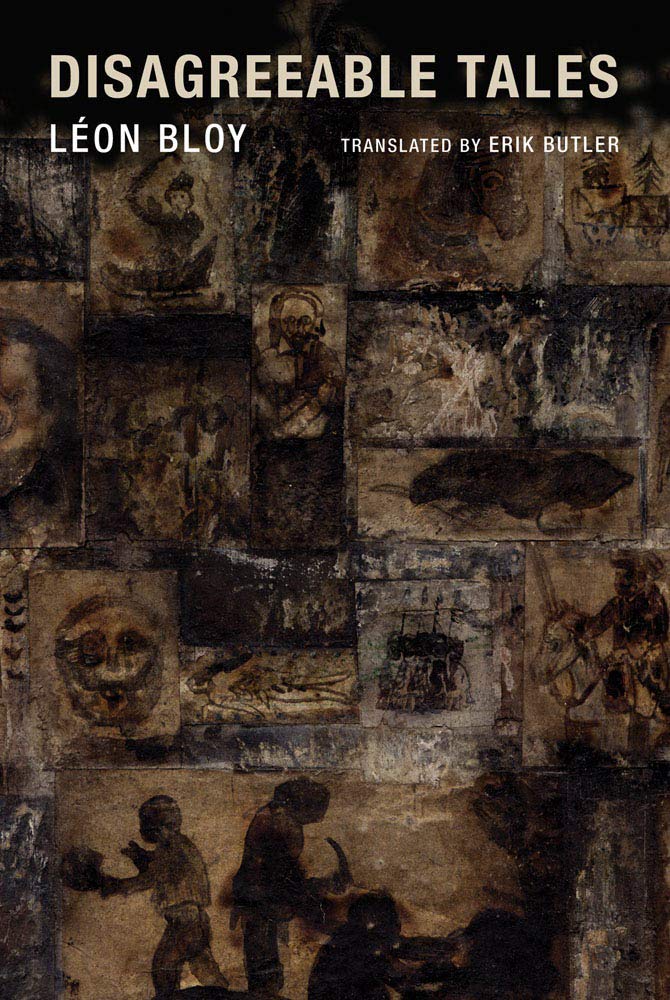
Léon Bloy - Thirty tales of theft, onanism, incest, murder and a host of other forms of perversion and cruelty from the "ungrateful beggar" and "pilgrim of the absolute"

Amazon.com: Disagreeable Tales (WAKEFIELD PRESS) (9781939663108): Bloy, Léon,  Butler, Erik: Books

Léon Bloy, Disagreeable Tales, Trans. by Erik Butler, Wakefield Press, 2015.


Thirty tales of theft, onanism, incest, murder and a host of other forms of perversion and cruelty from the "ungrateful beggar" and "pilgrim of the absolute," Léon Bloy. Disagreeable Tales, first published in French in 1894, collects Bloy's narrative sermons from the depths: a cauldron of frightful anecdotes and inspired misanthropy that represents a high point of the French Decadent movement and the most emblematic entry into the library of the "Cruel Tale" christened by Villiers de l'Isle-Adam. Whether depicting parents and offspring being sacrificed for selfish gains, or imbeciles sacrificing their own individuality on a literary whim, these tales all draw sustenance from an underlying belief: the root of religion is crime against man, nature and God, and that in this hell on earth, even the worst among us has a soul.
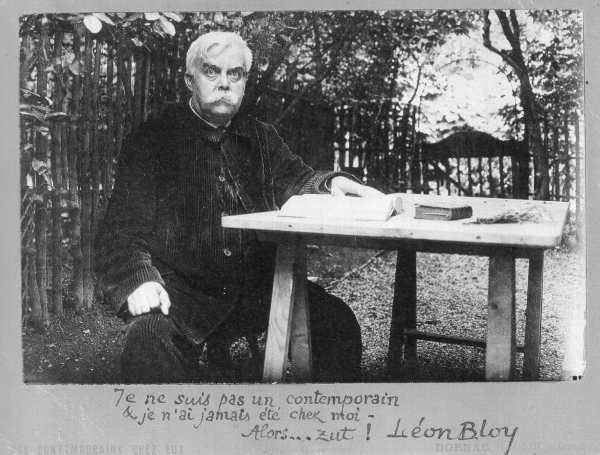
A close friend to Joris-Karl Huysmans, and later admired by the likes of Kafka and Borges, Léon Bloy (1846-1917) is among the best known but least translated of the French Decadent writers. Nourishing antireligious sentiments in his youth, his outlook changed radically when he moved to Paris and came under the influence of Barbey d'Aurevilly, the unconventionally religious novelist best known for Les Diaboliques. He earned the dual nicknames of "The Pilgrim of the Absolute" through his unorthodox devotion to the Catholic Church, and "The Ungrateful Beggar" through his endless reliance on the charity of friends to support him and his family.


His fire is nurtured by the dung-heap of modern times.”—Franz Kafka

“Bloy has come my way... He is an iceberg hurled at me to break up my Titanic and I hope my Titanic will be smashed.”—Flannery O'Connor

“Léon Bloy is a cathedral gargoyle who pours the waters of heaven down on the good and on the wicked.”—Barbey d'Aurevilly


The Infusion
An "Unsavory Tale" by Léon Bloy


Granted, the title is not necessarily enticing -- but at least Bloy is upfront from the beginning. And these are, indeed, tales of the disagreeable -- the often monstrously disagreeable. They're strikingly amoral, too: Bloy doesn't tuck edifying lessons into them. Yet Disagreeable Tales isn't mere profaning revel in the worst of man (as, for example, de Sade's endless cataloguing novels are).
       The subject matter is striking. The first two tales alone see, respectively, a mother responsible for the death of her child, and a daughter responsible for the death of her father; in neither case is there any doubt about responsibility for the death, and yet the true cruelty, or at least final twist, is in it being accomplished (slightly) indirectly. The first tale, too, is typical of how Bloy tidies up his tales and what he offers in conclusion, the closing paragraphs reading:
     "Finally !" she sighed, somewhat weary, and reached to ring for a servant.
     Jacques had a severe aneurysm, and his mother had a lover who didn't want to be a stepfather.
     The simple drama occurred three years ago in the neighborhood of Saint-Germain-des-Prés. The house that served as its theatre now belongs to a demolitions contractor.

       There are many other deaths, too, -- including one truly horrific parricide -- but even beyond that there's a great deal mired in the repulsive. Personal descriptions such as: "Her face resembled a fried potato rolled in scraped cheese" and "Your face is like a straw mattress they've all cleaned their boots on" abound. One character is introduced:
     The very sight of the old man engendered vermin. The dung heap of his soul extended so far into his hands and face one could not possibly imagine a more frightful contact. When he walked the streets, the slimiest gutters, shuddering at the reflection of his image, seemed to flow back to their source.
       Occasionally, Bloy explicitly acknowledges
     I am getting to the culmination of the story -- which kills me, devours me whole, and defiles me beyond all conception.
       But most of these tales speak for themselves in their abasement.
       There's a surprising casual lightness and stylishness to the writing too, making more of them than just ugly tales. Bloy's short pieces move along quickly, a succession of short paragraphs that often summarize compactly and leap quickly ahead. He may revel in filth and obscenity, but Bloy does not wallow; he observes, records -- and moves on. And Erik Butler's translation nicely captures the language and style of the era that Bloy relies so heavily on (as Disagreeable Tales is very much a decadent literary product of the French fin-de-siècle).
       There's a great deal of variety to the tales too -- quick summings-up of lives (that usually weren't exactly what they seem), anecdotes of decisive episodes. Bloy has some fun in making several of his protagonists literary types -- but there's no romanticizing of this path here:
     He had been given literary genius in addition to everything else. It was the kindling of his torments.
       And no matter how bad it gets, Bloy can always ratchet things up another notch:
     Nor is that all, O, my God ! Behold the abyss of woe.
       There's something ridiculous to all of this, too -- but then there has to be; to read it seriously seems almost unthinkable. Yet despite a light and occasionally even comic edge, this isn't really satire. Perhaps what makes for their staying power is an underlying sincerity to the stories; Bloy isn't a traditional moralizer, but there's a firmness of belief in society and men's failings, perhaps colored by his (surely complicated) religiosity, that underpins these tales: Bloy isn't just mocking, or aiming to shock; he really means to shake his readers with his depictions of the baseness of life at all levels.
       Decidedly odd, these Disagreeable Tales are nevertheless weirdly appealing. - M.A.Orthofer


“(He) was an utterly generic man – the next best, in a host of insignificant and vacant individuals, to happen by; he seemed one of those people who exist in the plural, so fully do they express atmosphere, collectivity, and sameness... His face seemed to be cast by a spade; it belonged to the innumerable number of fake he-men from the South no interbreeding can refine – but in whom everything, even the uncouthness, is just for show...”
  From 'A Dentist's Terrible Punishment,' featured here with twenty-nine other raucous faux anecdotes, this passage reminded me of one of British Prime Minister David Cameron's recent rhythmically alliterative, but ultimately empty, speeches. I had to smile, in a way that the tale's author Leon Bloy (1846-1917) would surely have approved.
  This is a theatre of blood from the perspective of a catholic outsider. A born contrarian, who seemed to lose as many friends as he gained, Bloy swung from a youthful hatred of the Catholic Church to converting to it in adult life under the pervasive influence of local novelist and short tale author, Barbey d'Aurevilly; a dandyish figure of the previous generation whose open literary non-conformity would soon inspire Bloy's own. Proudly unclubbable as Bloy became - being also unemployable - left the permanently destitute writer with little choice but to plead for financial aid from friends and found acquaintances. This left him with the unenviable moniker, 'the ungrateful beggar,' yet one, if connected to his output, that might also be deemed a selling-point. Among what he produced (three autobiographical novels and eight volumes of journals) nevertheless stand as a barefaced antidote to stuffier English cousins.
  Oddly, what all my biographical sources leave unwritten is Bloy's disparaging, satirical humour; at least highlighted in this collection. Here, he punctures the sinecures of self-serving middle-class complacency with as much black vehemence as any contemporary anarchist. Translator Erik Butler, in his Introduction, at least acknowledges this:
 
“A few years after Bloy's birth, in 1851, Louis-Napoleon Bonaparte staged the coup apropos of which Karl Marx, glossing Hegel, made the famous observation that historical events occur twice: 'the first time as tragedy, the second as farce.' The less-than-great man's reign, which began with harshly repressive measures and, ten years later, introduced the so-called Liberal Empire, was imposing but hollow. The 'real' Napolean had been a revolutionary general who succeeded in conquering half of Europe. Napolean III, as his nephew called himself, measured up only in appearance.”
 
  Understanding this context helps understand the trigger for Bloy's ripe, lampooning venom. I'd argue he did too well, if not protesteth too much. The paradoxical effect – far from accusing the guilty back into the fold – surely only highlighted to his readership the hypocrisies in organised religion all the more.
  While the tone – at least in this collection – is openly misanthropic, by the standards of the day it is surprisingly un-misogynist; the women characters of their class as well delineated – and taken down – as his men, with the latter on the receiving end of marginally greater contempt.
  Yet, again, how can even today's politically-correct critics not find irresistible wit in, “Her face resembled a fried potato rolled in scraped cheese...her whole person exuded the odour of a landing in a furnished hotel of the twentieth order --- on the seventh floor.” ('Two Ghosts').
  As with most of Wakefield Press's reissued translations, (and Butler has done a deliciously sinuous job), I can give near fulsome recommendation; as long as you are prepared to keep a wryly jaundiced tongue in a capacious, accepting cheek. - Mark Andresen

Bloy observed the vows of both poverty and suffering; he earned the nickname the Ungrateful Beggar.
In his first homily as Pope Francis, in March 2013, the Pontiff included an obscured voice of the French fin de siècle. Restating one of the most entrenched principles of Catholic dogma, Francis declared, “When one does not profess Jesus Christ, I recall the phrase of Léon Bloy—‘Whoever does not pray to God, prays to the devil.’ ” Though it may have struck religious scholars as unusual, the reference to Bloy indicated the Church’s cautionary role against the millennial idolatry of technology and humanism. Bloy, who wrote a series of pamphlets, novellas, and essays during the increasingly scientific climate of the Second Empire and the Belle Epoque, included himself among the cabal of symbolists and decadents who had taken Satan as the object of their literary obsessions—specifically, the resurgence of the devil in the popular French imagination.

Richard Weiner - Blending metaphysical questions with farcical humor, bizarre twists, and acute psychology, The Game for Real is a riveting exploration of who we are — and why we can’t be so sure we know

The Game for Real by Richard Weiner


Richard Weiner, The Game for Real, Trans. by Benjamin Paloff,  Two Lines Press, 2015.         excerpt


Compared to Kafka and a member of the Surrealists, Richard Weiner is one of European literature’s best-kept secrets. The Game for Real marks the long overdue arrival of his dreamlike, anxiety-ridden fiction into English.
The book opens with The Game of Quartering, where an unnamed hero discovers his double. Surely, he reasons, if he has a double, then his double must also have a double too, and so on . . . What follows is a grotesquely hilarious, snowballing spree through Paris, where real-life landmarks disintegrate into theaters, puppet shows, and, ultimately, a funeral.
Following this, The Game for the Honor of Payback neatly inverts things: instead of a branching, expanding adventure, a man known as “Shame” embarks on a quest that collapses inward. Slapped by someone he despises, he launches a doomed crusade to return the insult. As the stakes grow ever higher, it seems that Shame will stop at nothing — even if he discovers he’s chasing his own tail.
Blending metaphysical questions with farcical humor, bizarre twists, and acute psychology, The Game for Real is a riveting exploration of who we are — and why we can’t be so sure we know.   
                      
In this edition of Czech Books we look at the work of Richard Weiner, a Czech writer of the first half of the twentieth century, who was immensely influential on his own and later generations of writers and yet today is little read and little known outside the Czech Republic. Even within the country, among the writers of the period of the First Republic, he is far from being a household name. This neglect is very much undeserved, and one person who has been trying to draw attention to Richard Weiner and his legacy is the translator and literary scholar, Martin Tharp.


Martin TharpMartin Tharp
What made you interested in this almost forgotten Czech writer?
“I would first say that he is not almost forgotten, but he is definitely a kind of minority taste. He was officially neglected during the years of “normalization”; not that they disapproved of him for anything that he wrote. He was not in any way a programmatic anti-communist, or even have much of a definite political position most of the time. However, they did disapprove of him simply for being Jewish, cosmopolitan and modernist.”
And that was enough to be going against the grain of socialist realism of virtually the whole period of the post-war.
“That’s true. At the same time I think it is not so much even a question of communist ideology, but he went so much against even a kind of Czech national self-conception. For one thing, he was very closely tied to artistic life within Paris, where he lived as the Lidové noviny correspondent throughout the 1920s up until the late 1930s.”
I think this is an important point to make. He was a Czech writer, but he spent most of his active life and career outside the country.
Richard Weiner
Richard Weiner
“That’s true… mostly in Paris and what is also interesting is that at the time when Czech literature and art looked towards Paris for their chief inspiration, he was actually there, and he knew people. Every time that a new book by Proust would come out, he would review it in Lidové noviny for that very week, even before it was translated. At the same time though, he was writing his own literary work, which is what his reputation is built on – even though his journalism makes such wonderful reading that you don’t want to pick up one of today’s newspapers!”
Here is a short extract from one of his newspaper articles:
In a single life the average person reads many a stupid book, sees countless bad theatre productions and hears endless hours of poor music, and so often trembles in convulsions before all sorts of colour imprints. Likewise he sees films that are foolish, falsely comic, falsely tragic. Indeed, so many types of tastelessness saturate our lives, let this be taken as fully valid coinage. If, though, one meets with the most stupid of stupidities that knows whereof it is and nonetheless hopes to amuse one, the reaction is to rise up in indignation against such a suggestion. For there is for me nothing more unbearable than when a fool has the daring to take me for a greater one. As far back as my memory can reach, I cannot remember having met with a greater idiocy than now exists in the cinema. That it precisely transpired in cinematography pains me, since up to now I have held it in esteem.
(trans.: Martin Tharp)
So we can see that he was an outspoken critic…
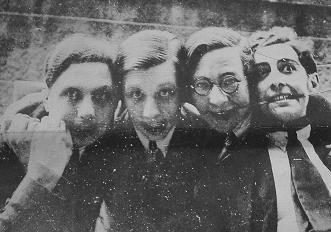
René Daumal, Roger Vailland, Roger Gilbert Lecomte, Robert Minet
Very definitely. But at the same time as this, his own writing, both in prose and in poetry, is very different. He started out as a poet, and I should add that, though he was from a Jewish family, much like that of Kafka, he was not from Prague, but from the provincial town of Písek in South Bohemia, an area where almost exclusively Czech was spoken – even though he was by-and-large bilingual in German. Secondly, when he started off as a poet before World War I, most of his poetry was still fairly lyrical and romantic, celebrating the strength of nature. That all lasted up until he was mobilized, first in 1913 to Bosnia - then part of the Austro-Hungarian Empire - and then again, after the attack in Sarajevo he was sent back to the front. He suffered a nervous breakdown, was invalided out of service, and during that time he wrote what I would consider to be his first truly mature work. It is a series of stories from his experience of the war, the horror of modern trench warfare.
“And after that, also in the immediate post-war years, he completed his second volume of short stories, called “Škleb” (The Grimace), which is in my view probably one of the finest things he wrote. Then he stopped. He stopped his creative work altogether, went to Paris, wrote his pieces for Lidové noviny, and did not seem to want to do anything more than that.”
Josef Sima
Josef Sima
This changed when Weiner introduced his friend, the Czech painter Josef Sima, to some of his French artist and writer acquaintances, most importantly René Daumal and Roger-Gilbert Lecomte, who were interested in the ideas of the surrealists, but at the same time had doubts about the Marxist and anti-religious tone of André Breton’s surrealism. Unlike Breton they felt that they could reach other poetic realms not just through the dream but even through mysticism or religious ecstasy. This encounter led to the emergence of a group called Le Grand Jeu (The Big Game). From the start Weiner played an important role in the group, in the process falling in love with the much younger Lecomte. The encounter was to influence his literary career.
'Le Grand Jeu'
'Le Grand Jeu'
“He returned to writing poetry and eventually to his last volume of prose. But the one thing to remember is that after his two final prose volumes, he increasingly suffered from stomach trouble, which turned out to be cancer of the stomach. In 1936 he left Paris, returned to Prague, moved in with his sister and within a year he was dead, almost as if he knew what was coming.”
As someone of Jewish origin, he would have been unlike to have survived the Holocaust.
“I have chosen an extract from one of his stories called ‘The Voice in the Telephone’, from the volume, ‘The Grimace’. I should begin by explaining the plot of it. It is the story of a man who refers to himself as a hermit of the metropolis, a solitary confirmed bachelor. One day, sitting in his usual chair in the café, he is called to the telephone. A mysterious female voice on the telephone says to him, ‘I’m in love with you, but I can’t reveal who I am.’ In fact, throughout the story, he never finds out who this person is. This extract is from the middle of the story:"
Fourteen days had passed since that encounter in the café, and I had seen no persons unknown to me. Today, however, the voice again spoke into the telephone, and into that instrument for which we had made our agreement – so laugh, if you so wish. In any event, you may think whatever thought you find preferable.
“What is it that you demand? That I had promised, while making my invitation, that I would come as well? If I had wished to reveal myself, would I have chosen so convoluted a path? And if I love you, of which you have no doubt, fearing all the while to appear before you, would I have wished upon you such an awkward situation? I never have seen that woman whom you describe.”
“Such a turn of phrase is one we occasionally use if we speak of ourselves. But this joke has gone a bit stale. I know that the unknown woman was you.”
“Is that what you believe?”
“More than believe: know!”
“Then all that I can now do is to disappear forever. For you have betrayed me.”
“I betrayed you?!”
“Yes, for you do not believe the only thing that is reality: the word.”
“You promised me a sign. Now give it!”
“I have given you countless signs for you to believe that I am who I am.”
“I never noticed a one of them, and asked you in vain for a sign that was apparent. In addition, I have no doubts that you are who you are.”
After a pause, she spoke:
“There is no time for jesting. Was it not I who started this fermentation in your mind? Was not I the cause of it, when upon that one day you noticed how long the path may be towards others, yet for all that a path of which you had never known before? Was I not the cause of it, when you began to notice with much closer attention things diminutive and subordinate? Who else but I whipped up within you the desire, and the question of whether you are indeed attractive to women? And why, then, do you persist along that course that leads nowhere, unless it is to death.”
(trans.: Martin Tharp)
There is a very distinct similarity to Kafka in this writing.
Richard Weiner
Richard Weiner
“I would say very definitely that it is similar to Kafka, but at the same time, you could also find so many other references in this, because he bore so much of the world of Habsburg Vienna within himself, and at the same time was able to touch upon equally the world of French modernism, of the great importance of the dream and the unconscious, and the unknowable. The way that he was able in his life to bring these two elements together really does mark him out as a kind of genius of the twentieth century. But at the same time, he really is, because of it, outside of even the main currents of Czech modernism, which were -most of them – born around 1900 and too young to be called up for military service. They simply saw the new world, the post-war order, as a kind of ecstatic liberation, which Weiner never did. He never could have. And of course for that reason their ecstatic liberation included an enchantment with Marxism and later, in the case of many of them, they turned into complete cultural functionaries after the communist coup of 1948, a form of mental coarseness which Weiner never had. This made him perhaps more influential for dissident literary life in the 70s and 80s. He was to a certain extent rediscovered during that time as someone who did not succumb to these siren-songs of modernity.”
And he has never been translated into English.
“That is something I have always found strange – that no one has yet taken him up, possibly because his own command of Czech is very unusual. He had a great love for archaic forms of grammar, even deliberate archaisms of style that at the time when he wrote must have sounded more than a bit strange or backwards.”
You have taken up the challenge of translating some of his work.
“I have done so, I think, because he really is a kind of European mind, that brings in the experience of trench warfare in Serbia, of cafés of a provincial capital of the Habsburg Empire and a close connection with the Parisian avant-garde, as well as just the fact that his stories are just so enjoyable to read at the end of the day.”

2/5/15

Jiří Karásek ze Lvovic - the novella is set in Prague, which is portrayed as a dead city, a city peopled by shades, who, like the protagonist — a nihilist and the "last scion of a noble line" — are only a dim reflection of the city’s medieval splendor. The man lives in a dreamworld, the labyrinth of his soul giving rise to visions


Jiří Karásek ze Lvovic, A Gothic Soul, Trans. by Kirsten Lodge, Twisted Spoon Press, 2015. [1900.]


A Gothic Soul is the most acclaimed work of Czech Decadent prose. Expressing concerns that are unique to the Czech movement while alluding creatively and ironically to Joris-Karl Huysman's Against Nature, the novella is set in Prague, which is portrayed as a dead city, a city peopled by shades, who, like the protagonist — a nihilist and the "last scion of a noble line" — are only a dim reflection of the city’s medieval splendor. The man lives in a dreamworld, the labyrinth of his soul giving rise to visions. In his quest for meaning, he walks the city, often hallucinating, while pondering questions of religious fervor and loss of faith, the vanity of life, his own sense of social alienation, human identity and its relationship to a “nation,” the miserable situation of the Czechs under Habsburg rule, and Prague’s loss of its soul on the cusp of modernity as old sections, such as much of the squalid Jewish Quarter, are demolished to make way for gaudy new buildings and streets. With a history of madness running in the family and afraid the same fate awaits him, he ultimately retreats into seclusion, preferring the monastic way of life as the epitome of unity and wholeness and a tonic to present-day fragmentation. Yet Karásek eschews the mawkish, opting instead for darker tones that play with the tropes and motifs of Decadence while conflating the same-sex desires of his protagonist, the fatalism and futility of such an existence within the social construct of the day, with concerns for the dual fates of his nation and city.

Given his importance for Czech literature and for European Decadence, very little of Karásek's work has been translated into English. Kirsten Lodge included translations of his poetry in Solitude, Vanity, Night: An Anthology of Czech Decadent Poetry, and we have made available her translations of some of his shorter prose here and here. This is the first time A Gothic Soul, or any full-length work of Karásek's prose, has been translated into English.


Jiří Karásek begins his Preface by noting that: "A Gothic Soul is not a novel in the usual sense of the word". He admits: "It has almost no plot" -- it is: "the painting of a soul, he suggests. He acknowledges that it: "originated in the diary of a twenty-year-old" but emphasizes that it isn't a work of realism; indeed, he insists:
     To say that art should represent the world as it really is would be to assert that the purpose of art is to imitate those things that do not interest us even in reality.
       A Gothic Soul is, indeed, an intense decadent wallow, but it is also fairly reassuringly novel-like, its story-arc one of life-summary, of decline and fall. The protagonist is left unnamed, but a recognizable type, "the last scion of a venerable chivalric family" that, over the generations, had frayed under the "hereditary degeneration" that he worries afflicts him too.
       Already on the novel's first page an example of what becomes his life-long personal struggle is vividly described, from his insistence on confronting it head-on (or having the constant reminder staring back at him) to the rather dramatic affirmation of his concerns:
     The gaze of one particular relative frightened him terribly.
     He had died of religious mania, quite young.
     He had hung his cousin's portrait over his desk.
     The older he grew, the more convinced he became that they resembled one another. But he thought his senses might be deceiving him -- until a relative he hadn't seen for some time shrieked at their resemblance and plunged him back into doubt.

       In appearance, he's your typical Gothic-decadent specimen:
     He grew up anemically pallid, wasted rather than thin, and he looked lifeless.
       His parents die when he is young and he's raised in a very religious household, and the pull of religion (and mysticism) is always a strong one. A solitary soul, always looking inwards, he is influenced by what he encounters, even if his engagement remains passive, withdrawn, and introspective. He's your typical overheated, tormented young soul, and there's little that can shake him out of this near-stupor.
       He struggles:
     To conquer bodily desires ... To immerse yourself in melancholy over your own inner self ... To find a continuous but delicate trembling in the agitation of the nerves.
       The atmospheric Prague setting contributes nicely to the overall feel: as Karásek sums up:
     The Gothic still lived in Prague ... And then again everything was dead ...
       Karásek's protagonist is very much Czech, and in part his journey -- of the soul and mind -- are colored by that, too. So, for example, at one point:
He sought the explanation of his impotence in his being Czech.
       Religion plays a significant part in his life, but he can not embrace and follow in the traditional form; his heated soul finds a great deal in religious imagery and Church-myths -- notably the Christ-figure -- but unsurprisingly it is warped in his own tormented perspective.
       There is, of course, little hope for a happy ending here. A Gothic Soul is a novel of the decadence, through and through, a variation with less concern for the eternal-feminine than many others (Karásek was homosexual) and more directly influenced by (and reactive to) religion. Much of the writing is splendid -- if very much of the feverish-decadent school -- and though its arguably just another variation of a familiar take, it's still a fine exemplar. Beyond that, the book can be recommended for the Author's Preface alone, a wonderful summary of Karásek's endeavor and personal philosophies. - M.A.Orthofer


Published sixteen years before this book - and therefore too early to appear on my website - J K Huysmans' À rebours (Against the Grain) was the classic decadent novel, telling the story of a man who is disgusted with human society. It clearly influenced Karásek who, we know, read both French and German. The books, while similar in style (last scion of a noble family, a man who cuts himself off from society, strong Symbolist and religious imagery), are also different in many respects, as you would expect from the different French and Czech sensibilities.
This book is narrated by an unnamed narrator. However, before we get to his story, there is an author's preface, in which he explains what the book is about (and what it is not about). It has almost no plot. The protagonist merely walks around his room, or wanders the streets and reflects. A nameless protagonist – without external tribulations, subject to no outside calamities. He has become separate from everything real and material. Rather than plot, a series of stories and episodes, you will find the painting of a soul, uninterrupted by plot details – a continuous flow, a spiritual stream. My book is not a narrative; I have composed it from spiritual processes. Impression follows impression. Feeling gives way to feeling. Spiritual states are in constant agitation.This certainly sums it up. There is no narrative, as he says, in that not a great deal happens, at least a great deal outside the head of our narrator. He is the last scion of a venerable chivalric family, of which a few impoverished women remained, afflicted by hysteria. One of these women has apparently died of religious mania. He wanted to be a priest or, more particularly, a monk, not necessarily for the glory of God but for the solitude, so that he could spend his days in solitude and contemplation, away from people. He is fascinated by death and the dead. He frequently wanders Prague, a Prague which seems to be almost deserted, except for the occasional people at the stations he uses. Indeed, it seems to be a city of the dead, as he visits churches, chapels, crypts, and cloisters. He frequently ends up at the now deserted Barnabite cloisters and it is clear some denouement will take place there, as it does.Physically, he is anemically pallid, wasted rather than thin, and he looked lifeless but inside he has a soul, at least as far as things dead were concerned. The dead came alive for him, while everything alive died before entering his soul. His inner soul is sensuous and, at times, he is carried away by the beauty and smell of flowers but this is all in his mind, not there in reality. Indeed, at times, he has the same feelings about God, feeling very much that he is at one with God and that, with God, he would participate eternally in the beauty that is concealed from everyone else.He did train for the priesthood but melancholy, doubt and a fear of people overwhelm him and he abandons the idea. Indeed, he becomes so afraid of people that he shuns any places, even funerals, where there is a risk of meeting them. However, he later begins to somewhat regret this and yearns to have a friend. On a couple of occasions he meets someone who might be a friend but eventually pulls back from pursuing the relationship. (Though this is not mentioned, we know that Karásek was gay, so it is probable that the relationship the narrator is seeking is a sexual one as much as an intellectual one.) Sometimes, he wants people, other times not. On one occasion he flees Czechoslovakia and wanders round Bavaria for a while, before returning to Prague. But his mantra remains to flee from Judea to the mountains. Despite this, he is is concerned about what he calls the Czech soul. Indeed, he goes as far as anthropomorphising it and listening to it (or, rather, as he calls it, her) speak, though he maintains that it has now died. Nihilism, yes, nihilism is the only philosophy possible for this people he states and reviews the grim nature of Czech history. He turns to God, he turns away from God. He looks for solitude but wants some company. Christ comes to him as a silent stranger but he cannot connect with him. He visits his aged aunt and, after searching in various rooms, finds her but neither she nor her maid recognise him, the aunt assuming that he is Vilem, her dead son. The end is inevitable. The narrator is a man who is clearly not able to fit into this world or, it would seem, the supernatural world. His world is the world of his inner sense, away from human contact, struggling with his relationship with God, if, indeed, there is a god, something he wonders on more than one occasion. His way is the medieval way of life or, at least, his somewhat idealised idea of what the medieval life might have been for the medieval ascetic, a life of contemplation but also a life very close to death and death's images. Indeed, for someone like the narrator, who has had little experience of life, this is all that life has to offer - death. - www.themodernnovel.com/czech/karasek/gothic.htm


I’m your only friend I’m not your only friend But I’m a little glowing friend But really I’m not actually your friend But I am
Blue canary in the outlet by the light switch Who watches over you Make a little birdhouse in your soul Not to put too fine a point on it: Say I’m the only bee in your bonnet Make a little birdhouse in your soul
I have a secret to tell From my electrical well It’s a simple message and I’m leaving out the whistles and bells So the room must listen to me Filibuster vigilantly My name is blue canary One note, spelled L-I-T-E My story’s infinite Like the Longines Symphonette It doesn’t rest
I choose birdhouses in your soul as I used a lightbulb in my review as a metaphor for the narrator .source 
I love it when Twisted spoon bring a new book out as they seem to choose books that firstly would never see light of day in the uk , secondly are important in the context of where they are from . Here again they have published a book from the Czech decadence movement .A counterpart of the French books at the time this book has a much darker feel than the French decandence movement books I have read .Jiří Karásek ze Lvovic was a novelist and critic .He found the modern review a well-known magazine of the time that published the best French and Czech decadent movement writers  .
But he didn’t die
He arose from bed even paler than before . The sound of his voice was more somber . He looked even more terrifying . His eyes now disturbed anyone who looked into them .They lacked luster .They harboured a secret that seemed accusatory , though it could never be expressed in words .
His struggle is beyond words in the world around him .
The book is the story of a nameless narrator and his struggle in the world he is living a world that is caught under an empire that has changed from the world he knew. He wanders the town seeing these changes around him  .As much as it is his story it is also the story of the city he lives in which is Prague the city at night jumps of the pages .He seems to be struggling with life and death as the book goes on the world around him seems to dissolve to the struggle with in him .He is the last of his line losing faith in the world around him .He even goes to churches to try to find solace but struggles too .
He left the church .
Where he wandered after that , he could no longer remember .
Today everything that had occupied his soul back then was revived .He knew he would not be able to escape the dank tomb of the past into which he had descended , to free himself from the enchanted circle of overwrought blood and nerves in which he had unexpectedly become entrapped from this atmosphere could not be approached without incurring punishment .
A torture soul which even the church can’t save .
This is one dark book a man’s soul is on the line and we see how he struggles with it .A way to look at the book is the context of when it was written in 1905 the world has just entered a new century . The Habsburg empire is harked back to a lot the book  this of course in hindsight is showing the first ripples of the start of world war one . The narrators worry about his own world and the city of Prague maybe show the greater picture a world that has grown a modern age the is fast approaching them . This shows how one man gets caught in the world in flux  and like those early lightbulb he is trying to light his night , his dark places  but maybe is about to burn out! .
Have you a favourite book from the decadent movement? - winstonsdad.wordpress.com/2015/05/02/a-gothic-soul-by-jiri-karasek-ze-lvovic/


'Reality has only one purpose in art: the artist must become familiar with it so as to know how to avoid it'

Originally published in 1900, A Gothic Soul is a mysterious and alluring piece of fin de siècle decadence in the vein of JK Huysmans and Gustav Meyrinck. Presented by the Prague-based Twisted Spoon Press, with a new translation by Kirsten Lodge, the novel touches on themes of modernity, aesthetics and alienation, as well as contemporary psychiatric debates.
In his preface, a stream of Wildean epigrams regarding art and reality, Karasek declares that A Gothic Soul is 'not a novel in the usual sense of the word’; instead, it is ‘a diary of emotions and moods, of the undulating play of the spiritual world, an account of stories of the soul'. The narrative, such as it is, focuses on the inner life of a young man, 'the last scion of a venerable chivalric family'. Fearing that he may be suffering from a ‘hereditary degeneration’ which has afflicted his ancestors, the youth retreats from the world, attempting to exist in undisturbed solitude. Karasek details the morbid fantasies which concern the young man, who feels alienated by modernity.
Like the ‘decrepit old man’ of Poe’s The Man of the Crowd, the youth is an uncanny, idiosyncratic presence on the streets of early Twentieth century Prague; his eyes, in particular, ‘disturbed anyone who looked into them’. After spending a year living alone in Bavaria, he has returned to his homeland 'resolved to live by nothing but his dreams'. As with des Esseintes in Huysmans' novel A Rebours, he yearns to live an idealised and solitary existence, but crucially, he has never really been at home in society. So how can he renounce a life he has never fully lived?
His thoughts are primarily concerned with the difference between experience and understanding. The question of religious experience is particularly fraught. Watching worshippers in church, he witnesses the ecstasy of direct religious experience, 'mad kisses on holy wood... eyes burst into a blaze of frenzied pleasure', yet when he tries to experience this himself, he is repelled by man's attempts to bridge the gap between the mystical and the mundane, the 'arid desert' of theology. He is suffering from a form of false consciousness – the social conditioning which taught him to analyse and understand the phenomena which surround him has left him feeling alienated. He can learn, but he cannot feel: 'His entire attempt at life now seemed to him an effort to improvise on a violin whose strings had lost their sound and gone forever mute.'
Searching for a purer way of experiencing the world, he looks back to the Middle Ages. He is entranced by world of mythology, which is contrasted with the perceived drudgery of modern life: 'Czechness itself lost its contours in his thoughts, and the more everything became legendary, the more glorious that unfulfilled mission appeared to him'. He is all too aware, however, that his fantasies are illusory: ‘The Middle Ages were dead'.
The young man’s struggles are also those of the aesthetic movement. He privileges form over function, and yearns to live his life intensely, but seemingly lacks the capacity for such elevated thought. In an echo of Flaubert’s observation that an artist should ‘be regular and orderly in your life, like a bourgeois, so that you may be violent and original in your work,’ Karasek’s preface stresses that the artist must be familiar with reality, in order to avoid it in his writing. By contrast, his protagonist has been isolated and withdrawn from a young age, leaving him incapable of the sort of transcendence that aestheticism demands. Lacking experience, he is little more than a ghost who haunts himself.
This is the first time that a full-length work by Karasek has been released in English, and Twisted Spoon must be thanked for making such a fine example of Czech decadence available to a UK audience. Karasek’s writing is finely crafted, and Lodge deserves credit for her lyrical and fluid translation. While A Gothic Soul is primarily an introspective novel, the atmosphere is comparable to Meyrinck’s great works The Golem and The Green Face, and the two authors deserve to be viewed on an equal footing. - workshyfop.blogspot.com/2015/04/review-gothic-soul-jiri-karasek.html


Ana Kordzaia-Samadashvili shoots from the hip in these intimate tales of sometimes judgmental, often imperfect, but always likable women


Ana Kordzaia-Samadashvili, Me, Margarita: Stories, Trans. by Natalie Bukia-Peters, Dalkey Archive Press, 2015.


Short stories about men and women, love and hate, sex and disappointment, cynicism and hope--perhaps unique in that none of the stories reveal the time or place in they occur: the world is too small now for it to matter. A disillusioned woman, the narrator doesn't mince words about the imperfection of her life, her relationships, her prospects; yet what might in other hands seem discouraging is presented with such humor the reader can't help but feel there may yet be hope... for most of us.


Strikingly, in none of her stories does the author reveal time and place: the world is small, it could happen anywhere. Nothing is fabricated. The first-person narrator is usually an enlightened, disillusioned woman: without mincing her words she mocks the widespread pseudo-intellectuality and rediscovered religiosity of the times as well as her own unbecoming appearance, the usually under- or overestimated power of „eternal love“ and the dream of a perfect relationship that in reality is often quick to founder on the rock of impossible expectations. All this is told with such enjoyable humour that the reader cannot help but resolve to take life more lightly. - gratzfeld.ch/pages/en/authors/anakordsaia/title/memargarita.php?lang=EN


The Georgian Margarita is becoming one of the strongest female literary figures for years. And she is, in her uncomplicated, open way, more emancipated than any feminist construct... As is thematised in one short story with the rather suitable title 'Waiting for the Barbarians,' one of Margarita's most terrible experiences is the gradual disappearance of Georgian culture as it is replaced by European and Russian standards... This thematisation makes the book an unmatched achievement that simultaneously fascinates and alienates. What does cynicism taste like? And what colour is disillusion? Me, Margarita is powder blue and tastes refreshingly bittersweet. - Emil Fadel


As translators Field and Bukia-Peters write in their introduction to this delightfully frank collection of stories, “Georgia is little known on the international scene....” Enter the gifted Georgian writer Kordzaia-Samadashvili, who shoots from the hip in these intimate tales of sometimes judgmental, often imperfect, but always likable women. In the title story, the collection’s best, the country’s tumultuous history is alluded to in terms of a beautiful gorge, controlled, in turn, by Persians, Ottomans, and Russians; the gorge was also an important site for a lineage of women, all named Margarita, whose blunt sensibilities set the tone for the collection. In “Nina,” the narrator begins by saying, “I was never a very close friend of Nina’s. I can only take so much.” She proceeds to explain all the things about Nina that drive her crazy, not least of which are Nina’s tendency to cry in public and her fear of being alone at night. In almost every one of these discursive stories, the wit and self-awareness of the narrators hints at the difficulties they’ve endured without a lick of self-pity. With great skill, Kordzaia-Samadashvili brings readers into the kitchens, bedrooms, and hearts of these coarse, forthright women.  - Publishers Weekly


Challenging, contemporary short stories with sharp feminist commentary, translated from Georgian. 
Kordzaia possesses such dexterity with tone and structure that the book’s 22 tales feel like raunchy, visceral oral history cloaked in an array of fictional forms. The collection begins with the long, somewhat confusing title story about generations of women looking back at personal and national history, giving birth, grieving husbands who’ve disappeared during wartime, by turns angry or in awe of fate. The story’s breadth frames the range of women’s voices that follow. They live in mostly urban places, usually Tblisi, in vague yet hard circumstances, surviving bad relationships, raising children with little support, often at each other’s throats just before waxing poetic about life. In “A Foreign Man,” a painting triggers memories of past love in a series of anecdotes about bygone parties and art openings with friends drinking, flirting, sleeping on balconies—a paean to the sweet taste of regret. Many stories are monologues with fine twists, equal parts comedy and pathos. The dialogue rivals Beckett (“There, In the North”) for existential hilarity, and in cooler moments, the prose is reminiscent of Jean Rhys. In “It’s Raining,” an unnamed narrator’s experience is rendered timeless as her tales of love gone wrong lead to an act of violence and a coda from a mental hospital: “I am waiting for the time when I’ll become embittered.” Dependence on men tends to lead to despair, the violence of a passionate affair akin to war, with those who’ve survived questioning their methods and self-worths. As one supposedly happy woman is asked by a depressed friend in “An Insignificant Story of a Failed Suicide,” “If I live a long and happy life, does that mean I’ll be sent straight to heaven?”
Not all gems but essential reading in a sterling translation from a country little heard from in English-speaking countries. - Kirkus Reviews


In the translators’ note at the beginning of Me, Margarita, Victoria Field and Natalie Bukia-Peters explain that the Georgian language is full of ambiguities – there are no genders, and no articles. Therefore it can be hard to tell whether a character is male or female, or whether they are referring to ‘a house’ or ‘the house’ – a small but significant detail. The stories which make up the collection are also characterised by ambiguity. We are rarely told when or where the action is taking place, and details of who is doing the telling can also be hard to come by. We see snapshots of lives, from bohemian city-dwellers to the rural poor.
Me, Margarita gives the reader an idea of Georgia’s tumultuous and contested history. Stories often involve language barriers, as characters attempt to communicate in Georgian, Russian, German and English, and streets frequently change names, frustrating anyone trying to track down people and locations from their pasts. The country has a contradictory character of its own – the landscape is bleak ('The weather was awful, the sun never rose, and, on top of that there was no electricity, just death and joylessness’), and yet it inspires a sort of magical thinking in its inhabitants: 'In this country, no matter who you ask, everyone says that everything will be alright and wishes will all come true'.
Throughout Me, Margarita, we see massive geopolitical events reflected through their impact on individuals. We see characters who have been displaced by conflicts gathering together and forming improvised communities, whether the cause is Stalin’s programme of Dekulakisation in the 1930s or the present day conflict in Chechnya. As the author explains in her introduction, 'it is clear that if it was not for the three wars after the nineties, the first and second world wars, the Soviet Union etc, we would have been entirely different'  - by focussing on the individual, she is able to provide insight into a wider process of social change.
Kordzaia-Samadashvili’s writing is phlegmatic, and occasionally vitriolic, but also retains a deadpan humour. She has the ability to create a revealing and amusing portrait of a character with a couple of well-chosen phrases, for example Vitiok, 'a typical throwback to the Soviet hippy era. He was slightly madder than was desirable and claimed to have some knowledge of Buddhism, as well as rather bold sexual demands'. Another, Stolichni, 'together with many other merits, had Latvian citizenship, a three-bedroomed flat, and not entirely groundless claims to be a genius'.
Relationships between men and women are a primary concern throughout the collection, and are generally characterised by suspicion and contempt. The women are ‘golden girls. Okay, we have stretch marks, cellulite, difficult personalities and we are horrible drunks, but so what?'. One of her characters likens love affairs to bare-knuckle boxing. The men are prone to drink, and to disappearing, and so the women tend to be resourceful. Margo, for instance, is described as being ‘a bit soft in the head’, but when she reaches a certain age, 'instead of becoming an alcoholic, or going mad, she set up an excellent business together with two other cheats', becoming a fortune teller. They also display a certain romantic fatalism: one, for example, sleeps with a tombstone of Venetian marble under her bed.
In the midst of these stories, the author has placed ‘When A Parrot Flies Over You’, a brief and rather beautiful meditation on love and sex which bemoans the fact that the civil rights movement passed Georgia by. Typically, this is sandwiched between the mordant humour of An Insignificant Story of a Failed Suicide ('never mind hanging herself, she'd never even managed to hang a picture') and the splenetic rant of A Wonderful Evening.
Me, Margarita is an idiosyncratic collection, which balances bleakness with gallows humour, whilst occasionally throwing in an offbeat essay, rant or comic observation to keep the reader on their toes. - workshyfop.blogspot.com/2015/01/review-me-margarita-by-ana-kordzaia.html


Ambroise Paré - an illustrated encyclopedia of curiosities, of monstrous human and animal births, bizarre beasts, and natural phenomena

On Monsters and Marvels


Ambroise Paré, On Monsters and Marvels, Trans. by Janis L. Pallister, The University of Chicago Press, 1982. [1582.]


Ambroise Paré, born in France around 1510, was chief surgeon to both Charles IX and Henri III. In one of the first attempts to explain birth defects, Paré produced On Monsters and Marvels, an illustrated encyclopedia of curiosities, of monstrous human and animal births, bizarre beasts, and natural phenomena. Janice Pallister's acclaimed English translation offers a glimpse of the natural world as seen by an extraordinary Renaissance natural philosopher.


Figure 2
According to French surgeon and writer Ambroise Paré (1573) there are several situations that cause monsters:

The first is the Glory of God.
The second, his Anger.
The third, Excess of Seed.
The fourth, too little Seed.
The fifth, the Imagination.
The sixth, the Narrowness or Smallness of the Womb.
The seventh, the indecent Posture of the Mother during Pregnancy; when she has sat too long with the her Legs crossed, or pressed against her Womb.
The eighth, as a result of a Fall, or Blows struck against the womb of the Mother, being with Child.
The ninth, through hereditary or accidental Illnesses.
The tenth, through rotten or corrupt Seed.
The eleventh, through mixture or mingling of seed.
The twelfth, through the Artifice of wicked Beggars.
The thirteenth, through Demons and Devils.

Paré’s Preface explains that Monsters occur outside the course of Nature; but they may still be signs of an impending misfortune. Examples of monsters are those with supplementary or deficient digits, arms, legs, heads.

Marvels are completely against nature, such as a woman giving birth to a serpent or a dog.

Examples of the maimed are

The blind
The one-eyed
The hump-backed
Those who limp
Those with six digits on the hands or feet (or less than five; or fused)
Those with arms too short
The nose too sunken or flat-nosed
Those with thick or inverted lips
Girls with closed genitals or excessive flesh
Hermaphrodites
People bearing spots, warts, or wens

… Or any other thing that is against Nature …

Tiffany Midge - The language sizzles, the images are burned into memory, the living and the dead are conversing in this powerful first book


Tiffany Midge, Outlaws, Renegades & Saints: Diary of a Mixed-Up Half Breed, Greenfield Review Press, 1996.


tourquoise.livejournal.com/


OUTLAWS, RENEGADES AND SAINTS is an explosion of talent and imagination. The language sizzles, the images are burned into memory, the living and the dead are conversing in this powerful first book"- Susan Power


Poet Tiffany Midge is the author of the chapbook Guiding the Stars to Their Campfire, Driving the Salmon to Their Beds (Gazoobi Tales); the full-length poetry collection Outlaws, Renegades and Saints: Diary of a Mixed-Up Halfbreed (Greenfield Review Press, 1996), winner of the Diane Decorah Memorial Poetry Award; and the children's book Animal Lore and Legend: Buffalo (Scholastic, 1995). Midge's work has appeared in North American Review, The Raven Chronicles, Florida Review, South Dakota Review, Shenandoah, Poetry Northwest and the online journals No Tell Motel and Drunken Boat. She is the recipient of the Kenyon Review Earthworks Prize for Indigenous Poetry for her forthcoming book, The Woman Who Married a Bear.

Midge earned an MFA from the University of Idaho is an enrolled member of the Standing Rock Sioux Reservation. She is of Hunkpapa Sioux and German ancestry, and grew up in the Pacific Northwest, where she lives now.