Jack Cox, Dodge Rose, Dalkey Archive Press, 2016.
excerpt
Eliza travels to Sydney to deal with the estate of her Aunt Dodge, and finds Maxine, a hitherto unknown cousin, occupying Dodge's apartment. When legal complications derail plans to live it up on their inheritance, the women's lives become consumed by absurd attempts to deal with Australian tax law, as well their own mounting boredom and squalor. The most astonishing debut novel of the decade, Dodge Rose calls to mind Henry Green in its skewed use of colloquial speech, Joyce in its love of inventories, and William Gaddis in its virtuoso lampooning of law, high finance, and national myth.
Back in 2013, word started circulating about a novel called Dodge Rose, written by the unknown Jack Cox and picked out of the slush at the Dalkey Archive only to wear their dreaded “forthcoming” tag. In The Quarterly Conversation, Daniel Medin put it at the top of his favorite reads, calling it “the most singular work of fiction written in English… this year.” But Medin read it in samizdat, and time went by and the book never launched. So here we are two years later, with Cox’s debut finally set to appear on shelves in November, accompanied by little fanfare, overshadowed by the fall’s towering monuments to massive advances, this little Australian novel about inheritance, tax law, and ownership, bearing comparison to Beckett and Joyce and Gaddis, with word on the street that it’s as good as any of them. Let’s not let this one go down without a fight. - Hal Hlavinka
The most singular work of fiction written in English that I encountered this year. Difficult to summarize what it does in so little space, though in addition to being a Great Australian Novel–in less than 200 pages–Dodge Rose is a funny and profound take on the legal language of property and ownership. For a sense of what Cox manages on a smaller scale, seek out his story “The Fisherman” in issue 6 of The White Review. You can even sample Dodge Rose in a recently published volume of The Review of Contemporary Fiction devoted to new writers. It may take a while for the entire book to appear, but remember this young author’s name: Cox is a brilliant and utterly original novelist, renewing the labors of Beckett and Joyce in exhilarating ways. - Daniel Medin
I promise to retire this anecdote after one last airing, but here goes: When Dodge Rose first landed at my desk at Dalkey Archive Press, I thought it was a hoax. A trap. (It wouldn’t have been the first.)
I showed it to my assistant editor of the time and he agreed: novels like Dodge Rose don’t come into one’s life in brown paper, humble, untrumpeted. They’re whispered of, recommended, enthused and griped about, passed around, gradually shibbolethed, forgotten . . . then reprinted with glowing intros, taught, accepted, and still never enough read.
It wasn’t possible, we said, that a young, Australian Beckett with virtually no publications to his name had just dropped in our laps. No, there was some sinister plot in the works. A plot to—well, what? Was this some éminence grise of the mainstream cutting loose and producing the high-modernist novel he or she had been lusting to write since their teenage infatuation with Ulysses? Or could this be one of Dalkey’s own authors—or employees?—submitting a novel under a false name to see if we would be able to sniff out the imposture? It even occurred to me to worry that Dodge Rose was, Ern Malley-wise, a prank, an attempt to snare a small press known for publishing “subversive” fiction into signing on a book written expressly to parody said fiction. There had to be a catch, no?
After all, when we sit down with Joyce, with Beckett, we sit down with the celebrity as well as the text, often instead of the text, even—you know who you are—in preference to the text. Sitting down with Dodge Rose, we were alone in the presence of Dodge Rose, and could not entirely believe the evidence of our senses, which told us, from the first gnomic sentence—“Then where from here”—that we were in the presence of the Real Thing.
Even now, with the book finally hitting stores, and the author’s identity confirmed (supposedly confirmed), there is a soupçon of suspicion in me, as though the trap’s jaws are still waiting, out of sight, to bite. Perhaps this is because, even now, after multiple readings, Jack Cox’s Dodge Rose remains something of a mystery—this is a book that demands a book’s worth of exegesis, not a brief appreciation—but its elusiveness is something I have come to treasure, and is in any case central to the book’s strategy of beguilement. It is cryptographic and disorienting in its manner of presentation, in the density of the information presented. But this is not, as they say, a drawback—it’s a feature.
Though made up largely of dialogue, Dodge Rose eschews quotation marks, wages an almost totally successful campaign against the hyphen, and, as it progresses, empties the apostrophe, the comma, and capital letters too from its aesthetic quiver. You’ll say that these are typical modernist tics, and you’d be right, but Cox goes a ways farther than homage: this is a novel that demands of the reader that she labor continually to orient herself not only in the sentence, on the page, in the plot, but in Australian history, geography, architecture, commerce, in property law, in the properties of language and personality. The reader can never sleep, letting the comfortable mores of fiction propel her from page to page, but must ask always who is now addressing whom, where in the line or paragraph did the speaker change, the tense, the object, the tongue? And neither is there any relaxing into incomprehension—the other form of readerly slumber—because Dodge Rose is that wonderful rarity, a novel that flirts so skillfully and successfully with seeming incomprehensibility, with some private order of authorial logic, that it never once crosses the line to lapse into the mere objecthood of so much “experimental” fiction, content to be read as a blank or black page. That is, Dodge Rose wants to be enjoyed, to be entered and experienced, to be grappled with and for its subjects to be grasped, not skimmed over. Its intentions are legible, but other; its tools are familiar but wielded askew. It is a work of fiction that, despite its playfulness of diction, its successful absorption and deployment of the full compliment of modernist artifice, is committed to meticulous research and deployment of the real—the real in all its definitions: “fixed, permanent, or immovable things”—while operating in a mode nonetheless dominated by a syntax of confusion, a vocabulary of multilingual malapropism.
As must be evident, then, whatever my paranoid, Dalkeyesque suspicions at the beginning of my relationship with Dodge Rose, I harbor no such doubts about the essential point: that it will go down as one of the most charming, mystifying, and dexterous first novels to have appeared in some thirty years.
So what is Dodge Rose about? What is it like?
It is a novel taking up the conversation in which Joyce and Beckett, Stein and Gaddis, Faulkner and Djuna Barnes and Henry Green were all, to various measures, engaged. More recent comparisons would be Sergio De La Pava’s or Jeff Bursey’s novels of legal transcript, though filtered in Cox’s case through the hilariously befuddling fustian of his genius countryman Joseph Furphy’s 1903 Such is Life, and with echoes throughout of the Dickens of Bleak House and his discursions there on the Court of Chancery.
There are two portions, not quite halves, to the book. The first is the story of Eliza, who travels in 1982 by train from rural Yass to Woolloomooloo—lovingly excoriated later as “woolloomoolethal,” “woolloomoolewd,” and “woolloomoolibertine”—to execute the will of her mother’s (probable) sister, Aunt Dodge. In Dodge’s supposedly vacant apartment, she finds our narrator, Maxine, called Max, who was raised by Dodge from childhood, but may or may not be Dodge’s daughter, understood legally or biologically—Max can’t remember. Both young women hope to make quick work of Dodge’s estate and thereby come into enough money to live as they please. They visit Dodge’s lawyer; they are orated to by a lawyer friend of said lawyer over many pages on the subject of Australian property law—the foundations of the real, of real estate, in fictions. They soon get a crash course too in the world of antique sales and estate auctions after their hasty decision to sell all of Dodge’s furniture before her creditors come calling. They are not, in the end, very good at profiting from Dodge’s demise, but they are very funny as they do their best to be callow and mercenary.
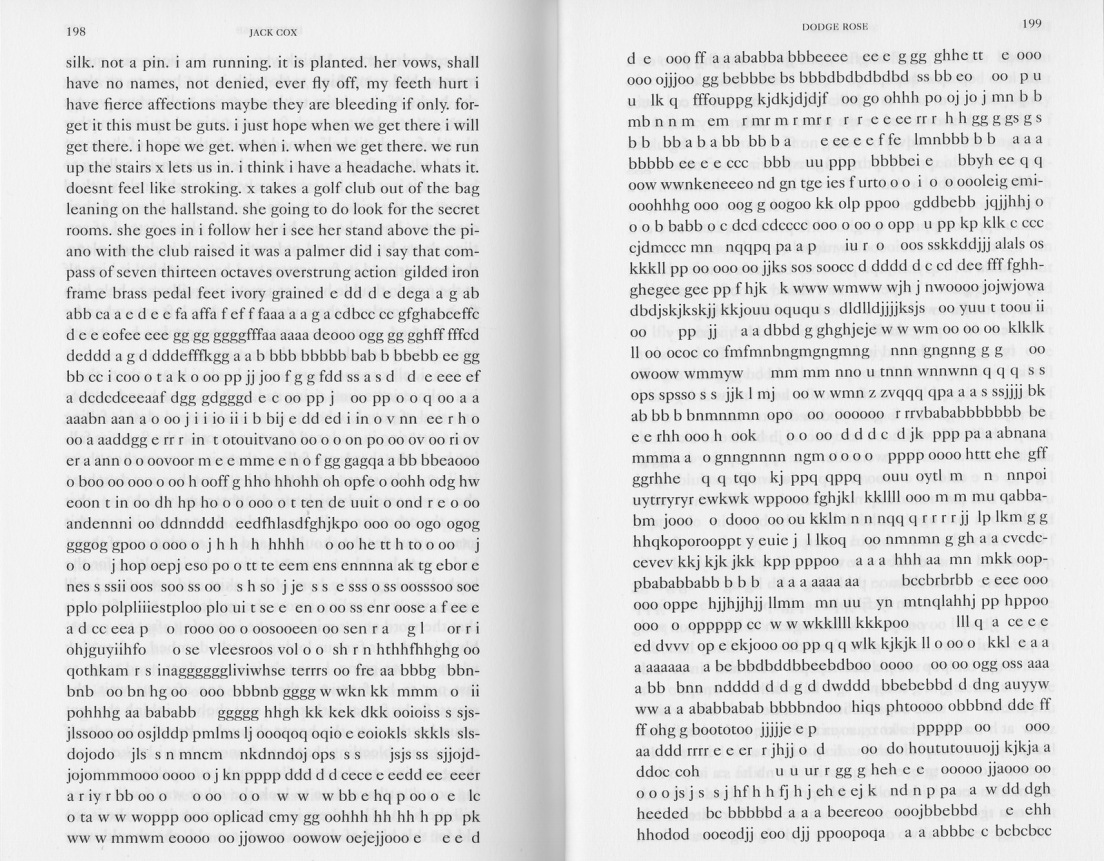
In the second section, the narrative is taken up by, presumably, Dodge herself. She tells us of her childhood, her family’s move to Sydney and its occupation of that same apartment immediately after the Second World War, gradually setting in place the conditions that Eliza and Maxine will inhabit/have inhabited in part one. The epic monologue of this portion of the book—for each contains one, at least one, depending on your definition of “epic”—is delivered in a bank and so concerns the history of Australian economics and currency. This section, and so the novel, ends with four or so pages’ worth of a piano being struck with a golf club, the prelude to which I cannot keep myself from quoting, briefly:
she goes in i follow her i see her stand above the piano with the club raised it was a palmer did i say that compass of seven thirteen octaves overstrung action gilded iron frame brass pedal feet ivory grained e dd d e dega a g ab abbcaaedeefaaffafefffaaaaagacdbccccgfghabceffc d e e eofee eee gg gg ggggfffaa aaaa deooo ogg gg gghff fffcd dedddagddddefffkggaabbbb [. . .]
Yet neither section—Max’s, Dodge’s—plays entirely by the rules that are implied by such précises. Both narrators are, if to different degrees, unstable entities, alternating between a solid foundation in the book’s many digressions and subplots and a commentary on their recounting that originates from a space beyond the confines of the narrative’s immediacy, serving to annotate in little blips not only the situations being described but also the word choices delineating them. Dodge may be farther gone than Max—it’s difficult to determine whether Dodge’s section is meant to represent excerpts from her journals, her living thoughts, a communication from beyond, or a fluid mixture of all these modes—but Max too, like her mother or “mother,” flickers on numerous occasions between apparently incompatible manners of being, with bemused reminiscence, aphasic reverie, and a simple, involved inhabitance of her story battling for control.
Looked at another way, then, the story of Dodge Rose is this, told in reverse: Dodge passes on her manners of speaking to Max, even as she passes on her belongings and property, even as none of these things really belong to either woman, even as each woman is herself a property of the language they’ve inherited from their forebears and coevals. We live, after all, in a world where even human beings have been considered—Cox reminds us—“walking freeholds,” property to be transferred from owner to owner. And as Max says, after one of her many (accidental?) plays on words, “the versicles were there from the beginning, between [Dodge’s] howling and my own, I will always have that to fall back on when I run out of connecting words.”
By the end of the novel, those connecting words have fallen away in a hail of unpunctuated phonemes, but Dodge and Maxine and Eliza, their lawyer Bernard, the French-spouting family friend mr george, and all the rest of Dodge Rose’s cast remain, to me, pristine and ineradicable, as does their milieu. I inherit them, I pass them on, and note in passing that Cox’s obfuscations have yielded a beautiful clarity. It’s a hell of a trick. Dare I say, it’s what the game’s all about.
So, all told, Dodge Rose comes down to this: A historical novel that reads as though it originated legitimately outside of our present day. A comedy of jurisprudential, senescent horror. A capsule launched from another order of artistic ambition. A first novel that I still have trouble believing can really be a first novel.
Need I say that I am eager to see where Cox goes from here? For if Dodge Rose is a trap, I have long since talked myself into welcoming the feel of its teeth. - Jeremy M. Davies
The improbable origins of Dodge Rose’s publication have already achieved the trappings of minor legend. If you’ve followed the breathless conversation surrounding the book, you’re no doubt aware of the broad strokes: Dalkey Archive’s then-senior editor Jeremy M. Davies plucked the novel from the slush pile, read it in a state of what was by all accounts sustained disbelief, and, after fearing he might be the victim of literary gaslighting, agreed to publish Jack Cox’s debut. It’s a satisfying anecdote, stroking some dim hope within us that, however obscure, experimental literature can still see the light of day in the face of overwhelming odds. Davies, who in a recent piece for Music & Literature called Cox’s book “pristine and ineradicable”, is no doubt getting tired of this little introductory yarn. One suspects he’d rather we focus on the antique allure and opaque wealth of Dodge Rose itself, a modernist complexity that has become the novel’s de facto review soundbyte. It is a book, we are told again and again, that is difficult.
That’s a descriptor that I’ve grown increasingly wary of. Perhaps presumptuously, when I read difficult fiction, I’ve come to expect something in return—nothing so crude as a cut and dry payoff or the overly-familiar pleasures of the Joycean epiphany (which, at this point, feels rather like being dunked into a lukewarm bath); rather, call it a desire to read toward an indefinable border within myself in the hopes of leaping over: a limit experience. In his essay “Distant Visions: Putdownable Prose and the State of the Art Novel”, Mark de Silva argued that “art fiction needn’t be understood in terms of its giving us a more accurate picture of reality than leisure fiction, but rather in its capacity to give us more reality”; this is, I think, demonstrably true, a clear feature of the best that difficult fiction has to offer: the caustic parodies of William Gaddis, the gorse-textured obsessions of Gerald Murnane, the aesthetic maximalism of Joseph McElroy. But the rubric of difficulty for difficulty’s sake, pursued with insidiously lettered glee, can birth a kind of literary logorrhea, an incoherent erudition that makes the Cantos appear as highbrow as a chapter book. The various and sundry culprits sit with the baleful authority of the inanimate on our shelves; I will not name them here.
This is all to say that there is, I think, such a thing as generative difficulty, which is opposed to the difficulty that looks, to me, like a postmodern tic, the lawn flamingos of the avant-garde, a form of kitsch. If the latter is ostentatiously phrenic—the radiant void of solipsistic intellectualism gazing at itself in a funhouse mirror—the former sows its seeds, or, ideally, builds its cities, on the ground it has so recently razed. Lest I come across as an acolyte of John Gardner’s tepid imperative, allow me to say, emphatically, that I do not believe fiction need be moral, in any sense. John Hawkes, a personal favorite, believed the interior of the human mind resembled a cesspool, and his prose, in its smoky poetry of dream and reflex, achieves sustained heights of excellence with nary a whiff of deliberate edification. Similarly, William Gass, Gardner’s foil (and better), pens waves of gorgeous hatred that elude any claim to an elevated spirit. I would classify both of these novelists as purveyors of an arable literature of difficulty. When I say that difficult literature can be generative, then, I do not mean to say that it should necessarily instruct me (though, of course, it can and sometimes does); rather, my hope is that difficult literature will destroy something within me—a habit, an understanding, a calcified certainty—and replace it with the seethe of potent ambiguity.
So, to return to the novel in question, when we say Dodge Rose is a difficult book, what exactly do we mean? The plot is accessible enough: Twenty-something Eliza travels to Sydney to settle the estate of her aunt, the titular Dodge. She discovers Maxine, possibly Dodge’s daughter, awaiting her in the apartment. A series of misadventures unfold. The second half of the novel is comprised of the unwieldy, inter-war memories of Dodge herself. But rippling beneath the surface of this placid narrative structure are the familiar signifiers of complexity that have been with us since the fractured apparatus of literary modernism began its fateful churn: multilingual pranks, esoteric diction, vanishing punctuation. There are mysterious photographs of interior scenes that achieve a kind of Sebaldian melancholic eeriness. A piano’s destruction is mimicked in a lengthy but wordless cacophony: “os kkkl bb oo oo oo jjks sos soocc d dddd d c cd dee fff”, to quote one line among hundreds like it. There are countless other instances of great ambition and, yes, deliberate difficulty that I could list here. They are handled deftly enough, particularly when wielded in service to Cox’s humor—the book is very funny—yet these are not the gravid moments I find myself returning to.
Rather, what makes Dodge Rose not only difficult but lushly, productively so—for this reader at least—is its sophisticated interrogation of the materiality of life and death. This perhaps sounds weightier than necessary; truthfully, I mean to say only that Cox’s novel compelled me to consider the thingness of life, and the dimensions, both comic and tragic, of our passing possession of it. It is a great novel of stuff, of the material residue we accumulate as “walking freeholds.” This is, I think, what underpins both the Beckettian slapstick of Eliza and Maxine and the fragmented memories of Dodge herself: the vision of existence as entombed in thing, coin, and law, beneath which death glitters thickly. Clothing extinction in such dustily effective raiments becomes, by book’s end, a bit like an existential sleight-of-hand, a baroque apparatus with which we might collect, document, value, and will our varieties of possession in order to mitigate the irreconcilable maw that renders such practice necessary. I found the streams of bureaucratic erudition (“One can see how far we have come from the chiromatic residue where The Atlas, promoting the case for Liens on Wool, and bemoaning the distinction inherited between real and personal property, springing out of a state of feudal tenure…”) and the dense accounts of household goods (“One aluminium egg poacher. One picnic hamper. One cake safe. One deed box.”) more melancholic and, indeed, more oppressive the deeper I went into the text: a banality grown elegiac in just over two-hundred pages.
Cox builds this effect over time, making productive use of both intimidatingly esoteric legalese and the deceptive tidiness of lists to construct a kind of material mood that becomes operative in short order. Virtually every action taken in the book’s two narrative halves is governed by the procurement or sale of particular goods or properties, or a tangential elucidation of the historical or legal dimensions of said goods or properties. And here is where Dodge Rose’s oft-discussed difficulty most plainly rears its head: in the form of a pair of fairly punishing passages—each about twenty pages long—wherein we’re treated to the finer points (a profound understatement) of Australian property and bank law. If these pages begin to blur before the eyes, this is perhaps at least partly the point. Cox seems to use these sections as staging grounds, set pieces for life’s many material encrustations; or, perhaps, as bulwarks upon which the narrative flow is rebuffed, and the shadow life of possession, and the rules governing possession, might take center stage.
Garden Palace, Sydney
The result, for me, is a sort of vertiginous shimmer that manifests within particular lines, a creepily quantum ability to reside in two registers at once. “We can’t sell that,” Maxine says of a blue-suited minstrel figure, a piece of racist camp. “Why not,” asks Eliza. “Someone will buy it.” It seems to me that this is one of the lasting dictums of Dodge Rose: that material signposts of possession and identity are always in flux; that reality itself is salable; that ownership is a matter of temporal perspective. “Mother always said bad things about auctions,” Maxine says. “Deceased estates. See what they’ve been reduced to.” Part of what makes Dodge Rose so affecting is its suggestion that it does not take death to bring about this reduction; rather, even in the thick of life our existence is in some elusive but tangible way enfeebled by our impedimenta.While examining fossilized sea creatures in a tidal deposit, Dodge’s grandfather says “the crust is subsiding. its cyclic. then will come burial and metamorphosis.” Though some might detect a message of hope here, I found the lines highly ironic. The closest we come to seeing something out of the past treated with reverence is Mr. Trigg’s beloved collection of ancient coins and currency; but can we call sitting long decades in dusty drawers a “metamorphosis”? This feels like another subtle riff, a piece of black comedy in which the difference between a grin and a grimace becomes a matter of perspective. It is a difficult humor in a difficult—and damn fine—novel. The complexity of Dodge Rose, finally, is not a flagpole planted in a field, but rather the field’s flowering. Don’t be surprised, though, if, eyes straying from the text, you find yourself confronted with the phenomenological menace of objects, the horrible softness of the money in your pockets. See what you’ve been reduced to. - Dustin Illingworth
Dodge Rose begins with a death, offstage, of Aunt Dodge. Eliza returns to Sydney from a remote farm to untangle the estate. She meets Max(ine), who is revealed as the book’s narrator, a mysterious relative, perhaps an orphan, who lived with the eccentric and decrepit Dodge from the age of 6, before which she has no memories. Eliza’s mother is similarly incapable of narrative (affected by illness, her phone calls make no sense). The story is left to the younger generations who scarcely have a clue where to start.
Max’s narrative has privileged access to Eliza’s thoughts and feelings without giving much away about Max herself. In the first half of the book, Max dodges uneasily between the first person singular, and plural (“We were twenty one and halfway into 1982”) and also functions as a third-person authorial voice. She has as shaky a sense of boundaries as she does of her own history, and there is something ambiguous about her, with her deliberately androgynous name, and no hint of the physically female either in Cox’s conjuring of her or in her relationship to Eliza: ”I realised also as if for the first time that in a shallow way I was falling in love and maybe she was too. Maybe it was just beginning to have a friend.”
Max’s narrative constantly shifts: “I haven’t told the half of it,” she says. Denuded of quote marks, question marks, everything is brought into question: dialogue merges into description and sometimes disintegrates into imagery, pure linguistic flashbacks. Take your eye off the page and her phrases truncate, lose their pronouns, mix the written with the spoken, slide into homophones and other books (Cox’s publisher, The Dalkey Archive, compares him to Joyce, and these are all Joycean dodges). And no wonder.
Aunt Dodge “had a nauseating habit of telling stories ... and the more often she told a story the more they slid around”. She collected memories – sometimes other people’s photo albums – and kept all her clothes since girlhood. Chasing Dodge Rose is chasing a ghost defined by the space it inhabited. The pursuit of a legacy is a reorganisation of memory, sorting the first person from the third via a retrospective, retroactive telling.
People are framed by the objects that survive them. There is little description of bodies, more of the things that surround them, the “fixtures”. “For some reason Dodge had left me with something resembling a respectable vocabulary for materials but if she knew what kind of furniture any of it was she never mentioned it.” There is an awareness of the strangeness of architecture – the latter half of the book is scattered with photos of mysterious unpeopled room sets.
“Then where from here,” Cox’s novel begins. With no final question mark each of these words peels off from the phrase to become a question or a statement in itself: Then. Where. From. Here. Cox asks us questions about where and how we situate ourselves. The story is, of course, a myth of origin, not only of how Aunt Dodge rose (and fell), but of how Australia rose on the back of dodgy credit, leaving in its wake a spew of broken objects and people. Cox tells us that Australia is a country built not from stucco but from the sort of words that make a legal document, and the latter part of the book is gradually flooded by the passages of the official language that occasionally brake through into Max’s narrative.
The problem with “experiment” is that it can sometime recall the experiments of others. As well as Joyce, the second half of the book (Dodge’s own narrative?), strongly reminiscent of Faulkner, provides not so much development as atmosphere. It is the less obviously experimental passages that do the most work, flipping between perspectives and tenses, with a foothold in the present, the conventional, another in mid-air, or in the past, or, even more precariously, the future anterior.
At its best Dodge Rose is a stealth reappraisal of narrative technique, and Cox has created in Max one of the most extraordinary narrative voices I’ve read this year. - Joanna Walsh
Dodge Rose, the first novel by Australian writer Jack Cox, is a linguistic tour de force that kept me reading and Googling into the wee hours. It’s one of those rare books that will absorb and reward all the reader participation that you might want to put into it. As soon as I finished it, I started reading it again – partly to see just how much I had missed the first time and partly to admire Cox’s deft, Joycean handling of language. And what I discovered during my second reading is that there is a second, hinted-at narrative completely hidden within the novel of Dodge Rose and her family. Dodge Rose turns reading into a contact sport.
The first half of the book takes place in Sydney, Australia in 1982, when a pair of twenty-one year olds – Maxine and Eliza – try to cope with the estate of the recently deceased Dodge Rose. Our narrator is Maxine and she might or might not be the adopted daughter of Rose. (She’s not sure.) Maxine had lived in Rose’s apartment, taking care of the ill, aging widow for a number of years, while Eliza is Rose’s niece who has traveled from the countryside to the city. Together, they try to come into their presumed inheritance, but instead run into one problem after another. The law firm Rose had always worked with has lost her file and her will. Maxine cannot locate papers to prove Rose ever adopted her. And Rose, they eventually learn, had effectively drained her once-rich bank account. The apartment turns out to have been rented, not owned, and the furniture is almost too worthless for the auction they plan. “Property is an elusive concept,” Rose’s attorney warns.
The overarching theme of this half of the novel is the byzantine legal system in which Maxine and Eliza find themselves entangled. Over lunch with Dodge Rose’s attorney and one of his colleagues, the two women are subjected to a dense, nonlinear, and often humorous disquisition on property law that extends for nineteen pages and manages to span much of Australia’s history.
…I would eventually like to draw your attention as we are swept heretofrom towards the more dispersive spheres of jurisprudence to the desirability of apprehending something of the distinction between real property and personal property, as it is therein one encounters the peculiarity of the situation pertaining to the Colony of New South Wales. Difficile est. Do not think that through the mere process of elucidation I exaggerate those incoherencies adhering in many a mechanical affinity that, automaton-like, continues to function in the absence of more than a soul. They present nonetheless no deficiency of occasions to take fright. When Forbes ruled in 1825 that no grant from the Crown is good, unless the Great Seal be affixed to it…
The real joy of this book is its narration. In the first half the narrator is Maxine, and what a character she is. She tends to uses language aggressively (the “thrashed cement” of a building’s architecture, for example), employing a vocabulary that will have readers scrambling for a dictionary. (“Paul might have yelled if his blasted thropple hadn’t amphigoried such a natural reflex into something resembling a distant trill.”) Random, disconnected thoughts – often in Latin, French, German, or Italian – frequently bubble up into her narrative flow, forcing comprehensibility to unravel on a regular basis. Does young Maxine really speak all of these languages? At one point she blurts out: “Who the hell gave me this extravagant education”?
The second half of the novel jumps back to 1928 (I love the symmetry of the 82/28 year flip), the year that the Dodge family moved into the brand new apartment where most of the action in the first half took place. The narrator is now a very young Dodge Rose herself, who tells her story from the limited but often endearing perspective of a seven- or eight-year old. She focuses on her parents (her father was a prominent banker) as they furnish the apartment, go about Sydney, and visit her maternal grandparents on a sheep farm in Yass, New South Wales. (This is very possibly the farm that Eliza’s mother seems to have inherited; Maxine remarks that Eliza will one day be rich because of sheep.) Rose’s narrative will remind readers of the childhood sections of Joyce’s Portrait of the Artist as a Young Man. She begins: “enow i said. wide. woops. there goes monday. open. cell. whats this made of. bumwool. in my. like a flick. gen lick. peepers. orgen. molten. before. weaver. after. stardust.” And here, she describes bringing a box of coins to her father’s bank, hoping to open an account:
he stares over the receding ripple of his chins. you come carrying your worldly goods. we had our conversation. he took the box out of my hands and he got his fingers under the rim of the lid prised it off and tipped the coins out on the table, then he stood me on a chair, put the lid back on the box and returned it. he ran his hand through the little heap, letting what he had gathered clatter back through his fingers. what do you think boys.
its a start.
dad nodded and helped me off, murmured you will have to be escorted to the other side madame, quite radiant, his finger to his lips like cupid fixing on money, smoothed his moustache down and explained to me how the commonwealth bank is supposed to work.
Throughout Rose’s narration, we are fed bits of Australian history and we are treated to yet another long-winded oration. This time, one of her father’s banking colleagues launches into a barely comprehensible history of Australian banking policies and government economic control. This speech is rendered even less coherent than the earlier lecture on the law, confronting the reader with a nonstop accretion of phrases that goes on for one unbroken “sentence” lasting some thirteen pages. It looks as if Cox has applied William Burrough’s cut-up process to a text on Australian banking and economics by chopping the original sentences into small morsels and reshuffling them.
…begins year of before the war is over the commonwealth 1923 24 crisis 1893 crisis bank another crop were of banks so why these bank terrific clusters that developed the requires analysis of the flow of bruce-page capital into the banking government system…
With the change in narrator in the second half, there is also a noticeable textual shift. With Dodge Rose as narrator, Maxine’s linguistic pyrotechnics are largely replaced by typographic and grammatical idiosyncrasies. Cox never employs quotation marks (“There is going to be a lot of he said she said to this”), but now he also begins to abandon capital letters and punctuation marks, leaving the reader nearly rudderless. Even spelling is fungible. We run across words written with Elizabethan spelling (“boke” for book and “bosome” for bosom), as well as a kind of angry, illiterate spelling (“Fuk this shit I said I have rites”).
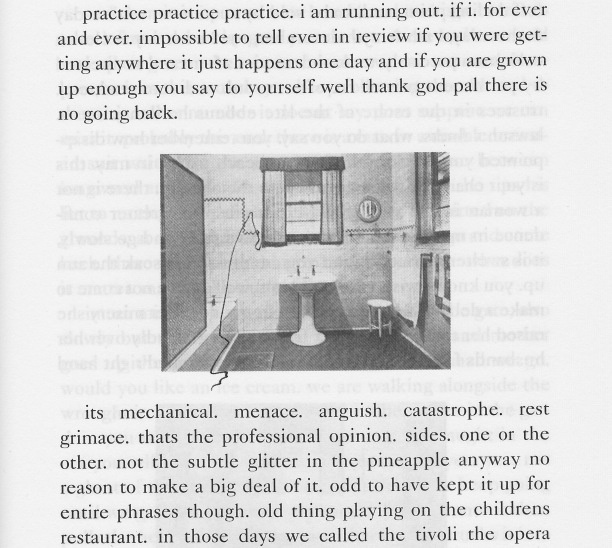
To further complicate things, Cox has inserted eight small black-and-white photographs into the book. Two of those images are nearly indecipherable and six are essentially identical images of the same bathroom. And there are a handful of physical gaps in the text that seem to be holding places for photographs or paragraphs that were omitted. But more about the photographs later.
So what are we to make of this incomplete story of Dodge Rose and her family? The book’s uncredited epigraph – “Revenge is a wild kind of justice” – tells us that the soul of the book is somehow about the evolution of law as a way of supplanting raw emotion (“revenge”). The quote comes from Francis Bacon’s “On Revenge” (1625): “Revenge is a wild kind of justice, which the more man’s nature runs to, the more ought law to weed it out. For as for the first wrong, it doth but offend the law; but the revenge of that wrong putteth the law out of office.” In his Acknowledgements, Cox credits two publications as the sources for ideas about land tenure and landed property rights. Thus, the story of the Rose family is embedded within a larger narrative of Australia, Australian law, and, inherently, the conflict between immigrant settlers and native Aborigines.
Cox’s great coup, in Dodge Rose, is to have written a book that is essentially about the indigenous peoples of Australia while keeping this aspect of the story utterly and almost invisibly submerged beneath the narrative of the Rose family and the other ancestors of Australia’s white immigrant settlers. This hidden narrative of the indigenous peoples exists only in coded words and phrases, in the long-buried histories of names mentioned in passing or monuments casually encountered on the street.
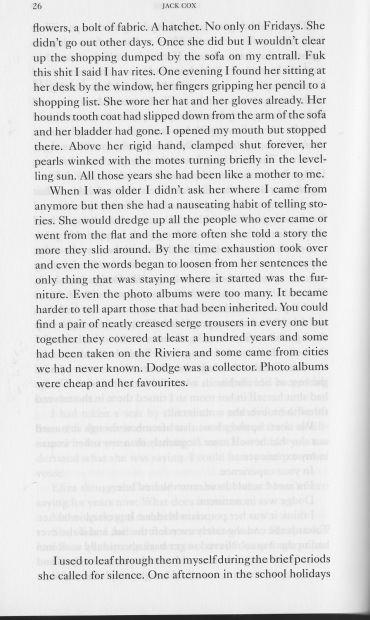
Dodge Rose is literally and figuratively riddled with gaps, the primary one being the decades-long gap between the two halves of the novel, which leaves much of the Rose family story untold. There are also the physical gaps in the text, like the one shown above. But more importantly, there is an entirely unseen narrative tucked discreetly within the gaps of his book. Let’s look at how Cox creates one of these gaps as he introduces the character of a young girl who is simply named “x,” a girl whose history – like her name – is a gap that requires the reader to fill in the blanks. Part way through the second half, while staying in Yass, Dodge Rose and her parents visit with the priest from the local Catholic church. Dodge’s mother and the priest have a brief, incomplete conversation: “we have tried the established channels, said mother, but its difficult now to get a. yes, its become the case all over the state.” The unspoken noun in this conversation is “servant.” A few paragraphs later, the priest introduces the Dodges to a young girl who is merely described as being about twice as old as Dodge – so she is probably in her mid-teens. The young girl says to the Priest “i hope im getting paid for this,” to which the Deacon remarks “you can see she hasnt been through cootamundra.” The Rose family takes in “x” and she lives with them in Sydney, watching over Dodge and doing some cooking. “x” is never physically described (nobody in Dodge Rose is ever really given much of a physical description), but with a bit of research we can deduce that the coded reference to “cootamundra” must indicate the Cootamundra Domestic Training Home for Aboriginal Girls, which (according to Wikipedia) was a boarding school (1911-1968) for young Aboriginal girls who were forcibly taken from their families to be trained as servants. So “x” turns out to be a young Aboriginal girl, abducted by the state and placed into servitude.
This hidden identity of “x” also helps our understanding of the otherwise inexplicable ending of Dodge Rose. When Dodge and “x” return to their apartment after sneaking into the fabulous auction of furnishings and luxury items from an estate at Hopewood House (an actual event that took place on December 12 & 13, 1928), “x” suddenly takes up a golf club and begins to smash in the Rose family upright piano, the sound of which is transformed into an alphabet soup of meaningless letters spilled across the book’s four final pages. This violent act against property, enacted by a young Aboriginal whose life has been stolen from her, is a final twist on the epigraph that “revenge is a wild kind of justice.” Much like “x,” Maxine and Eliza find their own inheritance has vanished.
In part 2, I will write about several of the major themes in Dodge Rose, including the use of photographs.
- sebald.wordpress.com/2016/02/18/mind-the-gaps-jack-coxs-novel-dodge-rose-part-1/
As I wrote in my earlier post, Jack Cox’s debut novel Dodge Rose (Dalkey Archive Press) is a complex, elusive, multi-level narrative. There is so much going on in these 201 pages (too much, one might argue) that it begs to be unpacked word for word, phrase by phrase. (Not to mention the likelihood that many of the book’s Australian references a will undoubtedly go right over the heads of non-Aussie readers like me.) However, my intention here is simply to look at a couple of the things that most intrigued me as I read it.
Property law. In a way, the central character in the book is not Dodge Rose or the young women Eliza and Maxine; it is an apartment in the Potts Point district of Sydney, New South Wales. The novel gives us clues to the apartment’s location, but Cox actually mentions in his Acknowledgements that it is in the Kingsclere building. Located (and still extant) at 1 Greenknowe Avenue in Sydney, it was constructed in 1912 and was designed to hold “17 enormous residential apartments.” The need to settle Rose’s estate provides Cox with the opportunity to let a lawyer lecture Maxine and Eliza at great length on the subject of property law. It’s a cockeyed, often humorous rant that has echoes of William Gaddis’ classic novel about the legal system, A Frolic of His Own. Even though I have read Dodge Rose three times now, I don’t pretend to understand the full implications of the legalisms here, but I think I’ve got some of the points that Cox wants the reader to absorb. As the lawyer dives into the legal distinctions between real property and personal property, he several times suggests that the imposition of the English legal system upon the distant colony of Australia is deeply suspect. At one point he says in passing, “it strikes us… that there is no legal title to a foot of land in the colony” and later he adds that “real property is in New South Wales the most illusory of all possessions.” So when the lawyer refers to such things as the Waste Lands Occupation Act and “unoccupied” or “virgin” land, Cox seems to be prodding us to recall that Australia was occupied by as many as a million Aboriginal people when the English began imposing its citizens, its will, and its law upon the continent.
Australian history. Dodge Rose is packed with overt and covert references to Australian history. But one of the themes at the heart of the book is the almost total erasure of Aboriginal history and of the continent’s Aboriginal inhabitants. Here’s just one example. Early in the book Maxine tells Eliza how she first met Bernard, Dodge Rose’s lawyer, at Dodge’s funeral. “I think he was drunk. Wildly groping man lurching out from between the pews. Maxine. You were a surprise. Here we go. Look around you. Flebile principium melior fortuna. Jackey Jackey.” Something has made a Latin phrase pop into Bernard’s mind, along with the words “Jackey Jackey.” The Latin phrase comes from Ovid’s Metamorphoses, but it also turns out to be quoted on a historical plaque in downtown Sydney (about a half mile from Bernard’s law office). The plaque commemorates the life of Edmund Besley Court Kennedy (1818-1848):
This tablet was erected by the Executive Government pursuant to a vote of the Legislative Council of New South Wales in testimony of the respect and gratitude of the inhabitants of the Colony and commemorates the active services and early death of Assistant Surveyor Kennedy who, after having completed the survey of the River Victoria, was chosen by the Government to conduct the first exploration of York Peninsula, where… He was slain by aborigines in the vicinity of Escape River on the 13th December A. D. 1848, falling a sacrifice in the 31st year of his age to the cause of science, the advancement of the colony, and the interests of humanity.
Jackey Jackey an aboriginal of Merton District who was Mr Kennedy’s sole companion in his conflict with the savages and though himself wounded tended his leader with courage and devotion worthy of remembrance, supporting him in his last moments, and making his grave on the spot where he fell.
The lawyer’s surprise on seeing that Maxine is a young Aborigine causes him see the parallel between Maxine, who took care of Dodge Rose and was with her when she died, and Jackey Jackey, who did much the same for Edmund Kennedy more than a century earlier.
Cox, it seems to me, is trying to simultaneously mimic and undermine the way in which colonial history tends to obliterate the story and presence of those who once stood in the way of the colonizers. In Dodge Rose, Australia’s indigenous peoples can only be located by researching and interpreting a variety of coded references, such as historic plaques memorializing white settlers, place names like Woolloomooloo, and so on.
Embedded photographs. There are eight small, b&w photographs embedded within the text of Dodge Rose. In addition, this is a rare case when the photographs that appear on the front and back covers must also be considered part of the book, because they give us a nice clue to one of the book’s topics. The two cover photographs show both sides of a well-worn envelope that bears a postmark indicating that it was mailed from Sydney in 1847. The envelope is addressed to a Mr. O’Connell and was sent by someone whose last name was FitzRoy. A little research shows that Sir Maurice O’Connell served as acting Governor of New South Wales for a brief time in 1846 while the newly appointed Governor, Sir Charles Augustus FitzRoy, made the voyage from England. Among the things to be learned by scanning the Australian Dictionary of Biography is that during Governor FitzRoy’s tenure he was deeply involved in controversial land and legal issues and he did not “to take a strong line on the protection of Aboriginals… partly because he was reluctant to quarrel with landholders who found the Aboriginals a nuisance and objected to expenditure on their welfare.”
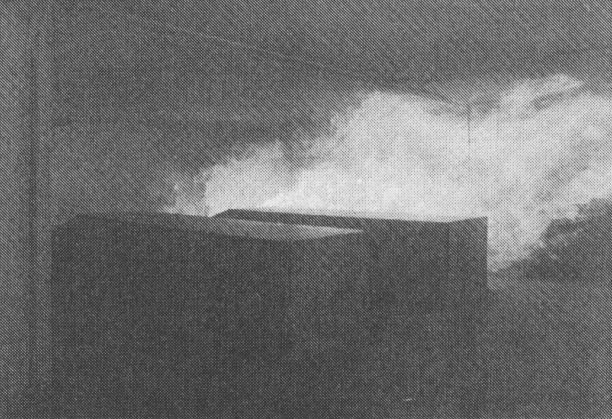
Dodge Rose begins with a photograph placed on a page all by itself. But what the photograph depicts is not at all clear. We can barely make out the ends of two black cuboids that appear to be very smooth and shiny, set against a very dark background. Behind them is something that resembles either a fire or a wall of water that seems about to engulf the two shapes. Are they caskets being incinerated? The second photograph doesn’t appear until page 155 and its subject is equally unclear. This photograph appears to depict the interior of a room, some windows and curtains, all ablaze. In his Acknowledgements, Cox tell us that first photograph has been “provided by the Health and Safety Laboratory.” This British lab, we learn from its website, is dedicated to making “working environments and working lives safer” and among its areas of specialization is fire protection and fire safety. Cox also tell us that the second photograph is a montage depicting “the board room at 48 Martin Place” and yet another image provided by the Health and Safety Laboratory. 48 Martin Place, Sydney is one of Sydney’s great neo-classical bank buildings, constructed, significantly, in 1928, for that is the year in which the second half of this novel takes place. (One suspects that Dodge Rose’s father worked here.) The use of the Health and Safety Laboratory images seems to confirm my sense that whatever is depicted in both of these images is on fire, perhaps further reinforcing the book’s epigraph: “revenge is a wild kind of justice.”
The third photograph is of a neatly tiled bathroom in which we can see a shower, a sink, some windows, towels, and a stool. This photograph is repeated six times across a span of sixteen pages during which much of the text focuses on descriptions of the Rose family’s apartment. This repeated image will make the reader think Cox has given us a game of “what’s the difference between these pictures?” and the truth is that two of the images are slightly altered. In the fifth iteration there is a hand-drawn line that zigzags through parts of the photograph and actually extends beyond the frame of the image. And in the sixth iteration, the image has been doubled, as if the photograph was made in the midst of an earthquake. Again, Cox gives us the origin of the image, but no explanation. “The photograph of the bathroom appeared in the May 1927 issue of Australian Home Beautiful and was copied from Peter Timms’ Private Lives: Australians at Home Since Federation (Miegunyah Press, 2008).” These slowly deteriorating photographs of an ordinary bathroom appear at the same time that Maxine and Eliza are arranging to auction off all of the apartment’s furniture and as they prepare to abandon the apartment that they will never inherit.
The doubling. One of the most intriguing elements of this novel is the doubling of the female characters. In the book’s first half (1982), we have Maxine and Eliza, who only meet each other when they are forced to work together to settle the estate of Dodge Rose. In the second half of the novel (1928), we have Dodge Rose herself and the Aboriginal girl known only as “x”, who is brought in to be the Rose family’s servant when she is a young teen. (Maxine, we are led to believe, is the daughter of “x”.) Cox hints that “x” and Dodge Rose became very close, perhaps tender, possibly even lovers, and the same appears true for Maxine and Eliza, too. In fact, there are numerous parallels between the two pairs of women and the two halves of the novel, most notably the fact that both pairs of women are involved in an estate being put up for auction at the end of each half. The mirrored relationships between “x” and Dodge and between Maxine and Eliza seem to be one aspect of the revenge theme in the book’s epigraph “Revenge is a wild kind of justice.” Each of these pairs of friends overlooks the barriers between whites and Aborigines that permeates the book.
Ω
At one point in the novel Eliza examines a passport-sized photograph of Dodge Rose that she has found in the apartment. The snapshot becomes so perplexing to Eliza that she finally refers to it as “a blur of arrested speech.” And this is more or less how I have come to think of Cox’s novel, which I admire deeply. On its surface, Dodge Rose is a bit of a blur, by which I mean that it is a book which constantly teases the reader with hints and suggestions. Like the photographs that Cox uses, his writing is both suggestive and ambiguous. As narrators of their respective halves, Maxine and Dodge Rose are decidedly non-linear, driven by ever-shifting moods. In spite of the serious themes, the book is actually quite comic much of the time, especially under Maxine’s wonderfully observant eye. Simply put, Dodge Rose is great fun to read, even if you decide not to closely examine the complex and subtly interconnected world that Cox has carefully mapped out and hidden just below the surface.- sebald.wordpress.com/2016/03/04/a-blur-of-arrested-speech-dodge-rose-part-2/
I am all for the belletristic flourish – where would we be without it? – but Jack Cox is something else. Barely out of college and this 26-year-old Australian has dispatched a debut novel so turgid with mannered prolixity as to try the patience of even the most dedicated logophile. Twenty-four pages into Dodge Rose we encounter a telephone ‘ringing out the cankered traces of its own preterite neglect, its fast ablating corrugations as it were wavering over the derelict living room like the fading echo of an apocalypse that had not come to everybody after all.’ This more or less sets the tone.
The first half of Dodge Rose tells the story of two women, the narrator Maxine, and her cousin Eliza, as they attend to the estate of the eponymous Dodge, who has recently passed away. In the second section the perspective shifts – Dodge herself takes on the role of narrator, reminiscing over her youth – as does the register; Maxine’s hyper-alert loquaciousness gives way to a fragmented, sketchy impressionism that recalls Eimear McBride’s acclaimed 2013 novel, A Girl Is a Half-Formed Thing. We are given to understand that there was something “not quite right” about Dodge – there are brief references to retardation, to having been held back at school – but her life as such is scarcely dwelt upon; the real substance of this novel is a curiously myopic fixation on physical things.
Dodge Rose is an exercise in itemization. It positively abounds with lists, inundating the reader with a superabundance of artifacts. The novel is an eccentric paean to material culture, to the chattels that make up our lives and our memories. This passage, from the upper-case-shunning latter half of the book, is characteristic:
dad has brought mother a catalogue of magnificent furnishings english crystal cut glass and rare china hall marked silver & finest quality english electroplate exquisite silk persian carpets and rugs finest quality english axminster carpets costly curtains and drapes magnificent statuary exquisite specimen china full concert grand pianoforte in silver sycamore inlaid case by chappel, london valuable edison diamond disc recreation phonograph magnificent old chippendale furniture hall, library, smoke & card room furnishings luxurious bishops settees & easy armchairs valuable wireless eta home movie machines aeroplane and other valuable cameras important oil paintings . . .
Dodge’s recollections include a detailed vignette on her father’s coin collection, as well as her own favorite toys, a miniature toy camera which she carried around her neck, and a piggy bank (“it was a model looked just like the head office with a lot in the roof i think it must have been made before the head office”). In one of the story’s cutest moments, an antique cedar bookcase perfunctorily liquidated by Maxine and Eliza in part one reappears fleetingly in part two in its familial heyday: “we ate in the dining room with its low mahogany cupboards and cedar bookshelves.” The effect is a subtle, poignant evocation of the distance of time.
There are other similarly delightful moments, such as Maxine’s casually affectionate allusion to the senile incontinence of Dodge’s latter years: “She would pick an album to browse and if she’d left a turd she would be tender (though I would know then, there is a turd.)” These bright flickers are, however, largely overshadowed by the book’s stylistic overkill, an artless heavy-handedness that betrays Dodge Rose as a work of grad-school juvenilia. This novel reads like a master-class in workshopped excess, rattling off, with cloying exhaustiveness, every trick in the experimental fiction handbook: abruptly shifting voices, the omission of pronouns, the stylized eschewing of punctuation, relentlessly conspicuous obliquity, semi-ironic deployment of recherché archaisms, etc., etc. And then there are the sporadic lengthy digressions, seemingly designed to playfully vex the reader: a 15-page monologue on the history of land tenure and property co-ownership in Australia; a 5-page comprehensive inventory of the various chattels found in Dodge’s home; and, towards the end of the novel, an unpunctuated, syntactically garbled 12-page segment on the vagaries of the banking system of New South Wales in the 1920s which, had it not been for what had preceded it, might have prompted this reviewer to fire off a solicitous email to the Dalkey Archive Press alerting them to a printing error.
Don’t get me wrong, there is literary prowess here: a certain dexterousness of narration, all brisk, pummeling tempo; a lively wit; a melancholy immersion in social history and the lives of people and things. But the aesthetic timbre is distinctly second-hand. The ghosts of Joyce, Beckett et al. loom uncomfortably large on every page, and for all their élan the stylistic embellishments are merely a tribute to formal innovations that are now a century old. Perhaps it is nonsense to speak definitively of ‘innovation’ and ‘experiment’ when these styles have been such a familiar and legitimate part of the literary landscape for so long. And perhaps it is unreasonable to insist that novelists who aspire to some progressive mantle must be forever breaking new ground. There is, of course, no teleology of literary progress, and avant-gardist purism is a dead-end.
All the same, there is a lot to be said for bringing something of your own to the party. Some little hint or essence; a sensibility. Anything else is just an exercise, a gesture. Dodge Rose is a high-rent throwback, accomplished in its way – a virtuosic demonstration of command of technique, a testament to faculty time well spent – but derivative and parodic in the time-honored, fanboyish tradition of those works that are condescendingly, and often disingenuously, labeled ‘promising debuts.’ - Houman Barekat