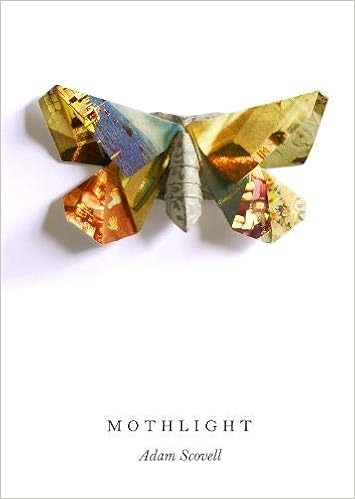
Adam Scovell, Mothlight, Influx Press, 2019.
Phyllis Ewans, a prominent researcher in Lepidoptera and a keen walker, has died of old age. Thomas, a much younger fellow researcher of moths first met Phyllis when he was a child. He became her carer and companion, having rekindled her acquaintance in later life.
Increasingly possessed by thoughts that he somehow actually is Phyllis Ewans, and unable to rid himself of the feeling that she is haunting him, Thomas must discover her secrets through her many possessions and photographs, before he is lost permanently in a labyrinth of memories long past.
Steeped in dusty melancholy and analogue shadows, MOTHLIGHT is an uncanny story of grief, memory and the price of obsession.
“One of the most interesting and original young British writers about landscape, culture and people that I know; consistently adventurous in his explorations of place as a novelist, essayist, critic and film-maker.”– Robert Macfarlane
“Adam Scovell is an archaeologist of the imagination, forever unearthing stories like treasure from the soil, raising ghosts, finding links and shining a flickering light into England’s hidden corners.”
– Benjamin Myers
– Benjamin Myers
“The English landscape, peculiarly charged domestic spaces, a suggestion of the uncanny and a mind unravelling at the heart of it all. Restrained, precise, perceptive writing. Fine British weird.”– Adam Nevill
“Innovative, moody and melancholy. This intriguing novel's obsessions will become yours.”
– Paul Tremblay
Adam Scovell's Mothlight is a wonderful slice of British weird fiction that will appeal to everybody who loves uncanny stories. It's one of the most captivating novels of the year, because it's something different yet strangely familiar and compelling in its depiction and exploration of grief, loneliness, memory and uncertainty. It's an excellent debut novel worthy of attention.
Mothlight tells of Thomas who becomes obsessed by the past life of the lepidopterist Phyllis Ewans whom he first met when he was a boy. Thomas begins to unravel the mysteries that surround Phyllis and her life. Phyllis has lived a secret life and Thomas doesn't know everything about her, including why she seems to hate her sister Billie. Phyllis' life is like a puzzle and Thomas tries to piece things together.
This novel is filled with small and significant details that add to the atmosphere and make the story haunting. The photographs that represent events from Phyllis' past are an important part of the story and offer a kind of a visual treat for the reader. As the story begins to unfold, the reader is led deeper into a world of mystery, melancholy and strangeness surrounding Phyllis.
The first person narrative mode works perfectly in this novel, because it allows readers a glimpse into a disturbed and haunted mind. The author creates a distinct sense of unease and obsession, and evokes a feeling in the reader that something is not quite right. He explores what kind of an influence Phyllis has had on Thomas and how Thomas has followed in her footsteps and has taken an interest in the Lepidoptera.
Being a novel largely about atmosphere, memory and grief, the author conjures up touching images about what kind of a person Phyllis Ewans is and how much Thomas is intrigued about her. The melancholy elements are handled beautifully and the author writes about them in a restrained way. Nothing is overdone in this novel, because the author steers the story away from melodrama and sentimentality.
Adam Scovell writes clear and atmospheric prose. His precise and restrained writing is perceptive and unsettling. Everything is strictly controlled in this novel. The author keeps all the elements and events under control and delivers a story seasoned with grief and memory. He succeeds in creating a sense of underlying mystery that adds an additional flavour to the story.
I feel that this novel will be of great interest to everybody who is familiar with the works of such authors as Robert Aickman, Timothy J. Jarvis and Joel Lane, because it has a few things in common with them. If you love gradually unfolding stories steeped in atmosphere and memory, this novel is for you.
Adam Scovell's Mothlight is a skillfully written novel, one that is easy to recommend to readers who are intrigued by atmospheric and strange stories that gradually reveal their secrets. This strange and quietly unsettling novel is a haunting reading experience that stays with the reader long after the final page has been read.
Highly recommended! - Seregil of Rhiminee
https://www.risingshadow.net/articles/reviews/914-review-mothlight-by-adam-scovell
It has been said that moths are drawn to burning candles because they confuse flames with the light of the moon. Moths, after all, use moonlight to navigate a path through darkness, but light from elsewhere reliably drags them off-course. The result is a split in perceptions. From the moth’s perspective, the path remains direct although the destination is unreachable: the creature believes itself to be flying straight on towards its goal, even as it fails to close the remaining distance. From the perspective of an observer, however, the moth has been snared into a spiral with no way to break free; it flutters around the flame in a way that makes a misleading light the centre of an experience, surveying the object of its desire continually from a distance. In his début novel, Mothlight, Adam Scovell has written a book that shadows the movements of the captive moth. Scovell’s narrator takes aim at a very particular objective, albeit one that is hazily conceived, only to end up whirling around in circles, unable to seize his prize, fixating on an ideal in a frenzied pursuit that robs him of his sanity.
The narrator’s name is Thomas, though he discloses very few meaningful details of his life. He is a young man involved in academic research, his area of interest being lepidoptery. He says he developed his fascination with moths as a result of his acquaintance with an elderly woman named Phyllis Ewans, who he met when he was a boy in Cheshire. Phyllis, “Miss Ewans”, lived on the Wirral Peninsula, close to Thomas’ grandparents, in a house she shared with her sister, Billie. That was where she cultivated her two great interests, walking the hills of Snowdonia and collecting and studying moths, and that was where she inducted Thomas into her idiosyncratic ways. After a series of events leads to the death of Billie and brings about Thomas’ closer involvement with Phyllis, Thomas begins to function as the ailing woman’s carer, and then, following her death, he becomes the executor of her estate.
As he narrates Mothlight, Thomas describes in detail the character of Phyllis Ewans and the significant events of her past, focusing on her activities as a walker and lepidopterist while also considering the extent to which his affection for these activities was bequeathed to him by her. But of his own character and past he has little to say; he is strikingly, tantalisingly opaque. Once, halfway through Mothlight, he refers to having been involved in just “one brief romance” which ended, he says, “like most of my own social relations… as soon as my obsessions with walking and moths had become readily apparent.” More generally, he mentions that he is employed as an early career researcher at a university in London, and he occasionally makes reference to colleagues who remain nameless. The only significant event he describes at length, in all its complexity, is what he calls “the great calamity”. He frankly admits that this calamity amounted to a “breakdown”, “in which the death of Miss Ewans cast my obsessions into a startling cage from which I could not escape”, and Mothlight is essentially a record of his efforts to recover himself.
In this last respect, the setup of Mothlight calls to mind the opening pages of W.G. Sebald’s The Rings of Saturn, and it would be fair to say that Mothlight is a novel written in a Sebaldian spirit. The text is interwoven with photographs that Thomas scours for telling details, and the rhythms and tones of Thomas’ narrative voice carry recognisable echoes of Sebald’s. His methods, too, are Sebaldian; he embarks upon lines of inquiry with academic precision, but then drifts off into digressive tracts and recursive loops, and in his descriptions of the behaviour of hawk moths, convolvulus, and parasitic wasps, he does for entomology what Sebald did for ichthyology in pondering the bioluminescence of herring. In Sebald, of course, the combined effect of these manoeuvres is notoriously melancholic — melancholy being the middle ground between the raw panic of the narrator’s experiences and the reticence, pedantry, and willed composure of his narrative voice. In Mothlight the general effect is much the same, heightened by the fact that Scovell’s narrator rivals Sebald’s with his listlessness and peripatetic habits, but there are also a couple of new elements in the mix. There’s more of an overtly gothic flair to Mothlight than in any of Sebald’s novels, and a greater willingness to look directly at the sheer distress of a psychological breakdown as it is occurring, so that Scovell ultimately pushes the Sebaldian novel into the realm of the genuinely surreal.
The initial symptoms of Thomas’ breakdown are auditory and visual hallucinations. First he believes he can hear the incessant fluttering of the wings of countless moths, then his vision becomes clouded by a storm of wings falling in front of his eyes like snowflakes. But while he specifically attributes his decoupling from reality to the death of Phyllis Ewans, his own memories of the time he spent with her during her final years suggest that his troubles have been with him for a while. He recalls being unsettled, for instance, when he once told Phyllis of a solo moth-catching expedition that came as no surprise to her: “Each detail was met with a nod of recognition as if merely confirming something of which she was already aware. … In my memory, she walks behind me on that trip, passing comment on various butterflies and moths.” While she is still alive, he also begins to dream that his body is transforming into someone else’s, or perhaps someone else’s is merging with his: “My hands had never been especially masculine”, he says, “my whole body in fact never really seeming either male or female apart from in the most basic of ways. But my hand was no longer my own, or at least the impression of my own. … The lower arm was that of a woman, and my arm was equally feminine.” Eventually, Thomas even suggests that he spent the last years of Phyllis Ewans’ life becoming one with her, or that the two of them were somehow merging into a single entity: he noticed “much likeness between her past and my past”, he says, “albeit my past already had hers intertwined within it. Such dizzying thoughts would plague my mind as if we were, in fact, the same person: a reflection of simulacra displaced by some impossible mistake… somehow mimetic of one another.” And so, when Phyllis does indeed die, Thomas feels as if some essential aspect of the woman has been cut loose from her body and integrated into his being. “I began to ghost her life”, he says, “following in her footsteps: sometimes symbolically with my study of biology, and sometimes simply by walking far into the northern Welsh mountains… [and t]he loneliness which had seemed to pervade Miss Ewans’ life was also transferred to my own.”
How to account for this uncanniness? In Phyllis’ absence, Thomas can’t help but feel as if she has taken a monumental secret to the grave — although he can’t say exactly what the secret might look like, or what answers it might provide, or even what questions might need to be asked in order to make those answers intelligible. The mere possibility of the secret, or the promise of answers, is what drives him deeper into an obsession with Phyllis, no matter that his burrowing into her life may turn up nothing of any great significance for his state of mind. That possibility is, in other words, the moonlight by which Thomas navigates a path towards an ideal destination, striking at it again and again and again, even though the reality of the secret is to him as the flame is to a moth: a force that attracts but cannot be apprehended. “[T]here was something enormous missing from my understanding of [Phyllis Ewans] that I simply needed to know, in order to consider staying sane”, Thomas insists, and finally he pegs his sanity on the possibility that the woman herself has “deliberately left behind a trail of clues to follow”. He resolves to devote himself to uncovering the truth, whatever the truth may be, “studying and solving her mysteries” by ensconcing himself in her house, throwing himself into her collection of moths, and trawling through her belongings in search of anything that might satisfy his sense of a lack. “As I moved [her] many things”, he says,
https://www.thisissplice.co.uk/2019/02/04/dark-illumination-adam-scovells-mothlight/
– Paul Tremblay
Adam Scovell's Mothlight is a wonderful slice of British weird fiction that will appeal to everybody who loves uncanny stories. It's one of the most captivating novels of the year, because it's something different yet strangely familiar and compelling in its depiction and exploration of grief, loneliness, memory and uncertainty. It's an excellent debut novel worthy of attention.
Mothlight tells of Thomas who becomes obsessed by the past life of the lepidopterist Phyllis Ewans whom he first met when he was a boy. Thomas begins to unravel the mysteries that surround Phyllis and her life. Phyllis has lived a secret life and Thomas doesn't know everything about her, including why she seems to hate her sister Billie. Phyllis' life is like a puzzle and Thomas tries to piece things together.
This novel is filled with small and significant details that add to the atmosphere and make the story haunting. The photographs that represent events from Phyllis' past are an important part of the story and offer a kind of a visual treat for the reader. As the story begins to unfold, the reader is led deeper into a world of mystery, melancholy and strangeness surrounding Phyllis.
The first person narrative mode works perfectly in this novel, because it allows readers a glimpse into a disturbed and haunted mind. The author creates a distinct sense of unease and obsession, and evokes a feeling in the reader that something is not quite right. He explores what kind of an influence Phyllis has had on Thomas and how Thomas has followed in her footsteps and has taken an interest in the Lepidoptera.
Being a novel largely about atmosphere, memory and grief, the author conjures up touching images about what kind of a person Phyllis Ewans is and how much Thomas is intrigued about her. The melancholy elements are handled beautifully and the author writes about them in a restrained way. Nothing is overdone in this novel, because the author steers the story away from melodrama and sentimentality.
Adam Scovell writes clear and atmospheric prose. His precise and restrained writing is perceptive and unsettling. Everything is strictly controlled in this novel. The author keeps all the elements and events under control and delivers a story seasoned with grief and memory. He succeeds in creating a sense of underlying mystery that adds an additional flavour to the story.
I feel that this novel will be of great interest to everybody who is familiar with the works of such authors as Robert Aickman, Timothy J. Jarvis and Joel Lane, because it has a few things in common with them. If you love gradually unfolding stories steeped in atmosphere and memory, this novel is for you.
Adam Scovell's Mothlight is a skillfully written novel, one that is easy to recommend to readers who are intrigued by atmospheric and strange stories that gradually reveal their secrets. This strange and quietly unsettling novel is a haunting reading experience that stays with the reader long after the final page has been read.
Highly recommended! - Seregil of Rhiminee
https://www.risingshadow.net/articles/reviews/914-review-mothlight-by-adam-scovell
It has been said that moths are drawn to burning candles because they confuse flames with the light of the moon. Moths, after all, use moonlight to navigate a path through darkness, but light from elsewhere reliably drags them off-course. The result is a split in perceptions. From the moth’s perspective, the path remains direct although the destination is unreachable: the creature believes itself to be flying straight on towards its goal, even as it fails to close the remaining distance. From the perspective of an observer, however, the moth has been snared into a spiral with no way to break free; it flutters around the flame in a way that makes a misleading light the centre of an experience, surveying the object of its desire continually from a distance. In his début novel, Mothlight, Adam Scovell has written a book that shadows the movements of the captive moth. Scovell’s narrator takes aim at a very particular objective, albeit one that is hazily conceived, only to end up whirling around in circles, unable to seize his prize, fixating on an ideal in a frenzied pursuit that robs him of his sanity.
The narrator’s name is Thomas, though he discloses very few meaningful details of his life. He is a young man involved in academic research, his area of interest being lepidoptery. He says he developed his fascination with moths as a result of his acquaintance with an elderly woman named Phyllis Ewans, who he met when he was a boy in Cheshire. Phyllis, “Miss Ewans”, lived on the Wirral Peninsula, close to Thomas’ grandparents, in a house she shared with her sister, Billie. That was where she cultivated her two great interests, walking the hills of Snowdonia and collecting and studying moths, and that was where she inducted Thomas into her idiosyncratic ways. After a series of events leads to the death of Billie and brings about Thomas’ closer involvement with Phyllis, Thomas begins to function as the ailing woman’s carer, and then, following her death, he becomes the executor of her estate.
As he narrates Mothlight, Thomas describes in detail the character of Phyllis Ewans and the significant events of her past, focusing on her activities as a walker and lepidopterist while also considering the extent to which his affection for these activities was bequeathed to him by her. But of his own character and past he has little to say; he is strikingly, tantalisingly opaque. Once, halfway through Mothlight, he refers to having been involved in just “one brief romance” which ended, he says, “like most of my own social relations… as soon as my obsessions with walking and moths had become readily apparent.” More generally, he mentions that he is employed as an early career researcher at a university in London, and he occasionally makes reference to colleagues who remain nameless. The only significant event he describes at length, in all its complexity, is what he calls “the great calamity”. He frankly admits that this calamity amounted to a “breakdown”, “in which the death of Miss Ewans cast my obsessions into a startling cage from which I could not escape”, and Mothlight is essentially a record of his efforts to recover himself.
In this last respect, the setup of Mothlight calls to mind the opening pages of W.G. Sebald’s The Rings of Saturn, and it would be fair to say that Mothlight is a novel written in a Sebaldian spirit. The text is interwoven with photographs that Thomas scours for telling details, and the rhythms and tones of Thomas’ narrative voice carry recognisable echoes of Sebald’s. His methods, too, are Sebaldian; he embarks upon lines of inquiry with academic precision, but then drifts off into digressive tracts and recursive loops, and in his descriptions of the behaviour of hawk moths, convolvulus, and parasitic wasps, he does for entomology what Sebald did for ichthyology in pondering the bioluminescence of herring. In Sebald, of course, the combined effect of these manoeuvres is notoriously melancholic — melancholy being the middle ground between the raw panic of the narrator’s experiences and the reticence, pedantry, and willed composure of his narrative voice. In Mothlight the general effect is much the same, heightened by the fact that Scovell’s narrator rivals Sebald’s with his listlessness and peripatetic habits, but there are also a couple of new elements in the mix. There’s more of an overtly gothic flair to Mothlight than in any of Sebald’s novels, and a greater willingness to look directly at the sheer distress of a psychological breakdown as it is occurring, so that Scovell ultimately pushes the Sebaldian novel into the realm of the genuinely surreal.
The initial symptoms of Thomas’ breakdown are auditory and visual hallucinations. First he believes he can hear the incessant fluttering of the wings of countless moths, then his vision becomes clouded by a storm of wings falling in front of his eyes like snowflakes. But while he specifically attributes his decoupling from reality to the death of Phyllis Ewans, his own memories of the time he spent with her during her final years suggest that his troubles have been with him for a while. He recalls being unsettled, for instance, when he once told Phyllis of a solo moth-catching expedition that came as no surprise to her: “Each detail was met with a nod of recognition as if merely confirming something of which she was already aware. … In my memory, she walks behind me on that trip, passing comment on various butterflies and moths.” While she is still alive, he also begins to dream that his body is transforming into someone else’s, or perhaps someone else’s is merging with his: “My hands had never been especially masculine”, he says, “my whole body in fact never really seeming either male or female apart from in the most basic of ways. But my hand was no longer my own, or at least the impression of my own. … The lower arm was that of a woman, and my arm was equally feminine.” Eventually, Thomas even suggests that he spent the last years of Phyllis Ewans’ life becoming one with her, or that the two of them were somehow merging into a single entity: he noticed “much likeness between her past and my past”, he says, “albeit my past already had hers intertwined within it. Such dizzying thoughts would plague my mind as if we were, in fact, the same person: a reflection of simulacra displaced by some impossible mistake… somehow mimetic of one another.” And so, when Phyllis does indeed die, Thomas feels as if some essential aspect of the woman has been cut loose from her body and integrated into his being. “I began to ghost her life”, he says, “following in her footsteps: sometimes symbolically with my study of biology, and sometimes simply by walking far into the northern Welsh mountains… [and t]he loneliness which had seemed to pervade Miss Ewans’ life was also transferred to my own.”
How to account for this uncanniness? In Phyllis’ absence, Thomas can’t help but feel as if she has taken a monumental secret to the grave — although he can’t say exactly what the secret might look like, or what answers it might provide, or even what questions might need to be asked in order to make those answers intelligible. The mere possibility of the secret, or the promise of answers, is what drives him deeper into an obsession with Phyllis, no matter that his burrowing into her life may turn up nothing of any great significance for his state of mind. That possibility is, in other words, the moonlight by which Thomas navigates a path towards an ideal destination, striking at it again and again and again, even though the reality of the secret is to him as the flame is to a moth: a force that attracts but cannot be apprehended. “[T]here was something enormous missing from my understanding of [Phyllis Ewans] that I simply needed to know, in order to consider staying sane”, Thomas insists, and finally he pegs his sanity on the possibility that the woman herself has “deliberately left behind a trail of clues to follow”. He resolves to devote himself to uncovering the truth, whatever the truth may be, “studying and solving her mysteries” by ensconcing himself in her house, throwing himself into her collection of moths, and trawling through her belongings in search of anything that might satisfy his sense of a lack. “As I moved [her] many things”, he says,
I thought that I would use them later as a map to find the heart of her secrets. She was leaving me the means with which to communicate with her after she had departed. It occurred to me that I had not really needed her alive at all, and that most of what I required was probably right here in the house.Mothlight, then, is a novel of haunted places and haunted people, as well as a novel of haunted pasts that intermingle and continue to haunt the present. It is peppered with eerie doublings, blurred identities, and spellbinding imagery, and the wild unreliability of its narrator builds up an atmosphere of paranoia that colours everything in a spectral pall. Even when Thomas reminisces on the daily joys of spending time with Phyllis, of indulging his obsessions in her company, Scovell’s prose tilts towards proleptic elegy with evocative sentences like this one: “It was her spectre that spoke more as her age took her under the waves, and I often felt as if I was walking side by side with her ghost whilst inconspicuously pushing her corpse along in front; her frail but edged words floating back into the air.” What’s most impressive about Mothlight, however, is the way in which it uses the spiralling path of the wayward moth as an architectural scaffolding for its sentences. While the events of the narrative also loop back on themselves as Thomas retraces his steps through Phyllis’ past, there’s an even more intricate looping at work on a smaller scale:
I knew [the investigation] would end in the countryside of Wales. It was always to be Wales and the memories of the place. Her memories of the landscape regularly became one with my own in the dying moments before sleeping. The mysteries would be solved in those moments because they were our memories. I questioned, when lying on the duvet just before sleep, why I did not get up and write such memories down. My illness was briefly cured, and it could have been retained if only I could have got up off the bed and solidified them, the details of the life that she and I had somehow shared…The passage continues to unfold, but the pattern is clear in these few lines: each sentence gives a significant word to the sentence that follows it, so that each sentence also repeats a word from the preceding sentence before offering a new word to the next one. “Wales” bleeds over from the first sentence to the second; “memories” from the second to the third; “moments” from the third to the fourth; “memories”, again, from the fourth to the fifth; “get up” from the fifth to the sixth; and so on. Scovell edges away from Sebald with this technique, taking a step towards the territory of a writer like Gertrude Stein, and although the technique doesn’t dominate Mothlight with iron-fisted discipline, it does govern perhaps three quarters of the prose. It’s not always successful, and when it combines with the pressure to give the sentences a mellifluous rhythm it produces a few redundancies. At one point, for instance, when Thomas falls into a stupor, he describes himself as “only performing the minimal basics of a living creature” while suffering “the pangs of a painful hunger” — as distinct from what? the maximal basics and a pleasant hunger? At its best, however, when Scovell exploits Thomas’ fragile psyche not only to use words recursively but also to shift the meanings of the recurring words, this technique has an effect that is simultaneously enthralling and distressing. It purports to pin things down through repetition while also causing reality to lose its integrity, dissolving literal referents into figurative formulations. Consider, here, in a passage from the novel’s final pages, the simultaneous instability of the sound -tion and a word as simple as “hand”:
My hand reached for the piece of card on which the poplar hawk moth had been mounted, almost slamming it down on the table so that Heather could read the inscription, the words that I had hoped would force her hand. I could not take another moment of this torture, and blurted out another direct question. “What did Miss Ewans do?” I said with a manic disposition, my hands shaking as I drowned in the cacophony of moth wings.“A manic disposition”: the disposition of the moth as it draws ever nearer to the flame, draws close — too close. What does it see when it teeters towards the fire? A blitz, a searing whiteness, a blaze too intense to bear? Then black. That is what the flame is to the moth: not the caress of the moon, not a pale waymarker, but a source of dark illumination — a light that seduces, troubles, obsesses, and obliterates — and Thomas’ narration is a testament to the agony of its touch. In Mothlight, Adam Scovell has written a dark little novel of unaccountable power, power that builds and builds as the narrator increasingly believes himself bound for a radiant truth. It is a novel dense with disturbing ideas, textured by subtle shifts in mood, and exacting in the execution of its ornate technicalities. Even when it doesn’t fully convince, it moves in mesmerising and tremulous ways, leaving behind a sensory impression every bit as vivid as the trace of light on the retina after the flame has been snuffed out. - Daniel Davis Wood
https://www.thisissplice.co.uk/2019/02/04/dark-illumination-adam-scovells-mothlight/
Adam Scovell’s debut novel Mothlight is a first-person introspective journey of understanding how a personal identity is informed and shaped by other people. As if trying to sharpen the focus of this exploration, Scovell isolates the most important details of his narrator’s life and inspects them closely. The narrator is Thomas, who sifts through old photographs and his memories in order to tell the story of his relationship with a much older woman, Phyllis Ewans, with whom he shared, above all, an academic interest in moths and a passion for walking. He starts by telling the story of the first time he met Phyllis Ewans and her older sister Billie, who were acquaintances of his grandparents when he was a young boy in Cheshire, and goes on to describe how he reconnected with Phyllis years later when they had both moved to London.
“To my knowledge, Phyllis Ewans had only two great preoccupations in her long life: walking and moths.” — Adam Scovell (Mothlight p.9)
In London, Thomas holds a research position at a university and spends most of his days studying moths. This interest was first sparked when he first saw the dozens of moth displays at the Ewans’ house in Cheshire, and he seems to have subconsciously internalised the influence Phyllis had on him. He also frequently walks the Welsh countryside, often looking for moth specimens. When he is doing neither, he pays visits to an ageing Miss Ewans, and talks to her about various aspects of his research and their shared background and experience in lepidopterology. As her health deteriorates, Thomas prepares for her death and starts reflecting on their relationship.
Mothlight is a novel written with the style and sensibility of a literary memoir. It is as much an exercise in self-exploration as it is an exercise in memory. Thomas guides the reader, perhaps unintentionally, through his past by highlighting specific elements, and leaving out a multitude of details. Very few names are revealed throughout the book, to the point where it seems to be populated solely by him and Phyllis; his activities are restricted to walking, research, and visiting Phyllis, but even in the case of the latter, the conversations are often summarised in description and are rarely presented in dialogue form. Everything – Cheshire and London, the university where he works, the countryside, his visits at Miss Ewans’ house, and even Miss Ewans herself – is funnelled through his perception and recollection. Often his memories are aided by photographs (printed in the book) and help form the story. This use of photographs is reminiscent of W.G. Sebald’s The Emigrants, a novel known for the way it explores the past and tries to understand how memories form identity. We are often told more about Phyllis from one of the photographs than from an undocumented account provided by Thomas.
“I had even felt at times that I was Miss Ewans which, as a thought, would shake me to my very core. ‘I am a boy and my name is Thomas,’ I would often say to myself as a mantra, though it felt hollow.” — Adam Scovell (Mothlight p.49)
Particularly in the second half of the novel, Thomas is preoccupied not only with understanding Miss Ewans from her archives and old photographs, but also with an eerie feeling he has that he is her. After recognising her influence in his character, his internal journey becomes about differentiating himself from her in order to establish his identity. Sometimes it seems like he was always drawn to Miss Ewans and shaped his interests and activities after this attraction, but it always seems involuntary and happening without him realising it. It is only in retrospect that he sees how this relationship has shaped who he is, and identifying the important details of this influence becomes central to his now-active act of asserting his self.
Mothlight is often experimental in the way it tells the story and brings the character of Thomas on the page. Adam Scovell’s writing makes it easy for Thomas’ train of thought to hook you and bring you on board as he explores his relationship with Phyllis Ewans. - PLATON POULAS
Adam Scovell’s debut novel is narrated by Thomas, a young man who hallucinates the memories of his deceased mentor, Phyllis Ewans. Phyllis is a lepidopterist who lived in Thomas’s town in Cheshire when he was a child, and they reconnect in London after Thomas has also become an academic who studies moths. He travels and researches with her as she ages, and supervises her care before her death, becoming so essential to the reclusive woman that he inherits her house and many of her possessions. Thomas’s reality bends as he clears out Phyllis’s house and attempts to learn secrets which she never revealed to him in life. Thomas envisions landscapes he has never seen, only to see identical places in Phyllis’s photographs; he feels, and sees, a hand holding his while studying certain mementos; he overhears conversations when he is alone. But elements of insanity and the supernatural are countered by photographs, placed throughout the novel, of Phyllis, her sister, and the landscapes she visits. Scovell reveals in his afterword that the photographs are originals, from the real-life Phyllis who was friends with his grandmother. Mothlight is a novel poised between reality and fantasy, and Scovell’s presentation of half-formed truths makes reality as distorted for the reader as it is for Thomas.
From the beginning of the novel, it is clear that Thomas seeks answers; his academic’s mind analyses his childhood and all the photographs he finds. He blames his disinterest in Phyllis’s older sister, Billie Ewans, on Phyllis’s unflattering memories of the woman. He analyses the photographs he finds, from their state of preservation to their composition, to gauge how significant they are to Phyllis’s memory. He compares the records of caught and mounted moths to the gruesome details of a murder mystery novel. Scovell characterises Thomas’s voice with calm, formal language—even when Thomas is hallucinating, or is anxious about Phyllis’s past, he uses long sentences that distance the reader from the “traumatic effect upon [his] own psyche” (43). The effect is not clarifying, but distancing; the reader is as far from Thomas as Thomas is from Phyllis. Human connection is difficult, if not impossible, in Mothlight. Thomas fails several times to ask about Phyllis’s past while she is alive, and becomes so frustrated and obsessed that he decides it will be easier to learn about her after she is dead.
Death is central to the novel, as Thomas’s narration all takes place after Phyllis passes away. Phyllis announces the necessity of death for her work as a lepidopterist while riding the tube with Thomas; Billie announces her imminent death while she and Phyllis sit in their living room; Thomas notes a connection between himself and Phyllis through photographic evidence that they visited the same graveyard in North Wales. The motif of a swarm of moths which obscures Thomas’s vision and hearing follows him from the burial of Billie Ewans, during his childhood, to the last pages of the novel. Scovell’s imagery is haunting, as well. He describes a mounted moth’s wings as “dripping away from the thorax” (14), Thomas’s feelings towards Phyllis as “parasitic passion” (28), and the withered skin of Billie’s body underneath the makeup she always wore. Scovell also details the tedious paperwork after death. This is observed by Thomas as a child, when Phyllis’s detachment about her sister’s death obligates Thomas’s grandparents to file all the papers. Thomas must take on the work himself after Phyllis’s death, as he fills out her paperwork and catalogues decades of moth specimens.
There is still love and warmth for Scovell’s characters, however. Thomas’s strong connection to Phyllis is based on their shared interest in moths and walking, and he describes her warm treatment of him. When Phyllis is too old to walk, he takes her to National Trust properties in a wheelchair. One especially touching passage narrates Thomas’s plan to show Phyllis a wall covered in vines that attract a certain moth, hoping she will appreciate the sight. She does, and Thomas observes the rejuvenating effect of the species which defined her career. Phyllis also experiences happiness before Thomas. He finds an old love letter among her possessions, and several of the hallucinations he experiences are of an affectionate ghost who embraces and comforts him. The mystery which Thomas follows until the end of the novel is about the identity of this ghost, and their importance to Phyllis. He finds several photographs, half-destroyed and hidden in the leaves of random books, which document an unspoiled era of Phyllis’s life.
In the end, uncertainty characterises Mothlight. Thomas does learn Phyllis’s secret, but not in the detail that he wishes. Scovell’s last lines emphasise that the details will remain undiscovered. The novel’s origins in the true story of Scovell’s grandparents’ friend is also incomplete; in the novel, the reason for Thomas’s grandparents’ closeness with Phyllis and Billie is not explained. The sisters jump from customers of his grandfather’s travelling general store to friends so close that his grandmother organises Billie’s funeral. While this relationship is probably clear to Scovell himself, it is not explained to the reader. Thomas’s increasing insanity, and his denial of it, is not resolved over the course of the novel. He loses his post as a university researcher and perplexes his grandparents by bonding with Phyllis after her treatment of Billie, and there is no evidence that his personal or professional life will improve. This reflects the first photograph of Phyllis in the novel: she sits with a dog in her lap, her face obscured. It is the only photograph which is not analysed through Thomas’s narration. Phyllis’s image eludes definition as much as her mystery eludes explanation. Thomas’s obsession dooms him to the same unresolved state in which Phyllis Ewans, living with a romantic secret for decades, was obligated to exist. - Emma Deshpande
https://www.thelondonmagazine.org/review-mothlight-by-adam-scovell/
Mothlight, due to be published in February 2019, is the story of a young researcher whose present is haunted by the influence of a figure from his past. Thomas’s research focuses on the work of the late Dr Phyllis Ewans, an eminent lepidopterist whom he first met when he was a child. As he researches her writings and pictures, her grip on him grows and becomes ever more palpable.
Dr Ewans seems to grow inside Thomas like, Scovell seems to suggest, the grub of a parasitic wasp eating away at its host. Written in the first person, Mothlight has an atmosphere that is claustrophobic to the point of suffocation. We share Thomas’s grief at Dr Ewan’s death and live with him as his psyche gradually comes apart at the seams.
As he examines his late friend’s work Thomas appears to find patterns, but as quickly as the pieces of the puzzle come together, they fall apart. Perhaps unsurprisingly, Scovell writes with the eye of a cinematographer: his prose sweeps broadly across hilly landscapes and then closes in sharply to focus on the human face and the mind behind it.
Dr Ewans’s house is a place of dust, decay, memories and echoes. Thomas inhabits the house while he works on her papers and, as he does so, she in turn inhabits him. Adam Scovell’s first novel is a disturbing and haunting work and is a welcome addition to the English folk-horror oeuvre he has done so much to promote. -
http://psychogeographicreview.com/mothlight-by-adam-scovell/
Adam Scovell’s Mothlight tells of a friendship between a scholar called Thomas and an older woman called Phyllis Ewans. They bond over long walks and a shared passion for moths. Mystery surrounds Phyllis’s relationship with her sister, Billie, with whom she had fallen out many years ago. Early in the novel, Phyllis dies of old age; at her funeral Thomas experiences the first in a series of hallucinations, seeing “the wings of dead moths fall and float down into the grave like snow”.
From the beginning of the novel, it is clear that Thomas seeks answers; his academic’s mind analyses his childhood and all the photographs he finds. He blames his disinterest in Phyllis’s older sister, Billie Ewans, on Phyllis’s unflattering memories of the woman. He analyses the photographs he finds, from their state of preservation to their composition, to gauge how significant they are to Phyllis’s memory. He compares the records of caught and mounted moths to the gruesome details of a murder mystery novel. Scovell characterises Thomas’s voice with calm, formal language—even when Thomas is hallucinating, or is anxious about Phyllis’s past, he uses long sentences that distance the reader from the “traumatic effect upon [his] own psyche” (43). The effect is not clarifying, but distancing; the reader is as far from Thomas as Thomas is from Phyllis. Human connection is difficult, if not impossible, in Mothlight. Thomas fails several times to ask about Phyllis’s past while she is alive, and becomes so frustrated and obsessed that he decides it will be easier to learn about her after she is dead.
Death is central to the novel, as Thomas’s narration all takes place after Phyllis passes away. Phyllis announces the necessity of death for her work as a lepidopterist while riding the tube with Thomas; Billie announces her imminent death while she and Phyllis sit in their living room; Thomas notes a connection between himself and Phyllis through photographic evidence that they visited the same graveyard in North Wales. The motif of a swarm of moths which obscures Thomas’s vision and hearing follows him from the burial of Billie Ewans, during his childhood, to the last pages of the novel. Scovell’s imagery is haunting, as well. He describes a mounted moth’s wings as “dripping away from the thorax” (14), Thomas’s feelings towards Phyllis as “parasitic passion” (28), and the withered skin of Billie’s body underneath the makeup she always wore. Scovell also details the tedious paperwork after death. This is observed by Thomas as a child, when Phyllis’s detachment about her sister’s death obligates Thomas’s grandparents to file all the papers. Thomas must take on the work himself after Phyllis’s death, as he fills out her paperwork and catalogues decades of moth specimens.
There is still love and warmth for Scovell’s characters, however. Thomas’s strong connection to Phyllis is based on their shared interest in moths and walking, and he describes her warm treatment of him. When Phyllis is too old to walk, he takes her to National Trust properties in a wheelchair. One especially touching passage narrates Thomas’s plan to show Phyllis a wall covered in vines that attract a certain moth, hoping she will appreciate the sight. She does, and Thomas observes the rejuvenating effect of the species which defined her career. Phyllis also experiences happiness before Thomas. He finds an old love letter among her possessions, and several of the hallucinations he experiences are of an affectionate ghost who embraces and comforts him. The mystery which Thomas follows until the end of the novel is about the identity of this ghost, and their importance to Phyllis. He finds several photographs, half-destroyed and hidden in the leaves of random books, which document an unspoiled era of Phyllis’s life.
In the end, uncertainty characterises Mothlight. Thomas does learn Phyllis’s secret, but not in the detail that he wishes. Scovell’s last lines emphasise that the details will remain undiscovered. The novel’s origins in the true story of Scovell’s grandparents’ friend is also incomplete; in the novel, the reason for Thomas’s grandparents’ closeness with Phyllis and Billie is not explained. The sisters jump from customers of his grandfather’s travelling general store to friends so close that his grandmother organises Billie’s funeral. While this relationship is probably clear to Scovell himself, it is not explained to the reader. Thomas’s increasing insanity, and his denial of it, is not resolved over the course of the novel. He loses his post as a university researcher and perplexes his grandparents by bonding with Phyllis after her treatment of Billie, and there is no evidence that his personal or professional life will improve. This reflects the first photograph of Phyllis in the novel: she sits with a dog in her lap, her face obscured. It is the only photograph which is not analysed through Thomas’s narration. Phyllis’s image eludes definition as much as her mystery eludes explanation. Thomas’s obsession dooms him to the same unresolved state in which Phyllis Ewans, living with a romantic secret for decades, was obligated to exist. - Emma Deshpande
https://www.thelondonmagazine.org/review-mothlight-by-adam-scovell/
I scraped away a line of dust from the glass to reveal the moth inside. It had faded too, its lower left wing detached almost entirely and now disintegrating at the bottom of the frame. Something struck me about the moth that I had not noticed before.Many followers of this blog will know Adam Scovell’s work from his Celluloid Wicker Man site and his film, Holloway; the latter being made in collaboration with Robert Macfarlane. Scovell’s first book, Folk Horror: Hours Dreadful and Things Strange was published in 2017.
Mothlight, due to be published in February 2019, is the story of a young researcher whose present is haunted by the influence of a figure from his past. Thomas’s research focuses on the work of the late Dr Phyllis Ewans, an eminent lepidopterist whom he first met when he was a child. As he researches her writings and pictures, her grip on him grows and becomes ever more palpable.
Dr Ewans seems to grow inside Thomas like, Scovell seems to suggest, the grub of a parasitic wasp eating away at its host. Written in the first person, Mothlight has an atmosphere that is claustrophobic to the point of suffocation. We share Thomas’s grief at Dr Ewan’s death and live with him as his psyche gradually comes apart at the seams.
As he examines his late friend’s work Thomas appears to find patterns, but as quickly as the pieces of the puzzle come together, they fall apart. Perhaps unsurprisingly, Scovell writes with the eye of a cinematographer: his prose sweeps broadly across hilly landscapes and then closes in sharply to focus on the human face and the mind behind it.
Dr Ewans’s house is a place of dust, decay, memories and echoes. Thomas inhabits the house while he works on her papers and, as he does so, she in turn inhabits him. Adam Scovell’s first novel is a disturbing and haunting work and is a welcome addition to the English folk-horror oeuvre he has done so much to promote. -
http://psychogeographicreview.com/mothlight-by-adam-scovell/
Adam Scovell’s Mothlight tells of a friendship between a scholar called Thomas and an older woman called Phyllis Ewans. They bond over long walks and a shared passion for moths. Mystery surrounds Phyllis’s relationship with her sister, Billie, with whom she had fallen out many years ago. Early in the novel, Phyllis dies of old age; at her funeral Thomas experiences the first in a series of hallucinations, seeing “the wings of dead moths fall and float down into the grave like snow”.
Sorting through her belongings, he becomes fixated with getting to the bottom of “her mysteries, her estrangement from her sister, the constant parallels between our lives”. As the story progresses, Thomas relates “the great calamity of what could accurately called my breakdown, in which the death of Miss Ewans cast my obsessions into a startling cage from which I could not escape”.
Lepidoptery and storytelling have been known to make congenial bedfellows. In his Nabokov in America (2015), Robert Roper proposed that Vladimir Nabokov’s distinctive prose style in Lolita owed something to his sideline as a butterfly enthusiast. Nabokov’s contributions to lepidoptery journals enabled the Russian emigré to hone an English turn of phrase that combined belletristic exuberance with scientific precision; it was this blend that made Lolita’s narrator, Humbert Humbert, such a compelling companion. Like Humbert, Scovell’s narrator expresses himself in a somewhat mannered style. But whereas Humbert’s haughty diction evoked a charming, old-world elegance, Thomas’s verbosity is curiously half-baked. Despite his obsessive nature, he is not much of a details man when it comes to telling his tale: he professes a keen interest in the topography of the Welsh countryside, but has little to say about it beyond remarking that a particular region of North Wales is “notorious for its meagre public transport”; of his long walks with Phylis, we are told “there is little need to relate the extensive details of such conversations, as they were almost always framed around walking and moths”.
Gibberish
https://www.irishtimes.com/culture/books/mothlight-by-adam-scovell-review-an-unconvincing-tale-1.3780672Gibberish
Conversely, he is more than happy to regale us with inane gibberish, remarking, for example, that his cumbersome Polaroid camera “was useless for photographing Lepidoptera, so I often wondered why I carried it around”. Happening across a picturesque graveyard, Thomas “thought of the many different types of moths that would inevitably also avail themselves of this graveyard, sharing my taste for its quietude”. When Phyllis becomes incapacitated towards the end of her life, he is “quietly depressed” because it means “Miss Ewans could no longer be interested in both moths and walking”. He reflects wistfully on his “one brief romance [that] had ended as soon as my obsessions with walking and moths had become readily apparent”.
Having theorised that wall-mounted moths might be said to enjoy a certain kind of freedom, he concedes that “such a description is arguably trite when considering that the moths were physically pined to the boards with steel needles”. Feeling under-appreciated in his academic milieu, he snipes that his supervisor “was clearly someone who hadn’t seen a live moth in years”.
These vaguely cringe-inducing pronouncements undermine the novel’s attempt to conjure an atmosphere of spine-tingling dread. The reader is left unsure as to whether folk horror is being performed in earnest, or pastiched.
Historical memory
Mothlight nods to touchstones of recent intellectual history, such as psychogeography, historical memory and material culture – “the busy life of objects left but not forgotten” – but these allusions are rarely fleshed out, and are in any case overshadowed by the narrator’s clumsy prattlings. Were we to impute a degree of knowing intent on the author’s part, we might judge this unconvincing portrait a masterly rendering of addled incompetence: in the infinitely elastic purview of the deranged mind, anything goes.
There would remain the small matter of enjoyment, which is contingent upon the conviction of the prose. If he were only losing his mind, that would be one thing; the trouble with Thomas is that, in addition to being evidently somewhat ailed, he is incredibly tedious. - Houman Barekat
Thomas, the narrator of Adam Scovell’s quiet new novel Mothlight, is deeply affected by two things: moths, which he studies as a researcher, and the life of Phyllis Ewans, a family acquaintance who, likewise, is a researcher in Lepidoptera. Over the years, Thomas has formed a close relationship with her: “My visits were no longer those of a curious friend desiring the secrets of her past life, but those of a caring relative.” Phyllis is a taciturn, solitary woman whose past life remains a mystery even for Thomas. To fill the gaps, he sets out to learn about her history via photographs, which are abundantly presented on the pages of the novel. (There are some thirty photographs included).
Like with any preoccupation, there is the danger of overdoing it, and the hunt for more information begins to have an effect on Thomas’ psychological wellbeing. There are hues of a looming mental illness when, for instance, he starts to hear the wingbeats of moths in unlikely places, like here during the funeral of Phyllis’ sister:
The thought of such a skein of moths took a great hold over my senses at the funeral, and I remember imagining that same flock constantly and chaotically flying close behind my shoulders. This would be the first of many such occasions when what can only be described as an attack took hold of my senses and rendered me useless. The priest conducting the service spoke slowly and hypnotically as the coffin was lowered into the arid grave. My grandmother cried and I could hear her sobbing behind the fluttering, a cacophony gradually drowning out all the priest’s words, lost in the endless wingbeat of a thousand moths.
What I’m most impressed about in this novel is Scovell’s language. His sentences tend to be long, associative, attempting verbally to catch sensations as precisely as possible. To me, there is something very non-British about it, and as much as I detest making comparisons to one particular author, I’m reminded of Marcel Proust. This is not only because of the winding sentences but also because there is something refreshingly non-masculine about Thomas, who in “moments of synchronicity” begins to associate himself with the woman, believing they are one and same person. He remarks of his body: “My hands had never been especially masculine, my whole body in fact never really seeming either male or female apart from in the most basic of ways.” An inevitable comparison to W. G. Sebald could also be made in regard to the photos included.
But, in the end, we get to know relatively little about Thomas and his life, so engrossed he is with making sense of Phyllis. It is rare of me to wish that a novel was longer, but in this case I could easily have devoured another 150 pages or so. This is, however, more of a compliment than criticism, and a sign of an author who can write very captivatingly. Mothlight is a great example of a very focused and non-tangential novel. Moths, memory, and identity all blur together here beautifully, and I was happy to learn that this won’t be the last time we hear from Scovell, who already has a new title lined up for next year via Influx Press.
The act of remembering, so I thought, is the parasite of our hopes. It is parasitic. It lives and thrives upon us, whilst we live with the delusion that we define it, when it really defines us. It hatches, it devours and it destroys us from the inside out, until it is done and moves on to annihilate another life. I decided there and then that I was not going to let this parasite devour me, considering further that this was not even the parasite of my own memory, but doubly parasitic because it was the plague of someone else’s memory.
OF ALL THE STARTLING facts that make up the biology of butterflies and moths, perhaps the most impressive is their varied and wide-ranging use of mimicry. Numerous non-poisonous lepidopteran species have evolved a colouration similar to that of the toxic monarch butterfly, fooling predators wary of an unpalatable meal. Certain species of the subfamily Arctiinae take things a step further, resembling wasps almost completely—their colouration, body shape, wing size and even behaviour all altered to achieve a more wasp-like appearance.
Only, in reality, the change is not by design. There is no intention involved on the part of the moth. Rather, the species finds itself slowly resembling another, transformed by natural selection, a force beyond its understanding and marked only by uncanny echoes of past forms and the slow, gradual loss of what once made them distinct.
Adam Scovell’s debut novel, Mothlight, is a book concerned with both moths and mimicry. Our protagonist Thomas is drawn into lepidoptery by the mysterious Phyllis Ewans—a woman he first meets, along with her sister Billie, during his childhood in Cheshire—his fascination with the sheer volume of mounted moths that adorned her walls growing into an interest of his own. When Billie dies of old age, Phyllis does little to mark her sister’s passing, leaving the role of organising her death to Thomas’ grandparents. What instigated such apathy is unclear, and Thomas’s burgeoning curiosity extends beyond mere moths and onto the Ewans sisters themselves.
Theirs was a house of ghosts and memories, where secrets were locked away in photographs and trinkets, the dust comprising scales and wings from insects long dead. Scovell recreates the sensation by placing photos amidst the text, images possessing the fading ache of time that belies their fictional context. Phyllis is fictional; yet Scovell implies otherwise, his pictures serving the hauntological purpose of bringing to life that which has never existed, Derridean ghosts whose emotional weight outweighs any logic or reason.
Phyllis herself represents such a ghostly presence within the narrative. She moves to London and out of Thomas’ life, though despite her absence, something of the woman stays with him, lurking somewhere just over his shoulder, whispering in his ear. So, when the newly qualified Thomas also decants to London for a new job at a university research lab, he is only half surprised when a chance encounter reveals Phyllis’s connection to his new role. Soon they are meeting as regularly as in his childhood, dedicating hours to talk of moths and walking once more.
Their bond only strengthens, and Thomas finds himself slipping into the role of companion and then, as Phyllis’ health deteriorates, carer; nursing her through her final days as old age claims its second Ewans sister. The situation not only resurrects Thomas’ old curiosities but puts a clock on them, the truth of what happened between Phyllis and Billie set to be lost forever, though all attempts to raise the subject are met with firm silence.
Only, Thomas begins experiencing a strange phenomenon, or rather sees something he has felt since childhood intensify until he can ignore it no longer. For all of Phyllis’ reclusive, secretive habits, Thomas starts understanding her thoughts and recognising facts he could not possibly know, as though the life of Phyllis Ewans is bleeding into him, or his into her. Scovell reinforces this with further photographs, putting the reader through the same experience as his narrator, the unfamiliar pictures imbued with an inexplicable weight, the fictional world breathing down the neck of our own.
Like the Arctiinae moths, Thomas’ transformation operates beyond his agency. Visions of times and places now past haunt his waking hours, nostalgia for experiences he never lived, even the ghostly apparitions of hands and heads belonging to whom he cannot be sure—though the answer seems to lie in whatever happened between Phyllis and her sister. Scovell pushes his narrator into an increasingly disturbed and dazed position, sifting Phyllis’ postcards and photographs and pin-stuck moths, his voice tending toward repetition and over-explanation, though more for his own benefit than that of the reader. The result is a strange blend of the explicit and implicit—none of Thomas’s thoughts or actions left to the imagination, yet the mystery behind the narrative never venturing from behind the dusty shadows.
“I feel as if I am letting a ghost speak for me,” goes the Jacques Derrida quote Scovell uses as the epigraph. “Curiously, instead of playing myself, without knowing it, I let a ghost ventriloquise my words or play my role.” Thomas undergoes this very process with alarming totality, though it is in Scovell’s ability to invoke something of the experience in the reader that is Mothlight’s true strength. Within the accumulation of photographs and postcards lies an insidious undertow, one that wants to pull you into its own world, a place where the figures and places make sense and you are no longer quite yourself. Like the Arctiinae moths perhaps, morphing into another creature gradually and without control until all there is left to do is yield to the process, to join the dance with the ghosts that assail you. - Jon Doyle
https://www.cardiffreview.com/single-post/2019/01/28/Dead-Moths-and-Derridean-Ghosts-Adam-Scovells-Mothlight?fb_comment_id=781259528667253_781461475313725
Adam Scovell: On Mothlight
Interview with ADAM SCOVELL
Adam Scovell: On Mothlight
Interview with ADAM SCOVELL

Adam Scovell, Folk Horror: Hours Dreadful and Things Strange, Auteur, 2017.
Interest in the ancient, the occult, and the "wyrd" is on the rise. The furrows of Robin Hardy (The Wicker Man), Piers Haggard (Blood on Satan's Claw), and Michael Reeves (Witchfinder General) have arisen again, most notably in the films of Ben Wheatley (Kill List), as has the Spirit of Dark of Lonely Water, Juganets, cursed Saxon crowns, spaceships hidden under ancient barrows, owls and flowers, time-warping stone circles, wicker men, the goat of Mendes, and malicious stone tapes. Folk Horror: Hours Dreadful And Things Strange charts the summoning of these esoteric arts n the latter half of the twentieth century and beyond, using theories of psychogeography, hauntology, and topography to delve into the genre's output in film, television, and multimedia as its "sacred demon of ungovernableness" rises yet again in the twenty-first century.
As recently announced, I have a book being released in January all about Folk Horror and its many related areas of interest. The book has been in the works for the last year or so though many of the arguments within have been growing now for several years. Though I’ll undoubtedly being doing the usual interview-esque things to coincide with the release in December and January, I wanted to get some words down about the book now just before it becomes available; it is, after all, the first book to fully attempt to understand what this strange genre of film and television actually is. In October 2015, I was lucky enough to be approached by Auteur Publishing with the offer of a book deal involving an analysis of the genre. The result is Folk Horror: Hours Dreadful and Things Strange, named from a line of Macbeth which I feel surmises the genre beautifully (because of both its oddness and its essential link to various temporal slips and notions of the past). The book is heavily about landscape but also touches upon history, sociology and various other issues besides culture.
The book is split into six chapters in a style which I hope balances the academic detail with a sense of readability. The first chapter deals with the specific etymology of the classification and looks into several potential meanings which could be attributed to the description of Folk Horror. This has been a constant in the general analyses of Folk Horror from its inception and I hope that this chapter in particular adds to the many interesting theories and ideas already set down in the last few years. The second looks into the Unholy Trinity of films (The Wicker Man, The Blood On Satan’s Claw and Witchfinder General) and seeks to find some linkage between them; a complex and surprisingly difficult problem that is usually the first to be addressed in most Folk Horror explorations. The third looks into the role of topography in Folk Horror, specifically in the stranger iterations of British television. This has been a subject close to my heart of late and is a detailed overview of how landscape functions in a variety of television classics including the BBC Ghost Stories, the multitude of HTV children’s series and the television work of Alan Garner.
The fourth looks at a concept I have labelled as Rurality, which attempts to connect the more disparate elements of the genre with many films that run parallel to it but are, perhaps, not quintessentially Folk Horror. Through a surreal clashing of rural aesthetics, the tipping of the diegetic reality can arguably account for the many films and examples that crop up in analysis of the genre that appear odd and often ruffle a few academic feathers. The fifth attempts to link the concept of Hauntology with the sprouting of occultism in film during the post-war era. This is the most complex argument presented and covers a huge range of pulp occult material as well as assessing what I call the “Urban Wyrd” through exploring the work of Nigel Kneale and Folk Horror that is set in more urban realms. The sixth finally looks at the politics of the genre, its modern equivalents and potentially why it has manifested again in the 21st century; through both its more nostalgic modes in the likes of Ghost Box Records, and its more viscerally political modes in films by the likes of Ben Wheatley and others.
In other words, there’s a lot of area to cover and I hope that, in trying to do so, that the detail still remains interesting and varied. The last aspect to mention is what really haunts this book and what it ultimately concludes upon. Though I won’t give specific details for now, not that you can really spoiler a documentary book such as this, the bulk of the writing was done during the run-up to the UK’s referendum on membership of the EU. It is impossible to not see the manifestation of many of Folk Horror’s darker traits in the very social and political discourse of recent months; where the diegesis has blurred and we are now living in a surreal, post-factual Summerisle of our own making. I can only hope that this particular Folk Horror film, one that personally terrifies me on a daily basis, rolls its credits sooner rather than later. - Adam Scovell
celluloidwickerman.com/2016/12/05/folk-horror-hours-dreadful-and-things-strange-january-2016/
As recently announced, I have a book being released in January all about Folk Horror and its many related areas of interest. The book has been in the works for the last year or so though many of the arguments within have been growing now for several years. Though I’ll undoubtedly being doing the usual interview-esque things to coincide with the release in December and January, I wanted to get some words down about the book now just before it becomes available; it is, after all, the first book to fully attempt to understand what this strange genre of film and television actually is. In October 2015, I was lucky enough to be approached by Auteur Publishing with the offer of a book deal involving an analysis of the genre. The result is Folk Horror: Hours Dreadful and Things Strange, named from a line of Macbeth which I feel surmises the genre beautifully (because of both its oddness and its essential link to various temporal slips and notions of the past). The book is heavily about landscape but also touches upon history, sociology and various other issues besides culture.
The book is split into six chapters in a style which I hope balances the academic detail with a sense of readability. The first chapter deals with the specific etymology of the classification and looks into several potential meanings which could be attributed to the description of Folk Horror. This has been a constant in the general analyses of Folk Horror from its inception and I hope that this chapter in particular adds to the many interesting theories and ideas already set down in the last few years. The second looks into the Unholy Trinity of films (The Wicker Man, The Blood On Satan’s Claw and Witchfinder General) and seeks to find some linkage between them; a complex and surprisingly difficult problem that is usually the first to be addressed in most Folk Horror explorations. The third looks into the role of topography in Folk Horror, specifically in the stranger iterations of British television. This has been a subject close to my heart of late and is a detailed overview of how landscape functions in a variety of television classics including the BBC Ghost Stories, the multitude of HTV children’s series and the television work of Alan Garner.
The fourth looks at a concept I have labelled as Rurality, which attempts to connect the more disparate elements of the genre with many films that run parallel to it but are, perhaps, not quintessentially Folk Horror. Through a surreal clashing of rural aesthetics, the tipping of the diegetic reality can arguably account for the many films and examples that crop up in analysis of the genre that appear odd and often ruffle a few academic feathers. The fifth attempts to link the concept of Hauntology with the sprouting of occultism in film during the post-war era. This is the most complex argument presented and covers a huge range of pulp occult material as well as assessing what I call the “Urban Wyrd” through exploring the work of Nigel Kneale and Folk Horror that is set in more urban realms. The sixth finally looks at the politics of the genre, its modern equivalents and potentially why it has manifested again in the 21st century; through both its more nostalgic modes in the likes of Ghost Box Records, and its more viscerally political modes in films by the likes of Ben Wheatley and others.
In other words, there’s a lot of area to cover and I hope that, in trying to do so, that the detail still remains interesting and varied. The last aspect to mention is what really haunts this book and what it ultimately concludes upon. Though I won’t give specific details for now, not that you can really spoiler a documentary book such as this, the bulk of the writing was done during the run-up to the UK’s referendum on membership of the EU. It is impossible to not see the manifestation of many of Folk Horror’s darker traits in the very social and political discourse of recent months; where the diegesis has blurred and we are now living in a surreal, post-factual Summerisle of our own making. I can only hope that this particular Folk Horror film, one that personally terrifies me on a daily basis, rolls its credits sooner rather than later. - Adam Scovell
celluloidwickerman.com/2016/12/05/folk-horror-hours-dreadful-and-things-strange-january-2016/