8/16/19

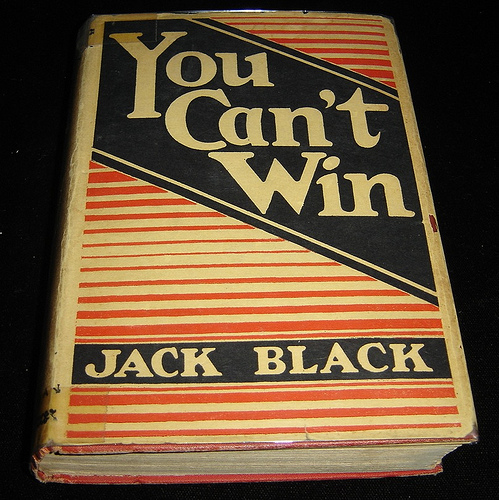
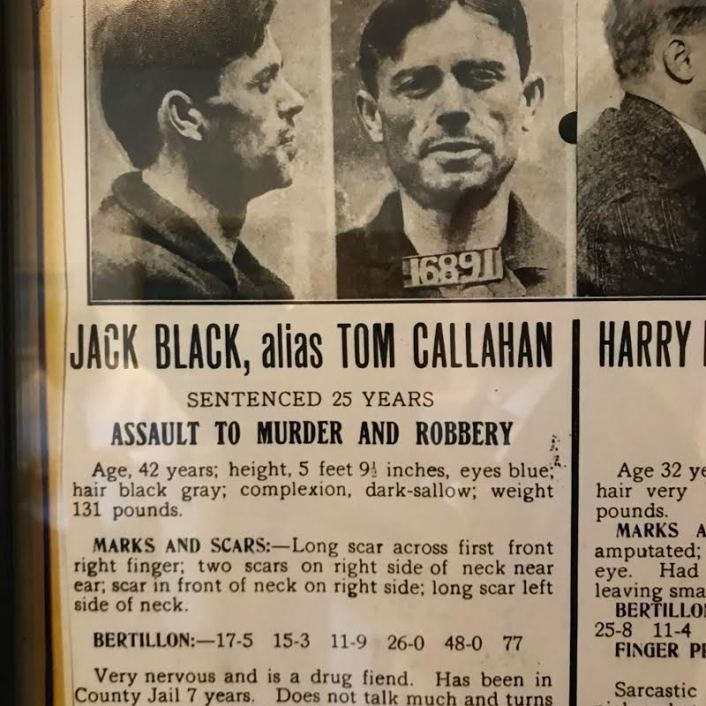
Jack Black - The favorite book of William Burroughs. A journey into the hobo underworld, freight hopping around the still Wild West, becoming a highwayman and member of the yegg (criminal) brotherhood, getting hooked on opium, doing stints in jail or escaping, often with the assistance of crooked cops or judges

Slikovni rezultat za Jack Black, You Can’t Win: Complete and Unabridged,
Jack Black, You Can’t Win: Complete and Unabridged,  Sublime Books, 2016. [1926.]
borrow it here


My background is crowded with robberies, burglaries, and thefts too numerous to recall. All manner of crimes against property. Arrests, trials, acquittals, convictions, escapes. Penitentiaries! I see in the background four of them. County jails, workhouses, city prisons, Mounted Police barracks, dungeons, solitary confinement, bread and water, hanging up, brutal floggings, and the murderous straitjacket. I see hop joints, wine dumps, thieves' resorts, and beggars' hangouts. Crime followed by swift retribution in one form or another. I had very few glasses of wine as I traveled this route. I rarely saw a woman smile and seldom heard a song. In those twenty-five years I took all these things, and I am going to write about them. And I am going to write about them as I took them - with a smile.
    
The favorite book of William Burroughs. A journey into the hobo underworld, freight hopping around the still Wild West, becoming a highwayman and member of the yegg (criminal) brotherhood, getting hooked on opium, doing stints in jail or escaping, often with the assistance of crooked cops or judges. Our lost history revived.. With an introduction by Burroughs.


ANY AUTOBIOGRAPHY DEDICATED to the man who picked buckshot out of the authors back under a bridge at Baraboo, Wis., and to another fellow who sawed the author out of the San Francisco County Jail must be a hell of a read. Legendary beat writer William Burroughs thought so, as have hundreds of other readers who have managed to get their hands on Jack Black’s elusive You Can’t Win, a turn-of-the-century hobo/burglar memoir first published in 1926. Now reissued by AK Press, this printing will be welcomed by all those ready to live the outlaw life, if only vicariously.
Black’s matter-of-fact treatment of the hobo life resonates with honesty. We watch Black first-hand as he deals with women of so-called negotiable virtue; as he visits the opium dens or hop joints scattered about San Francisco’s Chinatown; and as he relates to the safecracker hipsters of the era known as yeggs. We see Black in all of his glory: jumping rails, witnessing shootings, robbing banks, and ironically obeying the law – that is, the law of the Johnson’s, a code of ethics among burglars and thieves that rivals anything respectable society has managed to promote.
With Black we roam the countryside, meeting characters like the Sanctimonious Kid, whose name speaks for itself; foot-and-a-half George, whose leg injury was the result of a safe blowup gone awry in Butte, Mont.; and Salt Chunk Mary in Pocatello, Idaho, whose principal business was selling wine, women, and song (not to mention fencing stolen jewelry) to the railroad men and gamblers who passed through town.
This book offers not only the boastful burglar, telling of his fantastic heists, but the burglar who can, now that time has passed, look back on the unsuccessful exploits with humor. We have the time Black and his comrades in crime blew open the door on a huge safe only to have it fall on its face – too heavy for Black to get its contents. We have the story about Black and his partners purposefully being arrested for vagrancy, breaking out of jail to commit a successful burglary, only to break back in for the perfect alibi. Over and over again the book delivers. It is engaging, with nothing of the sensational for its own sake.
The first publication of this book in 1926 went through five printings in less than one year. The 1988 reissue by AMOK press included an introduction by William Burroughs, of Naked Lunch fame, who acknowledged the influence this book had on him. The new edition, ushered in by Bruno Ruhland and AK Press, includes the Burroughs preface as well as a nearly 40-page afterword by New York City 1960s literary underground figure Michael Disend (whose own novel, Stomping the Goyim, was praised by Burroughs as “brilliant”). Disend’s afterword alone, written in a powerful and irreverent style, is worth the price of the book. He rightfully places You Can’t Win in the turn-of-the-century prison reform movement that was sweeping the country at the time. Disend politicizes Jack Black by taking the book beyond the romanticism of the on-the-road genre and into the realm of politics and an indictment of the modern prison industrial complex. Sure, readers will love the book because of the great story-telling, but Disend’s afterword helps a new generation see the message of redemption in this post-Three Strikes, post-Proposition 21, prison state America is turning into.
Black’s memoir undermines the notion that violence and inhumanity will somehow reform him. Black survives a chain gang in Denver, flogging in Canada, being straitjacketed in Folsom prison, and three weeks in the infamous cooler of Utah’s state prison, where he lives in darkness surrounded by steel walls, is giving no bedding, and must survive on a single slice of bread a day.  He also endures the psychological terror of witnessing the hanging of a fellow prisoner in the San Francisco jail from his own cell a few feet away. But it isn’t until his brutal beating and choking by a notoriously cruel sheriff in Seattle named John Corbett that he condemns, somewhat prophetically, our modern approach to reforming criminals: “If people can be corrected by cruelty I would have left that cell a saint.” And he didn’t, of course, because we cannot beat justice into a man no matter how hard we try. Nor can we employ cruelty to obtain or guarantee safety because the societal ills that encourage criminality are not diminished in the least by such acts of retribution.
What is beautiful about this book is the realization that Jack Black changes because other men believed in him and took the chance that he wouldn’t betray their trust. He changed because he saw things as a result of the life he led, not in spite of it. Michael Disend’s afterword is filled with historical research that tells of what became of Black after the publication of You Can’t Win. Without giving away the details, let’s just say there were many surprises, as many as are contained in this engaging memoir.
The publication of this new edition of You Can’t Win coincided, ironically enough, with the final verdict to be recorded in the San Francisco’s criminal courts in the last millennium. Just as the book reached the bookstores in San Francisco the last week of 1999, Frank Grano, who was facing life in prison under the Three Strikes law for the  nonviolent charge of receiving stolen property, was found not guilty by a jury at the Hall of Justice. He had chosen to represent himself against an experienced prosecutor and all the odds. Jack Black, who himself faced life in prison in a San Francisco courtroom at the turn of the last century, would have approved. - Matt Gonzalez
https://themattgonzalezreader.com/2009/06/15/jack-black-rides-the-rails-again/
jb3
Jack Black’s autobiography, originally published in 1926, was apparently William Burroughs’ favourite book – Denton Welch was his favourite writer, by the way, so there is perhaps a little bit of a contradiction here – and he provides an appreciative foreword to the AK Press edition of You Can’t WinOn even a first reading, it is easy to see why Burroughs would admire the book: Black was an outsider, a criminal and an opium addict, and he presents a compelling (and cynical) insider’s view of the justice system of the time. And for this last alone, the book is a valuable document: a criminal outsider of intelligence pretty much tells it like it was. More crucially though, there is often a sense, as you read, that Black’s is a voice we weren’t meant to hear – at least not in this form. For Jack Black isn’t a monster; he comes across as being (at the end, at any rate) a wise and compassionate man.
A large part of the charm of You Can’t Win is that it reads like the hard-boiled American fiction of the ‘20s; like Hammett or one of the other Black Mask boys. Chapter 20, in particular, is a superbly told story: an account of a payroll robbery and its fallout that pushes all the right buttons. Like many of Black’s adventures (or at least like those recounted here), it does not end well. Downbeat doesn’t do it justice.
Throughout, the writing has great immediacy and the same sort of authenticity with regard to the criminal life as the first few chapters of Edward Bunker’s later No Beast So Fierce. This is so whether Black is describing dodging railroad bulls and jumping on boxcars, getting picked up for vagrancy or winding up in a jailhouse where “a coloured woman was singing a mournful dirge about ‘That Bad Stackalee’”. Many scenes bring to mind images from old American films: a lost world, but one we’ve seen or seen imagined.
We follow Black’s life from the 1890s to about the mid-1920s. He is attracted to crime as a kid of 14, after reading tales of Jesse James and others, and at first it is a life of adventure and excitement. Later, as he becomes a “yegg” (a travelling thief), he comes to see crime as a game or sport: there are codes and rules, smart plays and foolish moves, allies and opponents. At the end, after opium addiction (“opium, the Judas of drugs, that kisses and betrays, had a good grip on me,” Jack writes at one point) and time spent in Folsom, Alcatraz, San Quentin and other prisons, he arrives at the pessimism of his title: you can’t win. Crime doesn’t pay. Still, he went to hell in his own way, which is the best any of us can hope for.
There are some extras here, to add to the Burroughs foreword. An afterword by Bruno Ruhland gives some further background of Jack Black’s life; and Ruhland’s account of the social reformer Fremont Older is interesting too. There is also an article by Black about prison reform: “What’s Wrong with the Right People?”.
To sum up: this is a memorable book and was an influential one too, for the Beats especially (“on the road” is a phrase that recurs throughout; Kerouac seems to have palmed it from here). It is that rare thing: a cult book that lives up to its reputation. Its take-home message: the world is a tool for self-discovery; not at all bad for an autobiography. - Paul Kane
http://www.compulsivereader.com/2007/11/06/a-review-of-you-cant-win-by-jack-black/


Current Exhibit: You Can’t Win: Jack Black’s America, Curated by Randy Kennedy
In 1926, Jack Black’s career took another unlikely turn. The former vagrant, burglar, addict, convict, escapee, and, more recently, librarian of the San Francisco Call could now boast that he was a best-selling author to boot. Black had dictated his memoir – a criminal CV covering some thirty years’ experience across the pre-Volstead West – to none other than Rose Wilder Lane; under the sage editorship of Fremont Older, the feature had been serialised in the Call as a cautionary tale – a set of variations on the theme of ‘crime doesn’t pay’ – and it had proven so popular, moreover, that MacMillan decided to publish. You Can’t Win underwent five further reprintings, and the ‘one-man San Francisco reign of terror’ became a New York lecturer, Harper’s essayist, one-time dramatist, and salaried screenwriter for MGM. Black had won – or so it seemed until his sudden disappearance in 1932. ‘Fremont,’ wrote Older’s wife, reckoned Black ‘did what he always said any down-and-outer should do, “fill his pockets with rocks and take a header into the bay.”’
Today, Black’s reputation is chiefly floated by William S. Burroughs’ old habit of naming You Can’t Win his favourite book. Prefacing the AK Press edition of 1988, Burroughs explained the book’s attractions. It introduced him to a ‘code of conduct’ which ‘made more sense’ than the ‘arbitrary, hypocritical rules … taken for granted as being “right”’: crime might not pay, but the ‘straight’ life, for Burroughs, was itself so crooked, and its odds stacked so heavily against the vast majority of its players, that even on the ‘right’ side of the law you could never really win. Hence, Black’s book also stirred in Burroughs ‘a deep nostalgia for a way of life that is gone forever’. And for this, Burroughs can’t really be blamed: when Prohibition came into force at midnight on 17 January 1920, the new outfits made the likes of Black look like the tinkerers of yore. Little wonder that Burroughs made constant reference to You Can’t Win within his own books, even copying entire sections into The Place of Dead Roads.
Black, however, happens to have pre-empted Burroughs’ admiration in an essay of 1930. ‘A Burglar looks at Laws and Codes’ has this to say about ‘hypocritical rules’:
The law… has become complicated, perverted, prostituted. Special legislation has made of it a cloak for all kinds of high-roguery. Specialized enforcement that penalizes one man and lets another brush by for a like offense has brought it into disrepute…If the rules governing baseball were as complicated as the income tax law, the world’s series would rival “Jarndyce vs. Jarndyce”. Laws make lawyers and lawyers make laws and this makes a sinister circle that grows larger and larger.
For Black, then, the law is both inefficient and indecipherable, not just corrupt but fundamentally criminal. The actual criminal’s ‘code of conduct’, meanwhile, enforces behaviours far closer to what we might think of as being lawful:
The criminal’s code is based upon the same fundamentals as the social code: protection of life and property…It pays its debts and its grudges on the minute. The crook, like the business man, strengthens his position and credit if he meets his bills and discharges his obligations promptly.
It’s in the book that the crook pays his room rent and his board…to fail to pay the board bill is an admission that he is a “slow connecter”; he can’t make the grade. In other words, he’s a failure in his profession; not a thief but a dead-beat. Sooner or later he winds up where he belongs, stealing milk bottles and doormats, serving short sentences in small jails, despised by honest people and shunned by “honest” thieves.
But if the ‘law’ and the ‘code’ are not wholly distinct, nor are they compatible:
The crook has one yardstick for measuring the conduct of the upperworld, another for the underworld. If his attorney strips him of his loot, as frequently happens, he is supposed to whistle it off and take it out on the next citizen that he meets. The attorney belongs to the upperworld, and the crook’s obligation ends when he exposes him to his fellow crooks. But if a thief’s partner robs him of his end of the loot he must “regulate” him according to the code, or lose caste.
The more strictly a criminal adheres to the underworld code the greater will be his handicap if, and when, he decides to mend his ways. This adherence makes him friends, and he is proud of it; but these very friends help to anchor him in that life
Hence, ‘A Burglar looks at Laws and Codes’ urges its reader not to romanticise the pre-Volstead years, reminding us that the law – the ‘arbitrary, hypocritical rules’ so despised by Burroughs – was then operating in perfect tandem with the criminal world and its ‘code’:
I’m not finding fault with these brave days of jungle music, synthetic liquor, and dimple-kneed maids, and anybody that thinks the world is going to the bowwows because of them ought to think back to San Francisco or any other big city of twenty years ago- when train conductors steered suckers against the bunko men; when coppers located “work” for burglars and stalled for them while they worked; when pickpockets paid the police so much a day for “exclusive privileges” and had to put a substitute “mob” in their district if they wanted to go out of town to a country fair for a week. Those were the days when there were saloons by the thousand; when the saloonkeeper ordered the police to pinch the Salvation Army for disturbing his peace by singing hymns in the street; when there were race tracks, gambling unrestricted, crooked prize fights; when there were cribs by the mile and hop joints by the score.
But if Burroughs’ ‘nostalgia’ was misplaced, why should anyone care about Black’s book at all?
II
A good answer has been yielded – albeit indirectly – by the current exhibition at the Fortnight Institute – You Can’t Win: Jack Black’s America. As Randy Kennedy, the exhibition’s curator, writes in the press release:
Black’s America is not historical. We live in it today, in ways that he foresaw and ways he could not have imagined, or would not have wanted to. What Faulkner said of the South applies equally to every part of the country, especially in the Trump era: “The past is never dead; it’s not even past.” Black’s alienation and evocation of life on the lam trace two interrelated kinds of disappearance: chosen and enforced. Between them lies a third: that of people born into American society already disappeared, socially and economically, because of race, gender and other fundamental aspects of their being.
For Kennedy, Black’s America – in which even the ‘straight’ population found itself disaffected and disenfranchised en masse – is uncannily like today’s. And the Fortnight exhibition is largely devoted to demonstrating that this is the case. Kennedy continues:
The works in the show could be regarded as unindicted – or perhaps indicted – co-conspirators of Black’s deep anomie and solidarity with the subjugated. Beverly Buchanan’s Miz Hurston’s Neighborhood Series – Church, from 2008, locates her beloved shack sculptures in a specific milieu, the Florida of novelist Zora Neale Hurston, where Hurston’s life ended in obscurity in a welfare home, her body buried in an unmarked grave. The self-taught artist Pearl Blauvelt (1893-1987), made her phantasmal drawings—discovered accidentally, years after her death—in a house in northeastern Pennsylvania where she had lived alone without electricity or plumbing; neighbors called her the village witch. Martin Wong’s prison paintings, often depicting his friend, the playwright and activist Miguel Piñero, shimmer with tenderness and carnality for the cellmate. Selections from Luc Sante’s folk postcard collection double as the incriminating pictures of a feral young nation that Black himself never had time to take, between jobs. The 1991 painting by Burroughs and poet John Giorno encompasses all-American violence as if it were made yesterday…
You Can’t Win, then, continues to resonate because, for the most part, you still can’t win: the ‘straight’ life remains a fixed game, and the house still doesn’t ever lose.
But some have felt that Black’s book does more than simply foreshadow the inequalities of our own era. The 2013 edition of You Can’t Win from Feral House carries on its cover the following testimony from Nick Tosches:
Jack Black’s book has too often and for too long been looked on, more by reputation than by reading, as a ‘cult classic,’ implying that it belongs to the fringes of literature. Nothing could be more untrue. It deserves a much vaster, if not universal, audience. More than – rare enough – a damned good book, it is a book of timeless, illuminating truth that offers the antidote to the poisonous lies, from the fool platitudes of faith to the rot about the inalienable right to life, liberty, and the pursuit of happiness, that have made suckers and losers of us all. This book is one of a kind.
Here, Tosches rephrases the standard arguments for canonicity. To claim that a book might deserve a universal audience is to suggest that everyone should or ought to read it. The suggestion is qualified by two more: first, that You Can’t Win possesses a qualitative superiority which distinguishes it from the majority of published works – that it is ‘rare enough – a damned good book’; second, that You Can’t Win is not some artefact, not merely an evocation of a particular era, but a work that transcends the circumstances of its production and speaks ‘timeless, illuminating truths’. Heartening stuff, but what would Black have made of these endorsements?
From the very outset of You Can’t Win, Black is acutely sensitive to distinctions of quality. Describing his introduction to books and reading, he relates the following story:
One day I found a dime novel and devoured it. After that I was always on the lookout for dime novels… I read them all. “Old Sleuth,” “Cap Collier,” “Frank Reade,” “Kit Carson.” Father saw me with them, but never bothered me. One day he brought me one of Fenimore Cooper’s Leatherstocking Tales. I read it and was cured of the five- and ten-cent novels.
Almost as soon as he enters the world of literature, then, he learns to discern high from low, legitimate from suspect, art from pulp. And once he has discovered the former, the latter becomes intolerable to him. Perhaps unsurprisingly, You Can’t Win goes on to reproduce, albeit in miniature, that thing beloved by every hard-line advocate of the canon – a list of Great Works:
The widow gave me a trunkful of books she had taken for a board bill. Among them I found a battered old volume of Dumas The Count of Monte Cristo, on which I put in many nights. This sharpened my appetite for reading, and I went around second hand bookstores and got hold of the D’Artagnan tales and devoured them. Then Les Miserables, and onto the Master, Dickens.
Did Black wish to be ranked among this high company? Should we read his autobiography as Literature-with-a-capital-L?
We would be fools to try. The laws of canonicity – the regulations by which the cultural authorities determine whether a text is deemed a legitimate Classic, a work fit for universal study – are as complex, as baffling, and, for many, as politically corrupt as the actual law seemed to Black. One could not, in the scope of this or any piece, hope to lay down their complete sections and subsections, nor pass judgement on whether Black’s book adheres to them. And even if we could, it would be hard to imagine even a reformed crook like Black deliberately observing any kind of law when setting down with Lane the record of his criminal career; if Black’s book ever fulfils the laws of canonicity, it does so, surely, by accident. This is not to suggest that You Can’t Win should be discarded along with the dime novels of Black’s youth: Black’s most important difference from Cooper, Hugo, Dumas, and Dickens is not one of quality but one of kind. And to attempt to measure You Can’t Win against their ‘yardstick’ would be fruitless, therefore, for it is Black’s very refusal to stand within its scope which lends his book its strange affect.
And this is another thing which Black’s book has in common with the other works collected at the Fortnight Institute: all come from the margins of their respective fields, and draw their power from the fact that they cannot be measured against the officially-sanctioned criteria of canonicity.
III
The ten photo postcards from the personal collection of Luc Sante are no exception. As Sante writes in Folk Photography: The American Real Photo Postcard 1905-1930:
The photo postcard is a vast, teeming, borderless body of work that might as well have a single, hydra-headed author, a sort of Homer of the small towns and the prairies. Self-taught and happily ignorant of the history of the medium, this author was free of the sort of second-guessing that cripples artists. He or she was out to do a job, to please a public, to turn a dollar, but also to record things faithfully, to hold up a mirror to that bit of the world shared with the clientele, maybe to make the familiar strange, simply by noticing things. Freedom from the historical burden made for an aesthetic that prized above all finding the distance between two points. That is, the pictures are most often blunt and head-on, and in fact are best when they are blunt and head on.
I have collected similar cards, with varying degrees of seriousness, since childhood. What draws me to this arcane pursuit is hard to define [for if I could perfectly articulate it, presumably, I wouldn’t be drawn to it anymore]. On the one hand, photo postcards seem to eschew, either by chance or design, the established ‘laws’ of the photographer’s art. At the same time, they clearly adhere to what Black might have called a ‘code’: not only do they fall into clear ‘types’, genres unique to the medium [train-crashes and shipwrecks are particularly well represented in my collection], they also seem to embody a common aesthetic, a shared sensibility by which it is possible, moreover, for a collector to assess [in retrospect, of course] a particular card’s success. And the best I can do to explain that sensibility is this: a card is significant, I think, not simply when its subject reminds us of the present day, but when it records something which has been overlooked in the grand-narratives of History – when it documents some minutia which hasn’t been assimilated within the authorized accounts. The presence of Sante’s cards [all of which are exceptional] within the Fortnight exhibition forces us to ask further questions of You Can’t Win. Does it too partake in a shared sensibility? Does it adhere, in Black’s words, to some ‘code’? If it won’t be measured against Cooper, Hugo, Dumas, and Dickens, how does it fare against the other hobo biographies of the inter-war period?
You Can’t Win might seem unique among its companions-on-the-road. Jim Tully’s Beggars of Life was published only two years before You Can’t Win, but the life it describes is crucially different from Black’s. Tully was born near St Mary’s Ohio in 1871 – some twenty years after Black; the ‘way of life’ whose loss was mourned by Burroughs had all but vanished by the time Tully arrived on the scene. Tully’s wanderings, moreover, were largely restricted to areas in and around Cincinatti. And he was, crucially, no criminal, but a migrant worker: a roadkid, factory slave, circus hanger-on, stakedriver, ditchdigger, chain maker, tree surgeon, boxer, and, eventually, a Hollywood journalist and secretary to Charlie Chaplin. Dr Reitman’s Sister of the Road, meanwhile, was published a whole decade after Black’s book and is not, strictly speaking, a biography at all: Boxcar Bertha, the book’s narrator – though she is, like Reitman, both a gynaecologist and an anarchist agitator – is ultimately a fictional creation.
Nevertheless, the three texts are united by two things. First, each is told in the first person and rendered in radically unsentimental prose [Jim Tully has even been credited with inventing the ‘hardboiled’ style popularised by Dashiell Hammet]; second, each of their respective narrators is a vagrant – a figure on the bottom of the social ladder, with little or no hope of moving up it, and whose want of social mobility is only matched by an excess of physical mobility. The vagrant, then, is probably best viewed as the opposite of flaneur – the urban wander of Nineteenth Century Paris who is able, as Baudelaire originally put it ‘To be away from home and yet to feel at home anywhere, to be at the very centre of the world, and yet to be unseen of the world’; the vagrant, by contrast, is homeless wherever he find himself, and always consigned to the position of outsider. And it is due this position that Black’s stories of domestic burglary are particularly fascinating: they are accounts of stealing into people’s homes, of breaking into their inner sancta, narrated by an unsentimental outsider for whom the very concept of ‘home’ has long become alien. Not only are they deeply disorienting, therefore, they also form precisely the kind of detail which, by definition, doesn’t make its way into the authorised accounts of the pre-Volstead West.
There is little doubt, then, that You Can’t Win is, in Tosches’ phrase, ‘a damned good book’; more specifically, it is a ‘damned good’ example of the vagrant biography – one whose success, moreover, is attributable to the fact that it places the subjective experience of the outcast squarely at the centre, rather than at the margins, of its narrative. And it is this same sensibility which ultimately unites the works in the Fortnight exhibition: all have the feeling of being, in some way, ‘outside-in’. - Oscar Mardell


www.3ammagazine.com/3am/you-still-cant-win/


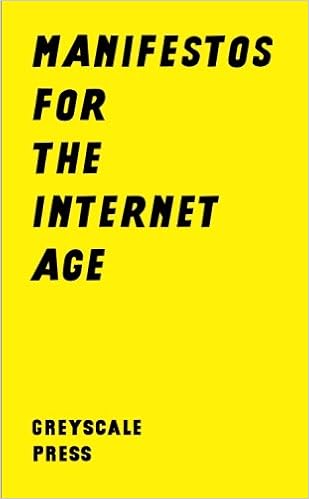
Manifestos for the Internet Age - a reader that collects manifestos of computer culture, starting with Ted Nelson, through the GNU Manifesto and the Hacker Manifesto, up to current influential positions such as the Critical Engineering Manifesto, the 3D Additivist Manifesto and the Xenofeminist Manifesto

Slikovni rezultat za Manifestos for the Internet Age
Manifestos for the Internet Age v0.8, Ed. by Manuel Schmalstieg, Bram Crevits and Viktor Kruug
Greyscale Press, 8. ed., 2016)


Manifestos for the Internet Age is a reader that collects manifestos of computer culture, starting with Ted Nelson (Computer Lib), through the GNU Manifesto and the Hacker Manifesto (1986), up to current influential positions such as the Critical Engineering Manifesto (Oliver, Savicic, Vasiliev), the 3D Additivist Manifesto (Morehshin Allahyari & Daniel Rourke), the Xenofeminist Manifesto (Laboria Cuboniks) and many other writings from both artists and activists. The present edition (as of July 2016) includes writings by VNS Matrix, Aaron Swartz, Asher Wolf, the Swedish Piratpartiet, Constant Dullaart, Aram Bartholl, Edward Snowden, Piotr Czerski, David Weinberger, Doc Searls, Evan Roth and Casey Gollan.

Greyscale Press’ Manuel Schmalstieg understands publishing after the Internet. Not only because its catalogue of books is full of critical texts originally available only online, but mainly because it applies skilled editing qualities and ideas to the confusing amount of interesting content that can be accessed on screen. When it comes to manifestos, many of these have been forgotten in recent decades, languishing in unpopular websites or mailing lists, even when they are extremely important. Moreover, the manifesto format is a synthesis of impetus and analysis in a short amount of words, one that continues to work today because of its distinctive communicative aspects (it is authoritative, clear and short.) Traditionally, manifestos had to be very visible, posted in a popular public square, or published in a relevant newspaper or magazine. Significantly this seems to be of constant value, as the “Declaration of the Independence of Cyberspace” which became definitely popular after its publication on Wired magazine. This collection is divided chronologically (before 2000, and then into its first two decades) and hosts much more than the classics (like Computer Lib, GNU, Unstable Media, Lo-Fi, Critical Engineering, etc.), with an attention to critical technology-related and artistic pieces. So, for example, we find Hactivismo, the Web Indépendant, the New Clues and the Xenofeminism manifestos, and all of them in a small paperback format that makes them both ideal to be carried anywhere and a good case of an edited and archival use of print. - neural.it/2016/09/vv-aa-manifestos-manifestos-for-the-internet-age/ CYBERFEMINIST MANIFESTO FOR THE 21ST CENTURY
We are the modern cunt
positive anti reason
unbounded unleashed unforgiving
we see art with our cunt we make art with our cunt
we believe in jouissance madness holiness and poetry
we are the virus of the new world disorder
rupturing the symbolic from within
saboteurs of big daddy mainframe
the clitoris is a direct line to the matrix
VNS MATRIX
terminators of the moral codes
mercenaries of slime
go down on the altar of abjection
probing the visceral temple we speak in tongues
infiltrating disrupting disseminating
corrupting the discourse
we are the future cunt
– VNS Matrix, 1991
This is what you get when you dip into Manifestos for the Internet Age, a reader issued by Greyscale Press. It might be the best way to consume manifestos, in fact, jumping in for a page or two and getting out fast. But I possess an above average tolerance for manifestos, having written about them for a decade and even having seen one scrawled across a fellow classmate’s private parts (see tenet six of this essay) in an undergraduate class on Futurism. For that reason I decided to bravely read the book in one sitting, wading through dozens of proclamations on hacktivism, transhumanism, cryptocurrencies, and other facets of the hyper-accelerated, 3D-printed technoverse we’ll soon be living in. And I came out with a better understanding of where things are in 21st century activism and art.
Manifestos for the Internet Age comes in digital (via GitHub for initiates) or paper formats. The paperback is print-on-demand by Amazon, which seems to compromise the principles of most of the radical manifestos contained within; perhaps it was an afterthought, a consolation gesture to the arcane. There is no foreword, index, colophon or even much sense of design; the original cover (pictured) was quite nice. On the other hand the book has a bold and non-commercial feel, it’s cheap and pocket-sized, and this presentation is well suited to the manifesto.
The book was ‘generated’ over a single weekend in 2015, and it is still a work in progress—mine is beta version 0.7. Participation in future iterations is encouraged, which means that infinite changes and additions are possible. In this sense it realizes the old modernist dream, expressed in the circular form of Joyce’s Finnegans Wake (aka ‘Work in Progress’) with the end circling back, ‘a way a lone a last a loved a long the / riverrun, past Eve and Adam’s, from swerve of shore to bend of bay’, Finnegan begin again, or the potentially endless emendations and extensions written into galley proofs of Ulysses, which really only ever stopped because of Joyce’s love for numerology and his wish to have a copy printed in time for his 40th birthday. So everything is a work in progress, an endless draft. ‘Laugh at perfection’, as the eighth tenet of ‘The Cult of Done Manifesto’ (2009) commands. But is that really wise? If everything now exists forever, should we not work for a greater rather than a lesser degree of finish? How much more half-baked content does the world need?
One of the compelling things about these manifestos is the frequent overlap between theory and action: open source manifestos that are open source, for example. This has long been the case, of course: a century ago the manifestos and live performances of avant-garde movements like Dada and Futurism sought to cross lines; since the 1960s examples of violent action supported by violent texts, from Valerie Solanas and Ted Kaczynski to Anders Breivik and Dylann Roof, have become almost commonplace. Thankfully the manifestos gathered here are overwhelmingly utopian and for the greater good. Edward Snowden’s ‘A Manifesto for the Truth’, for example, lays out the principles behind his decision to leak classified information from the National Security Agency in 2013; Aaron Swartz, who committed suicide the same year, aged 26, while facing a US federal indictment for data theft, left a record of his views in the ‘Guerilla Open Access Manifesto’.


Manifestos for the Internet Age is a curious mix of tech geekery and various hybrids of social, political and art activism. I lean toward the latter, but I’m trying to understand the former, especially since I now write about it, and anyway I’m realizing they are inextricably intertwined. This was a good primer because manifestos are by definition plain spoken, unambiguous, easy to understand (the Latin root means to make obvious or clear). So I learned a few things I didn’t know about the code wars; but I also heard persuasive arguments about art and politics. Not all were persuasive. It seems that someone will always use a manifesto to put a lasso around the zeitgeist and try to wrangle it, the way the ‘Avant-Pop Manifesto’ tries to declare a unifying sensibility for the digital generation. More successful by far is Xenofeminism, which aims ‘to re-engineer the world’ and is a true manifesto—one that walks the knife-edge of the extravagant and the possible. It is a line that the best manifestos have always walked, from Futurism, with its banquets, ballets, and buildings, to Situationism, which pried loose the cobblestones of Paris to reveal the beach beneath the street.
The manifestos are divided into three periods: 1974-1999, 2000-2009, and 2010-2015. The jump from a twenty-five to a five-year span—with the last five years taking up half of the volume—has a touch of Moore’s Law about it. You get a sense of the amount of sheer stuff out there, increasing minute by minute, like the endless water buckets borne by marching brooms that torment the sorcerer’s apprentice in Fantasia. In fact the unfathomable quantity of stuff—and the environmental degradation that goes with it—becomes a theme in the last section. In the first section there are manifestos about hackers’ rights, the promise of liberation in new online communities, and open source code; in the second come the piracy advocates, post-media art, and increasing concern for those left behind by the digital revolution evident in cheap hardware manifestos (James Wallbank’s ‘Lowtech Manifesto’ and ‘The Zero Dollar Laptop Manifesto’). Then finally we arrive at the glorious hell of now and the near future—the Anthropocene, digital natives swimming in oceans of grey goo, bioprinted body parts, your fridge spying on you, and the rest of it. Underpinning this timeline is something like the shift from modernism to postmodernism—a shift from optimism and progress dogma about the endless new possibilities of the Internet to a more jaundiced understanding that everything is fucked, but we really should do something concrete to try and ease the pain.
The collection ends on a high note with Additivism. The ongoing project is perhaps harder to grasp and more diffuse than Xenofeminism, but no less vital. It has strong ties to the historical avant-garde as well as a radical new post-everything agenda and means of dissemination. Its manifesto is a computer animated, web-based video; it calls not for paintings and poems but for glitches and algorithms and the manufacture of interspecies sex organs. This being the 21st century, I reached out to the authors of the 3D Additivist Manifesto, Morehshin Allahyari and Daniel Rourke, on Twitter. A couple of weeks went by and then they each responded at length via email. ‘I personally have always loved reading manifestos’, Morehshin wrote. ‘With our 3D Additivist Manifesto, we were interested in the idea of creating a Cookbook inspired by the Anarchist Cookbook but … we decided that we needed to first define a position and ask difficult questions … we saw it as an opportunity to create both a movement and a community around our ideas.’ Daniel, a true aficionado, gave me the names of some manifestos I had missed, like Svetlana Boym’s ‘Off-Modern Manifesto’ (2003). He also mentioned some classics, like Oswald de Andrade’s surreal and incantatory ‘Anthropophagite Manifesto’ (1928).
All of this served to reinforce my belief, supported by Manifestos for the Internet Age, that the manifesto is undergoing a renaissance at the moment. Rourke agreed, pointing for evidence to the scores of ‘provocative manifestos coming out of artistic/academic communities’ in recent years. The urgent tone of these manifestos has only increased since the global crisis of 2008 and its aftermath in Occupy and similar movements. It is aided on one hand by a renewed spirit of activism and political engagement, in art and elsewhere, and on the other with the spread of the Internet, particularly social media, into every corner of our lives—meme culture being a perfect environment for the manifesto.
Manifestos belong at the bleeding edge of culture and politics. Today the manifesto has once again, as a century ago, found its moment: through its unabashed bravado and arrogance, its provocation and performance, and its willingness above all to shock the timid reader, the genre has found new relevance in the Age of Outrage. - Julian Hanna
minorliteratures.com/2016/04/29/manifestos-for-the-internet-age-by-various-julian-hanna/

Marc Nash - This fiendishly complicated story is made even tougher by its tricksy prose, but it’s not hard to admire its daring


Marc Nash, Three Dreams in the Key of G, Dead Ink, 2019

extract


In peace-agreement Ulster a mother rears her two daughters, as her husband is decommissioned from his violent paramilitary past.
In Florida a septuagenarian runs a community refuge for women and the authorities have surrounded it as a threat to national security. In laboratories all over the world the human genome is being dissected and decoded.
In Three Dreams in the Key of G three female voices, Mother, Crone and Creatrix, unknowingly influence each other's fates as each battles to assert themselves and discover their voices in hostile environments.


In post Peace Agreement Northern Ireland, a young mother feels besieged. Both by the demands of motherhood and her militant Loyalist husband, decommissioned with the advent of Peace and thrown back into the world of the domestic hearth; whither the violence of his soul? To stop her mind becoming silted up through inactivity, surrounded by the infantile and the exasperating, she maintains a journal. Through which she pursues questions of nature versus nurture in the development of her children, within a divided society such as Northern Ireland, proffering its rarefied environment of acquired symbol and historical legacy. Only, why is her journal all out of sequence and what meaning can it therefore provide to answer her despairing question, 'why do we even have children?'
In Florida, a British septuagenarian with no papers and no official existence, also finds herself under a state of siege. Her community is currently surrounded by FBI, ATF and DEA armed agents. Yet they are not a sect of any kind, rather a refuge for battered women. And while it is true she does have a scheme for redrawing the map of the world, it could hardly be said to be a doomsday scenario. Except maybe, if you're a male of the species. Her fight is for hearts and minds, which might explain why her principal manifestation appears to be through the internet. Where lurk useful allies for her in the war of information technology.
In commercial laboratories all over the world, the human genome is being decoded and compiled. Or ravished and dissected depending on your point of view. What is that textual voice feedbacking through the monitors? Protesting the assault; challenging the epistemologies of both scientist and theologian; chiding us for our linear notions of relationship, the depleted metaphors with which we construct thought and even our 26 letter alphabet in the face of the genome's intricate weaves formed from combinations of just 4 letters. Goading us that we will never unravel the mystery that lies behind the genetic code, unless we open up our very natures to unlimited potential.
Three powerful female characters, Mother, Crone and genetic Creatrix. None of them will meekly submit to their besiegers. Their three narrative voices, intercut and interweave with one another. In a sense, all three are palimpsests, constantly writing over, and being written by, one of the other two. Whether they are aware or not, they are being informed by another intimate voice so close at hand, as to be under the skin. Will the language they are able to draw on, be sufficiently robust to meet their enquiries, or will it betray them and lead the triumph of their besiegers?
https://www.thedreamcage.com/2018/07/book-three-dreams-in-key-of-g_26.html


Hold tight. Because I’m now going to try to explain what I think is happening in Three Dreams in the Key of G. As the title hints, there are three narrative strands, although they are not particularly dreamy. The first contains the journal entries of Jean Ome, a mother of two children living in Ulster and married to a man who has connections to violent Protestant paramilitaries. These journal entries have been written infrequently and with no definite purpose by an intelligent and frustrated woman trapped by circumstances who is prone to prolixity. Just to make things extra difficult, they have all been muddled up and are presented out of order.
The second strand is made up of internet messages from Jean Ohm, an equally verbose voice, but one under severe constraint. Ohm supposedly lives in a kind of sanctuary for battered women and claims to have found a way to breed without men – and that she is writing her missives while under siege from the “FBI, DEA, ATF and all manner of sect-obsessed acronyms”.
The third strand is a hectoring Greek chorus, presented by – bear with me – a genome. That’s to say, A, C, T and G: the four letters in the sequence of DNA. This voice is also called the “Creatrix” and its general role is to explain the mysteries of genetics and the hubris of mankind for thinking it can map out such complexities, even though, as the voice reminds us: “You, you don’t even know you’ve been born. How or why.”
I’m not wholly confident about all this, but I’m confident no summary can really do justice to this fearsomely complicated book. Nothing is certain and everything is presented in dense, complex and frequently confusing sentences.
There’s something exhilarating about a novel that cares so little for reading pleasure. Marc Nash hasn’t compromised his vision in any way, which is admirable. But there are also obvious problems. Three Dreams in the Key of G can be a brutal slog, with Nash laying down some punishment prose. Such as: “For even though I range with my counter of lachrymosity and flash my bloodshot lens, I’m fumbling to illuminate America’s topmost popular pastime, spouse beating.”
Riddle me this too: “Like the freestanding bridge designed by one of the sharpest minds to fall furthest from your topiary of knowledge.” Or: “It’s not down to the climatic marasmus, however.” The undernourished climate? And there’s this: “The glorious, faceless, nameless failures, borne on powerfully broad shoulders upon which you gnomically squat.” Why all the adjectives? How does one squat “gnomically”?
Such gnarly prose can get annoying. So too can the Nash’s propensity for making puns (“Jean’s gene genie is out of the box.”). No thanks.
Yet while such writing is ugly, it isn’t purposeless. Early on, Nash has his genome narrator explain: “Here we are forensically investigating the intent, the every nuance of verbiage itself.” Nash is always making suggestions about the limitations of language and the combinations we can achieve with the 26 letters in our alphabet. (All those letters, the Creatrix reminds us, can do less than just A, C, T and G.) Eventually, I had to concede that there was validity to the way the voices of his three different narrators become virtually indistinguishable: they might have all swallowed the same dictionary.
These voices can also be beautiful, exhilarating and funny. The DNA strand can be especially amusing, lording it over computers for only working in binary: “They can also count the number of letter E’s in the works of Shakespeare, but that doesn’t mean they can approach him any the better either.” Miaow!
When I reached that passage, I realised I was actually starting to appreciate this unusual book. Yes, I found it frustrating and occasionally dull, but this book becomes increasingly intriguing and challenging as it goes. The questions it poses about free will and self-determination have been asked before, and the themes of male violence and irresponsibility are all too familiar. But Nash’s approach to them is original. It’s daring. (As, incidentally, is his attempt to give sympathetic voice to female experience, at a time when so much ink is wasted on debating who is allowed to write what.)
Nash never makes things easy for his readers, but he does give us an emotional core to cling to. Particularly Jean Ome, who is never sentimental and is as likely to recall the “green-brown inky squirt” in a nappy as she is her baby’s smile – but that makes the bond between mother and child seem all the stronger. Many of the intimate scenes of home life have real power. Similarly, the questions the book asks feel ever more urgent. I had to respect this book, in spite of everything. It is curiously impressive. -
https://www.theguardian.com/books/2018/sep/26/not-the-booker-three-dreams-in-the-key-of-g-by-marc-nash-review-curiously-impressive


Three Dreams in the Key of G, by Marc Nash, is a book that took me some time to engage with. The language used is complex in places with much play on words not often employed in storytelling. There is a reason for this which when revealed left me exhilarated. The ideas presented and their presentation will not easily be eclipsed.
The story utilises three voices. The most accessible is that of a young mother living in small town, small minded, mid Ulster as the peace process is brokered. She is married to a staunch Loyalist, despising his hate filled rhetoric but silently. Where once she had dreams of attending university in Belfast, her family vetoed this plan due to the possible dangers a young girl could be faced with living alone in a big city. These dangers concerned the freedom from family watchfulness, freedom from the ever present threat of their opprobrium, and what such freedom might enable her to become.
The second voice is that of the human genome project – somehow the author makes this work. It explores how humans seek to understand and thereby control what they are, their essential make up. Man wishes to meddle to prolong life, to affect what he creates. There is still much that he does not comprehend about what makes him what he is. This voice is resonant with irony and wit. The details bring man down to size, mocking his earnest endeavours. However marvellous scientific discoveries may be their impact will be shadowed by other influences.
The third voice is that of an elderly lady running a refuge for victims of domestic violence in America. The state is suspicious of her attempts to escape the deleterious effects of overt masculinity. They regard her venture as a threat.
The mother writes in her journal of her thoughts and experiences with her two young daughters. Having accepted this path for her life, as is expected of the women in her family and community, she rails against its constrictions. She aims to raise her children well, with little help from her husband: “the troubles (small ‘t’)“. She ponders what her girls have inherited from their parents and how this will affect them as they develop, what language they will learn to speak.
“Cooing and trilling, sound cantered asunder like spiderlings ballooning on their silk threads. But gradually she anchors her vocal drift, as she ingests the intoned gobbets spilling from my tongue. I watch her kneading the sounds, hands to mouth, a second, invisible umbilical from me to her. Passing along my dead language. That parched parchment from my cracked and parched lips that will not quench her thirst for congruence. For I recognise it will only succeed in re-sealing the esophagal aperture magically parted by her genes.”
“A dead language emanating from someone who scarcely lives a life. But even this is not the mummifying cause. The language, my language, is sententious and doctrinaire. Replete with exclamations, directives and interrogatives.”
“So the everyday arpeggio of parenting inevitably thrums and frets my stretched nerve strings. Single noted, sharp and shrill, instead of flat and even. A drone all the same. Off-kilter rather than merely off key. Whatever the issue at hand, the tilting ground, the mittened gauntlet thrown down is ratcheted up into a disproportionate response on my part. Since, no matter how much it is cloaked with the pathognomy of tiredness or frustration, behind each and every one of my emissions flares the filament of anger. The incendiary of rage and dejection at myself and what I have become.”
As the mother goes through her days – shopping, school runs, desolate beach trips, daytime TV – the genome project churns out its findings, musing on why it is being attempted.
“For there is only Sex and Death. Passing on and passing over and vice versa. How your trepidation over mortality feeds into your procreative drive. The pair intertwined round one another like poison ivy.”
“I deal in the architecture of potentia, where you are grounded in the material shoring of tenure. See, the key difference between you and I is that life and time stretch everlasting into the future, for me as DNA and you as my prized host bloodstock. But not for you as individuals.”
In the refuge women are also procreating, but not with those who drove them to reside in this place. Their choices, their autonomy to make such choices, are what the state sees as a threat. Women should exist for man’s pleasure and the perpetuation of his genes.
This is remarkable writing that explores man’s proclivities and purported cleverness. Each relationship is shown to be one sided, supposed understanding a reflection of self. Man can draw the map and tinker around the edges of the detail, but how much of true note can be changed?
All of this is explored, dissected, and presented in language rich with depth and meaning. The conclusions are salient yet, when considered dispassionately, unsurprising. Man chooses to ignore so much in plain sight as he strokes his prejudices and vanities.
A book that soars and leaves a frisson in its contrails. A challenging, stunning, wholly satisfying creation. - Jackie Law
https://neverimitate.wordpress.com/2018/07/24/book-review-three-dreams-in-the-key-of-g/


Hidden amongst the words and paragraphs of Three Dreams In the Key Of G is a secret code that is begging to be deciphered. It’s there, the ultimate thesis Marc Nash wants us to take away from his story, I can see it. But, every time I thought I had a good grasp on it, Nash moved us to a different perspective and I had to start all over again. Three Dreams is a very interesting book, one that I’ll be pondering for a long time, but ultimately left me hanging.
I wish I could give you the exact plot of the book. I know it has to do with three characters: a mother, an older woman whom might be the head of a cult, and DNA. The book weaves between the three of them, the Mother telling us her story through her diary, the old woman, Jean, writing in her blog, and DNA speaking to us with its different genome sequences.
Their stories are told through a rambling stream of conscious. Thoughts jump from one thing to the next, sometimes going off on a tangent before settling on a point they were trying to make pages before. Some of the passages are beautiful, highlighting Nash’s mastery of the English language. It’s just too bad they are hidden amongst a slog of sentences that bog down the beauty.
I’m not the biggest fan of stories written in this style. I can appreciate the work. Nash’s ability to find three unique and fully realised voices is top notch. I just have a hard time following the train of thought, sometimes getting lost on one path before realising the narrator has moved on to something else.
At times I found it easier to let the words flow and see if I could discern what was important. Maybe that’s the reason why Nash wrote it in this style, forcing the reader to determine what they want to get out of the story. I’m all for a story making me work, but at times it didn’t feel like the effort was worth it.
It’s not all incoherent. The Mother’s section is the most grounded of the three. Through the intimacy of her journal we are instantly connected to her and her thoughts on motherhood. She lays it all out, the mundane, the wonderful, and the heartbreaking. She lays herself bare holding nothing back. The questions she pose are probably the same ones every parent has asked. Did she say the right thing? Who should she invite to a birthday party? What will the children think of her when they are older?
The other two characters have the more wild and unpredictable stories. At times they were fun, at other times they were more confusing.
Jean works at a women’s clinic and believes that men are the cause of all the problems of the world. She has an idea of removing the Y chromosome from DNA to eventually fill the world with just females. Cool, I get that. It’s a neat concept that I think would be awesome to explore. But, she is so focused on being smart and cute on her blog that it just comes across as someone that wants attention. She alludes to the clinic being under siege by the FBI, but we never truly get to see it. Which leads me to wondering if it was true or it was just something she made up for her blog.
Then we have DNA defending its right to protect its secrets. Which gives us a sort of trial situation, with DNA on the stand defending itself through bizarre typography and layout styles. Nash uses a lot of unique word choices, digging deep into the dictionary and thesaurus to give DNA a smarmy attitude. It feels a bit like a Word-of-the-day calendar, which can be fun but can also pull you out of the story.
When I was done with Three Dreams In The Key Of G I was exhausted. My brain felt like it had been through an intense workout. Nash is at the top of his game with this amazing feat of fiction. I don’t know if it’ll be for everyone, stream of conscious stories are definitely an acquired taste. But, the ideas presented in here make it worth the effort and time you’ll put into reading it. - Matt Brandenburg
storgy.com/2018/09/04/book-review-three-dreams-in-the-key-of-g-by-marc-nash/


Dead Ink is a Liverpool based publisher (part of the Northern Fiction Alliance) and their previous output includes the acclaimed anthology Know Your Place, Gary Budden’s debut collection Hollow Shores, as well as Harry Gallon’s first two novels (click here to see my review of his debut, The Shapes of Dogs Eyes, for Open Pen) and the absolutely astounding Sealed by Naomi Booth, which has been my go-to fiction recommendation since I read it.
DIGRESSION: Sealed is a post apocalyptic novel about a disease which causes a sufferer’s skin to seal over their bodily orifices – think Cormac McCarthy’s The Road but with more dread and less violence; think The Rover, think Children of Men, think of a *perfect* popular novel – both plot-driven and characterful, its omission from the Man Booker list a travesty. However, the fact that it made this year’s shortlist of the Guardian’s Not the Booker Prize (last year won by Winnie M Lee’s Dark Chapter) is some consolation for Dead Ink. That accolade, however, is both diminished and expanded by the presence of a SECOND Dead Ink book on the same award shortlist: this one. Yes, that’s right: fan of TriumphoftheNow.com Marc Nash has been shortlisted for the Not the Booker Prize for his complex, experimental, novel, Three Dreams In The Key of G.
Nash’s latest is a multi-part text that includes three narrators, one of whom is a young mother in a loyalist household in Ulster at the turn of the millennium. The second narrator is an old woman facing off, online, against the amassed forces of the United States’ various law enforcement agencies. She is typing within a Floridian refuge for victims of male abuse (both women and gay men) where they are attempting to edit the human genome to forever destroy the male gender. The third strand – and the one that, for me, kept me from falling in “book love” with Three Dreams in the Key of G – is a discursive and digressive monologue that supposedly comes from the psyche of the human genome itself. As the book went on and these sections reappeared, I kept hoping for a connection to the other threads that was as thematically and emotionally powerful as the links between the young and the old women. And I didn’t find it.
All three sections of the novel are written with a wider vocabulary than my own, and this is something that generally turns me off a novel. I have two English degrees (#catchphrase) and read (on average) two books a week, so when a word I don’t know occurs in a novel that isn’t technical jargon (which is allowed) or its meaning isn’t obvious from the context, I’m secure in stating that it’s the writer either intentionally showing off or accidentally forgetting his readers. And, yes, it is usually his: women who know big words don’t tend to have the insecurities that plague excessively polysyllabic men. But, with Nash’s novel, I got over my linguistic disapproval: even though these characters speak with language that (a few too many times) prevents understanding on a sentence level (I’m not using a dictionary when reading English-language fiction, I’m almost 30 years old), Nash successfully evokes two complex characters, both of whom are in vastly different locations and linked, purely, by a shared history of poor relationships. Both are mothers, both identify as British2 (even though one was born on Ireland), and both speak with a similarly intellectual, though unrehearsed, voice.
The themes of these two narrators connect: the violence and incompetence of men, the unfairness of conservative ideals of motherhood, the value of private thought and learning… They gel together, as separate narratives, in a coherent and interesting way, drawing attention to different parts of the other. The third part, however, often felt to me like little more than intellectual filler, and maybe it was the language and the sentence structure and the deliberate and never-unmasked lack of humanity to the voice, but I failed to slip into a satisfying engagement with the voice, with its opinions and interpretations. And I think this was the problem: the voice spoke opinions and interpretations rather than feelings and emotions, and I can’t go for that (no can do).
I was expecting, or hoping, that the three threads would neatly tie together by the novel’s end, each revealed to be the same woman at different stages of her life, perhaps, or – preferably – something more unexpected than that. Although the disconnect between the sections in Ulster and Florida always remains (geographically), the two narratives humanely and engagingly explore similar ideas. The talking genome thread, though, with a bolshy, lecturer, tone of condescension, never clicked with me – right until the end I was hoping for a reveal that would emotionally justify its inclusion, but for me this didn’t happen. It was disappointing for me, because I felt that two thirds of this novel were great, and able to incorporate an exploration of humanity into the kind of clever-person-writing that usually makes me roll my eyes and write another poo poem.
I thoroughly enjoyed two thirds of Three Dream in the Key of G, and maybe a more intelligent reader (or a reader less interested in emotionality) might get more out of the genome sections than I did. However, for me this was a novel that spent a full third of itself doing all the things I don’t like a novel to do.
Still, the two thirds I liked were good. - scottmanleyhadley
https://triumphofthenow.com/2018/09/01/three-dreams-in-the-key-of-g-by-marc-nash/


Marc Nash, The Death of the Author (in

Triplicate), Corona Samizdat, 2023


A trine cycle produced by three authors. A senior investigating officer is on his way to a fresh murder. In his crisis of faith, he questions the material nature of evidence and the abstract judicial system. The dead body signposts a crime scene staged with symbols of the divine interred in one of the four elements constituting the material universe. In part 2, a widow and a literary agent are having a heated phone exchange about the fate of her late husband's manuscript. In 3, an author is talking down all his sticky notes, twine and graph paper for the book he has just completed, pondering his next steps, anticipating questions such as where he gets his ideas from, a paradox set against the mundane act of sitting at his desk...readers must trace the leap into a work of imagination.


Marc Nash has published five collections of flash fiction and four novels, all of which look to push narrative form and language. He also works with videographers to turn some of his work into digital storytelling. He lives and works in London in the NGO realm.


8/14/19

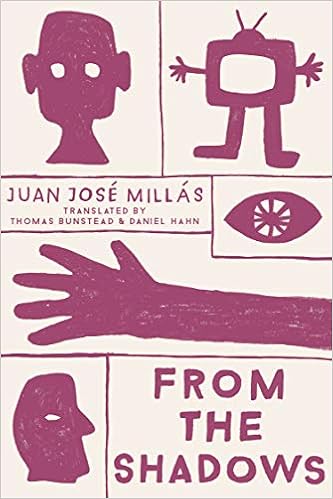
Juan José Millás - A nicotine- and porn-addicted Spanish misanthrope secretly lives in the closet of a family of strangers. Middle-aged and just laid off from his dead end janitorial job, he wanders Madrid’s streets alone, imagining himself as an interview subject—and figure of ridicule—on a saucy talk show

Slikovni rezultat za Juan José Millás, From the Shadows,
Juan José Millás, From the Shadows, Trans. by Thomas Bunstead and Daniel Hahn, Bellevue Literary Press, 2019.         


read it at Google Books


Laid off from his job, Damián Lobo obsessively imagines himself as a celebrity being interviewed on TV. After committing an act of petty theft at an antiques market, he finds himself trapped inside a wardrobe and delivered to the seemingly idyllic home of a husband, wife, and their internet-addicted teenage daughter. There, he sneaks from the shadows to serve as an invisible butler, becoming deeply and disastrously involved with his unknowing host family. Every thread of the plot is ingeniously tied together, creating a potent admixture of parable, love story, and thriller. Millás masterfully reveals the everyday as innately surreal as he renders the unbelievable tangible and the trivial fantastical, and full of dark humor.


Why can't breaking with routine be considered among the most subversive of acts? Damián Lobo does exactly this the day he loses his job. He starts off by obsessively imagining himself being interviewed as a celebrity on TV, in denial of his solitude and his habit of talking to himself. From there, he commits a petty theft at an antique market, which then leads him to hide inside an old gigantic wooden closet which he can't get out of until it's sold and transported to the idyllic home of an apparently happy husband and wife and their Internet-addicted teenage daughter. Once the movers leave the closet in the place the couple wanted it to be and with no one watching or in the house, Damián uses his carpenter skills to carve out a living space between this closet which was placed in front of a built-in closet. From this space and this shadow, he convinces himself he will be of more use inside the house, living with them and without them ever realizing it. Every morning, once the coast is clear, he makes their beds, cleans their washroom, their dishes, and becomes their "invisible butler". Who in the family will find out first? How will they find out? Will he save the day and conquer their hearts, or will he provoke more disaster or time in prison? All of the answers will come in a surprise twist ending, only a literary genius can think up, with atypical optimism conquering justified melancholy.


In Millas’s first novel to hit the U.S., he takes readers on an absurdist ride into the psyche of a man who has lost his job and ended up living inside a massive antique wardrobe. Trapped inside it after running from a cop who caught him shoplifting, Damian Lobo is soon transported to the home of a young family, purchasers of the giant antique. As days, then weeks, then months slide by, Damian becomes a ghostlike butler for the family during their daytime absence: doing their laundry and dishes, cooking meals, and fixing things around the home, and then slipping back into the shadows of the wardrobe at night. The dark and humorous narrative is often told through the internal monologue of Damian, who obsessively imagines himself a celebrity being interviewed on TV, allowing the reader insights into his thoughts and slowly deteriorating mind. “He sometimes wondered how long the situation might last. He fantasized about it lasting forever. And about things progressing, too, in the sense of a day arriving when he would be able to step out of the wardrobe and move among them while remaining invisible.” Part surreal comedy, part dark parable, Millas’s wild work brings readers face to face with the mundane facets of middle-class suburban life, while also dragging them along on Damian’s slow descent into alienation, disassociation, and perhaps even madness. A page-turner of the strangest order, Millas’s debut stuns and entrances. It’s impossible to put down. ―Publishers Weekly (starred review)


“[From the Shadows is] about alienation, loneliness, voyeurism, and the power of fantasy to transform claustrophobic, humdrum lives. Written by one of Spain’s most original and important authors and set in contemporary Madrid . . . [it] pays tribute to a very Spanish tradition, embodied by, among others, surrealists like Luis Buñuel [whose] 1962 film, The Exterminating Angel, [is] another claustrophobic allegory that turns middle-class comfort into a desert island.” ―Public Books


“The narrative of Juan José Millás, our literary Buster Keaton, is inimitable and unique.” ―La Vanguardia


“Millás’s imaginary world is constructed with a playful attitude and an ever-present indignation, set on the boundary between reality and fiction . . . it is enhanced by his sudden shifts into the mysterious folds of quotidian life.” ―El Cultural


“Millás deftly executes the art of narration.” ―Revista de Libros


A nicotine- and porn-addicted Spanish misanthrope secretly lives in the closet of a family of strangers.
This novel by celebrated Spanish author Millás, his first to be published in North America, is spectacularly bizarre. The protagonist is Damián Lobo, age 43, and after a 25-year career as a maintenance man, he’s recently been fired from his job. He’s addicted to cigarettes and internet porn, specifically the Asian variety, as we learn that his formational sexual experiences were with his Chinese adoptive sister. Our boy masturbates a lot, as you might have guessed. To balance out his other habits, it’s also pretty apparent that he’s mentally ill, to the point where half his waking day is spent in hallucinated interviews with Sergio O’Kane, a Spanish journalist, which are broadcast around the world in Lobo’s imagination. After nicking a stupid tie clip from an antiques market in a fit of pique and nearly getting caught, he takes refuge in a smelly old wardrobe that winds up being delivered to a family’s home. Hidden most of the time, he secretly insinuates himself into the lives of Federico, who owns an electronic-toy store, his unhappy wife, Lucía, and their troubled daughter, María. As he begins to clean up their home, Damián (also naked most of the time and occasionally masturbating under the parents’ bed) reimagines his role as “Ghost Butler,” posting about his exploits on internet forums and achieving a bit of anonymous fame. There’s certainly a change here between Lucía's blossoming, María's trying to conquer her teenage troubles, and a troubling revelation about Federico, but readers will need to surmount a lot of hurdles to embrace our eccentric leading man despite Millás’ obviously imaginative style and literary weight.
A Kafkaesque story about transformation and our collective human desire to connect with one another. - Kirkus


Damián Lobo is a fix-it man who’s unable to fix his own life. Middle-aged and just laid off from his dead end janitorial job, he wanders Madrid’s streets alone, imagining himself as an interview subject—and figure of ridicule—on a saucy talk show. But then an act of shoplifting accidentally lands Damián inside of an old wardrobe that is relocated into a middle class family’s apartment. Damián’s misadventures fuel Juan José Millás’s dark comic novel From the Shadows.
Just like the moray eel he often compares himself to, Damián lives hidden from sight. As his latest predicament unfolds, though, he opts to be an agent of change. Growing obsessed with the family who unknowingly shelters him, he ventures out from the wardrobe when no one is around, cleaning the house. In the process, he discovers a newfound purpose as the family’s guardian angel, even as he figuratively becomes a “ghost butler”—a perception he encourages by posing as a poltergeist in an online forum.
Millás finds both the hilarity and pathos in Damián’s situation, freely flowing between the quotidian and the existential. While Damián creates painstaking new routines to clean up his host family’s home and lives and preserve his secrecy, his internal musings run rampant, from the profane (is it wrong to want to sleep with one’s adopted sister?) to the sweetly innocent (should one look under the bed before going to sleep every night?). Throughout, the overriding question nags: Is Damián’s strange new life sustainable?
A compelling stew of comedy, philosophy, and even tragedy, From the Shadows maintains a light touch, even as sinister undertones bubble underneath. Damián’s risky existence leads to unexpected twists and a climax that lingers long after Millás’s absurd lark comes to an end. -  Ho Lin       
https://www.forewordreviews.com/reviews/in-my-own-moccasins/


From the Shadows centers entirely around Damián Lobo, now in his early forties and recently laid off from his job. He is not in financial straits -- he got a good severance package, has some savings, can rely on unemployment support for the next few years -- but certainly otherwise feels somewhat at sea. With little close contact to others, he's taken to playing out dialogue in his mind, imagining himself being interviewed on a television show ("with stratospheric viewing figures"), in front of a live studio audience: "a mechanism for conversing with himself".
       Lobo is conscious that this alternate reality he immerses himself in -- often running concurrently with the real one -- is only in his head. He's not deluded; it's simply a fallback mechanism he uses to engage with himself, an elaborate form of self-analysis as well as a stage on which he can get the attention missing elsewhere. So also, there's a considerable focus on the ebb and flow of the questioning, and how the audience reacts -- and the subject-matters and topics that draw in more viewers.
       A small transgression leads to a small comedy of errors that finds Lobo needing to slip out of sight briefly. He does so by slipping into an enormous wardrobe he comes across -- only to find that the wardrobe is picked up and transported to the house of someone who has bought it -- with, unbeknownst to anyone (beyond the observation of how heavy the piece of furniture is: "Christ ! Feels like there's a dead body in there"), Lobo still stashed inside. The wardrobe had been purchased by Lucía, who was stunned to discover that it was the old wardrobe from her grandparents' home, complete with the repeated markings of her and her brother's heights over the years still visible -- a blast from the past that she can't resist.
       Lucía is married to Federico -- a marriage that is pretty tired and routine by now -- and they have a moody teenage daughter, María. Lobo can't make good his escape from the wardrobe when it is first put in place -- or rather can, but only as far as the couple's bed, under which he hides for the first night -- but then decides he might want to stick around. The design of the huge wardrobe is such that there's a large dead space at the back of it. With a bit of work, Lobo transforms it into a small hidden room of his own. And he moves in.
       The family is away during the day, so he can putter around the house (and clean up behind the messy family), and when they're home he remains well-hidden in his secret room. It seems fairly easy not to leave traces of his presence behind, and he rather takes to this odd new living situation -- often still with his imagined interviewer for company. And though the husband and wife occasionally look into the wardrobe and fetch things from it, they remain oblivious to what's almost right in front of their noses: even when they're separated from Lobo just by thin sheet of plywood:
it was as though the two of us occupied parallel dimensions -- simultaneously very close to each other and very far away.
       And rather than feeling isolated and separated from the world at large, Lobo finds:
I'd never felt so free. Like my wardrobe was the center of the universe, like the universe was expanding outward from that very point ...
       The family isn't one of great readers, but there are some books on the supernatural in the attic, and Lobo takes to these; he also goes online, in the persona of the 'Ghost Butler' -- i.e. basically as himself. And eventually he makes contact, of sorts, with Lucía, who recognizes a ghost-presence in the house ever since she bought the wardrobe; the relationship remains on this other plane, Lucía accepting Lobo as a ghostly presence, but it certainly also affects Lobo.
       His relationship with his interviewer, whom he calls Sergio O'Kane, also shifts during his time in the wardrobe. Lobo dislikes him, and outgrows him in a way, and:
A day came when Damián decided never to go back to the show, and soon after this he learned that it had been discontinued due to woeful viewing figures.
       When he eventually needs a substitute he doesn't revive Sergio O'Kane ("who still occasionally showed up, begging to be brought back to life") but eventually finds (i.e. imagines) another questioner, Iñaki Gabilondo, a cable TV host -- meaning that because: "it was a subscription channel, the ratings could never match those enjoyed by O'Kane, but it was a more select audience".
       Lobo has issues that have weighed on him for much of his life. He's not that close to his father, whom he rarely sees, but he is fixated (including sexually) on his sister, a Chinese girl adopted by his parents two years before he was born; she is often on his mind -- including the concern that she must be wondering what happened to him (even though he mostly keeps his distance from her too -- and, typical for all his relationships, when he finally does get back in touch with her, she tells him she hadn't been particularly worried about not hearing from him for so long).
       Already as a child he felt almost that he, and not his sister, was the adopted one -- and:
I felt like I was the one who'd come into the family unit from outside, from some far-off place.
       The wardrobe, in this household, is an ideal island-refuge -- even if, of course, Lobo remains, in practically every sense, apart from the family and their lives (not to mention the world at large ...). He is, at best, a shadowy presence in their lives.
       It's an entertainingly presented look at social isolation and dependency, the search for a role in life, and in others' lives. Lobo essentially lets himself be swallowed whole, disappearing entirely from the (open) face of the earth -- a vanishing that no one really even notices -- and only slowly does he (re)create a public self, and even more slowly a physical one. Millás pushes Lobo to action with a twist to the family's not-so-happy marriage, as Federico brings a lover home when his wife and daughter are away and Lobo finds a way out his situation; a nice dark touch to the novel (which Millás only carries so far, in leaving his ending fairly wide-open).
       It all works quite well, and certainly makes for an entertaining little tale, with Lobo's fantasized TV interviews a particularly clever and enjoyable touch. Yet From the Shadows ultimately also feels a bit insubstantial -- perhaps appropriate, considering Lobo is meant to be such a shadow of a character ... --, a solid story but somehow not entirely convincing as a novel; indeed, feeling more like a (pleasantly) drawn-out short story. Gossamer light -- with even any ugliness or evil barely having any depth, a sense reïnforced by Lobo's almost entirely untroubled journey (despite the obvious personal hurt, as well as a very dark turn the story eventually takes) --, the narrative in From the Shadows feels almost too anecdotal; perhaps that's what he was going for -- certainly with the TV interviewers, since that's their style --, but it ultimately does limit the resonance of the story.
       Still, this is a good, quick read, all the more gripping for the sustained tension of possible discovery -- of Lobo's presence in the household, as well as more personal discoveries among the various, each in their way troubled, characters. - M.A.Orthofer
http://www.complete-review.com/reviews/espana/millasjj.htm


Juan José Millás is the recipient of Spain’s most prestigious literary prizes: the Premio Nadal, Premio Planeta, and Premio Nacional de Narrativa. A regular contributor to El País, Millás has also won many awards for his journalism. He is the author of several short story collections and works of nonfiction as well as over a dozen novels, including From the Shadows, the first of his novels to be published in North America. He lives in Madrid.