5/18/20

K. Ferrari barrels through this blackly comic story the way his protagonist, Luis Machi, barrels through life: loud, crude and indifferent to the finer points of character and plot as he rushes inexorably toward doom ... Heavy on action and dark humor

Like Flies from Afar | K. Ferrari | Macmillan
K. Ferrari, Like Flies from Afar: A Novel, Trans. by Adrian Nathan West, Farrar, Straus and Giroux, 2020.


Oligrachs gone wild, in a brutal and darkly comic Argentinian noir

Mr. Luis Machi is an unforgettably loathsome and hilarious Argentinian oligarch who made his fortune collaborating with the worst elements of society—parasites, pushers, and secret policemen. He has a cocaine habit, a collection of three hundred ties, ten million dollars in the bank, and a bloody corpse in the trunk of his BMW . . . but as far as the body goes, he's completely innocent. He has no idea who the victim could be, or who among his many, many enemies might be trying to frame him for murder, and he doesn't have much time to find out . . .
The profane and uproarious Like Flies from Afar follows Machi through twenty-four hours of his eventful life—one full day in which to solve this mystery, or at least to make sure he isn't the one to take the fall.
The first novel to appear in English by the "subway janitor by night, novelist by day," who began his writing career while an undocumented immigrant in the United States, Like Flies from Afar will demonstrate why K. Ferrari is already an award-winning star of international crime fiction. A hardboiled noir thriller, a whodunit, a black comedy, and a filthy catalog of the excesses of wealth, this is a Jim Thompson novel for the globalized world.


"Not only is Like Flies from Afar a tough, perfectly constructed novel, it was written with the understanding that the noir is the new protest novel of the twenty-first century." ―Paco Ignacio Taibo II 

"K. Ferrari is one of the most important voices in the contemporary Argentine crime novel. His unique tone creates characters that are unforgettable―realistic and poetic all at once. Like Flies from Afar is yet another example of his literary mastery." ―Claudia Piñeiro

A darker shade of absurdist noir featuring an Argentine businessman, as contemptible as he is successful, who finds his life inexplicably falling apart.

The opening of this short novel finds Mr. Machi in the afterglow of a fellatio-induced, cocaine-driven orgasm, luxuriating in his obscenely opulent success, as he prepares to take a drive. “He doesn’t need to wonder what success is, because he can feel it in the potent purr of the accelerator beneath his right foot, in the cushioned upholstery, in the power steering, in the sunlight and the stares of astonishment and envy reflecting off the BMW’s gloss finish,” writes Ferrari, who works as a subway-station janitor in his native Buenos Aires after having been deported from the United States in the 1990s. This is his first work to be translated into English, and it could pass as a madcap mixture of Kafka, Bukowski, and Jim Thompson. In quick order, the corrupt, politically connected Mr. Machi finds his tire sabotaged and his trunk somehow occupied by a corpse whose face has been mutilated beyond recognition. Then more clues seem to link Mr. Machi himself to the murder. He has no idea who the victim is, who the perpetrator was, or why he has been targeted. The book follows his efforts over one day to dispose of the body and the evidence and to discover the motive and culprits. He “feels there’s no bottom to the pit he’s fallen into,” and his attempts to dig himself out find him falling deeper in. He believes he has no enemies, but as he ponders his predicament, it appears to the reader that pretty much everyone he knows could have wished him ill—his wife and their children, his employees and partners, his rivals. His daughter’s boyfriend is a writer who supports himself with menial work (like the author) and has plans to write a detective novel much like this one, in which Mr. Machi would be the protagonist “and terrible things would happen to him.”

Though ultimately unsatisfying as a mystery, it works as an existential parable, with a protagonist whose character is destiny. - Kirkus Reviews


Like Flies from Afar comes with epigraphs from Jim Thompson and David Goodis, and Ferrari's writing is clearly modeled after theirs -- fast, sharp, and pitch-black dark; the third epigraph, squeezed in between the other two, is from Karl Marx, suggesting the novel's other focus, as its protagonist is the embodiment of ugly capitalism. Yet another epigraph on a separate page, from Rodolfo Walsh, spells the combination out more clearly: "If someone wants to read this book as a regular old thriller, that's their right" -- implying, of course, that it can also (or should) be read as something more than that.

Like Flies from Afar begins with a coked-up (and Viagra-supplemented) Luis Machi getting a blow-job and then lighting up an expensive cigar. He is one for enjoying the fruits of his labor, getting his due; his business empire is called 'El Imperio', and he likes to see himself and be seen as an emperor-figure, bending every-one and -thing to his will (and whims). A supplicant on her knees, offering him gratification, sets the stage just right.

It is early morning, and Machi wants some domestic satisfaction too: he calls his wife and demands that she have breakfast waiting for him when he gets home in what he imagines will be: "an hour, give or take". But breakfast, it turns out, will have to wait.

Machi gets in his car, a two-hundred-thousand-dollar BMW, and begins the drive home. He does not immediately realize there are two things in his car that don't belong. One is a book that his daughter, Luciana, dropped -- Michel Foucault's The Order of Things -- though she calls him up to be on the lookout for it, because she needs it for an upcoming midterm. The Order of Things famously begins with the observation that: "This book first arose out of a passage in Borges", as Machi sees when he leafs through the book; the passage -- quoted by Foucault -- is from Borges' 'The Analytical Language of John Wilkins' and is itself a list Borges reports finding in a work by Franz Kuhn, who attributes it to a Chinese encyclopedia, the 'Celestial Empire of Benevolent Knowledge' ('Emporio celestial de conocimientos benévolos'), categorizing animals; the listed categories are used by Ferrari as the titles of the thirteen parts of his novel, with the final, fourteenth one -- "que de lejos parecen moscas" -- taken for the title of the novel.

The list -- and its transmitters, Borges and Foucault -- thus very obviously serve as a scaffold for the novel. Machi is, unsurprisingly, oblivious to it, unimpressed by what his daughter is studying and by Borges; amusingly, he eventually purchases a new copy of the book -- and, at the suggestion of the counter girl at the bookstore, Barthes' Writing Degree Zero -- as well as two Sidney Sheldon novels (for his wife).

If The Order of Things pretty much goes over his head and is nothing more than a slight irritation -- at what his daughter is wasting her time with, at what he's wasting tuition-money on -- the other thing he finds in the BMW proves to be considerably more urgently problematic. He doesn't realize it immediately, but soon enough he's in for a very rude surprise: there is a dead body in the trunk of the car. Complicating matters further, it's handcuffed inside -- making it even harder to dispose of -- with a personal accessory, the pink fur handcuffs he likes to use in some of his sexual encounters.

Machi has a problem -- and it's a confounding one too. He's baffled by how the body came into the trunk. Machi lives in a gated community, and his office garage is well secured. So there are a lot of open questions about this corpse that he can't even identify, and how it got there:

Where, Mr. Machi asks himself.

Who, he asks himself.

He asks himself how.

And why.

Last of all, Mr.Machi, a businessman above all else, can't stop wondering: What did they expect to get out of planting a body in his trunk ?

He spends the next couple of hours driving around, trying to figure all this out. And trying to get rid of the corpse.

It brings him -- and his very showy car -- to neighborhoods where he stands out like a sore thumb. He's covered in elitist markers: Scappino, Versace, Rolex, Armani. And he's sitting in that obscenely expensive BMW. Driving through these common neighborhoods, he can't help but be outraged , his blinding sense of entitlement leaving him baffled: "Why are they all calm and not me ?" He can buy anything -- and anyone -- so why can't he have the piece of mind he deserves ?

Like Flies from Afar is then a fast-paced ride-along, as Machi tries to extricate himself from this very uncomfortable situation he finds himself in -- and wonders who he can trust and who has it in for him -- complete with some blasts from the past and examples of his cutthroat policies and the damage they've done. His rise is one of ultra-capitalist success -- taking advantage of the possibilities, having the right connections, trampling anything in his way. It mirrors the Argentine experience in general, complete with high-finance games that crush the general population and benefit only a few winners. And Machi is one of those winners:

I passed the factory over to the investors at Varano, we issued bonds, we stripped the motherfucker down, and we declared bankruptcy a few years later. In '92 all we had was a second-rate textile plant and in '94 I could put two million just into remodeling the club, see ?

Like Flies from Afar is a novel of comeuppance -- but Ferrari doesn't go for facile moral tales: if this is the story of Machi's fall (into the abyss), it isn't the one of straightforward justice. Machi remains oblivious. Machi continues to believe he can get his way. And, mostly, Machi does. Sure, his wife has cleared out by the time he finally does get home, pissed off that she made him breakfast and he didn't show. But, hey, he bought her some Sidney Sheldon novels; it'll all be good in the end, he figures.

As the invocation of Jim Thompson and David Goodis at the opening suggested, Ferrari's writing heart is in a deep, dark place, and that is where he brings the novel to in its conclusion. If most of Like Flies from Afar is a traditional tale of dark countdown suspense -- will the authorities catch up to what Machi is hiding or will he somehow extricate himself from this predicament ? -- its conclusion finds Machi confronted with the fact that he's at best managed a brief detour in the game that's actually being played with him. Does Ferrari play fair ? Absolutely; it's the perfect conclusion for this tale -- even as it leaves everything open. (But, yeah, it's hard not to think that Machi might have met his match.)

Like Flies from Afar is a cruel portrait of a modern-day success story, its protagonist, forced by rare circumstances beyond his control, to navigate the world at large -- exposing him to how the other 99 per cent live, but he incapable of even beginning to comprehend the divide (much less accept any blame as to his own role in creating the conditions around him, or what is happening to him). Machi is being taught a lesson, but regardless how it's hammered home he doesn't seem to learn, which is part of the (sometimes grim) fun over the course of the story; the nice closing touch suggests that it won't be that easy for him to escape in the long run, which is fun too.

Much here is familiar excess and outrageous behavior, but Like Flies from Afar is fast and furious and sly enough in Ferrari's presentation to work well on its multiple levels -- whether as simple thriller, socio-political critique, or anything in between. A solid little thriller, of and for our times. - M.A.Orthofer

http://www.complete-review.com/reviews/trcrime/ferrarik.htm


K. Ferrari telegraphs his intentions from the outset of his novel “Like Flies From Afar.” Newly translated from the Spanish, the book opens with epigraphs from Jim Thompson, Karl Marx and David Goodis: a trinity of writers who guide, or inhabit, Ferrari’s sensibility.

Thompson and Goodis were among the most unrelenting of the 20th century American noirists, their fiction set in a universe that is indifferent, if not outright hostile, to their character’s concerns. And Marx, of course, is Marx, perhaps the most influential political philosopher of the last 175 years — regardless of whether, or to what extent, we agree with his worldview.

“Like Flies From Afar” collapses these perspectives — the hard-boiled crime novel as social allegory. Ferrari, born in 1972, was deported as a young man from the United States and works as a janitor in a Buenos Aires subway station. He has published six other books in Argentina, but this is the first to appear in English.

Unfolding over the space of a single morning, it revolves around a character known only as Mr. Machi, who, as the action begins, is in the office of his Buenos Aires club El Imperio, high on cocaine and engaged in some sexual hit-and-run.

Mr. Machi is a walking act of blunt force trauma, pushing his way through the world in his Versace sunglasses and a BMW that electrifies the road like “a black bolt of lightning” and sparking his Montecristo cigars with a gold Dupont. He is a bad father and a worse husband, a bully who has trafficked in power for so long — first during Argentina’s junta of the 1970s and now under its democratic successor — that he cannot recognize that he, like all of us, is vulnerable.

His precarity asserts itself after his tire is flattened on the Panamericana highway. On his way to retrieve the spare, he finds a man handcuffed to his trunk, his face shot away with a bullet from Mr. Machi’s own Glock.

That’s a terrific set-up for a crime novel: The locked-room murder mystery transplanted to the cocoon of the car. Ferrari, however, is not after resolution so much as entanglement, a widening net of implication in which Mr. Machi finds himself ensnared. The body in the trunk is less important in its own right than as the catalyst for an internal reckoning, in which Mr. Machi is forced, through a series of recollections, to assess the flashpoints of his life.

More often than not, these reexamined moments involve the people (his son, his enforcer, a business partner, the maid he cheats with) whom he has used or wronged. Ferrari’s plotting is ingenious, not only in the way it unveils the kaleidoscopic, potentially viral network of Mr. Machi’s connections, but also in how it shatters the illusion of his mastery to reveal “the great beast of paranoia” within.

“When all’s said and done,” he writes of Mr. Machi, who is trying to soothe himself, “I’m a good guy, he thinks. … But the crack’s already there and doubt is threatening to blow his skull wide open.” The ensuing breakdown — heightened by Ferrari’s strategy of blurring Mr. Machi’s point of view into his own as well as those of other characters — is the real subject of the novel, which is less about any external crime than the disintegration of his protagonist’s arrogant façade.

“Like Flies From Afar” is, in other words, an existential mystery, in which corruption emerges from the inside and the most pressing dangers are those we bring upon ourselves. Ferrari makes the point explicit during a scene in which Mr. Machi’s enforcer, an assassin named Pereyra, pulls a gun on a student in a Che Guevara tank top that features an inverted (and misattributed) version of Emiliano Zapata’s slogan: “Better to live on your feet than to die on your knees.”

Ferrari knows exactly what he’s mocking, as he reveals with Pereyra’s response. “I’ll give you ten seconds to choose,” the killer barks, reframing the line correctly: “Live on your knees or die on your feet.” After the frightened young man sinks to the ground, he shoots him in the kneecaps anyway. The scene is horrifying but also, in context, bleakly comic, reflecting both Pereyra’s brutality and the callowness of bourgeois youth. Even as we shudder at the violence, we cannot help but appreciate the ironies.

Mr. Machi himself is not unaware of these incongruities; early in the novel, he pitches Foucault’s “The Order of Things” from his car after discovering that his daughter has left a copy there.

The postmodern text is a signifier, as Ferrari makes clear when Mr. Machi reads from it: “This book first arose out of a passage in Borges, out of the laughter that shattered, as I read the passage, all the familiar landmarks of my thought.” Something similar happens to Mr. Machi as the order of his life is swept away.

The idea takes unexpected shape late in the novel when we meet the daughter’s boyfriend, a crime writer and a radical, who decides he will “write a novel with Mr. Machi as protagonist, and terrible things would happen to him.” It’s a spectacularly meta move, framing him (perhaps) as not just author but antagonist.

For all that, “Like Flies From Afar” is hardly a work of literary gamesmanship. Instead, it offers contrapuntal pleasures — a propulsive chase across Buenos Aires as well as a finely rendered portrait of a man so enraptured by his wealth and power that he has lost sight, if he ever had it, of his frailty. The novel takes prodigious turns as Mr. Machi pushes harder, every decision leading to more disruption and more doubt.

What happens when your world blows up, when everything you thought you could count on is revealed to be a reverie? It’s a question a lot of us are asking in the surreal, occluded moment we have come to occupy.

“[H]e can’t trust his recollections just now,” Ferrari writes of Mr. Machi. “He’s nervous, he feels hemmed in, stuck in a dream or some other kind of irreality. But the stink of his own vomit tells him it’s real.” - David D. Ulin

https://www.latimes.com/entertainment-arts/books/story/2020-03-25/review-k-ferrari-argentine-social-noir-both-existential-and-electric


Subtlety is not something Ferrari has time for. He barrels through this blackly comic story the way his protagonist, Luis Machi, barrels through life: loud, crude and indifferent to the finer points of character and plot as he rushes inexorably toward doom ... Heavy on action and dark humor — fluidly rendered in West’s translation from the original Spanish — Like Flies From Afar is for those who like their noir fast, short and nasty. - David Gordon

https://www.nytimes.com/2020/03/20/books/review/like-flies-from-afar-k-ferrari-long-way-off-pascal-garnier-second-sister-chan-ho-kei.html

Futurity Report - theorists, historians, and artists address the precarious futurity of the notion of the future itself.

Futurity Report – Sternberg Press

Futurity Report, Sternberg Press, 2020.


Theorists, historians, and artists address the precarious futurity of the notion of the future.Not long ago, a melancholic left and a manic neoliberalism seemed to arrive at an awkward consensus: the foreclosure of futurity. Whereas the former mourned the failure of its utopian project, the latter celebrated the triumph of a global marketplace. The radical hope of realizing a singularly different, more equitable future displaced by a belief that the future had already come to pass, limiting post-historical society to an uneventful life of endless accumulation. Today, amidst an abundance of neofuturisms, posthumanisms, futurologies, speculative philosophies and accelerationist scenarios, there is as well an expanding awareness of a looming planetary catastrophe driven by the extractionist logic of capitalism. Despite this return to the future, the temporal horizon of our present moment is perhaps more aptly characterized by the “shrinking future” of just-in-time production, risk management, high-frequency trading, and the futures market. In Futurity Report, theorists, historians, and artists address the precarious futurity of the notion of the future itself.

Contributors: McKenzie Wark, China Miéville, Kerstin Stakemeier, Diedrich Diederichsen, Natascha Sadr Haghighian, Marina Vishmidt, Johannes Paul Raether, Felicity D. Scott, Silvia Maglioni, Graeme Thomson, Doreen Mende, Pedro Neves Marques, Achille Mbembe, Kodwo Eshun, Haytham El-Wardany, T. J. Demos, Ana Teixeira Pinto


5/7/20

Flann O’Brien: Gallows humour - 16 great chapters on O'Brien, biopolitics and body humour, ranging from violence, eugenics & capital punishment to gender, prosthetics & Gaelic games


Flann O’Brien: Gallows Humour, Ed. by Ruben Borg and Paul Fagan, Cork University Press, 2020.

The essays collected in this volume draw unprecedented critical attention to the centrality of politics in Flann O’Brien’s art. The organising theme of Gallows humour focuses these inquiries onto key encounters between the body and the law, between death and the comic spirit in the author’s canon. These innovative analyses explore the place of biopolitics in O’Brien’s modernist experimentation and popular writing through reflections on his handling of the thematics of violence, justice, capital punishment, eugenics, prosthetics, skin, prostitution, syphilis, rape, reproduction, illness, auto-immune deficiency, abjection, drinking, Gaelic games and masculinist nationalism across a diverse range of genres, intertexts, contexts.

5/6/20

Edmondo De Amicis - - In this comic masterpiece timid little Mr Celzani is consumed by love for the disdainful Miss Pedani, an Amazonian gymnast. He finds his romantic efforts repeatedly thwarted by his beloved’s single-minded focus on her rigorous physical discipline


Love and Gymnastics (Hesperus Classics): Edmondo de Amicis, David ...

Edmondo De Amicis, Love and Gymnastics, Trans. by David Chapman, Hesperus Press, 2011. [1892.] 


‘Great God, how beautiful she was! He had never seen her looking so well as she had that evening, sitting there with an erect torso like an empress on a throne with that ample bosom quivering with life… He had observed her hand, which was a bit thickened by gymnastic exercise, resting on the table; still it was long and beautiful, full of strength and elegance, and he had wanted to swoop down upon it like a vulture on a turtledove.’

In this comic masterpiece from 1892, timid little Mr Celzani is consumed by love for the disdainful Miss Pedani, an Amazonian gymnast with whom he shares an apartment block.The machinations of their fellow inhabitants notwithstanding, he finds his romantic efforts repeatedly thwarted by his beloved’s single-minded focus on her rigorous physical discipline.Through the intertwining themes of the title, De Amicis proposes a timeless meditation on devotion, hope, persistence and the need for balance in all human relations.

Rediscovered by Italo Calvino, this rare novella by one of Italy’s best-loved literary talents links the themes of romantic love and sportsmanship. It is published here for the first time in English.


'David Chapman’s translation, the first into English, is clean and sprightly, and shows De Amicis as a master of the skewering one-liner which fixes a character to a page... Best of all is his portrait of Celzani, which astutely traces the surging hopes and withering self-delusions of this thwarted no-hoper as he tries to persuade “la Pedani” that he’s more worthwhile than a “simple jumping half-step.” It delivers fistfuls of cruelty, but always with a smile. This edition comes with a foreword by Italo Calvino, who thought it was the best thing De Amicis ever wrote, and you can see why.'– Intelligent Life, The Economist

"All this is very funny, as is the bland, light-hearted satire of the infatuation for physical training which was sweeping Italy at the time. (...) (H)e has a real gift for accurate observation of both characters and scenes. (...) Amore e ginnastica (...) still makes for delightful reading, and one would not be surprised if it becomes as popular as Cuore." - Times Literary Supplement


Love and Gymnastics is set largely in a single house of six apartments, one of the oldest in Turin -- and one which: "suited itself well to intrigues and to the secrets of amorous passions". The time is the late nineteenth century, as a gymnastics-craze is sweeping Italy -- not competitive gymnastics, but rather as a fitness- and wellness-exercise, suitable for all to participate in; as presented here it's perhaps most comparable to the present-day yoga fad, complete with competing schools of what are the best forms of the exercise and devotees who swear by it.

Several of the tenants of the house are very wrapped up in this gymnastics enthusiasm, with the third floor being: "all scholastic and gymnastics". It is there that Maria Pedani -- a: "tall and strong lass of twenty-seven" -- lives with Miss Zibelli, who is nearly a decade older and "the physical opposite of her friend".

Miss Pedani is completely devoted to gymnastics -- obsessed with it: "She lived with one thought alone: gymnastics". Her life revolves entirely around it: she practices and she preaches it; she is a teacher as well as an ardent proponent of the activity and she follows all the latest news and trends; she also writes about it, to spread the word and share her expertise, including for professional journals. If not a classic beauty -- her facial expression and gait are a bit too manly, for one --, she is, thanks to her lifestyle, still quite a figure: she "was of statuesque proportions, breathed health and strength from her entire body" (and she has: "the flexibility of a ten-year-old child"). And so she of course attracts some attention, including from one of the sons of a family in the building, as well as from the landlord's nephew, employed by his uncle as secretary after he decided that the path to priesthood he had previously embarked upon wasn't quite for him after all -- though he's not allowed to forget it, as: "all the tenants of the house had for years called him 'Reverend' Celzani in jest".

It is Celzani's passion for Miss Pedani that dominates the story. As is perhaps to be expected from a priest-manqué, he is not just not a ladies' man -- he really doesn't even know how to approach one, and so his is fumbling actions around Miss Pedani are a source of much of the comedy in the novel. He might only be: "a few years past his thirtieth birthday, but he had the bearing and behaviour of a man of fifty". But it isn't only his bearing and hapless approach -- which includes first making his feelings known by sending her a letter -- that hinder his hopes for romantic happiness: there's that problem that Miss Pedani doesn't even think of romance, her entire being taken up by gymnastics.

De Amicis' tale is an enjoyable romantic and gymnastic romp. Celzani's first letter quickly makes the rounds, and many of the tenants get pulled into the affair to some extent. It doesn't develop into much of a romantic affair -- Miss Pedani makes her position clear, time and again -- but Celzani is the sort of deluded would-be lover who refuses to give up. De Amicis presents this very well, right down to Celzani's voyeurism, which sees him gaze down longingly into Miss Pedani's rooms from an attic perch, as well as how Celzani goes to pieces when his suit fails, again and again:


When she had first arrived at that house, he was wise, hard-working, calm, good, and liked by all. And everything had fallen apart from there.

Miss Pedani doesn't even seem to think of romance, trying to explain to him: "For my occupation I need to be free; I have decided to be free". And De Amicis convincingly presents her as completely wrapped up in what is her true passion -- hilariously over the top, down to the enthusiasm with which she immerses herself in the reports coming hour by hour from a gymnastics-meet in distant Frankfurt.

The basic story of Love and Gymnastics is a fairly familiar one, but De Amicis makes of it one that is quite the cut above the usual variation. For one, he deftly ties in Italy's enthusiasm of the day for gymnastics into the story -- "The teachers of gymnastics will become the nation's elite", one enthusiast insists --, gently, rather than harshly, mocking it; his characters are all sincere in their engagement with it (though there is the occasional exaggeration-for-purposes-of-flattery). It's this sincerity, that extends beyond gymnastics, and the true-to-life depiction of the characters' behavior and attitudes which De Amicis pulls off particularly, with his well-drawn characters and his presentation of the house, and the interaction of the tenants.

These strong supporting characters, and their own issues and interests, work particularly well in the story, especially in relation to the in many ways oblivious-seeming Miss Pedani, whose interests are so specific and limited. So, for example, her flatmate seesaws in her intense feelings for Miss Pedani, in a relationship where it is at one point suggested: "one would assume that she was a husband rather than a friend". Similarly, the different ways Celzani is treated by the others in the house, including his uncle, as he falls apart in his failed courtship is very well-handled.

Love and Gymnastics is a surprisingly rich work, with even the satire of the gymnastics craze of the day holding up very well. It is an accomplished novella, in all respects -- and it's very good entertainment too.

- M.A.Orthofer

http://www.complete-review.com/reviews/italia/deamicis.htm


 Edmondo De Amicis (1843–1908) was one of Italy's most popular writers, and perhaps more than any other figure in post-Risorgimento Italy, he reflected the common hopes, dreams and prejudices of his countrymen. De Amicis was particularly interested in gymnastics and physical education, and he wrote about them frequently. His most famous work on these subjects is his novella Amore e ginnastica [Love and Gymnastics] (1892) which explores female fitness, sexual stereotypes and gender roles in nineteenth-century Italy. This opus, along with two others (a lecture and a magazine article), can help modern readers understand the role of female sport and gender expectations in post-Risorgimento Italy. In addition to exploring women's gymnastics, De Amicis was also interested in female mountain climbing. By examining the activities and physical appearance of lady mountaineers, the author reveals his personal criteria for the perfect woman. When these are combined with the gymnasts in the earlier work, we can distill the writer's own particular attitudes toward gender and female perfection. For De Amicis a woman was required to be athletic, beautiful, modest, faithful, loving and with just a soupçon of uncertainty about her sexuality to make her interesting. - David Chapman

https://www.tandfonline.com/doi/abs/10.1080/09523367.2010.494390


Julian L. Shapiro - the sort of thing that has to come after Joyce, Stein and Surrealism. It is as fine and sensitive at times 'as beautiful' as Virginia Woolf


Julian L. Shapiro, The Water Wheel, Tough Poets Press, 2020.[1933.]

 First-ever new edition of The Water Wheel, the 1933 semi-autobiographical debut novel by Julian L. Shapiro, who later achieved cult status writing as John Sanford.

From the original edition's dust jacket:

"The Water Wheel recounts both the real and imagined-real adventures of one John B. Sanford in New York and London over a short period in 1927. The novel is completely dominated by Sanford, a self-assumed individualist--and self-styled 'lawclerk, sinner, ex-convict, adolescent, grandson and legatee of a Litvak matchvendor.'

"The author has maintained a rigid objectivity, at no time intruding upon the narrative, or showing his hand by making Sanford a mouth-piece for the expression of ideas outside the scope of the novel. Notwithstanding the author's neutrality, only the most literal will overlook in Sanford a character definitely in our time.

"In form, The Water Wheel has no counterpart in American letters. It deliberately avoids the traditional, but its objectives are always clarity and simplicity. The many technical and typographical innovations are designed to suit the subject matter, and are not fake-modern tricks."


"This first novel has some effective, even brilliant, scenes. It has originality of language, especially in the projection of moods... verbal brilliance."- The New York Times


"I can't say that I have ever seen better work. It is really written, it moves, it has the quality of a novel. The story as a story bites in, a matter of serious concern to anyone who can think and feel. It is excellent." - William Carlos Williams


"I personally regard Shapiro's novel as the sort of thing that has to come after Joyce, Stein and Surrealism. It is as fine and sensitive at times - if the word were not so utterly damned, I'd say 'as beautiful' - as Virginia Woolf.... In addition, Shapiro is a highly conscious and finished craftsman, which is to say that he is always exceedingly readable."- Samuel Putnam

The Water Wheel by Shapiro, Julian L. , pen name of John Sanford ...

Julian Lawrence Shapiro was born in Harlem, New York, on May 31, 1904, to a first-generation American mother and Russian immigrant father, who was a lawyer. He obtained his law degree from Fordham University and joined his father's legal practice. While still a law student, Shapiro had a chance encounter with his childhood friend Nathan Weinstein, who was then going by the name of Nathanael West (later known for such works as Miss Lonelyhearts and The Day of the Locust) and working on his first novel. Inspired by West, he ultimately decided to retire from practicing law in order to devote all his time to writing. In 1935, Shapiro adopted the name of The Water Wheel's protagonist, John Sanford, in hopes that, in a time of rising antisemitism in the U.S., a gentile name would aid book sales. In his earlier novels, he was noted for blending experimental techniques with realism. He was described as "perhaps the most outstanding neglected novelist," by The Cambridge Companion to Jewish American Literature. While Sanford's later novels were well received-especially The Old Man's Place (1935), Seventy Times Seven (1939), and his masterpiece The People from Heaven (1943)-The Water Wheel was panned by reviewers when it was released. The Miami Herald was appalled by the sordidness of the novel, tame by today's standards. In a review titled "Sex, Sin, Slime," they wrote, "This is a first novel. It should be the last." and "It is a pity that God's green trees must be sacrificed to provide paper for printing this stuff." The New York Times was a little kinder. While admiring the author's flair and "originality of language," they dismissed the work as "sensitive, neurotic workings of the Sanford mind, with its defensive egotism and pleasure in self-torment-a study in the immature egotist and his inferiority sense." The review concluded, "Mr. Shapiro, with his verbal brilliance, will do better work in a more objective novel." Sanford wrote half of his books after he was 80. He published a five-volume autobiography, for which he received a PEN Award and the Los Angeles Times Lifetime Achievement Award. He left three unpublished novels and was writing up until a month before his death on March 5, 2003, at the age of 98.

Robert M. Coates composed the book like a collage, employing an experimental writing style that incorporated billboards, advertising slogans, and traffic signs to make immediate and vivid the perceptions and experiences of the characters. Dada' spirit brings to life the cacophonous, visually chaotic and mentally demanding life of New York City


Robert M. Coates, Yesterday's Burdens, 1933.

 Originally published in 1933 by The Macaulay Company, Yesterday's Burdens is the second novel by Robert M. Coates, "Lost Generation" writer and long-time art critic at The New Yorker. Prior to publication, three chapters of the novel appeared in The New Yorker under the title "The Dada City" (1930), and another chapter in The American Caravan, a Yearbook of American Literature (1931).

Yesterday's Burdens was first resurrected in 1975 by the Southern Illinois University Press as part of their “Lost American Fiction” series, and included a new afterword by Malcolm Cowley. A paperback version of that edition was published the following year by the Popular Library. The novel has been out of print since.


"Coates composed the book like a collage, employing an experimental writing style that incorporated billboards, advertising slogans, and traffic signs to make immediate and vivid the perceptions and experiences of the characters. In Yesterday's Burdens, Coates's 'Dada' spirit brings to life the cacophonous, visually chaotic and mentally demanding life of New York City."— Mathilde Roza & Jack Mearns, "Collecting Robert M. Coates," Firsts, The Book Collector's Magazine, October 2007


REVIEWS OF THE ORIGINAL EDITION

"Yesterday's Burdens is certainly one of the most original books of the year... The strange thing is that, despite the confusion, despite stylistic vagaries unequaled since E.E. Cummings's EIMI, Yesterday's Burdens is an enjoyable book."— The New York Times, December 10, 1933

"An arresting, free, unique work of art which may possibly leave an effect on novel-writing in the next few years."— Vanity Fair, February 1934

"Not easy reading because it is done in the Dadaistic style but worthwhile as a kaleidoscopic picture of our present kaleidoscopic life. Fine humor and written with distinction."— Scribner's, February 1934

“The writing in detail is always fresh and frequently excellent; some of the isolated episodes . . . are no less than beautiful.”— The American Mercury, April 1934


This new edition of Yesterday's Burdens contains Malcolm Cowley's afterword from the 1975 Southern Illinois University Press edition as well as a new introduction by Mathilde Roza, associate professor of American Literature and American Studies at Radboud University Nijmegen, the Netherlands, and author of Following Strangers: The Life and Literary Works of Robert M. Coates (University of South Carolina Press, 2011).  


The Eater of Darkness: Coates, Robert M., Roza PhD, Mathilde:  9781947951235: Amazon.com: Books

Robert M. Coates, The Eater of Darkness, 1929.


American expat name of Charles Dograr is tricked into firing a laser death ray. Chuck is so in love with the idea, he helps the laser's maker plan a bank job. Then it gets surreal. First published by Robert McAlmon in 1929.


Considered by many to be one of the most unique, avant-garde works published by the Lost Generation, The Eater of Darkness is hailed as the first Dada novel published by an American. Previously out of print for more than fifty years, this new edition has been updated with a new introduction and contemporary material that pays homage to the groundbreaking life and career of author Robert M. Coates.

One of the cleverest tours de force ever contrived by the pen of a wit.”

Young, charming, and fresh from a passionate jaunt in France, Charles Dograr leaves behind his French lover and returns to America to spend a year in New York City.

Eager to make his year in New York one to remember, Charles leaves his boarding house room one night in search of an adventure. As he wanders, Charles stumbles into the living quarters of Picrolas, an eccentric, crazed scientist who refers to himself as “the Eater of Darkness.” Picrolas reveals his prized invention: a remote-control x-ray machine, designed to electrocute and kill at random by shooting “x-ray bullets” into the brains of Picrolas’ intended targets.

Tricked by Picrolas into releasing the trigger, Charles is instantly taken by the machine and the power it holds. After a string of murders ensue, Charles agrees to help Picrolas plot an elaborate bank heist, using the x-ray bullets to kill the bank’s guards and any unlucky witnesses that happen to be on the street during the heist.

As the city is terrorized by these mysterious murders, Charles becomes entangled in the fallout. Characters disappear and reappear; events spiral in a disorienting, antirealistic fashion; and genres collide in an unpredictable, dreamlike conclusion.

Often compared to Flann O’Brien’s The Third Policeman, The Eater of Darkness is many things: both an acclaimed crime novel and a study in surrealist fiction; an experimentation of style, structure, and syntax; and an innovative, avant-garde concoction from an author who wrote years ahead of his time.

I stumbled upon The Eater of Darkness by Robert M. Coates while undertaking research into visual prose, sometimes also called visual writing, for a recent lecture. I had never heard of the novel, first published in Paris in 1926 by Contact Editions with the help of modernist matriarch Gertrude Stein, and the title alone would have been enough to compel my attention. From descriptions, the book appeared to be a genre-busting collision of science fiction, murder mystery, and Dada and/or Surrealism. A spread reproduced online — the same spread I show below — seemed to indicate that it featured artful typographic arrangements, with texts wrapping around each other and fragmented syntax. Even more promisingly, the website where I found it proposed that its interlocking passages anticipated the multi-voiced patchwork layout of Jacques Derrida’s Glas, meticulously designed by the late typographer Richard Eckersley.

Unfortunately, the American paperback edition in question, published by Putnam in 1959, was not immediately accessible to me in London, and it was also expensive. But it seemed there was an alternative. Out of print for decades, the book was republished in 2012 by the latest incarnation of Olympia Press, notorious Parisian purveyor of narrative pornography and literary landmarks such as Lolita and The Naked Lunch. This cheap edition I could obtain at once. Alas, this screen dump of a book makes a complete hash of the typography and treats the spread that had interested me as though it were a linear text. No way around it: I found the cheapest copy of the 1959 edition available and waited for it to turn up.

In the meantime, I contacted Milton Glaser because the other thing that made The Eater of Darkness a book I wanted to see was Glaser’s cover design. The website with the spread also reproduces the back cover where he has a credit. It doesn’t look like Glaser as we came to know him as designer-illustrator — he was then around 30 — but it is still an enticing design. The uncanny atmosphere and disorientating compositional style of the book, described on the back as “the first surrealist novel in English,” are signaled by the vertically positioned title and author’s name (surely unusual on a novel at the time) and by the curious device of the reader-beckoning, centrally placed exclamation/question motif with the gothically styled points — a graphic “what the heck.”

The illustration, a black-and-white photo of a Joseph Cornell-like surrealistic box, to which vibrant color has been applied at the printing stage, is not at all Glaserish. The mechanical elements and optical discs reminiscent of Duchamp’s Rotoreliefs represent the machine that the inventor and self-styled “Eater of Darkness” in the novel devises to kill people at a distance by means of a deadly, invisible “X-ray bullet.” “I very rarely ever use any art other than my own, so it may in fact be mine,” says Glaser, “but I have absolutely no recollection of having made it. I do, however, recall designing the cover.” I couldn’t find any occurrences online of the box as a freestanding work of art, suggesting that the piece was indeed made for the cover, and most probably by Glaser since there is no other credit.

The properly typeset 1959 edition of The Eater of Darkness turned out to contain fewer departures in visual prose than I had hoped. (My lecture was prepared for a one-day event at the Royal College of Art about the British experimental writer Christine Brooke-Rose, and I included examples such as Glas, Avital Ronell’s The Telephone Book, Raymond Federman’s Double or Nothing, and Mark Z. Danielewsi’s House of Leaves, alongside Brooke-Rose’s Thru.) From a layout point of view, the spread shown here, where the central character, Charles Dograr, learns from a newspaper report that the first victim has been found mysteriously dead, is the most adventurous in typographic terms. Still, this is a book saturated with the anti-conventional artistic ambitions of 1920s Paris where much of it was written. Just before the killing, the narrative devolves into a three-page list of objects that the X-ray bullet passes through before destroying its target’s brain, which reads like a gleefully sustained exercise in Surrealist chance encounter:

. . . a pack of cards

a glass eye

two felt slippers

the C in a Chop Suey sign

a cigarette holder

an umbrella

Reginald Marsh

a bottle of gin

[etc.]

Other devices include a chapter broken into sections labeled (a) to (i) like a textbook; footnotes (years before Nicholson Baker); an annotated diagram of the “engine of death”; conjunctions that lead on to empty spaces followed by other conjunctions; and a lengthy passage rendered as if describing a movie, with interpolated captions summarizing the scene in the manner of intertitles. It is worth adding that Coates felt it necessary to update some of the more obscure references for the 1959 edition. These changes can be spotted easily because the lines of type are lighter; the unsatisfactory Olympia Press edition has the original text.

The Eater of Darkness is shot through with bizarre incident, antic humor and unexpected swerves, and comparisons have been made with Flann O’Brien’s The Third Policeman. The novel seems like perfect material for Exact Change, Dalkey Archive, or Atlas Press, and it deserves a proper reissue. Robert Myron Coates (1897-1973) had a long relationship with The New Yorker, where he was a contributor and art critic from 1937 to 1967, and he wrote other novels and short stories, but he has tended to be regarded as a “minor” writer and most of his fiction is out of print. His most committed advocate, Dutch academic Mathilde Roza, published the first biography about him in 2011 so a revival of interest may already be mounting. - Rick Poynor

https://designobserver.com/feature/on-the-trail-of-the-eater-of-darkness/37857


One of the advantages of being a student again is having access to a good library. I’ve long been intrigued by an obscure little book called The Eater of Darkness, a sci-fi pastiche and early example of Surrealist fiction in English, written by an American expatriate in Paris who later became a well-known art critic (to whom we owe the term ‘Abstract Expressionism’)—and what could be more intriguing than that? My curiosity about had been frustrated for years by the scarcity and expense of available copies: first editions are on sale for about £300 at the lower end of the scale, and more than £1,000 at the higher end, while even the 1959 reissue would set you back by about £30—all for a slender paperback of less than 200 pages.* When I learned that my university library has a copy of the first edition, I was delighted, but there was also a touch of trepidation that the high expectations I’d been building up would be confronted with a dry, justly-forgotten period piece, a curio of strictly academic interest. In fact, the book is a hoot from beginning to end.

The hero or anti-hero is Charles Dograr, a young man who becomes involved for no discernible reason in a murderous crime wave masterminded by ‘the old gentleman’, the many-aliased inventor of the ‘oculascope’, a machine which can kill at great distance and to a high degree of accuracy by means of what Dograr calls an ‘x-ray bullet’ (the diagram Coates includes of this apparatus is less Heath Robinson and more Joan Miró). When Dograr first looks through the oculascope, his vision is directed through a series of things, the series becoming one of those long, amusingly miscellaneous lists that seldom come as a surprise in modernist literature:**

a cigar humidor

the mechanism of an alarm clock

a roll of toilet paper

the chain of an electric light fixture

four pages of the New York Journal

the hand of the reader

an orange

an El station turnstile

a goldfish bowl.

a cushion

the calf of Fannie Brice’s leg

two kissing lips

an iron handrail

a corset string

a garbage can

a plate of ham sandwiches

Laurence Vail

Peggy Vail

a pack of cards

a stiletto

a glass eye

two felt slippers

a cigarette holder

an umbrella

an art-bronze bookrack

Harold Stearns

Floyd Dell

a clogged drain pipe

a sheaf of Shulte Cigar Store coupons

Malcolm Cowley

a tree

a bottle of gin

a street lamp in an open park. . .

You might expect to find some of these objects in fragmentary form in a Cubist painting, but while many of them can be visualized individually, the action that is supposed to link them is all but inconceivable—the curiosities and wonders of modern physics travestied into utter nonsense. The old gentleman’s expression of his scientific and philosophical creed, which defines ‘homo physico-philosophicus’ as a person to whom physics and metaphysics are synonymous, becomes ever more pseudo-scientific and nonsensical (‘And Form, therefor, is capable of indefinite projection through space—provided that the co-related energy be entirely endogenous !’).

It is entirely appropriate, then, that the figure at the centre of these shenanigans is an absurd bundle of mannerisms, attitudes and behaviours that can in no way be contained within a psychologically convincing character, even an insane one. Charles Dograr: the sensitive soul who murders without pity or motivation, who impersonates the relative of one of his victims, who fantasizes that innocent pedestrians are bent on robbing and killing him, who buys a bunch of silk shirts and music records before abruptly dumping them in the trash, who delivers a solemn hymn to plant-life (‘The vegetables are not vindictive’). At the centre of a nonsensical plot is a nonsensical protagonist, nothing but an occasion for authorial fun and games:

For Charles Dograr was one of those rare souls whose spirit seems to have been compounded, as it were, of more fragile substance, of emotion more volatile, perception more finely tunable than the rest, so that he rode currents of intuition that others sank through seeking the rock-bottom of logic, and was uplifted and exalted by the transcendental vapors of a perhaps earthly—even, to continue the figure ad locandum, miry—concept into which others, trudging, stuck bogged and bemisted.

So sound moved him more than hearing, vision more than sight, and his instinct sucked Truth, like honey, from the flower of Life, disdaining the syllogistic distillation of the comb. Briefly, he listened to the melody, not the words, of the Eternal Song, and he was just the person—perhaps the only one alive—to imagine there was any discoverable meaning in such a passage as this, when he found it in a book.

The punchline is anything but subtle, yet it made me laugh. Funnier still are the crazed antics that ensue from Dograr’s encounters with life in a 20th-century metropolis, a mode of existence which cannot accommodate a walking absurdity such as Dograr without chaos being the result. And yet from that chaos, there emerges a critique of the hidden absurdities of technological, capitalist modernity, in all its strait-laced humbug. Take, for instance, the moment when Dograr bumps into a total stranger on a busy street—an everyday occurrence in a major city, but one transformed into an extraordinary moment when Dograr, instead of exchanging the customary apologetic looks and walking on, beats the man senseless. A crowd of passers-by gathers around him to provide an audience for a rousing speech that extricates him from any unpleasantness (the idiosyncrasies of punctuation have been retained):

“This man would drag down the Fair Name of American Womanhood into the Mire of Infamy,” he proclaimed, pointing to his recumbent antagonist. “Bearing the outward semblance of Honor, Uprightness, and the Spirit of Fair-Play that is typical of American Manhood, he worms his way into the sanctity of the American Home ,and there works his foul way unobserved. That man—”, he drew himself to his full height—“was trying to get my wife to run away with him. And besides, he’s a Bolshevist !”

A confused murmur rose from the hoarse throats of the crowd—a mingling of cheers for Charles, and threats for the unconscious victim. Charles, with charming modesty, raised a deprecative hand, and vanished in the direction of the Grand Central.

Naturally, Dograr is unmarried. His puffed-up rhetoric, parodying that of the red-baiting press and of the blustering politicians who operate symbiotically with it, is all too effective; the unfortunate pedestrian becomes one of the novel’s several hapless victims—ordinary, unremarkable citizens who become entangled at random in the mechanisms of events beyond their comprehension. This fellow gets off relatively lightly; others are blown up or have their brains fried. The political reading that is available here is concurrent with the sense of a writer enjoying himself, messing around with meaningless non-lives and goofily disposing of them. The skewering of rhetorical clichés is expertly done, but fairly elementary; what gives the joke its kick is the little absurd touch at the end—the ‘deprecative hand’ raised ‘with charming modesty’—and it is this that caused me to disturb the peace of the library’s Rare Books reading room with one of several very audible giggles.

This is a funny book, as funny as Flann O’Brien in full flight. The highpoint of its humour is, I think, when the author promises to describe the habitation and person of a young lady, only to withhold most of the detail on the grounds of decency:

In fact, had the reader been led actually to open the door of that chamber at the hour mentioned, the first glance about the walls of the room would have led him (if he be as mature in experience as we suppose he is) to close the door softly and make his way out to the street again (if he be as decent and upright a man as we pray him to be).

Once again, Coates is not content with the joke as it stands, hilarious though it is, but takes it to even greater heights of comic invention:

In other words, the lady was a prostitute. In the flesh, the reader must have fled from her—or paid ten dollars to investigate her charms. We see no valid reason why the readers of this book should be otherwise dealt with. On receipt of ten dollars we will forward in plain wrapper a complete and catalogued (illustrated) description of Madame Helène Montmorency.

At this point, I dissolved into something far less controlled and dignified than mere giggles.

The book is full of such delightful tricks: a column of a newspaper report running alongside the novelistic narrative, the report degenerating into gibberish; a purple-prosed Scotland Yard report (‘the heavy-shouldered, the ruffian sea, the ruffed and petticoated, creaming sea, its void immensity’); sly cracks at the conventions of pulp sensationalism (‘beautiful and unashamed in the curving redundancy of her body’s loveliness beneath the unconcealing silk chemise’); mimicry of cinematic technique (captions accompanying short, ‘montaged’ scenes, references to irises closing); unhelpful mock-scholarly footnotes, including one which abuses the author for his ignorance of the elementary principles of plot construction. These tricks alone would be enough to make the book a comic masterpiece, but Coates can do more besides, for there also marvellous passages that strike other notes, notes that convey something of the wonderment and anguish of being alive, of being surrounded by questions that have no answer. I will say nothing of the narrative frame into which Coates inserts his ludicrous thriller plot, except to note that it leads to an ending that is at once audacious, unsurprising, appropriately anti-climactic and oddly beautiful. It is a sad quirk of literary history that this book has so little reputation; it will be a minor tragedy if this situation continues.

*There is a cheaper reprint from 2012 by Olympia Press, but to judge from the Amazon reviews, this seems to be best avoided.

**The people named in this list are all historical figures. Fannie (or Fanny) Brice was a stage and radio star; Laurence Vail was a writer and artist; his wife Peggy (better known as Peggy Guggenheim) was an art collector; Harold Stearns, Floyd Dell and Malcolm Cowley were all writers.

https://mimichootings.wordpress.com/2019/12/30/the-eater-of-darkness-robert-m-coates-1926/


 For more on his life and works, check out “Collecting Robert M.Coates” (PDF) by Mathilde Roza and Jack Mearns.

Robert Myron Coates was born in New Haven, Connecticut, on April 6, 1897. He graduated from Yale University in 1919. During World War One, his studies were briefly interrupted by naval aviation ground training at M.I.T. and flight training on Long Island. In the winter of 1921, he moved to Paris, where he befriended such “Lost Generation” writers as Gertrude Stein, Ernest Hemingway, Malcolm Cowley, and Ford Maddox Ford. Coates returned to New York in 1926 with two completed novels, the first still in manuscript and the second, The Eater of Darkness, already published by Contact Editions in Paris with help from Stein. It was released in the U.S. in 1929 by The Macaulay Company and is considered the first Dada novel in the English language.

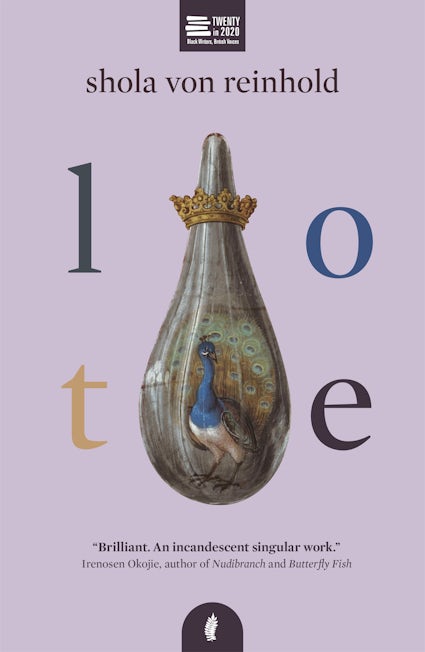
Shola von Reinhold - From champagne theft and Black Modernisms, to art sabotage, alchemy and lotus-eating proto-luxury communist cults, Mathilda’s journey through modes of aesthetic expression guides her to truth and the convoluted ways it is made and obscured.


LOTE

Shola von Reinhold, Lote, Jacaranda, 2020.


A literary novel which follows present-day narrator Mathilda's fixation with the forgotten black Scottish modernist poet, Hermia Drumm, LOTE is an exploration of aesthetics, Beauty, and the ephemeral realm in which they exist.

Lush and frothy, incisive and witty, Shola von Reinhold’s decadent queer literary debut immerses readers in the pursuit of aesthetics and beauty, while interrogating the removal and obscurement of Black figures from history.

Solitary Mathilda has long been enamored with the ‘Bright Young Things’ of the 20s, and throughout her life, her attempts at reinvention have mirrored their extravagance and artfulness. After discovering a photograph of the forgotten Black modernist poet Hermia Druitt, who ran in the same circles as the Bright Young Things that she adores, Mathilda becomes transfixed and resolves to learn as much as she can about the mysterious figure. Her search brings her to a peculiar artists’ residency in Dun, a small European town Hermia was known to have lived in during the 30s. The artists’ residency throws her deeper into a lattice of secrets and secret societies that takes hold of her aesthetic imagination, but will she be able to break the thrall of her Transfixions?

From champagne theft and Black Modernisms, to art sabotage, alchemy and lotus-eating proto-luxury communist cults, Mathilda’s journey through modes of aesthetic expression guides her to truth and the convoluted ways it is made and obscured.


To read Shola von Reinhold’s ornate, multi-layered novel LOTE (2020) is to encounter a baroque mind. It tells the story of a queer Black thinker named Mathilda, in the present day, who is transfixed by an historical era that does not adequately represent her. Via diaries, letters and photographs she discovers the Bright Young Things, as they were fondly known, a set of decadent and disobedient socialites who threw elaborate, drug-fuelled parties across the 1920s and 30s. Through a cocktail of hedonism, androgyny and queer love, this group — along with their counterparts in the Bloomsbury Group — began to deconstruct patriarchy a century ago, and seem to offer Mathilda an escape from the present, with all its social and racial barriers – except they don’t. The catch is that members of both groups were, by and large, spoilt, white and rich. Despite their experimental poetry, queer lifestyles, and self-fashioning (‘frock consciousness’, as Virginia Woolf called it), radicality is countered by entitlement; after all, rich people have always made exceptions of their own kind.

The novel is underpinned by a question: Why are so few queer Black British modernists documented in those flourishing interwar years? Through an impressive mix of scholarship and historical fiction, Reinhold sets out to unravel and challenge this history, prying open the ledgers to ask how and why the received archive is so overwhelmingly white. ‘I would venture to guess that Anon, who wrote so many poems without signing them, was often a woman,’ Woolf famously wrote. ‘And/or Black,’ amends Reinhold – and with this as a sort of epigraph, their novel begins both a critique and a celebration of the era, setting out to recover the lives of Black Anons, and to conjure voices that didn’t make it into history.

The novel opens in the National Portrait Gallery archive in London, circa 2019. Mathilda has been recruited, without pay, to sift through a donation of photographs. Not yet captioned, these snapshots have been gathering dust in the gallery for a decade, their significance undetermined. Mathilda is a self-declared ‘Arcadian‘, her term for a pleasure-seeking yet political archivist, who strives to enhance her present with visions of the decadent past. She takes an almost narcotic delight in glimpses of the Bright Young Things, particularly the ‘brightest’ member, as he was once christened, the muse Stephen Tennant. Those neglected photographs turn out to be scenes of ‘modernist Alpine Queerdom’: exquisite, if familiar, images of the Bright Young Things jetting off on a skiing holiday (one particular jewel captures Tennant hand-in-hand with his lover, the war poet Siegfried Sassoon). But then Mathilda comes across an image unlike one she’s ever seen before: a costume party held at Lady Ottoline Morrell’s Garsington Manor, where her beloved Tennant appears beside two women bedecked as Renaissance angels. One flaunts a pair of feathered wings and a fine chain mail suit, grasping a champagne coupe – and her skin is black. Her afro doubles as a kind of halo, ‘brushed into a commanding nimbus’, enthuses a mesmerised Mathilda. ‘It made me ache with jealousy and bliss.’ Entranced, she steals the photograph, determined to learn more about this Black pleasure-seeker – and thus the book slips into gear. Who is this Black Bright Young Thing, and why is she absent from the history books? As Mathilda will discover, she is a Black Anon who exists only in fragments – appearing in scraps of gossip (often defamatory), and cited in sources that can’t be tracked down. When invoked by her contemporaries, she is exasperatingly anonymised as ‘the Mulatto paintress’ or ‘the Negress of Dun’. A disembodied figure, she turns out to be a lost Modernist poet, whom the prejudices of her day, combined with the bigotry of successive archivists, have vanished from the archive.

Hermia Druitt – whose life Mathilda comes to uncover – is an invention of Reinhold. They insert Druitt into actual history in order to show how she really might have existed, in turn allowing her to stand in for other Black Anons who have been irretrievably lost to the present. When it comes to representing non-elite, non-white lives, the historian’s hands are often tied by the absence of primary sources – letters, diaries, artworks – a reflection of who gets to write, and what sources are deemed worthy of the archivist’s attention. Reinhold does what a historian could not, inventing a figure – a Scottish-born Black poet of ‘Low Bloomsbury’, a queer woman and friend of Tennant, a guest at Garsington, a minor figure who should have been a major one, had the world not been so snobbish, cruel, and often racist.

Partway into the novel, Mathilda orders a cocktail called a Poussé Cafe Royal, one popular with her heroes, which ‘came served in a tulip glass and consisted of a rainbow of alcohols floating on top on one another’. In a way this image encapsulates the novel itself, which plays out on many levels, and in many sources, all at once. To sip the novel’s prose is to be whisked away on a fractal journey, in which the author transfigures into an eclectic ensemble of voices, shape-shifting through different forms and styles. First there is Matilda’s narrative in the present, in which she travels to Europe on a quest to locate Druitt’s missing poem. At the same time, stratified into the book are chapters of an invented academic text, Black Modernisms – missing from libraries, but which Mathilda hunts down – in whose pages a professor named Helen Morgan follows on Druitt’s trail a decade earlier. Finally there is Druitt’s own story, inserted into the novel by Reinhold, and encountered in invented primary sources: letters written by friends, and fragments of Druitt’s own memoir.

The strategy of writing Druitt into the archive is a form of historical revisionism. In his clever novel Confessions of the Fox (2018), Jordy Rosenberg deployed the same tactic to address the unsatisfying, and often violent, representation of trans people in the archive, who are encountered though documents that sexualise, medicalise or make monstrous. LOTE adds to this emerging revisionist literature. Cocooned within Mathilda’s narrative are alternatives to actual history, hatched by way of radical scholarship, as Reinhold utilises sources that obscured, and stole from, the Black world, and plunders the archive back.

Mathilda’s first-person narrative is written with intoxicating beauty, co-opting the highfalutin party-prose of the Bright Young Things as she emulates Druitt – describing the present as her hero might have done – to report on ‘gowns the colour of algae’, ‘a bowl of amethyst punch’, ‘a wheat coloured wig’. Meanwhile, Reinhold’s scholarship, distributed across the novel as chapters of Black Modernisms, sets out some of the harsh historical realities. If, writing from the present, Mathilda tends to indulge and rose-tint the era, as Morgan, Reinhold brings Druitt to earth.

LOTE is a novel about coming to terms with one’s heroes, as its author – via Mathilda and Morgan – grapples with both the possibilities and failures of queer British literary history. How receptive were the Bright Young Things and ‘the Bloomsberries’, as they are affectionally called, to friendship across the so-called colour line? Through Morgan’s scholarship, which Mathilda devours, Reinhold is able to explore the the spectrum of possibility, to rub up against, and expose, the era’s limits. As a queer woman, a poet and aesthete, Druitt would no doubt have sought out the group, but who would her allies have been? In the 1920s and 30s, there really was a queer intersection between the Harlem Renaissance and the Bright Young Things: the so-called ‘Faggot’s Ball‘ in Harlem in 1929 attended by the British; in turn, queer Black Harlemites like Richard Bruce Nugent – whose unpublished 1920s novella Geisha Man Reinhold cites as an influence – visited London. What’s more, members from both sets sojourned in Paris, where the Négritude movement and relaxed attitudes to homosexuality worked in everybody’s favour.

Instances of intellectual fellowship can also be pinpointed: as Black Modernisms recounts, the British eccentric Edith Sitwell formed a friendship with Trinidadian historian C.L.R. James; Garsington hostess Lady Ottoline Morrell befriended the singer Josephine Baker. Central to the plausibility of Druitt’s story is the American shipping heiress Nancy Cunard, herself a writer who established a Modernist publishing house in the 1920s. Reinhold identifies Cunard as an available historical figure through her intellectual and romantic union with the Black jazz musician Henry Crowder, which caused outrage among Americans at the time (Cunard was disowned and disinherited). Together Cunard and Crowder published a number of canonical African-American writers in the 1930s through the Hours Press, among them Langston Hughes and Zora Neale Hurston. This fact of history gives Reinhold room for more: in their historical insertion, Druitt’s lost poem was published by Hours, but subsequently vanished – perhaps intentionally suppressed. - Izabella Scott

read more here


Interview with Shola von Reinhold: ‘It felt like Hermia Fabulated herself out of the archive’

1ST JUNE 2021 by FRANKIE DYTOR

On zoom between Glasgow and Hamburg, Shola and I sat down to discuss LOTE, the novel which inspired my new series, BAROQUE. We talked about hyper-aesthetics, trans joy, and mourning in the archive. Thank you, Shola, for your time, grace and intellectual generosity throughout the interview!

As I was reading LOTE, I felt sensorially overwhelmed – it was this really heightened experience and I was wondering, if I felt that reading the novel, what was the process of writing it like?

I think it would be a lie to say anything other than that writing fiction is generally a sensory process for me and LOTE was no different. I guess how I write does issue from a sensorial place and it happens very visually. Apparently this visuality isn’t universal: I was watching an interview with Susan Sontag, who was talking about how, when she writes, she hears the words rather than sees images. That said, for me the visual means less the information side of things, and more something which is loaded with various registers of the optical – the haptic eye, the sensory eye and so on. Which has been reminding me of Tina Campt’s Listening to Images (2017) and I love the fact of these other layers of the senses – in this case, she is looking at the photographs, but she is listening-looking.

That’s so interesting, because that really reminds me of how across your work, so much of your writing takes up typically Decadent themes like the deliberate blurring of the senses, a focus on artifice but also attention to sensuality and material texture. Did you deliberately play with this in your work?

LOTE was probably less directly influenced by fin de siècle ‘Decadence’ than some people seem to think; but my curiosity with and love of certain modes and forms and ways of being that have a considerable stake in the aesthetic world do mean I end up thinking about all those typically Decadent methods you mention – but they’re (usually) not there to make it ‘Decadent’ or even just ‘decadent’. That given, I do also have more of a general interest in decadence. Both the particular movements associated with the word and other connotations of decadence including the way it’s used in art history, not to mention the way Marx uses decay to describe the stage of an economic epoch. Separate from (but overlapping) the French instantiation, it has that particular association with Walter Pater and Oscar Wilde and the decadent project stemming from Wilde-era aestheticism. The word is often used to describe anything that is deemed stylized. To go back to Sontag – and it’s weird to think how her work in the 60s is closer to the ‘belated’ decadents of the 20s than it is to us now – as well sculpting out, critically, the category of camp, she speaks of camp in another essay in terms of ‘stylization’, of which decadent work was a prime example. So there’s that as one taste category, which is cognate with the decadent. And then there are other terms like the pastoral (used in a specific sense of the word relating to the poetic convention that formally and thematically dissented from the Epic) to describe writers like Ronald Firbank. Then there are terms like baroque and rococo which, like decadent, are used in a more general sense to describe a type of art or period of art history that is stylistically involved. All of these modes share an attendant constellation: artifice, surface, ornament, beauty, excess, pleasure and so on. Subjects which resonate for me. And I usually (in my head) branch all these modes under the ‘extra-aesthetic’, the ‘extra’ obviously being completely relative – it’s always worth asking when statements like ‘over the top’ are made: over the top of what? Over the top of who: whose bland imposition? Even as more space has been sculpted out in recent years for the extra-aesthetic (in certain quarters) and the kinds of art held aloft have changed (in certain quarters), this regulation and relegation of the decorative and opulent visions persists, whether it is invisibility, simplicity, or unobtrusiveness being championed, or add to that stylelessness, harmony, evenness, order, effortlessness. Some being modes I have an interest in but they are too easily posited as ‘good’ at the expense of all kinds of deemed excesses.

So do you think that words like decadence can actually weirdly have a normative effect in that they always have to operate against the markers of the normal?

Yeah and I wonder if you can see the results of that in the fact that the very word ‘decadence’ is diluted enough to be used in copy to describe chocolate, for instance. Although what isn’t?

It’s also interesting how the word and the idea of it are used (opprobriously) in both radical and reactionary rhetoric for describing late phase cultures when things are meant to collapse, and that a marker of this stage is a preoccupation with the decorative. We’re always being reminded of these tyrannical Roman emperors who are so often described in terms of androgyny or effeminacy: in reactionary-capitalist terms, we see this logic tediously invoked for any old transphobic whim, like when in an interview C*mille P*glia suggests that trans fem people and queers suddenly manifest before the collapse of a civilisation, all of this being the corruption of a cismasculine culture and precurser to a new masculine ‘primitive’ stage, with society sweeping in to obliterate these apparently effete cultures. And obviously these assessments brush under the rug (or are entirely oblivious to), whole histories of transness and other gender categories, like third gender, which exist in the cultures they would ultimately classify as primitive. Maybe this is all so tedious it’s almost not worth engaging, but is useful in seeing how these aesthetic laws are invoked daily against trans people and queer people and still shape the contours of living, including received wisdom around taste and artmaking and what is considered measured and what is ‘superfluous excrescences.’ Oh, and we can’t separate the social conception of decadence that emerged from the trials of Wilde from the subsequent violent reception of both homosexuality and the transness in Britain which was exported colonially.

The kind of logic P*glia invokes is so omnipresent in the way that we understand taste and aesthetics, and as you say it totally obliterates histories that don’t treat the decorative and ornamental as simply excessive and superfluous. How do you deal with this problem of ornament, especially when you’re dealing with production from a Marxist point of view? Decadent art-for-arts-sake as one way of explaining ornament stems in many respects from an elitist or aristocratic tradition that doesn’t have to consider the labour involved. How can these two problems be balanced, that on the one hand the ornamental has been denigrated, but then on the other hand that ornament is also this luxury theorised by the elite?

Ornament also has a history of abject horror tied to it in relation to labour and yes, a history of elitism even as it is denigrated by the same elite. Compared to other aesthetic modes, its transgressive, radical potential and history are still neglected. ‘Good honest simplicity’ rarely needs intervening for (though people always are) because it isn’t coded as effeminate and evil in the same way, but of course simplicity has an equally abject history weaponised by the elite. As does ‘moderation’, as does ‘stylistic invisibility’, as does ‘naturalness’. Not to oversimplify, but their aesthetic benefits have long been paraded whereas the extra-aesthetic always exceeds the bounds, or it is hollow and empty – it is either too much or not enough, in ways that are racialised and gendered.

For me ornament just as much calls up other sites of production including a myriad of Yoruba arts, queer Black utilisations of the opulent found in ballroom and adjacent cultures, Black disco, various working-class domestic histories. All these offer sites where production and labour and the value of ornament is different to that of white aristo engagement, and many have been sources for an elite interest in the ornamental in the first place. I’m also reminded of the essay by Abondance Matanda called ‘The First Galleries I Knew were Black Homes’ [in Dead Ink’s essay collection Know Your Place] which really beautifully offers a Black domestic ornamental history, and then for instance work by the scholar Amber Jamilla Musser who looks at the way Black artists have used visual and sensory lustre, i.e. the ornamental, as a strategy which can be radical in its evasion of and resistance to certain kinds of legibility and one that deals with the question of commodification. Her work in turn points to the work of Krista Thompsen who looks specifically at Black cultural production by way of the ornamental category of Bling.

And ornamentality can be relational, or rhetorical or detached from the material (if anything can). And then, of course, ornament doesn’t have to be radical either. There is so much in the ornamental that can sit alongside the radical, partly because of its demoted status and partly just because of what it does, as a form. I think it becomes an off-stage world, which can harbour knowledge, histories and conversations. I always think of the ornamental dimension as this kind of sideways zone, where alterities are going on and seeds of utopia get lodged, different ways of being and experiencing the world, whether this ornament is abstract geometric pattern, braided hair, makeup, music or poetry. So yes, the production of ornament is definitely a fraught and complex problem in all its excess and beyond-ness, but there is so much there that is worth exploring.

Read more here


Shola von Reinhold is a Scottish-Nigerian writer and recent graduate of the MLitt in Creative Writing at the University of Glasgow which they completed through the Jessica York Writing Scholarship. Shola was Cove Park's 2018 Scottish Emerging Writer and a Desperate Literature Short Fiction Prize 2019 runner-up. Shola writes widely around race, modernism, ornament, gender, labour-evasion and Queer Black extra-aesthetics; and has been published in or on i-D, AnOther Magazine, The Independent and The Cambridge Literary Review. LOTE is Shola's debut novel.

3/5/20

L. D. Janakos - Eccentric physicist Brancusi hires Joana, exploring her inherited inadequacy, to collect impressions of his life. The two find themselves sandwiched between the absurd and the surreal as they search for the pathology of windows, listen to the last sounds before the first utterance

Slikovni rezultat za L.D. Janakos, Plato's Screw,
L. D. Janakos, Plato's Screw, Wild Ocean Press; 2nd ed., 2013.
http://platos-screw.blogspot.com/
excerpt


An anti-novel built on frames, chapters and an almanac(k) of things. Take a surreal picaresque journey into the absurd reality of work, love and surveillance. An eccentric physicist and an ambivalent writer hired to follow him to collect impressions of his life find their reality sandwiched between the absurd and the surreal as they search for the pathology of windows, listen to the last sounds before the first utterance, and try out ways to outsmart their inherited inadequacies or social ambiguities.


L. D. Janakos, The Oldest Show (after the abandonment), highmoonoon, 2003.

sample (pdf)


Dreamer and contortionist by trade, 19-year-old Reselda takes an unwanted picaresque journey through our contemporary interior landscape. Haunted by old myths and mostly foolish people in charge of her life, she not only tries to live out her first love for a mysterious man, who remains partly hidden, but to get to her own story, which seems buried under everyone else’s.

A M.A.G. SERIALIZATION BY L.D. JANAKOS

Reselda
by LD Janakos
In this absurd coming of age story, a traveling dreamer from the oldest show circus wakes up in a vacant horse pasture without any knowledge of how she got there. When she is threatened with trespassing, she escapes into a surreal forest but can't find her way out to get her trailer, the only place she can dream new dreams for her acts.
Cast:
Reselda: no older than twenty Croquette: a surreal "monk" from Monastery C who speaks mostly in riddles Crocket: Croquette's partner from Monastery C who also speaks mostly in riddles Morrison: A poet lost in the forest who has lost his tower. Friend to Reselda Ob/Swifty: Same character in different contexts; truthtellers Sheriff/Masked Figure/Dictator 1: Same character different context Cleric/Second Masked Figure/Dictator 2: Same character different context Voice of circus owner Pugacello on answering service Voices of Cut out look alikes: both genders


Janakos is a fiction writer and filmmaker. She is the recipient of a Bumbershoot Literary Award and a University of Oregon Fiction Award along with several finalist awards. Her first novel, the oldest show (after the abandonment) (Highmoonoon Press, 2003), was one of three finalists for a Nivola award by Plover Press. A second edition and adaptation for the stage is forthcoming. She lives and works in California.