9/7/17

Olivia Locher - In Ohio it’s illegal to disrobe in front of a man’s portrait. In Arizona you may not have more than two dildos in a house

I Fought the Law
Olivia Locher, I Fought the LawForeword by Kenneth Goldsmith, Interviewer Eric Shiner, Chronicle Books, 2017.


Strange, outdated laws from each of the 50 U.S. states—some overturned, some still on the books, and some merely the stuff of legends—are depicted with sly wit by Olivia Locher. Incisive, ironic, and gorgeous, these images will appeal to art buffs and trivia fans alike. A foreword from American poet Kenneth Goldsmith and an interview with the artist by Eric Shiner, former director of the Andy Warhol Museum, contextualize rising-star Locher's photography. From serving wine in teacups in Kansas to licking a toad in Kentucky or perming a child's hair in Nebraska, breaking the law has never looked so good.


In Arizona you may not have more than two dildos in a house
In Delaware it's illegal to consume perfume
In Hawaii coins are not allowed to be placed in ones ears
In Idaho it's illegal to be nude outdoors, even on private property
In Indiana it’s illegal for a man to be sexually aroused in public
In Neveda it's illegal to put an American flag on a bar of soap
In North Carolina it’s a misdemeanor to urinate on someone else’s property
In Ohio it’s illegal to disrobe in front of a man’s portrait
In Pennsylvania it’s illegal to tie a dollar bill to a string and pull it away when someone tries to pick it up
In South Carolina it’s illegal to go fishing with dynamite
In Texas it is illegal for children to have unusual haircuts
- www.dazeddigital.com/art-photography/gallery/24223/11/olivia-locher-s-i-fought-the-law


and more here
and here


Olivia Locher was photographing a friend for her senior thesis when he mentioned — out of the blue — that, in Alabama, it is illegal to carry an ice-cream cone in your back pocket.
The conversation soon moved on to other topics.
But Locher did not.
For months, she found that bit of trivia popping back into her head. So she decided to do some research on what other strange statutes were out there.
“I found out there wasn’t a shortage of bizarre laws," the 25-year-old photographer recalled.
That discovery sparked an effort to illustrate reports of unusual laws across all 50 states. With the help of the internet, a Crazy Laws children's book published by Scholastic in the 1970s, and a fact-checker, Locher has tracked down apparent statutes on everything from bouncing pickles to more serious topics, like Peeping-Tom photos.
The resulting photo series, I Fought The Law, is now set to be made into a book that will be published in 2017.
Not all the laws Locher featured are still in effect — or enforced if they do remain on the books — and the origins and intent of some remain murky. In some cases, such as Massachusetts' ban on upskirt photos, she found that there were serious issues that sparked the legislation.
While Locher's bright and playful images give the statutes a satirical spin, the project raises a more serious point about politics: The hundreds of decisions, big and small, made every year by local and state lawmakers matter.
"What they’re setting and what’s going into motion really can affect our daily lives," Locher said.
Ahead, a look at some of the strange and surprising laws Locher found. - Torey Van Oot


Meet the Photographer Turning Alternative Facts Into Art


We trust our lawmakers to pass legislation that will keep us safe and serve the greater public good. In every state's books, though, there are laws outlandish and weird enough to make you question those lawmakers' sanity. Try as you might, it's hard to imagine why anyone would take the time to make it illegal to have an ice cream cone in your pocket.
“A few states still have that one in their books, which is strange,” says photographer Olivia Locher, who's lampooning the silliest of these statutes in her ongoing photo series, I Fought the Law. After hearing about the ice cream law she got curious and started looking into more examples, soon realizing it would make a good series. "After doing that I just found out there were so many," she says.
It's not hard to satirize statutes that ban people from picnicking in a graveyard or tickling a woman's chin with a feather duster. Many of the things that legislators have seen fit to legislate read like something straight out of Monty Python. And some of them make a crime of things we all do daily, like tapping our feet to the beat of a great tune. Locher portrays them in irreverent photos inspired heavily by the bold colors and aesthetics of pop art.
She also looks into the background of the laws, but doesn't include that information as part of the series. Even the silliest examples are often tied to the history and culture of the regions where they were raised. Hawaii's law against keeping coins in your ears stems in part from the region's complex history surrounding currency. According to Locher's research, placing coins in your ears is also a sign of being a drug dealer in Hawaii. If you know anything about Wisconsin, you could believe the state once required serving cheese with every slice of apple pie—something of an urban myth inspired by a short-lived law requiring cheese and butter be served with every meal. Some of the laws are totally reasonable anyway; you really shouldn't fish with dynamite, and Rhode Island's statute against transparent clothing is pretty clearly for the common good.
Nonetheless, there are some downright daffy decrees out there.
“I feel that not being able to have teacups with wine in them is really strange—I personally do that all the time," says Lochner. "And I mean, undressing in front of a man’s portrait, I don’t see how that conversation would’ve ever come up."
Locher hears about these from a variety of sources, so she does her best to confirm they actually exist, or once did. She reviews law books and public records and even talks to locals when she can. The points she satirizes are sometimes buried in the bureaucratic language of state code. For example, Georgia’s law against graveyard picnics might not jump out if you weren’t looking for it:
Sec. 9-7. Injury to property, trees, etc.–Picnicking; firearms. No person in the city cemeteries shall pick flowers of any kind, break branches from shrubs or trees, or climb fences to the cemeteries or trees located therein. Picnicking, lunching, lounging, shooting or loud and boisterous or disorderly conduct are forbidden in the cemeteries. No person with firearms shall be permitted to enter the cemetery grounds. (Code 1914, § 585; Ord. of 10-14-24, § 33; Ord. of 5-17-49, § 23)
Once she's got a handful of seemingly legit laws, Locher starts shooting. Staged shots typically are made in her Manhattan studio, but sometimes she'll shoot in the field. Her riff on Pennsylvania's dictum against fishing with dynamite, for example, was shot at a lake near her hometown of Johnstown, PA.
“It’s just deciding on what needs to be included in the picture to tell a cool story," she says. "Sometimes the subject matter could be kept really simple, but then other times you need more of an environment. Whatever the laws are saying, that’s how I come up with how much information I need to show. Some of them I feel require a little bit more than just a simple studio shot.”
These laws aren't likely to ruin anyone’s day—you’re more likely to be cited for jaywalking than selling a pickle that didn't bounce. Locher's project isn’t about addressing a broken legal system. It's more an indulgence in the absurdities that inevitably arise when people are left to set the rules for themselves. Regardless of all that, she likes having fun with it and making the photos look as silly as the laws sound.
“I’m always interested in trying to get across a sense of humor," she says. "I like an overall kind of lightheartedness, maybe something being slightly wrong that maybe kind of makes you stop and look a little bit longer than you would.” - Doug Bierend www.wired.com/2014/07/olivia-locher-i-fought-the-law/


In Utah, no one may walk down the street carrying a paper bag containing a violin.

In Connecticut, pickles must bounce to officially be considered pickles.

Writers Who Love Too Much : New Narrative Writing 1977-1997 - a major anthology of New Narrative, the movement fueled by punk, pop, porn, French theory, and social struggle to change writing forever


Writers Who Love Too Much : New Narrative Writing 1977-1997,
ed. by Dodie Bellamy and Kevin Killian, Nightboat Books, 2017.


In the twenty years that followed America's bicentennial, narrative writing was re-formed, reflecting new political and sexual realities. With the publication of this anthology, the New Narrative era bounds back to life, ripe with dramatic propulsion and infused with the twin strains of poetry and Continental theory. Arranged chronologically, the reader will discover classic texts of New Narrative from Bob Gluck to Kathy Acker, and rare materials including period interviews, reviews, essays, and talks combined to form a new map of late twentieth-century creative rebellion.


Contributors: STEVE ABBOTT ** KATHY ACKER ** MICHAEL AMNASAN ** ROBERTO BEDOYA ** BRUCE BENDERSON ** CHARLES BERNSTEIN ** NAYLAND BLAKE ** BRUCE BOONE ** LAWRENCE BRAITHWAITE ** REBECCA BROWN ** KATHE BURKHART **MARSHA CAMPBELL ** DENNIS COOPER ** SAM D’ALLESANDRO ** GABRIELLE DANIELS ** LESLIE DICK ** CECILIA DOUGHTERY ** BOBFLANAGAN ** ROBERT GLUCK ** JUDY GRAHN ** BRAD GOOCH ** CARLA HARRYMAN ** RICHARD HAWKINS ** ISHMAEL HOUSTON-JONES ** GARY INDIANA ** EDITH A. JENKINS ** KEVIN KILLIAN ** CHRIS KRAUS ** R. ZAMORA LINMARK ** EILEEN MYLES ** JOHN NORTON ** F.S. ROSA ** CAMILLE ROY ** SARAH SCHULMAN ** GAIL SCOTT ** DAVID O. STEINBERG ** LYNNE TILLMAN ** MATIAS VIEGENER ** SCOTT WATSON ** LAURIE WEEKS


Was it Chris Kraus’s Aliens & Anorexia or Dodie Bellamy’s The Letters of Mina Harker? Maybe Great Expectations by Kathy Acker. I can’t say for sure which was my first encounter with New Narrative, but I remember the thrum of exhilaration I got from it. I was twenty-five, studying fiction at Temple. Acker, Kraus, Bellamy—and later discoveries like Laurie Weeks, Kevin Killian, Lynne Tillman: whatever I thought I knew about writing, these writers challenged all of it. I didn’t quite grasp exactly what I’d read—fiction? memoir? theory?—but I came away reeling and raving, and itching to write.
In their new anthology, Writers Who Love Too Much: New Narrative 1977–1997, editors Bellamy and Killian gather what they consider the first generation of New Narrative writing—though in keeping with the movement’s suspicion of linear, coherent narratives, they are quick to shrug at this marker. Formed in the late 1970s in San Francisco, New Narrative was a transgressive, queer-leaning, self- and body-obsessed literary avant-garde that took shape in part against the dominance of anti-narrative, self-evacuating Language poetry at the time. Combining the confessional with the conceptual, it experimented with the possibilities of loosely autobiographical storytelling to produce an exploded and unstable “I.” Gossipy and uninhibited, its breath is hot in your ear. It wants to tell you everything, and it wants you to overshare back.
Bellamy and Killian’s project is first and foremost a historicizing one. Writers Who Love Too Much charts a literary history that grew out of punk, second-wave feminism, and the gay rights movement and covers the Reagan era and the HIV/AIDS crisis to close just about where the Internet and Semiotext(e)’s Native Agents book series take over. The anthology compiles generous selections, many of them excerpts, from more than forty writers, as well as talks, interviews, and other valuable, otherwise out-of-print ephemera from the period. The book has been built with deep feeling, and the title is right: including the thick appendix of chatty notes, we’ve got a haul of five-hundred-plus pages, a hefty chunk of which are given over to the urgent tug of infatuation of every conceivable stripe. Kathe Burkhart declares, “I love you. I’ll obsessively worship you as long as you’ll let me”; Dennis Cooper reflects, “I loved him. I should have said so less often.” The final selection, an excerpt from Kraus’s abject, swooning I Love Dick, culminates the movement’s central concern with the ways in which desire reconfigures and amplifies the self.
With its exposed asshole and eager grin, the toy lamb on the book’s cover gaily describes the New Narrative aesthetic. Dodie Bellamy’s own “Dear Gail”—effusively citational, frankly sexual, and slyly confessional—is a case in point. This excerpt from her epistolary Letters of Mina Harker perhaps best represents that slippery New Narrative “I.” The novel’s premise is that Bellamy has been possessed by Dracula’s victim-turned-vampire Mina Harker and is writing to Bellamy’s friends about the affairs she is having. “Quincey stuck his thing in my hole and gossip trembled along the telephone lines . . . ,” Mina starts. “Is this what it means to live in a writing community?” Then she launches a zigzagging tour through her sexual encounters, dreams, and reflections underpinned by passages lifted from other writers such as Georges Bataille, David Wojnarowicz, and Sylvia Plath.
Bellamy’s Mina is a catty, often merciless narrator, her observations about her/Dodie’s life bubbling over with mirth. This campy playfulness is shared by other selections, especially those adopting a more avant-pop mode, such as Matias Viegener’s “Twilight of the Gods.” Originally published in 1990, the story proposes a love triangle developing between Rock Hudson, Roy Cohn, and Michel Foucault as they receive experimental AIDS treatment at the American Hospital in Paris: “Each of them knew he was dying, and it was time for them to settle their scores with each other. They had to answer the Big Questions.” While this outlandish scenario brings a nervous levity to a crisis that casts a long shadow over the anthology, the philosophical exchanges imagined between these three very different public figures are as meaningful as they are absurd, and Viegener ultimately grants the lovers a “blissful” last few weeks.
It’s true this school of writing was made up of mostly white writers, at least this first generation. One of several notable exceptions is R. Zamora Linmark, whose raucous excerpt from the (recently reissued) novel Rolling the R’s uses avant-pop strategies to construct a 1970s-era Hawaiian world populated by mostly queer, mostly poor, mostly immigrant kids channeling fantasies of American whiteness through the figure of Farrah Fawcett. The next wave of New Narrativists would bring more diversity, with writers like Pamela Lu and Renee Gladman joining its ranks, among others. (A New Narrative Now conference in the works is likely to address the movement’s relationship to race and identity and other minoritarian avant-gardes.)
The editors describe the anthology as a “definitive sampling.” While it can be frustrating to encounter so many excerpts not meant to stand alone, these selections achieve a vibrant coherence. Gathered together, they accumulate a heady velocity, the sense of roving, unstoppable minds bending narrative through an unfailingly complex prism of the self. Given the recent turn toward autofiction and new experiments in memoir, it’s clear this movement has ongoing relevance. What has made it so influential, I’d argue, is not a flavor or style, but an energy that redirects interiority into a potently outward-looking charge. Put another way, New Narrative is not only a citational mode, but an inciting one; and Writers Who Love Too Much should incite an abundance of writing to come. - M. Milks


Long Note on New Narrative
by Robert Glück

To talk about the beginnings of New Narrative, I have to talk about my friendship with Bruce Boone. We met in the early seventies through the San Francisco Art Institute’s bulletin board: Ed and I wanted to move and Bruce and Burton wanted to move—would we all be happy living together? For some reason both couples dropped the idea and remained in our respective flats for many years. But Bruce and I were poets and our obsession with Frank O’Hara forged a bond.
I was twenty-three or twenty-four. Bruce was seven years older. He was a wonderful teacher. He read to transform himself and to attain a correct understanding. Such understanding was urgently political.
Bruce had his eye on the catastrophic future, an upheaval he predicted with a certain grandeur, but it was my own present he helped me find. I read and wrote to invoke what seemed impossible–relation itself–in order to take part in a world that ceaselessly makes itself up, to “wake up” to the world, to recognize the world, to be convinced that the world exists, to take revenge on the world for not existing.
To talk about New Narrative, I also have to talk about Language Poetry, which was in its heroic period in the seventies. I treat diverse poets as one unit, a sort of flying wedge, because that’s how we experienced them. It would be hard to overestimate the drama they brought to a Bay Area scene that limped through the seventies, with the powerful exception of feminist poets like Judy Grahn, and the excitement generated by movement poetry. Language Poetry’s Puritan rigor, delight in technical vocabularies, and professionalism were new to a generation of Bay Area poets whose influences included the Beats, Robert Duncan and Jack Spicer, the New York School (Bolinas was its western outpost), surrealism and psychedelic surrealism.
Suddenly people took sides, though at times these confrontations resembled a pastiche of the embattled positions of earlier avant-guards. Language Poetry seemed very “straight male”—though what didn’t? Barrett Watten’s Total Syntax, for example, brilliantly established (as it dispatched) a lineage of fathers: Olson, Zukofsky, Pound, etc.
If I could have become a Language poet I would have; I craved the formalist fireworks, a purity that invented its own tenets. On the snowy mountain-top of progressive formalism, from the highest high road of modernist achievement, there was plenty of contempt heaped on less rigorous endeavor. I had come to a dead end in the mid-seventies like the poetry scene itself. The problem was not theoretical—or it was: I could not go on until I figured out some way to understand where I was. I also craved the community the Language Poets made for themselves.
The questions vexing Bruce and me and the kind of rigor we needed were only partly addressed by Language Poetry which, in the most general sense, we saw as an aesthetics built on an examination (by subtraction: of voice, of continuity) of the ways language generates meaning. The same could be said of other experimental work, especially the minimalisms, but Language Poetry was our proximate example.
Warring camps and battle lines drawn between representation and non-representation—retrospection makes the argument seem as arbitrary as Fancy vs. Imagination. But certainly the “logic of history” at that moment supported the idea of this division, along with the struggle to find a third position that would encompass the whole argument.
I experienced the poetry of disjunction as a luxurious idealism in which the speaking subject rejects the confines of representation and disappears in the largest freedom, that of language itself. My attraction to this freedom and to the professionalism with which it was purveyed made for a kind of class struggle within myself. Whole areas of my experience, especially gay experience, were not admitted to this utopia, partly because the mainstream reflected a resoundingly coherent image of myself back to me—an image so unjust that it amounted to a tyranny that I could not turn my back on. We had been disastrously described by the mainstream—a naming whose most extreme (though not uncommon) expression was physical violence. Political agency involved at least a provisionally stable identity.
Meanwhile, gay identity was also in its heroic period—it had not yet settled into just another nationalism and it was new enough to know its own constructedness. In the urban mix, some great experiment was actually taking place, a genuine community where strangers and different classes and ethnicities rubbed more than shoulders. This community was not destroyed by commodity culture, which was destroying so many other communities; instead, it was founded in commodity culture. We had to talk about it. Bruce and I turned to each other to see if we could come up with a better representation—not in order to satisfy movement pieties or to be political, but in order to be. We (eventually we were gay, lesbian, and working class writers) could not let narration go.
Since I’m confined to hindsight, I write as though Bruce and I were following a plan instead of stumbling and groping toward a writing that could join other literatures of the present. We could have found narrative models in, say, Clark Coolidge’s prose, so perhaps narrative practice relates outward to the actual community whose story is being told. We could have located self-reference and awareness of artifice in, say, the novels of Ronald Firbank, but we didn’t. So again, our use of language that knows itself relates outward to a community speaking to itself dissonantly.
We were fellow travelers of Language Poetry and the innovative feminist poetry of that time, but our lives and reading lead us toward a hybrid aesthetic, something impure. We (say, Bruce Boone, Camille Roy, Kevin Killian, Dodie Bellamy, Mike Amnasan, myself and, to include the dead, Steve Abbott and Sam D’Allesandro) are still fellow travelers of the poetries that evolved since the early eighties, when writers talked about “nonnarrative.” One could untangle that knot forever, or build an aesthetics on the ways language conveys silence, chaos, undifferentiated existence, and erects countless horizons of meaning.
How to be a theory-based writer?—one question. How to represent my experience as a gay man?—another question just as pressing. These questions lead to readers and communities almost completely ignorant of each other. Too fragmented for a gay audience? Too much sex and “voice” for a literary audience? I embodied these incommensurates so I had to ask this question: How can I convey urgent social meanings while opening or subverting the possibilities of meaning itself? That question has deviled and vexed Bay Area writing for twenty-five years. What kind of representation least deforms its subject? Can language be aware of itself (as object, as system, as commodity, as abstraction) yet take part in the forces that generate the present? Where in writing does engagement become authentic? One response, the politics of form, apparently does not answer the question completely.
One afternoon in 1976, Bruce remarked on the questions to the reader I’d been throwing into poems and stories. They were self-consciously theatrical and they seemed to him to pressure and even sometimes to reverse the positions of reader and writer. Reader/writer dynamics seemed like a way into the problems that preoccupied us, a toe in the water!
From our poems and stories, Bruce abstracted text-metatext: a story keeps a running commentary on itself from the present. The commentary, taking the form of a meditation or a second story, supplies a succession of frames. That is, the more you fragment a story, the more it becomes an example of narration itself–narration displaying its devices–while at the same time (as I wrote in 1981) the metatext “asks questions, asks for critical response, makes claims on the reader, elicits comments. In any case, text-metatext takes its form from the dialectical cleft between real life and life as it wants to be.”
We did not want to break the back of representation or to “punish” it for lying, but to elaborate narration on as many different planes as we could, which seemed consistent with the lives we lead. Writing can’t will away power relations and commodity life; instead, writing must accept its relation to power and recognize that at present group practice resides inside the commodity. Bruce wrote, “When evaluating image in American culture, isn’t it a commodity whether anyone likes it or not? You make your additions and subtractions from that point on.”
In 1978, Bruce and I launched the Black Star Series and published my Family Poems and his My Walk With Bob, a lovely book. In “Remarks on Narrative”—the afterword of Family Poems—Bruce wrote, “As has now been apparent for some time, the poetry of the ’70s seems generally to have reached a point of stagnation, increasing a kind of refinement of technique and available forms, without yet being able to profit greatly from the vigor, energy and accessibility that mark so much of the new Movement writing of gays, women and Third World writers, among others. Ultimately this impasse of poetry reflects conditions in society itself.”
We appreciated the comedy of mounting an offensive (“A critique of the new trends toward conceptualization, linguistic abstraction and process poetry”) with those slenderest volumes. My poems and stories were set “in the family,” not so antipsychological as they might have been given that we assumed any blow to interiority was a step forward for mankind.
We contended with the Language Poets while seeking their attention in the forums they erected for themselves. We published articles in Poetics Journal and L=A=N=G=U=A=G=E, and spoke in talk series and forums—a mere trickle in the torrent of their critical work. If Language Poetry was a dead end, what a fertile dead end it was!
New Narrative was in place by the time Elements of a Coffee Service was published by Donald Allen’s Four Season’s Foundation in 1982, and Hoddypole published Bruce’s novel, Century of Clouds in 1980. We were thinking about autobiography; by autobiography we meant daydreams, nightdreams, the act of writing, the relationship to the reader, the meeting of flesh and culture, the self as collaboration, the self as disintegration, the gaps, inconsistences and distortions, the enjambments of power, family, history and language.
Bruce and I brought high and low together between the covers of a book, mingling essay, lyric, and story. Our publishing reflected those different modes: stories from Elements appeared in gay anthologies, porn magazines, Social Text, and Soup. Bruce wrote about Georges Bataille for The Advocate.
I wanted to write with a total continuity and total disjunction since I experienced the world (and myself) as continuous and infinity divided. That was my ambition for writing. Why should a work of literature be organized by one pattern of engagement? Why should a “position” be maintained regarding the size of the gaps between units of meaning? To describe how the world is organized may be the same as organizing the world. I wanted the pleasures and politics of the fragment and the pleasures and politics of story, gossip, fable and case history; the randomness of chance and a sense of inevitability; sincerity while using appropriation and pastiche. When Barrett Watten said about Jack the Modernist, “You have your cake and eat it too,” I took it as a great compliment, as if my intention spoke through the book.
During the seventies, Bruce was working on his doctorate at UC Berkeley. His dissertation was a structuralist and gay reading of O’Hara, that is, O’Hara and community, a version of which was published in the first issue of Social Text in 1979. He joined the Marxism and Theory Group at St. Cloud which gave birth to that journal. Bruce also wrote critical articles (especially tracking the “gay band” of the Berkeley Renaissance). Bruce introduced me to most of the critics who would make a foundation for New Narrative writing.
Here are a few of them:
Georg Lukacs: In The Theory of the Novel, Lukacs maintains that the novel contains—that is, holds together—incommensurates. The epic and novel are the community telling itself its story, a story whose integration becomes increasingly hard to achieve. The Theory of the Novel leads to ideas of collaboration and community that are not naive, that is, to narrative that questions itself. It redistributes relations of power and springs the writer from the box of psychology, since he becomes the community speaking to itself. I wrote “Caricature,” a talk given at 80 Langton in 1983, mostly using Lukacs’ book, locating instances of conservative and progressive communities speaking to themselves: “If the community is a given, so are its types.”
Louis Althusser: His essay, “Ideological State Apparatuses,” refigures the concept of base/superstructure. Terry Eagleton rang the following change on Althusser’s bulky formula: Ideology is the imaginary resolution of real contradictions. By 1980, literary naturalism was easily deprived of its transparency, but this formula also deprives all fantasy of transparency, including the fantasy of personality. If making a personality is not different from making a book, in both cases one could favor the “real contradictions” side of the formula. If personality is a fiction (a political fiction!) then it is a story in common with other stories—it occurs on the same plane of experience. This “formula” sets those opacities—a novel, a personality—as equals on the stage of history, and supports a new version of autobiography in which “fact” and “fiction” inter-penetrate.
Althusser comes with a lot of baggage. For example, he divided science from ideology, and ideology from theory. Frankly, Bruce and I pillaged critical theory for concepts that gave us access to our experience. In retrospect, it might be better simply to “go with” cultural studies. To the endless chain of equal cultural manifestations (a song by REM, the Diet of Worms, Rousseau’s Confessions), we add another equal sign, attaching the self as yet another thing the culture “dreamed up.”
Georges Bataille: Bataille was central to our project. He finds a counter-economy of rupture and excess that includes art, sex, war, religious sacrifice, sports events, ruptured subjectivity, the dissolution of bodily integuments—”expenditure” of all kinds. Bataille showed us how a bath house and a church could fulfill the same function in their respective communities.
In writing about sex, desire and the body, New Narrative approached performance art, where self is put at risk by naming names, becoming naked, making the irreversible happen—the book becomes social practice that is lived. The theme of obsessive romance did double duty, de-stabling the self and asserting gay experience. Steve Abbott wrote, “Gay writers Bruce Boone and Robert Glück (like Acker, Dennis Cooper or the subway graffitists again) up the ante on this factuality by weaving their own names, and those of friends and lovers, into their work. The writer/artist becomes exposed and vulnerable: you risk being foolish, mean-spirited, wrong. But if the writer’s life is more open to judgement and speculation, so is the reader’s.”
Did we believe in the “truth and freedom” of sex? Certainly we were attracted to scandal and shame, where there is so much information. I wanted to write close to the body—the place language goes reluctantly. We used porn, where information saturates narrative, to expose and manipulate genre’s formulas and dramatis personae, to arrive at ecstacy and loss of narration as the self sheds its social identities. We wanted to speak about subject/master and object/slave. Bataille showed us that loss of self and attainment of nothingness is a group activity. He supplied the essential negative, a zero planted in the midst of community. His concept of transgression gave us lots of fuel, as did his novels of philosophic pornography.
Now I’d add that transgressive writing is not necessarily about sex or the body—or about anything one can predict. There’s no manual; transgressive writing shocks by articulating the present, the one thing impossible to put into words, because a language does not yet exist to describe the present. Bruce translated Bataille’s Guilty for Lapis Press when I worked as an editor there. We hammered out the manuscript together, absorbing Bataille gesturally.
Five more critics. Walter Benjamin: for lyrical melancholy (which reads as autobiography) and for permission to mix high and low. V.N. Voloshinov: for discovering that meaning resides within its social situation, and that contending powers struggle within language itself. Rolland Barthes: for a style that goes back to autobiography, for the fragment, and for displaying the constructed nature of story—”baring the device.” Michel Foucault: for the constructed nature of sexuality, the self as collaboration, and the not-to-be-underestimated example of an out gay critic. (Once at 18th and Castro, Michel pierced Bruce with his eagle gaze and Bruce was overcome!—he says.) Julia Kristeva: for elaborating the meaning of abjection in Powers of Horror.
Our interest in Dennis Cooper and Kathy Acker produced allegiances and friendships with those writers. Kathy moved to San Francisco in the fall of 1981; while getting settled she stayed with Denise Kastan, who lived downstairs from me. Denise and I co-directed Small Press Traffic. Kathy was at work on Great Expectations. In fact, Denise and I appear in it; we are the whores Danella and Barbraella. Kathy’s writing gave Bruce, Steve Abbott and myself another model, evolved far beyond our own efforts, for the interrogation of autobiography as “text” perpetually subverted by another text. Appropriation puts in question the place of the writer—in fact, it turns the writer into a reader.
Meanwhile, Bruce and I were thinking about the painters who were rediscovering the figure, like Eric Fischl and Julian Schnabel. They found a figuration that had passed through the flame of abstract expressionism and the subsequent isms, operating through them. It made us feel we were part of a crosscultural impulse rather than a local subset. Bruce wrote, “With much gay writing and some punk notoriously (Acker the big example), the sexual roots of aggression come into question. There’s a scream of connection, the figure that emerges ghostly: life attributed to those who have gone beyond. So in Dennis Cooper’s Safe there’s a feeling-tone like a Schnabel painting:the ground’s these fragments of some past, the stag, the Roman column, whatever—on them a figure that doesn’t quite exist but would maybe like to. The person/persona/thing the writer’s trying to construct from images—”
In 1976, I started volunteering in the non-profit bookstore Small Press Traffic and became co-director not long after. From 1977 to 1985, I ran a reading series and held free walk-in writing workshops at the store. The workshops became a kind of New Narrative laboratory attended by Michael Amnasan, Steve Abbott, Sam D’Allesandro, Kevin Killian, Dodie Bellamy, Camille Roy, and many other writers whose works extend my own horizon. I would start by reading some piece of writing that interested me: Chaucer, Robert Smithson, Lydia Davis, Ivan Bunin, Jim Thompson, a book of London street games, Thomas Wyatt, Sei Shonagon. We were aspiring to an ideal of learning derived as much from Spicer and Duncan as from our contemporaries.
Most writers we knew were reading theory. Later, guided by Bruce, we started a left reading group at Small Press Traffic, attended by Steve Benson, Ron Silliman, Denise Kastan, Steve Abbott, Bruce, myself and others. The personal demolished the political, and after a few months we disbanded. From that era I recall Ron’s epithet (which Bruce and I thought delicious) The Small Press Traffic School of Dissimulation.
More successful was the Left/Write Conference we mounted in 1981 at the Noe Valley Ministry. The idea for a conference was conceived in the spring of 1998 by Bruce and Steve Abbott, who sent letters to thirty writers of various ethnicities and aesthetic positions. Steve was a tireless community builder, and Left/Write was an expression of New Narrative’s desire to bring communities together, a desire which informed the reading series at Small Press Traffic, Steve Abbott’s Soup (where the term New Narrative first appeared), Michael Amnasan’s Ottotole, Camille Roy and Nayland Blake’s Dear World, Kevin Killian and Brian Monte’s No Apologies, and later Kevin and Dodie Bellamy’s Mirage. We felt urgent about it, perhaps because we each belonged to such disparate groups. To our astonishment, three hundred people attended Left/Write, so we accomplished on a civic stage what we were attempting in our writing, editing and curating: to mix groups and modes of discourse. Writers famous inside their own group and hardly known outside, like Judy Grahn and Erica Hunt, spoke and read together for the first time.
Out of that conference the Left Writers Union emerged; soon it was commandeered by its most unreconstructed faction which prioritized gay and feminist issues out of existence. At one meeting, we were instructed to hold readings in storefronts on ground level so the “masses of San Francisco” could walk in!
During this decade–1975-1985–Bruce and I carried on what amounted to one long gabby phone conversation. We brought gossip and anecdote to our writing because they contain speaker and audience, establish the parameters of community and trumpet their”unfair” points of view. I hardly ever “made things up,” a plot still seems exotic, but as a collagist I had an infinite field. I could use the lives we endlessly described to each other as “found material” which complicates storytelling because the material also exists on the same plane as the reader’s life. Found materials have a kind of radiance, the truth of the already-known.
In 1981 we published La Fontaine as a valentine to our friendship. In one poem, Bruce (and Montaigne!) wrote, “In the friendship whereof I speak…our souls mingle and blend in a fusion so complete that the seam that joins them disappears and is found no more. If pressed to say why I loved him I’d reply, because it was him, because it was me.”
In using the tag New Narrative, I concede there is such a thing. In the past I was reluctant to promote a literary school that endured even ten minutes, much less a few years. Bruce and I took the notion of a “school” half seriously, and once New Narrative began to resemble a program, we abandoned it, declining to recognize ourselves in the tyrants and functionaries that make a literary school. Or was it just a failure of nerve? Now I am glad to see the term used by younger writers in San Francisco, writers in other cities, like Gail Scott in Montreal, and critics like Earl Jackson, Jr., Antony Easthope, Carolyn Dinshaw, and Dianne Chisholm. Bruce and I may have been kidding about founding a school, but we were serious about wanting to bring emotion and subject matter into the field of innovative writing. I hope that these thoughts on our project—call it what you will—are useful to those looking for ways to extending the possibilities of poem and story without backtracking into the mainstream, or into 19th-century transparency.


New Narrative @ Wikipedia
New Narrative and the Making of Language Poetry
Realism and Utopia: Sex, Writing, and Activism in New Narrative
New Narrative writer and poet Kevin Killian showcases work
Colonized on Every Level: An Interview with Dodie Bellamy
Robert Glück Makes You Blow Him
Strategies of Deviance: Studies in Gay Male Representation
New Narrative: A Queer Genealogy – LLSL 2415 A
Contestatory Writing Practices in the San Francisco Bay Area in the Seventies–New Sentence, New Narrative
The Small Press Traffic school of dissimulation
Biting the Error: Writers Explore Narrative


- denniscooperblog.com/please-welcome-to-the-world-dodie-bellamy-kevin-killian-editors-writers-who-love-too-much-new-narrative-writing-1977-1997-nightboat-books/


9/1/17

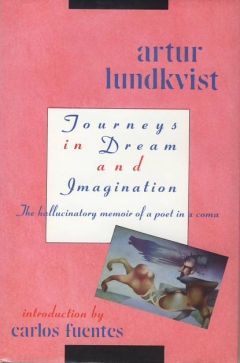
Artur Lundquist - "the hallucinatory memoir of a poet in a coma.". He attempted to re-capture the now-elusive dream visions that illuminated the two months of his coma as well as to set down the waking dreams that he experienced during the first year of his convalescence, intense and vivid ones in which his eyes remained open and during which reality mixed with unreality in a half-aware reverie

Image result for Artur Lundquist, Journeys in Dream and Imagination,
Artur Lundquist, Journeys in Dream and Imagination, Trans. by Ann B. Weissmann and Annika Planck, Four Walls, Eight Windows, 1991.


In 1981 the author, a well-known 75 year old Swedish poet, suffered a heart attack and lay comatose for two months. He then began a prolonged period during which he gradually recovered all of his faculties. In the early stage of his recovery, Lundkvist experienced a series of strange and intense "waking dreams," which he describes in this memoir. Many were dreams of journeys to real or fantastic places: for example, a trip to a railroad station in Chicago where physicians surgically transformed white people into black people, or a visit to a strange planet where cows produced blue milk. Lundkvist's memories of these dreams are embedded in a series of imaginative meditations on aging, human nature, the meaning of life, and the inexorable passage of time.


This short book is accurately subtitled "the hallucinatory memoir of a poet in a coma." The poet's meditations are unfailingly imaginative, gracefully written, and often very insightful. Lundkvist's clinical circumstance is not new: a patient hovering near the maw of death returns to life to report a profound experience that took place while others thought he or she was comatose or delirious. In this poet's version, the tale makes for astringent and elegant reading. It is interesting to compare these hallucinatory experiences with those reported by Richard Selzer in Raising the Dead (see this database), the book he wrote after experiencing a near-fatal episode of Legionella pneumonia.


I’m attracted to unusual states of consciousness in the history of literature, such as Hanna Weiner’s poetic conversations with the words that she saw projected, involuntarily, onto surfaces; and those “Kubla Khan’s” written during drug-induced altered states of consciousness. One of the most remarkable poetic records of an altered state of mind is Artur Lundkvist’s Journeys in Dream and Imagination: The hallucinatory memoir of a poet in a coma.
In 1981, at the age of 75, Swedish poet Artur Lundquist had a heart attack while giving a speech on Anthony Burgess. A friend administered artificial resuscitation and he was rushed to the hospital, where he lay in a coma in the intensive care unit for two months, his life sustained by a heart-lung machine. He gradually regained consciousness over the next few months, maintaining awareness for greater and greater periods of time. As soon as he was able to write again or at least to dictate to his wife, he attempted to re-capture the now-elusive dream visions that illuminated the two months of his coma as well as to set down the waking dreams that he experienced during the first year of his convalescence, intense and vivid ones in which his eyes remained open and during which reality mixed with unreality in a half-aware reverie. Such dreams are not uncommon for persons who have experienced a change in breathing patterns, as is the case being on a lung machine (1). Fortunately, Lundquist’s linguistic abilities were rusty but intact, and he was able to document his fantastical visions that arose during this fertile period of dreaming.
The memorable opening of his poetic journal of dreams, “I know I am traveling all the time,” suggests that he’s aware of his altered condition, and that the background noise of his mental state is his impression of traveling, paradoxically in “complete stillness and silence” and “without a sound or feeling of movement.” He exists “without distance in time and space” yet he feels that he is traveling “through time or space.” He can’t tell if he’s “lying in the same place” or “traveling without interruption.” He’s unaware of minutes and hours passing, “yet time is moving somehow.” It’s as though he existed in suspended animation while riding a train. He describes his state of mind during his convalescence as being full of contradictions: moving yet stationary, timeless yet in time, lonely yet also belonging, unaware yet on some level conscious. In this twilight state, while he’s on life support in the hospital, he dreams, sometimes about his own death and sometimes about the annihilation of the earth. Fantasies of nothingness, purposelessness, and oblivion haunt him in his awareness that his own consciousness could easily fritter away and end rather than be revived, and that eventually nothing will be left of the earth and all its life forms: “nothing that can see or feel or think remains in existence.”
His journey is metaphorical as well as viscerally sensed. The point of departure of the journey is a state of suspension in a world of silence and paralysis, as if he were in a cocoon. He seems to be neither conscious nor unconscious, and sometimes, for brief periods, he perceives the objects and people in his hospital room, but he’s helpless to make contact with them. The journey is one of transformation, and his destination is consciousness, the regained ability to speak and read, and ultimately, the ability to write about the journey of his dreams.
Yet he has no sense of destination in his dream journeys. What he has lost—his consciousness of place, of his body in a particular space, situatedness—becomes an obsession in his dreams. In a particularly poetic entry that is reminiscent of Stephen Dedalus’ meditation on place, telescoping from self to universe (2), Lundquist describes a village of farms in some detail, then zooms away:
behind that the forest began, and the moors, the meandering creek and the half-overgrown lake, the cows who grazed without fences, knew the paths and followed them, and returned when it was milking time,
then there was the church village and the whole parish, the district and the county and the whole country, and it was on earth in the universe, below the sun, the moon, and the stars, with years carved into tree trunks without revealing if the world was actually old or still young
Like Dedalus’ list, Lundquist’s image of an ever-expanding view tells of his wished-for certainty of place in an orderly world in which you know exactly where you are, even though there is a mystery about where you’re precisely bookmarked in the age of the world. When he does feel, in his dreams, a strong sense of self, that self feels alien to him: he doesn’t recognize the echo of his own shouting voice. It is absence and loss that most often shape his dreams, as when he envisions a couple buried alive after a strong earthquake, or a living, sentient stone mountain that is being cruelly and terrifyingly quarried by men who are more murderers than miners, or himself as the village idiot, “carry[ing] within [him] something that has never fully blossomed.” He’s in purgatory, a guest lost in a vast hotel, a village hidden in a mist. Corporeality and consciousness are absent or impaired, and desire—for life, for sexuality, for communication—is thwarted since the means necessary to fulfilling these desires are in a liminal state, halfway between action and immobility and unable even to know with certainty whether he is alive or dead.
Journeys in Dream and Imagination is a record of meta-dreams, meditations on Lundquist’s state of consciousness, dreams about the dream state. In the beginning of his journey, his dreams are “of iron, so strong, so durable.” However, this strong state of consciousness gradually starts “to rust,” and the dreams “fall off like flakes of rust” until they vanish entirely. He then switches “to dreams of dough,” which he bakes and eats, “almost like bread” that nourishes him through this period of amorphous half-consciousness. The metaphor of the consumption of dreams describes the interiority of his state of mind, and the next image of vomiting a snake that is also a giving birth to speech seems to signify his ability or desire to engage once more in communication with the world outside his twilight prison. Within his dream state, he sometimes interprets the vision he has just experienced, as when he sees trees growing between his toes and believes that dream to be a good omen, a “sign that life continues to grow inside me.” It is as though his consciousness were trying to solve the puzzle of its own impairment.
The necessarily interior turn during this period when perception of the outer world was subdued or shut off perhaps accounts for his awareness of his body, which he felt to be in a state of flux (the sensation of traveling, for example) and transformation: he has become something of a shapeshifter. In two successive dreams, he is transformed into a giant and then a miniature person, in the manner of Gulliver’s Travels. Proprioception is the brain’s ability to locate the position of the body relative to its own parts as well as to the exterior world. Since altered states of consciousness (during meditation or praying, for example) can change the strength of a person’s feeling of separation from or continuity with exterior space, other people, or objects, I wonder whether Lundquist’s dreams reflect disturbances in his proprioceptive sense of self in relation to others. During his convalescence, his brain was repairing itself—but was it also rehearsing, in a sense, the process of its own repair? Is this what the image of consuming the nourishing bread of his dreams signifies? If reinforcing the lessons of the day in a kind of rehearsal of knowledge is part of the function of dreams, as some neuroscientists studying sleep now believe, what was the purpose of Lundquist’s dreams, if indeed they can be said to have one? Why do so many of them have the feel of meta-dreams about the journey towards consciousness?
Regardless of the purpose of these dreams, it seems likely that Lundquist’s hallucinatory visions, alternately peaceful and nightmarish, represent his fears of being forever in a coma and his hopes of someday rejoining the realm of real people, objects, places. In his dreams, he creates worlds of uncertainty, where nothing can be pinned down as completely familiar and habitual; where communication is problematic or impossible, consciousness is present in some way but still suspended in a timeless, placeless journey; and where he is alien to himself and inhabits a world that is strange and unrecognizable.
His limbo is real and extreme, but there is something oddly familiar about his dilemma dramatized or described in his dreams, something that elicits the feeling that you’ve been there, too, in moments of doubt or frustration, when order dissolves, when thought fails to render its shiny nugget, when self seems irremediably scattered, when you feel alone on a teeming planet that seems to belong to another dimension, when talking to others falters and stumbles, when you no longer know who or why you are, and the world, faced ultimately with demise, seems pointless but stubbornly present. In his meta-dream stories investigating suspended being, the often surreal analogies for these states are almost endlessly inventive. But in them one can also read a description of what it is to be human, or to exist in “negative capability,” as Keats called the ability to live with “uncertainties, Mysteries, doubts without any irritable reaching after fact & reason.”
Part of the pleasure of Lundquist’s record is becoming aware that even in a coma, the mind can cut seemingly endless facets in which to reflect itself and rehearse the dramas—miniscule or vast—of its journey through the interior. If his world seemed to be a solipsistic nightmare from which he couldn’t completely awaken, he peopled that world with rich possibilities and a self-awareness that sometimes comes across as more lucid and knowing—for all its twilight uncertainties—than the consciousness he so desperately wanted back.
(1) I gleaned most of the information in this narrative of Lundquist’s heart attack and recuperation from Carlos Fuentes’ introduction to the book.
(2) He turned to the flyleaf of the geography and read what he had written there: himself, his name and where he was. - Camille Martin

Outside of literary circles the name of the author is not well known in this country. Arthur Lundqvist (1906-1991) was a leading contemporary Swedish poet and author who, in addition to his prolific output (over eighty books of poetry and prose) was a prominent member of the Literary Committee of the Swedish Academy. As such he exerted considerable influence on the choice of Nobel laureates. Fluent in Spanish he was instrumental in bringing a new generation of Latin and South American writers to Sweden. (Carlos Fuentes, Gabriel Garcia Marquez, Pablo Neruda, Octavio Paz). He is generally regarded as having brought modernism to the Swedish literary scene.
An inveterate traveler, urbane and cosmopolitan in outlook, he was truly a world citizen. He was also an autodidact. Brought up in a working class household his formal education terminated in the sixth grade. Early in his career he was identified with the generation of left-wing avant-garde writers. He has been described as proletarian in his sympathies and aristocratic in his writings. Like all Swedes he had a deep love for nature and never lost touch with his rustic roots.
In October of 1981 Artur Lundqvist suffered a severe heart attack, lost consciousness and lapsed into coma. He was kept alive on a heart-lung-machine but remained unresponsive for two months. His wife, Maria Wine, also a writer, remained at his bedside constantly and, despite the forebodings of his doctors, persisted in her efforts to reach him through poetry and song. The first indication that some measure of awareness had returned was a faint flicker of a smile in response to being told a funny story. It took many weeks for the recurrent stretches of clouded consciousness to dissipate and many months to regain most of the ground he had lost. In the years that followed he returned to writing and continued to be productive.
Published originally in Swedish this book came to my attention by Swedish colleagues who knew of my interest in dreams. As I made my way slowly through the Swedish edition I was amazed at the author's detailed recall of dreamlike imagery in connection with the prolonged coma and the slow recovery that followed. There is no clear timing of the events he describes but, from what I could gather, there were a few fragmented memories and impressions from the period of deep coma.
Most of his recall seems to be associated with his subsequent struggle to hold on to the fleeting moments of awareness. His inner life was particularly vivid during this period and was recounted later in elaborate detail. The result is a melange of dreams, dream-like imagery, flights of imagination and the exaggeration of various sensory impressions.
How does a gifted and richly imaginative person cope with the dreadful combination of enforced immobility and near total disconnect from the world he knew? Artur Lundqvist found a say which he describes in his opening words:
"I know I am traveling all the time, possibly with no interruptions, also with no tremors or noises, soundlessly and softly, and then I am no longer lying in my bed but stepping out into the world where everything is awake, sundrenched, comforting, and I am there clearly as a visitor, and I am quite at ease, it must be a dream journey I have undertaken, a definite dream journey where all is real, where all my wishes are fulfilled without my even asking, precisely the way all journeys ought to be, but maybe one has to be dead in order to journey like that."
Out of touch with his surroundings, entombed in a metal cabinet, he was able to create and later recall elaborately crafted metaphorical imagery that simultaneously reflected the confinement he was subjected to and the contrasting freedom he felt as his imagination took over. This "immobile traveller" as Carlos Fuentes refers to him in his Introduction, went on voyages to strange lands, witnessed strange happenings (cows giving purple milk, white people transformed into black people) and where strange things happened to him (varying in size from tiny to huge).
Not all was pleasantly wishfulfilling. Although he usually experienced himself as a detached observer, the scenes he witnessed on his journeys reflected poignantly his touch and go encounters with the ever-present threat of total oblivion. Scenes of passion, sensuality and beauty are offset by images of death, barrenness and petrifaction. He comes upon starving people who wear their skeletons outside their bodies. He muses about the sun as a "master of space ... tearing itself apart ... bearer of unbearable forces constantly destroying themselves". He reflects on the evanescence of life as he watches a rain drop splash against a window or a snowflake falling and disappearing.
His feelings of confinement are metaphorically transformed:
"I wake up and find myself in surroundings with no vertical dimensions, the room seems to close just above me, leaving no space at all to sit up, I am forced to lie there straight on my back unable to turn on my side. He experiences a suffocating anxiety: ... now the horrifying thought comes to me that maybe I am in a coffin without having the slightest idea how I ended up there, possibly already considered dead. On another occasion he finds himself in a cage as if in a zoo with a crowd staring at him with curiosity. He comes across a building designed and built along time ago by two Japanese architects and wonders if they had been walled into the building alive.
The sense of his own cognitive loss is depicted in the inept and helpless feelings as a hotel guest in a land where he is ignorant of the language. He has difficulty negotiating even the simples amenity: "How badly suited you are to being a hotel guest, from the very beginning you feel suspect, you use the wrong expressions even in your own language, not to mention others ..." Dealing with the reception desk is "purgatory". He does not know where to leave the key or whether or not to say good morning.
Soon after the return of consciousness, when he discovered he could no longer write, he describes an anosognosia-like response. He blames his hand for the problem and suggests "... perhaps I could replace the hand one way or the other, perhaps have a new hand from a dead person surgically attached".
He captures the essence of dreaming itself when he notes: " ... how easy to lift the past to the surface and perceive its strange reality as present, but ... it escapes (as) from the hand cupped around water", or: "My dreams are of iron so strong, so durable, but they soon begin to rust and nothing is left of them".
This edition includes a Preface by a neurophysiologist, dr David Ingvar, who had an extended interview with Lundqvist during his period of recovery, an Introduction by Carlos Fuentes and a Foreword by Maria Wine; his wife of over fifty years. Dr Ingvar recounts the onset of the illness and some of the details of his stay in the intensive care unit. During the course of their conversation the subject of death came up. Lundqvist's response was: "But I know what happens now. It finishes. The world disappears. It is quite simple".
In her foreword Maria Wine writes movingly of her long vigil trying to keep hope alive despite the gloomy prognostications of the medical staff. To what extent did her persistent daily efforts to reach her husband through the poems and music he loved play a role in his recovery? A question not to be dismissed lightly! She writes: "Suddenly you were gone, and yet not quite gone: you lay there with large, open, astonished eyes, as if something invisible had interrupted their last visual impression, your pupils seemed wordless like black lackluster stones, yet in the greyish-blue iris of your eyes there was a hint of a milky white shimmer ... your face was dreamlike and still, you were like a 'dreamer with open eyes'". The latter was a reference to a book Lundqvist wrote in 1966, perhaps with some prescience, entitled "Self Portrait of a Dreamer with open Eyes".
Fuentes notes the metaphorical power of Lundqvist's imagery in translating, as the poet does, living experience into art, even the living experience of being so close to a sustained death-like state. In a wide-ranging explication of Lundqvist's account he sees connections to Aztec mythology, to man's effort to identify with and remain separate from nature, and finally as an epiphany of the changing state of European consciousness.
As is the case with any successful literary effort, this book stands on its own, apart from context. In this instance, however, knowing the context adds a significant psychological dimension, revealing as it does, the congruence between the imagery evoked and the nature of the life threatening circumstances under which it was generated. I would have liked to have been privy to greater clarity about the course of the illness and the timing of the various images that were recalled. That might satisfy my scientific curiosity but at the cost of greedily pursuing my own interest in the face of a perfectly satisfying aesthetic experience. The imaginative realm was Lundqvist's last remaining resource. He certainly put it to good use, enabling us to share with him what he described as "an autobiography visualized in a state of unconsciousness". For more of that autobiography to become available to an American audience I would hope that some day the hundred and two vignettes omitted in this edition will be made available in English.
In closing, I want to pay tribute to the superb translation by Ann B. Weissman and Annika Planck. They captured in full the lyrical quality of Lundqvist's prose. - Montague Ullman

I CONFESS that opening this fascinating, lyrical, out-of-body travel book to the table of contents was a little daunting. First, a medical history by David Ingvar, the chief of the department of clinical neurophysiology at the University of Lund in Sweden; next, a preface by the author's wife, Maria Wine, a writer; then, an encomium by Carlos Fuentes. All this just to prepare the reader for a slender volume of what appear to be prose poems, smoothly translated from the Swedish by Ann B. Weissmann and Annika Planck.

But the story behind "Journeys in Dream and Imagination," written by Artur Lundkvist, who died last month at the age of 85, is almost incredible. After suffering a massive heart attack while delivering a lecture on Anthony Burgess in 1981, Lundkvist, a Swedish poet, linguist, essayist and influential member of the Nobel Prize committee who brought many Latin American authors to the world's attention, lay in a coma for two months. His doctors thought his chances for recovery were very slim, and that if he did revive, he would probably spend the rest of his life in a wheelchair.
Despite the doctors' disparagements, though, Lundkvist's wife came to the hospital twice a day to sing to his inert form, read poems and recount their shared experiences while he lay there, eyes open but unseeing, lungs breathing with the help of a respirator. After six weeks, amazingly, he began to rouse for brief periods. When his breathing tube was removed, he was instantly able to speak. His knowledge of five languages returned to him intact. And as he recovered from his ordeal, he began to record the strange and vivid journeys that he had taken during his long coma.
Many people who have experienced a similar return from clinical death report that they traveled down a long tunnel toward a blinding source of light. And for some, this trip has served as a comforting indication that there is life after death. But Lundkvist, who was an unrepentant secularist, shows us quite another view:
"I have met imperceptible death, without recognizing it, as an ever so rapidly passing pain, not a moment of suffocation or anxiety, / now I know that death is nothing once it has arrived . . . a repose like an extinguished flame, leaving no trace, / there is no meaning to your having lived . . . / but we are bound to the concept that nothing has a meaning unless it is transformed into something else, a consequence of our incorrigible overestimation of ourselves."
Aware of his blasphemy, he then assumes the voice of his accusers: "you have been unconscious for two months, and if you haven't seen God in that time you are beyond hope."
Lundkvist came back from the edge of the abyss, from his paradoxical immobile voyage of discovery, with reports of excursions so richly adventurous, so full of vivid and concrete detail, so packed with the furniture and geography of his hallucinatory travel as to charm the casual reader, deeply engage the poet and captivate the harshest skeptic. Once, as he watches two green saplings emerge from between his toes, he wonders, "will I have to water them and tend them . . . will I still have to put on some kind of shoes to protect the plants without preventing their growth." Another time he flies with the wind. Often he drifts over water. Occasionally he is conveyed by train. In one hallucination he is a sort of Gulliver, in the next a Lilliputian; in each, he is filled with erotic desires, which are inventively consummated.
Several of his dreams allow him to return to the landscape of his boyhood, filled with blacksmiths and women working spinning wheels, quarry diggers and nuns. Others find him in Germany, Italy, China. A dog recurs, "a shadow dog I cannot clearly perceive . . . / it might be an unfortunate soul imprisoned in its fur . . . hoping each time that I am the human it is looking for, the one who will recognize it and give it a right to exist." There are birds "painted in a cubist fashion, with sharp angles and curves, brilliantly colored with red against blue and yellow against green, as if they were camouflaged for living in the jungle." And there are seals "no bigger than half-grown cubs, they have a finely textured light-gray skin, as soft as fine gloves, their eyes are clear blue and twinkling with joy."
Such commonplaces as clouds, sun, cold, the nature of greenness, the distant kinship between human form and the elements of the universe -- subjects before which most poets quail, fearful of uttering banalities -- evoke from Lundkvist an extraordinary metaphorical response. At times his lyrical voice is overridden by realism, especially when he takes on global issues like hunger, pollution, desertification and man's propensity to wage war. But virtually every entry in this little book turns up buried treasure.
Lundkvist has made imaginative leaps that are truly breathtaking and startlingly apt. But more than anything, "Journeys in Dream and Imagination" is a tribute to human courage. As Carlos Fuentes suggests in his introduction, Lundkvist "has never been beaten, he has simply been, all this time, at the center of an unfathomable mystery . . . at the epiphany where our awareness of humanity is our innermost self." - Maxine Kumin


excerpts:
I know I am traveling all the time, possibly with no interruptions, also with no tremors or noises, soundlessly and softly, and then I am no longer lying in my bed but stepping out into the world where everything is awake, sundrenched, comforting, and I am there clearly as a visitor, and I am quite at ease,

it must be a dream journey I have undertaken, a definite dream journey where all is real precisely the way all journeys ought to be, but maybe one has to be dead in order to journey like that,
by the way, how can I know I am not dead, even though I have no sensation of being dead, and it is as if I rest in a middle zone without feeling either warmth or cold or hunger or any human needs
* * *
No wind, not even the slightest breeze, complete stillness and silence, yet I am traveling or have a definite sense of traveling, but how can it happen without a sound or feeling of movement,
can I travel motionless or glide onwards without the least resistance from the earth or the air, can it be that time has stopped or speed no longer has a meaning, that I have reached the crossroads beyond motion and stillness . . .
but yet I am here, can feel my body and sense my breathing, it is a nothingness that is definite, but without any wind or air or sound whatsoever, as if all but my own being has ceased existing,
it amazes me somewhat, but it actually does not matter, why should I need wind and sound, that which exists does exist nevertheless, and I must be the one perceiving it, and that is surely sufficient to make me alive and capable of perceiving,
I do not know what time has passed, but now I begin hearing something, at first vaguely, then with increasing strength, and soon, I can recognize a distant song by women, a choir like in a church but heard from a distance, the song rises and falls rhythmically, with different voices blending, lighter ones and darker ones,
It is actually not beautiful, but it still makes an impression by its inherent certainty and power, yes, the song bears witness of a conviction that conquers silence and nothingness as if journeying by its own force and conquering all resistance,
I feel that I am again traveling, that immobility and silence no longer reign, but I don not know what the women are singing or what the song means, it is simply there, filling the room which was only silence and emptiness
* * *
The silence is like a fine spiderweb against my face, I cannot rub it off, it is simply there without being tangibly real, it does not flutter like a leaf in the breeze, nor is it entirely immobile, it feels like the impression of a wind that is already becalmed, it is hardly the beginning of the weave and it does not betray a pattern, it is the most insignificant matter, yet it makes itself known
* * *
My dreams are of iron, so strong, so durable, but they soon begin to rust, eventually they fall off like flakes of rust and nothing is left of them, then I shift to dreams of dough so that I might bake and eat them, almost like bread,
suddenly, as I sit at the table in good company, I am nauseated, I do not even have time to stand up and run to the toilet before I spew out a snake that curls out of my mouth, one piece with each spasm, like a birth,
the snake lands in front of me, on the plate that is still empty, it is curled up, mottled, with a zigzag pattern on its back, more beautiful than a sausage and much longer,
the snake raises its head and opens its jaws as if to say something but at that moment, I faint and I do not hear it. -
rogueembryo.com/2009/09/12/i-know-i-am-traveling-all-the-time-the-twilight-dreams-of-artur-lundquist/


8/31/17

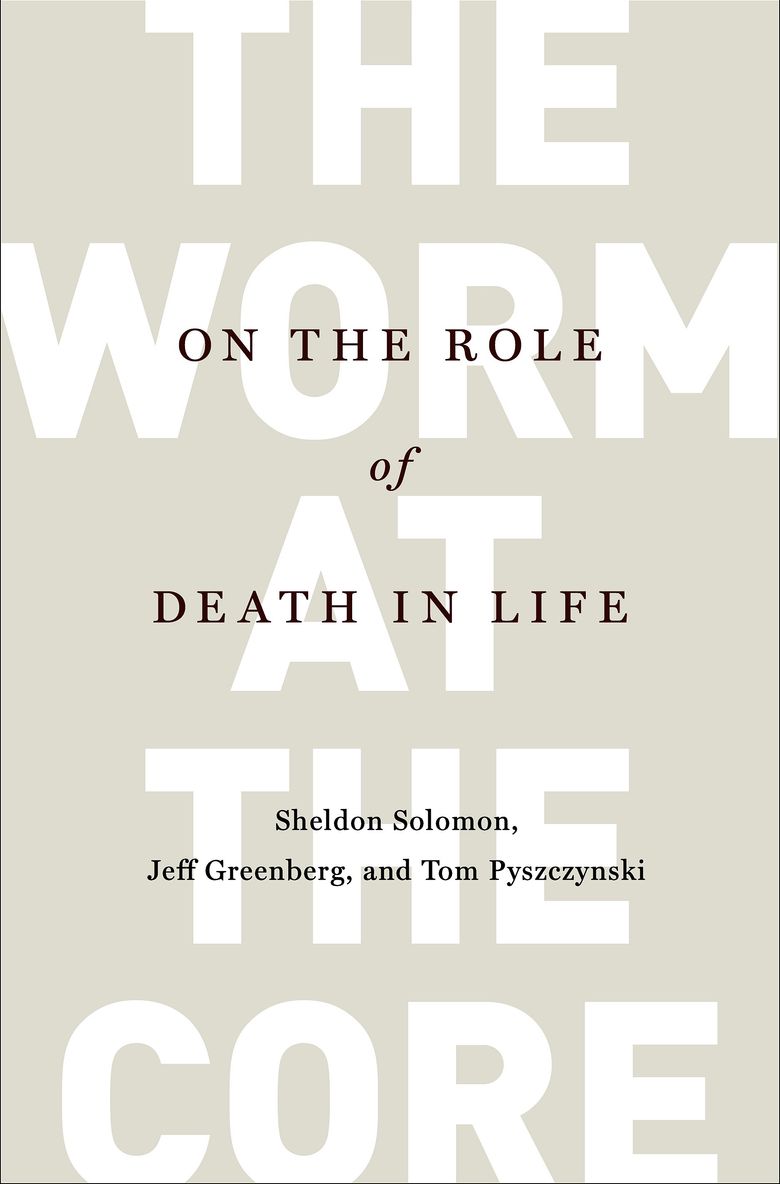
Sheldon Solomon, Jeff Greenberg, and Tom Pyszczynski - Drawing from innovative experiments conducted around the globe, authors show conclusively that the fear of death and the desire to transcend it inspire us to buy expensive cars, crave fame, put our health at risk, and disguise our animal nature


Sheldon Solomon, Jeff Greenberg, and Tom Pyszczynski, The Worm at the Core: On the Role of Death in Life, Random House, 2015.


A transformative, fascinating theory—based on robust and groundbreaking experimental research—reveals how our unconscious fear of death powers almost everything we do, shining a light on the hidden motives that drive human behavior.
More than one hundred years ago, the American philosopher William James dubbed the knowledge that we must die “the worm at the core” of the human condition. In 1974, cultural anthropologist Ernest Becker won the Pulitzer Prize for his book The Denial of Death, arguing that the terror of death has a pervasive effect on human affairs. Now authors Sheldon Solomon, Jeff Greenberg, and Tom Pyszczynski clarify with wide-ranging evidence the many ways the worm at the core guides our thoughts and actions, from the great art we create to the devastating wars we wage.
The Worm at the Core is the product of twenty-five years of in-depth research. Drawing from innovative experiments conducted around the globe, Solomon, Greenberg, and Pyszczynski show conclusively that the fear of death and the desire to transcend it inspire us to buy expensive cars, crave fame, put our health at risk, and disguise our animal nature. The fear of death can also prompt judges to dole out harsher punishments, make children react negatively to people different from themselves, and inflame intolerance and violence.
But the worm at the core need not consume us. Emerging from their research is a unique and compelling approach to these deeply existential issues: terror management theory. TMT proposes that human culture infuses our lives with order, stability, significance, and purpose, and these anchors enable us to function moment to moment without becoming overwhelmed by the knowledge of our ultimate fate. The authors immerse us in a new way of understanding human evolution, child development, history, religion, art, science, mental health, war, and politics in the twenty-first century. In so doing, they also reveal how we can better come to terms with death and learn to lead lives of courage, creativity, and compassion.
Written in an accessible, jargon-free style, The Worm at the Core offers a compelling new paradigm for understanding the choices we make in life—and a pathway toward divesting ourselves of the cultural and personal illusions that keep us from accepting the end that awaits us all.


“The idea that nearly all human individual and cultural activity is a response to death sounds far-fetched. But the evidence the authors present is compelling and does a great deal to address many otherwise intractable mysteries of human behaviour. This is an important, superbly readable and potentially life-changing book. . . . The lesson contained within The Worm at the Core suggests one should confront mortality in order to live an authentic life, as the Epicureans and the Stoics suggested many centuries ago.”The Guardian


“A neat fusion of ideas borrowed from sociology, anthropology, existential philosophy and psychoanalysis . . . [The] sweep-it-under-the-carpet approach to death is facile and muddle-headed. More than that, it has consequences more far-reaching than we could possibly imagine because, as [the authors] see it, death informs practically every aspect of human existence. From the way we organise our societies to the moral codes we live by, even down to how we have sex and what rituals and emotions we ascribe to it, death is the bedrock.”The Herald

“Deep, important, and beautifully written, The Worm at the Core describes a brilliant and utterly original program of scientific research on a force so powerful that it drives our lives, but so frightening that we cannot think clearly about it. This book asks us to, compels us to, and then shows us how—by shining the light of reason on the heart of human darkness.”—Daniel Gilbert


Social psychologists Solomon, Greenberg, and Pyszczynski provide an intriguing but uneven volume aimed at lay readers that attempts to show that humanity’s unique awareness of death “has a profound and pervasive effect on our thoughts, feelings, and behaviors in almost every domain of human life—whether we are conscious of it or not.” They cite a number of interesting experiments that contrast the behavior of subjects made more aware of mortality with those who are not. Readers might be surprised to learn that judges belonging to the first category sentenced prostitutes more harshly than their colleagues in the second. The authors explain that those forced to think “about their own mortality [react] by trying to do the right thing as prescribed by their culture.” The language sometimes lapses into cliché (“We have a lot to learn from the ancients”) or overstatement. For all the book’s arguments, some readers will arrive at the end unconvinced that every instance of human cruelty to other humans “stems from humankind’s fundamental intolerance of... those who subscribe to different cultural worldviews.” - Publishers Weekly


Ernest Becker’s The Denial of Death (1973) made the striking claim that human activity is driven largely by unconscious efforts to deny and transcend mortality. “We build character and culture in order to shield ourselves from the devastating awareness of underlying helplessness and terror of our inevitable death,” observed Becker. The authors of The Worm at the Core extended Becker’s work with a presentation in 1984 at a meeting of the Society of Experimental Social Psychology. They called it “Terror Management Theory”. The reception was lukewarm. As the authors recount, “renowned psychologists were storming for the exits”.
Undeterred, they approached the journal of the American Psychological Association with a paper on the theory of terror management. The editor insisted their ideas wouldn’t be taken seriously unless some hard evidence could be provided (Becker’s work was built largely around psychoanalytic theory rather than empirical research).
The authors spent the next 25 years measuring the influence of the fear of death on human affairs. The results not only confirmed Becker’s speculation but built on it. “Over the course of human history,” they write, “the terror of death has guided the development of art, religion, language, economics and science. It raised the pyramids in Egypt and razed the Twin Towers in New York.”
The book addresses the two pillars of terror management – cultural worldviews and self-esteem. To demonstrate how fears about death influence societal opinion, judges were prompted to set a bail figure nine times higher for a (putative) prostitute after being reminded of death. This, and substantial other evidence, suggests that reminders of death accentuate our negative feelings towards those who do not share our values. The closer our death fears are to the surface, the more we cleave to social norms – not necessarily those of wider society, but any group we have chosen to identify with (on this definition even support for, say, Islamic State, is an assertion of a “social norm” and therefore an extension of our “immortality projects”. Suicide bombers ultimately act out of fear of death).
Consciousness of death also, crucially, feeds into people’s assessment of their own worth. “Unlike the baboon who gluts himself only on food, man nourishes himself mostly on self-esteem,” wrote Becker in The Birth and Death of Meaning (1962). Intriguingly, the greater your fear of death, the lower your self-esteem – and vice versa. Self-esteem provides psychological protection against existential terror.
The book also charts the history of man’s relationship with death, asserting that it was primary in creating civilisation. Religion did not develop as an offshoot of settled society – it seems probable that the earliest settlements, marking the stage of human development from hunter gathering to agriculture, were built around sites of ritual and worship. The need for immortality predated the requirement of settled economic activity. Strategies for denying death have been there since the dawn of human cognition – the cave paintings at Chauvet, dating back 30,000 years, featured spirit realms and depictions of the supernatural world.
In the modern secular world, we seek to overcome death through fringe cod-scientific activities such as cryogenics. More subtly, we convince ourselves that scientific progress, by curing cancer, or finding a way to upload a human personality on to a hard disk, will rescue us from oblivion. Meanwhile, we distract ourselves from our mortal terror – which would impair functional human activity were it allowed free rein – by working hard, staying busy, shopping and entertainment. Or we seek immortality via the everyday heroism of our jobs, by means of our children who will carry our genes forward, or through connections with our ancestors (hence our obsession with the family tree). For those who have the capacity to create, works of art and invention will stand as our legacy.
The idea that nearly all human individual and cultural activity is a response to death sounds far-fetched. But the evidence the authors present is compelling and does a great deal to address many otherwise intractable mysteries of human behaviour. This is an important, superbly readable and potentially life-changing book – if uncomfortable at times. The lesson contained within The Worm at the Core suggests one should confront mortality in order to live an authentic life, as the Epicureans and the Stoics suggested many centuries ago.
Denial does not remove the problem of death – it merely buries it. This can lead not only to an intractable and inflexible worldview, but collective neuroticism – all in the service of creating an effective psychological barrier against reality. Yet for those with courage and clear-sightedness, facing up to our common destinies can mark a kind of rebirth. As Camus wrote: “Face up to death. Thereafter anything is possible.” -


Given the inevitability of death and its power to render human life meaningless, why read a book about this existential quandary, the authors of such a book ask.
Furthermore, they ask, why write it?
They have written a book to try to prove it — and one worth reading.
For them, the recognition of the power of death in life comes from Ernest Becker, a cultural anthropologist who died in Burnaby, B.C., in 1974, two months before his book “The Denial of Death” won the Pulitzer Prize. Becker argued that unconscious efforts to deny and transcend death are behind much of human activity.
Solomon, Greenberg and Pyszczynski wrote their book to explain the empirical evidence they have developed in the past 30 years to support Becker’s theory. Mostly their proof consists of experiments where one group of people was given some reminder of death — anything from a slightly morbid question on a survey to being shown a grisly movie — and a control group received a neutral substitute. Then the groups were asked to perform some task and the differences were measured.
Judges asked to describe their emotions about their own deaths were more harsh in sentencings than the neutral group. People reminded of death were more susceptible to charismatic political candidates. Give Americans a death reminder and they are more likely to apply stereotypes to those different from themselves.
All these experiments involve the ways humans have devised to keep death at bay, constructing “cultural world views” that give a sense of meaning and then operating successfully within those constructs to provide self-esteem, another key to believing that life is worth living.
Explaining each experiment to show another aspect of “terror-management theory” makes the book somewhat repetitious. But whether you believe the experiments offer definitive proof of how the fear of death shapes human behavior, there is insight here about how and why we live our lives.
The book’s language is straightforward and even light at times, making a weighty subject approachable.
The three psychologists’ exploration delves into religion, sex, mental illness and our conscious and unconscious defenses deployed to ward off the fear of death. That includes efforts, often desperate and perhaps silly, to achieve immortality through means both literal (for $80,000 you can have your head frozen for a chance at a second time around) and symbolic (my name will be remembered as long as this review is read).

Will the book make life meaningful or stay death’s sting? Maybe not, but there’s no question it will shine light on why we do the things we do. -