4/8/19

Adam S. Cantwell - These stories are richly imagined mysteries. They could be fairly equated with the works of Kafka or Borges if their prose were not so luxuriant and surprising at every turn. While readers may not chortle in experiencing these awful fantasias, they will be captivated by them

Image result for Adam S. Cantwell, Bastards of the Absolute
Adam S. Cantwell, Bastards of the Absolute, Egaeus Press, 2015.


Bastards of the Absolute contains eleven pieces — a mix of novellas and short stories, revised and reworked especially for this book — along with nine previously unpublished drawings by Charles Schneider and an introduction by George Berguño.


'The stories in Adam Cantwell’s Bastards of the Absolute are richly imagined mysteries. They could be fairly equated with the works of Kafka or Borges if their prose were not so luxuriant and surprising at every turn. Contemplating the mood and storylines of these arresting pieces, a quote from Poe’s The Narrative of Arthur Gordon Pym comes to mind: “My visions were of shipwreck and famine; death or captivity among barbarian hordes; of a lifetime dragged out in sorrow and tears, upon some gray and desolate rock, in an ocean unapproachable and unknown.” The fate of each protagonist in Cantwell’s collection delineates or fulfills Pym’s fantasy—one that is both lavish in its exoticism and unbounded in its desolation. Although these beings are entrapped in worlds that to all appearances turn upon axes of torment, they are as likely to be resigned as resistant to their cruel destinies. While readers may not chortle in experiencing these awful fantasias, they will be captivated by them.' The book contains eleven pieces — a mix of novellas and short stories, revised and reworked especially for this book — along with nine previously unpublished drawings by Charles Schneider and an introduction by George Berguño. - Thomas Ligotti


I predict that Adam S. Cantwell’s Bastards of the Absolute is destined to survive the passage of time. I predict also that the book that you, dear reader, are holding in your hands will join the ranks of the classics of strange fiction. Moreover, there are stories in this collection — stories such as ‘Face in the Wall’ and ‘Moon Paths of the Departed’ — which are masterpieces of the genre; stories that are destined to be reprinted time and again. - George Berguño; from his introduction


This is a delight of a book.  It comprises ten short stories and a novella, “Orphans on Granite Tides” and invokes only the best of the format’s writers; Borges, James, Lovecraft and Poe.
The style throughout is gothic.  Settings include castles, dungeons and cave complexes and the scenes are often oppressive, emphasised by the lack of light, overbearing rooms and inclement weather.  The protagonists are in the main troubled artists, as often as not thwarted in their ambition and endeavours.  Authors and composers feature as well as a trade agent and a book hound.  Most are European and in the main the stories themselves are set in the first half of the 20th Century Europe, featuring evocative cities such as Berlin, Paris and Helsinki.  Exceptions are “The Filature”, a tale of a German businessman exiled to China to conduct interminable negotiations with a sadistic factory owner and “Orphans on Granite Tides” which revolves around the supposed journal of a Native American mystic.
Each tale involves fantasy, horror and the bizarre.  They are told in the first person in classic gothic styles. Journal and diaries feature strongly, as do letters and the transcript of an interrogation.  The literature and classical music of the period are explored and there is a constant struggle between the traditional and orthodox conservatism and the new and revolutionary movements typical of the period.
So what are the stories about?  “The Face in the Wall” centres on, well, a face in a wall.  “The Notched Sword” is set in Warsaw in 1939 and features a double agent who, whilst riding a horse, is literally split vertically in two.  Not that it stops him (them?) from carrying on his life and work.  The protagonist of “Moonpaths of the Departed” is a composer, recovering from a breakdown, enticed to a mid-European castle built upon a series of prehistoric caverns.  What he witnesses down there influences him to compose a dark and dangerous work that has unexpected effects on those who hear it and lead to him fleeing for his life.
I cannot conclude without remarking on the splendid presentation of this book.  It features illustrations by Charles Schneider and cover and endpapers by Eduard Wiiralt.  Like the stories themselves, they are grotesque, beautiful, complex and haunting and reward repeat visits to fully appreciate their worth. - Simon Ives
http://www.britishfantasysociety.org/reviews/bastards-of-the-absolute-by-adam-s-cantwell-book-review/


I think it's appropriate to open this review with a look at the physicality of the book itself. Egaeus Press is consistently publishing some of the best looking hardcover books being put out today. The appearance and feel of the book is enough to get any jaded bibliophile to drool.
Now, even though the book as a physical object is gorgeous, the most importantaspect is the quality of the writing between the covers. Thankfully, this book delivers.
Adam S. Cantwell is a British author, and part of what I'll for now call a "European strange literature" movement. Certain things that come to mind when talking about this subset of weird literature: Old World Europe, dense prose, intellectual narrators, decadence, surrealism. Many of these authors have their work published as beautiful, limited hardcovers from publishers such as Passport Levant, Ex Occidente, Side Real Press and now Egaeus Press.
Several of the stories in this collection have appeared in limited tribute anthologies to Bruno Schulz, Mikhail Bulgakov, and Hanns Heinz Ewers, or as very limited Passport Levant editions, so it's great to see them all collected in a beautiful, yet affordable edition.
Some of my favorites:
The Face in The Wall is a story about a man who is imprisoned inside a city wall. His entire body is in in the wall, with only his face exposed. He spends ages in the wall, watching the changes of the city, and coping with ill treatment from citizens of the city. A clever blend of fantasy and horror, it's great story to open the collection with.
Next up is The Filature, a story in tribute to Hanns Heinz Ewers. As punishment, a German man's employers send him to a Chinese silk factory. The story reads as his journal, and we see the man repeat many of the same mistakes that brought about his corporate exile in the first place. Some truly creepy moments in this one.
Music is an important aspect of several stories in the collection. Three of which (Moonpaths of the Departed, The Kuutar Concerto, and Symphony of Sirens) first appeared collected together as A Pallid Wave on Shores of Night by Ex Occidente. Another, Beyond the Two Rivers: A Symphonic Poem, first appeared in The First Book of Classical Horror Stories edited by D.F. Lewis. I loved the shared themes of these stories, and how they managed to all use music differently. Several (all?) feature real life composers. My favorite of the four may be The Kuutar Concerto,  which features Sibelius having a drunken night out in seedy bars after an incident at one of his concerts. He runs into someone who knows him from the past, and the drunken revelry spirals into the realms of the otherwordly.
Only For The Crossed-Out is Cantwell's Bulgakov tribute, and is a wonderfully absurd story. A clerk of sorts works in an archive of books where they cross-out and censor books.Things take a turn for the interesting when our protagonist falls down a chute and becomes trapped in a basement mass-grave of books.
The collection ends with Orphans on Granite Tides, originally released as a stand alone by Ex Occidente. Billed as a "Metaphysical Grotesque," this tale follows a German man who finds rare books and manuscripts as his occupation, although this job of his has become his life. This serves as a frame story for a peculiar document he finds. The document claims to be a sort of memoir by a well traveled Native American, who has metaphysical experiences and sees the world within our own world. A difficult piece, but one that shines for it.
This book was my first experience with Adam S. Cantwell's fiction, and shan't be the last. His fiction is tantalizingly mystifying, and brings readers to a magical, Old World Europe that is equal parts horrifying and beautiful. - www.arkhamdigest.com/2015/08/review-bastards-of-absolute-by-adam-s.html

It's impossible to talk about this book without first referring to the product: in stark defiance of the old saw concerning books and their covers, the instant I got this item in my hands, I was amazed at how beautiful it is; a solid, weighty hard back, embossed titles down the lip of the cover, the images decorating its exterior a mass of absurdity and surrealism; inviting the eye to wander over every detail in the manner of carvings on temples, the statuary of cathedrals.
    My first thought: I hope that the quality of writing is even half as impressive. Something so beautiful deserves to be good.
    It's my earnest pleasure, then, to report that Bastards of the Absolute is one of the most impressive titles I've read for some time. It's increasingly rare these days that I come across a writer that makes me sit up and take notice; that engages me to the point that I want to know who they are, where they come from, what else they've done. Adam S. Cantwell is one of those rare beasts, his writing an exercise in utter precision; the prose so fine tuned, so technically apt it's impossible for the reader to not be impressed. Beyond the technical precision of the writing itself lie the stories; strange and surreal post-modern myths, explorations of the darkest existentialism in which worlds of mindless accumulation choke on their own redundancy, in which acquisitiveness has become more and less than religion; more and less than love, first hand accounts of societies and their vicissitudes from the perspectives of prisoners interred in their very walls, journals of commercial slavers afflicted with moth-like metamorphoses in the cultures they have come to preside over...stories as elegant in theme and conception as the are in their recording. Here, the banal and the concrete sifts into nightmare state with the natural ease of fire into smoke, lives of certainty, of pure assumption, splitting, sloughing away from themselves, the revelations they spill or give birth to universally disturbing, but rarely completely nihilistic; even in the most monstrous of transformations, Cantrell seems to find a glimmer of macabre beauty, to quietly celebrate what others might bemoan or lament. It's a rare quality in horror fiction at present, which is generally predominated by titles which follow highly proscribed and standardised moral codes and absolutisms or which are so saturated in irony, it's difficult to tell what occurs in earnest and what does not.
    This is an entirely other species of fiction; one which is not concerned with having its tongue buried so deep in its cheek it could lick out its own ear from the inside; here are earnest and poetic examinations of humanity, of culture, of history; the vicissitudes and vacillations that both define and rob our lives of definition. Cantwell quietly acknowledges inconstancy as the only constant; of how powerless human beings generally find themselves against the factors of circumstances and idiot chance; of cultural pressure and political design. The result is fiction that could so easily be morbid or moribund in tone, and which is, to a certain degree, but which also finds beauty in abjection; in the breaking down and dissolution of lives, states; possibility where there might otherwise be only hopelessness.
    In concert with the aching precision of the prose; its almost poetry like swells and rhythms, Bastards of the Absolute stands as a book that deserves to be read; a template or example of how the disturbing; the tropes and forms of what might ostensibly be considered horrific fiction, can be utilised to create and engender so much more than shock or repulsion; how even those states have a degree of potential within them.
    On a personal note, it has been a sincere pleasure to experience this collection, as well as intimidating to find a product of such professionalism; as a reader, it stands as a rarity; something that the audience and market ache for. As a writer, it is simultaneously inspiring and intimidating; it demonstrates the extent of possibility, the degree of refinement that such prose can demonstrate, whilst maintaining weight and evocation. Reading something like this makes me up my own game; it stands as an example of the raw quality that can and should exist out there; that publishers should, quite frankly, be looking for.
    These are stories that treat themselves and their readers with utmost respect; as entities of imagination and intellect; as though they have minds to make up. You will not find any story here insisting on its own interpretation or significance; they are often open ended, almost fragments that suggest wider narrative or mythology in the surrounding ether. This can fail quite spectacularly in less deft hands, but here, the suggestions are sufficient to set the reader's imagination racing, to puncture it and have it bleed out over the empty spaces. It is a subtle and brilliant technique, one that very few even attempt and so often fail when they do. The stories want to engage the reader; to weave them into themselves, becoming almost symbiotic; not to impose themselves. Also, these are stories of meaning; they resonate with significance, demanding that the reader think and feel; reflect on their imagery, their commentaries. In an age when so, so many collections have the air of being written or produced by committee, their contents contrived to meet particular deadlines, this is the equivalent of a course of minutely prepared restaurant dishes compared to microwave ready-meals.
    If you operate in publishing, in fiction; if you have even a passing interest in the subject matter or genre, you owe it to yourself to experience this.
    For my part, I'll be on the lookout for more of Adam S. Cantwell's work; the most sincere recommendation I can give. - http://gingernutsofhorror.com/fiction-reviews/bastards-of-the-absolute-by-adam-s-cantwell
I last wrote about Egaeus Press back in May last year when I mentioned two of their fine tomes as part of an article about new books and strange tales (here). I was excited to receive an email a couple of months ago stating that they were about to publish several more titles and one in particular caught my eye, Adam S. Cantwell’s collection of short stories & novellas titled Bastards Of The Absolute. I duly put in my pre-order and waited for the book to arrive upon publication which happily was last month.
I’ve waited until now to write about this fine collection as I’ve just started reading it and have found the first few stories to be works of total brilliance in their dark, surreal and unsettlingly odd way. I knew nothing about the author and his work except from the blurb on the Egaeaus website which reads as follows;
“The stories in Adam Cantwell’s Bastards of the Absolute are richly imagined mysteries. They could be fairly equated with the works of Kafka or Borges if their prose were not so luxuriant and surprising at every turn.”
A quote from literary cult figure Thomas Ligotti no less!
The introduction by George Berguño also contains this passage;
“I predict that Adam S. Cantwell’s Bastards of the Absolute is destined to survive the passage of time. I predict also that the book that you, dear reader, are holding in your hands will join the ranks of the classics of strange fiction. Moreover, there are stories in this collection — stories such as ‘Face in the Wall’ and ‘Moon Paths of the Departed’ — which are masterpieces of the genre; stories that are destined to be reprinted time and again.”
Both very strongly worded pieces of praise for this collection of stories and its writer then.
And now to the book itself, it is a beautiful lithographically printed, 256 page sewn hardback with a stunning embossed wraparound cover and printed endpapers which are both by Eduard Wiiralt.
There are also a number of fascinatingly twisted black and white illustrations throughout by Charles Schneider, one of which is included as a postcard with initial copies.
The artwork is absolutely sumptuous and I couldn’t help but feel that this just had to be an outstanding read because it looked so very good. I have not been proved wrong as yet. Egaeus Press are definitely one to watch as their output so far has been of such a high standard that it’s hard to see them succumbing to such vulgar things as the whims of market forces or seeing their quality control slipping any time in the future. Head over to their ‘morbid and fantastical’ website (here) to order a copy of this truly outstanding book but be quick as it is limited to only 250 copies.
- unsubscribedblog.wordpress.com/2015/07/01/bastards-of-the-absolute-by-adam-s-cantwell-via-egaeus-press/


Image result for Adam S. Cantwell, Bastards of the Absolute


Image result for Adam S. Cantwell, Bastards of the Absolute

Ed Smith blazed onto the Los Angeles poetry scene in the early 1980s from out of the hardcore punk scene. The charismatic, nerdy young man hit home with his funny/scary off-the-cuff-sounding poems, like “Fishing”: This is a good line. / This is a bad line. This is a fishing line.

Image result for Punk Rock Is Cool for the End of the World: Poems and Notebooks of Ed

Ed Smith, Punk Rock Is Cool for the End of the World: Poems and Notebooks of Ed Smith, Ed. by David Trinidad, Turtle Point Press, 2019.


In Punk Rock Is Cool for the End of the World, David Trinidad brings together a comprehensive selection of Ed Smith’s work: his published books; unpublished poems; excerpts from his extensive notebooks; photos and ephemera; and his timely “cry for civilization,” “Return to Lesbos”: put down that gun / stop electing Presidents.
Ed Smith blazed onto the Los Angeles poetry scene in the early 1980s from out of the hardcore punk scene. The charismatic, nerdy young man hit home with his funny/scary off-the-cuff-sounding poems, like “Fishing”: This is a good line. / This is a bad line. This is a fishing line.
Ed’s vibrant “gang” of writer and artist friends―among them Amy Gerstler, Dennis Cooper, Bob Flanagan, Mike Kelley, and David Trinidad―congregated at Beyond Baroque in Venice, on LA’s west side. They read and partied and performed together, and shared and published each others’ work.
Ed was more than bright and versatile: he worked as a math tutor, an animator, and a typesetter. In the mid-1990s, he fell in love with Japanese artist Mio Shirai; they married and moved to New York City. Despite productive years and joyful times, Ed was plagued by mood disorders and drug problems, and at the age of forty-eight, he took his own life.
Ed Smith’s poems speak to living in an increasingly dehumanizing consumer society and corrupt political system. This “punk Dorothy Parker” is more relevant than ever for our ADD, technology-distracted times.


“In the very early ‘80s Ed was intimidatingly skinny and gorgeous and as reckless and charismatic as that guy in The Libertines who got caught doing coke with Kate Moss, but very, very talented and massively intelligent, and even when he was a little too wild, he was always so kind and heartbreakingly sweet and smart. Saying he was our Rimbaud is way too lazy, but there was that. I thought of him as LA’s John Wieners. Ed’s poetry has Wieners’s deep melancholy and low-key, note-perfect lyricism, mixed with Ed’s strange, bright ideas and his dead-pan, startling sense of humor. I‘m one of the many people who misses his poetry a lot.” ―Dennis Cooper

"Years ago my wife slept with Ed Smith and wrote him into her novel; we goggled, bemused by his ubiquity. It was a time when Ed was everywhere, or so it seemed, and his energy and taste for the zany and the outrageous fit right in with what we in San Francisco appreciated most about the heroic LA artists―Bob Flanagan, Mike Kelley, Amy Gerstler, Dennis Cooper, so many more. The present anthology is not only the best of Ed’s writing but contains in his notebooks the single greatest account of the genius brewing in the Southland at that moment. Hats off to David Trinidad for bringing it all back home―his exquisite care in selecting and contextualizing is the greatest gift he could have given his late friend." ―Kevin Killian

"Sappho invented civilization, and Ed Smith made it punk."―Tony Trigilio

"Reflecting the heroic editorial efforts of David Trinidad, this collection of Ed Smith's poems and journals makes me nostalgic for a lost era; sad that this talented if troubled poet took his own life; glad that we included his work in The Best American Erotic Poems, and in total agreement with David Trinidad that Smith's poetry would have a salutary effect on a group of young writers, such as those attending a graduate writing program."―David Lehman


‘Ed Smith was this brilliant, handsome, charismatic, disarming, hedonistic, wounded math and science nerd who discovered punk music and art and poetry and was swept away, besotted with all three, and never looked back. He loved drugs and bands and science fiction and science and Sappho and poets and poetry. He liked to give people a little treatise by Alfred North Whitehead on mathematics for a gift. He loved being part of a cool scene. He introduced me to Prince’s music when his first album came out. I think he would have described himself as bi-sexual. He was intense and sensitive and wild. He burned hotly.’ — Amy Gerstler


‘I’d like to use this opportunity … to introduce you to a poet you’ve never heard of before. Ed Smith. A common enough name. There are a zillion Ed Smiths on Facebook—I gave up counting them once I reached one hundred. But this Ed Smith was no ordinary Ed Smith, let me assure you. He was born in Queens, New York, in 1957; his family moved to Southern California in 1959. He grew up in Downey (the hometown of Richard and Karen Carpenter) and attended Pomona College in Claremont for one academic year (1975-76). He then made his way to Los Angeles, Hollywood specifically, where he worked as a paralegal and for an independent record and video company, became involved in the punk rock lifestyle, then finally found his niche as a poet in the scene that centered around Beyond Baroque Literary/Arts Center in Venice, California, when Dennis Cooper ran the reading series there in the early eighties. The Beyond Baroque scene has sometimes been called “hip,” sometimes “infamous.” It was lively, that’s for sure. Other young poets who gravitated to the literary liveliness were Amy Gerstler, Bob Flanagan, Jack Skelley, and myself.
‘Ed published two books of poetry in his lifetime, both with Cold Calm Press: Fantasyworld in 1983 and Tim’s Bunnies in 1988. You’ll probably have trouble finding either of these titles—Cold Calm Press was a very small operation. Ed also published his work in Poetry Loves Poetry: An Anthology of Los Angeles Poets (Momentum Press, 1985) and in what Bruce Hainley calls “the most rambunctious publications of the day: Barney, Mirage, Santa Monica Review, and Shiny International [later just Shiny], a magazine for which he conducted interviews with artists Jim Isermann, Mike Kelley, and Chris Burden and eventually served as West Coast editor.” Publishing poems in rambunctious magazines does not pay the rent, so Ed worked as a typesetter, a movie ad copywriter, and a math tutor at a private school. He moved to New York City in the late nineties, married artist Mio Shirai, and founded Creative Systems Architecture, Inc. (CSAI), a consulting firm meant to help companies apply W. Edwards Deming’s principles of emergent intelligence to their organizations. (Sounds crackpot, but there’s something to it.) Sadly, Ed took his own life in 2005.
‘At first I didn’t care for Ed. I mistook his irreverence for disrespect. And maybe there was some jealousy. He was slightly younger than the rest of us in the Beyond Baroque group, cute (almost everyone was infatuated with him at some point), and punkish (he had, after all, come of age in the punk rock scene). I thought he could be obnoxious, a brat. But after I got sober (in 1984) and calmed down a bit (I’d been an uptight alcoholic, which kind of defeats the purpose), I became quite fond of him. Underneath the brash exterior was a very sweet, guileless young man. …
‘And what of his poems? Ed’s poetry was exactly like he was: playful, free of inhibition and decorum, troubling in just the right way. And wrought with intelligence, brilliance even, though on the surface they may seem apathetic to loftier poetic aims. He wrote “Return to Lesbos” (most likely his longest poem) in a black-and-white composition book, scrawling the whole poem throughout it, often with only two, three, four words per page. Ed apparently never typed or tried to publish it. He read the poem at least once to my knowledge, at Beyond Baroque in 1982. Lucky for us this performance (which Amy remembers as a sublime consummation of Ed’s talent as a poet and performer) was filmed and included in Gail Kaszynski’s 1983 documentary about the Beyond Baroque scene, Fear of Poetry. It’s breathtaking to watch Ed stand at the mike, wearing a short-sleeved nerdish shirt he undoubtedly bought at a thrift shop, and read the poem from the composition book, swiftly turning its pages. He simply gallops through the poem, as if he’s uncomfortable with what it’s saying. Fitting, since “Return to Lesbos” is an emotionally charged onrush in which he repeatedly questions his responsibility as a poet: is he going to just hold that “fucking pencil” or use it to “cry for civilization.”
‘Ed is at his best in his short lyrics. They have the sense that they were jotted down on scraps of paper while waiting at a bus stop or standing in a club nursing a beer he’d bought with his last bits of loose change. They probably were. I’ve always thought of Ed as a punk Dorothy Parker. Bruce Hainley refers to Ed’s poems as “toy time bombs.” I think that’s perfect. Something does tend to “go off” as you read them. They delight and cause unease at the same time—they’re authentic, that’s why. There’s real pain and real experience in them, despite their apparent toy-ness.
‘Last year, Bruce Hainley edited a generous selection of Ed’s poems for Court Green (issue 10), a journal I co-edit at Columbia College Chicago. The feature was called, appropriately enough, “Memoirs of a Thrill-Seeker.” This year, in Court Green 11, we published a transcription of “Return to Lesbos.” At the publication party in March, we showed a clip of Ed reading the poem. The audience went wild. “Where can I find his work?” many in attendance eagerly asked. Students, in particular, showed irrepressible excitement. Young people love Ed; his work speaks to them, it’s pertinent. Amy Gerstler and I have been talking about co-editing a book of Ed’s work. I think this would please him—his poems gathered up by two poet friends he hung out with. I’m glad we can continue to hang out with him, and that you’ll be able to, too, since he let himself get caught “being words on paper.”’ — David Trinidad


Excerpts
UNTITLED
This is a good line.
This is a bad line.
This is a good line.
This is a bad line.
Here is a country,
an idea we share.
There is an idea for paying
all debts public and private.
This poetry is now in its own future,
and let me say as an eyewitness
that we are quite primitive back here,
sophisticated only in things we do not do.
My people roll their autos
over goddam asphalt.
This line is doing its best to remain indifferent,
but here it is in this poem.
1982

BENEDICTION
Fuck you.
Fuck your mom.
Fuck your cat.
Fuck your mom’s cat.
Fuck your cat’s mom.
Fuck your mom’s cat’s second cousin
from Schenectady.
1982

LETTER FROM THE GRAVE
This situation is so embarrassing
that i’m considering approaching it
sheepishly,
but i can’t cause i’m too numb.
Well, numb isn’t exactly the right word,
but it’ll do for now.
Anyway, this is called “Letter from the Grave”
cause i was supposed to have killed myself
last Tuesday,
but i didn’t:
i’m still here,
and next year i’ll be eleven.
1982


more on Dennis Cooper's blog
https://denniscooperblog.com/please-welcome-to-the-world-punk-rock-is-cool-for-the-end-of-the-world-poems-and-notebooks-of-ed-smith-edited-by-david-trinidad-turtle-point-press/


Ed Smith (1957–2005) was a poet involved in the punk and alternative arts scenes in Los Angeles in the early 1980s. His books were Fantasyworld (1983) and Tim’s Bunnies (1988). His poems appeared in Rolling Stone, St. Mark’s Poetry Project Newsletter, and other publications. Smith also worked as an animator on Nickelodeon’s Blue’s Clues.


4/4/19

Bernard Lortat-Jacob - Refusing to separate the music from the world in which it arises, the author offers twelve vignettes focused on individuals such as Cocco, a chicken farmer who deciphers the shapes of his fowl and the layout of his henhouses in the constellations of a summer sky, and Pietro, a sleep-walking postman who divides his time between mail deliveries and impromptu serenades

Image result for Bernard Lortat-Jacob, Sardinian Chronicles,
Bernard Lortat-Jacob, Sardinian Chronicles, Trans. by Teresa Lavender Fagan, The University of Chicago Press, 1995.
read it at Google Books


The forward is written by Michel Leiris who begins by comparing Lortat-Jacob's work in ethnomusicology to Karl Marx's contributions to the dialectics of Hegel.


This work introduces the reader to Sardinian music through a series of encounters with individual musicians and their families. Refusing to separate the music from the world in which it arises, the author offers twelve vignettes focused on individuals such as Cocco, a chicken farmer who deciphers the shapes of his fowl and the layout of his henhouses in the constellations of a summer sky, and Pietro, a sleep-walking postman who divides his time between mail deliveries and impromptu serenades. These vignettes bring to life an art still very much alive: the music of villages with an oral tradition, sung or played in the company of others. Through these portraits of music makers and their families, Lortat-Jacob overcomes some of the epistemological and methodological dilemmas facing the modern field of ethnomusicology, while also giving the general reader a sense of the multiple and idiosyncratic ways that music is involved in everyday life. A compact disc containing samples of the music being discussed is also provided.


In Sardinian Chronicles Bernard Lortat-Jacob poetically evokes Sardinian music through a series of encounters with individual musicians and their families. Refusing to separate the music from the world in which it arises, Lortat-Jacob offers twelve vignettes focused on individuals such as Cocco, a chicken farmer who deciphers the shapes of his fowl and the layout of his henhouses in the constellations of a summer sky, and Pietro, a sleep-walking postman who divides his time between mail deliveries and impromptu serenades. These vignettes bring to life an art still very much alive: the music of villages with an oral tradition, sung or played in the company of others.
Through his sensitive portraits of music makers and their families, Lortat-Jacob overcomes some of the epistemological and methodological dilemmas facing his field today, while also giving the general reader a sense of the multiple and idiosyncratic ways that music is involved in everyday life. With a foreword by Michel Leiris and a compact disc containing samples of the music being discussed, this book constitutes a breakthrough in ethnomusicology that will also interest many in Mediterranean studies and European anthropology.


The sound of the launeddas, a traditional clarinet along with the playing of the more modern accordion and polyphonic singing have remained hallmarks of Sardinian music. Distinct from the rest of Italy primarily because of its proximity to Africa to the south and neighboring Corsica to the north it has been a staple of sound cultural inquiry, and within that inquiry, music can be examined alongside whatever the primary focus is. This is largely the case with Bernard Lortat-Jacob's Sardinian Chronicles. Unique among scholarly texts, the book is written with an air of travel writing complete with descriptions of beautiful sights, sounds and people. It is perhaps because of this style that the text is often considered to be a seminal project in the study of ethnomusicology.
Unlike most texts on the subject of ethnomusicology, Sardinian Chronicles dispenses with lengthy transcriptions of melodies and rhythms heard during fieldwork, there is very little written on the long history of the music, and very little attention is paid to pedagogical subjects on the teaching of the art form. Rather, Lortat-Jacob seems to be more interested in the individuals making the music and the environment in which it takes place. As Julane Beetham wrote; “Sardinian Chronicles is less a theoretical discussion than a simple, straightforward presentation of people and their customs.” (Beetham, 1997) This sentiment is echoed in Jane Cowan's statement; “Lortat-Jacob resists abstracting the musical and social systems from the everyday life in which they are embedded.” (Cowan p. 158) In many ways, the text reads like a cast of characters making appearances in a series of one-act plays as the chapters move on. This form of writing challenges the reader to consider the issue of culture from the individual or household level, all the way to the larger society.
The forward is written by Michel Leiris who begins by comparing Lortat-Jacob's work in ethnomusicology to Karl Marx's contributions to the dialectics of Hegel. Leiris then describes the process by which the author moved through Sardinia finding musicians at fetes (parties), spending time with them in their homes and at times traveling with them. It is Leiris' contention that the “flesh-and-blood characters” help us to “learn in the most direct of ways from the portraits of these people,” (p. ix) which gives an intimate look at a culture as opposed to other writers of the time who might otherwise paint it with a very broad brush.
In chapter one, Lortat-Jacob describes the beginning of his journey. The ferry that will take him to Sardinia is not a comfortable one, but in some ways this acts as a metaphor for the feelings of cultural displacements experienced by the author later on in the text. It is on the ferry that the reader is introduced to the first of the “flesh and blood” characters who make the book such a rich read. Coco, a man who likes to talk about stars and poetry. The two men engage in a conversation about the role of music in Sardinian culture being primarily an accompaniment for dancing whereas poetry is the more refined art form. There is also discussion on an instrument which is never mentioned again; the serragia, which is a type of bowed lute, Lorat-Jacob describes this as a “cello” made out of a pigs bladder fashioned to a broom-stick played with a bow strung with a few strands of horsehair.
Lortat-Jacob hits the ground running in chapter two with rich descriptions of virtuoso accordionists and issues of performance rights along with a very detailed account of a traditional fete for this town. The reader becomes acquainted with two rival accordionists named Pichiaddas and Dillu who both capture the author's attention. Pichiaddas for his virtuosity while playing at fetes and Dillu for his once great fame, but present attempt to sell his repertoire. This attempt raises issues of artistic rights and ownership of interpretation of traditional melodies and leads to an argument between Dillu and one of the author's friends. There is also some time devoted to the author attempting to learn accordion techniques from Pichiaddas, but to little avail as Pichiaddas is innept at teaching.
It is in the town of Oliena that Lortat-Jacob finds a radio station that plays all traditional Sardinian music. He uses this to familiarize himself with what is current in terms of taste, and write down insights. The main thrust of this chapter revolves around an exchange of the author's accordion with a performer in the town who arranges for the author to borrow an accordion from a friend who has just been a funeral. The instrument turns out to be virtually unplayable, and in his own colorful language Lortat-Jacob contemplates the handling of such a situation as borrowing items within the climate of Sardinian culture.
Chapter four is the first (outside of the ferry) to introduce the reader to an instrument or musical style other than the accordion. In Orgosolo, Lortat-Jacob writes about a shepherd's choir performing the traditional polyphonic song so popular in Sardinia as well as a famous maker of Jew's harps. The Jew's harp maker turns out to be a very young man who credits his father for everything he knows, and then gifts the author with some of his creations. The section of the text devoted to Orgosolo is in all actuality a very somber one. The main characters for this portion of the book live in a house with a woman who's husband is spending time in prison. This casts an uncomfortable state upon Lortat-Jacob as he attempts to carry out his research.
In Muravera the reader becomes acquainted with the launeddas which is described in the chapter as a “Sardinian Clarinet.” In truth the instrument is really more of a bag-less bag-pipe made from canes. There is no hard-description of the instrument in the the book, although there are a few pictures of the instrument being played in the following chapter. Lortat-Jacob spends some time comparing the conversational style of Moroccan people and the Sardinians in relationship to music. The author determines that Sardinians discuss musical subjects openly, which is quite the opposite to the Moroccan taste for conversations around art. The process of tuning launeddas is also a large portion of this chapter, where one of the makers of the instrument; a man named Cannargiu, shows the author his process for hearing correct pitches over a drone which contrasts other multi-tonic traditions of the west.
Chapter six devotes more time to the launeddas players in Sardinia. In this case the reader is introduced to another two (for the most part) friendly rivals by the names of Aurelio and Luigi. A good portion of this chapter is taken up describing Aurelio playing for a religious procession in which statues of the Virgin Mary along with angels and saints are carted through the streets. The procession went from the church into the village and back to the church again and was treated by the player as a kind of manual labor. There is also description of a dinner party in which Aurelio brings the author with him with the intention of reinforcing his social status. A status he needed in order to keep receiving well paying jobs. The chapter ends with a quaint story about the author needing to invite both men to play in Paris at the command of Aurelio which seems to show a certain mutual respect.
The thrust of chapter seven is really taken up with the author's anticipation of aiding gentleman in a serenade. Lortat-Jacob fancifully daydreams about the young woman who is to be sung to, leaning out her bedroom window looking beautiful and reminiscent of the most romantic of European films. His hopes are dashed when he learns that the individual who is to be serenaded is a mature man who has never been married. It seems the serenade was to be an encouragement for him to find a suitable bride and settle down. The man is gracious in meeting with the musicians and offers them cheese and wine keeping everyone at his home until daybreak.
Chapter eight begins with a reminiscence of the author being in France, witness to a phone call between two Sardinians from Irgoli. The pages then segue into a narrative on the town itself and Lortat-Jacob's fondness for it. He states that he would always stay there longer than was necessary due to its pleasant people and pretty girls. The primary musician in this chapter in a mature singer by the name of Tonino who participates in bar-songs around a guitar as well as a traditional Sardinian vocal quartet style known as a tenore. The bulk of this chapter, however; deals with local squabbles over a bridge that has been restricted by the town government due to its instability. The chapter ends with the decision of the village to build another bridge alongside and a little lower than the original.
Chapter nine deals very little with music of any kind. It begins with a conversation with the women of Santu Lussurgiu decorating the church for the procession of Christ through the town. The author then goes into an in-depth description of two very colorful characters; a local scholar named Pietro Lombardini and the son of a Sardinian expatriot named Dimitrius Onni. Onni is looking for lost kin and information on his father who lived in exile after emigrating to Italy, and later, the family eventually settled in France. As the quest for potential family turns out numerous candidates the story segues to the church music that is performed during the wooden Christ's procession. This music is described in the text as loud and aggressive, sung by four men and working better outside while the wind blows. The chapter ends with Onni's van having left before daybreak so as to escape his new friends in Santu Lussurgiu.
Castelsardo is another account showing a procession, this time the text deals quite a bit more with music and slightly less with the characters involved. This chapter has an atmospherically detailed account of the rehearsal process, in which the choirs used for the procession participate. The rehearsals are done around food and wine and from all hints in the book revolve around the act of careful listening. This is shown more in depth later on in the chapter, which describes members of the choir listening for an harmonic overtone addition to their four-person sound called the quintina (translating to; “little fifth”). The text then goes on to describe the gentlemen socially meeting in a bar after the procession is completed. There is a lengthy description of conversation about whose ice cream is better (the bar owner's or his competitor across the street) along with observations about the qualifying nature of Sardinian dialectics (the use of statements such as “however,” “on one hand” and so on).
Chapter eleven is primarily a recount of the author's time with a retired opera singer, turned choral instructor named Carlo Cicilloni. It begins with a somewhat opinionated description of Italian bel canto singing as “it claims to be beautiful; the singer believes it natural to accede to the sublime, and he must have a certain talent for combining sentimental narcissism with the unbridled outpurings of the heart.” (p. 99) The text goes on to retell a rehearsal of traditional Sardinian music, and how it was stripped of its beauty by the implementation of operatic technique on the part of Cicilloni. Lortat-Jacob makes no qualms about his distaste for this practice and even exclaims relief when his tape-recorder breaks making any record of the evening unavailable. Carlo is described as a passionate character, but one who is not totally sympathetic as his cosmopolitan approach to teaching singing is seen to be a detriment to what the author views as authentic music of Sardinia. The chapter ends with reflections on his automobile accompanying him through eight years of visiting Sardinia and not being able to make another trip.
The final installment in the text is the most meager in the volume, two pages which suggest that as the author was anxious to return home, he was also anxious to end his book. Sassari makes no mention of music or really any characters (save for the employees of the ferry who were satisfied with the end of the busy season of travelers). Rather, it seems as though this closing chapter reasserts the role of the foreigner in a culture that is loved by the traveler, yet the traveler is a foriegner nonetheless and one who eventually must return home.
The accompanying compact disk is a helpful and very positive aspect of the text for those who are unfamiliar with Sardinian music. There is also an appendix in the book itself that contains translations of the songs as well as performers' names and a short description of what the listener is hearing. The disk consists of twelve tracks, mostly a capella vocal and vocal with instrumental accompaniment, but there are also tracks devoted to the launeddas as well as some accordion music. The vocal tracks are perhaps the most valuable as it would be difficult to glean a clear understand of the sound based on Lortat-Jacob's descriptions in the book. Stylistically, within the ensemble vocal pieces there is a heavy emphasis on fry (low growling) sounds made by the low end of the quartet which was something not mentioned in the rest of the text. Indeed, these are very harmonically rich and though it is difficult to make out, the listener could easily imagine the bright overtones that were so sought after in the discussions taking place in chapter ten. These songs cover the religious pieces used in processions as well as the a tenore choral works. Hearing the launeddas is likewise useful, the droning base provides a tonal reference for the dancing tones in the upper two voices which makes for very enjoyable harmonics. Finally, the accordion pieces on the disk do well to illustrate the kinds of ornamentation the author writes about in the first few chapters.
It could be said the the strengths and weakness of the Sardinian Chronicles are one and the same. As stated before, this is not an in-depth look at the music itself, there are no transcriptions available of the music being described and the descriptions themselves are fairly lackluster in their ability to render an accurate portrayal of what the author was hearing. Sabina Magliocco, in her review of the book writes; “this is not, like so much of the distinguished ethnomusicologist's other work, an analysis critique, or deconstruction of the current musical situation in Sardinia.” (Magliocco p. 1998) The book rather chooses to examine the individuals whom the author encounters in his journeys. We learn of their families, their history, their hardships and their ambition. It is as the introduction to the text describes, these are “flesh-and-blood” people and not necessarily what the reader might expect as a series of case studies. The fact that twelve communities are covered is also noteworthy, mostly because Lortat-Jacob is able to illustrate the differences between them to the extent that they hold the attention of the reader.
There are a number of topics peripheral to music which are raised in Sardinian Chronicles. One subject is the pedagogical issue in chapter two in which the author was trying to learn from Picchiadas, an individual who had been a virtuoso for some time. Because of this, the musician had little idea how to explain his practice to someone attempting to learn. Another issue is the book's insights into the tuning practice, in both the launeddas and the voices that make up the vocal quartets. In both instances the emphasis is on the a sound tuned from the base upward, whether it be the drone note of the Sardinian clarinet or the bass singer of the quartet. The aim appears to be one of harmonics and how the notes fall naturally within the artists conception of being “in tune.” This contrasts with other texts' presentation of tuning such as The Soul of Mbira by Paul Berliner. In Berliner's text, the instruments are tuned by comparing one Mbira to another which is already in tune. (Berliner, pp. 60-61) In this sense each note is treated as a separate entity whereas in Sardinian Chronicles the scale seems to be treated as a whole unit.
From an ethical standpoint there are some considerations to be made. The characters who are all important to the base of this text don't seem to be completely aware of their role as it is unfolding. The fact that in chapter two, the author leads the accordionists Dillu to believe that he is a wealthy man who is considering purchasing his repertoire in order to get an interview is problematic at best. The same type of considerations could be made with Lortat-Jacob including so much of his subjects' personal lives in the text when his stated purpose was to study music. This raises many issues on maintaining proper distance with subjects, as Timothy Cooley and Gregory Barz wrote in Casting Shadows: Fieldwork is Dead! Long Live Fieldwork! “...in all field relationships conflicts in loyalty easily occur that mold our experiences with informants.” (Cooley, Barz p. 19) On the other hand, it can't be said one way or the other how much information the individuals knew was going to be included in the final product. For this reason, the reader might be encouraged to give the author the benefit of the doubt, especially as so many of the people described appear to be long-term acquaintances.
Perhaps the greatest strength of the text is its ability to raise questions about the subjects of both ethnomusicology and anthropology. If both are concerned with the study of culture, then the question must be asked “what is culture?” This is not as simple of an answer as might be assumed, evidenced with the frequency of the use of the word. The fact that Lortat-Jacob uses individuals in such an in-depth fashion makes a fairly cogent argument that “culture” might well be defined from the individual, continue to the village, community and all the way up to the nation and beyond. If the reader examines the text from this standpoint then it could be said that Sardinian Chronicles is a valuable and representative account of Sardinian culture. The text is replete with accounts of sights, sounds, taste, costume and custom. Therefore; the musical accounts or lack thereof turns out not to be the thrust, it is the thread that runs through the book tying it together. Music is a way to socialize, and more it is an obvious passion for the author and finally the reader recognizes how it becomes a reason to write and not an end. The writing style is very florid and easy to read, and it is interesting while being educational. The compact disks are well recorded and make for enjoyable listening which in the final analysis makes this book and the recordings indispensable in any study of Mediterranean culture. -Michael Wheeler
http://ponderingmusic.blogspot.com/2011/07/book-review-sardinian-chronicles-by.html

Reza Negarestani and Keith Tilford create a graphically stunning and conceptually explosive universe in which the worlds of pop culture, modern art, philosophy, science fiction, and theoretical physics crash into one another


Reza Negarestani and Keith Tilford, Chronosis 1, Urbanomic, 2019.


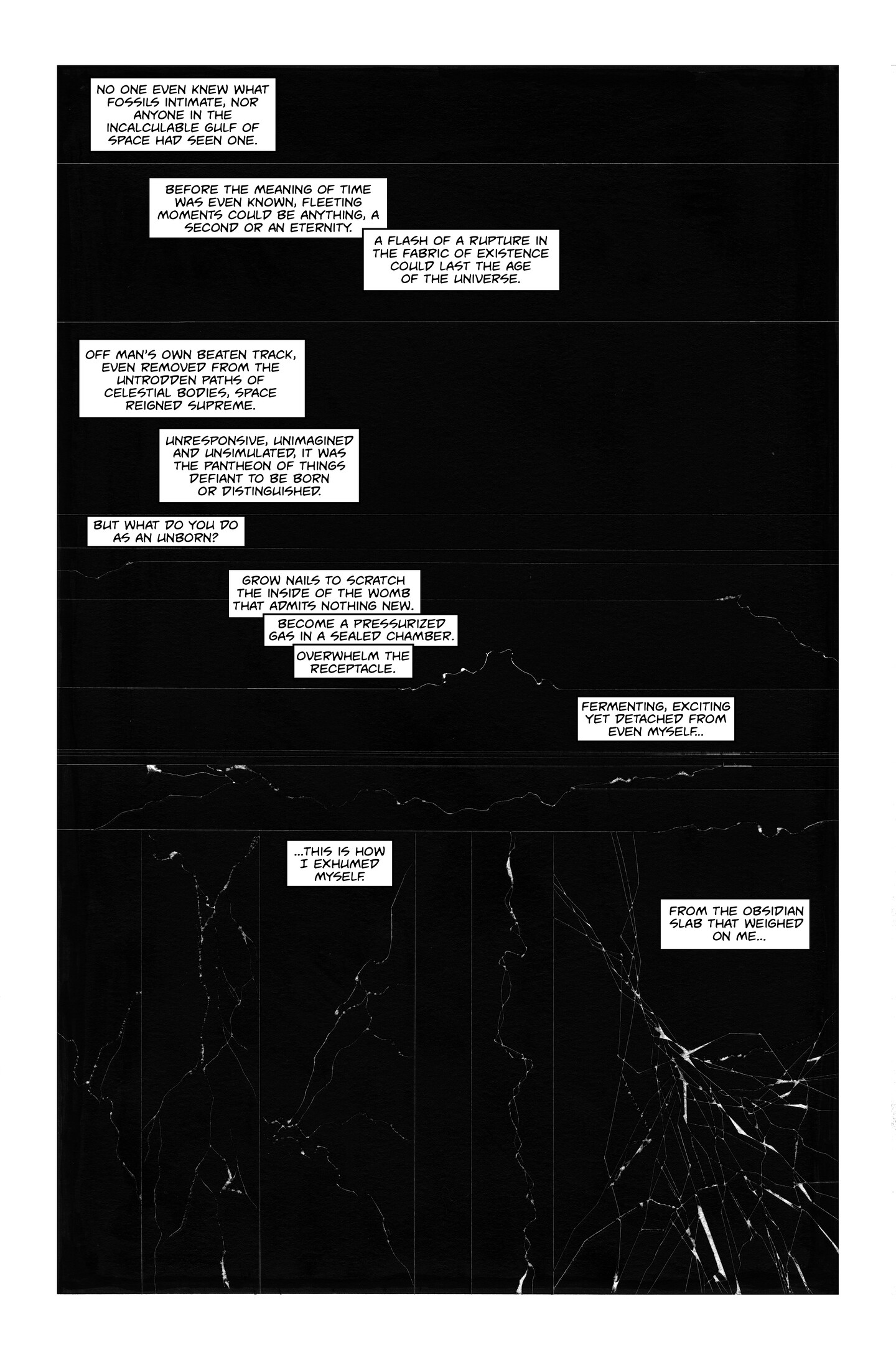
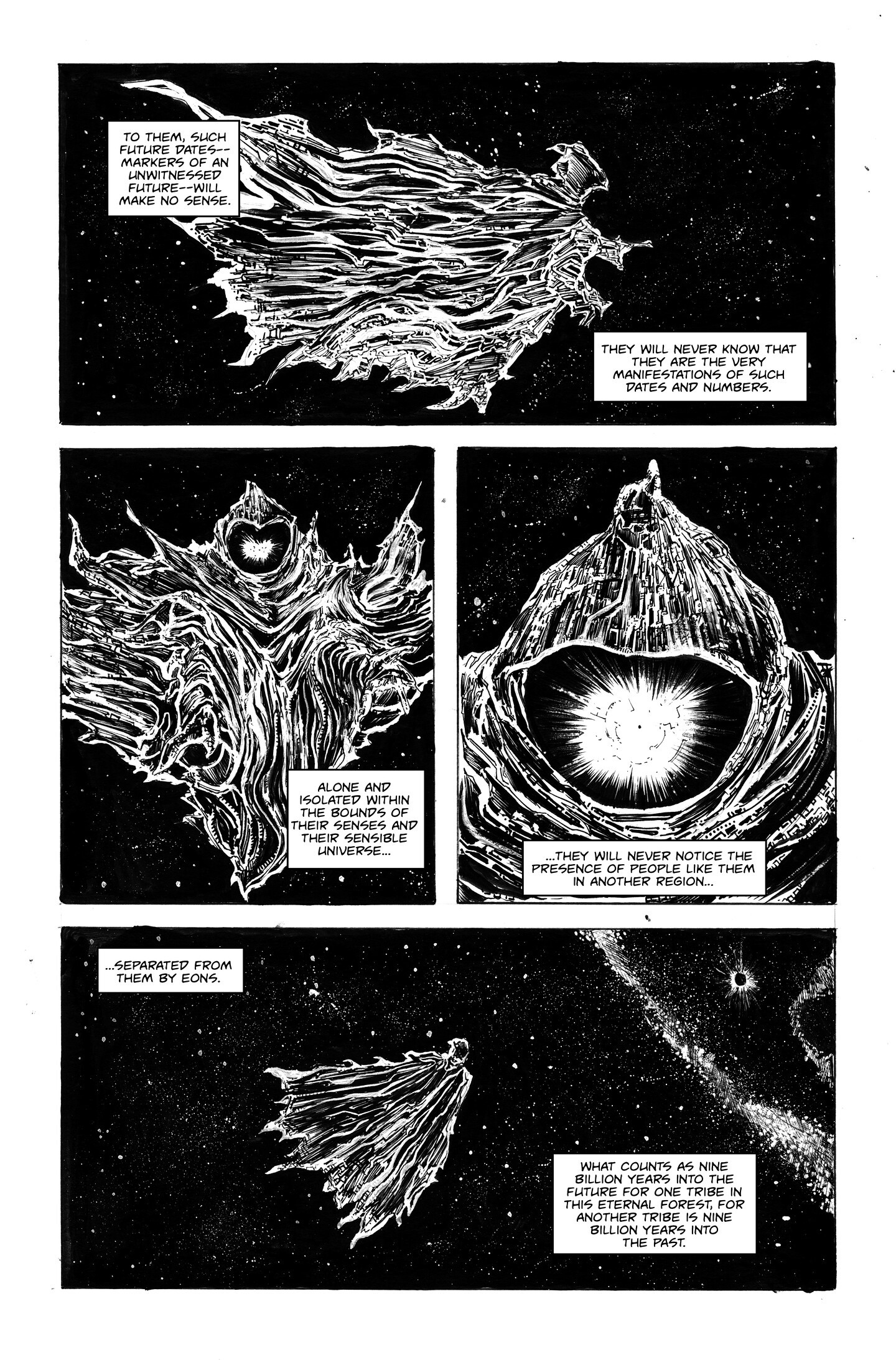
Approaching the comic medium as a supercollider for achieving maximum abstraction, in Chronosis artist Keith Tilford and philosopher Reza Negarestani create a graphically stunning and conceptually explosive universe in which the worlds of pop culture, modern art, philosophy, science fiction, and theoretical physics crash into one another.
Taking place after the catastrophic advent of the birth of time, Chronosis narrates the story of a sprawling multiverse at the center of which monazzeins, the monks of an esoteric time-cult, attempt to build bridges between the many fragmented tribes and histories of multiple possible worlds.


Image result for Reza Negarestani and Keith Tilford, Chronosis 1,

AUDINT - The 64 short essays in this volume probe how unsound serves to activate the undead.Contributors from a variety of disciplines chart these warped zones, mapping out a zigzagging timeline stretching from the 8th century BC (the song of the Sirens), to 2013 (acoustic levitation), and speculatively extending into 2057


Image result for AUDINT—Unsound:Undead,
AUDINT—Unsound:Undead, Ed. By Steve Goodman, Toby Heys and Eleni Ikoniadou, Urbanomic, 2019.

For as long as recording and communications technologies have existed, the potential of the vibrational continuum that connects sound to infrasound, ultrasound and other inaudible frequencies has been evoked to access anomalous zones of transmission between the realms of the living and the dead.
For the past ten years the AUDINT group has been researching these peripheries of sonic perception (unsound) and the portals they open to new dimensions, activating a continual intersection between fiction and fact, and pressuring thought to become something other than what it has been. The 64 short essays in this volume probe how unsound serves to activate the undead.
Contributors from a variety of disciplines chart these warped zones, mapping out a zigzagging timeline stretching from the 8th century BC (the song of the Sirens), to 2013 (acoustic levitation), and speculatively extending into 2057 (the emergence of holographic and holosonic phenomena).
With texts by: Lawrence Abu Hamdan, Lendl Barcelos, Charlie Blake, Lisa Blanning, Brooker Buckingham, Al Cameron, Erik Davis, Kodwo Eshun, Matthew Fuller, Kristen Gallerneaux, Lee Gamble, Agnès Gayraud, Steve Goodman, Anna Greenspan, Olga Gurionova, S. Ayesha Hameed, Tim Hecker, Julian Henriques, Toby Heys, Eleni Ikoniadou, Amy Ireland, Nicola Masciandaro, Ramona Naddaff, Anthony Nine, The Occulture, Luciana Parisi, Alina Popa, Paul Purgas, Georgina Rochefort, Steven Shaviro, Jonathan Sterne, Jenna Sutela, Eugene Thacker, Dave Tompkins, Shelley Trower, and Souzana Zamfe.


Image result for AUDINT Dead Record Office,
AUDINT, Dead Record Office, Art in General, 2014.


The Dead Record Office outlines a brief history of AUDINT from their emergence as a sonic research unit shortly after the end of the Second World War until 2014. During this documented 70-year period, the works of the three waves of AUDINT personnel are focused on and their connection to three phases of martial hauntology – the Ghost Army, Wandering Soul and Phantom Hailer – explained. The book functions as a historical document that offers insight into the framework of AUDINT’s investigations and experiments; an on going inquiry into the weaponisation of waveforms and the activities of those that harness such techniques to stake out psychological and physiological realms at the edge of perception.
The Dead Record Office reveals the deceptive sonic strategies, technologies, and programs developed by military organisations since 1944 to orchestrate the spectral phenomena of a haunting within an area of conflict for territorial gain. Instances of this frequency-based haunting of the battlefield include – World War II when the U.S. military’s Ghost Army pioneered speaker based deception techniques and apparatus; the Vietnam War in which the U.S. military deployed ‘Wandering Soul’ (‘Ghost Number 10’) tapes that imitated the voices of dead Vietcong fighters from helicopter mounted speaker units; and in Guantánamo Bay, where detainees who were legally dead yet biologically alive were tortured by Death Metal music.


2017: Greg J. Smith, Dread Bass: AUDINT’s alternate timelines reverberate with fear and death, Creative Applications, August
http://www.creativeapplications.net/environment/dread-bass-audints-alternate-timelines-reverberate-with-fear-and-death/
download PDF


2016: Philipp Rhensius, Schallkanonen und Rauchpanzer
Das englische Künstlerkollektiv Audint nähert sich beim Loop Festival der historischen Verwendung von Klang und Musik für militärische Zwecke.

http://www.taz.de/!5350924/


2016: Eleni Ikoniadou & Lendl Barcelos, The Unsound Methods of AUDINT, Wire magazine online, December
http://www.thewire.co.uk/in-writing/interviews/the-unsound-methods-of-audintdownload PDF


2016: Kristen Gallerneaux, Humming Through Salt: AUDINT’s Spurious Frequencies. ArtWindsor. Issue: Winter, Canada
https://issuu.com/barbedmagazine/docs/noisesissueiii, p22-27
download PDF


2015: Marc Couroux, Internal: AUDINT (Phonocultural Studies). CTM Magazine, Berlin, Germany
download PDF 

Ghostcode

film animation in development
Based on the book The Holo Wars by AUDINT, Ghostcode is an animation set in 2056 when Corporations and Nation states have fused into single economic and political entities. This is an era in which human flesh has been removed from the messy equations of political turbulence, resulting in conflicts being conducted by holographic and holosonic forces. The film follow the exploits of Irex2, a rogue Artifical Intelligence on the run from its undead creators as it competes against a Columbian Black Hat named Sureshot to develop A.I. Holographic fighters named AIHolos.
Fuelled by the sound of human pain, the AIHolo’s weapons require massive injections of recorded suffering. As torment becomes an economy in its own right, Pain ©Amps are constructed to generate the sonic power source. By amping up the rationale of the music industry’s most successful formula of the C20th – recording and selling the sound of poverty stricken urban areas – the functionality of suffering has been pushed to the limit. The needle is in the red, but it is pain that is wanted, not blood.


Delusions of The Living Dead

film animation, video installation
22 mins, 2015

AUDINT’s animated film Delusions of the Living Dead is a sub-chapter of their Martial Hauntology book, which documents Walter Slepian’s 1949 plan to purloin and photograph Jules Cotard’s notebook; a medical document that holds information pertaining to the process and methods required to seed walking corpse syndrome into a subject’s bed of cognition.
Martial Hauntology was released in late 2014 as a limited edition of 256 copies. It links the underground groove of the Large Hadron Collider with the vaults of the Bank of Hell; connects the Dead Record Network with the Phantom Hailer; and traces the evolution of the Wandering Soul Tapes to the viral dynamics of the online spectreware named IREX2.


State Machines: Reflections and Actions at the Edge of Digital Citizenship, Finance, and Art - This publication investigates the new relationships between states, citizens and the stateless made possible by emerging technologies


State Machines: Reflections and Actions at the Edge of Digital Citizenship, Finance, and Art, Ed. by Yiannis Colakides, Marc Garrett, Inte Gloerich, Institute of  Network Cultures, 2019.


read it here (issuu)


Today, we live in a world where every time we turn on our smartphones, we are inextricably tied by data, laws and flowing bytes to different countries. A world in which personal expressions are framed and mediated by digital platforms, and where new kinds of currencies, financial exchange and even labor bypass corporations and governments. Simultaneously, the same technologies increase governmental powers of surveillance, allow corporations to extract ever more complex working arrangements and do little to slow the construction of actual walls along actual borders. On the one hand, the agency of individuals and groups is starting to approach that of nation states; on the other, our mobility and hard-won rights are under threat. What tools do we need to understand this world, and how can art assist in envisioning and enacting other possible futures?
This publication investigates the new relationships between states, citizens and the stateless made possible by emerging technologies. It is the result of a two-year EU-funded collaboration between Aksioma (SI), Drugo More (HR), Furtherfield (UK), Institute of Network Cultures (NL), NeMe (CY), and a diverse range of artists, curators, theorists and audiences. State Machines insists on the need for new forms of expression and new artistic practices to address the most urgent questions of our time, and seeks to educate and empower the digital subjects of today to become active, engaged, and effective digital citizens of tomorrow.


Contributors: James Bridle, Max Dovey, Marc Garrett, Valeria Graziano, Max Haiven, Lynn Hershman Leeson, Francis Hunger, Helen Kaplinsky, Marcell Mars, Tomislav Medak, Rob Myers, Emily van der Nagel, Rachel O’Dwyer, Lídia Pereira, Rebecca L. Stein, Cassie Thornton, Paul Vanouse, Patricia de Vries, Krystian Woznicki.
http://networkcultures.org/statemachines/2019/03/19/out-now-state-machines-reflections-and-actions-at-the-edge-of-digital-citizenship-finance-and-art/

4/3/19

David Scott - connections between the hands of Michelangelo’s David and the leaning tower of Pisa, or a scar on the shoulder and the beach at Copacabana, open upunexpected links that, like Hokusai’s prints, provide thirty-six ways of encountering – and accounting for – the fleeting insights life can offer

Image result for David Scott, Cut Up on Copacabana,
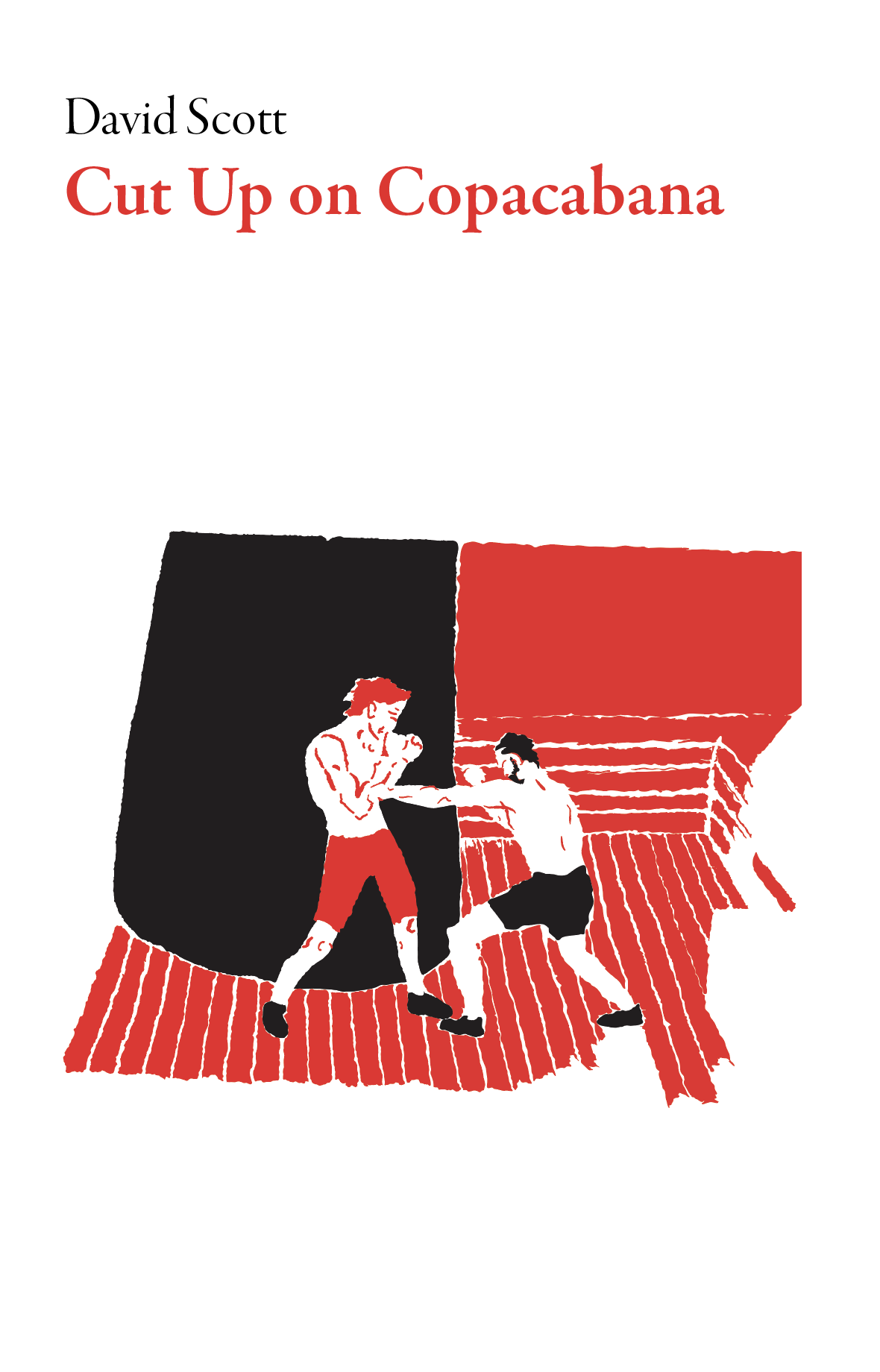
David Scott, Cut Up on Copacabana, Dalkey Archive Press, 2018.


What’s the connection between the hands of Michelangelo’s David and the leaning Tower of Pisa? – a flashflood in a Thai regional airport and the death of a fish in a road accident? – a scar on the shoulder and the beach at Copacabana? David Scott’s stories explore such unexpected links, providing, like Hokusai, 36 ways in all of encountering – and accounting for – strange experiences – in travel, boxing and boyhood.


Life is often experienced as a tedious continuum fragmented by moments of intense feeling or excitement. In Cut up on Copacabana, three sets of texts (‘Travel Notes’, ‘Boxing Rings’ and ‘Schoolboy Rites of Passage’) explore some of these moments in terms of travel, sport and youthful experience recollected later in life. In David Scott’s stories, connections between the hands of Michelangelo’s David and the leaning tower of Pisa, or a scar on the shoulder and the beach at Copacabana, open upunexpected links that, like Hokusai’s prints, provide thirty-six ways of encountering – and accounting for – the fleeting insights life can offer.


It’s a great honour to be asked to speak about this book, which, like its author, is exceptional. I mean both David and his book are exceptional in the sense of brilliant—but also in the sense of very strange.
The text announces its weirdness from the outset, opening with a series of different dialogues, in which several different and conflicting explanations for the same set of scars on the protagonist’s chest are offered. There is no narrator, the reader is left to chase truth themselves. These playful verbal back and forths immediately call to mind the good-natured dominance contest of sparring in the ring. David’s sophisticated relationship with the sweet science of boxing is present explicitly and implicitly throughout this book.
Next the reader is treated to a series of short poems displaying different perspectives on the same scene, Mount Fuji. The presentation of different viewpoints here is not the fatuous and pretentious subjectivity of postmodern nihilism. David does not present a denial of objective reality—but instead a wise rumination on how external reality can be refracted through the prism of subjectivity. He shows us how we can benefit from seeing things through the eyes of others—but also how we can be misled if we allow ourselves.
I’m not known as an advocate of intersectionality, but the intersection of the academic analysis of literature and creative writing can be of great value, particularly when the practitioner is as distinguished as David. And although that is evident throughout this book, there is a remarkable clarity here—David never occludes meaning, even if he does make you chase it. He is never obtuse or obfuscatory—perhaps the prototypical depredation of literary and academic imposter alike.
The rigour and discipline of both academia and boxing is echoed also in the systematised organisation of the book—the short vignettes like 3 minute rounds in a bout, the boundaries neatly marked, each small segment squared off with chapter headings like the ropes around a ring. Structuring books in short episodes has become suddenly fashionable of late—probably due to the decimation of our collective attention spans that came with the ubiquity of social media. Short poems, parables, vignettes, and anecdotes, are more easily processed by those who, like myself, have succumbed to Zuckerberg induced brain-rot. But David is no follower, he developed this style not reactively through his use of technology. Indeed in every facet of his life he is dedicated to thoughtfully and consciously using technology, rather than passively allowing technology use him. This is expressed in his ring-name and alter-ego of Dynamo Dave, which references his passion for cycling, and appropriately a device which generates power sustainably.
Dave’s interest in sustainability is more about endurance than eco-hipsterism, sustainability not in some faddish sense, but in the sense of intelligent pragmatism. In an earlier book, Dynamo Island, Dave laid out his manifesto for an entire society structured according to his personal philosophy. His velocipedal Arcadia makes an appearance again here, with a dedicated chapter of this book, another moment in which this text is nonchalantly defiant of the limits of genre. This imagined island society may seem whimsically utopian, but of course in real life Dave has managed to actually create such a utopia on a personal level—living volitionally, according to his principles, pursuing his interests. That is no mean feat. The glimpses we are given into this in the boxing chapters in particular could almost serve as a more subtle form of self-help book—encouraging bravery, fortitude, resilience, playfulness, and courtesy.
Indeed, while dominant narratives in the media and academia are now determined to reduce descriptions of masculinity to a binary of either “fragile” or “toxic”, David presents a complex, nuanced, and defiantly non-stereotypical masculinity that is sublimely unafraid to honour intensely unfashionable masculine characteristics: strength, perseverance, discipline, determination, while simultaneously unashamedly—or perhaps shamelessly—expressing less traditionally masculine characteristics like timidity, vulnerability, uncertainty, and curiosity—not to mention unflattering sexual escapades, which is brave in itself. To write honestly about sex is to invite ridicule—on this I can speak from experience.
When asked to sum up Joyce’s aesthetic, a friend explained he had a picture of Cork City on the wall of his study, and the frame was made out of cork-wood. David similarly matches content to structure. There is the same concern with precision, control, discipline, even offence and defence in this text as David brings to both his academic and pugilistic pursuits. The prose is Spartan—by which I don’t mean plain or unadorned. The vivid descriptive passages about getting lost in Bangkok, for example, are far from “sparsely furnished” as most people now use Spartan to mean. By Spartan prose I mean precise, purposeful, confident—and most of all systematised and efficient.
What I find most refreshing about this book is its unpretentious curiosity—the very opposite of the contrived cynicism that seems a compulsory posture for writers to strike these days. There is no cynicism here, David’s enthusiasm for life is at once childlike and wise. This is epitomised in anecdote from his youth when on the first night of a holiday with his grandmother he was allocated “an enormous double-room in the Grosvenor Hotel”. He writes “I felt I had to do justice to the space by sleeping alternately in the two giant double-beds and using as often as possible the giant en-suite bathroom”. I guarantee that if he was put in the same situation today, David would alternate between those double-beds.
This is both because he has retained the best element of boyhood, and because he is obsessive about order and completeness. This sort of benevolent OCD is apparent in the cleanness of his prose—and his office—but also his assiduous annotation, another transfer from his academic writing that creates some surprisingly comic moments in this book, such as the list he supplies of the fellow passengers on the aforementioned tour, which includes: “two spinster sisters from Newcastle, a very loud woman, a married couple from the North with a pronounced Yorkshire accent, a dutiful bachelor with Brylcreemed hair, three girls all pretty from Norwich, London and Canada respectively, a fat lady, a pair of pensioners from Australia, and a rather sharp young couple.”
This topic of travel is the final important theme. David can well be described as an explorer in many domains, not just geographical. Relating in broad terms the experience of being in an unfamiliar foreign country, David at one point advises that tourists should “be attentive to the meaning of signs.” He goes on to explain this doesn’t just mean neon nightclub advertisements, but also strange words, or even body language. It is this constant, dedicated, and optimistic search for meaning in so many dimensions: language, texts, art, music, sport—and his joyous quest for meaning in life itself—which makes this book, and David himself, so very inspirational. - Frankie Gaffney
http://the-scum-gentry-alternative-arts.com/journal/david-scott-cut-up-on-copacabana-book-review-frankie-gaffney.html


David Scott is the author of numerous books on art, boxing, poetry, travel, and graphic design. His novel Dynamo Island: The Cultural History and Geography of a Utopia was published in 2016, while his translation of Mallarmé’s sonnets appeared in 2008. He is Emeritus Professor of French (Textual & Visual Studies) at Trinity College Dublin.