4/13/21

Phillip O’Neil - a study in hell. Mahler’s trauma & amnesia can be cured. But what will he remember if it is? Is Mahler the perfect Guinea Pig the doctors have been hoping to find? Or is it a case of kill or cure? Mahler wants to uncover all that lies hidden in his brain. Powerful men want it to stay buried.

Mental Shrapnel: O'Neil, Phillip: 9781999696405: Amazon.com: Books

Phillip O’Neil, Mental Shrapnel, Equus Press,

2020.

excerpt


Chris Mahler was a top psychologist, but that was before the war in Bosnia. Something happened to him during that war – it left him too traumatised to remember. Jasmina was the love of his life. She was killed in the siege of Sarajevo & his ability to live & love again died with her. Or so he believes. Now a shell-shocked survivor, he is the patient, strapped to a bed under the care of the mysterious Dr Steinfelder.

Mahler’s trauma & amnesia can be cured. But what will he remember if it is? Is Mahler the perfect Guinea Pig the doctors have been hoping to find? Or is it a case of kill or cure? Mahler wants to uncover all that lies hidden in his brain. Powerful men want it to stay buried. The Orwellian tyrant known as ‘The Censor’ has his secrets too, but what does he want from Mahler? Once colleagues, Steinfelder & ‘The Censor’ are now arch-enemies. Mahler must go to war once more & this time the stakes are higher than ever before, discovering that in the twenty-first century, psychiatry is the newest & deadliest weapon of war.


“Literature would be dead if it weren’t for publishers like Equus Press, a second-to-none specialist in narrative innovation, unique voices, and marginalized lines of flight. The latest contribution to the Equus project, Philip O’Neil’s MENTAL SHRAPNEL, is a refreshing, remarkable departure from the overwhelming horde of canned, lifeless fiction that threatens to eat literary history whole. O’Neil’s first novel makes almost everything else look like dreck. It’s precisely what the corpse of modern literature needs to bring it back to life.”—D. Harlan Wilson


“Sinequanon threads of Gonzo journalism tie hot shards of Philip K. Dick’s paranoid fantasies to Kingsley Amis’ insouciant British humour in this 400-page pill, as we are flung between war-torn Sarajevo & post-communist Prague between the early 90s & the late 00s. A war correspondent come psychotherapist, Christopher Mahler, is sequestered into a theatrical vortex of alternating comedic & tragic skirmishes. In an attempt to uncover the true cause of his fugue states, Chris delves into the kind of analysis which promises to drag him & the reader screaming into an ignominious past of flak jackets fantastic journeys & love lost in unaccountable circumstances. Many a seemly character enters & exits this cathartic trip as our sardonic protagonist Randle McMurphies his way through a Dante’s Inferno of lost souls. With sensitive, lyrical wit O’Neil teases the most devastating (ir)realities into palatable, poetic medicine. Mental Shrapnel is the author’s nostalgic suicide letter to Prague, left on a mantle piece over the flaming fires of hell, propped up by a bowl of rotting oranges.” —Michael Rowland


“Equal parts memoir, war narrative, & love story, Mental Shrapnel takes you deep into the wounded psyche of a man forced to put himself back together when the health care “system” fails him completely. Reminiscent of One Flew Over the Cuckoo’s Nest, Down Below, or Kleinzeit, Mental Shrapnel paints a darkly humorous portrait of a fractured mind in a damaged healthcare system. Replete with a cast of larger-than-life characters, patients, junkies, & war criminals, Mental Shrapnel probes the darkest recesses of the human psyche in this story of a dizzying freefall into madness and a painful climb back to sanity – an intense vertiginous journey that will leave readers in doubt of their own sanity as much as Chris’s. Mental Shrapnel also paints an intimate nuanced picture of the city of Prague that will be instantly recognizable to longtime residents or serve as a psychedelic walking tour for those who have never traversed the narrow, labyrinthine streets of the city. Not a novel for the faint of heart, but still a compelling read full of wit, heart, and history.” — Jeffrey Howe


The image of hell dies hard. The rest of the Christian assemblage may have fallen away, but hell retains its power over us.

This is because hell is a description of a world without forgiveness.

I recently read René Girard’s work, Violence and the Sacred, in which he argues that sacrifice, whether human or animal, was not simply ceremonial, or a tribute to the gods, but a way of directing the whole society’s violence in one direction, thus dispelling it.

In a collective act of murder, ancient man could finally attain forgiveness. Eventually, Christ supplanted the living sacrifices.

Without a mechanism to allow us to forgive, ancient society entered a state of total distrust, total suspicion and total war. Without forgiveness, we unleash hell.

Phillip O’Neil’s book is a study in hell. Christopher Mahler, our protagonist, is either a psychotherapist or a war correspondent (his identity is unstable, in flux). He saw the worst of the war in Sarajevo and, years later, suffers blackouts as a result.

Sarajevo is a vision of the hell without. Mobs, murder and mutilation are commonplace. Simply seeing the war is enough to pollute Mahler. The chaos enters his soul.

Cut to 2008; Mahler is now in Prague, living in a halfway house with drunks and drug-addicts. He witnesses their decline while trying to piece his own mind back together. His bizarre PTSD-driven actions and fugue states are easily confused for drunkenness. He fits in well.

Finally, having seen the hell without and lived the hell within, Mahler pierces the fabric of reality. He goes in search of his memory, and his lost Beatrice, in a world of his own making.

This parallel existence takes the form of a city, similar to Unthank in Alasdair Gray’s Lanark, where every meeting is a confrontation and every compliment contains a threat.

The alternative worldspace is divided between PeaceZone and WarZone. The differences between the two are minimal and the line drawn between them is shifting and arbitrary.

At times we are back in the Bosnian war. Sometimes we meet the drunks and drug addicts from his building. Often the dead come back to life.

There is a reason that hell is a circle. We learn that through Mahler’s odyssey, and whether O’Neill truly succeeds in exorcising his character’s demons is up to the reader to decide.

This is a brutal book. It’s shifts in tone are often jarring. And yet that gives it a texture and a patina unlike any other book I’ve read.

I would expect no less from Equus Press, whose experimental texts are at the forefront of the contemporary avant garde. As publishers, they don’t flinch from discomfort, and works of twisted brilliance like Mental Shrapnel are the result.

This is a book that shoves you, then looks at you expectantly; waiting to be shoved back. A dynamic absolutely of our times. - Joe Darlington

https://manchestereviewofbooks.wordpress.com/2021/03/10/hell-is-a-circle/


Born in London, Phillip O'Neil worked as a journalist for two decades after reading history at Liverpool University and journalism at The London College of Printing. He worked as a travel journalist based in Antwerp, Belgium before moving to Prague in 1992. He moved to Romania in 1998 and then Alaska, returning to London to work as assistant editor and feature writer for The Institute for War and Peace Reporting covering events in The Balkans and the Caucasus. Returning to Prague in 2009 he wrote a monthly column for The Prague Review and has published his poetry in a number of publications including Scarlet Leaf Review, Wilderness House Review, and Suisun Valley Review. MENTAL SHRAPNEL (Equus Press, 2020), based partly in Prague, is his first novel. He is currently writing a second, set in the Czech Republic.


Jacob Miller - an invitation to engage in an achronological excursion through prose that conceal moments of ambiguity — deploying rhetorical devices such as paranomasia. Exploring the richness of Japanese culture, questions of economy, hospitality, and catharsis reside just beneath the surface

The Toilet God: Amazon.co.uk: Miller, Jacob Alexander, Walsh, Hannah Irene:  9789811456527: Books

Jacob Miller, The Toilet God, Delere Press, 2020.  


In the spirit of Georges Bataille, Anne Dufourmantelle, Sigmund Freud, and others, The Toilet God presents an invitation to engage in an achronological excursion through prose that conceal moments of ambiguity — deploying rhetorical devices such as paranomasia. Exploring the richness of Japanese culture, questions of economy, hospitality, and catharsis reside just beneath the surface. Consider the posture of Buddha, handcrafted yosegi-zaiku, or the prescient dreams of Tokugawa Ieyasu. Accompanying illustrations by Hannah Walsh proffer a glimpse into the world of mojie and the vistas of Japan setting a familiar territory for The Toilet God who awaits your visitation.


Lines from a Canvas (American Literature): Miller, Jacob: 9781628971378:  Amazon.com: Books

Jacob Miller, Lines from a Canvas, Dalkey Archive Press, 2016.


Lines from a Canvas offers the public one of the best kept secrets in the world of poetry for years, the work of Jacob Miller. His poems uniquely traverse the cultural territory from Homer to the Grateful Dead, taking the reader from ancient Greece and Rome to the Holocaust to the Cold War to Vietnam to 9/11. In short, the expansive canvas of his content presents a compelling spectrum mixing classical and modern brush strokes, all while exploring experiences of love and loss, isolation and separation, as well as mortality. Consistent with his content, though perhaps of even greater importance, the crowning achievement shown in this collection is Jacob Miller’s new poetic technique, which delivers the reader to an expertly constructed and long-needed bridge between classical traditions (such as rhyme and meter, or even hidden slant rhymes or assonance connections), and imagistic free-verse. Additionally, this collection contains the poet’s free-verse libretto to the modern opera Manhattan in Charcoal, (recently released on CD). The title poem, Lines from a Canvas, offers the point of view of a canvas, not the painter, and this launches the operative conceit in this collection: each poem explores the perspective of the canvas of life and death, more than the poet himself. Each poem truly brings something new to the page.


Jacob Miller first emerged as a young poet in the 1970's after winning a Hopwood Poetry Award, studying briefly with Allen Ginsburg, then working with the Nobel Prize Laureate, Joseph Brodsky, in classical verse forms for years, while also working with the American Poet Laureate, Robert Hayden, in more economic free-verse. During this period he also launched the literary and arts journal, Empyrea, and published his work, Sublimity vs. Circulation, urging librarians nationally to more aggressively seek out new writers, which was awarded in the Best of Lit. Series and published first in Library Journal and later by The Scarecrow Press. Through the 1980's, his poems were published in numerous literary journals and he gave readings across America as well as in London, England. Then he fell off the map.

For the next 30 years, Miller became a reclusive poet and author who did not aggressively pursue publication and stopped doing public readings, but never stopped writing, refining his craft, pursuing his own new hybrid verse form, alternately living abroad (mostly in Italy) and New York, while making ends meet as a teacher. In recent years though, he resurfaced, was the recipient of support from the New York Foundation for the Arts for this collection of poems, Lines from a Canvas, as well as his novel, Leviathan. He also wrote a free-verse libretto, Manhattan In Charcoal, for a modern opera released on CD last year. His poem cycle Blues from an Airport Bar was also set to music and released on the CD "Song Cycles."

Jacob Miller has three children and an avid interest in vintage motorcycles.


4/10/21

Matthew Turner - A cluttered home can be stream of consciousness made real, which is much more convincing than traditional articulations of that narrative mode... a novella of psychotic architectures. It is a story about hidden wealth, identity, edges becoming centres and how our homes are a crowd of strangers

Loom by Matthew Turner – Gordian Projects
Matthew Turner, Loom, Gordian Pojects, 2020. 

Loom is an illustrated novella of psychotic architectures. It is a story about hidden wealth, identity, edges becoming centres and how our homes are a crowd of strangers.

‘…continuing to scrape away at the powdery plasterboard I reveal the end of a fine, barely perceptible, twenty-four carat gold thread. I tug at it with force and it ruptures a razor thin fissure right across the room, and I begin…’


EVEN BEFORE OPENING a copy of Matthew Turner’s Loom, which the publisher describes as a ‘novella of psychotic architectures’, the minimalist arthouse cover of oversized titular lettering and shiny gold rings hung on a Mallarméan white background declares itself to be a product of the contemporary art world, as if a literary annex and elaboration of the white cube aesthetic. Perhaps this eye-catching jacket design had been subliminally affected by the Christmas market, its über-cool credentials meant to attract a readership long since graduated from Penguin paperbacks? Cleverly though, by breaking down the usual demarcation between cover and contents, we are prepped in advance for an abnormal, slightly giddying experience: the perfect bound object both text and textile.

As a story though, Loom starts in the most humdrum way, as its main protagonist hovers on a kerb waiting for traffic to clear in order to cross the road. However, at this very moment his attention is caught by a single gold filament that’s become snagged by the weave of his own overcoat. This provides a thread to follow, as the writer/artist’s methodology unwinds, while the street in question turns out to be no ordinary thoroughfare, but The Bishops Avenue N2, said to be the wealthiest row of houses in London, and a nirvana for estate agents (according to Zoopla, the average price of property in December 2020 was £7.5 million). Employed as a caretaker, Loom’s unnamed narrator has privileged access to a run down Bauhaus-type family home, the kind of rectilinear modernist building of the 1930s (think Isokon flats), and clean-cut European architecture so vilified by John Betjeman, which must have looked like an oddity to the average Londoner of the period, so used to sooty Victorian terraces. Turner describes the road as

a Potemkin, glutted with overblown mockeries of Tudor, Classical and Modernist style architecture. Cheap plastic signs emblazoned with stately portraits of aggressive looking Alsatians are cable tied to the railings, warning of surveillance.

But the irony is that many of these grand houses are rotting away, derelict investment opportunities belonging to overseas owners too rich to care, hulks that loom over a hollowed-out London, resentfully living under unenforceable Tier 5 Covid-19 protocols. These are domestic ruins, posh addresses with flytipped bin bags, syringes, dried up fountains, where nature has come indoors, and Persian carpets act as grow bags for rare orchids. Identifiable plants such as vetch, charlock and ragged robin feature in the line drawings which are an integral part of Loom, along with manhole covers, telephone inputs, floral wallpaper, Italian marble, brickwork, cables, wire barbs, duct pipes, knots, parquet, keyholes etc., an inventory of stuff that gives the fiction a basis in the everyday, Turner’s flat writing a product of the digital age transposed onto blank paper: immaterial retro-fiction. This depthless quality is a manifestation of the psychosis on show here, the quiet mania of an avatar-like narrator unable to tell where his mirrored self ends and the world begins, or focused OCDstyle on minutiae, to cope with information overload. He haunts a wrecked space (a substrate of the house has been forensically examined for its elusive owner’s dirty money), looking for solace in

Those unknowable whispering cavities, between walls, under stairs, in the hollow of doors, intricate rococo warrens gnawed through concrete foundations.

In the process, the narrator, the house, and London itself (which features as an oblique presence) have all been made utterly strange, and Turner’s Loom, with its fluctuation from Swiftian close-up to chilly filmic overview, places him alongside other recent London topo­graphical explorations of the capital city as uncanny per se, viz Nick Papadimitriou’s Scarp (2012), Gareth E. Rees’s Marshland: Dreams and Nightmares on the Edge of London (2013), and Marko Jobst’s A Ficto-Critical Theory of the London Un­der­ground (2017),1 where research-driven de­fa­mil­iar­iz­a­tion, or a ‘trans­fig­ur­a­tion of the com­mon­place’ as supercritic Arthur C. Danto put it, turns life into art, and, particularly in Turner’s case, curates decay.

Only an on-site security guard in a ‘creased Oxford shirt’ provides any social normality, a slacker who makes himself known by an occasional creaky floorboard or burst of unintelligible radio static, though interactions are off-hand and loaded with menace. And yet in a classic plot twist it becomes clear that the protagonist is not who he says he is, ie a casual handyman, but an undercover operative, a maniac who has returned to salvage a personal cache of gold concealed at the house, revealing too that the build was a design based on Adolf Loos’s functionalist Villa Müller in Prague (now a museum ̶ of itself! ̶ and behind Lucy McKenzie’s 2013 installation Loos House, described by Jonathan Griffin in Frieze as ‘an act of deliberate slippage, a provocative mistranslation’, words which could equally apply to Loom). So then, having found and tugged on a golden thread embedded in plasterboard, his treasure unravels completely in a glistening spool, and this phoney caretaker escapes with the sound of police car sirens in the background. Loom has all the hallmarks of a parable, a new take on the anxieties surrounding art as derivative form, and art as commodity, its maker’s right of droit-de-suite weakened in a post-Brexit market economy; concerns which Turner might well have to address in his role as Lecturer at Chelsea College of Arts.

Yet it is as a re-writer of London that Turner is most effective, joining the crowd of post-Sinclair names cited above who are re-imagining the city, a cross between Urbex trespassers and sober archivists, equipped with proprioceptive sensitivities that can tune into both ancient resonances as well as stand witness to traumatic contemporary change. In Loom so-called ‘Internal Edgelands’ emerge, pockets of dark space inside the metropolitan area which the virus has nullified. For as the administrative centre and Canary Wharf are purged of tourists and commuters, once again the cluster of villages which were slowly fused together in the nineteenth and twentieth century as Greater London, postcodes from Barnes to Walthamstow, Hampstead to Gypsy Hill, start to look more and more vital as local life hubs. But Loom as its name implies, builds up surface patterns — line upon line — woven into Paisley arabesques, expressing the creeping horror of the haunted house idiom. - Michael Hampton

https://fortnightlyreview.co.uk/2021/02/hampton-turner-loom/


excerpt:

I don’t react and continue scrutinising the dining room. The lucidity and minimalism it radiates starts chaotically doubling up in the ambiguities of onyx melting into transparent and semi-transparent glass, chrome clad columns mirroring themselves and dissolving in light, veins of marble blending with rippling reflections off parquet flooring, appearing as curtains blowing in the wind. When I entered this morning, the sun came in through the south-facing window against the fireplace, and up until now it had been tracking across the floor and creeping slowly towards the centre of the room. When I entered this morning, the windows were obscured with thick condensation, now it is quickly dissipating out towards their deep wooden frames. When I entered this morning water droplets crawled along the glass, pulled into spheres by the equalising forces of surface tension. 


The guard disrupts my reverie again: ‘That jacket of yours is strange’. Confused, I look across at him and he continues: ‘it’s so frayed around the cuffs and wearing out at the elbows, but there is something that shines in the lining.’

‘Ah, yes,’ I reply, still dazed, ‘the lining is sewn in with gold thread. Where I come from we sew our money into our clothes for safe keeping.’

A mouse unmoors itself from the skirting boards, skitters to the main body of the room, looks up, panics, then runs back again.

Matthew Turner - Hesterglock Press

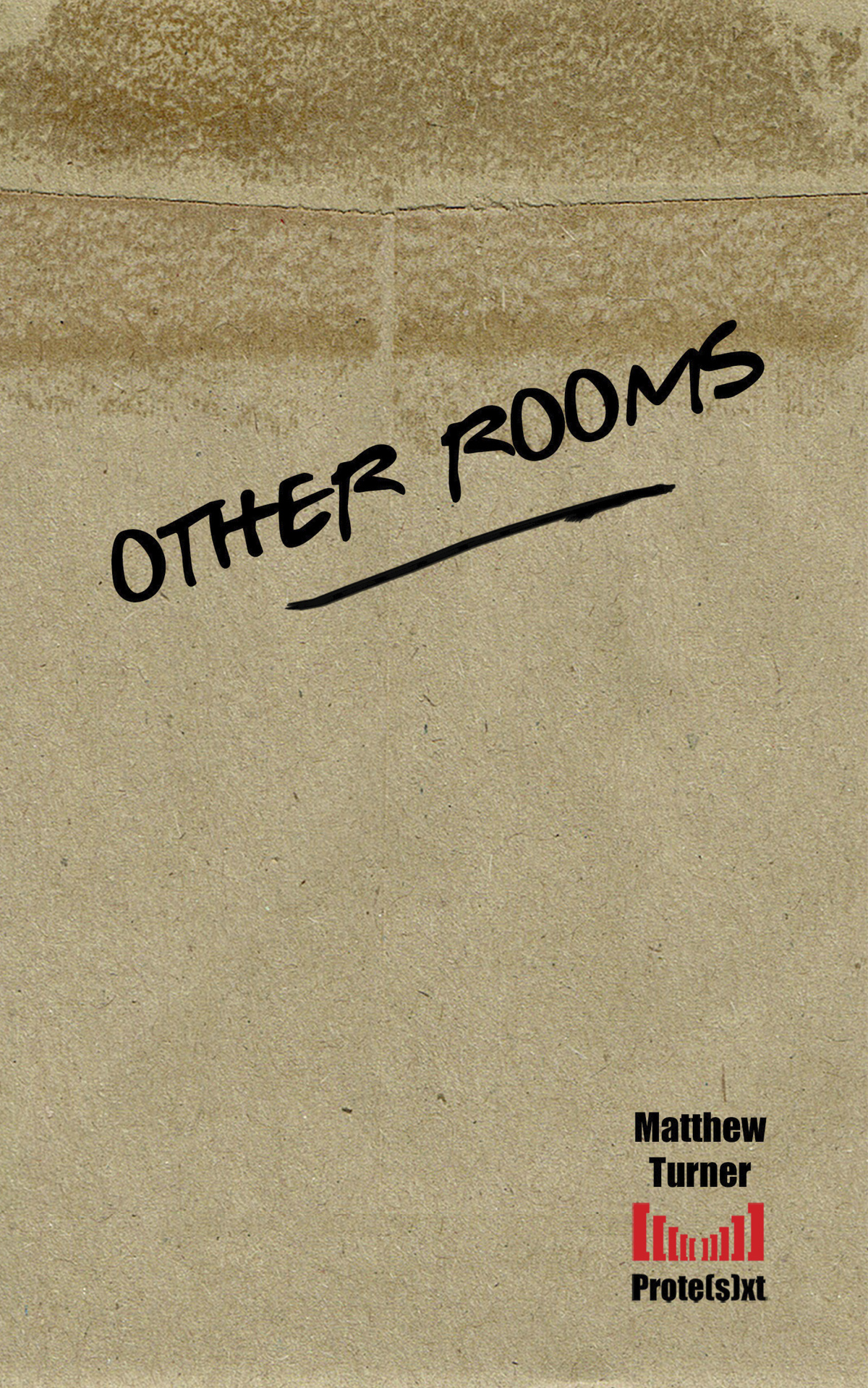
Matthew Turner, Other Rooms, Hesterglock

Press, 2019./ Dodo Ink, 2021.


excerpt (Google Books)

excerpts (minor literatures)

excerpt (Zenopress)


Other Rooms is the debut short story collection by Matthew Turner. It comprises three spectacular and uncanny stories set in storage units, thresholds, passages, geographic points and the mental spaces we occupy online. Originally published by Hesterglock in paperback, Turner's critically acclaimed collection has been released for the first time as an ebook by Dodo Ink. Other Rooms has attracted considerable praise, lauded by Will Wiles as 'I feel like 'ballardian' is an overused description, but- this is it, specifically JGB's own short stories', by Ruby Cowling as containing 'all the visual games and intellectual highs of a Tom McCarthy novel’ and M. John Harrison as placing us ‘accurately in the ideological volumes that shape us’.


“Other Rooms is a thing of unparalleled beauty. It tore me down and reordered me in constituent parts, and it aches and breaks in ways I don’t know how to capture”

- Emma Miles for Minor Literature(s), on Other Rooms   read mor here (pdf)


"This is tiny, so you've really got no excuse - three polished little tales linked by architecture and disturbing in-between spaces. I feel like "ballardian" is an overused descriptor, but - this is it, specifically JGB's own short stories." - Will Wiles


"These stories are a series of stretched and compressed thresholds between contradictory states. Told through architecture, they explore the luxury of being able to compartmentalise parts of our lives and the violence at the junction between them when they finally collide again. Although expressed through a specific sequence of architectural spaces, the psychological phenomenon is ubiquitous whether the spatial confines are there or not. The narratives consequently attempt to reveal the disquieting strangeness of making the syncopation of the digital world into a physical construct." -- lulu.com.


Other Rooms by Matthew Turner is a book about rooms, spaces, passages, geographic points and the mental spaces we occupy online.

It’s also about how we interface (or “buffer” as it’s so nicely put in the book) with the physical space around us, toggling as we do between our phones and the real world.

This book reminded me of La Jalousie (particularly the first section).

Isolation is another theme here and it’s hard not to see a subtle critique of the gentle self quarantine of social media.

Airports and hotels also get a debriefing :

I liked hotel rooms for their liminality, for their ability to facilitate the inhabitation of a realm between reality and fantasy. They also existed in a weird place between order and chaos; you can mess around with them as much as you like, move the furniture, leave your underwear strewn all over the floor, stain the sheets, and still, when you return at the end of the day everything will be back in its place. The legs of the sofa, for example, will have migrated safely back to the indentions in the carpet they have been cultivating for years. If only people were a similarly self-reordering system.

The whole time I was reading the first section I couldn’t get this game out of my head.

On a sentence level turners writing can startle take this example :

Oil is millions of years of Earth’s activity and energy rendered down into a slick darkly iridescent information archive. All the Sun’s energy, all the plant and animal life that had been and gone is contained within the acrid substance. It averages out the colour of the world’s history, and that average is dark. The oil disturbed me, like white noise did, because it facilitated a confrontation with too much information. - Judson Hamilton

https://queenmobs.com/2019/09/hey-there-chappie-7/


The Architecture of Fascism in Ingeborg Bachmann’s ‘Malina’


The Poetics of Non-Space: An interview with Matthew Turner

Matthew Turner interviewed by Andrew Gallix.

3:AM: Matthew, last year you were Visiting Professor of Architecture and Visual Theory at the University of Bergen, and are currently a Lecturer at Chelsea College of Arts, as well as an editor at an architectural magazine (LOBBY), so it seems quite natural that both your non-fiction (I’m thinking of your superb piece for frieze on the ‘architecture of fascism’ in Ingeborg Bachmann’s Malina) and fiction should revolve around architecture, as the title of your first collection of short stories — Other Rooms (Hesterglock Press, 2019/ Dodo Ink, 2020) — attests. Your fiction, in particular, delineates a poetics of space — an architecture of the mind — that often focuses, as we shall see, on the liminal or uncanny.

You seem to be exploring very similar themes — the intersection between built and mental space — through your academic work, criticism and creative writing: could you tell us a little about these different approaches?

MT: I could answer this by describing how they all relate, and they do, but the real reason is pragmatic. It’s difficult to have the time and funding to think and develop new work, and working across these different areas allows for that. The needs of the students and readers come first of course, and unpacking books which have triggered something for me, but a by-product is that the academic work and criticism are a kind of test site for what filters into the fiction. I don’t have the Nevada Desert to experiment in, however, these more immaterial locations work well at the moment.

The precursor to Loom was an essay on what I called ‘Interior Edgelands’ for Icon Magazine (Icon 196: The London Issue), where I showed how the traditional edgelands, those strange areas on the outskirts of cities where the urban met rural, were migrating inwards because of properties bought for investment and left vacant, and all the buildings sites that pollute the small fragments of nature in the city with toxic dust and other detritus. And that was what I initially proposed to Emma Bolland at Gordian Projects.

It was a bizarre proposition really but I set it as a kind of thought problem to myself and hoped someone else might be intrigued. I essentially wrote a proposal describing this perennially exchanging urban condition, and asked whether someone who was on the run could evade capture by using it. And that happens in Loom, an urban myth of a persona called Olian who is on the run and there are rumours of hidden money that apparently nobody can find.

At the time I was thinking about other crime fiction based on changing urban conditions, such as Chinatown (1974) with its backdrop of changing water landscapes, the California water wars, as well as Scarface (1983) which is supposedly set in Miami, though more often the locations are simulated with these brilliantly grotesque wallpapers and plastic palm trees which really capture the unreality of that city, and, how anything is permissible.

These two examples really capture what I’m interested in when it comes to space, something I explored in the Bachmann piece. There is lots of discussion about how spaces can express personalities and dogmas, while I think they are more effective as incubators that create personas. J. G. Ballard usually described his ‘psychic landscapes’ as emanations from his characters’ minds, but really I think his brutal environments are incubators for these characters. They are made by it and for me that makes them more powerful, because they are real and not fitful projections. You can also see it in Patricia Highsmith’s writing, who was well aware of how spaces can be used to uncover disassociated psychological states. Remember that her first protagonist in Strangers on a Train is an architect who becomes paranoid that his guilt will somehow be shown in the buildings he is designing, yet when they are reviewed his peers see only ‘serenity’. Again, Tom, in The Talented Mr. Ripley, people know he’s evil, however, he gains some kind of redemption because of his exquisite taste in clothes, furniture and painting — which is most likely Highsmith toying with the shallow morals of the reader. All this stuff is not an emanation of his good taste at all, rather the environment is Tom Ripley because he has no solid personality of his own. The intense opulence of this incubator he creates for himself only underscores his lack of psyche. Similarly in Loom I wanted to explore how a corrupt built environment can affect the minds of the people who inhabit it. What kind of person does corruption carve out?

read more here


4/8/21

Wolfgang Borchert caused an immediate furor throughout his native Germany with its youthful, indeed revolutionary, vision against war and the dehumanizing effects of the police state

Amazon.com: The Man Outside: Play & stories (9780811200110): Wolfgang  Borchert, David Porter: Books

Wolfgang Borchert, The Man Outside: Play &

Stories, New Directions; Revised ed., 1971.

read it at Google Books


This collection of Borchert’s most important prose, translated by A. D. Porter with an Introduction by Stephen Spender, includes the complete text of the title play, as well as 39 stories and assorted pieces that comprise much of the author’s output during the two short, fever-ridden years in which he wrote, complemented by Kay Boyle’s appreciative Foreword.

Wolfgang Borchert died in 1947––the twenty-six-year-old victim of a malaria-like fever contracted during World War II. This was just one day after the premier of his play, The Man Outside, which caused an immediate furor throughout his native Germany with its youthful, indeed revolutionary, vision against war and the dehumanizing effects of the police state. In a very real sense, Borchert was both the moral and physical victim of the Third Reich and the Nazi war machine. As a Wehrmacht conscript, he twice served on the Russian front, where he was wounded, and twice was imprisoned for his outspokenness. His voice speaks plainly and


"['The Bread' is] a document, an eyewitness testimony to starvation but also a masterful story, cool and spare, not one word too few or too many."― Heinrich Böll


"Caught between departure and arrival, in the middle of Borchert's world, stands the wanderer, the seeker...who is pursued by his own memories and by the question of guilt."― Alfred Andersch


Wolfgang Borchert (1921-1947), a German author and playwright, served in the Wehrmacht during World War II. While there, a cut on his hand became infected and he contracted hepatitis, a condition that continued to worsen. In 1946, after the war ended, doctors gave him a year to live. With little time left, he wrote prose and poetry. He wrote The Man Outside in January 1947, shortly before passing away.

4/7/21

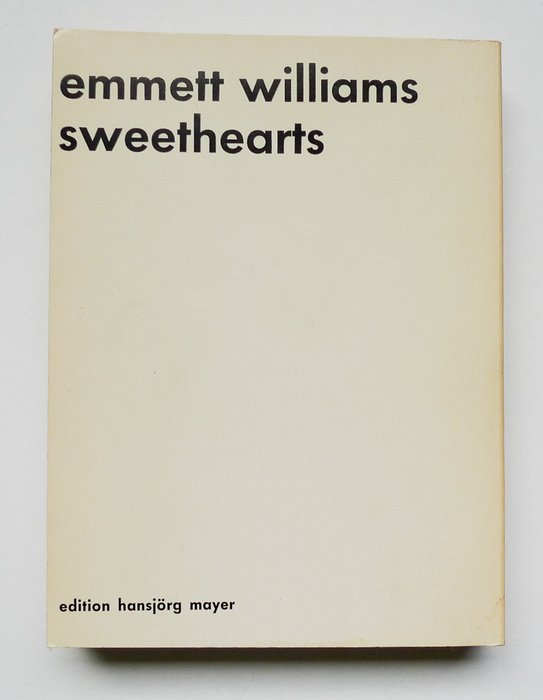
Emmett Williams - exploring the possibilities and limitations of the word ‘sweethearts’ using an eleven-by-eleven grid (the number of letters in the word itself). The book is deliberately typeset backward, opening from left to right, accentuating the fact that it can be read as a flip book

Sweethearts: Williams, Emmett: 9783865608109: Amazon.com: Books

Emmett Williams, Sweethearts, Walther König,

Bilingual edition, 2011 [1967]

https://www.sweetheartsweetheart.com/


A founding member of Fluxus and the concrete poetry movement, Emmett Williams (1925-2007) made several performances and poems that stand today as defining gems of those genres. Among them is the book-length concrete poem Sweethearts, first published by Something Else Press (where Williams was editor in chief) in 1968, and back in print for the first time, still sporting its classic cover by Marcel Duchamp. Sweethearts is an anagrammatic erotic encounter between a "he" and a "she," whose entire vocabulary is derived from the word "sweethearts." The letters maintain the same spacing in every word on each page, lending the volume a flipbook dimension that Williams enhances by organizing the text to read backwards, so that the reader can flip the book with her or his left hand (thus the front cover is on the back, and vice versa). Richard Hamilton described Sweethearts as being "to concrete poetry as Wuthering Heights is to the English novel... compelling in its emotional scope, readable, a sweetly heartfelt, jokey, crying, laughing, tender expression of love."


Emmett Williams’s Sweethearts (1967), in which the title word is subject to sequential typographic variations that, as you turn its pages in Hebraic sequence, evoke a heterosexual relationship, introducing the possibility, still scarcely explored, of writing visual fiction with minimal verbal material. (A shorter fiction on the same theme is Norman H. Pritchard’s brilliant “Hoom” [1970], published in Ishmael Reed’s 19 Necromancers from Now (1970). Here two-page spreads filled entirely with “sh” are punctuated by a progressively increasing number of spreads with other kind of wordless typographical arrangements.) - Richard Kostelanetz

https://neglectedbooks.com/?p=6448

Sweethearts by Emmett Williams


I love this book! Emmett Williams takes a very basic building block (the letters in the word "sweethearts") and uses them to tell the tale of a romance in progress. It's a very smart book that will open your eyes to new possibilities in narrative.

Please note: This book is for people who are open-minded about literature. Not for someone who's looking for a typical sort of reading experience. - Tim Callan @ amazon.com


Emmett Williams - Sweethearts - 1967 - Catawiki

The white cover edition of Williams’ iconic and intimate artists’ books exploring the possibilities and limitations of the word ‘sweethearts’ using an eleven-by-eleven grid (the number of letters in the word itself). The book is deliberately typeset backward, opening from left to right, accentuating the fact that it can be read as a flip book. Through the arrangement, addition, and omission of letterforms all set in the font Futura, Williams creates one of the most timeless and cinematic pieces of concrete poetry of the1960’s. Published a year before the Something Else Press edition in 1968.


Richard Horn - a novel written as alphabetized entries in a small, one-volume encyclopedia concerning the affairs of a group of New York-area poets and writers. The entries aren't your standard encyclopedia listings; instead, you get entries like "Straight Left Jab, A," and "Rita Meter Maid Handbags"

Encyclopedia: Horn, Richard: Amazon.com: Books

Richard Horn, Encyclopedia, Grove Press, 1969


This daring novel is structured as a series of alphabetical entries, complete with definitions, dates, verbatim dialogue, lists of objects, and cross-references, that the reader can use as he pleases. The dates of various events, given within the entries, carry the narrative forward, so that the reader is made aware of the ultimate fortunes of the characters by means of a multiple, interior chronology.

In the book, the author has delineated a literary community whose main points of concentration are New York City, Hoboken, New Jersey, and Provincetown, Massachusetts. The people are familiar enough--bohemians, failed poets, celebrities who maintain ties with their lesser-known peers, and the endless "artistic" hangers-on that such communities inevitably attract. What is not so familiar is that the author has contrived not only to write a book that is flashingly funny, he has endowed this community of letters with the bitter addenda that make his humor all the more poignant.

The basic story is of the desperate and unhappy love of Tom Jones, a young, aspirant poet, for Sadie Massey, a well-off girl who has flung herself into the several bohemias available to her, and embraced, with equal fervor, drugs, alcohol, art, and sexual promiscuity. Their love affair, and the background of mutual friends and enemies against which it is set, reveals a cross-section of urban artistic life that is limned with a clarity and acuteness that borders on the photographic.

Richard Horn is a native New Yorker. Encyclopedia was written over a two-year period when the author lived in Mexico. For the past year he and his wife have been traveling throughout India, and he is well into a second novel based on his Indian experiences.


Richard Horn’s Encyclopedia (1969), in which alphabetized notations (filled with cross-references worth following) weave an ambiguous fiction about human interrelatonships, paradoxically disordering by reordering and thus forcing the reader to pursue his or her own path in experiencing the fiction. (Why haven’t we heard from this author again? He seemed too sophisticated to be a one-shot. Someone once suggested Horn’s name might be a pseudonym for Gilbert Sorrentino, who worked as an editor at Horn’s publisher around that time; but Sorrentino’s own novels are not quite so good.) - Richard Kostelanetz


"There is a good bit of fun in the doing, particularly in watching the author contort his entries to tell the rudiments of a situation. (...) Unhappily, the book has all the gripping development and vitality of the latest Britannica." - Edward M. White, The Los Angeles Times


"The writing is formidable and formed, despite the formlessness of its vehicle. (...) Surprisingly, the style works. But the story Encyclopedia conveys is banal and ultimately a bore." - Tom Rettew, The Morning News

Encyclopedia: Horn, Richard: Amazon.com: Books

Encyclopedia: Horn, Richard: Amazon.com: Books

Yet another forgotten sixties novel from an author who seems to have published nothing else, 1969's "Encyclopedia" by Richard Horn lives up to its title in that the narrative is relayed by a series of alphabetical entries spanning the years 1965-1967, concerning the affairs of a group of New York-area poets and writers. The entries aren't your standard encyclopedia listings; instead, you get entries like "Straight Left Jab, A," and "Rita Meter Maid Handbags." Likewise the main characters are given their own listings, which provide brief biographical details as well as clues about what happens to them after the narrative proper. Cross-referencing is the order of the day; I flipped through this book more than one of those "Choose Your Own Adventure" novels I devoured as a kid. This really heightens the interactive aspect of the novel. You'll be reading about, say, Sadie Massey (the boorish harlot-in-training, rich NYC girl whom our mediocre hero Tom Jones lusts after), and then flip to and fro through the pages, glimmering additional details about her. Horn, in his short intro to the novel, explains that cross-referencing is key to gathering the narrative; you can't just read from listing to listing. So all this is novel and exciting: an interactive entertainment decades before the internet.

Only problem is, the story and its characters are about as mundane as standing in line at the post office.

I use "story" in its most liberal sense. This novel is really more of a haphazard collection of what seems to be the author's personal memories over the years 1965 to 1967, with listings derived from lines of dialog between various characters, and events ranging from hanging out at bars to poetry readings. Nothing much happens.

The plot which can be excised concerns Tom Jones, a poet (and we get several lines of his and other characters' lines) who, after having an affair with Valerie Johnson, the wife of his instructor, moves to Putney, MA and becomes involved with the aforementioned Sadie Massey. Sadie features all those stereotypical tropes we know so well of the sixties socialite ultra-hip chick, sleeping with anyone or anything, engaging others in brainless banter, and invoking ire in the reader. The cluster of artists and poets who surround these two are an execrable lot who drone back and forth about the usual sixties topics: sex, drugs, the "new, electronic music" that's so hip with the kids. The crux of the plot (and this is revealed in the first few pages) is that Sadie eventually leaves Jones in Fall of '66, going to Europe with the older, successful author Blacky Falis (a bitter curmudgeon I bet was modeled on Norman Mailer). Throw in a brief cameo by Neal Cassady (to whom the novel is dedicated), another fictional author who seems modeled on Ginsburg (who factors into the book as well), and lots of talk about the relativity of art, and you have what seems to be the memoirs of someone who was on the inside, who knew a lot of the movers and shakers of the time.

This raises the question of who Richard Horn was (and is). The author's bio on the inside back jacket flap reveals that he and his wife had recently been India, with Horn working on a novel about his experiences there. Yet the promised novel seems to have never been published. In fact it seems like nothing else came out by the author; I've come across some Fifties-style design books published in the 1980s by a "Richard Horn," but I don't think it's the same guy.

So was this a pseudonym of another, better-known author? Or was Horn unable to secure a second book contract, only to become yet another sixties author (like Lee Richmond, William J. Craddock, Dow Mossman, countless others) who was never given the chance to fulfill his early promise?

"Encyclopedia," needless to mention, is out of print. It only seems to have had one edition, the original hardcover release from Grove Press in 1969 (the novel's very short, I should mention - a little over 150 pages). I can't see the day that it's back in print. It's such a snapshot of its age, a frieze of its time, that I can't see the modern reader relating much to it. Too late for the Beatniks, too early for the hippies, "Encyclopedia" is stuck in that short period of the mid-sixties of Beatle boots and Bohemian hipsters. What I'm saying is, it's not what one thinks of, these days, when one thinks of "THE SIXTIES."

So then, a brave experiment which is rewarding in its own right (with the focus on dates and places, I suspect you could piece together all sorts of hidden revelations if you took the time with it), but which is failed by its mundane characters and story. Mildly recommended to other devotees of Sixties Lit, but in no way a forgotten classic.

It gets a bonus point for mentioning Gaddis's "The Recognitions" as "the best in English," though. - Joe Kenney @ amazon.com


A work of fiction, Richard Horn's novel nevertheless also lives up to its title, as it is presented in encyclopedia-format: the chapters proceeding alphabetically, each with one or (usually) more entries (that are in turn also presented in alphabetical order). Encyclopedia is not all-encompassingly encyclopædic -- it's a slim work if 165 pages, the total number of entries probably somewhere around three hundred; it doesn't even have entries for the letters Q and X -- but what there is is presented true to form. As a Preface explains, however, this work is different from the familiar encyclopedia in that:

It is not an encyclopedia or encyclopedic dictionary of general knowledge, but of particular knowledge, and it is not derived from any previous encyclopedia.

(Horn suggests: "Such a work is called on the Continent a hand encyclopedia", though this does not seem to be a common usage or term.)

What stands out immediately is that the entry-terms are largely not those one would expect in any sort of traditional encyclopedia and, even more so, that the entries themselves then are defined and explained in very personal, local, and particular terms. So, while the first entry is a more general one, the definition/explanation itself then focuses on a specific incident rather than more general description:

ABORTION: self-induced by SADIE MASSEY (Aug. 3, 1966) in Ptn, Mass.; induced by an ampule (100 mg) of ergotamine tartrate injected intramuscularly and pethadine, a synthetic morphine; Massey was assisted by TOM JONES, who believed himself responsible for the embryo. Massey said, "Up to two months this is the safest and easiest way. More girls should know about it."

Horn also emphasizes in his Preface:

In this book the cross-references are of the utmost importance. These cross-references are indicated by ITALIC CAPITALS. Furthermore, a person, place, or thing which has its own entry in this volume, when first mentioned in an entry other than its own, is in SMALL CAPITALS. The cross-references are not used recklessly; every possible effort has been made to guide the reader through only the relevant material, and to insure that the information under the other heading will be useful.

The novel is thus not built up in a straightforward sequential way, but rather with its pieces arranged in a very neat -- alphabetical -- but largely counterintuitive order. Many of the entries are dated, helping readers (re-)arrange a chronology of events, and, as promised, Horn does cross-reference related entries, but cause and effect are nowhere near as clear as they are in conventional fiction.

There are also separate entries for each of the individuals that figure in the story, but in this way the cast of characters is only introduced piecemeal and, being presented alphabetically, not in the order of appearance or importance (though, of course, readers can easily jump ahead and look up the basics about each character as soon as they are named, beginning with Sadie Massey and Tom Jones).

As with the incidents and objects that rate entries, the person-descriptions vary greatly in what and how much information is provided. The first -- Lane Anderson -- is the most detailed and traditional (if, as such, also very impersonal), with everything from his home address and telephone number to an entire curriculum vitæ, complete with a three-page listing of each poem he has ever published, and where. Other entries are more specific and revealing about specific aspects of the person's life, or limited to certain parts of it.

The range of entries is great and amusing, from food ('JAR OF SPANISH OLIVES'; 'THREE BOILED POTATOES' (yes, listed under 'T')) and meals to statements, poems, and letter-headings ('DEAR DR. LORENZ,') to general-specific descriptions ("RAINY AFTERNOON (July 26, 1966) in Ptn., Mass."); one is a: "LIST OF BOOKS, on TOM JONES'S bookshelf (606 Comml. St.) Ptn., Mass. (June-Oct., 1966)". The variety ranges from 'ORGIES' to the number 'NINE' to a game of 'MONOPOLY' to one that begins and asks:

WHY IS EVERYONE SO CRAZY ? question raised and answered (Aug. 21, 1966) by TOM JONES in Ptn., Mass.

Most of the action takes place in 1965 and the summer of 1966; a great deal involves sex and drugs; several of the characters are writers, of varying success, with quite a few poems also presented in full. It is very much a novel of the mid- to late-sixties -- down to Jones having a first edition of "FIXER, THE", by Bernard Malamud. The novel is dedicated to Neal Cassady, and there's a longer entry given over to a declamation of his (while wearing the: "UNMATCHED BOOTS (PAIR)" of that entry).

In his Preface -- writing as 'Editor-in-Chief' (rather than author) --, Horn suggests that:

We feel we have performed a service for the modern American reader by ordering the data of particular, daily life in a form already familiar in grasping the entire range of general knowledge (and most specialized fields), and thus affording the reader a new perspective from which, perhaps, he may better his understanding.

The 'particular, daily life' is of its place and time, and the presentation of it certainly a different, and arresting, way of looking at it.

In the entry on the "NEW YORK TIMES SUNDAY BOOK REVIEW" ("wadded into ball and thrown (Aug.23, 1966) into the fireplace") Jones quotes from Percy Lubbock's 1921 The Craft of Fiction (the author's name misspelled -- intentionally ? -- in the text as 'Kubbock'):

"As quickly as we read a book, it melts and shifts in the memory; even at the moment when the page is turned, a great part of the book, its finer detail, is already vague and doubtful. A little later, after a few days or months, how much is really left of it ? A cluster of impressions, some clear points emerging ... is all we can hope to possess." Jones asked Falis why someone hadn't written a novel made up entirely of these "clusters of impressions," since they were all that remained, regardless of the manner of composition.

This is the closest Horn comes to explaining, in the novel itself, what he is doing in Encyclopedia, which is ultimately such a 'cluster of impressions'. The novel succeeds as such -- but also largely only at that level, as the story -- the intermingling of the characters and the consequences -- is, for the most part, not particularly compelling. Almost disarmingly true to life in its bits and pieces -- the episodes and events recounted in Encyclopedia feel quite authentic --, that isn't enough to make them, or any story pieced together from them, truly engaging, beyond the effort of piecing things together. (In that way it is of course very true to life, which, in simple description, is often very boring.) Ironically, Encyclopedia is simply not encyclopædic enough: a larger, denser net of terms and cross-references likely would have made a greater impression. than the somewhat limited cluster on offer here.

Encyclopedia does largely succeed on its own terms; as such, it's an interesting play-on-form, as well as reflection of and commentary on both the place and time of its writing, as well as American writing itself (especially the experiments of those times; one couldn't hit the nail more on the head than this being first published by Grove Press in 1969).

Encyclopedia is ultimately more a curiosity than a good read, but it is, and remains, of interest.

- M.A.Orthofer

https://www.complete-review.com/reviews/usx/hornr.htm


Tough Poets Press, 2023

New edition of Richard Horn's forgotten literary oddity (and his only published novel), Encyclopedia, originally published by Grove Press in 1969.

A brief description from the October 24, 1969, TIME magazine review: "The hapless love affair of hopeful poet Tom Jones and wealthy, bohemia-bound Sadie Massey is cross-referenced in brief, satirical, encyclopedic passages from ABORTION to ZOO CAFETERIA."


The narrative is entirely multilinear, and the author's preface advises the reader not to read it from beginning to end, but rather to explore the book following the cross-references.


". . . a nice smattering of sex and on the whole is quite enjoyable."— St. Louis Post-Dispatch, December 7, 1969


"The author's treatment of the subject, the inventive structure of the book make it something with which the student of the novel ought to become familiar."— Green Bay Press-Gazette, November 30, 1969


"There is some excellent comedy in the book and some of the descriptions of the swinging scene are extremely entertaining. Horn also has a very considerable gift as a parodist."— The Province (Vancouver, BC), October 25, 1969


"It's a daringly original idea, but it comes off successfully and effectively. . . . Author and publisher alike are to be commended for their venture into the use of such an extraordinary device."— Argus-Leader (Sioux Falls, SD), November 2, 1969


"Surprisingly the style works."— The Morning News (Wilmington, DE), November 6, 1969


"Richard Horn has it."— The Cincinnati Enquirer, January 4, 1970