12/29/17

Benjamin Zucker takes his form from the Talmud—a central text surrounded by commentaries, with each page accompanied by a photo or artwork on the opposite side. The novel's main character, Abraham Tal, is (like Blue's author) a gem merchant in New York City

Image result for Benjamin Zucker, Blue,


Benjamin Zucker, Blue, The Overlook Press, 2000.

Modeled after the Talmud, this uniquely constructed novel introduces Abraham Tal, a New York diamond merchant who spends his days counseling friends and neighbors from his shop. A first novel.


An imaginative, unusual layout inflates Zucker's novel into a true novelty as well as a detailed, heartfelt love story. Modeling his book on the Talmud, Zucker places a brief chapter of the tale in the center of each odd-numbered page, surrounded by commentary on the passage by such figures as Kafka, Vermeer, Monet, Joyce, Bob Dylan, Bobby Fischer, an assortment of ancient Greek and Jewish scholars and the central character's family and loved ones. Photographs and paintings on facing pages reference images from the text. In the core story, a young artist named Dosha seeks counsel from Abraham Tal, a New York diamond merchant whose avocation is dispensing advice: for $1 he counsels how to change your life; for $2 he tells you how to change it back. Dosha wants to know how to get her lover, Raphael Fisher, to marry her. Abraham, who has not proposed to his own girlfriend, Rachel, sees Fisher on Dosha's behalf, and in the meantime confronts his own family and Joycean memories. From this simple encounter a universe unfolds. Like all the novel's commentators, Joyce chimes in with advice and personal perspectives, riffing off the main story in quotes from published works or works of Zucker's imagination. Reproductions and details from the artistic creations of Vermeer and Modigliani, and from ancient Jewish texts, are extraordinarily beautiful. Antique jewelry is featured, too: a Venetian wedding ring is portrayed through photographs and in Abraham's mother's and grandmother's stories, as a symbol of cultural, religious and personal heritage. While cleverly presented, the descriptions sometimes grow tedious, however. Zucker himself is an established jewelry expert, the author of several books on gems and culture (Cameos in Context) and he treats this slight but multifaceted story like a precious jewel, looking at it from all directions, holding it up to the light, under the microscope, defining its color and shades, detailing its beauty and imperfections. - Publishers Weekly


The author of several nonfiction books on gems and jewelry draws on his expertise for an ambitious first novel of challenging design.
Zucker takes his form from the Talmud—a central text surrounded by commentaries, with each page accompanied by a photo or artwork on the opposite side—but the format looks denser than it is. In essence, the author simply embellishes a mundane core story with lots of modernist gestures, a hodgepodge of quotation and imagination that draws on everyone from Kafka to Derrida. His gallery of images is mostly a hall-of-culture heroes: Bob Dylan, Jackson Pollock, van Gogh, Vermeer, assorted rabbis and yeshiva students. At the heart of this collage is the tale of New York City diamond merchant Abraham Tal, who serves as a counselor to his Hudson Street neighbors, doling out advice for two dollars a session. Dismissed by his jewelry-dealing older bother as a pathetic loner, Abraham blames this same brother for all his worldly troubles. A long-ago thwarted marriage in Antwerp obsesses Abraham to the end, which eventually comes in an Israeli synagogue attended by his faithful nephew Isaac. Before that, though, Abraham smartly advises Dosha, a local painter, on how to win in marriage her Yalie boyfriend, Fisher, an aspiring author hoping to write The Great American Novel. The final scene finds Isaac’s son, years later, in the Israeli desert, fulfilling the dream of his great-uncle in a moment of transcendent blueness. Zucker’s “guide to the reader” invokes Joyce and Fitzgerald, but these references are unmerited conceits; his commentators are mostly idle kibitzers who rarely add anything essential to the simple text, and his quotations are often quite commonplace.
The various materials assembled here might add up to a novel, but not without greater authorial inventiveness. - Kirkus Reviews


Blue, a wildly original first novel by Benjamin Zucker, is a richly illustrated, multilayered story about aesthetics, love, brotherhood, and tradition. The novel's main character, Abraham Tal, is (like Blue's author) a gem merchant in New York City. Tal's treasure is a Venetian Jewish wedding ring, a mysterious link to the traditions of his family and his culture; his search for the ring's origins and significance drive the book's main plot. Blue's design is highly unusual and worth close attention. The text of the main story, about Tal and the ring, appears at the center of every other page in the book (each page of text faces a full-page illustration, meant to shed light on the story--subjects range from a photograph of the Taj Mahal to a self-portrait by Claude Monet). This central text is surrounded by commentaries in the margins, which are written in the voices of historical characters such as Vermeer, Crazy Horse, Bob Dylan, Proust, and Kafka, as well as the voices of Tal's mother, father, and girlfriend. The commentaries, like Talmudic writings, play with, build upon, and illuminate the primary story. Blue moves fluidly through time, offering its reader countless opportunities to discover the harmonies and beauty that, over the course of this story, its main character gradually learns to see. --Michael Joseph Gross


'Blue' is a multifaceted work that has no beginning and no end, no straight lines, and where the past and present intersect. In that sense, it is a design fabricated to evoke the experience of Kabbalah. At the same time it is constructed like pages of Talmud with a central text that contain the modern story but vaguely evoke relationships and events in the Torah, and with parallel commentaries/stories on the margins, the story spins off in many directions, sometimes off on its own tangents and sometimes bending back on itself to illuminate and elucidate the text. These parellel stories are a comingling on each page of famous Jewish mystics such as Luria, numerous Rabbis of old, with Kafka, Bob Dylan, Vermeer, a Native American chief, and the fictional Tal's parents, taking the form of direct quotes, actual and imagined lives which can be read in any order along with or without the main text. In yet another dimension, this is also a great art book of past and present, combining masters like Van Gogh and Vermeer with photographs of Kafka and Bob Dylan, and of Jewish scholars and students in Poland prior to World War II. The art work, too, also intended as a commentary to interact with the various texts.
The central story, which reads like an allegory belongs to Abraham Tal, a New York gem merchant and advice giver, who can't solve his own problems. Among other concerns, he is torn with indecision and regret about whether to marry Rachel Heller. Eventually this leads him on a journey to Safed, the center of ancient Jewish mysticism, presumably to track down the origins of a 16th century Venetian wedding ring, which of course contains a sapphire, but also as a personal quest for spiritual answers.
Blue holds many meanings. The most obvious is the blue sapphire gem which narrator, Abraham Tal, is using to make a suite of jewelry. Tal connects the word sapphire to "sefer" which means "book" in Hebrew, and to the giving of the book, the story of Moses finding a blue sapphire at the burning bush and the continuity of a people commemorated in the blue thread of the tallis. There is much more. Almost every page refers to a blue stone, blue in someone's clothing, blue walls, blue light.
I found Mr. Zucker's notes at the beginning and end of the book a good source as well as a help to confused readers. One cannot help but be confused (it even seems intentional), but at the same time delighted with this highly imaginative and light-hearted multimedia feast. - Lynn Adler @ amazon.com

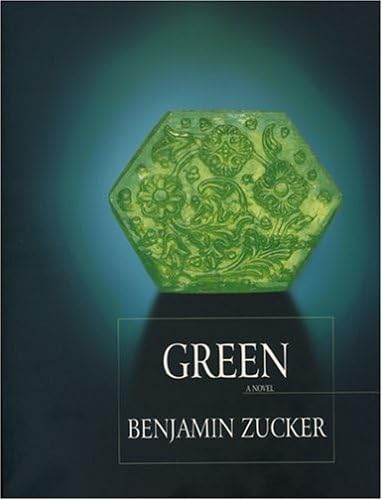
Image result for Benjamin Zucker, Green,
Benjamin Zucker, Green, Overlook Books, 2001.


A richly-textured novel, filled with paintings, illustrations, and photographs, details Abraham Tal, a New York gem merchant and advice-giver to his friends and neighbors in Greenwich Village, who has inherited a spectacular realm of voices, including Borges, Breton, Monet, and Melville - all of whom vie for his attention in order to dispense important information.


Picking up where he left off in the remarkable Blue, Zucker once again mixes art, history and narrative to examine the fate of a young Jewish man in New York. Using the same Talmudic style, in which the main story is placed in the center of the page and surrounded by blocks of running commentary, Zucker introduces the plight of Raphael Fisher, a writer at Time Inc., who finds himself unable to make a decision abut his relationship with Dosha Jerusha. Fisher's confidant is the same gadfly gem dealer who starred in Blue, Abraham Tal: he steers Fisher in a variety of philosophical and artistic directions for guidance as the writer pens the proposal for Green and tries to get some attention for the project from Time mogul Henry Luce. The inevitable movement toward the wedding is almost an afterthought as Fisher journeys along his unique path, accompanied by real and imagined commentary from the likes of Fisher's parents, Vermeer, Bob Dylan and F. Scott Fitzgerald. Given the ambitious but somewhat fragmented concept, the beauty of Zucker's book will rest in the eye of the beholder: fiction fans who prefer a straightforward narrative will tend to see it as a coffee-table art book containing a rather disjointed story, while art devotees looking for something more than a coffee-table book should be entertained by the inventive combination of gorgeous visuals and intriguing commentary. - Publishers Weekly


Green continues the story that began with Zucker's previous novel, Blue, about a New York gem merchant named Abraham Tal who offers advice to friends and family from his shop in Greenwich Village. Here Abraham guides Raphael Fisher, a young writer unable to make up his mind about a relationship, as he takes on a series of artistic and spiritual endeavors. Like its predecessor, Green combines an ingenious use of graphics and layout (each page is faced with color reproductions of, for example, C‚zanne and Vermeer paintings, as well as images of jewels and calligraphy) with an exuberant intersection of voices that jostle one another across the pages. The novel is laid out in a manner similar to the Talmud, with a main narrative passage occupying a block in the center of the page and surrounded on all sides by passages from other authors, among them Bob Dylan and Marcel Proust as well as Abraham's own ancestors, who offer their commentary on the story as it develops. This beautifully produced and inventive second novel by Zucker, himself a New York gem merchant, is recommended for all literary collections. - Philip Santo


Image result for Benjamin Zucker, White:
Benjamin Zucker, White: A Novel, The Overlook Press, 2008.               


Talmudic in form, sui generis  in conception, this novel completes the story of the Tal family, a New York City family in the gem business, begun in Blue  and Green. The story is juxtaposed against marvelous images, among them paintings from Mary Cassatt and Vermeer and a collection of photographs, ranging from Bob Dylan, to the Wild West days, to moving works by Roman Vishniac. An extraordinary novel that is at once broad in its outlook and deftly self-referential, White  concludes a remarkable family saga.

D. Keith Mano - It is as if Joyce, for his sins, had been forced to grow up in Queens; as if Beckett had been mugged by Godot in a Flushing comfort station; as if Sid Caesar played the part of Moby-Dick in a Roman Polanski movie shot underwater in Long Island City; as if Heidegger had gone into vaudeville and... never mind


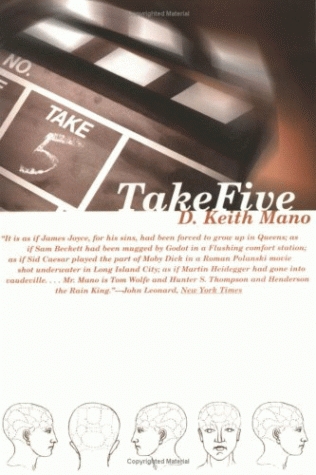
D. Keith Mano, Take Five, Dalkey Archive Press, 1998.


Welcome to the world of Simon Lynxx and to one of the great overlooked novels of the 1980s. Con-man, filmmaker (currently working on producing “Jesus 2001″, what he calls the religious equivalent of The Godfather, best known for his movie “The Clap That Took Over the World”), descendent of a wealthy and prestigious New York family whose wealth and prestige are on a sharp decline, racist and anti-Semite (though Simon dislikes all ethnic groups equally), possessor of never-satisfied appetites (food, women, drink, but most of all, money and more money), and the fastest talker since Falstaff, Simon is on a quest that goes backwards.
Through the course of this 600-page novel, Simon loses, one by one, all of his senses (taste is lost when trying to siphon off gasoline for his roving, broken-down production van), ending in a state of complete debilitation in which he is being made ready for eternity and salvation.
As energy packed as a William Gaddis novel and as rich in language as a Shakespearean play, Take Five is a modern masterpiece that is at once a celebration of life and a morality play on excess, as though anticipating the self-indulgent “me generation” of the decade.


Mano (The Death and Life of Harry Goth, Horn) still hasn't really found a steady focus for his exuberant, caustic verballismo; this very long, very dense novel repeats itself, sags periodically, and never lives up to its grandiose blueprint. But. . . it's funny, laugh-out-loud funny a lot of the time--and that's nothing to sneeze at, even if Mano-vian humor continues to be off-limits for those unsettled by sex-jokes, Jesus jokes, ethnic jokes, or scatology. The source of all this hilarious foulness is Simon Lynxx, a non-original but grandly cumulative creation: the total sum of every abusive, narcissistic, selfish creep in comedy--from Volpone to Sheridan Whiteside to Don Rickles. Simon, you see, is a filmmaker (The Clap That Took Over the World, Diner), and he's broke again, without the funds needed to continue work on Jesus 2001. (""I have something in mind like Truffaut's Day for Night, but without the frog mannerisms. Get it? Huh? Or am I talking to a piece of wallboard?"") So Mano follows Simon's picaresque pursuit of cash--a pursuit which causes him to lose each of his five senses, one by one, in slapsticky accidents (the novel, by the way, is paginated backwards); and since Simon travels, in his film-co, van, with a female/Jewish/homosexual production team, there's lots of bigot-buffa to fill in between adventures. Some samples of Simon's fund-raising schemes: he returns to loot his ancestral manse--Van Lynxx Manor in Bayside, Queens--but finds that it's been donated to the Landmarks Commission (15 black schoolkids on a tour encounter the naked Simon in the Martha Washington bedroom); he becomes a courtesan, dressing up as a tango-dancer to service an elderly, addled matron; he renames his film Jesus 3X, puts on blackface, and tries to get Minority Incentive funding (""I gonna need more than six tits an' a clean sheet. Jesus 3X is a major minority flick""); he hires two black pals to mug old movie-titan Herman Wolff, so that Simon can save Wolff and cash in on gratitude. (Wolff comes across, but Simon has to dish up a new scenario: ""I've just ransacked North Banality for a four-Kleenex screen treatment. . . Dogs and little boys. Crippled little boys."") And when Simon also tries to seduce an heiress--""you, my tiny side order of spaetzle, you have a great face""--it's a case of mistaken identity that leads him, slowly, to true-love Merry, a wearisome philosophy major. Heard enough? Well, there's lots more: Simon's trysting with van groupie Mrs. Minnie Fischer, she of the bronze bas-relief-cum-chastity-belt; the sexual fate of Minnie's teenage son; Simon's memories of his grotesque parents, with family secrets to be revealed; send-ups of the media, artsy and otherwise; etc. And, throughout, there's that loss-of-the-senses framework--which, though never leaned on pretentiously, does eventually take on some (if not enough) resonance: Simon is left a zombie/vegetable, loved by Merry but otherwise destroyed by his dubious art-quest. As a parable of the artist's fate? Half-baked. As a bravura mega-fiction? Richly uneven. But as a showcase for Mano's comedy--the allusive lancings, the verbal vaudeville, the thesaurus of insults, the scenic invention--this is just fine: if you're not easily offended, you'll be easily, repeatedly blasted into fits of shamefaced laughter. - Kirkus Reviews


IT is as if James Joyce, for his sins, had been forced to grow up in Queens; as if Sam Beckett had been mugged by Godot in a Flushing comfort station; as if Sid Caesar played the part of Moby-Dick in a Roman Polanski movie shot underwater in Long Island City; as if Martin Heidegger had gone into vaudeville and ... never mind. Just boggle.
D. Keith Mano used to show up with a novel almost as often as the children come home with report cards. ''Take Five,'' however, took him nine years. It is long enough for three ordinary novels and seems even longer because, second of all, it is paginated backward, and, firstly, every bone of it is scrimshawed. There isn't a word that hasn't been tattooed. It weighs on the eyes. And it seems to be trying to offend every race, color and creed.
Meet Simon Linxx. He is 6 feet 3, sometimes in a burnoose, sometimes in a gorilla suit, and believes himself to be descended from the Dutch who inexplicably decided to squat in surprising Bayside. His father had a radio program, his mother sucked his blood, and he wants to make a movie, ''Jesus 2001,'' in which the Three Wise Men get off the D train and Christ is either an epileptic or a drug addict or ''lead guitar with a group called the Gadarene Swine.''
Making movies is expensive. For most of ''Take Five,'' Simon tries to raise money. He will be, variously, black and Jewish and Spanish Republican. He will talk incessantly about sex and not get any. He will lose, one by one, all five of his senses, beginning with ''the fire in your mouth.'' When he falls, too late, in love, she will be a priest, and the cross she wears will be abstract, ''Jesus crucified, expressing Cubist pain.''
Simon despises abstractions. Nor does he believe in history: ''He hasn't seen it.'' He can't understand stillness: ''It is, to him, not viable.'' He is fast, ''but he has never yet been spontaneous.'' He hates laws and fears madness and treats everyone like a Polish joke. ''I don't have many friends, but my enemies are very careful.'' Not even Sweden is safe: ''The gross national product is hypocrisy and nudist volleyball.'' He thinks of himself as ''the fullness of time,'' ''a sweeping generalization,'' ''the eye of America'' and ''the origin of the species.'' He is, we will learn, ''dying of perception,'' of a ''cancer of the impressions.'' A woman who loves him asks, ''Who writes your material, Sophocles?''
A novel as demanding and resonant as ''Take Five'' needs explaining, and the explaining will use up too much space. But before we get at it, this should be said: More than half of ''Take Five'' is hilarious, even when it is vile. Mr. Mano speaks in many tongues, all of them vipers. What he tells us about Hollywood, the art world, Episcopalianism, homosexuality, Jewish motherhood, black huckstering, Eastern religion, Queens night life, Freud - ''a Viennese fortune cookie'' - and white dwarves is savage, but it is also very, very funny. You will laugh, and then feel guilty about it.
In this particular gear, Mr. Mano is Tom Wolfe and Hunter S. Thompson and Henderson the Rain King. He dances to scourge. Of course, Simon as a boy will have a dog and of course the dog will be a paranoid German shepherd whose name is Von Ribbentrop. Of course, the name of the priest he loves is Merry, and he will call her ''Lamb Chop of God.'' Of course, God will call off his game with Isaac: ''Whistle. Time out. Coach Yahweh wants to make a substitution: Abraham in foul trouble.'' Such humor is black, like the holes in the universe.
But Mr. Mano will do more than dance on our heads. ''Take Five'' is a novel of identity: Who is Simon, and why do his parents hate him? (Alert readers are reminded of the Gospel according to St. Luke.) It is a novel about 300 years of American history, a low-budget movie singing the song of assimilation. It is a novel about art, especially modernist art; its many parodies, puns and anagrams serve as a thesis on the nature of metaphor and play.
Not by accident does young Simon find speaking difficult; his tongue will need a knife; he will become a child again. Not by accident is the primitive Alf tattooed as a bestiary: ''Eagle, lion, bull, snake, griffin, toad, shark, mosquito: The magic of pleistocene hunters: No human picture here.'' The games Mr. Mano plays with names and point of view, with contact lenses, are quite serious. (I don't, I admit, understand his obsession with umbrellas.)
Finally, though, ''Take Five'' is a novel about grace. Simon has sinned enough to be a saint. His very excess is a kind of innocence. He is passionate enough to deserve God. His changes of personality and identity -as though Melville and Thomas Mann had collaborated on a confidence man - are conversions and purifications according to the script written by Christian mystics. In losing his senses he gains his soul. His Uncle Arthur, the most likable character in the book, speaks of ''the terrible attempt to silence the sensual faculties and drop into an absolute blackness of knowing. A total letting go.''
The last 40 pages of ''Take Five,'' as we fall toward zero, depict salvation as persuasively as Joyce did damnation in ''Portrait of the Artist as a Young Man.'' That is Mr. Mano's reversible point. Art is not enough. This is a difficult, astonishing, almost wicked gospel. -  John Leonard   http://www.nytimes.com/1982/04/30/books/books-of-the-times-100419.html

I met Keith Mano at a writers workshop when he was about to launch this book. I sat at a reading he gave and was blown away by the sheer genius and power of his writing. I was at a week-long writers workshop held at the University of Rochester in 1981. Mano was the other author there to hold fiction workshops — I was in the fiction workshop held by Helen Iglesias.
Mano quickly got a rep for being “arrogant” and difficult in his workshop — challenging the fledgling writers, being sarcastic at times, direct, giving them homework. The first time I saw him, he marched through an afternoon talk being given by one of the founders of the workshop, an editor from a NYC publisher, interrupting to address some problem (I think he felt his workshop was overcrowded). What a jerk, I thought.
At the end-of-day cocktail hour held each day, I sat with one of my fellow workshop members; both of us shared the rumors we’d heard about D. Keith Mano. He ended up wandering over to where we were sitting and struck up a conversation with Edie, my new writer friend. I listened to him talking about the pain of writing. “It’s like vomiting blood for me,” he said. I snickered. He noticed.
He turned and smiled at me, like a snake ready to strike. “And what is writing for you?” he asked. “A HOBBY?”
Although I was a grown woman with four children, I reacted to this in a way that surprised both of us. I stuck my tongue out at him, like I was in grammar school. But before I could feel embarrassed for being a dork, he burst out laughing. “OH my god — that was so cute! Do that again!” — And we three had a great time talking. He wasn’t an ogre after all.
Every evening of the 5-day workshop, one of the participating authors would give a reading from their work. I couldn’t miss the one by Mano — a group of us (all women) sat in the front row. Most of them were loaded for bear, ready to dislike him. (The Playboy aspect of his career had a bit to do with it, I suspect.)
I’ll never forget that evening. In his reading, I heard a voice like no other. The energy in the writing made my head spin. The comedic parts were brilliant and hilarious. It was outrageous. Raw and inappropriate. But I was seduced by Simon, the main character – a man raging against life and God, yet as vulnerable as a broken arm with a compound fracture.
Some women walked out of the reading, feeling his book was misogynistic and crude. I stayed for the whole thing. The room cleared when he finished, leaving just Edie and I to go up to Mano to comment. And this author (and senior writer for Playboy, and columnist for National Review, and author of 6 other novels) was feeling as rejected as a first-timer. The three of us ended up going out for drinks and having a fantastic time, talking and laughing.
Take Five is not an easy read — the fact that it is paginated backward, the loss of senses of his main character in fairly gruesome ways, and the particular style Mano used in using serial colons. At the end of it, you are left to wonder — if a man loses all five senses, how does he know if he still exists inthis world?
I loved this book. A work of genius. - Marci Diehl
http://marcidiehlauthor.com/take-five-d-keith-mano-goodreads-review/

The hero as foulmouth is evidently a side effect of the new American middle-class puritanism, which thrives on being nonjudgmental verbally and is prissy on every topic except sex. So appalling is the unctuous discourse of everyday life, it is no wonder the novelists turn, through their protagonists, toward a vocabulary of obscenity and insult. The problem is once you’ve set up your profane and blasphemous hero, what do you do with him? An apparent solution—not particularly happy, but perhaps the best available—is to discover beneath his rough and bristling exterior that old cornball standby, the heart of gold. One is half ashamed even to mention it. Here we are creeping up on the twenty-first century, and we have nothing to fall back on except a convention that was hackneyed in the sixteenth.
Take Five by D. Keith Mano presents an unusual set of imbalances. It is painfully hard to get into and much too easy to get out of. The reader will be fore-warned to expect a certain number of infantile tricks from the fact that the book’s pages are numbered backward and the book’s chapters in reverse order; i.e., one begins at Book V, Chapter 7, and works remorselessly down the numerical scale. The “hero” also degenerates from a blustering, rambunctious, brutal exhibitionist to an insensible, impotent, incontinent bundle of infirmities. We are supposed to find him a good deal more attractive in his later stages than in his earlier ones; but it will be someone more patient than the average reader who puts up with the improbable antics of his prime long enough to appreciate the eloquent account of the last stages of his decline.
Simon Van Lynxx (the name alone warns us to expect a novel of caricature) is set before us as a genius movie producer with two award-winning shorts and a number of turkeys to his credit; surrounded by a menagerie of pickup associates, he inhabits a large van parked somewhere in the outskirts of New York City. His current project, for which he hasn’t bothered to write a script (or, in the cant of his trade, a “treatment”) is a pop-satiric version of the Gospels, Jesus 2001. Perhaps fortunately, filming of this epic never gets any further than a few pictures of a recalcitrant donkey carrying a more than dubious virgin and child down a garden path. For Simon is too much of a genius to bother with getting anything organized, and too busy with his own noisy, zany buffoonery to give anyone else the benefit of half a sentence. If he is an artist at all, he is a put-down artist; his loud mouth is stored with a rich assortment of racist and sexist slurs, plus an unfailing plethora of miscellaneous abuse for special occasions. He is a one-man Cloaca Maxima, Don Rickles with delusions of grandeur; and discharging all this contempt in a steady stream of one-liners leaves him little chance to display anything like the metaphorical genius that is… - Robert M. Adams   http://www.nybooks.com/articles/1982/06/10/shyster-saints/

I knew D. Keith Mano long before I met him. My family first subscribed to National Review in 1969. Mano’s regular column, “The Gimlet Eye,” appeared in 1972. His mandate, described by WFB, was “to go about seeking strange and remarkable things.” This he did, for 17 years, writing a thousand words in every issue — two or three columns in a row, punctuated by a book review. He was, I would argue, the best writer to appear regularly in NR. WFB at his best was unbeatable, but his ubiquity pulled at his batting average. James J. Kilpatrick’s presidential-campaign pieces, beautiful and wise, came and went like comets. Garry Wills and Florence King (this must be the first sentence in history to include them both) shone. But for sustained energy, issue after issue, Mano won the gold. Journalism tracks change, for every day brings something new. But journalism also relies on the familiarity of repeating frameworks, or features, whether they be columns, cartoons, or centerfolds. Mano thrived on the push/pull of this regimen. I took a bound volume from NR’s library shelf, 1975, and read (reread) every one of his pieces. The book reviews come closest to being dutiful, but even they sparkle. Myron, by Gore Vidal: “Gore Vidal is such a bitch” (Mano liked a strong lede). Humboldt’s Gift, by Saul Bellow, “gets its talkative, awkward form from its genre: It belongs, with Crockett’s or Franklin’s autobiography, to confessional not novelistic literature.” Of The Connoisseur, by Evan S. Connell, Mano asks, Why do we collect? “To share the thing’s strength, its age, its creator’s talents, as cannibals collect brave human hearts?” Mano could listen. Here is Robert, a 15-year-old street magician. “A blind man approaches,” Mano writes, “and I aim two dimes at his cup. Robert intercepts my throw. ‘He sees better than I do. You can tell when they’re faking, with their pupils all rolled up.’” Here is an executive for public-access television, on those who make use of his service: “One man took a record of Ezio Pinza singing ‘Some Enchanted Evening’ and lip-synched himself to it. The whole business is frustrating and silly and sad.” Occasionally Mano did impressions; his favorite fake voice was a ruder version of himself, talking Queens. Outer-borough Mano buys a card that identifies him as a Talent Scout, and reads the accompanying packet. “‘If you are a red blooded male’ (me for sure) ‘or female and are eager to make money and have fun meeting beautiful women and photographing them . . . even in the Nude.’ That kept coming up. And I liked the way they put a capital N on it, like it was Peoria, or Des Moines, made it seem even Nuder.” Over and over, he described. A crowd at an Upper West Side synagogue, waiting to hear Abba Eban. “You’ve seen them before: From park benches on a sunlit afternoon they captain those squat, barge-prowed islands in the middle of Broadway.” Bella Abzug, a raucous far-left congresswoman. “Grossness is a tool, used as Belle Barth [a Sixties comedienne] used grossness. To shock. After all, what you can’t cosmetize must be made a virtue.” Mano visits Miami Beach. “Beaches are a savage hoax. . . . Read? Pages snowblind, one might as well read the wattage on a lit bulb. Sleep? The sheets are never changed. Cigarette butts bristle, filter end up. Beaches are sand-filled marble ashtrays from some gigantic hotel lobby.” Divorce. “Out my way a male black-widow spider has better odds of survival in marriage. I can count eight couples uncoupled or uncoupling in 1974, about a third of our acquaintance. When they visit us by halves, we sterilize the glasses afterward. It’s a virus, I think: Gauze masks are recommended.” Transcendental meditation. “They pass around a pamphlet full of bar graphs, where TM initiates stand out like the World Trade Center next to a Greenwich Village brownstone on scientific skylines.” Marian visions in Bayside. “For more than five years now, two or three times a month, the Virgin Mary has been visiting Mrs. Veronica Lueken. That’s pretty good: I don’t even have friends who visit me that often.” Republicans in Manhattan. “I thought they got stored away with the Christmas balls: those rapt, secure faces you see fox-trotting to Guy Lombardo on New Year’s Eve. They look most at home in cardboard hats, all webbed up with paper streamers like Laocoön and his immediate family.” Overeaters. “Obesity makes drug addiction look like thumb-sucking. A trifle. You can give up heroin cold, but you can’t give up food. Every third TV commercial is a pusher.” Pre-season football workouts. “This is the awful time, windsprint time. Some scream while they run, getting a jump on their agony. Nostrils shear with inbreath; throat linings come apart.” Church bingo. “The numbers come, come. Women of seventy shame me. There’s a cortisone in bingo that frees arthritic joints. One old woman who can hardly walk plays five dozen cards at once, broadcasting chips, dabbing with her marker bottle, fast, sure as a Benihana chef.” Pornography. Mano was cast in a 16mm skin flick once. “Then the director put me on a hard-boiled-egg diet to lose ten pounds in ten days. It was only after the 15th hard-boiled egg that morality asserted itself. I quit and had three club sandwiches on the way home.” And finally, in 1975’s 20th-anniversary issue, there was an inserted parody of NR, edited by Mano. One of the bogus letters to the editor scolded “The Gimlet Eye.” “D. Keith Mano’s Gimlet Eye, ‘Chickie on the LIRR,’ was a shameless outrage,” wrote Betty Prole. “The teenagers of Baldwin, L.I., do not — repeat, do not — stand on railroad tracks to see who will ‘chicken out’ first. The sordid fact is that Mr. Mano paid my son, John, and his friend Peter five dollars apiece to stand in front of the 6:15 express from Penn Station.” Mano ran a family business in Queens, which made expandable cement, but his vocation was art. He went to Columbia and Cambridge, studying with Lionel Trilling and F. R. Leavis (a path also trod by Norman Podhoretz). He wrote a string of novels, culminating in Take Five (1982), a 600-page showpiece. The book had an intimidating reputation. NR gave it to the critic Hugh Kenner to review. Kenner, who read Pound’s Cantos with ease, was late with his copy. What had Mano done? When I took the plunge, years later, I found it, after two gnarly opening pages, to be easy reading, in the best sense: lively, fresh, flowing. The picaresque hero is Simon Lynxx, an indie filmmaker from Queens (almost-Mano again) who is trying to fund a movie about Jesus’ sex life. He encounters a plethora of mishaps and characters (two of them based on real New Yorkers: Andy Warhol and Bishop Paul Moore, a once-prominent liberal Episcopalian). A deeper plot gradually takes over as Lynxx loses his senses one by one, finally left only with grace. Mano wrote a lighter, late novel, Topless, about an Episcopal priest inheriting a topless bar. He sold it to Hollywood as a one-sentence treatment, with the hook that Tom Cruise play the priest. The movie never got made, but Mano made a nice payday. For the book party he hired a strip club at the foot of the Empire State Building and stood at the door, giving guests dollar bills to tip the dancers. Mano was as interested in sex as Donald Trump is, and far more interesting about it. Late in life, he experienced a shift: He told me he prayed every night for the women who worked in bars and clubs: “They lead a hard life.” Keith was warm, generous, and funny; his marriage to actress Laurie Kennedy blessed them both. He had a hard life writing, though. Talent often comes accompanied by anxiety, which is why so many writers drink, smoke, or practice magic. Kipling had to have certain knick-knacks on his desk, arranged just so, before he could produce. Keith produced systems that relieved stress by limiting choice. He had a set of rules for writing, which he never fully explained to me; the point was to avoid similar constructions in adjacent sentences. He did explain his rules for reading: He pulled books blindly from a bag. One source for the bag was the Strand, the great used-book store below Union Square. Keith would visit it with a pair of dice; the first throw picked the aisle, the second the shelf, the third the order in from the end of the book he would buy. You must have got some odd ones, I said. An Indian five-year plan from 1959, he answered. You read the whole thing? I asked. There were lots of charts, he said. Keith, Keith, you could have begun every sentence with “I think that . . .” and they still would have flashed. And I will never have to roll dice to come back to your wonderful words. - Richard Brookhiser  https://www.nationalreview.com/magazine/2016-11-07-0000/d-keith-mano-national-review
 

D. Keith Mano, a onetime Shakespearean actor and self-described “Christian pornographer” who wrote provocative novels about the struggle for faith and who was a popular columnist for National Review, died Sept. 14 at a New York City hospital. He was 74.
He had complications from Parkinson’s disease, said his wife, Laurie Kennedy.
In the 1960s and 1970s, Mr. Mano (pronounced MANN-oh) was considered one of the country’s most promising young writers, publishing six novels in as many years, each filled with vivid writing and heady ideas.
He wrote from an avowedly conservative Christian perspective as a practicing Episcopalian before growing disenchanted and abandoning the faith, in part because he refused to take communion from a female priest. From 1972 to 1989, he also wrote a column of wide-ranging cultural commentary, “The Gimlet Eye,” for National Review, the conservative magazine founded by William F. Buckley Jr.
“Week in, week out, Mano was the best writer this, or any American magazine has had, for the last 50 years,” Richard Brookhiser, a senior editor of National Review, wrote in 2005.
Mr. Mano was long captivated by the battle between good and evil that is a central element of Christianity. He addressed weighty subjects such as war and peace, but he also wrote in explicit terms about sexuality, body functions, pornography, strip clubs and other subjects not typically featured in the Christian literary canon.
“I have the honor of being the one person that [Dr.] Ruth Westheimer says is too dirty for her to talk to,” he said in a 1994 interview with the now-defunct magazine the Wittenburg Door.
In Mr. Mano’s 1969 novel “Horn,” a pudgy white Episcopal priest is placed in all kinds of compromising positions while serving as the pastor of a predominantly African American church in Harlem during the height of the black power movement. In “The Proselytizer” (1972), Mr. Mano examined the hypocrisy of a sexually ravenous television evangelist in graphic detail.
The dystopian 1973 novel “The Bridge” is set largely in the 21st century, when environmental laws have forbidden killing of any kind — leading the human race into a form of voluntary suicide. (Reviewers for the New York Times and the Jesuit publication America both called it “repellent.”)
Mr. Mano spent nine years writing his next novel, “Take Five” (1982), a political and religious satire in which the 583 pages are numbered backward. During the course of the ambitious novel, the central character, a would-be filmmaker, loses all five of his senses.
Mr. Mano “seems to be trying to offend every race, color and creed,” critic John Leonard wrote in the Times. “It is as if James Joyce, for his sins, had been forced to grow up in Queens; as if Sam Beckett had been mugged by Godot in a Flushing comfort station; as if Sid Caesar played the part of Moby-Dick in a Roman Polanski movie shot underwater in Long Island City; as if Martin Heidegger had gone into vaudeville and . . . never mind. Just boggle.”
It was also, Leonard noted, “hilarious, even when it is vile.”
David Keith Mano was born Feb. 12, 1942, in New York. His father ran a family business, X-Pando Corp., which manufactures building materials.
As a student at Columbia University, Mr. Mano rebelled against what he saw as the prevailing secular liberalism of the intellectual world. After one class, he told the Columbia Daily Spectator in 1976, “I went over to St. Paul’s Chapel, and said, ‘If that’s the way the world is, I’d better turn to God.’ ”
After graduating in 1963, Mr. Mano studied at the University of Cambridge in England, where he began acting. He spent a year in the mid-1960s touring the United States with a Shakespearean theater company and worked for several years at his family’s company.
From 1968 to 1973, Mr. Mano published a novel each year, inviting comparison to Joyce Carol Oates and other rising literary stars of the time. After “Take Five,” he published only one other novel, “Topless,” in 1990. In that book, an Episcopal priest leaves his suburban church in Nebraska to take over a New York strip club managed by his brother, who has disappeared.
“My occupation hasn’t changed,” the priest says at one point, describing his relationship with the women in his employ. “I am still a pastor, still an authority figure. I still have a congregation that comes to me for advice. In fact, it’s the same stupid confessions, hassles, pretty much.”
From the 1960s to the 1990s, when he developed Parkinson’s disease, Mr. Mano attended almost every Columbia football game, home and away, even though the team seldom won a game. He sometimes tried to rally the hapless troops by reciting stirring passages from Shakespeare.
His first marriage, to Jo McArthur, ended in divorce. Survivors include his wife of 36 years, actress Laurie Kennedy, who had recurring roles in the TV series “Homicide: Life on the Street” and “Law & Order,” of New York; two sons from his first marriage; and four grandchildren.
Over the years, as a freelance journalist, Mr. Mano said he interviewed people who practiced incest and others who may have been cannibals. He underwent hypnosis, pretended to be an alcoholic, entered a mental institution as a patient and lived briefly as a cross-dresser.
For a classically trained actor with staunch religious beliefs — he eventually joined the Eastern Orthodox church — Mr. Mano adapted easily to the high-octane writing style of Playboy, Oui and other men’s magazines to which he often contributed.
“When your prose is in direct visual competition with soft, nubile young women all set for some antic hay,” he wrote, “you better talk loud, brother.” - 


Alfredo Bryce Echenique - In this postmodern novel author incisively charts the decline of an influential, centuries-old aristocratic family faced with the invasion of foreign capital in the 1950s

Image result for Alfredo Bryce Echenique, A World for Julius:


Alfredo Bryce Echenique, A World for Julius: A Novel, University of Wisconsin Press, 2004.
read it at Google Books


Julius was born in a mansion on Salaverry Avenue, directly across from the old San Felipe Hippodrome. Life-size Disney characters and cowboy movie heroes romp across the walls of his nursery. Out in the carriage house, his great-grandfather’s ornate, moldering carriage takes him on imaginary adventures. But Julius’s father is dead, and his beautiful young mother passes through her children’s lives like an ephemeral shooting star. Despite the soft shelter of family and money, hard realities overshadow Julius’s expanding world, just as the rugged Andes loom over his home in Lima.
    This lyrical, richly textured novel, first published in 1970 as Un mundo para Julius, opens new territory in Latin American literature with its focus on the social elite of Peru. In this postmodern novel Bryce Echenique incisively charts the decline of an influential, centuries-old aristocratic family faced with the invasion of foreign capital in the 1950s.
Winner of the Outstanding Translation Award of the American Literary Translators Association and the Columbia University Translation Center Award.


Up next in the Month of a Thousand Forests series is Alfredo Bryce Echenique, whose entry in A Thousand Forests includes a bit from his novel A World for Julius and a previously untranslated story, “Manzanas.”
One of the most intriguing things about Echenique’s life is the plagiarism case that he was involved in. Here’s a bit from Valerie’s intro that makes me think there’s a lot more to this story:
In 2007, Alfredo Bryce was embroiled in a bizarre accusation of multiple plagarisms. The episode, itself with the coloring of a spy novel, carried with it a certain enmity, but also the unconditional support of those who, like Enrique Vila-Matas and Mario Vargas Llosa, have been uncompromising in defending their faith in the writer, who continues to steer his literary course between suffering and laughter.
And remember, you can only get Echenique’s previously untranslated story by purchasing this collection. And if you buy it before the end of the month, use the code FORESTS and it’ll only be $15.

Above all I like the pages I picked from Un mundo para Julius for their efficiency. Let’s not forget that they’re the first pages in the book and, in a condensed way, although not lacking in subtleties, they contain a lot of information about the novel’s central characters, with the exception of Juan Lucas—Julius’s stepfather and the novel’s antagonist—whose presence is implied in the nocturnal outings of Susan, Julius’s frivolous, widowed mother. But in addition to introducing the book’s main characters, these pages also introduce the book’s principal settings. The boy’s house is a microcosm of Peru, with borders that he crosses for the first time when he goes from the elegant part of the large mansion where he lives into the so-called “servants’ quarters,” an accurate reflection of a whole country that is profoundly and cruelly divided between the very rich and the very poor, and into distinct regions such as the coast, the world of the Andes, and the Amazon. From these immense and varied regions of Peru come the so-called servants of this wealthy family who, instead of taking interest in their own country, live with their eyes fixed principally on Europe and secondarily on the United States. And so Julius and his siblings attend British and American schools, where the few Peruvian teachers working there come off as deeply pretentious in the eyes of their students.
“Manzanas” is the long monologue of a young and beautiful nymphomaniac who competes with any good-looking girl who crosses her path, and who, at the same time, maintains a romantic relationship with an important musician who is much older, and is able to see her in a good light, even to overlook her infidelities. The tension comes from her admiration for the refined, cultured, and respectable man combined with her desire to surpass him in some way, petty as it may be. She doesn’t say any of this. She just suggests it. A murder, although only symbolic, might be the only way for the guilt-ridden girl to escape from her constant and spiteful obsessions and contradictions.
*

Julius was born in a mansion on Salaverry Avenue, directly across from the old San Felipe Hippodrome. The mansion had carriage houses, gardens, a swimming pool, and a small orchard into which two-year-old Julius would wander and then be found later, his back turned, perhaps bending over a flower. The mansion had servants’ quarters that were like a blemish on the most beautiful face. There was even a carriage that your great-grandfather used, Julius, when he was President of the Republic, be careful, don’t touch! it’s covered with cobwebs, and turning away from his mother, who was lovely, Julius tried to reach the door handle. The carriage and the servants’ quarters always held a strange fascination for Julius, that fascination of “don’t touch, honey, don’t go around there, darling.” By then his father had already died.
Julius was a year and a half old at the time. For some months he just walked about the mansion, wandering off by himself whenever possible.
Secretly he would head for the servants’ quarters of the mansion that, as we’ve said, were like a blemish on a most beautiful face, a pity, really, but he still did not dare to go there. What is certain is that when his father was dying of cancer, everything in Versailles revolved around the dying man’s bedroom: only his children were not supposed to see him. Julius was an exception because he was too young to comprehend fear but young enough to appear just when least expected, wearing silk pajamas, turning his back to the drowsy nurse and watching his father die, that is, he watched how an elegant, rich, handsome man dies. And Julius has never forgotten that night—three o’clock in the morning, a lit candle in offering to Santa Rosa, the nurse knitting to ward off sleep—when his father opened an eye and said to him poor thing, and by the time the nurse ran out to call for his mother, who was lovely and cried every night in an adjoining bedroom—if anything, to get a bit of rest—it was all over.
Daddy died when the last of Julius’ siblings, who were always asking when he would return from his trip, stopped asking; when Mommy stopped crying and went out one night; when the visitors, who had entered quietly and walked straight to the darkest room of the mansion (the architect had thought of everything), stopped coming; when the servants recovered their normal tone of voice; and when someone turned on the radio one day, Daddy had died.
No one could keep Julius from practically living in the carriage that had belonged to his great-grandfather/president. He would spend the entire day in it, sitting on the worn blue velvet, once gold-trimmed seats, shooting at the butlers and maids who always tumbled down dead by the carriage, soiling their smocks that the Señora had ordered them to buy in pairs so that they would not appear worn when they fell dead each time Julius took to riddling them with bullets from the carriage. No one prevented him from spending all day long in the carriage, but when it would get dark at about six o’clock, a young maid would come looking for him, one that his mother, who was lovely, called the beautiful Chola, probably a descendant of some noble Indian, an Inca for all we know.
The Chola, who could well have been a descendant of an Inca, would lift Julius from the carriage, press him firmly against her probably marvelous breasts beneath her uniform, and not let go until they reached the bathroom in the mansion, the one that was reserved for the younger children and now belonged exclusively to Julius. Often the Chola stumbled over the butlers or the gardener who lay dead around the carriage so that Julius, Jesse James, or Gary Cooper, depending on the occasion, could depart happily for his bath.
And there in the bathroom, two years after his father’s death, his mother had begun to say good-bye. She always found him with his back to her, standing naked in front of the tub, pee pee exposed, but she never saw it, as he contemplated the rising tide in that enormous, porcelainlike, baby-blue tub, which was full of swans, geese, and ducks. His mother would call him darling, but he never turned around, so she would kiss him on the nape of his neck and leave very lovely, while the beautiful Chola assumed the most uncomfortable postures in order to stick her elbow in the water and test the temperature without falling in what could have been a swimming pool in Beverly Hills.
And about six-thirty every afternoon, the beautiful Chola took hold of Julius by his underarms, raised him up and eased him little by little into the water. Seeming to genuflect, the swans, geese, and ducks bobbed up and down happily in the warm, clean water. He took them by the neck and gently pushed them along and away from his body, while the beautiful Chola, armed with soapy washcloths and perfumed baby soap, began to scrub gently—ever so gently and lovingly—his chest, shoulders, back, arms, and legs. Julius looked up smiling at her, always asking the same questions, such as: “And where are you from?” and he listened attentively as she would tell him about Puquio, a village of mud houses near Nasca, on the way up to the mountains. She would tell him stories about the mayor or sometimes about medicine men, but she always laughed as if she no longer believed in those things; besides, it had been a long time since she had been up there. Julius looked at her attentively and waited for her to finish talking so he could ask another question, and another, and another. And it was like that every afternoon while his two brothers and one sister finished their homework downstairs and got ready for dinner. (Translated by Dick Gerdes)
- http://www.rochester.edu/College/translation/threepercent/index.php?id=12692


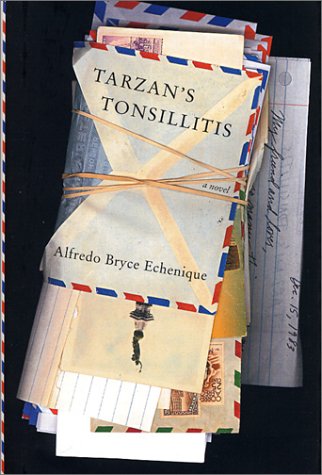
Image result for Alfredo Bryce Echenique, Tarzan's Tonsillitis:


Alfredo Bryce Echenique, Tarzan's Tonsillitis: A Novel, Trans. by Alfred MacAdam, Pantheon, 2001.               

From the internationally acclaimed Peruvian writer—winner of the Cervantes Prize, the most prestigious literary award in the Spanish-speaking world—a tragicomic story of improbable, inevitable love.
At the center: a couple in love, in exile together and apart. He is Juan Manuel Carpio, a second-generation Peruvian of Native American origins, a middle-class singer-composer. She is Fernanda María de la Trinidad del Monte Montes, a polyglot and cultured Salvadoran. Through the mostly epistolary narrative set in 1960s Paris, revolutionary El Salvador, Chile, 1980s California, and London, we follow the thirty-year arc of their relationship.
At once cheerful, hopeful, and informed by a serene lack of sentimentality, the narrative—rich with the delights of paradox and hyperbole—sees the couple through disastrous and traumatic marriages to other people; the ups and downs of their respective careers; the inexorable effects of politics on their personal lives; their shifting passions and gradual realization that the truest bond between lovers is a tender, abiding, and respectful friendship.


IN 1970, the Peruvian novelist Alfredo Bryce Echenique published a fictionalized portrait of his Lima childhood. Richly detailed and full of subtle scorn for his country's ruling class, ''A World for Julius'' is an exile's novel. It could only have been written in a seat of alienation like Paris, where the author lived and taught in the 1960's and 70's.
''Tarzan's Tonsillitis,'' Bryce Echenique's 14th published work, is something rather different -- an expatriate's novel, a rueful retrospective tribute to the heroic survivors of decades of rebellions and coups and dirty wars. The encomium takes the graceful form of a love story between a hyperarticulate Peruvian singer and composer, leading a charmed life in Europe, and the beautiful Salvadoran woman he worships from afar.
The star-crossed lovers meet in Paris in 1967, when Latin liberation movements and Latin ''boom'' novelists are all the rage. Fernanda María de la Trinidad del Monte Montes, a beautiful red-haired, green-eyed daughter of the oligarchy, arrives in town to occupy a sinecure at Unesco. She has an Alfa Romeo and great connections. Her exclusive Swiss finishing school has even taught her the correct posture to assume while hailing a taxi. Juan Manuel Carpio, the grandson of Quechua-speaking Indians, is at the beginning of his career, performing in the Métro with a Che Guevara poster as a backdrop to increase his tips. This unlikely couple fall in love, quarrel and separate, knowing right away that they have missed their great opportunity.
She goes off to Chile to study architecture and marries a photographer, who is forced to flee after being mistaken for a leftist by the Pinochet regime. They wander from Paris to Caracas to San Salvador, where it's Fernanda's turn to flee, this time after being mistaken for a right-wing sympathizer. In California, she toils bravely to support her abusive alcoholic husband and two children. The novel's only vivid character, she evolves from a Latina Holly Golightly into a woman of courage and stature. She's also the Tarzan of the cutesy title, her lover's pet name for her.
The tone throughout is resolutely cheerful and end-of-millennium mellow. Lines from so many famous tangos and boleros and ranchero ballads lace the text that it could be sold with an accompanying CD. To capture an era through its hit songs is a fine comic approach that has worked for other Latin novelists, but once he leaves the Paris of his youth, Bryce Echenique's writing turns disappointingly generic.
In fact, the trouble starts on Page 5, where Fernanda reports that she has been mugged in Oakland, Calif. In the original Spanish, she describes her attackers as ''terrifying gorillas (in size and color, I mean)'' and ''three huge, horrible black guys.'' These and other racial remarks are presumably meant as amusing signs of Fernanda's irrepressible Tarzan-of-the-jungle fighting spirit. Alfred MacAdam has the good grace to omit such slurs from his translation, but some of the novel's stereotypical assumptions are impossible to lose. If Oakland equals black street crime, Berkeley equals white male stolidity. Bryce Echenique's gringos are ''laconic'' when they're not ''monosyllabic.'' There's a pattern here: other men may compete for Fernanda's affections, but with Juan Manuel around no other male is allowed to get a word in edgewise.
Or is the author merely spoofing his own relentless volubility? The advantage of a long-distance love affair, after all, is that it's mostly verbal and imaginary -- like the work of writing a novel. -
"Something extremely valuable and beautiful always existed between us," says Juan Manuel Carpio, a 60-ish poet-songwriter. "Fernanda Maria and I were always first-class passengers each time one of us made a stopover in the reality of the other."
Fernanda is the red-haired, green-eyed beauty Fernanda Maria de la Trinidad del Monte Montes, one of the angelic, Swiss boarding school-educated belles of an elite Salvadoran family. She is the partner of Juan's life, if not always his bed. He calls her a female version of Tarzan; brave, fearless, restlessly globe-trotting, her jungle yell sometimes loud, sometimes muted by circumstances.
Juan and Fernanda started as conventional lovers, but an older and wiser Juan, who narrates "Tarzan's Tonsillitis," admits that "when everything is said and done we were better by letter." They met in 1967 at a Parisian Christmas party for a glittery set of Latin American exiles; drawn by each other's sensitivity, they set up house together. But his self-consciousness and Fernanda's social status clashed; affection strained. Juan seemed obsessed with Luisa, the wife who left him, even though it was some idea of love that obsessed him, not the real woman (she's an ungrateful shrew). He and Fernanda drifted apart.
As the novel opens, the aging musician receives a letter from Fernanda, who's in Oakland, where her purse was stolen--the purse in which she carried all of his correspondence as if it were too precious to leave at home. That loss spurs Juan to recall the rich, bittersweet years that he's known her, spanning several countries from the 1960s to the '90s. He and Fernanda missed many chances to reunite as a couple, and yet, rather than ditch the whole thing, a special love grew that withstood everything. Their love is star-crossed, minus the tragedy that sent Romeo and Juliet to the cemetery.
"The blame for all this, as usual, rests with our 'Estimated Time of Arrival,'" Fernanda writes in one letter, using a travel metaphor to explain their fate, "which you and I obey with such discipline, and which always makes us arrive at different times, if not different places."
That's a nice poetic expression, but if two people are so deeply connected, why can't they get the timing right? One of Peru's best novelists ("A World for Julius") and short story writers, Echenique answers that question with more questions: Why must it work out? In the end, does love always lead to a platinum wedding band and a reservation for the honeymoon suite?
After that Parisian breakup, a couple of years passed and they met again. This time Fernanda was married and had a child; she was struggling to find work and her husband Enrique, an abusive drunk, was no help. Yet friendship arose among the three of them and Juan and Fernanda began to exchange letters, full of yearning and ideals, thus renewing a relationship that always worked best at a distance, when oceans separated them.
Why do this? Why would two educated people, whose conversations range from Hemingway to D.H. Lawrence to Dante, willingly agree to be divided lovers, continuously apart? Echenique subtly shows how their relationship evolved into a special form of consolation as each faced disappointments and sorrows.
Juan wandered far and wide, lonely, playing gigs while Fernanda returned to her violent Salvadoran homeland to find work. His letters comforted her and kept her sane in the madness of military executions and upheavals ("I love you and depend on you" she told him), and she consoled him, late in the novel, when his inability to love a psychologically fragile young woman had a tragic result. The reality of love really seems strange, less knowable after reading Echenique's novel. For some people, love is based on specific commitments; for Fernanda, it's something much simpler.
"At every turn in the road, and now in this damn mezzo of the road in the sometimes extremely dark forest," she wrote Juan, "the quality of your friendship has been a light."
Echenique skillfully captures the emotional changes as they travel that road. Because he's a Latin American, Echenique might get labeled with the overused term "magical realism" and, on the surface, that instinct initially seems right. Echenique's writing is magical. Only it's not the sort of magic that Gabriel Garcia Marquez and company are known for--beggars with angel wings, women who float into the clouds and disappear, circular narratives or paranoid dictators.
Echenique's magic is his graceful, stylistic way of touching his wand to a platitude about love and turning it to gold. When Juan and Fernanda meet again at the story's end, happy though not reunited like lovers in a typical happy ending story, Echenique convinces us of the cliche that true love, in some form, conquers after all, even if it doesn't result in a ride off into the sunset together. - NICK OWCHAR   http://articles.latimes.com/2001/dec/27/news/lv-books27

Lawrence Sutin - Spanning over two centuries, this inventive novel follows fictional writer Hector de Saint-Aureole and his novel, and includes imaginary responses from his imaginary readers. It is an intrepid, whimsical read that delights with its sense of play and twisting narrative


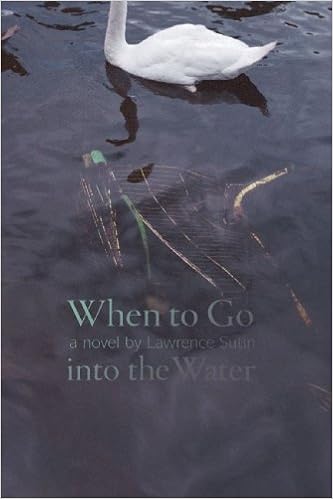
Image result for Lawrence Sutin, When to Go into the Water,
Lawrence Sutin, When to Go into the Water, Sarabande Books, 2009.


This short novel, interlaced with vintage postcard images, details in small chapters the life of Hector de Saint-Aureole, the author of a book of reflections entitled When to Go Into the Water. The novel contains a book within a book and multiple lives, including those of readers, within the protagonist’s life story.


In discrete, delightfully composed vignettes, Sutin, a biographer of Aleister Crowley and Philip K. Dick, tells the rags-to-riches story of a French peasant farmer. Born in 1900 on a farm in eastern France, Hector de Saint-Aureole, the humble protagonist of this clever pseudobiography, gravitates first to Paris, where he works as a renderer in an abattoir, then to London, where he becomes a barman in Bloomsbury. Luck strikes the young man in the form of a friendship with a Scotsman who dies and leaves Hector his considerable estate: “a fortune to assure a lifetime of ease and choice.” Hector sets out to explore the world, determined to leave a record of his passage, which takes the shape of his life's opus, When to Go into the Water . Sutin alternates this factual-sounding narrative of Hector's journeys with more contemporary dispatches about readers who have over the decades come upon Hector's work, e.g., “a fading male movie star of the 1990s.” It's fascinating to watch Sutin turn his biographer's wiles toward fiction, and the result is charmingly original and intelligent. - Publishers Weekly


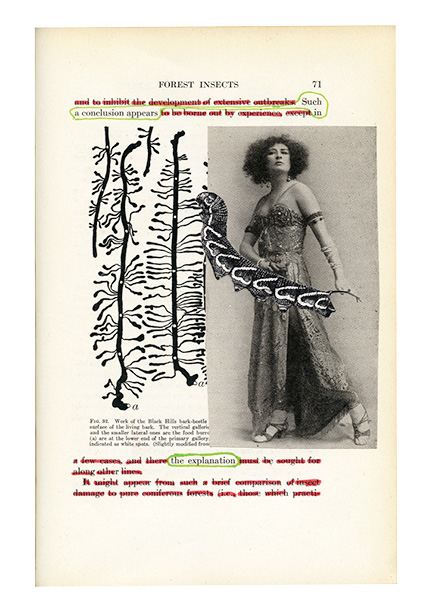
Image result for The Seeming Unreality of Entomology


Lawrence Sutin, The Seeming Unreality of Entomology, See Double Press, 2016. 


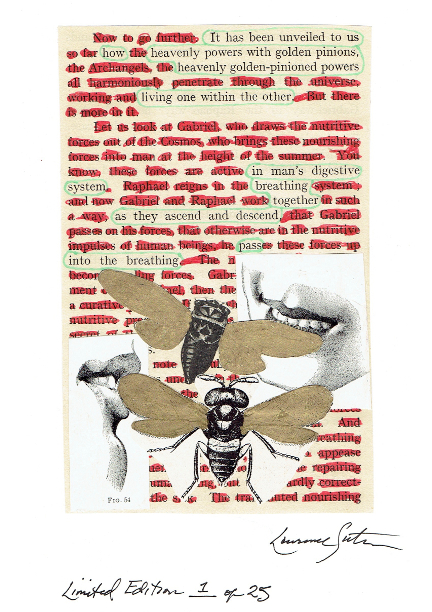
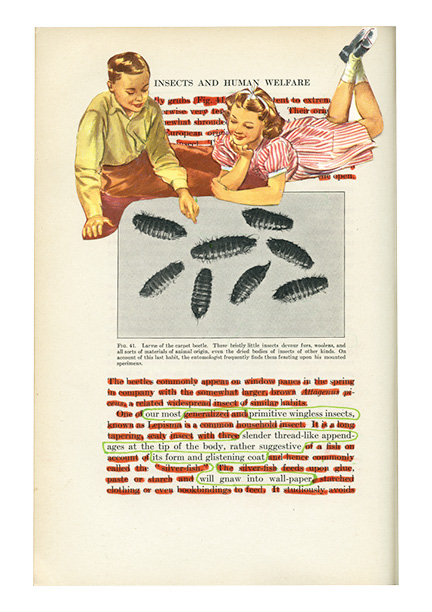
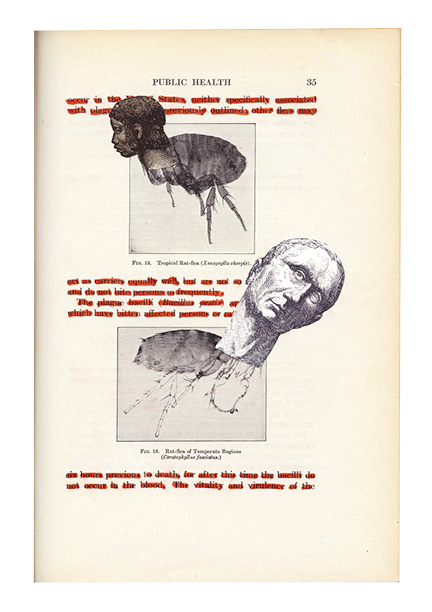
The Seeming Unreality of Entomology is a never-before published erasure book by Lawrence Sutin. It is a dream of spacious interspecies unity that also warns against the dire threat of knowing too much and finding it too little. Some of the pictures are funny.


Of Sutin’s work in the erasure genre, a Nepalese Sherpa has written: “When commencing a climb of a challenging peak, the last thing one wants to take along is a largish book with such engrossing content that it causes one to lose one’s way. If I were to pack such a book, I would pack Lawrence Sutin’s The Seeming Unreality of Etymology."
Image result for The Seeming Unreality of Entomology


All Is Change: The Two-Thousand Year Journey of Buddhism to the West


A historical narrative that traces the exchanges between Buddhism and the West from the time of Alexander the Great to the current-day creation of a Western Buddhism, including the impacts of Western colonialism and orientalism.


A Postcard Memoir


This memoir is written in lyric and subjective short sections accompanied by images from postcards drawn from the author’s collection. The interplay of text and images (from other settings, other lives) and the exploration of inner experiences makes this a distinctive, experimental, yet accessible reading experience.


Do What Thou Wilt: A Life of Aleister Crowley


A full-scale biography of the leading Western occultist of the twentieth century, a man whose legendary status as “The Great Beast” has overshadowed both his genuine achievements and his genuine failures. Crowley was a brilliant modernist theoretician of Western esoteric thought.


Jack and Rochelle: A Holocaust Story of Love and Resistance


This book, assembled from interviews with my parents Jack and Rochelle Sutin, provides a vivid account both of Jewish partisan life during World War Two and of a love that blossomed during the Holocaust and continued through sixty-eight years of marriage.


The Shifting Realities of Philip K. Dick: Selected Literary and Philosophical Writings


An assemblage of Philip K. Dick’s most significant essays with Exegesis material included as well.


In Pursuit of Valis: Selections from the Exegesis


The first selection from the late philosophical and personal notebooks of Philip K. Dick


Divine Invasions: A Life of Philip K. Dick


The first major biography of Philip K. Dick, who in the years since this biography appeared has gone on to become a recognized master of twentieth-century American literature.

Why Do We Need to Think We Agree on Reality? — Lawrence Sutin

12/28/17

Matthew Remski - Half cartoon and half ritual, Silver asks: Does photography murder us? Is reality itself pornographic? Was Christ's tomb the first pinhole camera? Why do we feel dead?

Image result for Matthew Remski, Silver,
Matthew Remski, Silver, Insomniac Press, 1998.
matthewremski.com/wordpress/books/fiction/


Matthew Remski's second novel, Silver, is an absurdist eulogy for the 20th century with a cast of thousands, including Leni Riefenstahl, Dorothy Stratten, J.P. Morgan, the Silver Surfer, and Bob Barker, with cameos by a born-again-dead-again Jesus Christ.
Half cartoon and half ritual, Silver asks: Does photography murder us? Is reality itself pornographic? Was Christ's tomb the first pinhole camera? Why do we feel dead?
In a maze of visualizations that will enrage and enlighten, Remski tells the terrifying story of power. Power: transferred from fascism to corporate America on the backs of pin-up queens, rape victims, and misunderstood saviours.


Like David Foster Wallace, Matthew Remski seems to be struggling with the aesthetic legacy of the high postmodernists: How is the young contemporary writer to make the lessons of the masters his own and then move beyond them? Silver, Remskiâ’s response to this dilemma, is nothing less than a parody of Gravity’s Rainbow, but it’s also something more: he has the style down and also the weird imagination and encyclopedic knowledge; but where rocket-obsessed GR is, some would claim, phallocentric, Silver explores the insidious fallout of phallocentrism.

The plot, which the following can only suggest, begins with investigative reporter Tyrone Pynchon scuffling through prewar Germany, uncovering the dangers behind the ascendant Nazis and pursuing a fascination with the Shroud of Turin. The novel then turns its attention to postwar America, where the Nazis, though defeated, have managed to perpetuate their fascist worldview. The desire to objectify others, most evident in Germany in the Holocaust, is manifested in North America in a male chauvinism that has been internalized by men and women. The Barbie doll, with its impossible image of female beauty and its dangerous lessons about commodification, was created, it turns out, by Klaus Barbie. Playgoy magazine is the brainchild of Nazi Hans Hugo Heffner. The climax of the novel is the inevitable coming together of events that result in the murder of Playmate Dorothy Stratten. (There’s also a wonderful digression about Jesus Christ’s post-Resurrection roamings, searching for meaning. Did you know He was the first Ronald McDonald?)

Silver is a work of incredible imagination, combining the comic and tragic in purposes aesthetic and ideological. Starting as an in-joke, it becomes an intelligent and challenging novel in its own right.
- Robert L. McLaughlin


Rick Moody wrote in his review of Mason & Dixon that writers of his generation have exactly one author with whom they must come to terms: Thomas Pynchon. This is hyperbole, to be sure, but it’s no exaggeration to say that many of our best writers work in the shadow of Gravity’s Rainbow in the way that folks like William Faulkner and William Gaddis worked in the shadow of Ulysses. William T. Vollmann and David Foster Wallace come instantly to mind, as do Carol De Chellis Hill and Richard Powers. Each of these writers is powerful enough and original enough to stand without GR as a crutch, but the influence is undeniable, and not talking about it would be like playing a game of literary Taboo. So then what’s a young, hyper-smart literary wunderkind to do but tackle the Rainbow head on?
This is exactly what Matthew Remski does in his new novel, Silver. Not just a Pynchon-esque novel, Silver is a long improvisation/meditation on Gravity’s Rainbow and its author, written almost exactly in Pynchon’s style. Hardly coy about his approach, Remski names his main character Tyrone Pynchon, fusing GR’s protagonist Tyrone Slothrop with Pynchon himself, and sets him down in pre-War Germany as an erudite, paranoid, and dissolute correspondent for the News of the World. Pynchon gets his NOW assignments through elaborately cabalistic means, sent by editors he’s never met, and the novel begins with him finding instructions tattooed in a Lewis Carroll-like spiral around a chance lover’s asshole: “Go to Berlin. Check out Mengele and the violinist, plus the Riefenstahl virus. Also look into the bunny trade….”
Resigned, Pynchon heads for the Reichstag, where his journalist’s credentials allow him to observe all manner of Nazi perversity. The violinist in question is a young Jew named Ghimel whose hands have been amputated and switched, his ability to re-learn the violin proving Mengele’s theory of the “ambidextrous and therefore unnatural, lawless, and uncentred nature of the Semite.” Ghimel serves as entertainer/lackey for the Nazi revelers, and his wrist wounds set up a powerful crucifixion motif that Remski explores throughout the rest of the novel.
Present in various capacities are Leni Riefenstahl, Josef Mengele, Klaus Barbie, and Hitler, as well as Hans Hugo Heffner, rabbit breeder, and Andrei Lupus Weber, Party composer. Mixing these historical and quasi-historical figures together, Remski addresses another of the book’s central motifs: the pornography of image, as illustrated by everything from film and propaganda to children’s toys (i.e. “Barbie” dolls). If there’s a central image to Silver, the way the Rocket is the central image to GR, it’s the Shroud of Turin—or more accurately a specific negative photograph of the Shroud, which Remski portrays as the ultimate pornography. The silver of the novel’s title refers to the silver used in photography, and the “Riefenstahl virus” is a cloud of silver that surrounds our Nazi pornographers, infecting everyone with whom they come in contact.
What’s interesting about the novel’s structure is that it surrounds Gravity’s Rainbow like Riefenstahl’s cloud of silver. The first forty-five pages all take place before GR, and, excluding a two-page “WWII Segue,” everything else takes place in GR’s aftermath. And true to Pynchon’s vision, Remski charts the Nazi diaspora all over the world. Weber and Eva Perón hit it off when the Nazis go to Argentina, the composer becoming her chief propagandist, and when burger-meister Ray Krok enters the picture, sights begin to be set on the ultimate destination: the States.
Around this point, the novel begins to break apart considerably, following the Rainbow’s trajectory downward into fragmentation. Tyrone Pynchon heads for America, aboard the U.S.S. Television, but he gets sidetracked by Their meddling, and as we see him fall more and more under Their control, he begins to disappear from the novel, à la Tyrone Slothrop. Taking several leaps in time, Silver follows the disparate storylines as they diverge and recross in masterfully orchestrated lurches toward modern-day America. We see Ghimel’s child born and then emigrate to the States. We meet wholly new characters—most notably doomed “Playgoy” bunny Dorothy Stratten—and wait for them to intersect with the rest of the crew. And, most importantly, we watch the Nazi aesthetic infiltrate and infect America.
As in Gravity’s Rainbow, however, there are counterforces at work, if only fatalistic ones—namely the authors Pynchon and Remski themselves. Not nearly as self-indulgent as it sounds, Remski turns the novel into a profound examination of authorship and identity, and even when it gets a little wanky, Remski has volumes to tell us about the nature of reading and writing.
So the question is, with all this rampant Pynchania, is it possible that Silver is a great book? None of the setting or subject matter is Remski’s own, nor are the prose style or pacing. Some of his themes and motifs vary from Gravity’s Rainbow, although not by much. For all of its lack of originality, though, I’d have to say that Silver may be one of the most wildly brilliant—and weirdly original—novels in recent memory. Like the premise of Borges’ story “Pierre Menard, Author of the Quixote,” Silver is an astonishing experiment in mimesis. The prose style is so outrageously Pynchonlike that a few times I thought it was Pynchon and that Matthew Remski was just one of his characters. And when Remski really gets going, he can pull off feats so outlandish that they rival some of Pynchon’s best bits.
Overall, however, Remski is no Pynchon. Nobody is. As brilliant as Remski may be, his vision is much smaller, and his scope far narrower. For all its plenitude, Silver often finds Remski doing the things we expect and understand Pynchon to do—and usually stopping before things get too dense and the counter-counter-counter-plots get too confusing. Nevertheless, Remski is an out-and-out genius. And even though it contents itself with remaining under the Rainbow, Silver just might be a great book. David Wiley  http://www.raintaxi.com/  Summer 1999


Dying for Veronica: A Sub-Catholic Dream with Mind-Music
Matthew Remski, Dying for Veronica: A Sub-Catholic Dream With Mind-Music: A Novel, Insomniac Press, 1997.                   


Matthew Remski's first novel, set in 1970s Toronto, is an incestuous love story of bizarre proportions. The narrator recalls an unhappy and twisted childhood spent with his sister Veronica, whom he is in love with - which leads to an even more unhappy adulthood. Shot through with black humour and biting satire, Dying for Veronica is rich with dark secrets. It draws deeply on the often mysterious imagery of Catholic mythology and its collision with - and submersion by - modern North American culture.


A young man is coming of age at the intersection of a broken Catholicism and a rupturing postmodernity. His sister initiates him into transgression, shadow-play, and the sublime. Then she vanishes. He writes a long love-letter to her and his own silence, shredding both liturgy and language in passionate confession of whatever comes after faith. A second edition of Matthew Remski's ground-breaking first novel.


“Remski writes a rich work, whose blasphemous intensities evoke the broken genius of Rimbaud or Baudelaire.” -- Christian Bök


Early in Dying for Veronica, Matthew Remski’s more-gothic-than-Catholic, guilt-ridden first novel, the author writes: “The room filled with the light you see when the purple curtains of your confessional cleave open like the dress of a whore mounting the steps of a gallows.” It’s an unwieldy image, but for all the force and apparent seriousness, it is an apt description of the sublime sensibility on which this novel depends.
And so, Remski has issued a challenge: a novel that pursues a story through a series of portentous, ludicrous pronouncements. For the most part, Dying for Veronica does away with the restraints of plot, offering in its place a man remembering his unholy love for his sister. The setting is a Catholic church and the story (such as it is) unfolds as a kind of passion play that both condemns the narrator to his nostalgic, repugnant lust and redeems him from it.
What actually happens to Veronica, an elusive saint/whore/virgin archetype is difficult to tell. Molested by her father (Our Father, in the novel), a drunken lout who received free room and a small salary as caretaker of the church, she learns to give her body like a sacrament, even to her brother. Eventually, she finds redemption in a convent, becoming the Sister her now-adult brother – the organist at the cathedral, plunking the keys and mooning for his irreverent childhood – can never have.
The question at the heart of Dying for Veronica, though, isn’t so much, “What happens to Veronica?” as, “What happens to personal history?” In searching for truth in the past, Remski seeks the gloriously religious. Dying for Veronica is more ritual than substance, and while the prose is at times overwrought, Remski still manages to convey what it once must have been like to believe. - Hal Niedzviecki   https://quillandquire.com/review/dying-for-veronica/